Through-Running and American Rail Activism
A bunch of us at the Effective Transit Alliance (mostly not me) are working on a long document about commuter rail through-running. I’m excited about it; the quality of the technical detail (again, mostly not by me) is far better than when I drew some lines on Google Maps in 2009-10. But it gets me thinking – how come through-running is the ask among American technical advocates for good passenger rail? How does it compare with other features of commuter rail modernization?
Note on terminology
In American activist spaces, good commuter rail is universally referred to as regional rail and the term commuter rail denotes peak-focused operations for suburban white flighters who work in city center and only take the train at rush hour. If that’s what you’re used to, mentally search-and-replace everything I say below appropriately. I have grown to avoid this terminology in the last few years, because in France and Germany, there is usually a distinction between commuter rail and longer-range regional rail, and the high standards that advocates demand are those of the former, not the latter. Thus, for me, a mainline rail serving a metropolitan area based on best practices is called commuter and not regional rail; there’s no term for the traditional American system, since there’s no circumstance in which it is appropriate.
The features of good commuter rail
The highest-productivity commuter rail systems I’m aware of – the Kanto area rail network, the Paris RER, S-Bahns in the major German-speaking cities, and so on – share certain features, which can be generalized as best practices. When other systems that lack these features adopt them, they generally see a sharp increase in ridership.
All of the features below fall under the rubric of planning commuter rail as a longer-range subway, rather than as something else, like a rural branch line or a peak-only American operation. The main alternative for providing suburban rapid transit service is the suburban metro, typical of Chinese cities, but the suburban metro and commuter rail models can coexist, as in Stockholm, and in either case, the point is to treat the suburbs as a lower-density, longer-distance part of the metropolitan area, rather than as something qualitatively different from the city. To effect this type of planning, all or nearly all of the following features are required, with the names typically given by advocates:
- Electrification/EMUs: the line must run modern equipment, comprising electric multiple units (self-propelled, with no separate locomotive) for their superior performance and reliability
- Level boarding/standing space: interior train design must facilitate fast boarding and alighting, including many wide doors with step-free boarding (which also provides wheelchair accessibility) and ample standing space within the car rather than just seated space, for example as in Berlin’s new Class 484
- Frequency: the headway between trains set at a small fraction of the typical trip time – neighborhoods 10 km from city center warrant a train every 5-10 minutes, suburbs 20-30 km out a train every 10-20 minutes, suburbs farther out still warrant a train every 20-30 minutes
- Schedule integration: train timetables must be planned in coordination with connecting suburban buses (or streetcars if available) to minimize connection time – the buses should be timed to arrive at each major suburban station just before the train departs, and depart just after it arrives
- Pedestrian-friendliness: train stations designed around connections with buses, streetcars if present, bikes, and pedestrian activity – park-and-rides are acceptable but should be used sparingly, and at stations in the suburbs, the nearby pedestrian experience must come first, in order to make the station area attractive to non-drivers
- Fare integration/Verkehrsverbund: the system may charge higher fares for longer trips, but the transfers to urban and suburban mass transit must be free even if different companies or agencies run the commuter trains and the city’s internal bus and rail system
- Infill: stations should be spaced regularly every 1-3 km within the built-up area, including not just the suburbs but also the city; slightly longer stop spacing may be acceptable if the line acts as an express bypass of a nearby subway line, but not the long stretches of express running American commuter trains do in their central cities
- Through-running: most trains that enter city center go through it, making multiple central stops, and then emerge on the other side to serve suburbs in that direction
Is through-running special?
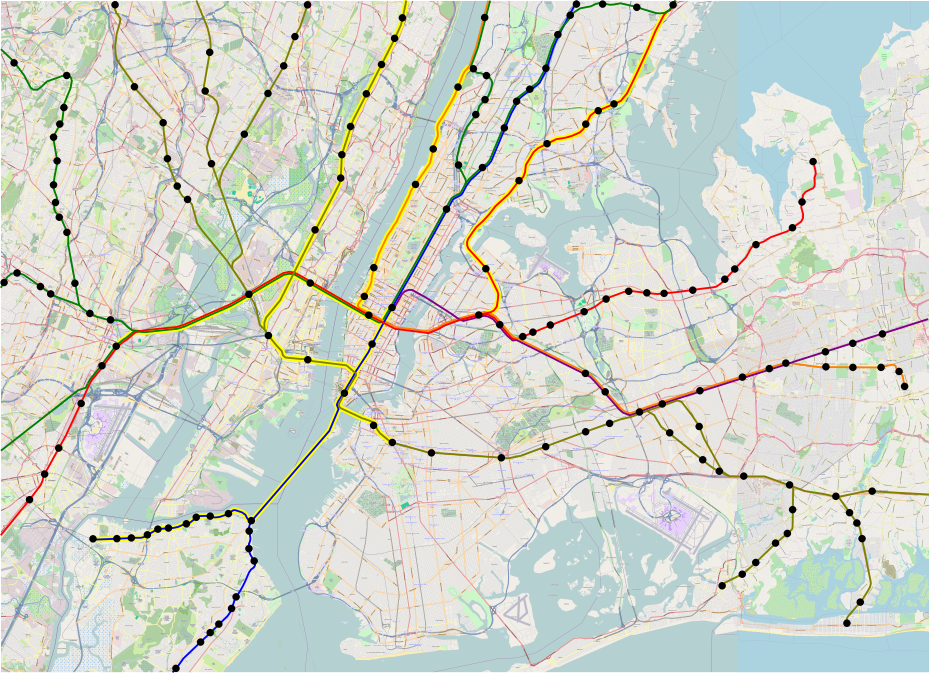
Among the above features, through-running has a tendency to capture the imagination, because it lends itself to maps of how the lines fit together in the region; I’ve done more than my share of this, in the 2009 post linked in the intro, in 2014, in 2017, and in 2019. This is a useful feature, and in nearly every city with mainline rail, it’s essential to long-term modernization; the exceptions are cities where the geography puts the entirety of suburbia in one direction of city center, and even there, Sydney has through-running (all lines go west of city center) and Helsinki is building a tunnel for it (all lines go north).
The one special thing about through-running is that usually it is the most expensive item to implement, because it requires building new tunnels. In Philadelphia, this was the Center City Commuter Connection, opened in 1984. In Boston, it’s the much-advocated for North-South Rail Link. In Paris, Munich, Tokyo, Berlin, Copenhagen, London, Milan, Madrid, Sydney, Zurich, and other cities that I’m forgetting, this involved building expensive city center tunnels, usually more than one, to turn disparate lines into parts of a coherent metropolitan system. New York is fairly unique in already having the infrastructure for some through-running, and even there, several new tunnels are necessary for systemwide integration.
But there are so many other things that need to be done. In much of the United States, transit advocacy has recently focused on the issue of frequency, brought into the mainstream of advocacy by Jarrett Walker. Doing one without the other leads to awkward situations: after opening the tunnel, Philadelphia branded the lines R1 through R8 modeled on German S-Bahns while still running them hourly off-peak, even within the city, and charging premium fares even right next to overcrowded city buses.
This is something advocates generally understand. There’s a reason the TransitMatters Regional Rail program for commuter rail modernization puts the North-South Rail Link on the back burner and instead focuses on all the other elements. But there’s still something about through-running that lends itself to far more open argumentation than talking about off-peak frequency. Evidently, the Regional Plan Association and other organizations keep posting through-running maps rather than frequency maps or sample timetables.
Through-running as revolution
I suspect one reason for the special place of through-running, besides the attractiveness of drawing lines on a map, is that it most blatantly communicates that this is no longer the old failed system. There are good ways of running commuter rail, and bad ways, and all present-day American commuter rail practices are bad ways.
It’s possible to make asks about modernization that don’t touch through-running, such as integrating the fares; in Germany, the Verkehrsverbund concept goes back to the 1960s and is contemporary with the postwar S-Bahn tunnels, but Berlin and Hamburg had had through-running for decades before. But because these asks look small, it’s easy to compromise them down to nothing. This has happened in Boston, where there’s no fare integration on the horizon, but a handful of commuter rail stations have their fares reduced to be the same as on the subway, still with no free transfers.
Through-running is hard to compromise this way. As soon as the lines exist, they’re out there, requiring open coordination between different railroads, each of which thinks the other is incompetent and is correct. It’s hard to sell it as nothing, and thus it has to be done as a true leap generations forward, catching up with where the best places have been for 50+ years.
 Pedestrian Observations


Philadelphia.
Indeed. EMUs and through running are not necessarily going to solve insanely low crew productivity (3 crew members per train), terrible dispatching (sitting at Suburban Station randomly for 10 minutes), and low train speeds (approaching Suburban Station from 30th street at a crawl). SEPTA can barely run a whopping 12 trains per hour on a four-track mainline.
There needs to be a real impetus for reform rather than a dumpster full of money. If the MBTA gets their tunnel what’s to force them to improve operations?
The CCCT was politically framed as a last-ditch economic effort to keep suburban commuters and employers coming into the city, by solving the last-mile issue of getting from Reading Terminal to Market West. All other operational and infrastructural considerations (mainly from Vukan Vuchic) were treated as academic exercises to be had in a more well-funded future. And on funding, the CCCT was one of the last projects to enjoy generous Great Society-era UMTA federal subsidy before the Reagan cuts. Anyway, Boston has little to worry about because through-running tunnels at any level requires electrification at minimum for all lines using it, and that is the improvement that will likely trigger broad reform on all levels.
“Anyway, Boston has little to worry about because through-running tunnels at any level requires electrification at minimum for all lines using it, and that is the improvement that will likely trigger broad reform on all levels.”
What if they kept everything exactly the same, electrified only the tunnels, and slapped a bi-mode locomotive with a 33-ton axle load in front of the existing rolling stock? Because to many railroad managers, that sounds like a _brilliant_ plan.
Never mind this, some of the older NSRL activism proposes that as an alternative to electrification (which, to be clear, would cost something like one quarter what the tunnels would).
To actually use the wires you have to buy a whole new fleet. Hooking old cars to new locomotives costs a lot less. Or alternative view, to use the new fleet everything has to be wired up. When great big thundering herds of people who want to cross Boston to go to Walgreens instead of CVS a few blocks away they can wire up the busiest branch, buy EMUs for it and move stuff to the next busiest line.
If you don’t want to wire everything at least buy something good – https://en.m.wikipedia.org/wiki/British_Rail_Class_800
You want something different for suburban service, where the train is stopping frequently.
Ok so something like https://en.m.wikipedia.org/wiki/British_Rail_Class_755
Caltrain.
The stated and unassailable intention of US Commuter Railroading Professionals is to run 1950s style service, forever, just the way they like it, with the same over-staffing and the same egregious operations and maintenance efficiencies, but with the added bonus of (sub-par, because USA USA USA!) catenary maintenance costs and inevitable catenary failures.
It’s always going to be just fucking worse-than-steam-era “service” but with wires on top — it’s what they like, and it’s what you’re going to get, no matter how much money you throw at the rent-seeking subhumans .
As bad as Caltrain is, it was much, much worse in the steam era, when they generally ran about half as many trains per day (https://docs.google.com/spreadsheets/d/1TTBQRrPkAU1I7J93pN7j6SBbe2663_kmnr3bjnTSNoY/view#gid=970690919) and many of those were peak-hour section expresses while multi-hour gaps remained at midday. While improvements have been very slow by European standards, the changes have generally been in the right direction; today Caltrain runs a local and a limited every hour all day, each *almost* on an hourly takt. I’m therefore optimistic that we’ll continue to see slow but positive incremental improvements even after electrification.
Dude, I’ve lived with Caltrain “service” for nearly 30 years.
THERE HAVE BEEN NO IMPROVEMENTS IN THE LAST NINETEEN YEARS. None!
None! In fact, service (headways, span of service) has only gotten worse.
You can believe whatever bullshit you want about “slow but positive incremental”, but it hasn’t happened, it isn’t going to happen, and the assholes in charge are completely clear and explicit that they’re not going to do improve anything.
But sure, keep throwing them tens of billions to “maintain” their “fixer upper railroad”.
$350+ million for one single two-track (never ever four-track, never) overpass of one single road? Hell yeah, that’s going to improve everything.
“*almost* on an hourly takt” — almost! … amost! give them another two decades! they’re trying as hard as they can, really! — for maybe six hours a day, on weekdays only, with shit schedule adherence and nosebleed expensive fares, is a fucking hell of deal for the billions pf public dollars these assholes have snorted up their noses over the last three decades.
Look, they’re promising hour headways post electrification.
They’re promising higher operating costs post electrification.
They’re promising that they need higher and higher subsidies to operate even their fictional hourly headways long-term aspirational far-future stretch goal post-2040-maybe service.
What part of “slow but positive incremental improvements” are you hallucinating?
These people need to be put out of our misery.
> THERE HAVE BEEN NO IMPROVEMENTS IN THE LAST NINETEEN YEARS. None! In fact, service (headways, span of service) has only gotten worse.
This is verifiably false.
Here’s the timetable from June 2004: https://web.archive.org/web/20040606152545/http://transit.511.org/schedules/detail.asp?cid=CT&rte=5083&dir=S&day=1
And here’s today: https://www.caltrain.com/?active_tab=route_explorer_tab
The 2004 timetable lists 43 southbound trains per weekday; today’s timetable lists 52. Both have locals and limiteds each on hourly headways during midday periods. In the evening period, the 2004 timetable has just one train per hour from SF at 19:07, 20:07, 21:07, 22:07 and then a two hour gap until the last train at 00:07; today there are a total of ten southbound trains leaving after 19:00 with departures every 30 minutes until 22:46 (and then a 79-minute gap to the last train at 00:05). Span of service in 2004 was 04:46 until 00:07 which you’re right has decreased (by seven minutes) to 04:51-00:05 today, but northbound from San Jose the span then was 04:35-22:25 which is significantly worse (by 54 minutes) than today’s 04:28-23:12. Weekend service was all-local on hourly headways same as today, but in 2004 the last southbound train on Sundays was at 21:00 while today there are weekend departures at 21:58, 22:58 and 00:05; last northbound from San Jose was at 22:30 Saturdays and 21:00 Sundays vs 23:12 today. (It’s true that weekend service started earlier in 2004 but the overall span was still shorter.)
Current service levels are of course pathetic when Caltrain is an urban railway that should be running level-boarding electric trains every 10 minutes all day or better. But the claim that service has gotten worse is simply not true, and accordingly there is little reason to think it is likely to get worse rather than at least slightly better in the future.
Also worth mentioning is that there were fewer express trains in 2004, meaning that train was never faster, even against the worst traffic. Baby Bullets changed that by making trains competitive with driving in cases where your origin and destination locations were close to a station.
While many disagree, I’m much in favor of providing faster times by skipping stations because you can capture riders from a greater distance from stations. If a train is 5 minutes faster, then you can be further away from a station and still have a reasonable commute, rather than trains serving more stations by reducing wait time for a train at more stations.
I feel through-running is also special because it changes the hierarchy. Old style radial lines connect SomePlaceBig to MiddleOfNowhere. Through-running connects SomeOutskirt to SomeOtherOutskirt via SpecificStationInTheCity…
+1
It allows transit to provide freedom of mobility throughout the city, not just to the city centre.
For example, in Montreal, I argue that the St.-Jerome and Candiac lines should be through run and avoid downtown. Through running, with an extension to St-Jean-sur-Richelieu, would provide a completely new way of getting through the most congested axes in the region with decent connectivity to other lines, albeit while missing the densest neighbourhoods (that it doesn’t serve particularily well to begin with).
It really depends on how good the transfers are. For example, there’s MCD 5, a planned commuter railway in Moscow that will connect the northeastern and the southern radial line. Except digging under central Moscow is expensive and slow and is mostly a case of Crossrail envy. Boosting the two radial lines to 10-12tph in each direction and implementing fare integration will bring 80% of the benefits for 20% of the cost, especially since both termini have transfers to the circle line of the metro.
“there’s no term for the traditional American system, since there’s no circumstance in which it is appropriate.”
1) Moat rwy? (Thematically matches “my home is my castle”, and the purpose of the service pattern is to keep city yoof out of the suburbs.) If the last trains leave early, it even has a chastity belt function for the commuters as well.
2) Diode rail? (Low resistance to commute traffic in one direction, high resistance in the other.)
Re terminology: your point about the ambiguity of the term “regional rail” is well-taken, but I still think “commuter rail” is also a bad term for something better than the existing bad paradigm. The S-bahn/RER model is superior precisely because it is not entirely 9-to-5 commuter-centric. I understand that importing a foreign-language name like S-bahn is not likely to succeed in the aggressive not-invented-here culture of US planning, but maybe “suburban rail” is the term US advocates should use as an umbrella for the S-bahn and suburban metro models, which as you said should both feel to the rider like a longer-distance, higher-average-speed metro. That would disambiguate it from regional rail (RegionalBahn) while conveying that it’s different from the existing failed model.
Re schedule and fare integration: at least in the Bay Area, there does seem to be some growing activism about this, in the form of the group Seamless Bay Area.
I’ve always thought the term “S-Train” should be introduced. If people ask what the S stands for, then the answer can be suburban, but it would be a handy way differentiate traditional suburban commuter rail from these systems (e.g. what Philadelphia should have been, what Boston could be with the NS link, and even what Washington-Baltimore could be without any building if MARC and VRE merged)
I agree, the term S-Train needs to be used to describe similar systems to the German ones.
…and other cities that I’m forgetting, this involved building expensive city center tunnels..
…like Stuttgart! Longest S-Bahn tunnel in Germany — nearly 9 km! Once the extension with the new station as a part of Stuttgart 21 is open, it will be about 1 km longer.
Lol. Montréal had the ability to run trains from lines north of Mount Royal to lines south of Montréal via the tunnel. They never did this because they never wanted to get CN to allow them to electrify any of those lines on the CBD side of the tunnel. Instead, they allowed an arm of the provincial pension fund to build a light rail system to replace the tunnel line and spread out into the suburbs … replacing main-line EMUs that could carry ~800 seated pax with tiny trains that can carry A Full 128 seated pax. Yes, it is alleged to use automated tech to replace on-board staff and yes, they plan to run many more tiny trains, but they never bought more that their original order of EMUs in the 1990s (when the line was rebuilt) and the tunnel was nowhere near capacity.
The whole thing is a “Senior Capstone Project” accepted by managers as do-able.
And now the Powers That Be are scrambling to figure out how to run “High Frequency Rail” from Québec City to Toronto and Ottawa via Montréal now that there is no tunnel and no way to get trains from the north shore of the Saint Lawrence R into the city and then on to the other parts of the line without a back-up move (like ~20-km backup move) or a change of trains.
The whole fiasco is a textbook case of “the blind leading the blind”. Except no one with impaired vision would be this dumb.
They can get to Toronto, New York and Boston from Lucien L’Allier can’t they? Too bad about Quebec City
Montréal’s Central Station (what’s left of it) isn’t the issue (“LuLa” would need a lot of work to be used for intercity trains) – the issue is running trains from Québec City to anywhere west *via* Montréal. Because the tunnel is no longer suitable and because the plan is to run from Québec City down the north shore past Trois-Rivières (w/its >130k people not to mention Montréal’s northern suburbs) and onto the island. Before the REM fantasy took over the tunnel, trains from the east would have simply turned left at Eastern Junction, gone through the tunnel to Central, then continued west. Options now are to go “straight” at EJ down to the Montréal Sub, turn east there and head in to Central … a distance of about 8 miles … then what? Change trains to go west again? Reverse direction?
You could skip Central entirely, turn west on the Montréal Sub and make Dorval the main stop … but that probably won’t be acceptable.
A pox on all their houses.
Roughly half the people in all of Canada live in greater greater Toronto or greater greater Montreal. People on the puddle jumper from Quebec City to Billy Bishop Toronto don’t care where the train station is, in Montreal or Ottawa. Or for that matter where it is in Quebec City or Toronto.
An elaborate rebuilding of a station that is in the open air would be a lot cheaper than digging tunnels across Montreal. It’s too bad Quebec City got screwed
.
In the case of Helsinki, are you referring to the City Rail loop / “Pisara”, which would connect the frequent commuter train lines between North-East and North-West?
The project has been shelved since 2015 and is increasingly unlikely to be ever built. Among many reasons for this, one is that half of the frequent commuter train lines were connected in the 2010s at the airport through the Ring Rail line. If the City Rail loop were built, it would create a circular line, which would cause operational issues and dilute benefits. The primary/original reason for the project was to free space for other trains from the main railway station – though lately a new consensus has been reached, that this is not required due to improvements in signalling and more efficient turnarounds.
The only reason the city rail loop has not been _officially_ shelved is political: the city does not want to cancel a project, in which the national government would pay most of the costs for what in practice would have been two new train stations in the city.
Though then again, in the last decade we have extended our single subway line to be through-running from the east onwards to the west. Through-running is a great idea, but for the forseeable future, Helsinki will not see any of them on commuter or mainline trains and possibly not even in the new upcoming light rail network.