The Hudson Tunnel Project is Funded!
Two days ago, the federal government announced that it was funding the Hudson Tunnel Project, adding two new tunneled tracks between New Jersey and New York Penn Station. The total grant is $6.88 billion, representing slightly less than half of the projected cost, which is officially still $16 billion in year-of-expenditure dollars but may rise to $17 billion; nearly all of the rest of the budget is already matched in state grants from New York and New Jersey, and so for all intents and purposes, the project should be considered fully funded. Frustratingly, it’s an extremely expensive project, and yet its benefits are high that it may still pass a benefit-cost analysis – and the more operational improvements there are down the line, the higher the benefits.
The grant only covers the bare tunnels and a $2 billion project to do long-term repairs to the existing tunnels after damage suffered in Hurricane Sandy. The $14 billion new tunnels are the centerpiece of the wider $40 billion Gateway Program, which includes other items that are said to be necessary for an increase in capacity. But most of those items by cost are duds, such as the completely useless $7 billion Penn Station Expansion program to condemn an entire city block to add tracks, or the useful but not at this price $6 billion Penn Station Reconstruction program to improve pedestrian circulation at the existing station. There still remain necessary improvements on the surface to go along the Hudson Tunnel Project, but they are small – a junction fix here, some double-tracking of a single-track branch there, some high-platform projects to improve reliability yonder.
The reporting on the project says that it will be overseen by the Federal Transit Administration (FTA), not the mainline-specific Federal Railroad Administration (FRA). It looks like this is coming from the general bucket of money for mass transit in the Bipartisan Infrastructure Law, rather than from the $30 billion dedicated to the Northeast Corridor; thus, the budget for other Northeast Corridor improvements should remain $30 billion, rather than $23.12 billion.
The issue of costs
The Hudson Tunnel Project is about five kilometers in length, from the portal on the western slope of the Palisades to the existing Penn Station:
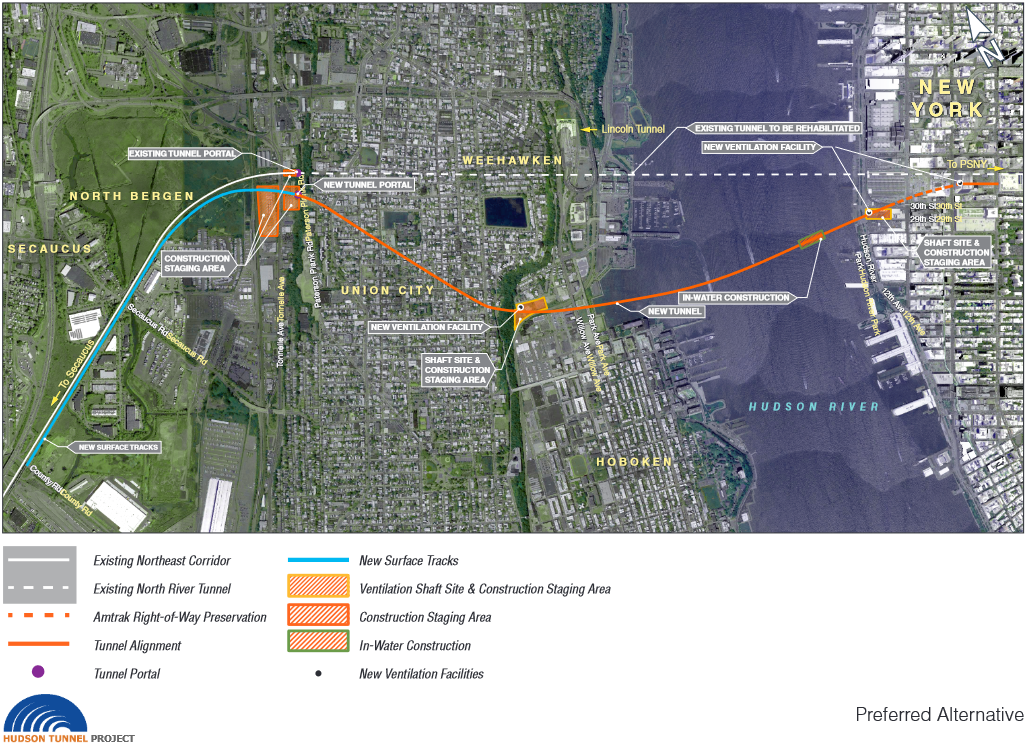
The alignment, as can be seen in the picture, is not closely parallel to the existing tunnels. On the Manhattan side, the alignment is fixed in place, due to the construction of the Hudson Yards project since the project was first mooted in the early 2000s, when it was called Access to the Region’s Core (ARC); the only available alignment between building foundations is as depicted. Under the Hudson and in New Jersey, there are no such constraints.
What is far more suspicious is that 5 km of double-track tunnel, even partly underwater, even partly in Manhattan between skyscraper foundations, are said to cost $14 billion in total. This is not just the usual problem of high New York costs. Second Avenue Subway’s hard costs were 77% stations and station finishes and only 23% tunnels and systems; excluding the stations, and pro-rating the soft costs, the costs in 2022 dollars were only about $500 million per km. There is an underwater premium, but it doesn’t turn $500 million per km into nearly $3 billion per km, nor is the expected inflation rate over the project’s 2023-35 lifetime high enough to make a difference.
What’s more, the underwater premium is highest where the costs are already the lowest. The New York cost premium for civil infrastructure is rather small, only about a factor of around 3 over comparable European projects. Systems and finishes have a considerably higher premium, due to lack of standardization; stations have an even higher premium, due to overbuilding (the Second Avenue Subway stations were 2-3 times as big as necessary, and the two smaller ones were also deep-mined at an additional cost). The installation of systems like electrification and cables should not cost more underwater than underground – the construction of the tunnel and its lining is where the premium is. Whatever we think the underwater construction premium is – a factor of 2 is consistent with some Stockholm numbers and also with the original BART construction in the 1960s and early 70s – it should be lower in New York.
Some of it must come from ever worse project management and soft costs. The destruction of state capacity in the English-speaking world, and increasingly in nonnative English-speaking countries influenced by the UK like the Netherlands, is not a completed process; it is still ongoing. Soft costs keep rising, and the response to every failure is to add yet another layer of consultants or another layer of review. Second Avenue Subway phase 2 manages slightly higher per-km costs than phase 1, despite having less overbuilding, and from my encounters with the people in charge of capital construction at the MTA, it’s not hard to see why.
And yet, even relative to the highest costs of phase 2, Gateway is overpriced. The level of experience the people running this project have with capital construction at this scale is less than that of the MTA, and this should matter. And yet, even that doesn’t explain the large jump in costs.
Is it possible to do better?
Well, once the almost $16 billion for the project is there, it will be spent. The main reason one might oppose overpriced projects like Second Avenue Subway phase 2 even if their benefit-cost ratio is okay (which, for both phase 2 and the Hudson Tunnel Project, is iffy, though not obviously bad), is that pressure to reduce costs before approval can result in efficiencies. But once a budget is approved, nobody will make a serious effort to go significantly below it.
That said, the only smoking gun I have for how to make this project cheaper pertains to the $2 billion for fixing the existing tunnels. Currently, the timetables for both Amtrak and New Jersey Transit trains across the tunnels are written so that on weekends, only one of the two single-track tubes is in operation. Thus, maintenance work can be done on the other tunnel for an uninterrupted 55-hour period. However, Amtrak rarely takes advantage of this. In fact, reporting in the New York Daily News has found that over the last few years, only about once every three months – 13 times in a four-year period from mid-2017 to mid-2021 – has there been a full weekend repair job in one of the tunnels. Accelerated repairs would be able to reduce the costs of the fixes through greater efficiency, and, since American government budgeting is done in nominal dollars, a lower price level than in the mid-2030s.
It’s likely that such egregious examples also exist for the main project, the $14 billion new tunnels. I don’t know of any such example, and I don’t think it’s worthwhile stopping the project over this; but it’s important to remain vigilant and remember that while the tunnels are fully funded for all intents and purposes, a small gap remains and should be fillable without new money.
The benefits of the tunnels
The costs are very high. But what are the benefits?
In isolation, the benefits are that capacity across the Hudson would double. This would enable doubling commuter rail traffic. Before corona, the trains were very crowded, to the point of suppressing demand; ridership is lower now than it was then, but east of the Hudson, Metro-North is at 78% of pre-corona ridership and rising fast. Moreover, the prospects of future growth in commuting in New Jersey are better than those in suburban New York and Connecticut, since New Jersey permits housing at an almost healthy rate, 4 annual housing units per 1,000 people, whereas Long Island permits about 1, Westchester 2-3, and Fairfield County 1.5-2.5. There’s enough pressure in New Jersey even in the short term that a ridership flop like that of East Side Access is very unlikely.
That said, New Jersey Transit only had about 310,000 weekday riders in 2019, double-counting transfers (of which there aren’t many, unlike on the LIRR). Not many more than half those trips even originated or ended at Penn Station – one of the adaptations to overcrowding on New Jersey Transit is to send about half the trains from the Morris and Essex Lines to Hoboken, from which passengers take PATH into the city, and another is for passengers to get off at Newark and transfer to PATH there. Penn Station’s ridership in 2019 was 94,000 boardings, or 188,000 trips; that is the number that could potentially be doubled. So, $14 billion for 188,000 trips; this is $74,000 per rider, which is too high, and if that is the only benefit, then the project should be canceled.
However, the Hudson Tunnel Project interacts positively with every operational improvement in commuter rail. If off-peak frequencies are increased so that passengers can use the trains not just for rush hour commuting, then ridership will rise. Of course, peak frequency is not really relevant to off-peak ridership – but there are advantages from the new tunnels to off-peak service, such as more cleanly separating Northeast Corridor service from Morris and Essex service, improving reliability for both.
And then there are all the necessary small improvements, such as electrification. For example, right now, the Raritan Valley Line today is unelectrified, and passengers have to transfer at Newark to either PATH or a Northeast Corridor or North Jersey Coast Line train to Manhattan; only a handful of trains run to Manhattan using dual-mode locomotives, none at rush hour. The current service plan with the new tunnels is to run ever more trains with dual-mode locomotives, which are exceptionally expensive, heavy, and unreliable. However, the new tunnels interact positively with electrifying the Raritan Valley Line, currently the busiest diesel line in New Jersey, and with wiring short unelectrified tails on the North Jersey Coast and Morris and Essex Lines. These would raise both peak and off-peak ridership – and the extra capacity provided by the new tunnels improves the business case for them, even if the business case is healthy even purely on off-peak travel.
The same is true of platforms. The low platforms at most stations impede efficient boardings. They take too long at rush hour, and they’re inaccessible unless a conductor manually operates a wheelchair lift; conductors are not really cost-effective on commuter trains even at the wages of the 2020s, let alone those of the future. As with electrification, the case for converting all stations to high platforms for level boarding is strong even on off-peak ridership; the benefits are high and the costs are low (New Jersey Transit appears capable of raising platforms for $25 million per station). However, commuter rail managers and suburban politicians are squeamish and ignorant of best practices and only really get peak ridership; thus, the higher peak ridership expected from the new tunnels not only improves the already-strong business case for high platforms, but also makes this business case easier to explain to people who think that off-peak, everyone must drive.
With such improvements to speed and reliability – modern rolling stock (which none of the region’s agencies is interested in acquiring), electrification, high platforms, some junction fixes, and better timetabling (which the region will have to adopt for greater peak throughput) combine to a speed increase of a factor of about 1.5, with all the benefits that this entails.
Necessary efficiencies
Much of the benefit of the Hudson Tunnel Project comprises necessary improvements on the surface, some of which I expect to happen as ancillaries. But then there is also the issue of necessary efficiencies in New York.
The issue is that the current operating paradigm involves very long turns at Penn Station. LIRR trains terminate from the east and New Jersey Transit trains terminate from the west, and neither railroad turns trains especially quickly. The turn times are on the order of 20 minutes; mainline trains in the United States can reverse direction in service in 10 minutes when they need to (for example, if they’ve arrived late), and even eight minutes look possible, and outside the United States, constrained terminals like Tokyo Station on the Chuo Line or Catalunya on FGC do it much faster.
The relevance is that agency officials keep saying, falsely, that Penn Station Expansion is necessary for the full increase in capacity coming from the new tunnels. But they are not going to get the money for the expansion; it competes with so many other priorities for a pool of money, $30 billion for the entire Northeast Corridor, that is large compared to normal-world costs but small compared to American ones. This means that they’re going to have to make necessary efficiencies.
Through-running is one such efficiency. But there are others – chiefly, turning faster at terminals, since the new tunnels would mainly feed stub-end tracks. This, in turn, means better service in general, with lower operating costs and (if there’s through-running) better service for passengers.
On just a raw estimate of extra peak capacity, there just isn’t enough ridership to justify $14-16 billion in funding for new tunnels. But once all the necessary improvements and efficiencies come in, the benefit-cost analysis looks much healthier. It doesn’t mean anyone should be happy about the budget – agencies and area advocates should do what they can to make sure money is saved and the same budget can build more things (like all these necessary improvements) – but it could be more like the extremely high-cost and yet high-benefit Second Avenue Suwbay phase 1 and not like the failure that is East Side Access.
 Pedestrian Observations
I had no idea that they chose such a convoluted route across the Hudson. 1) I assume this was done to avoid touching the LIRR tail tracks because they didn’t want to consider through running? 2) Maybe it would be cheaper to knock down the skyscraper, build the tracks in a straight line, and rebuild the skyscraper?
The alignment is determined by where NJ acquired land for the ventilation shaft for ARC.
On which side? If it’s the NY side, then it looks like the land acquisition was also constrained by refusal to through-run.
There is precisely no way to get a tunnel under the Hudson and connect to Hudson Yards (LIRR storage tracks). Nothing to do with through running and even if you did that I’m not sure the NJ transit side of Penn could actually be serviced. Also it would make the alignment on the NJ side rather interesting.
Through-running would allow the downsizing of that giant train yard on precious real estate. It would make room for a straighter Gateway tunnel as well as more and cheaper development. The straighter tunnel would also save journey time due to both shorter length and higher speeds.
IIRC Weehawken was able to veto ventilation within their dinky jurisdiction during ARC planning.
It would be a wiser move if they built these new tunnels directly to the north of the existing Hudson River PRR tunnels, since it would be cheaper, and goes directly under W 33 Street to directly line-up with the tracks at Penn Station already there. This way they can directly send OOS trains to and from Sunnyside Yards for storage, and trains can be placed back into service much quicker that the proposed loop to south of Penn Station which on the Jersey Side would require a lot of land acquisition within the Union City area .
Yeah, that’s the ARC-north option, which I crayoned many years ago. But if there are any plans to expand further, getting to the southern tracks as in ARC and in the current plans is superior, because then the tracks could be extended to Grand Central, while the northern LIRR tracks could be extended to the Empire Connection.
EDIT: link in case anyone is interested in Ped Observations archeology.
We’ll just sit back and see how this all plays out. They will have environmental impact studies, communities liaison and meetings with local leaders and public input from the property owners whose property must be acquired, and etc. before any shovels can hit the ground.
In that post you said, “a connection to Grand Central could then be built from one of the two East River tunnel pairs, the one not used by intercity trains.” So a hypothetical GCT connection could be built either way it sounds like. And currently the Empire Connection leaves from the south side, I thought, so wouldn’t it be better for the new tunnels to be on the north side and out of the way of Empire?
Yeah, you’d need to realign the Empire Connection. But it’s a short tunnel, with moderate constraints on how it gets to the station because of the LIRR yard.
They went and built 20 billion, with a B like in boy, of skyscrapers over the Empire Connection. Someday, far far in the future when they need fifth and sixth tunnels under the Hudson and East Rivers for the high speed trains, Hudson line trains can turn and head to New Jersey and beyond.
Ok. So where would the necessary shaft be on NJ to allow for transition from a hard rock TBM to a much more complicated pressurized face TBM be? You need space and there’s not much in that area. This also suggest that your going to come up right in Penn station throat? And given the overbuild now this would be almost impossibly expensive.
Turning faster at the terminals is easier if the train services are reliable. I’d have thought that’s where it’s tough in the US.
Obviously in Japan you can set your watch against the time of the train, and in Spain there probably aren’t many long distance passenger trains on the same track as the commuter trains because Spain doesn’t run many – so it’s easier to keep the commuter trains to-time. And yes America doesn’t run many long distance trains either, but they can be extremely unreliable due to the freight companies.
It’s also difficult to argue that bi-mode trains are particularly unreliable. Both LNER and GWR have seen a clear reduction in “fleet” delays since the bi-mode class 80x trains were introduced – see https://dataportal.orr.gov.uk/statistics/performance/passenger-rail-performance/ and look at the PowerBI delay minutes in TOC-on-self, fleet, technical fleet delays category for LNER and GWR.
The Northeast Corridor barely has any freight; Penn Station has none.
Commuter train S24 is turned around in 6 minutes in the non through running part of the Zürich main station (surface tracks). These tracks are also used by all long distance trains that terminate in Zürich. Those are often late. There are occasionally freight train going through the station.
Fair enough! Sounds like I’m wrong 🙂.
The alignment has been fixed like this for years. Helps with the EIS process if you don’t change the horizontal alignment once you have you Record Of Decision. The connection from Pallisades into the NEC is all though “wetlands” so once that was fixed moving it was not really an option. The Hoboken Shaft is the primary driver of the alignment as you need to be able to service the Hudson tunnels from there as they will use totally different technology than the Pallisades hard rock tunnels. Plus NJT bought that land a while ago. The alignment in NY is not really dictated by the overbuild as the box beneath Hudson Yards was built before the overbuild. The Empire line tunnel plus Water Tunnel #1 also come into play here. What has changed is the vertical alignment. When it was the ARC project it was deeper to get beneath the existing Hudson approach and into the new 34tg St Terminal. This also took the tunnels beneath the Hudson bulkhead and helped with the buoyancy issues beneath the Hudson. The current vertical alignment now requires tunneling through the Bulkhead from the Manhattan side and around 2000 linear feet of ground treatment in the Hudson to stop the tunnel popping out to the surface. Also the shallower depth is going to make the cross passage construction more difficult. Depending on how difficult Army Corps are going to be on navigable water permits in the Hudson to allow ground treatment from the river for those the price could be high or astronomical due to the risk mitigation factors. And yes the recent technology improvements where a small TBM can be used to mine these passages could be used as in Highway tunnel projects around the world but would impact critical path as the Hudson tunnel is significantly smaller than most highway tunnels.
As for cost the previous incarnation of the Pallisades was awarded at $259m back in 2009 and has since been simplified a little so with escalation since then I would guess this would be around $750m. The Manhattan shaft and works was $582m. This has changed since ARC as it’s mostly about mining or open cutting back to the Hudson Bulkhead to remove it before the Hudson tunnel arrives as TBM’s don’t like mining through old saturated timber. That one is going DB I believe as the owners engineer does not want the liability for designing that work. Given the utility work and general NY factor that contract could be around $1b. Hudson tunnels last estimate was $550m so spending on how the cross passages are constructed I would guess around $1.5b.
The other contract for ground treatment in the Hudson includes a massive cofferdam and pre treatment of the ground. This did not exist previously so difficult to judge but probably in the $500m range.
From the managing side of this it’s not a particularly complicated project. You have railroad interface in NJ to tie into (Amtrak) and similar in Penn so not much there unlike ESA that essentially had to rebuild Harold. Given that the project will be in 2 states that adds complications as NJ and NY have slightly different procurement requirements as well as different Union jurisdictions. The Hudson tunnel will likely be blended NY and NJ Union crews as compressed air work is under the Sandhogs Local 147 whether it’s in NY or NJ and you will need compressed air to get into the Hudson tunnel TBM cutterheads for maintenance. Gateway Development Corp was set up to be a cross border agency to help with these issues but are more political than technical and are in the process of appointing a Project Delivery Partner. The talent in the NY/NJ area to deliver this project is almost non existent as the agencies have no one capable of this, and they never had it. All the previous major infrastructure was delivered by private companies such as Pennsylvania Railroad not state agencies.
As for train turn time for NJT. Have you tried to exit a train at Penn during morning rush? It can take 10 to 1( minutes to completely empty a train and get off the platforms thanks to the narrow stairwells leading up to the main concourse. And if you get folk trying to descend those same staircases to get on the train for a departure it’s an utter clusterfuck. If there’s ever a fire down there it’s going to be really bad. So speeding up the turn especially for NJT may not be that easy on the terminal tracks. For the through tracks they can run the deadheads out to Sunnyside obviously but that capacity is constrained for the foreseeable as Amtrak rehab the East River tunnels to improve reliability and get ready for MNR access to Penn. Once MNR get into Penn then LIRR will be giving up slots so my guess is tha ridership on ESA will increase as service to Penn is throttled back. Those dozy Long Islanders will have to learn a new timetable.
Taking the NY side as constrained, and the ventilation/staging area on the NJ side as also constrained, I still don’t understand why a WB train has to turn north to emerge from a new portal next to the existing one. Why not tunnel straight west under Union City and join the existing track later on?
You wrote 842 words on every detail of arguably the most overpriced tunneling project in history, but couldn’t find a single word to indicate anything that might have been done wrong. The refusal to admit to mistakes is what guarantees they will continue, and means that costs will continue to escalate until nothing can get built (we’re almost there) and you are out of a job.
So what does the choice of a southern tunnel mean for potential through running to Grand Central, or across the East River to Sunnyside?
Also, do these funds include money for the Bergen Loop at Secaucus? It would be nice to have the NJT Main Line, Pascack Valley Line, Port Jervis/Bergen County Line and someday, a reactivated West Shore Line, be able to make direct trips into Penn Station without having to transfer at Secaucus. If I remember correctly, funds for the Bergen Loop were a part of the initial funds for ARC before Governor Christie cancelled it.
Also, do these funds include money for the Bergen Loop at Secaucus? It would be nice to have the NJT Main Line, Pascack Valley Line, Port Jervis/Bergen County Line and someday, a reactivated West Shore Line, be able to make direct trips into Penn Station without having to transfer at Secaucus. If I remember correctly, funds for the Bergen Loop were a part of the initial funds for ARC before Governor Christie cancelled it.
What do you think of not having any stations east of Secaucus Junction?
Underground stations add significant cost but with the density of the Jersey City Heights and Union City a station near the border of them would see significant ridership. The route is also curving right under where a new HBLR station would make sense in uptown Hoboken. A station there would immediately turn a lot of bus commuters into rail ones potentially opening space in the Lincoln Tunnel bus lane and at Port Authority Bus terminal for other areas. Also if the northern HBLR extension to Bergen County ever happens a transfer there could help turn more current car commuters into rail ones.
I blogged about this in 2015.
Would it be feasible and cost-saving to use the currently planned access and staging tunnel in NJ as a future station? Potentially it’s close enough to the current HBLR for an infill station there, and route a hypothetical Bergenline subway as an extension of the WTC-Hoboken PATH, with Bergen-bound passengers in Newark transferring at Exchange Place (instead of Journal Square like in a straight Bergenline subway). Alternatively if there’s no Bergenline subway for whatever reason and HBLR serves Bergenline going north from the current station, there’s probably still a speed saving over a jitney via signal-priority light rail and then transfer to the new tunnel to Penn Station.
one of the adaptations to overcrowding on New Jersey Transit is to send about half the trains from the Morris and Essex Lines to Hoboken, from which passengers take PATH into the city, and another is for passengers to get off at Newark and transfer to PATH there.
It’s a good thing that people who want to go to Wall Street don’t have to go through Midtown. Newark, Journal Square and Hoboken have lots and lots of local buses serving them. They let the locals use PATH too. They let the locals use NJTransit. And Amtrak at Newark.
Yes, except that Midtown has several times the job count of Lower Manhattan.
You are somewhat correct here. However this is the current situation Midtown Manhattan finds itself in presently. See – https://www.youtube.com/watch?v=Acu57kQ1mrA&pp=ygUOZ2VyYWxkIGNlbGVudGU%3D and this – https://www.youtube.com/watch?v=E7aqGIvNyjc&pp=ygUOZ2VyYWxkIGNlbGVudGU%3D and you can also comment on same as well. Have a nice weekend Alon.
Yes it is. That doesn’t change that Wall Street is big destination also. Why do you find it so difficult to comprehend that someone not on a train to Midtown frees up capacity for someone who wants to go to Midtown?
So, $14 billion for 188,000 trips; this is $74,000 per rider, which is too high, and if that is the only benefit, then the project should be canceled.
The no build alternative is hopeless gridlock.
The mildly reasonable alternative is the Port Authority’s 10 billion dollar extravaganza of expanding the Port Authority Bus Terminal. With the dirty little secret that it would require two eXclusive Bus Lanes or a fourth Lincoln Tunnel tube. To clogged roads in New Jersey.
The cheapest way to move people, when it’s as high demand as it is in New Jersey, is by rail. To existing, in service, train stations. Trains don’t get stuck in automobile traffic.
The no build alternative is to provide less transportation capacity. The economic benefits of transportation are considerable but they’re not infinite.
I want to see your plans to depopulate New Jersey and Pennsylvania. Though I suppose depopulating Manhattan would work too. They’ve been nibbling around the edges of the problems since the eXclusive Bus Lane opened in 1971. Though that goes back even farther to the conclusions of the 1959 study that said trains are the cheapest solution. The no-build alternative is hopeless gridlock or depopulation.
Trains do get stuck in automobile traffic during level crossing accidents.
The subway is grade separated. The busiest parts of the commuter system are. The parts that aren’t, are busy enough that people pay attention to the gates, flashing lights and bells, making crossing accidents rare. Highway traffic happens most of the day most days.
the failure that is East Side Access.
A worldwide pandemic was outside of the scope of the planning phases.
There should be a station in Union.
Amtrak closing one tunnel every weekend for 10 years and not doing much work on it should be a criminal inquiry with maximum prison sentences.
Management didn’t even know when the NY Daily News confronted them; they assumed there were weekly closures, that’s how uninvolved they are in operational and technical matters.
“They’re lying” is a perfectly good explanation, also.
I mean, always assume “they’re lying”, but feel free to throw in “they don’t give a fuck” or “they couldn’t be bothered to read what’s put in front of them” as well, but start and end with “they’re lying”.
Everybody isn’t as omniscient as you. The usual presumption of why they run one tunnel on the weekends is that when something goes wrong the schedule can be accommodated with one tunnel. Things do go wrong.
No, that’s not the explanation; they tell the public, and told journalists on the record, that it’s necessary to do this because they close one tunnel for maintenance every or almost every weekend. It’s not about redundancy, because why do it just weekends and not weekday off-peaks if that’s the case?
Pick a tale to tell. Either they do know what’s going on or they don’t. It can’t be both.
I don’t know what class of track they maintain the tunnels to. Or care. It’s not “exempt” so there is a regular inspection schedule. Occasionally, mid week, they have to shut everything down to go whack icicles with sticks. I’m going to assume that needs a detailed inspection and repairs. And since nobody has weather forecasts for next year, that’s unscheduled. Since this isn’t the perfect world of you Sim City other shit happens.
You’re assuming things that they didn’t actually say. They didn’t say “we only go in the tunnel once every three months but we need to keep the possibility open.” They said “we go there every week,” which they demonstrably don’t. Richard thinks they’re lying; I think they’re just clueless, based on the interpretation of the NYDN journalist who told this to me.
The Daily News has archives.
I assume you mean Amtrak management, but it fucks over NJT weekend schedules tremendously and that management also doesnt know or doesnt care.
LATE COMMENT HERE: Alon I am seeking your POV on an idea. The Gateway tunnel passes directly under the Hudson Bergen light rail line at the site of the project’s ventilation shaft and the massive construction staging site. Both are situated in a large undeveloped plot of land. This parcel is a mile from the Lincoln Tunnel Weehawken Portal and 495 Helix. QUESTION: Why wouldn’t the tunnel project include a station box (let’s name it “Gateway Hudson”) wide enough to allow sidings for suburban NJ Transit trains to make a Hudson County stop; enable a new PATH +Airtrain shuttle (terminals to terminals) to run between Jamaica, Long Island City, Penn Station, “Gateway/Hudson”, Secaucus, and Newark/EWR (my favorite idea) or permit a future extension of the NYC Transit 7 Line. Additionally, with congestion pricing looming North Jersey will be in a transit crisis. Hudson and Bergen are extremely bus dependent. Most buses snake their way through Hudson Streets. A NJ Transit bus terminal in Weehawken might allow access to trains to airports and points in NYC, as well as intra-state bus transfers without having to cross the river. Thoughts?
I wrote about this eight years ago:
A smooth transfer from HBLR to Gateway! And then push HBLR past Englewood Hospital, current proposed northern terminus app the way to Rockland County.
Getting past downtown transit will be tricky. I suggest teaching, dipping below grade at Westervelt, fully covered underground at the Elks Lodge and re-emerging beyond downtown Tenafly at Central, then back to grade around the end of Grove Street.