Commuter Suburbs and Express and Local Trains
At both TransitMatters and my ongoing Northeast Corridor high-speed rail timetabling project, one question we face is how to mix local and express trains on the same line. I blogged about this years ago, but that was from first principles and this is from a much better position of using Devin Wilkins’ code and analysis of recent research on rail timetabling to evaluate alternatives.
Most of this post is going to be about the Worcester Line in Boston, which we used as a test case; thus, the following two sections cover how to modernize the line, which will be covered in greater detail in an upcoming TransitMatters report, and you can skip them if you genuinely don’t care about Boston. But much of the analysis generalizes, especially when it relates to the issue of American commuter suburbs and their land use. This land use makes neat express patterns hard to justify in most cases, and the outcome in historic American planning has often been irregular patterns, which in postwar suburban New York led to regularizing around zonal express trains, designed to be usable only by rush hour suburb-to-city commuters and nobody else. Nonetheless, it’s still possible to run coherent timetables that make suburb-to-city commutes convenient while also making other trips viable – it just requires running fewer express trains in most cases.
The Worcester Line’s current situation
The Worcester Line connects Boston and Worcester. It is 71 km long and double-track and has 17 stops on the way. There is a planned infill station within Boston at West Station in Allston, and one to four potential infill locations on the way (Newton Corner is the most interesting; the other three are US 20 and the poorly-named Plantation Street in Worcester and Parsons Street in Faneuil). On the way, it passes largely through commuter suburbs of Boston, with one intermediate city, Framingham, station #12 out of Boston, at km-point 34.4, dividing the line into an inner and outer zone. Atypically for a Boston commuter line, seven stations in the inner zone not only don’t have level boarding, but also don’t even have a railcar length’s worth of high platform for wheelchair accessibility (called “mini-highs” in Boston).
All trains are pulled by diesel locomotives. Currently, off-peak and on weekends, all trains make all stops, running roughly hourly. At rush hour, trains either run local between Framingham and Boston, or express between Worcester and Boston, the latter trains running nonstop between the last station in Boston (Boston Landing, #3) and West Natick (#11) and running local beyond; each of the two patterns ran roughly half-hourly before corona, but currently runs roughly every 45 minutes.
Exceptionally, reverse-peak and some midday trains do not stop at the Newton stations (#4-6), where not only are the platforms low but also they only serve one track, and so the peak trains use the track with Newton platforms and the reverse-peak trains use the track without; they switch to the usual right-hand running farther west, the line running infrequently enough it can be scheduled. However, a project to build high platforms on both tracks at these stations is currently in design, and all future modernization assumes it will be completed by then; the current pattern is so atypical that what should generalize is the timetable after completion, not the current one.
Worcester Line modernization and timetabling
Modernization of the Worcester Line means, at a minimum, high platforms at all stations and electrification. This is the starting point of everything that follows; while the North American rail network has practically no electrification measured by route-length, the electrified share measured by ridership is fairly high (nearly all ridership in metro New York is on electric lines, for one).
The combination of those two, plus the improvements in reliability that would follow permitting less timetable padding, would make trip times much faster. Where today, locals to Framingham take 58 minutes and expresses to Worcester take 1:26, EMUs would do these trips in 35 and 46 minutes respectively even with infill stations, or maybe slightly more with schedule padding. This would induce higher ridership, requiring higher frequency – not to mention that at stations 15-20 minutes out of Boston, which the Newton stations will be if this is implemented, increasing frequency from a train every 30 minutes to a train every 15 or ideally less would increase ridership in and of itself.
Then, there’s planning for intercity trains beyond Worcester, to Springfield, which is called East-West Rail in Massachusetts. The plans have gotten some funding, but it isn’t enough, and the current plans are still measured in diesel trains per day and not electric trains per hour. But for future planning, we look at space for faster trains, running even faster than Boston-Worcester express trains. Internally in meetings, Devin has come to calling the three patterns local (current locals), local-express (current expresses, so named because they run local between Framingham and Worcester), and Heart-to-Hub (trains running express between Framingham and Worcester, named after a daily express train that got a lot of love from Worcester boosters but not much ridership). The Heart-to-Hub’s ridership was low and therefore its main use is to speed up Boston-Springfield trips. We express frequency in trains per hour at rush hour in both directions, in the order above: 4/4/0 means the local and local-express patterns run every 15 minutes and there are no Heart-to-Hubs, 4/2/2 means the locals run every 15 minutes and the other two run every 30 minutes, etc.
To boost frequency to 4/4/0 or 4/2/2, even with very fast EMU acceleration rates, requires additional infrastructure. The options are to rebuild Framingham from an at-grade two-track station to an elevated four-track station, so that locals could terminate while local-express and Heart-to-Hub trains continue west, and to add a third track in Wellesley (current stops #7-9, the overtake done toward the east). An ongoing plan to triple-track both Wellesley and Natick is budgeted at $400 million, including four station rebuilds; even net of the rebuilds, it’s expensive, and being able to build a shorter triple-track section would save a lot. (Another option is a modified 4/0/4, with the locals running all the way to Worcester; close to 100% of the riders from the local outer-zone stations would transfer at Framingham.)
Anything beyond eight trains per hour requires too much extra infrastructure – at a minimum, both quad-tracking Framingham and triple-tracking Wellesley, and even then the timetable would be fragile. A coherent 4/4/2 pattern would even require an additional passing track around Southborough (stop #14): the issue is that local-express and Heart-to-Hub trains have narrow windows to depart between pairs of local trains, so if there are four local trains per hour and six express trains, then two pairs of express trains have to be closely spaced, forcing an overtake on the outer section even though the speed difference between them is small.
Thankfully, the Worcester Line can live with eight peak trains per hour indefinitely: it’s a doubling over current frequency, and modernization stands to raise ridership by more than that but largely off-peak, as the modal split at rush hour is healthy.
Short-turn trains
Eight trains per hour on the Worcester Line, four running local to Framingham and four running express to Framingham and continuing on to Worcester, is solid. But are there other ways to shove more trains in? This is where the compromises that lead to irregular express patterns become apparent.
The first possibility is to add short-turn trains: those are trains that run short of the outer terminal. Technically, Framingham locals can be thought of as short-turns, but it’s perhaps better to think of Framingham as the outer terminal of local trains, and then conceive of local trains turning short of that. Newton is a good candidate for short-turns: it is on the dense side for an American suburb, it’s close to Boston, and there’s a place for trains to short-turn off the track via a disused connection to Riverside, where the Green Line D branch terminates. But this still doesn’t work, for a subtle reason that generalizes.
The generalization is that instead of the three names for future Worcester Line trains, we will have more patterns, so let’s refer to them by letters. Local trains are L; local trains that turn short are M. Express trains are X (local-express) and Y (Heart-to-Hub), but in the most general case, it’s fine to think in terms of just L, M, and X, since on the inner zone, X and Y make the same stops.
The issue is that X and Y trains still have to fit between L trains or between L and M trains. Under the 4/2/2 option, with Framingham overtakes and no short-turns, outbound departures look roughly as follows:
:00 X
:02 L
:15 Y
:17 L
(Repeat every half hour)
L is allowed to take at most 11 more minutes to get to the overtake point than X/Y, otherwise X/Y have to be slowed down. Under our current assumptions, this is the exact difference. So there’s no space for additional trains unless they turn short, enough that by the time they’d be overtaken mid-line, they’re on the spur to Riverside. This leads to the following principle: if short-turn locals are added to a line with local and express trains, the express train must run behind a short-turn local and not a full-line local. Concretely, where would M short-turns fit? It would look roughly as follows:
:00 X
:02 L
:07 M
:15 Y
:17 L
:22 M
(Repeat every half hour)
This shoves more frequency on the line, which is good for residents of the stations served by M, neutral to slightly bad for everyone else, and costly. The issue is that on the section where M trains run, the operating costs are those of eight local trains per hour, but the maximum gap is not 7.5 but 10 minutes. Moreover, the trains arriving after the longer gap are L trains and not M trains. Thus, the L trains would end up considerably more crowded than the M trains – all passengers traveling beyond the short-turn would be on L and so would two-thirds of the passengers traveling on the short-turn section. Ideally, if there are programmed irregular gaps on a line with short-turn trains, the short-turns should arrive after the longer gap and not after the shorter gap; if L departs :02 and M departs :12, then L takes just one-third of the passengers on the shared section and M takes two-thirds, which manages capacity better. But the presence of X and Y makes this impossible, because X and Y have to run behind M and ahead of L and still have a fairly long gap from M to avoid having to overtake.
Irregular express patterns
Okay, so short-turn trains are not a good way to add capacity to a line with a mix of local and express trains. This leads to the next step: slowing down some express trains, reducing the speed difference between locals and expresses, and compensating by running more express trains serving different stations.
On the Worcester Line, this means running trains in the pattern Y-X-L, with X making more stops to slow it down a little. But this then raises the question of which intermediate stops get to run express.
The New York City Subway standard of having express stops at regular intervals every three to six stations doesn’t work on commuter rail. The subway is designed around four-track trunk lines with cross-platform transfers at express stations, and those work because the trains are very frequent (or, off-peak, used to be). What works for a four-track system that runs local trains every five minutes doesn’t work for a two-track one that runs them every 15. On a commuter rail network, if a station only gets local trains, there is not going to be an opportunity to transfer, not at the scale we’re talking about.
The simplest answer to who gets the express stations is “the busiest stations.” This is a valid answer. Here is the RER B, between Massy-Palaiseau and Cité-Universitaire, the last station within Paris, where all trains make all stops. Off-peak, the southbound stopping patterns include S trains to Robinson on a branch, K trains making all stops to Massy, and P trains running express to Massy and local beyond, each every 15 minutes; at peak, the S is as before, the K skips one stop, there’s an L pattern skipping stops and running local from Massy to Orsay, and the P runs the fastest and is express to Orsay and only local past that, each every 12 minutes.
| Station | Ridership | S | P (base) | K (rush) | L (rush) | P (rush) |
| Cité-U | 7,531,642 | * | * | * | * | * |
| Gentilly | 2,415,990 | * | * | * | * | |
| Laplace | 3,707,718 | * | * | * | * | |
| Arcueil-Cachan | 3,634,116 | * | * | * | * | |
| Bagneux | 2,241,461 | * | * | * | * | |
| Bourg-la-Reine | 4,446,499 | * | * | * | * | * |
| Parc de Sceaux | 574,699 | * | ||||
| La Croix de Berny | 3,161,602 | * | * | * | * | |
| Antony | 6,304,424 | * | * | * | * | |
| Fontaine-Michalon | 731,635 | * | ||||
| Les Baconnets | 1,860,108 | * | * | |||
| Massy-Verrières | 607,314 | * | ||||
| Massy-Palaiseau | 9,141,486 | * | * | * | * |
There are no overtake locations on the RER B; because of this, the shared trunk to Bourg-la-Reine has to run local at rush hour. The express patterns still run on a regular clockface schedule every 12 minutes at rush hour and every 15 off-peak, but they aren’t neat, due to the density of traffic. The stations that always get served are the busiest ones – Bourg-la-Reine, La Croix de Berny, Antony, Massy – and are an order of magnitude busier than the stations that get skipped the most. This is not an artifact of service – at the distance of those stations from Paris, a train every 12 or 15 minutes is enough for ridership not to depend too much on frequency. There really is much higher demand at Bourg-la-Reine and Massy than at the minor stations.
In contrast, here is ridership per station between Boston Landing and Framingham, on weekdays:
Boston Landing: 479
Newtonville: 429
West Newton: 243
Auburndale: 203
Wellesley Farms: 285
Wellesley Hills: 322
Wellesley Square: 591
Natick: 697
West Natick: 914
Framingham: 995
So, the first thing to notice is that Framingham, the busiest station, has 995 weekday boardings, which is maybe 290,000 per year, which would be by far the least busy on the RER B (the least busy on the entire RATP-run part of the RER is La Hacquinière, on the outer tail of the RER B, with 419,294/year). But also, the spread is much smaller than on the RER B, a factor of about 5 rather than 16. The spread in potential demand is actually larger, since Auburndale and West Newton are close enough to Boston that the hourly frequencies hurt a lot, whereas Framingham and West Natick both are farther away and get much more rush-hour frequency at any case.
A line like the Worcester Line should only even be running express trains in the first place to speed up some outer-zone trips, and with the expectation that Framingham could develop to something bigger. But that brings in the issue of land use in American suburbs.
Land use and commuter rail ridership
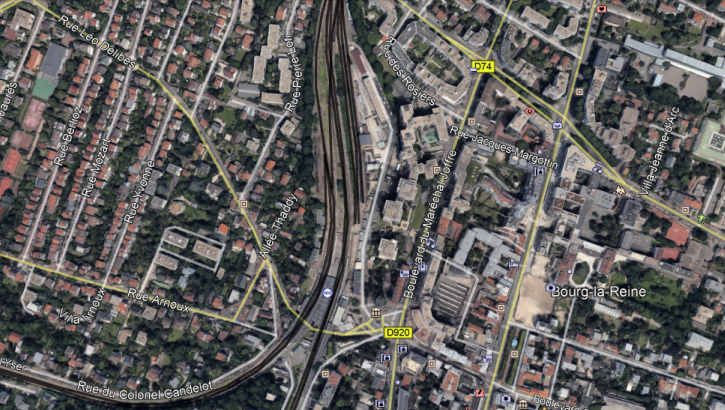
I encourage people to compare land use near American and Parisian commuter rail stations. Here is Bourg-la-Reine:
And here is Massy:
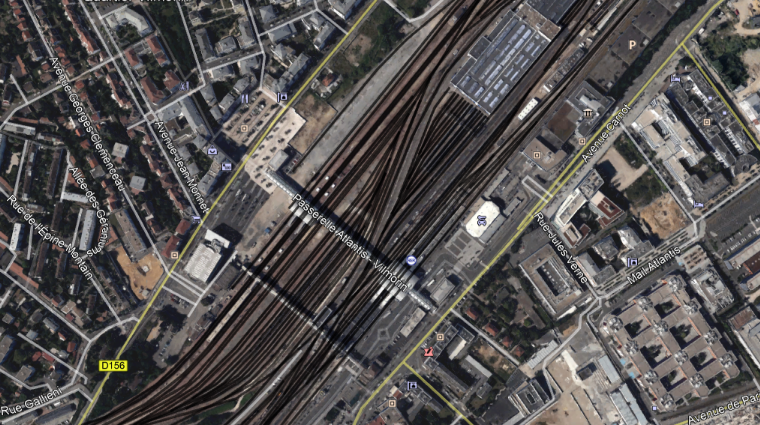
These are town centers. Massy is a postwar suburb developed around the train station, with town center development near the station and plenty of later urban renewal as the area got a TGV station. There’s visibly more stuff near Massy or Bourg-la-Reine than near the minor stations on the RER B, in the same way there is more stuff near a major transfer point on most subways than near a station on one line on a tail. They anchor express service.
The land use near American commuter rail stations works differently. It is lower-density, of course, but more importantly, it is uniformly low-density. Density isn’t especially oriented near the train stations. Occasionally there is walkable retail from the train, but it’s not consistent, and there are no clusters of mid-rise buildings with retail and some local office jobs. American suburbanization of residences may follow the train, with gray near the lines and green between them, but suburbanization of jobs never does, instead following highways.
In this context, there’s no real distinguishing feature that allows some stations to get more express service than others. Riders get to the station by car; the fares and schedules don’t allow for integration with suburban buses, and there is no reason for anyone in these suburbs to rely on bikes when all local destinations are auto-centric. The car has a fairly long range within suburbia, and thus riders drive to a better park-and-ride or kiss-and-ride; the busiest suburban American train station, Ronkonkoma, with around 10,000 weekday riders pre-corona, is a parking lot with practically nothing else near it.
What this means is that express trains often generate their own demand, as passengers start driving to them, neglecting other stations. It creates a fiction of lopsided demand with similar ratios between busier and less busy stations as on the RER B, with no underlying reason for it; the Worcester Line has no such ratio, but the LIRR Main Line does, largely due to the park-and-ride effect. Once planners accept that everyone needs an express trains, schedules evolve to be ever more irregular and less reliable, in the search of the perfect express. Caltrain even came up with the push model, in which the scheduler’s job is to push passengers to park-and-rides with open spots, and otherwise there would be no reason to run trains other than the fastest express trains.
This, in turn, guarantees bad service – these irregular patterns repel riders who are not city-bound commuters, and the frequency is never good enough to sustain such patterns off-peak. In the most extreme cases, it can even backfire: the LIRR’s split between Grand Central and Penn Station frequencies has made it so that so far, the East Side Access project has generated zero new ridership. It’s sometimes possible to salvage something: in the case of Framingham and Worcester, both cities have skeletons of bus networks, and coordinated planning could ensure that the buses would be timed with the train and have free transfers. But at most stations, it’s pointless to try to turn them into distinguished nodes beyond the usual for a local train station.
The upshot is that the only way to run coherent timetables is to focus on local trains. Express trains are for express stops, and few places in the suburban United States are worth the effort; Framingham and Worcester are two of those few because of their town center development, but nothing else on the line is.
In that sense, when I harp on the need for high platforms and electrification, it’s not just because these are good practices in and of themselves, but also because they’re necessary for making local service work. Otherwise, the stop penalty kills you: Boston-Worcester is 1:38 on all-local off-peak trains today, which is an average speed of 43 km/h. And nothing except local stretches works in the context of continuous, isotropic suburban density.
 Pedestrian Observations
But a four track Framingham would not be needed if locals turned up the Ag Branch, even if only to provide service to FSU
You need to move the platforms anyway to get to the Ag Branch – the current location of the station is past the junction.
New York led to regularizing around zonal express trains,
On the electrified lines, they can run more trains with same amount of electrical infrastructure. They can run two locals or two expresses and a local. And they have three or more tracks to work with.
The zonal express system was not set up to minimize electricity consumption. It was set up to regularize the timetables around the concept of only carrying suburban commuters (the railroads were deliberately becoming hostile to short trips to simplify business analysis – it’s common behavior to American railroading culture), and also facilitate fare collection by conductors, who wouldn’t have to memorize or look up fares between each pair of stations. Electricity is a small proportion of commuter rail operating costs, and the other costs scale with fleet size or train-hours and are insensitive to the start-and-stop nature of local operations.
If you try to run three locals, in many places, it’s too much demand and none of them run because the circuit breakers trip shutting off all of the electricity.
Only if your management is too incompetent to install a proper electric supply.
“The options are to rebuild Framingham from an at-grade two-track station to an elevated four-track station, so that locals could terminate”
If locals are going to terminate at Framingham, wouldn’t the the desired design be three track (express-local-express) with the two local tracks merging into the single station track? This way with two platforms you have a cross platform transfer to/from express and local trains. At 15 min frequency there is plenty of time for a local to pull in, unload, be readied for turn-around, load, and depart before the next train arrives and needs the same station track.
“Anything beyond eight trains per hour requires too much extra infrastructure – at a minimum, both quad-tracking Framingham and triple-tracking Wellesley,”
Isn’t this technically only true if you are running a mixed service pattern? If you are running only locals you can fill the line to the limit of the signaling capacity, correct? Even in the US there are commuter rail agencies that get above 8 tph out of two tracks.
I don’t think the timetable constraints on three tracks are worth the cost saving on building a smaller el. With three tracks, using a symmetry axis of :00, the locals at Framingham arrive :55 and depart :05, so the expresses serve the station westbound at :57 and eastbound :03; this allows some timing of bus transfers but it’s imperfect between Worcester and the Framingham buses (it’s good between Boston and the Framingham buses). Then, if we allow one infill stop in Worcester at the unfortunately-named street, the local-express trains get to Worcester :21 (depart :39) and the Heart-to-Hubs at :29 (depart :31), which in theory works okay if the outbound Heart-to-Hub returns inbound as a local-express and vice versa, but in practice means that the Heart-to-Hub has difficulties turning into a Springfield intercity. On top of this, at Boston, the inbound express comes in :27 and departs :33, which requires an extra trainset and forces a local-express to switch identity with a Heart-to-Hub at Boston (unlike at Worcester, this doesn’t screw up Springfield trains). It also has kind of ugly bus transfers at Framingham, though at least the Worcester Heart-to-Hub ones are perfect.
Another option is to try timing locals at Framingham to arrive :59 and depart :01, with four tracks and 15-minute turnarounds. Then the westbound express is :01 and the eastbound express is :59, which is optimal for bus transfers. At Boston, the locals arrive :36 and depart :24, which requires an extra trainset. The expresses arrive :22 and depart :38. At Worcester, the local-express arrives :25 and departs :35, and the Heart-to-Hub arrives :33 and departs :27, so the Worcester bus transfers are meh but at least there’s no dependence between local-express and Heart-to-Hub trains anymore.
If you can’t turn round a local service in 15 minutes there is no way you can turn round a medium/long distance service in less than that.
In Britain I believe we allow ~35 minutes to turn a long distance train around in London which allows 15-20 minutes for delays and 15-20 minutes for loading and unloading. This seems like something reasonable for the Americans to aim for. Probably in a big city like Boston with terminal platforms allowing 10-15 minutes for loading and unloading even for local trains makes sense.
Boston routinely turns trains in 10 minutes when they’re late; timetabling practices prefer 15 but it’s not actually necessary.
Right so basically Boston can turn trains round at a similar speed to Britain ignoring delays.
Still you would need longer than that for a medium distance service with at least some reserved seats etc – and longer still to account for delays.
There aren’t any reserved seats on any of these services – the US doesn’t even let you reserve seats on intercity trains, Amtrak will just not sell more seats than there are on the train and will expect you to find your own seat.
If you want a medium distance service that the elderly, families and groups of friends can use then you need to offer reserved seats.
And if you don’t make it work for those groups then it won’t be politically viable to operate.
The thing is 6 minutes between medium distance trains is good. Make it 36 minutes and you have something workable.
Over here, seats on RegionalBahn and RegionalExpress trains aren’t reserved, and it’s fine. Those trains are underfull anyway; in an American context, the trains would only be full at rush hour, when group travel isn’t much of a thing.
Seats wouldn’t be reserved on a 45-60 minute train here either. That said if you were running through service to Albany then you would have reserved seats for sure, and that would be a good idea if you want to gain passengers.
I also in general agree that there are lots of lessons to learn from the Japanese. But also it’s never going to be possible to do a full-Japan.
They have much higher infrastructure and running costs than in Europe and also much higher social compliance. They also have much lower levels of leisure travel which always is going to be a bit slower. At all but the biggest stations this all isn’t necessarily that relevant. But you aren’t going to get people to queue up neatly on the platform at big city terminals for long distance trains.
Amtrak doesn’t reserve seats anywhere.
The track is too squiggly west of Springfield to make it faster than a bus.
Yeah, we’re aware; we’ve been explaining to Western Mass interests that East-West Rail = Boston-Springfield, not enough people living in Pittsfield for it to be worth extending the line to.
Apparently there are a few masochists in the world. I suspect, mostly tourists.
Click to access MASSACHUSETTS22.pdf
and
Click to access MASSACHUSETTS19.pdf
More ridership than Worcester.
Apparently MASSDOT thinks it’s worth it. https://en.wikipedia.org/wiki/Berkshire_Flyer
…..but not from Springfield.
Yeah, because if you’re in Worcester and you’re sane, you ride the MBTA to Boston.
Going to Boston doesn’t get you to Springfield or Pittsfield very effectively. The Berkshire Flyer takes four hours. Which made me wonder why people didn’t take the bus. There is no bus. And why doesn’t it go through Springfield. It would take too long to go through Springfield.
The Wassaic Metro North station – the end of the line for the Harlem Line – has long term parking. For people who use the station to go their weekend retreat. They can leave the car parked from Monday to Friday. Hudson NY is one of the busiest Amtrak stations in the state. I suspect the same thing is going on. With less parking. Someday far in the future when there is high speed rail between Boston and Albany and beyond, it might make sense to have a station somewhere in Berkshire County Mass. It doesn’t have to be in downtown Pittsfield because most people will be using an automobile to get to and from the station. They can hash out, where, in 2130.
Re British turnback times: bear in mind that we’re talking about short distances and short trip times here. Today, with the worst operating practices on the planet and the shittiest infrastructure and rolling stock, Boston–Framingham making all stops is about 45 minutes each way. With EMUs and level boarding the trip time plummets. I don’t recall what numbers Alon’s come up with, but 30 minutes doesn’t sound outlandish.
But then on top of that you want to pile in ~30 minute reversal times at both terminals, just so everything is all Merry Olde England? We’re talking trains (and crews, because if there’s one thing US railroad unions love it’s being paid for not driving trains) sitting idle for 66% of the service day, just depreciating and salary-sucking away, a bonfire of ineffiency and pointlessness.
Really if you can’t reliably turn the sorts of services Alon is discussing here in under 15 minutes, you should do the entire planet a massive favour and just walk outside and kill yourself.
There’s no justification spending a cent on anything concrete if operations are going to be so shitty that you’re simply incinerating resources and gaining nothing.
Richard.
The British are probably the best outside Japan of turning stuff around efficiently on limited infrastructure. And unlike the Japanese and like the Americans and the whole of Europe the British have to cope with trains being late.
London Fenchurch Street only has 4 platforms and turns its trains around in 8-10 minutes with 3-4 minutes between trains at peak.
Chiltern turns them round in as little as 20 minutes at Marylebone and 7 minutes at Aylesbury Vale Parkway. Of note that would allow 1 platform to serve a train every 15 minutes comfortably away from the city centre.
Overall that’s probably all you can aim for.
Quitting one’s scheduler or mgmt job and making way for a competent replacement is also an option. Bit easier, less unpleasant, and less melodramatic than suicide. Also, @ Matthew Hutton, since there’s no reply button under ypur above comment: both on the Northeast Corridor and at least one of the land cruises (if you go “coach”–in a seat instead of a room/roomette), families and other groups do just fine w/ unreserved seats. The conductors just put a numbered paper tab thingy on your seat’s headrest as soon as you board and sit down. They use it to keep track of who’s getting off where, and catch anyone sneakily trying to travel farther than they paid for. Announcements regularly remind people to return to their chosen seat b4 their destination, so the conducter can remove the tabs for that stop and track if you left.
Richard: 35 minutes one-way (the EMU Framingham local) with 30 minutes sitting at a terminal would “only” be 50%, not 67% inefficiency.
Matthew: I apologise, but “the British are probably the best outside Japan [at railway operations]” is hilarious. It’s kind of telling that the Japanese can keep their trains on time (without excessive padding, too).
That’s because the tools known from accident investigation or for that matter (manufacturing) quality control can be applied to delays, if you choose to do so. On the one hand, document not just the fact that delays happened, but follow up to establish their empirical causes. On the other hand, “sit and think hard” about what sorts of things can plausibly cause delays. Check how the two approaches match, and start addressing the causes of the delays. Equipment (e.g. level boarding), operations policies (e.g. backup plans — if X breaks, divert Y traffic flow over to Z), training, whatever turns out to be causing it. Basically, “trains are delay-prone in the same way aircraft are crash-prone, so dropping the same kind of effort that made aircraft crash extremely rarely onto trains should make them delayed extremely rarely.
In that spirit: what needs to be done to turn a train around?
– Passengers need to alight and board. Given that boarding passengers are already standing on the platform, and can distribute themselves over the length of the train even once it is already in motion (and for particularly close-in stops, there will be standees), with level boarding this needs 2-3 min for a badly designed train full of elderly people.
– If the same driver takes the train back, they need to walk the length of the train. For a 200 m (“8-coach” train; no locomotive since EMU) at 5 km/h this is roughly 2 min.
– If the “stepping back” system is use, with one (per terminus-with-stepping-back) more driver than trainsets in operation, the outbound driver is waiting for the train on the platform, thus the crew change takes ~no time. Drivers also get a coffee-and/or-bathroom break on the order of 10 min (given 15 min frequency). There is a variant where the crew layover point is actually a stop or more removed from the terminus, but that is not relevant here.
– If you either expect passengers to be inconsiderate, or you choose not to provide sufficiently sized and conveniently located rubbish bins that they last the day (such that all cleaning can take place overnight), you may want to have someone empty the rubbish bins. Let’s give it ~10 min (average speed of progression less than a quarter of walking speed) and mark it as optional. (Also, if you can’t drop cleaning to end-of-day and it’s bottlenecking the operation on your expensive track and trains, it’s entirely justified to hire multiple people, who wait on the platform and each only needs to do a section of the train.)
– Anything else?
So, if you drop cleaning, you can have a setup with a “normal” turn at one end and a stepping-back turn at the other. Both can be done in 2-3 min (the latter only constrained by passenger exchange, so on a subway, this could be <1 min). Your drivers also get a ~10 min break after (on this line) every ~70 min of driving. If the schedule requires a longer wait at the terminus, that should be interpreted as schedule padding on top of this. In the latter case, you may also decide you want to push in cleaning, but in that case, you either have to provide a standard way to inform the cleaner(s) to stop and get off the train, and/or tell them that it's expected that sometimes they will not have finished emptying bins before the train moves off (so they should not freak out, but alight at the first stop (with an island platform) and catch the next train back).
So, if schedule padding is elsewhere, you can aim to turn a commuter train in 3 minutes.
SBB runs 15 minute headway service nearly hour every day on a single track (with very short passing loops at just three locations, all of which are intensively used) between Genève and Coppet.
The route has been triple-track the whole way in a highly constrained setting; the all-stops local trains I am discussing below are confined to one of the three tracks, while regional, intercity and freight share the other two tracks, with very high levels of traffic (main line from Genève to Laussane along Lac Leman)
This is not the only example I could give.
The turnback time at Coppet, where the local trains terminate and reverse at a single track serving a single platform (platform 1, on the eastern side of the station; platforms 2/3 are for regional and intercity) in eight minutes (arr :11/:26/:41/:56 dep :19/:34/:49/:04) pretty much every hour every day.
Oh, and these are international trains! Except after 10pm, they run at least as far as Annemasse in France (51 minute trip time, 15 intermediate stops, 68 trips/direction/weekday), with significant through-running in France (France! Land of timetable hell!) to and from Evian-les-Bains (95 minute trip 10/day), Annecy (117 minutes 8/day), St-Gervais-les-Bains-Le Fayet (127 minutes 6/day) and Cluses Haute-Savoie (105 minutes 6/day)
So trains running to and from France (France! Land of Timetable Hell!) can run along the mostly-single-track 12km section from Genève-Sécheron to Coppet (10 stops, 3 very short crossing loops around 3 of the intermediate stations), terminate at the single available platform track at Coppet, and reverse and return in service in 8 minutes, and do this 8 minute turnback 4 times an hour, a total of 60 times every weekday.
To repeat myself, if you can’t reliably turn the sorts of services Alon is discussing here in under 15 minutes, you should do the entire planet a massive favour and just walk outside and kill yourself.
05:04 dep L4 23192 Chêne-Bourg
05:11 arr xxx
05:19 dep L2 23410 Annecy
05:26 arr L4 Genève (05:00)
05:34 dep L4 23118 Annemasse
05:41 arr xxx
05:49 dep L4 23218 Annemasse
05:56 arr xxx
06:04 dep xxx
06:11 arr L4 Chêne-Bourg (05:24)
06:19 dep L2 23412 Annecy
06:26 arr L4 23117 Annemasse (05:35)
06:34 dep L1 23332 Evian-les-Bains
06:41 arr L4 23217 Annemasse (05:50)
06:49 dep L4 23222 Annemasse
06:56 arr L1 23351 Evian-les-Bains (05:21)
07:04 dep L1 23312 Evian-les-Bains
07:11 arr L4 23219 Annemasse (06:20)
07:19 dep L2 23414 Annecy
07:26 arr L1 23375 Evian-les-Bains (05:51)
07:34 dep L4 23126 Annemasse
07:41 arr L2 23411 Annecy (05:44)
07:49 dep L4 23226 Annemasse
07:56 arr L3 23477 St-Gervais-les-Bains-Le Fayet (05:49)
08:04 dep L3 23458 St-Gervais-les-Bains-Le Fayet
08:11 arr L4 23223 Annemasse (07:20)
08:19 dep L2 23416 Annecy
08:26 arr L1 23377 Evian-les-Bains (06:48)
08:34 dep L4 23130 Annemasse
08:41 arr L2 23413 Annecy (06:44)
08:49 dep L4 23230 Annemasse
08:56 arr L1 23357 Evian-les-Bains (07:21)
09:09 dep L1 23314 Annemasse
09:11 arr L4 23227 Annemasse (08:20)
09:19 dep L2 23418 Annecy
09:26 arr L1 23379 Evian-les-Bains (07:51)
09:34 dep L4 23134 Annemasse
09:41 arr L2 23415 Annecy (07:44)
09:49 dep L4 23234 Annemasse
09:56 arr L3 23479 St-Gervais-les-Bains-Le Fayet (07:49)
10:04 dep L3 23460 St-Gervais-les-Bains-Le Fayet
10:11 arr L4 23231 Annemasse (09:20)
10:19 dep L2 23420 Annecy
10:26 arr L4 23133 Annemasse (09:35)
10:34 dep L4 23138 Annemasse
10:41 arr L2 23417 Annecy (08:44)
10:49 dep L4 23238 Annemasse
10:56 arr L1 23359 Evian-les-Bains (09:21)
11:04 dep L1 23316 Annemasse
11:11 arr L4 23235 Annemasse (10:20)
11:19 dep L4 23240 Annemasse
11:26 arr L4 23137 Annemasse (10:35)
11:34 dep L4 23142 Annemasse
11:41 arr L2 23419 Annecy (09:44)
11:49 dep L4 23242 Annemasse
11:56 arr L3 23481 St-Gervais-les-Bains-Le Fayet (09:49)
12:04 dep L3 23462 Cluses (Haute-Savoie)
12:11 arr L4 23239 Annemasse (11:20)
12:19 dep L2 23424 Annecy
12:26 arr L4 23141 Annemasse (11:35)
12:34 dep L4 23146 Annemasse
12:41 arr L2 23421 Annecy (10:44)
12:49 dep L4 23246 Annemasse
12:56 arr L4 23143 Annemasse (12:05)
13:04 dep L1 23318 Annemasse
13:11 arr L4 23243 Annemasse (12:20)
13:19 dep L4 23248 Annemasse
13:26 arr L4 23145 Annemasse (12:35)
13:34 dep L4 23150 Annemasse
13:41 arr L2 23423 Annecy (11:44)
13:49 dep L4 23250 Annemasse
13:56 arr L3 23483 St-Gervais-les-Bains-Le Fayet (11:49)
14:04 dep L4 23152 Annemasse
14:11 arr L4 23247 Annemasse (13:20)
14:19 dep L2 23428 Annecy
14:26 arr L4 23149 Annemasse (13:35)
14:34 dep L4 23154 Annemasse
14:41 arr L2 23425 Annecy (12:44)
14:49 dep L4 23254 Annemasse
14:56 arr L1 23363 Annemasse (14:05)
15:11 arr L1 23251 Annemasse (14:20)
15:26 arr L4 23153 Annemasse (14:35)
15:41 arr L4 23253 Annemasse (14:50)
15:56 arr L4 23155 Annemasse (15:05)
16:04 dep L3 23466 St-Gervais-les-Bains-Le Fayet
16:11 arr L4 23255 Annemasse (15:20)
16:19 dep L2 23432 Annecy
16:26 arr L4 23157 Annemasse (15:35)
16:34 dep L1 23334 Evian-les-Bains
16:41 arr L4 23257 Annemasse (15:50)
16:49 dep L4 23262 Annemasse
16:56 arr L1 23365 Annemasse (16:05)
17:04 dep L1 23322 Evian-les-Bains
17:11 arr L4 23259 Annemasse (16:20)
17:19 dep L2 23434 Annecy
17:26 arr L4 23161 Annemasse (16:35)
17:34 dep L1 23336 Evian-les-Bains
17:41 arr L2 23431 Annecy (15:44)
17:49 dep L4 23266 Annemasse
17:56 arr L3 23487 St-Gervais-les-Bains-Le Fayet (15:49)
18:04 dep L3 23468 St-Gervais-les-Bains-Le Fayet
18:11 arr L4 23263 Annemasse (17:20)
18:19 dep L2 23436 Annecy
18:26 arr L1 23383 Evian-les-Bains (16:51)
18:34 dep L1 23338 Evian-les-Bains
18:41 arr L2 23433 Annecy (16:44)
18:49 dep L4 23270 Annemasse
18:56 arr L1 23367 Evian-les-Bains (17:21)
19:04 dep L1 23324 Evian-les-Bains
19:11 arr L4 23267 Annemasse (18:20)
19:19 dep L2 23438 Annecy
19:26 arr L1 23385 Evian-les-Bains (17:51)
19:34 dep L4 23174 Annemasse
19:41 arr L2 23435 Annecy (17:44)
19:49 dep L4 23274 Annemasse
19:56 arr L3 23489 St-Gervais-les-Bains-Le Fayet (17:49)
20:04 dep L4 23176 Annemasse
20:11 arr L4 23271 Annemasse (19:20)
20:19 dep xxx
20:26 arr L4 23173 Annemasse (19:35)
20:34 dep L4 23178 Annemasse
20:41 arr L2 23437 Annecy (18:44)
20:49 dep xxx
20:56 arr L1 23369 Evian-les-Bains (19:21)
21:11 arr L4 23275 Annemasse (20:20)
21:19 dep xxx
21:26 arr L4 23177 Annemasse (20:35)
21:34 dep L1 23328 Evian-les-Bains
21:34 dep L4 23182 Annemasse
21:41 arr L2 23439 Annecy (19:44)
21:49 dep xxx
21:56 arr L4 23179 Annemasse (21:05)
22:04 dep L4 23184 Annemasse
22:11 arr xxx
22:19 dep xxx
22:26 arr L4 23181 Annemasse (21:35)
22:34 dep L4 23186 Chêne-Bourg
22:41 arr L2 23441 Annecy (20:44)
22:49 dep xxx
22:56 arr L4 23183 Annemasse (22:05)
23:04 dep L4 23188 Chêne-Bourg
23:11 arr xxx
23:19 dep xxx
23:26 arr L4 23185 Annemasse (22:35)
23:34 dep L4 23190 Chêne-Bourg
23:41 arr xxx
23:49 dep xxx
23:56 arr L4 23187 Annemasse (23:05)
00:04 dep L4 23192 Chêne-Bourg
00:11 arr xxx
00:19 dep xxx
00:26 arr L4 23189 Chêne-Bourg (23:39)
00:34 dep L4 23194 Chêne-Bourg
00:41 arr xxx
00:49 dep xxx
00:56 arr L4 23191 Chêne-Bourg (00:09)
01:04 dep xxx
01:11 arr xxx
01:19 dep xxx
01:26 arr Chêne-Bourg (00:39)
Basil: re “35 minutes one-way (the EMU Framingham local) with 30 minutes sitting at a terminal would “only” be 50%, not 67% inefficiency.”
Right. Sorry.
35 minute trip time, 30 minute turnback at Framingham, 30 minute turnback at South Station Boston means minimum 46% non-revenue.
Squee-eeeeeeeeee-z those turnbacks all the way down to 25 minutes and you get the repeating cycle time of one train/crew all the way down to 120 minutes 42% non-revenue, saving one train and crew to operate a Takt pattern (8 trains/crews for 4tph; 4 for 2tph)
Reduce the turnbacks to unambitious 20 and 15 minutes and the cycle time drops to 105 minutes (7 trains for 4tph, 33% non-revenue.)
Getting to the next Takt-dictated level of a 90 minute cycle (6 trains for 4tph, 22% non-revenue) would require very ambitious 10 minute turnbacks at both ends; I don’t imagine this to be feasible chez MBTA Commuter Railroading any decade soon.
Richard. With your Swiss example the trains look to have absolutely massive amount of padding. They can make up a 4-5 minute delay over a couple of stops.
Re “With your Swiss example the trains look to have absolutely massive amount of padding. They can make up a 4-5 minute delay over a couple of stops.”
Absolutely no question about that! It’s a choice made under many contraints, but maybe it’s a pretty good choice. One of those constraints is making timings work at the small Takt symmetry node at Coppet – 15 minute service all day, timed transfers to RE trains in both directions and to three bus in six directions lines every half hour – and to make these connections reliably over a super-tight section of track.
The average speed of the zoomy FLIRTs on this local service single-track shuttle section of line is below 32kmh over the 25 minute trip. But that meets the service goals.
Meanwhile the twice hourly non-stop RE train on the adjacent tracks is timetabled for 9 minutes for the same 13.26km between Genève and Coppet = 88kmh.
So yes indeed, the local trains are padded way out the wazoo even with 9 intermediate stops (3 of them involving an opposite-direction meet.) But that does the job, and the service wouldn’t be running if it weren’t providing sufficiently attractive service to the people who pay for the trains to run.
FYI the distances between the stations are 0.00 1.39 2.25(x) 0.84 1.01 0.97(x) 1.85 0.89 1.60(x) 1.24 1.22 km. The public timetable for the local Genève-bound local train shows departure Les Tuileries :18 arr Chambésy :21 (crossing point) dep :22 meaning 4 timetabled minutes for 0.84km = 12.6kmh! FLIRTs can do better than that, indeed, when necessary.
Honestly aside from all of us disagreeing with Alon and believing that it is possible for a single track station being able to handle a 15 minute service out in the suburbs I think we basically all agree. It’s just there are different compromises out there.
Pesky passengers on a passenger railroad. If the eastbound train from Springfield is full, passengers boarding between Worcester and Framingham will have to stand.
Alon a lot of words but no diagrams!
FYI Ye Olde Taktulator (impossibly bad creaky decade-untouched code in the worst possible programming language) is completely table-driven internally, so if you shoot me a table of station-to-station run times in seconds for every station pair it could generate crufty old PNG diagrams of Boston–Worcester, allowing your and others to Show, Not Tell. (Yes, I could dive in to the code cesspool and try to spit out less-bad SVG diagrams, but no, no, no!)
I’m not a pictures guy, but I am all for diagrams showing directly what lots of words sometimes fall short of doing, and I think this blog post really needs a few simple diagrams. (Do as I say, not as I do!)
I can ask Devin to do it with her code, there are string diagrams that I just need to ask her for this week.
I’ve spent too much time pondering this in the context of Redwood City on the Caltrain line in California, where the one true and sole divinely acceptable service pattern involves an all-stops local train from the north terminating across a platform from a limited-stops train, reversing and departing north parallel to a limited-stops train from the south. (Note I don’t agree with the service plan Clem Tillier proposes in the linked blog article, which for political reasons proposes local trains overtaken but not reversing, but regardless it’s the four-track two-island-platform infrastructure for parallel local/limited cross-platform that matters.)
Your fundamental choices are:
* 1. Whether the station (Framingham/Redwood City) is a Takt symmetry node, meaning simultaneous arrivals from both directions, with all train and all bus dwells overlapping for maximum transfer convenience.
* 2. Whether the terminate-and-reverse-at-Framingham service pattern is going to be set in concrete (effectively) forever, or whether some flexibility with regard to line terminals might be useful.
* 3. Whether 4.5m of additional station width footprint – the difference between a stations with three tracks and four platform faces on two island platforms versus four tracks – is a cost that can’t be borne.
Re 3: In the out of control bonkers US project costs, I submit that the hard construction costs of an extra station track – bridge widths, embankment fill, even ROW costs – are effectively zero. The soft costs are so out of control that this sort of thing is just noise. The costs are political, in the form of mollification of either insane (“BERLIN WALL of elevated rail tracks with BLIGHT and DESTROY our COMMUNITY!”) or sociopaths. The sociopaths come in the form of all of:
* local property owners and speculators who will and do hold projects hostage by obstructing and enormously inflating and preventing real estate parcel assembly
* local rent-seeking interests that use objections to project size and scope to force unrelated local projects to be bundled into the big project’s Other People’s Money budget as the cost of doing business in this town
* by far the worst of all, engineering consultants who actively weaponize “technical design criteria” and “insuperable community opposition” to, say, find a four track elevated station utterly impossible to build, but hey, check out this four-track underground design with two levels of stacked tunnels! It’s the only thing that meets both our “technical criteria” and the “needs of the community”, and, by a striking coincidence, we already happen to have done a 5% design in-house already, so there is no choice but to go with the worst and most expensive “alternative”, after all, the Community Has Spoken.
Actually, there’s no need to go beyond this and talk about turnback service patterns and the like, really. In the USA these projects are solely about cost maximization, and have less than zero – generally far lower than zero, in the form of sabotaging desirable service plans – regard for operations and riders.
Anyway, back to points 1 and 2.
Re 1: A Takt symmetry node is clearly The Way. You really do want this. I mean, one really wants this at every stop stop of every bus and tram and train and ferry line, everywhere! But maybe it’s infeasible for other timetabling or infrastructure reasons.
So assuming a symmetry node is desirable and feasible, what are the operational costs?
Well, you need sufficient lengths of parallel approach and departure tracks, in combination with sufficient timekeeping discipline, that the symmetry node’s services are stable under moderate perturbations (ie delays.)
You might need an additional train and perhaps an additional train crew because of the overlap in time of the arrival of the terminating local train and the reversed local train. In the contrary non-symmetry case, it might be possible to reverse a single train in, say, in a ten minute offset between the eastbound train connections and westbound train connections, and even, much less likely, to use the same train driver. In the symmetry node case, you might barely be able to do this in the three-track station scenario, but at the cost of worse passenger time for local/limited transfer trips because the reversing train will simply have to dwell longer (arrive earlier, depart later) than the limited trains for timetable stability reasons as well as any technical/regulatory slowness in train reversal. You’re really not going to save a train crew, because in real world practice the way this is done is for the arriving train driver to leave the train to take a break while a new crew enters the opposite end of the reversed train.
I think on balance there really isn’t any savings here at all in the symmetry node case, because what you gain in potential saving of one train in operation you lose in timetable stability and in slower passenger trip times.
This all points me towards a four-track solution, even purely for operational reasons.
So what are the costs of the fourth track? In addition to the 4.5m footprint width station cost, there’s the cost of a “tail track” or “pocket track” past the station where the arriving train does its reversal and returns to the departure platforn track, and the crewing cost of the extra time to travel to and from the reversing track.
I claim that in practice that this “tail track” will be there in some format unless there’s no track connection at all from the terminating platform tracks to the west of the station. (This is point 2 “Whether the terminate-and-reverse-at-Framingham service pattern is going to be set in concrete (effectively) forever, or whether some flexibility with regard to line terminals might be useful.”) If there is even 300+m of triple track extending west (300m = 200m for the train itself, 80m for the crossover/turnout linking the adjacent platform tracks, and add in some slop) then you already have your reversing pocket track, for free.
An actual pocket track (meaning a total of five parallel tracks for some distance west of the station) only makes sense when there’s so much train traffic west of the station that it saturates four approach tracks, and we’re not talking that.
But who are we kidding? Rent-seeking and insanity win every time over rational, human-oriented, service-oriented engineering. We’re doomed.
1000k weekday *boardings* is surely 2000k weekday riders which is surely very roughly 500-650k riders a year depending on how much weekend/holiday traffic you have?
Even assuming you don’t have any holiday/sickness when you do the ridership check as there are around 220 working days per year that would come to ~440k riders a year even assuming no holiday/weekend traffic at all.
All numbers in the post are boardings, so Massy has 9.1 million annual boardings and about 9.1 million alightings.
American commuter rail has a ratio of about 280-290 annual trips to daily trips, since weekend traffic is very weak. French commuter rail is about similar – weekend traffic isn’t so weak, but people get six weeks of paid vacation a year, and the daily trip counts are never taken during peak vacation season in the summer. I think the Tube has a ratio of around 330? Good weekend traffic (except at a few places like Bank), no prominent summer vacation season emptying the city.
Fair enough!
the busiest suburban American train station, Ronkonkoma, with around 10,000 weekday riders pre-corona, is a parking lot with practically nothing else near it.
The parking lot has to be somewhere. If there isn’t any parking at the suburban stations they’ll drive.
And guess what after all this the ridership numbers will barely move. Who the eff wants to work in Boston? Where is the job density analysis to support the need to shuttle more people faster into Boston? There are a lot of office campuses along I-95 which is not serviced by rail except where rail intersects I-95. So this is all well and good, but essentially meaningless. As for land use density around rail stations, any station in the middle of a town or city better have a good secure parking lot nearby because otherwise no ones going to use it. They will however use somewhere like Fairfield Metro built as a car park with a station. Commuter habits in the US are very different than the rest of the world speaking from the experience of being one. I used to live in Hopatcong NJ and commuted in to Penn every day, but I drove to Dover rather than use the Hopatcong station even though I had to pay for parking in Dover. Why? Because NJ Transit was frankly incapable of developing a schedule that permitted proper connections at Dover, especially in the evening…..
Alon’s proposal increases frequency which is a big issue from your perspective to be fair!
People want to commute to Boston just like people from Sussex County New Jersey want to commute to Manhattan?
There were 831,278 people in 2019 working in Boston and Cambridge. Tens of thousands of them live near Worcester Line stations (39,832 in the towns served by the line, of whom 17,758 in Newton). Boston is one of the strongest CBDs in the United States relative to metro area size.