Category: High-Speed Rail
EU, Germany to Accelerate Rail Investment in Response to Iran War
As the American war on Iran led Iran to close the Straits of Hormuz, taking 20% of global oil deliveries offline, the German government and the EU have both promised that they are going to implement short- and long-term measures to reduce oil consumption and the national security risks it involves. These include investment in electric vehicles and German and European infrastructure packages on public transportation to reduce the extent of driving. Sources close to Chancellor Friedrich Merz added that even if the war is resolved soon and oil deliveries resume, the long-term package will reduce Russia’s oil and gas export revenues and improve European security.
In Germany, deficit spending will be used; members of the SPD left assure the coalition that there will be a two-thirds majority for it as Die Linke is opposed to the Iran war and supportive of both the green transition and visible decoupling from the American-led world order, and the Greens have long been supportive of such investments. The package is said to total 100 billion € in capital construction for urban, regional, and intercity rail, and negotiations are ongoing over the split, with the coalition insisting that nearly all money be spent on U- and S-Bahn extensions including future park-and-rides with electric vehicle charging stations and on high-speed rail lines and negotiators for the Greens demanding more money for regional trains and trams. The Greens’ working group on transportation insists on prioritizing regional trains, since the point of the program is to provide alternatives to the car where the current quality is too low, rather than to make already strong intercity lines stronger.
At the EU level, a package will be used to construct high-speed rail on the core cross-border lines in Western and Central Europe; farther east, financing for member state-led projects will be made available with member states choosing their own priorities, which can even be about issues other than transportation. The highest-priority lines are said to be Utrecht-Rhine-Ruhr, a connection from the LGV Est to Saarbrücken and Frankfurt via Metz and to Karlsruhe and Stuttgart via Strasbourg, completion of high-speed rail across the gaps in Belgium, an acceleration of construction of the connecting high-speed lines on the German and Austrian side of the Brenner Base Tunnel, an acceleration of the remaining gap from Perpignan to the rest of the TGV network, a new line from Bordeaux and Dax to Irún and the Spanish network, and a connection from Berlin to Poznań and the under-construction Polish network toward Warsaw. The German government assures the EU Commission that its own package will include a Berlin-Dresden connection to link with the base tunnel to be built to Czechia, where the Czech network will connect from it to Prague and the rest of the country.
The total cost of all of these lines at the EU level is said to be 50 billion €, but the package is expected to be much larger to include electric vehicle infrastructure and grants to the cohesion countries. Hungary may be included with especial subsidies in the event Péter Magyar wins the election this month, in order to provide him with more economic legitimacy, in which case a program connecting Budapest with the major secondary cities of Hungary as well as Bratislava and Vienna will be announced, a total of 600 km of Hungarian construction at what is estimated to cost 20 billion €.
High Speed Rail-Airport Links
As somewhat of a followup to my last post on how successful high-speed rail isn’t really made for tourists, I’d like to talk about the issue of air-rail links. Those are beloved by both foreign tourists and domestic residents using them to travel abroad, and American high-speed rail planning has on occasion tried focusing on them. This has always been awkward for both environmental and ridership goals. Such links are not inherently bad, but they are often overrated in planning, especially at the level of public advocacy and shadow planning agencies, which reproduce the biases of frequent fliers.
Skipping the airports in rich Asia
The Shinkansen does not serve Narita. There were plans for it to do so but they have not been implemented. Such service would require a dedicated line, since the Shinkansen is on a different gauge from the classical JR network and the standard-gauge link between the city and the airport is owned by private railway Keisei, and Narita itself is not important enough to drive such a line, not at the urban tunneling construction costs of Japan.
But the same lack of service to airports is seen in the two most Shinkansen-like systems outside Japan, Korea and especially Taiwan. The airport is not in Taipei but in Taoyuan, and is connected to the city by an express commuter train, the Taoyuan Airport MRT, but the Taiwan High-Speed Rail system does not serve it, instead having a different Taoyuan station on the Airport MRT. Even in Korea, which uses standard gauge and runs KTX trains through on classical lines in the French style, there is no KTX service to Incheon or to Gimpo.
The issue in all three countries is that the role of the capital’s international airport is to connect passengers between the capital region and the rest of the world. Tourists visiting the capital don’t need a train to secondary cities; in South Korea, last year, 66% of tourism by spending was in Seoul, and in Taiwan, 53% of tourism by occupied hotel nights was in Taipei, New Taipei, and Taoyuan (PDF-pp. 20-21 of the 2024 annual report). Domestic residents using the airport to travel abroad are a more serious use case, but far more residents of Busan or Kaohsiung are going to their respective country’s capital than abroad, and so the airport link is not a high priority for planning.
Serving the airports in Europe if they’re on the way
Three of the four busiest airports in the EU – CDG, Schiphol, and Frankfurt (the fourth is Barajas) – have high-speed rail links. However, in all cases, it’s because they’re on the way somewhere. CDG and Frankfurt are both on valuable bypass routes around the primary city with its terminal-only train stations, so they might as well be served. Schiphol is between Rotterdam and Amsterdam, but serving it involved high-cost tunneling, on a high-speed line, HSL Zuid, that has in retrospect been more a case of imitating the TGV than responding to Dutch intercity rail needs.
In all cases, the airport link is decidedly secondary to the network, and is not a major planning goal. There are intercity trains routed into Berlin-Brandenburg, but these are intended for long-distance regional use: the extensive rail tunneling to the new airport is for various regional express trains, with a 15-minute Takt to Berlin Hauptbahnhof and four hourly Takt trains to regional destinations starting next month and only one intercity train on a two-hour Takt between Berlin and Dresden. Munich has no ICE connection, and a proposal for one never got beyond the conceptual stage because the airport-city center connection was deemed a higher priority. It’s notable that even high-cost, high-prestige air-rail links here prioritize connections to city center, and not to the national network.
The awkward environmental politics of air-rail links
High-speed rail is justified on both economic and environmental grounds. But sometimes these different justifications end up conflicting. It’s noteworthy that in the United States, a common argument for high-speed rail in California and the Northeast has been that the airports are too clogged with short-haul regional flights and if high-speed trains replaced them then the gates and runway slots would be usable by long-haul flights. This argument is made at the same time as arguments about reducing greenhouse gas emissions – but long-haul flights contribute far more emissions than short-haul ones per unit of airport capacity consumed, airport capacity not particularly caring if you’re flying 700 km or 7,000.
It’s possible to ignore the environmental effects and just focus on the economic benefits; in Europe, the broad environmental movement is neutral or even hostile to high-speed rail, viewing it as inferior to running more night trains and regional trains. But then in Europe the economic-only planning for high-speed rail does not prioritize the air links, because they are fundamentally secondary. In a country like France, the demand for high-fare rail links to CDG is to the center of Paris, not Marseille.
High-Speed Rail is not for Tourists
Foreigners to a country often get a warped idea of what its infrastructure is like. Most infrastructure is used for day-to-day domestic travel, for commuting to work or school, for visits to family and friends, for social gatherings, for business travel within the national internal market. Foreign travelers make use of this infrastructure when they visit, but they use it differently, and can make erroneous assumptions about how locals use it and what it means for transportation in general. This has two policy implications: one concerns American misconceptions about European rail travel; the other concerns pan-European misconceptions about European rail travel, which is almost entirely domestic, based on domestic networks, and planned and debated in the local language and not in English.
The Europe of the tourists
To estimate how foreign tourists may view Europe, we need some information on tourist travel within the bloc. The best I have is lists of the most visited cities in the world, and unfortunately, the only lists I have that go beyond the global top 10 are from before corona. But 2019 should not be too different to first order from the present. Here are international arrivals, from the global top 50:
| City | Millions of arrivals (2019) |
| London | 19.55 |
| Paris | 19.08 |
| Istanbul | 14.71 |
| Rome | 10.31 |
| Prague | 9.15 |
| Amsterdam | 8.83 |
| Barcelona | 7.01 |
| Vienna | 6.63 |
| Milan | 6.6 |
| Athens | 6.3 |
| Berlin | 6.19 |
| Moscow | 5.96 |
| Venice | 5.59 |
| Madrid | 5.59 |
| Dublin | 5.46 |
Notably, there’s almost no intersection with any of the busiest intercity rail links in Europe. The top two are the trunk from Paris on the LGV Sud-Est to the bifurcation between Dijon and Lyon, and the Frankfurt-Mannheim trunk line. Paris is a huge international tourist draw, but nothing on the LGV Sud-Est and its extensions is; the top department outside Ile-de-France in tourism overnight stays is Alpes-Maritimes, a 5.5-6 hour trip from Paris by TGV. Germany has little tourism for its size, especially not in Mannheim – foreigners come to Berlin or Munich, or maybe Frankfurt for business trips. Only two city pairs in Europe with solid high-speed rail links appear in the table above, Milan-Rome and Madrid-Barcelona.
The upshot is that the American tourist who comes here and marvels at the fact that even in Germany the trains are faster and more reliable than in the United States isn’t really experiencing the system as most users do. If they take the TGV, it’s much likelier that they’re taking Eurostar and dealing with its premium prices and probably also with its security theater if they’re going to London rather than Brussels or Amsterdam. They have nothing to do in Lyon or Bordeaux or Strasbourg or Lille, so it’s unlikely they see the workhorse domestic lines. It’s even more unlikely they take the train to the smaller cities with direct TGVs, such as Saint-Etienne, Chambéry, and others that beef up the ridership of the LGV Sud-Est without serving Lyon itself; there were considerable errors made by American analysts in the Obama era about high-speed rail coming from looking only at the million-plus metro areas and not at these secondary ones.
By the same token, the American tourist in question is much likelier to be riding Spanish trains with their brand and price differentiation by speed than to be riding the workhorse regional and intercity trains anywhere in Northern Europe. ICEs charitably average 160 km/h on a handful of lines when they’re on time, which isn’t often, and on key corridors like Berlin-Cologne or Berlin-Frankfurt are closer to 120 km/h. The reason Germany is close to even with France on ridership per capita and well ahead of Italy and Spain is that these trains have decent connections with one another and with slower regional trains, so that people can connect to those secondary cities better. Trips from Berlin to Augsburg with a connection in Munich are not hard to plan, or trips to city cores in the Rhine-Ruhr and other polycentric regions. These are largely invisible to the foreign tourist, who doesn’t have anything to do in a city like Münster.
This also applies to the European tourist, not just the American or Asian or Middle Eastern one. A German who visits France is interested in trains from Germany to Paris, and those are not that good, but will probably not be taking TGVs between Paris and Rennes or Lille. From that, they’ll conclude the TGVs aren’t that useful in general.
The Europe of the typical intercity rail traveler
In contrast with the tourists’ picture of the countries of Europe, the typical intercity rail traveler uses the system in a way that the table above doesn’t really capture. All of the following characteristics are likely:
- They are traveling domestically since cross-border rail within Europe is practically never good.
- They are traveling based on domestic business, leisure, and social networks: if French, they can be going between Paris and anywhere else in France, and very occasionally even between two places outside Ile-de-France; if German, they are likely going between two major cities or maybe between a major and a midsize city.
- They are a regular traveler, which implies good knowledge of the system and its quirks, experience with large complex stations allowing getting between the train and the street within minutes, and probably also some kind of discounted fare card such as the BahnCard 25 in Germany or the half-fare card of Switzerland.
- They have the disposable income to drive, and choose to take the train because of a combination of speed, fares, and convenience rather than because they truly can’t afford a car or because they are ideologically opposed to travel modes with high greenhouse gas emissions.
The upshot is that finicky systems like the TGV and ICE are useful to their current travelers, even if foreigners and people who move in pan-European networks find them unreliable for various reasons. Any kind of EU-wide policy on rail has to acknowledge that SNCF and DB may have problems but are the main providers of solid intercity rail within Europe and are not the enemy, they just focus on city pairs that reflect their domestic travel needs.
And any attempt to learn from Europe and adapt our intercity rail successes has to look beyond what a tourist visiting for a few days would notice. It’s not just the wow effect of speed; Eurostar has that too and its ridership is an embarrassment, with fewer London-Paris trips per day than Paris-Lyon even though metro London is around six times the size of metro Lyon. It’s other details of the network, including how far it reaches into the longer tail of secondary markets.
The secondary markets require especial concern, first because they form a large fraction (likely a majority) of European high-speed rail travel, second because they’re invisible to tourists, and third because they require careful optimization.
One issue is that secondary markets are great for cars, decent for trains, and awful for planes. The TGV owns them at distances where cars take too many hours longer than the train, which helps extend the trains well past the three- to four-hour limit that rail executives quote as the upper bound for competitive train trip time. At shorter range, high-speed rail competes with cars more than with planes, and so the secondary markets lose value.
Another issue is that it’s easy to overdo secondary markets at the expense of compromising speed on the primary ones. This is usually not because of tourists, who almost never ride them, but rather because of domestic travelers who are atypically familiar with and dependent on the system and will use it not just on city pairs like Berlin-Augsburg or Berlin-Münster but also things like Wismar-Jena, on which most people will just drive. In the United States, groups of users of Amtrak trains outside the Northeast Corridor like the Rail Passengers’ Association (RPA, distinct from the New York-area planning organization) routinely make this mistake and overrate the viability of slow night trains. I bring this up here because it is possible to overcorrect from the principle of “don’t rely on tourist reports too much, and do pay attention to the secondary markets” and instead pay too much attention to the secondary markets.
High-Speed Rail Ridership Estimator Applet
Thijs Niks made a web applet for calculating high-speed rail network ridership estimates. This is based on the gravity model that I’ve used to construct estimates. The applet lets one add graph nodes representing metro areas and edges representing connections between them. It estimates ridership based on the model, construction costs based on a given choice of national construction costs, and overall profitability after interest. It can also automate the exact distances and populations, using estimates of population within a radius of 30 km from a point, and estimates of line length based on great circle length. The documentation can be found here and I encourage people to read it.
This is a very good way of visualizing certain things both about high-speed rail networks and the implications of a pure gravity model. For one, Metcalfe’s law is in full swing, to the point that adding to a network improves its finances through adding more city pairs than just the new edges. The German network overall is deemed to have insufficient financial rate of return due to the high costs of construction (and due to a limitation in the applet, which is that it assumes all links cost like high-speed rail, even upgraded classical lines like Berlin-Hamburg). But if the network is augmented with international connections to Austria, Czechia, Poland, Belgium, the Netherlands, France, and Switzerland, then it moves into the black.
To be clear, this is not a conclusion of the applet. Rather, the applet is a good visualization that this is a conclusion of the model. The model, with the following formula,

is open to critique. The minimum distance d can be empirically derived from ridership along a line with intermediate stops; I use 500 km, or around a trip time of 2:15. The constant c is different in different geographies, and I don’t always have a good explanation for it. The TGV has a much higher constant than the Shinkansen (by a factor of 1.5), which can be explained by its much lower fares (a factor of about 1.7). But Taiwan HSR has a much higher constant than either, with no such obvious explanation. This is perilous, because Taiwan is a much smaller country than the others for which I’ve tested the model (Japan, South Korea, France, Germany, Spain, Italy). There may be reason to believe that at large scale, c should be lower for higher-population geographies, like the entirety of Europe; the reason is that if c is truly independent of population size, then the model implies that the propensity to travel per individual is not constant, but rather is larger in larger geographies, with an exponent of 0.6. This could to some extent be resolved if we have robust Chinese data – but China has other special elements that make a straight comparison uncertain, namely much lower incomes (reducing travel) and much higher average speeds (increasing travel).
The other issue is that the value of c used in the applet is much higher than the one I use. I use 75,000 for Shinkansen and 112,500 for Europe, with the populations of the metro areas stated in millions of people, the distance given in kilometers, and the ridership given in millions of riders per year. The applet uses 200,000, because its definition of metro area is not taken from national lists but from a flat applet giving the population in a 30 km radius from a point, which reduces Paris from 13 million people to 10.3 million people; it also omits many secondary cities in France that get direct TGVs to the capital, most notably Saint-Etienne and Valence, collectively dropping 12% of the modeled Paris-PACA ridership and 37% of the Paris-Rhône-Alpes ridership. (Conversely, the same method overestimates the size of metro Lille.)
Potentially, if the definition of a metro area is the population within a fixed radius, then the 0.8 exponent may need to be replaced with 1, since the fixed radius already drops many of the suburbs of the largest cities. The reason the gravity model has an exponent of 0.8 and not 1 is that larger metro areas have diseconomies of scale, as the distance from the average residence to the train station grows. Empirically, splitting combined statistical areas in the US into smaller metro areas and metropolitan divisions fits an exponent of 0.8 rather than 1, as some of those divisions (for example, Long Island) don’t have intercity train stations and have a longer trip time; it is fortunate that training the same model on Tokyo-to-secondary city Shinkansen ridership results in the same 0.8 exponent. However, if the definition of the metropolitan area is atypically unfair to New York and other megacities then the exponent is likely better converted to the theoretically simpler 1.
How One Bad Project Can Poison the Entire Mode
There are a few examples of rail projects that fail in a way that poisons the entire idea among decisionmakers. The failures can be total, to the point that the project isn’t built and nobody tries it again. Or the outcome can be a mixed blessing: an open project with some ridership, but not enough compared with the cost or hassle, with decisionmakers still choosing not to do this again. The primary cases I have in mind are Eurostar and Caltrain electrification, both mixed blessings, which poisoned international high-speed rail in Europe and rail electrification in the United States respectively. The frustrating thing about both projects is that their failures are not inherent to the mode, but rather come from bad project management and delivery, which nonetheless is taken as typical by subsequent planners, who benchmark proposals to those failed projects.
Eurostar: Flight Level Zero airline
The infrastructure built for Eurostar is not at all bad: the Channel Tunnel, and the extensions of the LGV Nord thereto and to Brussels. The UK-side high-speed line, High Speed 1, had very high construction costs (about $160 million/km in today’s prices), but it’s short enough that those costs don’t matter too much. The concept of connecting London and Paris by high-speed rail is solid, and those trains get a strong mode share, as do trains from both cities to Brussels.
Unfortunately, the operations are a mess. There’s security and border control theater, which is then used as an excuse to corral passengers into airline-style holding areas with only one or two boarding queues for a train of nearly 1,000 passengers. The extra time involved, 30 minutes at best and an hour at worst, creates a serious malus to ridership – the elasticity of ridership with respect to travel time in the literature I’ve seen ranges from -1 to -2, and at least in the studies I’ve read about local transit, time spent out of vehicle usually counts worse than time spent on a moving train (usually a factor of 2). It also holds up tracks, which is then used as an excuse not to run more service.
The excusemaking about service is then used to throttle the service offer, and raise prices. As I explain in this post, the average fare on domestic TGVs is 0.093€/passenger-km, whereas that on international TGV services (including Eurostar) is 0.17€/p-km, with the Eurostar services costing more than Lyria and TGV services into Germany. This includes both Eurostar to London and the services between Paris and Brussels, which used to be called Thalys, which have none of the security and border theater of London and yet charge very high fares, with low resulting ridership.
The origin of this is that Eurostar was conceived as a partnership between British and French elites, in management as well as the respective states. They thought of the Chunnel as a flashy project, fit for high-end service, designed for business travelers. SNCF management itself believes in airline-style services, with fares that profiteer off of riders; it can’t do it domestically due to public pressure to keep the TGV affordable to the broad public, but whenever it is freed from this pressure, it builds or recommends that others build what it thinks trains should be like, and the results are not good.
What rail advocates have learned from this saga is that cross-border rail should decenter high-speed rail. Their first association of cross-border high-speed rail is Eurostar, which is unreasonably expensive and low-ridership even without British border and security theater. Thus, the community has retreated from thinking in terms of infrastructure, and is trying to solve Eurostar’s problem (not enough service) even on lines where they need competitive trip times before anything else. Why fight for cross-border high-speed rail if the only extant examples are such underperformers?
This dovetails with the mentality that private companies do it better than the state, which is dominant at the EU level, as the eurocrats prefer not to have any visible EU state. This leads to ridiculous press releases by startups that lie to the public or to themselves that they’re about to launch new services, and consultant slop that treats rail services as if they are airlines with airline cost structures. Europe itself gave up on cross-border rail infrastructure – the EU is in panic mode on all issues, the states that would be building this infrastructure (like Belgium on Brussels-Antwerp) don’t care, and even bilateral government agreements don’t touch the issue, for example France and Germany are indifferent.
Caltrain: electrification at extreme costs
In the 2010s, Caltrain electrified its core route from San Francisco to Tamien just south of San Jose Diridon Station, a total length of 80 km, opening in 2024. This is the only significant electrification of a diesel service in the United States since Amtrak electrified the Northeast Corridor from New Haven to Boston in the late 1990s. The idea is excellent: a dense corridor like this with many stations would benefit greatly from all of the usual advantages of electrification, including less pollution, faster acceleration, and higher reliability.
Unfortunately, the costs of the project have been disproportionate to any other completed electrification program that I am aware of. The entire Caltrain Modernization Project cost $2.4 billion, comprising electrification, resignaling (cf. around $2 million/km in Denmark for ETCS Level 2), rolling stock, and some grade crossing work. Netting out the elements that are not direct electrification infrastructure, this is till well into the teens of millions per kilometer. Some British experiments have come close, but the RIA Electrification Challenge overall says that the cost on double track is in the $3.8-5.7 million/km range in today’s prices, and typical Continental European costs are somewhat lower.
The upshot is that Americans, never particularly curious about the world outside their border, have come to benchmark all electrification projects to Caltrain’s costs. Occasionally they glance at Canada, seeing Toronto’s expensive electrification project and confirming their belief that it is far too expensive. They barely look at British electrification projects, and never look at ones outside the English-speaking world. Thus, they take these costs as a given, rather than as a failure mode, due to poor design standards, poor project management, a one-off signaling system that had very high costs by American standards, and inflexible response to small changes.
And unfortunately, there was no pot of gold at the end of the Caltrain rainbow. Ridership is noticeably up since electric service opened, but is far below pre-corona levels, as the riders were largely tech workers and the tech industry went to work-from-home early and has still not quite returned to the office, especially not in the Bay Area. This one failure, partly due to unforeseen circumstances, partly due to poor management, has led to the poisoning of overhead wire electrification throughout the United States.
Did the Netherlands Ever Need 300 km/h Trains?
Dutch high-speed rail is the original case of premature commitment and lock-in. A decision was made in 1991 that the Netherlands needed 300 km/h high-speed rail, imitating the TGV, which at that point was a decade old, old enough that it was a clear success and new enough that people all over Europe wanted to imitate it to take advantage of this new technology. This decision then led to complications that caused costs to run over, reaching levels that still hold a European record, matched only by the almost entirely tunneled Florence-Bologna line. But setting aside the lock-in issue, is it good for such a line to run at 300 km/h?
The question can be asked in two ways. The first is, given current constraints on international rail travel, did it make sense to build HSL Zuid at 300 km/h?. It has an easy answer in the negative, due to the country’s small size, complications in Belgium, and high fares on international trains. The second and more interesting is, assuming that Belgium completes its high-speed rail network and that rail fares drop to those of domestic TGVs and ICEs, did it make sense to build HSL Zuid at 300 km/h?. The answer there is still negative, but the reasons are specific to the urban geography of Holland, and don’t generalize as well.
How HSL Zuid is used today
This is a schematic of Dutch lines branded as intercity. The color denotes speed and the thickness denotes frequency.

The most important observation about this system is that HSL Zuid is not the most frequent in the country. Frequency between Amsterdam and Utrecht is higher than between Amsterdam and Rotterdam; the frequency stays high well southeast of Utrecht, as far as Den Bosch and Eindhoven. The Dutch rail network is an everywhere-to-everywhere mesh with Utrecht as its central connection point, acting as the main interface between Holland in the west and the rest of the country in the east. HSL Zuid is in effect a bypass around Utrecht, faster but less busy than the routes that do serve Utrecht.
This needs to be compared with the other small Northern European country with a very strong legacy rail network, Switzerland. The map, with the same thickness and color scheme but not the same length scale, is here:
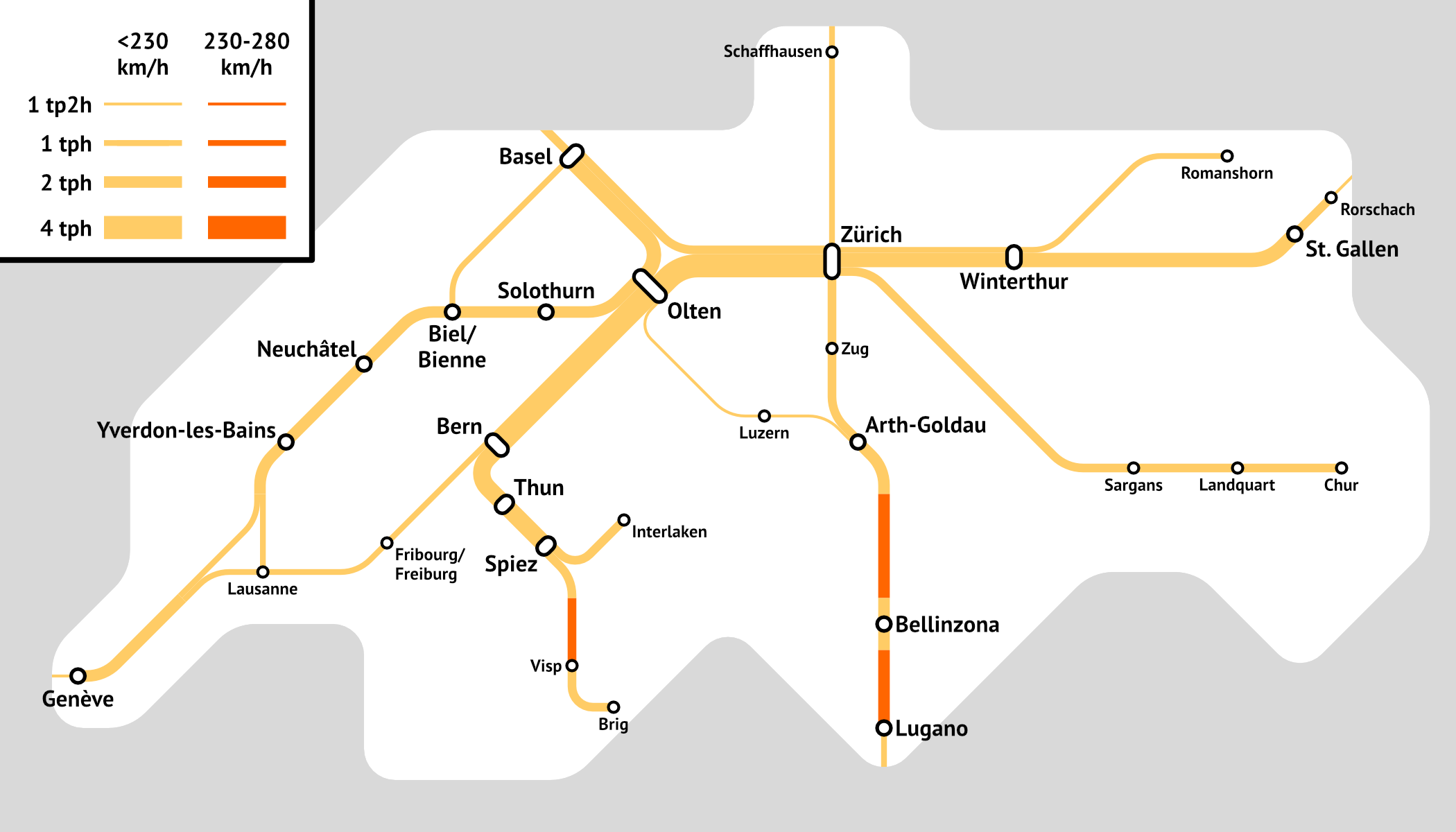
The orange segments are Alpine base tunnels, with extensive freight rail. The main high-cost investment in passenger-dedicated rail in Switzerland is not visible on the map, because it was built for 200 km/h to reduce costs: Olten-Bern, with extensive tunneling as well as state-of-the-art ETCS Level 2 signaling permitting 110 second headways. The Swiss rail network is centered not on one central point but on a Y between Zurich, Basel, and Bern, and the line was built as one of the three legs of the Y, designed to speed up Zurich-Bern and Basel-Bern trains to be just less than an hour each, to permit on-the-hour connections at all three stations.
By this comparison, HSL Zuid should not have been built this way. It is not useful for a domestic network designed around regular clockface frequencies and timed connections, in the Netherlands as much as in Switzerland. There is little interest in further 300 km/h domestic lines – any further proposals for increasing speeds on domestic trains are at 200 km/h, and as it is the domestic trains only go 160. In a country this size, so much time is spent on station approaches that the overall benefit of high top speed is reduced. Indeed, from Antwerp to Amsterdam, Eurostar trains take 1:20 over a distance of 182 km, an average speed comparable to the fastest classical lines in Europe such as the East Coast Main Line or the Southern Main Line in Sweden. The heavily-upgraded but still legacy Berlin-Hamburg line averages about 170 km/h when the trains are on time, and if German trains ran with Dutch punctuality and Dutch padding it would average 190 km/h.
What about international services?
The fastest trains using HSL Zuid are international, formerly branded Thalys, now branded Eurostar. They are also unfathomably expensive. Where NS’s website will sell me Amsterdam-Antwerp tickets for around 20€ if I’m willing to chain trips on slow regional trains, or 27€ on intercities doing the trip in 1:37 with one transfers, Eurostar charges 79-99€ for this trip when I look up available trains in mid-August on a weekday. For reference, the average domestic TGV trip over this distance is around 18€ and the average domestic ICE trip is around 22€. It goes without saying that the line is underused by international travelers – the fares are prohibitive.
Beyond Antwerp, the other problem is that Belgium has built HSL 1 from the French border to Brussels, HSL 2 and 3 from Leuven to the German border, and HSL 4 from Antwerp to the Dutch border, but has not bothered building a fast line between Brussels and Antwerp (or Leuven). The 46 km line between Brussels South and Antwerp Central takes 46 minutes by the fastest train. A 200 km/h high-speed line would do the trip in about 20, skipping Brussels Central and North as the Eurostars do.
But what if the fares were more reasonable and if Belgian trains weren’t this slow? Then, we would expect to see a massive increase in ridership, since the line would be connecting Amsterdam with Brussels in 1:40 and Paris in slightly more than three hours, with fares set at rates that would get the same ridership seen on domestic trains. The line would get much higher ridership.
And yet the trip time benefits of 300 km/h on HSL Zuid over 250 km/h are only 3 minutes. While much of the line is engineered for 300, the line is really two segments, one south of Rotterdam and one north of it, totaling 95 km of 300 km/h running plus extensive 200 and 250 km/h connections, and the total benefit to the higher top speed net of acceleration and deceleration time is only about 3 minutes. The total benefit of 300 km/h relative to 200 km/h is only about 8 minutes.
Two things are notable about this geography. The first is that the short spacing between must-serve stations – Amsterdam, Schiphol, Rotterdam, Antwerp – means that trains never get the chance to run fast. This is partly an artifact of Dutch density, but not entirely. England is as dense as the Netherlands and Belgium, but the plan for HS2 is to run nonstop trains between London and Birmingham, because between them there is nothing comparable in size or importance to Birmingham. North Rhine-Westphalia is about equally dense, and yet trains run nonstop between Cologne and Frankfurt, averaging around 170 km/h despite extensive German timetable padding and a slow approach to Cologne on the Hohenzollernbrücke.
The second is that the Netherlands is not a country of big central cities. Randstad is a very large metropolitan area, but it is really an agglomeration of the separate metro areas for Amsterdam, Rotterdam, the Hague, and Utrecht, each with its own set of destinations. The rail network needs to serve this geography with either direct trains or convenient transfers to all of the major centers. HSL Zuid does not do that – it has an easy transfer to the Hague at Rotterdam, but connecting to Utrecht (thus with the half of the Netherlands that isn’t Holland) is harder.
In retrospect, the Netherlands should have built more 200 and 250 km/h lines instead of building HSL Zuid. It could have kept the higher speed to Rotterdam but then built direct Rotterdam-Amsterdam and Rotterdam-Utrecht lines topping at 200 km/h, using the lower top speed to have more right-of-way flexibility to avoid tunnels. Separate trains would be running from points south to either Amsterdam or Utrecht, and fares in line with those of domestic trains would keep demand high enough that the frequency to both destinations would be acceptable.
In contrast, 300 km/h lines, if there are no slow segments like Brussels-Antwerp in their midst and if fares are reasonable, can be successful, if the single-core cities served are larger and the distances between stations are longer. The distances do not need to be as long as on some LGVs, with 400 km of nonstop running between Paris and Lyon – on a 100 km nonstop line, such as the plans for Hanover-Bielefeld including approaches or just the greenfield segment on Hamburg-Hanover, the difference between 200 and 300 km/h is 9 minutes, so about twice as much as on HSL Zuid and HSL 4 relative to their total length. This works, because while western Germany is dense much like the Netherlands, it is mostly a place of larger city cores separated by greater distances. The analogy to HSL Zuid elsewhere in Europe is as if Germany decided to build a line to 300 km/h standards internally to the Rhine-Ruhr region, or if the UK decided to build one between Liverpool and Manchester.
The Hamburg-Hanover High-Speed Line
A new high-speed line (NBS) between Hamburg and Hanover has received the approval of the government, and will go up for a Bundestag vote shortly. The line has been proposed and planned in various forms since the 1990s, the older Y-Trasse plan including a branch to Bremen in a Y formation, but the current project omits Bremen. The idea of building this line is good and long overdue, but unfortunately everything about it, including the cost, the desired speed, and the main public concerns, betray incompetence, of the kind that gave up on building any infrastructure and is entirely reactive, much like in the United States.
The route, in some of the flattest land in Germany, is a largely straight new high-speed rail line. Going north from Hanover to Hamburg, it departs somewhat south of Celle, and rejoins the line just outside Hamburg’s city limits in Meckelfeld. The route appears to be 107 km of new mainline route, not including other connections adding a few kilometers, chiefly from Celle to the north. An interactive map can be found here; the map below is static, from Wikipedia, and the selected route is the pink one.

For about 110 km in easy topography, the projected cost is 6.7 billion € per a presentation from two weeks ago, which is about twice as high as the average cost of tunnel-free German NBSes so far. It is nearly as high as the cost of the Stuttgart-Ulm NBS, which is 51% in tunnel.
And despite the very high cost, the standards are rather low. The top speed is intended to be 250 km/h, not 300 km/h. The travel time savings is only 20 minutes: trip times are to be reduced from 79 minutes today to 59 minutes. Using a top speed of 250 km/h, the current capabilities of ICE 3/Velaro trains, and the existing top speeds of the approaches to Hamburg and Hanover, I’ve found that the nonstop trip time should be 46 minutes, which means the planned timetable padding is 28%. Timetable padding in Germany is so extensive that trains today could do Hamburg-Hanover in 63 minutes.
As a result, the project isn’t really sold as a Hamburg-Hanover high-speed line. Instead, the presentation above speaks of great trip time benefits to the intermediate towns with local stops, Soltau (population: 22,000) and Bergen (population: 17,000). More importantly, it talks about capacity, as the Hamburg-Hanover line is one of the busiest in Germany.
As a capacity reliever, a high-speed line is a sound decision, but then why is it scheduled with such lax timetabling? It’s not about fitting into a Takt with hourly trip times, first of all because if the top speed were 300 km/h and the padding were the 7% of Switzerland, the Netherlands, and Sweden then the trip time would be 45 minutes, and second of all because Hamburg is at the extremity of the country and therefore it’s not meaningfully an intercity knot that must be reached on the hour.
Worse, the line is built with the possibility of freight service. Normal service is designed to be passenger-only, but in case of disruptions on the classical line, the line is designed to be freight-ready. This is stupid: it’s much cheaper to invest in reliability than to build a dual-use high-speed passenger and freight line, and the one country in the world with both a solid high-speed rail network and high freight rail usage, China, doesn’t do this. (Italy builds its high-speed lines with freight-friendly standards and has high construction costs, even though its construction costs in general, e.g. for metro lines or electrification, are rather low.)
Cross-Border Rail and the EU’s Learned Helplessness
I’m sitting on a EuroCity train from Copenhagen back to Germany. It’s timetabled to take 4:45 to do 520 km, an average speed of 110 km/h, and the train departed 25 minutes late because the crew needed to arrive on another train and that train was late. One of the cars on this train is closed due to an air conditioner malfunction; Cid and I rode this same line to Copenhagen two years ago and this also happened in one direction then.
This is a line that touches, at both ends, two of the fastest conventional lines in Europe, Stockholm-Malmö taking 4:30 to do 614 km (136 km/h) and Berlin-Hamburg normally taking 1:45 to do 287 km (164 km/h) when it is on time. This contrast between good lines within European member states, despite real problems with the German and Swedish rail networks, and much worse ones between them, got me thinking about cross-border rail more. Now, this line in particular is getting upgraded – the route is about to be cut off when the Fehmarn Belt Line opens in four years, reducing the trip time to 2:30. But more in general, cross-border and near-border lines that slow down travel that’s otherwise decent on the core within-state city pairs are common, and so far there’s no EU action on this. Instead, EU action on cross-border rail shows learned helplessness of avoiding the only solution for rail construction: top-down state-directed infrastructure building.
The upshot is that there is good cross-border rail advocacy here, most notably by Jon Worth, but because EU integration on this matter is unthinkable, this advocacy is forced to treat the railroads as if they are private oligopolies rather than state-owned public services. Jon successfully pushed for the incoming EU Commission of last year to include passenger rights in its agenda, to deal with friction between different national railroads. The issue is that SNCF and DB have internal ways of handling passenger rights in case of delays, due to domestic pressure on the state not to let the state railroad exploit its users, and they are not compatible across borders: SNCF is on time enough not to strand passengers, DB has enough frequency and extreme late-night timetable padding (my connecting train to Berlin is padded from 1:45 to 2:30, getting me home well past midnight) not to strand passengers; but when passengers cross from Germany to France, these two internal methods both fail.
At no point in this discussion was any top-down EU-level coordination even on the table. The mentality is that construction of new lines doesn’t matter – it’s a megaproject and these only generate headaches and cost overruns, not results, so instead everything boils down to private companies competing on the same lines. That the companies are state-owned is immaterial at the EU level – SNCF has no social mission outside the borders of France and therefore in its international service it usually behaves as a predatory monopoly profiteering off of a deliberately throttled Eurostar/Thalys market.
If there’s no EU state action, then the relationship between the operator, which is not part of the state, and the passenger, is necessarily adversarial. This is where the preference for regulations that assume this relationship must be adversarial and aim to empower the individual consumer comes from. It’s logical, if one assumes that there will never be an EU-wide high-speed intercity rail network, just a bunch of national networks with one-off cross-border megaprojects compromised to the point of not running particularly quickly or frequently.
And that is, frankly, learned helplessness on the part of the EU institutions. They take it for granted that state-led development is impossible at higher level than member states, and try to cope by optimizing for a union of member states whose infrastructure systems don’t quite cohere. Meanwhile, at the other end of the Eurasian continent, a continental-scale state has built a high-speed rail network that at this point has higher ridership per capita than most European states and is not far behind France or Germany, designed around a single state-owned network optimized for very high average speeds.
This occurs at a time when support for the EU is high in the remaining member states. There’s broad understanding that scale is a core benefit of the union, hence the regulatory harmonization ensuring that products can be shipped union-wide without cross-border friction. But for personal travel by train, these principles go away, and friction is assumed to only comprise the least important elements, because the EU institutions have decided that solving the most important ones, that is speed and frequency, is unthinkable.
The Northeast Corridor Report is Out
Here is the link. If people have questions, please post them in comments and I’ll address; see also Bluesky thread (and Mastodon but there are no questions there yet).
Especial thanks go to everyone who helped with it – most of all Devin Wilkins for the tools, analysis, and coding work that produced the timetables, which, as the scheduling section says, are the final product as perceived by the passenger. Other than Devin, the other members of the TCP/TLU program at Marron gave invaluable feedback, and Elif has done extensive work with both typesetting and managing the still under-construction graphical narrative we’re about to do (expected delivery: mid-June). Members of ETA have looked over as well, and Madison and Khyber nitpicked the overhead electrification section in infrastructure investment until it was good. And finally, Cid was always helpful, whether with personal support, or with looking over the overview as a layperson.
Against State of Good Repair
We’re releasing our high-speed rail report later this week. It’s a technical report rather than a historical or institutional one, so I’d like to talk about a point that is mentioned in the introduction explaining why we think it’s possible to build high-speed rail on the Northeast Corridor for $17 billion: the current investment program, Connect 2037, centers renewal and maintenance more than expansion, under the moniker State of Good Repair (SOGR). In essence, megaprojects have a set of well-understood problems of high costs and deficient outcomes, behind-the-scenes maintenance has a different set of problems, and SOGR combines the worst of both worlds and the benefits of neither. I’ve talked about this before in other contexts – about Connecticut rail renewal costs, or leakage in megaproject budgeting, or the history of SOGR on the New York City Subway, or Northeast Corridor catenary. Here I’d like to synthesize this into a single critique.
What is SOGR?
SOGR is a long-term capital investment to bring all capital assets into their expected lifespan and maintenance status. If a piece of equipment is supposed to be replaced every 40 years and is currently over 40, it’s not in good repair. If the mean distance between failures falls below a certain prescribed level, it’s not in good repair. If maintenance intervals grow beyond prescription, then the asset to be maintained is not in good repair. In practice, the lifespans are somewhat conservative so in practice a lot of things fall out of good repair and the system keeps running. The upshot is that because the maintenance standards are somewhat flexible, it’s easy to defer maintenance to make the system look financially healthier, or to deal with an unexpected budget shortfall.
Modern American SOGR goes back to the New York subway renewal programs of the 1980s and 90s, which worked well. The problem is that, just as the success of one infrastructure expansion tempts the construction of other, less socially profitable ones, the success of SOGR tempted agencies to justify large capital expenses on SOGR grounds. In effect, what should have been a one-time program to recover from the 1970s was generalized as a way of doing maintenance and renewal to react to the availability of money.
Megaprojects and non-megaprojects
In practice, what defines a megaproject is relative – a 6 km light rail extension is a megaproject in Boston but not in Paris – and this also means that they are not easy to locally benchmark, or else there would be many like them and they would be more routine. This means that megaprojects are, by definition, unusual. Their outcome is visible, and this attracts high-profile politicians and civil servants looking to make their mark. Conversely, their budgeting is less visible, because what must be included is not always clear. This leads to problems of bloat (this is the leakage problem), politicization, surplus extraction, and plain lying by proponents.
Non-megaprojects have, in effect, the opposite set of problems. Their individual components can be benchmarked easily, because they happen routinely. A short Paris Métro extension, a few new infill stations, and a weekend service change for track renewal in New York are all examples of non-megaprojects. These are done at the purely professional level, and if politicians or top managers intervene, it’s usually at the most general level, for example the institution of Fastrack as a general way of doing subway maintenance, and that too can be benchmarked internally. In this case, none of the usual problems of megaprojects is likely. Instead, problems occur because, while the budgeting can be visible to the agency, the project itself is not visible to the general public. If an entire new subway line’s construction fails and the line does not open, this is publicly visible, to the embarrassment of the politicians and agency heads who intended to take credit for it. In contrast, if a weekend service change has lower productivity than usual, the public won’t know until this problem has metastasized in general, by which point the agency has probably lost the ability to do this efficiently.
And to be clear, just as megaprojects like new subway lines vary widely in their ability to build efficiently, so do non-megaproject capital investments vary, if anything even more. The example I gave writing about Connecticut’s ill-conceived SOGR program, repeated in the high-speed rail report, is that per track- or route-km the state spends in one year about 60% as much as what Germany spends on a once per generation renewal program, to be undertaken about every 35 years. Annually, the difference is a factor of about 20. New York subway maintenance has degraded internally over time, due to ever tighter flagging rules, designed for worker protection, except that worker injuries rose from 1999 to the 2010s.
The Transit Costs Project
The goal of the Transit Costs Project is to use international benchmarking to allow cities to benefit from the best of both worlds. Megaprojects benefit from public visibility and from the inherent embarrassment to a politician or even a city or state that can’t build them: “New York can’t expand the subway” is a common mockery in American good-government spaces, and people in Germany mock both Bavaria for the high costs and long timeline of the second Munich S-Bahn tunnel and Berlin for, while its costs are rather normal, not building anything, not even the much-promised tram alternatives to the U-Bahn. Conversely, politicians do get political capital from the successful completion of a megaproject, encouraging their construction, even when not socially profitable.
Where we come in is using global benchmarking to remove the question marks from such projects. A subway extension may be a once in a generation effort in an American city, but globally it is not, and therefore, we look into how as much of the entire world as we can see into does this, to establish norms. This includes station designs to avoid overbuilding, project delivery and procurement strategies, system standards, and other aspects. Not even New York is as special as it thinks it is.
To some extent, this combination of the best features of both megaprojects and non-megaprojects exists in cities with low construction costs. This is not as tautological as it sounds. Rather, I claim that when construction costs are low, even visible extensions to the system fall below the threshold of a megaproject, and thus incremental metro extensions are built by professionals, with more public visibility providing a layer of transparency than for a renewal project. This way, growth can sustain itself until the city runs out of good places to build or until an economic crisis like the Great Recession in Spain makes nearly all capital work stop. In this environment, politicians grow to trust that if they want something big built, they can just give more money to more of the same, serving many neighborhoods at once.
In places with higher costs, or in places that are small enough that even with low costs it’s rare to build new metro lines, this is not available. This requires the global benchmarking that we use; occasionally, national benchmarking could work, in a country with medium costs and low willingness to build (for example, Germany), but this isn’t common.
The SOGR problem
If what we aim to do with the Transit Costs Project is to combine the positive features of megaprojects and non-megaprojects, SOGR does the exact opposite. It is conceived as a single large program, acting as the centerpiece of a capital plan that can go into the tens of billions of dollars, and is therefore a megaproject. But then there’s no visible, actionable, tangible promise there. There is no concrete promise of higher speed or capacity. To the extent some programs do have such a promise, they are subsumed into something much bigger, which means that failing to meet standards on (say) elevator reliability can be excused if other things are said to go into a state of good repair, whatever that means to the general public.
Thus, SOGR invites levels of bloat going well beyond those of normal expansion megaprojects. Any project can be added to the SOGR list, with little oversight – it isn’t and can’t be locally benchmarked so there is no mid-career professional who can push back, and conversely it isn’t so visible to the general public that a general manager or politician can push back demanding a fixed opening deadline. For the same reason, inefficiency can fester, because nobody at either the middle or upper level has the clear ability to demand better.
Worse, once the mentality of SOGR is accepted, more capital projects, on either the renewal side or the expansion side, are tied to it, reducing their efficiency. For example, the catenary on the Northeast Corridor south of New York requires an upgrade from fixed termination/variable tension to auto-tension/constant tension. But Amtrak has undermaintained the catenary expecting money for upgrades any decade now, and now Amtrak claims that the entire system must be replaced, not just the catenary but also the poles and substations. The language used, “the system is falling apart” and “the system is maintained with duct tape,” invites urgency, and not the question, “if you didn’t maintain this all this time, why should we trust you on anything?”. With the skepticism of the latter question, we can see that the substations are a separate issue from the catenary, and ask whether the poles can be rebuilt in place to reduce disruption, to which the vendors I’ve spoken with suggested the answer is yes using bracing.
The Connecticut track renewal program falls into the same trap. With no tangible promise of better service, the state’s rail lines are under constant closures for maintenance, which is done at exceptionally low productivity – manually usually, and when they finally obtained a track laying machine recently they’ve used it at one tenth its expected productivity. Once this is accepted as the normal way of doing things, when someone from the outside suggests they could do better, like Ned Lamont with his 30-30-30 proposal, the response is to make up excuses why it’s not possible. Why disturb the racket?
The way forward
The only way forward is to completely eliminate SOGR from one’s lexicon. Big capital programs must exclusively fund expansion, and project managers must learn to look with suspicion on any attempt to let maintenance projects piggyback on them.
Instead, maintenance and renewal should be budgeted separately from each other and separately from expansion. Maintenance should be budgeted on the same ongoing basis as operations. If it’s too expensive, this is evidence that it’s not efficient enough and should be mechanized better; on a modern railroad in a developed country, there is no need to have maintenance of way workers walk the tracks instead of riding a track inspection train or a track laying machine. With mechanized maintenance, inventory management is also simplified, in the sense that an entire section of track has consistent maintenance history, rather than each sleeper having been installed in a different year replacing a defective one.
Renewal can be funded on a one-time basis since the exact interval can be fudged somewhat and the works can be timed based on other work or even a recession requiring economic stimulus. But this must be held separate from expansion, again to avoid the Connecticut problem of putting the entire rail network under constant maintenance because slow zones are accepted as a fact of life.
The importance of splitting these off is that it makes it easier to say “no” to bad expansion projects masquerading as urgent maintenance. No, it’s not urgent to replace a bridge if the cost of doing so is $1 billion to cross a 100 meter wide river. No, the substations are a separate system from the overhead catenary and you shouldn’t bundle them into one project.
With SOGR stripped off, it’s possible to achieve the Transit Costs Project goal of combining the best rather than the worst features of megaprojects and non-megaprojects. High-speed rail is visible and has long been a common ask on the Northeast Corridor, and with the components split off, it’s possible to look into each and benchmark to what it should include and how it should be built. Just as New York is not special when it comes to subways, the United States is not special when it comes to intercity rail, it just lags in planning coordination and technology. With everything done transparently based on best practices, it is indeed possible to build this on an expansion budget of about $17 billion and a rounding-error track laying machine budget.
 Pedestrian Observations