The Scope and Future of Our Project on Costs

I was on a panel at Eno’s symposium on costs, talking with other teams investigating comparative construction costs. We worked off a list of questions Eno’s Robert Puentes had sent us before, knowing that the list was too long for five people (me, Eric, Laura Tolkoff, Ethan Elkind, Romic Aevaz) to cover in an hour. So for more completeness, here are my responses – and pay attention specifically to issues of scope and what we should be doing in the future. In particular, as we’re getting funded to do other things, we will likely have room in the budget to add a few more cases, and hire people who can put them together.

What were your key takeaways on the extent of our cost premium, and key cost drivers?

I blogged this just before the panel. The only major headers I’ll add are poor interagency coordination in the United States, especially for projects that are or touch commuter rail, and a political system full of real and imagined veto points. The imagined veto points are not unique to the US – the UK, Germany, and the Netherlands all have visible problems with excessive tunneling on high-speed rail projects coming from NIMBY demands, NIMBY demands that at least in the first two cases are paper tigers that the state can ignore if it doesn’t mind a few news cycles with negative headlines.

Questions on scope

There were three separate questions on this, since our approaches differ – Eno has more cases covered in less depth (and we made sure to pick disjoint comparison cases from theirs), Berkeley focuses on California projects. So we went through questions about what our respective scopes and limitations are:

  1. Could you walk us through the general scope and bounds of your work?
  2. What were some of the limitations you ran into when collecting information on costs/timeline, and what recommendations would you have to improve data reporting for projects?
  3. What are some of the lingering questions or areas for future study that your teams have flagged?

The answer to all three is that our scope – the six cases – looks at specific issues rather than general ones. The forest comprises trees and cannot be studied as an ecosystem until one understands the biology of the tree species therein. But then, understanding the biology of the tree species requires understanding the ecosystem they have evolved in; the reason we do cases simultaneously is that hearing about issues arising in one place informs our work on other places.

That said, I think it matters that none of our six cases is typical. Medium-cost environments like France, Germany, and Japan are unfortunately not in scope; I’ve read a lot of work on cot issues plaguing Grand Paris Express, but unfortunately not in any global or even just European comparative sense. All of our cases are Western (for infrastructure purposes Turkey is a Western country); this matters because, while European and East/Southeast Asian costs are broadly the same, both covering the entire global range short of American costs, there are notable differences in how they build, so it’s plausible that there re things one side does right that the other doesn’t in both directions. All of our cases are first-world or, in Istanbul’s case, 1.5th-world.

This means that we would like to add cases. Attractive targets include anything in Spain, to beef up our set of low-cost examples, and then cases that represent examples we didn’t study, that is places that are medium-cost, non-Western, or not in or in the penumbra of the developed world. My suspicion is that medium-cost examples will interpolate practices – Germany and France both vaguely appear to mix good Scandinavian or Southern European behavior with bad British and American behavior, each in its own way. But I do not know and that’s why we’d like to add cases. In middle-income countries like Russia, Mexico, Brazil, and China, and in low-income ones like India or the Philippines, I do not really know what to expect and my only explanation so far is completely different from any first-world pattern.

We should have a budget for this, but I don’t yet know how many cases we can juggle in addition to where we’re going to shift the main of our attention starting in early 2022, that is high-speed rail and a synthesis for the Northeast Corridor. Most likely other people will write the cases (for pay of course) and we will supervise in between looking at the history and technical data of the Northeast Corridor.

Consensus and Costs

I’m in the middle of an online symposium at Eno about construction costs; I talked on Tuesday and I think there will be a recording made available later. The conference is good by a lot of standards, including the “do they tell me things I don’t know about costs” standard. But for now, I want to address one point made repeatedly in interviews re some low-cost cities: the argument from consensus. It’s wrong, and leads to very wrong conclusions.

What is the argument from consensus?

In Eno’s lowest-cost comparison cities, like Madrid, there’s political consensus in favor of building more subways. Repeated panels gave this example of how in the 1990s and 2000s, PP and PSOE both supported subway construction and promised to build more in their election campaigns for the Community of Madrid. PSOE in fact attacked PP saying its proposals were unrealistically ambitious, but then the Madrid Metro expansion opened as planned. In such a political environment, no wonder planners had leeway to build the system without much interference.

Why is this wrong?

Britain has bipartisan political consensus in favor of both Crossrail and High Speed 2, both of which are explicitly supported in both parties’ manifestos. Its construction costs are still Europe’s highest.

More to the point, the United States is not uniformly an environment where public transportation is a partisan flashpoint, because in most of the cities that build subways, the Republican Party does not exist. The closest thing to a Republican Party in New York is the Manhattan Institute, which criticizes unions incessantly but does not call for ending public support for the subway and refrains from making the anti-transit arguments made by national Republican outfits like Reason and Cato. The last Republican mayor, Rudy Giuliani [sic], tried to expand the subway to LaGuardia. I’ve met New Yorkers who view Giuliani as a savior and who are ant-immigration climate denialists and thy too think the city and state should make the subway better – if anything they treat its poor state as evidence that the Democrats can’t govern.

This consensus does not lead to low costs. Why would it? There is no respect for planners or engineers. The consensus in New York means every governor installs their political cronies at the head of the agencies involved. None of the mechanisms that make Madrid Metro work is present.

The consequences

Just having more political support for subway construction is not going to by itself make things better. American states where investment is safe from cancellation do not do better than ones where one election could spell doom for the investment program. Sea changes are required, not just more public support.

Quick Update on Where We are on New York Costs

The New York report is still a few months to go (the next ones to release on our list will be Istanbul and Italy), but from interviews, we can get a rough estimate of where the problems are. I want to stress rough and there are still extra sanity checks we need to do, both locally to New York and in comparisons. But a picture of the breakdown of what’s going wrong is starting to emerge.

Procurement

Procurement issues roughly double costs. This includes everything related to contracting, including the change order regime, the lack of competition between contractors for large projects, the qualify-to-bid system, risk compensation by contractors, and so on.

This is not quite the same as the change order problem seen in California, where Tutor Perini infamously bids low and overcharges on change orders; New York has regulations to prevent that, but the cure is sometimes worse than the disease. Overspecified contracts reduce flexibility and increase costs; normal design-bid-build systems let the building contractors make small modifications based on meter-scale geology and short-term changes in material prices, but New York is inflexible. The design-build solution is more flexible but removes a layer of public oversight and increases private-sector risk, so costs do not go down.

There is a blacklisting system, called disbarment, but it’s too onerous and goes further than just finding repeat offenders like Tutor and blacklisting them, so contractors bid higher to avoid the appearance of cost overrun. Some of this is not seen in Second Avenue Subway – disbarment is a Cuomo policy that was not present then, and must therefore be seen as part of the per-km cost increase from phase 1 to phase 2 even though phase 2 is easier.

Utilities

Roughly everyone involved in infrastructure construction in New York has told us some variation of the story that New York has complex underground utilities and getting around them is a challenge. This is not exactly what is going on – there’s stuff underground in Paris too – but is correct on the level of agency turf battles. All of the following problems are institutional, coming from our sources:

  • Utilities such as Con Ed and DEP don’t maintain up-to-date databases of what’s precisely down there, so every time there’s a project, there’s a surprise, like an electric cable that was laid around the footprint of a car that was parked during construction rather than moving as it was supposed to.
  • The knowledge that the utilities have is closely-guarded because who is the MTA to tell them to divulge secret information like where the pipes are?
  • The MTA doesn’t run interference for its own contractors, so the contractors are on their own when dealing with the utilities, not just for underground work but also routine things like elevator installation and elevated station repairs.
  • The utilities demand that their own workers supervise changes to their infrastructure. There is no state- or city-level coordination of infrastructure construction and maintenance.
  • The utilities use subway capital money as OPM for their own wishlists for larger pipelines and upgraded infrastructure.

Finally, there is a fear-itself problem: dealing with utility relocation is so painful that the MTA avoids it even when doing so would be cheaper than digging deeper. I cannot give a precise estimate for the impact of utilities writ large, but a factor of 2, counting the fear-itself factor (which is large), is about reasonable.

Labor

Labor productivity in New York is low, and wages are elevated due to the use of local workers (in Stockholm the tunnel workers come from all over Sweden, and wages and benefits are high but somewhat less than in New York). This covers both blue- and white-collar labor: many different agencies, departments, and regulators demand to have their own supervisor down there looking at the work being done.

This is the part where I’m least certain of the impact. The reason is that labor productivity numbers beyond patterns that have been covered amply before are hidden behind layers of subcontracting – there is far less transparency on this in the US than in any other country we have looked at. Moreover, management-labor relations are so strained that planner interviews are not a perfectly reliable source; figuring out how much of the overstaffing problem was about too many white-collar supervisors and not just sandhogs took a while.

The impact of labor is best explained as, US infrastructure breaks down as 40-50% labor, vs. 20% in Turkey; I don’t have a breakdown in Sweden yet, where wages are high but labor efficiency is very high to reduce costs. In isolation, some labor costs scale with everything else. For example, contractor risk is added as an overhead on top of everything and is not part of the breakdown between labor, materials, and equipment. Likewise, delays induced by unexpected utilities require paying overtime during the wait, so labor costs scale to some extent. However, using the wrong material because the contract micromanaged what the contractors could use would be seen as material costs.

Design issues

Design is clearly an important factor but is even harder to quantify than labor. This does not include the preference for mined stations over cut-and-cover stations in SAS phase 1 – that was partly fear of utility work – and station costs were at a far larger premium than tunneling. It’s better to look at the project work for the 96th Street station, which was as expensive as the mined 72nd and 86th Street stations, and was an unusually large dig (7 blocks long) due to unusual but understandable geological issues. But even so, the station was costlier than it should have been based on dig volume.

Some design problems are defensive. Two notable ones:

  • TBMs have to work 24/7 to avoid a cave-in. However, due to either real or predicted neighborhood complaints about noise, trucks did not remove the muck overnight. The overnight storage chamber for the muck cost $20 million. I do not know if this made things better; my personal experience in Berlin is that the worst time for truck noise is 6-9 am and this doesn’t help with sleeping.
  • The MTA spent a lot of effort on shoring up a building that was damaged due to ground settlement in construction. The building was subsequently demolished anyway to make room for a taller building for transit-oriented development.

In addition, the speed of tunneling in New York is notably low. I do not know why, nor do I know the net cost impact of it, though at this point I suspect that by itself it’s a secondary issue to defensive design; we are investigating further.

The biggest question of the impact of design questions is to what extent the mined stations for SAS phase 1 were defensive against community impact (as mentioned by some of our sources) as opposed to utilities work. But, again, phase 2 stations are cut-and-cover except 125th Street, and costs are higher as procurement keeps getting worse.

Fire safety is another aspect. Contrary to what too many New Yorkers have told us, the American fire code in NFPA 130 is not unique to the United States. China uses the same code, as does Turkey; Spain uses a very similar code. However, the interpretation of the code leads to visible scope that does not exist elsewhere, including full-length mezzanines and obtrusive ventilation structures.

Everything together

Procurement and utilities together explain a factor of 4 cost difference. The rest is more hazily estimates; labor gets us to a factor of 5-6 (and it will get more precise in the next few months). Design is the big question mark of whether we can promise a factor of 7 or 15 reduction in costs.

Second Avenue Subway is a factor of 7-8 too expensive relative to the global average, but the global average isn’t necessarily the baseline – much of it includes Anglosphere subway with some of the same problems as New York, and non-Anglo examples near the average, such as Paris, have their own visible problems with costs by comparison with lower-cost examples. The baseline is not the lowest-cost places either – they tend to do unique things like building very short platforms (though Stockholm and some of the extensions in Italy clock at 140 meters to New York’s 180, and Istanbul has lines at 180). But a baseline around $150 million/km is reasonable to aim for. So a factor of 15 reduction relative to SAS phase 2 is exactly what we look for, and a factor of 7 still gets New York to be better than Germany and Japan and close to Paris.

So we’re getting close. Not quite there yet – but something that looks like an actionable recipe, provided reasonably competent political leadership looks achievable.

Express Rail Tunnels and Regional Rail Capacity

In three cities that I know of, there are plans to deal with an incipient regional rail capacity crunch by building a new tunnel: Tel Aviv, Hamburg, London. The route in question in all cities already has regional rail service making frequent urban stops as well as longer-distance intercity trains. Setting Tel Aviv aside – new tracks are not necessary there at all – both Hamburg and London have a choice of what to build in the tunnel. In both cases, the answer must be intercity rail and not regional rail. This affects Crossrail 2 in London, currently shelved but still in active planning, as well as plans for Hamburg Hauptbahnhof-Altona capacity improvements.

The dominant factor in the cost of an expensive urban railway in a constrained environment is the stations. Low-cost countries build very cheap stations, but that’s true in outlying areas, urban as they may be, and not in city center areas under and around older subways. What’s more, Britain and Germany are not low-cost countries. German costs are somewhat higher than the global median, British costs among the world’s highest. Thus, keeping down station costs is paramount – and express tunnels have fewer stations than local tunnels.

Normally, the express vs. local issue is not relevant to a new urban rail line. Yes, more stations are more expensive, but on a line designed to open up service to a new area, more stations also provide more access, so the extra cost is often worth it. This is true even for urban subways that act as relief lines, like Second Avenue Subway, a relief line for the Lexington Line: more stations provide better local access and therefore increase the line’s relief value.

However, when the problem comes from regional or longer-distance capacity, all of this goes out the door. Crossrail 2 includes a long tunnel from Central London all the way to Wimbledon not because of purely local needs but because of very high rail usage along the South West Main Line. In Hamburg the problem is similarly about the main line between Hauptbahnhof and Altona – local traffic is saturated on the S-Bahn, and all other trains have to squeeze on the remaining two tracks of the Verbindungsbahn. Thus, capacity expansion should involve a tunnel with the fewest number of stations, on the most express services.

And yet both cities are doing it wrong. Hamburg is planning an S-Bahn tunnel, with the existing S-Bahn route then given over to regional trains, to be segregated away from the intercity trains. But there are already two Hauptbahnhof-Altona S-Bahn routes – that’s not where the service need is. Instead, new tunnels should go between the stations without stopping, to reduce costs, hosting intercity trains while regional trains take over the existing intercity tracks.

London is likewise planning on an undulating connection between Clapham Junction and Wimbledon, with links to other parallel north-south lines in the area. This is not good planning – those new stations are inordinately expensive and not needed for network connectivity. If there is no way to six-track the South West Main Line above-ground by replacing the sloped berm with retaining walls, it’s the fastest trains that should go underground, to save money on stations. Crossrail 2 is a £31.2 billion project; I don’t think Paris has spent this money on all Métro and RER lines in the region to date combined, and Grand Paris Express, at a broadly similar cost, includes 160 km of tunnel. It’s necessary to economize and build the tunnels that are necessary, and not the ones London would like to have.

Rapid Transit as an Amenity

An urban rapid transit system needs to be understood as both a consumption amenity and a production amenity. As a consumption amenity, it lets people have access to more of the city, for work as well as recreational travel; people pay a premium to live close to the subway. As a production amenity, it makes it easier to build dense office clusters and expect that people can get to work without too much traffic; businesses pay a premium to locate in city center. This means that such infrastructure is generally good for the city’s economy and the well-being of the people in it, without prominent distributional impact.

City center and rapid transit

I wrote a thread two years ago about CBD job concentration. The thread looks at the total number of jobs in the central 100 km^2 of a metro area, which figure is used because it’s about the land area of Paris plus La Défense and INSEE data only exists at the level of the commune or arrondissement (see for example here). Pointing out that Dallas and Atlanta’s central 100 km^2 have only about as many jobs as Vancouver’s and half as many as San Francisco’s, I talked about the need to build bigger CBDs to entice higher transit ridership.

This looks weird to people who immediately associate European cities with short buildings and polycentricity and American ones with tall buildings and monocentricity. But at the scale of 100 km^2, European cities are far more centralized. Paris has 2.2 million jobs in the central 100 km^2, the Bay Area 850,000, Dallas and Atlanta 400,000 each.

And as I threaded about this, it was pointed out to me that Dallas does not have very strong demand for office space in city center. Parisian commercial rents in the 8th are very high, indicating demand for taller buildings than Europeans find acceptable; Texan commercial rents in city centers indicate no such pent-up demand, and the Dallas CBD has high vacancy rates. In Los Angeles, the center is weak as well – in a metro region 50% larger than Paris, the most gerrymandered central blob, not at all centered on Downtown Los Angeles but rather reaching from Downtown to Century City and UCLA, has around 800,000 jobs. The highest pent-up demand in Downtown LA is residential and not commercial.

I bring this up because this indicates rapid transit is a strong amenity for producers: they pay a premium to locate in city center, provided a large system exists to feed commuters to their offices. This is the case in New York, Paris, and other transit cities, but notably not in large auto-oriented cities like Los Angeles and Dallas.

…but it’s not just about work

Transit cities are not just places of production. The city is simultaneously a production amenity and a consumption amenity. Pure production amenities, like the quality of the harbor, the location relative to logistics facilities, and the tax rate on businesses, do not draw in people except insofar as they lead to higher wages. But transit cities do draw people in – residential rents are higher where job access is better and even where general access to non-work destinations is better.

This effect happens at several levels. The highest level is the regional one: a transit city is less polluted than an auto-oriented alternative of the same size, and clean air is a consumption amenity. The lowest level is the block: the construction of rapid transit raises property values near stations. In between, there are the benefits of access, which like the regionwide benefits are diffuse; it’s hard to point out an exact set of winners and losers.

This is not just a matter of job access. A transit city is good at access to special amenities, of the type that people do not go to very regularly. Ones that people do go to regularly do not require public transit: an auto-oriented medium-size metropolitan region can perfectly well provide high-quality retail choices with plenty of variety. I don’t recall missing anything at the shopping centers of the French Riviera, nor hearing complaints about same from Americans in similar-size regions.

But once the options get more specialized, size and transit accessibility become important. Los Angeles notably has amazing restaurants from just about every ethnic and regional tradition on the planet and also it takes two hours to drive to them because they’re strewn about five counties with no fast transit options. It’s nothing like New York and Paris, which have plentiful options as well but they’re within 30-60 minutes by train.

Specialized restaurants are a convenient example – they won’t cluster in city center because that’s expensive, but they’d like to be in near-center areas, perhaps in the central 100 or 200 or 500 km^2 but not the central 5 or 10 km^2. But the same issue occurs for everything else: museums, visits to friends throughout the region, etc.

The implication of dual amenities

Rapid transit is annoying to analyze in that it doesn’t break down neatly as for one group or another. It’s incredibly diffuse, and the only definitive interest group that benefits from its existence more than anyone else, the providers, is small and doesn’t always benefit from making it more efficient. There are no distributional impacts to mitigate or take advantage of; the environmental impacts are uniformly positive because of the competition with cars and auto-oriented development; the local benefits of access are real but require building an expansive system with hundreds of stations each generating local benefits in a small radius.

The result is that it bores people who enjoy conflict. There is not much there for the marketer to bite on – transit as a product is optimized when everyone uses it. The upshot of the fact that rapid transit is simultaneously a production amenity and a consumption amenity is that there is nothing there for people who enjoy dwelling on class conflict or on postmaterialist New Left notions of conflict, either. Socialist states have built great transit systems once things have settled down and it’s time to rebuild, but would-be socialist revolutionaries in non-socialist states find it boring. Likewise, New Left green politics is much more interested in pure consumption amenities like bike paths and street redesign than in dual amenities like rapid transit, which also benefits the staid corporations green voters define themselves against. From the other direction, people whose political identity is indifference to the needs of anyone who’s not a business don’t find transit interesting, even though it clearly benefits business, because it doesn’t offer opportunity to engage in right-populist or Thatcherite politicking: it’s possible to run the system like a business, but actually kicking out visibly poor people fragments the market and reduces frequency.

Cost- and Project-Centric Plans

I did a poll on Patreon about cost issues to write about. This is a close second, with 11 votes; other people’s money won with 12, whereas neighborhood empowerment got 8 and will not be on my docket.

There are infrastructure investment programs defined around the specific projects funded: Crossrail, Second Avenue Subway, Grand Paris Express, Nya Tunnelbanan, the Toronto RER, Marmaray. Then there are programs defined around costs, where one constantly hears the project defined by its budget rather than what it produces; these are all in the United States, and include the entire slates of Los Angeles and Seattle rail extensions, and to some extent also California High-Speed Rail and Gateway. The latter appears like bad practice for cost minimization.

What’s the problem?

In isolation, I’d have expected cost-centric plans to be more prudent with the budget – there’s less room for overruns. This is related to Swiss practice, which is project-centric but also requires projects to go to referendum on the precise amount, which has disciplined cost overruns in most cases and also kept absolute costs low. However, the fact of the matter is that the only places that use cost-centric plans have high costs, having recently risen from levels that were not so bad 20 years ago. So why?

My suspicion is leakage. This is getting to be less general and more specific to the situation of California and its sales tax measures, but the way it works is, there is an amount that proponents think they can go to ballot on, and then they work the slate of projects backward. In theory, this is supposed to discipline the planners into better behavior: the amount of money is truly fixed, and if costs go up, it delays the entire program. In practice, there is no prior discipline about what infrastructure should be included, and thus the slate is decided politically on a place-based plan.

Further leakage occurs when buying off additional interest groups. Soon enough, one useful if very expensive subway line, like the Purple Line Extension in Los Angeles or the Ballard-West Seattle LRT, is bundled into a huge program alongside bus operating subsidies, road money, and low-usage lines to lower-density areas.

I can’t prove that this is the result of budget-centric planning. The comparison examples I have – all high-cost, politicized North American projects – exhibit leakage as well, but less of it. The Green Line Extension in Boston had extensive local leakage in the first iteration of the project, like the Somerville Community Path, but it wasn’t paired with less useful infrastructure elsewhere. Second Avenue Subway Phase 1 was paired with East Side Access and the Broadway subway in Vancouver is paired with a SkyTrain extension deeper into Surrey toward Langley; in both cases, the less useful projects are nonetheless more useful on a likely cost per rider basis than any of the American West Coast leakage and compete with the more useful projects. ESA is probably going to end up $60,000/rider, not much worse than GLX and probably about the same as the Purple Line Extension depending on how much transit-oriented development Los Angeles permits.

Place-based extraction

Place-based politics is a scourge and should be eradicated whenever possible. What it does wherever it is not suppressed is create political identification among local and regional power brokers not with the piece of infrastructure but its cost. The reason is that evaluating transportation needs is too technocratic for the attention span of a local politician, whereas the budget is a straightforward measure of one’s importance.

Once local actors are empowered, they make further demands for irrelevant extras (“betterments”), or construction techniques that spend too much money to avoid real or imagined negative local impact. People with a local identity don’t care about public transit much – public transit takes riders to other localities, especially city center, whereas the locally-empowered minority of people who work locally has little use for it and drives everywhere.

Local empowerment is not unique to budget-based infrastructure. It was a major drag on GLX and at least a moderate one on SAS Phase 1, neither of which is budget-based. The Central Subway and BART to San Jose projects are both place-based vanity, for Chinatown and San Jose respectively, but even these projects are smaller in scope than the Los Angeles or Seattle ST3 leakage. There’s just more surface area for it when advocates lead with a budget, because then every local hack sees an opportunity to make a claim.

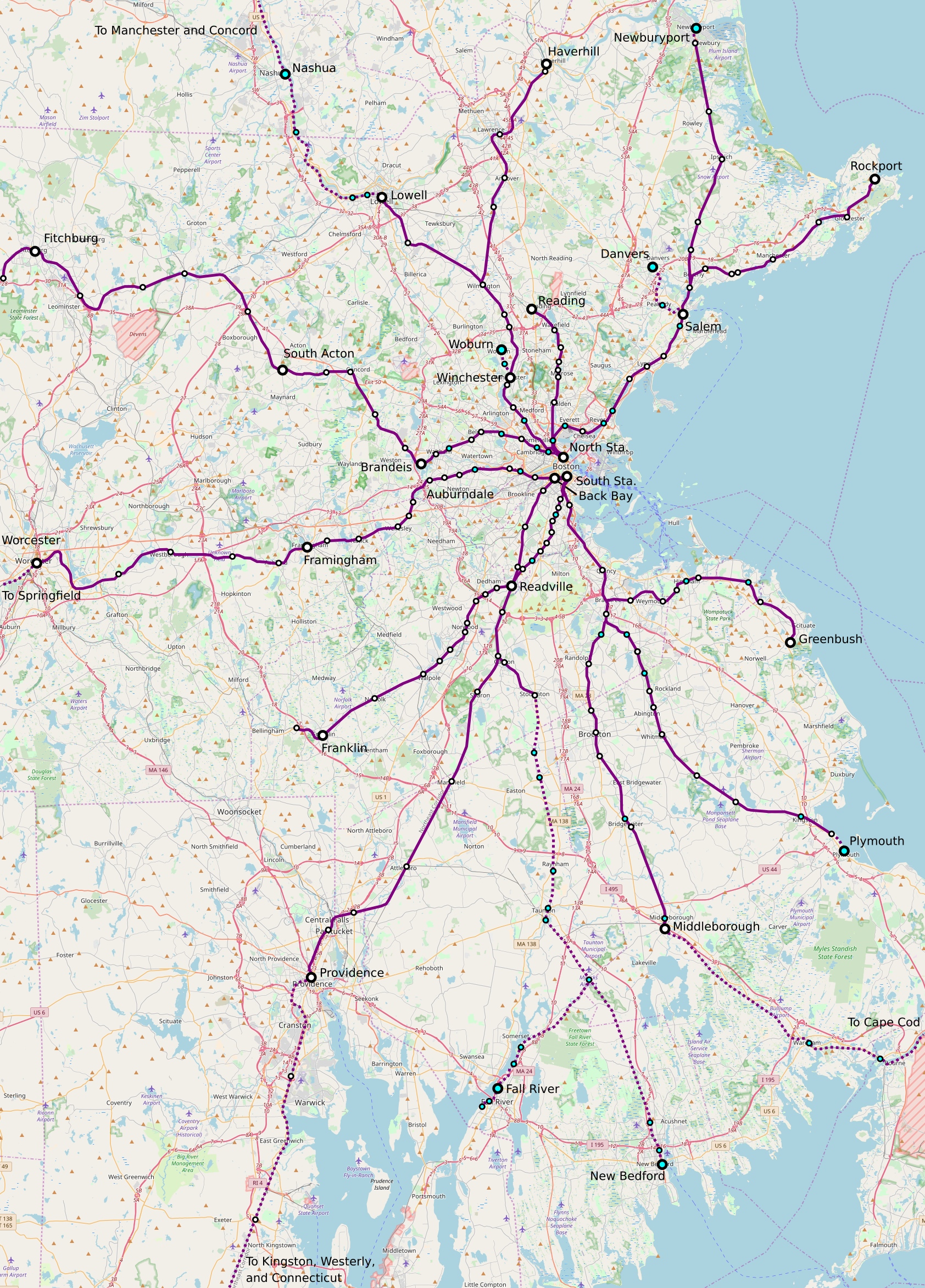
The place-based politics in the Northeast is much broader and more regional: SAS, a city project championed by then-Assembly speaker Sheldon Silver (D-Lower East Side), was balanced with ESA, a suburban project serving the base of Governor George Pataki (R-Peekskill, but the state Republicans were based on Long Island). Metro Vancouver’s place-based extraction follows the same schema: if Vancouver gets a useful SkyTrain extension, Surrey must get an extension too regardless of usefulness. Massachusetts is likely to be in a similar situation with the TransitMatters Regional Rail program: RR serves the entire east of the state, and must be balanced with a Western Massachusetts project, for which we propose the still-useful East-West Rail program connecting Boston and Springfield.

In contrast, the situation in California and metropolitan Seattle is much worse – useful lines in Los Angeles are paired with many layers of leakage, as different groups make claims on the pot of money. This way, Los Angeles doesn’t build as much useful transit as New York and Boston even though its construction costs are comparable to Boston’s and much lower than those of New York, and even though it makes large amounts of money available for transportation by referendum.

Are jobs a cost or benefit?

Like place-based extraction, the use of infrastructure as a jobs program is terrible everywhere in a modern developed country where construction is not a labor-intensive zero-skill job, and should be eradicated. And like place-based extraction, I think – and am less certain than on the other points – there is more surface area for this when the program is about a budget and not a piece of infrastructure.

The mechanism is the same as before: once money becomes available, local labor groups descend on it to make claims. Promises of job creation are thus always local, including beggar-thy-neighboring-state demands for local rolling stock construction. These occur for both budget-based plans (like the Los Angeles light rail fleet) and project-based ones (like the new Red and Orange Line cars for Boston, built in Springfield due to place-based extraction). However, it’s easier to make a claim when the political discussion is about how to spend $X and not how to optimally produce a desired piece of infrastructure.

The way forward

The American West Coast’s problem of budget-based planning is, thankfully, easy to solve, because it’s been solved in other parts of the same country. The Bay Area has less of it than Southern California and the Pacific Northwest (but it’s not free of it – many of the specifics of California High-Speed Rail’s failure come from Bay Area power brokers hoping to use it as a slush fund). The Northeast doesn’t have it at all. Los Angeles is likely to be forced in that direction anyway, because it’s running out of sales tax capacity – the already-approved measures are spoken for through the 2050s.

The impact is likely not a matter of straight construction costs in dollars per kilometer. Rather, it’s about leakage. Los Angeles and Seattle do not have unusually higher per-km costs by American standards; in the 2000s Los Angeles looked like the good part of America and in the 2010s Seattle did, but since both have converged to much higher figures. The problem is that a smaller share of the Los Angeles Measures R and M spending goes to useful expansion than the capital budget in places that have project-based planning. This is what needs to be fixed through transitioning to project-based planning, costs aside.

I Voted, but There’s no YIMBY Politics in Germany

It’s the first time in my life I’m eligible to vote in a national election. I thought it would be faster than it was; the line took 1:10, of which the first 10 minutes were taken standing in the wrong line – there were two precincts at the same physical location. It felt weird, feeling out of place and yet knowing, approximately for the first time in my life (unless one counts the European Parliament election), that I had a right to be there no matter what.

I voted Green, up and down the ballot, which is a vote for prioritizing public transportation over cars and climate protection over coal jobs and cheap Russian natural gas, but is not a YIMBY vote. And there’s the rub: a YIMBY political party does not exist here, and neither does even a YIMBY movement.

YIMBY is not exactly a movement about more development. It’s specifically about development in the most in-demand urban areas, through infill. It’s about aggressive transit-oriented development; when YIMBYs cite a success case, it’s the TOD of Tokyo and Seoul, and to a lesser extent what’s happening in Stockholm (where the term YIMBY originates) and the Paris suburbs, and not the equally fast but exclusively suburban and auto-oriented development in the Austin area.

And this does not exist here. SPD supports building housing in Tempelhofer Feld; the Greens are against it, treating it as common parkland, where in reality the treeless field makes a poor park and is adjacent to actual wooded parks in Kreuzberg and Neukölln. So in that sense SPD is the YIMBYer party – but SPD also built a freeway cutting through Neukölln last decade, going into coalition with CDU rather than with the Greens in order to build it. The Greens, in contrast, oppose freeways and support bike lanes and road diets – but they oppose new housing, want to downscope a proposed high-rise building in Alexanderplatz, and prefer bike lanes and city center tram expansion to extending the U- and S-Bahn.

And there’s the rub. The central tenet of YIMBYism is that cities are predominantly loci of production, and people choose where to move based on work more than anything else; building more housing is the central policy proposal, in recognition that economic production is done predominantly in city centers. And this does not exist, because every political faction that wants to build more housing pairs this with more roads and more peripheral locations for new development. The idea that post-car cities represent growth rather than stagnation does not exist in German politics, at least not yet. People still think of cars as the industrial future, rather than as what people thought the future would be 70 years ago, about as relevant to the world of tomorrow as what people thought of agriculture in the 19th century was in the middle of the 20th. The Greens just want to slow that industrial future down instead of building the information future – and nobody in German politics wants to build that future, the right preferring more cars and more gas.

I suspect there’s room for such YIMBY politics in Germany, cobbled together from the most left-wing fringes of FDP, the younger and less NIMBY Greens, and sundry SPD members. Already, most Green voters in Berlin support Tempelhof redevelopment, albeit at much narrower margins than SPD, FDP, and CDU voters. At the climate march two years ago, I saw a single anti-nuclear sign carried by two older people; new nuclear is out of the question here due to costs, but it matters that younger Greens aren’t animated by Green boomers’ anti-nuclear activism. There was a bigger sign carried by a few people opposing urban development, but it was one sign, not the thousands of generic signs about climate change and many hundreds opposing coal power, oil, and cars. Up the Elbe, younger G/EFA parties like the Czech Pirates are pro-digital.

Good Practices for State Planning and Local Public Transportation

Earlier this week, I complained about the OPM (other people’s money) problem: federal funding of American public transportation, which is managed locally, leads to cost-raising behavior as local and state governments seek to maximize federal infusion of cash. This is a companion post about more positive and fruitful interactions of government at different levels on this side of the Pond. The examples here often look pointless or acrimonious by local standards, but at the end of the day, they produce cost-effective infrastructure and are positive examples to learn from.

Of note, all the examples below are from unitary, not federal states. This is just an artifact of where I have talked to the most people about this – from what I know of Germany, Austria, Switzerland, and Belgium, they all fall within the spectrum spanned by Italy, Turkey, France, and Sweden when it comes to state-local funding allocation. Moreover, the extent of subnational fiscal autonomy in Germany is not greater than that of Sweden, where there are extensive county and municipal taxes funding subnational government, whereas in Germany nearly all taxes are federal and the Länder mostly rely on transfers.

This is a theme I’ve been investigating ever since I talked to a planner at DOTr. Philippine construction costs are high, although that’s mainly for subways, while elevated lines have fairly average costs. The planner explained to me how planning and procurement are done and specifically how it contrasts with the role of the federal government in the US. Manila Metro projects are planned and designed by DOTr, and ever since that conversation I’ve learned to interpret interviews with European experts in that light.

Sweden: state-local negotiation

The Nordic states practice consensus government. This means that decisions are done by majority vote without veto points, but also there’s no such thing as a majority. In practice, infrastructure involves negotiations between different stakeholders. Bigger projects, including the subway megaprojects we study, require funding from different sources, creating more stakeholders in the process.

In the case of Stockholm, it’s instructive to compare Citybanan and Nya Tunnelbanan. Citybanan is a regional rail tunnel, and therefore the lead agency was the state’s Trafikverket – but even then, Stockholm County had extensive input. Regions send wishlists to the state, and compete for a fixed pot of funding for grants, but there are further negotiations about project details. Nya Tunnelbanan is a subway project led by the county’s SL, but funding comes 25% from local sources, 25% from the county, and 50% from the state.

Crucially, Trafikverket builds rather than just nudges. It has a strong professional civil service capable of designing and supervising the construction of infrastructure megaprojects – and the same pool of civil servants move between agencies within the Swedish public sector, so that some of the people I’ve spoken to have moved between Trafikverket and SL. The example planners I have in mind are mid-level, not top management – this is not a case of a mobile executive suite lording over mid- and low-level career bureaucrats who can’t move between agencies easily.

There is also integration of transport and housing, in the sense that residential upzoning in Stockholm County focuses on areas that have or will soon have urban rail access. Construction rates in Stockholm County are some of the highest in Europe: per SCB, annual completions were around 6.5-7 per 1,000 people in the five years before corona. I’ve been told that it’s a consensual process, with no further elaboration; in Oslo, in contrast, the state has to compel wealthy NIMBY municipalities to upzone as a precondition of giving them subway expansion, but state-local coordination is as far as I can tell otherwise similar to the situation in Stockholm.

Turkey: state-local competition, but no OPM

Turkey has one of the world’s lowest construction cost levels; more details will be available in a report to appear soon, led by Elif Ensari. Wages in Turkey are low by European standards and social protections are weak, but the direct labor share of subway construction is small enough that it is a secondary contributor to the low costs; Turkey dos some things more efficiently than Sweden and others less efficiently.

The situation of state-local relations there is the exact opposite of Sweden’s. There is no collaboration – rather, there are metro tunnels in Istanbul funded and built by the state and others funded and built by the city.

The city is not quite local – the municipality covers the entire metropolitan area of 15.5 million people, and Istanbul politics has an ideological left (i.e. anti-Erdoğan) vs. right (i.e. pro-Erdoğan) characteristic rather than the hyperlocal ties of New York and other American cities. Moreover, now that AKP lost the municipal election and the mayor is CHP’s Ekrem İmamoğlu, who will likely challenge Erdoğan in the 2023 presidential election, there is friction between the state and the city, each trying to argue that it builds more and better infrastructure. There are arguments between pro- and anti-Erdoğan sources over who is to blame, but the city has much less access to state financing now than before İmamoğlu’s victory, which it has been able to replace with financing from the European Investment Bank and other sources of loans, like JICA and Deutsche Bank.

In this situation, there is no coordination, and this is a drag on efficiency – one of the ways Istanbul has been able to keep costs down is finding parks and state land to use for station footprint to keep station construction costs down. However, because there is direct responsibility for the state or the city for infrastructure, there is no OPM problem – İmamoğlu’s political career depends in part on his ability to build infrastructure, and Erdoğan’s ability to interfere is real but limited.

Housing construction is extremely rapid. Istanbul has a housing surplus thanks to the construction of around 160,000 annual housing units; neighborhood character is not a priority there. But I do not know whether it is integrated with subway construction as in Sweden.

France: the capital is the state

France has a convoluted set of local and regional governing mechanisms. However, in Paris, much of the power remains in state and state-appointed organs. The transport association Ile-de-France Mobilités, which would be called a Verkehrsverbund in Germany, is coordinated by the Ile-de-France region, but its two largest components, SNCF and RATP, are both state-owned (though SNCF-RATP agency turf battles remain). Public services that elsewhere in France might be devolved are in Paris often run by the state – for example, the Paris Police Prefecture is part of the National Police, and it’s smaller cities, for example in the Riviera, that have local police departments.

This is not unique to France. In infrastructure, Sweden too exhibits more state involvement in urban rail planning in the capital than in smaller cities – Västlänken in Gothenburg is a Trafikverket project but more of the planning and funding come from the county than was the case for Citybanan. London is a mix: TfL is run by the mayor, offering much more devolution than the Metropolitan Counties of England have, but conversely the construction of infrastructure megaprojects like Crossrail is really within the purview of UK-wide politics.

The issue here is one of scale. Grand Paris Express is a 200 km, 80% tunneled project, and France is a medium- rather than low-cost country. Even the state barely has enough planning capacity for it – the Cour des Comptes report on the cost overruns, not seen before for smaller Métro extensions, blamed the insufficient size of existing planning organs, but unfortunately, the solution arrived at, the special-purpose delivery vehicle (SPDV) GPE, is not good, and is either in imitation of or evolved toward convergence with Crossrail. Nothing below the level of the state could build such a project.

And because the project is so large, it’s been forced into a situation that rhymes with Sweden’s intergovernmental negotiation. It’s also been discussed as part of national politics, with some redesigns stemming from the Sarkozy-Hollande transition. In some cases, this has led to OPM – namely, M18 is unpopular among the region’s public transportation advocates and remains because of pressure by the high-income suburbs it would serve. However, there is no visible impact on unit costs; it’s notable that the OPM the state would dispense is additional infrastructure at per-rider costs that are high for France but common in the United States, rather than extras of little use like signature stations or more expensive construction methods.

Finally, housing construction in Ile-de-France is, as in Stockholm County, among the YIMBYest in Europe. Yonah Freemark’s paper on the subject is indispensable: stating around 2017, the annual construction rate rose to 80,000 units regionwide, around 6.5/1,000 people. Construction is largely in the Petite Couronne suburbs, and not the city, and focuses on regions with current or future urban rail extensions, as in Stockholm.

Italy: state planning and austerity

A full report on Italy will appear soon, on a similar timeline as Turkey, written by Marco Chitti. In Italy, there has been a transition from municipal funding and planning of metros to state funding; in Rome, there was always more state involvement as I understand it.

The situation leading up to the Financial Crisis had similarities with the United States: state funding, municipal or regional responsibility for construction. However, the state always exercised far more oversight. The Italian state builds rather than just nudging. State regulation is done through administrative rather than judicial mechanisms, and thus questions of environmental and historical protection are decided by civil servants trained in engineering, archeology, history, and ecology; there are clear rules, providing similar final outcomes to the Nordic process of negotiation and superior ones to the American process of lawsuit.

More recently, the state has devolved some of the funding to regional, provincial, and municipal governance. This was an artifact of post-Crisis austerity, so the state would fund the majority (I believe 70%) of each project’s budget but not all of it. The result has not been positive – subnational governments have no money, not even wealthy ones like Milan, and to fill in for missing state funding they’ve resorted to PPP financing, which has not impacted construction costs but in effect required hidden loans at high interest bonded to future revenue.
Paris, World Capital of Expensive Regional Trains

I have found something a European city does worse than the United States in public transit. Paris has just announced its new bilevel design for the RER B, currently the only line running single-deck trains due to restricted clearances. The new double-deckers, dubbed MI 20, are expected to cost 2.56b€ for 146 trainsets, each 104 meters long, for a total of 168,600€ per meter of train length.

I’ve criticized Paris’s use of double-deckers in the past. The cost premium for a double-decker, usually around 25-50%, at best matches the gain in seated capacity, and leads to other capacity problems with access and egress, which are of especial importance on urban rail like the RER. Not for nothing, bilevel trains are not used in Tokyo except for the occasional first-class car (“green car”), which is less crowded by design than the legendarily crowded subway and regional rail cars.

However, this is a lot worse than the usual premium. The only comparably expensive bilevel I can find is the Stadler KISS order for Caltrain, which at $230,000/m for the base order (and only $160,000/m for an equal-size option) comes at a large premium over usual KISSes (both around 130,000€/m) due to client interference and micromanagement coming from low competence by American railroaders.

But the KISS is a high-performance train, at the expensive end in Europe, too. Moreover, it is fully bilevel, whereas the MI 20 has a mix of single- and double-deck cars, with high-platform boarding. Comparable split-level trains go well below 130,000€/m. Canalblog has a compendium of recent Coradias: the single-level example for Milan is 6.25m€ per 84-meter train, or 74,400€/m, and the mixed single- and double-deck examples are 96,700€/m in Luxembourg and 117,600€/m in Germany. The mixed-deck Siemens Desiro HC has a range of costs: its RRX order is 1.7b€ for 82 150-meter trainsets, which is 138,200€/m, but a smaller order for the Berlin RegionalBahn is 300m€ for 21 six-car and 2 four-car trainsets, or 89,600€/m, which is a high but not unheard of cost for a single-decker, let alone a double-decker. The Desiro HC is being delivered to Israel as well, at a cost of 900m€ for 60 trainsets totaling 330 cars, or 109,100€/m.

There’s nothing special about Paris that justifies such a cost – the highest in the world so far, even beating the Americans. Rather, the problem is most likely that Paris thinks it’s special and won’t buy a standard platform. Canalblog points out that the Coradia Duplex formed the basis of the X’Trapolis, currently delivered for the RER D and E – and the X’Trapolis’s first tranche spent 29% of its budget on design and engineering, driving the cost up to a stratospheric 21.83m€ per train of length 112 or 130 meters. Even averaged over the entire order of 255 trainsets, at which point economies of scale kick in and the bespoke design is less harmful, the cost is 121,400€/m, which is 25% more than the more standard Luxembourg design.

Update: Clem Tillier asked me about Madrid’s recent Cercanías order. This is a mix of Stadler trains and Coradias, both mixed single- and double-deck; the Coradias, using the same platform as the Paris X’Trapolis trains and built in Spain rather than in France, cost 1.447b€/152 trainsets, or 95,200€/m, and the Stadlers, mixing KISS and FLIRT technology, cost 998m€ for 24 100-meter trains and 35 200-meter trains, or 106,200€/m.

In a megacity like Paris, it’s tempting to think one is special and must have special equipment. But the resulting high costs are particularly damaging in such a city. The RER B runs every 3 minutes at rush hour, which means that high rolling stock costs are proportionally a bigger problem than on a less frequent system. The cost premium of the order over standard single-deck trains is a factor of around 2; half the cost is 1.3b€, which would be enough to build some necessary tunnel extensions, like quad-tracking the combined two-track tunnel for the RER B and D between Châtelet-Les Halles and Gare du Nord, or if RER investment is not desired then around 6 km of tunnel for Grand Paris Express after the latest cost overruns.

France needs to let go of its pride and recognize that Paris is merely the largest city in the Union, with the same standards and regulations as the other 440 million of us who do not live in Ile-de-France. Vanilla Coradias and Desiros that work elsewhere should also work for the RER, with minor tweaks to take into account high platforms and the loading gauge, both of which the vendors are experienced in dealing with due to common intra-European variation. The people who sign extravagant contracts may feel special about the train design, but the passengers who end up not getting the investment the cost premium would have gone to are going to keep feeling packed on rush hour RERs. The region ought to do better and hire managers who are better than this.

The Other People’s Money Problem

I did a poll on Patreon about cost issues to write about. This is the winning option, with 12 votes; project- vs. budget-driven plans came second with 11 and I will blog about it soon, whereas neighborhood empowerment got 8.

OPM, or other people’s money, is a big impediment to cost reform. In this context, OPM refers to any external infusion of money, typically from a higher-level government from that controlling an agency. Any municipal or otherwise local agency, not able or willing to raise local taxes to fund itself, will look for external grants, for example in a federal budget. The situation then is that the federal grantor gives money but isn’t involved in the design of where the money goes to, leading to high costs.

OPM at ground level

Local and regional advocates love OPM. Whenever they want something, OPM lets them have it without thinking in terms of tradeoffs. Want a new piece of infrastructure, including everything the local community groups want, with labor-intensive methods that also pay the wages the unions hop for? OPM is for you.

This was a big problem for the Green Line Extension’s first iteration. Somerville made ridiculous demands for signature stations and even a bike path (“Somerville Community Path”) thrown in – and all of these weren’t jut extra scope but also especially expensive, since the funding came from elsewhere. The Community Path, a 3 km bike path, was budgeted at $100 million. The common refrain on this is “we don’t care, it’s federally funded.” Once there’s an outside infusion of money, there is no incentive to spend it prudently.

OPM modifying projects

In capital construction, OPM can furthermore lead to worse projects, designed to maximize OPM rather than benefits. Thus, not only are costs high, but also the results are deficient. In my experience talking to New Englanders, this takes the form of trying to vaguely connect to a politician’s set of petty priorities. If a politician wants something, the groups will try pitching a plan that is related to that something as a sales pitch. The system thus encourages advocates and local agencies to invest in buying politicians rather than in providing good service.

This kind of behavior can persist past the petty politician’s shelf life. To argue their cases, advocates sometimes claim that their pet project is a necessary component of the petty politician’s own priority. Then the petty politician leaves and is replaced by another, but by now, the two projects have been wedded in the public discourse, and woe betide any advocate or civil servant who suggests separating them. With a succession of petty politicians, each expressing interest in something else, an entire ecosystem of extras can develop, compromising design at every step while also raising costs.

The issue of efficiency

In the 1960s, the Toronto Transit Commission backed keeping a law requiring it to fund its operations out of fares. The reason was fear of surplus extraction: if it could receive subsidies, workers could use this as an excuse to demand higher wages and employment levels, and thus the subsidy would not go to more service. As it is, by 1971 this was untenable and the TTC started getting subsidies anyway, as rising market wages required it to keep up.

In New York, the outcome of the cycle of more subsidies and less efficiency is clearer. Kyle Kirschling’s thesis points out on PDF-p. 106 that New York City Transit’s predecessors, the IRT and BMT, had higher productivity measured in revenue car-km per employee in the 1930s than the subway has today. The system’s productivity fell from the late 1930s to 1980, and has risen since 1980 but (as of 2010) not yet to the 1930s peak. The city is one of a handful where subway trains have conductors; maintenance productivity is very low as well.

Instead of demanding efficiency, American transit advocates tend to demand even more OPM. Federal funding only goes to capital construction, not operations – but the people who run advocacy organizations today keep calling for federal funding to operations, indifferent to the impact OPM would have on any effort to increase efficiency and make organizations leaner. A well-meaning but harmful bill to break this dam has been proposed in the Senate; it should be withdrawn as soon as possible.

The difference between nudging and planning

I am soon going to go over this in more details, but, in brief, the disconnect between funding and oversight is not a universal feature of state funding of local priorities. In all unitary states we’ve investigated, there is state funding, and in Sweden it’s normal to mix state, county, and municipal funding. In that way, the US is not unique, despite its federal system (which at any case has far more federal involvement in transportation than Canada has).

Where the US is unique is that the Washington political establishment doesn’t really view itself as doing concrete planning. It instead opts for government by nudge. A federal agency makes some metrics, knowing that local and state bodies will game them, creating a competition for who can game the other side better. Active planning is shunned – the idea that the FTA should have engineers who can help design subways for New York is unthinkable. Federal plans for high-speed rail are created by hiring an external consultant to cobble together local demands rather than the publicly-driven top-down planning necessary for rail.

The same political advocates who want more money and care little for technical details also care little for oversight. They say “regulations are needed” or “we’ll come up with standards,” but never point to anything concrete: “money for bus shelter,” “money for subway accessibility,” “money for subway automation,” etc. Instead, in this mentality the role of federal funding is to be an open tab, in which every leakage and every abnormal cost is justified because it employed inherently-moral $80,000/year tradesmen or build something that organized groups of third-generation homeowners in an expensive city want. The politics is the project.