Penn Station Followup with Blueprints
People have been asking about the Penn Station 3D model I posted at the beginning of the week (for a direct link, go here again and use letsredothis as a password). This post should be viewed as a combination of some addenda, including a top-down 2D blueprint and some more comments on how this can be built, and also some graphics contributed by Tunnelbuilder in comments, who sent some Grand Central profiles to me for posting to argue that it’s difficult to impossible to punch through to the station’s stub-end tracks and build through-running infrastructure.
The rebuilt Penn Station blueprint

This version highlights the underlying map of columns (which I flagrantly disrespect in the main block of the station):

The platforms are in magenta. The ochre paths are tracks and areas immediately next to them, 3.4 m wide since the track center to platform edge distance is 1.7 m in the American loading gauge; this leaves an uncolored strip, 1.1 m wide, for generous 4.5 m track centers (German standards allow 4 m). The elevators are in green with black Xes; staircases and escalators are in different shades of red. Partly transparent gray denotes streets and East and West Walkways. Partly transparent dark green denotes West and East End Corridors, the former about two-thirds deep (same as the subway passageways) and the latter one-third deep (same as the subway platforms); the green connection between them is the existing Connecting Concourse, portrayed as changing grade, with potential changes if it’s decided to place East End Corridor on the same grade as the West End. Partly transparent light blue denotes the footprint of Moynihan Train Hall. The scale is 10 pixels = 1 meter, with the black cube helping show scale.
How to build this
The sequence for construction should be as follows:
- Madison Square Garden just got a five-year operating permit extension; previously it had always gotten 10-year permits. There is real impetus for change, at least at the level of City Council. This means that there are five years to work on the design and find MSG a new site in the city. In 2028, it should begin demolition, also including Two Penn Plaza.
- The superblock between 31st Street, 7th Avenue, 33rd Street, and 8th Avenue should be hollowed out with direct access to the existing concourses. At this stage, East and West Walkways should be built, by a method that is either independent of what is below them (such as a tied arch) or is supported by columns at the middle of the future platform locations. In the latter case, it is necessary to take out some tracks out of service early, as the columns would hit them: tracks 10, 13, and 20 are all aligned near the centers of future platforms.
- Temporary escalators and stairs should be dropped from the walkways to the existing platforms, as the concourses between the street and platform levels are removed and the tracks daylit.
- Tracks should be closed in stages to permit moving the platforms according to the blueprint. The first stage should be the southernmost tracks, 1-4 or 1-5, because they don’t run through to the east, and in this period (early 2030s), most to all New Jersey Transit trains should be running through to the New Haven Line or the LIRR. If tracks 10, 13, and 20 are closed, then construction of future platforms 4, 5, and 8 can be accelerated, since tracks 8A and 8B are aligned with 19 and 21, and tracks 5A and 5B are aligned with 12 and 14.
- After tracks 1-5 are replaced and platforms 1 and 2 are built, or potentially simultaneously, middle- and high-numbered platforms should be progressively replaced. With good operating practices, trains to and from New Jersey can be accommodated on six tracks (four New Jersey Transit tracks, two Amtrak), and LIRR trains using the tunnels under 33rd Street can be accommodated on about six or potentially four (current service fits on four, especially with the high capacity of tracks 18-21). This means that of tracks 6-21, 12 need to be operational at a given time, or maybe 10 in a crunch if there are compromises on LIRR capacity. Tracks 1, 3, 6, 9, 12, 14, 15, 17, 19, 21 are aligned with tracks 1A, 1B, 3A, 4A, 5A, 5B, 6A, 6B, 8A, 8B and may be able to stay in service for the duration of construction, in which case the process becomes much easier, requiring just two stages; in the worst case, four stages are required.
The deadline for this is that the Gateway tunnel (the Hudson Tunnel Project) is slated to open in 2035. The current plan is to then shut down the preexisting North River Tunnels for three years for repairs, but in fact, the repairs can be done on weekends; the New York Daily News found that only 13 times in four years did Amtrak in fact conduct any repairs in the tunnel, even though the weekend timetable is designed for one of the two tracks to be out for an entire weekend continuously. The new tunnel points toward the southern end of the Penn Station complex, and thus the new platforms 1 and 2 need to be in operation by 2035, giving seven years to build this part; the other tracks can potentially follow later, and tracks 18-21 in particular may be kept as they are longer, since the current platform 10 (tracks 18-19) is fairly wide and the current platform 11 (tracks 20-21) has many access points to the Connecting Concourse.
The Grand Central complication
The through-running plan implied in this design is that platforms 1 and 2 should connect to the Grand Central Lower Level, where Metro-North trains terminate (the Upper Level has additional Metro-North tracks, generally used by longer-distance trains). This requires the tunnel to thread between older tunnels, including subway tunnels. The following two diagrams are in profile, going south (left) to north (right); the second diagram continues north of the first one.
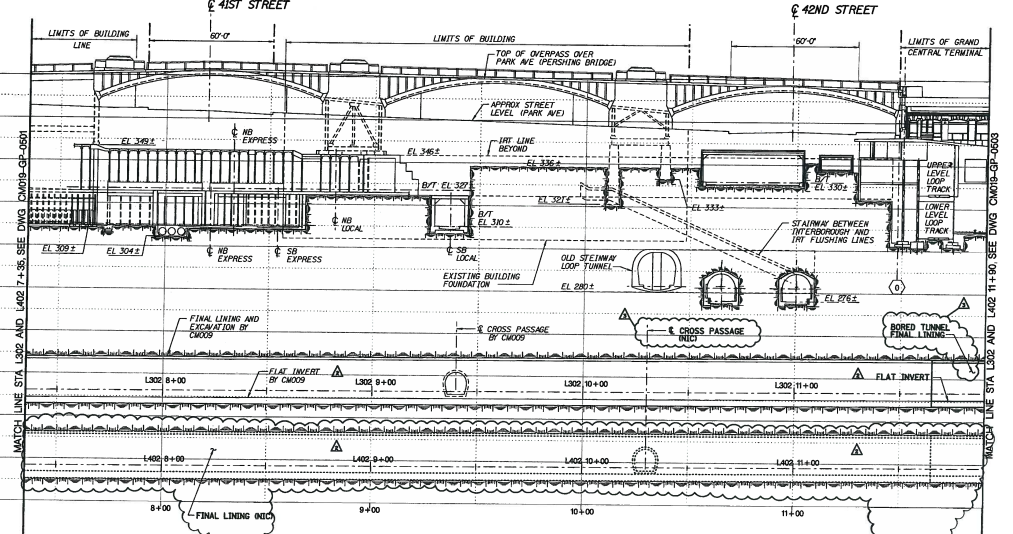
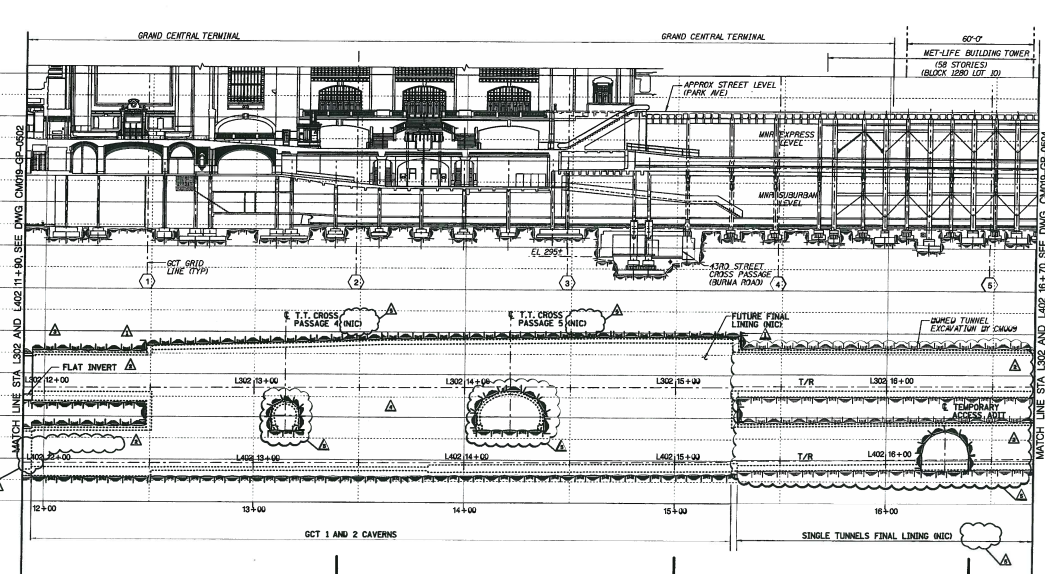
It’s possible to punch south (left) of the Lower Level while respecting every constraint, but not all of them at once. Two constraints are absolute:
- No interference with the 7 train tunnels
- No interference with the 6 train tunnel (labeled “SB local”)
These can be satisfied easily. However, all other constraints, which are serious, require some waivers, or picking and choosing:
- Keeping absolute grades to 4%, forcing the tunnel to go above the 7 and not below it (which requires clearing around 15 m in around 150 m of distance)
- Respecting the Lower Level loop track
- Respecting the disused Steinway Loop tunnel
If the latter two constraints are waivable, then the tunnel needs to clear around 1.5 m, for 6 m of diameter minus 4.5 m between the roof of the 7 tunnel and the floor of the 6 tunnel, in what looks like 40 horizontal m; it’s doable but with centimeters of slack, and may require waiving the 4% grade (though over such a short length it doesn’t matter – what matters is vertical curve radius, and the vertical curves can be built north of the 7 and south of the 6).
 Pedestrian Observations
Not sure how familiar you are with stadium/arena construction, but I don’t see any way you can begin MSG demolition in 2028. A replacement venue would need to be in place by then to avoid massive amounts of compensation from the Knicks/Rangers/concert promoters, and a five year timetable for doing something of that scale in Manhattan, when no site selection or planning has yet taken place, is nigh on impossible.
Barclays Center took 18 months to build between the first concrete pour and opening night, but was preceded by many years of bitter litigation from local NIMBYs. And they at least had a site in place. Where would a new MSG go? Short of building a floating venue in the Hudson River I can’t see many viable locations that would have anywhere near the same level of accessibility that the Garden presently has.
There’s the plan to move it across 7th Avenue, to the blocks south of Macy’s.
It’s two-ish uptown/downtown blocks wide and 2/3s-ish crosstown blocks long. Vornado is busy building a tall skyscraper on the east side of 7th Ave. between 32nd and 33rd. There isn’t “south of Macy’s”. unless someone wants to tear down a half completed skyscraper. If tearing down a block between 31st and 30th between 7th and 8th is going to cost a billion, to buy the real estate, tearing down four blocks, a block away would cost four billion. You’d have to convince the city that creating a new “superblock” would be a good idea. Unless it means 33rd to 31st, between 6th and 7th. That’s not “south of Macy’s” to me, that’s a block south of Macy’s. I’m old, that would be south of Gimbel’s.
After using the West Side Yards for at stadium fell apart there were suggestions to move it behind the Post Office. It could have been west of 9th Ave in the open air above the tracks east of the tunnel portal but they’ve gone and built skyscrapers over that.
….. Stadiums/Arenas almost never make money. Socialism for billionaire sports team owners and cold hard capitalism for the rest of us. Supposedly the only one built without a lot of tax abatement etc. low interest loans hanky panky was Giants Stadium in New Jersey but that hosts two NFL teams, the Giants and the Jets. I’m sure even that had a lot of sweetheart deals in it. Like building a train station there. There are also many people pointing out that metro New York has too many venues. The one in the Meadowlands is empty/abandoned. It’s on the other side of the station built for the Giants and Jets. ..it’s my opinion, when billionaire sports team owner begins to extort for a new stadium the answer should be “good, let someone else lose money on you”.
There’s also no actual plan to build a new arena; just a few loose ideas and concepts from third parties.
This isn’t like the normal sports stadium funding battle. The owner isn’t asking for billions for a new arena – it’s the rail advocates who will need to ask for the billions so that they can relocate MSG.
The permit issue isn’t relevant; the city will have no choice but to keep issuing permits. The only way to move MSG off of the private property that they own is to either bribe them with a new stadium in an equally good location, or use eminent domain to buy them out at a premium. Either option will be extremely expensive.
Does MSG actually own MSG? It isn’t some kind of ground lease situation from Amtrak? If they actually “own” MSG, what is it they own…the air rights?
Yes, MSG owns the arena, as well as the air rights for development above the arena. It is a piece of privately owned property. There is no ground lease. MSG is the successor of the original sale of the air rights by the Pennsylvania Railroad back when Penn Station was torn down.
The legend is that the Pennsylvania Railroad wanted tax abatements and or wanted to give the city the station. But everybody wanted to make money, so they tore the old Penn Station down.
Squint at the “Program for Action” they were going to shove the New York Central/New Haven passengers up to 48th, like they were with the LIRR passengers through the new tunnel and tear down Grand Central for tall office towers. Squint hard at “LIRR service to the vicinity of Broad Street” – they’ve been toying with the idea of LIRR service to Wall Street forever – they were going to use the Montague Street tunnel and the Chambers Street subway station. Program for Action also had “subway super express service using the LIRR ROW”. Someone was using bizarre arithmetic or frequency would be low. … there was going to a lower level carved out at 71st/Forest Hills.
The forest of columns you see at track level are holding up the concourses. That’s easiest to see in the rotunda and the upper level west end waiting room. I don’t know how many or where the columns holding up the Garden and it’s skyscrapers are. There aren’t many of them because there is a lot of wide open space in the rotunda and the waiting room.
Check out my plan for relocating MSG Arena to the Meadowlands as a part of the Gateway Tunnel and Penn Station project. My plan integrates LIRR trains that through-run Penn Station to reach New Jersey which reduces congestion and increases regional economic development. Click on the link below to view my presentation slides to learn the details.
https://docs.google.com/presentation/d/1bIuSoXZWEI6ucqATaqNTo8kxHpoDtxhY/edit?usp=sharing&ouid=111853125971498779240&rtpof=true&sd=true
Vornado is busy canceling plans, mostly. The commercial real estate market is softer than Vornado hoped; this is why Penn Expansion is on the ropes – it’s way too expensive to get BIL funding and neither anybody sane nor the Hochul administration is throwing
$13$16 billion of tax money into this, so they were hoping to extort money out of Vornado in exchange for approving its skyscrapers.Buying MSG should be in the low single digit billions? Using Class A office space as a comparison, One Vanderbilt has 1.5 msqft of office space, assuming it all rents at $140/sqft (top end of the range for Class A) as a 6% perpetuity gives a value of $3.5b. This is obviously the max value as its all revenue with no allowance for any costs of any type at all. Even so, that should be the upper limit for a deal, whether that is a direct buy-out, property swap, or some other kind of deal. Given all the figures flying around for new tunnels etc., it’s almost unremarkable in its size.
Buying MSG would be one thing if the owners wanted to sell, but they do not.
The government can take the property via eminent domain, but that opens the door to litigation on the valuation which is unlikely to favor the government.
And none of that gets to the political issue of evicting beloved sports teams (even with a despised owner) without a plan to keep them in NYC. It’s one thing for elected officials to say no to a sports owner demanding public money for a new stadium, but this would be the opposite. Significant political risk for the government, which makes eminent domain for the entire MSG property unlikely.
I could see a case where the government uses eminent domain for a portion of the MSG complex; definitely for street level elements or for the theater even.
I would be surprised if a big business wasn’t prepared to sell for a small premium of market value if that was all that was offered.
Vornado has been changing their mind since they bought it in 1997. It’s what real estate developers do. Most real estate developers do. Some of them cook the books and go bankrupt fairly frequently.
I had the gumption to go look things up. They got approval to build a tall building, under the new zoning for denser uses near transit, in 2010. The market had soured, so they kept the aging hotel. According to Wikipedia they were scheduled to finish tearing it down in July of this year. Aging hotel can make enough money to pay the property taxes, interest on any loans, administrative expenses etc. An empty lot can’t. There is also a short blurb that the architect had filed plans for a shorter building in May. They are going to build something on it because even at outrageous Manhattan parking rates they have expenses to cover. Who knows what but somebody is going to build something on the empty lot across the street from Penn Station.
….It’s hard to extort money from a developer, in 2023, for approvals given in 2010.
Check out my plan for relocating MSG Arena to the Meadowlands as a part of the Gateway Tunnel and Penn Station project. My plan integrates LIRR trains that through-run Penn Station to reach New Jersey which reduces congestion and increases regional economic development. Click on the link below to view my presentation slides to learn the details.
https://docs.google.com/presentation/d/1bIuSoXZWEI6ucqATaqNTo8kxHpoDtxhY/edit?usp=sharing&ouid=111853125971498779240&rtpof=true&sd=true
Those are problems for the owners of Madison square gardens. They should see how the winds are blowing and figure it out. If they don’t make plans that is their incompetence and they deserve to go bankrupt. Capitalism only works when there is a downside to risk, otherwise it is something else.
MSG owns the property: they don’t need to see which way the winds are blowing. If Amtrak or the MTA or anyone else wants to remove MSG, they will need to buy that property. It’s very simple.
And that’s why all the drama around the operating permit is a sideshow; the onus is on the station redevelopment side to find a way to move MSG. MSG has no incentive or reason to move themselves just for the sake of moving.
I stand corrected on ownership. That does change things, the station needs to get serious, not renewing msg rights has a reasonable chance of being struck down in court and thus isn’t to be counted on. The station needs to buy the property, and make it clear that if a deal can’t be reached they will use eminent domain. A deal might include 7 years of operating rights for example.
There’s no one in the Meadowlands Arena, and as far as I know it hasn’t yet been demolished. Couldn’t they use that in the interim while whatever new arena location gets sorted out?
If/when there is a deal to move MSG, then yes, it would be plausible to temporarily use the Meadowlands (or Barclays or Prudential).
But MSG absolutely will not abandon their current location without an ironclad plan for a new location. Everything would be “figured out” already, we would just be talking about construction phasing.
https://www.nj.com/bergen/2020/02/closed-for-years-the-legendary-arena-in-the-meadowlands-has-found-a-new-purpose.html
Thanks for working on this. I still find a few points confusing and would appreciate a few tweaks to the map:
– Could there be a graphical legend with e.g. a green picture of an elevator next to the word “elevator”?
– I assume partly transparent blue is the footprint of Moynihan – could you spell this out?
– Two tracks seem to suddenly end rather than continue off the east end of the diagram. I assume they also continue, but could you make them do so in the diagram to make this clear?
– Could you write track and platform numbers on the map?
– Could you indicate the location and name of the streets (7th, 8th, 31st-33rd)? A bit of this appears in the current track diagram, but it’s mostly covered up.
– Is it really the case that 6 tracks come from the east but only 4 tracks come from the west? Doesn’t your plan call for full through running?
– Maybe it’s worth indicating on this diagram which platforms are used by LIRR, NJT, Amtrak?
33rd is at the top, 31st is on the bottom. 7th is where the vertical green bar, on the right, is and 8th is where the vertical green bar, on the left, is. “North” is at the top.
“8th is where the vertical green bar, on the left, is.”
That can’t be literally true, so it seems, because this green bar overlaps Moynihan station.
I didn’t know you were expecting centimeter accuracy. It’s unclear if the outline is the curb line on the west side of 8th Avenue, the bottom of the grand staircase leading to the Post Office lobby and sales windows or the building line. The top in North ( rumors have it that the current track 21 is under 33rd. ) the right is East and 7th Ave side, the bottom is south and the 31st St. side and left is west and the 8th Ave. side.
The station, below street level extends quite far out. The east of of the current platforms, the long ones in the center, extend just east of 7th Ave to well under the Old Post Office. An 18 car Broadway Limited arriving or departing for Chicago, in ancient times when it had a dining car and a lounge car and a barber and stenographer and… is much longer than a crosstown Manhattan block. A block in that part of Manhattan is 10-ish cars.
It’s the bottom of the grand staircase, abutting east (that’s why it’s not a perfect rectangle).
I was staring at things attempting how this works. From the prose I get the impression there is a wall of exits along 7th Ave., a wall of exits along 8th and two mid block. That’s four. I only see three pinkish north south things. I decided to stop staring because this hasn’t been very well thought out.
There are two escalator banks per mid-block walkway, one going east and one west. So it’s six. The seventh goes to West End Corridor. The long platforms have an eighth to the interior of Moynihan.
The 3D version has a mass that seems to represent the Old Post Office. Across the street is a wall of exits/entrances. It may just be me but something on 8th Ave isn’t midblock anything. It’s on 8th Ave. “7 1/3rd and 7 2/3rd” confirmed that suspicion. There is only three of them so they are at 233 West 33rd, 266 West 33rd and 299 West 33rd at 8th or at 225, 250 and 275. 275 West 33rd is not on 8th Ave.
Left to right/west to east there are four banks of stairs and escalators going into Monihan, eight shorter ones going into the green thing, eight into the pink thing, which is the wall of exits/entrances on street level, on 8th Ave. two sets of eight into mid-block-west, two sets into mid-block-east and a set into green thing along 7th. There isn’t any wall of exits/entrances on 7th Ave.
The green things and the pink things apparently are on different levels. How do I get from the pink things to the green things? Apparently the green dots in the pink things are supports for the pink things and the roof. Put them between the tracks where there aren’t any pedestrians.
It needs to be at least three. East/west tracks and platforms, circulation on the “subway” level – more people want to go to and from the subway than want to go to 245 West 33rd and even less of them to 261 West 31st, and the streets. It would suck to have to go up to the street to go down into the subway. It would add to the pedestrian congestion on street level. Somewhere in there there needs to off-street circulation between Moynihan and the stuff east of 8th Ave because it would suck to have to cross 8th Ave traffic to get to or from a Moynihan escalator and track 1.
Governot Hochul has a vision of “a single level Penn Station”. I have no idea what that means because having grade crossings between the east/west tracks, the north/south tracks and the streets wouldn’t work out. I suspect she has been in Downtown Buffalo where the Amtrak trains are in a trench below street level, where the streetcars are and the Thruway is elevated over both. A quick glance at the website for Buffalo’s airport, it’s on two levels. Arrivals and departures. Except for itty bitty 12 gate airports, most airports have two levels. And if the train station is in the terminal(s) a third.
I don’t know how I get between the pink things and green things or to 7th Ave. I dunno what “single level Penn Station” is. …. I don’t know what planet youse people are living on.
The legend is indicated in the 3D model – remember, this originates as a blueprint for Cid and Emily to turn into a 3D model. But yes, I’ll indicate the Moynihan color, thanks for the catch.
There are six tracks going west – platforms 7 and 8 are connected to a realigned connection to the Empire Connection. There’s still a demand mismatch so I’m assuming half the trains run through and half terminate at Penn and go back east.
Most men have 7 colors.
Quite a few of them will have no idea what magenta is. It’s purple. Monitors are notorious for inaccurate coloring rendering. I’ve been in industries where the difference between verimillion and cerise is important. Or aqua, teal and turquoise. There can be differences of opinion about that, particularly turquoise. The tracks aren’t ochre, on my monitor, they are olive or perhaps sage. Definitely greenish and ochre is “warmer” than that depending on which kind of ochre you are talking about. There are umpteen different shades of ochre.
…. which is why there are things like Pantone. I can select Pantone sumptin and anywhere in the world someone else can consult their physical Pantone chart and know what I mean. I digress.
I have no idea what kind of software you used to generate the PNG. Tell it to change the “ochre” to yellow or brown it would be clearer. Yellow and brown are one of the seven colors.
The “official color” of Tmobile is magenta.
They could call it Electric Fushcia. Or Brilliant Mauve. The only people who would know that are T-Mobile geeks. The advertising people, the printers, sign makers etc probably want to know what Pantone it is. People can distinguish millions of colors. That doesn’t mean there is a name for each of them. The platforms aren’t the same color as T-Mobile’s logo. YMMV depending on the settings and quality of your monitor. Many people would see a shade of dark pink. Or lighter purple. The tracks are definitely green on my screen and shades of ochre definitely aren’t. Apparently, that English has a specific word for light red is unusual. You knew that “light red” is pink. Or perhaps a shade of magenta if it has blue undertones. Some languages don’t have a distinction between green and blue. Ya made me pull out my thesaurus, amethyst, fuschia, magenta etc. are under 373 for purpleness.
….It’s not like they are doing this with pots of paint, if the tracks were yellow it would be much more distinct and definite.
There’s a bit of wishful thinking going on here. First of all the long section does not show where the connections are between 7 Line and the Lex Line. Also the Lex Line runs on an angel across this area, this is a specific long section. My point is the further to the east side of GCT you go the closer the 6 gets to the end of the existing MNR platforms. Also Im not sure what diameter you are considering, the Gateway Palisades tunnel is going to have an internal diameter of 25ft6″, assuming a lining that is 12 inches thick, and that might not be correct here with all the high loading from foundations, that would be a 27ft 6″ external diameter, which is around 8.5m diameter TBM. If you go with East Side Access size tunnels that would be a 22ft6″ or roughly 7m TBM. So Im not sure your clearances work.
You would have to exit to the East Side of GCT and go to the East of the Park Ave Rd tunnels because the Lex Line and the ESA 38th St vent plant for ESA are in the way to the west side of Park Ave tunnel. But you get closer to the Lex Line station.
It is certainly not as you state, easy. In fact it would be extremely difficult, if even possible, and very expensive as you would need to underpin the Lex Line and Grand Central Station. Plus you will have to clear all sorts of stuff out the way in GCT.
If there are going to be NJTransit pantographs in it, East Side Access tunnels are too small. Some railfans suggest splattering third rail all over New Jersey. That isn’t an option.
There’s too much capacity or not enough. Railfans have trouble juggling three or four things at once. If half the trains from New Jersey are going to Long Island or Connecticut the other half will be going to Grand Central. Commuters to any of them come from all over. They can’t change trains in New Jersey because the people going to Penn Station and beyond are still on them. I see mayhem in Penn Station. If they all go to Grand Central, they can’t go to Long Island too.
In other threads there is connecting the LIRR to NJTransit via Brooklyn and Wall Street. That’s another 20 trains an hour. Sending all the train everywhere is too much capacity. They have to integrate high speed rail as far as Atlanta, Chicago, Detroit, Toronto and Montreal with using up excess capacity west of Secaucus and east of Jamaica. And a train an hour to Scranton or Allentown and New England high speed trains through Long Island and …. and…
I come up with sending East Side Access trains to New Jersey. Without stopping on the West Side. It’s not the Toonerville Trolley meeting every train, it’s Midtown Manhattan. If you want to go to the West Side get on a train going to the West Side. There will be one in a few minutes if you are changing from a train from a more distant suburb that isn’t going to the West Side. Or if you are going to the East Side etc. I don’t know if East Access trains could keep going south and then west.
I’m well aware of that, which is why I gave the Gateway tunnel size which will handle bi levels and overhead catenary, and the ESA tunnel size. Also ESA cannot handle bi levels as 63rd St tunnel is too small.
I’m aware of it, you are aware of it. Many railfans, along with thinking skyscrapers and arenas sit on dirt like their garage does, think any train can go anywhere. They can’t.
It still has the problem that 100 percent of NJTransit trains could go someplace east of 7th Av. There can’t be 150 percent of them east of 7th Ave. ( all of them to Grand Central and half of them to Queens and beyond.)
It’s too much capacity or not enough.
Why would they need NJT Pantographs in ESA or third rail all over New Jersey? Metro North already runs dual mode M8 trains that can use both third rail and overhead power. NJT could buy dual mode trains if needed.
Just to clarify some of the dimensions.
Lets assume you can obliterate the Steinway tunnel, not unreasonable as its been abandoned for a while. And assume that you scrape the roof of the 7 Line and scrape the floor of the SB1 Local and you will need a section of 13% grade to get into GCT, minimizing the amount of relocation and underpinning you need to do in GCT. This gets you a 230ft horizontal length to achieve a 30ft elevation change and that’s not taking into account the vertical curves. But that’s barely buildable as it will need significant temporary works.
If you cant touch the Steinway tunnel you need a section of 43% slope to rise 30ft in 80ft.
You cannot fit the tunnels between 7 line and the ESA tunnels as there is only 20ft between 7 line invert and crown of ESA so there is not enough space. To do this though would require the new lines to start descending at the south edge of 43rd ST Cross passage and drop 54ft in 365ft at 14%. To get enough clearance though you’d have to go between the ESA tunnels and then come up to get over the cross passages and vent plant at 38th St. You could get one tunnel in, not sure if you could fit 2.
This would also require a trench to be excavated through the footings of the building columns, which here would be GCT but this would not be easy.
Dimensions on the drawings are all in feet and inches.
When calculating grades, my assumption is that you don’t need to use literally the same grade as the Lower Level loop – you can dig below it, starting from the grade of the Lower Level tracks a block and a half to the north. So it’s a lot gentler than 13%.
Well as I explained previously if you do that you would have to divert 43rd and 45th st cross passages which run below the lower level tracks. Possible but expensive as they contain lost of infrastructure including ConEd hi pressure steam lines as well as MNR’s traction power feed network. But that only works if your trying to go under 7 line, but if you do that you run into the problem of ESA, there’s only 20ft between 7 line and ESA, which is not enough space to thread a new tunnel. Now depending on which MNR track you extend south you could align it between the ESA tunnels, go under 7 line and then come back up quickly to clear the ESA upper level cross passages and then the 38th St vent plant which basically spans the width of Park Ave. But then you run into the Park Ave Road Tunnel. You could probably get one tunnel south of GCT, I don’t know if you could actually physically fit two tunnels into the space. So lets assume you want to minimize support work to 7 line, then ideally you need half a tunnel diameter between invert and crown of new tunnel, in this case the Manhattan schist is pretty good so lets assume a 6ft pillar, which is half what we used on ESA. So top of rail would be approx. 25 ft below this. Based on the elevation of 7 line invert 273ft that means ToR would be 273-31 = 242. ToR in GCT is at 310 so that would require a 68ft elevation gain. At 5% that would require say 1400 ft horizontally which would bring you to the existing MNR lower level at around 47th St. Now assuming your extending Track 108 or 109 as they are the ones that line up with the gap between the ESA tunnels, this would be near the end of the platform. So unless your planning to put a platform on a 5% grade you could not actually platform a train coming out of this tunnel. And to get back up above the ESA cross passages, the first one of these is 110 ft south of 7 line. Lets assume you need to get ToR 6ft above this so that would be at El 252. So you need to gain 10ft in 110ft, that would be around a 9% grade, plus a vertical S curve.
Now could you head out of GCT outside of the ESA footprint, of course, but you still have to get under 7 line, meaning all the issues with building columns and grades and length of platform remain. You would also be beneath buildings flanking Park Ave that would require permanent easements to be purchased. Then you’d be using Track 105 and Track 112 whose platforms end before 47th St.
And the other problem is that once you get that far up the train shed, your likely dealing with a lot of third party building columns from the overbuild. So what you say. Well these columns do not simply sit on the rock, they sit on a foundation pad that sits on the rock. These pads, depending on the load they are taking can be quite large. The likelihood is that to excavate the trench you may have to break through these footings. This will be expensive, as you will have to replace the bearing capacity which would require mini piles and all sorts of new foundations to underpin the existing ones, from a purchasing of a permanent easement from the building owner who will of course claim that if you touch their foundations they may not able to take advantage of any future rezoning in the area, meaning that any redevelopment will be limited and hence your reducing their ability to make money out of a rezoning. I recall discussions with property owners when we were finalizing the ESA concourse layout and these easement costs were eye wateringly large. Our solution on ESA was to not touch the foundations, but to concrete around them using bond breaker board and simply encase the columns using free standing architectural cages and cladding so that we literally attached nothing and did not touch their columns. We also had to leave inspection hatches in the architectural finishes to enable the owners to inspect their columns as needed. Now this may or may not be possible in the case of dropping tracks 108/109 it depends on whose columns they are. Even if all the columns are MTA or DOT owned at the cross streets, the design and construction still has to be performed to replace the lost bearing capacity, or the upper level collapses.
If they are building columns your looking at the Met Life building, which we avoided touching on ESA because of the massive loads, hence the gap between the caverns and the Wye caverns at the south end of the station and the Helmsley Building, which we underpinned for one of the escalator well ways.
You can start at 43rd Street; you probably don’t need to move that cross-passage, and definitely don’t need to touch 45th.
But if you do that it’s a 14% grade to get under 7 line. Because there is no way to get over 7line and Steinway and beneath SB Local. I mean anything is possible but that cheap link you mentioned in your post just got very expensive because of what’s in the way.
Wasn’t the initial proposal from ARC to blast through the steinway tunnel and relocate the Southbound six track to a disused track from the original subway days? Has anything done by ESA eliminated that as a possibility?
There were 137? proposals if you include “no build” as an option. Many were eliminated because they had fatal faults. Like, this is a paraphrase “doing that would risk taking the Lexington Ave subway out of service, there are other options”
The cavern for East Side Access is under Park Ave. The ARC proposal was farther west and a bit nebulous because they wouldn’t be able to do anything until Water Tunnel 3 is complete and Water Tunnel 1 goes out of service for inspection and maintenance. All of it hypothetical because it was canceled.
@N
“Wasn’t the initial proposal from ARC to … relocate the Southbound six track to a disused track …?”
I don’t know about ARC, but see my post below that explains how to do exactly this.
“Because there is no way to get over 7line and Steinway and beneath SB Local.”
This is technically true with the SB Local tunnel as is, but if you relocate it to the old subway tunnels (relatively easy) there is most certainly a way.
The situation at the south end of GCT is not as bad as Alon’s diagram makes it seem. For reference, here it is, a cut along Park Ave, call it Fig. 1.

The SB Local tunnel is so low as a result of NYC Subway history. The first subway line went Park Ave, 42nd, Broadway. In 1918 the Dual Contracts split this line. The Park Ave portion went north under Lex (todays 4,5,6) the Broadway portion went south on 7th (todays 1,2,3). 42nd St became the shuttle. To do this the express tracks and the SB local for the new Lex subway dove down to turn East and go under the existing subway line as it went West under 42nd. Although those existing tracks would be abandoned, they were in operation and couldn’t be cut. Fig 2a shows the situation as cut across Park Ave. Tracks 1-4 are the original subway line from Park Ave, 1B-4B are the new lines heading to Lex Ave.


Fig 3a shows how this works from above.
Today of course tracks 1-4 are not used (except for Track 1 as a non-revenue link for the 42nd shuttle) so there is no requirement for the SB local tracks to go under them. If you dug out old Track 1 to match the profile of Track 4B, you could move Track 1B there at a higher elevation. There is no impact to cutting track 2. Fig 2b shows this as a cut:


Fig 3b shows this from above.
This raises the Track 1B invert by about 3m halfway across Park Ave. The invert would be about 319.5’. If the top of the 7 tunnels is at 290’ and the Penn-GCT connection has an external diameter of 27.5’ per Tunnelvision, then technically you don’t need any slope here, you can run level between the tunnels with a few feet to spare. In reality, if you start just past 45th St with a 27.5’ tunnel and pass below the new SB Local with 6’, then you need a grade of 2.19% and you scrape the roof of the southern 7 tunnel.
But there is no need to only move Track 1B to old Track 1. If we move Track 1B to the location of old Track 2, then you end up with about 12m on the west side of Park Ave with only the non-revenue connection to the Shuttle as a vertical constraint until 39th St. (when the Park Ave subway tracks spread out to make room for the Murray Hill tunnel, at an elevation of ~327’).


Fig 2c shows this alignment
And Fig 3c shows it from above
12m is wide enough for 4.5m track centers plus 0.5m tunnel walls. You can begin south of 43rd St (affect no cross tunnels) and with a 3-4% grade sail over the 7 and go under the Track 1 Shuttle connection by a few feet, then continue with a 1 to 1.5% grade and go under all tunnels south of 39th with a dozen feet of overburden. If you start south of 45th street and sever the 43rd connector, you can do this with an even 1.5% grade the whole way.
These are worst case numbers using the 25’6” tunnel height. That height is needed for 25kV over double stacked containers or high speed, neither of which will be found in these tunnels. Plate F is 3’2” shorter than Plate H, which means a 22’4” fully AAR compliant tunnel height for overhead wire, and makes all of the slopes less or clearances greater. Nor does this take into account using overhead bar instead of overhead wire for less height inside the tunnel.
Getting into GCT from the south is tight, and probably can’t be done vertically with current tunnel alignments. However, if you think laterally instead of vertically, by shifting the SB 6 tunnel it no longer becomes an “absolute” constraint and most of your vertical issues go away.
How many years does the 6/Lexington Ave. Local go out of service while things are moved? The 6 is one of the busiest lines in the system. Taking it out of service for a weekday much less months or years isn’t an option.
It would be out of service for 0 years. Look again at the diagrams. The red line on Fig 3c does not cross or cut the tunnel currently carrying Track 1B, it meets it at the mouth to 42nd St Station. The 6 can continue to run everyday underneath those abandoned tunnels for Tracks 1 & 2 while excavation happens inside them.
I expect there would be some overnight closures when excavation occurs to join the new tunnel to the existing. The slack can be picked up by slots unused by the 5 at night. Then probably a 3-4 day closure over a low-ridership long weekend after the new tunnel is ready to move the tracks to their new alignment at the junction.
The idea that taking a single track out of service for a day “isn’t an option” is absurd. That track is already closed at times for normal maintenance, the same windows can be used for most of the work. The 14th St tunnels were shut for a whole year with no direct alternative – the 6 has another track providing identical service right next to it for all of Manhattan. Plus, it isn’t even necessary to shut down the whole line, just the few hundred feet from 42nd to 40th. There is already a crossover between the SB local and express tracks at GCT, add another just north of 33rd St station and there you are.
There’s a lot less congestion south of 23rd. The substitute service for the L involved a lot using other lines and a lot of buses. There is no other line on the East Side.
It’s all hypothetical because nobody is building it or attempting to build it. The other problem is that even it could be built there aren’t any or many trains to send to it. 40 eastbound trains, from New Jersey, 30 of them run through to the LIRR, 6 of them to New Haven Line that leaves 4 to go to Grand Central. I can get from Penn Station to Grand Central or vice versa in less than 15 minutes today. I could probably walk it in under 15 if I walked fast.
Everybody has to keep more than one thing at time in mind and juggle three of them simultaneously.
I agree with Onux. Every metro on the planet would do closures like this. They shut Bank station in central London for a few weeks to join up a new tunnel.
Have you worked with NYCT?
London has had their fingers stuck in their nether regions since World War II and had no choice but to close it down to reconfigure it.
Hmmm. Ok so lets assume you relocate the SB Local, directly beneath Park Ave Viaduct etc. and miraculously do that with limited track outages on the busiest NYCT line, then we have the following.
43rd St cross passage to the utility duct at El 304 under the SB and NB express is horizontally around 600ft. Lets go with 6 ft of clearance and the 27.5 circular tunnel diameter that get us to elevation 270.5 for tunnel invert and lets say 275 for ToR, its a circular tunnel and ToR will be around 4ft above the invert together with a 12inch thick lining, which is probably a little optimistic. So that gives us a required vertical distance to rise into GCT of 35 ft, in 600ft which is a gradient of 5.8%.
Of course this would require the 7 line crown to be removed to accommodate the new tunnel lining, ToR shaves the crown but you need something to put the rail on..
Oh and all that removal and relocation of the SB Local, shoring up of 7 Line etc. will be slow, costly and disruptive,
All this to get NJ Transit trains into GCT and MNR trains into Penn, which they will be able to do through Penn Station Access……… I mean there really is very little cost benefit here. Or are we saying that NJT should run to New Haven, which they can already do using the Hells Gate Line, I like an engineering challenge but this would be extremely challenging.
All this to give NJT riders access to East Midtown and MNR riders access to West Midtown. (Penn Station Access would accomplish the latter, but for many fewer trains and only a subset of MNR destinations.) Time saved per dollar would be high due to the vast number of passengers whose trips currently end at the “wrong” station. Dividing the passenger load between two Midtown stations would also cut dwell times and enable a moderate increase in frequencies on NJT/MNR lines. Also it would make the expense and complication of Penn Station Access unnecessary.
Penn Station Access will cost a lot less than digging tunnels across Manhattan. The tracks already exist it’s just that the MTA chooses to not use them.
It would cut passenger load on the shuttle but not in Penn Station or Grand Central Terminal. All it would do is swap passengers between stations.
The trains don’t have to stop in both stations. People who want the East Side can get on trains going to the East Side, outside of Manhattan. People who want the West Side can get on trains going to the West Side, outside of Manhattan.
Reverse interlining cuts capacity. And you seem to have missed the part where I noted that many MNR stations are inaccessible to Penn Station Access.
Everybody wants express service to everywhere. Everybody can’t have that. Some people are going to have to change trains. That’s just tooo tooo bad.
Penn Station Access looks like reverse interlining but it’s not. It’s using excess capacity on the Hudson Line and the New Haven line to get people out of Mott Haven so other people can go through Mott Haven. And people off the shuttle so other people can use the shuttle. It’s Manhattan not the Toonerville Trolley meeting every train.
I admit it’s a little strange for someone who just worked on ESA to think that connecting the two stations directly is a strange goal. The answer is of course Harlem line riders in particular would greatly benefit as would Bronx riders if the MTA were to engage in fare reform. It would also help take pressure off the 4/5
Finally nyct busiest line is the 4/5 not the 6! The express tracks as far as I can tell are totally untouched in this redo. And we just built a 6 relief line in SAS.
Why would you have 6′ of clearance to cross a utility duct? You’re not worried about collapse like when two tunnels cross.
What’s in the utility duct? Does it cross all of Park Ave? Relocate it.
You don’t need a 27.5′ tunnel with 25.5′ internal clearance to run passenger trains trains under wire, 25.5′ ATOR is the standard to clear Plate H double stack containers, not Plate F trains let alone Superliners which are 4′ less than Plate H.
Don’t use a TBM and circular tunnel profile, mine a quarter mile of tunnel through the tough spot to get TOR closer to the invert and lower the crown.
Why would moving the SB Local be slow and costly? It is only a few hundred feet or work beginning and ending in existing tunnels. That is about the easiest tunneling job you can get.
“All of this” is to get an integrated regional transportation network, not NJT to GCT or MNRR to NYP (although both of those are valuable too). PSA/Hellsgate does not get anyone to/from most of the Bronx or the Hudson/Harlem lines. It doesn’t help someone from Yonkers take that better job in Newark, or someone from Morristown get to a show at the Apollo in Harlem or someone in East Rutherford attend a wedding in White Plains. All of these things should be easy with a single-seat ride or single cross platform transfer, and can be with a Penn-GCT connection that allows through running.
Why do you even need Plate F clearance? All of those trains need to be able to run in the Park Avenue Tunnel and probably also in the North River Tunnels (the Penn-GCT connection is for the new tunnel and not the old one but the rolling stock through the two should be compatible unless there’s a very good reason otherwise).
Like the New Haven Line the Hudson line has a connection to Penn Station. Has for decades, unlike the New Haven which has had one since 1917.
If I was in New Jersey and I wanted to get to the Apollo, I would, like the song says, take the A train. From Saratoga Springs – the nearest Amtrak Station to me. Boston. Washington D.C. Flying into one of the metro New York airports. Almost anyplace except a Metro North station. Then I’d get off at 125th and take the bus because the Metro North station is on 125th and Park ( where 4th Ave should be ) and the Apollo is on 125th between Adam Clayton Powell Blvd ( where 7th Ave. should be ) and Fredrick Douglas Blvd. ( where 8th Ave should be ) It’s a hike. Possible but it’s a hike.
The C train goes to the same station, on 125th, that the A train goes goes to but the C train sucks. And it’s a local and the A train is an express. I don’t want the E train, which uses the same station, at 34th St, as the A and the C because that goes to Queens. I could take a 2 or 3. I don’t want the 1 because that stays on Broadway which is much farther west than the A, C, 2 or the 3, which is on Malcolm X Blvd. ( where 6th Ave should be )
Weddngs and the reception don’t happen very often in the thick of rush hour. They’d drive. If the train from Rutherford runs through to LIRR, that isn’t a one seat ride to the Harlem line.
Someone in Yonkers who gets a better job in Newark, which I find very unlikely, there are better jobs in Manhattan too, which is a much shorter commute, can change trains in Penn Station when the the Hudson line gets Penn Station Access service.
Everybody wants express service to everywhere. Everybody can’t have that. Some people are going to have to change trains. That’s just tooo tooo bad. It ain’t the Tooneville Trolley either. It’s unlikely except, perhaps some New Jerseyans who want to go to Jamaica and Long Islanders who want to go to Newark, that they have to won’t have to change trains.
I still want to know how 4 Hudson Line trains, east bound at Tenth Ave and 40-ish NJTransit trains eastbound at Tenth Ave become 30 eastbound LIRR trains, 6 New Haven Line trains and 20 to Grand Central and beyond.
The only arguments I can see for Plate F clearance are 1) it is a standard that accepts all North American passenger rolling stock (except the Rocky Mountaineer’s unique supertalls) and you should always build to the standard. 2) The connection will be in use for more than a century. We can’t know what the future brings, but if Gateway and a Penn-GCT both accept Plate F, then rebuilding Park Ave allows extension of technology/service we can’t conceive of yet.
On the other hand, MNR and LIRR both move more people than NJT using single levels, and with North River/East River/Park Ave tunnels are being shorter limiting a Penn-GCT connection to similar loading gauge probably isn’t an issue.
“take the A train.”
This is why the RER inParis and S-Bahn in Berlin and the Elizabeth Line in London are barely used, because people would rather stop at a train station and switch to a subway line. Oops! Its exactly the opposite, the RER carries more people than the Metro and the Elizabeth line is close to being busier than any tube line. It turns out when people can get fast direct service to where they want to be (like a one seat ride to 125th) they use that service more often.
More people in the New York area don’t drive than anywhere else in the country. They deserve fast options to get where they want to be. Even more wouldn’t drive if those fast options existed.
If you tell the person in Yonkers they can only take jobs in Midtown it lowers their earnings potential and economic prospects, your transportation system is supposed to do the opposite. And if they live in White Plains they can’t even change trains at Penn because the Harlem line isn’t part of either route for Penn Station Access.
“Everybody wants express service to everywhere. Everybody can’t have that.”
New York’s rail infrastructure is set up such that with a tunnel of less than a mile you CAN have express service to Penn and GCT for most routes, unlike your PSA options that make people wait longer for the train they need (on top of not even being an option for the Harlem line). You can also give lots of people express service to destinations on the other side of the region, instead of making ALL trips need a transfer. You can also make most transfers easy cross platform, with a train from Stamford to Morristown stopping at the same platform in the same direction as the one from Peekskill to Princeton.
None of these advantages happen with your cobbled together “its already there” connections. Look back to the top of my comment to see what happens to ridership when those advantages do actually happen with through-routed regional rail.
Well because if you look at the drawing its a utility duct under the rather large box that contains the Lex Line tracks. That’s why. Plus your crossing at an angle for a reasonable distance. Where would you relocate it to? You just added significant cost to the project.
I never said you need 25.5 clearance, you need a 25.5 ft internal diameter to get around a 19’6″ clearance from ToR to the OCS. You don’t put the track in the bottom of the tunnel, you have to install track drainage, an invert slab and then the tracks site on the top of the invert slab, And even if you use a rigid conductor for the OCS rather than wire you still need to drop the conductor down from the crown to accommodate the pantograph dynamic envelope. So you lose a fair chunk of the 25.5. I borrowed from Gateway Palisades for the diameter, just as an example to establish elevations.
I also assumed that size because unless someone has found the perfect site, there’s nowhere to put a vent shaft, and emergency access between Penn and GCT, which will be needed for the distance to comply with NFPA 130, so assumed that there would be a similar cross section to Gateway with the air duct inside the tunnel. Not sure where the vent would come from though. As such you’d also need an ADA compliant bench in the tunnel and cross passages to allow passengers get from one tunnel to the other in the event of a fire. Hence the tunnel diameter, maybe it could shrink by an inch or two but if you don’t have the fire management systems in there your not getting certified to open.
These pesky issues that once the visionaries have decided what’s needed the engineers end up having to work around and design for to be then told, you’ve over engineered the project why is it so expensive…………
I’ll bite. I lived in New Jersey most of my life and used Penn Station Newark most of the time. When I wasn’t using a bus to the Port Authority Bus Terminal. Only when I was going East on a workday, otherwise I drove. Most of the time. For instance I’d take the bus back from dropping off the car for repairs and and to go pick it up.
The signs over platform for Track 1 and platform Track 2 in Penn Station Newark direct you to Uptown trains or Downtown trains – through the PATH turnstiles to the Spanish solution track between 1 and 2. I assume they are still there because they are part of the ambience of the historical landmark station. When I lived in New Jersey, it was a choice between the bus to the Port Authority Bus Terminal, a bus to Penn Station Newark and a downtown train, PATH, to the World Trade Center or an uptown train to Penn Station New York.
I’m going to assume, after years of taking the risk of having the southbound local out of service when the weekend work doesn’t go well, I’d be able to take an uptown train through Penn Station New York to Grand Central and get off at 125th. Why would I do that if a train that’s going to ruunnnnn through to the LIRR comes in first? And I can change to A train which is a shorter walk to the theater?
I’m still trying to figure out how 44 trains west of Penn Station become 56 trains east of it. You are imagining every train runs to every station. They won’t. And that every suburbanite will have a one seat ride to their suburban destination on the other side of Manhattan. They won’t. There other solutions that don’t involve the Lexington Ave. Subway. too. I lean towards send East Access Trains, non-stop to Secaucus and terminating them in Newark. Nice round numbers it’s longer wider M7s at Penn Station Newark and every ten minutes at Newark Broad Street. Through the magic of timing transfers from Uptown trains or Downtown trains ( Not PATH trains. NJTransit M8-ish things that run throoooooooooooooough Wall Street and Brooklyn to the LIRR. ) it wouldn’t be ten minutes.
Everybody has to juggle more than one thing at once and keep third grade arithmetic in mind. 56 minus 44 is 12. Hmm.
Would it be easier to connect Penn to one of the Grand Central Madison platforms instead of the GCT Lower Level? I imagine it would be lower than the 7 and other obstacles, through you’d also have to connect the MNR tracks to GCM.
No – as Tunnelbuilder mentions, the East Side Access project did not extract the tunnel-boring machine from the tunnel but rather buried it just south of the tunnel, so continuing those tunnels to the south would be difficult (but still possible).
Those pesky Long Islanders are using the tunnel to Queens. Sending trains from New Jersey to the Bronx through the platforms isn’t very effective at that. You have to juggle all the parts at the same time.
I’m specifically proposing things that don’t really touch the LIRR?
And UWS apparently is considering sending trains from New Jersey through the LIRR platforms to the Bronx. It doesn’t matter if the Flushing Line is the way or if there a tunnel boring machine in the way or if Water Tunnel 3 is complete. Long Islanders are using the LIRR platforms. Everybody has to juggle more than one thing at once.
And the other thing is ESA cannot accommodate bi-levels, 63rd ST tunnel is too small, so its sized for single level railcars with no overhead catenary. Also it would not really make much sense from an operational point of view as you would end up in Harold interlocking, the exact same place you end up in if you go through the East River tunnels. I mean it would save NJ Transit customers having to use the subway to the east side of Manhattan but I’m not sure the investment would really be worth it. Also ESA is designed for 24 trains an hour, if you add NJ Transit to that mix you reduce LIRR trains, which puts more pressure on Penn, where LIRR will be losing capacity to allow MNR in there.
I’ve read that East Side Access “could run 26 and can consistently run 20”. Eventually. That prediction looks different from 2017 versus 2023. Ridership has collapsed, who knows when it will recover. The plan was for someday there to be 20 LIRR trains an hour to Grand Central and 30 to Penn Station. 30 to Penn Station so Metro North can run 6 from the New Haven Line
Throooooooooooooogh runnnnnnnnnnnning! ! ! works better when it’s a few lines and one central station that is “balanced”. Manhattan isn’t.
36 westbound commuter trains, four of them go up the Hudson line that’s 32 to New Jersey. Or vice versa. There aren’t any or very few eastbound trains that can go to Grand Central. This hasn’t been thought through. Send 6 of them up the Hudson line that’s only 30. In another comment it was said “Half of the trains to and from New Jersey terminate at Penn Station.” this definitely hasn’t been thought through. To run trains through it needs something M8-ish. There isn’t a new railroad car dealer with 2,000 of them on the lot. This hasn’t been thought through.
ESA was designed for 24 trains per hour, can it run more, not sure, due to the signaling and more importantly the ” one train in a ventilation zone” requirement that was adhered to and the vent system is probably the limiting factor here.
It’s all academic until demand builds enough to fill 20 trains an hour to Grand Central.
I’ve consistently read “can consistently run 20”. There might be some fudging at the peak of rush hour where trains disappear into the tail tracks or appear from the tail tracks. And during a 60 minute period, not a tidy hour, it’s more it’s more than 20. What they could run in ideal conditions is different from what they can put on a schedule. It interacts with traffic to and from Penn Station.
I don’t know how many trains they can pump through Woodside. Or care. It’s unclear if things are going to continue to run to Long Island City. Or care because my point of view is from west of Ninth Ave. To me “Long Island City” is the 7/Flushing line or if LIC is more broadly defined perhaps the E train. Until the Second Ave is built to Hanover Square and today’s E train goes down Second. Something “8th Ave” that goes through the 53rd St. tunnel.
And you have to electrify the lines in New Jersey that terminate in Newark or Hoboken. I don’t know how this affects service to Hoboken. It hasn’t been thought through.
Finally!
There is a lot to like, but eliminating the roof and platform-only concessions are not among them.
Re the roof, outdoor stations are ok in mild climates, but New York is not Hawaii. Part of the plan’s justification is reducing congestion by widening platforms, but it would dramatically increase congestion when people crowd under the 7-1/3 and 7-2/3 Ave walkways during inclement weather.
Re concessions, just as cities gain efficiency by concentrating popular destinations, it is more efficient to pass through a central area with concession options on the way to the train, instead of restricting passengers to the option on their platform or making them go up-down up-down to get what they want.
Alon is (appropriately) focusing on train operations over all else; thus a plan to fully through-route (improves train ops but degrades passenger experience by the need for escalators) as opposed to Jarret Walker’s argument for terminal stations (provides a step-free passenger experience, but degrades train ops). However, Alon makes the mistake of assuming everything that isn’t improvement is degradation. A roof and concessions improve passenger experience but do not degrade train ops. There is no tradeoff here, so no need to make things worse for passengers.
A good check is airports. Modern airports (like Denver) use satellite terminals to optimize aircraft movements, even though it requires passengers to use a people mover. However, no airport is so silly as to forgo a roof (even “outdoor” airports in Hawaii have roofs for sun and rain showers) or restrict customers to only the shop at their gate
Alon’s “only technical performance matters” has a time and place (natural disaster response and underground sewage infrastructure come to mind) but designing the continent’s most important passenger station is not one of them.
Seeing Alon’s sketches and regarding the comment above, the obvious and appropriate answer is to join the two walkways into a single passenger hall, with the space between the walkways being concession areas. This means the passenger hall is roughly centered over the platforms and reached by 80% of the street access escalators for good passenger accessibility. See this sketch:
The space to the west facing 7th Ave should be developed as an office building replacing 2 Penn Plaza, and the space facing 8th Ave as a new office building. Why? Alon has criticized plans to expand Penn Station because of the cost of buying up a Manhattan block. If the real estate is that expensive then it is in demand, and it is foolish to leave it empty on top of such great transportation access. I suspect that people would want a grand entrance through the east building from 7th Ave, which is fine. After I made the sketch but before posting I realized they don’t have to be office buildings, they could be hotels, whatever.
Maybe this link to the sketch will work.

Concourse, circulation and the green thing are all on the same almost pool-table-flat level? The difference between circulation and concourse is that circulation has moving pedestrians and concourse has things like bathrooms, a newsstand or two, someplace to get food and drink… TVMs for people who didn’t realize they could use or don’t have a smartphone. Or people, I realize the concept is becoming quaint, cash? There are people in this world who want to use cash. It has seating, through running fantasists imagination nobody arrives at :13 to change to a train that departs at :08. There will be people who are arriving and have an almost hour long wait until departure.
It’s has to be at least three levels. East/west train tracks and platforms.North/south subway tracks and platforms. The street. And a way to get between all three…. Zoom in on Google Maps with the transit layer enabled. The outlines of the subway stations are reasonably accurate. Access to the 7th Ave lines is going to be bit different than access to the 8th Ave lines. There should be a “subway” level passageway to the Herald Square stations on 6th Ave. A passageway between Moynihan and the rest of Penn Station was built. Because it would be a pain in the ass to have to go up to street level to get between the two. There has to be one for that too.
They don’t want anything at all above the platforms and aren’t even sure about a roof. That might work in a conceptualization but every place, where people usually go, has weather. As renewable energy naysayers love to point out it’s not sunny at night. I’ll leave it at that. Sunlit platforms is highly overrated. Open air ones are annoying when there is weather other than room temperature and dry.
I used Penn Station New York most of my life. And commuting using it for years. I think it’s fabulous that the short staircases go to the lower level and the long staircases go to the upper level. We get to the top of the stairs and have two levels to spread out on. Sunlit single level works in the hinterlands. It’s not the hinterlands.
Alon is (appropriately) focusing on train operations over all else
Many railfans do. The goal of a passenger railroad is to move passengers not trains. They can lose sight of that. They also lose sight that passengers and staff bring their stomachs, bowels and bladders along with them and have to accommodated.
People don’t have to eat at the train station. They just need places to eat easy to get to from the station. Make it easy to get to the cafes next door and you are good. Most people are not taking a train to a station to eat and then taking a train on, so they will be passing these cafes anyway.
You don’t go up the street if you take a train to the station to change to different train.
This discussion has me looking at a map of Metro North.
Sorry for the off-topic question:
Why don’t any of the trains on the west side of the Hudson go north
of Rockland County into Ulster and/or Sullivan County?
Because there isn’t enough demand? Partly because there aren’t many of them. And partly because many of them live that far out because they think the city is a festering cesspit of crime, sin and corruption and don’t want to go there.
The MTA is only chartered to operate in Rockland and Orange Counties west of the Hudson River; it’s charter doesn’t cover Ulster or Sullivan Counties.