The Need for Ample Zoning Capacity
An article by Vishaan Chakrabarti in last month’s New York Times about how to make room for a million more people in New York reminded me of something that YIMBY blogs a decade ago were talking about, regarding zoning capacity. Chakrabarti has an outline of where it’s possible to add housing under the constraints that it must be within walking distance of the subway, commuter rail, or Staten Island Railway, and that it must be of similar height to the preexisting character of the neighborhood. With these constraints, it’s possible to find empty lots, parking lots, disused industrial sites, and (in near-Midtown Manhattan) office buildings for conversion, allowing adding about half a million dwellings in the city. It’s a good exercise – and it’s a great explanation for why those constraints, together, make it impossible to add a meaningful quantity of housing. Transit-oriented development successes go far beyond these constraints and build to much higher density than is typical in their local areas, which can be mid-rise (in Europe) or high-rise (in Canada and Asia).
The issue with the proposal is that in practice, not all developable sites get developed. The reasons for this can include any of the following:
- The parcel owner can’t secure capital because of market conditions or because of the owner’s particular situation.
- The parcel is underdeveloped but not empty, and the owner chooses not to redevelop, for a personal or other reason.
- The area is not in demand, as is likely the case near the Staten Island Railway or commuter rail stations in Eastern Queens, or in much of the Bronx.
- The area is so auto-oriented, even if it is technically near a station, that prospective buyers (and banks) demand parking, reducing density.
New York has, on 2020 census numbers, 8.8 million people; 1 million additional New Yorkers is 11% more people. Cities that permit a lot of housing have an envelope for much more than 11% extra population. In New York’s history, it was computed in 1956 that under the then-current 1916 zoning code, the city’s zoned capacity was 55 million people, but under the proposed code that would be enacted in 1961, the zoned capacity would fall to 12 million. In Los Angeles, The Homeowner Revolution makes the point (on PDF-page 19) that in 1960, zoned capacity was 10 million in the city proper, four times the city’s population, but by 1990 it fell to 3.9 million, 11% more than the city’s population.

Technically, the same extra zoned capacity that Chakrabarti finds for New York has existed in Los Angeles for a generation. In practice, for all the above reasons why development never reaches 100% of capacity even in expensive areas, Los Angeles builds very little housing, and rents are very high, perhaps comparable to those of New York even as wages are much lower.
What this means is that the way forward for any transit-oriented development plan has to get out of the mentality that the buildings need to be of similar size to the existing character of the neighborhood. This constraint is too strict, and not at all observed in any successful example that I know of.
To Americans, the most accessible example of transit-oriented development success is Vancouver; some sections of the Washington suburbs (especially Arlington) qualify as well, but the extent there is much less than in Canada, and consequently ridership on Washington Metro has lagged that of its Canadian counterparts. In Vancouver, the rule that Chakrabarti imposes that the preexisting parcels must be empty or nonresidential is largely observed – as far as I can tell, the city has not upzoned low-density residential areas near SkyTrain, and even in Burnaby, the bulk of redevelopment has been in nonresidential areas.
The redevelopment in Vancouver proper looks like this:

And here is Metrotown, Burnaby:

The surface parking may look obnoxious to urbanists, but the area has more jobs, retail, and housing than the parking lots can admit, and the modal split is very high.
European transit-oriented development is squatter – the buildings are generally less tall, and they’re spread over a larger contiguous area, so that beyond the resolution of a few blocks the density is high as well. But it, too, often grows well beyond tradition. For example, here is Bercy, a redevelopment of the steam-era railyards at Gare de Lyon, no longer necessary with modern rail technology:
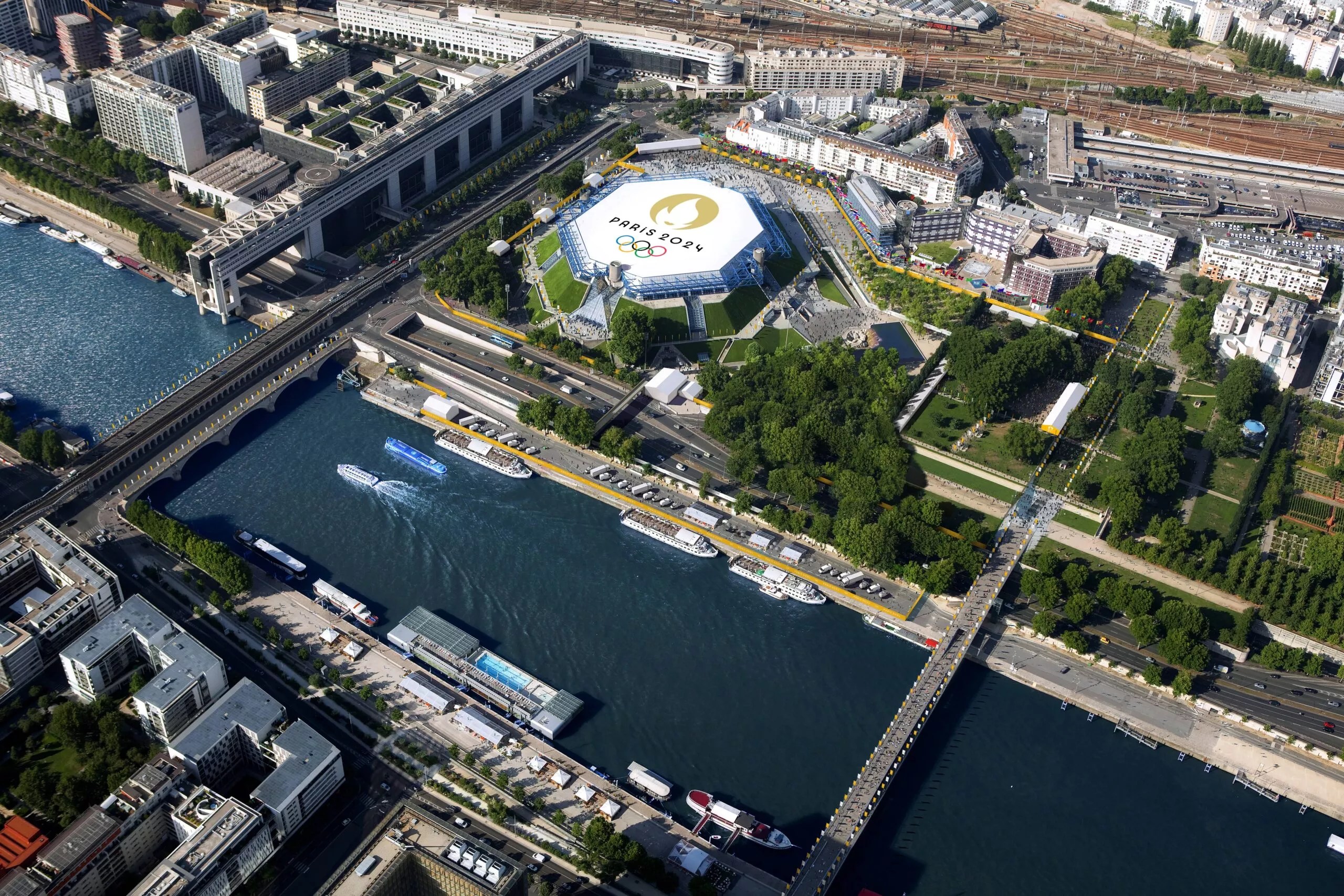
In the future, a New York that wants to make more room will need to do what Vancouver and Paris did. There is no other way.
 Pedestrian Observations

You have it half right. You are correct that the only way to provide ample housing capacity is to increase the density of the built form – generally speaking this means more height than what is there before. You are exactly right that no city can develop every single parcel to max zoning all the time, so almost by definition increasing density means increasing height. There is also the fact
But Vancouver is not the model. Permitting towers at stations/non-residential parcels and then not upzoning nearby areas is not a sustainable housing model. In the US this is often known as the “Seattle Compromise” after a process a decade ago called HALA that saw upzoning (and affordability bonuses) in urban villages around the city – with the compromise being that single family zones were not upzoned. This was clear imitation of its neighbor to the north in Vancouver. However, it could be called the “San Francisco Compromise” as an identical track was taken in 1978 of downzoning and making much of the city single-family only, in exchange for highrise development downtown and in the then-industrial SOMA.
This model fails for the same reason as only building to existing height on undeveloped land fails – it doesn’t provide enough housing. An acre of 100 story towers provides less space/fewer units than 20 acres of 6 story towers (all else being equal on floorplate and unit size). The ratio of single-family to metrotown/urban village in Vancouver/Seattle is as lopsided as the ratio of developed to undeveloped land in Chakrabarti’s analysis of NY. Building high rise on the few parcels isn’t enough. Eventually sites for towers all get built and housing production stops again. Worse, because everyone in the single family homes knows there was a compromise, they will be resistant to further upzoning with the argument of “there can’t be a housing shortage look at all those huge high rises!”
Ten years after its compromise, Seattle is doing alright because more housing is being built than was immediately before. 25-35 years after starting its building boom Vancouver has the highest rents in Canada. 45 years after its compromise San Francisco – well, we all know how that turned out.
A much better model comes from Minneapolis. The city upzoned everywhere, eliminating all single family zones in favor of duplexes-quadplexes, and allowing apartment buildings along corridors thoughout the city, not just 10-30 story highrises near transit (they did that too). As this article details https://www.route-fifty.com/management/2024/01/do-land-use-reforms-spur-housing-development-you-betcha/393154/ the results were dramatic, city housing stock rose 12% in 5 years and income adjusted housing costs dropped 20%(!), with homelessness going down too. Interestingly, the elimination of single family only resulted in a few % of the units built, it was the widespread midrise zoning that added most stock.
A better Canadian model is Montreal, which following its French roots allows midrise and small multi-unit buildings basically everywhere. Montreal rents look like Calgary or Edmonton (slightly higher or lower depending on unit type) and 3-bedrooms in Montreal go for less than 2-bedrooms in Vancouver.
Texas is another success story that follows the same model. The lax or non-existent zoning in Houston, Dallas, Austin mean plenty of homes are built to keep prices low, even as the state is growing fast. The ‘Texas Donut’ may be no urbanists vision of beauty, but it once again proves that widespread midrise construction produces more homes than spot zoning for high rise.
Michael has consistently been, continues to be, and perhaps will forever be wrong with his argument that Hausmannian-style Paris construction can hold greater population than high rise like Manhattan. However, he is correct that it can provide a very dense livable city without resorting to buildings higher than 7-9 stories (forget the myth of 5-6 story Paris, the mansard roof adds 2-3 floors to almost every Parisienne building). At 1/3 the density of Paris (some combination of larger units, slightly shorter, or more single family) you are denser than Vancouver city, and at 1/10th the density you are twice as dense as Vancouver metro. If the 73% of SF that is single family instead had triplexes and corner apartments like the Victorian core the city would not have a housing crisis – Minneapolis achieved its success producing only twice as much housing per capita as SF. That is the model to emulate, not tower-on-a-parking-lot.
Forgot two things.
First, when NYC was zoned for 55m people, it wasn’t because of a multiplicity of high rises. Instead the most common housing type being built at the time was the “New Law” tenement. Although the design of air shafts, courtyards and windows gets most discussion of NYC housing of the age, a key feature of the New Law buildings was that buildings up to six stories high could be built “semi-fireproof” which at the time meant brick or stone walls with wood floors and partitions inside. This was an economical way to build, and the housing typology of mid-rise apartments allowed almost everywhere (I seem to be noticing a pattern…) with affordable construction was what housed the majority of New Yorkers throughout the 20th century. The zoning change in 1961 wasn’t getting rid of high rises but making New Law-style buildings illegal across much of the city, and NYC has had housing price issues since, just like SF post 1978.
Second, Washington state last year eliminated almost all single family zoning statewide in favor of duplexes, etc., so perhaps some people are learning and Seattle will be saved from its own compromise.
I feel like you’re missing Alon’s point. Their actual point, in sum, is “Whatever your density, you probably need to go higher”.
You’re math’s not wrong, but it’s kind of trivially so: you shrink the height by a factor of 16.67, and expand the area by 20. Of course you’ll get a 20% bonus. If you shrink the height only by 4 to 25 stories, and keep the expanded area, you’d get a 400% bonus.
But that’s not really the issue. Here in the Madison WI urban area, dominated by 1 and 2 story buildings, many people call 6 stories a “high rise”. There’s a Texas Donut on the corner of one street, with the apartment section currently unfinished, and already the neighbors are complaining about “ugly concrete” and expressing skepticism that it can even have apartments; presumably they’ve never seen a wrap building before. The TOD area is based on only 1/4 mile distance from the planned initial BRT line; it’s barely anything, and it only grants something like one to two additional floors.
Which is to say, even to get your mid-rises spot zoned here is a huge political task, because we are stuck in the mentality that new development has to be “in character”. It doesn’t matter that, mathematically, Paris is not all that dense: people here think it’s too dense. I mean, literally in my suburb city which is indistinguishable from any neighborhood in actual Madison we have people saying things like “we don’t want to become like Madison”; and if our folks are afraid to change from 1/4 acre SF houses to 1/4 acre SF houses (yes I did that on purpose) how exactly are we going to convince them that 6 story mid-rises are in character?
@Tad, no I get his point exactly, and I agree with it wholeheartedly, almost everywhere needs more density than they currently permit. The problem is his example of Vancouver does not actually produce more density across the region, however high it might go in spots. The math might be trivial but it is correct. Metro Vancouver has identical density to Metro Montreal, so high rise TOD does not in fact make things denser than broad mid rise.
Yes, it’s very difficult to get people to agree to up zoning. But if mid rise is hard then high rise is impossible, if mid rise is impossible (your Madison suburb example) then duplex/triplex is just hard. Instead of making huge compromises to get just a little bit of high rise, better to fight for a lesser level of upzoning, but everywhere.
If you trade one neighborhood of high rise for other neighborhoods of SFD, then those SFD neighborhoods will never change, they will feel they already “gave something up” by allowing the high rise across town. And they will think any up zoning will automatically mean high rises across the street. If you push to allow duplexes, small apartments, etc in SFD neighborhoods you set up for organic growth. A neighborhood of 10% triplex and 90% SFD has the same “character” as one with 30% triplex and 70% SFD – but the latter has 1/3 more homes. An apartment building on he corner isn’t so dramatic/scary if there are already some row houses for rent mid block. Given that this typology results in more units(= less expensive rents) than high rise in limited areas, what is the point for fighting for Vancouver style TOD?
@Onux
And you will forever misquote and misinterpret what I say. I have said that only Manhattan and Hong Kong exceed intramuros-Paris for residential density over a similar scale. HK exceeds by quite a bit but Manhattan not by much. As usual, the point is that despite spiky hi-rise it is only 10-15% more dense. It is hardly a strong case for building such stuff if there is no real need. I also suspect that Manhattan real residential population might slowly decline from here on, because the cost is forcing real New Yorkers into Brooklyn etc and those ultra-hi-rises and other starchitect stuff ends up with a lot of unoccupied housing (non-resident international rich set).
Again, need to get the facts right. The average height in Paris would be 6 floors and that includes any mansard. There is a fair bit of 7 storey building (that number includes a mansard) but very, very few with double mansard to achieve 8 floors. Anything above 8 floors will be post-war with low ceiling modern construction (horrible). The stuff in the bottom-left (opposite Bercy and immediately west of Bibliotheque National FM) in Alon’s pic of Bercy is of that type and might be as high as ten floors but same absolute height as 7 storey Haussmannian.
The rest of your post is somewhat odd to me. I wouldn’t even begin to compare Vancouver and SF with Minneapolis or any Texan city! Canada has had more immigration than any other developed country (#2 is Australia), and obviously SF too has had enormous pressure on housing due to growth of the Bay Area. Also I am not aware there has been much new residential development in Soma? The thing that everyone knows about SF housing solutions, including the NIMBYs, is that a reasonable fraction of those huge SFH zones (Sunset etc) needs to be transformed to Haussmannian. But note, not really that much: with about 8% of SF’s 122km2 it would accommodate 200,000 residents, a 25% increase.
………………..
And Alon: “The surface parking may look obnoxious to urbanists, but the area has more jobs, retail, and housing than the parking lots can admit, and the modal split is very high.”
I don’t quite get your point. I’d take a sizeable bet that there are far more jobs in Bercy. (There’s hardly any residential in that picture.) The “Bercy fortress”, ie. ministry of finance, hanging over the river, by itself probably has more with its 5 hectares.
Then there is the sheer inefficiency of that ‘spiky’ Vancouver zone. Hideous and completely anti-pedestrian, though the surface car parking is so large that most north-Americans get more exercise walking from their car to wherever!
” Bercy, a redevelopment of the steam-era railyards at Gare de Lyon”. No, most of the Bercy development is not on old rail yards but on the site of the old wine markets. Of course it had train tracks to intersect with those of Gare de Lyon to bring all that wine in from the provinces to the warehouses.
https://en.wikipedia.org/wiki/Ministry_of_Economics_and_Finance_(France)#/media/File:Paris_Finanzministerium_2.jpg
This is a bit nitpicky but I go to Paris about once a month and I spend an unusual (probably neurodivergent) amount of time counting the number of floors of Haussmann buildings and to me the standard height of a typical Paris building is 7: R + 5 + mansarde:Avenue de la République: https://i.imgur.com/LbwAr0g.png
The 8 story type (either R+5+2mansarde or R+6+mansarde) is definitely a minority, but it’s not super rare either, and many were built prior to WWI (https://www.comeetie.fr/galerie/BatiParis/#13.82/48.8583/2.3127):
Boulevard de Grenelle: https://i.imgur.com/KxzfH6Y.png
The 9 story type (either R+6+2Mansarde or R+7+mansarde) does seem to be quite a lot rarer, and as far as I can tell these are built almost entirely after WWI, though there are a few pre-WWI buildings that were later extended to reach 9 stories (175 Boulevard Haussmann).
Anyway I digress, the main point is that in my experience staring at buildings 7 is the typical number of floors of a “classic” Paris building, with some 6 and 8 mixed in.
I just realized that I actually don’t know the Australian method of counting floors, so I actually am unsure whether the R+5+mansarde building would count as 6 or 7 floors in Michael’s speech, so my nitpick might not actually apply as I’m using the US method of counting.
Statistically I understand that the classic 6-floor Haussmannian is the most common type. The pic you link to of the 7 floor (R +5 +mansarde) is on a major boulevard. As I explained in an earlier piece, the change in the building rules towards the end of the Belle Époque (ie. post-Haussmann) allowed extra height by setback of the mansards but that was only done/allowed on wide streets. And contrary to what some think most of Paris is not on those boulevards.
It is easy to find pics to illustrate one’s desire. Here’s one (link below) I have shown before. It is a HLM that I believe was built inter-war on the land liberated from the Thiers Wall. It is 6 floors including (1x) mansard. The two main places I lived in (4th & 10th arr.) were the same 6 floors (and I lived on the fifth floor in both which rather put me off living below a mansarde); one of which was Ile St Louis which is entirely that same format (fairly sure all built pre-18th century).
https://en.wikipedia.org/wiki/HLM#/media/File:Paris13_HBM-rueJeanFautrier.jpg
Though this is not Haussmann Haussmannian, if you know what I mean, that is why I show it: it is after the changes to the building regs. Perhaps some built on that same land add the extra (full) floor but I doubt very much any would add an extra mansard level because such chambres-de-bon were no longer in favour.
I think this issue will be covered by Evanson in her book but I’ll have to get back to you later on that. Meanwhile:
That’s 6 floors total, ie. including mansard. Note if there is an entresol it is counted as second floor (first floor in US), ie. it doesn’t sneak in an uncounted ‘extra’ floor. In any case it is not that common and again is mostly on wide boulevards (as within the commercial ground floor).
I went to my Norma Evenson book (Paris: a century of change 1878-1978) to begin searching for the data, but actually it is already clear from a glance at the cover photo:
https://www.amazon.com/Paris-Century-1878-1978-Norma-Evenson/dp/0300026676/
The picture is of the “zinc de Paris” or the “toits de Paris”, ie. the iconic roofs across the 2nd, 9th to the 18th with Sacre Coeur on the hill. In this great sea of a substantial slice of Paris (which is fairly representative except for the 13th), there are four buildings that stand out from the vast majority. In the middle there are two buildings that are almost certainly 7 floors (including 1x mansarde) and these are like in the link minhn1994 gave. All the others are standard 6 floors; you can see the overwhelming evenness of them. By itself this shows that roughly 80-90% of Paris is of the 6-floor typology.
Further in the distance are two non-residential buildings: the one on the left has double-mansards and is higher than the one on the right that has a single mansarde. I reckon these are the grande magazines, possibly Lafayette and/or Printemps on Blvd Haussmann.
Groan. Just gave a substantial reply but it must have been swallowed by the Spammer due to the various links.
I think what Minneapolis, Montreal, and Texas are doing by allowing widespread medium density housing is right. But the metro areas are not bounded by mountains and water like Seattle/SF/Vancouver are, so that is not an entirely fair comparison. Minneapolis, Montreal and DFW metro areas are entirely surrounded by farmland for miles so those metro areas expand outwards as well as densifying. Houston has the Gulf of Mexico but that’s relatively far from the CBD.
Montreal is literally an island (well, technically an archipelago of several islands) surrounded by the St. Lawrence River. 55% of the metro area lives on one of those islands surrounded by water on four sides, a far greater percentage than the part of the Bay Area living in San Francisco surrounded on three sides.
Vancouver has plenty of flat land, stretching 60-100km up the Fraser River.
Metro Montreal’s population density is equal to Metro Vancouver’s, is slightly higher than Metro SF, and is fully four times that of Metro Seattle. If the other three were truly constrained by geography while Montreal was not, then you would expect them to have higher density because more limited land would be filled up. In reality all of these metros are areas of millions of people covering thousands of sqkm. Geography is not the problem. Metro areas that produce lots of housing by widely allowing ‘missing middle’/medium density/mid-rise construction have more reasonable housing costs. Those that don’t do not.
The expansion of the Montreal metro area north, south, east, and west is not substantially constrained by Montreal being technically an island. There are many bridges crossing the St. Lawrence River, including the REM and Yellow line along with many more on the other rivers and islands. Water is only a small portion of the space in the Montreal metro area. In contrast, the Vancouver metro area has mountains to the north, ocean to the west, and the U.S. border to the south. It can only expand development narrowly to the east. SF Bay Area has mountains to the north, east, and south, and ocean to the west, as well as a bay taking a huge amount of space in the middle.
Also, the “density” of the metro areas tend to not actually be useful metric. For example “metro Vancouver” includes a large amount of land that is mountainous land that cannot be developed. Electoral district A, for example, has 815.21 km2 of space but only 18,612 population. The mountainous areas of Seattle and SFBA metro areas cause similar distortions in “density” metrics. The way U.S. metro areas are calculated also tend to include lots of undeveloped rural areas and therefore also distort metrics. This is obvious if you look at a map of the Seattle metro area. Maybe I should more precisely refer to “urban areas” or “developed areas” instead.
https://en.wikipedia.org/wiki/Metro_Vancouver_Electoral_Area_A.
https://en.wikipedia.org/wiki/Seattle_metropolitan_area#/media/File:Map_of_Seattle%E2%80%93Tacoma%E2%80%93Bellevue_MSA_and_Seattle%E2%80%93Tacoma%E2%80%93Olympia_CSA.svg.
It doesn’t make as much sense to think of the actual cities as a housing market rather than the actual metro areas. If you look at the satellite view of these metro areas it becomes clear that some metro areas have a larger amount of water and mountains restricting the ease of development expansion. Just because there is still a direction of expansion remaining and still some amount of open land doesn’t mean the comparative lack of expansion in all directions doesn’t affect housing growth for a metro area. You won’t find many ~4 million population non-coastal non-mountainous metro areas like Minneapolis and Montreal having the housing prices of the Seattle/SF/Vancouver metro areas.
Montreal is at sea level. The next high tide will peak at 5:09 local time. It’s the main reason Montreal is there. It’s as far up the estuary the ocean going ships can go. ( without going through a lock, these days, smaller ones can go as far west as Minnesota. )
Expanding Vancouver’s urban area further into the Fraser Valley would mean repurposing much of BC’s very limited arable land. Building on this land would mean more food imports, higher food prices, and lower quality food.
Portions of the Fraser Valley are also unsuitable for non-agricultural use as they are prone to flooding and/or liquefaction during an earthquake. While these risks can be mitigated, they cannot be mitigated cheaply.
I personally do not see building on farmland to be worth the tradeoffs when Vancouver’s housing crisis could be addressed, without negative consequences, by upzoning the City of Vancouver and the inner suburbs.
Canada is part of NAFTA and other free trade agreements, and Vancouver can receive food by boat which has a low shipping cost. The impact of local farmland on local food prices is minimal. Canada right now has an extremely high immigration rate per capita, so it will have to do more to expand housing than a country with a stable population would including expanding developed area, unless it wants to reduce its immigration rate. Upzoning is unlikely to be entirely sufficient with Canada’s current population growth.
Most of the stuff in a Vancouver supermarket comes from someplace other than British Columbia.
I live in metro Vancouver and am aware of these issues. Much of the retail food supply is already imported, but locally produced food is generally cheaper and of higher quality. Food production in the Fraser Valley is also heavily skewed towards items that are politically or logistically difficult to import, such as dairy and fresh fruit. Certainly, these problems could be solved given an overwhelming need, but that need doesn’t exist at present.
The City of Vancouver has a land area of about 110km^2 (deducting Stanley Park) and a population of just over 660,000. If the city were to be upzoned to the same density as Barcelona, the population could rise to about 1.7 million. Similarly, Burnaby is about 90km^2 and houses just under 300,000 people. If it were upzoned to the same extent, Burnaby could house 1.4 million. Essentially, the Vancouver region could support at least another two million people simply by rationalizing land use in just two cities.
There is no fundamental need to develop the Fraser Valley in the foreseeable future.
You have to convince the people already using the developed parts to move.
Something to note, hope it contributes to the point about:
“will forever be wrong with his argument that Hausmannian-style Paris construction can hold greater population than high rise like Manhattan. However, he is correct that it can provide a very dense livable city without resorting to buildings higher than 7-9 stories”
Instead of comparing different cities, maybe we can compare what happens in a same city that has both types. In the metro of my city, Barcelona, we have some neighborhoods of tall towers (I’d call them commieblocks but they were build by a fascist dictatorship), and they were built in times of “emergency we need to relocate a lot of people from slums”, so they weren’t picky about making it nice. Those areas (Bellvitge, Gornal, la Mina, Sant Roc…) have densities of 20k-40k hab/m2, a bit lower than most of the residential areas, because you need to leave space between the huge blocks. Gràcia, a neighbourhood that is considered a town inside the city, is consistently denser than that for a bigger area, out of sheer “build all the space that is not a street or a square”. Sants – Collblanc – Torrassa – La Florida – Pubilla Casas is twice as dense as the tower areas, while still containing all daily services like schools, medical centers, etc. The most Haussmanian-similar area, the Eixample, also goes around 50k hab/km2 when getting away from the city center (where a lot of old apartments have been converted to offices).
If you want to navigate the data, there’s this official map:
https://sitmun.diba.cat/sitmun2/inicio.jsp?lang=es
(I guess you’ll be more familiar with Spanish than Catalan)
My theory and it is mine is that as societies get wealthier, the average citizen starts getting less comfortable with the organic and disorganized way cities have been traditionally built and wants something that looks more uniform and orderly. This is something both bottom up and top down, at least in the United States we are dealing with decades of people trained by the media to think this is what a good neighborhood looks like (single family homes, yards, gardens, and strict separation of land uses) and this is what a bad neighborhood looks like (jumble use of land unless in a charming European tourist city). This is why we get things like new housing must look like existing housing, etc.
People pay premium prices to live where the real estate ad says “walk to train”. Where it’s jumbled and disorganized. From the point of view of someone who thinks all the world should look like Levvittown. It makes sense to me. To be able to walk to the train there has to be a train. And the train has to take them someplace that isn’t islands of buildings surrounded by parking deserts set in highways.
Some people are willing to pay a lot of money to walk to a train. However such places where that is possible are so rare only a tiny minority willing to pay for it can – by supply and demand – drive the cost of living in such a place very high. If trains were more common how much would people be willing to pay for that? (Something I would like to find out)
It’s possible in suburbs where there is a train. Which is usually a place that suburbanized before World War II. And they want to do it because there is a lot of congestion along the way to the destinations and it’s difficult to park there. The other people make compromises and find some other way to get to the station. Almost all of them will still have automobiles because doing things like going to the supermarket once a week, is worth it.
I wonder to what extent the bottom-up desire for single family detached housing in America is driven by how anti-social most Americans are. Most Americans think nothing of making excessive noise or emitting noxious odors (tobacco, marijuana, cooking-related, etc) at any time. An air gap between residences is a desirable barrier to protect against emissions by neighbors.
In contrast, wealthy cultures that live successfully at higher densities (e.g. Japan, Germany) tend to have much stronger socio-legal taboos against neighbor abuse and/or better noise isolation practices in multi-family housing than are found in the US.
As a counterfactual, American attitudes towards higher density housing may have evolved to be more favorable than they are if the American cultural experience with multi-family housing was in buildings with a socially-appropriate level of noise isolation and ventilation.
As things stand, however, when many Americans hear ‘apartment building’ they think of a slum where the units are separated by two sheets of 1/2″ drywall and one tenant keeps the entire complex awake by plaing urban music all night, every night. Of course Americans don’t want that in their neighborhoods.
I think the tendency to single family housing in most Anglophone countries is because they were generally wealthier than average and accept for the UK, big and not very dense places. The preference was encoded in law latter.
I don’t know how wide-spread it is elsewhere, but NYC has FAR (Floor Area Ratio) restrictions in entire neighborhoods. Even if zoned appropriately (residential/commercial), a developer many times can’t tear down an existing building and build a new one because the existing building is grandfathered-in with a FAR that is greater than the present allowance. The Empire State Building can’t be torn-down and replaced with an identical building for this reason (yes, there is the newer concept of buying air-rights from your neighbor, but that is another kettle of fish. I am waiting to see how a new Penn Station/Madison Square Garden fights this out.).
NYC, SF, and other urban areas also have rent control. This makes housing construction financially less attractive, with affordable housing being a non-starter. Even if you can get by the zoning and FAR, the numbers may say that you shouldn’t build rental housing. Covid and non-return-to-office has now got commercial building owners begging for special dispensation from the pope to do residential conversions. Look at the recent 60 Minutes episode about NYC real estate to see how FAR restrictions are dealt with during conversions with (stupid) “void” rooms (inaccessible, completely walled-off) being constructed.
Most of New York City is below the FAR. There is life north of Columbus Circle. New construction isn’t controlled.
This is a perfect example of how the ultimate purpose of modern zoning regulations is to constrain the supply of built space in order to protect valuations and income streams for incumbent property owners.
Void rooms do not impact the “character of the neighborhood,” cast shadows on other buildings, or have implications for global warming. They exist only to keep floor area out of the market.
Restrictive zoning is economic rentierism. Everything other aspect of zoning policy is window dressing around this fact.
@Coridon Henshaw
Exactly, and the same reason why government building social housing has been very restricted over the past half century.
FYI, today sees publication of the inaugural issue of Nature Cities. But dare I venture to comment that the editor does sound a bit … woke?
Being a Nature pub I assume it demands an outrageous subscription for access.
Your Upper West Side symbol manipulator biases are showing. The people living in Eastern Queens or Staten Island find it desirable. 30 years ago Brownsville wasn’t desirable. 50 years ago there were suggestions to shut down the Canarsie line for lack of interest.
And it’s not the zoning. Click around on zoning maps lots of places are zoned for much higher. Those pesky pesky people already there will want lots of money to vacate.
It’s a stretch to call greater Vancouver a TOD success story.
Vancouver’s reliance on TOD without upzoning has resulted in the region having the third worst housing affordability in the OECD. The consequences of that have been a double epidemic of homelessness and deaths of despair, declining quality of life, and a looming demographic crisis as young adults flee to cities where it is legal for them to live.
This does, of course, substantiate your main point that zoning needs to allow for population growth. Greater Vancouver’s zoning regime, however, does not.
It will be interesting to see what impacts provincial zoning reforms will have on Vancouver going forward, but unless these reforms remove the voices of incumbent property owners from housing policy making, the region will continue to serve only as an example of what not to do.
Exactly right. The “Vancouver/Seattle/San Francisco Compromise” (towers in a limited area of TOD/Urban Villages/Near-CBD without residential up zoning of single-family neighborhoods) is exactly an example of what not to do.
SF doesn’t even have that many towers within the radius of transit stations. I moved out to the Bay Area in early 2018. Since that time only one really big apartment complex has been built along the MacArthur BART station in Oakland, a few around the 12th and 19th street ones in Oakand, the old parking lot in Walnut Creek was turned to apartments, and that is about this. The Berkeley BART stations are the same along with most of the San Francisco ones. Parking lots still domiante the other BART stations.
Correct. In the 70’s the NIMBY focus in SF was reaction to the first wave of skyscraper building (Bank of America Building, Transamerica Pyramid, etc.) The far left Bay Guardian newspaper did a cover with a cartoon of a skyscraper and a headline Death of the City or something similar. Coming off of the successful freeway revolts there was a movement to ban high rises. Downtown business interests didn’t want that, so the compromise was that the 1978 zoning reform didn’t ban downtown towers (although a more successful movement in 1985 did limit them) but it did cap the rest of the city at 40’ and a huge portion single family. The mechanism is different than TOD (high rises consolidated in the CBD instead of clustered at stations) but the pattern is the same – a small amount of land gets zoned very dense while the vast majority is zoned very low density.
@Onux
So laissez faire building hi-rise doesn’t solve housing issues?
Mais non, c’est pas possible?
These are specifically examples of not laissez-faire zoning. The areas that haven’t been redeveloped into higher density have been prevented from doing so by local opposition, specifically in opposition to market demand, hence the high prices.
When you very specifically limit where high rises can be built, that isn’t “laissez faire” it’s just the opposite. Houston does have laissez fairs high rises, the lack of any zoning code in the city means tall buildings occasionally get built just about anywhere in the city, sometimes to neighborhood discontent. Houston also has plenty of housing production and reasonable rents, so yes laissez faire high rise does solve housing issues. The point is the Alon’s example of Vancouver (along with SF, etc.) is not an example of laissez faire high rise building, or if any other kind of building. High rises are only permitted in very restricted areas, and any sort of reasonable density (including much low rise and mid rise not just high rise) is prohibited everywhere else.
The vast majority of housing being built in metro Houston is single family. With some condos that don’t have elevators.
Adirondacker is correct. And in Houston/any Texan city residents, especially new homeowners, directly exchange housing affordability with huge VMT*, your lifestyle and sanity.
Anyway your arguments are like the neoliberal economists who say, yeah we’ve had 40+ years of neoliberal practice around the entire world … and it has made most things for most individuals worse … but it has never been hard enough or pure enough. Just give us another decade or two with real neoliberalism and we’ll show you.
Yeah, let’s go real laissez faire in Vancouver, you know say like Hong Kong (most unaffordable and stressed housing market in the world). Good luck with getting Vancouverites to trust you. Of course Canada has introduced limits to foreign ownership (or at least a moratorium?) but that’s shutting the barn door …
…………..
*From Jane Holtz Kay, p32 in Asphalt Nation:
*from the world’s fave psychologist (and only Nobelist):
http://www.slate.com/id/2295603/pagenum/all/#p2
Your Commute Is Killing You By Annie Lowrey, May 26, 2011
“The vast majority of housing being built in metro Houston is single family.”
In 2020 37% of housing starts in Houston were multi-family. It was the year with the highest number of single family starts since ’07. In 2016 46% of housing starts in Houston were multi-family. It’s called a “Texas Donut” for a reason.
“Your Commute Is Killing You“
Average commute times by metro, per https://www.census.gov/library/visualizations/interactive/work-travel-time.html
NYC 37.6 min (highest in the country)
Wash DC 34.9 min
Bos 32.2 min
Chicago 32.2 min
Philadelphia 30.5 min
Houston 30 min
Dallas 28.5 min
San Antonio 26.6 min
I mean, the two of you could at least try to do some research before posting things that are factually inaccurate, like the idea that a car-centric metros have longer commute times than transit centric ones.
“he young man who drove me to the airport … has 78,000 miles on it and he hasn’t been anywhere“
Did you seriously quote someone who complained about how far his taxi (Uber? Lyft?) driver has driven without ‘seeing the world’!?!?!? Does he, or you for that matter, realize that taxi drivers drive a lot because driving all day is their job?!?! London black cab drivers put on about 46k mi/yr (50% more than this young Texas man) without ever leaving the home counties, should we consider London a failure?
Another simplistic and misleading approach in comparing Houston to NYC. It doesn’t prove what you think it does.
I couldn’t get mode-share from that link but here is some oldish data:
City……………..walking………cycling……..transit…….car
Houston……………..2%…………..0%…………4%…………88%
New York City…..10%……………1%………….55%………29%
The reason why NYC has always held the “longest commute” record is because walking and transit take longer than car, and car in NYC is also worse because it is a bigger city with bottlenecks (bridges & tunnels).
Now it may not be true for all Americans and certainly not for ‘true’ Texans, but even with NYC’s shitty subway, I would rather walk, cycle or use the subway than be stuck driving in Houston. I do not consider it a worse experience because it might take a bit longer.
Commuting by car might be as frustrating in NYC as it is in Houston but then only one third as many New Yorkers make that choice. Houstonians have no choice.
As to the 78,000 miles driver, it wasn’t a taxi or uber, it was a student travelling to his school. Talking about someone who has chosen driving as a living is kind of a dumb non-argument. And the student had no choice (though maybe he could have lived closer, but then he may have stayed in the parental home so avoided rent etc etc).
Most people in metro Houston don’t live in Houston.
All of the figures I gave above are for the Houston MSA.
Vishaan Chakrabarti points out the undertaxation of lots, which could be fixed with the bill for land value taxation in the NY senate passing and if implemented in NYC. But even that is a small portion of the amount that could be built by upzoning to high density near transit including at commuter rail stations outside the city.
Might want to remove the California HSR Blog link. It links to this page https://www.ceritakorea.com/ now
😦 Done. Sad…
Also people often have a very limited view on what amount of transit access is necessary to support moderate to high density
While a subway station often enables moderate and high density to occur. Moderate and high density doesn’t necessitate a subway station in order to be built, especially in high cost metro areas
In Washington state the committee on housing has already passed changes to its TOD bill to limit zoning reform to mostly only light rail and exclusive lane BRT, changed from the previous bill that would have included upzoning around trolleybus stops in Seattle.
This is profoundly self limiting given that Seattle’s light rail serves very few neighborhoods in the city (U link for instance only served Capitol Hill between UW and downtown missing large swaths of high job density neighborhoods like First Hill, Central District, etc).
And outside of the city limiting zoning reform to light rail stations pretty much means limiting zoning reform to neighborhoods hugging freeways which are exactly the opposite of neighborhoods where demand for housing is the highest and are where GHG emissions and health problems associated are greatest
Regular frequent buses can support moderate to high density housing. People who assert otherwise usually are just trying to raise the bar (cost and timelines) for zoning reform
Transit should follow density. Vancouver is completely and utterly unaffordable and out of reach for most canadians but it didn’t have to be this way
Apart from NIMBYism there is no reason why TOD projects couldn’t have taken place while rezoning the entire city and outlying suburbs to allow any density of housing
Is eastern queens by the LIRR really not redevelopable (I know you mean not stuff on the Port Washington Branch which would all look like Hong Kong thanks to Chinese immigration if we allowed it), but like Queens Village has got to be a viable redevelopment location right?
If the LIRR is improved. I hope that happens, but I also hope that Netanyahu and Putin both spontaneously combust.
The people already living and working there would want a lot of money to move. Which slows down redevelopment.
it remind me some people say Hong Kong being lack of land development despite large parts of the city still zoned for rural housing/agricultural/foshery purpise, is probably because Hong Kong government charge 100% of difference in value in land when a land change zoning, and thus unless developers can expect the land’s value will continue to grow after zoning, there are little incentive for developers to actually pay up to change those lands into high density residential.
“In Vancouver, the rule that Chakrabarti imposes that the preexisting parcels must be empty or nonresidential is largely observed – as far as I can tell, the city has not upzoned low-density residential areas near SkyTrain, and even in Burnaby, the bulk of redevelopment has been in nonresidential areas.”
This is true historically, but is in the process of changing. The raft of provincial legislation changes will push the process along, but even without that, municipalities were already starting to move the needle on this front.
For example, out in the outer suburbs, Coquitlam council consulted detached homeowners near Burquitlam station and found that the majority of them wanted the city to upzone their neighbourhood as much as possible so they could sell out for a big payday. And if you go by there now, almost all the houses within 800m of the station (except the ones in Burnaby!) have been demolished and a forest of condo towers and 6 story buildings is in the process of going up.
Even further out, in Port Moody (sometimes referred to locally as Port Nimby), after years of back and forth, a pro-development council was elected and is allowing the demolition of a detached home neighbourhood near Inlet Centre station to proceed, while the few remaining single detached houses near Port Moody Centre station are steadily being replaced by low rise (mostly 6 story) apartments.
In Surrey, where the extension of the Expo line to Langley will run through, the city is pre-emptively upzoning anything near the new stations (whether detached housing or whatever) to allow for much higher density housing to go ahead.
Even in Vancouver proper, the city is grudgingly moving forward on a number of fronts, from the Cambie plan, to the Broadway plan to more localized plans such as the Renfrew & Rupert station area plan along with marginal and modest but heading in the right direction upzoning of single detached homes in general.
Despite the long overdue replacement of city council with fresh faces, Burnaby continues to be a laggard on this front, but on the other hand, many of the Burnaby stations still have a lot of commercial and industrial land around them that can be built on, so their intransigence on single detached housing isn’t preventing ongoing densification around most Burnaby stations.
Another thing that can blocks development of housing is rent control tenants refusing to leave, even when offered large buyouts. This is happening in NYC, for example:
https://eastsidefeed.com/real-estate/score-one-for-the-big-bad-developer/
I bet if they gave him another apartment with the same rent and conditions and $50k he would move.
The developer offered millions of dollars to the tenant, who refused it, per the NYT.
https://www.nytimes.com/2021/09/10/realestate/holdout-new-development.html
I think we really do have to stop this sort of situation where <5% of existing residents block a development proposal even when they are being made fully whole financially and get a goodwill payment on top.
The legacy of Moses is that we don’t want to allow governments that power as they abused it. We have gone too far the other way I agree, but I have not seen anyone suggest how we can ensure the next Moses won’t do just as bad of things if we relax things.
I think the solution to that is that you have a signature requirement for objections. You could require maybe 5-10% of the voters in the area to sign a petition in order for it to be reviewed. Maybe for an individual building like this you could have a lower figure that isn’t zero.
It’s difficult to imagine that these individual residents who won’t move when everyone else has could gather even 250 signatures or whatever.
But on the other hand for controversial projects it would be relatively easy to get lots of signatures for it. If one volunteer can get 15 signatures in an hour for an unpopular project then with 20 volunteers you could get 1500 signatures if each volunteer spent 5 hours gathering them.
You can’t force private owners to sell.
“It’s difficult to imagine that these individual residents who won’t move when everyone else has could gather even 250 signatures or whatever.”
@Matthew Hutton, you clearly have no experience whatsoever in current left-NIMBY/BANANA thinking or organizing. You could get 250 signatures in a heartbeat in almost any NY neighborhood (same for Boston, SF, Seattle, etc.) opposing a large development even if a tenant didn’t want to stay. Look at the title of @B’s first link: ‘Score One for the Big Bad Developer.’
A huge swath of urban America is inherently against real estate development for emotional/ideological reasons, and will fight building new houses no matter how illogical it is. In San Francisco there were years long fights over development of a parking lot and a fast food restaurant into buildings much shorter than the one in NY – only 7-8 stories not 22 – even though by definition parking lots and fast food joints have no one living there refusing to move.
@Adirondacker, the issue here isn’t one private owner forcing another private owner to sell. It’s the opposite, the owner wants to stop renting and the city was trying to force him to extend the lease. What is happening is in effect what you say cannot – a private owner is being forced to give up property to another that they don’t want to.
The McDonalds thing sounds super bananas. I cannot imagine that happening here.