Security Theater on Metros
In comments, Sarapen asked me about security on urban rail. It’s common in developing Asia to require people to go through metal detectors to get to the platforms; I’ve seen this in Bangkok, she mentions this in the context of Manila, and it’s also the case on Indian metros and Chinese ones. Seung Y. Lee, a BART digital media worker and indispensable commentator on American and Asian metro history who sadly doesn’t blog enough, has an excellent post about it, talking about the use of security as a tool of social control, for example in Hong Kong.
But Sarapen is asking about the need for security to deter terrorism and violence, which do exist in the Philippines.
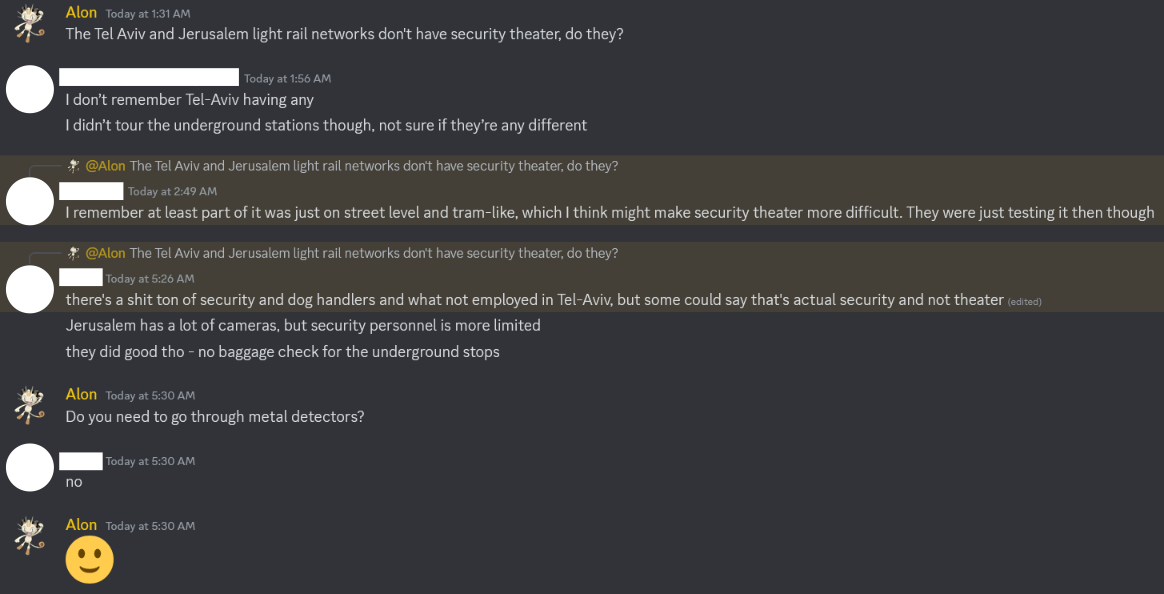
For this, I naturally went to the country facing terrorism and violence that I know most intimately. I haven’t visited in more than 11 years, and so I’ve never taken the light rail in either Tel Aviv or Jerusalem (which was open on my last visit but I didn’t visit the city then). So I went ahead and asked on my Discord server, and got this:
The person covered up by the two shorter white rectangles also posted a picture of a platform in Tel Aviv, with a vault for bomb disposal:
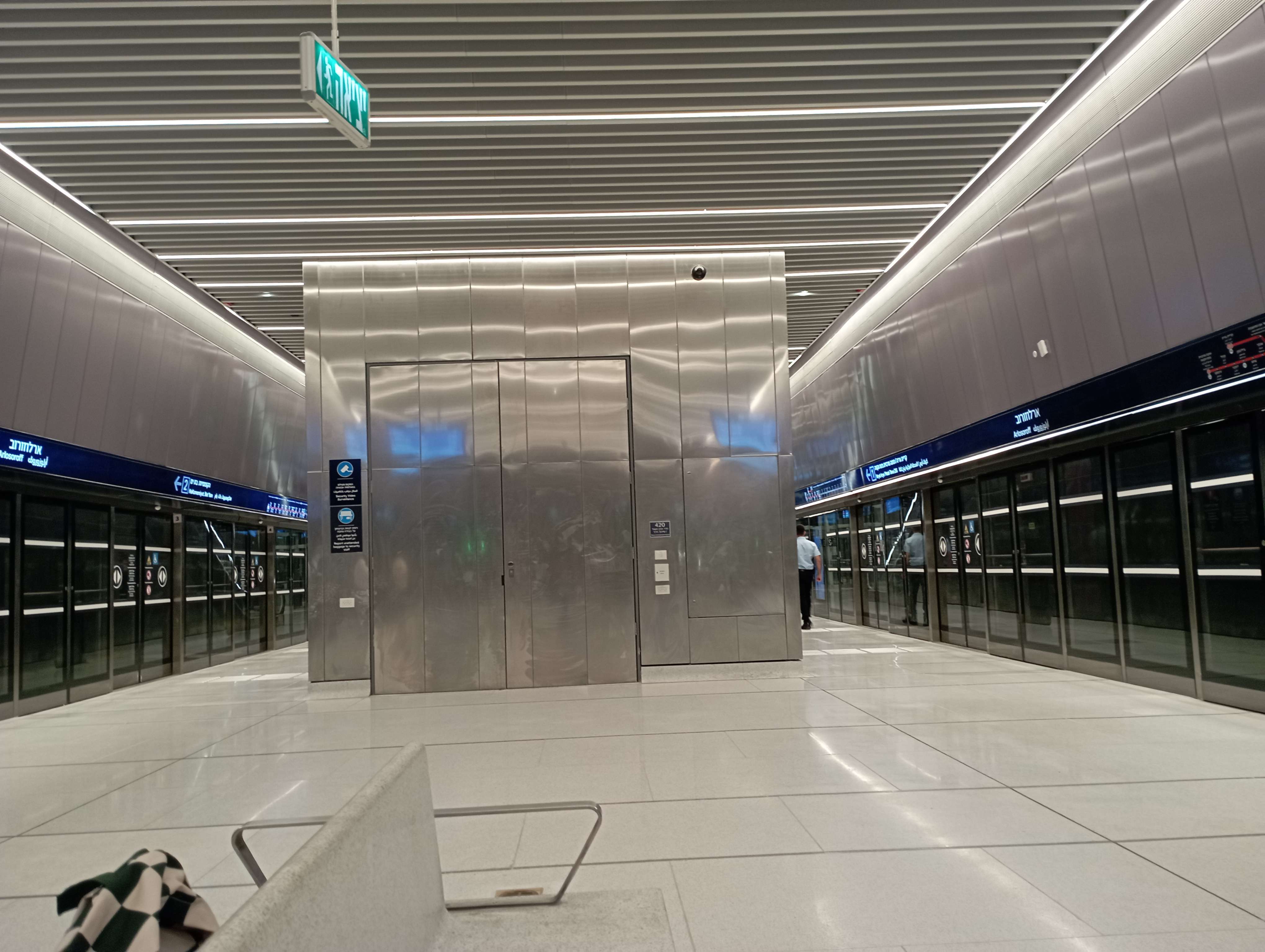
Israel Railways does have security theater – one has to open one’s bags in front of a security guard and go through a metal detector, and this being Israel, there is extensive racial profililng. But the light rail, including the underground portions in Tel Aviv, do not. There’s a lot of visible security presence, including cameras, security personnel, and K-9 units, but no metal detectors. This is in a country that, in the 1990s and early 2000s, underwent a wave of suicide bombings on buses, and still didn’t put metal detectors on them, because it’s infeasible to install such technology on surface transit, and too expensive and frankly not too useful on metros (a security line is an attractive bombing target).
This shouldn’t be too surprising, in a way. Western Europe did not install security theater on trains in response to far-left terrorism in the 1970s and 80s. Israel’s way of building and running public transportation is intended as a pan-European medley, using consultants who have done work in Europe, and with media discourse that looks up to Europe’s urban transportation systems (on other matters Israel looks up to the United States, but Israelis understand American public transportation is not good). If nobody in Europe (or at least Western Europe) does something, it’s unlikely Israel will do it, not on civilian public infrastructure.
 Pedestrian Observations
Brightline in Florida does require sending your bags through the X-ray machine. Still, with everything in their stations being very deliberate – even down to scent machines – I wonder what kind of calculus they did to justify that.
Weird – Amtrak has successfully resisted TSA mandates to that effect.
I mean, it is in Florida. I’d not be surprised if someone somewhere in the company was paranoid enough–of actual terrorism/violence or just liability thereto–to incorporate some non-mandatory security features. It’s an expensive investment for that kind of thing, but then if you weigh the cost against some potential multi-million dollar lawsuit, who knows how many avoided events you’re amortizing the cost against?
Meanwhile the trains running between the country’s capital and a city that was the victim of one of the largest terrorist attacks in history manage to run without any x-ray machines or metal detectors.
Well, one train line is surrounded by geography which isn’t amenable to sprawl–the Atlantic, Long Island Sound, Chesapeake Bay, the Berkshires, etc.–and another is, provided you fill all the holes in the limestone with enough concrete. And so in one place, efficient land-based transportation is an inevitability of productive urban economics, and the other, it’s not; waste can run wild.
In the northeast, you have to have some meaningful portion of the population using rail-based transportation networks if you don’t want the economy of the area to die eventually, and in the other, the economy was never really that productive to begin with, so imposing unnecessary security theater is fine.
@aquaticko
Are you suggesting that the Brightline route is amenable to sprawl while the NEC is not? If so you have it exactly opposite. Between the Atlantic Ocean and the Everglades the south Florida coast is far more constrained by geography than the Northeast. Between Miami and W. Palm Beach the built up area is nowhere wider than 30km, and the vast majority is 20km or less. North of W. Palm or south of Miami its 10km, max. Miami is the 13th densest urban area in the country and denser than any urban area on the NEC except for NYC. Its a bit of different story in the rest of the state, but even Orlando is almost the same urban density as Philadelphia and denser than Boston.
The place constrained by the Atlantic and LI Sound is Long Island itself – which is the one place that doesn’t have intercity service by Amtrak. Philadelphia is ~40km “wide” (perpendicular to the NEC) taking only the ends of the rail system (Voorhies to King of Prussia). DC about the same from the ends of Metro. As for the rest of the NEC, there is from 100-150km from the coast (or the Chesapeake) to where the foothills begin. The Berkshires at 100+km from NYC and 150+km from Boston, even Hartford/Springfield are 40+km away, which is more space from one side of the center than S. Florida has for it’s urban strip in total.
@Onux
From this, we get into a chicken-or-egg question. The NEC and its adjacenies has ~50 million people; the areas served by Brightline has ~12 million people. This, in spite of the fact that it’s far easier/cheaper to fill holes in the ground than to level hills and mountains; has rail responded to more difficult urban geography, or has rail enabled the greater overall population densities caused by more difficult urban geography?
That said, Brightline isn’t South Florida; there are, as you say, few people there specifically because the land doesn’t permit for easy settlement. Brightline is Central Florida, across the peninsula’s widest section, where the biggest challenge is to ensure that the land people build on isn’t actively sinking. There’s also the fact that the era of greatest population dispersal in the NEC is pre-automobile, meaning that distances between major population centers are smaller, and consequently, the region is denser overall.
There are no flat, easily populable areas along the NEC that aren’t Boston/NYC/Philly/DC, even if first-glance at the topography suggests there could be. By contrast, all of Central Florida can be easily filled with people, particularly as municipal/county governments there don’t seem to concerned with flood control.
That’s because the north east corridor is grandfathered in, but Brightline in Florida isn’t grandfathered in.
There’s also the difference of delay times, well run security checks including passport controls might delay passengers by 10 minutes. On a regional train that’s a big deal, on a long distance one it is far less significant.
@aquaticko
The NEC is larger than Florida, that is not in question. The point is that the NEC does NOT have more difficult urban geography than the part of Florida where Brightline operates. Florida is very flat, but although flat, swamp is difficult to build on so everything is compressed into a very narrow urban strip, resulting in S. Florida having greater urban density than anywhere on the NEC except NYC. This directly contradicts your initial statement that Florida is more amenable to sprawl than the NEC.
“Brightline isn’t South Florida; there are, as you say, few people there specifically because the land doesn’t permit for easy settlement. Brightline is Central Florida, across the peninsula’s widest section”
Brightline currently runs from Miami to Orlando, which is very much South Florida, five of six stations are West Palm Beach or south of it. Only a very small portion of track runs partially across the peninsula instead of north-south along the coast.
South Florida has a population larger than Central Florida, so it is completely wrong to say that “there are…few people there”.
I can understand not knowing that Miami is denser than Boston or Philadelphia because Census urban area boundaries and statistics are obscure, but the most cursory look at a map would show that Brightline in no way serves Central Florida across the widest part of the state. Perhaps you should do some minimal research before commenting so ignorantly.
“the NEC . . . is denser overall.”
It depends on your definition of the NEC. If you include just urban areas on the mainline (DC-Bos) and compare it to the urban areas between Miami and Orlando inclusive (the route of Brightline) then the NEC has slightly higher urban density, but not appreciably so (1,507 vs 1,402 pop/km2, a 7% difference). If you include urban areas with direct service on the Regional or Keystone or commuter service to the NEC (Harrisburg, Richmond, Lynchburg, Waterbury, Hartford, Worcester, etc.) then Florida pulls ahead (1,402 vs 1,297 pop/km2, a 8% difference). Either way, the densities are very similar, in no way supporting your assertion that the NEC is much denser
Brightline also has checked bags. Do you know where on the train they are put?
During my gap year in Israel I remember that to enter the Central Bus Station in Jerusalem they made you go through a security line and your bag got put in the x-ray machine. Do they still do that?
They do in train stations and maybe some central bus stations, but not in most bus stops (which are just on the street, including for most intercity buses).
They removed trash-bins in French stations after an attack in 95 where a gaz container was used as a bomb in one of them. Not sure if they put them back. There were other measures, like mandatory luggage labelling in trains, and mean sounding acronyms.
UK stations used to have metal trash bins until the IRA bombings in the 1980s/1990s. Now, the bins are just a metal hoop with a very light plastic lid and then a transparent plastic bag hanging from the loop. They work, but you can see exactly what’s in the bin at any time (so anything bomb-like can be identified) and there’s no metal shrapnel from the body of the bin, which was what did most of the damage from the bombings.
They are less attractive than a solid metal bin, but they’re still functional. There was a long and frustrating period after the metal bins were sealed before this new design was rolled out when there were no bins on stations and litter accumulated everywhere.
Thanks for answering, I didn’t realize metal detectors wouldn’t just be useless but actually harmful with regard to terrorism.
Pune India hotels and malls xray your bags before you are allowed to enter. The metro was still under construction when I was last there. Since India like Isreal has had terrorist attacks in recent years, I wonder how they handle security there. India labor is cheap so security guards are all over.
Of interest, Cairo makes everyone getting on the Metro go through the metal detector and run any bags through an x-ray machine. (They do the same on Egyptian State Railways.) But the real holdup on the metro is that everyone has to buy their tickets from a guy at a window. (A few stations *have* TVMs, especially downtown and on the newer Line 3, but none of them ever seem to be working.)
With Israeli bag checks, I’d also note that IIRC in Haifa they’re absent on the Karmelit but present on the Rachbelit, not sure whether that’s because one is a rail funicular and the other a cable car, or for ease of transfers from the Rachbelit to mainline rail at Merkazit HaMifratz.
Forgot to mention this but the last time I rode a long-distance bus in Latin America a cop boarded before departure with a video camera recording the faces of all the passengers before returning to the bus station. This was in like 2007 and I’ve been to various countries since that time, so I can’t be sure where this took place, but I think it may have been Peru.
Thanks for mentioning Western Europe in the ’70’s and 80’s. I was stationed in Berlin at the founding of the Red Army Faction (or Fraction) in our neighborhood and it was interesting to see how things evolved. The top transit measure that I observed was a renewed emphasis on keeping the U-Bahn free of litter. It made sense that if the environment is clean, something unusual is more likely to be noticed. On my subsequent transit jobs in the U.S. and Canada I was supportive of our cleaning and maintenance people. Unfortunately that does not meet political demands, even though customers like it for mundane reasons. It’s a tempting target during budget cuts. And admittedly, it defends better against groups that don’t consider themselves to be expendable.
In that era, there did not appear to be any special measures on the West S-Bahn lines. It was destroying itself.
The rail industry has huge fixed costs, anything that increases passenger numbers and revenue has to be treated as a good thing.
Keeping stations clean I cannot imagine is particularly expensive, so undoubtedly it brings in more revenue than it costs.
and some countries are just inconsistent. If I go to a shopping mall in Istanbul for example I need to go through a metal detector. and if I park a car at many such locations some bored security guy will use a mirror to check under my car and ask to open the trunk. But this does not happen everywhere.
and just to get into the airport to departures you have to go through a check and then after you check in you go through another check and then depending on where your flying to you go through another check before being allowed to the gate….
but the metro, buses and ferries have no such checks. Although I have to believe that facial recognition surveillance is ongoing.
Getting people to behave with minimal decorum is a lot more important for the safety of transit users.
Security checks on metro systems just seem like it would slow down the entire system if you did it as thoroughly as an airport. I get it that know politician wants to be the one with their pants caught down if something occurs but European politicians seem the most brave in not imposing security theater in response to terrorism compared to politicians elsewhere, including outright dictators. American systems don’t have security theaters but BART police have been a more active presence on the trains lately rather than just showing up when people make a report.
I really wouldn’t call Israeli politicians “brave.” (It’s also not a decision made at the political level – Miri Regev likely doesn’t know it’s even an option, so the civil servants at the ministry of transport run things and they prioritize capacity over theater.)
Security theater in Bangkok tends to be more obviously theater, and more an excuse to turn away people who security feels might cause minor trouble, than a real attempt to even give the appearance of fighting violent crime and terrorism.
There’s a metal detector at the entrance of most luxury malls in Bangkok, but even just a month after the recent luxury mall shooting, every metal detector I walked through was either completely ignored or turned off entirely. And while I have seen an MRT station actually using the metal detector and doing bag searches, it’s incredibly rare. Most of the time, the metal detector is just a useless arch people walk through.
i have heard about people in China saying that, wuth how crowded the security theaters are, any serious attempt at terrorism could simply target the crowd waiting for check and will probably get better kill count.
Also, the security check in China isn’t supposed to be serious, when the HSR extension to Hong Kong open, MTR didn’t got the memo and tried to apply actual airport level security check to high speed rail passengers, and that caused quite a bit of problems.
@Phake Nick
Isn’t the whole HSR terminal in HK under control of the PLA, ie. it is a bit of extraterritoriality by PRC.
The station is legally part of Mainland China with Chinese law enforcement and other Chinese government employees executing Chinese law on the side of the station after crossing the border crossing line inside the station. However MTR is still responsible for the operation of the entire station. With the exception of ticketing which MTR tried to develop its own system of ticketing in parallel with China Railways’ 12306 but that couldn’t really worked out and now they mostly let China Railways group handle it.
So, as I said.
The point about lines is amusing, because Tokyo did little other than add a few more CCTV cameras around stations and removed more trash bins after the Sarin Gas Attacks. I think the rail companies would’ve been vehemently against any sort of measures at the gates as they’re (particularly JR East) pretty adamant about maintaining a 60-passenger a minute throughput capacity per gate as a safety measure.
i think they are investing into Thz wave radar that can scan and see suspicious content inside passengers baggages without needing passengers to stop
Tokyo, and Japan rail generally, also closed all of the coin lockers after the Sarin attack.
Remind me what the link to your Discord is again?
Check your email. (I don’t like having the link out in the open because of spam, but I will email or DM it to anyone on request.)
please email/dm me the link if you can, thank you.
Check your mail too.
Going to +1 that; I’m not terribly active on discord but always love to join interesting servers
Check your email.
Mentioned on this blog before: Spain put in train station security after the 2004 Madrid bombings.
At least in February 2020, just before the pandemic was actually considered a problem, in the subway in Minsk there were random checks of backpacks and bags at the main stations (in the city center), but it was very random and there did not seem to be any consistent criteria neither it was routine. At one of the central stations I remember there was an X-ray machine.
It seems like this security theater is more common in countries with rather low car/motor vehicle ownership rates per capita. https://en.wikipedia.org/wiki/List_of_countries_and_territories_by_motor_vehicles_per_capita
It’s like as if there is more car ownership, public transit agencies must compete with driving somehow. It probably explains why events like 9/11 or 2015 Paris attacks didn’t bring them.
Europe (especially Western Europe/EU member states) and also Japan are rather car dependent societies it’s just that they aren’t to the extent USA/Canada/Australia are.
Israel was security theater-free on buses even at very low levels of motorization, though. And Singapore has no security theater on the MRT; it has about 150 cars per 1,000 people and an authoritarian government, just one that prioritizes throughput over theater.
No significant violent crime or terrorism in Singapore to be fair.
But people might carry a forbidden snack if you’re not careful and we can’t have that in Singapore….