Trucking and Grocery Prices
In dedication to people who argue in favor of urban motorways on the grounds that they’re necessary for truck access and cheap consumer goods, here are, at the same scale, the motorway networks of New York, London, Paris, and Berlin. While perusing these maps, note that grocery prices in New York are significantly higher than in its European counterparts. Boston is included as well, for an example of an American city with fewer inherent access issues coming from wide rivers with few bridges; grocery prices in Boston are lower than in New York but higher than in Paris and Berlin (I don’t remember how London compares).
The maps


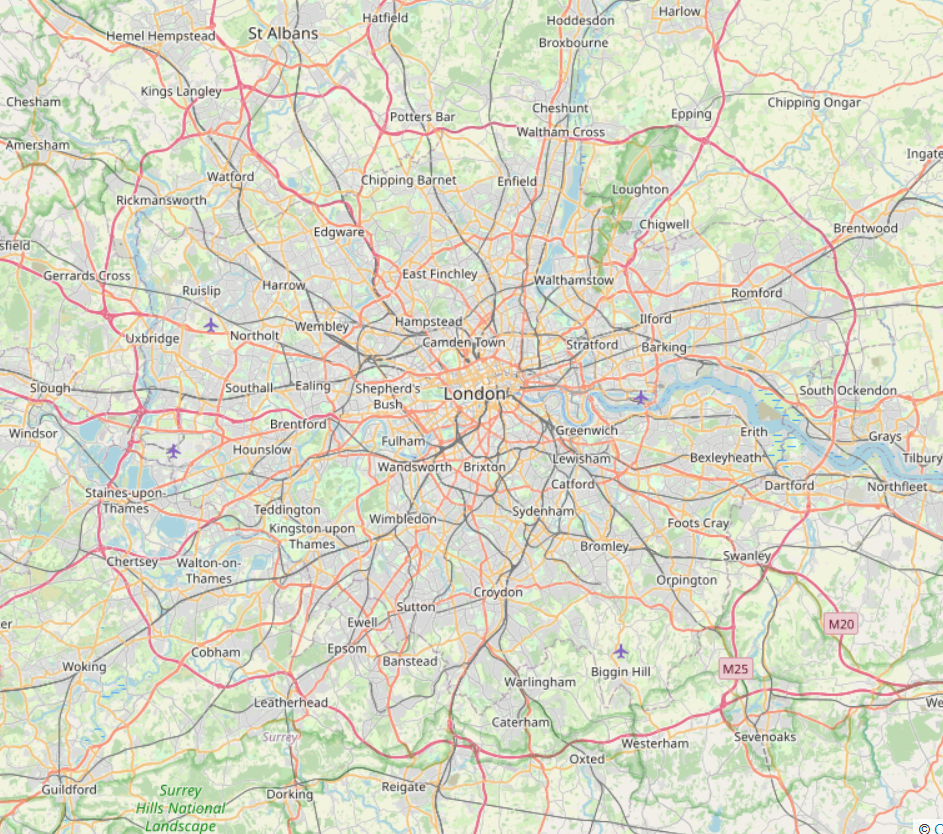

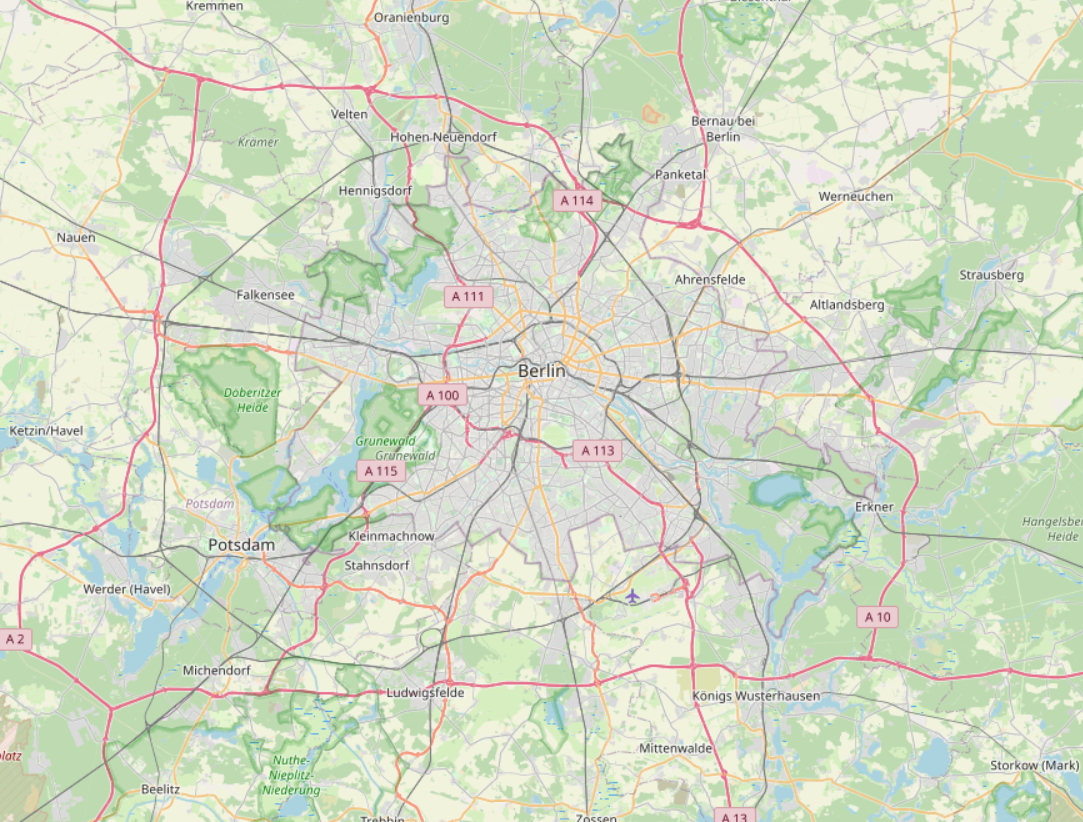
The scale isn’t exactly the same – it’s all sampled from the same zoom level on OpenStreetMaps; New York is at 40° 45′ N and Berlin is at 52° 30′ N, so technically the Berlin map is at a 1.25 times closer zoom level than the New York map, and the others are in between. But it’s close. Motorways are in red; the Périphérique, delineating the boundary between Paris and its suburbs, is a full freeway, but is inconsistently depicted in red, since it gives right-of-way to entering over through-traffic, typical for regular roads but not of freeways, even though otherwise it is built to freeway standards.
Discussion
The Périphérique is at city limits; within it, 2.1 million people live, and 1.9 million work, representing 32% of Ile-de-France’s total as of 2020. There are no motorways within this zone; there were a few but they have been boulevardized under the mayoralty of Anne Hidalgo, and simultaneously, at-grade arterial roads have had lanes reduced to make room for bike lanes, sidewalk expansion, and pedestrian plazas. Berlin Greens love to negatively contrast the city with Paris, since Berlin is slowly expanding the A100 Autobahn counterclockwise along the Ring (in the above map, the Ring is in black; the under-construction 16th segment of A100 is from the place labeled A113 north to just short of the river), and is not narrowing boulevards to make room for bike lanes. But the A100 ring isn’t even complete, nor is there any plan to complete it; the controversial 17th segment is just a few kilometers across the river. On net, the Autobahn network here is smaller than in Ile-de-France, and looks similar in size per capita. London is even more under-freewayed – the M25 ring encloses nearly the entire city, population 8.8 million, and within it are only a handful of radial motorways, none penetrating into Central London.
The contrast with American cities is stark. New York is, by American standards, under-freewayed, legacy of early freeway revolts going back to the 1950s and the opposition to the Lower Manhattan Expressway, which would have connected the Holland Tunnel with the Manhattan and Williamsburg Bridges; see map here. There’s practically no penetration into Manhattan, just stub connections to the bridges and tunnels. But Manhattan is not 2.1 million people but 1.6 million – and we should probably subtract Washington Heights (200,000 people in CB 12) since it is crossed by a freeway or even all of Upper Manhattan (650,000 in CBs 9-12). Immediately outside Manhattan, there are ample freeways, crossing close-in neighborhoods in Brooklyn, Queens, the South Bronx, and Jersey City. The city is not automobile-friendly, but it has considerably more car and truck capacity than its European counterparts. Boston, with a less anti-freeway history than New York, has penetration all the way to Downtown Boston, with the Central Artery, now the Big Dig, having all-controlled-access through-connections to points north, west, and south.
Grocery prices
Americans who defend the status quo of urban freeways keep asking about truck access; this played a role in the debate over what to do about the Brooklyn-Queens Expressway’s Downtown Brooklyn section. Against shutting it down, some New Yorkers said, there is the issue of the heavy truck traffic, and where it would go. This then led to American triumphalism about how truck access is important for cheap groceries and other goods, to avoid urban traffic.
And that argument does not survive a trip to a New York (or other urban American) supermarket and another trip to a German or French one. German supermarkets are famously cheap, and have been entering the UK and US, where their greater efficiency in delivering goods has put pressure on local competitors. Walmart, as famously inexpensive as Aldi and Lidl (and generally unavailable in large cities), has had to lower prices to compete. Carrefour and Casino do not operate in the US or UK, and my impression of American urbanists is that they stereotype Carrefour as expensive because they associate it with their expensive French vacations, but outside cities they are French-speaking Walmarts, and even in Paris their prices, while higher, are not much higher than those of German chains in Germany and are much lower than anything available in New York.
While the UK has not given the world any discount retailer like Walmart, Carrefour, or Lidl, its own prices are distinctly lower than in the US, at least as far as the cities are concerned. UK wages are infamously lower than US wages these days, but the UK has such high interregional inequality that wages in London, where the comparison was made, are not too different from wages in New York, especially for people who are not working in tech or other high-wage fields (see national inequality numbers here). In Germany, where inequality is similar to that of the UK or a tad lower, and average wages are higher, I’ve seen Aldi advertise 20€/hour positions; the cookies and cottage cheese that I buy are 1€ per pack where a New York supermarket would charge maybe $3 for a comparable product.
Retail and freight
Retail is a labor-intensive industry. Its costs are dominated by the wages and benefits of the employees. Both the overall profit margins and the operating income per employee are low; increases in wages are visible in prices. If the delivery trucks get stuck in traffic, are charged a congestion tax, have restricted delivery hours, or otherwise have to deal with any of the consequences of urban anti-car policy, the impact on retail efficiency is low.
The connection between automobility and cheap retail is not that auto-oriented cities have an easier time providing cheap goods; Boston is rather auto-oriented by European standards and has expensive retail and the same is true of the other secondary transit cities of the United States. Rather, it’s that postwar innovations in retail efficiency have included, among other things, adapting to new mass motorization, through the invention of the hypermarket by Walmart and Carrefour. But the main innovation is not the car, but rather the idea of buying in bulk to reduce prices; Aldi achieves the same bulk buying with smaller stores, through using off-brand private labels. In the American context, Walmart and other discount retailers have with few exceptions not bothered providing urban-scale stores, because in a country with, as of 2019, a 90% car modal split and a 9% transit-and-active-transportation modal split for people not working from home, it’s more convenient to just ignore the small urban patches that have other transportation needs. In France and Germany, equally cheap discounters do go after the urban market – New York groceries are dominated by high-cost local and regional chains, Paris and Berlin ones are dominated by the same national chains that sell in periurban areas – and offer low-cost goods.
The upshot is that a city can engage in the same anti-car urban policies as Paris and not at all see this in retail prices. This is especially remarkable since Paris’s policies do not include congestion pricing – Hidalgo is of the opinion that rationing road space through prices is too neoliberal; normally, congestion pricing regimes remove cars used by commuters and marginal non-commute personal trips, whereas commercial traffic happily pays a few pounds to get there faster. Even with the sort of anti-car policies that disproportionately hurt commercial traffic more than congestion pricing, Paris has significantly cheaper retail than New York (or Boston, San Francisco, etc.).
And Berlin, for all of its urbanist cultural cringe toward Paris, needs to be classified alongside Paris and not alongside American cities. The city does not have a large motorway network, and its inner-urban neighborhoods are not fast drive-throughs. And yet in the center of the city, next to pedestrian plazas, retailers like Edeka and Kaufland charge 1€ for items that New York chains outside Manhattan sell for $2.5-4. Urban-scale retail deliveries are that unimportant to the retail industry.
 Pedestrian Observations
In my travelling around the world I’ve observed that the price of basic products (food, groceries, basic services…) are strongly correlated with the local salary level, while the price of global items (technology, cars, etc…) are mostly globalized. So I’m not surprised that in US groceries are more expensive than in Europe.
That said, the “need for trucking” is irrelevant to the argument about road capacity. According to the statistics in my city (Page 47: https://omc.cat/documents/662112/0/EMEF+2022_Informe+BCN_DEF+%281%29.pdf/b86a68c7-42bf-d132-8fcc-3be1ba2df84f?t=1706000538724 ) vans and trucks represent only 10% of the private vehicle trips in the city in working days. I think we should keep private vehicle accessibility for people who really need it, but given the externalities of using cars inside dense urban areas, we really need to think on how people choose their mode of transport. A lot of the trips are made by car out of marginal convenience over an excellent public transport network.
In general I’ve observed that vans drive in the city more aggressively than average cars, consistently. I was once told that companies tell drivers they’ll happily pay if they get driving fines, as far as they get the job done (personal “wanting to get the job done” must count too, because I see the same pattern for delivery bikers). I guess those same companies would be quite happy to pay for congestion pricing if that means that their drivers get a more expedite way around the city?
That’s true but not in conflict with Alon’s thesis. In fact it is the reason why retail prices are insensitive to reducing road access (within limits).
The trick is how to reduce overall congestion without impeding essential stuff. Alon mentions Congestion Charges but they are problematic. London’s hasn’t really worked as overall traffic eventually returned, though in different form consisting of rampaging delivery and Uber-type services. Incidentally Hidalgo’s objection is based on socialist principles, ie. it is intrinsically advantaging the wealthy to the disadvantage of the less-wealthy. Funny enough this may not have been a major issue in London but that is because the Congestion Zone is only a relatively small area which has a mere 140,000 residents (compare to Paris’ 2.1 million) and by definition they are very wealthy. In Singapore it is very much a strategy that favours the wealthy as is normal for one of the most unequal rich countries. Having said that, one doesn’t have much sympathy for people whether rich or poor for driving in these cities. But there is something to say for equal access.
Whatever Hidalgo has done has worked, and arguably more sustainably than London. A big deterrent of driving into Paris has always been parking which is a de facto congestion charge that only applies to private cars and not delivery vans (which use legal short-term free loading zones). One thing it has shown pretty conclusively is that closing some freeways (the only one in Paris, the Pompidou riverside expressway), roads giving more space to bikes, scooters and parking spaces to outside dining, and reducing speed limit to 30kph, car-free days, has not resulted in carmageddon. The trend of fewer cars in Paris continues. I’d say, as a one-time car owner (though barely a driver) in Paris, most drivers were primed over years by these factors. In fact the downward trend began in the 90s:
The only tiny qualification I’d put on the Paris case–which I don’t think makes any of the strategies or conclusions invalid–is that Paris is somewhat special in having the Peripherique ring road so close to the centre; of course it forms the border between Paris and its suburbs with approx. 5km radius. All of the autoroutes converging from all over the country join the Peripherique which is why it is the busiest road in Europe (300m pa; not sure if it has increased as Parisian traffic has decreased; possibly not because it has been saturated for ages and long reached the state of self-limiting). It means that delivery vehicles can get very close–within a few kilometres–of any part of inner-Paris before actually transgressing holy ground of Paris itself. There are 32 exit/entry points.
And of course the Paris Metro (& RER) delivers you much closer to your destination than most other transit systems via the ‘accident’ of extremely dense lines and stations. By contrast London often means a long walk after exiting the Underground station; I don’t mind walking but it does mean getting around London to multiple destinations/chores during a visit is more time consuming–to a degree this encourages more use of taxis and ride-sharing.
The 10% comment was precisely to reinforce Alon’s point, not to refute it.
I’ve lived in Singapore, and actually I don’t have much problem with their mobility model. Car is considered a luxury product there, so they’re consistent with it. Since the country is so small, they can afford having a nationwide hard limit on the amount of cars, and they auction the licenses to own a car. So if you’re not in the car-driving privileged class, at least the ridiculous amount of money paid by people with cars contributes to you having a top notch public transport system. Sounds better than hearing “we cannot implement a low-emissions zone because we can’t force the working class to change car out of the blue”.
“The trick is how to reduce overall congestion without impeding essential stuff.” Yes, and that’s easier said than done. If you make driving convenient for those who need it, you easily make it more convenient for everybody and, as I said before, you end up having a majority of traffic consisting of “trips made by car out of marginal convenience over an excellent public transport network”, becoming a problem both for those who need it, and those who don’t drive. I’m open to listen for ideas and success stories from everywhere…A lot of what you describe sounds so familiar, makes me feel like Barcelona is Paris with some frustrating missed opportunities. Excellent metro, same ringroad around almost 2 million people (and half of an older inner one), limit of 30 kph to big areas, expensive parking space, as a former car owner I gave up on the car because it gave me more work than solutions, plus it was an expense.But at the same time, metro could be so much better if we hadn’t got trapped in the L9 (which ticks so many of Alon’s checkboxes on how not to run a project), tram lines disconnected because of political bickering and cowardice. Some main streets (notably Gran Via and Aragó) designed to simplify crossing the city through the middle instead of using the ringroad. Bike infrastructure is hit and miss, but I think the main deterrent is actually bike theft. And Rodalies (our RER) got such consistent bad rep after two decades of uninvesting, that people with the excuse “but we need the car to go to work” actually may have a point that the alternative is too unreliable. And at the same time housing inside the city is very expensive, and everybody wants a society where housing is affordable, “but don’t build the affordable housing next to my home because my neighborhood gets full of that people”.
Sorry for the ranting…
Sorry if I misinterpreted your point.
Singapore could run a simple lottery system or they could restrict the miles driven or the days you can drive. Instead of one totally skewed to the very wealthy. It’s a bit grotesque and perhaps no surprise that London, another city-state of absurd inequality and exorbitant often inherited privilege, is the only other place to have adopted something similar.
In fact London now has in place an electronic enforcement system, that has now extended over all of London for the ULEZ scheme, they could modify the congestion charge to one of these other ideas to reduce overall VMT without pandering to the rich. Khan probably doesn’t have the power to do it, or like Hidalgo/Paris, has to get approval from central government.
As to housing affordability, Barcelona has the same problem as Paris: too popular. Though without the historic infrastructure to cope with it. Your city could build more public housing like Paris and Greater Paris does, and along the lines of the Vienna Model so it isn’t solely concentrated in particular areas or SES.
As usual the solution to all these problems is: be more like Paris:-)
As usual the solution to all these problems is: be more like Paris:-)
The solution to housing affordability is to be like Paris?!?!?!
Average cost per sq meter in Paris is 10,000 euro . . . in Barcelona it is 4,120. For rent it is 1,880 vs 1,500. By both measures Paris is the 4th or 5th most expensive city in Europe.
Paris’ public housing is a flashy socialist band aid. The first right of refusal to buy buildings looks impressive, but the waiting list for public housing in Paris is over six years long.
You missed the hint that I was being ever so slightly facetious …
… but ok, not completely. As usual you are making the error (as almost all journos and even economists) of comparing “Paris” with other cities. Do you think your complaint stands if you compare to the Gotic or La Ribera quarters or even the Eixample? Not to mention London for which you’d have to look at where those approx. 130k uber-wealthy residents live in the centre; London’s periphery, where it takes an hour to commute, is more expensive than inner-Paris.
Here’s an example where they understand this distinction:
Here is a good comparison (€pm), published Dec-2023 (for latest data from INSEE I believe):
Rental property………………….Paris………London……Difference
Apt 1-bed in City Centre…………1,350.58……..2.615.96 ……..+93.7%
Apt 1-bed outside Centre………….935.79……..1,894.39………+102.4%
Apt 3-bed in City Center…………2,958.65…….4,783.42……….+61.7%
Apt 3-bed outside Center……….2,094.35……..3,032.32………+44.8%
As you can see, rent in outer-London is 140% more expensive than in inner-Paris! It is actually cheaper than Sydney (no surprise) but even my own secondary city of Brisbane (but due to be an Olympic city in 2032). “Paris” is hardly cheap but neither is it very expensive and that is comparing with cities that don’t offer nearly as much.
Perhaps Jordi has equivalent data for Barcelona. It wouldn’t really surprise if greater Barcelona was cheaper than Greater Paris but I’d wonder about old/inner Barcelona due to the AirBnB problem (see further below) and the fact that it is much more constrained than inner-Paris. And according to Jordi it is less convenient living in most of Barcelona compared to suburban Paris because its ‘RER’ is not as good. In fact for Barcelona the real comparison should not be Ile de France but the Petite Couronne where its 6m residents often have a Metro ride as well as RER and trams (and in many cases a short walk across the Periph.)
Likewise for the public housing. Of course there is a long waiting list because 1. there is never going to be enough and 2. of course lots of people are trying their luck on scoring one in inner-Paris. It doesn’t mean those people are homeless or whatever. Have you missed the analyses of Yonah Freemark, and reported here by Alon, on Paris building 50,000 houses a year, of course in Greater Paris, approx twenty times what London does (maybe even more considering how lots of existing public housing is being privatised or demolished; IIRC building isn’t keeping pace with losses). Most will also be on housing lists for Ile-de-France where there are far more available and where many will settle for.
Like Barcelona, Paris has had an AirBnB problem but Paris is the largest AirBnB market in the world and has been getting to grips with it. In addition its long-standing public and social housing stock has meant it suffered somewhat less, as well of course as there being five times more housing just across the Peripherique.
Oh, and I was riffing on:
That CityLab article (alas behind paywall) is close to a decade old. Today, the comparison is even starker, ie much more in favour of Paris. Perhaps you haven’t noticed but the world has been taking more interest, ie. urbanist, environmentalist, transit and housing and the whole 15-minute thing. There’ll be a lot more articles in the coming months you could learn from, Onux:-) Here’s another extract I have previously given on PO: (and when he’s saying “less acute housing crisis” he is talking about inner-Paris, so really not much of a housing crisis at all except for those who refuse to compromise on living a few hundred metres on the other side of the Periph.)
Stockholm, Gothenburg, and Milan have congestion pricing.
And London does not have especially high inequality; remember that disposable income inequality is about the same in the UK, France, and Germany nowadays (link). English speakers are more familiar with the aristocratic culture in the UK, one in which a Coutts can write an article in the Telegraph complaining about Youths These Days with a straight face, but western Paris and Bavaria have their own equivalents and so do rich suburbs in the US, those cultures just manifest themselves differently and use different prejudices against the poor. Just remember that a) Germany does not have comprehensive education and b) France subsidizes Catholic schools as an ersatz way to give middle-class conservatives class-segregated education without too much exposure to post-1945 civilization. The London-Singapore connection isn’t inequality, it’s language – Singapore adopted Smeed’s recommendations, and decades later British consultants who worked in Singapore brought the idea back home.
Now, Italy does have high inequality for Western Europe, though not for the US. The reason is that its welfare state is inefficient at redistributing income, for similar reasons as France – too much for retirees and civil servants, too little for the poor. But Italy has German tax levels whereas France has Nordic ones, so France, for Nordic taxes and spending, gets German inequality, whereas Italy, for German taxes and spending, gets the worst inequality in Western Europe, and also low productivity due to economic dwarfism of the kind that neither France nor Northern Europe has.
And then Sweden is not at all a high-inequality state. And moreover, in the debate there, as in London, the socialists wanted congestion pricing and the conservatives and right-liberals did not.
Your link doesn’t work but here is the OECD data (for selected countries; this is mostly for 2022 or later).
https://data.oecd.org/inequality/income-inequality.htm
Country ≥2022
Denmark 0.268
Sweden 0.268
Finland 0.273
Norway 0.285
Canada 0.292
Netherlands 0.297
France 0.298
Germany 0.303
Australia 0.318
Spain 0.320
Switzerland 0.320
Italy 0.330
Japan 0.339
UK 0.354
USA 0.395
There are lots of different metrics but obviously the OECD shows here the most commonly used/accepted one. It includes government transfers. The only countries worse than the UK and US are Turkey, Mexico, Chile & Costa Rica (and Singapore & HK but these aren’t in the OECD).
If anything I’d say the effective inequality is worse in London because these data won’t capture the impact of the non-resident ultra-rich of whom there are more in London than any other European city; they make the city more expensive especially for property and rents.
The reason the state subsidies Catholic schools is actually similar to Australia: many of these schools were quite poor and didn’t deliver good educational outcomes. In France any school receiving state funds has to adhere to state rules on curriculum and secularism, so it is the opposite of what you are implying. I’d say it seems to work. But I would prefer both in France and Australia they were fully taken over by the state.
Now if you (and Borners) want to talk about a private (aka ‘public’, ffs) school system that perpetuates a privileged elite ruling class we could discuss the UK … And actually they also have some independent schools that struggle and it has been suggested they should be nationalised; those that have converted into state schools have benefited (Melissa Benn, 18 Jul 2020). Starmer is under pressure to do this if he becomes PM; he is perceived as both promising or suspect on this because he went to a Grammar school then Leeds University but the school went private while he was a student then he went to Oxford for post-grad.
These elite “public” schools have charitable status so are also state subsidised. They represent 7% of students yet 40% or more of some top universities’ intakes, and of course 44% of the current government MPs (and 52% of senior court judges, etc etc). Almost the entire British ruling cabinet is from a narrow set of those private schools. That is a surefire way to maintain the kakistocracy! By comparison Macron is from Henri IV which claims to be one of the oldest public (state) school in the world, from 1796 of course.
In case it is thought this is a Guardianista conspiracy here is a German perspective:
https://www.spiegel.de/international/europe/how-eton-college-perpetuates-problems-in-the-uk-a-1280694.html
I explained that in my original post. It is arguable that the relatively small Congestion Charge Zone really only concerned the very wealthy and privileged (and insane, like anyone trying to drive there!). It is not at all comparable to all of (inner) Paris. That explains the political divide there, though of course that doesn’t mean either side/argument was correct. As for Paris and Hidalgo I admit I am equivocal in that I don’t have much sympathy for car drivers there, but Hidalgo’s point is also correct. I think it is also fair to question the economic theory which like so much is too simplistic. The logic is too similar to rail pricing in the UK which I absolutely hate (congestion acts as its own disincentive to travel at peak times but there are occasions when you need to and the cost differential is absurdly punitive and makes using the rail system a fantastic pain). The fact that the World Bank forced it on Singapore is an indictment IMO.
I note that it was implemented in Stockholm when the Centre-Right ousted the Social-Democrats. And that “the revenue would go entirely to new road constructions in and around Stockholm instead of entirely to public transport in Stockholm as it was during the trial period.” Discouraging cars by funding new road building! Then there is: “From 2006 to 2011, despite a reduction in traffic and increase in favorable public opinion[27] congestion in Stockholm increased .[28]” Like it did in London.
But the bottom line is that the socialists who have run Paris for 20+ years have achieved their aims without it, so what’s left to argue over? London, OTOH …
Alon white Australians have two settings 1. Britain is the mother country. 2. Britain is the worst country, my ancestors left its oppression for freedom (i.e. land you could steal cheaply*) and all that is bad in Australia is because of them.
Asking Aussies to not believe the Britain that they have created in their head is a fools errand. Britain is ideological composition in their heads before it is empirical question. I’ve had Aussies tell me to my face that I was more priveleged than them because of my accent even when they owned multiple homes in Sydney and I own….lots of Japanese art catalogues*.
A lot of this is that as with pretty much all our daughter nations/successor states except the US/Israel, there isn’t satisfying Imperial overthrow where you show how heroic you are**.
*I have also had American white Harvard grads tell me this (Nilo). And for the record I’m not of any aristocratic background. My English ancestors were Lancashire and Somerset bougie.
N/B A weird part of UK’s lower than you think inequality is that so much of UK PLC died 1945-present that the domestic capitalist class isn’t that strong (my sister works in London art market which is 95% foreigners in terms of customer base). And as I said downthread, housing outperforms the stockmarket in the UK, add in tax exemptions on houses plus the 1980’s transfer of social housing to Boomers and you have a very different class structure than many other social democracies with their big family firms. Hilariously UK may have a formal titular aristocracy but France and Germany those aristocrats held onto more of their wealth.
**Ireland doesn’t count because the Irish war of independence happens after a home rule plus partition has been passed by the UK parliament. Indeed that war happens precisely because peaceful independence wasn’t sexy enough.
London is also a city that fails to build housing.
For example, in EUR, average rent in Tokyo, with Chiyoda as a city center area, and Sumida/Katsushika as outside of city center areas
And those are averages, which hide the fact that entry level housing can be very cheap even in areas with lots of luxury dragging up the average. One of my friends is a migrant restaurant worker, and pays under 200EUR/month to live in Chiyoda.
Paris does build a lot more housing than London, but it could and should still be building even more housing.
Fair enough but we were comparing European cities. I could find some other big cities that were arguably cheaper but the thing is, I wouldn’t even consider living there and they are simply no comparison to Paris. Tokyo is in that category; I know a lot of gweilos rave about it but one can see from the numbers that it is not the reality for the vast majority. By comparison I was interested living in Hong Kong, and a lot of foreigners used to think the same as the numbers show(ed); it’s also extremely expensive.
When I did live there (well for a short working visit) there was only one person (out of maybe >30) in the lab in which I worked who lived in central Tokyo and he was a foreigner like me. But that was back before the property bust when it was horrendously expensive.
Again I think you are confusing inner-Paris with Greater Paris (Ile de France, or Petite Couronne). There can never be large-scale new housing in the former (except for fanciful schemes like Alon’s demolition and hi-rise rebuild) while there is a lot of new housing being built in the latter (incidentally the 50,000 pa cited is IIRC only social-housing, ie. without the private sector). London hardly builds anything.
But even here, Tokyo is special. I mean is much new housing being built in Chiyoda? I doubt it. And one would need to look at net building because part of the reason for a lot of new building is the Japanese habit of demolishing quite recent houses. Even Danchi apartment buildings, seemingly well designed and built, have fallen out of favour and are being demolished. The fact is that, despite overall continued growth of Tokyo, Japan’s falling population affects it:
Actually Tokyo is not continuing to grow. It peaked in 2018 and has been on a steady slow decline since.
Tokyo, Japan Metro Area Population 1950-2024
The current metro area population of Tokyo in 2024 is 37,115,000, a 0.21% decline from 2023.
The metro area population of Tokyo in 2023 was 37,194,000, a 0.21% decline from 2022.
The metro area population of Tokyo in 2022 was 37,274,000, a 0.18% decline from 2021.
The metro area population of Tokyo in 2021 was 37,340,000, a 0.14% decline from 2020.
Sorry that I’m back late to the party, a few clarifications:
“Perhaps Jordi has equivalent data for Barcelona. It wouldn’t really surprise if greater Barcelona was cheaper than Greater Paris but I’d wonder about old/inner Barcelona due to the AirBnB problem (see further below) and the fact that it is much more constrained than inner-Paris. And according to Jordi it is less convenient living in most of Barcelona compared to suburban Paris because its ‘RER’ is not as good. In fact for Barcelona the real comparison should not be Ile de France but the Petite Couronne where its 6m residents often have a Metro ride as well as RER and trams (and in many cases a short walk across the Periph.)”
I won’t pretend to be an expert in Paris here, but if we define the “Petite Couronne” as the area where metro arrives well, that would be the 2-2,5 million of Cornellà, l’Hospitalet, Barcelona, Sant Adrià, Santa Coloma and Badalona (and maybe Esplugues). Certainly Paris is bigger. The area affected by bad RER is the one beyond this ring, although here my point was that its bad reputation makes it harder to remove car convenience, which ends up being used by people who aren’t coming from RER area.
The Airbnb problem is strongest in l’Eixample, Ciutat Vella, and parts of Gràcia, but given how centric these areas are for business too, and how the difference is not that extreme respect to other areas (or between summer and winter), I feel there’s a bit of “looking for somebody from outside to blame”. The statistics I found don’t distinguish by type of apartment, but I think the rates are lower than the Paris ones you posted, though in a country with lower salaries as well.
Official statistics about renting prices: https://habitatge.gencat.cat/ca/dades/indicadors_estadistiques/estadistiques_de_construccio_i_mercat_immobiliari/mercat_de_lloguer/lloguers-barcelona-per-districtes-i-barris/
And about price of home buying (second-hand): https://ajuntament.barcelona.cat/estadistica/catala/Estadistiques_per_temes/Habitatge_i_mercat_immobiliari/Mercat_immobiliari/Preu_oferta_habitatge_segona_ma/evo/t2mab.htm
I don’t think the absolute numbers compare to London or Paris, I’d summarize it roughly in: “If you rent, you pay half of your salary forever. If you stay living with parents for long enough, maybe you and your partner can save for the entrance so you can buy with a mortgage until retirement age for only one third of your salary”. Surely there are more scientific ways to put it.
Tokyo is by any sensible measure the most desirable and accessible city in the world to live in, hence why it is the largest, despite all the other factors working against that. Paris is some combination of undesirable and inaccessible, considering that only like a fifth of even just French people live there, and it is only a third the size of Tokyo despite having a vastly larger pool of potential inhabitants who can legally move there.
Chiyoda is also building a lot of new housing, considering that the population has increased by 20% since 2015, and will probably accelerate both as post-pandemic norms shift office demand for residential demand, and more and more of Greater Tokyo moves into the 23W area. And yet at the very bottom of the housing market, people can still find homes for $200/month.
Singapore is somewhat unique in also having Hawker Centers and I believe a large number of inhabitants who do not cook at home. So you just pick something up for yourself or the family on the way home from work at the Hawker Center.
How unique is unique? Japanese city centres have bunch of these formal-informal commercial spaces, Ame-yokocho in Ueno, the canal yatai of Fukuoka, tourist trap shrine-temple precincts like Asakusa or Kiyomizu-dera. Plus there are the underground street networks in the big city central station districts.
Did a bit of googling…these Hawker Centers sound a lot like larger, more intentional versions of what Baltimore’s historic public markets have evolved into over the last few decades. And for the record, the five City-owned markets (contractor-managed i think) are generally nicer than the privately owned and operated Lexington Market. Expanding this system a bit here might be something to think about, somewhere near the middle of the priority list after the bigger and more basic stuff is in better shape and trajectory
Independent of the impact of transportation issues on prices, getting rid of individual car traffic in city centers leaves more space for vehicles with a strong need to be there: deliveries, emergencies, reduced mobility etc.
Its actually interesting how the people who whinge about urban highways in this way are usually the same people who deindustrialise cities with insufficient industrial estates. The deindustrialisation of NY, Boston, SF urban areas is driven by many things but one of them is NIMBY refusal to permit those industrial estates in the periphery. Modern factories and warehouses require And these aren’t the worst examples, Kansai/Osaka and Marseilles come to my mind.
But the worst is Greater London by miles. UK deindustrialisation is usually blamed on “amateur sociology” (to quote the late great Bob Solow), but its really just starving the SE of land and infrastructure*. This “strangely” has not led the North to develop commercially viable high-value added sectors, instead they get food packaging and Amazon warehouses (they whinge about those too). High-tech factories that do exist like the F-35 ones in Lancashire are only there because the Government put it there and BAE has to run commuter flights for the top engineers from Southern England.
*SE only has an advantage in rail infrastracture, everything else electricity, water, road capacity, housing, commercial estate is lower per capita in the south than in the various regions of Outer Britain, just as the 1947 intended, reinforced by Thatcher’s Nimby central planning tightening of the system. Not a single major new industrial estate has been built in the SE since 1990 despite the SE adding about 10 million people with the highest industrial estate prices in Europe.
UK ranting aside. I actually think the Japanese case is very interesting. All the major cities operate their own urban tollways that aren’t part of the national network, which were built on top the massive road-widening that happened during the reconstruction projects after WW2 (most notable in Nagoya and Osaka’s CBDs). Part of the reason Osaka and Nagoya have such extensive underground shopping streets is that they made above ground so car heavy while having stringent height restrictions.
There was some logic to it, Japan kept its inner city industrial zones for a lot longer than other industrial powers, Adachi, Sakai, Higashi-Osaka, Kobe’s Nagata-Ku and Atsuta (Nagoya). They only really started struggling post-1990 when the shift to peripheral big estates of which Toyota’s Eastern Aichi operations are by far the largest. This when out-of-centre shopping malls like Aeon start emerging big-time thanks to this and a degree of deregulation (LDP’s traditional small-shop keeper base has been slowly weakening).
This basically wrecked Osaka and Kobe’s position, as they had massively overinvested in urban highways servicing those traditional light-industrial areas and their heavy industrial portlands which they wrecked by trying to turn them into mixed use districts**. Hence massive shortage of modern large site industrial space in Kansai. Pointedly the only successful industries Kansai has had since 1990 are ones that don’t need that space i.e. Nintendo, Kobe’s biotech cluster, Kyocera’s high-end industrial ceramics and tourism. Real London/Boston vibes there.
Which would have been forgivable had they not ignored the light industrial sprawal in Southern Osaka which is poorly served by highways compared to city centre. And has at least until Naniwa-Suji is complete poor access to the CBD and points north because Osaka metro hated through-running. The only highway that needs to be built in Japan is Settsu-Southern Nara-Mie. And they aren’t building it, instead random roads to nowhere because LDP patronage politics.
**They are still at this with the world expo park in Yumeshima. Osaka factory land is barely cheaper than Tokyo. Which is insane given relative incomes or city centre commercial land prices.
There was discussion on urbanist/Japanologist Twitter over the last few days about how Japan secretly has lots of box store/shopping mall edge cities with decaying city centres. Which is true but that’s mostly because the locals wanted it that way and consistently voted for it. Classic Shotengai covered streets require lots of people in walking distance who don’t use cars to be viable. Hence the small business culture that so many people praise in Japan in books like Emergent Tokyo, is only healthy in the transit cities. Typical regional Japanese self-destructive L, they voted the LDP rural road machine to destroy their trad settlement patterns***.
***This really isn’t top down, as Utsunomiya’s new LRT line or Toyama’s intergrated tram network is showing you have options. And Fukui is an LDP fortress and has a huge amount of legacy rail it has just failed to turns into some sort of S-bahn/tram-train mix. I’d argue a key player is a functioning private rail operator which is what Hiroshima/Matsuyama.
How much of the UK’s deindustrialization is even the product of any postwar policy? Northern industries were having trouble competing on price even before the war, as the UK’s comparative advantage was shifting to professional services; by the 1950s and 60s, the North was already declining, which could not be just the postwar London plans…
This is mostly me drawing on the work of Peter Scott’s “Triumph of the South” and the corpus of the late great Nick Crafts and his students like Leunig.
UK starts the 20th century hyper-industrialised/manufacturing focues. High finance is important for the balance of payments and actually declines as globalisation collapses 1914-1945. Finance as whole mostly grows because of the mortgage industry and the spread of the general commercial-retail banking services.
Interwar years the UK is losing its comparative advantage as coal and iron exporter as mines get exhausted or are stuck with inferior technology. Textiles is no longer a 1st tier industry and WW1 means the Japanese have leg in (as do Chinese and…India) because they have cheaper wages. Ship-building is screwed because globalisation is screwed and the Japanese are on the march. The successes are cars, bikes, electronics and aerospace which is why the UK cleans Germany’s clock industrially and technologically in WW2 (read Philips O’brien). Every single one of those sunrise industries is located south of the Pennines. According to Scott 90% of all new businesses registered in 1920’s are in Southern England.
And the irony of the Gold Standard lost decade of 1919-1931 is that while the pain is concentrated in Outer Britain (never below 15% unemployment, peaks at 30%, while London’s highest unemployment is 8%), it actually suppresses the South’s growth because the Gold Standard was enforced via high interest rates, post-1931 the UK build more houses that ever had before or since. All the major industrial estates in SE England, park royal, Reading and Dagenham date to this era too. As do many of the high street brands.
N/B This is part of why Southern and what becomes TfL are able to do such rapid expansion of the electrified railways compared to sod all elsewhere. Ticket revenues are exploding and developers would pay Southern to extend electrification
This combo leads to a massive backlash. First pre-war the Tories abandon Free Trade for Imperial Preference and push a cartel policy. Competition in product markets collapses which interacts horrifically with UK’s craft union and management/ownership structure. Then post-war Labour nationalises a bunch of industries and starts adding tons of subsidies. But most important (although they would have surprised if you had told them) was the planning system which if read the Barlow report that was the evidence base whose title was “distribution of industrial population”. The UK planning system was designed as regional economic policy from the start.
What happens 1945-79 is that almost every single industry that the UK had a comparative advantage in is destroyed as this toxic combination creates industries whose primary purpose is make-work and subsidy harvesting. Also the power given to the state to “plan” is not matched an upgrading of state capacity. Civil Servants remain amateur generalists and ministerial discretion is extremely wide. The industries which UK does well at postwar are the ones that don’t get such explict support; culture, tourism, Pharma, finance, business services. Or get appropriate support because defense economics is weird i.e. arms exports and aerospace. I’d an universities to the latter. I’d also note most of these are industries that depend very heavily of agglomerations of skilled personnel and economise on capital especially land.
What happens after 1979 is that Thatcher euthanises/downsizes the zombie industries and opens up to EU single market, GATT and increases competition policy. But she also ruins it by reinforcing the planning system’s dysfunctions by removing the partial safety valve of council house investment and destroying local government’s capacity and above all financing. Since the 1980’s council basically don’t get any extra income from permitting development as all the rates/council taxes go through the treasury in a series of obscure “equalisation” formula. Since 2014 they’ve been actively punished if they add people. This is when the UK really becomes the trade deficit de-industrialised country everyone is use to because the south is completely starved of infrastracture. And Heseltine, Thatcher and co all say this means the north can revive! It also starves British business of finance because why invest in new companies when housing outperforms the stock market?
Outer Britain has nothing except property speculation, subsidies and welfare, London/Southern England is the capital, the largest city and the city closest to international markets. It even has better weather and heritage. Manchester, Leeds, Glasgow etc have nothing to offer except relics of the era where being on top a coal mine in the United Kingdom made you at the centre of world history. UK is pretty much what you’d expect given the patterns of Europe or indeed China/India. Southern Italy, Southern Spain, Eastern Poland are all in the same boat, they just didn’t have 1700-1920.
N/B I think had policy not been incompetent, we’d be like France, i.e. manufacturing around 20% of output and with a bunch of charismatic industrial congelmerates (like Thales and Alstrom etc). Germany is too manufacturing focused.
And any new industrial policy that you hear from Reeves or a Right winger like Cummings/Timothy can be evaluated by simple test. Are you going to open industrial estates in Southern England? If the answer is no, than its basically as stoopid as Brexit cake land.
Actually Britain has significantly more industry than France – https://en.wikipedia.org/wiki/List_of_countries_by_GDP_sector_composition
No, these two countries are very similar on many counts. Agriculture is one clear difference.
https://en.wikipedia.org/wiki/List_of_countries_by_GDP_sector_composition
GDP sector composition, 2017 (in percentage and in millions of dollars) using the Purchasing Power Parity methodology:[3][4]
[US$MM]
Rank…Country…..GDP…….Ag ……Indus ……Serv …..Ag $……Indus $…….Serv$
10……France…2,956,000…1.7%…..20.2%…..79.2%…49,484…633,473…..2,377,684
11……..UK…….2,925,000…0.7%…..20.2%…..79.2%…20,475…590,850…..2,316,600
Manufacturing Briefing Paper FINAL.pdf
Table 2: Manufacturing OECD:
Rank ..Country….Share (employment)
7…Germany……17.5%
8….Korea………..16.9%
9….Italy…………..16.2%
……OECD………15.16
10..Japan………..15.0%
12..Switz………..14.0%
14…Sweden……..12.3%
22…USA………….10.2%
23…France………..9.9%
24…Canada………9.6%
28…UK……………..8.1%
30….Australia…….8.0%.
https://data.oecd.org/natincome/value-added-by-activity.htm
Manufacturing %value added, 2005-2017
Germany…..23.36%
Japan………..21.1%
Switzerland..18.7%
Italy…………..16.64%.
EU…….……16.42
USA………….11.97%
France………11.38%
Canada……..10.45%
UK…………….10.10%
Australia………6.19%
1. Sectoral composition is the point here not total output.
2. Nominal prices is a terrible measure because the Euro/Pound rate is about relative interest rates not export/import balance.
Also think about how many more french industrial conglemerates. We only really advantage in jet engines and pharma plus some types of industrial laser. They export trains, naval ships, cars, AFVs, nuclear tech etc. And they have higher productivity/wages per hour worked. And French service sector is underrated, and a tad less extractive.
N/B This is relatively easy to solve. “Build 90sqkm worth of industrial estate and 6 million homes in Southern England in a decade with sufficient infra to service them”.
Also…oil/gas. Still quite big share of UK “manufacturing”. (manufacturing should really have a sans mining and construction version).
The deindustrialisation of NY, Boston, SF urban areas is driven by many things but one of them is NIMBY refusal to permit those industrial estates in the periphery.
The de-industrialization of urban areas is because industry is no longer an urban activity. In the late 1800’s/early 1900’s you built factories near the city center so that the large number of workers you needed could walk/take the trolley to the front gate; you built your factory multistory to make use of limited space, and it helped to be near the railway/canal bringing coal to the city because then you could get the coal for your boilers more cheaply. In the late 1900’s/early 2000’s factors are built in suburban or exurban areas where land is cheap so the factory can be spread out on one level, which cuts down capital costs and is more efficient for manufacturing, you have far fewer workers because of automation/robotics, and the medium voltage electrical line powering your equipment can be run to you more cheaply than if you were inside the city and getting that power required digging up the street.
Industry is following the trajectory of agriculture, the number of people required to provide for the population has been and is plummeting in advanced (no longer accurate to call them ‘industrialized’) economies, so it makes perfect sense that urban areas are focusing on post-industrial activities.
True a lot of industry is no longer so dependent on centralising activity of pre-1900 logistics technology. And unbundling the physical work from the service value-added of industrial output (design, marketing etc). However, globally major industrial zones in the developing world are quite centralised on the major service sectors. Industrialising Asia has its manufacturing centred on its major cities, particularly the high end and export oriented industries. Seoul, Shanghai, Mumbai, Dhaka, Kuala Lumpur, Taipei are all manufacturing centre once you include their suburbs. Agglomeration economies are still there when you don’t have Nimbyism ruining your day.
US dispersion is partly because technology changed the logistical advantage pattern away from the Midwest and the NE (especially the former). Its also a result of policy, the failure to have a national labour policy since Taft-Hartley allowed the South to labour market arbitrage the industrial North, add in Federal subsidies and pork (military industrial esp) plus dysfunctions of Northern city governance (Nimbyism in NE and suburban donut parasitism in the Mid-west).
Then you have the central Europeans where overland industrial trade is a very very high share of gdp, Germany/Czechia/Austria/Switzerland plus relatively weak capitals. Whereas the rest of Europe tends to an economic geography is “everybody moves to the capital and the city that is closest to Germany”.
“Seoul, Shanghai, Mumbai, Dhaka, Kuala Lumpur, Taipei are all manufacturing centre once you include their suburbs. Agglomeration economies are still there when you don’t have Nimbyism ruining your day”
This is true, but I think it points to the extent to which the ability to call a suburb a suburb–integrated into a larger metropolitan area, and not its own less-dense-but-still-agglomerated center–depends on size relative to a region’s center. E.g., a lot of Seoul’s manufacturing is in places like Pyeongtaek, Icheon, Cheonan, which are a good 40-60kms away. However, these are all much smaller cities, 1/10th the size of Seoul, and well-connected by long (long) subway lines or regional rail (albeit probably further than they should be from stations). I can’t help but think that building industrial clusters near railways that connect to metropolitan centers is essential for reducing overall sprawl, because it not only creates the possibility of freight rail to these clusters, but also puts people within non-car distance of rail service into the city for non-car access to amenities there.
It depends on your geography. Seoul is unusually lacking in buildable land for a city of its size.
In east Asia especially island East Asia, maritime freight-truck is the dominant logistics chain. There just aren’t that many connections that merit freight rail. Its good if you have it, but freight rail has real limitations in complex manufacturing clusters or getting things out of ports to next door cities.
The Gyeonnggi balance is to have car/bus service to the industrial zones and then make their residential districts have TOD plus access to seoul. Its a model with a lot of juice, at I am in awe at the scale of Ansan.
Its not the only version, traditionally Japanese inner city industrial zones were served by bikes/walking with rail secondary. That model hasn’t disappeared but its shrunken considerably because of land and congestion costs. Places like Utsunomiya or Okazaki are auto-oriented industrial cities, albeit with genuine transit systems orbiting nearby megacities (FWI that’s Honda and Toyota respectively). This isn’t all bad, Adachi and Katsushika have become still-poor but cleaned up inner suburbs thanks to mansion tower redevelopment along the major railines.
What is China, chopped liver? It has extensive rail freight, near-tying Russia and the US for busiest network in the world by ton-km.
I said island East Asia! China is a different beast all together. It has lots of 1000km transit and is at the perfect scale to boot. Also China has fewer cities that are as land-constrained as Tokyo let alone Seoul, Busan or Osaka. Even Shanghai’s metropolitan zone still has lots undeveloped agricultural land. Its really only Shenzhen and the Fujianese cities are that tightly bound, and Chongqing.
And yeah freight rail is land/cost economising just as rail is once you have enough market scale to overcoming the costs of last mile mode changes and timetable constraints.
Korea would be very different with unification and a reasonably open border with China. Even more so Vietnam. And yes I know there is an international border penalty.
Islands are just bad places for freight rail in general. That’s not an excuse for Japanese/Korean/Taiwanese performance, or British (which is different because of the Channel Tunnel).
When I was in Germany (Kaiserslautern) I observed that there was always at least one vehicle in the pedestrian only square no matter what day I went there. It was doing things that clearly could not be done without a vehicle though: delivering goods to a store on the square, decorations for whatever event was going on, sound system for a band playing, or full of supplies for some repair work going on.
Which is to say as others have also pointed, if you limit vehicles to things that actually need a vehicle you lose nothing get the best of both worlds: a pedestrian friendly environment, with all the supplies needed to make a city work. Of course I was in a tiny city, a denser city needs some larger streets for trucks, but they are only a minority of traffic.
I live in Connecticut and routinely shop buying own brands at Aldi, Shoprite and Whole Foods, with an occasional dabble at Trader Joes (Aldi by another name) in order of increasing cost. I visit Manhattan and Boston frequently for work and prices are more expensive in the cities, generally I would assume due to the increased rent in NY/BOS compared to Hartford. My experience of being a consumer is that whenever I visit the UK, family live near Manchester, the shopping basket my sister buys is not that different in cost from what I buy in the US but on a lower salary, it can be reduced by taking advantage of own brands, coupons, special offers and heading to the open market. And if I go to London, to our head office, my wallet complains every time I buy a beer…… of course this is subjective and not very scientific but that’s how I feel about costs in different countries.
Trader Joe’s is a different Aldi. Everyone thinks Walmart has low low prices. They do compared to Hannaford. Or Whole Mortgage. They don’t compared to the chains that compete on low prices like ShopRite…. There are no ShopRites in Manhattan.
Only comment is Trader Joe’s is, I think, a German discount supermarket in disguise (it has been owned one of the Aldi brothers since 1979) that has been gradually expanding it’s US footprint, and provides a welcome relief to high NYC grocery prices. Also, Lidl is expanding into the NYC market with the recent announcement of a store opening soon in Downtown Brooklyn.
The U.S. is the country in the world where people spend the smallest portion of expenditure on food at 6.7%. Germans spend at 11.8%. This fact does not seem to match with your anecdotes.
https://ourworldindata.org/grapher/food-expenditure-share-gdp
Though I agree that auto-orientation has little to do with grocery prices.
NYC and Boston are unusually expensive cities for groceries in the U.S. along with being lower quality. NYC and Boston have high wage and land/property costs. In Manhattan you see large lines at the comparatively cheaper retailers such as Trader Joe’s and Target, while there is little at the expensive local chains like Gristedes. It would be better to compare country to country, or at least compare the most common grocery retailers (Walmart, Costco, Amazon) to the most common German ones (Aldi and Lidl). Also, wages in London are not equivalent to NYC, everyone I know in London outside of finance earns very poorly by general U.S standards. I know several people who’ve left London to return to different “developing” countries. Also it’s worth noting Aldi is growing in the U.S. along with Trader Joes which has been owned by Aldi Nord for a long while. If consumers prefer shopping at these kinds of places, they will expand and gain market share. My impression is that the American consumer prefers to be able to do all of their shopping at one place/website (Walmart, Costco, Amazon) rather than go just for groceries, and a preference for consuming a variety of multiple ethnic foods that requires a bigger store than an Aldi’s. Costco already has a gross margin of 11%.
The US has cheap groceries, outside the cities; Walmart is not really interested in going after the urban market, so it’s just the occasional urban Target (like the one in Downtown Brooklyn).
Even then, Germans spend less on food than Americans. Look at the graph again, but look at per capita numbers, not percentages. The US has more private personal spending than comparably rich European countries, because what is called health care premiums or university tuition or daycare spending there is called taxes here. So Germany has a little less than half the per capita consumer expenditure, while GDP per capita is 0.84x, and the personal savings rate here is on pre-corona numbers 19% to the US’s 8%, not 40%.
Walmart is not in NYC because they are not allowed. There is a lot of local political opposition to them.
There would be otherwise be more competition and lower prices.
https://en.as.com/latest_news/why-are-there-no-walmart-stores-in-new-york-city-n/
There are very affluent people in NYC who seem to not mind paying the higher prices in their local ripoff store for the convenience rather than walking a bit further to Trader Joes/Target/Aldi’s/cheap ethnic store. Furthermore, there are stronger issues with retail theft in the urban U.S. Another issue is that the Amazon price is the same in NYC as the rest of the U.S. so people in NYC disproportionately get retail goods on Amazon.
Parts of the NYC metro area are very far from agricultural areas, as NYC is the largest metro area in the world by area. This leads to food being less fresh and requiring more transportation to the store. In general, NYC and Boston are far from the agriculturally strong areas of the U.S. It’s also worth noting that the EU subsidizes agriculture much more aggressively than the U.S. with over a 1/3 of the EU budget going towards agriculture.
Farm subsidies are about income support for farmers, not cheap food for consumers – at times they aim to raise food prices in order to steer money toward the rock throwers.
Parts of the NYC metro area are very far from agricultural areas,
So what about the Garden State, New Jersey just across the river which has significant agriculture…
That is largely in South Jersey which is 2+ hours away from Manhattan/Boroughs/Long Island. The metro is continuously suburbanized all the way to Philadelphia. If you compare to the rest of the world/U.S. it is unusually far. Many Americans only live a 10 minute drive away from farmland. And New Jersey’s contribution to agriculture is much less than California or Texas, which also happens to be the 2 most populous states.
Anchorage is 1947 square miles (bigger than all of Long Island).
The largest city in the contiguous 48 states is Jacksonville, at 875 square miles.
Walmart is not in San Francisco or Seattle because of local opposition. Walmart is not in Detroit because of bad security/theft. Walmart closed its stores in Oakland (California) and Portland.
Interesting comments on a relevant reddit discussion. A lot of people mention EU subsidies, low taxes, lower quality, a culture of frugality on food, and discount chains with lower customer service expectations.
https://www.reddit.com/r/germany/comments/j19lj6/how_come_things_in_germany_are_generally_cheap/
If German personal savings are so high, why is median wealth only $66,785. This is worse than the U.S.
https://www.reddit.com/r/MapPorn/comments/1846pf0/map_showing_median_wealth_per_adult/
https://en.wikipedia.org/wiki/List_of_countries_by_wealth_per_adult
https://www.wsi.de/en/how-is-wealth-distributed-in-germany-14401.htm
I don’t know and I also don’t think any living standard metric by which Italy is wealthier than Germany is worth looking into. I can speculate on what is or is not included in wealth, but again, it does not matter given that this metric fails a basic sanity check for external validity.
It seems pretty clear that personal savings are not a good measure. Americans and Italians have a stronger culture of house and car ownership, and they accumulate home and car equity. American per capita residential space (800 sq ft) is much larger than that in Germany (39.39 m/sq). Italy (42.92 sq m) also has more living space than Germany, and a higher home ownership rate. That is probably how Italy is wealthier than Germany, since home equity is typically a large portion of median wealth. Italy also has a larger car ownership rate (755 vs 628 per 1000). If the median Italian has more cars and housing, it explains why Italians have more median wealth.
Many Germans likely own very little, as they often don’t have a house or a car. It’s unlikely that the working class have a lot in the stock market either. My guess is that median Germans put more money into savings accounts due to risk aversion (personal savings) but it doesn’t amount to much in the long run as this generally returns below inflation unlike property or equity ownership. Italians and Americans probably have a stronger culture of small business ownership as well. People praise Northern Europe for income inequality, but wealth inequality is often quite high. If median Germans are really bad and timid investors, it will affect their long-term wealth.
You could argue that Germany is collectively slightly wealthier in other ways, like HSR per capita. But Italy’s cities tend to be more in a line, making HSR more useful in Italy. In other subjective measures of well-being like life expectancy, Germany also lags far behind Italy and other German-speaking countries like Switzerland. Germans often eat food which is not as good and have a healthcare system which is not as effective. Germany has a larger market cap than Italy, but that is small compared to the size of property and debt markets. And Germany’s market cap is very small compared to the U.S.
There are some metrics like life expectancy and residential space per person where Italy clearly is better off than Germany. High German hourly wages won’t translate into median wealth if Germans work few hours, invest their income into high return assets, property prices are too high for people to accumulate homes, only the rich save, or if those high wages make German businesses uncompetitive which reduces the value of those businesses. I remember you claimed that you personally did not have excess cash to invest and you live in Berlin as a high-skilled person.
https://entranze.enerdata.net/ – housing data viz for Europe
https://en.wikipedia.org/wiki/List_of_countries_and_territories_by_motor_vehicles_per_capita
https://en.wikipedia.org/wiki/List_of_high-speed_railway_lines
https://en.wikipedia.org/wiki/List_of_countries_by_stock_market_capitalization
https://www.worldometers.info/demographics/life-expectancy/
https://www.cia.gov/the-world-factbook/field/life-expectancy-at-birth/country-comparison/
Interesting visualization
https://www.visualcapitalist.com/all-of-the-worlds-money-and-markets-in-one-visualization-2022/
(Rescued from spamfilter very late, sorry.)
Italy is better off in many important ways, such as much higher life expectancy (better food+healthcare), residential space per capita, and a higher home ownership rate. Bigger homes+more ownership=higher median wealth, as homes are most of the wealth of the median person. Italian car ownership is also higher. Italians and Americans have “non-personal” savings such as accumulating home equity, car ownership, more small biz ownership, retirement accounts, etc. U.S. tax/bankruptcy structure and high-risk/reward culture heavily incentivizes saving in primary homes, cars, retirement/college/health accounts rather than placing money in savings accounts. Germans are comparatively risk-averse and get lower returns. HSR+urban rail (a form of public wealth) is arguably similar in both Italy and Germany. HSR in particular is more useful in Italy.
Where are you getting residential space per capita for Italy? Because the Eurostat numbers I have have it much below Northern Europe, and with a very high rate of young adults still living with parents.
The health care-GDP per capita relationship saturates at the income level we’re talking about (of note, the US is worse than any never-communist European country), which is not true of other measures of wealth; on residential space per capita, the US is so far ahead of Europe that on the numbers used by the ACS, New York averages 50 m^2/capita, which is more than the average in every European country except Luxembourg, Denmark, and maybe Switzerland, despite New York’s legendarily small apartments.
The Italian high speed rail network has much lower passenger numbers compared to the TGV, ICE or British long distance trains.
But I do like it, it’s reliable and the sleeper trains are shit comfort but at least still run and are on time.
I was looking at this source https://entranze.enerdata.net/ It could be possible that your source is more accurate.
It has Italy at 42.92 sq m of average floor area per capita, while Germany is 39.39 sq m. Germany does have more rooms per capita, but those rooms are smaller. This could be explained by cultural/environmental factors, as larger rooms are more comfortable in warmer climates. And living with your parents is also explained by cultural factors, south Italian culture has stronger extended families. Nordics are less likely to live with their parents than Americans even though our average floor area per capita is larger. For example, a lot of people around the world live with their parents in order to save for a down payment to buy their own home. But in German-speaking countries, owning your own home is not as culturally important.
https://en.wikipedia.org/wiki/Western_European_marriage_pattern
https://en.wikipedia.org/wiki/List_of_countries_by_home_ownership_rate
A possible explanation is that German’s export economy is more efficient, but this is not necessarily true for the internal economy. GDP PPP per capita is around 20% higher in Germany, but a much bigger difference is there for nominal GDP. For example, Italy builds urban rail for lower cost than Germany, and a similar advantage could exist in other aspects of construction like housing. Also, Italy has less heating expenses as it’s a warmer country, so it’s more economical to have larger homes. This is particularly important in the context of Germany’s high energy prices, which is another way that Italy is better off than Germany. You find a similar pattern in China with south Chinese homes being larger.
This is a higher number for Italy than I usually see. This is old data, but Italy would not have surged in 2001-8. This is 2010, supposedly. This has Germany and Italy averaging the same dwelling size, but Italian households are on average around 10% larger, because of the large number of young adults living with their parents.
Italian housing construction costs are lower than in Germany by a little – maybe about the same as the GDP per capita ratio. The big Italy-Germany economic difference is that big Italian firms are about as productive as their German counterparts, but a huge portion of the Italian workforce is in unproductive family-scale businesses, which can’t grow beyond that scale because they all cheat on their taxes and if they hire non-kin then those new workers will potentially rat them out. (For Michael’s benefit: France behaves rather like the US and Northern Europe on this, not like Southern Europe – most people work for large businesses).
I would never have thought otherwise. I wouldn’t describe France as having weak state institutions. After the war, when the black market was rife, France tried very strenuously to bring everything under state control. For national economic reasons if nothing else.
So UK and France have the informal economy as lower percent than the EU average (link below) and Germany and Italy have it above, the surprise perhaps is that Denmark, Sweden, Norway and Switzerland are the worst. Norway has the highest percentage of their economy as dark. Obviously this is because of their very high taxes. Australia and US are not on this EU list but Australia would be on the lowest level, partly due to lack of opportunity being an island but US not so much: agricultural workers and many others (like nannies) but also great variation in state taxes (Wiki gives the example of tobacco taxes being 35% in North Carolina but 5% in SC). Apparently the same forces exist between Northern Ireland (UK) and their south (Republic of Ireland). It was the common market (Maastricht treaty) and Eurozone that reduced Germany’s black economy.
I would assume that Germany and Austria’s unusually low median wealth is because of their low home ownership rates.
In the UK especially there are a lot of people who are incredibly wealthy simply because they bought a home 50 years ago. The great tragedy of this is that their wealth is pretty useless to them all tied up in their house, and all it does is shield them from the effects of the housing crisis.
Germany has a home ownership rate of under 50%, the second lowest in the OECD after Switzerland. A lot of middle class wealth is housing, and Germans are less likely to own their housing than Italians or Americans.
While I don’t think that is a bad thing, and is, if anything, a good thing and one of the most admirable parts of German society, it does mean that median wealth is going to be a lot lower than in homeowner majority cultures like Italy or the US.
Most German “savings” is the corporate sector, most chronic trade surplus countries suppress wages and interest rates via financial/labour repression. Housing is part of that system although less so than it used to be.
And it is related to the housing system, Postwar Germany uses regulation to suppress the mortgage market while using loan subsidies to rental apartment companies which have 15-30 years controlled rents as part of the deal. Switzerland does a similar version through financial repression. Austria is related but different because sub-market housing is more conventional social housing.
Germany’s system is running into problems. First its success has mean over time more people have bought homes although its very concentrated among the wealthy/rural. That has started to create a more Nimby constituencies which is major reason for the decline of SPD the traditional party of housing abundance. Germany has restricted urban expansion upwards and outwards, plus attached more regulatory conditions* to construction.
Second since unification German fiscal policy has not had the space to invest as much in those rental apartment loans, it also had such a huge stock of housing relative to modest population growth that it hasn’t really bit till the last decade as the early 1990’s rent control contracts phase out. That fiscal and political retrenchment from house building also has meant the state has done much less Land Readjustment projects for urban infill (Japan/Taiwan/Korea get around this by private access to land assembly powers).
*I’m not against these, its just all other things being equal they increase costs.
To keep the German system going Germany either needs to spend state cash on loans or liberalise planning. But think staying above 50% home ownership is here to stay. That doesn’t mean I think mortgage liberalisation is necessary. Although it would help redirect corporate savings towards to the household sector.
I wouldn’t say its a tragedy. They pocketed quite a bit of capital uplift while punishing their social “inferiors”. They chose this over alternatives. They vetoed taxation reform, elderly care provision, housing-for-the-elderly etc etc. Faustian bargains are Faustian bargains.
I think Germany got lucky with housing since it doesn’t have a primate city or a megacity, it doesn’t suffer much from home-destroying natural disasters like earthquakes or hurricanes, and cities are generally not geographically restricted by water or mountains. If Germany reduces NIMBYism most housing should be mostly construction cost and generally affordable.
The statistics may tell you one thing but my personal experience is that my sister, who lives near Manchester UK, spends a higher percentage of her income on food than I do in the US, but yet on a straight exchange rate calculation there’s not much difference for the overall cost. And its not like she shops at Marks and Spencer, its Morrisons and Aldi/Lidl. When I go and see my sons who live in Copenhagen it feels more expensive than the US, and when I’m in Izmir shopping at Carrefour or MIgros its much cheaper (except for alcohol) on an exchange rate basis but for locals its a much higher percentage of their income (ignoring street markets).
I guess all I’m saying is that depending on how analyze the numbers and how you experience the numbers may be different?
It does to be fair also depend what you buy. You can spend a fair amount at Morrisons or Lidl/Aldi if you buy their better quality food.
Walmart went after the urban market in Japan with Seiyu, though they did fairly poorly, and have since sold most of their shares off.
London does actually have a lot more ‘freeway’ than the image suggests (see <a href=”https://i.imgur.com/diPbMsr.png“>here </a>for my crude annotation) – probably more than Berlin and more along the scale of Boston. It’s just got rather arbitrary boundaries as to what falls into the ‘motorway’ category for historical/political/standards reasons and a fair number of roads that have been incrementally upgraded to become controlled-access rather than being built anew.
More notable is that UK grocery prices are set nationally by each supermarket, so London prices <a href=”https://www.centreforcities.org/blog/4-reasons-uk-cities-benefit-supermarkets-like-wetherspoons/“>don’t differ</a> from Manchester prices which don’t differ from Glasgow prices and so on. So you won’t see an effect of road density on the local level.
That map is still not at all like any American city – there’s little penetration into Inner London.
And you have to adjust for the legacy pre-motorway era roads too. Berlin is what maybe 1/3 the size of London at most (London FUA is 14 million, Greater Southeast has 30 million for the area of Brandenburg plus Berlin)? We haven’t got anything like Berlin’s 6 lane East-West road.
There is fascinating parallel to be made between the ways US supermarket operate compared to their counterparts in Europe and Asia and your comparisons about public transportation.
Very roughly, US supermarket chains are mostly about size and low salaries, European have much more integrated logistics and optimisations to save space and personnel. A stupid example, in Japanese supermarkets, you have a set of secondary desks to transfer things from your shopping basket into your bags, so you free the cashier. In many European supermarkets, you have a toboggan with a switch, so you can pack your groceries while the wares of the next person goes to the other “spur”. My experience with Walmart in the US is that there is a guy bagging stuff for you, and even if he is fast (not really), the cashier is blocked, twice the people, lower throughput. There is also the coin collateral for shopping carts which fascinated Tucker Carlson so much in Russia, which encourages people to put the carts back in the right place.
You can see this in the adoption of logistics standards like GTIN (Global Trade Identification Number). The US still clings to the deprecated 12 digit UPC, and things like PLU codes (Price-Look-Up), magazines and books use a different system (ISSN-13/ISBN-13) and foreign goods need to be recoded. Europe and Asia are moving 2D codes with expiration dates and lot numbers – Korea is moving to just a 2D code, no label, for bottles of water.
Urban mini-markets tend to have much more just in time logistics, with multiple deliveries during the day (storage space is expensive), and they also often double as a service / delivery point (something pioneered in Japan). Unsurprisingly, some of the supermarkets that use these standards the most aggressively are in Switzerland.
There is probably also something to be said about the trucks, European trucks are shorter (less parking space) and the small delivery vans are designed to have very low floor, where US pickup trucks are optimised for…
At my local Walmarts, Targets, and pharmacies in the U.S., it is almost entirely self-checkout with a helper managing the area to make sure things are going smoothly. In low theft areas, retail is becoming very disproportionately self-checkout. Costco is the 2nd most popular retailer and does the bulk+good salary model with a 11% average margin. Though German-owned Trader Joe’s and Aldi’s are also fairly common here. Aldi Süd has more outlets here than Germany and is further expanding. Aldi acquired 400 supermarkets recently.
The U.S. has 10x the retail space per capita compared to Germany, it’s an enormous difference. This became over-investment with the arrival of e-commerce and lot of malls in declining areas are dying. Also it’s worth noting that American have larger families than Europeans and Japanese, so buying in bulk once a week for the whole family is more common. E-commerce has a higher market share in the U.S. as well.
https://www.statista.com/statistics/1058852/retail-space-per-capita-selected-countries-worldwide/
https://www.nytimes.com/2023/08/17/business/aldi-winn-dixie-harveys-acquisition.html
https://en.wikipedia.org/wiki/Aldi
I’m not convinced that the buying in bulk once a week is only conditioned by family size. This model works better if you have large amount of storage space in the house and don’t consume many products that need to be very fresh (less than a week), which aligns with the US suburban life-style. Why would a Japanese family precious space in their flat when there are shops with fresh products in within walkable distance, where you can send the kids safely or you can go to when coming back from work?
The model I see a lot with families in our neighbourhood in Zürich is buying things like fruits, vegetable and bread multiple times a week, and buy CPG in bulk once every second week, either by going by car to a large super-market/shopping mal or by using some online delivery service.
Agree, having a house rather than a flat makes shopping weekly much more appealing.
How much space does one family need for a week’s worth of groceries? Generally it should fit in a refrigerator and kitchen cabinets. Japan has around 400 sq ft per capita of living space, which isn’t particularly bad and is enough to store food.
I don’t think 38m² is not a lot for a family, the average US family house is more than 210 m², so 5× bigger. You can’t keep fish in the fridge for a week, nor berries, nor mungo sprouts, Even for salad, this is too long. Proper bread won’t last more than four days.
The bread you buy in the US lasts more than a week. (I’ll agree it isn’t proper bread, but everyone calls me a snob) When we buy fish we have to cook/eat it early, meals for later in the week are made from things that last longer. Some salads last a week in the fridge, others are already rotting in the store. Which is to say if you shop once a week you need to plan means that last longer towards the end of the week – or you go to the store for just a few things – which might be a more expensive store that is more convenient.
38m^2 per person, so for a family, 120-160m^2 which is still small vs the US, but plenty of space to store food. Even in Tokyo it only drops to 34m^2 per person.
That said, when you shop for groceries more frequently, you can also choose to buy more better and/or more convenient versions of groceries that last less time. For example, since I buy groceries for each meal I decide to cook, I can buy fresh noodles instead of dry noodles, pre-cut onions instead of whole onions, a plethora of ready-to-eat small side dishes to complement the main dish I’m actually cooking instead of having to spend an entire day or two making such variety, etc..
Quite frankly, shopping before each meal saves me a ton of time due to being able to choose those more convenient options. I could save even more time by shopping every few weeks and just accepting worse food, but I could save even more time than that by ordering boxes of soylent online.
To clarify, this is per capita. So this is around 1/2 the space of the U.S., and about the same as the UK. A lot of Americans eat fresh fish, berries, sprouts, etc. but they just eat from the freezer or something else the last few days of the week. Frozen fish, berries, etc. have the same or even slightly better nutrition content. But yes, for certain specific foods, if you want it non-frozen, need to be bought more than once a week if you want it every day. Americans don’t consume fish, berries, or mungo sprouts that frequently.
Another general point is that Aldi is less suited towards college-educated urban Americans’ taste compared to Trader Joes, which operates similar size stores and is also owned by the same German family. For example, Trader Joe’s has a larger variety of ethnic cuisines, gives free samples, has brighter stores, more aesthetic layout, more health-oriented food, and cashiers who put your groceries in the bag. Aldi has the most stores in economically declining states like Illinois, Pennsylvania, Ohio etc. In NYC, Aldi is in the poor parts like the Bronx and East Harlem, while Trader Joe’s predominates in the more educated parts like UWS and East Village where it is the most popular grocery store. Also Trader Joe’s has frozen fish and berries. The reason that Aldi isn’t as common in Boston and NYC is that people who live there want to go to more upscale stores that suits their needs more.
In the US, Aldi aims at the low end and Trader Joe’s at the high end, yes. But even the notion of high- and low-end chains is an Americanism and a Britishism. Over here, there’s no real class loading to where one shops; there are some high-end organic stores like Biomarkt, but they’re such a small proportion of the national market that even Green voters mostly shop at Aldi/Lidl/Rewe/Edeka and not at Biomarkt. France is similar – there’s no class loading to shopping at Carrefour and Casino/Monoprix – those two chains dominate the grocery market throughout Paris, including again in places with a strong New Left identity like the Latin Quarter. It’s not like the UK, where Waitrose is extremely middle-class, or the US, where the New York grocery market is dominated by regional chains with class loading (Food Emporium, West Side Market, D’Agostino, etc. for the white middle class; Pathmark, C-Town, etc. for the black and Hispanic working classes; ethnic stores for white ethnic working classes, e.g. Jewish supermarkets in Kew Gardens Hills).
Trader Joe’s is a little interesting since their core market was the more educated, but not necessarily very very high income people such as journalists, university students, etc. Whole Foods is the stereotypical national chain for people who want to spend a lot of money. Germany has lower income inequality and a lower education divide with more practical training, so it makes sense the nation has more unified shopping preferences.
I’ve been living in NYC for a while, but I hadn’t realized the class loading of these regional chains until you mentioned it.
You also have the phenomenon of overworked double-income families with children in the U.S., who work OT exempt jobs. Those people are looking primarily to save time and aren’t constrained by finances, so they will look for places where they can shop quickly, buy pre-made meals, and get e-commerce grocery deliveries. Germany in comparison has less work hours, but middle class post-tax incomes are also lower due to less hours worked, higher middle-class taxes, and lower pay for jobs requiring university degrees. UK is more similar to the US in having a cultural divide from education levels.
Do immigrants in Germany tend to eat like ethnic Germans, or do they go to ethnic groceries?
Germany has an enormous divide by education levels; we don’t even have comprehensive education, and the attempts to integrate the Haupt- and Realschulen with the Gymnasien have failed and animated a middle-class backlash against any center-left policy. There’s more class mobility here than in the UK and US of course, but there are strong class identities here by education. The idea that German vocational training leads to a classless or integrated society is found in English-language punditry but nowhere in German-language media, because to a German audience the idea that there’s no class divide sounds as insane as the idea that the United States has solved racism is to an American audience.
(France is rather similar to Germany, but there’s somewhat less social mobility there, and more racism.)
Immigrants in Germany buy most of their goods at Aldi, Lidl/Kaufland, Edeka/Netto, and Rewe/Penny. But this is supplemented by some specialized goods – thus, Sonnenallee has the usual supermarket chains but also some smaller ethnic stores for people who want Middle Eastern items like raw tahini.
I can’t believe I completely forgot about Haupt/Realschulen/Gymnasien! I was thinking more just about the percent of people who were college grads. But from an American perspective entirely separating schooling that early on would be seen as extreme. Maybe it’s my American bias but it seems not as good of a system compared to advanced classes for specific subjects as a student can be good in one subject but bad in others. I don’t think it would work well in the U.S. anyways as you have a lot of recent immigrants who are still learning English and U.S. History but excel in all the other subjects. But you would have that same problem for immigrants to Germany…
From what I understand Trader Joe’s was founded to address the rising # of college grads and the jet age increasing interest in foreign inspired cuisine. In the U.S. going to ethnic stores is fairly common as well as stores having ethnic products, which is easier to do for Walmart/Costco sized stores but Trader Joe’s also manages. But from what I know Germans do travel a lot to other countries due to high vacation time, strong passport, reasonable incomes, etc. I meet a lot of Germans when I’m traveling. Some are very unpatriotic about German cuisine. I’ve heard eating kebab is fairly popular in Germany. Aldi’s is the cheapest grocery store, but I rarely shop there as I find it’s lacking in (non-German) ethnic cuisine.
Do these stores stock differently in Germany, and they actually have more high-quality ethnic food? For example, 7-11 has way better food in Asia than the U.S. despite being the same company. Or do immigrants and locals mostly desire to eat German cuisine at home?
I disagree with your claim that there’s no difference in the “class image” among different German supermarket chains… from what I can tell, Rewe and Edeka are definitely seen as being on a higher level in terms of price and quality than the discounters (and even among the discount chains there’s a difference in terms of image, with Aldi and Lidl being seen as being somewhat “classier” than Netto and Penny)..
I don’t think there are any actual price differences for the goods I buy? Cottage cheese is 0.99€ at both Rewe and Penny; I get that Penny is supposed to be a discounter and Rewe isn’t, but I’m not really seeing it as a price difference, only as a store size difference. The really different ones are things like Denn’s Biomarkt, but they’re a tiny share of the market.
On what basis do you say that food prices are “higher” in one city than another? Simply using current exchange rates and converting cash prices is not a meaningful comparison.
I’m comparing various items; they’re in different currencies, but it’s meaningful to say that deflated to the cost of urban groceries, 1€ here has the purchase power of around $2-3 in the US, whereas the PPP rate is 1€ = $1.40-1.45.
At this instant Google seems to think one US dollar is equal to 0.94 Euro. Or one Euro is worth a $1.06.
Yeah, the US dollar is overvalued relative to PPP due to the strong American economy.
Things are worth what people will pay for them. I don’t think cross-currency consumer prices are easily comparable.
Things are worth what people will pay for them. I don’t think cross-currency consumer prices are easily comparable.