More on American Incuriosity, New York Regional Rail Edition, Part 2: Station Dwell Times
This is the second part of my series about the Regional Plan Association event about expanding capacity at Penn Station. Much of the presentation, at least in its first half, betrays wanton ignorance, with which area power brokers derive their belief that it is necessary to dig up an entire block south of Penn Station to add more station tracks, at a cost of $16.7 billion; one railroad source called the people insisting on Penn Expansion “hostage takers.” The first part covered casual ignorance about the history of commuter rail through-running in Europe, including cities that appear in the presentation. This part goes over the core claim made in the presentation regarding how fast trains can enter and exit Penn Station. More broadly, it goes over a core claim made in the source the presentation uses to derive its conclusion, a yet-unreleased consultant report detailing just how much space each train needs at Penn Station, getting it wrong by a factor of 5-10.
The issue is about the minimum time a train needs to berth at a station, called the dwell time. Dwell times vary by train type, service type, and peak traffic. Subways and nearly all commuter trains can keep to a dwell time of 30 seconds, with very few exceptions. City center stations like Penn Station are these exceptions; the RER and the Zurich S-Bahn both struggle with city center dwell times. The Berlin S-Bahn does not, but this is an artifact of Berlin’s atypically platykurtic job density, which isn’t reproducible in any American city. That said, even with very high turnover of passengers at central train stations, the dwell time is still usually measured in tens of seconds, and not minutes. In the limiting case, an American commuter train should be able to dump its entire load of passengers at one station in around two minutes.
The common belief among New York-area railroads is that Penn Station requires very long dwell times. This is not made explicit in the presentation; Foster Nichols’ otherwise sober part of the presentation alludes to “varying dwell times” on pp. 23 and 26, but documents produced by the railroads about their own perceived needs go back years and state precise times; for through-running, it was agreed that the dwell times would be set at 12 minutes in the Tri-Venture Council comprising Amtrak, the LIRR, and New Jersey Transit. The consultant report I reference below even thinks it takes 16 minutes. In truth, the number is closer to 2-3 minutes, and investments that would precede Penn Expansion, like Penn Reconstruction, would be guaranteed to reduce it below 2 minutes.
Dwell times in practice
Before going into what dwell times should be, it is important to sanity-check everything by looking at dwell times as they are. It is fortunate that examples of short dwell times abound.
As mentioned in my previous post, I have just returned from a trip to Brussels and London. My train going out of Berlin was late, so at Hauptbahnhof, the dwell time was just three minutes. The train, which had departed Ostbahnhof almost empty, filled almost to seated capacity at Hauptbahnhof, where there is no level boarding. DB routinely turns trains in four minutes at terminal stations that are located mid-line, like Frankfurt and Leipzig, but this time I observed such dwells at a station with almost complete seat turnover. In Japan, where there is level boarding and two door pairs per car rather than one, the dwell times on the Nozomi are a minute, even at Shin-Osaka, where through-trains transition from JR Central to JR West operation.
On commuter rail, dwell times are shorter, even though the trains are much more crowded at rush hour. The reason is a combination of higher toleration for standees, and higher toleration of mistakes – if passengers get on the wrong train or miss their stop, they will get off at the next stop in a few minutes rather than ending up in the wrong city.
As mentioned in the introduction, Penn Station is a limiting case on commuter rail, since it’s the only station in Manhattan for any possible through-trains today; a future tunnel to Grand Central, studied over 20 years ago as Alternative G and recurrently proposed since in various forms (for example, in the ETA writeup, or in this post of mine from last year), would still leave trains that use the preexisting North River Tunnels running through the East River Tunnels and not making a second Manhattan stop. Thus, the best comparison cases need to be themselves limiting cases, as far as possible.
For this, we need to go to Paris, especially its busiest lines, the RER A and B. The RER B has two central stations: Gare du Nord, Les Halles; Gare du Nord isn’t really in the central business district, but is such a large travel hub that its RER and Métro traffic levels are the highest in both systems. The theoretical dwell time (“stationnement”) is 30 seconds on the RER. In practice, at rush hour, it’s higher – but it’s still measured in tens of seconds. In the 2000s, the RER B reached 70-80 second dwell times at Gare du Nord at peak, before new work reduced the average to 55 seconds. I timed dwell times while living in Paris and riding the RER B regularly to IHES, and at rush hour, the two central stations and Saint-Michel-Notre-Dame were usually 50-60 seconds. This is optimized through signaling as well as wide platforms and single-level trains with four door pairs per car, though the internal configuration of the corridor of the RER B rolling stock still leaves something to be desired, especially if there are passengers with luggage (which there often are, as the line serves CDG Airport).
The RER A has four central business district stations: Les Halles, Auber, Etoile, La Défense; a fifth station, Gare de Lyon, is like Gare du Nord a transport hub with very high originating ridership. A report from the early 2010s lamenting that the theoretical throughput of 30 trains per hour was not achieved in practice blames a host of factors, including high dwell times due to traffic, reaching 50 seconds in the central section. The RER A rolling stock is bilevel with three triple-wide door pairs per car, and for a bilevel its internal circulation is good, but it’s still a bilevel train, and getting through a crowded rush hour car to disembark takes a lot of shuffling.
Is Paris a good comparison case?
Yes.
Part 1 of this series goes over the history of the RER, and points out that in 2019, the RER A had 1.4 million weekday trips, and the RER B 983,000. This compares with a combined LIRR and New Jersey Transit ridership of about 600,000 per weekday. About 67% of LIRR ridership is at rush hour; on SNCF-operated Transilien and RER lines, at the suburban stations, the figure is 46%, and my suspicion is that the RER B is somewhat lower than Transilien.
The higher peakiness in New York evens things up somewhat. But even then, peak hourly traffic into Penn Station from New Jersey was 27,223 passengers in 2019, per the Hub Bound report (Appendix III, Section C), and peak hourly traffic from the four-track East River Tunnels was 33,530; in contrast, the RER A’s peak hourly traffic last decade was 50,000.
Now, Paris does have multiple central stations, whereas there is only one in Manhattan on the LIRR and NJ Transit. That said, this only evens things up. My table on this only includes the SNCF-operated portion, and only includes boardings at a resolution of four hours, not one hour; thus, all central RER A stations are missing. From the table, we get the following maximum boarding counts between 4 and 8 pm and between 6 and 10 am on a work day:
| Station | Line | Trains/hour | Boardings (pm) | Boardings (am) |
| Penn Station | LIRR | 37 | 73,430 | 4,920 |
| Penn Station | NJ Transit | 20 | 56,664 | 7,838 |
| Gare du Nord | RER B (both directions) | 20 | 48,989 | 54,137 |
| Gare du Nord | RER D (both directions) | 12 | 34,512 | 28,073 |
| Châtelet-Les Halles | RER D (both directions) | 12 | 28,586 | 6,877 |
| Gare de Lyon | RER D (both directions) | 12 | 49,392 | 17,158 |
| Haussmann-Saint Lazare | RER E | 16 | 45,383 | 10,719 |
The numbers represent single-line trips, so people transferring cross-platform between the RER B and D at Gare du Nord count as boardings. The reason for including both morning and afternoon peak traffic is that afternoon boardings are largely symmetric with morning alightings and vice versa, and so the sum represents total on and off traffic on the train at the peak.
Peak traffic per train in a single direction occurs at Saint-Lazare on the RER E, which only began through-running in May of this year; the counts are from the mid-2010s, when the station was a four-track underground terminal. At the through-stations, total ons and offs per rush hour train are slightly lower than at Penn Station on NJ Transit and slightly higher than on the LIRR. Even taking into account that at Penn Station, 40% of the peak four hour traffic is at the peak hour, and the proportion should be somewhat smaller in Paris, the difference cannot be large. If Gare du Nord can support 60 second dwell times, Penn Station can support dwell times that are not much higher, at least as far as the train-platform interface is concerned.
Gantt charts
A yet unreleased consultant report for the Penn Station Capacity Improvement Project (PCIP) details the tasks that need to be done for a through-running train at Penn Station. This is shown as a pair of Gantt charts, both for a future baseline, the second one assuming dropback crews and station scheduling guaranteeing that trains do not berth on two tracks facing the same platform at the same time. All of this is extravagant and unnecessary, and could not be done by people who are familiar with best practices in Europe or Japan.
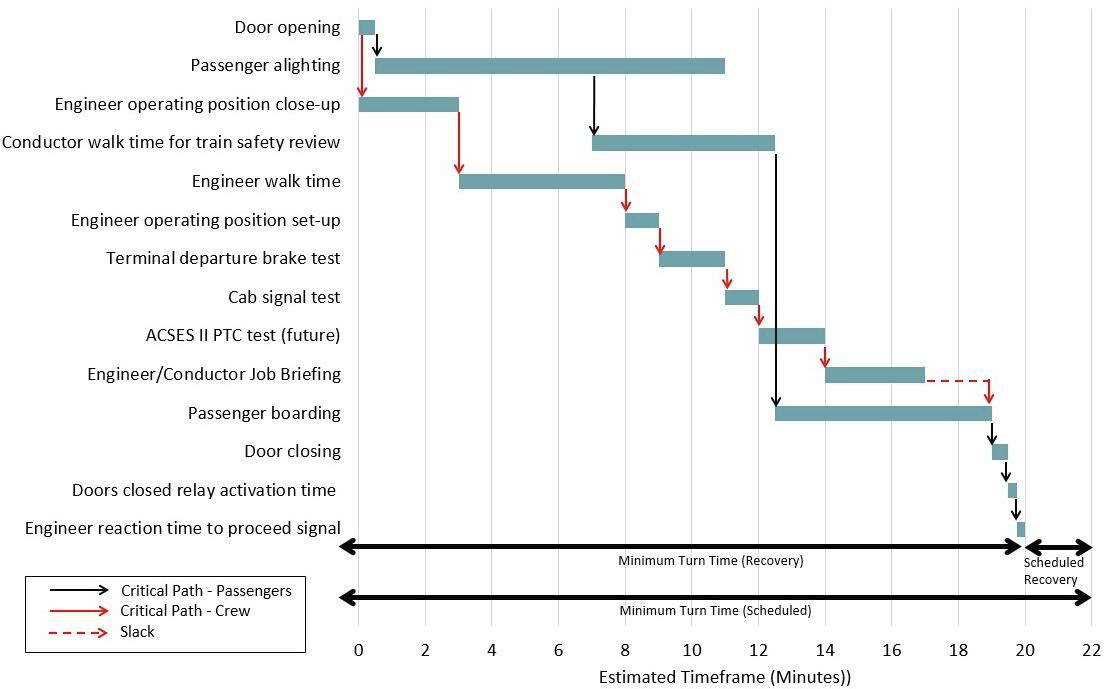

This is said to be turn time in the chart and dwell time in the description. But the limiting factor is the passenger path and not the crew path, and for that, it doesn’t matter if a train from New Jersey then goes to Long Island or Stamford and a train from Long Island or Stamford goes to New Jersey or if it’s the other way around.
To be clear, 16 minutes is insanely long as an unpadded turn time, let alone a through-dwell time. The MBTA can do it in 10; I think so can Metro-North at the outer ends. ICE trains turn in four minutes at pinch points like Frankfurt Hauptbahnhof, with extensive rail passenger turnover. So let’s go over how to get from 16 down to a more reasonable number.
Passenger alighting
Alighting does not take 6.5 minutes at Penn Station, even at rush hour, even on trains that are configured for maximum seats rather than fast egress. The limiting factor is not the train doors – the RER D runs bilevels with two door pairs per car and narrow passageways, and would not be too out of place on NJ Transit. Rather, it’s the narrow platforms, which have fewer egress points than they should and poor sight lines. This was studied for the Moynihan Station project, which opened in 2021. The project added new staircases and escalators, and now the minimum clearance time is at most 2.03 minutes, on platform 9, followed by 2.02 minutes on platforms 4 and 5. The expected clearance time, taking into account that passengers prefer to exit near the 7th Avenue end but the egress points are not weighted toward that end, peaks at 4.83 minutes on platform 4 – but passengers can walk along the platform while the train is moving, just as they do on the subway or on the RER.
What’s more, Penn Reconstruction, a project that may or may not happen, but that is sequentially prior to the Penn Expansion project that the slide deck is trying to sell, is required to install additional vertical circulation at all platforms, to reduce the egress times below 2 minutes even in emergency conditions (one escalator out). This is because NFPA 130 requires evacuation in 4 minutes assuming every track that can be occupied is, which given timetabling constraints means both tracks facing each platform other than the single-track platform 9. Responding to Christine Berthet’s questions about through-running, the agency even said that Penn Reconstruction is going to bring all platforms into compliance, but still said dwell times would need to be 8 minutes.
Passenger boarding
Alighting and boarding peak at different times of day. As the above table shows, reverse-peak traffic at Penn Station is only 12% of the combined peak and reverse-peak traffic on NJ Transit, and only 6% on the LIRR. In any circumstance in which the alighting time needs to be stretched to the maximum (again, only somewhat more than 2 minutes), the boarding time can be set at 30 seconds, and vice versa.
Moreover, because the access points to the platforms include escalators, not all running in the peak direction, and not just staircases, reverse-peak traffic consumes capacity that is otherwise wasted. Even the 30 seconds for additional boarding time in the morning rush are generous.
Conductor walk time for safety review
This is not done in Europe. Conductors’ safety review comprises checking whether passengers are stuck in the gap between the platform and the train, which is done after boarding, and takes seconds rather than minutes, using CCTV if the sight lines are obstructed.
Door opening and closing
These do not take 30 seconds each; the total amount of time is in the single digits.
Engineer operating position set-up, and engineer/conductor job briefing
Crews switch out in 1-2 minutes at boundaries between train operating companies in Paris and Shin-Osaka. The RER B is operated by SNCF north of Gare du Nord and by RATP south of it, and they used to switch crews there – and the operating position had to be changed, since the two companies’ engineers preferred different setups, one preferring to sit and the other to stand. It took until the early 2010s to run crews through, and even then it took a few years to unify the line’s dispatching. It does not take 3 minutes to brief the engineer on the job.
Total combined time
On a through-train, using alighting times in line with the current infrastructure at Penn Station, the minimum dwell time is 2-3 minutes, provided trains can be timetabled so that no two tracks facing the same platform have a train present at the same time. If there are four through-platforms, then commuter trains can run every 5 minutes to each platform, which is borderline from the perspective of egress capacity at 7th Avenue but does work.
Intercity trains make this easier to timetable: they have lower maximum capacity unless standing tickets are sold, which they currently are not, and even if Amtrak runs 16-car EMUs, they’ll still have fewer seats than there are seats plus standing spaces on a 10-car NJ Transit train, and not all of them turn over at Penn Station. Potentially, platform 6 can be dedicated to intercity trains in both directions, and then platforms 4 and 5 can run eastbound, alternating, and platforms 7 and 8 can run westbound. Using the timetable string diagram here, the local NJ Transit trains on the Northeast Corridor would have to share a platform, running every 5 minutes, while the express trains can get a dedicated platform running every 10; the local trains are likely to be less crowded and also have more through-passengers, first because usually through-service is more popular in inner suburbs than in outer ones, and second because the likely pairing in our Northeast Corridor plan connects those trains to Long Island City and Flushing while the express trains awkwardly turn into local Metro-North trains to Stamford.
Note that intercity trains can be scheduled to dwell for just 2-3 minutes too, and not just commuter trains. That’s actually longer than Shinkansen express dwell times (involving a crew change at Shin-Osaka), and in line with what I’ve seen with full turnover in Berlin. The Avelia Liberty has better circulation than the ICE 3, since it has level boarding, and any future trainset can be procured with two door pairs per car, like the Velaro Novo or Shinkansen, rather than just one, if dwell times are a concern.
The incuriosity of consultant-driven projects
I spoke to some of the people involved about my problems with the presentation, and got very good questions. One of them pointed out that I am talking about two- and three-minute dwell times in big European cities, and asked, how come experienced international consultants like Arup and LTK, which prepared the Gantt chart above, don’t know this? What’s missing here?
This is a question I’ve had to face with the construction cost comparisons before, and the answer is the same: consultants are familiar with projects that use consultants. Anglo consultants like Jacobs, AECOM, Arup, and WSP have extensive international experience, with the sort of projects that bring in international consulting firms to supervise the designs. The bigger Continental European and East Asian countries have enough in-house engineering expertise that they don’t really bring them in.
This can be readily seen in two ways. First, getting any detailed information about rail projects in France and Germany requires reading the local language. Practically nothing gets translated into English. I almost exclusively use French sources when writing about the RER, which can be readily seen in this post and in part 1. My German is a lot less fluent than my French, but here too I have to rely on reading technical German to be able to say anything about the Berlin or Munich S-Bahn or the ICE at greater depth than English Wikipedia (for one example, compare English and German on switches). A lot of the information isn’t even online and is in railfan books and magazines. This is not an especially globalized industry, and a consultancy that works in English will just not see things that are common knowledge to the experts in France or Germany, let alone Japan.
And second, the few Continental European projects that are more globalized turn into small reference pools for American agencies looking to compare themselves to others. Woody Allen portrays a Barcelona with the works of the only architect his American audience will have heard of. The MTA compares its per-rider costs to those of the not-fully-open Barcelona Metro L9/10, MassDOT uses L9/10 to benchmark the North-South Rail Link (again with the wrong denominator), and VTA uses L9/10 as a crutch with which to justify its decision to build a single-bore San Jose subway. L9/10 is an atypically large project, and atypically expensive for Spain; it also, uniquely, uses more privatization of planning than is the norm in Spain, including design-build project delivery, whence the line from the one of the consultants I’ve had to deal with in the US, “The standard approach to construction in most of Europe outside Russia is design-build” (design-build to a good approximation does not exist in Germany, Spain except L9/10, or Italy, and is uncommon in France and done with less privatization of expertise than in the US).
To take these two points together, then, the elements of foreign systems that are likeliest to be familiar to either American railroaders or English-primary consultants are the biggest and flashiest ones. This can even include elements that are not consultant-driven, if they’re so out there that they can’t be missed, like a high-speed rail network: rail consultants know the TGV exists, even if they’re not as familiar with how SNCF goes around planning and building lines, and can sometimes imitate design standards. Commuter rail infrastructure that’s similarly flashy gets noticed, so the presentation mentions the RER and Munich S-Bahn, even while getting their histories wrong and fixating on the new station caverns that even a tourist on a short trip can notice.
Commuter rail operations are not flashy. The map of RER or S-Bahn lines is neat, which is why rail activists talk about through-running so much – it’s right there posted at every station and on every railcar. But the speed at which people get on and off the train is not as obvious, and it requires looking into detailed reports to do an even rudimentary comparison, none of which in the case of Paris is available in English or easy to find on Google (the word “stationnement” usually means “parking,” in the same manner that the word “dwell” usually means “to live in a place”).
The upshot is that consultant reports written by serious people who absorb the knowledge of the railroaders of the Northeastern US with some British sanity checks can still say things that are so wrong to make the entire report useless. The same process that produces the whopper that the Munich S-Bahn, built 1965-72, took 46 years to build, can produce a Gantt chart that has a combined boarding and alighting time with conductor check that’s more than five times longer than what Penn Station in its current configuration is capable of and more than 10 times longer than what Gare du Nord achieves with similar peak ridership. Based on this false belief regarding dwell times, the agencies are then convinced that through-running is difficult and, separately, many additional tracks at Penn Station are required to fully use the capacity of the under-construction Gateway tunnel, building which would waste $16.7 billion.
 Pedestrian Observations
Nailed it!
Sensations from a non professional:
I can’t imagine a train that takes 30 seconds to open doors and 10 minutes to empty. Doesn’t even look like it would be safe according to fire code.
If your train is pausing for 15 minutes, it is not giving a through running service, just two separate consecutive services in different directions.
About L9/10 they started with design-build, but it looks like it’s been considered a failure, the old contracts are going to be completed like it’s written there, but anything new is going to be done in the traditional way, for example (if you can translate from Catalan): https://govern.cat/salapremsa/notes-premsa/586203/territori-licita-redaccio-del-projecte-constructiu-del-perllongament-ll4-metro-pau-sagrera
Excellent points!
1) The Gantt chart dwell time is horrifying, but consistent with dwell time of Amtrak Keystone service in Philadelphia (17-25 minutes to reverse direction).
2) In contrast, JR Narita Express separates or joins sections at Tokyo station and is moving again within 5 minutes (including brake tests).
3) In Tokyo (and elsewhere in Japan) operation of a train changes within one minute, with driver changes, hundreds or thousands of times each day as train runs on a commuter line onto a subway system and then onto another commuter line. The driver is waiting on the platform.
4) A broader point. Working for the government, a railroad or transit system is more prestigious in Japan than in the US. Top university graduates are attracted to their management jobs. Retirement with a pension is at age 58-65. Many retirees have a second career as a consultant, either part time at the same agency or for a smaller agency. Thus, agencies have good internal planning skills.
5) You do not need to know French, German or Japanese in order to appreciate the points Alon is making. You do need to have a rail orientation. I have visited all of the cities Alon mentions and “get” what he is saying. (Consultant interviewing question: “How do you get to work?”).
6) At least the Japanese do a superior job of informing themselves about foreign transportation systems. For example, I met a Japanese engineer from the national railway research institute who was going to Paris for a year at the SCNF research center. 7) People do what they are motivated to do. Money is a major motivation. So is job security, at least for some people. So competent planners and engineers may be more attracted to consultancies in the US and consultants often are motivated to design big projects, even if they are never built.
>I have visited all of the cities Alon mentions and “get” what he is saying.
*they
Do you think maybe you should have a “my pronouns are they/them” tagline at the top of your page? Your first name scans to most people as masculine and it can’t really be expected of casual visitors to this blog that they should otherwise be overly familiar with your gender identity.
I mean bqrail is a regular commenter and probably should have realized.
Though even if you list your pronouns, surprisingly few people pay attention. I added my pronouns to the corporate directory when I worked for a megacorp, and was still misgendered in emails even by HR ladies that went by name gender instinct, despite HR ostensibly being the DEI cheerleaders.
Apologies to Alon. Let’s talk about trains.
I think there does need to be some care referencing Japan. Most of Europe is better than the US at this but I don’t believe anywhere else gets close to Japanese operations.
Why can’t Europeans point at Japan and demand faster dwell times?
Obviously for intercity trains, the all high platform system has a big advantage allowing better door placement and level boarding, but Japanese turnaround times should be achievable in high platform S-Bahn/Metro/etc. systems, which often even have much newer signaling systems than their Japanese counterparts.
Because Europeans don’t really learn from outside Europe. There’s some knowledge transfer from Japan, especially to France, but it’s very limited compared with intra-European knowledge sharing.
Ok, but what are Korea, Taiwan or China doing? I cannot believe none of them would learn from Japanese best practice.
With regards to Covid 19 the islands of Taiwan, Japan and the effective island of South Korea were in the same ballpark as western Iceland, Australia and New Zealand.
Arguably Britain should have done better as we are an island too, but aside from possibly China no other continental country with believable statistics really has[1] – I guess South East Asia has done about twice as well as Europe.
[1] Even with China I am not really sure I believe the Chinese did so much better than Korea, Taiwan or Japan.
Yeah, the point is that Britain did really poorly despite being an island – worse than Continental Western Europe. Australia and New Zealand did well, and reacted to corona in similar ways to South Korea and Taiwan, with quarantines and early adoption of medical masks (in the fall of 2020, the RKI was still saying cloth masks were okay, while Australia was recommending medical masks).
Thailand and Vietnam were corona fortresses in 2020 without being islands, but their land borders are not as busy as the internal borders of Europe, granted.
Fully agree Britain could have done a lot better. But I do think in general Western Europe did OK.
Don’t forget as well as there probably being less cross border trade there are also many fewer border crossings and fewer countries in SE Asia.
They say that when SNCF managers saw how JR Central turned around Nozomi at Tokyo Station in 15 minutes (including cleaning etc.), they said “We can not do that”… well, they need about 16 staff, and their pride in their work is astonishing.
The British can do it in 18 minutes. I have seen that done.
@Matthew Hutton: Pretty thorough cleaning etc. of a 16 car long train?
Probably not quite as thorough as Japan and 11 cars not 16. But there was a school group on the train they got on.
GRRR typo. For a 16 car long train, they work with 32 cleaners; 2 per car.
But as such a team turns around up to 3 trains per hour, it is worthwhile…
Yeah, if the trains run frequent schedules and the limiting factor is the cleaning, then it’s just a matter of how to assign a fixed number of cleaners.
I think at Euston the main limiting factor is delay recovery. My train they turned round in 18 minutes was 17 minutes late arriving.
I assume they are aiming for a 20 minute turnaround with 15 minutes to recover delays. So if you could make the West Coast mainline more reliable so 5 minutes was enough for delays that would give you more capacity.
To be fair its a decent argument for HS2 being able to manage on fewer platforms than today as you propose.
In the context of the Northeast Corridor the trains can go to Sunnyside to be cleaned. D.C. Philadelphia and Boston will have fewer trains and have scads of space. The trains that will be pinging and ponging between NY and DC will be in service the same amount of time as the fewer trains pinging and ponging between Boston and DC. Or, someday, far in the future, Chicago and New York. Or Atlanta and New York.
Should Europeans ask for Japanese dwell times? Alon is right to look at the issue when long dwell times aggravated by the lack of through running imply that more than $16 billion must be spent to expand NY Penn Station. Japan, though handicapped by the mixture of 1435 and 1067 mm gauge, excels at through running and that aspect was copied by the Europeans. Are the RER, Crossrail or similar lines missing something in regards to dwell time?
In theory, with 40 doors per face, the 180 meter long single deck trains running on Osaka’s Midosuji line should have better dwell times than 224 meter long MI2N with 30 doors or 204 meter Aventras with 27 doors. That would allow shorter intervals between trains. In practice, it is not happening with 26 trains scheduled on the RER A core, 24 on Crossrail, and only 20 on the Midosuji.
The RER A and the Midosuji carry a massive 1.4 million per weekday but in a different way. Peak hour theoretical capacity of the RER A is 59000 per direction with 23504 seats on offer after 2+2 seats replaced 3+2 ones. Midosuji schedule has a peak hour theoretical capacity of 27600 and, even after replacing the sets of 5 seats pictured on the Wikipedia page by 6 seat benches, only 8760 seats on offer. In other words these trains are overloaded and most are standing. This must do wonders for the operating ratio. As for the dwell time, who knows and who cares?
Eh? From the MLIT crowding statistics, Midosuji Line is 27 trains per hour/direction peak, around 55k at the maximum crowding level acceptable in Osaka, and 80k at crush load, with peak hour peak segment peak direction average ridership around 48k. It’s far from overcrowded, with frequency being reduced from 29 trains per hour/direction in the past as riders shifted to alternative routes that have opened, though with no further cuts even as ridership dropped post-COVID.
All longitudinal seating is generally nicer for people who are standing, and probably improves dwell times since it’s easier to walk around.
Being able to do 29 trains per hour/direction reliably would be useful for decreasing crowding on RER A if that is demanded.
Thanks for the correction. The website I relied on, Japantravel.navitime.com, gave departures every 3 minutes for the sake of simplicity I suppose. 27 to 29 trains per hour/direction is what RATP used to schedule with single level RER A trains. With 3 doors per car face instead of 4, dwell times in the busiest stations could stretch and reliability was poor. They won’t do it again or try longitudinal seating in the foreseeable future. Commuters prefer to be seated away from the standing areas and the embryonal RER E operations are already diverting passengers from the A. In 2026, the RER E should be fully deployed and four years later the Grand Paris Express Line 15 is expected to reach La Defense.
I still think my point stands. There is no Japanese miracle. Four doors per car face would transform the Reseau Express Regional into a fast subway, beating the purpose. The Midosuji trains cover the Minoh-kayano to Nakamozu route in 60 minutes, average speed 32.9 km/h with average inter station interval of 1371 meters. Despite a shorter interval of 1308 m, Mexico City line 7 has a 38.26 km/h average speed, the new Dhaka L6 runs at 40.2 km/h on a 1340 m average interval, London Victoria line runs at 40.64 km/h on a 1400 m interval.
That’s great. As there is no magic in Japan, transit activists should draw freely from Japan for benchmarks of what could be reasonably expected from railway operations, instead of always focusing on Europe, and treating Japanese comparisons with caution.
They do have some magic bullets, Tokyo hasn’t got terminal platforms like London or Paris so clearing a train is quicker. There is a big time loss in turnaround when you have to wait for most people to walk the length of the platform.
In comparison with European termini, Tokyo is indeed at an advantage because passengers don’t have to walk the length of the platform. However, in comparison with NY Penn, a true through station, Tokyo is disadvantaged. Because of the 50/60 Hz barrier, it is actually a terminus for Shinkansen operations. Tokyo works better than NYP because the exits and platforms are better designed but this is not magic. The only magic ingredient that cannot be imported into New York is the Shinkansen time keeping. One of the reasons why operations are inefficient at NYP is Amtrak’s struggle with punctuality. Many Northeast Regional trains travelling between Boston and Washington DC are scheduled to sit more than 30 minutes at Penn because an Acela is supposed to overtake them there and who knows at what time the trains will show up.
I think that in the termini that Britain gets pretty close to Japanese operations.
Perhaps the Japanese would take 17 minutes to turn around a Pendelino not 20.
Away from the termini stopping times can be much longer than Japan. We have zones at our stations yet people don’t pay much attention even though the trains do typically stop as expected in the zones.
Why can’t the relative delay between the Northeast Regional and the Acela that is supposed to overtake it be managed better? They literally run on the same line! Iirc, there are issues with Acela trains getting moved to the local tracks, which is conveniently either impossible or basically never done in comparable Japanese cases, but that seems like something that shouldn’t require magic to fix.
And why isn’t is possible to add better platform access to the big European terminals with just one access at one end of an almost half kilometer long platform? There’s almost always ample space above the above ground tracks, and probably often ample space below the tracks as well. Sure it costs money, but compared to more platforms? Iirc at least one of the big Paris terminals already has some mid-platform access points, so it’s even provably doable with zero sprinkling of magic matcha powder.
On the topic of people not standing at the zones ready for the train: better signage.
The British even famously love queuing, so throw down some queuing zone floor tape for train types, have the digital signage at least hint toward the stopping positions, have some big posters in concourse areas about train stopping positions, etc..
So I don’t know the other cities that well, but in London only really at Paddington does it definitely make sense to have a rear exit – as that gets you access to the circle line to Kings Cross and could also get you access to Crossrail and perhaps even the Bakerloo Line.
In the other stations all the tube, bus and taxi services are at the front of the station – so probably 90% of passengers want to go to the front anyway so you’d be giving them a worse experience with choice and wouldn’t achieve a lot.
In Paris in Gare d l’Est perhaps a rear exit to the platforms would give you better access to Gare du Nord – maybe worthwhile too?
With regards to people moving they announce where the train will stop and have clear digital signage and still people don’t move to the right place. Very difficult to fix without paint and guaranteeing all the trains will be exactly the same configuration like the Shinkansen.
It’s not impossible.
It’s expensive, but necessary and so it happens.
I know I go on about Zürich HB all the time, but always my go-to example! Two separate very large under-platform cross-passages have been added over the last 30 years.
And it’s not just terminal stations. Pretty much every important Swiss station I can think of has had additional platform acesss points (under or over) added or significanty widended. Clear and fast passenger access is important both to save passengers time but also to make inter-platform “Takt” node transfers work. (No ticket gates helps A LOT!) Seach terms include SBB “neue passerelle” / SBB “neue unterführung”
And because I happened to be looking at it yesterday: another example is Frankfurt a/M: one existing cross-passage (constructed, as with Zürich, as part of the the underground through-running S-Bahn station), with an additional much wider one to be constructed (as with Zürich!) if the new through-running underground intercity station is built.
There are plenty of examples, through there should be many more. And not just terminals.
Access at the other end of the platforms is rarely a priority in France. Since 1999, the RER E has been taking Gare de l’Est banlieusards to the new Magenta station, well connected to Gare du Nord but disconnected from Gare de l’Est. 500 m through unpleasant streets with narrow sidewalks separate Gare de l’Est et du Nord. An underground tunnel already connecting the far end of Gare de l’Est platforms to the Chateau Landon metro station would need to be prolonged a mere 60 meters to reach Magenta platforms. The 50 million Euro project which includes sprucing out the surface connection has been delayed for years.
Some 40 years ago, an underground passage connected the mid section of Marseille St Charles platforms. Its entrances were locked for good a few weeks after its opening. SNCF likes to be able to control platform access to limit fare evasion.
St Charles dwell times would be slashed by a 8 km tunnel partially transforming it into a through station. It would include four 400 m platforms and a second hall and exit at the site of the old parcel building. This would cost about 3.5 billion Euros which are yet to be found. Marseille will first upgrade its two metro lines with Wabtec platform screen doors, Urbalis 400 automatization and 38 Alstom driverless trains.
There should be more floor signage of queuing zones for trains. If you look in Tokyo, Taipei, etc., there are often boxes for queues with floor stickers telling you what car/door number it is for. I think European stations are way too averse in general to floor markings: even the tactile paving when it exists is often the same color as the floor or unpainted metal, instead of high contrast yellow.
It works much better when the rolling stock is consistent, but when there is great signage on lines with consistent rolling stock, it creates a culture of standing in the right place for the train, and nudges people to decipher and use more complex setups for lines with varied rolling stock. Stations served by a wide variety of rolling stock have zones for each, e.g., the Tobu Limited Express platforms at Kita-Senju and Asakusa have little pictures of the train types on the floor stickers, some other stations use shapes corresponding to digital signage shapes, etc.. It’s not as obvious, but people will figure it out if they are pushed to by a culture of waiting for trains at the right spot.
And consistent door placement should be part of buying rolling stock. There’s already a ton of Class 800 variants, so it shouldn’t be that hard to just demand all future intercity trains have compatible door layouts. And if it were a requirement back then, I don’t see why the Class 800 couldn’t have been designed with door layouts compatible with Intercity 125. Especially if “compatible door layout” means just with marked queueing positions rather than the tighter tolerance of alignment with platform doors.
European should ask for Japanese dwell times, but as Alon pointed out, Europe does not learn from Japan, and the same goes for the public perception, and culture. When I came back to Switzerland from Japan, train boarding appeared to me as chaotic as when I boarded a train in Italy in the 80s and being used to Swiss trains.
SBB did run a set of ads trying to have people behave better for boarding and getting off, not sure how well it worked.
That said, one big difference between Japan and Europe is luggage for long haul trains. People travel light in trains in Japan, they typically will send luggage by a separate service (like Kuro Neko) and people don’t travel with babies. Heavy luggage and prams don’t help fast boarding. I remember boarding some S-Bahn in full military gear, and well…
The other difference is static train composition, with door positions and queue structure marked in colour on the platform and with metal plates hanging down. This makes queuing much precise that sectors. This works if train composition is static and the trains always run on the same platform. Trying to read the explanations to know which set of plaques applied on Sundays was a tough Kanji exercice for me.
Re: dwell times in Germany, they do often have trouble in Köln Hbf, a through-running station, speaking from personal experience. I’ve been on trains scheduled to stop 6 min and which overshot it by a few min.
There the issue is narrow platforms, high turnover (feels like more than half the train gets out, an equivalent number gets in), an overcrowded train full of standees and then of course messed up station approaches full of flat junctions.
This echoes my experience of Frankfurt Hbf. Alon maintains that ICE trains can turn around in 4min, but I’ve never seen this either timetabled or in reality, and I have a lot of experience catching these trains. 6 minutes seems to be the bare minimum, as this is what they are expected to do when a train is running late and misses its departure slot (even then they often go over this).
I have seen 4min turnarounds timetabled (and achieved) in the Netherlands, but this was on a shorter commuter train and may have used stepping back.
Contrary to Alon I would also assume dwell times to be longer on intercity trains than commuter trains, even with fewer passengers on board, because there is a higher percentage of passengers with luggage and the egress points are usually more constrained (narrower aisles, smaller vestibules, narrower doors), although the latter is not something that is inevitable.
If you look at the late running Cross countries that turn round at Birmingham New Street they sometimes do it in 3 minutes, but sometimes take longer. And there is a crew swap there too.
Köln Hbf is through-running so I do believe trains could reliably dwell there well below 6 min with wider platforms.
The question is if it’s possible to widen the platforms. The station is in a constrained location, maybe you could expand it a bit towards Breslauer Platz but not much. Otoh inside the station footprint you have these technical, staff-only platforms. They’re used to restock the dining car and such but I feel like they’re a bit of a waste since they each take 6m of precious width over the whole length of the station while only a small part of it is used at a time. Meanwhile passengers pile themselves into their platforms. Could the station be rebuilt to eliminate those technical platforms and widen those used by passengers?
Maybe there are reasons why this isn’t possible, I’m not familiar enough with the station. But in the near future I’ll probably be visiting quite often…
(Apologies if this a double comment, from my POV seems like my other comment got eaten by WordPress while I was logging in?)
Certainly have to agree to the extent that you should be able to turn a train around in 10-11 minutes timetabled with 4-5 minutes of padding for delays and the rest being necessary.
And that is substantially quicker than America manages today.
there are trains that turn and through run faster than this chart in Penn station today. They just run on a railroad called the “LIRR.” Add a minute for passenger boarding in the off peak direction and you’d have a reasonable facsimile of what it should take to dwell at Penn.
Yeah, to be clear, the Berlin Hbf example I saw was an edge case – the train had departed Ostbf delayed, so it was a rare case of a through-station where nearly all seats were filled.
The Leipzig and Frankfurt turns used to be timetabled at 4 minutes, but I can’t vouch for what is done in practice, and evidently these days it’s 6 (that’s the norm on Berlin-Leipzig-Munich and is what the D-Takt assumes of Frankfurt Hbf, at least).
My limited experience of Frankfurt is that it is a complete shitshow.
Yeah it is, I’m guessing that’s why they decided that 4min turnarounds were not achievable on a regular basis. Even 6min seems to be pushing it with the station in its current layout. But it’s really the station throat that is the issue rather than loading and unloading trains. There are long-term plans for underground intercity through platforms to deal with this issue, but getting that done will probably make Stuttgart 21 look like a minor project.
I’m not at all sure how you reached that conclusion. “Fernbahntunnel Frankfurt” certainly would be a major construction project, but not within an order of magnitude (certainly not a couple binary orders, maybe a 10x order) of Stuttgart 21.
It’s highly comparable to Zürich Löwenstrassse, but with less approach tunnelling, and what I perceive as a far simpler tie-ins to the existing network.
Sure, an underground under-river grade-separated junction. Cool civil engineering, and pretty complex! Still, simpler than what SBB did to put the extra stations platforms under the Sihl! Vastly simpler than what SBB did to tie the Weinbergtunnel in at Oerlikon. I see nothing remotely like the total reconfiguration of the regional Fernverker network that was bundled with the S21 HB itself.
The Frankfurt project appears to be very well studied and fairly well isolated in its impacts. There’s an almost precisely comparable project a mere 300kmh that was successfully completed within the last decade. It’s a major project, certainly, but kind-of small compared to the vast tentacles of S21.
(Unhelpfully, https://www.fernbahntunnel-frankfurt.de seems to be down right now, but there’s a ton of info there, especially https://www.fernbahntunnel-frankfurt.de/downloads.html archive.org has it all, but I presume the official web site will come back to life sooner than later.)
@Richar Mlynarik: oh, thanks for this info, I stand corrected. I was going more off of the complexity of the environment they will have to be working in: S-Bahn and U-Bahn tunnels everywhere, a massive skyscraper district next door and one of the most complicated station throats in all of Europe. Seems like a nightmare at first glance. But if it’s all been studied out and if they’ve learnt from the S21 experience maybe it will proceed smoothly.
The “most obvious” Frankfurt tunnel route was indeed eliminated early because of the building footings and S-/U-bahn tunnels you mention: see the sketch on page 14 of this presentation (“Der mittlere Korridor wurde aufgrund des Frankfurter Hochhausriegels mit seinen ca. 50 m tiefen Gründungen und Lastausbreitungsbereichen ausgeschlossen”) There’s a great deal more detail on alternatives development and elimination in this document, especially starting around page 36 section 3.1.6 “Vorgehen bei der Entwicklung von Trassierungsvarianten”
If you look under the “Machbarkeitsstudie” section of the project’s public downloads page (can’t give a direct link due to stupid “web designer” madness) the Lagepläne, Höhenpläne und Querschnitte usw (ZIP files of PDFs, sigh, not just links to the PDFs) etc show that plenty of preliminary engineering analysis has been done.
None of that of course is a guarantee of easy project approval, final design, financing, nor construction.
Always good for a giggle. I’m still wondering how trains go to Grand Central and to Long Island at the same time.
You are conflating many different things. From experience at Penn Station New York, Penn Station Newark, Grand Central, Union Station DC.. It takes perhaps 90 seconds for the car to empty out. With level boarding. Clearing the platform will take longer. Especially in terminal stations where walking from the back of the long long long train to the headhouse takes a long long time. 90 seconds may be grossly over guesstimated. The doors can close and the train move just like it does on the subway. Rumor on railroad.net is that a rush hour NJTransit train, destined for Sunnyside, can be turned over to Amtrak in four minutes. I suspect some of that time is checking to make sure the train is empty. Train to the Game, which was a train that ran throoooughh between New Haven and Trenton, was scheduled for 10. Just like it takes time to unload a train it takes time to load a train.
This is a fifth grade arithmetic problem. 60 eastbound trains an hour, which would be toooo many, into ten platforms is ten minutes to get from the east side of the eastern interlockings to the west side of the western interlockings. Or vice versa. 40 an hour which is reasonable, is 15 minutes.
If you send trains from New Jersey to Grand Central they aren’t on Long Island. If you send alllllllll the trains from Long Island to New Jersey you have to send them back to Long Island and there can’t be any trains to Grand Central. Considering more than one thing at time is beyond the scope of most railfan fantasies. And it would only be half of the trains from New Jersey they wouldn’t be building four tracks of tunnel. Railfans will be on the branch that goes to Grand Central.
I mean the platform clearing time for terminal platforms is really true, and the Japanese “cheat” by having them at a higher level that you can exit at a bunch of places along the platform and not just at one end.
Also aren’t the platforms at Shin Osaka massive?
Also in Japan it looks like the limiting time from Kyoto to Shin Osaka is 11.25 minutes, there’s a lot of Shinkansen scheduled to take 13/14 minutes for that journey which is fairly heavily padded – although to be fair there are some scheduled to take 12 which is keen.
People truding along the platform or up or down the stairs doesn’t stop the train from departing. Closing the doors and moving the train can happen while people are still on the platform. Happens all the time at all sorts of train stations.
There is the time it takes for the train to enter the arrival interlocking to the time it takes to leave the departure interlocking. Somewhere in that there is the time between the doors opening and the time the doors close.
Fifth grade arithmetic to figure out that 40 trains an hour into five island platforms with ten tracks is 15 minutes from the time it enters the arrival interlocking to the time it leaves the departure interlocking. In the case of Penn Station New York, schedule three minutes of open doors for the magical mystical through runnnnnnning that leaves 6 minutes to get from Fifth Ave, east of the eastern interlockings, to the station and 6 minutes to get from the station to 11th Ave. west of the western interlockings. From experience it doesn’t take six minutes to do that.
Assumption: 2-3 minute dwells are theoretically possible at Penn.
Fact: East River and Hudson running tunnels are maxed at 24 TPH per track.
Conclusion: only two platform tracks per direction per running track are needed for each to serve a train every ~5 minutes. This would require only 8 platform tracks, down from the current 21.
With minimal structural reconfiguration, it’s possible to consolidate the platforms to meet this criteria: eliminate tracks 6-7, 10-11, 14-15, and 18; connect track 13 to the Northern pair of East River Tunnels; then pave those spaces with new platform area, thereby creating 4 island platforms with 8 total tracks.
The “new” platforms 3-4, 5-6, 7-8, and 9-10 would each possess paths connecting to either set of ‘Northern’ or ‘Southern’ running tunnels respectively, while maintaining the potential for reversing moves + access to Empire Corridor. Stair egress would effectively be doubled through consolidation alone.
Honestly this seems so simple to me, I’m not sure why I haven’t seen the idea propagate anywhere else.
Trying to board an Amtrak Long Distance train in 5 minutes really makes me appreciate Sunnyside Yard for Amtrak to be able to do all the train prep more quickly and have everything ready.
In my last Acela, it took a long time to board because people were standing in the hallways for lots of time. Just like with airlines, there’s no reason we couldn’t pre-block the passenger boarding to the correct car
The norm here is that seats are assigned – Amtrak is the weird one for selling seated tickets without assigned seats, Southwest-style. The ticket also includes the car number, and the car numbers are shown on the outside of the train so that passengers know where to board; at the station, there are even indications on the departure screen for which part of the platform corresponds to which car.
Adopting that on the Northeast Corridor would mean something a bit Japan-like, in that a train should have permanent car numbers, say 1-16, with permanent ends, say 1 north, 16 south (so on a northbound train, car 1 is the lead car, and on a southbound train, car 16 is). When booking tickets, passengers get to pick an available seat, and if it departs New York, there can even be a link to a chart of Penn Station with each access point to platform 6 labeled with the nearest car. At Penn itself, each access point should be labeled with the correct car, so that for example West End Corridor can be labeled as “near car #12” or something like that.
I thought the ideal was that all the tickets were good on all the trains at the same price any time of any day. And that no one would need to trouble themselves with checking a timetable.
It’s 2024, the cars can have full color information screens on them that change depending on what kind of train it is. Especially the ones that don’t back out on their way from New York to D.C. because they went out to Queens and used one of the many tracks that loop back towards Manhattan.
The goal is to get people from where they are to where they they want to be, when they want to be there, with whoever they want to go with, with whatever packages they bring, in a reasonable amount of time for a reasonable cost. Everything else follows from that. (I have said that before here, but I’ve added a few things this time, likely I’ve forgotten some factor). sometimes you look at something and say we cannot reasonably do that (don’t try to bring a stack of plywood on transit even though you might want to move it)
If you are traveling alone random seating is best – just grab the first empty seat that looks good to you. This works until the train is very full and the only empty seat might be in a different car, and then you want assigned seating. (I’m assuming you are not willing to stand – even if it is you still need to find a car with room to stand)
If you are with a large group the hassle of needing to get seats in advance and figuring out where those seats are on the train is must better than trying to find a group of seats that you can fit in once you arrive. If the train is empty enough though there will always be a group free and so you don’t need it.
If you can run trains empty enough that there are always enough seats together for groups then don’t do assigned seating. However in the real world this may not be possible, so assigned seats for groups or everyone may be a required compromise.
Don’t forget that time marches on. Most people are carrying a cell phone with them. A good app can do a lot for assigned seating by detecting people already on the platform and assigning them seats just before the train arrives. A good app allow people to form a group while on the platform and give them seats together. AFAIK this functionality doesn’t exist in any app yet, but it is only a matter of if someone is willing to pay to make it (it must have a good user experience, and you may need to put location beacons on the platforms to be accurate enough, and plus the costs of writing it and keeping it up to date) – given the costs I’d prefer to just run more trains that are not anywhere close to full but if that isn’t an option.
There is as mode of transport that does that, automobiles. If you don’t want to use an automobile there will be compromises.
Automobiles are compromises as well. When I moved I hired a semi to pack my house into instead of trying to do it all by car. Everything I put in the above should have reasonable appended. Generally people have a good feel for what is a reasonable amount of baggage to get on a train. I think any group of 1000 people trying to go the same place will assume they cannot go as one – it doesn’t matter if they drive, use transit – even if they walk they will assume they cannot stay together (or will arrange police to block cross roads so they can)
I specifically wrote reasonable on cost and time but not the because those are the areas where I think transit should focus most. Cost and time are most directly in control of transit agencies and places where they often with some effort can make the process much smoother/better.
Large groups of people who want to travel together call Amtrak and charter a whole train. They don’t bring steamer trunks with them. The people who own their own railcars may view it differently.
long distance trains are nominally not supposed to board or alight during the peak. Realistically long term probably no long distance train should be running on the northeast corridor between Washington and NYC and boarding daily low speed services should be relegated to PHL, DC and Albany. Even more long term most of the ones out of nyc (besides the cardinal) should be replaced by some high speed service for most of their trip.
With $16 billion at stake why not just plan to do a trial of commuter rail through running along the NEC after Penn Station Access is complete and get a real number for what the dwell times could be?
NJ Transit and Metro North could intentionally sandbag the trial because they don’t want to have to work together, but if not we would actually know what these agencies are capable of and if $16 billion of transit funding really needs to go toward Penn Station South.
Metro North and NJTransit are at each other’s throats in the fever swamps of railroad.net and subchat.com. Here on planet Earth, NJTransit and Metro North did it for years for Train to the Game. it was scheduled for 10 minutes stop in Penn Station while very very cleverly they magically turned the Train to the Game into a train to Trenton. They only did it for Sunday afternoon games because they don’t have enough equipment to do it at other times.
Dwell times in Zürich, S-Bahn: We look at the Museumstrasse station, tracks 41 to 44. It has two island platforms, between tracks 41 and 42 (direction Hardbrücke) and between tracks 43 and 44 (direction Stadelhofen).
Scheduled dwell time is 2 minutes, but as there is also a small padding, trains may arrive a minute earlier. Train distance is also 2 minutes, which means that in this situation, it is possible to catch a “forward” connection (such as S-9 to S-5). However, if the train is late, the driver may close the doors and leave when the passengers got on and off; this may be within less than a minute during the day.
Another feature is that the track assingment is not fixed; normally, it is one track, then the other one, but the assignment happens a few minutes before arrival; no big deal, as it is on the same platform.
The situation is a bit different in the Löwenstrasse station. The Takt system is based on the pre-Durchmesserlinie schedules. Because the Durchmesserlinie is way faster than turning around in the main hall, many trains have to wait to get into their slot in Oerlikon (or Altstetten). This applies also to the IC serving this station.
Turning around S-Bahn trains in the main hall is set to 4 minutes, and because it only applies to EMUs, there is only a limited brake test needed, and the outgoing driver is already in the rear cab, or waits there, this is possible; even if the train is strengthened.
Max, great to see your informed contributions once again!
This isn’t cultural, it’s institutional. There is no incentive to efficiency in public non-profit systems in the US. Competition and private capital are the only way to change this in the US with massively subsidized car use. No criticism of Amtrak will change Amtrak in any way. Only alternatives to Amtrak will change Amtrak.
How does Brightline perform?
Like shit.
Shittier than you can possibly imagine.
It’s a beautiful world we live in / A sweet romantic place / Beautiful people everywhere / The way they show they care / Makes me want to say / It’s a beautiful world / It’s a beautiful world / It’s a beautiful world/ For you / For you / For you
Amtrak employees have threatened me with fines and arrest for trying to enter or exit train cars at stations. They’ve told me to go away when I ask about delays. They’ve dared me to ask a question while taking 20 minutes to loudly announce long lists of ‘verboten’ activities at every stop. It’s absurdly bad. After the tenth such experience, I’ve never taken Amtrak again. Not because of delays or even dirty train interiors…because of the insults, threats, and mockery. I’ve travelled from DC to NYC by MARC, SEPTA, and NJ Transit. I’ve flown from DC to NYC. I’ll never take Amtrak again. We need ‘Brightline Northeast Corridor.’
Sounds terrible!
…and it was all done so casually, as if this it was just another day on the job. I was simply amazed to see other passengers take it all in stride.
I looked at the Brightline performance level. It’s not bad. Roughly 90% on time, so probably ~French reliability.
And to be fair it should improve. I would expect them to get to Swiss reliability eventually. Some months they are hitting that already.
And of course after the way NYC treated private subway operators (forcing fare prices) you would be a fool to start a private railroad in the US. I offer Texas Central’s treatment by Texas as another example of why private business should stay out of public transport. (Brightline of course proves it is possible)
Dwell time is time stole from passengers. People have places to be and they are generally running late. Yes you have to stop at stations in between, but people not getting on/off there don’t want a stop at all (they might use that station some other time and want the stop then, but not now when they are not using the station). Even at the terminal stations where everyone needs to get off, get them off and on their way as fast as possible, they don’t like waiting in line for everyone else to get off in front of you.
There are a few exceptions who like long train rides. Three year olds and train advocates often fall into this category. However they are a minority, everyone else doesn’t care. Even when those people are enjoying a conversation with a neighbor, that isn’t the goal.
The question with dwell is how many journeys it really matters if the dwell is 1 minute as in Japan or 2-3 as in Europe.
The only one in France for example that it really matters is Paris-Barcelona. But then probably the right answer is to run a faster Paris-Montpellier-(Perpignan)-Barcelona service.
Same in Britain. Only London-Edinburgh/Glasgow does it really matter. But I would have thought a perfectly valid solution was to add a new hourly London-Preston-Glasgow service and perhaps do London-York/Darlington-Newcastle-Edinburgh every 30 minutes.
For example Paris-Nice has 5 intermediate stops, cutting 2 minutes off each would save 10 minutes on a 5.5 hour trip. Who cares?
A quick reminder that the subject under discussion is 22 minutes of US-consultant-sanctioned through-running platform dwell time for inter-city or even local trains, versus the roughly 1 to 2 minutes (local) or 3 to 7 minutes (long-distance) that trains dwell when running through competently-operated, non-US, non-sandbagged major central city stations.
It’s fascinating that you think that dwell times do not matter for trip time Flight Level 0 point-to-point airline surrogates. Whatevs.
The facts remain that there are immense downsides — the number of nose-bleed-expensive CBD station platforms tracks required; the the potentially superior types of service that can be provided; the number of trains; the number of staff — to not giving a damn about how long big expensive trains sit blocking the tracks at hyper-expensive stations. The only people who don’t care about this are rent-seeking US consultants and lunatic US railfans.
OK so if we ignore Japan as unworkable and look at European examples they manage boarding and un boarding in approximately 5 minutes at major stations such as Birmingham New Street, Frankfurt or Stuttgart.
Birmingham New Street long distance journeys typically have a 10 minute stop, 5 minutes is required and 5 minutes for delay catch-up.
American transit agencies, including Amtrak, simply dont care about dwell times. To them, the old timey “allll abooooard” style service is what they know.
At Newark Penn Station, I frequently see the Acela arrive, 2 people get off, 15 get on. Takes 20 seconds. 2 minutes later, the train finally leaves.
NJT is even worse with their blatant disregard for dwell times. They are buying hundreds of articulated (60-foot) buses with TWO doors. Not three, like most place, not four, like best practice, but TWO. And this is for urban routes where people get on and off every stop. I wouldnt be surprised if it adds 10 minutes to a 30 minute run.
Likewise, if we look back at the infamous Super Bowl, NJT spent months (years?) planning for it and advertising how much time and effort went into a perfect event.
Except not once in that planning process did they consider dwell times. It was a disaster because they sent 2-story trains with tiny doors to make the 14 minute trip instead of single levels with 3 doors. It was all about maximizing seating instead of maximizing throughput. No one needed a seat for such a short ride!
The NFL didn’t want to pay for a through running station that would need the capacity once every few decades. The NFL also thought East Rutherford New Jersey was out in the hinterlands where everybody drives everywhere and there is no traffic. So everybody would be taking the bus. They took the train. And the NFL hasn’t volunteered to upgrade the station for the once every few decades event they might hold there.
It’s not NJTransit’s fault the NFL doesn’t want to pay to service their stadium.
NJT is fully in control of the vehicles they chose to run to events.
Yes they are. They chose to run the ones with the most standing room. The NFL didn’t want to pay for high capacity station that would be used every few decades so the station is a terminal. It takes time to reverse a train out.
Because that’s the sort of thing I do, I scraped the SBB timetable for terminal-level (tracks 3-18) arrivals and departures at Zürich Hauptbahnhof for last Thursday, massaged it to try to (approximately) match arrivals to departures of the same train from the same platform, then I elided all S-bahn (either 12 minutes uniform turnback for S24 on platform 3, 26 minutes for S24 on platform 6, or 20 minutes for peak-only S21 on platform 18) and … here you go:
Sub-10-minute reversals (not just stop and continue in the same direction; stop and reverse) are absolutely routine.
Looking at the new underground through platforms (tracks 31/32 and 33/34) at Zürich HB, of the 146 intercity of interregional trains/day I could match up, dwells are scheduled for between 2 minutes and 14 minutes, with an average of 7.3 minutes (36 2/3 min, 60 7 min, 16 10 min, 33 11 min, 1 14 min)
Of the 285 through-running S-Bahn on tracks 31-34, average dwell is 2 minutes (73 1 min, 178 2 min, 30 4 min, plus a couple late-night outliers)
Of the 669 through-running S-Bahn on tracks 41/42 (used interchangably with no per-side platform assignment) and 43/44 (ditto), the average scheduled dwell is 2.2 minutes (222 1 min, 296 2 min, 40 3 min, 40 4 min, 71 5 min)
That’s how through-running of a regional S-Bahn from one side of a city to another through a major central interchange station is done.
And just to be pointlessly complete: S4 (a self-contained 12-stop 31-minute shuttle with 10 min peak headway, 20 minutes all day) is scheduled to arrive, reverse and depart from Zürich HB underground terminal platform track 21 72 times/day.
S10 (10 stops, 80 minute trip and … 8% grades!) reverses in 8 minutes on adjacent platform 22 76 times a day on 10/20 minute headway.
lol point made and adored, Richard. SBB is running mostly bi-level Kiss-esque stock on these?
……….Amtrak runs through a high demand station all day every day since there has been an Amtrak, Philadelphia….
My apologies for commenting slowly. Why is it necessary to change crews when you run through? You may need to properly train crews to know the details of the route and the conventions of the system on both sides, but why change crews other than needing to negotiate new labor agreements and shoot a few incompetent executives so they won’t jump in front of a train to slow things down.
Because the time cost of changing crew is not that significant; the RER did that at Gare du Nord for decades after the opening of through-service, before finally stopping last decade.
I agree on the process argument re time for a crew change. Even in the 30’s, the UP did the crew change at Omaha on it’s steam powered expresses in less than 4 minutes.
My argument is slightly different. Rather than work around the problem by careful personnel training and discipline, eliminate the the problem by running the crew through. Assume you’re running a through regional from Trenton to Stamford. Why change crews? It’s a short enough run, that running through will yield better personnel utilization; with turn arounds per your takt, much better. And, it totally eliminates a host of issues that shouldn’t need to be addressed in the first place.
Because those wacky wacky crew members bring their bladders, bowels and stomachs with them? Which need to be attended to now and then.
Also, the doors should start opening the moment (ok within milliseconds) of the train stopping. And, of course, start the train moving the moment the doors are closed. If we can routinely land planes all over the world under Cat 3C conditions (0 ceiling, 0 visibility) then the automatic handoffs to precisely stop the train within a few hundredths of an inch and open the doors when stopped should be routinely expected. Similarly, the departure controls should permit the operator/operating robot to initiate a journey using an automatic system to reserve clearance from the signalling system(automatically) , then start motion when cleared (electronically transmitted) and doors closed (electronically transmitted) and notify train control of initiation of travel under the clearance automatically. Getting that interlocking done correctly has to save at least 5 sec. on each end of the station stop and probably twice that, together at least 15 sec. Not huge, but helpful,
If you do Driver only operation (DOO) you typically get the doors opened quicker. With regards to closing the doors and departing you also do have to wait for people to be clear of the train for safety reasons.
That said with DOO we have 30 second followed by 60 second stops, I.e an average of 45 seconds. That isn’t terrible.