Second Avenue Subway Phase 2 Station Design is Incompetent
A few hours ago, the MTA presented on the latest of Second Avenue Subway Phase 2. The presentation includes information about the engineering and construction of the three stations – 106th, 116th, and 125th Streets. The new designs are not good, and the design of 116th in particular betrays severe incompetence about how modern subway stations are built: the station is fairly shallow, but has a mezzanine under the tracks, with all access to or from the station requiring elevator-only access to the mezzanine.
What was in the presentation?
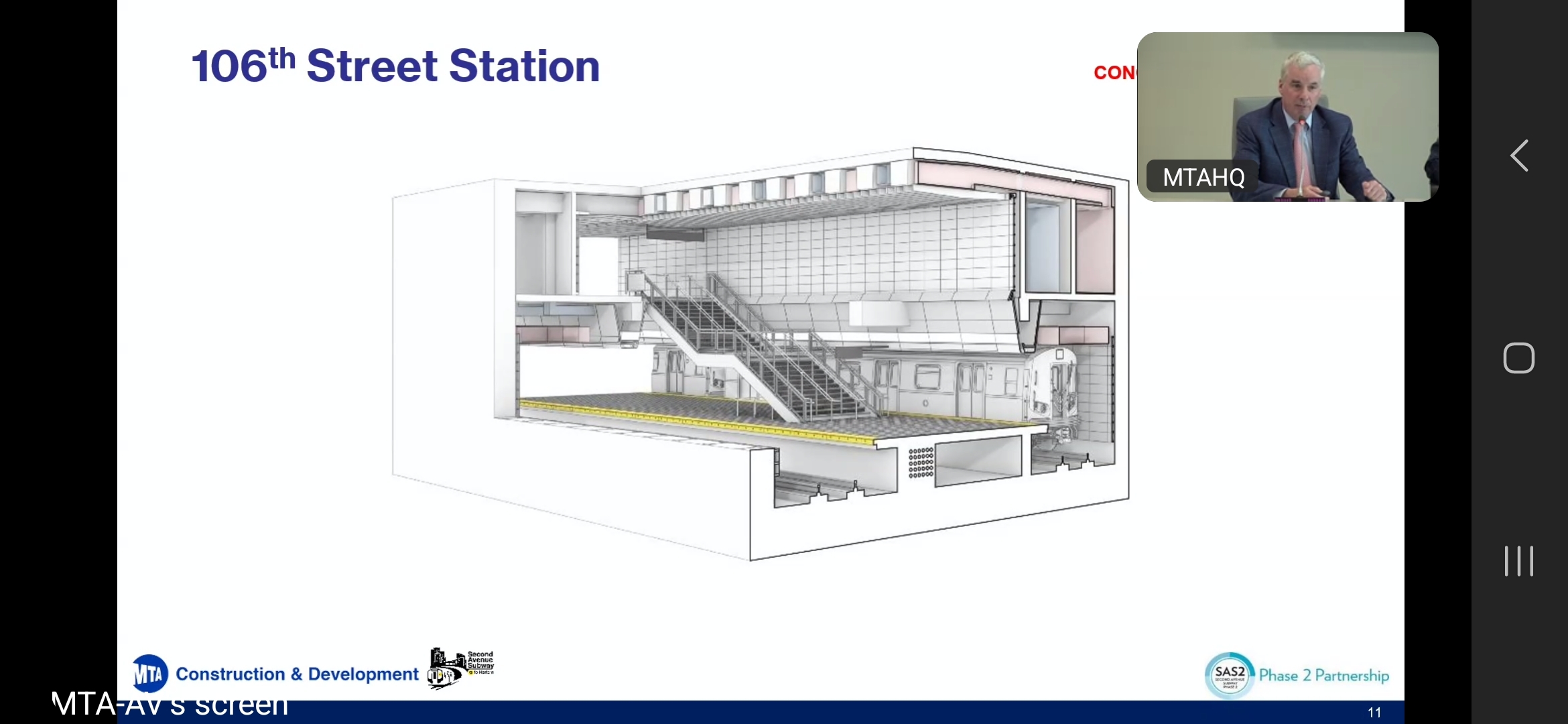
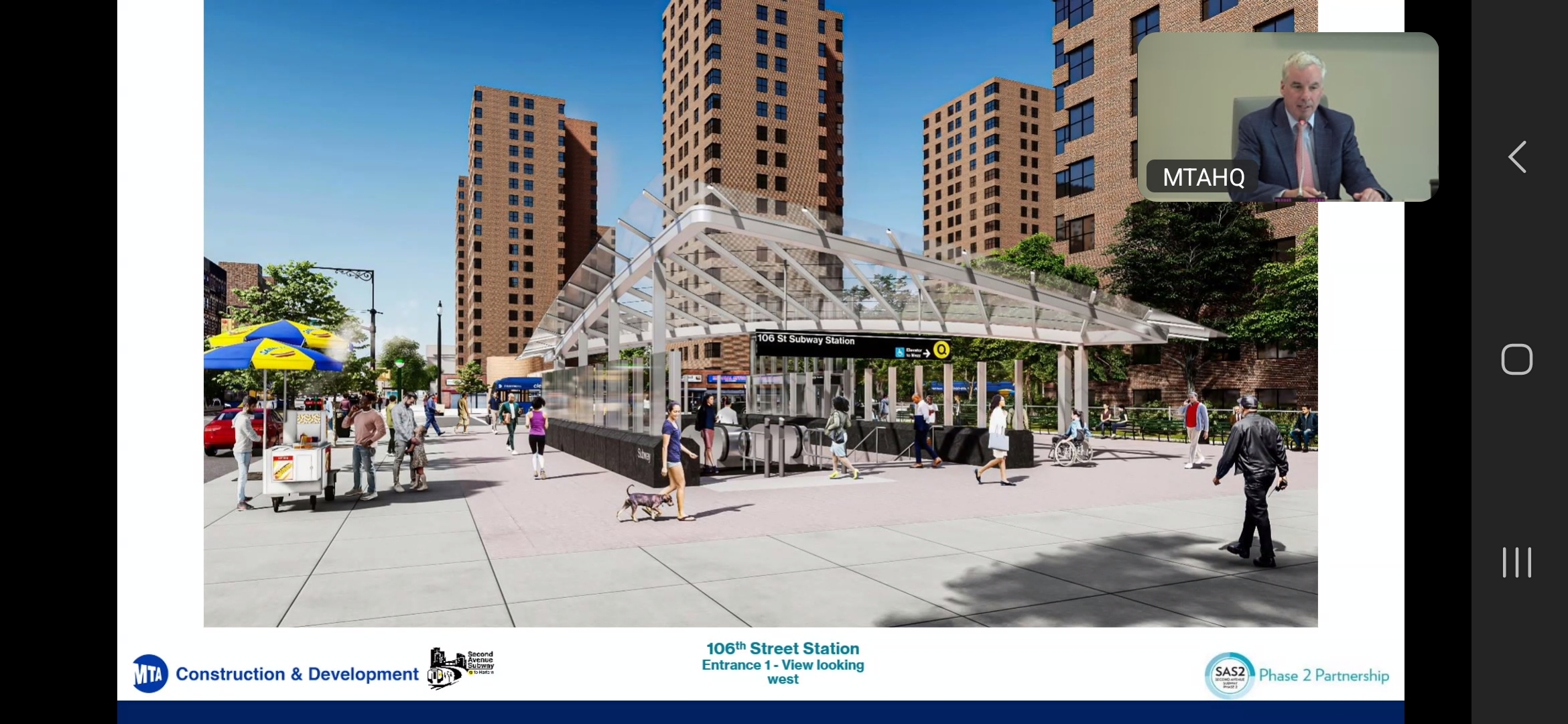
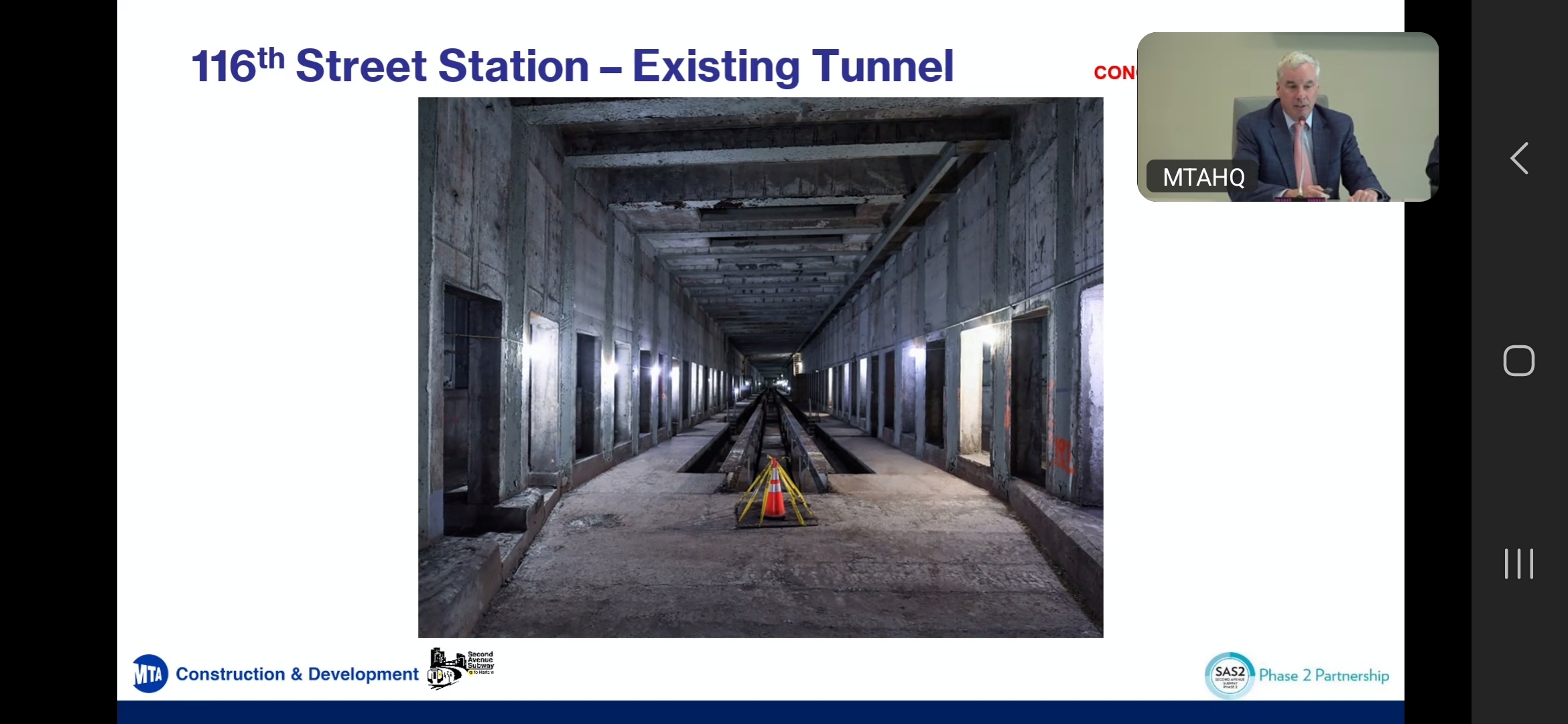
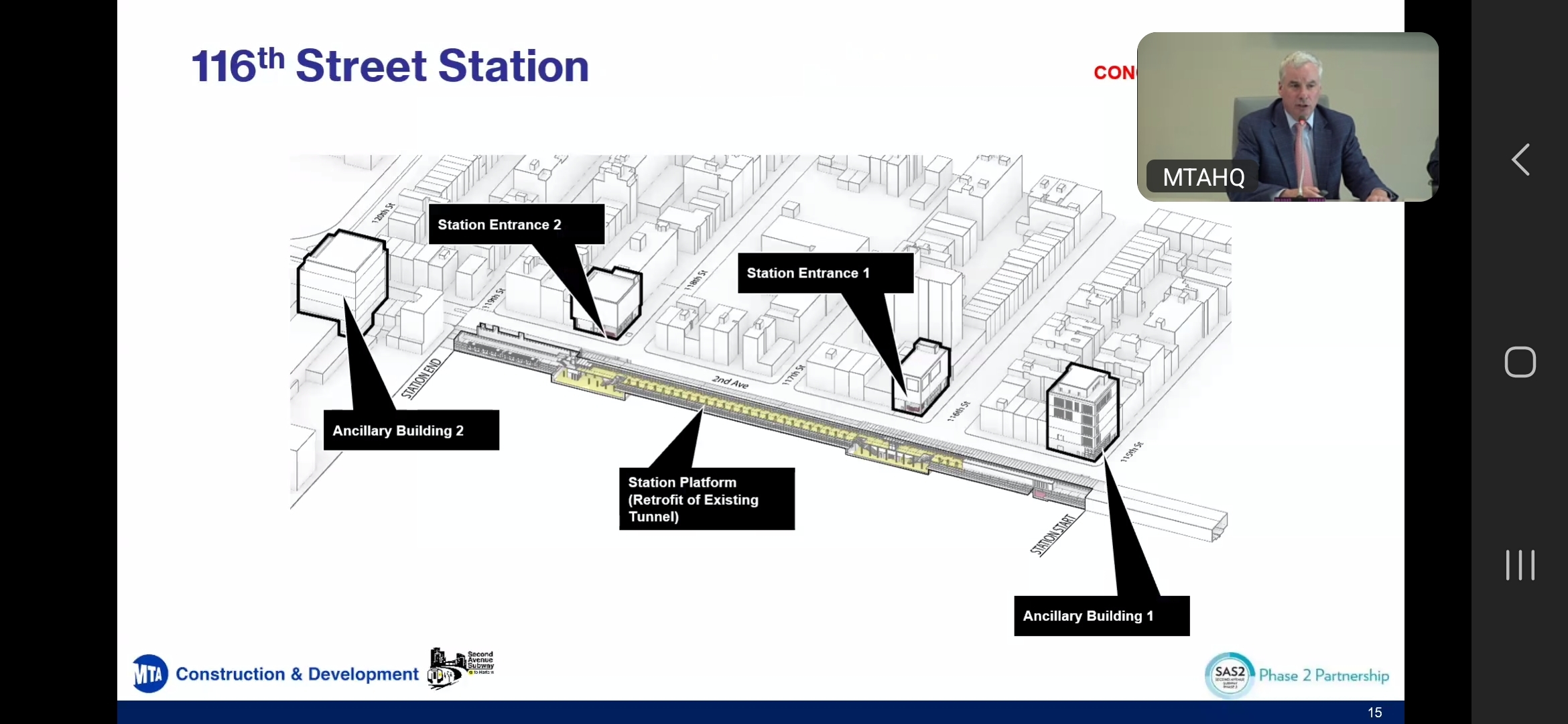
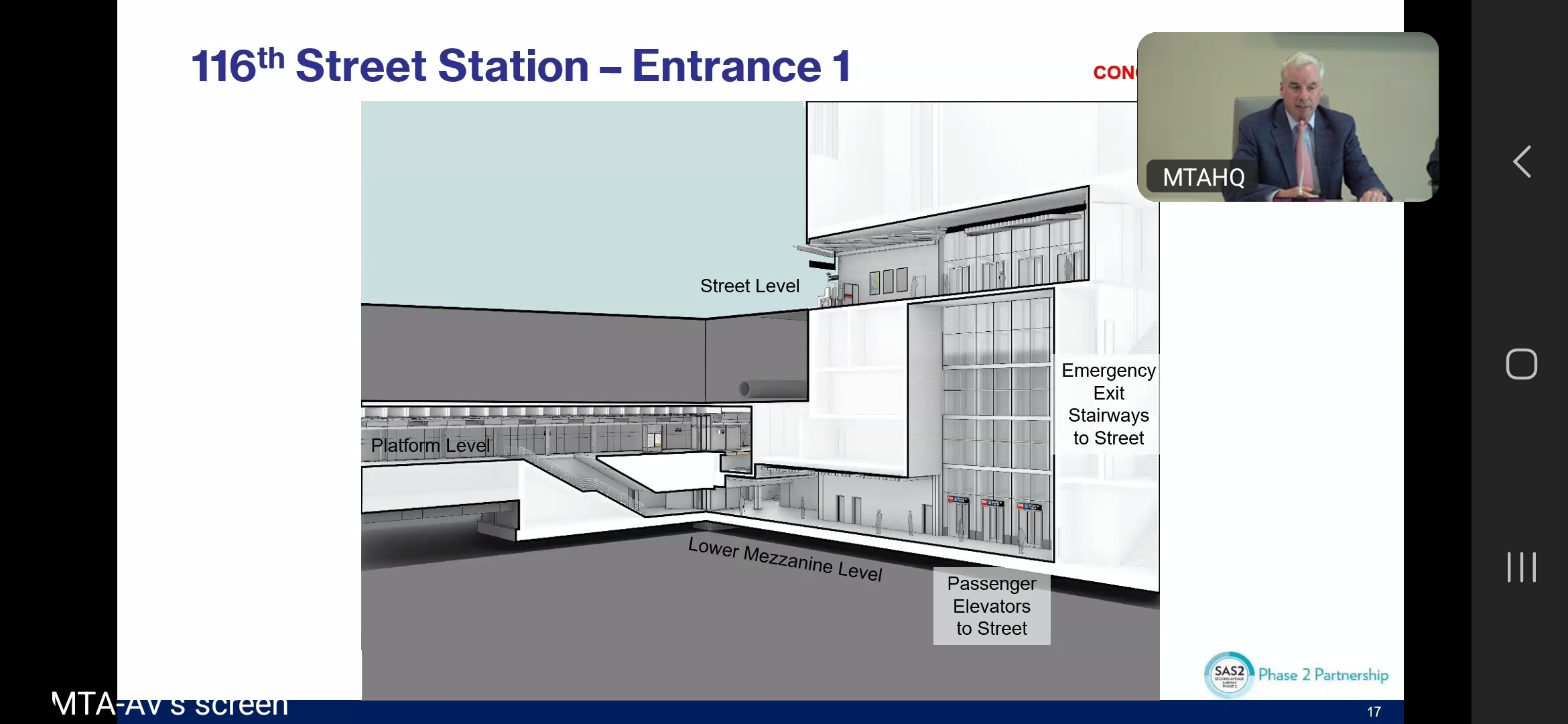
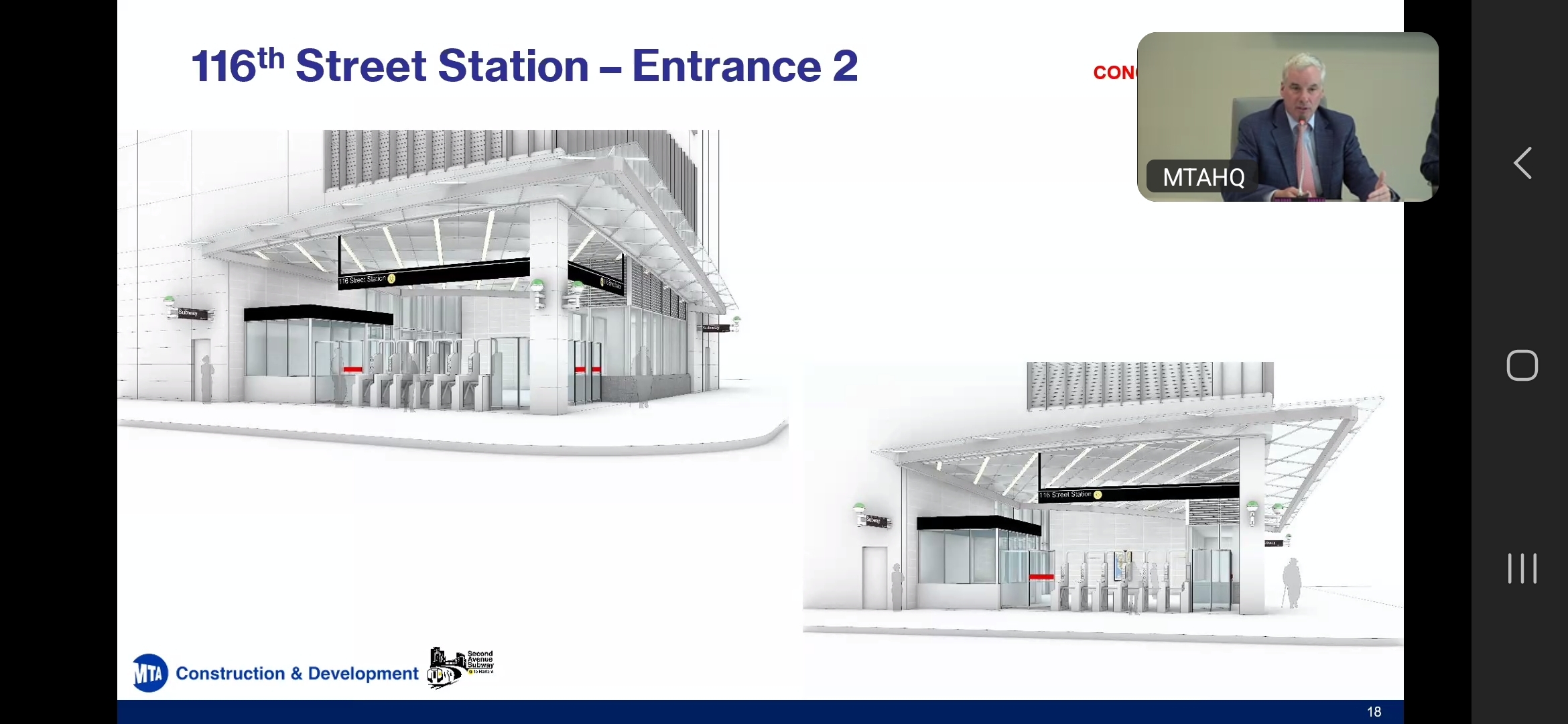
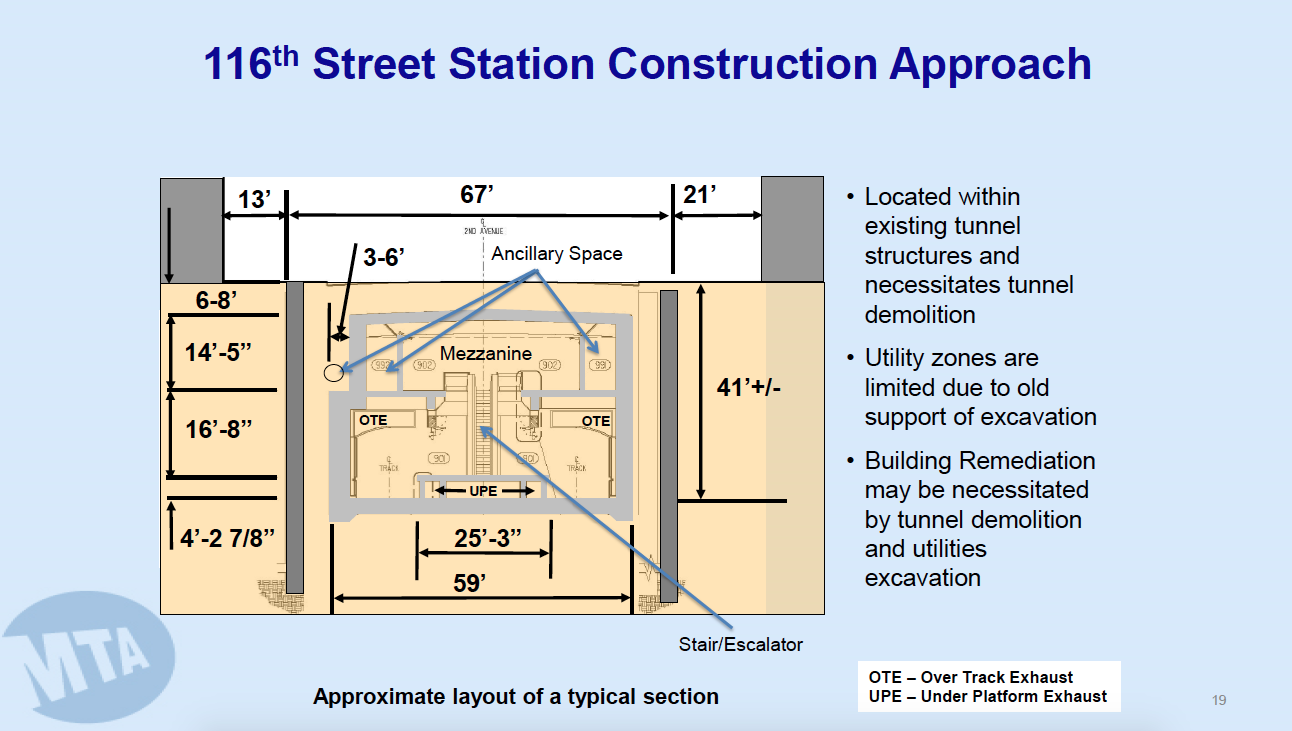
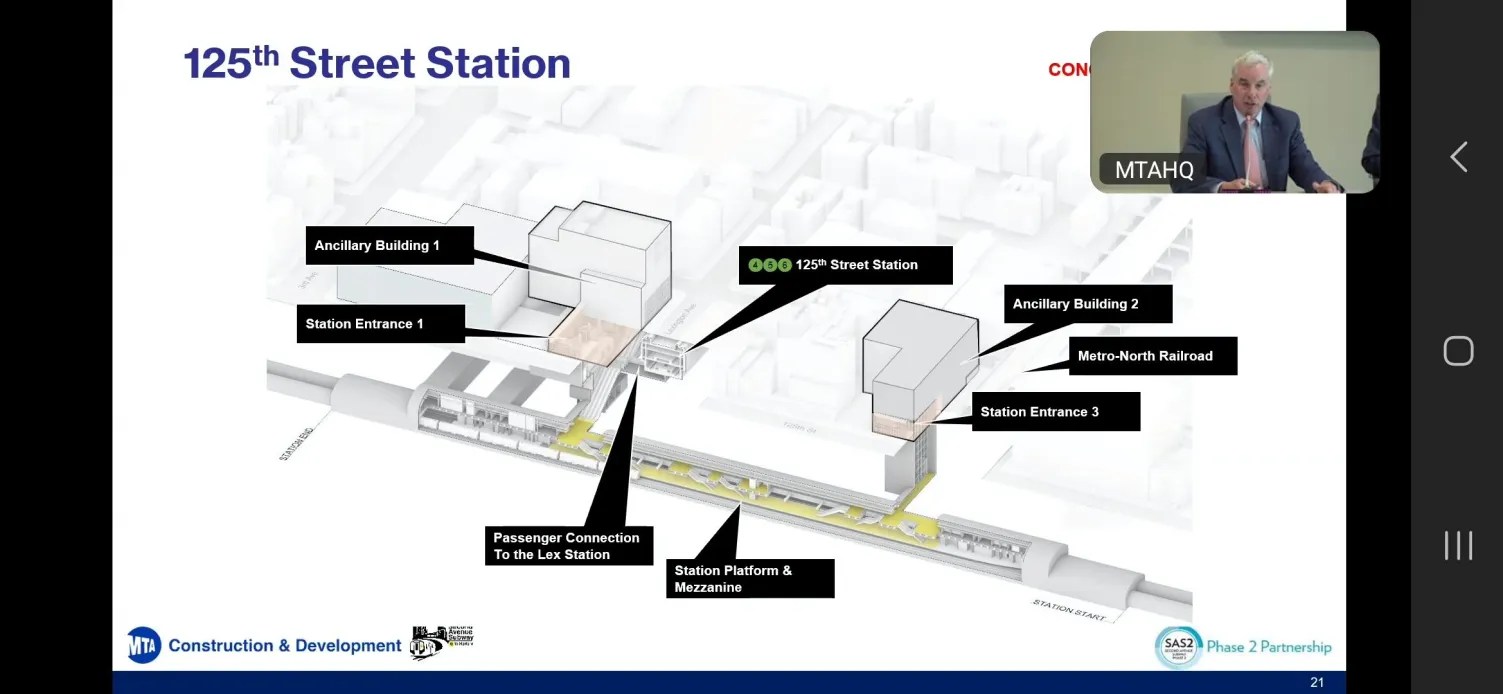
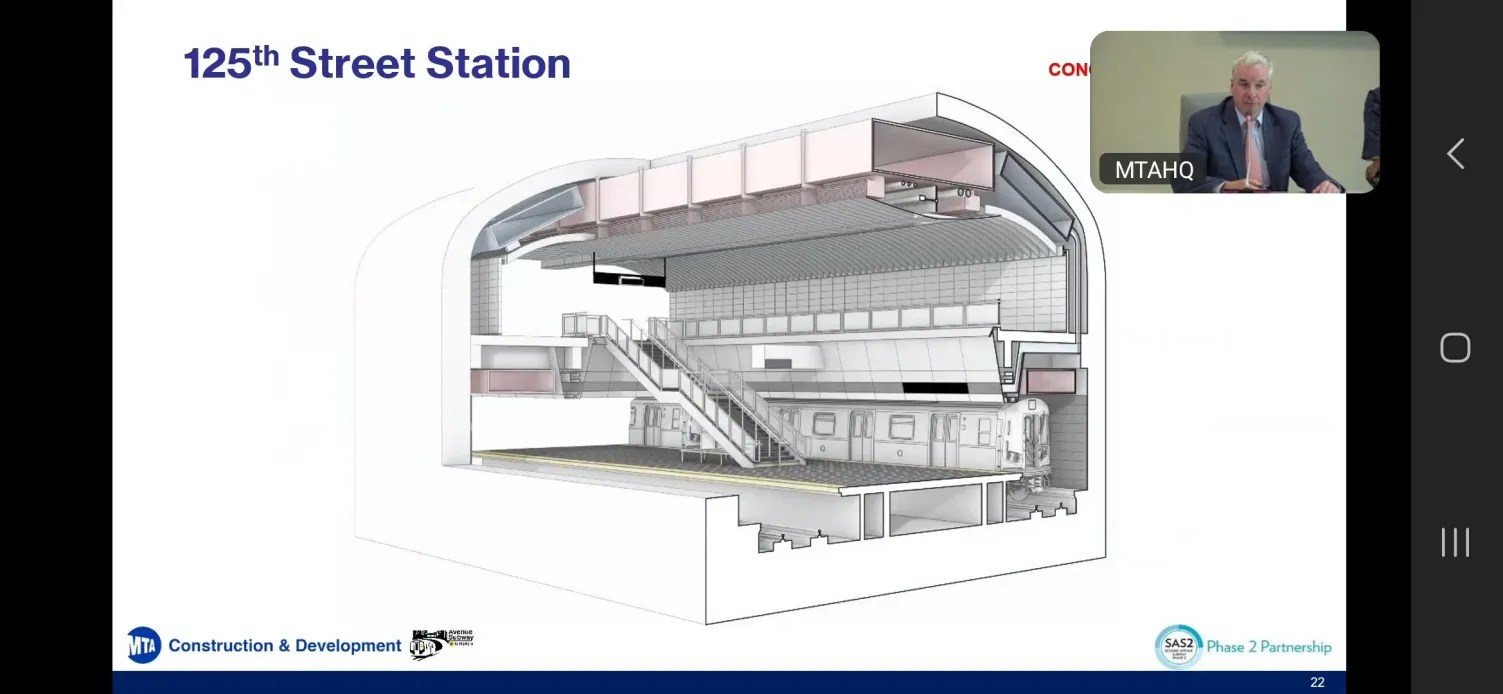
Here is a selection of slides, describing station construction. 106th Street is to be built cut-and-cover; 116th is to use preexisting construction but avoid cut-and-cover to reach them from the top and instead mine access from the bottom; 125th is to be built deep-level, with 125′ deep (38 m) platforms, underneath its namesake street between Lexington and Park Avenues.

The problems with 116th Street
Elevator-only access
Elevator-only access is usually stupid. It’s especially stupid when it’s at a shallow station; as the page 19 slide above shows, the platforms are about 11.5 meters below ground, which is an easy depth for both stair and escalator access.
Now, to be clear, there are elevator-only stations built in countries with reasonable subway construction programs. Sofia on Nya Tunnelbanan is elevator-only, because it is 100 meters below street level, due to the difficult topography of Södermalm and Central Stockholm, in which Sofia, 26 meters above sea level, is right next to Riddarfjärden, 23 meters deep. Emergency access is provided via ramps to the sea-level freeway hugging the north shore of Södermalm, used to construct the mined cavern in the first place. Likewise, the Barcelona L9 construction program, by far the most expensive in Spain and yet far cheaper than in any recent English-speaking country, has elevator-only access to the deep stations, in order to avoid any construction outside a horizontal or vertical tunnel boring machine.
The depth excuse does not exist in East Harlem. 11.5 meters is not an elevator-only access depth. It’s a stair access depth with elevators for wheelchair accessibility. Stairs are planned to be provided only for emergency access, without public usage. Under NFPA 130 the stairs are going to have to have enough capacity for full trains, much more than is going to be required in ordinary service, and they’d lead passengers to the same street as the elevators, nothing like the freeway egress of Sofia.
Below-platform mezzanines
To avoid any shallow construction, the mezzanines will be built below the platforms and not above them. As a result, access to the station means going down a level and then going back up to the platform level. In effect, the station is going to behave as a rather deep station as far as passenger access time to the platforms is concerned: the planned depth is 57′, or 17.4 meters, which means that the total vertical change from street level is around 23.5 meters, twice the actual depth of the platforms.
Dig volume
Even with the reuse of existing infrastructure, the station is planned to have too much space north and south of the platforms, as seen with the locations of the ancillary buildings.
I think that this is due to designs from the 2000s, when the plan was to build all stations with extensive back-of-the-house space on both sides of the platform. Phase 1 was built this way, as we cover in our New York case, and after we yelled at the MTA about it, it eventually shrank the footprint of the stations. 116th’s station start and end are four blocks apart, a total of about 300 meters, comparable to 86th Street; the platform is 186 m wide and the station overall has no reason to be longer than 190-200. But it’s possible the locations of the ancillary buildings were fixed from before the change, in which case the incompetence is not of the current leadership but of previous leadership.
Why?
On Bluesky, I’m seeing multiple activists I think well of assume that this is because the MTA is under pressure to either cut costs or avoid adverse community impact. Neither of these explanations makes much sense in context. 106th Street is planned to be built cut-and-cover, in the same neighborhood as 116th, with the same street width, which rules out the community opposition explanation. Cut-and-cover is cheaper than alternatives, which also rules out the cost explanation.
Rather, what’s going on is that MTA leadership does not know how a modern cut-and-cover subway station looks like. American construction prefers to avoid cut-and-cover even for stations, and over time such stations have been laden with things that American transit managers think are must-haves (like those back-of-the-house spaces) and that competent transit managers know they don’t need to build. They may want to build cut-and-cover, as at 106th, but as soon as there’s a snag, they revert to form and look for alternatives. They complain about utility relocation costs, which are clearly not blocking this method at 106th, and which did not prevent Phase 1’s 96th Street from costing about 2/3 as much as 86th and 72nd per cubic meter dug.
Under pressure to cut costs and shrink the station footprint, the MTA panicked and came up with the best solution the political appointees, that is to say Janno Lieber and Jamie Torres-Springer and their staff, and the permanent staff that they deign to listen to, could do. Unfortunately for New York, their best is not good enough. They don’t know how to build good stations – there are no longer any standardized designs for this that they trust, and the people who know how to do this speak English with an accent and don’t earn enough to command the respect of people on a senior American political appointee’s salary. So they improvise under pressure, and their instincts, both at doing things themselves and at supervising consultants, are not good. To Londoners, Andy Byford is a workhorse senior civil servant, with many like him, and the same is true in other large European cities with large subway systems. But to Americans, the such a civil servant is a unicorn to the point that people came to call him Train Daddy, because this is what he’s being compared with.
 Pedestrian Observations
I support reforming transit infrastructure planning and delivery in California to be performed at the state level, where they’ll have the pipeline of work to allow them to iterate and improve and retain expertise. But examples such as Metrolinx and MTA suggest volume isn’t sufficient. I’m curious what principles you feel are effective to put a transit capital planning and delivery organization on a good track. Some ideas I can think of are:
It seems clear there’s a reason the MTA wants to do this, and it doesn’t seem right that we can only speculate about it. It often appears to be politically fraught to provide design rationale, but I think if there were an expectation that each decision be explained with “we can’t do this/this is a requirement because ___” then bad reasons would either be less binding or could be challenged and reformed over time.
Lots of areas this seems to apply, whether it’s streets departments not saying they can’t protect a bike lane because the fire department insists on wider streets, NFPA 130 plenum size driving tunnel diameter in Sepúlveda, a councilmember going hard against street disruption, or smoke evac and egress grandfathering killing pursuit of PSDs in the cradle.
I would start with competent leadership. Leadership of agencies tend to be given not to someone who is competent, but to someone who helps with the campaign and these do not always align. (if you are interested in a particular position you can get it, but many are just I helped you win the election now get me a good position that I won’t be fired from). There is also often the interest of supporting some disadvantaged population which is easy to agree with in the abstract, but often those populations don’t have anyone with the decades of built up leadership experience needed to lead an agency and if you appoint them anyway they get bad leadership, which if you don’t they get left behind again for another generation.
DEI hires is not directly a cause (I’m not aware of any specificly in transit, but we do see it elsewhere), but it is a sympotom of the type of problem: competency is not valued in leadership.
Dude, I live in San Francisco, the doomscape hellhole poster child, according to the places you get your information, for Woke Madness DEI Gone Wild.
“DEI” is not a meaningful problem here. Nor is it a meaningful problem anywhere. Outright rank political corruption, self-serving, cronyism, and the uniform US expectation that government can’t work so don’t bother trying to make it work are the problems.
Oooooh but I once saw a black woman who didn’t deserve her job! DEI makes NYC subway station design bad. Root it out! Let’s break a lot of eggs and make no omelettes!
No you don’t because the only time you hear about it is from straight white guys who got passed over for someone equally qualified. Straight white guys who are butt hurt it’s not 1925 anymore when they would get extra special deference for having a pink penis. Except if the circumcision was in a religious ceremony.
Certainly every successful high speed rail project does include a stop every 40km at a minimum so within reason every town of 50k people or maybe a bit less gets a station.
Actually twice that, generally 50–100 km, even more in France. 40 km would be very inefficient.
I think if you look at what has actually been built when they aren’t going through empty countryside there are a lot more stops than that.
20, 25 seconds to find
https://en.wikipedia.org/wiki/Tokaido_Shinkansen#Stations_and_service_patterns
It’s a passenger train and it doesn’t make sense to stop where there aren’t a lot of people. It does make sense where there are a lot of people. This may be shocking but in places without a lot of people, people drive a lot. Which means when they want to get to Paris or Tokyo they can drive to the station 40 or 50 km away.
@adirondacker12800, and the largest gap between stations in the Tokaido Shinkansen is 50km?
I didn’t check very hard because the Tokaido isn’t the Riviera and the Riviera isn’t Montana. Railfans seem to have difficulty connecting passenger railroad with people. There will be stations where there are people. Few where there aren’t many. None in Bismarck North Dakota because no matter how hard railfans press the crayon between the dots on the map between Minneapolis and Seattle there aren’t enough people – the reason passenger trains run – in North Dakota. Or Montana.
It’s more the other way around: Except in extremely dense areas, stop spacing is much wider. In Germany there is short stop spacing only in Rhine-Ruhr where there are many cities with more than half a million people each a few tens of kilometers apart. Other than that, only the two largest cities at the end of lines have more than one stop: Hamburg HBf – Hamburg Harburg and Berlin HBf – Berlin Suedkreuz. The other ICE stops are more than 50 km apart—typically 70–120 km, some even farther.
HSR usually serves cities with populations of more than 150.000. The few exceptions are smaller regional centers with a large catchment area far away from the next big city (e.g., Baden-Baden/Offenburg) or political compromises that technically shouldn’t be there (Limburg/Montabaur).
Where in Germany is the average stop distance more than 40-60km where the line isn’t going through empty countryside with only very small villages?
You’ll find the answer in my previous post: everywhere outside Rhine-Ruhr. The average distance between ICE stops—including Rhein-Ruhr—is 70 km, which is on the short side for HSR. Germany is one of the most densely populated countries in Europe. Only in the North-East and North-West there are some more empty spaces.
But since you keep insisting on this:
Where did you get this idea? Is there even one example of such a system? How does it qualify as HSR if it never gets up to speed, given the short hops?
The Tokaido Shinkansen has 14 stations plus the termini over 515km, or an average of one every 34km. And its not just older lines like that, the brand new Nagasaki Shinkansen has 3 intermediate stops over 66km plus the termini – or one every 16.5km.
High Speed one in Britain is 110km long with three intermediate stops and only one terminal station, i.e one every 37km.
The under construction Mumbai–Ahmedabad in India has 10 intermediate stops plus the termini or one every 46km.
Beijing-Shanghai has 21 stations plus the termini or one every 59km – so a bit bigger but it also isn’t a democracy.
For German examples when it is finished Stuttgart-Ulm will have 2 stations over 90km, or one every 30km on average. Erfurt-Nuremburg has 3 stations en route that ICE services stop (Coberg, Erlangen and Bamburg) which is one every 48km on average.
ICEs don’t stop between Stuttgart and Ulm. Stop spacing: 90 km.
Out of the 27 daily ICEs between Erfurt and Nuremberg
* 10 go non-stop (230 km),
* 11 make only one stop, most in Bamberg (stop spacing: 60 km and 173 km, respectively),
* 5 stop twice and
* only one train stops at all three.
Erlangen and Nuremberg form one metropolitan area. Arguably, no ICE should stop at both as they are only a 1/4h regional train ride apart. Worse, with a population of less than 120,000 Erlangen is too small for a stop. I’d consider the 8 ICEs a day to Erlangen (per direction) an anomaly. (Coburg only gets 3 ICEs a day, so doesn’t really count.)
So most trains on this relation still conform to the general model.
And some of the trains make all of the stops, some of the trains make many but not all stops and some trains make few stops. If you want a really fast ride between Tokyo and Osaka, when you are reserving your seat you pick the train with the shortest journey time. If you cannot cope with these new fangled computers I’m sure there is a, how very quaint, a telephone number you can call for assistance.
Most places aren’t the Tokaido and they will build stations where there are people. Because it is a passenger railroad and the whole point of a passenger railroad is to carry people. And places without a lot of people, like most of Canada, aren’t going to have high speed trains.
As Adirondacker notes, most people are talking past each other, some are comparing the spacing between stations on a line, and others are comparing the spacing between stations that certain services stop at. Matthew Hutton is correct that stop spacing is generally in the range of 30-50km. In addition to the Tokaido Shinkansen (Tokyo-Osaka), the Sanyo Shinkansen (Osaka-Fukuoka) has 19 stations over 553.7km or average spacing of 30.8km. Madrid to Barcelona has 14 stations including terminal over 620.9km or average interstation of 47.8km.
France is difficult to evaluate because they build HSR lines (LGV’s) entirely greenfield, largely using legacy route to get to stations off of the HSR track. This can lead to the appearance of very wide stop spacing if you only look at the stations built along the new line, and not the actual service pattern. For instance, there are 147.7 km between Massy TGV and Vendome TGV on the LGV Atlantique. However, the line also serves TGV trains to Chateaudun and Chartres (at least, as far as I can tell) which right away drops average interstation to 49.2 km – if you start at Montparnasse then the 5 total stations in the 162.1 km to Vendome gives an interstation of 40.5 km.
As Oreg notes ICE (Intercity Express) trains don’t stop between Stuttgart and Ulm, but that doesn’t mean that Merklingen station doesn’t exist between them (or that Filder station is not being built on the under-construction Stuttgart-Wendlingen high-speed line). The train labeled “ICE” doesn’t stop there, but trains labelled IC (Intercity) or RE (Regional-Express) do, just as trains labelled Nozomi (Express/ICE) train doesn’t stop at Shizuoka but ones labelled Hikari (Limited/IC) and Kodama (Regional/RE) do, while Shin-Fuji only gets the Kodama.
For express services distance between stops do tend to average 100+km. Yet Oreg’s argument is not strengthened when his own data shows that a quarter of ICE trains (the fastest class of service) have average stops of 60-75km. If you include all of the RE stops between Erfurt and Nuremburg (Coburg-Nord, Furth) average interstation drops again to 46km.
And Stuttgart airport will also exist when the whole project is done and that will presumably get ICE service.
I also think one train every 2 hours like Erlangen has is a good basic service.
…. because the planners take into account that it is a passenger railroad and it’s goal is to serve people not some railfan’s concept of optimal station spacing.
Between Erfurt and Nuremberg it’s
* 230/4 = 58 km for 1/27 = 4% of trains
* 230/3 = 77 km for 5/27 = 19% of trains
* 230/2 = 115 km for 11/27 = 41% of trains
* 230 km for 10/27 = 37% or trains
So there’s a single train a day that has an average stop spacing of 58 km. The other 96% are at 77–230 km.
Either way, even your number seems to match my claim perfectly:
Also:
Why would you do that? We’re talking about HSR. In Germany, that is ICEs (and not even all of these) but no other brand.
His claim was actually:
The only country with such short spacing so far is Japan, with famously high population density. Most HSR stops there are cities with far higher populations that 50k, and the few exceptions are strategic transfer points, regional hubs, or tourism gateways—in line with the model I described above.
I cannot follow your other numbers, Onyx:
Places
PEOPLE
on the
PASSENGER
trains want to go.
I don’t know or care what sort of bizarre railfan fetishes all of you are attempting to satisfy. The
PASSENGER
trains will stop where there are
PEOPLE
to use them.
Matthew, you and others overestimate the number of stops on the LGVs. TGVs only pass Le Creusot and Macon-Loche stations on the 430 km Paris-Lyon route but just a few will serve both. The 2 stations, Massy and Vendome, on the 262 km LGV Atlantique are never served by the same TGV. There are three stations on the 333 km LGV Nord (Picardie, Lille-Europe and Frethun), one on the 116 km LGV Rhone-Alpes (Lyon Airport), three (Valence, Avignon and Aix) on the 251 km LGV Med, three (Champagne, Meuse and Lorraine) on the 406 km LGV Est, zero on the 182 km LGV Bretagne and 302 km LGV SEA. There are High Speed Trains with shorter stops or higher top speed but TGVs are fast because they run at full speed through most of the widely spaced stations.
@Oreg, @dralaindumas – no-one is saying that many or even most trains on a high speed line should skip smaller destinations.
Because the hourly regional express services that stop at Merklingen, a village of 2000 people, use the high speed line.
Le Creusot, Macon-Loche do get a basic two hourly service to them all day, and do a lot better for train service than almost every town of their size anywhere in the world.
And yes the LGVs in general don’t have many stops, but they also pass virtually no places of even ten thousand people without stopping. The closest the LGV’s get to not stopping at a medium sized place is the Seine River towns, but they get hourly express service on the 100mph classic line instead.
@Oreg, @dralaindumas – no-one is saying that many or even most trains on a high speed line should skip smaller destinations.
Because the hourly regional express services that stop at Merklingen, a village of 2000 people, use the high speed line.
Le Creusot, Macon-Loche do get a basic two hourly service to them all day, and do a lot better for train service than almost every town of their size anywhere in the world.
And yes the LGVs in general don’t have many stops, but they also pass virtually no places of even ten thousand people without stopping. The closest the LGV’s get to not stopping at a medium sized place is the Seine River towns, but they get hourly express service on the 100mph classic line instead.
It should read that no-one is saying that high speed service should NOT often skip smaller stops
@dralaindumas, in terms of the extra stations Onux is talking about they are destinations off the LGV which are served by trains which use the LGV.
In most of France they are branded TGV but in the north east some are regional express services. This still means all of those places do also benefit from the LGV’s existence.
They let people from the whole department, even people from outside the department, use the stations.
Le Creusot wouldn’t get 689k passengers a year and Macon-Loche wouldn’t get 465k passengers a year without people from outside using those stops. And those stops are extremely profitable as a percentage, the stations cost negative money to build and the line cost was zero.
They probably have an 80% margin.
The extra stations Onux is talking about are not served by the TGV. Chateaudun is on an unnelectrified secondary line. Chartres is on the Paris-Le Mans conventional line.
@dralaindumas, I think Onux is confused by the Ouigo classic service that does serve Chartes, and confusion over the routing of the trains to Chateaudun which are parallel to the high speed line for a distance.
Regardless Chateaudun is tiny at 12k people and Chartes is 25km from the high speed line.
Decide what you want to argue. Are they itty bitty teensy weensy little towns and it is astounding they get service or they let people from outside of the itty bitty teensy weensy little town use them too.
Both?
The places outside them are individually tiny too
Who gives a flying fandango how small the municipal level subdivsions are? Apparently there are a lot of them.
@adirondacker12800, the whole department with both LGV sud est stations has only 550k people.
And only 64 per square kilometre. It’s empty.
What the hell is wrong with people? Do you enjoy turning every post comment section into a cesspit of incoherent non-sequitur bullshit.
Just STOP FEEDING THE TROLL!
Yet more than million people, a year manage to make it to the stations to use them. Peculiar, there is no one there yet they show up. Odd.
@Richard, the whole blog is about keeping costs of infrastructure down.
One of the ways you do that is by making sure people affected by the construction of the project gain meaningful benefits from it. Otherwise you’re costs can increase by many billions if not tens of billions.
Stop spacing is a compromise of speed vs utility for those served. You automatically lose the time spent stopped at the station, and you lose the time spent slowing down and getting back up to speed. For simple round numbers you can figure this costs 5 minutes per stop, though it does vary (I’m not sure what HSR typical times are, but Amtrack sometimes spends 15-20 minutes in each station). This is all time robbed from eveyrone who doesn’t want to be at the station in question.
In my opinion it isn’t fair to call a train high speed with 40km stop spacing – you just barely get up to top speed before you are putting on the brakes again, and so your average speed is well under your claimed speed. There is plenty of need for short fast trains, so building them may be a good idea. However calling them high speed is a lie.
Yeah but that’s why you run express services as well as Kodama services.
But the good value projects are definitely running Kodama services as well making regular stops where there is a town of 50k people or so unless they are extremely close together (I.e less than 40km or so apart).
Do not forget that for smaller towns and rural areas that a train that averages 130km/h like the Kodama from Tokyo to Shin Osaka is pretty respectable.
That does not have to be a high-speed station, though. In places that have a respectable pre-high-speed intercity service, that can be a train from the existing station in that smaller city that runs to a (timed, or sufficiently frequent to be untimed) connection at the nearest high-speed station, or even a non-high-speed service running all the way if the final destination is not all that far.
To pick a hypothetical American example, if you were to build an entirely new high-speed line on a new right of way along the Northeast Corridor, you’d probably only have stations in Washington, Baltimore, Philadelphia, New York and Boston. But you don’t cancel the Northeast Regional, and passengers from, say, Wilmington to Boston could take an NER to Philadelphia and then transfer there to the high-speed train to Boston. Similarly, from Providence or New Haven, you can transfer in Boston or New York.
Obviously, this is a different issue if there isn’t an existing route that can average 100 km/h, but you probably shouldn’t be building high-speed if that doesn’t already exist (unless you are building a non-stop express between two big cities through a near-uninhabited area between, usually either mountain or desert).
I think it probably does need to be a high speed stop. That is what the good value projects in densely populated places have done.
Now maybe it averages 80mph like the Shinkansen. But still.
We could get caught in the cross fire of the Venusian-Martian interplanetary war and have to rebuild everything. You haven’t considered that.
Alon apparently can’t imagine anyone wanting to go to Pittsburgh or even Richmond and is willing to settle for trip time, in round numbers, of four hours, between Boston and DC for an average speed of 112 mph or 180 kph. Three hours would be an average speed of 150 mph or 240 kph. Either of them more or less along the existing right of way. And there are enough people for there to be a train that makes few stops and then a train that make all the stops. In a plethora of combinations that the the computer with reservations prognostication algorithms programmers have been poking at for generations can sift through and make suggestions. And since all the trains can go to all the tracks at all the stations, when the Superbowl is in the Meadowlands again, have special trains that stop in Secaucus.
I just asked the Amtrak trip planner for New York to DC, tomorrow with a return on Friday. It’s offering me 40 …trips. There are trains that make all the stops and trains that don’t. Unless you are planning on banning automobiles it’s unlikely there will ever be the need for more than six tracks between Rahway New Jersey and North Philadelphia. And there are never going to be enough people in New England to need more than two tracks of high speed rail through New Haven.
There is certainly demand and it is good politics to offer a service that does something like the northeast regional, something like the Acela or the service plan Alon has proposed and a super express that does Boston-New York-Philadelphia-Washington DC.
When your plan deliberately cripples things to save a few hundred million dollars it doesn’t. Partly so that people with a supercomputer welded to their hand don’t have to look at at timetable or use the trip planner.
More stops will reduce costs not raise them.
Again, this is about compromise. Every stop slows down the people who don’t want to be at that stop, while making trips reasonable for people who do want to be there. If you are running different services (skip-stop) on the same track, then you also increase complexity for people who need to figure out what train to be one.
If you are not running show up an go frequency service then you also need to deal with schedules of whatever you connect to. For long distance trains that means connecting with a different operators on both ends. Even if the operators work together (which is not a given!) There is no super computer that can help you make this work as the limits are physical: either you allow for transfer time for the vacationing family with a lot of luggage (they don’t know where they are going and so will stop to read maps!), or you screw the experienced travelers. Running a set schedule is a compromise because running frequent service for little used routes is more expensive than the gain, and also because it allows running different service patterns on the same line. Nobody this though, they want to get where they want to be when they want to go.
The only truly turn up and go long distance service is the Nozomi from Tokyo to Shin Osaka. Everything else is less good than that. The north east corridor in the US doesn’t have that level of demand.
Yes it is, like having some trains stop at all the stations and some trains stop at fewer.
It’s the same skills they have to use to get on the train going to Washington D.C., from New York, when they want to get to Philadelphia and not the train to Boston. Or the train to Dover N.J. There are customer service agents available to help people who have disabilities. Like being too stupid to read timetables.
Passenger railroads exist to move people. Not to move trains.
If the train didn’t make any stops at all it could make the trip much faster. With a lot less people on it because it didn’t stop where there are passengers.
Thus the compromise. Skip some people and the others can move faster, skip too many people though and you don’t get enough riders. If it is only 40km to some other stop people can almost always find some other way to get to that stop that is reasonable and thus the stop should be skipped so the train can move faster. If a 40km trip is a problem that is something the overall transport plan needs to fix, not try to make the high speed trains stop too often thus making the speed lower.
This is about High speed rail. High speed implies long distances. If your trip is only 7km then 300km/h (physically impossible for a train to reach in this distance) is not meaningfully faster than 50km/h (an express train can do this).
For shorter distances there is room – particlary in spread out US cities – for fast trains that skip a lot of stops. We already have that someone with local, express, and commuter trains, but there is plenty of room for more. (there often isn’t budget). Likely these trains even when sped up could not usefully reach high speed categroy.
If there are a lot of people 40 km away, that don’t have any other trains because it’s west of Ninth Ave., the train that leaves the origin at :00 can whooooooooooooosh through giving you the willies and the train that leaves the origin at :05 can stop there. Even though it offends your sensibilities. Because it’s a passenger railroad and it exists to serve people not move trains. There are only a few places in the contiguous 48 states there is enough demand for that.
Running two different service patterns is sometimes possible, and sometimes a good compromise. However it isn’t easy – you need to maintain plenty of safety spacing between trains in case soumans and geography conspire against you so your ideal station locations to make the schedule work are not where your stations need to be and so there is some forced delays while a train is waiting for some other one (robbing those people on board time).
The above is faced with lower speed rail as well, but the safety margins are much shorter and and your stations are generally closer anyway so you have better chances of hiding it in noise.
There are many other compromises possible. However everything is a compromise. Do you serve enough new people to be worth the cost to the riders you harm. Everyone wants a train every 10 seconds 24x7x365 that runs non-stop to where ever they want to go, that is not physically possible.
Surely an super express half hourly Boston-New York-Philadelphia-Washington DC service a half hourly medium express that does the stops Alon spoke about before on https://pedestrianobservations.com/2025/02/19/16-car-trains-on-the-northeast-corridor/ and a half hourly slower service that covers all the current north east regional service stops could be done?
Is the point of moving the passenger trains providing service to people? I’m not sure you are clear about that.
Chicago isn’t Tokyo, St. Louis isn’t Kyoto. The train at :00 can skip most stops in Illinois and the train at :05 can stop at all of them. Since it’s Chicago not Tokyo the next train will be at :30. Plenty of time for the train making all the stops to get out of the way of the train leaving at :30. That might be all the trains for every hour because Chicago is not-Tokyo. And Illinois isn’t the Tokaido.
Los Angeles isn’t Tokyo, neither is Dallas-Fort Worth, Houston… or any other place there are actual people. The passenger trains, some time far in the future, will stop where there are people.
Railfans including Alon have difficulty imagining complicated things. American Airlines computerized all of it’s reservations in 1964. The computer programmers have been poking at predicting passenger…. desires… since. The computers can come up with very complicated things.
There are 15 million people in all of New England. If they get Japanese level of …. desire…. for flitting about by rail how many 1,000 passenger trains an hour do they need? It’s not a dozen because Boston isn’t Tokyo. And there aren’t going to be a lot of intercity stations to skip.
The express leaving Boston at :00 can stop at Providence, New Haven, New York, Philadelphia, Baltimore and terminate at Washington D.C. The New England all stops can leave at :03 and then also stop at Newark, Trenton, Wilmington and BWI. And the computer can suggest continuing it to Richmond. If you want to go to Cornwells Heights change to the train going to Harrisburg in New York. Or sumptin.
You’re saying things like this like we didn’t use computerized schedule planning to figure out what’s possible based on track conditions, commuter rail integration, and ridership.
And yes, airlines have been using computerized schedule planning for decades, but rail and air scheduling don’t work in the same way. Rail scheduling is tighter, more integrated with infrastructure construction, and more reliant on high fixed and low variable costs. What we’re doing is an open-source software version of what planners would be doing in Germany or Switzerland, except the NEC is a much simpler system than even Switzerland, let alone Germany.
Are we talking about passengers or trains here? This is important because in https://pedestrianobservations.com/2020/02/13/metcalfes-law-for-high-speed-rail/ Alon already calculated how many riders the NEC should see. (why it doesn’t is the subject of plenty of discussion). That NYC to Boston express should see 18.77 million passengers per year. If we divide that evenly over a year we need 4 of those 1000 passenger trains per hour just for that trip – in between you need to fit all the other trains that you want to run – which totals to 10-12 more trains to somehow fit in. (If you want to argue with the numbers above feel free, but they are the best I can find so justify your argument)
Every time a high speed train stops you lose 5 minutes (rough rule of thumb, you can perhaps get down to 3 minutes) to stopping/unloading/loading/acceleration – those express trains are catching up all this time. Now you need to allow for safety spacing between those trains so that the following train doesn’t hit the next train while it is getting up to speed (or worse something goes wrong – which will happen) Computers are not magic, they cannot get around fundamental laws of geometry and margin of safety. If you try to build that express NYC-Boston train on the same tracks as the rest you will end up with the other train stopping not where people are, but where the train schedule requires them to be out of the way for the express trains – and even then it only works because those stations not placed in the smaller cities where people live means more of those people won’t be taking the trains.
Airlines have scheduling much easier because airplanes work in 3d, and they don’t care what runway they use at the airport when they arrive. Trains work in 1d (or maybe 1.00001d if you allow for switches.) As Alon already said, trains have very different cost structures as well, so airline scheduling isn’t a good fit. Not that computers are not helpful – sure I can do the math with a pencil, but the computer is faster even before I account for time triple checking my work.
@adirondacker12800 Chicago is a single city. We cannot talk about it alone in the context of HSR (well maybe you can justify one north-south high speed line that never leaves city limits – it would be a quick trip to O’Hare for those on the south side – seems unlikely, but maybe). There are not touch passengers to get from Chicago to Thunder Bay (even if we assume crossing lakes is free). Chicago to St Louis, Minneapolis, or NYC have all been discussed, and all three seem like useful routes, but they have very different situations – but all are at least 4 trains per hour, which makes fitting anything else in between tricky at best for geometry reasons.
And you come up with things that are hilarious.
Yes, because without passengers there is no point to running the trains. There have to be people on the trains to make running them worthwhile. Because if there are no people on them it a waste of money to run them. Very very few people will want to hurl themselves at a moving train to get on or jump off a moving train. Having it stop now and then is a good way to lure people onto the train.
19 million is optimistic but I’ll play.
18,770,000 divided by 365 is 51,424. Half of them heading south and half of them heading north.
51,424 divided by 2 is 25,712. 25,712 divided by a 15 hour service day is 1,714.
I leave it up to you to divide 1,714 by 1,000.
If the train was one dimensional it wouldn’t work at all because there would be no place to go. They work in two dimensions. A line is the epitome of two d-ness. Ain’t English grand. So is a plane. The place where you can draw lines.
Yes it is. So is St. Louis. Which isn’t Chicago which is why people call it St. Louis. For trains to be intercity trains they have to travel between cities. Like Chicago and St. Louis. St. Louis is in Missouri so any stops the train makes that are in Illinois, that isn’t in Chicago won’t be in St. Louis either. There are enough people not-in-Chicago and not-in-St.Louis who want to get to either to have trains that stop along the way so they can get on and go to Chicago. Or get on a different train and go to St. Louis. Or even get on the train someplace other than Chicago and get off in Springfield because they have business with the state government and are bright enough to figure out that attempting that in St. Louis wouldn’t be very effective. And this may be hard to believe, people in Chicago who want to go to Springfield!! !!
Opps, I was off by a factor of two because I forgot the two-way part. We can drop down to just 3 trains per hour – we are too close to the full to risk just 2 trains per hour though – at peaks times we would be overfull and since trains have different constraints from airlines that is a bad thing.
The above is one more reason to be careful about computers – they are only as good as the programming that goes into them (unless you use AI in which case they are a hallucination that might randomly be related to the truth) and programmers forget about factors like the above all the time.
A line is one dimension. A plane is 2 dimensions. A cube/sphere is 3 dimensions. A line need not be a straight line (tracks are not Euclidean geometry), but fundamentally a train can only move in one direction – along the track. If there is another train already in some part of a line a different train cannot occupy that same section of track.
Yes people in Chicago want to get to Springfield. Some of them want to get to Lafayette, Illinois as well (according to my quick search the smallest town in Illinois). The question is which of those people we choose to serve – this is a compromise, the people who want to go to Lafayette or St Louis are wasting time if the train stops in Springfield. If the tracks have to divert from the perfect Euclidean straight line to get to Springfield they lose even more time. Who do we serve is a compromise. Choosing to serve any destination is figuring out the trade offs.
High speed is a relative term. Despite their efficient service patterns and operations, stop spacing and curvy alignments limit the speed of Japanese narrow-gauge trains. Any Shinkansen train on a new alignment will be significantly faster than any limited express service. The initial Shinkansen was only 200 kph / 125 mph when it first opened but it already saved Osaka-Tokyo riders 3.5 hrs.
But the point of the Shinkansen isn’t necessarily speed but rather more capacity. Postwar, intercity demand grew to the point that the existing Tokaido Main Line couldn’t handle all of the urban, commuter, regional, and intercity traffic. It just turns out that since a 4-track main line with stop density already exists, all that’s needed is an intercity alignment, and fewer stops is ultimately more cost and time-effective for everyone involved. The designers chose an incompatible gauge, albeit one that could be upgraded over time, because ultimately they wanted to segregate different-speed trains from each other to eliminate any complex serving patterns that would result in delays that would.
The existing service pattern on the Tokaido Shinkansen is actually suboptimal: the Kansai – Nagoya – Tokyo ridership is massive and is well-served by all the Nozomi trains, but there are way too few Hikari trains serving the still sizable ridership at places like Shizuoka and Hamamatsu. The Kodamas are too slow since numerous Nozomi and Hikari trains have to overtake them throughout the entire corridor. The original designers clearly did not anticipate the line having 16 peak tph, and so now the Chuo Shinkansen has to be built to take the time-sensitive business travelers off the Tokaido. Even the Chuo Shinkansen has come under criticism because the steel wheel-incompatible maglev trains will not have nearly the same capacity as the current line, and so fares are going to be fairly high to properly manage demand on the new line.
For what it’s worth, other countries don’t have nearly the population density as Japan, and their systems are already standard gauge. So it’s more cost-effective for them to treat HSR as 4-tracking the local lines; the express tracks just run on a completely different alignment outside the urban areas. Expensive new stations don’t need to be built when existing historic city center train hubs already exist.
In regard to HSR, you think that 4 tracking the local lines and avoiding “expensive new stations” is cost-effective in countries that don’t face Japan’s narrow gauge issue. I disagree. Expanding urban infrastructure is expensive.
In 2003 Euros, the LGV Med budget included 123 million for a third track over the 7 km between the LGV end and Marseille St Charles station. Facing local opposition, SNCF had spent the 123 million digging longer tunnels north of Marseille. Cost cutting was necessary and the third track was never built. As for the three new stations, the bill totaled 234 million or 5.4% of the overall LGV cost of 4362 million. Saying that the stations came for free is an understatement. Just the connections to Aix-centre station and its expansion for 400 m long TGVs would have been much more costly. The scenario was repeated on the Nimes-Montpellier bypass. Facing a budget shortfall, the promoters cut the connexion to the existing Montpellier station instead of cancelling the out of town LGV station.
Facing capacity issues, JR’s president Sogo was right to choose HSR for the Tokaido corridor. Other regions may not have the same pressing need but should plan for it. If the existing stations can cope with the traffic brought by HSR, they are either overbuilt to start with or the HSR is underperforming. I don’t have anything against existing stations. I am not here to argue that our British friends were wrong to expand St Pancras and should drop their Euston plans. I just want to say that the choice is not between expensive new stations and using existing ones. It is between cheap new stations and expensive works on existing ones. Lyon Part-Dieu, built on an underused good yard, opened in 1983 with 8 tracks at a cost of about 250 million in 2025 Euros, a fraction of what was later spent expanding it. Just the latest additional track, # 12, cost 114 million.
If the en-route stations hadn’t been built how much would the alternative mitigations that satisfy no one have cost instead?
HS2 has a much larger overspend than merely £150m for two stations or however many our international friends might have built.
To go back to the United States I think 15-20 stations or thereabouts are probably necessary between Boston and Washington DC given the distance. Now sure some or maybe all can be existing. But the services will need to use the express tracks so they are faster than today.
I also think if you are planning brand new express service on legacy track you will need to have stops en-route and likely at a higher frequency than high speed rail projects typically have.
Amtrak didn’t ask you and serves 32, assuming I counted correctly.
https://en.wikipedia.org/wiki/Northeast_Corridor#Stations
They can continue to have some trains that make all of the stops and some trains that make fewer and even have trains that skim off the the people traveling on expense accounts between the big cities and brand it differently so they can brag they used the train everyone knows is expensive. Like they do now.
Things looked different when automobiles were experimental. Railroads bought wide right of way. Partly because electric trains were experimental too. There is enough space between the Connecticut-New York border and the Maryland-Delaware border for six tracks. Where there aren’t already six tracks.
“Adverse community impact” is implausible as an explanation; the same agency has happily embraced far worse community impacts for the Metro-North Viaduct replacement project for two years and counting. The MTA clearly views this as a community to be traveled through, rather than served itself.
So I wonder: might they be so resistant to cut-and-cover out of fear of disrupting highway traffic?
116th st. is the only artery onto the FDR between 125th (which is always buried in Triboro Bridge traffic) and 102nd St. Now take out the E 116th and 2nd Ave. intersection.
For highway-entering traffic: you can’t detour north of 116th because 1st Ave goes uptown and Pleasant Ave is two-way and not up to high traffic volume. A southern detour would have to send vehicles down Park (single-lane, implausible) or Lex (perpetually backed up) to at least 112th St in order to rejoin 1st Ave northbound. Honestly, even 112th is unlikely–it’s much narrower than 116th, and using it would probably require removing a lot of parking by a NYCHA superblock; you probably wouldn’t have a decent detour route until 106th.
Highway-exiting traffic is probably less significant (one would just exit onto 106th st) but access to the intervening space via 1st Ave would compete with any detoured highway-entering traffic.
There’s also probably some political influence from the East River Plaza project at 116th between Pleasant Ave and the FDR–that’s a big parking garage, and a shopping complex that promised a bunch of economic revitalization but has been struggling to maintain its anchor retailers after Target left.
Ah the poor widdle automobiles that are in East Harlem because they can go anywhere can’t drive a few blocks. Just terrible. Awful. There is also the option of doing something like banning parking on First and making it two way for a few years. Or something besides making everybody take long elevator rides forever and ever and ever. And ever. Until someone has the spine to dig it up and put in shorter staircases.
The MTA doesn’t read comments on blogs. Someone, I dunno someone who could do it on NYU letterhead, has to file it formally.
Guess I cut it from the final version of this comment, but to be clear I find the reasoning I laid out incredibly shortsighted and unpersuasive. I’m just speculating (cynically) what the MTA might be thinking.
I cut out the part that I’m an old fart who drove over the hole back in the 70s. They can have some disruption or they can have long expensive elevator rides forever and ever and ever and ever. That doesn’t change that the poor widdle four-wheel-drive-can-go-anywhere ginormous SUVs, just like normal automobiles can drive a few blocks. Because they can go anywhere. Which is why they are clogging streets that have some of the best mass transit in the country. Which is what the drivers tell you. That they can go anywhere. Many many many of them say that because they understand it would be rude to say they drive to avoid thooooooooooooose people.
….there was the delay while people who had plenty of time, decades, to hone their arguments, waited until after the comment periods to object to additional pedestrians in front of their building. For the 86th Street station? The impertenance, pedestrians. On the sidewalk. that is there for pedestrians. Because the people in automobiles using the building’s driveway would have to watch out for them. Walking. On the sidewalk. That is for pedestrians. To the subway. Which means they aren’t in an automobile. Clogging traffic for the people who want to use the driveway. Which is there because the city was gracious enough to allow the building’s driveway to cross the sidewalk. And cut the curb. And remove parking spaces. Apparently many people think the most important consideration is how it’s going to affect the poor widdle automobiles.
Isn’t 106th street blocked by the next station?
Yeah, that would be an additional complication; I was assuming they just wouldn’t be digging both at the same time.
Anyway, by the time you’ve detoured to 106th, you might as well just take the 102nd St on-ramp; both entrances only access the southbound freeway so there’s no reason to detour ten blocks back further north.
That is probably why they have gone for this approach then. Probably they will dig both at the same time.
No it’s not because automobiles can go anywhere including going across to First Ave. which has banned parking for the duration so it can be two way for a few blocks. The whole reason the people in cars are in them. They can go “anywhere”. Which many times is a polite way of say “I don’t have to interact with anyone including those people”. They can even, this would upset automobile drivers destined for 105th Street, ban parking on the side streets so the traffic can divert around the hole for a short while. Until they put the temporary cover over it.
……. I vaguely remember they did one lane at a time and the blocks around the current lane being dug and covered, banned parking. They can do things that keep traffic moving. Slowly perhaps but moving.
Why is the mezzanine below the tracks? Is there something I missing? Just back of envelope if I give 4 meters to the track, 1 meter for the mezzanine floor (seems very high), 1 meter for the street above (might be a little low), and 3 meters for humans, I come up with 9 meters needed for the station, with more than 2 meters left over because I’m sure to have forgotten something. (I’d put it for a utility crawlspace since they need to run pipes/wires someplace). This won’t be a palace station, but I always put function over form and getting people to their trains faster with less energy (human energy: walking or climbing stairs) is more important than a nice station. (Not that I favor brutalist architecture, but we can do a lot of nice things as a facade within the functionality of the above)
This way, the entrance excavations connect to the platforms via adits, which can be mined under the street from the neighboring site. If they were above the platform they’d have to be dug into the street from above. So there’s a higher weight being given to street disruption during construction than to future rider station access time. It’s neat that they’re willing to do a partial-mezzanine design, at least.
I’d guess that someone with access to New York Times archives could check what was proposed back in the 70s. They may have been planing side platforms which is why there isn’t any space for an island platform in the photograph of 116th. Though there aren’t any side platforms either. Perhaps it’s a photograph of the tunnel between south of 116th? Hmm.
I don’t remember grandiose station entrances off the sidewalk. Likely something similar to the 63rd Street entrances. Which don’t include grand stationhouses like along Broadway. Or in Paris.
According to Wikipedia, 116th was never meant to be a station, it was a three track section with a central track for laying up trains. So basically they are converting that central track to an island platform meaning you can access that island from above or below. Above is probably out due to lack of clearance, street utilities and well 2nd Ave, so you have to go down on the west side and then come under and up. Cant go on the East Side due to the East Harlem Historic District apparently. So your rather limited in what you can do. Plus the old Support of excavation from when they built the box is going to be in the way in the soil. I believe the box is founded on rock for the most part so that SOE will not get in the way if you do what is shown. Whether escalators or elevators are the right choice, the only thing I can think of is that using escalators will push the exit points away from 2nd Ave onto the cross streets and require more properties to be obtained, so it becomes more expensive. Obviously its not perfect and I’m sure the armchair designers will have a perfect scheme but there are realities that have to be worked around.
My copy of Wikipedia says it’s been proposed since 1968.
https://en.wikipedia.org/wiki/116th_Street_station_(Second_Avenue_Subway)
I’m sure they were planning a station at 116th when it was a four track proposal and earlier when it was a six track proposal.
Read a little bit further,
The original 1970s plans for the Second Avenue Line did not include a station at 116th Street; as part of the original construction, there were three tracks built in this segment, with the middle track intended to be used for repairing and inspecting trains.[20] A station at 116th Street was added due to requests from the community during Phase 1’s planning in the early 2000s.[43]: B-15
Either way the structure as built was not a station.
If it was 186 meters wide it would be almost square and reach half a block towards Third Ave. Perhaps you mean 186 meters long? 10 cars of 60 foot long cars is 600 feet which is 182 meters. …. the cars are 10-ish feet wide.
When you enter a station on the north end and saunter to the south end because you want the exit on the south end at your destination station, you are sauntering along it. If the trip involves changing between the local and express you walk across the platform to change trains. Not along it..
Yeah, 186 m long (610′), sorry.
Is there a link to the actual presentation or documentation? Something more than just the Zoom screenshots? I’ve been searching online and looking at the MTA’s website but can’t find anything.
I imagine that 116th is designed weirdly to reuse the 1970s tunnel while avoiding further utility relocation
Utility relocation is a second-order cost for a subway station, even in New York.
Is it possible that there are utilities that cannot be relocated? (Either technically, legally, or bureaucratically)
Just wild speculation here but when they dug the hole to put the tunnel in, back in the 70s, they relocated utilities.
Why does it need to be an island platform? I realize vaccinations are required to visit Central Park West, from Yorkville/East Harlem, but why didn’t they consider downtown side platform on the lower level and uptown side platform on the upper. Like Central Park West. Even people on the Upper East Side cope with odd arrangements at 125th and Lexington, yet a different one at 86th and Lex and a third at 59th and Lex.
You are ignoring fundamental questions: what purpose do the current SAS proposals serve and should it be built.
The 1929 SAS proposal was far different than what’s being built. Its primary purpose wasn’t a subway under Second Ave. It was an expansion to the outer boroughs.
Here are 2 links to the proposal – I hope there isn’t a firewall problem. N.B. you have the article dates to try, if there are download problems.
https://timesmachine.nytimes.com/timesmachine/1929/09/16/95996986.pdf?pdf_redirect=true&ip=0
and
https://timesmachine.nytimes.com/timesmachine/1929/09/22/91938390.pdf?pdf_redirect=true&ip=0
The upper SAS portion was conceived as a means to deliver new lines into underserved areas of the Bronx. In addition there were routes to Eastern Queens and Southeast Brooklyn. The 1929 plan called for an additional 100 route miles of which only 12 were in Manhattan. The remaining 88 route miles were distributed to: the Bronx (19 route-miles); Brooklyn (17 route-miles) and Queens (52 route-miles).
The current SAS design, including the completed Phase 1, precludes any further expansion. Phase 2’s turn onto 125th St makes expansion into the Bronx much more difficult.
Starting the SAS hasn’t been difficult. It’s been tried a couple of times, in the past. Finishing it has been the challenge. The initial stage has been so difficult that maximum effort has been expended into building something, without regard to its intended purpose. “When one is up to one’s eyelids in alligators, it’s difficult to remember the primary objective was to drain the swamp” applies.
In the early 20th century, Paris implemented a policy to make every building within its city limits to be within 500 meters (3/8 mile) walking distance of a Metro entrance. It did not deviate from that policy. Today, the guideline is 800 meters or 1/2 mile. Today, 97% of the buildings in Paris are within 800 meters of a Metro entrance, according to Open Streetmaps. The comparable figure for NYC is 43%. However, the figure for Manhattan is 87%.
This discrepancy means that any new subway construction in Manhattan is not likely to any appreciable numbers of new subway riders. Phase 1 proves this.
Here’s a link to before (2016) and after (2019) passenger count figures for the Upper East Side, collected as part of NYMTC’s Hub Bound Report.
https://www.nymtc.org/Portals/0/Pdf/Hub%20Bound/2016%20Hub%20Bound/DM_TDS_Hub_Bound_Travel_2016-FINAL.pdf#page=79
N.B. the daily number of passengers entering the CBD from the UES on the Lex Exp & Loc was 349,096
https://www.nymtc.org/Portals/0/Pdf/Hub%20Bound/2019%20Hub%20Bound/DM_TDS_Hub_Bound_Travel_2019.pdf#page=94
N.B. after spending $4.5 billion, the daily number of passengers entering the CBD from the UES on the Lex Exp & Local and the SAS was 352,074
That’s a net gain of 2,978 daily riders for $1.5 million per new new rider. One should remember Einstein’s definition of insanity, if one believes Phase 2 would be different.
You are assuming the goal was new riders. And that they would all magically appears on opening day.
Less crowding on the Lexington Ave. lines means people in the Bronx or Brooklyn can actually get on the trains. And sending trains from the Upper East Side to the West Side means there are less people attempting to change trains at 59th and Lex, 51st and Lex and Grand Central. All sorts of things rippled through the system. That may have even generated new riders remote from Second Ave.
The subway carries people from the outer boroughs to Manhattan too. Someday far in the future when half of the Second Ave. trains go to 125th and St. Nicolas, people from there to Inwood can get to the Upper East side and the other half goes up Third Ave, people who take a local to 149th and Third or 138th and Third can change to the Second Ave. train that goes all the way downtown. Which means other people can use the 4, 5 or 6 trains. It takes a long time to build new condos in the Bronx or Brooklyn that generates new riders.
I’m assuming the goal of any capital project should be to increase net income either by attracting new business or by reducing operating costs. Moreover, the increase to net income (or reduced deficit in this case) should pay for the entire capital cost within its operational lifetime. That’s the break even point.
There are major operating cost differences between the different transportation modes. Buses are the most costly per capacity by a lot. Reducing bus dependence by building new lines to subway deserts would reduce operating costs.
Building new lines to areas that are subway rich would transfer riders from one subway to a different one. It won’t result in a cost saving due to a modal shift from reduced bus use. This could have been predicted by the metric of 87% of Manhattan buildings being within 1/2 mile walking distance of a subway entrance. There aren’t that many bus riders to divert to a walk to a subway.
Shifting passengers from old to new subway lines is like re-arranging the deck chairs on the Titanic.
Phase 1 opened on 1 January 2017; I quoted data from October 2019. That’s 34 months after opening day. How long should learning curve is required before one concludes steady state has been achieved.
I chose 2019 to avoid pre and post Covid comparisons.
The latest NYMTC report is for 2023.
https://www.nymtc.org/Portals/0/Pdf/Hub%20Bound/2023%20Hub%20Bound/2023%20Hub%20Bound%20Report-%203.18.25.pdf#page=96
The daily total for the Lex exp, local and SAS was reported as: 260,651. That’s a decline of 88,445 or 25% from before Phase 1 became operational. There’s no reason to skew the results to make the SAS appear worse than it actually is.
Peak demand on the Lex and other lines decreased around 33%, since the 1960’s. Demand for off peak hours has more than compensated for the peak hour decline. Look at past NYMTC Hub Travel Reports for confirmation.
How was the larger peak handled? Simple, they ran more trains. They also ran them with the same signal system – CBTC wasn’t required.
Crowding is passenger count divided by train count. Crowding can be increased by reducing the train count. It’s a bit worse because the MTA has share the pain policy. There are loading guidelines. If a rush hour train lacks standees, policy dictates that the service level be reduced. Enforcing this policy means the SAS will have negligible effect on Lex Ave crowding.
Compare that minor inconvenience with those who require a 20 or 30 minute ride on a bus before they can board an overcrowded subway. The difference is that the bus ride pain costs the system a lot more than crosstown transfers.
You are still trying to provide duplicate rather than new service. 53% of the Bronx buildings and 64% of Brooklyn buildings are within 1/2 mile walking distance of a subway entrance.
The figure for Queens is 45%. That’s the place to start, all other things being equal. One does not have to look far. The eastern subway terminals in Flushing and Jamaica are smothered in traffic. Extending each of these lines a couple of miles would have the following results. First, it would capture many people who live within 1/2 mile of the new stations. Second, it would shorten bus routes to closer subway terminals. The shorter routes would result in operating cost reductions.
The FTA-mandated STOPS tool for ridership estimation is effectively fake news when it comes to estimating net new riders. It can estimate the number of riders on a new line if you tell it what you think systemwide ridership should be, but it can’t effectively count systemwide ridership. There may be internal tools for estimating new ridership better, but what’s reported in EISes is bad. For example, the estimate for SAS was a couple thousand new net riders and everyone else diverting from the Lex or buses, which doesn’t match at all the patterns of ridership seen on the Upper East Side starting 2017.
I was using actual passenger counts on actual trains. Once a year, in late October, the MTA cooperates with NYMTC to provide passenger counts for the number of people entering the CBD. The put a ton of their passenger counters (human) on platforms to estimate the number of people on each train that passes through. I have some reservations about the accuracy of the methodology they employ but the counts are not the product of any model.
The actual passenger count resulted in a daily (24 hours) net gain of 2,978 nearly 3 years after the SAS opened. I have not reviewed the EIS but it would appear a couple of thousand gain was close to the mark.
I think the argument is “there were no new riders so they should have built extensions at the far ends in the outer boroughs so the no-new-riders could be out there”.
Why is the metric new riders?
Just like faster trips for people who chose to live a long bus ride from the terminal of the subway, faster trips for people who got on crowded trains long long crosstown blocks away on Lexington is a consideration too. And people in the Bronx and Brooklyn being able to get on a Lexington Ave train. There were other reasons, besides new riders, to build it.
For almost 100 years the subway has been using turnstiles. Which have counters in them. Which is cheaper to keep track of than the system of tickets and canceling them that was in use before turnstiles. In 2019 the average weekday ridership at 72nd and 2nd was 31,585; 86th 26,307; 96th 19,704. Total of 77,756. Which would have made it the 10th busiest mass transit system in the country. Very round number of $25,000 per rider.
It’s not a business. Numbers, worksheets, databases and reports on ridership don’t ride the subway. People do. They don’t ride the commuter trains either. People do. Or the buses.
It’s too bad you lack the imagination to consider that shifting someone from changing from the 6 to the shuttle to get on the Q train in Times Square means someone who took a New Haven line train to Grand Central can have less crowded ride on the shuttle. And maybe perhaps someday far far in the future when the MTA gets around to using the capacity freed up by East Side Access, sends New Haven trains to Penn Station condos will be built in Larchmont. Or that someone who takes the bus to the end of the line at Ditmars Blvd and has been attempting to change trains at 59th and Lex has less crowding.
at least you didn’t ramble on about the effects on the poor widdle cars.
Ultimately, the metric that matters most is time savings. It’s easy to see that all the phases of SAS result in significant time savings for a significant number of people. Even if there aren’t actually that many new riders going to / from the UES, just relieving congestion on Lex Ave and 125 St will save those riders time by reducing the number of delays. Money is a function of time and reducing everyone’s commute while result in a more efficient society in the long run.
The main issue at the moment is the opportunity cost. There are many good expansion plans out there and unfortunately, going unnecessarily overbudget on SAS Phase 2 is delaying the time benefits that would come from SAS Phases 2B (125 St), 3 and 4, let alone other lines such as IBX and Utica. Though the costs of SAS aren’t as egregious as ESA yet.
Do you (or any commenters) have a recommendation on who the best official is to contact if we want to see this changed? Is submitting a comment as part of the planning process enough or should we escalate to politicians? I am in Nadler’s congressional district, so I can email him. Hochul of course has ultimate control over the MTA so I could complain to her, but I also know that political interference is part of the reason we have ended up with such poor planning to begin with…
The politicians will have to fix these problems.
Politicians will fix problems when they think voters care. Right now they think voters care more about all the expensive additions – those bring jobs and something nice to look at. They don’t think voters care about transit for themselves, just for “other people” – they don’t see themselves as using it (unless after 5 DWIs they can’t get friends to drive them – then the bad transit is a part of their punishment), so that it is useful or cost effective doesn’t matter.
I am pretty sure the voters at large want things to be done quickly and cheaply. Both of which governments are struggling to do.
Voters want many things. They have proved time and again that quickly and cheaply is something they say they want, but not enough to go vote for it. Even for those who will vote, it isn’t nearly as important as other things they are interested in. If you want something done at all you will vote for those who do it and against those who oppose it – nobody will vote for someone who opposed something because it was too expensive but would have supported it at a lower price.
In the US with a two party system the Democrats don’t even pretend to care most of the time, while the Republicans will campaign on it, but will only act like they care when democrats would get credit for spending (that is when a Democrat is president). This plays out in other countries, but without a two party system it is much harder to see all those dynamics since they are forced to share credit with someone else to get any spending.
I am not sure how much evidence there is that voters don’t care about value for money elsewhere. There are a lot of countries delivering low-medium cost projects.
Also in e.g Britain most of the most outrageous projects on cost aren’t being progressed. HS2 phase 2 is cancelled (phase 2 doesn’t include many additional trains and is away from London so costs should be lower) and the Bakerloo line extension in London isn’t being funded.
There are many many political science PHDs had on the subject of what voters care about why and when over different stages of the development of the country. I’m not interested in getting such a phd or doing all the research needed to make a contribution there, so let me just acknowledge that voters sometimes care about costs. When and why is complex.
That said, it seems insightful to notice that HS2 is cancelled, instead of bringing in costs to something that should be reasonable and possible.
I’ve read that there are 33 bridges on the line, 28 of which need “repair, refurbishment or reconstruction”. Bridge work is budgeted at just under a billion. A bit over $30m per bridge isn’t an order-of-magnitude too high. And have you seen pictures of the current track? Ties visibly rotted, or clearly canted.
The $4bn includes .. $1.2bn in “contingency”.
That said, I’m not saying that $3bn-$4bn for 6,000 daily riders is justified.
So a good price would be a billion for the bridges plus maybe $50m/mile in today’s money for the rest of the rehabilitation based on complete reconstruction?
So $2 billion total?
Also Brightline is clearly getting usage from “real Americans” merely by offering European-level service.
No it’s not. It takes three and half hours to go 235 miles or 378 kilometers. It’s Northeast Corridor level of service.
Brightline has hourly all day service, 90%+ on time performance and lower ticket prices though.
I just asked Amtrak for travel between New York and Washington on July 14.
Lowest fare is $25 for Coach on a Regional. Highest is for a private room on one of the long distance trains, $418. Better hurry, they are sold out on the other train offering private rooms. Or $409 for first class on one of the high demand Acelas. Lowest fare Brightline is offering is $39 for Orlando to Miami.
It’s offering 38 …… itineraries….for NY to Washington. I’ll leave it up to you to divide 38 by 24.
Brightline is the same speed as the Acela which is definitely less than hourly, the other trains are slower.
Brightline maximum speed is 125mph, average 69mph. Acela max speed is 150mph, average speed DC-NY is 90mph. Not the same. Acela NY-Bos averages 66mph, so a fairer comparison (though Brightline diesels would likely be slower than Acela on that route, as they have less power, so lower acceleration).
Acela average on the whole corridor with the 1pm service from Boston is 65mph, or 68mph for the 3h18 between New York and Washington DC
And the Acela is also pretty reliable but the other NEC services are routinely half an hour behind schedule. Even the German trains or Avanti west coast in Britain have a median delay of only a few minutes. And most services in Britain/France etc have a median delay of 0 minutes.
Three hours and eighteen minutes is twelve minutes shorter than three hours and thirty minutes.
It’s just awful that the slower trains stop where there are people who want to use the passenger trains.
It’s just too too too bad that Amtrak has decided to serve people instead of scheduling trains at regular intervals. 38 itineraries a day are more than 17 itineraries a day and $25 is less than $38.
Chiming in on this topic super late because I just finished Abundance and they cited the Transit Costs Project in Chapter 3 or some early point, and I was literally screeching and doing the Leo-points-at-TV meme
Derek Thompson has a Substack now, and I dearly hope he interviews you.