Did the Netherlands Ever Need 300 km/h Trains?
Dutch high-speed rail is the original case of premature commitment and lock-in. A decision was made in 1991 that the Netherlands needed 300 km/h high-speed rail, imitating the TGV, which at that point was a decade old, old enough that it was a clear success and new enough that people all over Europe wanted to imitate it to take advantage of this new technology. This decision then led to complications that caused costs to run over, reaching levels that still hold a European record, matched only by the almost entirely tunneled Florence-Bologna line. But setting aside the lock-in issue, is it good for such a line to run at 300 km/h?
The question can be asked in two ways. The first is, given current constraints on international rail travel, did it make sense to build HSL Zuid at 300 km/h?. It has an easy answer in the negative, due to the country’s small size, complications in Belgium, and high fares on international trains. The second and more interesting is, assuming that Belgium completes its high-speed rail network and that rail fares drop to those of domestic TGVs and ICEs, did it make sense to build HSL Zuid at 300 km/h?. The answer there is still negative, but the reasons are specific to the urban geography of Holland, and don’t generalize as well.
How HSL Zuid is used today
This is a schematic of Dutch lines branded as intercity. The color denotes speed and the thickness denotes frequency.

The most important observation about this system is that HSL Zuid is not the most frequent in the country. Frequency between Amsterdam and Utrecht is higher than between Amsterdam and Rotterdam; the frequency stays high well southeast of Utrecht, as far as Den Bosch and Eindhoven. The Dutch rail network is an everywhere-to-everywhere mesh with Utrecht as its central connection point, acting as the main interface between Holland in the west and the rest of the country in the east. HSL Zuid is in effect a bypass around Utrecht, faster but less busy than the routes that do serve Utrecht.
This needs to be compared with the other small Northern European country with a very strong legacy rail network, Switzerland. The map, with the same thickness and color scheme but not the same length scale, is here:
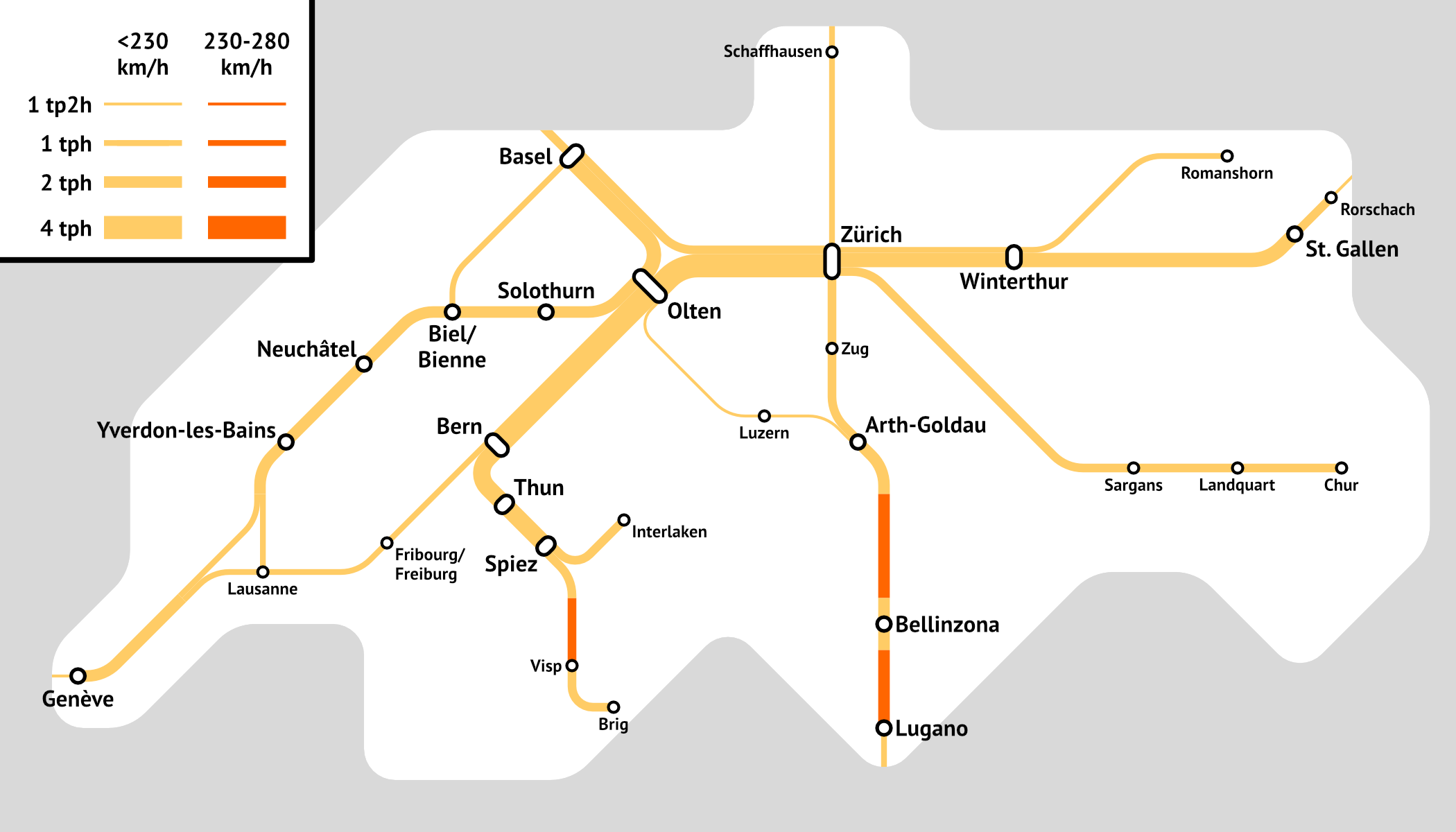
The orange segments are Alpine base tunnels, with extensive freight rail. The main high-cost investment in passenger-dedicated rail in Switzerland is not visible on the map, because it was built for 200 km/h to reduce costs: Olten-Bern, with extensive tunneling as well as state-of-the-art ETCS Level 2 signaling permitting 110 second headways. The Swiss rail network is centered not on one central point but on a Y between Zurich, Basel, and Bern, and the line was built as one of the three legs of the Y, designed to speed up Zurich-Bern and Basel-Bern trains to be just less than an hour each, to permit on-the-hour connections at all three stations.
By this comparison, HSL Zuid should not have been built this way. It is not useful for a domestic network designed around regular clockface frequencies and timed connections, in the Netherlands as much as in Switzerland. There is little interest in further 300 km/h domestic lines – any further proposals for increasing speeds on domestic trains are at 200 km/h, and as it is the domestic trains only go 160. In a country this size, so much time is spent on station approaches that the overall benefit of high top speed is reduced. Indeed, from Antwerp to Amsterdam, Eurostar trains take 1:20 over a distance of 182 km, an average speed comparable to the fastest classical lines in Europe such as the East Coast Main Line or the Southern Main Line in Sweden. The heavily-upgraded but still legacy Berlin-Hamburg line averages about 170 km/h when the trains are on time, and if German trains ran with Dutch punctuality and Dutch padding it would average 190 km/h.
What about international services?
The fastest trains using HSL Zuid are international, formerly branded Thalys, now branded Eurostar. They are also unfathomably expensive. Where NS’s website will sell me Amsterdam-Antwerp tickets for around 20€ if I’m willing to chain trips on slow regional trains, or 27€ on intercities doing the trip in 1:37 with one transfers, Eurostar charges 79-99€ for this trip when I look up available trains in mid-August on a weekday. For reference, the average domestic TGV trip over this distance is around 18€ and the average domestic ICE trip is around 22€. It goes without saying that the line is underused by international travelers – the fares are prohibitive.
Beyond Antwerp, the other problem is that Belgium has built HSL 1 from the French border to Brussels, HSL 2 and 3 from Leuven to the German border, and HSL 4 from Antwerp to the Dutch border, but has not bothered building a fast line between Brussels and Antwerp (or Leuven). The 46 km line between Brussels South and Antwerp Central takes 46 minutes by the fastest train. A 200 km/h high-speed line would do the trip in about 20, skipping Brussels Central and North as the Eurostars do.
But what if the fares were more reasonable and if Belgian trains weren’t this slow? Then, we would expect to see a massive increase in ridership, since the line would be connecting Amsterdam with Brussels in 1:40 and Paris in slightly more than three hours, with fares set at rates that would get the same ridership seen on domestic trains. The line would get much higher ridership.
And yet the trip time benefits of 300 km/h on HSL Zuid over 250 km/h are only 3 minutes. While much of the line is engineered for 300, the line is really two segments, one south of Rotterdam and one north of it, totaling 95 km of 300 km/h running plus extensive 200 and 250 km/h connections, and the total benefit to the higher top speed net of acceleration and deceleration time is only about 3 minutes. The total benefit of 300 km/h relative to 200 km/h is only about 8 minutes.
Two things are notable about this geography. The first is that the short spacing between must-serve stations – Amsterdam, Schiphol, Rotterdam, Antwerp – means that trains never get the chance to run fast. This is partly an artifact of Dutch density, but not entirely. England is as dense as the Netherlands and Belgium, but the plan for HS2 is to run nonstop trains between London and Birmingham, because between them there is nothing comparable in size or importance to Birmingham. North Rhine-Westphalia is about equally dense, and yet trains run nonstop between Cologne and Frankfurt, averaging around 170 km/h despite extensive German timetable padding and a slow approach to Cologne on the Hohenzollernbrücke.
The second is that the Netherlands is not a country of big central cities. Randstad is a very large metropolitan area, but it is really an agglomeration of the separate metro areas for Amsterdam, Rotterdam, the Hague, and Utrecht, each with its own set of destinations. The rail network needs to serve this geography with either direct trains or convenient transfers to all of the major centers. HSL Zuid does not do that – it has an easy transfer to the Hague at Rotterdam, but connecting to Utrecht (thus with the half of the Netherlands that isn’t Holland) is harder.
In retrospect, the Netherlands should have built more 200 and 250 km/h lines instead of building HSL Zuid. It could have kept the higher speed to Rotterdam but then built direct Rotterdam-Amsterdam and Rotterdam-Utrecht lines topping at 200 km/h, using the lower top speed to have more right-of-way flexibility to avoid tunnels. Separate trains would be running from points south to either Amsterdam or Utrecht, and fares in line with those of domestic trains would keep demand high enough that the frequency to both destinations would be acceptable.
In contrast, 300 km/h lines, if there are no slow segments like Brussels-Antwerp in their midst and if fares are reasonable, can be successful, if the single-core cities served are larger and the distances between stations are longer. The distances do not need to be as long as on some LGVs, with 400 km of nonstop running between Paris and Lyon – on a 100 km nonstop line, such as the plans for Hanover-Bielefeld including approaches or just the greenfield segment on Hamburg-Hanover, the difference between 200 and 300 km/h is 9 minutes, so about twice as much as on HSL Zuid and HSL 4 relative to their total length. This works, because while western Germany is dense much like the Netherlands, it is mostly a place of larger city cores separated by greater distances. The analogy to HSL Zuid elsewhere in Europe is as if Germany decided to build a line to 300 km/h standards internally to the Rhine-Ruhr region, or if the UK decided to build one between Liverpool and Manchester.
 Pedestrian Observations
Mentioning the rail connection between Liverpool and Manchester brought back some bad memories of taking the train between Liverpool and Manchester Airport, something I often did when I was living in Liverpool since Manchester was the closest airport if you wanted to fly on an airline that was not Ryanair or EasyJet.Unfortunately, the fastest trains between Liverpool and Manchester only run to Manchester Victoria while the trains from the airport go to Manchester Piccadilly on the other side of the centre of Manchester. This being the UK outside of London, there is no quick way to cross the centre of Manchester, so you are stuck with one of the local trains to Liverpool. Liverpool is a much more sensible city with all its long distance trains departing from Liverpool Lime Street.
This is why the (250 km/h) proposed “NPR” line between Liverpool and Manchester is routed via Manchester Airport (in the original plan this is to take advantage of the HS2 approach to Manchester via Manchester Airport). This way some or all of the trains would be able to stop at the airport and replace the very slow route.The basic problem with Manchester’s rail is that there is no north-south route through the city and there are two separate east-west routes (one through each of the main stations). While most routes into Manchester connect to either of the two stations, there are some routes that connect only one side or the other (notably including Manchester Airport that can only be reached from the southern route). In addition, while trains from Yorkshire can terminate at Piccadilly, they can’t run through the station without creating major disruption, so all through services from Liverpool to Yorkshire run via Victoria – and this is why all the fast trains from Liverpool to Manchester are on that route, because the fast trains don’t terminate in Manchester.
Your immediate problem could be resolved by building the “Ardwick flyover” (which has been proposed for many years) which would remove the disruption of a train running through Piccadilly from west to east and so allow the fast Liverpool-Yorkshire trains to run that way, but the other problem is that the east-west route via Piccadilly is at capacity, and everything that can be routed via Victoria already has been – so the capacity of that route needs to be significantly enhanced. This is the big constraint on not just Manchester but much of northern England’s rail, and Britain – going all the way back to the 1970s under BR – has repeatedly done every possible project to avoid four-tracking that line because it would require an enormously expensive land-take and then a very disruptive construction project (it’s all on viaduct and the viaduct would have to be closed to be widened).
Liverpool has the great advantage in terms of rail design of being a coastal city and therefore virtually all trains have to terminate there (the only exception being the “Northern Line” that runs along the coast), so it’s easy to route them all into Liverpool Lime Street.
The other option is the Picc-Vic tunnel, then you could have at least some Victoria-Manchester airport trains. And also more through centre services.
I agree with the main point that the HSL-Zuid didn’t need to be built as 300km/h. It would have been fine as a 200km/h line. A “hindsight crayon” is that in that case, HSL-Zuid should have been slightly moved and included intersection stations at Alphen a/d Rijn West and Zoetermeer Lansingerland, massively improving connectivity for these suburban cities in the Green Heart, that currently have very weak links to Rotterdam and Amsterdam.
Some points in the post don’t really make sense. HSL-Zuid isn’t a bypass of Utrecht. It’s the second bypass of the “Oude Lijn” that runs Amsterdam C – Haarlem – Leiden – The Hague – Rotterdam. The first bypass was the 1970/80s “Schiphollijn” that created the Amsterdam Centraal / Zuid – Schiphol – Leiden line, bypassing Haarlem (and later bypassing Amsterdam Centraal as well). The HSL-Zuid further bypasses Leiden and The Hague.
This is also why IC traffic on Amsterdam – Utrecht is higher (since 2025 it’s 6+6tph instead of 6+4tph by the way): all the traffic from Amsterdam to the southeast is concentrated on a line that was quad-tracked, while Amsterdam – The Hague/Rotterdam traffic is spread around three 2-track lines (that run together to create quad-track segments on Amsterdam – Schiphol and Leiden – The Hague respectively).
Also, I don’t see the need for a separate Utrecht – Rotterdam line. Because of the configuration of the network within Rotterdam, you would exit the city the same way as currently with a curve (otherwise hypothetical Belgium – Utrecht trains would need to turn around). The situation in Utrecht is the same, with trains entering from the north, or way too far from the southeast. So the only thing you could do is bypass Gouda. However, the tracks are pretty straight, and 4-tracking Woerden – Gouda (Utrecht – Woerden is already 4 track) and setting up Gouda for non-stop service would free up even more capacity on the network, and also speed up Utrecht – the Hague by 5-10 minutes (depending on top speed).
The new line that you’d build in this region (if any) would be Breda – Utrecht (more or less along the A27 motorway), in which Breda would be the branching point for international services (most running Belgium – Rotterdam – Schiphol – Amsterdam, a few running Belgium – Breda (transfer to Eindhoven) – Utrecht – northeast).
4-tracking and/or a new line towards the German border are more urgently needed though.
I’d also add that the HSL-Zuid would have been much more succesful as a 200 km/h line (fit for double-decker trains, which the current line is not) running along the A4 highway with a bidirectional branch to Den Haag Centraal. Such a line would have allowed fast trains from the Hague to run to various cities to the north and south, and it would free up a ton of capacity on the legacy railways for local and interregional trains.
A HSL branch avoiding Schiphol and running along the A5 to Sloterdijk and Amsterdam Centraal would have sped things up even more as trains could then avoid the slow railway through Amsterdam West and still serve the city centre, though that would probably be a big ask.
The fundamental issue is that the people in charge don’t believe in faster trains to the Hague, and instead prefer higher frequencies on fewer service patterns (7.5 minute frequencies in the future). Non-stop trains on the Hague – Rotterdam could be done on the existing network with relatively small investment (in the grand scheme of things), and that investment (4-tracking Delft – Schiedam) also massively benefits other train services. But even if this 4-tracking is done, every IC will most likely still stop in at least Delft.
An A5 Schiphol bypass line is definitely an interesting way to solve the Schipholtunnel bottleneck. Maybe there’s too much of a fixation on serving Schiphol with every train. It would result in a complicated service pattern though, because every destination would still demand direct trains to Schiphol regardless.
Again what is the delta difference in cost between building a line to 200/250 vs building to 300? If it is just a single digit percent point than targeting 200/250 make no sense almost regardless of anywhere on earth we’re talking about
On the same right of way/same geometry? The difference between running trains at 200 kph on tracks that can allow 300-350 is a bit more electricity. It’s not quite as masochistically puritanical though. I suspect there is some consternation that there are local trains, express trains, intercity trains that make all the stops and intercity trains that make fewer. …. though offering all the choices could be disappointment with insufficient puritanism and lack of masochism.
World Bank study on China Railways HSR:
https://openknowledge.worldbank.org/server/api/core/bitstreams/29e19da8-1a38-5fb1-acef-f247aa0b9669/content
Electrification’s a bit more expensive. Makes sense as substations have to supply higher power, the OCS itself needs to be a tad hardier. Track and civil works appears to be a wash. Signaling’s a little higher, makes sense as well from a safety perspective. I think a big chunk would be rolling stock, which is not covered by this study.
I think the point is more about the mismatch between operational needs (passenger throughput) and capital outlays, which boils down to cost-effectiveness, caused by political actions.
Witness California HSR – poor routing, planning, specifications, project management – mainly chalked up to political actions and a lack of technical expertise (e.g. premature lock-in on a Central Valley-Tehachapi alignment versus running along I-5 and Tejon Pass). I don’t really care about Merced and Bakersfield. Nobody does, except UP trains full of delicious vegetables. The objective was supposed to be fast and frequent service between the two main population centers in California, the Bay Area and SoCal. But political meddling, combined with the ARRA’s “you must improve air quality in the Central Valley, and HSR is the way to do it” nonsense, led to this lock-in. And here we are.
You forgot to mention the Holy Altamont.
To my knowledge that wasn’t seriously considered. The route would have had to cross the bay on or near the Dumbarton bridge. A tunnel or new bridge was cost-prohibitive and the existing bridge was decrepit at the time and has since been damaged by fire on a few occasions. Lastly, it would have diverged from the Caltrain route before it reached San Jose Diridon, which would have been super dumb, but then again, it’s CAHSR.
No, Altamont was seriously considered. That’s why I don’t think it’s an example of lock-in. Both Central Valley-Bay Area routes were studied extensively, and the Pacheco decision was not based on insufficient information. I think that decision was wrong but it wasn’t at all premature – the arguments for it, chiefly LA-San Jose travel time, were about priorities, not about making decisions based on partial information.
In contrast, the Tejon vs. Tehachapis issue was an example of lock-in, in the sense that the argument for the Tehachapi route was that in preliminary design it seemed easier to engineer subject to earthquake safety and environmental protection rules, and then upon further work it turned out they needed much more tunneling in the Soledad Canyon, but by then the authority had heavily marketed Palmdale as a hub for HSR commuting and LA County had already begun making growth plans around it.
Fair enough. Thanks for your response!
And they could have studied it for another decade or two and by then the original studies would be outdated which means more studies and you’d be dead for a few decades before anything happened. They are actually building something. It may not be the bestest greatest mostest goodest stuff you’d want but it’s being built. Something built is better than fantasizing about something that isn’t.
…. Access to the Regions Core should have been open by now. Amtrak may put something all the way down on 30th Street by 2060.
I suggest the thread on railroad.net that examines what would have happened if the Erie and the Delaware Lackawanna and Western had merged in 1950, rationalized their routes, the hurricances of 1955 had never happened, gasoline was taxed more heavily, Sputnik had never launched and Richard Nixon had won in 1960. With a cherry on top.
Hi, I was there. In fact, this egregiously corrupt “decision” was got me riled up and involved in all of this bullshit back around 1994 — I literally could not believe that something so stupid and wrong and obviously corrupt could possibly be occurring … oh how naïve could somebody be, way back when!
Anyway, California HSR via San Jose and Pacheco was selected in 1996 solely and purely for the profit and benefit of the Parsons-Brinkerhoff/Bechtel duopoloy which had controlled northern California “public” megaprojects for 30 years by then. It was all and solely about keeping funding for endless suburban/exurban BART extensions (a fully-owned subsidiary of the PB/Bechtel Joint Venture, quite literally fully owned) steadily and managably flowing.
Any distracting capital inflow to a non-PB/Bechtel non-BART non-freeway major project was rightly considered an existential threat.
That’s why we don’t have Caltrain to downtown SF, 30 years later.
That’s why we don’t have high speed rail to anywhere at all in California, 30 years later.
That’s why we have a fucking appalling stupid BART extension to Millbrae, past the San Francisco airport, carrying 1/3 the “predicted” riders of 20 years ago, today.
That’s why we have the stupidest possible BART extension not yet (ANY DECADE NOW! JUST A FEW TENS OF BILLIONS OF MORE DOLLARS NOW! STEADY AS SHE GOES! HOLD THE COURSE!) reaching “downtown” San Jose 30 years later.
I saw all this shit go down.
The worst possible humans made it happen.
They’re still at it. The world is burning. It will be over soon enough, and none of those responsible will pay the slighest price.
@Richard Mlynarik
I’m glad to see how I as a CT resident will feel 20 years from now when $25M battery-diesel Chargers are hauling $5.25M Alstom coaches from Springfield to New Haven under a blue sky bereft of catenary; and, potentially, going all the way to GCT while crawling through Fairfield County under a 30mph slow order due to the yearly $700M CTDOT track renewal project.
That’s the way maintenance should work. The oldest stuff gets fixed up and then next year the stuff that is now oldest gets fixed up. The alternative is waiting until something falls apart and it going out of service until they find someone to fix it.
https://en.wikipedia.org/wiki/September_2013_New_Haven_Line_power_outage
$6m/mile/year sounds like an awful lot for maintenance.
Network rail spends £3.9bn for 9848 miles of track or £400k/mile or $600k/mile PPP.
$700,000,000.00 is an exaggeration.
https://www.mta.info/document/173861
“The New Haven Line is four-track, but since the late 1990s it has never had all four tracks in service at the same time, as maintenance is done during the daytime with flagging rules slowing down the trains. Despite decades of work, the backlog does not shrink, and the slow zones are never removed, only replaced (see PDF-p. 7 of the report). The report in fact states (PDF-p. 8),
Moreover, on PDF-p. 26, the overall renewal costs are stated as $700-900 million a year in the 2017-21 period. This includes rolling stock replacement, but the share of that is small, as it only includes 66 new M8 cars, a less than second-order item. It also includes track upgrades for CTRail, a program to run trains up to Hartford and Springfield, but those tracks preexist and renewal costs there are not too high. In effect, CTDOT is spending around $700 million annually on a system that, within the state, includes 385 single-track-km for Metro-North service and another 288 single-track-km on lines owned by Amtrak.”
Wait, who wrote that?
Oh, right: https://pedestrianobservations.com/2021/06/22/consultants-and-railroaders-turn-new-haven-line-investment-into-shelf-art/
MTA does provide some cost share, but it doesn’t matter, because the spend is the spend, and CTDOT is doing the spending.
Hopefully it’s improved. I’m not optimistic. CTDOT’s rail practices are poor. And it’s not just Alon Levy or Marron or ETA who recognize this.
At a recent legislators’ town hall, I had a chance to speak with State Sen. Rick Lopes, the vice chair of the CT Legislature’s transportation committee. He freely admitted that CT lags both its peers and the average in management of passenger railways. I quoted the acquisition costs for battery-electric and dual-mode Chargers and unpowered coaches versus electrification of the Danbury and Waterbury Branches and the New Haven-Springfield Line, and advocated the rolling stock replacement be cancelled and the monies used to fund electrification; and the underutilized M8s for NHL and SLE be used to provide through services from the branch termini and Springfield to GCT. I told him that there is an electrification study underway (https://portal.ct.gov/dot/ctdot-press-releases/2023/feasibility-study-of-electrifying-hartford-line-and-danbury-and-waterbury-branch-lines-underway?language=en_US) but I was worried that whatever slop consultant’s doing the work — I cannot find even a single additional detail about this study contract, and I have pored through all of CTDOT’s publicly available contracts for the last three years — will produce a number that is so large it will condemn electrification to the circular file.
Sen. Lopes answered, “Everything you said was correct. I wish I had a better answer for you.”
He added that my fear is well-founded: CTDOT’s commissioner in the early 2000s apparently sabotaged the possibility that the Hartford-New Britain Busway (BRT, branded as CTFastrak) could have been a light rail line by literally making up a number ($1B) for its cost, then admitted it later when questioned by legislators, after the FTA had committed funding. We could have had a light rail line running from New Britain to Bradley Airport, but no. This is the state I live in, so don’t give me this nonsense about $700M iS aN exAGerrAtioN and “that’s the way maintenance should work.”
Begone, troll.
https://ctmetro.org/ctdot-transportation-infrastructure-capital-plan/
2.7 billion over 5 years is 540 million a year. It includes things other than tracks.
The trains don’t run if the substation melted down. Or if the signals stopped working. Or a bridge gets stuck. Building new stations, which probably includes things like automobile parking is definitely something other than tracks.
@J.G, Adiron, my figures are all renewals for April 2023-March 2024 – https://dataportal.orr.gov.uk/statistics/finance/rail-industry-finance/. Then divided by the distance on https://en.wikipedia.org/wiki/Rail_transport_in_Great_Britain.
Alon,
The lock-in for Tehachapi goes far deeper than a premature engineering decision relating to earthquake safety or minimizing tunneling. The route “Fresno to Bakersfield to Palmdale to Los Angeles Union Station.” is directly specified as part of the language in Proposition 1A that authorized CAHSR. The same text authorizes “San Francisco Transbay Terminal to San Jose to Fresno.” and “Merced to Stockton to Oakland and San Francisco via the Altamont Corridor.” however no such language exists for a direct Bakersfield to LAUS corridor. Technically it is illegal for CAHSR to build through Tejon; in 2012 CAHSR began studying Tejon again after it became clear the tunneling over Tehachapi wouldn’t be less, but Palmdale threatened to sue and the authority dropped the issue.
Why was Prop 1A so specific about a route through Palmdale? Michael Antonovich was a long serving member of the LA County Board of Supervisors, and was serving as Board Chair in 2005-2006; he was very influential in LA politics. His district included the Antelope Valley, where Palmdale is. Its widely believed he exerted his influence to get Palmdale “written into the story”, thereby severely compromising the CAHSR route compared to the obviously superior Tejon route. No one in California politics knew enough, cared enough or was willing to push back, so Palmdale was in the law that went to the voters.
If your view across Ninth Ave. only includes San Francisco and Los Angeles. In the immediate-ish future it’s going to allow travel to Las Vegas. Which isn’t San Francisco or Center-of-the-Universe-West, San Jose. Las Vegas has slightly more people. Someday far far in the future people in San Diego who want to go to Sacramento won’t have to go through Los Angeles. People in San Bernandino who want to go to, I know this is hard to believe, Fresno. Palm Springs-Bakersfield. People who aren’t traveling throooooooooooooooogggggggggggh Los Angeles frees up capacity for people who want to go to or from Los Angeles.
….. Though I’m sure people are just dying to get to Cupertino,
https://en.wikipedia.org/wiki/Apple_Park#Apple_Park_Visitor_Center
I hear there are things to do in and around Las Vegas too.
……. I’m sure they will be very very disappointed they aren’t going through San Jose, just like people who want to go to or from southern New England to Montreal or Toronto will be disappointed they aren’t going through Stamford. They will get over it.
If your view across Ninth Ave. only includes San Francisco and Los Angeles. In the immediate-ish future it’s going to allow travel to Las Vegas.
The LA-Riverside Combined Statistical Area is 18.51M, SF/SJ is 9.16M, Sacramento is 2.75M, Fresno/Bakersfield/Merced combine for 2.56M. Las Vegas is 2.45M. The LA to NorCal traffic will dwarf LA-LV traffic given that about six times as many people live in NorCal.
But wait, there’s more! If someone from SoCal does want to go to LV, Palmdale is not the way they want to go! Look at a map. To get to Palmdale from LA you start out going NorthWEST, towards Santa Clarita. But Las Vegas is NorthEAST of LA. Going to LV via Palmdale unnecessarily adds ~40km to any trip from LA. If you are coming from Riverside or San Diego it is worse, detouring to WEST LA to go to Palmdale before going back EAST adds at least 180km! To get to LV you want to follow I-15 and go through the Cajon Pass, not through Soledad Pass to Palmdale.
But wait, there’s more! The only way in the “immediate-ish future” there will be HSR travel to Las Vegas is via Brightline West. But Brightline West is not going to Palmdale, it is going to Rancho Cucamonga, using (wait for it…) Cajon Pass! So there will be nothing for a CAHSR route over Tehachapi Pass to Palmdale to connect to, unless you also build an additional 75km of track across the high desert to connect Palmdale to Victorville. But that would be a terrible investment. No one from SF or Sac will ride it, because Palmdale is some 180km SOUTH of LV, and detouring 360km going south then north again will never compete with flying. No one from Riverside or San Deigo will ride it, because they already have the direct trip to LV along the I-15 corridor. Probably no one from LA will ride it, because the Cajon/I-15 route will still be direct and attractive, and for that matter Rancho Cucamonga Metrolink station is only 67km from LA Union Station and building 67km of HS track there (or even just upgraded and electrified track) would be a great investment because lots of people from LA would ride a single seat direct route to LV (plus that’s the way to Palm Springs/Phoenix).
Someday far far in the future people in San Diego who want to go to Sacramento won’t have to go through Los Angeles. People in San Bernandino who want to go to, I know this is hard to believe, Fresno. Palm Springs-Bakersfield. People who aren’t traveling throooooooooooooooogggggggggggh Los Angeles frees up capacity for people who want to go to or from Los Angeles.
Except it doesn’t free up capacity, because the routes you mention (not-LA SoCal to not-SF NorCal) all end up going through the same set of tracks to the Central Valley, whether Tejon or Tehachapi. The train from SD/SB/Palm Springs will take up a track slot over that pass regardless of if it stops in LA or not, and while it is in that track slot, a train that did start in LA cannot be there.
Your plan could make capacity WORSE for people going to/from LA. The combined pop of SD/SB/Palm Springs etc. is ~8M. The LA Metro area is ~13M, LA county alone is 9.75M. Plus, areas like SD and Palm Springs are far enough away that flying will be more competitive than HSR to SF/Sac, while the areas within HSR range like Bakersfield are smaller than SF/Sac. This means that many more people will be taking the train from LA to SF than from not-LA to not-SF. That means that the trains not stopping in LA per your scenario would be less full. That means it would be better for LA if those trains stopped there, so that people from LA can take the seats not used by the people coming from Riverside or San Diego. Which would INCREASE capacity for people wanting to go to/from LA, because there would be trains stopping more frequently and more seats available.
But wait, there’s more! Taking the Tehachapi pass is still longer for SD/Riverside riders than taking Tajon pass! Tajon is the straight shot NW from SoCal to the Valley, which is the way to SF/Sac/Fresno/Bakersfield. Taking Cajon and Tehachapi pass adds ~50km to any trip from SD-Sac or Palm Springs-Bakersfield.
The only way anything you write makes the remotest amount of sense is if there is so much traffic between northern and southern California that you build both Tejon and Tehachapi to cross the mountains between them. But that much traffic will never happen. The population along the Tokaido from Tokyo to Osaka is ~80M and is serviced by two HSR tracks (admittedly at very high frequency and with plans for a second pair via Maglev). This over a distance of ~450km straight line. California is just under 40M (not all in the HSR corridor) with more than 750km between SD and Sacramento which means that HSR will never capture as high a mode share between NorCal and SoCal as it does between Tokyo and Osaka. Two mountain crossings/four tracks will not be needed.
What is needed is 1) The most direct crossing from the LA Basin to Las Vegas – via Cajon Pass, as planned by Brightline; and 2) The most direct crossing from the LA Basin to the Central Valley/San Francisco – via Tejon Pass. Tehachapi Pass need not apply.
Note that even if anything you said was true (and please read above, none of it is) that still has nothing to do with the fact that the Palmdale route for CAHSR was not chosen for ANY of those reasons. It was chosen because Michael Antonovich wanted the base of his political power (Palmdale/Lancaster) to be on the same level of importance as SF/LA with a stop on the HSR line. There is also speculation that he had ties to land speculators who thought they could make money off of land that would be more valuable because it was ‘directly connected to SF and LA’.
You never take Tehachapi and Cajon – you take Tehachapi and then cut across to Victorville. The Tehachapi route is actually faster for Bay Area-Vegas trips, which was used as an excuse to keep it and not switch to Tejon in the early 2010s.
I can read the WIkipedia article on the statistical areas of California too. I’m still going hazard a guess that Las Vegas is a more attractive destination for Southern Californians than San Jose.
Uh huh. Yep. What part of “Someday far far in the future” was difficult to understand?
Unfortunately the trains aren’t going that way. Other people made decisions you don’t like. It’s that too too bad. Going over Tejon doesn’t get you to Las Vegas either. If people from not-San Fernando-Valley are getting to the rest of the state and Las Vegas by going under the Cajon pass they aren’t in Downtown Los Angeles.
I don’t know why railfans can not get it through their thick skulls that when somebody is someplace-not-busy they can not simultaneously be someplace-busy. San Diegans getting to Bakersfield and beyond using Cajon and Tehachapi aren’t in Los Angeles.
And this makes most railfans collapse into a quivering heap of confusion. Some trains from San Diego can go to Phoenix. Some trains can go to Las Vegas. Some trains can go to San Francisco and other trains can go to Los Angeles. Alon will get out his circular takt calculator and have them changing trains in San Bernardino.
I’m still going hazard a guess that Las Vegas is a more attractive destination for Southern Californians than San Jose.
It is more attractive than San Jose alone. It is not a larger destination for Southern Californians than San Jose, San Francisco, Sacramento, and the Central Valley combined.
Going over Tejon doesn’t get you to Las Vegas either.
And crossing the Potomac out of DC doesn’t get you to Boston. If you want to go to Richmond from DC you build a line crossing the Potomac. If you want to go to Boston you build a line heading north. Building a line west across the Appalachians gets you to neither. You build through Cajon to get to Las Vegas. You build through Tejon to get to northern California. You don’t use Tehachapi for either.
If people from not-San Fernando-Valley are getting to the rest of the state and Las Vegas by going under the Cajon pass they aren’t in Downtown Los Angeles. . . . San Diegans getting to Bakersfield and beyond using Cajon and Tehachapi aren’t in Los Angeles.
If people from anywhere are getting to Las Vegas via Cajon that is fine. If people from not-San Fernando Valley are getting to the rest of the state via Cajon and Tehachapi that is stupid, because it is a longer route for everyone involved, including people who are in Downtown Los Angeles if they also have to go over Tehachapi.
What you are describing is the equivalent of building a line from Baltimore to Harrisburg and Allentown so that DC trains don’t clog things up in Philadelphia. That would be totally unnecessary, there is plenty of capacity at Philadelphia for both it and DC, and again it would be stupid because it would make the trip longer for people from DC for absolutely no benefit whatsoever. Someone who comments here frequently points out that the point of passenger railroads is to carry passengers (who is that?) and there is no reason to make every passenger between Northern and Southern California spend more money and have a longer trip just so some of them don’t have to go through Downtown LA for no point whatsoever. There is absolutely no negative if someone from San Deigo stops in Downtown LA on the way to Bakersfield, just as there is no negative if someone from DC stops in Philadelphia on the way to New York.
As I pointed out above, its actually a negative if the San Deigo trains don’t stop there, because there will be limited slots through any mountain crossing, and if a train San Diego is in that slot then a train from LA cannot be there too. Avoiding Downtown LA means fewer trains for LA travelers and thus less capacity. Because there is no reason a person going from LA to Fresno cannot get on the same train as someone going from San Deigo to Bakersfield, just as people going from Philadelphia to Boston get on the same train as people going from DC to NY every single day.
the Pacheco decision was not based on insufficient information. I think that decision was wrong but it wasn’t at all premature – the arguments for it, chiefly LA-San Jose travel time,
The arguments for Pacheco were not about travel time. They were basically the same as for Tehachapi/Palmdale, although without the clear proponent/manipulator that Michael Antonovich was. San Jose (the “Capital of Silicon Valley”) did not want to be on a spur, they wanted to be on the main line so that they would be as important as San Francisco. The travel time argument does not really hold water. Altamont would add ~55kmto SJ-LA travel distance, but it would still be shorter than SF-LA. Tehachapi by contrast adds ~72km of distance, so an Altamont+Tejon route would be shorter for SJ than what CAHSR is planning today. Going via I-5 instead of CA99 (i.e. skipping Fresno, etc.) would save another ~55km, so if anyone in the process really cared about LA to Bay Area travel times they would have used the SNCF proposed route.
Where Pacheco vs Altamont really impacts travel time is Sacramento to Bay Area travel – and in a major way, none of it good. Going all the way south to Pacheco go then go all the way east to Madera to then start going NorthWest(!!!) to Sacramento adds ~138km to SJ-Sac travel and a whopping ~177km to SF-Sac travel. That is a greater than 50% increase for SJ and close to 2/3 for SF. The SF-Sac distance, at ~288km, is long enough that at a lot of express HSR speeds (i.e. Tokyo-Osaka, Paris-Lyon, Madrid-Sevilla, Rome-Milan) driving would be faster than CAHSR outside of traffic.
That said, unlike Tehachapi, where there is no possible reason to ever use it, there are actually two arguments for when you would use Pacheco. The first is if you want the absolute fastest SF-LA travel time, no holds barred, don’t care about Sacramento, no stations in Fresno/Bakersfield, etc. In that case, the shortest practical path is SF-SJ-Pacheco-I5-Tejon. Doing this could shave ~125km off of SF-LA distance compared to the current CASHR route, a ~16% savings.
The other reason is if you wanted to do a single line connecting all of the major cities (LA-Fresno-SJ-SF-Sac) with no ‘Y’ in the central valley. Everyone on the main line. This would result in crazy fast Bay-Sac service: SF-Sac <150km, SJ-Sac <250km. The tradeoff would be that Sac-LA would increase ~110km compared to the CAHSR route, and almost 200km over what could be done with a better routing via Tejon. At ~825km Sac-LA is well past Bos-Wash distance, and mode share vs flying would presumably take a hit.
The Tehachapi route is actually faster for Bay Area-Vegas trips, which was used as an excuse to keep it and not switch to Tejon in the early 2010s.
No, as I mentioned previously CAHSR dropped the Tejon study in 2012 due to the threat of a lawsuit from Palmdale, due to how Michael Antonovich rigged the Prop 1A language. Actual evaluation of travel time or options had nothing to do with it.
Also, Bay-Area to Vegas travel is totally irrelevant for CAHSR, because it will be never be a serious factor. SF-LV via CAHSR’s route and Victorville is over 1,000km. As I noted, Vegas is almost as far north as Fresno, so the extra 380km to go south of Bakersfield before turning back north makes the route a non-starter. Even at some world best non-stop HSR speeds this is a 3.5-4 hr trip, which means it won’t be competitive with a 1h40 flight even accounting for security, etc. (The planned Brightline station is actually slightly farther from the strip than McCarran airport, and due to LV’s urban geography there is no access penalty from the Casinos to the existing airport or the future train, so you can’t even win on “the train station is already downtown”). That assumes you can even generate the ridership to run non-stop service in the first place. If you stop in SJ, Fresno, etc. along the way to ‘fill the train’ then the trip is even longer, and then you aren’t filling the train because everyone is flying instead. It’s a doom spiral before you even start.
Las Vegas HSR is a great (great!) market from SoCal. Bakersfield is a long way round (especially if you do it right and go Tejon-LA-Cajon) but there are no direct flights and the driving route goes south to go north too, so HSR still wins. Fresno has only a few direct flights per day, so even if the trip is long and roundabout, there isn’t much to compete with. Beyond that, forget it, people from NorCal are flying to Vegas.
Other people didn’t consult your omniscience and made decision your majesty doesn’t like. tough shit.
They made them. People in Southern California will able to get to Las Vegas by going around Palmdale. Which offends your delicate sensibilities. That’s too bad. The people going to Las Vegas or San Fransiciso won’t care. Because they care about what is happening on planet Earth. Not what coulda shoulda woulda happened if the bestest mostest greatest stuff some omniscient railfan fantasizes about had maybe happened
@Onux
People do Orlando-Miami by train which takes 3.5 hours even though the flight is only 1h15.
Of course a more strict alignment is better, but even without that, SF via LA (Even if via switch back at in town station inside LA) to reaxh Las Vegas should still have enough attractiveness to be able to attract a few passengers.
Never would have been approved and you would be wondering when California was going to reconsider.
The people going to Las Vegas or San Fransiciso won’t care.
They will care. Making the route longer makes the trip longer. Making the route longer makes the tickets more expensive, because you have to maintain more track and catenary, because you have more wear and tear on the vehicles, and because a longer trip means you have to pay the salary of the train staff for a longer time. Someone who comments here (who is it?!?) frequently states that he point of passenger railroads is to carry passengers. Why would you want to make the trip longer and more expensive for passengers where there is a shorter more direct route just sitting there, one which many of your potential passengers are already driving on when they make this trip today? As trip time and ticket cost goes up, even incrementally, your potential passengers, who do care about these things, will leave you for other modes that are faster or cheaper.
People do Orlando-Miami by train which takes 3.5 hours even though the flight is only 1h15.
Last I saw Brightline carried 1.6M trips in 2024 compared to 17.4M trips between the Orlando and Miami metro areas (in 2022) so about 9% mode share. That is not great. And total travel in 2024 may have been higher than the most recent available DOT figures from 2022. And the distance is short enough that most people are driving not flying (flights only have about 5% mode share, and Brightline effectively parallels the shortest driving route. SF-Vegas is a much longer drive and the rail route is not as direct as a flight, it literally goes hundreds of km out of the way!
SF via LA (Even if via switch back at in town station inside LA) to reaxh Las Vegas should still have enough attractiveness to be able to attract a few passengers.
Anything can “attract a few passengers”. Someone is paying money to travel from Chicago to Seattle on Amtrak today, even though it is not a viable route. All travel from California MSAs to be served by CAHSR to Las Vegas is ~16M annually, of that ~12M is from SoCal. Travel from North of Tejon to South of it is ~75M. Grabbing 10-30% of the ~4M people going from north of Bakersfield to Vegas each year is the same as a 0.5-1.5% shift of mode share for other potential CAHSR travel. Don’t let the tail wag the dog, small degradation of SF-LA trip time loses you more passengers than large improvements in SF-LV time.
Going to Vegas via La Union station would be an ~1200km trip. SF-Salt Lake City is 1184km. Do you think there is a viable market for HSR between SF and Utah? If not, why would you think there is one for a trip where the rail distance is the same but the flight is 30 min shorter?
Yes it does. A longer route that actually exists is shorter than a railfan fantasy that isn’t being built. That route has to compete with flying or driving. Not with your fantasy.
And no matter how hard you clap, click the heels of your ruby slippers and hope to put more numbers in your trainspotter’s log, people can’t ride in your fantasy. Passengers being acquainted with how things work here on Planet Earth will expect an actual train. Not one that isn’t being built.
Is better than no-percent mode share on a fantasy train that no one responsible is currently proposing.
If the tracks only exist your fevered dreams no one, not even you, will ride any trains on it.
Californians made decision you don’t like. Tough shit. It seems they will be building tracks that offend your sensibilities. Again, tough shit. Actual tracks have to exist to carry actual trains with actual people in them.
Californians, someday, that are blissfully unaware of your omniscience, will get on trains and go to Las Vegas. Unconcerned that someone somewhere put down his notebook filled with car numbers long enough to fantasize about what coulda shoulda woulda happened if the bestest mostest greatest stuff had been done. Instead of the actual train they are on.
Richard Attenborough voice
And here the screeching troll further loses his powers of reasoning, inventing words and forgoing punctuation while hollering into the void
CAHSR’s chosen alignment is similar to the Tokaido Shinkansen’s, one straight line connecting a bunch of metro areas: SF – SJ – Fresno – Bakersfield – Antelope Valley – LA – OC. In a vacuum, this would be a very reasonable Amtrak intercity route.
The issue with this alignment is that modern HSRs recognize that the majority of ridership and revenue come from the stops within the megaregions. LGV Sud-Est is effectively a nonstop route between Paris and Lyon, HS2 will be nonstop between Birmingham Interchange and Old Oak Common, and the Chuo Shinkansen is needed to better handle the Nozomi demand and decongest the Tokaido Shinkansen.
The ideal HSR route, which outcompetes both car and air travel, is between 50 and 750 miles. SJ – LA via I-5 is 340 miles. SF and OC are another 50 and 30 miles, respectively; importantly, these segments won’t be high-speed. Routing via Fresno and Bakersfield adds another 30 miles, which isn’t too bad considering the 2+ million people along the route. From a housing affordability standpoint, these cities could become bedroom communities to relieve SJ and LA. Palmdale was a political choice, as it is significantly less justified with its 400k population and 45 mile detour.
Most trains should be running nonstop between SJ and Burbank, which is 415 miles and should take roughly 2 hours. Add another 15 minutes to LA. Based on this, CAHSR should outcompete SJC – Burbank and SJC – LAX. Even at 3 hours, SJ – OC should be about the same travel time on flights vs CAHSR. Millbrae – Burbank / LA should take 2:30 and 2:45, which should be about the same as flying, but Millbrae – OC will take 3:30 and not be competitive with flights. Not going through the Tehachapis would have saved 15 minutes made CAHSR even more competitive than it already is.
For all its shortcomings, Brightline West’s LA (Ontario) – Vegas route is perfect. There’s no need to create a reverse branch to Palmdale and there’s no demand for nonstop HSR between the Bay Area and Vegas. Instead just build an actual HSR line between LA Union and Ontario. It might be incredibly expensive, but it’s the key line for HSR routes from LA to the IE, Vegas, Palm Springs (and long-term Phoenix), and SD via Escondido.
a railfan fantasy
A route using Tejon is not some fantasy, it is a perfectly viable alternative that lots of people are proposing; even the people responsible (California High Speed Rail Authority) wanted to propose it in 2012 when it became apparent Tehachapi might require more tunnels and be just as or more expensive than Tejon. The Tehachapi route does not exist either, it is not in the process of being built, and no funding is available.
You have frequently commented regarding the North East Corridor that someday trains from Boston to Toronto will take a route west Albany while those from Boston to New York will take a different route heading south. But there are no high speed tracks from Boston to Albany, none under construction, and no plans for them, or for a HS route from Albany to Toronto. Your comments on this matter are just as much a fantasy as advocating for Tejon; but that is fine, the whole point of advocacy is to discuss things that don’t exist yet and provide reasons why they should.
Californians made decision you don’t like.
But that’s the thing, Californians didn’t really make the decision. Yes, they voted for Prop 1A which has language to legally lock in the Palmdale route, but the implications of that were not explained to them, nor were they presented with any sort of choice (“If you serve Palmdale then SF-LA trip time will be ## minutes longer than if you take a direct path over Tejon.”). People were told if they vote Yes they will get high speed rail for California; the backroom machinations that included the ‘Palmdale-Only’ language were hidden. And it was the legal straitjacket that resulted that prevented the people responsible from conducting that study back in 2012.
Californians, someday, . . . will get on trains and go to Las Vegas.
If/when they do, they will not go through Palmdale, because Brightline West is planning a route that uses Cajon pass and will go through Victorville not Palmdale. So nothing about switching to Tejon would prevent this.
blissfully unaware
But if the route is not switched to Tejon, they will be very aware, because with a slower, more expensive route, actual passengers will vote with their actual feet and choose not to ride the actual train and to drive or fly instead.
@caelestor
The CAHSR route it totally unlike the Tokaido Shinkansen. Yes, the Tokaido Shinkansen does not take a perfectly straight line from Tokyo to Osaka. But that is because of geography, the Akaishi Mountains and Ise Bay prevent a perfectly straight route. And the places it serves with those wiggles (Nagoya, Kyoto) are huge cites. In California it is the opposite, geography dictates a direct path from LA to Bakersfield, crossing the mountains once, not detouring 70km to cross two mountain ranges with a total mountain/tunnel distance no less than if you had chosen Tejon. And the Antelope Valley, as you note, is far from a major city.
It is here on planet Earth because nobody is going to switch too it at this late date, no matter how hard you clap.
at this late date
What late date? The Tehachapi route is not designed, not funded, no property obtained, not out to bid, not mobilized, not under construction. None of those things have even started. It is in the exact same state as a Tejon route.
The only issue with Tejon is political. As Prop 1A was written/rigged it is technically illegal to build via Tejon. But what the voters did the voters can change.
The only thing done for Tehachapi is that the final environmental statement was approved by the board last year with the general route. But even that is a political issue. Back in 2009 (one year after the CAHSR measure passed) the California legislature passed a law exempting a new stadium in LA from CEQA for some well connected developer/donor. If CA cares about completing HSR between LA and the rest of the state the legislature could do the same, and switch the route without any further environmental reviews.
They have, from many many many years ago “We aren’t going to use Tejon” and Final Enivironmental Impact Statement for Bakersfield to Palmdale.
https://hsr.ca.gov/programs/environmental-planning/project-section-environmental-documents-tier-2/bakersfield-to-palmdale-draft-environmental-impact-report-environmental-impact-statement/
The FEIR isn’t many, many years ago, it was approved last year.
Access to the Regions Core had a FEIR, then Chris Christie cancelled it. Boston Green line extension had a FEIR, then they redesigned the project to make it less expensive when they got a change to more competent management. The SMART Train in the northern SF Bay Area had an FEIR, then they filed an addendum so they could extend it to Healdsburg. FEIR’s are not some magical document that once enacted can never be changed. Addendums could be filed to the Bakersfield-Palmdale or Palmdale-Burbank FEIRs since part of the route of each remains the same. A new FEIR could be done for Bakersfield-Burbank as a single section. Or the California Legislature could treat HSR with the same attention it wanted to treat an NFL stadium and pass a law exempting CAHSR from CEQA and do no further FEIRs.
The only thing from many, many years ago preventing use of Tejon is that Michael Antonovich slipped into Prop 1A that the route had to use Palmdale, either to stroke his ego as to the importance of his otherwise not-important small high desert city, or as a payoff to supporters who could sell their real estate at a higher price because it would be near the station, or both. Sneaking such language into popular referendum via backroom deals is, as the saying goes, no way to run a railroad.
@J.G.
The route would have had to cross the bay on or near the Dumbarton bridge. A tunnel or new bridge was cost-prohibitive
Actually there would have been (still wouldn’t be) anything cost prohibitive of building a new rail bridge at Dumbarton. See here: https://caltrain-hsr.blogspot.com/2019/03/build-dumbarton-rail-tunnel.html?showComment=1551831008449#c3799470562353670008 and here: https://caltrain-hsr.blogspot.com/2021/09/down-tubes-with-dtx.html?showComment=1641945968676#c353992809604846746 for reasons why a replacement rail bridge would be a relatively simple and cost effective project compared to a tunnel.
I give up. I bow to your omniscience. The legislature, the courts, the Federal Government are just going to acquiesce to it. Do you think it was the clapping or the ruby slipper?
@ Phake Nick: 200 to 300 km/h means much higher pressure changes. Plan to put separate the tracks by another meter. Tunnel sections will go from to 62 to 100 square meter.
Most of the regular trains don’t even run 300 km/h on it either! The only ones that hit 300 are the Eurostar and the Thalys (I guess they’re the same now?). The ICNGs that run every 15 minutes domestically only hit 200 km/h. And even that is an improvement over the Intercity Direct trains, granted those were temporary, but they only hit 160 km/h.
Not sure where to rank other infrastructure improvements that would have benefitted from a lower HSL Zuid investment (in the 200 or 250 range), but electrification of all the remaining branch lines would be a solid choice. They are getting there… slowly.
There’s a great deal wrong with your Swiss diagram (and yes I know it’s all a big simplification, but it’s verging on “not even wrong” territory).
Zürich—Zug—Luzern is 2tph not 0 (yes you’re simplifying, but no you’re not omitting this pair!)
Olten—Luzern is 4tph not 1
Zürich—Winterthur is 16tph not 4
Yverdon-les-Bains—Lausanne is 4tph not 2
Zürich—Sargans is 3tph/5tph (every second hour there are two additional international trains)
Bern—Fribourg is 5tph not 2
Fribourg—Lausanne is 4tph not 2
Genève—Lausanne is 6+tph not 1
I could go on. (I will, if it helps you make fixes.) Only a handful of the line weights (NEAT peripheries) appear remotely correct.
Even if you admit only interregional/intercity trains and omit s-bahn (which you shouldn’t as your diagram is illustrating route segment passenger trains per hour, not point-to-point limited-stop pairs only, besides and in Switzerland there’s basically no difference) so much is wrong.
It’s very easy to look up reality: SBB Netzgrafik 2025 (I started off using the sbb.ch web site journey planner entering pairs of cities and counting results, but that’s stupid as the Netzgrafik is sitting right there with everything on one page.)
It’s IC-only, which is why the graph excludes, for example, the slower IRs from Zurich to Basel doing the trip in 1:12 and not 0:54.
(For the same reason, the Germany graph only includes ICE- or similarly-branded trains, which most Berlin-Dresden trains are not, so there’s no link from Berlin to Dresden on the graph.)
Alon, effectively nobody in Switzerland cares if a train is labelled “IC” or not. You have a ticket, you get on the next train going where you want to go. (Yes, I know there are saver tickets and differential pricing, but they’re kind-of irrelevant to most pass-carrying domestic passengers, thank God.)
Reality is that for most of the node pairs you’ve shown that trains labelled “Interregio” have almost the same timings as those called “IC” or “EC”. And in fact the S-Bahn/RER trains are often very little less slow, because that’s just the geography and urban form and infrastructure.
Yes, there are examples where the IC takes the a faster route and arrives before an earlier-departing S-bahn, and fewer (because quad-tracking in the same corridor isn’t so common in Switzerland all told; it’s a county with so so so much heavily-used single track, after all) where an IR overtakes a S. I was well aware of this when I pointed at the Netzgrafik after having wasted time with sbb.ch’s every-more-enshittified journey planner. “Good enough” is often good enough, ands certainly better than “actively wrong”, which is what your schematic map is, sorry.
In general, the netzgrafik gives a 99% good picture of the number of hourly trains between nodes, and an 85% good picture of the number of trains per hour that arrive in order. I think your diagram provides a poor picture.
It makes be question the veracity of the Dutch diagram, where it’s more lingusitic work for me to fact-check and where I’m not super familiar with the rail network operations.
Anyway, here’s some TL;DR since I did the work to type up these examples:
Zürich—Winterthur, where you show 4tph, there are actually 16tph (with five different routings), of which only 4 arrive “out of order” due to a slower routing departing westbound not eastbound, meaning there are 12tph from a passenger’s perspective, not 4 (:01-:21 :03-:27 :05-:29: 09-:36 :16-:38 :25-:49 :31-:51 :33-:57 :35-:59 :39-:06 :46-:08 :55-:19) Eyeballing the netzgrafik without reading the arrival/departure fine-print or even bothering to compare the two indicated (simplified) routes would have suggested 16tph, which isn’t correct but is a lot closer to rider experience than your 4tph
Zürich—Zug, an example of a pair with a fast 2-track bypass via the Zimmerberg tunnel as far as intermediate Thalwil in parallel to the old 2-track route, then tons of single track to get to Zug which results in directional fleeting, plus a completely separate circuitous mostly single-track route via the Albis river valley) there are 7tph, of which only one arrives “out of order” despite 2tph taking the far slower route. (Trip times are 24,45,21,35,26,27,45,35 min) Even with the Zimmerberg tunnel non-stop effective quadruple track there end up being no overtakes. As a rider there are 5 or 6tph (3 of which are IR or EC, none IC), not the 2tph on your diagram
Genève—Lausanne: 6tph of which 4tph non-RER, not 1tph: IR,RER,IR,IC,RER,IR, trip times 39,51,43,39,51,43 minutes. Two track route. Everything arrives in order. Nobody would ignore the 3tph IR and only consider the 1tph labelled “IC”, and few would ignore the RERs
Very true, Richard. Some IRs between Zurich and Zug are faster than some ICs. Half the S-Bahns between Zurich and Winterthur are faster than the IC and IR services. It seems more useful to group trains by journey time than by brand.
Just a few nitpicks:
Saver tickets are quite attractive also to half-fare card carriers.
Albis is a chain of hills, not a river. The valley you probably mean is called Knonauer Amt.
The Frankfurt-Cologne line is not comparable at all. The dense part of North Rhine-Westphalia is Rhine-Ruhr. Cologne is at its southern end. The line to Frankfurt passes through the Westerwald which is pretty empty. (And mostly in Rhineland-Palatinate rather than NRW.) Pretty much the opposite of Randstad. The last two sentences of your post appear to agree.
The fastest ICE between Cologne and FRA averages 217 km/h (170 km, scheduled trip time 47 min), the slowest 185 km/h (55 min, for no obvious reason), not just 170 km/h.
The Frankfurt-Cologne line is not comparable at all. The dense part of North Rhine-Westphalia is Rhine-Ruhr. Cologne is at its southern end. The line to Frankfurt passes through the Westerwald which is pretty empty. (And mostly in Rhineland-Palatinate rather than NRW.) Pretty much the opposite of Randstad. The last two sentences of your post appear to agree.
The fastest ICE between Cologne and FRA averages 217 km/h (170 km, scheduled trip time 47 min), the slowest 185 km/h (55 min, for no obvious reason), not just 170 km/h.
(WordPress keeps adding my comment to the wrong thread. This should be top-level.)
Manged to post it to the right level now. Feel free to delete this and the three posts above.
London Marylebone to High Wycombe is about the same distance and has the same top speed as Brussels-Antwerp (100mph/160km/h) and the fastest non-stop services (e.g. the 14:02) do the trip in 24 minutes. The 17:49 from London Marylebone which has 5 intermediate stops not 4 takes only 40 minutes to do the trip, and that is with 35 year old DMU rolling stock with a top speed of 75mph/120km/h.
You cannot list HS2 as literally the worst project in the world on cost grounds and defend its operational practices.
Also I really don’t think these comments on size and importance are actually true. Currently from Birmingham New Street there are ~3 million passengers a year from there to central London. So when HS2 only runs as far as Old Oak Common you might double that figure giving a net-additional passengers figure of 3 million.
Birmingham interchange is harder to judge as there will be trips north of Birmingham with larger journey time improvements. Perhaps that will also see a net additional passengers of 3 million.
Still fairly conservatively a north Buckinghamshire station might get 1.5 million in net additional passengers which isn’t exactly tiny compared to the Birmingham stations.
It’s worth noting that the fastest non-Eurostars EuroCity direct trains take only 1h23 to go from Amsterdam to Antwerp vs 1h20 on the Eurostar/Thalys – but they run from Amsterdam Zuid instead of centraal.
I feel the author never really offers a solid argument for his main claim. First, he doesn’t back up his points: the article is full of assertions with no evidence, feasibility checks, or supporting facts. Second, the comparisons he does make are incomplete. Take the claim that a new route saves 11 minutes. Whether that’s a big deal depends on the total travel time and on similar time-savings elsewhere. Without that context, it’s like saying “a flower is blue” without judging whether it’s beautiful, which is the question that actually matters. And he can’t judge beauty, or success, because he never defines what success would look like, so any real comparison is missing.
He also sets the Dutch situation against Switzerland, a mountainous country with entirely different geography; the two contexts just don’t match, so the comparison falls apart. On top of that, he never examines the original reason the high-speed line was built, nor does he present, and rebut, a counter-argument, which is standard in an essay of this kind. In the end, the piece feels like an elaborate circular argument. That’s a pity.
*they
And the claims about time savings come from running code on train performance on the existing lines, with existing high-speed trainsets’ technical characteristics, and then seeing how this changes if we reduce the top speed, or build a Brussels-Antwerp bypass.
Give me some credit.
Certainly the existing Brussels – Antwerp line should be able to support trip times of 24-25 minutes.
Perhaps you need a new tunnel from Brussels south to Brussels north to achieve that? But I would have thought there was scope to increase speeds from the current 60km/h to something a bit quicker.
To be honest, I would love to give you some credit. You clearly put a lot of effort in it. That’s why I wrote it’s a pity, and I didn’t mean in a sarcastic way. I might have been too blunt in my Dutch directness. With these changes the article would have been more interesting and convincing. With a bit more structure your position would mirror that effort.
Sorry if this is a FAQ, but what software are you using for the maps? They’re great. (I’m hoping the answer isn’t “hand-drawn in Illustrator” or similar.)
I’m not using anything; Kara Fischer made the maps and is available for commissions (link).
While the savings of 300 km/h vs 200 km/h might be only 8 minutes, if you were to apply this logic to other cities, you’d be quickly adding 30 minutes or more to the end-to-end travel time between the largest cities.
There’s also a tendency to compromise speed all transit projects, so for example. Light rail might be compromised to some 10 mph turns. Heavy rail, might be compromised to some 25 mph turns. In this case, HSR might be compromised from 300 km/h to 230 km/h. However, if your plan going in is to be build a 200 km/h line, it will be EXTREMELY likely, that you’ll have to compromise to 140 km/h or worse.
So yes, while our 300km/h line is 8 minutes faster than a “theoretical” 200km/h line, if your 200 km/h line was actually built, it might provide even more slowdowns than just 8 minutes.
The thing is that for domestic purposes building/upgrading their lines to 160-200km/h line makes sense for the Belgians, as does tightening their operations to Chiltern Railways standards. But the benefits from building a 300km/h line are small.
Do not forget the Belgian domestic trains aren’t going to do Brussels-Antwerp non-stop.
Belgians are allowed to leave the country. And have the ability to comprehend that some trains make all the stops and some trains don’t.
The Frankfurt-Cologne line is not comparable at all to the HSL-Zuid. The dense part of North Rhine-Westphalia is Rhine-Ruhr. Cologne is at its southern end. The line to Frankfurt passes through the Westerwald which is rather empty. (And mostly in Rhineland-Palatinate rather than NRW.) Pretty much the opposite of Randstad. The last two sentences of your post appear to agree.
The fastest ICE between Cologne and FRA averages 217 km/h (170 km, scheduled trip time 47 min), the slowest 185 km/h (55 min, for no obvious reason), not just 170 km/h.
Liverpool – Manchester might have justified a 300km/h railway if there were two megacities the other side of Hull.
If a future where Britain is in Schengen and there’s better regulation or procurement of or competition on cross-border services is worth imagining, then we are talking about a network connecting the three biggest and productive regions in Europe. With the highest concentration of business traffic, where journey time is in the 4-hour zone where demand is highly elastic, every minute matters. In fact, especially given the nature of the polycentric Randstad that places unskippable stops, every minute clawed back from the stopping penalties is precious.
The weak link is Belgium. If Belgian railways were managed by Prorail and NS then Brussels – Antwerp would have 6tph express services calling at Mechelen only.
Right now Belgium has a railway network that works OK for its own perceived domestic needs and there’s no impetus for it to change its entire railway culture purely for the benefit of people passing through their country.
Fast forward 20 years there may be a more assured Europe no longer caught up in firefighting the far right, a Europe that’s got more headspace for pursuing further European integration and unity. If the L25N can carry on in the central reservation of the E19 then dive down near Kontich to re-emerge before Noorderkempen, you’d then be looking at a 20-minute journey time reduction for Brussels – Amsterdam. That’s where London – Amsterdam decisively shifts from air to rail.
What would the choice of 200km/h vs. 300 km/h be/have been for the corridor Brussels-[Randstad]-Bremen-Hamburg[-Copenghagen]? Is the idea that all that medium-distance traffic would be better off routed around NL entirely, via Köln and Liège, excepting the poor sods with Amsterdam or Rotterdam as a destination, who just have to lump it with the terrible conditions cross-border between NL and DE?
Brussels-Hamburg doesn’t really have any reason to pass via the Netherlands – HSR upgrades can get Brussels-Cologne to around 1:15-1:30 (it’s 1:51 right now), and then with a good intra-German network it should be possible to get from there to Hamburg in 2:15.
Agreed. The corridor has either existing HSL (Brussels – Cologne) or HSLs in planning (Bielefeld – Hanover and Hanover – Hamburg. Of course this is German in planning so it could be many many decades away.
The missing bits are Liege and Aachen bypasses, something that travers the Rhine-Ruhr conurbation more quickly, and a Hanover western bypass. None of these are politically easy …
England is as dense as the Netherlands and Belgium, but the plan for HS2 is to run nonstop trains between London and Birmingham, because between them there is nothing comparable in size or importance to Birmingham
This is a good example of aggregation being deceptive. It would be more accurate to say that England has London in it, which is extremely dense, but also Dartmoor, which isn’t. I suspect that the typical square kilometre of England is much less dense than the typical square kilometer of the Netherlands.
If you look along the route with the circle mapper (https://www.tomforth.co.uk/circlepopulations/) the Netherlands is more dense along their high speed line (although no more so than Birmingham interchange), but Belgium is more similar, as is the sections along the Tokaido Shinkansen to e.g. Stoke.
London and the rest of the Southeast are denser than the rest of England, but then Holland and Utrecht are denser than the rest of the Netherlands. In both cases, there’s quite a lot of density in the other regions. The Regions of England and the provinces of the Netherlands overall don’t have much of a difference in their density distribution, if you lump London with the Southeast.
Thought you might be interested in this map showing the percentage of trains running to a clockface schedule across Europe
https://proto.propexum.com/expo/?data=2025-05-07