Quick Note: The Importance of Penn Station Access West to Through-Running
A video by the Joint Transit Association talks at length about through-running in New York – which lines are easier and which are harder, what some of the tradeoffs are, what sequencing works best with ongoing infrastructure plans starting with the Gateway tunnel. It’s a good video and I recommend watching – and not just because it gets a lot of its ideas from ETA reports but also because of its own analysis and own points (about, for example, Mott Haven Junction) – but it has one miss that I’d like to highlight: it neglects Penn Station Access West, the proposal to connect the Hudson Line to Penn Station via the Empire Connection.
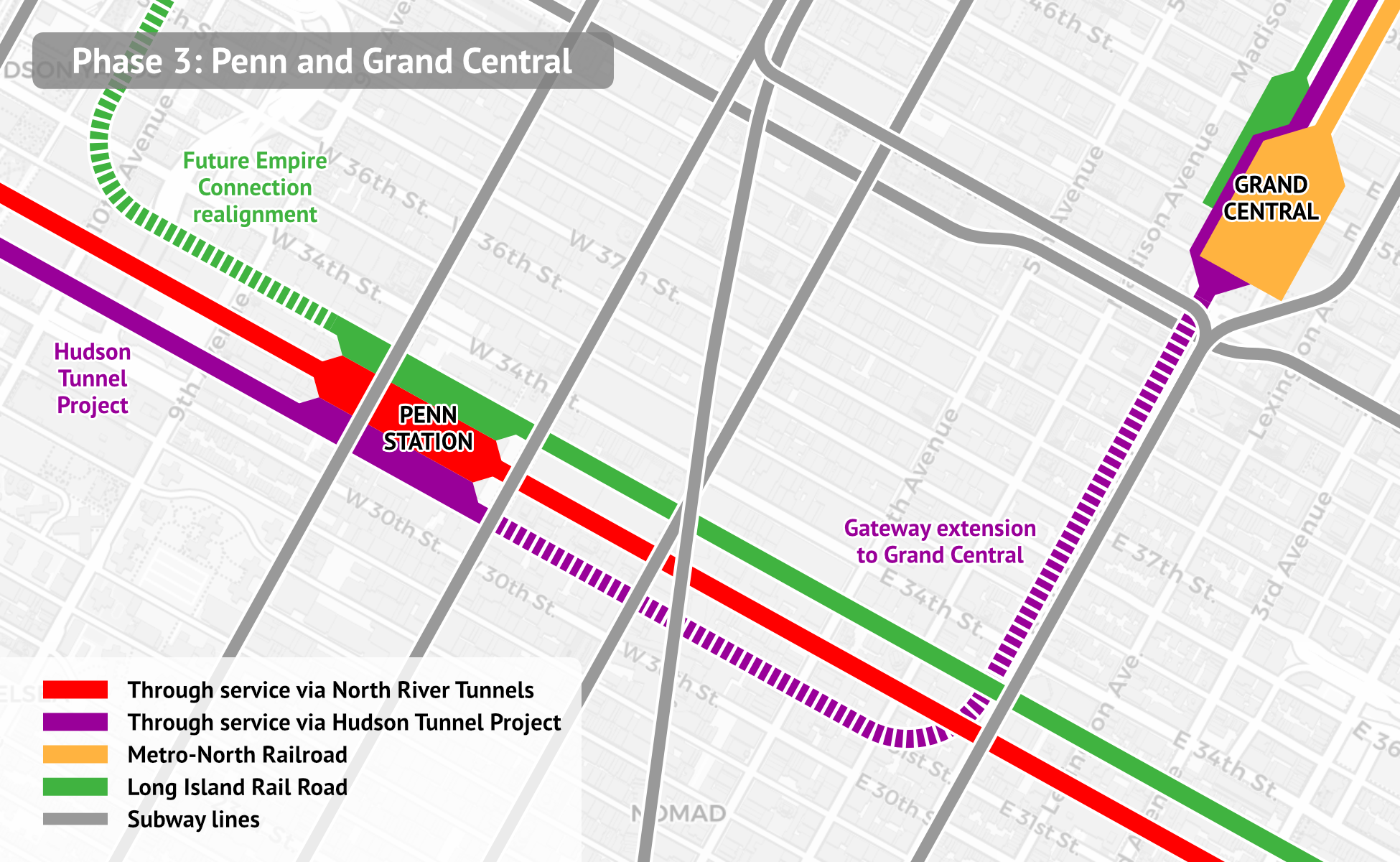
The issue is that without the realignment, too many trains would be going into Grand Central – all preexisting Metro-North service minus trains diverted to Penn Station Access. We expect all this through-running infrastructure to add to peak demand substantially. Today it fills about 50 peak trains per hour, which a four-track trunk line would struggle with (Metro-North runs trains three-and-one at the peak). Even with diversion of 6-10 trains to Penn Station Access, the extra demand would saturate the line. Penn Station Access West is important in reducing this capacity crunch.
The realignment is both important and cheap. The Empire Connection exists and the tunnel has room for two tracks; it needs a short realignment to reach the right part of Penn Station – the high-numbered northern tracks as in the image, where today there is a single-track link from the Connection proper to the low-numbered tracks – but that realignment is much cheaper than a full through-tunnel such as between Penn Station and Grand Central or the various lines to Lower Manhattan mooted for longer-term plans.
The total capacity produced should be every train that doesn’t have to go to Grand Central. It’s hard to exactly say what the split should be – there should be a minimum of a train every 10 minutes to each destination, if only to serve the inner stations that are (or would be infill) on the lower Hudson Line or the Empire Connection before the two routes meet at Spuyten Duyvil. Beyond that it’s a matter of measuring demand and seeing what the limit of timed connections are; ideally there should be 12 peak trains per hour on Penn Station Access West and only 6 on the preexisting route, up from 14 total on the Hudson Line today due to service improvements brought by through-running and related upgrades. This is necessary to create the capacity to run more service on the other lines – today the Harlem Line peaks at 16 trains per hour and the New Haven Line at 20, but these upgrades would create a lot more demand and my assumption in sketching through-running tunnels is that the Harlem Line would need 24 and the New Haven Line would need 18 to Grand Central and 6 on Penn Station Access.
 Pedestrian Observations
The video noted through running would decrease existing peak direction service level capacity. This is because 3 of 4 tracks are operating in the peak direction. Through running would require 2 peak and 2 off-peak direction track assignment. The video tries to get around this by assuming that CBTC would increase service level capacity from 24 to 30 tph.
The 24 tph limit isn’t due to signal system limitations; it’s more fundamental. FRA regulations wisely limit a train-to-train spacing to a single train within a ventilation zone. The ventilation zone for the Hudson River tunnels is defined by the ventilation fan locations. These are located at Tonnelle Avenue in New Jersey and 12th Ave in New York for the longest zone. That’s a distance of 2.39 miles (12619.2 ft), per Google Map’s distance measuring tool.
Train speed in the tunnel is 50 mph (73.5 fps). This means a train composed of 12-85 ft cars must travel 13639.2 before a follower can enter the ventilation zone. The travel time will take a minimum of 185.5 seconds to cover this distance @ 50 mph. This limits service level capacity to 19.4 tph.
A sanity check with NYMTC’s 2011 (the year before Super Storm Sandy) Hub Bound Report shows a 8-9am peak of 26 inbound and 10 outbound trains for a total of 36 tph. By comparison the totals for the East River Tunnels were 37 inbound and 11 outbound; the totals for the Park Ave Tunnels were 53 inbound and 11 outbound.
The underwater tunnel capacity limitation does not exist for Paris, London or Philadelphia which are cited as successful examples for through running conversions.
The Channel Tunnel consists of 3 tubes. 2 are for train operation. The third is for service that includes ventilation. There are connections between the service and rail tubes that provide shorter ventilation zones so more than a single train can safely operate within each tube. The East and Hudson River tunnels are not designed this way.
Also worth noting that Eurostar doesn’t even allow standing passengers when there is disruption like today – even though e.g. Japan has allowed standing passengers on the Shinkansen since the beginning with zero deaths.
Now hopefully I and others can persuade Eurostar that if there is a delay that they should be more pragmatic and allow standing passengers but I think persuading them to run that service day-in-day-out would be nigh on impossible.
So even if the ventilation shaft thing is basically nonsense it will still be almost impossible to win the argument on.
In terms of services per hour the Elizabeth line tops out at 24tph with thameslink running fewer services and the RER in the same ballpark. I think running 30tph that only closed metro lines manage is implausible.
“I think running 30tph that only closed metro lines manage is implausible.”
I don’t see why closed systems would matter. It seems train length and car layout (e.g. number of doors) would be more significant as they would affect dwell time.
IIRC Paris used to get 30tph on RER A but decreased to 24tph when passenger loads got too high, and Munich still gets 30tph on its highly branched regional rail.
If it’s less than 60 minutes late that counts as on time in Germany.
The big advantage of a metro line is that they just cancel trains when there are delays.
it does look like you are allowed two trains in a ventilation zone in some cases in the US – https://www.apta.com/wp-content/uploads/Solutions-for-Multiple-Trains-in-a-Vent-Zone-While-Increasing-Train-Capacity_Justin-Edenbaum.pdf. Something similar for Britain – https://www.hsenode.com/NewSamples/BSI/115643584/BS-9992-2020-2.pdf
Here’s a link the the relevant section of the EIS: https://railroads.dot.gov/sites/fra.dot.gov/files/2021-05/18%20Safety%20and%20Security_2021-05-27.pdf
Look at page 18-7 and the ventilation paragraph.
“The ventilation zones would be large enough to accommodate the longest trains that would operate in the tunnel so that all trains can travel in separate zones and no zone would accommodate two trains at the same time.”
I wasn’t able to follow the powerpoint link. There was too much left out between the bullet point for me.
The British Standards link has a fairly high threshold for placing a second train in a ventilation zone: “Multiple trains may be permitted within a ventilation zone provided that the hazard of smoke exposure to passengers, staff and the fire and rescue services is no greater than that for the situation of one train per ventilation zone.” A strict reading might conclude the second train should have no passengers and be ZPTO. That’s the only way to guarantee in increase in smoke exposure for a single train. :=)
This is not an FRA safety standard. This is someone at NJT and its consultants writing that the new tunnel (of which NJT is not the owner nor a regulatory authority) would comply with a bad technical standard. The FRA cannot force an agency to follow a rule that isn’t in the rule book. An EIS is a disclosure document, not a commitment to engage in certain operating practices.
Come on man, no-one has died due to standing on the Shinkansen which is banned in the channel tunnel. In contrast large numbers of people have died in tunnel fires.
Care is needed and being cautious about allowing two trains in a single ventilation zone isn’t a “bad technical standard”.
What are you arguing with here? The one vent zone rule isn’t currently followed for the old Hudson tubes, why on earth would you follow it for the new one? I doubt the people who wrote the EIS cited even knew that 24 trains per hour use the hudson tunnels.
@Nilo, existing structures are grandfathered in.
There are lots of late 20th century rules that are sensible, wired smoke alarms, electricity consumer units with RCDs, banning asbestos, locked train doors when in motion etc. It would be insane to go back.
Ok, let’s ignore that you guys are wrong about what the actual regulatory environment is for a second.
What’s the logical reason to grandfather the old tubes in under your regulatory regime. By any metric they are less safe per train going through them, so allowing more trains through them and fewer through the new tubes is patently an insane safety and risk mitigation strategy.
@N, grandfathering in existing stuff is how it is done with any regulatory change.
That said when the old tunnels are refurbished they will probably have to comply with modern standards at that stage and e.g. asbestos will need to be removed etc.
This is not in fact how any regulatory change is done. Many in fact require bringing up old things to code within a specific time frame if previous standards are determined to be dangerous or inadequate.
When in terms of building regulations have old stuff not been grandfathered in?
This legislation requires the retrofit for all San Francisco “multi-unit soft-story buildings,” defined as: […], and permitted for construction prior to January 1, 1978. This program is currently active.
if you are tearing it out, back to the structural elements, the new stuff has to follow current codes.
If the tunnel ventilation limits capacity to 19.4 tph at 50 mph (Isn’t the limit 60 mph? But trains often go considerably slower especially with congestion.), then how was 26 tph run in practice?
There are 4 tunnels and the limitation is 19tph per tunnel.
There are only two Hudson tunnels currently, though, and they are the constraint since they’re longer than the ERTs, and they’re the ones that ran 26 tph.
Purportedly the 26 an hour is a particular 60 minute period years ago, when NJTransit had the money to spend to increase service in December. 23 an hour was consistent over the year.
Both Hudson River tunnels are bidirectional. One of the tunnels will operate in one direction with a capacity of 19.4 tph. The other will operate in both directions. The capacity is still 19.4 tph because there are switches just beyond the ventilation shafts. The second tunnel handles 7 tph in the peak direction and 10 tph in the off-peak direction. That’s why I quoted both inbound and outbound service levels from the NYMTC report.
Another point on fire risk is that people take it extremely seriously.
First off I want to stress that I have no direct knowledge of Amtrak operations in the North River Tunnels, but I believe there are several inaccuracies in @StephenBauman’s post.
First, the ventilation facility for the tunnels is not at Tonnelle Ave. Tonnelle Ave is where the tunnels emerge from the Palisades, and while the Bergen Substation providing power to Amtrak is here, there is no ventilation facility. The ventilation facility is in Weehawken, NJ, here:
https://www.google.com/maps/@40.7633786,-74.0233077,248m/data=!3m1!1e3!5m1!1e2?entry=ttu&g_ep=EgoyMDI1MTIwOS4wIKXMDSoASAFQAw%3D%3D
The tunnel ventilation was upgraded ~25 years ago, details here, accurately identifying its location at a NJ Transit bus facility: https://www.usa.skanska.com/what-we-deliver/projects/57417/North-River-Tunnels-Ventilation-Facility
The Weehawken facility is 1.07 mi from what appears to be ventilation buildings at 12th Ave on the Penn Station site. I cannot speak to how ventilation zones work, but per @StephenBauman’s calculations it would take a 12 car train 91 seconds to cover the 1.07 mi from one fan house to the next at 50mph, or a limit of 39.5 trains per hour. It would appear that the signaling limitations of 24-26 tph are what set capacity in the tunnels, not ventilation zones.
Second, there do not appear to be switches just beyond each set of ventilation shafts. One can see on Google maps that there is no switch at Tonnelle Ave (https://www.google.com/maps/@40.7717114,-74.0433073,248m/data=!3m1!1e3!5m1!1e2?entry=ttu&g_ep=EgoyMDI1MTIwOS4wIKXMDSoASAFQAw%3D%3D). Both the ETA through running report (https://www.etany.org/penn-station-can-handle-the-load) and Vanshookenraggen’s track map (https://www.vanshnookenraggen.com/_index/docs/NYC_full_trackmap.pdf) show no full switch on the tracks from the North River Tunnels until almost at the platforms, in the vicinity of 9th Ave, not 12th. A switch at the Weehawken ventilation facility is unlikely, as it is basically at the river, which means the tunnels are already in their cast iron tubes, and I don’t know of any evidence that the two bores were ever connected underground for installing a switch.
Finally, I do not believe it is technically feasible to run one of the North River tunnels bidirectionally at the intensity @StephenBaumen states even if there were switches. Running 17 trains when 19.4 is the max would mean 3m45s between directions if you ran a platoon of 10 trains one direction then one of 7 trains in the other then repeating. That should be enough time for the last train to clear, the switch to move, and then be confirmed locked and release the signal block for the first train in the next direction.
However, there is no evidence I can see that NJT and Amtrak are running platoons of trains through the tunnels. Doing so would mean that the 10 off peak trains would leave within 28 min of each other (first train at time 0, then 9 more trains 3m06s apart). On the NJT real time departure tracker (https://www.njtransit.com/dv-to/Penn%20Station%20New%20York), however, it shows Penn Sta departures as 12 between 5:40 and 6:40 (as I view it right now), which is 11 per hour not 10, and they are pretty evenly spread throughout the hour, not clustered from 5:40 to 6:15 (if there were 35 min for the 11 departures after the first at 5:40). Instead there are seven departures between 5:40 and 6:06 with five departures between 6:20 and 6:40.
Interspacing eastbound trains in this schedule would be impossible. 17 alternating trains an hour with a 3m06s min spacing would mean ~26 sec between trains in different directions, which is just barely enough time for a switch to throw and confirm it is locked (although some modern switches now have throw times of only 3 seconds) with no margin for error like a slow switch or a switch that doesn’t throw fully and needs to cycle, etc.. But this is to say nothing of the absolute impossibility of having two trains running straight at each other at 50mph (100mph closing speed!) ON THE SAME TRACK with only 26 sec of planned separation. This would never happen because the slightest error would result in the worst possible kind of collision, and signaling block architecture would never allow the second train to approach the first at speed with the track still occupied by the first. So I think we can say pretty definitively that the North River Tunnels are not run bidirectionally with 17 tph.
I assume you also have to add on time for the train to stop so there has to be a gap when there are no trains in the tunnel?
Plus some extra paths for resilience.
That would explain the limitation of 24tph.
The weekend schedule is what they can consistently provide if only one tunnel is available. Which is different that what they did in past rush hours which were different than what they do now. I don’t know or care if demand has recovered from the pandemic lows. What they can do consistently is somewhat different than what railfans hypothesize is possible.
“First off I want to stress that I have no direct knowledge of Amtrak operations in the North River Tunnels, but I believe there are several inaccuracies in @StephenBauman’s post.”
I must admit that I concur about ignoring the Weehawken ventilation shaft. My analysis also allowed the follower to enter the same ventilation zone at speed. The follower should have stopped at the beginning of its leader’s ventilation zone. The follower’s emergency braking time is a parameter that must be included into minimum headway calculations.
According to Google Map’s distance measuring tool: the distance between the Tonnelle Av portal and the Weehawken ventilation shaft is 1.27 miles (6705.6 ft); the distance between Weehawken and 11th Ave ventilation shafts is 1.11 (5860.8) miles. Train length up to the last car must be added to figure out the time the leader spends in each ventilation zone. Assuming the only the last car remains in the ventilation zone, an additional 11 * 85 = 935 ft must be added to the leader’s travel distance. The ventilation zone lengths are approximately 7640.6 and 6795.8 ft. At 50 mph (73.5 fps), this translates to 104 and 92 seconds for the leader’s travel time in the tunnel.
The emergency braking rate 4.9 fps/sec.
The follower approaching the Tonnelle Ave portal is traveling at 75 mph (110.25 fps). It will require 22.5 seconds to come to a stop. There is an additional 8 second delay interval between when PTC determines an emergency situation and when emergency brakes are applied in the absence of the driver not applying the brakes. This means the worst case for the follower’s time to come to a stop will be 30.5 seconds. This implies the shortest headway for the tunnel is 134.5 seconds without any additional safety margin. This corresponds to 26.8 tph.
The follower approaching the Weehawken ventilation shaft is traveling at 50 mph (73.5 fps). Ground level at the Tonnelle Ave portal is 39 ft above sea level. This drops to 0 ft above sea level at the Weehawken ventilation plant. The tunnel is probably about 50 ft lower than that making a downgrade of 89 ft over 6795.8 ft for a 1% downgrade. This means that the emergency braking rate must be derated by 1% of gravity or 0.3 fps/sec, reducing it to 4.6 fps/sec. The stopping time for a follower in the tunnel becomes 16 seconds. This becomes 24 seconds, when the PTC delay is added. This brings the minimum headway to 108 seconds without any additional safety margin. This corresponds to 33.3 tph.
The tighter constraint is the ventilation zone between the Tonnelle Av portal and the Weehawken ventilation shaft. Maintaining the nominal either the 26.8 or 33.3 tph service levels becomes problematic, when schedule deviations are considered. Let’s assume that 15 second schedule deviations are permitted. This means that 30 seconds must be added to these headway values (leader 15 seconds early and follower 15 seconds late).
BTW, there are switches between Secaucus Jct and the Tonnelle Av portal that would permit bidirectional use of both existing tunnels.
Thanks for pointing out my error.
Please state which part of the CFR says that a single train is limited to each ventilation zone.
The CFR defers to the National Fire Protection Association (NFPA) Standard 730 – NFPA 130
Standard for Fixed Guideway Transit and Passenger Rail Systems
https://atapars.com/wp-content/uploads/2021/01/atapars.com-NFPA-130-2007.pdf
It’s section A.7.2.4 reads as follows:
“A.7.2.4 Transition from fixedblock to movingblock (cabbased or communicationbased)
signaling is being made by many properties to increase train throughputs during rush hour
operation. Ventilation zones are fixed elements, and the number of trains allowed in a single
zone affects both ventilation plant requirements and the effectiveness of the ventilation
response. Traction power blocks are fixed elements and affect the ability to extract
nonincident trains from the incident ventilation zone. Signal system reversing capability and
rapidness of executing a reversal in an emergency are key to the effective extraction of
nonincident trains. The best protection to passengers is to allow no more than one train in a ventilation zone. Failing that, there must be a viable extraction capability to remove
nonincident trains in the same time frame as the activation of the ventilation response. This
extraction requires coordination of the three system elements.”
Where in the CFR does it state it defers to NFPA 130?
In fact excellent evidence against your contention that NFPA 130 somehow has federal regulatory backing are Amtrak’s own technical standards, which say it voluntarily complies with NFPA 130. Amtrak is not subject to any local or state regulatory standard, and only federal ones, and has chosen to voluntarily adopt NFPA 130 as its design standard.
https://www.amtrak.com/content/dam/projects/dotcom/english/public/documents/corporate/engineering-practices/ep-4000-200-structures-standard-design-practice-sdp-amtrak-adopted-codes-standards.pdf
If there are only 12 Hudson Line trains running through to Long Island on Penn Access West, will the rest of the LIRR trains using the northern East River tunnels turn at Penn or go out of service to Hudson Yards?
Is there also enough platform space in the green (high-numbered) platform zone for Amtrak trains on the Empire Connection to turn at Penn or go out of service to Sunnyside Yard?
Terminate; there’s more demand from the east than from the west.
There aren’t going to be 12 Hudson Line trains an hour to Penn Station.
What sort of dystopian catastrophe would create that sort of demand?
If you want to be taken seriously you have to make serious proposals.
The “dystopian catastrophe” where every Harlem Line train goes to both Grand Central and Penn Station instead of just Grand Central?
For sure more analysis is needed, but it’s not at all unserious to suggest that adding Penn Station (and, less significantly, New Jersey) to all Harlem Line trains could result in a 50% demand increase from the present 16 peak trains to 24.
Which Hudson line or New Haven line trains are you going to cancel to do that?
Send 24 Harlem line trains throooooooooooouuuuuuuuuugggggggggggg !! to Penn Station they have to go somewhere. New Jersey seems likely. Which implies sending 24 trains from New Jersey to the Harlem line. Someday far in the future Metro North and Amtrak will be sending 10 trains from the New Haven Line. That’s 34 trains. Railfans frequently forget that if the train is runnnnnnnnnnnnnnnnnning throooough to one place it cannot simultaneously run through to a second one. 48 minus 34 is 14. Which seriously fucks up sending all of the NJtransit trains to Long Island, doesn’t it? Or vice versa.
Someday the LIRR is proposing sending 30 trains to Penn Station. 30 plus 10 plus 24 is 64. Which is more than 48. It’s more than an extraordinary amount of 30 per tunnel for 60 trains too. Someone somewhere isn’t considering TWO things at the same time.
The crayons melt into a muddy brown blob quite fast. If they want to be taken seriously they have to make serious proposals.
The other flaw with Alon’s proposal is that it assumes the US can improve in one step from worse than Europe service to better than Europe service. Most likely like Britain you will end up with each service in a given hour doing something slightly different to give a number of stops express service so your service will be more limited than 48 services an hour anyway.
I’m glad you agree about the potential demand (or at least I assume you do, since you didn’t respond to my points at all).
Your math does not add up, because you ignore Penn Access West and West Side Yard. Strange since that was the entire focus of OP.
No trains on the Hudson or New Haven would be canceled. It’s all laid out in OP but to go over it again: there are two lines into Grand Central, so 48 trains per hour. One would be 24 Harlem trains (running through to Penn and Gateway to New Jersey—the purple line on the map) and the other would be 18 New Haven and 6 Hudson (terminating at GC—yellow line on map). Adds up to 48 into Grand Central, so no problem.
Now let’s do Penn. Again the purple line (Gateway to Grand Central) is 24 trains per hour from Harlem to New Jersey.
6 more New Haven trains (for a total of 24, with 18 going to GC) plus 4 Amtrak would use Hell Gate (Penn Access East). These plus 14 LIRR trains would use the southern East River tunnels into Penn, running through the North River tunnels to New Jersey for a total of 24 trains per hour (could possibly adjust the Amtrak/LIRR split). This is the red line on the map.
12 more Hudson trains (for a total of 18, with 6 going to Grand Central) and 1-2 Amtrak would use the Empire Connection (Penn Access West) with the Hudson trains running through to LIRR via the northern East River tunnels, as well as 10-11 more LIRR trains (not 12 as I’m assuming the 1-2 Amtrak trains must go out of service to Sunnyside Yard) which will go out of service to West Side Yard for a total of 24 through the northern East River tunnels, 22-23 LIRR and 1-2 Amtrak (green line on map).
You will notice that none of the lines contains more than 24 at any point, and also that we well exceed 30 LIRR trains to Penn Station. Penn Access West and West Side Yard provide plenty of space for these trains which can’t run through the North River or Gateway tunnels. Complain about railfans and crayon if you want but at least get the numbers right!
I don’t agree with outrageous claims for demand. Why is demand on the Harlem line going to increase greatly and demand on the Hudson and New Haven lines go down? Which is what has to happen if you want to send more Harlem line trains through Mott Haven. Unless you think people who want to go to Grand Central, from the Hudson line or the New Haven line are going to be stupid enough to use a Penn Station train to do that. Which will be limited in number because those pesky pesky pesky Long Islanders are using the tunnels that go to Penn Station.
If NJTransit gets allocated 40 trains an hour across the Hudson you can’t send 24 of them to the Harlem line, 6 of them to the New Haven line and 30 of them to Long Island. Because 24 plus 6 is 30 and 30 plus 30 is 60. Not 40.
The crayon scrawls have to be seriously trimmed back to something rational.
Isn’t the west side line just doing the work the current west side yard does more or less?
Non-transit expert here so apologies for my confusion. I thought you didn’t like reverse branching, but isn’t doing the Empire Line to Penn Station West going to require reverse branching of MetroNorth Hudson Line? Which as I understand it, would reduce service say from Hastings-on-Hudson to GCT. Or am I understanding correctly that anything north of Spuyten Duyvil won’t be impacted? But if that is so, then how will routing trains that don’t really exist much below Spuyten help alleviate congestion?
Sorry for my inept understanding. I’m a layperson.
Not inept at all! It’s a nonstandard situation.
Metro-North has three outer lines: Hudson, Harlem, and New Haven. This consolidates down to two double-track lines into Grand Central. So, some capacity potential on the outer lines is wasted. Actually they currently mitigate this by running 3 tracks in the peak direction and 1 reverse-peak. But if you through-run one of the double-track lines to Penn Station, it gets harder to do this.
So, if you need to add any more capacity on the three outer lines, you have no choice but to reverse-branch, since the two inner lines have no more capacity available. This is what the two Penn Access projects (New Haven Line via Hell Gate, Hudson Line via Empire Connection) seek to do, as well as providing Metro-North riders a second Manhattan destination option. Unlike in most reverse-branches, you aren’t reducing any inner capacity here, although you are adding more complex interlining.
You can put more than one train in a vent zone, but you still have to provide a tenable environment irrespective of what ever standard or rules you decide to follow, otherwise people die in the event there’s a fire. So you want to put two trains in a vent zone, fine, but now you may have to deal with 2 x 50MW fires or whatever fire load value is used, Gateway is using 50MW, so did ESA. So now you have to provide a ventilation system and sufficient emergency egress to manage 2 train loads of passengers and a very high smoke and fire load in the very limited scenario that both trains will burn. This affects the size of the tunnels, the tunnel lining, the power demands, the ventilation demands etc. etc. which will likely increase the cost but hey its all about trains per hour right and damn the consequences. And there is no way in the US that any transit or rail operator is going to sign up to fry or smoke people……. but of course you could just ignore all that and cross your fingers and whine about gold plated standards and overdesign when your fantasy operations do not come to pass.
As for adjusting the alignment of the Empire Connection to run into the N side of Penn, well good luck with that, I means it only passes beneath the entire West Side Yard which is now overbuilt….but hey, its just a line on a map right and its so simple to change the alignment on the map. Same for the link to GCT, sure its all possible, when MTA or AMTRAK or whoever has a few $bn to spare………
Its good to keep the agencies honest, but most of this is complete bollocks.
Yes agency’s have a view of risk that’s very detached from reality. An agency will spend billions to deal with the incredibly rare chance of fire deaths, but will just accept a handful of people jumping in front of the train every year. That’s unfortunately how a lot of people think.
It’s how the public thinks too.
But also given one fire the odds on there being two is probably 5-10% or so. Given there’s a fairly decent chance of one fire being caused by terrorism.
this is just making up numbers to justify a practice that has minimal safety benefits for massive costs. Fire death in tunnels are just not a real issue, compared to tons of other safety hazards on a railroad.
How come other people evaluating risks for other jurisdictions come up with very similar regulations?
NFPA 130 actually seems to be pretty different than how the Japanese or Spanish enact fire safety in tunnels.
Those countries aren’t allowing more than one train per ventilation zone.
Perhaps there are other lessons to learn though.
tell that to the 400 people who died in two incidents in Kaprun and Daegu
there’s also the train 904 bombing in Italy, the Kings Cross fire in London in the 1980s and the Baku metro fire in Azerbaijan in the 1990s. Plus more recently the 2020 New York subway fire which would have been a lot worse if it wasn’t at 3am Friday morning during the first lockdown for COVID.
As well as numerous freight fires in the channel tunnel and simplon tunnels.
Also there aren’t many lines running a service more frequently than once every 3-4 minutes, so its worth noting there’s only like half a dozen long old tunnels that might realistically have more than 1 train per direction in them at a time.
And most of those are bypassed by newer base tunnels/high speed lines at this point that will have modern safety features – so the old tunnels will typically have lower traffic than that.
They aren’t spending billions of dollars to build new tunnels under the Hudson River for the fun of it. They are building new tunnels under the Hudson River because the trains have been standing room only during rush hours – plural – since 1996.
6 tracks under the river is weak by the standards of London/Paris/Tokyo in 2025.
They are going to double it from two to four.
https://en.wikipedia.org/wiki/North_River_Tunnels
Apparently railfans think billion dollar skyscrapers sit on the dirt at street level. And wouldn’t need any support if you burrowed under them.
If all of the trains going through the new tunnel are going to Grand Central that means they aren’t going to Queens and beyond. Which means the trains from the Hudson line could go to Queens without moving anything anywhere. But that isn’t as much fun.
I think the only reasonable way to build a new connection is via the yard at the northwest edge of the Penn station complex under 31st st and it extend it from there. This makes it useful mostly for commuters though.
It doesn’t need a new connection. Trains can run throoooooooooouuuuuuuuughhhhhh !!! !!! !!! the southern pair of East River Tunnels from the existing Empire connection. It’s how Amtrak trains that passed through Yonkers get to Sunnyside to be serviced.
Not building something is almost always cheaper than building something. Especially when it involves burrowing under billion dollar skyscrapers.
current connection is single tracked
If the tunnel is big enough as Alon says it could be double tracked perhaps at a price of lower speed.
It appears to be single tracked, in the railfan videos. That doesn’t mean there isn’t a second …. trackway… awaiting installation of tracks, signals etc. Or that one couldn’t be built. Without burrowing under billion dollar skyscrapers. ( the billion dollar skyscrapers were built around the Empire connection tunnel and the Gateway tunnel, just like they were built around the rest of the LIRR West Side Yards. )
I’m a little confused. The proposed realignment would not pass under the yard as far as I can tell. The current alignment shows southbound double to single at W 39th St with a slight turn to the west before making a wide turn east under the yard toward the low-numbered (southern) platforms at NYP.
https://openrailwaymap.org/?style=standard&lat=40.7549254073046&lon=-73.99768888950346&zoom=17
The proposed alignment would eschew the West Side Yard entirely and run adjacent to 10th Ave southbound, turning toward NYP’s pocket tracks for Platforms 10 and 11 (maybe 9 as well?), Tracks 19-21 (+17 and 18 if Platform 9 is included). New bore would start making the turn around W 36th I’m guessing?
Presumably the existing single track could remain for excess capacity or equipment moves. Everything ends up at Sunnyside eventually.
As for the cost, yes, everything’s $$B, Anglosphere cost and schedule growth and project management incompetence has been covered a lot here. That is its own problem. Doesn’t automatically mean the project’s a bad idea – it means execution needs to be improved.
Which means you may have to probably replace Amtrak’s main pumping station for NY Penn and possibly one of their major substations……. nothing to do with competence in project management just plain hard facts…. sure you could make the alignment as you suggest but that’s not going to be easy or cheap with the easements and the fact that you still have to mine under some pretty significant buildings. Your also restricted somewhat as to how far north up the west side line you can go to get the new connection to surface, as the 7 Line runs beneath 41 st but before you get there you would have to clear the Lincoln tunnel entrances. Not saying its impossible but there are some constraints to be taken into account.
And the existing connection is a single track tunnel, Amtrak say so themselves.
Empire Tunnel (Amtrak)
The Empire Connection provides Amtrak passenger service
from Penn Station to Albany and beyond. It was open to
Amtrak trains in 1991. The single- track tunnel connects
to Penn Station just east of Tenth Avenue and travels
westward until turning to the north below the Western Rail
Yard (Figure 4-4). This single-cell tunnel is electrified and
has a low bench walkway on both sides of the trainway.
This tunnel section was constructed by the cut-and-cover
method and founded in rock. The tunnel’s walls, roof, and
invert slab consist of reinforced concrete
(Figure 4-5).
I’m also not understanding something here. If you now bring trains into Penn through the Empire connection and your then going to deadhead them to Sunnyside your once again sending empty trains through the East River tunnels thereby compromising their capacity? And why would MNR send trains to Sunnyside yard anyway? They have no engineering capacity there so unless its for mid day storage, why, or are you proposing a Hudson Line to New Haven Line service, linking New Haven to Poughkeepsie via Penn?
I have no dispute with this. Just pointing out that the new alignment would not cross under the yard.
I certainly appreciate the constraints you’ve outlined. I don’t know where the proposed new alignment would diverge from the existing tunnel. Presumably the MTA laid it out when first proposing PSA Phase 2, but as I said in another comment those project plans have disappeared so it’s all supposition at this point. It is worth noting, however, that the Freedom Tunnel currently crosses the 7 line and the Lincoln Tunnel entrances, and any alignment to the east would presumably have an easier time with the Lincoln entrances as they’d be closer to the surface level.
Again, presumably to accommodate the required service frequencies, a new alignment would be double-tracked.
Well, this question is really about the principles of through-running, potential services, and benefits, which I’m not qualified to comment on other than to say it all makes sense to me; for that I redirect you to the many sources Alon outlined in their post(s). The goal is to provide better public transport for Greater New York for greater quality of life, incentivize drivers to take public transit through fast and frequent services, and to do so affordably. I for one am open to any ideas to make this a reality.
Separate from that, very selfishly, for me and my family, I want Riverdale to NYP so I can take Amtrak from CT and not have to transfer two or three times. 😀
I apologize for replying twice, but here is some more information that might clarify things (from wikipedia, but substantiated by openrailwaymap):
https://en.wikipedia.org/wiki/West_Side_Line#Empire_Connection
I believe this is what Amtrak’s single-track description you quoted is referring to.
It does appear as if it’s electrified with both 3rd rail and 12 kV 25 Hz. The tiny section visible from google maps between W 36th and W 39th St appears to show both 3rd rail and catenary structures. It’s got 3rd rail for sure; if the catenary’s there, it’s not used presently, as Empire Service consists are powered by a P32AC-DM with third rail pickup, limited to, according to yet another source, about 10 minutes of operation due to thermal reasons.
This aligns with other sources I’ve read. Future Airo consists will be made up of, per Amtrak’s FY22-27 Asset Line Plan, “an ALC-42E locomotive and six passenger cars…The passenger car closest to the locomotive will contain a battery which will supply electricity to the locomotive for power when operating around New York Penn Station, eliminating the need for third rail propulsion.”
This is also backed up by openrailwaymaps and google maps visuals of the line once it exits the tunnel toward the north end of Riverside Park.
Hope this helps. Cheers.
Think inside the box.
They could have the New Haven Line to Penn Station trains run ThRouGhhhHhH!! !! !!!!! to the Hudson line and vice versa. Until someday far far in the future when a short length of single track isn’t enough capacity?
I’m curious what the other infrastructure improvements required/proposed on the West Side Line other than the realignment noted. I’ve tried to find some official documentation, but most project planning documents from this particular phase of Penn Station Access (formerly called PSA Phase 2) has all but disappeared from the MTA’s website.
I’m familiar with the area – I have family in Riverdale and visit often. More convenient rail options would definitely move us away from driving into Manhattan by shortening trip times to west side destinations or connections to Amtrak at NYP. The closest 1 train stop is quite far to walk and takes a while to get downtown. Some BxM routes are good point to point alternatives for some west side destinations but again takes a while and is at the mercy of road traffic.
I’d imagine infrastructure upgrades would include infill stations, double-tracking any remaining single track sections, electrification, the replacement of the Spuyten Duyvil swing bridge with a new double-track span, and reconstruction of the interlocking just north of Spuyten Duyvil station where the West Side and Hudson Lines meet. Electrification seems like a thorny problem. If I recall correctly NYP’s LIRR services use a different third rail than MNRR east-of-Hudson lines, rendering current LIRR and MNRR EMUs mostly incompatible for through-running? (Might be wrong about that.) Amtrak’s Airo replacements for the current dual-mode Empire Service consists do away with third rail entirely and rely on half a trailer car as a battery tender to push the consist over the finish line. Not particularly elegant, but okay, I guess. I find it symptomatic of a peculiarly American aversion to wiring the lines.
If anyone has links to project plans or documents, I’d appreciate it. I can forward those on to the folks I know.
To run more service they need more trains. They could buy ones that can cope with whatever they decide on, in 2060. When the trains currently in service will be in a reef.
On openrailwaymap the voltage between the two is different – 750V on Long Island vs 700V north. You can probably through run though even without any cleverness, the trains will just be slower accelerating north of NYC.
We compromise between 630 and 750.
also as per https://en.wikipedia.org/wiki/Penn_Station_Access#Phase_Two it looks like the 3rd rails are different beyond the voltage. One is under and one is over
Matthew, I appreciate the link, but the footnoted archived page is a single map with no details, and the actual plan does not appear to be on the MTA’s website anymore.
I don’t know the physical part geometry of an over- vs. under-running third rail contact system. Is it possible for an EMU to accommodate both?
Ironically, this may be a use case which is actually appropriate for a third-rail BEMU for Hudson Line trains that terminate at Penn – running off existing third rail from Croton-Harmon to Spuyten Duyvil and then running on battery for the remainder of the West Side Line. This is similar to German and Japanese BEMUs which extend services from under the wire into unelectrified territory. But through trains would need a solution that accommodates both voltages and over/under contact.
Nominal 750 volts
https://en.wikipedia.org/wiki/M2/M4/M6_(railcar)
The voltage will vary depending on how far away from the substation the cars are, how many trains there are on the section, the weather and whether or not ConEd is having a bad day.
It wasn’t much of a problem in 1907 when electric trains first ran to Grand Central. It’s not 1907 any more. The very clever electrical engineers designing inverters that do the wizardry for the variable voltage variable frequency motors can do all sorts of wizardry.
Wikipedia reckons it is possible to support both 3rd rail types and that that is planned to take place.
I am definitely sure the voltage difference isn’t an issue. We handle larger voltage differences here between rolling stock types without issues.
Wikipedia reckons a lot of things 😀
I just wonder if it’s possible to switch between the two types at speed or during station dwell versus in the shop.
I agree the voltage shouldn’t be an issue.
There is not going to be a “change between the two” at the same place.