Category: Good Transit
24/7 Rapid Transit
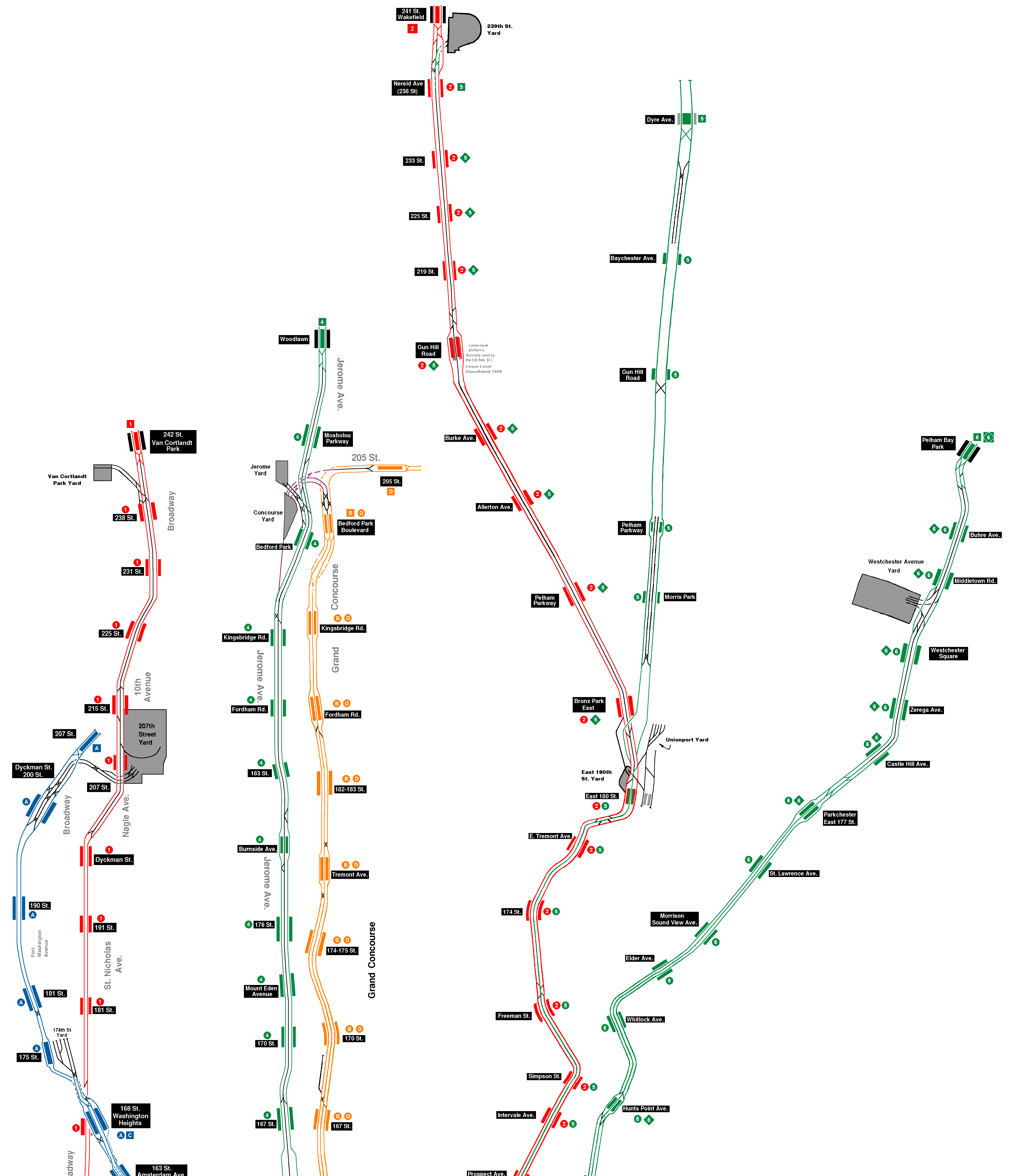
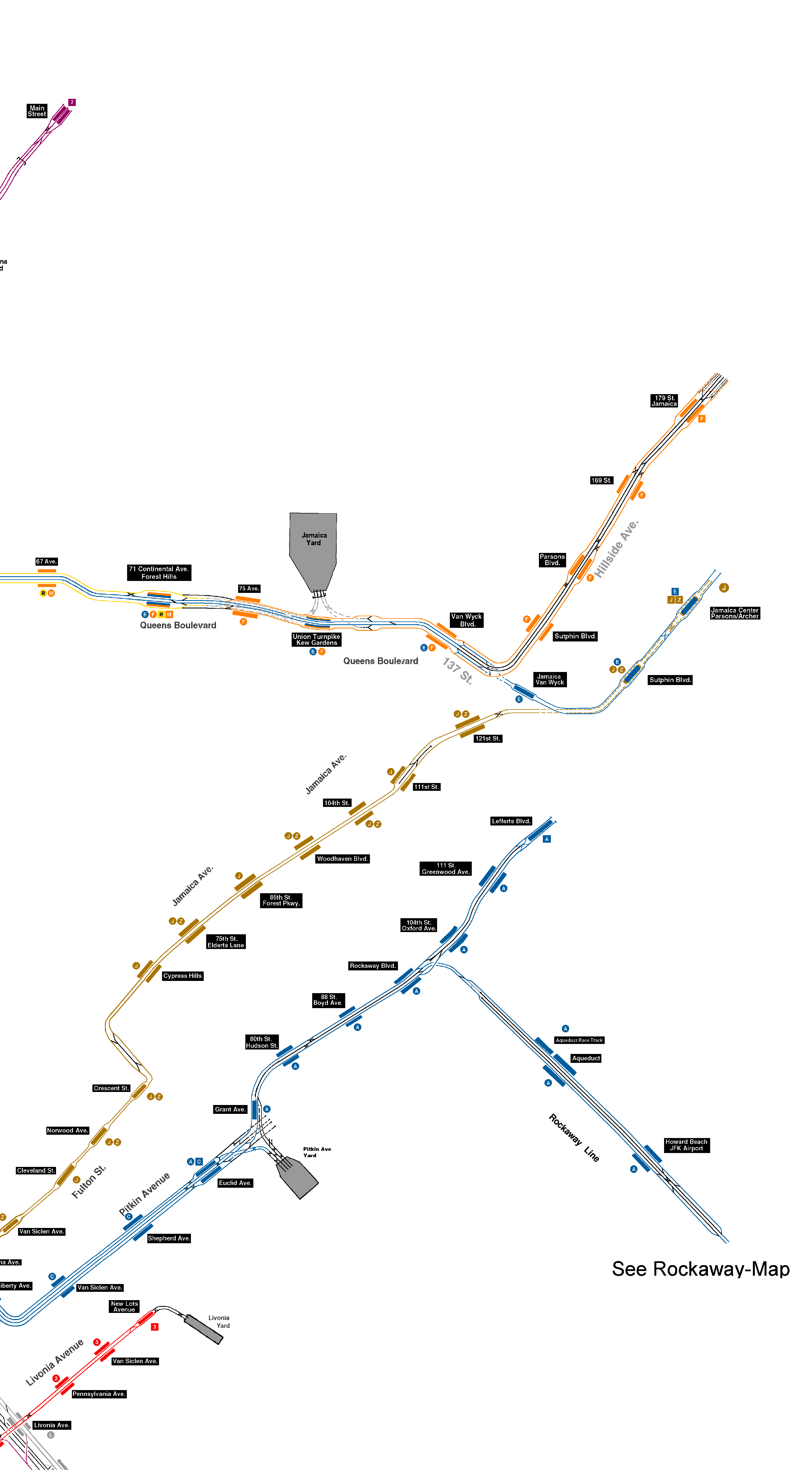
It’s a commonplace in New York that the New York City Subway is almost the only one that runs 24/7, and that the rest – PATH, PATCO, and two lines of the Chicago L – are small operations. The reason for this operating plan is that the main Manhattan trunklines have four tracks, making it feasible to shut down tracks for weekend and late-night maintenance and skip a few stations in one direction. Occasionally, even midday midweek service is disrupted. This leads to complaints from passengers who actually ride transit in the off-peak, as well as various politicians, and exhortations from political defenders of the MTA that it’s a necessary byproduct of 24/7 operation.
In fact, there’s one additional system not mentioned above: the Copenhagen Metro, which began 24/7 operation in 2009. Although around-the-clock operation on weekends is common in some European cities, such as Berlin, Copenhagen took the extra step to run 24/7 reliably. It has only two tracks, like some lines in New York, but made sure it would be possible to single-track at night for maintenance. Late-night headways in Copenhagen are 20 minutes, like in New York, and this gives enough time to reduce long segments to a single track and run wrong-way service. Copenhagen’s trains are automated and this helps with wrong-way signaling, but it’s not a prerequisite and wrong-way operation is already done late at night on the subway in New York.
What this means is that there’s a technical solution to the problem of late-night and weekend service disruptions: make sure that there are crossovers placed at regular intervals to allow 20-minute service on single track. Installing switches requires extra capital construction money, but is orders of magnitude cheaper than building extra tunnels, and would make late-night maintenance much easier. Headways are such that a switch would be required every 7 or 8 minutes, which means every 2.5-5 km. At some places, crossovers already exist at that density, for example at all four tunnels from Queens to Manhattan, and all that’s required is schedule modification.
The result would still not be as satisfactory as in Copenhagen, ironically because of the multi-track trunklines. Under the slow-fast-fast-slow system used in New York, as well as most other four-track lines, it’s impossible for a local train to cross over to the opposite track without fouling the express tracks. This would create serious problems even on the three-track lines in Queens and the Bronx, since extra switching moves would be required, shortening the acceptable crossover spacing. It would still be possible, say with crossovers 6-7 minutes apart, but the maintenance requirements would be higher.
On the four-track mainlines, I don’t see any solution that unequivocally improves on the status quo. It’s possible to have the same crossovers, but at even tighter spacing, and without any express traffic. Weekend express traffic could possibly still be retained, but not late-night express trains, and late-night frequency would be reduced to 20 minutes even on combined lines, for example the local 1/2 in Manhattan.
What this means for future trunklines is that, if four-tracking is required for capacity or for express service, it should not run as was built in New York a hundred years ago. Instead, the slow tracks should be in the middle, and the fast tracks on the outside; this allows more operational flexibility as well as short-turning local trains, at the cost of making it harder to build infill stations. While the subway short-turns some local trains, for example the C at 168th and at Euclid, this requires flying junctions, which contributed to the IND’s excessive cost.
Maximum flexibility could be obtained by building every station with two island platforms, as if it were an express station, and having express trains skip low-traffic stations. This way, two tracks could be shut down for maintenance along the entire line with no ill effect on reliability, except that retaining express service would required timed overtakes. The problem is of course the much higher cost of such a line, especially if it is underground.
For underground lines, there’s very rarely a reason to four-track. Washington may complain about lack of flexibility and express service, but modern subway lines with good rolling stock and wide curves can achieve acceptable average speed even with medium stop spacing. The Copenhagen Metro averages 40 km/h, a speed previously reserved for systems with very long (~1.6 km) interstations such as the Moscow Metro, even though its stop spacing is just 1 km. Capacity is the only serious drawback of two-track lines, but if it is so pressing then the city should built two separate two-track lines, which with tunnel boring machines cost about the same as one four-track line.
Is Technical Activism Necessary?
Since my post on technicals and politicals is getting some wider traction, with a discussion on Auckland Transport Blog, I should raise the question of whether technicals are even necessary. Recall that technicals are the transit activists who tend to mistrust transit authorities, especially when they claim a certain project or project component is required when it is unnecessary abroad or just very expensive. It’s a sort of activism that’s created by agency incompetence. I can imagine being technical about New York; I can’t imagine the same about Zurich.
Not knowing enough about the level of government competence in New Zealand, I can’t know how relevant what I’m going to say is to Auckland. Reading Auckland Transport Blog suggests that Auckland’s expansion projects are well-run, and the primary obstacle is political opposition by the National Party. In Auckland based on the impression I get from the blog, or in most major European cities (for example, Paris), the major divisions among transit advocates are either about pure politics (social services versus profitability) or value questions concerning how express lines should run or whether there should be more investment into buses or rail. Once the investment plan at each given level of funding is optimized, the question becomes how much funding to provide.
The political/technical division thus seems to be primarily North American and maybe Australian/New Zealander, certainly not European. In Europe, because the average quality of local projects is much higher, it is much easier to tell the bad projects apart.
Take Stuttgart 21, an expensive boondoggle that only looks good on a map. The need for massive takings and the high and escalating cost of the project led to massive protests, catapulting the Green Party to a state election victory for the first time in German history. But unlike unpopular rail projects in the US, the response was not to cancel all investment (the Green-SPD coalition wants to give more priority to rail investment and put it on equal footing with roads) but instead look for better solutions, hiring Swiss rail experts and coming up with an alternative plan. In other words, there was no difference between politicals and technicals.
In the US, such a response would be unthinkable. There’s no way for a mass movement to support transit investment in general but also oppose specific projects that are bad and promote more cost-effective alternatives. The Tea Party is heavily against all transit and urbanism, regardless of merit, and should not count. The opposition to Stuttgart 21 gathered in weekly protests by the tens of thousands; the opposition to ARC gathered in small rooms with about ten people in attendance.
Politicals vs. Technicals: the Primary Division of Transit Activists
There are two distinct streams among modern American transit activists, both of which support more transit investment but in ways so different that the arguments between them have taken over debates on such transit issues as California High-Speed Rail and New Jersey’s ARC, and led to scores of back-and-forths on transit blogs. It’s a wonky division rather than a culture war like the mode war between cars and transit, but it discusses issues that are critical for transit revival.
Lacking better terms for the two camps I’m going to call them politicals and technicals, but there’s a fair number of people on the political side who are quite technically minded, and vice versa. Politicals are the people who tend to trust the transit authorities, support a general expansion of all rail transit projects, and believe the primary problem is defeating oil-funded anti-transit lobbies. Technicals are the people who tend to distrust what the authorities say, and prefer their own analysis or that of technically-minded activists; they support transit but are skeptical about many projects, and treat agency inertia and turf wars as the primary obstacles for transit revival.
Because the politicals are much more likely to be rooted in activism, predominantly of the progressive kind, they are better-represented in the major transit advocacy organizations; Streetsblog, Transportation Alternatives, and Transportation for America all deal with the politics and almost never with the little regulations, except for various road engineering standards. NJ-ARP, the Institute for Rational Urban Mobility, and other ARC critics are perhaps the few organizations that focus on attacking bad transit projects and promoting better alternatives.
Concretely, the best was to understand this division is to compare Clem Tillier’s writings on timetables and train control with anything on California High-Speed Rail Blog or with Bruce McFarling’s Sunday Train series. While the major bloggers are politicals, the split is more even than among the major activist organizations. In addition to the aforementioned, the Infrastructurist‘s views tend to echo those of the agencies that support more infrastructure investment, and Second Avenue Sagas‘ Ben Kabak is a major-league fan of the MTA’s work today. On the technical side there are Systemic Failure, Clem Tillier’s Caltrain-HSR Compatibility, this blog, and increasingly even The Transport Politic on such issues as the Fairmount Line. Writing on other issues such as urbanism can avoid these battles, but it’s almost impossible to transcend them; the only people who can are those who represent well-run agencies, and on the Internet the only blog that has done that is Human Transit.
Despite the name, being technical does not mean ignoring politics, or supporting technocracy. On the contrary, the primary impetus for the technicals, mistrust of transit and government authorities, is often bundled with mistrust of engineering standards, and with preference for practices that have worked abroad (European commenters on American blogs almost invariably side with the technicals). The difference is that the political battle lines we draw are less about mode wars and more about the interests of agencies versus those of riders, how broader political ideas affect transit and cities, or just plain corruption and incompetence.
Conversely, being political does not mean ignoring everything other than the effort to get projects built. Although the politicals are less picky about what projects to support (Bruce McF once referred to the position that only true high-speed rail be funded, rather than medium-speed lines such as the since-canceled 110 mph Ohio Hub plan, as another form of HSR denialism), they often do care about alignment and regulatory choices. For example, opposition to security theater on trains is universal. The difference is that they subsume them into the main political fight, treating them as less important issues, or just believe that truly incompetent decisions such as airline-style security will not happen. Insofar as the government’s statements on train security send mixed signals, they may be right; on the other hand, the FRA’s self-reforms are half-baked.
Although transit activists of both groups tend to tilt left of center, the political distribution in the two camps is different. The politicals’ emphasis on being part of the progressive fight has attracted many down-the-line progressives, who write for Daily Kos and attend Netroots Nation. In contrast, the technicals’ emphasis on mistrust of authority has attracted both radical leftists and right-wingers: the complaints about train overstaffing and government incompetence appeal to conservatives and libertarians, while the unfavorable comparisons of the US with Europe appeal to anti-American leftists such as Richard Mlynarik (see e.g. here).
It’s important to note that the division is not as rigid as depicted so far. Although technicals tend to oppose more transit projects than politicals, some projects (for example, Second Avenue Subway) enjoy near-universal support, while others (for example, the Oakland Airport Connector) enjoy near-universal opposition. ARC is more or less split down the line in New York – politicals supported it, technicals preferred Alt G; in California, technicals universally opposed the choice of the Pacheco Pass alignment for HSR, while politicals had no opinion and prefer to stay the course. But apart from these two, projects often have a different split. Jeff Wood of Reconnecting America and The Overhead Wire, who has never mentioned the FRA or agency turf, opposes new commuter rail on account of its poor performance as well as some exurban rapid transit extensions. And Systemic Failure’s Drunk Engineer supported Florida HSR, and despite complaints about grandiosity and incompetence (“Diridon Intergalactic,” as San Jose’s overbuilt station is named after local power broker and former HSR board member Rod Diridon) Clem Tillier still seems to support California HSR.
Ultimately, the two camps are on the same side when it comes to supporting a transit revival. However, the strategies are diametrically opposed. Ask Clem Tillier or Systemic Failure’s Drunk Engineer how to do it and they’ll propose modernizing the regulations, minimizing community impact through smart engineering to reduce NIMBYism, and making sure to build the most cost-effective projects in order to appeal to fiscal conservatives. Ask a political, such as Bruce McF, and he’ll propose to build locally popular projects and spread money around until there’s a critical mass of train riders willing to lobby for more cost-effective regulations. The two camps’ goal is the same, and there can be agreement on individual issues such as the need for FRA reform or support or opposition for specific projects, but the general strategies have the opposite sequences of steps.
Why Transit Should be in the Fast Lane
Local buses tend to use the slow lane, which in North America means the rightmost lane; this is how they access the curb to pick up passengers. New York’s painted bus lanes on First and Second Avenues are to the right, with the buses slower than the cars both in perception and in actual practice.
Occasionally, transit uses the fast lane, especially if it’s BRT or a streetcar; for some of the access challenges of boarding not from the curb, see an old Human Transit thread on the subject. The issue of whether there should be sidewalk- or median-adjacent transit lanes came up in comments on Cap’n Transit’s blog. So let me explain why higher-grade transit than local buses, which means rail or BRT, should run in the median, with boarding from raised curbs either on the sides or in the center.
1. Service identity. This is probably the overarching concern, especially on the question of whether to have raised curbs or instead stop traffic in the slow lanes and have people cross to the bus from the sidewalk. ITDP’s magnum opus standards for full-fat BRT virtually take median running for granted, and only consider alternatives when the right-of-way is constrained. This is also mentioned as the highest grade of BRT in a conference paper examining BRT on city streets.
2. Fewer conflicts. Using pedestrian-friendly two-phase stoplights, it is impossible to eliminate turn conflicts, though in Delhi they found that median running (right lane in India) had fewer turn conflicts. In addition, it’s possible to eliminate conflicts with cars entering or exiting the parking lanes, as well as stopped cars left near the curbside lanes.
3. Median lanes are politically easier to physically separate, since separating them does not deprive cars of curbside access. If cars can physically violate transit lanes, they will, either accidentally or intentionally (my mother’s car’s GPS guidance routinely sends her along the tram-only lanes). As APTA mentions in its own standards for BRT,
One major advantage of a median busway is that there is typically no demand for other vehicles to stop in the center of the street for purposes such as parking or as a breakdown lane. As a result, there is a lot less reason for vehicles to want to occupy the center of the road and less resistance to creating a physical barrier separation between the busway and the adjacent general traffic lanes.
Point #3 is what killed the proposal for the 34th Street Transitway, which would have run two-way on one side of the street with one direction running contraflow. The NIMBYs on East 34th Street complained specifically about curbside access, using such language as “Delivery and service trucks… no longer have direct access to buildings and stores along stretches of 34th Street.” Most issues they raised involved curbside access or else bus noise adjacent to the street, both of which would have been solved by median lanes.
To add to what Steve Stofka is writing about grids, if I had to design a street from scratch, it would look a lot like a two-way version of a Manhattan avenue, with bus lanes in the middle. It would be 30 meters building to building, and about 20 curb to curb; this is enough space for two parking/loading lanes (2.5 meters) buffering pedestrians from moving traffic, two car travel lanes (3 meters), and two median bus lanes (3-3.5 meters), with room left for physical separation (measured in centimeters). Raised curbs for stations should add 3-4 meters, at the expense of either parking or sidewalk space once every few hundred meters; one advantage of trams, or buses with doors on both sides, is that they can use less space-consuming island stations.
Good Industry Practices Thread
In contrast to the mismanagement highlighted in the last few posts, there’s a set of best industry practices for good transit. Here is a list of what I believe are the most salient. As far as possible I’ve avoided contentious issues that well-run agencies disagree on. By its nature, the list is open, and you should feel free to comment with your own ideas of what’s more important.
1. Regions should organize regionwide transport associations (the German Verkehrsverbund) with integrated fares and schedules, even across political boundaries. One ticket should be valid on all trips, and transfers should be free even across different operators. Bus and rail schedules should coordinate to minimize transfer time; rail-rail transfers should be cross-platform when possible and timed when possible, even if frequency is high.
2. Schedules should be organized on simple clockface intervals (Takt): instead of complex timetables, the same pattern should repeat every half hour or hour, and should be compressible to a system map. Supplemental peak services should be integrated into the same takt, for example arriving at the half-points or maybe third-points if the peak is very prominent. Minimum off-peak frequency for regional branch lines is hourly; for commuter rail and anything else intended to serve as suburban transit, it’s half-hourly; for urban services, it’s 15 or at worst 20 minutes.
3. If express service is desired, it should be limited-stop and make stops at all major stations, rather than running very long nonstop segments. For a good example, go here and click on the interval timetable links. In addition, the express buses and trains should run on their own clockface schedule, and express trains should have timed transfers to maximize utility and overtakes to minimize the amount of four-tracking required. The practice on Metro-North and other legacy US railroads of having peak commuter trains make a small number of suburban stops and then run nonstop to the CBD should end; not everyone works in the CBD.
4. Boarding should be level. For regional rail, this means at least moderately high platforms are non-negotiable. For surface transit, this means low-floor equipment; high-floor BRT is a feature in Latin America, where it’s a lower-cost replacement for a subway, but in developed countries, the cost of paying so many bus drivers is such that BRT is a replacement for local buses and should be open with many curb stops in outlying areas.
5. All payment should be done on a proof-of-payment basis. Any vehicle, no matter how long, should have at most one employee on board, operating it. The fare should be enforced with random inspections; it pains me to have to say it, but the inspectors should never hold a bus during inspections. This should be done systemwide, even on local buses, as is normal in Paris, Singapore, and every German-speaking city; turnstiles are only worth it on extremely busy trains (nothing in the US outside New York) and maybe also legacy subways that already have them. To discourage fare dodging, there should be a large unlimited monthly discount, as well as unlimited 6-month or annual tickets, so that most riders will be prepaid; the unlimited monthly pass should cost about 30 times as much as a single ride even with multi-ride discounts.
6. Intermediate-grade surface transit – i.e. the BRT and light rail lines providing service quality higher than a local bus and lower than rapid transit – should run in dedicated lanes, except perhaps on outer branches. Bus lanes should be physically separated, and tram lanes could even be put in a grassy median. Except for special cases where one side of the street is much more important than the other, in which case one-way pairs may be defensible, those dedicated lanes should be in the median of a two-way street, when street width permits it, which it does everywhere in the US except the North End of Boston and Lower Manhattan.
7. Intermodal transfers should be painless. Commuter trains should run through from one side of the region to the other, to allow for efficient suburb-to-suburb travel, and the infrastructure should be upgraded to allow for such operations. It should be unthinkable to terminate transit short of its natural destination. Though transfers at the originating end are unavoidable, planners should still endeavor to place rapid transit stops at every walkable place the line intersects, and achieve adequate speed by running better rolling stock. (In contrast, bus stop spacing should be 400-500 meters, rather than 200-250 as is common in North America). Parking lot commuter stations should be rare; they impede reverse-peak traffic, are expensive to provide, and help ensure transit will be used only when there’s no alternative.
Any other important principles for transit, dear commenters?
Quick Note on Cities Where Transit Share is Increasing
In most large US cities, the transit mode share for commute trips is stagnant. If it’s increasing, it’s not by much – for example, Seattle is up from about 7% in the early 2000s to 8.7% in 2009. However, in Canada and Australia, there are multiple cities where the transit share has increased by 2-4 percentage points over the decade; all numbers are 1996-2006. Melbourne had the highest increase, from 13.1% to 17.7%. Car use declined by a little more than transit increased, at least in Canada. (Any information about similar increases or decreases in Europe and high-income East Asia will be appreciated.)
Even Melbourne’s performance is not going to be enough by itself to get car use to sustainable levels. Much more is needed: less distance traveled per car, less driving and more walking for non-work trips, and higher vehicle fuel economy, to name the three most important. But in four decades a city with Melbourne’s performance can raise transit use by 18 percentage points by 2050 and cut car use proportionately, and in conjunction with the other three points, it could make a serious dent in greenhouse gas emissions.
High-Speed Rail Operator Profit
I intended to write a post debunking the myth that high-speed lines do not pay for themselves, but Paulus Magnus has written one instead. He posts the revenue and net income figures for the mainland JRs, SNCF, DB, and RENFE. All but RENFE have positive net income, and even RENFE has positive EBIT.
The only thing I want to add is that there’s a myth going around that the Shinkansen isn’t really profitable because the government wiped its construction debt. While it’s true that the government wiped JNR’s debt, that debt was predominantly operating losses before restructuring; since JNR got few subsidies, it had to keep borrowing to cover its losses: see pages 46 and 88 on this PDF. Construction was only one eighth of the debt burden, and that part the JRs did have to pay. In other words, the government really just subsidize JNR’s operating losses from its inefficient pre-restructuring days.
Philadelphia Link, or Organization Before Concrete
Pedestrian Observations commenter Steve Stofka has a blog post treating Amtrak’s $117 billion high-speed rail proposal for the Northeast Corridor with all the criticism for extravagance it deserves. Focusing on his hometown of Philadelphia, he explains how Amtrak’s proposal for new urban tunnels under the city and a new stop at Market East is insane, and how using mostly existing rights-of-way and stopping at the existing 30th Street Station is a vastly cheaper alternative.
Criticizing Amtrak’s plan is like shooting fish in a barrel. The reason I’m linking to Steve’s post is that it underscores a general theme in transit cost overruns. He explains the reasoning behind Amtrak’s choice of new tunnels:
How expensive is freaking expensive? The kind of bore being proposed is the single most expensive type of tunnel possible: it runs through a soft geological environment with zero tolerance for surface subsidence. It would cost more, mile by mile, than even the Gotthard Base Tunnel. The expense of this tunnel is so great that it amounts to about a tenth of the total budget of the plan (about $10 billion, or a billion a mile, out of a budget of roughly a hundred billion). When a single budgetary item commands that much expense, one must analyze and ask why: why do we need to spend a ludicrous amount of money in Philadelphia for what amounts to marginal access improvements? Knowing SEPTA, politics–and SEPTA’s “get-off-my-lawn” attitude–is most likely to blame.
The relevant answer is the slogan Organisation vor Elektronik vor Beton: organization before electronics before concrete. Getting agencies to cooperate is hard on the managers, but cheap. Electronics, for example modern signaling to increase train capacity, costs more, but is affordable in a rich country. Concrete requires labor-intensive construction and is expensive.
The existing right-of-way in Philadelphia has no capacity constraint. It has four tracks, and a peak commuter rail frequency of six trains per hour. In contrast, the S-Bahn tunnel in Munich has two tracks and 24 30 trains per hour (thanks to ant6n for the correction); the above German link is concerned with cost overruns on a project to construct a second S-Bahn tunnel, currently estimated at half the per-km cost of the Philadelphia extravaganza. And Munich is far more advanced on organization than Philadelphia, where Amtrak and SEPTA have separate tickets, station staff, and schedules.
The same could be said about the LIRR/Amtrak grade separation. From a technical perspective, it is unnecessary. From a political one, it requires Amtrak trains to use the Penn Station’s lower concourse, currently monopolized by the LIRR; said concourse has better passenger flow and has station staff and ticket vending machines, but because of artificial separation into LIRR and Amtrak turf, New York State has to fork over $300 million for concrete.
Overperforming Rail Lines
Amtrak’s latest addition to the Northeast Corridor network, the once daily Lynchburg extension, is overperforming. Both Amtrak’s press release and local reporters brag that this train has overperformed ridership expectations by a factor of 2.5 and revenue expectations by a factor of 3. As a result, it has been consistently operationally profitable, in fact the only train to have this distinction other than the Acela.
The remarkable thing about it is that service levels aren’t high. The average speed south of Washington is mediocre, about 80 km/h. NARP talks about the importance of frequency; but the train is once daily, and is offset by only two hours from the Crescent, a long-distance train covering the same route. There were weak signs of pent-up demand on the Crescent – it sometimes sells out due to limited capacity, but even then it loses money like all other long-distance trains.
The best explanation for this success is that, although the route is slow, so are the competing highways. There are no Interstates that realistically compete with this train; I-81 is too far west. Google Maps gives a Washington-Lynchburg travel time of 3:32, versus 3:46 on the Regional and 3:30 on the Crescent. Add in traffic and the train can beat the car.
A more general point is that bad service that is failing could become more successful if it were improved. German regional trains that were closed due to low ridership when they ran just a few times per day are now flourishing after reopening on an hourly clockface schedule. And several Amtrak corridor runs improved their ridership and finances after more than daily or twice daily frequency was added; they just have to compete with faster roads, so they still lose money.
The next issue is then what other gaps there are in the Interstate network to be filled by trains. I’d say the biggest is Chicago-Kansas City, on which the Southwest Chief takes 7:11 and, since the only all-freeway route detours through St. Louis, driving takes 8:33. But this is a much longer distance, and the route is served by air. At shorter range, some other options I’m thinking of are Chicago-Fort Wayne and New York-Albany-Burlington. Any other suggestions?
Edit: for a similar view on frequency, see this rant, sourced to, I believe, the URPA. There are a lot of things in there that are just insane, but the point about financial performance improving with service levels is true. Too bad the implication is that those extra frequencies belong on long-distance rather than medium-distance trains. With the same equipment as just one extra long-distance run, Amtrak could run 4-5 times daily frequencies on an important corridor run.
 Pedestrian Observations