Category: Incompetence
Quick Note: Learning from the Past and the Present
There are two tendencies among Americans in the rail industry that, taken together, don’t really mesh. The first is to ignore knowledge produced outside North America, especially if it’s also outside the Anglosphere, on the grounds that the situations are too different and cannot be compared. The second is to dwell on the past and talk about how things could have been different and, therefore, to spend a lot of time looking at old proposals as a guideline.
The problem with this is that the past is a foreign country. They do things differently there. The world of the imagined past of modern-day Western romantics, usually placed in the 1950s or early 60s, is barely recognizable, economically or politically; Mad Men hits watchers on the head in its early seasons with how alien it is. The United States was an apartheid state until around 1964; France only decolonized Algeria in 1962; Germany had a deep state until the Spiegel affair of 1962 started to dismantle it and wouldn’t truly apologize for its WW2 crimes until the Kniefall and the fallout therefrom.
So as a public service, let’s look at some economic indicators comparing the US to the three low-construction cost countries that the Transit Costs Project is doing case studies about:
| Indicator | USA 2019 | Sweden 2019 | Italy 2019 | Turkey 2019 | USA 1960 |
| GDP per capita (2017 PPPs) | 62,631 | 52,851 | 42,708 | 28,197 | 19,444 |
| Female labor force participation, 15+ | 56.6% | 61.2% | 41.3% | 34.5% | 37.7% |
| Life expectancy at birth | 79 | 83 | 83 | 78 | 70 |
| Total fertility rate | 1.7 | 1.7 | 1.3 | 2.1 | 3.7 |
| Industry, % of jobs | 20 | 18 | 26 | 25 | 32 |
| Agriculture, % of jobs | 1.4 | 1.7 | 4 | 18 | 6 |
The US is comparable to Sweden on net – the higher GDP per capita is mostly an artifact of shorter vacation times. It is a considerably more developed country than Italy, by most accounts (except health care, where the US is more or less the worst in the developed world). Italy is a more developed country than Turkey. And Turkey, today, is considerably more developed than the US was in the imagined postwar golden age, even if it’s urbanizing later. The one indicator where they look similar, female LFP, masks the fact that the gender gap for employed women today isn’t especially high in Turkey and that, after a fall in female LFP in the late 20th century, today working outside the home is more middle-class, whereas in early postwar America it was considered a marker of poverty for a married woman to work.
So in that supposed golden age of an America before the Interstates, or when the Interstates were still in their infancy, GDP per capita was about comparable to Mexico today (and underinvestment in public transportation was comparable too; the Mexico City Metro’s expansion ground to a halt after AMLO was elected mayor). Women were only starting to emerge from the More Work for Mother era. Black people were subjected to literal apartheid. 65 was an old age to retire at (the majority of the increase in life expectancy at birth has occurred since age age 65 – it wasn’t mostly about declining child mortality).
Deindustrialization was nowhere on the horizon in 1960, which is a cause for celebration by people today who view industry as more moral than services. But the industrial jobs that are romanticized today were held by the era’s traditionalists to be morally inferior to the rapidly depleting farm jobs, and did not pay well until generations of wage increases brought about by unions. And Sweden, Italy, and Turkey are all deindustrializing rapidly; China today has a slightly lower manufacturing job share than the US had at its postwar peak, and elsewhere in the world than East Asia, there’s a serious issue of premature deindustrialization.
What about the law? Well, in 1960 the US had the same constitution as today, in theory, but the interpretative theories were completely different. The vast majority of the American constitution is unwritten (the word “filibuster” does not appear there) and there are vast differences in practice today and in the 1950s, when, again, members of the largest minority group risked being lynched if they tried voting in the states the majority of them lived. The party system at the time was extraordinarily loose; Julia Azari speaks of strong partisanship and weak parties today, but by postwar standards, both American parties are characterized by ideological uniformity and congressional command-and-control systems, even if the distribution of power within the parties is dramatically different from the European norm. Turkey might be comparable to postwar America – it’s hard to exactly say, since the two entities’ democratic systems are flawed in completely different ways. Italy and Sweden are not.
So the only thing that’s left is the romanticism. It’s the belief of 21st-century Americans that they could have ridden trains out of the old Penn Station, and worked in any of the prestige industries at the time, and done things differently. The constitution of the US today, its politics, its society, and its economy have little to do with their counterparts of 60+ years ago, but it’s useful for a lot of people to pretend that there’s continuity. It feels more stable this way. It just happens to be dangerously incorrect. Burn the past and look at the present.
The Solution to Failed Process isn’t More Process
The US Department of Transportation has an equity action plan, and it’s not good. It suffers from the same fundamental problem of American governance, especially at the federal level: everything is about process, nothing is about visible outcomes for the people who use public services. If anything, visible change is constantly deprecated, and direct interference in that direction is Not What We Do. Everything is a nudge, everything has to be invisible. When the state does act, it must do so in the direction of ever more layers of red tape, which at this point are for their own sake.
Case in point: a 12-page PDF with many graphics and charts manages to fit in two giant red flags, both with serious implications for how USDOT views its mission. They showcase a state that exists to obstruct and delay and shrugs off social and developmental goals alike. The action plan should be dismissed and replaced with an approach that aims to dissolve anti-developmental institutions and favor action over talk.
Contractors, or users?
Most of the document does not concern itself with how to be more equitable for the users of public transportation in the United States. It doesn’t talk about racial differences in commuting patterns – it says poor people spend more of their income on transportation (as is the case for other basic staples) but ignores the issue where 61% of American public transport commuters are racial or ethnic minorities in a country that’s 62% white.
What it does talk about is the needs of contractors. The US has special programs for disadvantaged business enterprises (DBEs). In contracting, this is called MWBE in New York – minority- and women-owned business enterprise. New York requires 20% of contract value to go to MWBE, and since construction is an oligopoly owned entirely by white men and there is no interest in breaking said oligopoly, everything goes through a web of subcontractors to satisfice the law while driving up costs for the end users; one source at the MTA quotes a 20% premium to me just from the subcontracting web caused by this and other special restrictions.
In anti-left American media, the black slumlord who complaints that it is racist to levy fines on him for violating building codes is somehow a sympathetic figure, in preference to the people with the misfortune of living in one of his 100 apartments. Similarly, when Americans speak about income mobility in their country, they center the origin stories of billionaires, most of whom grew up comfortably upper middle-class, rather than whether a working poor person has much hope to ascend to the middle class.
It’s the same with the focus on MWBE. MWBE are not socially relevant. There is no social or developmental purpose in creating a class of business owners shielded from competition – in this case, federal contractors – and then trying to diversify it. Most people are not business owners; most people work for someone else and to get to work they need to commute, and for women and minorities, this is disproportionately likely to be public transport. The path forward is a federal repeal of all MWBE laws and their replacement with preemption forbidding states to enact similar laws. Federal power should dissolve failed local arrangements, free from the need to kowtow to local power brokers who have limited power beyond the local level and none at the federal level.
Process for the sake of process
Community meetings in the United States are a failure. The action plan recognizes this problem, and even begins to understand why:
* Public meetings are a common public involvement strategy, but can be inconvenient or impossible to attend for some. Physical meeting locations may be inaccessible for some, including those with disabilities. Virtual public meetings are inaccessible for people without internet access or computer literacy.
* Various methods may be needed to allow people with diverse circumstances to have a voice in decisions that affect their community. Adaptive engagement strategies can be a resource-intensive but valuable endeavor that is responsive to specific community needs, including different language and cultural backgrounds.
Unfortunately, the solution wants to accrete more process for its own sake. There is no positive use for a community meeting; the defenders of the process in multiple American cities, when I challenged them on this point, could not name to me a single useful thing that came out of them. But the negatives are numerous, and not fixable through multilingual meetings:
- The times at which meetings are held tend to privilege people who can take time off during work hours – the same class of already overprivileged business owners, comfortable housewives, and retirees, to the exclusion of people who work for someone else.
- Community as a concept is exclusive; in Cultural Theory terms, egalitarian systems tend toward strong boundedness and this is inherently exclusive in ways that market- and state-based systems lack. Outsiders who attempt to attend community meetings report being verbally harassed for not looking like the typical attendee, for example if they are much younger.
- Community meeting dynamics favor loudness and adversarial agitation. Social media has the same problem, with a growing body of published work about the effect of online harassment on people, disproportionately people from disadvantaged background. Yelling is believed to get results, and the idea that the state should punish it to let other voices than that of the biggest blowhard be heard is treated as so ridiculous that in popular culture it’s put in the mouth of a junta member.
- Local community is not relevant to how most people live in metropolitan areas. In New York, only 8% of workers work in the same community board that they live in (and even same-borough commutes are only 39%); the other 92% and their dependents socialize in citywide networks rather than locally. And yet, community boards, representing those 8% with local ties, are taken as closest to the people.
- People with limited English proficiency need not just government services in the relevant language but also relevant information. For example, Chinese immigrants receive information out of Chinese networks, which are not especially local to one specific Chinatown, but are often pan-Chinese or pan-Chinese-American. With much thinner sourcing than is available in English, they can form opinions about the issues most in the news, which tend to be national, but not about local issues. This is something every intra-European immigrant gets very quickly – it’s easier to find someone who speaks the same language with opinions about Annalena Baerbock than someone who speaks the same language with opinions about Bettina Jarasch, let alone any borough-scale politician (I do not remember a single conversation within queer Berlin spaces about borough-scale politicians).
- Local knowledge, to the extent it even exists, is not important, but the community meeting foregrounds it. Long-timers insist on talking about the history of every parklet and mural and shop and not about jobs or rents or public services; the community meetings elevates their concerns above memorizing sports statistics or similar trivialities.
The community meeting as a source of knowledge for the state to use or as a source of informal or formal power is a social stain wherever it is tried, and the impacts disproportionately fall on women, the young, minorities, queers, and immigrants. And yet an equity action plan that understands at least some of the problems created by the process cannot bring itself to recommend its abolition in favor of top-down state action, informed by the academic research of ethnographers to create universal design standards. No: it is recommending even more process. Process cannot fail; it can only be failed. Fair outcomes are out; endless red tape with all talk and no action is in.
Quick Note: Regional Rail and the Massachusetts State Legislature
The Massachusetts state legislature is shrugging off commuter rail improvements, and in particular ignoring calls to spend some starter money on the Regional Rail plan. The state’s climate bill ignores public transportation, and an amendment proposing to include commuter rail electrification in the plan has been proposed but not yet included in the plan. Much of the dithering appears to be the fault of one politician: Will Brownsberger, who represents Watertown, Belmont, Back Bay, and parts of Brighton.
What is Regional Rail?
Regional Rail is a proposal by TransitMatters to modernize the MBTA commuter rail network to align it with the standards that have emerged in the last 50-60 years. The centerpiece of the plan is electrification of the entire network, starting from the already-wired Providence Line and the short, urban Fairmount Line and inner Eastern Line (Newburyport/Rockport Lines on timetables).
Based on comparable projects in peer countries, full electrification should cost $0.8-1.5 billion, and station upgrades to permit step-free access should cost on the order of $2 billion; rolling stock costs extra upfront but has half the lifecycle costs of diesels. An investment program on the order of high hundreds of millions or very low billions should be sufficient to wire the early-action lines as well as some more, such as the Worcester Line; one in the mid-single digit billions should be enough to wire everything, upgrade all stations, and procure modern trains.
Benefits include much faster trips (see trip planner here), lower operating and maintenance costs, higher reliability, and lower air and noise pollution and greenhouse gas emissions. For a city the size of Boston, benefits exceed costs by such a margin that in the developed world outside North America, it would have been fully wired generations ago, and today’s frontier of commuter rail electrification is sub-million metro areas like Trondheim, Aarhus, and Cardiff.
Who is Will Brownsberger?
Brownsberger is a Massachusetts state senator, currently serving as the Senate’s president pro tempore. His district is a mix of middle-class urban and middle-class inner-suburban; the great majority of his district would benefit from commuter rail modernization.
He has strong opinions on commuter rail, which are what someone unaware of any progress in the industry since roughly 1960 might think are the future. For example, here’s a blog post he wrote in 2019, saying that diesel engines are more reliable than electric trains because what if there’s a power outage (on American commuter rail systems that operate both kinds of vehicles, electric trains are about an order of magnitude more reliable), and ending up saying rail is an outdated 20th century concept and proposing small-scale autonomous vehicles running on the right-of-way instead. More recently, he’s told constituents that rail electrification with overhead wire is impossibly difficult and the only option is battery-electric trains.
Because he’s written about the subject, and because of his position in the State Senate and the party caucus, he’s treated as an authority on the subject. Hence, the legislature’s lack of interest in rail modernization. It’s likely that what he tells constituents is also what he tells other legislators, who follow his lead while focusing on their own personal interest, such as health policy, education policy, taxes, or any other item on the liberal policy menu.
Why is he like this?
I don’t know. It’s not some kind of nefarious interest against modernization, such as the trenchant opposition of New York suburbanites to any policy that would make commuter trains useful for city residents, who they look down on. Brownsberger’s district is fairly urban, and in particular Watertown and Belmont residents would benefit greatly from a system that runs frequently all day at 2020s speeds and not 1920s speeds. Brownsberger’s politics are pretty conventionally liberal and he is interested in sustainability.
More likely, it’s not-invented-here syndrome. American mainline passenger rail is stuck in the 1950s. Every innovation in the field since then has come from outside North America, and many have not been implemented in any country that speaks English as its primary language. Brownsberger lacks this knowledge; a lifetime in politics does not lend itself well to forming a deep web of transnational relationships that one can leverage for the required learning.
Without the benefit of around 60 years of accumulated knowledge of French, German, Swiss, Swedish, Dutch, Japanese, Korean, Austrian, Hungarian, Czech, Turkish, Italian, and Spanish commuter rail planning, any American plan would have to reinvent the wheel. Sometimes it happens to reinvent a wheel that is round and has spokes; more often, it invents a wheel with sharp corners or no place to even attach an axle.
When learning happens, it is so haphazard that it’s very easy to learn wrong or speculative things. Battery-electric trains are a good example of this. Europe is currently experimenting with battery-electric trains on low-traffic lines, where the fact that battery-electrics cost around double what conventional electric multiple units do is less important because traffic is that light. The technology is thus on the vendors’ mind and so when Americans ask, the vendors offer to sell what they’ve made. Boston is region of 8 million people running eight- and nine-car trains every 15 minutes at rush hour, where the places in Europe that experiment with battery tech run an hourly three-car train, but the without enough background in how urban commuter rail works in Europe, it’s easy for an American agency executive or politician to overlook this difference.
Is there a way forward?
Yes!
Here is a proposed amendment, numbered Amendment 13, by Senator Brendan Crighton. Crighton represents some of the suburbs to the northeast of Boston, including working-class Lynn and very posh Marblehead; with only four years in the State Senate and three in the Assembly, he’s not far up the food chain. But he proposed to require full electrification of the commuter rail network as part of the climate bill, on a loose schedule in which no new diesels may be procured after 2030, and lines would be electrified by 2028 (the above-named early action lines) to 2035 (the rest of the system). There are so far four cosponsors in addition to Crighton, and good transit activists in Massachusetts should push for more sponsorship so that Amendment 13 makes it into the climate package and passes.
No Federal Aid to Transit Operations, Please
This is the third in a series of four posts about the poor state of political transit advocacy in the United States, following posts about the Green Line Extension in metro Boston and free public transport proposals, to be followed by an Urban Institute report by Yonah Freemark.
In the United States, political transit activists in the last few years have set their eyes on direct federal aid for operating subsidies for public transport. Traditionally, this has not been allowed: federal aid goes to capital planning (including long-term maintenance), and only a small amount of money goes to operations, all in peripheral bus systems. Urban transit agencies had to operate out of fares and local and state money. Demands for federal aid grew during corona, where emergency aid to operations led to demands for permanent subsidies, and have accelerated more recently as corona recovery has flagged (New York’s subway ridership is only around 60% of pre-corona levels). But said demands remain a bad idea in the short and long terms.
In the early 20th century, when public transport was expected to support itself out of fares, operating costs grew with wages, but were tempered by improvements in efficiency. New York City Transit opened with ticket-takers at every subway entrances and a conductor for every two cars; within a generation this system was replaced with automatic turnstiles and one conductor per train. Kyle Kirschling’s thesis has good data on this, finding that by the 1930s, the system grew to about 16,000 annual car-miles (=26,000 car-km) per employee.
And then it has stagnated. Further increases in labor efficiency have not happened. Most American systems have eliminated conductors, often through a multi-decade process of attrition rather than letting redundant workers go, but New York retains them. The network today actually has somewhat less service per employee than in the 1930s, 14,000 car-miles as of 2010, because fixed costs are spread across a slightly smaller system. Compare this with JICA’s report for Mumbai Metro comparing Japanese cities: Tokyo Metro has 283,871,000 car-km (PDF-p. 254) on 8,474 employees (PDF-p. 9), which is 33,500/employee, and that’s without any automation and with only partially conductor-less operations; Yokohama gets 40,000.
Moreover, the timeline in the US matches the onset of subsidies, to some extent: state and local subsidies relieved efficiency pressure. In Canada, TTC saw this and lobbied against subsidies for its own operations in the 1960s, on the grounds that without a breakeven mandate, the unions would capture all surplus; it took until the 1970s for it to finally receive any operating subsidies.
Federal subsidies make all of this worse. They are other people’s money (OPM), so local agencies are likely to maximize them at the expense of good service; this is already what they do with capital money, lading projects with local demands for betterments figuring that if everyone else hogs the trough then they should as well.
Then there is the issue of wages. Seniority systems in American unionized labor create labor shortages even when pay is high, because of how they interact with scheduling and tiered wage structures. Bus drivers in Boston earn around $80,000 a year, a pay that German bus and train drivers can only dream of, but starting drivers are in probational status and have a lower wage (they are not even given full-time work until they put in a long period of part-time work). Moreover, because drivers pick their shifts in seniority order, drivers for about the first 10 years are stuck with the worst shifts: split shifts, graveyard shifts at inconsistent intervals, different garages to report to. New York manages to find enough bus drivers to fill its ranks but only by paying around $85,000 a year; other American cities, paying somewhat less, are seeing thousands of missed runs over the year because they can’t find drivers.
And outside aid does nothing to fix that. Quite to the contrary, it helps paper over these problems and perpetuates the labor gerontocracy. New York City Transit has learned to react to every crisis by demanding a new source of income; there is not enough political appetite for transparent taxation, so the city and state find ever more opaque sources of funds, avoiding political controversy over wanton inefficiency but creating more distortion than a broad income tax would.
Instead of subsidizing current consumption, a developmental state should subsidize production. Don’t pay money to hire more bus drivers; pay for automating subway systems, for better dispatching, for better planning around intermodal integration. Current American wages, not to mention the unemployment rate, scream “invest in labor-saving technology” and not “expand labor-intensive production.”
Free Public Transport: Why Now of All Times?
This is the second in a series of four posts about the poor state of political transit advocacy in the United States, following a post about the Green Line Extension in metro Boston, to be followed by the topics of operating aid and an Urban Institute report by Yonah Freemark.
There’s a push in various left-wing places to make public transportation free. It comes from various strands of governance, advocacy, and public transport, most of which are peripheral but all together add up to something. The US has been making some pushes recently: Boston made three buses fare-free as a pilot program, and California is proposing a three-month stimulus including free transit for that period and a subsidy for car owners. Germany is likewise subsidizing transport by both car and public transit. It’s economically the wrong choice for today’s economy of low unemployment, elevated inflation, and war, and it’s especially troubling when public transport advocates seize upon it as their main issue, in lieu of long-term investments into production of transit rather than its consumption.
Who’s for free public transit?
Historically, public transit was expected to be profitable, even when it was publicly-run. State-owned railroads predate the modern welfare state, and it was normal for them to not just break even but, in the case of Prussia, return profits to the state in preference to broad-based taxes. This changed as operating costs mounted in the middle of the 20th century and competition with cars reduced patronage. The pattern differs by country, and in some places (namely, rich Asia), urban rail remained breakeven or profitable, but stiff competition bit into ridership even in Japan. The norm in most of the West has been subsidies, usually at the local or regional level.
As subsidies were normalized, some proposed to go ahead and make public transport completely free. In the American civil rights movement, this included Ted Kheel, a backer of free public transit advocates like the activist Charles Komanoff and the academic Mark Delucchi. Reasons for free transit have included social equality (since it acts as a poll tax on commuters) and environmental benefits (since it competes with cars).
Anne Hidalgo has attempted and so far failed to find the money for free public transport in Paris, and other parts of Europe have settled for deep discounts in lieu of going fully fareless: Vienna charges 365€ for an annual pass (Berlin, which breaks even on the U-Bahn as far as I can tell, does so charging 86€/month).
In the United States, free transit has recently become a rallying cry for DSA, where it crowds out any discussion of improvement in the quality of service. Building new rail lines is the domain of wonks and neoliberals; socialists call for making things free, in analogy with their call for free universal health care. Boston has gotten in on the act, with conventional progressive (as opposed to DSA) mayor Michelle Wu campaigning on free buses within the municipality and getting the state-run MBTA to pilot free buses on three routes in low-income neighborhoods.
What’s wrong with free transit?
It costs money.
More precisely, it costs money that could be spent on other things. In Ile-de-France, as of 2018, fare revenues including employer benefits amounted to 4 billion euros, out of a total budget of 10.5 billion. The region can zero out this revenue, but on the same budget it can expand the Métro network by around 20-25 km a year – and the Métro is as far as I can tell profitable, subsidies going to suburban RER tails and buses. For that matter, the heavy subsidies to the suburbs, which pay the same cheap monthly rate as the city, could be replaced with investment in more and better lines.
The experiments with actually-free transit so far are in places with very weak revenues, like Estonia. Some American cities like it in context where public transport is only used by the desperate and no attempt is made at making service attractive to anyone else. Boston is unique in trying it in a context with higher fare revenue – but the buses are rail feeders, so the early pilot piggybacks on this and spends relatively little money in lost revenue, ignoring the long-term costs of breaking the (limited) fare integration between the buses and the subway.
What’s wrong with free transit now?
Free transit as deployed in the California proposal is in effect a stimulus project: the government gives people money in various ways. Germany is doing something similar, in a package including 9€ monthly tickets, a 0.30€ fuel tax cut, and a cut in energy taxes.
In Germany, unemployment right now is 2.9% and core inflation (without food and energy) is 3%. This is a country that spent a decade thinking going over 2% was immoral, and now the party that considers itself the most budget hawkish is cutting fuel taxes, in a time of conflict with an oil and gas exporter and a rise in military spending.
In the United States, unemployment is low as well, and inflation is high, 6.4%. This is not the time for stimulus or investments in consumption. It’s time for investments in production and suppression of consumption. So what gives?
The Green Line Extension
This is what I hope to be the first in a series of four posts about the poor state of political transit advocacy in the United States, to be followed by posts about free transit, operating aid, and an Urban Institute report by Yonah Freemark.
The Green Line Extension in Boston opened on Monday. Or, at least, the Union Square branch did; the main line to Tufts is expected to open in a few months. I rode it with Marco Chitti in the afternoon, a few hours after the formal opening ceremony. It was incomplete, with some access points not yet open, and the station fare barriers not yet functional (ticket receipts are checked by staff). There were many railfans on the platforms taking photos, and we accidentally let the first arriving train go because of a misunderstanding over whether it was in service; at least during the first day, it was not yet intended for a general audience.
Bostonians seem to view the extension as a great success. The media’s tone is celebratory. I no longer remember what local New York media said when Second Avenue Subway opened at the beginning of 2017, but I think it was more sober, more reflective of its high costs (I was getting a lot of followers on Twitter, but I tweeted that I was looking for work in the field around that day and got a lot of boosts over that). Within a year of SAS’s opening, Brian Rosenthal’s article appeared, detailing the mess that led to the line’s $1.7 billion/km cost. And as far as I can tell, there’s no comparable look at GLX in Boston.
This is not for lack of material. The Transit Costs Project began as a case study of how GLX got so expensive – it cost $2.2 billion not including rolling stock for a total length of 7.6 km. For a subway, it’s somewhat above global average. But it’s a light rail line with a short elevated segment and the rest in existing commuter rail trenched rights-of-way.
The line isn’t even especially good for the cost. It’s still incomplete. The fare payment is especially messy. The CharlieCard system used in Boston is a legacy mid-2000s system, which the MBTA wants to replace with something called AFC 2.0 (Charlie being AFC 1.0); it gave the contract to American transit agencies’ favorite military contractor, Cubic, which recently said it’s going to have a multi-year delay because it’s prioritizing New York’s Omny contract, and there’s nothing Massachusetts can do about it. When GLX value-engineered the stations, it was expected AFC 2.0 would be done by now, so there was no need for AFC 1.0-compatible fare barriers. It isn’t, so station staff stand in front of the platform directing passengers to tap their cards to get paper receipts. Going fareless at just this station for a short period is looked down on because it’s in a rich neighborhood and it may be discriminatory.
And as far as I can tell, nobody in Boston is asking “how can we make sure it will never happen again?”. The criticism I see in the media is about gentrification; Union Square has been gentrified for at least 10 years, but local politicians like Ayanna Pressley are using the line as an opportunity to make social criticism and impose even more political restrictions, so that future lines will be even kludgier and more expensive.
The MBTA is not always like this. Small projects do not have a large cost premium in Boston. Commuter rail infill stations, designed in-house, have a cost premium over Berlin in the 1.5x area. But the MBTA lacks in-house capacity to manage larger projects; GLX is beyond its capacity, so the original project was stuck and ballooned to $3 billion, and Governor Charlie Baker restarted it as a special-purpose vehicle, rather like Crossrail, with an externally-hired project manager in John Dalton. This mirrors the other transit megaproject in the region, South Coast Rail, currently clocking around $3.4 billion for 77 km of commuter rail in existing rights-of-way, a cost in line with German greenfield high-speed rail with considerable tunneling. No in-house hires were made, and now it seems that Dalton will be let go to take his experience elsewhere; the next MBTA megaproject will start from zero.
And as far as I can tell, nobody is pointing out this pattern. Baker and his political appointees are certain that their method works, because they are ignorant of global best practices. They are not exposed to ideas outside the US, except maybe in the most globalized parts of Britain and other high-cost English-speaking countries; a European who speaks to them like a typical European does – that is, without any pretension that Americans are better people – will just never get through.
In fact, they are failures. Not Dalton, who made the project better (but who is still unemployable anywhere with low costs; Milan Metro has its own in-house team, thank you very much). But Baker, who led the privatization of the state as budget director in the Weld era 30 years ago, must be viewed as the primary villain. His secretary of transportation for much of this period, Stephanie Pollack, must be viewed in a similar way: she does not believe it is possible to compare different projects, perhaps because the ones she is involved with are deficient. People should point at them and laugh on the street and perhaps yell at them for wasting government money with their failed ideology.
The second villain, after the state capacity destroyer that is Baker, consists of Governor Deval Patrick, who let the project balloon. He did not rebuild state capacity; he instead instructed the MBTA to accept the demands of every community that wanted something – in this case, Somerville and its demand for premium-cost bike paths (“Somerville Community Path”) and oversize stations. Pressley is an heir to this tradition; unless she changes her tune, it will be best for infrastructure if she is ignored, or better yet defeated for reelection.
Right now, I do not see any political group in the Boston area that is interested in making things better. High costs to them are just “it’s our turn to hog the trough.” This has implications for federal funding: the feds should choke funding to the region if it stays like this.
The G Train
The G train is bad. I say this, 16 years after I moved to New York, 11 years after I left, and I know it’s what every New Yorker knows. Tourists walk too slowly, rent is too high for small apartments, and the G train sucks. What I want to highlight in this post is how the subway’s scheduling paradigm is especially bad for the G train and leads to a vicious cycle making the train less frequent and less useful for passengers.
The role of the G train
The G train is the only mainline subway service in New York that does not enter Manhattan; see map here. It connects what are now the region’s two largest non-Manhattan business centers, Long Island City and Downtown Brooklyn, running vaguely parallel to the East River on the Queens and Brooklyn side of it. To the south of Downtown Brooklyn, it has a tail serving the wealthy neighborhoods collectively called South Brooklyn, such as Carroll Gardens and Park Slope.
I’ve criticized the G before for its poor construction. It misses critical transfers, like the other lines built in the IND program in the 1920s-30s. In Queens it misses Queensboro Plaza and the transfer to the N/W trains on the Astoria Line, and in Brooklyn it misses every single non-IND line except the L (and, at a suboptimal location, the R). This already makes it less useful as a circumferential line – such lines live on convenient transfers to radial lines, because direct O&D service is less valuable to secondary destinations than to primary ones.
But what I realized last week, commuting from Long Island City to Downtown Brooklyn, is more delicate. My hotel was near Queensboro Plaza, which the G doesn’t serve, but the station is served by the 7, which connects to the G one stop away at Court Square; Marron’s new office is in Downtown Brooklyn right on top of the Jay Street station, on the IND-built A/C and F trains, which is either a cross-platform connection or a short walk from the G. So for my trip, the connections worked. And yet, I was regularly facing 10-minute waits on the shoulders of rush hour, and on the subway countdown clock I saw a 15-minute gap.
To explain what went so wrong that the G should have such low frequency at 10 in the morning, it’s necessary to explain how New York City Transit decides the frequency of each service during each time of day.
New York City Subway frequency
In New York, the system for deciding the frequency of each subway service at each time of day is based on average peak crowding. This means that for all trains using the service in a given time period, the crowding level at the peak crowding point of the journey is averaged; frequency is adjusted so that off-peak the peak crowding level is 125% of seated capacity, and at rush hour it is based on published standing capacity per car that works out to about 300% of seated capacity depending on car design.
This system is done per numbered or lettered service. Thus, for example, the 2 and 3 trains run on the same track most of the way, but where they diverge, the 2 is considerably busier, and therefore the 2 runs slightly higher frequency (most ridership on the 2 and 3 is on the shared segment, not the tails). As a result, on the shared trunk, there cannot be perfect alternation of 2 and 3 trains; a few times an hour, a 2 train is followed by another 2 train, which means that on the tail, the frequency is uneven. When two 2 trains follow each other with no 3 between them, the leading 2 train is more crowded than the trailing one; this variation is averaged out in the guidelines – it is not the busiest train that sets the frequency guidelines.
These guidelines are not a good way to timetable trains. The above example of how it can create uneven crowding on the 2 is one problem with this system; if instead there were regular alternation of 2 and 3 trains then the 2 would be persistently slightly more crowded than the 3, just as today there is uneven crowding whenever two 2 trains run with no 3 in between, but the frequency on both the shared trunk and the branches would be more regular. This is especially important on more complexly interlined parts of the network, where the current system leads to large programmed gaps between trains occasionally.
The G is not very heavily interlined; the issue there relates to another criticism of the guidelines, which is that they assume travel demand is fixed. If the ridership on a train is independent of frequency, which it is if the headway between trains is very short compared to the trip time (say, if the trains run every 2-3 minutes), then the sole purpose of service is to provide the capacity the passengers need, and so the guidelines make sense as a way of rationing service convenience. However, in reality, the elasticity of ridership with respect to service provision is not zero. Three years ago I did some analysis of New York’s situation and the existing literature on ridership-frequency elasticity, suggesting it is equal to about 0.4. So the low frequency of the G deters ridership, which then appears to justify the low frequency.
But 0.4 < 1. And I believe that there are two reasons why on the G, and on circumferential lines in general, the elasticity of ridership with respect to frequency should be higher.
Trip length
Circumferential lines in general tend to have shorter average trip time. Between two nearby spokes, say between Downtown Brooklyn and Williamsburg, they are the only real option; between two farther away ones, a direct radial may be an alternative.
The G is different from (say) the Ringbahn in that it misses most transfers, but this should not impact this pattern too much. The missed transfers in Downtown Brooklyn weaken the G for short as well as long trips involving a connection there. In contrast, in the middle the G does make the most important transfer, that with the L, and only misses the weaker J/M/Z.
The 0.4 estimate for ridership elasticity with respect to frequency assumes average behavior for trip length. But if trips are shorter, then the impact of frequency is larger. The 0.4 estimate comes out of an estimate of about -0.8 of ridership with respect to generalized trip time, which includes in-vehicle time, walk time, and wait time, the latter two given extra weight to account for transfer penalty. If one of the three components of trip times is shortened, the other two grow in importance.
The role of options
The G is not usually passengers’ only choice for making the trip. They can connect in Manhattan, or, in some cases, go directly via Manhattan, for example taking the N or R from Downtown Brooklyn to Queens (in the opposite direction, they serve separate station so it’s a harder choice, leading to asymmetric demand). Going between Marron and the East Village, Eric Goldwyn could connect to the L via the A/C/F or the G; I never once saw him use the G, only the lines via Manhattan.
I have not seen the impact of different transit paths on demand elasticity in the literature. It is likely that the elasticity in such case must be higher, because it is standard in economics that demand is more elastic for goods sold on a competitive market than by a monopolist.
Note also that it is to the overall system’s benefit to convince passengers to switch from radial lines to the G. The G is less crowded, so such a switch distributes ridership better on the system. And the G starts out much less frequent, so that even on a fixed operating budget, the impact of a service increase on the G on ridership is larger than on an already frequent trunk.
Leapfrogging
Eric Stoothoff is the chief engineer of the MBTA. Last month, he offered the following excuse for why the MBTA just deelectrified the trolleybuses in Cambridge, replacing them with diesel buses and hoping in a few years to obtain battery-electric buses (BEBs):
We want to leapfrog Europe, not play catch-up. If BEBs are the future, why not have the future now?
https://twitter.com/mbtaroc/status/1493768313154904073
Unfortunately for Stoothoff, BEB technology still does not work in freezing temperatures. The current state of it is buses that have diesel heaters – otherwise the battery drains too fast in winter, as it did three years ago when I reported it for CityLab.
The actual cutting edge of electric bus technology is in-motion charging (IMC), in which the bus spends part of the route under wire and then part under battery, with an off-wire range of about 10 km. IMC is especially valuable for Boston, which is unusual for an American city in having an unplanned street network in which the same trunk road splits into several farther out, and then the trunk can be wired. Cambridge’s now-defunct trolleybus network had a short trunk, but could still be an attractive IMC target. In Boston proper, Washington Street is a valuable trunk for wire, with routes splitting off-wire to destinations in Dorchester and Mattapan farther south.
Stoothoff seems unaware of this, because he is an insular, ignorant, incurious manager. He uses leapfrogging as an excuse not to learn. Other American agencies buy BEBs, and then find that they don’t work in winter without diesel heaters, and instead of seeing what Europe does, he talks of leapfrogging.
Leapfrogging means something completely different. It means skipping an intermediate tech that has been obsoleted by newer tech. A classic example of leapfrogging is China’s phone network: by the time China developed enough for mass use of phones, in the 2000s, cellular phones were ubiquitous and mature enough that China skipped wired phones entirely, and did not have to spend money on building phone cable infrastructure in rural areas. More recently, mobile payments are connecting rural areas in Africa between the Sahara and the Kalahari to banking without the need for physical branches.
On the level of infrastructure, it makes sense: there is no need to invest in intermediate technology if something better is available. In the realm of rail, there are a lot of technological dead-ends that nobody needs to develop anymore – superseded electrification standards, experimental jet- or nuclear-powered trains, obsolete track geometry standards, etc. Train stations today are designed differently from in the steam era: the train is not noxious to be nearby, so the train shed is integrated into the passenger concourse, and train turn times are short, permitting much smaller station footprints even in major cities.
But on the level of knowledge, it’s daft. Leapfrogging requires knowing what the cutting edge is. Chinese development experts know exactly what technology is used in developed countries and what they should imitate and what they can bypass. The PLA began its modernization process in 1991 after Desert Storm and only began innovating rather than implementing NATO standards a few years ago. African development experts are generally aware of trends in rich countries as well.
This knowledge is especially important in public transportation, because many legacy cities had higher ridership before WW2 than they do today and there’s a lot of nostalgia for that era. Understanding why the modern train station can be compact and platform-centric, without a waiting concourse and space for a telegraph operator and baggage handlers, is crucial in limiting the construction costs of stations on new lines. Without such understanding, it’s easy to imitate historic stations; even in Europe, where trains are integrated into train sheds without the separate waiting halls characteristic of North America, most major-city stations are historic and very big, because they’re inherited from when they needed to be and the land was at the edge of the city and therefore cheaper.
But what one does not do is tear up legacy infrastructure that is still useful. Europe’s great train terminals are almost all oversize, but there’s no point in blowing them up and shrinking them just because it’s more modern. Urban renewal projects at train stations are common, but they replace goods yards that left the cities alongside industry, not passenger circulation. And at least shrinking station footprints has redevelopment value in major city centers; deelectrifying trolleybuses has no such value.
So under no circumstances should cities with existing trolleys remove the tail electrification for IMC. This is not what IMC-using cities do – they use IMC to expand the network rather than shrink it. It may be too late for Boston, but San Francisco, Seattle, and Vancouver should keep what they have.
And it’s even worse, because Stoothoff wasn’t justifying deelectrifying on the way to the future. No: he misstated what the future is. His incuriosity is such that he assumes BEBs are the future, from a position of interacting with American agencies that think the same and find fixed wire infrastructure too hard. Peripheries that engage in leapfrogging are voracious consumer of the metropole’s learning in order to apply it to their own circumstances, but Stoothoff cannot even bring himself to admit that the United States is a periphery and needs to absorb this knowledge.
A better MBTA is one in which Stoothoff is replaced with a more competent chief engineer, perhaps hired from abroad. But it’s not just him. He’s a removable obstacle to progress, but there are many like him – many managers who assume the future is one thing when it’s the other, and use their wrong beliefs to justify not imitating best practices. They have an assortment of excuses, and misstating what technological leapfrogging is is among them.
Why is Princeton Trying to Downgrade the Dinky?
Regular users of the Northeast Corridor in New Jersey know that there is a short branch off the line serving Princeton. Mainline trains do not use it – they continue between New York and Trenton – but a two-car shuttle, affectionately called the Dinky, connects the city with the train station. Historically, this is because the Northeast Corridor in New Jersey is a then-high-speed rail cutoff from 1863, which cut off Princeton from the old line. Trains run back and forth, with timed connections between New York (but not Trenton) and Princeton.
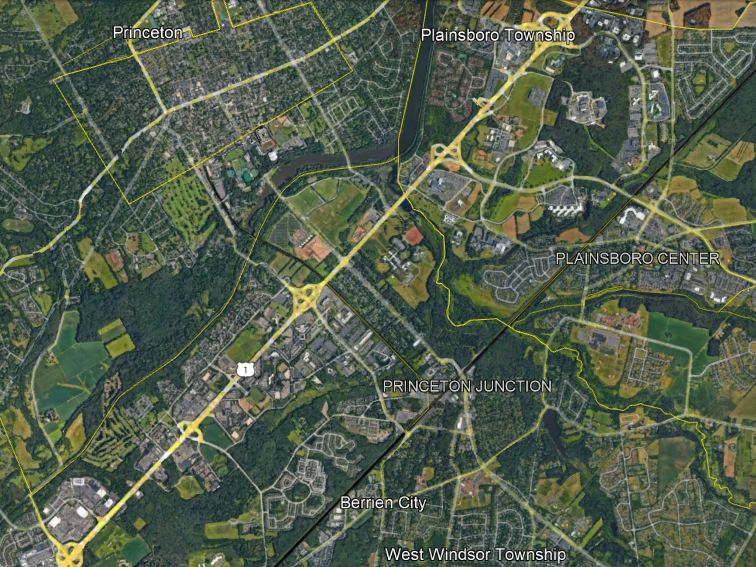
The Princeton stop on the Dinky, as can be seen in the satellite image, lies just outside the historic municipal limits of Princeton (since merged with the surrounding township). It serves the university fairly well, but is 800 meters at closest approach to the town’s main street, Nassau Street. So there has been a study for what to do to improve city access, in which a tram-train option was studied, looked good, and was dropped anyway. There are two options left: status quo, and a downgrade of the right-of-way to light rail with buses using the same corridor.
Unfortunately, transit advocates I respect, like Sandy Johnston, think the downgrade is an upgrade. So let me explain why in fact the light rail and bus option is inferior to current commuter rail operations.
The current use of the Dinky is as a connector to the Northeast Corridor. There is approximately nothing else at Princeton Junction: it’s one of the two busiest suburban stations in New Jersey, but like the other top station, Metropark, it’s a park-and-ride, designed exclusively for car-train interface. People who ride the Dinky do so to get to New York.
This means that the timed transfer with the mainline trains is critical. Frequency on the Dinky is irrelevant: all ridership from Princeton Junction into the town is going to be on the first train or bus after the mainline trains arrive, and almost all ridership to the junction is going to be on the last train that makes the connection. While frequency is not important except insofar as it matches that of the mainline, on-train capacity is important. My 2015 recollection is that off-peak ridership on the Dinky is maybe enough to fill an articulated bus (which New Jersey Transit only runs in Newark), maybe enough for a standard bus, depending on time of day – standees are likely, and standing on a bus is an awful passenger experience. At rush hour, the Dinky runs three-car trains (update 2022-2-18: no, it’s two-car trains) and they’re full.
The timed transfer is so important that the discussion of how to improve service must center how to make the transfer more efficient. The ideal improvement should be to regularize the timetable on the mainline commuter trains, and ensure that trains in opposite directions serve Princeton Junction around the same time (this is called a knot) so that the Dinky can connect to Trenton too, and even to Philadelphia with another timed transfer at Trenton or even through-service if that fits the New Jersey Transit and SEPTA schedules.
Sandy points out to me that while the Dinky only connects Princeton with the mainline, the right-of-way of the Dinky can serve more destinations – namely, the Route 1 job cluster, visible on the map as a line of office parks.
However, bus service from town to Route 1 is unlikely to succeed. It’s going to struggle to run sufficient frequency for what it needs, even as lower-frequency rail is sufficient for the Dinky’s current role:
- Route 1 is not on the way between town and the station – there would have to be separate buses to Route 1 from the service to the train station (which I presume will stay on rail even if the downgrade is picked). This means there’s no bundling of destinations – the buses to Route 1 have to live off of Princeton-Route 1 trips.
- Route 1 is a freeway with destinations located somewhat away, at automobile scale. Buses can stop on the side of the road but the walk is not great on the same side of the road and hostile and unsafe if crossing the road is required. A more pleasant experience is only possible if buses turn onto side roads, splitting frequency or increasing trip times.
- Route 1 is not a large job center. OnTheMap says that between the route of the Dinky and the junction with I-295 beyond the above satellite image, which ends at Quakerbridge Road, there are 21,000 jobs. The origins of those jobs are dispersed – only 5,000 come from within the county, and only 368 come from within Princeton.
- Conversely, the short distance traveled means that high frequency is crucial. A one-way trip from the townhouses just north of Nassau Street to the center of the Route 1 cluster along the right-of-way of the Dinky is 5.5 km, which at BRT and freeway speed is around 10 minutes one-way; a bus running less than once every 10 minutes might as well not run – but there is no chance for such a bus to fill at current demand.
Of course, the analysis of Route 1 assumes current development patterns stay with no or moderate change. A bigger change, such as greater development along Route 1 with sprawl repair, can make this option pencil out; O&D volumes need to rise by a factor of 3 assuming 100% transit modal split, or more if modal split is lower (which it invariably is, Route 1 is not Manhattan).
But then that raises the question – why engage in development in sprawl around a plan to downgrade a rail service?
If sprawl repair is plausible, then make Princeton more bikable and then set up bike lanes on Route 1 so that people can cycle to Route 1 jobs. The same bike lanes can also connect to the Dinky, with bike parking at the station, or even potentially at Princeton Junction if it’s faster to bike those 4 km than to ride a train and transfer. In the long run, all buses are going to have to be replaced by bikes anyway – bus operating costs are only going to go up.
And if redevelopment is plausible, look again at the satellite image and see what the land use at the existing train stations is like. Princeton is one of the most expensive places in the United States, and the Dinky station has a golf course on one side; that’s 0.5 km^2 of land, or, as I prefer to think of it, 50,000 housing units. Another 0.05 km^2 consists of parking lots right near the station, and can and should be redeveloped as a town center extension for a population that can swamp the existing town population by a factor of 4. The parking lots at Princeton Junction and the undeveloped land between them are another 0.4 km^2 of prime real estate.
In general, I cannot think of any railway where service would be improved by a downgrade from mainline rail to bus. But the Dinky has specific issues making such a downgrade especially deleterious for current users, namely the need for a timed connection, while the proposed source of new trips, namely Route 1, is too weak to be worth much. Thankfully, a no-build option keeping the status quo is still under consideration, and I hope that the region chooses it and invests in making the Dinky better rather than in replacing it.
Quick Note: California Gets Electrification Wrong
Caltrans has a new plan to make its intercity rail fleet zero-emission. The snag: it rejects electrification as infeasible and is instead looking for hydrogen fuel cell trains. I do not think any of the people who were involved in this study is competent enough to keep working in this field, and it’s important to explain why.
I refer readers to the electrification report we at TransitMatters put out a few months ago. It talks about the costs and benefits of overhead wire, and goes over some case studies of some electrification projects, some good (Trondheim), some okay (Israel, Denmark), and some examples of what not to do (Caltrain, Toronto). Since then I’ve seen additional data of electrification costs out of Italy, where they’re near the bottom of our range.
Our report also goes into alternatives to wire and why they’re infeasible. Hydrogen is not even remotely close. The largest order as of 2019 was 27 trains for the Rhine-Main region, each 54 meters long, for 500M€, or around 343,000€ per linear meter; single-level EMUs typically cost around 80,000€/m in Europe. It’s infant technology with wanting performance and its cost is not worth it compared with the cost of wiring the trains.
Instead, Caltrans thinks that overhead wires are infeasible. It does not publish cost estimates; those estimates would be based on the failure of Caltrain and not on successes in non-English-speaking countries (or even in Britain, with high but not fire-everyone costs), because nobody at Caltrans who has any authority knows or cares.
To make it worse, Caltrans says electrification “has right-of-way implications.” In other words, it requires space for poles and this is supposed to be difficult. In reality, it isn’t. A short distance from the tracks is needed for poles, but the rights-of-way in the state are not especially constrained; Caltrain, in a fairly dense suburban area, did not have that problem, but rather had problems with the execution of the design and with unusual standards for pole placement.
It’s a perennial problem in the United States that rail managers and agency heads are allergic to electrification. It’s a foreign concept, literally. They don’t travel – when they do they think of it as a vacation, not as work to see how countries with an order of magnitude more rail ridership per capita do it. None of the people they know knows, either. Nor are they technically apt or curious – they come from a managerial culture in which speaking of technical details is low-prestige, and making excuses and talking about politics are high-prestige. Fresh master’s graduates in Europe know more than they ever will. They are useless, and they know it.
So they avoid that technology using whatever excuses that they can find. Hydrogen feels to them like they’re innovative; they’re not, US mainline passenger rail is a joke, but they think they are because the notion that the US is a technological laggard doesn’t come naturally to them, since in many fields, none of which is public-sector, the US really is at the technological frontier. Nor are they qualified to tell the difference between mature and experimental tech, which is why they think electrification is not affordable and hydrogen trains at four times the upfront acquisition cost and an unproven maintenance cost are.
The only long-term solution to this recurrent problem is removing the people involved. I don’t have direct experience with California the way I do with the Northeast, but between what I know of the Northeast and what Richard Mlynarik and others have said of California, what’s likely is that the top people do not know what an EMU is, the traditional railroaders think electric wires are for toy trains, and the analysts have never once written an alternatives analysis in which the outcome was not politically pre-decided.
 Pedestrian Observations