Category: Transportation
The Ultimate Authoritarian Anti-Urbanism
Cairo is a dense megacity, without the infrastructure such cities require for high living standards. The city proper, according to Wikipedia, has 10 million people, living at a density approaching 20,000 per km^2, and the metro area has 20 million. With a subway system fit for a city a tenth its size, Cairo is heavily motorized for its income level, congested, and polluted. Despite high construction costs, urgent investment in public transportation is required. Ignoring this need, the current military government has just announced plans to build a new capital outside the city, eventually to house 7 million people, with all the public monuments of a planned city, at a cost of $300 billion (exchange rate dollars, not PPP), about the same as Egypt’s annual GDP. The first phase alone will be $45 billion.
Cairo itself is already suffering from neglect and disinvestment. There are 2 million cars in the city. This is enough to cause so much traffic congestion it costs Egypt 4% of its GDP. Cairo’s air pollution is legendary: pollution levels are akin to smoking a pack of cigarettes per day. At least as of 1997, lead pollution caused by cars using leaded gasoline reduced Cairene children’s IQ by 4 points. The poor transportation options have led to a housing crunch, forcing half a million people to live in a historic necropolis as squatters.
The Cairo Metro would be a solution to these problems to a large extent, but is very small relative to Cairo’s size: it has 3 lines, totaling 78 route-km. Other cities of comparable size have many hundreds of route-km of urban rail, with a handful of exceptions infamous for their sprawl (such as Los Angeles) or pollution (such as Sao Paulo). Despite its small size, the Cairo Metro gets about 1.6 billion passengers per year, by far the highest number of passengers per route-km in the world, nearly twice as high as on the legendarily overcrowded Tokyo subway. Cairo has high construction costs, but in exchange rate dollars they only amount to about $130 million per km; a fully underground expansion of the subway to 400 km, somewhat more than the length of New York’s subway lines and less than that of Beijing and Shanghai’s, would cost about $40 billion, less than the cost of the new capital’s first phase alone. This is on top of all other possible infrastructure investments Egypt should consider: sanitation, sewage, water treatment, electrification, hospitals, schools, the Suez Canal. I bring up the Metro since so many of Cairo’s pressing problems would be substantially reduced if it had the capacity to transport a large share of the city’s population.
The problem is that the Egyptian government’s first priority is not to serve the needs of the Egyptian population. It is an authoritarian military government; it is not accountable to the broad public. I bring this up, because it’s a necessary check on things I have said in the past, attacking local American governance as authoritarian. Andrew Cuomo and Chris Christie have the power to overrule useful spending bills and cause traffic jams in cities run by political opponents. Abdel Fattah al-Sisi has the power to jail political opponents without trial, and execute them by the hundreds after show trials.
Autocrats love planned cities, for two reasons. First, planned cities are monuments to their greatness, lasting long into the future. The people the autocrats trample will be forgotten. Tourists visit the Taj Mahal, and not museums commemorating the churches and temples Shah Jahan destroyed. They visit the Great Wall of China, and not any commemoration of the million-odd people who died in its construction. They visit the Old City of Jerusalem, while nobody commemorates any of the locals Herod taxed to build its monuments – even Judaism only commemorates the destruction of the Temple and the beginning of the Diaspora, generations later. Autocrats know this. Even in antiquity, they knew monuments would make them more famous. And even in modern democratic regimes, politicians like signature initiatives that have their names on them; going back to Andrew Cuomo, his proposed Queens convention center is a typical example. But Cuomo still faces some democratic checks and balances. Sisi does not.
And second, planned cities can be built in ways that enhance social control. City Metric compares the new planned capital with Naypyidaw, Burma’s capital, built in the era of military rule to replace Yangon. Purpose-built capitals can be (and are) built around the needs of the national elite, keeping the poor out of sight. They have street and building design plans that make it easy to bring in the military to quell riots: wide streets, buildings that do not touch, no central square where protests could happen. They also disallow squatters, without going through the difficult and controversial move of evicting squatters from the preexisting city. One rhetorical question I have seen on Twitter is, where will this city’s Tahrir be? An article on Cairobserver doesn’t make this exact argument, but does note that this plan disinvests in what will still remain Egypt’s largest city, and could only come about as a result of Egypt’s complete lack of democracy.
One of the bigger influences on my views of democracy is Brad DeLong and Andrei Shleifer’s paper from 1993, Princes and Merchants. I do not fully agree with the point they make, but one of the key components of it, on the spending priorities of an absolute ruler, is crucial to understanding the benefits of democracy. Per DeLong and Shleifer, absolutism chokes economic growth, since the absolute ruler will overtax the economy to maximize revenue. One may ask if actually, hereditary rulers would want to stimulate more economic growth in order to bequeath a stronger kingdom to their heirs. DeLong and Shleifer answer that no: even with clear rules of inheritance, succession wars are so common that kings have to constantly be on the guard against rebellion to make sure their heirs get to inherit anything.
For Sisi, it is perfectly rational to spend so much money building a capital city that would make an uprising against him less likely. The money is not going to come from his pocket, but from the pockets of people he need not care about too much – the Egyptian people. The personal benefits to Sisi are invaluable: Sisi’s two predecessors, Mohamed Morsi and Hosni Mubarak, were both overthrown and immediately charged with crimes, for which they were guilty (under Sisi’s influence, Mubarak was exonerated from most). Why not remove himself and the apparatus of the Egyptian state from the city where they were overthrown?
When I talk of infrastructure democracy in democratic first-world countries, I complain about (much) smaller versions of this exercise. One could reason with a democratic Egyptian government that there are better uses of the money in Cairo itself. One cannot reason this way with a military government. The same is true of the soft authoritarianism found in governments with a democratic deficit, from the European Commission to local American governments. Their power is ultimately limited by other layers of government, which are more transparent, and they are incapable of killing off political opponents, but they still do not have to listen to the people they impact, leading to decisions that are at times obviously ridiculous. Egypt’s new capital is this autocracy, taken to its logical end. A dictator, of the kind who the infrastructurists might praise as someone who can cut through the red tape and gets things done, is spending the country’s annual GDP on a plan to disinvest in the capital and build a monument to himself and his regime from scratch.
What Happened to the RPA?
Last month, New York’s Regional Plan Association published a report, Overlooked Boroughs, proposing various transit improvements in New York outside the Manhattan core to complement the existing Manhattan-centric subway network. I’ve been thinking for a while what to say about the report. I don’t want to mock too much, since the RPA clearly tries to improve things. But the report falls short in every way, and plays into fads about buses. The one point of light is a brief mention of subways under Utica and Nostrand Avenues, but it is vague and doesn’t even make any of the maps the RPA is producing for additional rail and bus service. Even the RPA’s positive past contribution to the region’s transit proposals, Triboro RX, is replaced by the inferior Crossboro system. All this is on top of wooden analysis of preexisting transportation options.
The Analysis
The technical report talks about low transit usage for travel within the Outer Boroughs, which for the study’s purposes include Upper Manhattan. Figure 3 on page 7 breaks down mode choice as transit versus other modes. This works in Queens, but in Upper Manhattan and the South Bronx, car ownership rates are so low that local transit is competing with walking (and biking). In the Bronx in general, the mode share for borough-internal commutes is 40% transit and 36% car; in Brooklyn, the corresponding numbers are 42% and 32%. Eyeballing figure 3, Upper Manhattan’s transit share looks like 35%, but the car share is almost certainly much lower, given very low car ownership. This means there’s a huge volume of non-mechanized transportation in those regions.
The study does mention expanding bike infrastructure, on pp. 50-51, with an emphasis on bike share. However, its conclusion is directly at odds with the fact that non-mechanized transportation is quite popular in Upper Manhattan, the Bronx, and Brooklyn. It calls for incremental enlargement of the current system’s coverage, which consists of Manhattan south of 59th Street and the innermost parts of Brooklyn. It specifically warns against rapid expansion, “so as not to spread the program too thin,” and says the next areas for coverage should be the bridge landings in Brooklyn and Queens and the Upper East and West Sides. Inexplicably, low-income Bedford-Stuyvesant, which is adjacent to the current coverage area, is explicitly listed as a future phase and not a current priority.
A better proposal would call for rapid expansion of bike share and bike lanes; this costs money, but so does transit. Moreover, since the neighborhoods that would gain the most are low-income, the city should give some thought to how to make its bike share system easier to use for low-income residents. The current system requires a debit or credit card and puts a $101 security hold per pass. A city-subsidized system allowing qualified low-income residents to ride without a security hold is required; for example, the city could allow EBT cards to be used in lieu of a security hold, even if their holders then need to put in cash or a MetroCard to pay, in case the federal government disallows using the cards for biking and not just food stamps.
Then, a few pages after the analysis of intra-borough commutes, the report makes another mistake: on table 2, it lists mode shares for commutes between city boroughs and suburban counties, as well as likely transit options. Where commuter rail exists, it lists it as an option: thus, the Manhattan, Queens, or Brooklyn to Essex County rows list “subway to New Jersey Transit” as an option, despite the fact that New Jersey Transit is expensive and infrequent in the reverse-peak direction. Most likely, transit commuters from New York to Essex County work in or near Downtown Newark and take PATH, or at the airport and take a bus.
Now, the report does talk about commuter rail’s deficiency in attracting urban riders, both in the discussion surrounding tables 2 and 3 and in the proposal to improve commuter rail on pp. 49-50. But it says little about frequency for reverse commuting. Even when it does acknowledge the LIRR’s one-way peak service, it pulls its punches and only says it “recommends this project” (three-tracking the LIRR Main Line); proposing to instead do away with peak express service in order to permit reverse-peak service on the other track – as is practiced on the two-track segments of the Chuo Line – is beyond its scope. The punch-pulling is significant; as we will see over and over, the report repeatedly lets itself be defined by current practices and low-level current proposals.
Finally, the analysis of buses leaves something to be desired. The report talks at length about issues regarding span, frequency, and speed, on the list of nine characteristics that determine the attractiveness of transit. There’s no attempt to look systematically at what the busiest bus corridors in the city are. At some places, the corridors proposed match those of busy bus routes, for example the main crosstown routes in Brooklyn, the B35 and B6. At others, they neglect them entirely: as Alexander Rapp noted in comments recently, Grand Concourse, hosting the Bx1/2, is one of the busiest bus corridors in the city, even though it parallels the subway – it’s busier than Nostrand, which is now a Select Bus Service (SBS) route. The third busiest Bronx route, the Bx19, running on Southern to 145th in Manhattan, is also neglected.
We Just Call It “The Bus”
I think it’s Zoltána who said that what Americans call bus rapid transit, Londoners call “the bus.” As she noted in the past, three-door buses with all-door boarding are ubiquitous in Italy. German-speaking cities tend toward all-door boarding as well, as does Paris, but the buses usually have just two doors. All of this is years-old discussion, here and on related blogs such as Human Transit.
The significance of this is that it throws a wrench in any and all attempts to plan surface transit in New York around SBS, which is a bundle of features: enforced off-board fare payment, longer stop spacing, dedicated (but not physically separated) bus lanes. Vancouver engages in similar bundling with the B-Lines, but at least gets it right by not enforcing off-board fare payment: there are no machines printing tickets at any B-Line bus stop, but instead passengers can pay the driver at the front, or board from any door if they have a monthly pass or a transfer slip, which most do. But even Vancouver makes a mistake by requiring everyone to board from the front and pay the driver on all but a handful of bus lines. Vancouver, at least, establishes B-Line routes to mark where it considers building SkyTrain extensions in the future. In New York, it’s not about subway extensions; the planners really do think these features are special, and should be combined.
The RPA could have pushed for citywide off-board fare collection. Instead, it chose to smother any such push:
Set up off-vehicle fare payment using a proof of payment system. Passengers will not only board faster, but they will also be able to board using either front or back doors. However, the high cost of this option makes it impractical for system-wide implementation. Alternatively, the MTA should shift to touch or vicinity passes, the successor to the MetroCard, which is fast becoming obsolete.
First, the invocation of high cost in any plan that includes subway extensions, as this report does, is laughable. One-word replies to this point include any city where all buses already use proof of payment (POP), such as Paris, Berlin, Zurich, or Singapore. This is especially true now that the front end of smartcard technology is so cheap that there are top-up consumer items sold for $30. The cost of putting a card reader at every bus stop and at every bus door is, in 2015, trivial; what is not trivial is the cost of paying drivers to idle while bus riders are dipping their MetroCards at the front one by one.
If we accept citywide POP and bus stop consolidation – again looking at practices in Europe (and in Singapore), bus stops here are spaced every 400 meters and not 200-250 as in the US – then the rationale for SBS breaks down completely. All that’s left is corridors that require bus lanes, and those do not need to be continuous, as a bus can run partly on dedicated lanes and partly in mixed traffic.
Planning for the best corridors for specially upgraded surface transit requires thinking in terms of key bus corridors; the report does this because it assumes SBS is special, and the discussion with Alexander Rapp about Grand Concourse was about light rail. But if this is really just about bus lanes, then planning should be in terms of street segments. Bus lanes are required whenever there are busy buses on congested streets, and feasible when the streets are wide enough to permit car lanes and parking lanes in addition to the bus lanes. The importance of congestion means that a citywide bus lane map would be much more Manhattan-centric: potentially all Manhattan avenues and most two-way streets should have bus lanes since Manhattan traffic is so slow, even if there are key corridors elsewhere in the city with higher ridership.
At this point it’s useful to step back and think about relative advantages of surface transit (in this case buses) and rapid transit. Surface transit will always be slower, more expensive to operate, and far cheaper to deploy than rapid transit. This is why bus maps look like dense grids or meshes in every major city whereas subway maps only do in a small number of megacities.
The upshot is that there’s less need to force buses into a few key corridors. If New York were to build a subway or even light rail on a corridor, it would have to choose the routing in a way that would replace multiple parallel buses. For example, light rail on Tremont would replace both the Bx40/42 and the Bx36, which run on or parallel to Tremont in different parts of the Bronx. There’s no need to do that with bus-based transit: the Bx40/42 and the Bx36 can stay where they are. Route consolidation is only beneficial insofar as it boosts frequency, which means it’s required on minor routes but optional on major ones – this is why there’s a bus on every Manhattan avenue except Park, with no consolidation of the various one-way avenue pairs. The Bx40/42 runs every 10 minutes in the midday off-peak, and the Bx36 runs every 7-8 minutes, so there’s no need for a combined corridor.
Another key difference, ignored in the report, is that surface transit needs to run on straight, continuous streets whenever possible. Turns slow the bus down much more than they slow the subway (although they do increase the subway’s construction costs, since the subway would need to go under private property). This is partly because the bus is already slower, so the extra travel distance is more onerous, and partly because turning from one street to another requires red-light cycles that may not be easily eliminated via signal priority.
One upshot of this is that the report’s proposed bus map has some routes that are completely insane. Figure 14, on page 40, has two proposed new SBS routes in the Bronx: one paralleling the Bx36 and Bx40/42 in a circuitous manner, and going north-south in the East Bronx with several jogs and turns larger than 180 degrees. Nobody needs such circuitous routes.
Another upshot is the situation in Brooklyn. Brooklyn has five of the city’s top ten routes: the crosstown B35 and B6, and the radial B41 (Flatbush), B44 (Nostrand), and B46 (Utica). The latter three follow their streets nearly the entire way. The first two do not, as Brooklyn does not have continuously important crosstown arterial streets the way it has Flatbush, Nostrand, and Utica. Now, to be fair, the B6 is as fast as the three radials, all averaging 11 km/h on local buses and 12-13 on limited ones, but the B35 is much slower, 8 km/h local and 9 km/h limited; all average speeds are computed departing eastbound or northbound at noon. Between this and the B6’s somewhat zigzaggy route, the circumferentials are slowed more than the radials, which means rapid transit becomes more useful.
Enter Triboro RX, which appears in modified form (see below) in the report. Although it doesn’t closely parallel the B35 or B6, it provides a similar kind of service, and could poach significant ridership from both. This means that the introduction of rapid transit service there would make it less important to upgrade the B35 and B6 beyond the upgrades all other buses receive; conversely, such service would get much more ridership than we see today on buses, since it would offer such a large speed benefit. Of course the same is true of subway extension on Nostrand and Utica, but the rail bias over the existing 12-13 km/h options is a bit less than over a 9 km/h option; it’s only the easy tie-in to the 2, 3, 4, and 5 trains and the very high ridership of three closely parallel bus routes that make two subway lines pencil out.
Unfortunately, there’s no attempt at combined planning in the report. There’s no attempt to tie upgraded bus routes in Brooklyn and Queens to new transfer points created by Triboro. At the city’s other end, in the Bronx, Second Avenue Subway Phase 2 would make an East 125th Street terminus desirable for some Bronx buses; this is again not shown. Figure 14 on page 40 doesn’t show subway extensions, and figure 15 on page 44 doesn’t show SBS routes.
Finally, one notable inclusion is that of North Shore Branch SBS. Everything I could say about this I said three and a half years ago; it’s a terrible plan, and the fact that the RPA is going through with it instead of explaining why a second Staten Island Railway line would be better speaks volumes to how little the RPA is willing to come up with its own ideas instead of following whatever fads the city and MTA engage in.
Rail: Even When It’s Right, It’s Wrong
The report’s proposals for subway and commuter rail expansion have good kernels, but manage to make big mistakes on top of them, producing projects of limited transportation value. Here the RPA’s mistake is less overrelying on bad government planning (there is none as far as rail is concerned) and more overrelying on its own hype and that of similar organizations.
The plan for Second Avenue Subway is still in place. However, one key proposal regarding phasing worries me:
There is a strong argument to move quickly to build the north segment first as far as 116th Street, which would be relatively inexpensive since much of the tunnel is in place from earlier work, leaving the more expensive last piece to 125th Street for later. This report supports this argument.
Although in East Harlem, 116th Street is the key throughfare, a connection to 125th Street is crucial, for the transfer to Metro-North and the 4, 5, and 6 trains. It’s not even too much more expensive than a Phase 1.5 to 116th Street, since the 106th and 116th Street stations would still need to be dug, and the stations are the dominant part of Second Avenue Subway’s cost, three quarters of Phase 1 if I remember correctly.
Moreover, the report suggests various tie-ins, all on page 43: going west across 125th, going north into the Bronx, going south to Brooklyn via a new tunnel and taking over the Atlantic Branch of the LIRR. The first one would be golden, but isn’t even depicted on the associated map, figure 15 on page 44. As with the Nostrand and Utica subways discussed on the same page, the best ideas in the report are presented as afterthoughts and not depicted on any map. The Bronx extensions are harmless, but the routes shown on figure 15 are at times circuitous. The Atlantic Branch plan, fortunately not shown either, is the worst: the Atlantic Branch should be part of a modernized commuter rail plan. Despite the fact that the report does talk about commuter rail upgrades, it still considers cannibalizing a key route for a Second Avenue Subway extension.
The second key piece of rail infrastructure proposed, Triboro RX, is the RPA’s key contribution, dating back to 1996. Michael Frumin worked on this project and, together with Jeff Zupan, one of this report’s two authors, estimated its ridership at 76,000 commuters, each taking a roundtrip per weekday, for about 150,000 weekday boardings. Unfortunately, this report scraps many of the useful features of Triboro, replacing the line with Penn Design’s inferior Crossboro, which runs alongside the Northeast Corridor in the Bronx instead of completing the semicircle around Manhattan.
Moreover, for reasons I do not understand, the report widens the interstations on Triboro. The original plan called for a station every 800 meters, excluding the Hell Gate Bridge; including it, there would be about a station every kilometer. The current version of the route has a station every 1.8 km; even excluding the Bronx and Hell Gate portions, this is a station every 1.6 km. Broadway Junction, a key transfer point with connections to the A, C, and J, is deleted; trains run nonstop from New Utrecht to the Brooklyn Army Terminal; successive spokes in Brooklyn get no stations between them, even when the distance between the radial lines is such that most subway networks would put in a station in the middle.
Finally, commuter rail modernization falls flat. The RPA correctly calls for lower fares and higher off-peak frequencies – but then fails to follow through with demanding reductions in marginal operating costs. A discussion of high off-peak frequency and subway-competitive fares is a waste of time if each train is staffed with five conductors. A more reasonable number of conductors, zero, is required for this to financially pencil out.
But even if we ignore the costs, the plan does not look like a plan with modernized commuter rail. There are no infill stations proposed. High frequencies and mode-neutral fares would make Astoria a desirable commuter rail stop; but the stations mentioned on pp. 49-50 for Penn Station Access service are only the ones currently proposed in the Bronx, omitting Astoria. Similarly, despite wild plans, not depicted on maps, to construct a commuter rail branch on Utica, there’s no mention of simply adding a Utica stop to Atlantic Branch trains. Nobody is going to use Utica or Astoria for today’s fares or on today’s schedules, but frequent, cheap commuter rail service to these areas would be very popular.
All of the ideas proposed for rail are good, in principle. I’m glad that Second Avenue Subway is receiving priority, that Triboro is on this map, and that there’s talk of commuter rail modernization. But every when the RPA gets it right, it wrecks things with bad details about phasing, station placement, and lack of consideration of what commuter rail modernization would do to demand patterns.
Where are the Forward-Thinking Proposals?
The report simply cobbles together various proposals by organizations and politicians, without trying to turn them into a coherent whole: some bus upgrades here, some subway and commuter rail expansions there, no real attempt to even make the various modes work together. Even within each tranche, the report often rehashes current city plans, no matter how inappropriate.
Is the RPA thinking forward here? I don’t see any evidence of forward thought in the report. Where Paris is beginning construction on 200 kilometers of driverless rapid transit, mostly underground, the RPA is proposing 10 km of subway in future Second Avenue Subway phases and 40 km of rapid transit on existing right-of-way in Triboro RX. If New York could build subways at Paris’s prices, about $250 million per kilometer, Ile-de-France’s budget for Grand Paris Express, about $35 billion, would build the entirety of Second Avenue Subway eleven times over. There would be money for multiple radial and crosstown subway extensions and commuter rail tunnels (at Parisian costs, my commuter rail through-running tunnels would together be $20 billion or somewhat less); bus upgrades, done right, would show as a rounding error in streetscaping, and actually save money since higher speeds would reduce operating costs.
The Third Regional Plan did talk about things that other people were not proposing at the time. It had more Second Avenue Subway tie-ins, for one. Here all the RPA is doing is slapping its logo on a bad bus upgrade plan and reminding people that there’s a Second Avenue Subway project waiting to be finished. What happened to the RPA?
Ferries
Last week, Bill de Blasio proposed a citywide ferry system in his otherwise perfectly boilerplate State of the City speech. Ferries, as Ben Kabak notes, are a tried and failed solution in New York, with a $30 per passenger subsidy on the ferry to the Rockaways, one of the neighborhoods mentioned in de Blasio’s speech. At the same time, some ferry routes do attract large numbers of passengers, including the Staten Island Ferry and SeaBus; in addition, MBTA Boat attracts fewer passengers than SeaBus, but achieves better cost recovery than the MBTA’s land transportation services. The purpose of this post is to explain which urban geographies could be well-served by ferries, and why New York could not.
Until the invention of the railroad, the fastest, cheapest, and most reliable form of transportation was the boat. Inland transportation of goods was by canal whenever possible. Overland transportation was so expensive that, as noted by Andrew Odlyzko, the cost of coal would double twelve miles away from the mine (see p. 14). As a result, cities were founded on shorelines and in river estuaries, and shrank if their rivers silted.
Railroads inverted this equation. Even in the 1830s, trains achieved higher speeds than ferries do today: the London and Birmingham averaged 31 km/h at opening, whereas SeaBus, which uses fast catamarans, averages at most 20 km/h. They could climb grades without resorting to locks and derailed much less often than boats sank; and, with the world still in the tail end of the Little Ice Age, the railroads did not freeze in winter. In this situation, a seaside location is no longer an advantage. At coastal locations, railroads have to cross more rivers, as did roads before; the current route of the Northeast Corridor in Connecticut was not the first but the third rail connection to be built between New York and Boston, after the Long Island Railroad (with ferry connections at both ends) and the inland Hartford and New Haven Railroad route.
The 19th century was a period of fast population growth in the industrialized world, especially the US, and fast urbanization. The industrial cities were then sited based on the optimal locations of a railroad network and not that of a shipping network. Birmingham and Manchester were already the largest cities in the UK outside of London, but the first railroad was, not coincidentally, built precisely to give Manchester port access without relying on the Manchester Ship Canal. In the US, we can see this in action, especially in New England: Boston has always been New England’s largest city, but many other early-settled cities – Salem, Newport, Plymouth, Provincetown, Portsmouth – declined, and now New England’s second cities include not just coastal New Haven and Providence but also inland Hartford, Worcester, and Nashua-Manchester.
In some areas of Long Island and New England, we can see towns with dual centers: an older coastal center, and a newer inland center, near the train station or a highway interchange. As Long Island had extensive suburban growth in the postwar era, the inland centers there are usually the larger ones, whereas in Massachusetts and Rhode Island, the coastal centers are usually larger.
Boston’s ferries serve these coastal centers. The Greenbush Line is locally infamous for its low ridership, about 3,000 per weekday in each direction. And yet, the ferries serving Hingham are fairly well-patronized: about 3,500 weekday passengers in both directions. (Both figures are from the 2014 Blue Book.) Now, the trains still carry nearly twice as many passengers as the ferries, but, relatively speaking, the ferries are doing quite well, since that part of the South Shore was settled before the railroad came, so the ferry serves passengers better than the trains do.
The other issue is which mode of transportation offers the most direct route. On the South Shore, the ferries go in a straighter line than the trains, which have to detour to remain on land. The Staten Island Ferry goes in a straight line, whereas roads and trains take big detours, especially for passengers leaving from St. George and not from near the bridges to Brooklyn and New Jersey. SeaBus, likewise, takes a direct route.
The significant fact for the Staten Island Ferry and SeaBus is that there economic centers of Staten Island and North Vancouver are right next to the ferry docks, coming from the fact that those areas were settled as suburban regions connected to the center by ferry. Because constructing a road or rail link across the New York Harbor or Burrard Inlet is difficult, those ferries were never replaced by fixed links; this is in contrast with Jersey City, which was also connected to New York by multiple ferry lines, but had enough demand a hundred years ago to fill the Hudson Tubes and later the Holland Tunnel with commuters.
None of these histories and geographies applies to the routes proposed by de Blasio and other ferry supporters. A Rockaway ferry has to detour around all of Brooklyn to reach Manhattan. The various waterfront ferries between Manhattan and Queens don’t really serve neighborhood centers, which are located around subway stations. Subway stations, like railroads, dislike coastal locations, not because of construction difficulties but because half their walk sheds would be underwater. Even Red Hook, which is cut off from the rest of the city by the Brooklyn-Queens Expressway and has no subway service, is not centered around the waterfront: the projects are several blocks inland, and Ikea Dock is facing the wrong way, south instead of west.
New York’s commercial centers, likewise, are inland. Why would a Midtown office developer waste any time building a skyscraper on the East River when the easternmost subway stations in Midtown are at Lexington Avenue? Thus the high-rise towers that line First Avenue are more residential than commercial, making them poor candidates for ferry connections. Lower Manhattan is better-connected to the water, but it is served by a large number of subway lines in all directions, none of which is at capacity since Midtown is the bigger office cluster. It’s also far from the waterfront condo clusters de Blasio wants to serve with ferries.
Even service between Staten Island and Manhattan shouldn’t be a ferry. A rail tunnel would offer a large improvement in trip times: about 8 minutes or even less, compared with 25 by ferry, and one to two transfers less than today. The question is entirely whether the costs could be contained enough to be in line with a realistic demand projection. Of course this is best realized as part of a regionwide commuter rail modernization plan, but even without such a plan, a connection to the 1 train would substantially reduce Staten Island’s commute time, which, at least last decade, was the longest of all US counties.
And this is an origin-destination pair that, given current infrastructure, is actually well-served by ferry, unlike the routes that de Blasio proposed. Ben tried to propose a better way of running ferries in New York, but with no real anchors to connect to, Ben’s proposal is a polite way of what I would phrase as “just don’t.”
Unlike Cuomo, de Blasio is not inherently hostile to public transit. However, he does not particularly care about transit, either. In this view, what he says about ferries is of limited consequence; the amounts of money in question are trivial. He’s not like Bloomberg, who directed $2 billion of city money to the 7 extension ahead of more deserving subway investments. Perhaps it’s wiser to focus on his plan to deck over Sunnyside Yards, or, more specifically, his invocation of massive projects including Stuyvesant Town, Coop City, and Starrett City – precisely the models that a Sunnyside decking should avoid.
However, there’s a good reason to focus on this, unimportant as it is. Cuomo’s failings are characteristic of an autocrat who is hostile to transit. De Blasio’s are characteristic of an autocrat who is indifferent. Although there is a long-term transit plan in New York, centered around completing Second Avenue Subway, this is not what de Blasio talked about, at all. Instead, he went for projects that can be done during his first term: off-board fare collection on a few more bus routes (“Select Bus Service,” complete with the pretense that they are bus rapid transit), and ferries. He won’t just follow an agenda set by others a long time ago: he has to remind people he exists on this issue as on his signature issues, but, as he doesn’t actually care about it, he will propose distractions that would at best do little (Select Bus Service) and at worst would be complete wastes of money (the ferries).
In a democracy, good transit advocates can push themselves into key positions at the ministry of transport, or its equivalent, such as a parliamentary committee on transportation (including the Congressional one, even). The same is true for people who care about other aspects of government spending and policy: housing, health care, education, defense, social welfare, policing. In an autocracy, such as the strong mayor system, it boils down to asking the autocrat to care and to take the right position. But the autocrat is just one person, and cannot pay equal attention to everything. Hence, ferries and Select Bus Service, in lieu of real transit investment.
The Wrong Kind of Branching
Transit lines branch. Core routes have more demand than outlying ones, so naturally trains and buses run on trunk lines in the core and then branch farther out, to match frequency to demand. I gave an overview of this years ago. This is both normal across nearly all significant transit systems, and good practice. In this post, I’d like to focus on the opposite kind of branching, which I am going to call reverse branching, when one outlying line splits into two core routes. This is much less common, but exists in multiple cities, and leads to problems including restrictions on capacity and disappointing ridership. Cities should avoid building new lines that reverse branch, and in one famous existing case, London’s Northern line, the city is working on changing the situation by building a new outlying branch.
London’s Northern line, as can be seen on the Underground map, has three branches to the north and two in the center, but just one to the south. The highest ridership demand is in the center, but because both branches feed into just one southern branch, there is less than full capacity on the central branches, about 20 trains per hour each, compared with 30 tph on the southern branch and 33 tph on the Victoria and Jubilee lines. As a result, Transport for London has made recurrent plans to split the line for good: one central branch (through the City of London) using the existing southern branch and two of the northern ones, and one (through Charing Cross) using one northern branch and terminating at Kennington, the junction with the southern branch. An under-construction extension of the line from Kennington to Battersea can then be tied to the Charing Cross branch. There is some NIMBY opposition from a member of Parliament representing a constituency on one of the northern branches, who would like her constituents to have one-seat rides to both branches, but most likely, Transport for London’s need for capacity will make the split inevitable once the Battersea extension opens, ending the reverse branching practice.
In New York, routes branch and recombine, and thus it is common to have trains of different colors (which only denote Manhattan trunks) running together on a branch in Brooklyn, Queens, or the Bronx. The single busiest entry point into the Manhattan core is via 53rd Street Tunnel (connecting to Queens Boulevard), technically a branch since it runs trains connecting to both the Eighth and Sixth Avenue Lines. This, again, causes capacity problems. It’s not so bad on the numbered lines, where four trunk tracks (the Manhattan express trunks, carrying the 2/3 and 4/5) recombine in a different way to four tracks in Brooklyn (pairing the 2/5), but the lettered lines’ reverse branching in Uptown Manhattan and Queens initially forced eight trunk tracks (the Sixth and Eighth Avenue services, the B/D/F and A/C/E) to converge to six branch tracks (the two Queens Boulevard express tracks via 53rd, and the four Central Park West tracks). New subway connections have replaced this situation with twelve trunk tracks (including the Broadway Line’s N/Q/R) splitting to ten, spreading the problem around but not dealing with the fundamental restriction on capacity. The under-construction Second Avenue Subway will connect to the Broadway Line and run Q trains, raising the number of lettered tracks Uptown and in Queens to twelve, but this will not be enough to disentangle the tracks and provide full capacity on each core track; see below for proposed examples.
In Delhi, the Green Line splits into short branches, to provide transfers to two different Metro trunk lines. As seen on the system map, the Green Line does not enter central Delhi, and the current setup allows passengers to travel to central Delhi via two different routes. However, the Phase 4 extension plan extends the one branch to go out of the city in a V-shaped direction (the light green Kirti Nagar-Dwarka Section 28 line on this map), and has an extension that may connect to the other branch (Inderlok-Indraprastha, colored ocher on the map) to connect it to central Delhi, which may cause a serious mismatch in demand on the outlying common segment.
Finally, in Tokyo, subway lines reverse branch in two locations. The Namboku and Mita Lines share their southernmost three stations and the tracks in between. Although most Tokyo subway lines, including Namboku and Mita, run through to commuter lines, which provide the normal kind of branching, the Mita and Namboku Lines only do so either to the north or via the shared segment, as seen on this map, constraining capacity. They run only 12 peak tph each, and have low ridership by Tokyo subway standards. The Fukutoshin and Yurakucho Lines are in a similar situation, but the Fukutoshin Line does run through to a commuter line, the Tobu Tojo Line, without going through the shared segment (it is not depicted on the map, which is a few years out of date). The Fukutoshin Line has low ridership (see last page here), but the Yurakucho Line does not.
In all examples I’ve listed so far, the two core branches serve very central areas (as in London, New York, and Tokyo), or neither of them does (as in Delhi). Tokyo is somewhat of an exception, since the Yurakucho and Mita Lines serve Central Tokyo and the Fukutoshin and Namboku Lines serve secondary centers, but those secondary centers are very dense themselves; the Mita and Namboku Lines in particular are quite close in ridership. I am more wary of proposals to split an outlying line in the core that have one branch serving the CBD and one branch avoiding it, as in Delhi, assuming I understand the proposal correctly.
Also of note, all the examples I’ve listed involve subways. This is because conventional branching, with a core trunk splitting into multiple outlying branches, is more limited on urban rail than on both buses and regional rail. Most subway lines do not have more than two branches feeding into a trunk. In New York, not counting the split in the A, which is inherited from the LIRR, there is exactly one place where three subway routes share tracks: the N, Q, and R from Manhattan to Queens. In Stockholm, with its highly branched subway network, only one line, in one direction, splits into three. This is because even a split into three branches requires limiting off-peak frequency on the branches to less than a train every ten minutes, which is undesirable in large subway systems. The result is that reverse branching can easily create a situation in which there are more tracks in the core than in the outlying areas, as it does in all four cities surveyed above, restricting capacity on each core track.
In contrast, regional rail tends to operate at lower frequency on the branches, and this permits conventional branching with more than two branches per trunk. In addition, there are often turnback facilities at through-stations, and substantial four-track segments on otherwise two-track lines. The result is that reverse branching is possible without any constraint on core track capacity. The Berlin S-Bahn is highly branched in both the conventional and reverse senses. The RER E is being extended to the west, including a takeover of an RER A branch. And the Tokyo commuter rail network has extensive reverse branching, coming from through-service between commuter lines and subway lines but also from the Shonan-Shinjuku Line’s split from the Tokaido and Tohoku commuter lines. In none of these cases is there a significant restriction on core capacity, simply because there’s enough slack in the branches that they can’t fill to track capacity unless the core has filled as well.
In the US, I am familiar with three proposals for new subway lines that involve reverse splits, in Boston, Washington, and New York.
In Boston, the proposal actually involves commuter rail rather than the subway: the Worcester Line would use the Grand Junction Railroad to go through Cambridge to reach North Station, bypassing South Station. See map on page 38 of the statewide transportation capital budget proposal. This would not reduce capacity, since the Worcester Line is nowhere near exhausting the capacity of a two-track railroad, and moreover, the Grand Junction line would terminate at West Station within Boston proper, where there’s a railyard. However, this is still bad transit, for other reasons. West Station serves a residential neighborhood, without enough density to justify a fork toward both North Station and South Station. On top of that, since North Station lies outside the Boston CBD, the proposal is essentially a mixture of a radial and a circumferential line, with all the problems that would bring – and despite running as a circumferential line through Cambridge, there is no transfer planned with the Red Line, although the Grand Junction passes close to the Kendall/MIT station.
It would be better to bag all plans to use the Grand Junction until such time that the state builds the North-South Rail Link, connecting North Station with South Station. Then, the Grand Junction would make an almost perfect alignment for a circular line, with its eastern leg connecting North and South Stations and its western end going through Cambridge, making several stops, including a transfer to Kendall/MIT. This would require high investment – besides being a single-track at-grade line, the Grand Junction would require a new junction to connect to the Worcester Line to go east toward South Station, whereas today it only connects to the west, toward Allston and Brighton – but still a fraction of the cost of the North-South Rail Link, which is getting some serious political support, including from former governors Michael Dukakis and William Weld.
In Washington, there already is some reverse branching: the Yellow and Blue Lines share tracks in Virginia, but run on two different trunk lines in Washington proper, each shared with other lines, so four central tracks become four tracks in Virginia. But now with the opening of the Silver Line, raising the number of Virginia tracks to six, WMATA would like to separate the Blue Line from the Orange Line, which it shares tracks with in Washington, in order to provide six tracks across the District as well. This can only lead to awkward service patterns and wasted core capacity, as Matt Johnson demonstrates on Greater Greater Washington: because the Orange and Silver Line will keep interlining under any plan, reckoned from their split east there are only four tracks in Virginia and not six. Moreover, the Yellow Line interlines with the Green Line in the District, which means that even if it’s separated from the Blue Line, it could not run at full capacity.
Washington built itself into a corner with its Metro route decisions. There’s no corridor in the city that really needs a subway line; unlike New York, Los Angeles, and San Francisco, Washington has no corridor with so much bus ridership that it should be a subway line. A fourth subway line would be useful for service to Georgetown, but that’s about it. So decisions about a fourth line in the District should be based on the capacity needs of the branches, not those of the core. On a list of possible changes that WMATA looked at, Greater Greater Washington included a separated Silver Line, including separation up to the junction with the Orange Line so that they share no tracks. I’ll add that if WMATA wants to go down that route, then it should give the Orange Line its own route through the District and keep the Silver and Blue Lines together; this is because the Orange Line is the busiest of the three, so that it should be the least branched, in this case not branched at all whereas the other two do branch.
Finally, New York. Second Avenue Subway is going to change the nature of the reverse branching used by the lettered lines, for the better. Because the plan for Phases 1 and 2 is to run only the Q train, the city will finally have matching numbers of lettered tracks in and north and east of the Manhattan core: twelve tracks in the core, and twelve in Uptown Manhattan and Queens. Unfortunately, it is impossible to match service, because that would sever too many connections. Second Avenue Subway only connects to the Broadway express line, so to match service there couldn’t be any other service using the Broadway express.
Recall the London NIMBYism mentioned at the beginning of this post: that was about a service change that would give commuters a cross-platform (see comment with diagram) transfer between their branch of the Northern Line and the central segment of the other branch. In New York, the transfers in western Queens involve a lot of walking between platforms, if they even exist. Then all the Broadway locals (the N/R) would go to Queens through 60th Street Tunnel, and thence to the Astoria Line, severing the connection to the Queens Boulevard Line. The Queens Boulevard Line has two ways into Manhattan: 53rd Street, which connects to both Eighth and Sixth Avenues, and 63rd Street, which connects only to Sixth Avenue. Moreover, either all F trains (through 63rd) have to run express in Queens and all E trains local, or the reverse; mixing and matching would produce at-grade conflict at the junction, as seen on the Queens 1 track map on nycsubway.org. The transfer between the E and F would be located at 74th Street in Queens, several kilometers east of the split, which is located just to the east of the westernmost express/local station, Queens Plaza. Neither the E nor the F would have a transfer to the N/R near their respective intersection points. The Q would not have a transfer to the E (it would have one to the F, though). This puts many commuters in an impossible situation and the capacity gains from it are frankly not enough to be worth it.
Instead, the capacity gains would be limited to running some more express trains on the Broadway Line. Before the service cuts in 2010, the N ran express on the Broadway Line, the Q terminated at 57th Street at the north end of Midtown, and a fourth Broadway route, the W, ran local and served the Astoria Line. Once the Q is extended up Second Avenue, the restored W could beef up Broadway Line service. Second Avenue would only get a branch despite its high ridership, but it’s still only a segment of a line.
Then there are Phases 3 and 4 of Second Avenue Subway, serving Midtown and the Lower East Side, where the Q runs on Broadway. The official plan introduces another reverse branching: a new route, the T, is planned to run the entire length of Second Avenue: see map here. When both phases are complete, there will be fourteen lettered tracks in Midtown but only twelve Uptown and in Queens.
To resolve this, the MTA should activate a connection that is included in the Second Avenue Subway plan as a non-revenue connection: a connection from Second Avenue south of the Q/T split at 63rd Street to 63rd Street Tunnel; currently, 63rd Street is the least used connection from Manhattan to Queens, since the reverse branching limits capacity and 63rd Street is the least useful connection since it enters Manhattan north of Midtown. This implies there should be a Queens Boulevard-Second Avenue service, which I will call the U, one letter next to the T. The Queens Boulevard express tracks are filled to capacity and the local ones are not, so the T should run local, cutting the frequencies on the existing local R and M trains a bit to make room. It would still leave New York with twelve Uptown and Queens tracks diverging to fourteen Midtown tracks, but it would distribute the load better, in the same way the present system distributes the load better than the 1930s-era reverse branching from six to eight tracks did.
New York is in a somewhat special case, in that its subway system is based on heavy branching and reverse branching, and moreover it’s historically based on three different systems, with poor transfers between them. Fully untangling the lines after Second Avenue Subway’s Phases 1 and 2 are built is not possible because there are no transfers between the lines that would result, and the station placement is such that any new transfers would involve long walks between platforms.
Other cities, especially cities planning new systems from scratch, should not emulate this feature, and should instead design all lines to either not branch at all or only branch conventionally. A system designed from the ground up could have cross-platform transfers between lines, and even make sure they’re timed, reducing the cost to passengers of having to transfer in lieu of using a reverse branch. It could be coherent, in the sense of making it easy for an unfamiliar passenger to understand how to get from each station to each other station. And it could be built for maximum capacity in the most crowded segments, where it matters the most.
North-South Rail Link Diagram
In my post about large-diameter TBMs, I proposed using them to bore Boston’s North-South Rail Link. Like the official plan, this calls for two pairs of tracks, one feeding Back Bay and thence the Providence and Worcester Line and the other feeding the Fairmount and Old Colony Lines. Since there are three sites for stations – South Station, Aquarium (for the Blue Line connection and the north end of the downtown office cluster), and North Station – this calls for a design in which the middle station has right-way cross-platform transfers, and the two end stations have wrong-way cross-platform transfers. Here’s a diagram, consisting of half this arrangement. Top end denotes either North Station or South Station, bottom end denotes Aquarium.
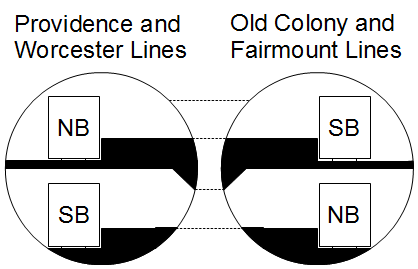
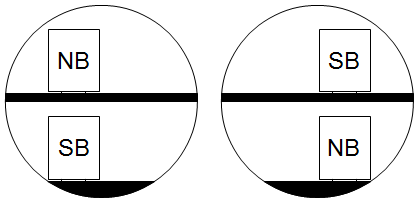
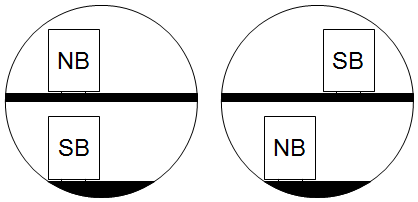
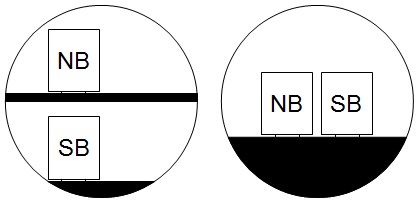
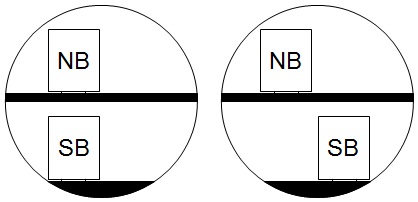

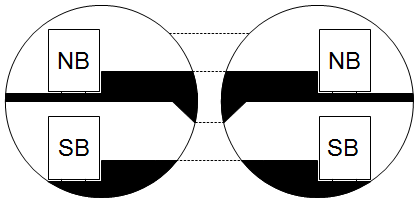
The assumed bore diameter is 12 meters, which corresponds to 1 meter = 16 pixels. The dashed lines are galleries punched at regular intervals into the two bores, connecting the platforms at stations. The assumed operating speed is 90 km/h; this requires a curve radius somewhat higher than 300 meters, about the lowest that can be achieved beneath the Central Artery, assuming no underground surprises.
Moving one track aside, as done between the second and third image and between the fifth and the sixth, requires 3.4 meters of lateral displacement, which at this speed is almost all curve spiral rather than full curve, encouraging using a higher curve radius and shorter spirals. Near the lower limit of the curve radius that permits 90 km/h, the spirals would be longer than the curve itself. With a 1,000-meter curve the track would do the transition in 118 meters. Switching the heights of the tracks, as done between the third and fifth images, requires 5.5 meters of vertical displacement (possibly a bit more, depending on catenary clearances, but certainly not more than 6 meters); I can’t find information about vertical curve radius at low speed, but if the same vertical acceleration as at high speed works, then using Swedish standards, 1,300 meters works, in which case, with EMU-friendly 4% grades, the transition requires 190 meters. 118+190+118 = 426, less than the distance between each pair of stations, if not by the most comfortable of margins.
The advantage of this configuration is that people making diagonal trips, such as between Framingham and Braintree, could transfer cross-platform at South Station. With two stations, as is the case in Singapore for the transfers between the North-South Line and East-West Line, passengers on one of the wrong-way pairs would need to travel one station farther than they have to on each line; with three, passengers between two points on lines north of Boston feeding two different tubes, for example Salem and Waltham, could transfer cross-platform at North Station.
Finally, the reason for two tubes rather than one is that it makes the portals simpler, especially at the southern end. I discussed above the transitions between different configurations of tracks inside the tube, but the transitions from an at-grade two-track line to a two-track tube with one track above the other require more vertical displacement, and this favors two separate portals to the south, one pointing at Back Bay and one pointing due south toward Fairmount and the Old Colony Lines. Merging the two bores underground is possible, but the cost differential with just doing two bores all the way may not be enough to justify the reduction in capacity.
Authoritarian Leaders and Agenda Setting
On Tuesday, Andrew Cuomo proposed a new signature initiative: a $450 million AirTrain to LaGuardia, connecting to the Mets’ stadium on both the 7 train and the LIRR. The proposal has practically no merit even as an airport connector: Ben Kabak and Yonah Freemark both note, with helpful graphics, that the connection is so circuitous it’d be slower than the existing bus-subway options to nearly every destination, including everywhere in Manhattan. Capital New York notes that in general, transit activist reactions to the plan were cold, precisely because it’s such bad transit.
The interesting aspect of this is about the counter-criticism, and the discussion it led to. (In contrast, Cuomo’s general hostility to transit and intercity rail is not news, and it’s unlikely someone with such a history could come up with cost-effective transit plans.) The main reaction to the criticism is not “where would you spend $450 million instead?”. That question has a few answers, all of which are boring: the general MTA capital plan, or, if the money is to go to expansion, Second Avenue Subway Phase 2, the next item on the city’s transit agenda now that Phase 1 is nearing completion.
Instead, the main reaction is “how would you connect to LaGuardia instead?”. That question, too, has a definite answer, which Ben talked about in his post, and which I pointed out in my post about airport connectors last year: an extension of the N to the east, with several stops (for example, at Steinway and Hazen) to serve more of Astoria and not just airport riders. The N takes a direct route to Manhattan, passing through or next to the top areas for LaGuardia passengers, as seen in the second map here. But even that is the wrong question. There are probably more cost-effective subway extensions in New York, having nothing to do with LaGuardia; I have to say probably, since at no point has the MTA proposed large enough a slate of possible extensions that we can compare projected costs per rider and say “this is the best.” There might even be better ways to extend the N eastward than to LaGuardia: an elevated line over Ditmars, a short segment of the Grand Central Parkway, and Astoria Boulevard would serve East Elmhurst, a dense, transit-deprived section of Queens, and would probably produce higher ridership than a swerve from the GCP to the airport.
Such is the power of a governor who’s accountable to nobody: he proposes a scheme, and even the criticism is on the governor’s own terms of providing service to LaGuardia. Yonah compares travel times to various destinations on various alignments for connecting LaGuardia to the subway. Nate Silver’s response has an infographic with travel times from the airport to city hall in various American cities – an infographic that is of little use to New York, where the main destination is far north of city hall, but is well within the general topic of LaGuardia’s airport connections. Even I, cognizant of this agenda-setting power, have to at least mention an alternative LaGuardia connector, knowing readers will want a plan.
The cheeky response to this is that in a democracy, this wouldn’t happen. Now, the US is a democracy. Cuomo has to stand for election every four years. The worst infrastructure disasters tend to be in countries that are authoritarian through and through: Russia’s elevated winter Olympics costs in Sochi and Qatar’s human rights abuses in the World Cup preparations are the two biggest recent examples. But democracies with insufficient checks on political power are susceptible to this as well. This is common in the third world, where corruption is more common – hence the abuses of the World Cup last summer, in a solidly democratic country – but can also happen in developed countries with democratic deficits.
Usually, the phrase democratic deficit refers to the EU, and by analogy other supranational organizations. But in the US, it’s a useful framework for thinking of local and state governments. Rick Scott, Scott Walker, and John Kasich needed nobody’s approval to reject federal funding for intercity rail. Chris Christie did not need anyone’s approval to cancel ARC, or to cause traffic jams in retribution against a mayor who refused to endorse him; in a recent article in New York YIMBY, defending the cancellation of ARC as originally proposed, I made sure to take multiple barbs at Christie, just to avoid playing into the agenda of canceling ARC to posture about government waste while diverting rail money to the New Jersey Turnpike.
Cuomo’s power is if anything even greater: the New York state government works by a three men in a room model, in which the governor, the speaker of the State Assembly (just indicted for corruption), and the majority leader in the State Senate (currently relatively powerless and dependent on Cuomo) wield all practical power. In such a system, Cuomo does not have the power to shoot protesters, thankfully, but does have the power to propose megaprojects that glorify him, without a broad discussion with stakeholders, in which the MTA’s long-term expansion plans and cost-benefit ratios would come into play.
Last year, in writing about elite infrastructure projects that are not about meeting a service need, I noted that talking about such projects in terms of cost-effectiveness is moot, because they were never intended to be about benefiting the wider public. We could discuss where to spend money on transit in New York in the way that would benefit the largest number of riders. We could even discuss what the optimal way of connecting to LaGuardia is, before comparing the best connection with non-airport projects to see where it should lie on the list of future expansions. But it would be pointless, because Cuomo is not interested in spending money on benefiting the largest number of riders; he frankly does not care about transit riders. When the time came to support transit riders, for example in signing a lockbox bill guaranteeing that money the state government had promised the MTA would indeed go to the MTA, he vetoed the bill instead.
In such a climate, as soon as we talk about tweaks to Cuomo’s plan, Cuomo’s already won; whatever happens, he will reap the credit, and use it to buy political capital to keep building unnecessary megaprojects. Even trying to make the best of a bad situation by making the airport connector better is of little use, since Cuomo will support the plan that maximizes his political capital and not the one that maximizes transit usage even within such constraints as “must serve LaGuardia.”
This is evident in his response to criticism among transit activists. After listing the many pundits and activists who oppose the plan, Capital New York included a response from the governor’s office, which said, in so many words, “our plan is better because it doesn’t go through populated neighborhoods, where there would be NIMBYs.” What those of us who want good transit view as a feature – connecting to underserved neighborhoods and not just to the airport – Cuomo regards as a bug. A plan that included additional stops in Astoria might well attract community support, while still offering much faster trip times to Manhattan because of the direct route, but would rely on non-airport ridership, which Cuomo doesn’t care about, to keep the cost per rider reasonable.
Because of this disconnect between what would work for transit users and what would work for Cuomo, the only reasonable answer to the plan is a simple no, which should be said as sharply as possible. No working with the proposal: it’s terrible, a true stone soup. No tweaks: Cuomo wouldn’t want any ingredients that would improve the soup, and would insist on keeping the stone in anyway. (He doesn’t have to eat it, he doesn’t use transit either way.) And, within the parameters of a transit conversation in which people are desperate to see expansions, no discussion that validates Cuomo’s original plan.
Update 7/28: in a joint announcement with Joe Biden, Cuomo has just announced $4 billion in airport improvements at LaGuardia, bundling the rail connector into the larger projects. I have nothing to add that I didn’t already cover in this post and in my older post about elite infrastructure investments.
Who Rides Commuter Rail?
I’ve had an argument in comments with the author of Purple City about who commuter rail should serve. He’s argued before that cities should make sure outer suburbanites can get to the center via express commuter rail, and I will add that American cities do do that, and orient commuter rail too much around the needs of peak-hour outer suburbanites. Insofar as I think cities should have commuter rail there’s no disagreement, but what I think they do wrong is focusing too much on the peak. The two practices in contention are the low off-peak frequency (for example, Metra’s Union Pacific-North Line, which has no freight to speak of, has worse than hourly off-peak service), and the stop distribution, which has trains making few or no stops in the city proper.
The common thread of these two practices is that they optimize one variable: peak travel time for a suburban commuter to the CBD. This neglects other sources of ridership on commuter rail, which are suppressed in the US but significant in countries with more modern operating practices. I will contrast the peak-focused approach with a rapid transit approach, using examples that I believe will show that the latter is bound to get far more ridership, even in the suburbs.
First, let us imagine a contrasting system, one in which North American commuter rail looks more like an RER, an S-Bahn, or a Japanese commuter rail network. Such a system will have the following features:
1. Relatively consistent stopping pattern. The busier lines may have local and express trains, but the express trains will stop at the same major stops. Local trains will make all local stops over a fairly wide stretch.
2. Low ratio of peak to off-peak frequency, in the vicinity of 2:1 or even less. In a major city like Chicago or New York, a line that can’t support half-hourly service all day, at a bare minimum, will likely have no service at all; the only exceptions I can think of are services at range so long they’re practically intercity, like New York-Hamptons or New York-Allentown.
3. An urban stopping pattern that’s not too express. If there’s a parallel subway then it’s okay to have a somewhat wider stop spacing than in the inner suburbs beyond the subway’s range, but still closer to the 2-3 km range than the 4-5 km range of Metra.
If it’s possible to do so technologically, then the commuter line may be interlined with a subway line, even. This is usually hypothetical, since subways and commuter trains, where both exist, are almost always technologically incompatible; Tokyo and Seoul are the two major exceptions, with London a borderline case. However, it’s useful to consider such hypothetical cases, to examine what would happen to train service. I will consider two such cases: having Vancouver’s Evergreen Line take over West Coast Express (the original argument), and having Boston’s Red Line take over Old Colony Lines. Neither situation is technologically possible, even ignoring FRA and Transport Canada regulations, as both Boston and Vancouver build subway tunnels for much smaller trains than run on the mainline, but this discussion may be useful in cases where a takeover is feasible, such as when the commuter line is an isolated branch. I prefer to discuss the hypotheticals since the two examples in question are purer examples of priorities: outer-suburban peak service, or rapid transit-style service.
Vancouver
Vancouver’s rail service consists of the SkyTrain network, which gets about 400,000 weekday riders, and the West Coast Express, a peak-only commuter rail network running 5 trains per day per direction, with 11,000 weekday riders. SkyTrain’s under-construction Evergreen Line will intersect the West Coast Express at Port Moody and Coquitlam, and then serve more stations in Coquitlam off the mainline, while the WCE continues much farther to the east, into the Vancouver exurbs. The WCE connects Port Moody to Waterfront in 25 minutes and Coquitlam in 30 minutes; the Evergreen Line is projected to take 33 and 38 minutes respectively, with a transfer at Broadway/Commercial. Despite the slower service, the much higher frequency, all-day service, and connections to more of the Vancouver metro area win: the projected ridership for the Evergreen Line is about 23 million a year (see Table 2 on PDF-p. 4 here), which corresponds to about 75,000 per weekday.
Now, what’s in contention is whether it would be wise to have the same treatment at WCE stations farther east. The potential ridership at those stations is lower since they’re in less built-up areas, so it is likely cost-ineffective to build an Evergreen Line branch along the Canadian Pacific mainline and have it replace the WCE, but if such a line were built, it would most likely have the same effect on travel times: people would have to transfer at Broadway/Commercial, and not including the transfer time take 8 minutes more to get to Waterfront. The eastern end of the line, Mission, has 75-minute service now, and this would change to 83-minute service plus a transfer.
I claim that Mission residents would still take the train more often if it were 8 minutes lower. The reason is simple: as a proportion of overall travel time, the 8 minutes are more important to a 25-minute Port Moody commuter than to a 75-minute Mission commuter. Mission commuters live farther out, so they’re somewhat less likely to care about service to various neighborhoods along the way, but they’re even less likely to care about 8 minutes. They also are less likely to care about very high frequency, since their trips are longer, but they do care about service availability all day, even if they’d be okay with half-hourly service. Moreover, the Evergreen Line will connect to secondary nodes like Metrotown better than the WCE does, and eventually have direct service to Central Broadway and UBC, both of which draw commuters from the entire region.
In the present, the WCE works as a placeholder – it’s possible to reduce staffing and improve turnaround times to allow off-peak service, but there’s too little population east of Coquitlam to justify a SkyTrain extension, and so far population growth is fastest in inner-suburban Port Moody and Surrey (see here and here) and not east of Coquitlam. In the future, if those areas grow then it will make sense to replace the WCE with SkyTrain. WCE upgrades are unlikely – adding infill stations is practically impossible, as the line hugs an active port, with no good station sites. While SkyTrain’s driverless configuration keeps operating expenses down, it makes it impossible to extend branches to the suburbs cheaply by running them at-grade and in mixed traffic with freight.
Boston
Several of Boston’s subway branches are parallel to extant or closed commuter lines. The Orange Line runs alongside the Northeast Corridor to Forest Hills, the Blue Line took over parts of the narrow-gauge Boston, Revere Beach and Lynn Railroad, the Green Line D Branch took over a commuter rail loop used by the Boston and Albany, and the Red Line took over a New Haven Railroad branch line to Ashmont and runs alongside the Old Colony Lines to Braintree. At the time the Braintree extension opened the Old Colony Lines were closed for passenger service, but they have been since reopened, running from Braintree to South Station with just one stop in between, either JFK-UMass or Quincy Center (never both, except on trains that skip Braintree); off-peak frequency is about every two hours on each of two lines, and with some off-peak trains skipping Braintree, service to Braintree is worse than hourly. The Red Line takes 26-27 minutes to go from Braintree to South Station, the Old Colony Lines take 19-21 minutes.
As is projected in Vancouver, ridership on the Red Line is much higher: according to the 2014 Blue Book, on PDF-pp. 14 and 74, the busiest MBTA commuter rail station, Providence, gets 2,325 riders per weekday and the busiest Old Colony station, Bridgewater, gets only 1,036, while the Braintree extension’s five stops get 6,975, 4,624, 8,655 (Quincy Center), 4,785, and 5,122 (Braintree). Those five stops get 30,000 riders between them, meaning 60,000 since it’s unlikely people ride internally on the extension; this is nearly half the entire MBTA commuter rail ridership, and three times the ridership on the Old Colony Lines (counting Greenbush, which diverges at Quincy, as a third line).
As in Vancouver, I claim that a Red Line extension taking over the Old Colony Lines would have much higher ridership. Of course the frequency per line, already middling since the Braintree extension is a branch, would not be very good; but at the range of the suburbs served by these lines, half the current frequency of the Red Line, giving about 20 minutes at the peak and 30 off-peak, is enough, and is a massive improvement over multi-hour headways. The extra 5-8 minutes of travel times matter less as one moves farther out, again; travel time to South Station from the first Old Colony stations past Braintree, South Weymouth and Holbrook/Randolph, is 28 minutes, about the same as from Braintree on the Red Line, and those two stations have a bit more than 500 weekday riders each.
Moreover, the Red Line has something the commuter trains don’t: service to multiple centers within the inner Boston region. Downtown Crossing is closer to most jobs than South Station, saving people the walk. Cambridge is a major job center in its own right (it has more jobs than any New England city except Boston, ahead of Providence, Worcester, and Hartford). Back Bay is a bit more accessible via the Orange Line at Downtown Crossing or the Green Line at Park Street than via commuter rail at South Station.
Like SkyTrain, the Red Line can’t run on mainline rail tracks, and there is not enough population to justify an extension, nor enough population growth in New England for such an extension to ever pencil out. However, it’s possible to modernize commuter rail, as I have written before. This would not provide direct service to Downtown Crossing or Cambridge, but could provide cross-platform transfers to Back Bay, decent frequency all day, and, since regional EMUs can have very good performance characteristics, much higher average speeds than with today’s slow diesel locomotives even if trains make more stops.
General Remarks
The examples of Boston and Vancouver’s ridership patterns suggest that it’s okay to sacrifice speed to provide coherent service. It’s worth noting here that the bulk of present-day ridership on North American commuter rail would not benefit too much from such sacrifice. North American commuter rail provides awful service in the off-peak or to non-CBD destinations: even the Newark CBD, relatively well-served by New Jersey Transit, has a 26% mode share as a job center as of 2000, as per an Alan Voorhees Transportation Center report called Informed Intuition (PDF-p. 13). There’s a huge amount of latent ridership on North American commuter rail, which is why rapid transit gets so much more ridership than peak-focused commuter rail.
This doesn’t change much at different ranges of distance from the center. The few minutes saved by expressing through the city to the CBD matter a great deal to the suburbs right beyond city limits, but those innermost suburbs are precisely the ones that could make the most use of service to multiple city nodes. Farther out, where commuters to the city tend to be more likely to be working at the CBD, since it is more specialized than most secondary nodes, frequency and service to everywhere matter less, but the extra few minutes matter even less.
However, since present-day riders are precisely the narrow slice of potential users who are okay with the current setup, they have the potential to engage in NIMBY protests against any attempt at modernization. Why change what works for them? This is why Long Island representatives oppose such modernization attempts as letting Metro-North access Penn Station; it’s entirely a turf war. Even reforms that do not degrade trip times to the CBD are unlikely in this political situation, for example mode-neutral fares: the people paying premium fare to ride the LIRR or (to some extent) Metra are the ones who are okay with paying this fare, and who may object to increased train crowding coming from lower fares.
Judging by the ridership multiple between the Evergreen Line and WCE, there are likely to be a few million weekday rides coming out of Eastern Queens and Long Island if the LIRR is modernized, but those are not the Manhattan-bound commuters who dominate the discussion today. Instead, they are people who have gotten used to unusable commuter rail, and drive to work, or take long bus-subway commutes to avoid paying higher fares. They do not seem like a significant source of regional rail ridership because they are not current riders (or they ride local transit instead), but they are precisely what makes the difference between the low ridership of every North American commuter rail system and the higher ridership of many European systems.
Mixing Circumferential and Radial Transit
Nearly all rapid transit lines belong to one of two categories: radial lines (a large majority), which connect city center with outlying neighborhoods or suburbs; and circumferential lines (a minority), which go around city center and often serve secondary centers and usually intersect all or nearly all radial lines perpendicularly, such as Paris’s Lines 2 and 6, Moscow’s Circle Line, Seoul’s Line 2, New York’s G train, and Shanghai’s Line 4. In this post, I’m going to discuss an uncommon third category, that of lines that combine circumferential and radial functions: they go toward city center, like a radial line, but then change direction and become circumferential. The G train in New York was like this until 2001, and Line 3 in Shanghai is like this today. This is apropos a proposal by a team Penn Design graduate students to build a variant of Triboro RX in New York that combines Triboro’s circumferential orientation with a radial commuter line. I believe such mixed lines are a recipe for low ridership and strained transfer points, and the Penn Design proposal is inferior to the original Triboro proposal.
First, some details about the mixed lines in question. The example most accessible to most readers is the historical G train in New York. When it first opened in the 1930s as part of the IND, it was designed to both connect Brooklyn and Queens without going through Manhattan and provide local service along radial lines, running alongside express trains that would serve Manhattan. Thus the northern half of the G ran under Queens Boulevard as a local, while the E and F trains provided express service and went to Manhattan. From the start, this arrangement was unstable. Demand for service to Manhattan was much greater than to Brooklyn, so people riding the G inbound changed to the E or F at the first express station after the one they boarded. With overcrowded express trains and undercrowded local ones, the Transit Authority was compelled to build a track connection in 1955 to add a Manhattan-bound local service, and to build a second track connection in 2001 to add another Manhattan-bound local train and remove the G from Queens Boulevard entirely.
In Shanghai, Line 3 was built as an (almost) entirely above-ground line, interlined for part of the way with the circular Line 4. The northern half of Line 3 is radial, running parallel to the overcrowded Line 1. However, where Line 1 enters the traditional center and serves People’s Square, Line 3 swerves west to go around it (missing Lujiazui, the new high-rise CBD to the east of People’s Square), interlining with Line 4, and leaving the loop southward to intersect Line 1 again at Shanghai South Railway Station. Its ridership disappoints not only by the standards of Line 1, but also by those of Line 4: 642,000 on 2014/4/30, the system’s busiest day, compared with 1,384,000 on Line 1 and 907,000 on Line 4. Line 6, which likewise combines a radial function at its northern end with a circumferential one at its center, serving Century Avenue but not Lujiazui or People’s Square, has even lower ridership, 376,000, although this is several times the original projection.
There’s a discussion on Human Transit, in which consensus is that the best circumferential lines connect secondary activity nodes that generate trips in their own right. Now, the G train connects Downtown Brooklyn (the largest business district in New York outside Manhattan) with Long Island City (one of the business districts of Queens), but it lacks the other positive feature of circumferential lines: transfers to the radial lines, to allow one-transfer trips from anywhere to those secondary nodes. The G has good transfers only to other IND lines, and at the Queens end, its transfer to the Queens Boulevard trains was cut in 2001 since, for operational reasons, it was cut not to its old junction with the E and F (Queens Plaza) but one station short (Court Square). Other G transfers are very recent and require a considerable amount of walking.
In contrast to the underperforming G, circumferential lines that both connect important activity nodes and have plenty of radial transfers are backbones of their cities’ transit systems. Shanghai’s Line 4 is fairly busy as noted above. Seoul’s Line 2 is according to a forum post the busiest in the system. Paris’s Lines 2 and 6 are only about average in ridership but combined would be the second busiest after Line 1 (and per route-km are third and fourth, only behind Lines 1 and 4, but are only narrowly ahead of many other lines). The juxtaposition of Shanghai’s Lines 3 and 4 in particular suggests that subway lines shouldn’t try to mix radial and circumferential functions.
Let us go back to the impetus for the post, Triboro RX. The proposal is to largely use existing freight rail lines, all of which are lightly used and could be turned over to the subway, to provide a semicircular line connecting nodes of activity in the Bronx, Queens, and Brooklyn. Because of the focus on using an existing right-of-way to reduce costs, the line misses the most important nodes in Brooklyn and Queens, which are served by the G in any case. However, it passes within half a kilometer of the Hub in the Bronx and, via a short greenfield tunnel, connects to Yankee Stadium, the Bronx’s busiest subway station; it also connects to Brooklyn College and 74th Street/Broadway in Queens, both busy stations if not as central as Downtown Brooklyn or Long Island City. Moreover, it provides direct Bronx-Queens service, which in the existing system requires circuitous routes through Manhattan with difficult transfers, and has reasonable transfers to nearly all subway lines. At the end, the lack of service to Downtown Brooklyn ensures it cannot be a very well-patronized line, but as the right-of-way is almost entirely in place, its cost per rider could be quite low.
In contrast, the Penn Design proposal, called Crossboro, severs the connection to the Hub and Yankee Stadium, and replaces it with service along the Northeast Corridor to Coop City, making sparse stops, at the same locations Metro-North plans to for Penn Station Access; this is 4 stops in 10 km in the Bronx, compared with stops spaced roughly every 800 meters in Queens and Brooklyn, as in the original proposal. The trains would be certified for mainline operation, on the model of the London Overground, rather than segregated from mainline traffic.
The problem with the Crossboro idea is essentially the same as that of the G train until 2001. Most riders at the four Bronx stops are interested in getting to Manhattan, and not to the neighborhoods served by Crossboro, so they’d look for transfer opportunities. The only such opportunity in the Bronx is at Hunts Point, to the 6, which unlike the E and F on Queens Boulevard runs local and provides slow service to Manhattan. With the extra transfer, there is no advantage to Bronx riders over continuing to walk or take the bus to the 2, 5, and 6 trains to Manhattan. Moreover, because of the poor transfers within the Bronx, it’s impossible to use the line to connect from Queens to anywhere in the western half of the Bronx, including Yankee Stadium and the Hub: there’s a connection only to the 6, and none to the 2, 4, 5, or B/D, or to Metro-North.
The principle in action here is that, especially when there are no compelling destinations, it’s critical to make sure the line provides connectivity between large regions. This means connecting to all or almost all radial lines in a region well-served by radial subways but poorly served by preexisting circumferential ones. Not including the 1, which no proposal connects to, the Bronx has five subway lines, all providing radial service to Manhattan; it is a feature of Triboro that it connects to all five (though the connection to the 2/5 requires a long walk), ensuring that people from nearly everywhere in the Bronx can use the line to get to its destinations in Queens and Brooklyn with one transfer. To get from anywhere to anywhere would require two transfers, but to get from a random station in the Bronx to one in Queens or Brooklyn often already requires two transfers, usually at busy Manhattan stations that are out of the way for the crosstown traveler.
Mixing radial and circumferential service interferes with this principle, since the radial component has to come at the expense of completing the circle (or semicircle in a geographically-constrained city like New York). Thus, it’s harder to use the line to get to a large enough variety of points of interest to make up for the fact that it misses the city’s most important destinations. Of course, such a line is also wanting as a radial line, since it misses the center. Thus, ridership underperforms, and the line usually fails to achieve its stated purpose.
New York Regional Rail: the Central Segments
I’ve written a lot of articles over the years about what should be done with regional rail in the New York area, focusing either on the overall shape of the system (as on The Transport Politic) or on specific aspects of the central links (as in past posts here). I’d like to synthesize these ideas into one coherent proposal. Unlike my posts on The Transport Politic, I’m going to pay relatively little attention to how to match branches for ridership, but more attention to what to do in a central region consisting of the city proper, New Jersey as far as Newark, and New Rochelle. I will also indicate things that can be done to keep construction costs under control for a plan that includes 30 kilometers of urban and underwater tunnel, about six times as much as the planned tunnels across the Hudson.
The Principles, Restated
The most important principle for infrastructure planning in developed countries is organization before electronics before concrete. In New York, it’s possible to squeeze some extra capacity out of the first two: notably, the LIRR and Amtrak together only run about 40 trains per hour into Penn Station from the east on four tracks, whereas the maximum capacity is about 50, and this is before trains are diverted to the East Side Access tunnels to Grand Central. The LIRR’s bottleneck is not the East River Tunnels, but the platforms at Penn Station, and this means it’s possible to use improved operations, including through-running, to squeeze extra capacity even before East Side Access opens.
However, the biggest bottleneck in the region is from the west, across the Hudson, and there, present traffic peaks at 24-25 trains per hour on just two tracks. I know of limiting cases in which mainline operations achieve about 30, using moving-block signaling on captive tracks (e.g. the RER A, which shares tracks with nothing else in its central segment), with one example that uses fixed blocks (the shared RER B and D tunnel achieves 32). Here, concrete is unavoidable, so new tunnels are required. In addition, providing service to more points than Penn Station, or Grand Central for commuter lines connected to it, requires new tunnels as well.
However, this new infrastructure should be built economically. The posts I linked to in the initial paragraph of this post provide some ideas, including the use of large-diameter tunnel boring machines to reduce station construction costs, and the use of the existing station cavern at Penn Station. This should be paired with seamless fare and schedule integration, including through-routing, and a fleet replacement plan to get rid of locomotive-hauled trains and replace them with EMUs (electrifying unelectrified branches as needed).
Subject to the requirement for new infrastructure, New York should remember that it’s a major city, and as such, it’s capable of supporting multiple independent commuter lines. Paris has five RER lines, of which only the B and D share tracks, and only between one pair of stations, on top of several major commuter lines disconnected from the RER network. It’s better to keep the map relatively coherent, so that one central trunk will split into several outer branches, but nearly all outer branches will feed into consistent central trunks. (As an example, the London Underground’s deep-level lines’ branching is coherent, while the New York subway’s mostly isn’t, with the E, F, M, and R trains running on what’s technically a branch and then diverging to three different Manhattan trunks.) This simplifies the junctions that need to be built just outside the city core, and also makes the network easier to remember.
The Tunnels
There should be a new pair of tunnels between New Jersey and Penn Station, parallel to and south of the existing tunnels. Those tunnels should then continue to Grand Central. This is the core of ARC Alternative G, which was removed from consideration in the original ARC project for reasons that were never explained adequately (Stephen Smith has been making freedom of information requests for years). However, unlike Alt G, it should not include new railyards in Manhattan, as those belong in areas where land is cheaper, nor should it include a loop for trains from the Erie lines to get to Penn Station.
The lynchpin of the plan is not the tunnels to Penn Station, which are already on the political radar in the form of the Gateway Project, albeit at a large multiple of an acceptable cost, due to such frills as new Penn Station tracks. Rather, it’s a new set of tunnels, meeting at Lower Manhattan in the vicinity of Fulton Street, going in four directions: north to Grand Central, south to Staten Island under Lower New York Bay, northwest to New Jersey via the Erie Railroad’s old Pavonia terminal, and southeast to Brooklyn to the Flatbush Avenue LIRR station. Using a double-O-tube large-diameter TBM, the Fulton Street station should feature cross-platform transfers, large banks of escalators to the street, and, to reduce costs, no station structures outside the tunneled station, putting timetables and ticket-vending machines on the street. All connections should be to Grand Central’s existing station and not the new East Side Access cavern, as the cavern leads only to the LIRR, which is already connected with both Penn Station and Flatbush Avenue. The existing tracks connect to Metro-North, which is not.
A possible additional tunnel in the far future would connect Hoboken with Grand Central’s new cavern, via Union Square. This is only in case the existing lines become congested. Current commute patterns make such congestion very unlikely, but things could change if, as a result of the new capacity, more people choose to live in suburban North Jersey and work in Manhattan.
The Network
There should be five lines running through Manhattan, without any track-sharing between them, and one using East Side Access and terminating in Manhattan. I am going to try using consistent numbering, different from the order I used in my posts on The Transport Politic, in order to group the lines using Penn Station and the lines to Lower Manhattan separately.
Line 1 is the existing mainline. Its inner route goes from Secaucus Junction to Sunnyside Junction, via the existing tunnels to Penn Station. Intercity trains use it (and should continue doing so), but most traffic will always be on commuter rail. Beyond Secaucus, trains can go to either the Northeast Corridor or the Morris and Essex Lines; to simplify junctions, most trains should use the Northeast Corridor (including the Raritan Valley Line, which splits past Newark). Beyond Sunnyside, they can go to the LIRR or the Northeast Corridor; to ensure adequate capacity for intercity trains while still providing service to the eastern Bronx, trains should use a mixture; in the long run, four-tracking everything north of Hell Gate Bridge will be necessary. It may be best to dedicate Port Washington trains to this line. At Penn Station, it uses middle-numbered tracks.
Line 2 uses the new tunnels to Penn Station and Grand Central. Its inner route goes from Secaucus to Penn Station, Grand Central, and Harlem-125th Street, splitting into branches thereafter. Most trains should go to the New Haven Line, since Line 1 could never provide adequate traffic for it; the rest should go to the Hudson Line – see below for Line 3. At the New Jersey end, it should run to a mixture of Northeast Corridor trains (including to the North Jersey Shore and Raritan Valley) and Morris and Essex trains, as required by demand. At Penn Station, it uses low-numbered tracks, potentially just 1-4. I expect it to be the most crowded, because of the service to both primary Midtown Manhattan stations.
Line 3 uses the Empire Connection, realigned tunnels to Penn Station, and the northern pair of the East River Tunnels to reach the LIRR. Its inner route goes from Yonkers to Penn Station and thence to Sunnyside. Intercity trains to Upstate New York use this line, but there are fewer of them than on the Northeast Corridor. Beyond Yonkers it can only go on the Hudson Line, so most Hudson Line trains should use it rather than Line 2. At the LIRR end it should run alongside trains to the East Side Access tunnel; as the splits are far to the east of Sunnyside, it may be prudent to have each branch serve both it and East Side Access, but in either case, timed East Side Access/Line 1 transfers at Sunnyside are necessary. At Penn Station, it uses high-numbered tracks. I expect it to be the least crowded, since to the west it only reaches one commuter line, one whose present traffic is moderate.
Line 4 is the main north-south line, from Staten Island (both the existing Staten Island Railway and the North Shore Branch) through the underwater tunnel to Fulton Street, Grand Central, and Metro-North. North of Harlem-125th Street, it can connect to any line, but I think the Harlem Line is the most coherent, as the only Metro-North line that is not needed for lines that don’t go to Grand Central. I expect it to be very crowded with inner-suburban and outer-urban traffic, as it serves Staten Island and underserved neighborhoods of the Bronx and the suburbs to its immediate north.
Line 5 is the combination of the Erie Lines, and possibly also the Northern Branch and the West Shore Line, and the LIRR’s Atlantic Branch, via Pavonia and Flatbush. For interlocking simplicity, all trains should go to one or two lines beyond Jamaica, ideally the Atlantic and Montauk Lines (the existing turnouts already favor trains from the Brooklyn Atlantic Branch continuing along the branch to Far Rockaway and Long Beach), leaving the Main Line to Line 3 and East Side Access. As there are five possible branches in New Jersey – the Northern Branch, the West Shore Line, the Pascack Valley Line, the Bergen County Line, and the Erie Main Line – frequency would be limited if all were used, so it may be best to choose just three.
Here is an unlabeled map of the five lines, with only inner branches shown; the decision of what station to terminate branches at has nothing to do with the desired service pattern, and is purely illustrative.
A potential Line 6 would take in all Morris and Essex lines, go to Hoboken, cross into Manhattan via a new tunnel with an extra stop at Union Square and then go to Grand Central and East Side Access; as discussed above, it’s omitted due to its very long-term nature.
Penn Station
I have discussed what to do with the Fulton Street Station. Penn Station is more complicated. The easiest thing to do is nothing, beyond new tunnels. There would be many platform tracks, two per access track for Line 2 and more than two for Lines 1 and 3; Line 3 would involve difficult switching moves and slow speeds through the station. Line 1 is the most important priority for allowing intercity trains to serve the stations with few (ideally no) diverging moves at turnouts, to maintain speeds.
To avoid platform congestion, especially on Line 2, more staircases and escalators should be installed. This, however, clutters the narrow platforms.
The second possibility is to pave over tracks to widen the platforms. I vacillate between preferring paving over pairs of tracks to create very wide platforms, and paving over every other track to create wider platforms at which trains can open doors on both sides. Right now I lean toward the former, as it would allow reusing preexisting escalators: the platforms currently have single-direction escalators as they’re too narrow for an adjacent pair of escalators, one per direction, and merging two platforms would be the easiest way to allow wider escalator banks.
Unfortunately, on the line with the biggest platform crunch, Line 2, this would imply a single platform with two tracks serving two tunnel tracks, so that dwell times would limit capacity somewhat. This limit is not too sharp – 24 trains per hour are achieved at through-stations in many cities without additional tracks, with some limiting cases of 30 (such as the moving block signal-equipped RER A) – but it’s still a limit, and requires good timetable adherence departing the station. These are only commuter trains, which run shorter routes than intercity trains, but Line 2 is likely to involve some long-range commuter runs, as far as Trenton or Dover or New Haven. (Since Line 1 is the only one serving local Northeast Corridor stations in the Bronx, it should only get the local trains, while longer-range trains to New Haven should use Line 2.)
The most expansive solution is to rebuild the station’s track level. There is an RPA study Penn Design study in that direction. For optimal passenger usage, the two concourse levels would be replaced by one, and the station’s 21 tracks would be reduced to 12, facing six 15-meter-wide platforms; the platforms’ eastern ends would be shaved slightly, to allow longer curve radii heading from the Lines 2 and 3 tunnels with simple turnouts, each tunnel track turning into two station tracks facing the same platform. In principle, it can be sequenced to shut down parts of the station in succession: first the southern tracks (New Jersey trains would be immediately interlined with Northeast Corridor and LIRR trains for a combination of Lines 1 and 2), then the northern tracks (the LIRR would have East Side Access by then), and finally the remainder of the central tracks. The bulk of the work on the central track could be done in conjunction, first removing the platform between the existing tracks 11 and 12 and then realigning tracks from the center outward.
I want to clarify that I do not support the most expansive solution, as it is likely to cost billions of dollars. It would create a nice Penn Station for train travelers. Those 15-meter platforms could have 6 escalators side by side with not too much obstruction, and 4 with practically none (the widest escalator is 1.6 meters wide outer end to outer end, with 1 meter used for the moving stairs). Reducing the two concourses to one would allow taller ceilings throughout, and redesigns of passageways for maximum passenger throughput. The only problem: it would be extremely expensive.
I bring this up only because the Municipal Arts Society and the RPA have teamed to propose a multi-billion dollar remake of Penn Station above track level, with high aesthetic value and zero transportation value. In addition, Amtrak wants to move its passenger facilities one block west, in the wrong direction, which has negative transportation value. If there has to be a redo of the station, it might as well be one that improves it at track level as well, rather than just making it pretty from the outside.
Phasing and Costs
The ideal phasing is “as soon as money becomes available.” There is a tendency in the US to be overly cautious about everything and chop projects into little pieces, in the name of prudence. It’s always easy to show one’s moderation by chopping a fixed amount of money from every proposal (quintessential moderate Senator Olympia Snowe was famous for this) and by funding many projects by small amounts. These small projects then fail because of reduced network effects or sometimes higher costs due to smaller orders.
The tunnels I proposed in this post sum to about 30 kilometers. These 30 kilometers are objectively difficult to build. The tunnels for Lines 4 and 5 of this proposal go under wide rivers and a bay, and once they reach Manhattan land they have to go under the entire Lower Manhattan subway network. Half a billion dollars per kilometer would be a good deal: Crossrail is more than a billion dollars per double-track tunnel kilometer, assuming there is nothing to build except tunnels (which is far from true), while Crossrail 2’s cost range is $600-850 million per km (see also my first comment in the link). London is a high-construction cost city, but New York is even higher-cost; building a line for London’s costs would be a major achievement for New York.
Bear in mind that Amtrak thinks the Gateway Project alone would be $16 billion. When I propose to build an entire regional rail network for perhaps $20 billion (in 2010 dollars, not year-of-expenditure dollars), based on what it would cost in other cities, I am not taking into account the bloat that leads to high costs in New York. At the per-km costs Amtrak thinks are appropriate for what would be one of the simpler tunneling projects for this system, this is plain unaffordable.
Still, precisely because of the network effects, and because this plan neatly separates branches of the existing commuter rail system, it should be proposed all at once. If it’s expensive then it will also be delayed; it’s better to have six mainline rail tracks under the lower Hudson by midcentury, than to have four and then realize there’s a capacity crunch and six tracks are required after all. Of course it’s best if everything is in place by the late 2020s, on the schedule of the Grand Paris Express. But the point is that longer project latency encourages bigger rather than smaller plans. The Line 2 tunnel, by whatever name, is still the most important priority, but the phasing then becomes “whenever it can be designed and built.”
The lower-end cost I’m proposing is for a project without any frills. It includes a bare minimum touch for Penn Station – simpler interlockings at places and some extra access points, but no more. It includes no Sunnyside decking or other redevelopment, which should be funded separately in any case. (When people build highways, do their projected cost figures ever include the construction of the suburban subdivisions they’d sprout?) It doesn’t include electrification of branches, although that is cheap enough as to be well within the uncertainty in even a first-order estimate. It doesn’t even include rolling stock, although the large preexisting fleet of decent EMUs means there’s no need for immediate fleet replacement as on the MBTA and other diesel-hauled railroads.
The only thing this project does include is more paths for more commuter trains to serve Manhattan and other regional job centers.
Quick Note: High Third-World Construction Cost Examples
Dhaka, the world’s poorest megacity (at least until Kinshasa crosses 10 million and qualifies as a megacity), is building a metro system. Using Japanese financing and Indian consultants, it is planning to build a multi-line system, and getting bids for the first line. This line is going to be elevated, and 20-21 kilometers long; construction costs are 220 billion takas, which is $2.8 billion in exchange rate terms and about $8.5 billion in PPP terms.based on the 2013 conversion factor here. This is a bit more than $400 million per kilometer, which is high for a fully underground line, let alone an elevated line.
Jakarta, which is much richer, but still third-world (Indonesia is slightly poorer than China, as of 2014), is building a metro as well. Its first line’s first phase is mixed underground and above-ground: 15.7 kilometers, of which 9.2 are underground. The cost is $1.4 billion, or about $4.2 billion after PPP conversion, giving $266 million per km, still on the high side for a 59% underground line, but nothing as extreme as in Dhaka.
It’s a reminder that poor countries aren’t just low-cost. Things usually are cheaper in the third world, but by a much smaller factor than the income difference. Bangladesh’s GDP per capita, before any PPP conversion, is about $1,000. It is cheaper than the US and Europe, but not by a factor of forty or fifty, but by a factor of about three. Three is an average – imported electronics cost about the same in exchange rate terms everywhere, whereas rent is much more sensitive to local wages – but, for rapid transit construction cost, the average turns out to level the entire difference between the first and third worlds. Some countries, like China, are still a bit cheaper than Europe, while others, like Bangladesh, overshoot.


