Category: Transportation
Passenger-Miles Are Overrated
One of the pushbacks I got about my post on road boondoggles is that I didn’t control for passenger-miles of travel, and the number for car subsidies is much lower when one divides it by the appropriate number of trillions. This is not the first time I hear people talk about passenger-miles as a measure of inherent worth, but it doesn’t make it any better.
Passenger-miles don’t vote. They’re not a unit of deservedness of subsidy. They’re one unit of transportation consumption. They’re like tons of staple as a unit of food production, or calories as a unit of consumption. We don’t subsidize food based on cents per calorie.
Even as a unit of consumption, there are flaws in passenger-miles as a concept, when it comes to intermodal comparisons. The reason: at equal de facto mobility, transit riders travel shorter distances than drivers. It’s very obvious when comparing total passenger-miles in transit cities and car cities (see e.g. page 36 here). Transit is slower than driving on uncongested roads, but has higher capacity than any road. In addition, transit is at its best at high frequency, which requires high intensity of uses, whereas cars are the opposite. The result is that transit cities are denser than car cities – in other words, need less passenger-miles.
What passenger-miles are more useful for is measuring intercity transportation. At intercity distance, mode choice has less influence over travel distance (though, even then, HSR and driving are shorter-range than flying, and thus passenger-miles can overstate the importance of flying over ground transportation). It is also a proxy for revenue, whereas on urban transit the fare is either flat or weakly dependent on distance. As a result, intercity railroads usually cite passenger-miles or passenger-km, and urban transit operators usually cite passengers.
But when it comes to local transportation, it doesn’t work very well. A country’s mode share expressed in passenger-miles is lower than that expressed in passengers, and this is going to make transit and especially walking look much less significant than they actually are.
Quick Note: Comfort
While reading a thesis about tilting trains, I saw a comparison of passenger comfort on different modes of transportation. This includes the following graph (p. 30), which the thesis sources to a study of motion sickness in US children and teenagers:
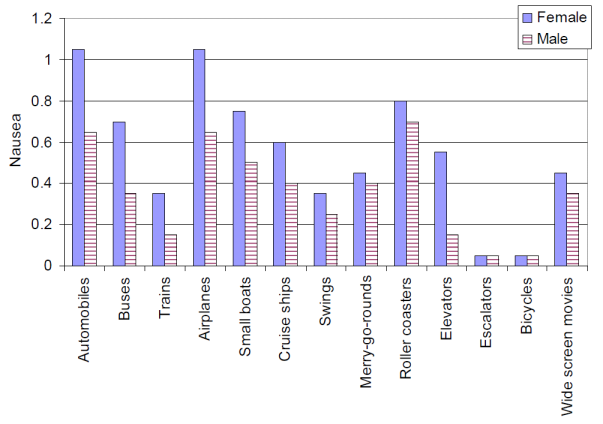
The scale is originally 0-3: this study polled a sample aged 9-18 and asked whether they feel nauseous on any of the above modes, where 0 is “never” and 3 “always.”
Selective Application of Smeed’s Law
A few months ago, in response to the Raquel Nelson case, author Tom Vanderbilt found an FHWA study from 2005 that finds that on wide, busy roads, pedestrian death rates are higher on marked crosswalks than on unmarked ones. The study itself is worth reading; its explanation of the finding is that,
These results may be somewhat expected. Wide, multilane streets are difficult for many pedestrians to cross, particularly if there is an insufficient number of adequate gaps in traffic due to heavy traffic volume and high vehicle speed. Furthermore, while marked crosswalks in themselves may not increase measurable unsafe pedestrian or motorist behavior (based on the Knoblauch et al. and Knoblauch and Raymond studies) one possible explanation is that installing a marked crosswalk may increase the number of at-risk pedestrians (particularly children and older adults) who choose to cross at the uncontrolled location instead of at the nearest traffic signal.
An even greater percentage of older adults (81.3 percent) and young children (76.0 percent) chose to cross in marked crosswalks on multilane roads compared to two-lane roads. Thus, installing a marked crosswalk at an already undesirable crossing location (e.g., wide, high-volume street) may increase the chance of a pedestrian crash occurring at such a site if a few at-risk pedestrians are encouraged to cross where other adequate crossing facilities are not provided. This explanation might be evidenced by the many calls to traffic engineers from citizens who state, “Please install a marked crosswalk so that we can cross the dangerous street near our house.” Unfortunately, simply installing a marked crosswalk without other more substantial crossing facilities often does not result in the majority of motorists stopping and yielding to pedestrians, contrary to the expectations of many pedestrians.
This is a rather standard application of Smeed’s law and similar rules governing traffic, whose one-line form is that traffic fatalities are determined primarily by psychology. This is not a problem; the problem is why such issues are only ever brought up in case of pedestrian fatalities.
In 1949, R. J. Smeed found a simple explanation for traffic fatalities: they depend less-than-linearly on the number of cars on the road. In the 1980s John Adams revised this to a more accurate rule based on VMT rather than the number of cars, and based on a constant decline in per-VMT accidents over time. Safety improvements do not bend or break the general trend. Quoting Adams again, the introduction of seat belts caused no reduction in traffic fatalities, and on the contrary caused pedestrian fatalities to temporarily inch up, as drivers felt safer and drove more recklessly. The only way to reduce the number of car accident victims is to reduce traffic.
And yet, government reaction is consistently on the side of accepting Smeed’s law when it implies there’s no need to improve pedestrian facilities, and rejecting it when its implication is bad for cars or good for pedestrians and cyclists. Local governments in the US routinely argue that safety is at stake when they want to upgrade a road with grade crossings into a full freeway. The FHWA helpfully adds that intersections are responsible to half of all car crashes and “FHWA will identify the most common and severe problems and compile information on the applications and design of innovative infrastructure configurations and treatments.”
In reality, all building freeways does is create more traffic, and cause more people to die in crashes. The average per-VMT death rate in the US has declined by 3.3% per year, but in the years following the Interstate Highway Act, it was practically flat – in other words, building freeways did nothing to accelerate the trend for reduction in per-VMT accident deaths. Although an individual freeway is undoubtedly safer than an individual road with intersections, the road network has to be viewed as a system: increase safety in one area and people will drive more recklessly elsewhere.
This systemwide view is clearly present in the case of pedestrians: the FHWA isn’t claiming that crosswalks are inherently unsafe, only that they cause more at-risk pedestrians to cross. In other words, the problem is that they cause too many of the wrong kind of pedestrians to cross. The implication is never used for roads. Traffic is never treated as variable, and if people shoot down freeway upgrades on the grounds that they’ll induce more traffic, it’s always on environmental or community grounds rather than on safety grounds.
Obama Proposes $4 Billion for HSR
President Obama’s new jobs bill includes $50 billion for infrastructure construction, including $10 billion for an infrastructure bank, $4 billion for high-speed rail, and $2 billion for Amtrak. Assuming it can get past the Republican Congress and that it will not be watered down as it already has been since the beginning of the year, the question arises: where to spend the money?
Fortunately, the separate grant for Amtrak suggests that the Northeast Corridor will be funded from a separate pile of money. This means that it’s more feasible to spend 100% of the HSR money in California. I claim that, in light of California’s present funding situation, this is the best possible use of the money, and, furthermore, the federal government should let California know of this as soon as possible, before it lets contracts out to tender.
Recall that California’s present HSR money is sufficient to build from Bakersfield to a point between Fresno and Merced, at least in principle, as the Environmental Impact Report projects slightly higher costs. Recall further that the $8 billion that could be made available to California – Obama’s $4 billion plus matching funds from Proposition 1A – are more or less enough to build from Bakersfield to Sylmar.
More precisely, the cost estimate for Bakersfield-LA is $12.6 billion, but according to CARRD, which independently of this also thinks the cost is going to be $18.6 billion, Palmdale-Sylmar is half the cost of Palmdale-LA, and as a result adding up Bakersfield-Sylmar using the 2009 Business Plan numbers works out to just under $9 billion. The approximately $1 billion in missing funds could either be obtained from local or private sources, or diverted from the plans to build north of Fresno; the segment that goes through and north of Fresno is expected to cost $1-2 billion, and diverting all north-of-Fresno money to Bakersfield-Sylmar should suffice to build the system from Sylmar to Fresno, with a cheap electrified legacy onward connection to LA.
Alternatively, if it turns out that going from Bakersfield to the LA Basin through Tejon Pass rather than through Palmdale is cheaper, then it’s possible to terminate the line in Santa Clarita and have trains continue further south at lower speed. This is in principle possible even through Palmdale, but then the legacy segment of the line would be both longer and curvier.
In other words, by spending all possible HSR money in California now, the Obama administration can guarantee a useful initial operating segment from LA to Fresno. On the margin the benefit of this is much bigger than its share of the cost, since it makes the difference between an upgraded San Joaquins train and a Phase 0 high-speed line.
If the administration funds California in full, then people will be able to ride a fairly long segment at full speed, connecting at lower speed to a major city. Some people are still going to call this a train to nowhere until it connects to San Francisco, but fewer people will use this epithet on LA-Fresno than on Bakersfield-Merced.
The primary problem with American transportation planning is that there is no transportation policy in the US. There is an industrial policy, a jobs policy, and construction for pizzazz on both sides, as well as the joy of hippie-punching among conservatives. An open HSR segment that is not a complete cost or ridership disaster could at least blunt the hippie-punching, if not develop local expertise that could eventually lead to transportation policy. In countries where HSR is in operation, or something close enough to it, the conservatives do not oppose its construction, even quite right-wing ones such as Berlusconi and Cameron.
The worst thing that can be done is spreading the money thin. The not-really-high-speed lines funded elsewhere, or, even worse, funding to Amtrak’s massively overpriced Vision plan, can only lead to small, barely noticeable improvements, ensuring there are plenty of disaffected people to continue the treatment of intercity transportation as a cultural political football. The only place where $4 billion in federal money makes a difference between having a usable system and not having one is California, and this is the basket the administration should put its eggs in.
The Rail-Trail Scam
I recently learned that a writer for the Adirondack Explorer has the following proposal to create a new rail-trail: demolish a line that’s in use by a heritage railroad, pave it over, and convert it to a bicycle trail. The arguments in the piece are your standard hatchet job considering only the costs of rail and only the benefits of the alternative, and are downright uninteresting; what’s interesting is that this is just the culmination of the misuse of the original concept of rail-trails.
Originally, rail-trails were created to preserve railroads for future use. Their mandate includes “to preserve established railroad rights-of-way for future reactivation of rail service.” In reality, restoration almost never happens. The Rails-to-Trails Conservancy’s review of railbanking points to success that a full nine railbanked corridors have had rail service restored, out of 301. The rest have been paved over, and often have enough non-railroad users that any restoration would be politically difficult in practice; I suspect that this is why the Providence Foundation makes no mention of restoring service on the second, now-abandoned track between Providence and Woonsocket in its regional rail study.
Another problem with railbanking is that it focuses on what’s useful as a trail, and not on what would be useful as a railroad later. There are pleasant exceptions, such as the Milwaukee Railroad’s route in most of Washington State, but in Rhode Island, the rights-of-way that have been preserved are those that would be easiest and least expensive to rebuild from scratch: the line to Hartford through West Warwick and Coventry, the line from East Providence to Bristol, and the aforementioned second track to Woonsocket. In contrast, many major pieces of infrastructure were demolished. Downtown Providence’s connection to East Providence was cut and would require new urban viaducts to be restored, and it’s sheer luck that the bridge over the Blackstone estuary is still there. Newport’s only rail connection to the mainline was railbanked but removed, which means restoration would face fewer regulations than starting new service from scratch, but only after rebuilding a bridge from the island to the mainland.
This is not intentional, but it’s neglectful of the needs of any mode other than the car as regular transportation; even bikes only get the nod for recreational use. The document coming out of Rails-to-Trails Conservancy, Railbanking and Rail-Trails: a Legacy for the Future, makes this thinking clear, when one reads between the lines. Here are some touted benefits of rail-trails:
The USDA’s Dietary Guidelines recommend at least 60 minutes of daily exercise for children and teens and at least 30-60 minutes everyday for adults. Trails provide close, safe, traffic-free paths for walkers, joggers, inline skaters [and] cyclists. Rail-trails are also part of a nationwide initiative launched by Congressman James L. Oberstar (D.-Minn.) to create safe routes that will encourage school children to walk and bike to school.
The first sign of utter disregard for alternative transportation as everyday transportation is the touting of “traffic-free paths.” Segregation of different modes of travel into different rights-of-way is the thinking of the traffic engineer and the freeway builder, not of the urbanist. The second is the fact that, in practice, the placement of those trails follows ideal corridors for the needs of trains, not bicycles or pedestrians. One does not use a mode of transportation that averages 60 km/h and loses 2 minutes every time it stops the same way one uses a mode that averages 25 km/h and can stop where you want. You can look at the northern end of the aforementioned West Warwick trail on Streetsview or on satellite and judge for yourself how useful it is for a cyclist’s daily work trip; a train would just blast through at full speed.
There’s already an ideal place for pedestrians are cyclists: the streets. Those are the strange linear alignments used by cars and fronted by actual residences and jobs. Away from urban areas, those are the country roads that go through small towns. A policy that aimed at reducing car use and getting people to use more active transportation would impose walkability and bikability standards on streets, which are where the exact addresses people want to go to are. A policy that didn’t care would turn railroads into recreational trails and greenwash it by saying they’re usable by pedestrians and cyclists. And I think we all know which of the two the rail-trail scam is.
Followup on the Providence Line and Woonsocket Trains
There’s a pretty bad mistake in my post about MBTA-HSR compatibility: the length of the Boston-Providence line is 70 kilometers, not 67 as stated in the post. In my defense, 67 (42 miles) is what the official mileposts say, on Wikipedia and on the catenary poles along the line. In calculating travel times I used a mix of milepost and Google Earth data, leading me to slightly understate the travel time difference between future high-speed trains on the corridor and improved regional rail. The difference is small, but is important for choosing overtake locations.
The correct technical travel times for nonstop 300 km/h HSR and 160 km/h regional trains making all current MBTA stops are 19.25 and 38.75 minutes, respectively. It’s offset by just half a minute from the technical time I originally thought was correct, but more of the difference occurs near Providence than near Boston. The upshot is that the single-overtake option in Sharon is loose in the north, allowing an additional Boston-area stop, and extremely tight in the south, requiring 200 km/h trains and not necessarily allowing regional trains to stop at Pawtucket.
This doesn’t directly affect Woonsocket trains, for which my example schedule is based on Google Earth lines and should be considered accurate given the assumptions. However, in a comment, I’ve been linked to a 2009 Providence Foundation study of the feasibility of a regional train to Woonsocket, under present FRA regulations, achieving similar trip times to those I propose but with fewer stops. The service proposed is very good relative to the regulatory and organizational environment it has to deal with – the projected cost per rider is about $25,000, fairly low by US standards.
The Providence Foundation study also includes a timed transfer at Pawtucket between Woonsocket and Boston, something I did not originally think of. Since the exercise on this blog assumes organizational competence on the MBTA’s behalf, we can choose an overtake option that makes this work optimally with short turnaround and transfer times. We should also include fare integration in the scenario, something that doesn’t currently exist even just between the MBTA and Amtrak. Under some HSR operating scenarios, it could charge the same fare as low-speed rail on the same corridor and have integrated ticketing, making a Pawtucket transfer less useful than an HSR transfer at Providence. Under others – for example, an HSR fare surcharge as currently practiced on the Shinkansen or ICE – it is not possible, and while integrated ticketing is still possible and desirable, cost-conscious commuters would need a solution not involving intercity trains.
It turns out that a single-overtake option does not accommodate Pawtucket transfers well, even if a Pawtucket stop could be squeezed into the schedule. Consider the following 200 km/h schedule north of Providence, with the 7% pad, rounded to a half-minute:
| Providence | 0:11:30 |
| Pawtucket-Central Falls | 0:15 |
| South Attleboro | 0:18 |
| Attleboro | 0:22:30 |
| Mansfield | 0:28 |
| Sharon | Arrive 0:33:30, Depart 0:37:30 |
| Canton Junction | 0:40 |
| Route 128 | 0:44 |
| Readville | 0:46:30 |
| Hyde Park | 0:48:30 |
| Ruggles | 0:54 |
| Back Bay | 0:56 |
| Boston South | 0:58 |
It’s possible to replace Readville with Forest Hills; the point is that there’s room in the schedule for it. The times above were chosen to make :00 the symmetry axis – i.e. southbound regional trains leave Boston at :02. Moving the symmetry axis is possible but requires giving up through-service to Warwick – the timetable would be too tight. Under this schedule, southbound regional trains would arrive in Pawtucket at :45, and HSR trains would arrive immediately after, at about :48; thus, southbound Woonsocket trains would arrive at the earliest at :50 and :20, timing them to just miss the northbound connection to Boston. Clearly, under such an option, the only way to provide satisfactory Woonsocket-Boston service is to connect to HSR at Providence.
The two-overtake schedule looks much better. It’s a tighter fit for Woonsocket trains between the faster MBTA and HSR trains, but once they fit, the transfer works well. Consider the following 160 km/h two-overtake schedule, with four-tracking between Readville and Route 128:
| Providence | 0:07 |
| Pawtucket-Central Falls | 0:10:30 |
| South Attleboro | 0:13:30 |
| Attleboro | Arrive 0:18, Depart 0:22 |
| Mansfield | 0:27:30 |
| Sharon | 0:33:30 |
| Canton Junction | 0:36:30 |
| Route 128 | Arrive 0:40, Depart 0:41 |
| Readville | Arrive 0:43, Depart 0:45 |
| Hyde Park | 0:47 |
| Forest Hills | 0:51:30 |
| Ruggles | 0:54 |
| Back Bay | 0:56 |
| Boston South | 0:58 |
Southbound MBTA trains arrive at Pawtucket at :49:30 and southbound HSR trains pass by Pawtucket at :44. Southbound Woonsocket trains have a window of about 1.5 minutes – they can arrive at Pawtucket between :51:30 (after the MBTA) and :53 (before the next HSR) to fit in on the same track pair used by the MBTA and HSR – but within that window they have a convenient transfer: 2.5-4 minutes to the next northbound MBTA train, at :55:30. Note that even in the off-peak, when MBTA trains would come every 30 minutes rather than every 15 minute, this works – we can just shift the slots used by MBTA and Woonsocket trains. Earlier arrival is good for the entire turnaround schedule for Woonsocket trains, which based on trip times would “like” to arrive at Providence at :58 and at Pawtucket at :51, though, if the Mineral Spring stop for Woonsocket trains is dropped, then :52 arrival is very comfortable at all ends.
The inclusion of Woonsocket service also favors ant6n’s proposed no-overtake schedule, in which Boston-Providence trains run at 200 km/h and skip stops near Boston and let Stoughton trains provide local service, and trains run every 20 minutes. It’s tight if MBTA trains stop at Pawtucket, but gives Woonsocket trains ample time for anything. Assuming a Pawtucket stop can be squeezed, for :58 Boston arrival northbound regional trains would depart Pawtucket at :27, i.e. southbound MBTA trains would depart at :33 and HSR would pass by at :35, right on their heels. Woonsocket trains could be slotted anytime between :37 and :47:30, where :41 would be optimal for their own turnaround times and :45-46 would provide the shortest robust connection.
Quick Note: Amtrak’s Rolling Stock Shortage
It’s a commonplace that Amtrak can’t expand service frequency or even lengthen consists because it has a shortage of rolling stock. This is usually what is meant by “Amtrak is at capacity,” since there’s ample room to run longer trains. So I’ve been trying to investigate how much rolling stock constraint Amtrak actually has.
The sharpest shortage would be present in the Acela trains, since they have high seat utilization – about 60-65%, vs. 45-50% on the Regional. There are ten daily Acela roundtrips north of New York and fifteen south of New York, so at worst, fifteen consists are sufficient. The maximum frequency is hourly; the Boston-Washington trip time is just over 6.5 hours, so fourteen consists should be enough to provide more service than is available today, and with the current mix of hourly and two-hourly service currently used north of New York, thirteen are enough. There are twenty consists, so there are more than enough spares, and rolling stock does not actually limit capacity.
The New York-Washington trip time is 2:47-2:52, and the turnaround time is 8-13 minutes, which means that six trainsets could provide one extra hourly train. This implies Amtrak could do one of three things with the seven spares:
1. It could increase the frequency south of New York to half-hourly, except in the peak one hour in which the North River Tunnels are at capacity with current signaling.
2. It could couple two trainsets together. It could also mix this with option 1, depending on North River Tunnel capacity – i.e. couple two trains together just during rush hour and run every 30 minutes otherwise, and use the seventh spare to cover the mismatch in peak scheduling if necessary.
3. It could cannibalize the cars of some of the spares to lengthen the other consists from six to eight cars – or even ten if service to Boston is strictly two-hourly, which would require only ten consists.
For the most part, the platforms are long enough for the reconfigurations in options 2 and 3. All platforms are long enough for eight cars, and it’s fairly trivial to lengthen the few Acela platforms that are only eight-car long to ten cars except New London. All from New York south are long enough for twelve cars, used in the Pennsylvania Railroad days; Washington’s long platforms are low-floor, but it suffices to convert just one to high-floor. Option 2 really requires fourteen-car platforms – there are twelve cars but two power cars are in the middle – but the platforms are long enough at New York, Philadelphia, and Washington, and at the other stations people at end cars could walk to an adjacent car, a practice already used at the low-floor Regional stations in Connecticut and Rhode Island.
Note that in option 3, it’s in principle possible to make all service north of New York half-hourly, and either run all trains in double or cannibalize trains to create twelve-car consists. The problem with this is not platform length, but the complete lack of spares throughout the day.
There is, in other words, capacity for doubling Acela service south of New York, where the highest demand is. If Amtrak doesn’t provide this service, it could be an artificial shortage meant to keep prices high, or just insufficient demand for the quality of service. And if it cries capacity, it’s just after more money.
Pedestrian Observations from Barbados: Followup to Caribbean Car Ownership
The biggest criticism I’ve gotten in comments to Matt Yglesias’s link to my previous post was about my comparison of Puerto Rico’s car ownership with that of neighboring middle-income Caribbean nations. Multiple people claimed that Puerto Rico is much larger than the other countries and therefore needs cars, whereas in the rest of the countries people can walk everywhere. The correlation between size and car ownership is not statistically supported – whereas that with urban density is – but I’m going to instead narrate the pedestrian experience in Barbados to explain why positing such correlation doesn’t make sense. One commenter, Peter from the Block, writes:
Unless you are on a small island like Barbados or Antigua or Barbuda, in which case everything is close [enough to walk]!
My experience with Barbados comes from a week-long conference in Holetown last year. The conference was at the beginning of May, when the Sun came within two degrees of the zenith. The main road we’d use to get back and forth from the institute where we slept and the conference was held to the area where we could shop for food has little shade and even less tree coverage. The sidewalks are narrow, and there’s no real street wall: on the contrary, commercial buildings are fronted by parking lots. With the Sun directly overhead, the high asphalt coverage made for intense heat.
There was not much traffic by suburban American standards, but enough that it was still impossible to walk in the roadway, making the narrow sidewalks a problem whenever more than about 3 people walked together. In addition, the mall we used for food shopping is surrounded on all sides by parking, with a gas station on the side. My recollection of the people I saw in the area, including in the mall, is that they were mostly black, therefore majority-local (for while presumably there were some African-American tourists, most tourists would be white), but tourists comprised a disproportionate fraction.
For trips to other parts of the island, we got around with a tour bus rather than on foot. I tried at one point and failed to learn to use the local bus system and visit the main city, Bridgetown; walking would take far too long. The tour bus took us to a patch of rainforest and back, with a stopover at a beach; none of the points we passed in between looked especially dense, and few looked walkable.
Bear in mind, the above does not apply to Bridgetown. Purely from Google Maps tourism, it looks like a pedestrian-centric traditional city to me, of the kind that Charlie Gardner and Nathan Lewis would rave about. Presumably, car ownership is low because people in the cities can walk to their daily errands. But this is precisely the point I was making about the role of national policy in transportation mode choice: while Barbados’s size and national density are features of geography, the shape of its cities and its urban density are features of government policy.
Another thing one should note is that although walking to local errands was annoying, it was possible. This, again, is a feature of land use and transportation policy – probably inertia rather than a conscious choice, but still a different path from that taken by the US. Local travel is not that sensitive to national size and density.
Barbados is not Monaco. Its national population density, 660/km^2, is high by any global standard, but it’s not a high urban density. There are plenty of suburbs in New Jersey with several times that density where one could not walk to a supermarket. Under an American (or Malaysian) transportation policy, Barbados would’ve not only been pedestrian-hostile, but also sprawled like San Juan or Honolulu.
Special Interests and the General Interest
Via Market Urbanism, I learn that the Obama administration’s latest push for jobs is to subsidize manufacturing batteries for electric cars. The New York Times article about it lets us know that manufacturing in America is bleeding and needs this support:
We may marvel at the hardware and software of mobile phones and laptops, but batteries don’t get the credit they deserve. Without a lithium-ion battery, your iPad would be a kludge. The new Chevrolet Volt and Nissan Leaf rely on big racks of lithium-ion battery cells to hold their electric charges, and a number of new models — including those from Ford and Toyota, which use similar battery technology — are on their way to showrooms within the next 18 months.
This flurry of activity comes against a dismal backdrop. In the last decade, the United States lost some five million manufacturing jobs, a contraction of about one-third. Added to the equally brutal decades that preceded it, this decline left large swaths of the country, the Great Lakes region in particular, without a clear economic future. As I drove through the hollowed-out cities and towns of Michigan earlier this year, it was hard to tell how some of these places could survive. Inside the handful of battery companies that I visited, though, the mood was starkly different.
While it’s true that the decline of the US auto industry has hollowed out Michigan, it’s not true that it’s a general feature of manufacturing. The recession barely hit Upstate New York and Pittsburgh, two regions with heavy, non-auto manufacturing; even prior to the recession, those regions had much faster per capita income growth than both the US as a whole and their respective states’ primate coastal cities. Even Providence, with unemployment that was at one point in the recession higher than Michigan’s, managed to eke out good income growth numbers. Not every Rust Belt region is Detroit.
But industrial policy in the US is decidedly auto-focused, and if it’s not, it’s based on hi-tech. Car batteries, offering both, can unite two different special interests, ensuring those industries will retain their government support.
Fundamentally, the US attitude to transportation is unchanged from the 1950s, when a former GM CEO tapped to serve as Secretary of Defense could tell the Senate that “For years I thought that what was good for our country was good for General Motors, and vice versa. The difference did not exist. Our company is too big. It goes with the welfare of the country. Our contribution to the nation is considerable.” Sprawl is good, not for the average American who’s forced to spend thousands per year on cars, but for favored industries; thus, the federal government has no interest in stopping it, and local governments merely use the zoning tools handed down by the federal government.
Although the original good roads movement was about transportation, and was fueled in part by populist anger at railroads and concentration of wealth in the cities, from about the 1920s on it featured collusion between government and industry: for example, Bureau of Public Roads chief Thomas MacDonald created a pseudo-scholarly Highway Education Board, funded primarily by the auto and tire industries, featuring such essay contests as “How Good Roads Help the Religious Life of My Community.” By the postwar period, the US had no coherent transportation policy, just an industrial policy. The Interstate network was partly the culmination of the 1920s and 30s’ efforts and partly fiscal stimulus in a recession; everything since then has been about preserving the status quo for the benefit of the relevant industries, which can buy Congress more cheaply than they can make good cars or diversify their products. Even public transit investment is essentially about preserving the status quo of the early 1960s in the big cities, which goes to explain why APTA’s culture is so wedded to keeping things as they are and avoiding policies that would benefit transit at the expense of cars.
It’s common to attribute the failure of American transportation policy to uniquely American features such as new urban design or low density, but when the same policy was tried elsewhere, it produced the same result. For example, compare Puerto Rico to Antigua and Barbuda, Barbados, and Trinidad and Tobago, which have comparable density and income: Puerto Rico has Interstates, the rest have no freeways; Puerto Rico’s car ownership is higher than in most European countries, and twice that of the other middle-income Caribbean nations.
Much like its richer, better-known tiger neighbors, Malaysia has had fast economic growth in the last few decades, involving heavy industrial policy. But unlike in South Korea, Japan, Singapore, and Taiwan, in Malaysia one of the industries chosen to be winners in the crucial period of early motorization was the car industry; to encourage the spread of this industry, the Malaysian government built highway infrastructure and let transit wither through benign neglect and overregulation, effectively turning Kuala Lumpur into a guinea pig for industry. Unsurprisingly, Malaysia’s car ownership is high for its income, and Kuala Lumpur’s transit mode share is 16%, compared with figures higher than 50% in richer East Asian cities.
The best source is Paul Barter’s thesis, comparing traffic policies in Tokyo, Hong Kong, Seoul, and Singapore on the one hand, and Kuala Lumpur and Bangkok on the other. The first four cities engaged in traffic restraint early in their motorization: they imposed sin taxes on cars or on gasoline, or in Tokyo’s case required car owners to purchase off-street parking space before being allowed to buy cars. Hong Kong has had no industrial policy, but the other three are in countries with heavy government involvement in industry. But Singapore has no auto industry, and the Japanese and Korean auto industries were late entrants to their respective countries’ export-fueled growth. In contrast, Kuala Lumpur and Bangkok imposed no such controls on traffic, and on the contrary built large urban freeway networks; if you’ve ever visited Bangkok, you’ve seen the double-decked freeways and the traffic cops with face masks.
Similar special interests dominate even in pro-transit policy in the US, since it’s so unused to having transportation policy whose primary purpose is to provide good transportation to users. I’ve already mentioned APTA, which is more interested in funding than in ridership, but the same can be said about development-oriented transit, which is judged based on its use to developers and ribbon-cutting politicians. A cleverer solution, due to Michael Moore, is to develop a domestic rolling stock industry from the carcasses of the auto industry – in other words, convert a special interest that promotes pollution into one that opposes it. But this won’t work, either, not when rolling stock is an order of magnitude cheaper than the cars it replaces; most of the costs of transit are local construction and operations rather than manufactures. An America that chooses transit over cars is an America that doesn’t need Detroit.
In a one-to-one match, special interests always win: they’re invested in their side and often fighting for survival. Detroit needs the rest of the US to keep driving much more than the rest of the US needs to reduce its sprawl. The gas and oil interests are more invested in their own existence than consumers are in rooftop solar panels. Corn farmers need ethanol subsidies more than people who aren’t corn farmers need the money for healthy food.
The reason general public interests can succeed is that while individual special interests are popular, the idea of special interests isn’t. The special interest-ridden politics of the Gilded Age led to the progressive movement – a movement that had its own special interests (including driving and suburbanization as the solution to social ills!) but somewhat cleaned up governance. Today the oil industry is unpopular in the US, even if its lobbyists are everywhere. The ideas of transit and clean energy are popular – in the few polls done on the subject, solar and wind power polls at the minimum in the 70s and often in the 80s, and “subway, rail, and bus systems” poll in the 60s, even higher than fuel-efficient cars.
The correct political strategy is therefore to keep hammering on the distinction between the general interest in good transit and walkability and special pollution and old-time practice interests. The general interest is what transportation policy is, as opposed to industrial policy. Some individual issues are too difficult and NIMBY-ridden, especially on the local level, but on the national level, policies promoting good government and a mode shift do not have those obstacles. Few politicians want to have to face entrenched special interests, but even fewer want to be branded as being for bad government.
California High-Speed Rail Alignment Questions
The most contentious technical issue about the California High-Speed Rail project is which alignment to use to get from the Central Valley to the Bay Area. The two options are Altamont Pass, roughly paralleling 580, and Pacheco Pass, much farther to the south. A summary of all alternatives can be found on page 115 of the revised Bay Area-Central Valley EIR. For more detailed examination of the alternatives, see the old EIR: the base Altamont option is on pages 903-4, the base Pacheco option on pp. 969-70. Although Altamont is somewhat longer, the two alignments are about even on travel time from Los Angeles to San Francisco (in fact, Altamont is 2 minutes faster).
The basic tradeoff is that Pacheco is somewhat faster for LA-San Jose and serves San Jose and San Francisco on one line, while Altamont is much faster for Bay Area-Sacramento and requires less construction overall and has separate branches to San Francisco and San Jose. Overall, Altamont is superior because of its advantage for travel from the Bay Area to Sacramento and the Upper Central Valley (except Merced, whose commute ties to the Bay Area are weaker than those of Modesto and Stockton). Transit activists and environmentalists either preferred Altamont or did not have an opinion. However, San Jose didn’t want to be left on what it perceived as merely a branch, and lobbied hard for Pacheco, and as a result Pacheco became the preferred alternative; in addition, unlike the NIMBYs on the Peninsula, the NIMBYs in Pleasanton and Tracy complained about HSR early.
A third option is to go via Altamont but enter San Francisco from Oakland via a second Transbay Tube (old EIR, pp. 957-8). The EIR projected it to have the highest ridership, since it serves both San Francisco and Oakland on one branch and has the shortest LA-SF travel time. It was rejected because a second tube would be very expensive, though in fact the EIR pegs the cost of this option at a few hundred million dollars more than the base Pacheco and Altamont options; urban construction along the Caltrain line is expensive as well. In a crunch trains could continue along an electrified but not otherwise upgraded Caltrain line at lower speed, reducing cost, but by a similar token people could transfer to BART at Livermore under any Altamont option and at West Oakland under a second tube option. However, should a second tube be built anyway to relieve the near-capacity BART tube, such an option would become far and away the best, making all others redundant.
The choice of Pacheco became one of the galvanizing features of the technicals in California, who without exception preferred Altamont. To answer concerns that Bay Area-Sacramento travel has to be served, both the HSR Authority and various politicals have proposed a cure that’s worse than the disease: build a high-speed commuter overlay along Altamont (the official version) or the I-80 corridor used by Capitol Corridor trains (consensus among pro-Pacheco blog commenters, see e.g. this map with a second tube just for SF-Sacramento trains).
Pacheco itself is mildly defensible. It would arguably have been superior if Sacramento did not exist, and I-80 would have been the better alignment for SF-Sacramento service if LA did not exist. But given that LA and Sacramento both exist, Altamont’s ability to serve LA, Sacramento, and SF with just one expensive bit through the pass becomes more valuable. If Altamont is built, there would be no point in a Pacheco overlay, whose primary use would then be a frankly uncompetitive connection to Monterey. But Pacheco leads to demands for an overlay service, one that’s almost certainly too expensive to build just for Bay Area-Sacramento travel.
The Capitol Corridor, the other option for SF-Sacramento service, is too slow. With a bus connection from SF to Emeryville, the fastest service takes 2:08 from downtown SF to Sacramento. Even Pacheco beats that: express trains detouring through Gilroy and Merced will nominally take 1:53; service via Altamont is a little more than an hour . For SJ-Sacramento travel, it’s 3:05 on Amtrak and 1:24 via Pacheco. Substantial upgrades are impossible since Union Pacific owns the track and restricts passenger trains’ performance in order to remove a headache for freight operations. The remaining option is to build passenger-dedicated bypasses, at considerable cost and with little benefit over doing it right the first time.

