We’re releasing our high-speed rail report later this week. It’s a technical report rather than a historical or institutional one, so I’d like to talk about a point that is mentioned in the introduction explaining why we think it’s possible to build high-speed rail on the Northeast Corridor for $17 billion: the current investment program, Connect 2037, centers renewal and maintenance more than expansion, under the moniker State of Good Repair (SOGR). In essence, megaprojects have a set of well-understood problems of high costs and deficient outcomes, behind-the-scenes maintenance has a different set of problems, and SOGR combines the worst of both worlds and the benefits of neither. I’ve talked about this before in other contexts – about Connecticut rail renewal costs, or leakage in megaproject budgeting, or the history of SOGR on the New York City Subway, or Northeast Corridor catenary. Here I’d like to synthesize this into a single critique.
What is SOGR?
SOGR is a long-term capital investment to bring all capital assets into their expected lifespan and maintenance status. If a piece of equipment is supposed to be replaced every 40 years and is currently over 40, it’s not in good repair. If the mean distance between failures falls below a certain prescribed level, it’s not in good repair. If maintenance intervals grow beyond prescription, then the asset to be maintained is not in good repair. In practice, the lifespans are somewhat conservative so in practice a lot of things fall out of good repair and the system keeps running. The upshot is that because the maintenance standards are somewhat flexible, it’s easy to defer maintenance to make the system look financially healthier, or to deal with an unexpected budget shortfall.
Modern American SOGR goes back to the New York subway renewal programs of the 1980s and 90s, which worked well. The problem is that, just as the success of one infrastructure expansion tempts the construction of other, less socially profitable ones, the success of SOGR tempted agencies to justify large capital expenses on SOGR grounds. In effect, what should have been a one-time program to recover from the 1970s was generalized as a way of doing maintenance and renewal to react to the availability of money.
Megaprojects and non-megaprojects
In practice, what defines a megaproject is relative – a 6 km light rail extension is a megaproject in Boston but not in Paris – and this also means that they are not easy to locally benchmark, or else there would be many like them and they would be more routine. This means that megaprojects are, by definition, unusual. Their outcome is visible, and this attracts high-profile politicians and civil servants looking to make their mark. Conversely, their budgeting is less visible, because what must be included is not always clear. This leads to problems of bloat (this is the leakage problem), politicization, surplus extraction, and plain lying by proponents.
Non-megaprojects have, in effect, the opposite set of problems. Their individual components can be benchmarked easily, because they happen routinely. A short Paris Métro extension, a few new infill stations, and a weekend service change for track renewal in New York are all examples of non-megaprojects. These are done at the purely professional level, and if politicians or top managers intervene, it’s usually at the most general level, for example the institution of Fastrack as a general way of doing subway maintenance, and that too can be benchmarked internally. In this case, none of the usual problems of megaprojects is likely. Instead, problems occur because, while the budgeting can be visible to the agency, the project itself is not visible to the general public. If an entire new subway line’s construction fails and the line does not open, this is publicly visible, to the embarrassment of the politicians and agency heads who intended to take credit for it. In contrast, if a weekend service change has lower productivity than usual, the public won’t know until this problem has metastasized in general, by which point the agency has probably lost the ability to do this efficiently.
And to be clear, just as megaprojects like new subway lines vary widely in their ability to build efficiently, so do non-megaproject capital investments vary, if anything even more. The example I gave writing about Connecticut’s ill-conceived SOGR program, repeated in the high-speed rail report, is that per track- or route-km the state spends in one year about 60% as much as what Germany spends on a once per generation renewal program, to be undertaken about every 35 years. Annually, the difference is a factor of about 20. New York subway maintenance has degraded internally over time, due to ever tighter flagging rules, designed for worker protection, except that worker injuries rose from 1999 to the 2010s.
The Transit Costs Project
The goal of the Transit Costs Project is to use international benchmarking to allow cities to benefit from the best of both worlds. Megaprojects benefit from public visibility and from the inherent embarrassment to a politician or even a city or state that can’t build them: “New York can’t expand the subway” is a common mockery in American good-government spaces, and people in Germany mock both Bavaria for the high costs and long timeline of the second Munich S-Bahn tunnel and Berlin for, while its costs are rather normal, not building anything, not even the much-promised tram alternatives to the U-Bahn. Conversely, politicians do get political capital from the successful completion of a megaproject, encouraging their construction, even when not socially profitable.
Where we come in is using global benchmarking to remove the question marks from such projects. A subway extension may be a once in a generation effort in an American city, but globally it is not, and therefore, we look into how as much of the entire world as we can see into does this, to establish norms. This includes station designs to avoid overbuilding, project delivery and procurement strategies, system standards, and other aspects. Not even New York is as special as it thinks it is.
To some extent, this combination of the best features of both megaprojects and non-megaprojects exists in cities with low construction costs. This is not as tautological as it sounds. Rather, I claim that when construction costs are low, even visible extensions to the system fall below the threshold of a megaproject, and thus incremental metro extensions are built by professionals, with more public visibility providing a layer of transparency than for a renewal project. This way, growth can sustain itself until the city runs out of good places to build or until an economic crisis like the Great Recession in Spain makes nearly all capital work stop. In this environment, politicians grow to trust that if they want something big built, they can just give more money to more of the same, serving many neighborhoods at once.
In places with higher costs, or in places that are small enough that even with low costs it’s rare to build new metro lines, this is not available. This requires the global benchmarking that we use; occasionally, national benchmarking could work, in a country with medium costs and low willingness to build (for example, Germany), but this isn’t common.
The SOGR problem
If what we aim to do with the Transit Costs Project is to combine the positive features of megaprojects and non-megaprojects, SOGR does the exact opposite. It is conceived as a single large program, acting as the centerpiece of a capital plan that can go into the tens of billions of dollars, and is therefore a megaproject. But then there’s no visible, actionable, tangible promise there. There is no concrete promise of higher speed or capacity. To the extent some programs do have such a promise, they are subsumed into something much bigger, which means that failing to meet standards on (say) elevator reliability can be excused if other things are said to go into a state of good repair, whatever that means to the general public.
Thus, SOGR invites levels of bloat going well beyond those of normal expansion megaprojects. Any project can be added to the SOGR list, with little oversight – it isn’t and can’t be locally benchmarked so there is no mid-career professional who can push back, and conversely it isn’t so visible to the general public that a general manager or politician can push back demanding a fixed opening deadline. For the same reason, inefficiency can fester, because nobody at either the middle or upper level has the clear ability to demand better.
Worse, once the mentality of SOGR is accepted, more capital projects, on either the renewal side or the expansion side, are tied to it, reducing their efficiency. For example, the catenary on the Northeast Corridor south of New York requires an upgrade from fixed termination/variable tension to auto-tension/constant tension. But Amtrak has undermaintained the catenary expecting money for upgrades any decade now, and now Amtrak claims that the entire system must be replaced, not just the catenary but also the poles and substations. The language used, “the system is falling apart” and “the system is maintained with duct tape,” invites urgency, and not the question, “if you didn’t maintain this all this time, why should we trust you on anything?”. With the skepticism of the latter question, we can see that the substations are a separate issue from the catenary, and ask whether the poles can be rebuilt in place to reduce disruption, to which the vendors I’ve spoken with suggested the answer is yes using bracing.
The Connecticut track renewal program falls into the same trap. With no tangible promise of better service, the state’s rail lines are under constant closures for maintenance, which is done at exceptionally low productivity – manually usually, and when they finally obtained a track laying machine recently they’ve used it at one tenth its expected productivity. Once this is accepted as the normal way of doing things, when someone from the outside suggests they could do better, like Ned Lamont with his 30-30-30 proposal, the response is to make up excuses why it’s not possible. Why disturb the racket?
The way forward
The only way forward is to completely eliminate SOGR from one’s lexicon. Big capital programs must exclusively fund expansion, and project managers must learn to look with suspicion on any attempt to let maintenance projects piggyback on them.
Instead, maintenance and renewal should be budgeted separately from each other and separately from expansion. Maintenance should be budgeted on the same ongoing basis as operations. If it’s too expensive, this is evidence that it’s not efficient enough and should be mechanized better; on a modern railroad in a developed country, there is no need to have maintenance of way workers walk the tracks instead of riding a track inspection train or a track laying machine. With mechanized maintenance, inventory management is also simplified, in the sense that an entire section of track has consistent maintenance history, rather than each sleeper having been installed in a different year replacing a defective one.
Renewal can be funded on a one-time basis since the exact interval can be fudged somewhat and the works can be timed based on other work or even a recession requiring economic stimulus. But this must be held separate from expansion, again to avoid the Connecticut problem of putting the entire rail network under constant maintenance because slow zones are accepted as a fact of life.
The importance of splitting these off is that it makes it easier to say “no” to bad expansion projects masquerading as urgent maintenance. No, it’s not urgent to replace a bridge if the cost of doing so is $1 billion to cross a 100 meter wide river. No, the substations are a separate system from the overhead catenary and you shouldn’t bundle them into one project.
With SOGR stripped off, it’s possible to achieve the Transit Costs Project goal of combining the best rather than the worst features of megaprojects and non-megaprojects. High-speed rail is visible and has long been a common ask on the Northeast Corridor, and with the components split off, it’s possible to look into each and benchmark to what it should include and how it should be built. Just as New York is not special when it comes to subways, the United States is not special when it comes to intercity rail, it just lags in planning coordination and technology. With everything done transparently based on best practices, it is indeed possible to build this on an expansion budget of about $17 billion and a rounding-error track laying machine budget.
Penn Station Expansion is a useless project. This is not news; the idea was suspicious from the start, and since then we’ve done layers of simulation, most recently of train-platform-mezzanine passenger flow. However, what is news is that the Trump administration is aiming to take over Penn Reconstruction (a separate, also bad project) from the MTA, in what looks like the usual agency turf battles, except now given a partisan spin. I doubt there’s going to be any money for Reconstruction (budgeted at $7 billion), let alone expansion (budgeted at $17 billion), and overall this looks like the usual promises that nobody intends to act upon. The problem is that this project is still lurking in the background, waiting for someone insane enough to say what not a lot of people think but few are willing to openly disagree with and find some new source of money to redirect there. And oddly, this makes me think of tariffs.
The commonality is that free trade is not just good, but is more or less an unmixed blessing. In public transport rolling stock procurement, the costs of tariffs are so high that a single job created in the 2010s cost $1 million over 4-6 years, paying $20/hour. In infrastructure, in theory most costs are local and so it shouldn’t matter, but in practice some materials need to be imported, and when they run into trade barriers, they mess entire construction schedules. Boston’s ability to upgrade commuter rail stations with high platform was completely lost due to successive tightening of the Buy America waiver process under Trump and then Biden, to the point that even materials that were just not made in America (steel, FRP) could not be imported. The problem is that nobody was willing to say this out loud, and instead politicians chose to interfere with bids to get some photo-ops, getting trains that are overpriced and fail to meet schedule and quality standards.
Thus, the American turn away from free trade, starting with Trump’s 2016 campaign. During the Obama-Trump transition, the FTA stopped processing Buy America waivers, as a kind of preemptive obedience to something that was never written into the law, which includes several grounds for waivers. During the Trump-Biden transition, the standards were tightened, and waivers required the approval of a political office at the White House, which practiced a hostile environment, hence the above example of the MBTA’s platform problems. Now there are general tariffs, at a rate that changes frequently with little justification. The entire saga, especially in the transit industry, is a textbook example not just of comparative advantage, but of the point John Williamson made in the original Washington Consensus that trade barriers were a net negative to the country that imposes them even if there’s no retaliation, purely from the negative effects on transparency and government cleanliness. This occurred even though tariffs were not favored in the political elite of the United States, or even in the general public; but nobody would speak out except special interests and populists who favored trade barriers.
And Penn Expansion looks the same. It’s an Amtrak turf game, which NJ Transit and the MTA are indifferent to. NJ Transit’s investment plan is not bad and focuses on actual track-level improvements on the surface. The MTA has a lot of problems, including the desire for Penn Reconstruction, but Penn Expansion is not among them. The sentiments I’m getting when I talk to people in that milieu is that nobody really thinks it’s going to happen, and as a result most people don’t think it’s important to shoot down what is still a priority for Amtrak managers who don’t know any better.
The problem is that when the explicit argument isn’t made, the political system gets the message that Penn Expansion is not necessarily bad, but now is not the time for it. It will not invest in alternatives. (On tariffs, the alternative is to repeal Buy America.) It will not cancel the ongoing design work, but merely prolong it by demanding more studies, more possibilities for adding new tracks (seven? 12? Any number in between?). It will insist that any bounty of money it gets go toward more incremental work on this project, and not on actually useful alternatives for what to do with $17 billion.
This can go on for a while until some colossally incompetent populist of the type that can get elected mayor or governor in New York, or perhaps president, decides to make it a priority. Then it can happen, and $17 billion plus future escalation would be completely wasted, and further investment in the system would suffer because everyone would plainly see that $17 billion buys next to nothing in New York so what’s the point in spending a mere $300 million here and there on a surface junction? If it were important then Amtrak would have prioritized that, no? Even people who get on some level that the agencies are bad with money will believe them on technical matters like scheduling and cost estimation over outsiders, in the same manner that LIRR riders think the LIRR is incompetent and also has nothing to learn from outsiders.
The way forward is to be more formal about throwing away bad ideas. Does Penn Expansion have any transportation value? No. So cancel it. Drop it from the list of Northeast Corridor projects, cancel all further design work, and spend about 5 orders of magnitude less money on timetabling trains at Penn Station within its existing footprint. Don’t let it lurk in the background until someone stupid enough decides to fund it; New York is rather good lately at finding stupid people and elevating them to positions of power. And learn to make affirmative arguments for this rather than the usual “it will just never happen” handwringing.
Nolan Hicks has wrapped up nearly a year of work at Marron on a proposal called Momentum, to upgrade mainline rail in the United States with electrification, high platforms, and additional tracks where needed, short of high-speed rail. The aim is to build low- or perhaps medium-speed rail; the proposed trip times are New York-Albany in 2:05 (averaging 109 km/h) and New York-Buffalo in 5:38 to 5:46 (averaging 123 km/h). The concept is supposed to be used US-wide, but the greatest focus is on New York State, where the plan devotes a section to Network West, that is New York-Buffalo, and another to Network East, that is the LIRR, in anticipation of the upcoming state budget debate.
The costs of this plan are high. Nolan projects $33-35.6 billion for New York-Buffalo, entirely on existing track. The reasoning is that his cost estimation is based on looking at comparable American projects, and there aren’t a lot of such upgrades in the US, so he’s forced to use the few that do exist. A second track on single-track line is costed cheaply with references to various existing projects (in Michigan, Massachusetts, etc.), but third and fourth tracks on a double-track line like the Water Level Route are costed at $30 million/km, based on a proposal in the built-up area of Chicago to Michigan City.
In effect, the benefits are a good way of seeing what upgrades to best American industry practices would do. The idea, as with the costing, is to justify everything with current or past American plans, and the sections on the history of studies looking at electrification projects are indispensable. This covers both intercity and regional rail upgrades, and we’ve used some of the numbers in the drafts at ETA to argue, as Nolan does, against third rail extensions and in favor of catenary on the LIRR and Metro-North.
(Update 4-3: and now the full proposal is out, see here.)
As people on social media compare the German and American rail networks, I’m going to share two graphics from the upcoming Northeast Corridor report, made by Kara Fischer. They are schematic so it’s not possible to speak of scale, but the line widths and colors are the same in both; both depict only lines branded as Amtrak or ICE, so Berlin-Dresden, where the direct trains are branded IC or EuroCity, is not shown, and neither are long-range commuter lines even if they are longer than New Haven-Springfield.
The Northeastern United States has smaller population than that of Germany but not by much (74 million including Virginia compared with 84 million), on a similar land area. Their rail networks should be, to first order, comparable. Of course they aren’t – the map above shows just how much denser the German rail network is than the American one, not to mention faster. But the map also shows something deeper about rail planning in these two places: Germany is two-dimensional, whereas the Northeastern US is one-dimensional. It’s not just that the graph of the Northeastern rail network is acyclic today, excluding once-a-day night trains. More investment in intercity rail would produce cycles in the Northeastern network, through a Boston-Albany line for one. But the cycles would be peripheral to the network, since Boston, New York, Philadelphia, and Washington are collinear on the Northeast Corridor, and the smallest of these four metro areas, Philadelphia, is larger than all those on the branches depicted above, combined.
The most important effect on network planning is that it turns the Northeast Corridor into easy mode. We would not be able to come up with a coherent timetable for Germany on the budget that our program at Marron had. In the Northeast, we did, because it’s a single line, the main difficulty being overtakes of commuter trains that run along subsections.
This, in turn, has two different implications, one for each place.
The one-dimensionality of the Northeast
In the Northeast, the focus has to be on compatibility between intercity and commuter trains. Total segregation of tracks requires infrastructure projects that shouldn’t make the top 50 priorities in the Northeast, especially at the throats of Penn Station, South Station, and Washington Union Station. Total segregation of tracks not counting those throats requires projects that are probably in the top 50 but not top 20. Instead, it’s obligatory to plan everything as a single system, with all of the following features:
Timed overtakes, with infrastructure planning integrated into timetable design so that the places with overtakes, and only the places with overtakes, get extra tracks as necessary.
Simpler commuter rail timetabling, so that the overtakes can be made consistent, and so that trains can substitute for each other as much as possible in case of train delays or cancellation.
Higher-performance commuter rail rolling stock, to reduce the speed difference between commuter and intercity trains; the trains in question are completely routine in German regional service, where they cost about as much as unpowered coaches do in the United States, but they are alien to the American planning world, which does not attend InnoTrans, does not know how to write an RFP that European vendors will respect, and does not know what the capabilities of the technology are.
Branch pruning on commuter rail, which comes at a cost for some potential through-running pairs – trains from New Jersey, if they run through to points east of Penn Station, should be going to the New Haven Line and Port Washington Branch, and probably not to Jamaica; Newark-Jamaica service is desirable, but it would force dependency between the LIRR and intercity trains, which may lead to too many delays.
In effect, even an intercity rail investment plan would be mostly commuter rail by spending. The projects mentioned in this post are, by spending, almost half commuter rail, but they come on top of projects that are already funded that are commuter rail-centric, of which the biggest is the Hudson Tunnel Project of the Gateway Program. This is unavoidable, given the amount of right-of-way sharing between intercity trains and the busiest commuter rail lines in the United States. The same one-dimensionality that makes intercity rail planning easier also means that commuter rail must use the same non-redundant infrastructure that intercity rail does, especially around Penn Station.
The two-dimensionality of Germany
A two-dimensional network cannot hope to put all of the major cities on one line, by definition. Germany’s largest metro areas are not at all collinear. In theory, the Rhine-Ruhr, Frankfurt, Stuttgart, and Munich are collinear. In practice, not only does this still exclude Berlin and Hamburg, which is not at all like how Northeastern US collinearity works, but also the Rhine-Ruhr is a two-dimensional polycentric region, and Frankfurt is a terminal station oriented in such a way that a Stuttgart 21-style through-running project would allow for through-service from Stuttgart or from Cologne to points east but not from Stuttgart to Cologne. There’s also a tail of regions in the 1-1.5 million population range – Leipzig, Dresden, Nuremberg, Hanover, Karlsruhe – that are collectively larger than the largest single-core region (Berlin), even if they’re still smaller collectively than the eight-core Rhine-Ruhr region. The highest-demand link, Frankfurt-Mannheim, is a bottleneck between many city pairs, and is not at all dominant over other links in frequency or demand.
This makes for a network that is, by necessity, atypically complex. Train delays between Frankfurt and Mannheim can cascade as far as Berlin and Hamburg. There are timed connections, timed overtakes of slower regional trains on shared links (more or less everything in yellow on the map), and bypasses around terminal stations including Frankfurt and Leipzig as well as around Cologne, which is a through-station oriented east-west permitting through-service from Belgium and Aachen to the rest of Germany but not between Frankfurt and Dusseldorf.
The solution has to be reducing the extent of track sharing. The yellow lines on the map should not be yellow; they should be red, with dedicated passenger-only service, turning Germany into a smaller version of China. The current paradigm pretends Germany can be a larger version of Switzerland instead. But Switzerland builds tunnels galore to go around strategic bottlenecks, and even then makes severe compromises on train speeds – the average speeds between Zurich, Basel, and Bern are around 100 km/h, which works for a country the size of Switzerland but not for one the size of Germany, in which even the current 130-150 km/h average speeds are enough to get rail advocates to never take any other mode but not enough to get other people to switch.
In effect, the speed vs. reliability tradeoff that German rail advocates think in terms of is fictional. The two-dimensionality of Germany means that the only way to run reliably is not to have high frequency of both fast and slow trains on the same tracks between Berlin and Halle, between Munich and Ingolstadt, between Hanover and Hamburg, etc. Eliminating the regional trains is a nonstarter, so this means the intercity trains need to go on passenger-dedicated tracks.
In contrast, careful timetabling of intercity and regional trains on the same line has limited value in Germany. The regional trains in question have low ridership – the core of German commuter rail is S-Bahn systems that run in dedicated city center tunnels and have limited track sharing with the rest of the network, much less with the ICEs. If there’s high regional traffic on a particular link, it comes from combining hourly trains on many origin-destination pairs, in which case trains cannot possibly substitute for one another during traffic disturbances, and timetabling with low padding is unlikely to work.
Like Takt-based planning for Americans, building a separate intercity rail network for Germans comes off as weird and foreign. France and Southern Europe do it, and Germans look down on France and Southern Europe almost to the same extent that Americans look down on Europe. But it’s the only path forward. If anything, this combination of speed with reliability means that completing an all-high-speed connection on a major trunk line, like Berlin-Munich or Cologne-Munich, would permit cutting the timetable padding to more reasonable levels, which would save time on top of what is saved by the higher top speed. Germany could have TGV average speeds as part of this system, if it realized that these average speeds are both necessary and useful for passengers.
A debate in my Discord channel about trains between Manhattan and Staten Island clarified to me why it’s so important that, in the event there is ever rail service there, it should use large commuter trains rather than smaller subway stations. The tradeoff is always that the longer trains used on commuter services lead to higher station construction costs than the smaller trains used on captive subway lines. However, the more difficult the tunnel construction is, and the fewer stations there are, the smaller the cost of bigger trains is. This argues in favor of commuter trains across the New York Harbor, and generally on other difficult water or mountain crossings.
When costing how much expansive commuter rail crayon is, like my Assume Normal Costs map, I have not had a hard time figuring out the station costs. The reason is that the station costs on commuter rail, done right, are fairly close to subway station costs, done wrong. As we find in the New York construction cost report, Second Avenue Subway’s 72nd and 86th Street stations were built about twice as large as necessary, and with deep-mined caverns. If you’re building a subway with 180 m long trains under Second Avenue, then mining 300-400 m long stations is an extravagance. If you’re building a regional rail tunnel under city center, and the surface stations are largely capable of 300 m long trains or can be so upgraded, then it’s normal. Thus, a cost figure of about $700 million per station is not a bad first-order estimate in city center, or even $1 billion in the CBD; outside the center, even large tunneled stations should cost less.
The cost above can be produced, for example, by setting the Union Square and Fulton Street stations at a bit less than $1 billion each (let’s say, $1.5 billion each, with each colored line contributing half), and a deep station under St. George at $500 million, totaling $2 billion. The 15 km of tunnel are then doable for $3 billion at costs not far below current New York tunneling costs. Don’t get me wrong, it still requires cost control policies on procurement and systems, but relative to what this includes, it’s not outlandish.
This, in turn, also helps explain the concept of regional rail tunnels. These are, in our database, consistently more expensive than metros in the same city; compare for example RER with Métro construction costs, or London Underground extensions with Crossrail, or especially the Munich U- and S-Bahn. The reason is that the concept of regional rail tunneling is to only build the hard parts, under city center, and then use existing surface lines farther out. For the same reason, the stations can be made big – there are fewer of them, for example six on the original Munich S-Bahn and three on the second trunk line under construction whereas the Munich U-Bahn lines have between 13 and 27, which means that the cost of bigger stations is reduced compared with the benefit of higher capacity.
This mode is then appropriate whenever there is good reason to build a critical line with relatively few stations. This can be because it’s a short connection between terminals, the usual case of most RER and S-Bahn lines; in the United States, the Center City Commuter Connection is such an example, and so is the North-South Rail Link if it is built. This can also be because it’s an express line parallel to slower lines, like the RER A. But it can also be because it doesn’t need as many stations because it crosses water, like any route serving Staten Island.
The flip side is that whenever many stations are required on an urban rail tunnel, it becomes more important to keep costs down by, potentially, shrinking the station footprint through using shorter trains. In small enough cities, as is the case in some of the Italian examples discussed in that case, like Brescia and Turin, it’s even possible to build very short station platforms and compensate by running driverless trains very frequently, producing an intermediate-capacity system. In larger cities, this trick is less viable, but sometimes there are corridors where there is no alternative to a frequent-stop urban tunnel, such as Utica in New York, and then, regional rail loses value. But in the case of Staten Island, to the contrary, commuter rail is the most valuable option.
Amtrak just released its report a week and a half ago, saying that Penn Expansion, the project to condemn the Manhattan block south of Penn Station to add new tracks, is necessary for new capacity. I criticized the Regional Plan Association presentation made in August in advance of the report for its wanton ignorance of best practices, covering both the history of commuter rail through-running in Europe and the issue of dwell times at Penn Station. The report surprised me by making even more elementary mistakes on the reality of how through-running works here than the ones made in the RPA presentation. The question of dwell times is even more important, but the Effective Transit Alliance is about to release a report addressing it, with simulations made by other members; this post, in contrast, goes over what I saw in the report myself, which is large enough errors about how through-running works that of course the report sandbags that alternative, less out of malice and more out of not knowing how it works.
Note on Penn Expansion and through-running
In the regional discourse on Penn Station, it is usually held that the existing station definitely does not have the capacity to add 24 peak trains per hour from New Jersey once the Gateway tunnel opens, unless there is through-running; thus, at least one of through-running and Penn Expansion is required. This common belief is incorrect, and we will get into some dwell time simulations at ETA.
That said, the two options can still be held as alternatives to each other, even as what I think is likeliest given agency turf battles and the extreme cost of Penn Expansion (currently $16 billion) is that neither will happen. This is for the following reasons:
Through-running is good in and of itself, and any positive proposal for commuter rail improvements in the region should incorporate it where possible, even if no dedicated capital investment such as a Penn Station-Grand Central connection occurs. This includes the Northeast Corridor high-speed rail project, which aims to optimize everything to speed up intercity and commuter trains at minimal capital cost.
The institutional obstacles to through-running are mainly extreme incuriosity about rest-of-world practices, which are generations ahead of American ones in mainline rail; the same extreme incuriosity also leads to the belief that Penn Expansion is necessary.
While it is possible to turn 48 New Jersey Transit trains per hour within the current footprint of Penn Station with no loss of LIRR capacity, there are real constraints on turnaround times, and it is easier to institute through-running.
The errors in the history
The errors in the history are not new to me. My August post criticizing the RPA still stands. I was hoping that Amtrak and the consultants that prepared the report (WSP, FX) would not stick to the false claim that it took 46 years to build the Munich S-Bahn rather than seven, but they did. The purpose of this falsehood in the report is to make through-running look like a multigenerational effort, compared with the supposedly easier effort of digging up an entire Manhattan block for a project that can’t be completed until the mid-2030s at the earliest.
In truth, as the August post explains, the real difficulties with through-running in the comparison cases offered in the report, Paris and Munich, were with digging the tunnels. This was done fairly quickly, taking seven years in Munich and 16 in Paris; in Paris, the alignment, comprising 17 km of tunnel for the RER A and 2 for the initial section of the RER B, was not even finalized when construction began. The equivalent of these projects in New York is the Gateway tunnel itself, at far higher cost. The surface improvements required to make this work were completed simultaneously and inexpensively; most of the ones required for New York are already on the drawing board of New Jersey Transit, budgeted in the hundreds of millions rather than billions, and will be completed before the tunnel opens unless the federal government decides to defund the agency over several successive administrations.
The errors in present operations
The report lists, on printed-pp. 40-41, some characteristics of the through-running systems used in Paris, Munich, and London. Based on those characteristics, it concludes it is not possible to set up an equivalent system at Penn Station without adding tracks or rebuilding the entire track level with more platforms. Unfortunately for the reputation of the writers of the report, and fortunately for the taxpayers of New York and New Jersey, those characteristics include major mistakes. There’s little chance anyone in the loop understands the RER, any S-Bahn worth the name, or even Crossrail and Thameslink; some of the errors are obviously false to anyone who regularly commuted on any of these systems. Thus, they are incapable of adjusting the operations to the specifics of Penn Station and Gateway.
Timetabling
A key feature of S-Bahn systems is that the trains run on a schedule. Passengers riding on the central trunk do not look at the timetable, but passengers riding to a branch do. I memorized the 15-minute off-peak Takt on the RER B when I took it to IHES in late 2016, and the train was generally on time or only slightly delayed, never so delayed that it was early. Munich-area suburbanites memorize the 20-minute Takt on their S-Bahn branch line. Some Thameslink branches drop to half-hourly frequency, and passengers time themselves to the schedule while operators and dispatchers aim to make the schedule.
And yet, the report repeatedly claims that these systems run on headway management. The first claim, on p. 40, is ambiguous, but the second, on the table on p. 41, explicitly contrasts “headway-based” with “timetable-based” service and says that Crossrail, the RER, and the Munich S-Bahn are headway-based. In fact, none of them is.
This error is significant in two ways. First, timetable-based operations explain why S-Bahn systems are capable of what they do but not of what some metros do. The Munich S-Bahn peaks at 30 trains per hour, with one-of-a-kind signaling; major metros peak at 42 trains per hour with driverless operations, and some small operations with short trains (like Brescia) achieve even more. The difference is that commuter rail systems are not captive metro trains on which every train makes the same stops, with no differentiation among successive trains on the same line; metro lines that do branch, such as M7 and M13 in Paris, are still far less complex than even relatively simple and metro-like lines like the RER A and B. The main exception among world metros is the New York City Subway, which, due to its extensive interlining, must run as a scheduled railroad, benchmarking its on-time performance (OTP) to the schedule rather than to intervals between trains. In the 2000s and 10s, New York City Transit tried to transition away from end-station OTP and toward a metric that tried to approximate even intervals, called Wait Assessment (WA); a document leaked to Dan Rivoli and me went over how this was a failure, leading to even worse delays and train slowdowns, as managers would make the dispatchers hold trains if the trains behind them were delayed.
The second consequence of the error is that the report does not get how crucial timetable-infrastructure planning integration is on mainline rail. The Munich S-Bahn has outer branches that are single-track and some that share tracks with freight, regional, and intercity trains. The 30 tph trunk does no such thing and could not do such thing, but the branches do, because the trains run on a fixed timetable, and thus it is possible to have a mix of single and double track on some sporadic sections. The Zurich S-Bahn even runs trains every 15 minutes at rush hour on a short single-track section of the Right Bank of Lake Zurich Line. Recognizing what well-scheduled commuter trains can and can’t do influences infrastructure planning on the entire surface section, including rail-on-rail grade separations, extra tracks, yard expansions, and other projects that collectively make the difference between a rail network and crayon.
Separation between through- and terminating lines
Through-running systems vary in how much track sharing there is with the rest of the mainline rail network. As far as I can tell, there is always some; near-complete separation is provided on the RER A, but its Cergy branch also hosts Transilien trains running to Gare Saint-Lazare at rush hour, and the Berlin and Hamburg S-Bahn systems have very little track-sharing as well. Other systems have more extensive track sharing, including Thameslink, the RER C and D, and the Zurich S-Bahn; the RER E and the Munich S-Bahn are intermediate in level of separation between those two poles.
It is remarkable that, while the RER A, B, and E all feature new underground terminals for dedicated lines, the situation of the RER C and D is different. The RER C uses the preexisting Gare d’Austerlitz, and has taken over every commuter line in its network; the through-connection between Gare d’Orsay and Gare d’Invalides involved reconstructing the stations, but then everything was connected to it. The RER D uses prebuilt underground stations at Gare du Nord, Les Halles, and Gare de Lyon, but then takes over nearly all lines in the Gare de Lyon network, with the outermost station, Malesherbes, not even located in Ile-de-France. Thameslink uses through-infrastructure built in the 1860s and runs as far as Petersborough, 123 km from King’s Cross on the East Coast Main Line, and Brighton, the terminus of its line, 81 km from London Bridge.
And yet, the report’s authors seem convinced the only way to do through-running is with a handful of branches providing only local service, running to new platforms built separately from the intercity terminal; they’re even under the impression the RER D is like this, which it is not. There’s even a map on p. 45, suggesting a regional metro system running as far as Hicksville, Long Beach, Far Rockaway, JFK via the Rockaway Cutoff and Queenslink, Port Washington, Port Chester, Hackensack, Paterson, Summit, Plainfield, New Brunswick, and the Amboys. This is a severe misunderstanding of how such systems work: they do not arbitrarily slice lines this way into inner and outer zones, unless there is a large mismatch in demand, and then they often just cut the outer end to a shuttle with a forced transfer, as is the case for some branches in suburban Berlin connecting to S-Bahn outer ends. Among the above-mentioned outer ends, the only one where this exception holds is Summit, where the Gladstone Branch could be cut to a shuttle or to trains only running to Hoboken – but then trains on the main line to Morristown and Dover have no reason to be treated differently from trains to Summit.
Were the report’s authors more informed about just the specific lines they look at on p. 41, let alone the broader systems, they’d know that separation between inner and outer services is contingent on specifics of track infrastructure, including whether there are four-track lines with neat separation into terminating express trains and through locals. But even if the answer is yes, as at Gare de Lyon and Gare d’Austerlitz, infrastructure planners will attempt to shoehorn whatever they can into the system, just starting from the more important inner lines, which generate more all-day demand. There don’t even need to be terminating regional trains; the Austerlitz system doesn’t, and the Gare de Lyon and Gare de l’Est systems only do due to trunk capacity limitations. In that case, they’d recognize that there is no need to have two commuter rail systems, one through-running and one not. Penn Station’s infrastructure already lends itself to allowing through-running on anything entering via the existing North River Tunnels.
Branching
S-Bahn systems usually try to keep the branch-to-trunk ratio to a manageable number. Usually, more metro-like systems have fewer branches: Crossrail has two on each side, the RER A has two to the east and three to the west, the Berlin Stadtbahn has two to the west plus short-turns and five to the east, the Berlin North-South Tunnel has three on each side. The Munich S-Bahn has five to the east and nine to the west, and the combined RER B and D system has three to the north and five to the south, but the latter has more service patterns, including local and express trains on the branches. Zurich has so much interlining that it’s not useful to count branches, and better to count services: there are 21 S-numbered routes serving Hauptbahnhof, of which 13 run through one of the two tunnels, as do some intercity trains.
If there are too many branches, then they’re usually organized as sub-branches – for example, Munich has seven numbered routes through the central tunnel, of which two have two sub-branches each splitting far out. Zurich has fewer than 13 branches on each side, but rather there are several services using each line, with inconsistent through-pairing – for example, the three services going to the airport, S2, S24, and S16, respectively run through to two separate branches of the Left Bank Line and to the Right Bank Line.
The table on p. 41 gets the branch count mildly wrong, but the significant is less in what it gets wrong about Europe and more in what it gets wrong about New York. A post-Gateway service plan is one in which New Jersey has 12 branches, but some can be viewed as sub-branches (like Gladstone and the Morristown Line), and more to the point, there are going to be two trunk lines. The current plan at New Jersey Transit is to assign the Northeast Corridor and North Jersey Coast Lines to the North River Tunnels alongside Amtrak, which is technically two branches but realistically four or even five service patterns, and the Morris and Essex, Montclair-Boonton, and Raritan Valley Lines to Gateway, which is four branches but could even be pruned to three with M&E divided into two sub-branches. The Erie lines have no way of getting to Penn Station today; to get them there requires the construction of the Bergen Loop at Secaucus, with an estimated budget of $1.3 billion in 2020, comparable to the total cost of all yet-unfunded required surface improvements in New Jersey for non-Erie service combined.
If the study authors were more comfortably knowledgeable of European S-Bahn systems, they’d know that multi-line systems, while uncommon, do exist, and divide branches in a similar way. The multiline systems (Paris, Madrid, Berlin, Zurich, and London) all have some reverse-branching, in a similar manner to how New York is soon going to have the New Haven Line reverse-branch to Penn Station and Grand Central. The NJT plan is solid and stands to lead to a manageable branch-to-trunk ratio, even with every single line going to Penn Station via the existing tunnel running through.
The consequence of the errors
The lack of familiarity with through-running commuter rail is evident in how the report talks about this technology. It is intimately related to the fact that the way investment should be done is different from what American railroaders are used to. For one, there needs to be much tighter integration between infrastructure and scheduling. For two, the scheduling needs to be massively simplified, with fewer operating patterns per line – usually one, occasionally two, never 13 as on the New Haven Line today. The same ignorance that leads Amtrak and its consultants to assert that the S-Bahn runs on headway management rather than a fixed timetable also leads them not to even know how through-running commuter rail networks plan out their routes and services.
From my position of greater familiarity as both a regular user and a researcher, I can point out that the required investments to make through-running happen in New York are entirely in line with the cheap surface projects done in the comparison cases. New rolling stock is required, with the ability to run on the different voltages of the three networks – but multi-voltage commuter rolling stock is the norm wherever multiple legacy electrification systems coexist, including Paris, London, and Hamburg. Some extensions of electrification and high platform conversions are required – but these are not expensive, and the latter is already partly funded at reasonable unit costs. Some rail-on-rail grade separations are required – but those are already costed and very likely to be funded, potentially out of the Bipartisan Infrastructure Law.
Penn Station would be used as the universal station in this schema, without the separation into a surface terminal and a through- underground station seen in Munich and Paris. But then, Paris and Munich don’t even universally have this separation themselves; Ostbahnhof was reconstructed for the S-Bahn but is still a single station, and the same is true of the RER C. In a way, Penn Station already is the underground through-station, built generations before the modern S-Bahn concept, complementing and largely replacing surface terminals like Hoboken and Long Island City because those are not in Manhattan.
None of this is hard; the hard part is the Gateway tunnel and that’s already fully funded and under construction. But it does require understanding that the United States is so many decades behind best practices that none of what American railroaders think they know is at all relevant. It’s obligatory to understand how the systems that work, in Europe and rich Asia, do, because otherwise, it’s like expecting someone who has never learned to count beyond 10 to prove mathematical theorems. The people who wrote this report clearly don’t have this understanding, and don’t care to get it, which is why what they write is not worth the electrons that make up the PDF.
One of the dirty secrets of my (and ETA’s) New York commuter rail through-running proposal is that it barely connects Long Island to New Jersey. The later lines with the longer greenfield tunnels do, but the base proposal only through-runs the Port Washington Branch to New Jersey, and with some work it can also through-run some branches to the Hudson Line via Penn Station.
Credit: Kara Fischer, ETA; Flushing is not depicted on the map and is on the Port Washington Branch
It’s long been a criticism of the plan in comments and on social media that it doesn’t do anything to connect Newark with Jamaica. I’d like to address this briefly, since changes in work geography over the last decade have made the Port Washington connection more valuable relative to the Jamaica connection.
Job counts
For the main secondary centers that are or could be on this system, here are the job counts within 1 km of the station, in the business cycle peak years of 2007 and 2019:
Jamaica and Flushing both grew rapidly in the 2007-19 business cycle, but Flushing both started bigger and grew faster, to the point of approaching the job count near Newark Penn Station.
Long Island City has seen booming development, as the only near-center neighborhood in New York with significant construction rates; the number of residents has grown even faster, from 4,502 to 12,183 employed residents over the same period, but with a jobs-to-employed-residents ratio higher than 5, it is a business district first. Plans for an infill station at Queens Boulevard are on the MTA’s wishlist in the 20 Year Needs Assessment, at typically extreme MTA costs; this is separate from Sunnyside Junction, somewhat to the east, which has less development but could be a cross-platform transfer with East Side Access-bound trains.
Non-work trips
Flushing is a booming ethnic center for Chinese-New Yorkers. Jobs there serve the community wherever its members live, and so do non-work destinations, including cultural centers and well-regarded Chinese restaurants. This generates not only work trips, but also consumption trips. Without fast transit to Flushing, it’s a special occasion to go there for food, especially if one does not live on the subway; with fast transit, Flushing restaurants are capable of outcompeting more local alternatives for people arriving from inner New Jersey, and people from suburbs farther out may choose to take a more frequent LIRR than to drive.
Jamaica is not a regional center of much. There is one big trip generator there, other than the growing job center: JFK, via the AirTrain. Airport connections are valuable, but also overrated. The unlinked (likely total) ridership on the AirTrain in the first three months of 2024 was 1.924 million, or 21,143/day (not weekday), slightly higher than in 2019. This is not a high modal split, but airport arrivals are disproportionately going to Manhattan already, and the frequency between Penn Station and Jamaica is high enough that through-running and other modernization elements would only mildly increase this figure.
I can’t quite compare the two figures, since leisure trips, especially routine ones like going out to restaurants, are hard to measure. But Jamaica’s airport trips coming from better commuter rail are just not going to be significant in volume by the standards of the work trips of Long Island City or Flushing.
Through-running schemas
The reason I’ve advocated for through-running from New Jersey to the Port Washington Branch and no other LIRR line is operational. There is only enough capacity for at most 12 trains per hour, because the trains have to share tracks with Penn Station Access local trains to Stamford and with intercity trains. Connecting to an LIRR branch serving Jamaica would create complex branching, with the same line in Queens reverse-branching to different destinations, reducing reliability. It was hard enough to timetable the reverse-branched New Haven Line in our Northeast Corridor project. The Port Washington Branch, running completely separately from the rest of the system, sharing tracks only on the approach to and within Penn Station, is an ideal candidate.
It is a happy coincidence that the through-running schema for the LIRR that is easiest to implement also happens to serve the larger Queens business center between the two traditional ones. It would also be a great opportunity to build infill in Long Island City, which has emerged in the last few decades to be a much larger center. Another happy coincidence is that, while New Haven Line timetabling has been difficult, there is room in the schedule for two infill stations in Queens without upsetting the delicate track sharing between Penn Station Access local commuter trains and intercity trains within the East River Tunnels to Penn Station. Anything involving mainline rail through legacy cities is necessarily going to have to rely on tricks, waivers, and happy coincidences like this to cobble together a good system out of a region that had no reason to be built in 1900-30 around the commuter rail technology of the 1970s-2020s.
This is the second part of my series about the Regional Plan Association event about expanding capacity at Penn Station. Much of the presentation, at least in its first half, betrays wanton ignorance, with which area power brokers derive their belief that it is necessary to dig up an entire block south of Penn Station to add more station tracks, at a cost of $16.7 billion; one railroad source called the people insisting on Penn Expansion “hostage takers.” The first part covered casual ignorance about the history of commuter rail through-running in Europe, including cities that appear in the presentation. This part goes over the core claim made in the presentation regarding how fast trains can enter and exit Penn Station. More broadly, it goes over a core claim made in the source the presentation uses to derive its conclusion, a yet-unreleased consultant report detailing just how much space each train needs at Penn Station, getting it wrong by a factor of 5-10.
The issue is about the minimum time a train needs to berth at a station, called the dwell time. Dwell times vary by train type, service type, and peak traffic. Subways and nearly all commuter trains can keep to a dwell time of 30 seconds, with very few exceptions. City center stations like Penn Station are these exceptions; the RER and the Zurich S-Bahn both struggle with city center dwell times. The Berlin S-Bahn does not, but this is an artifact of Berlin’s atypically platykurtic job density, which isn’t reproducible in any American city. That said, even with very high turnover of passengers at central train stations, the dwell time is still usually measured in tens of seconds, and not minutes. In the limiting case, an American commuter train should be able to dump its entire load of passengers at one station in around two minutes.
The common belief among New York-area railroads is that Penn Station requires very long dwell times. This is not made explicit in the presentation; Foster Nichols’ otherwise sober part of the presentation alludes to “varying dwell times” on pp. 23 and 26, but documents produced by the railroads about their own perceived needs go back years and state precise times; for through-running, it was agreed that the dwell times would be set at 12 minutes in the Tri-Venture Council comprising Amtrak, the LIRR, and New Jersey Transit. The consultant report I reference below even thinks it takes 16 minutes. In truth, the number is closer to 2-3 minutes, and investments that would precede Penn Expansion, like Penn Reconstruction, would be guaranteed to reduce it below 2 minutes.
Dwell times in practice
Before going into what dwell times should be, it is important to sanity-check everything by looking at dwell times as they are. It is fortunate that examples of short dwell times abound.
As mentioned in my previous post, I have just returned from a trip to Brussels and London. My train going out of Berlin was late, so at Hauptbahnhof, the dwell time was just three minutes. The train, which had departed Ostbahnhof almost empty, filled almost to seated capacity at Hauptbahnhof, where there is no level boarding. DB routinely turns trains in four minutes at terminal stations that are located mid-line, like Frankfurt and Leipzig, but this time I observed such dwells at a station with almost complete seat turnover. In Japan, where there is level boarding and two door pairs per car rather than one, the dwell times on the Nozomi are a minute, even at Shin-Osaka, where through-trains transition from JR Central to JR West operation.
On commuter rail, dwell times are shorter, even though the trains are much more crowded at rush hour. The reason is a combination of higher toleration for standees, and higher toleration of mistakes – if passengers get on the wrong train or miss their stop, they will get off at the next stop in a few minutes rather than ending up in the wrong city.
As mentioned in the introduction, Penn Station is a limiting case on commuter rail, since it’s the only station in Manhattan for any possible through-trains today; a future tunnel to Grand Central, studied over 20 years ago as Alternative G and recurrently proposed since in various forms (for example, in the ETA writeup, or in this post of mine from last year), would still leave trains that use the preexisting North River Tunnels running through the East River Tunnels and not making a second Manhattan stop. Thus, the best comparison cases need to be themselves limiting cases, as far as possible.
For this, we need to go to Paris, especially its busiest lines, the RER A and B. The RER B has two central stations: Gare du Nord, Les Halles; Gare du Nord isn’t really in the central business district, but is such a large travel hub that its RER and Métro traffic levels are the highest in both systems. The theoretical dwell time (“stationnement”) is 30 seconds on the RER. In practice, at rush hour, it’s higher – but it’s still measured in tens of seconds. In the 2000s, the RER B reached 70-80 second dwell times at Gare du Nord at peak, before new work reduced the average to 55 seconds. I timed dwell times while living in Paris and riding the RER B regularly to IHES, and at rush hour, the two central stations and Saint-Michel-Notre-Dame were usually 50-60 seconds. This is optimized through signaling as well as wide platforms and single-level trains with four door pairs per car, though the internal configuration of the corridor of the RER B rolling stock still leaves something to be desired, especially if there are passengers with luggage (which there often are, as the line serves CDG Airport).
The RER A has four central business district stations: Les Halles, Auber, Etoile, La Défense; a fifth station, Gare de Lyon, is like Gare du Nord a transport hub with very high originating ridership. A report from the early 2010s lamenting that the theoretical throughput of 30 trains per hour was not achieved in practice blames a host of factors, including high dwell times due to traffic, reaching 50 seconds in the central section. The RER A rolling stock is bilevel with three triple-wide door pairs per car, and for a bilevel its internal circulation is good, but it’s still a bilevel train, and getting through a crowded rush hour car to disembark takes a lot of shuffling.
Is Paris a good comparison case?
Yes.
Part 1 of this series goes over the history of the RER, and points out that in 2019, the RER A had 1.4 million weekday trips, and the RER B 983,000. This compares with a combined LIRR and New Jersey Transit ridership of about 600,000 per weekday. About 67% of LIRR ridership is at rush hour; on SNCF-operated Transilien and RER lines, at the suburban stations, the figure is 46%, and my suspicion is that the RER B is somewhat lower than Transilien.
The higher peakiness in New York evens things up somewhat. But even then, peak hourly traffic into Penn Station from New Jersey was 27,223 passengers in 2019, per the Hub Bound report (Appendix III, Section C), and peak hourly traffic from the four-track East River Tunnels was 33,530; in contrast, the RER A’s peak hourly traffic last decade was 50,000.
Now, Paris does have multiple central stations, whereas there is only one in Manhattan on the LIRR and NJ Transit. That said, this only evens things up. My table on this only includes the SNCF-operated portion, and only includes boardings at a resolution of four hours, not one hour; thus, all central RER A stations are missing. From the table, we get the following maximum boarding counts between 4 and 8 pm and between 6 and 10 am on a work day:
Station
Line
Trains/hour
Boardings (pm)
Boardings (am)
Penn Station
LIRR
37
73,430
4,920
Penn Station
NJ Transit
20
56,664
7,838
Gare du Nord
RER B (both directions)
20
48,989
54,137
Gare du Nord
RER D (both directions)
12
34,512
28,073
Châtelet-Les Halles
RER D (both directions)
12
28,586
6,877
Gare de Lyon
RER D (both directions)
12
49,392
17,158
Haussmann-Saint Lazare
RER E
16
45,383
10,719
The numbers represent single-line trips, so people transferring cross-platform between the RER B and D at Gare du Nord count as boardings. The reason for including both morning and afternoon peak traffic is that afternoon boardings are largely symmetric with morning alightings and vice versa, and so the sum represents total on and off traffic on the train at the peak.
Peak traffic per train in a single direction occurs at Saint-Lazare on the RER E, which only began through-running in May of this year; the counts are from the mid-2010s, when the station was a four-track underground terminal. At the through-stations, total ons and offs per rush hour train are slightly lower than at Penn Station on NJ Transit and slightly higher than on the LIRR. Even taking into account that at Penn Station, 40% of the peak four hour traffic is at the peak hour, and the proportion should be somewhat smaller in Paris, the difference cannot be large. If Gare du Nord can support 60 second dwell times, Penn Station can support dwell times that are not much higher, at least as far as the train-platform interface is concerned.
Gantt charts
A yet unreleased consultant report for the Penn Station Capacity Improvement Project (PCIP) details the tasks that need to be done for a through-running train at Penn Station. This is shown as a pair of Gantt charts, both for a future baseline, the second one assuming dropback crews and station scheduling guaranteeing that trains do not berth on two tracks facing the same platform at the same time. All of this is extravagant and unnecessary, and could not be done by people who are familiar with best practices in Europe or Japan.
This is said to be turn time in the chart and dwell time in the description. But the limiting factor is the passenger path and not the crew path, and for that, it doesn’t matter if a train from New Jersey then goes to Long Island or Stamford and a train from Long Island or Stamford goes to New Jersey or if it’s the other way around.
To be clear, 16 minutes is insanely long as an unpadded turn time, let alone a through-dwell time. The MBTA can do it in 10; I think so can Metro-North at the outer ends. ICE trains turn in four minutes at pinch points like Frankfurt Hauptbahnhof, with extensive rail passenger turnover. So let’s go over how to get from 16 down to a more reasonable number.
Passenger alighting
Alighting does not take 6.5 minutes at Penn Station, even at rush hour, even on trains that are configured for maximum seats rather than fast egress. The limiting factor is not the train doors – the RER D runs bilevels with two door pairs per car and narrow passageways, and would not be too out of place on NJ Transit. Rather, it’s the narrow platforms, which have fewer egress points than they should and poor sight lines. This was studied for the Moynihan Station project, which opened in 2021. The project added new staircases and escalators, and now the minimum clearance time is at most 2.03 minutes, on platform 9, followed by 2.02 minutes on platforms 4 and 5. The expected clearance time, taking into account that passengers prefer to exit near the 7th Avenue end but the egress points are not weighted toward that end, peaks at 4.83 minutes on platform 4 – but passengers can walk along the platform while the train is moving, just as they do on the subway or on the RER.
What’s more, Penn Reconstruction, a project that may or may not happen, but that is sequentially prior to the Penn Expansion project that the slide deck is trying to sell, is required to install additional vertical circulation at all platforms, to reduce the egress times below 2 minutes even in emergency conditions (one escalator out). This is because NFPA 130 requires evacuation in 4 minutes assuming every track that can be occupied is, which given timetabling constraints means both tracks facing each platform other than the single-track platform 9. Responding to Christine Berthet’s questions about through-running, the agency even said that Penn Reconstruction is going to bring all platforms into compliance, but still said dwell times would need to be 8 minutes.
Passenger boarding
Alighting and boarding peak at different times of day. As the above table shows, reverse-peak traffic at Penn Station is only 12% of the combined peak and reverse-peak traffic on NJ Transit, and only 6% on the LIRR. In any circumstance in which the alighting time needs to be stretched to the maximum (again, only somewhat more than 2 minutes), the boarding time can be set at 30 seconds, and vice versa.
Moreover, because the access points to the platforms include escalators, not all running in the peak direction, and not just staircases, reverse-peak traffic consumes capacity that is otherwise wasted. Even the 30 seconds for additional boarding time in the morning rush are generous.
Conductor walk time for safety review
This is not done in Europe. Conductors’ safety review comprises checking whether passengers are stuck in the gap between the platform and the train, which is done after boarding, and takes seconds rather than minutes, using CCTV if the sight lines are obstructed.
Door opening and closing
These do not take 30 seconds each; the total amount of time is in the single digits.
Engineer operating position set-up, and engineer/conductor job briefing
Crews switch out in 1-2 minutes at boundaries between train operating companies in Paris and Shin-Osaka. The RER B is operated by SNCF north of Gare du Nord and by RATP south of it, and they used to switch crews there – and the operating position had to be changed, since the two companies’ engineers preferred different setups, one preferring to sit and the other to stand. It took until the early 2010s to run crews through, and even then it took a few years to unify the line’s dispatching. It does not take 3 minutes to brief the engineer on the job.
Total combined time
On a through-train, using alighting times in line with the current infrastructure at Penn Station, the minimum dwell time is 2-3 minutes, provided trains can be timetabled so that no two tracks facing the same platform have a train present at the same time. If there are four through-platforms, then commuter trains can run every 5 minutes to each platform, which is borderline from the perspective of egress capacity at 7th Avenue but does work.
Intercity trains make this easier to timetable: they have lower maximum capacity unless standing tickets are sold, which they currently are not, and even if Amtrak runs 16-car EMUs, they’ll still have fewer seats than there are seats plus standing spaces on a 10-car NJ Transit train, and not all of them turn over at Penn Station. Potentially, platform 6 can be dedicated to intercity trains in both directions, and then platforms 4 and 5 can run eastbound, alternating, and platforms 7 and 8 can run westbound. Using the timetable string diagram here, the local NJ Transit trains on the Northeast Corridor would have to share a platform, running every 5 minutes, while the express trains can get a dedicated platform running every 10; the local trains are likely to be less crowded and also have more through-passengers, first because usually through-service is more popular in inner suburbs than in outer ones, and second because the likely pairing in our Northeast Corridor plan connects those trains to Long Island City and Flushing while the express trains awkwardly turn into local Metro-North trains to Stamford.
Note that intercity trains can be scheduled to dwell for just 2-3 minutes too, and not just commuter trains. That’s actually longer than Shinkansen express dwell times (involving a crew change at Shin-Osaka), and in line with what I’ve seen with full turnover in Berlin. The Avelia Liberty has better circulation than the ICE 3, since it has level boarding, and any future trainset can be procured with two door pairs per car, like the Velaro Novo or Shinkansen, rather than just one, if dwell times are a concern.
The incuriosity of consultant-driven projects
I spoke to some of the people involved about my problems with the presentation, and got very good questions. One of them pointed out that I am talking about two- and three-minute dwell times in big European cities, and asked, how come experienced international consultants like Arup and LTK, which prepared the Gantt chart above, don’t know this? What’s missing here?
This is a question I’ve had to face with the construction cost comparisons before, and the answer is the same: consultants are familiar with projects that use consultants. Anglo consultants like Jacobs, AECOM, Arup, and WSP have extensive international experience, with the sort of projects that bring in international consulting firms to supervise the designs. The bigger Continental European and East Asian countries have enough in-house engineering expertise that they don’t really bring them in.
This can be readily seen in two ways. First, getting any detailed information about rail projects in France and Germany requires reading the local language. Practically nothing gets translated into English. I almost exclusively use French sources when writing about the RER, which can be readily seen in this post and in part 1. My German is a lot less fluent than my French, but here too I have to rely on reading technical German to be able to say anything about the Berlin or Munich S-Bahn or the ICE at greater depth than English Wikipedia (for one example, compare English and German on switches). A lot of the information isn’t even online and is in railfan books and magazines. This is not an especially globalized industry, and a consultancy that works in English will just not see things that are common knowledge to the experts in France or Germany, let alone Japan.
And second, the few Continental European projects that are more globalized turn into small reference pools for American agencies looking to compare themselves to others. Woody Allen portrays a Barcelona with the works of the only architect his American audience will have heard of. The MTA compares its per-rider costs to those of the not-fully-open Barcelona Metro L9/10, MassDOT uses L9/10 to benchmark the North-South Rail Link (again with the wrong denominator), and VTA uses L9/10 as a crutch with which to justify its decision to build a single-bore San Jose subway. L9/10 is an atypically large project, and atypically expensive for Spain; it also, uniquely, uses more privatization of planning than is the norm in Spain, including design-build project delivery, whence the line from the one of the consultants I’ve had to deal with in the US, “The standard approach to construction in most of Europe outside Russia is design-build” (design-build to a good approximation does not exist in Germany, Spain except L9/10, or Italy, and is uncommon in France and done with less privatization of expertise than in the US).
To take these two points together, then, the elements of foreign systems that are likeliest to be familiar to either American railroaders or English-primary consultants are the biggest and flashiest ones. This can even include elements that are not consultant-driven, if they’re so out there that they can’t be missed, like a high-speed rail network: rail consultants know the TGV exists, even if they’re not as familiar with how SNCF goes around planning and building lines, and can sometimes imitate design standards. Commuter rail infrastructure that’s similarly flashy gets noticed, so the presentation mentions the RER and Munich S-Bahn, even while getting their histories wrong and fixating on the new station caverns that even a tourist on a short trip can notice.
Commuter rail operations are not flashy. The map of RER or S-Bahn lines is neat, which is why rail activists talk about through-running so much – it’s right there posted at every station and on every railcar. But the speed at which people get on and off the train is not as obvious, and it requires looking into detailed reports to do an even rudimentary comparison, none of which in the case of Paris is available in English or easy to find on Google (the word “stationnement” usually means “parking,” in the same manner that the word “dwell” usually means “to live in a place”).
The upshot is that consultant reports written by serious people who absorb the knowledge of the railroaders of the Northeastern US with some British sanity checks can still say things that are so wrong to make the entire report useless. The same process that produces the whopper that the Munich S-Bahn, built 1965-72, took 46 years to build, can produce a Gantt chart that has a combined boarding and alighting time with conductor check that’s more than five times longer than what Penn Station in its current configuration is capable of and more than 10 times longer than what Gare du Nord achieves with similar peak ridership. Based on this false belief regarding dwell times, the agencies are then convinced that through-running is difficult and, separately, many additional tracks at Penn Station are required to fully use the capacity of the under-construction Gateway tunnel, building which would waste $16.7 billion.
I am writing this post riding trains between Brussels and Berlin. My connection in Cologne was canceled as the connecting train was moved to depart earlier than my first train’s arrival time, and somehow, it is faster to stay on the train until Frankfurt and connect there, the trains between Cologne and Berlin are so disturbed this summer. Cologne-Berlin, normally a direct hourly connection in 4-4.5 hours, is slowed to 5.5 hours every two hours this summer. It got me thinking about something Jon Worth said last month about the importance of public transport being there, including at night, because it reminded me of how there are always tradeoffs. Train service cannot literally run 24/7 without changes; maintenance windows are required. So it’s a question of tradeoffs – when service must run less reliably, or not at all. Deutsche Bahn has unfortunately chosen a grossly wrong side of the tradeoff, leading to summertime shutdowns and slowdowns that its French and Japanese peers simply do not have. Those shutdowns, in turn, are, these days, leading to catastrophic levels of popular mistrust in DB.
The tradeoffs
I wrote six weeks ago about the problems of summer maintenance in Germany. But, more generally, there is a tradeoff between span of service on a railway and how consistently service can be delivered. A railway that runs overnight will not have regular maintenance windows, and therefore have to pick some low-traffic period for a special disturbance. On the New York City Subway, this is the weekend: New York City Transit exploits its four-track mainlines and high levels of redundancy in most of the city to shut down individual sections of track on weekends and tell passengers to use alternatives. In Europe, it’s more common for this to be the summer period, when local travel is lower as people go on vacation; unfortunately, in Germany, this extends to intercity rail, during the high season of travel.
Jon says that, “That 5am train with a dozen building workers on it, or the last train home in the evening matter for the trust and reliability of the system, even if those individual trains make heavy losses and are largely empty.” But the point is that knowing that I can book a train in July and have it run as expected without being rerouted onto the slow line is, like the 5 am train, a matter of trust and reliability too. It’s just a matter of which matter of reliability is easier to compromise on.
Then there is a tradeoff of all of this against maintenance efficiency. It is more efficient from the perspective of minimum total gross hours of shutdown to have a long continuous period of shutdown, such as the four-month period planned for the Riedbahn. Nighttime shutdowns require an hour of preparation and disassembly at each end, so that a five-hour nighttime shutdown only yields three hours of maintenance work. Some systems don’t make that work even with regular nighttime shutdowns, such as the London Underground or American systems that are not New York; notably, the Berlin U-Bahn manages to avoid this even with overnight service on weekends.
The situation in Germany
DB’s response to the tradeoffs outlined above is to attempt to run all day, including occasionally at night. There are night trains between Hamburg and southern Germany on the Frankfurt-Cologne high-speed line, so even this line, without any nighttime freight (the grades are far too steep), does not have the regular maintenance windows that LGVs and Shinkansen lines have. As a result, last month, the line was shut for maintenance, and trains were diverted to the old line, taking an hour longer. Right now, the same diversions apply to Cologne-Berlin trains, slowing them by about an hour.
These are not peripheral connections. Frankfurt-Cologne is not quite the busiest intercity line in Germany – that would be the Riedbahn – but it’s a fairly close second, with the same planned traffic level in the Deutschlandtakt of six trains per hour in each direction. It’s the primary connection between the Rhine-Ruhr and not just Frankfurt but also all of southern Germany. Then, Berlin-Cologne connects the two largest metro areas in Germany; the Rhine-Ruhr is close in population to Ile-de-France, while Berlin and Brandenburg have more people than Rhône-Alpes or PACA, which has implications for how much traffic this connection would have if it were fast and reliable, which it is neither (government officials fly between Berlin and Bonn instead of relying on DB).
Is this unavoidable?
No. France has none of these daytime shutdowns on its main lines. Neither does Japan.
German rail advocates sneer at France and ignore Japan, finding all manners of reasons to avoid learning from countries that, on this point, are Germany’s superiors. A common line from within Germany is that its secondary lines are in better shape than France’s, so there is nothing to learn from France. But then, the reason there are routine hour-long delays (or longer) in the summer on the main lines is not that DB runs better service to a city like Siegen or Münster or Jena than SNCF does to their French peers.
The path forward has to be, at the technical level, to institute regular nighttime maintenance windows, and stop trying to make night trains happen. At infrastructure level, it must be to avoid building dual-use infrastructure, and build passenger-dedicated high-speed lines; if freight capacity is needed that the old lines with just slow regional trains can’t provide, then build a separate freight line, based on the needs of freight, at costs that are going to be lower than the long tunnels required for dual-use lines.
But the most important change has to be at the level of governance and culture. Germany believes itself to be at the top of the world. To borrow a joke about Japanese technological stagnation, there is an element here that visiting a German infrastructure system in 2005 had a futuristic vibe like visiting the year 2015, and visiting it today is still like visiting the year 2015. There’s a slew of problems in Germany for which the solution really is “be less German and more French,” and this is one of them, no matter what people who think all French people are unemployed rioters think.
The Regional Plan Association ran an event 2.5 days ago about New York commuter rail improvements and Penn Station, defending the $16.7 billion Penn Station Expansion proposal as necessary for capacity. The presentation is available online, mirrored here, and I recommend people look at the slides to understand the depth of the ignorance and incuriosity of area decisionmakers about best practices displayed in the first half of the presentation; the second half, by Foster Nichols, is more debatable. I hope to make this a series of two or perhaps three posts, focusing on different aspects of why this is so bad. But for now, I’d like to just talk about what the presentation gets wrong about the history of commuter rail improvement in Europe, on pages 17-19. Suffice is to say, the extent of error that can be crammed into a single slide with little text astounded me. With such incuriosity about best practices, it’s not surprising that regional power brokers are trying to will the unnecessary Penn Expansion project into being, never mind that it has no transportation benefits despite its extravagant cost.
The rub is that the presentation on pp. 18-19 says that commuter rail through-running is really hard. Here is page 18:
Regional metro systems comprise a targeted portion of regional rail networks centers of population, employment, business or major attractions like airports that support frequent, fast service
Regional metro systems typically do not operate within original historic train sheds
They operate in new tunnels, shoulder stations adjacent to existing major stations, and separate, simpler interlockings that facilitate frequent service
Then, page 19 shows maps of the RER, Munich S-Bahn, Elizabeth line, and Thameslink, quoting the length it took to build them as, respectively, “30 years,” “46 years,” “2001-2022,” and “1970s-80s, 2009-2020.” The conclusion is “Systems take decades to implement, usually in stages.”
And all of this is a pack of lies.
In fact, commuter rail through-running systems routinely reuse legacy stations, even fairly major ones: both Berlin and Munich Ostbahnhof were incorporated into their respective S-Bahns, and several Parisian train stations were reused for the RER, for example Gare d’Invalides or Luxembourg, with varying levels of modification. New stations are built from scratch underneath surface stub-end terminals like Gare du Nord and Gare de Lyon as depicted in the presentation, but if the station already has through-tracks then it can be used as-is, like Munich Ostbahnhof, and in some cases even stub-end stations are at such grade that their infrastructure can be used. If Boston chooses to build the North-South Rail Link, then, since North and South Stations are both large at-grade terminals, the link will have to include new underground platforms at both stations. But Penn Station is an existing through-station below grade; Amtrak already runs through, and so could commuter rail, without adding platforms.
And as for the lines about the systems having taken 30 and 46 years to build, this is so painfully wrong that it is perhaps best to go over their actual histories. The actual length of time it took depends on one’s definitions, especially for Paris, but the maximum one can support for Paris is 16 years; for Munich, it is seven years.
The history of the RER
The RER and Transilien are, together, the largest commuter rail network in Europe by ridership, with around 1.1 billion annual riders. Globally, only four systems surpass them: Tokyo, Seoul, Osaka, Mumbai; the first two are integrated metro-commuter rail networks to the point that it’s hard to distinguish which mode they are, Osaka is several competing companies none with the ridership of the combined Paris system, Mumbai runs with practically no metro accompanying it. The RER’s history, as I will shortly explain, also makes it a good prototype for modern commuter rail operations, of the same type that is called S-Bahn in Germany. New Yorkers would do especially well to understand this history, which has some parallels to the administrative situation in New York today.
The topline of this is that since the 1960s, Paris has connected its legacy commuter and intercity rail terminals with new through-tunnels, called the RER, or Réseau Express Régional. There are five lines, dubbed A through E. Métro operator RATP runs most of the RER A, and the RER B south of Gare du Nord; national railway SNCF runs the rest plus commuter train networks stub-ending at most of the historic terminals, called Transilien, signed with letters from H to R.
But the history of the RER goes back further – and none of it can be said to have taken 30 years. In short: the Métro was built, starting in the 1890s and opening in 1900, to be totally incompatible with mainline rail – for one, where mainline trains in France run on the left, the Métro runs on the right. This was on purpose: city residents in the Belle Epoque already looked down on the suburbs and worried that if the Métro were compatible with the mainlines, then it might be used to connect to the suburbs and bring suburbanites to their city. The stop spacing, separately, was very tight, even tighter than on New York local subway trains, let alone the London Underground. By the time the system reached the inner suburbs in the 1930s, it was clear that it could not by itself connect the growing suburbs to the city, it would be too slow.
Various proposals for investment in commuter rail go back to the 1920s, but little happened, with one exception: the Ligne de Sceaux, shown as the blue line on the first image entering the city from the south, was acquired by the forerunner of RATP, CMP, in 1938, as the rest of the French mainline network was nationalized. CMP was attracted to the line because of its atypically good penetration into the center of Paris – the other lines terminated farther from the historic center, for example at Gare du Nord or Gare de Lyon. The line was also not useful for SNCF as it was being formed, due to its isolation from the rest of the network. The line was electrified as it was acquired, and run as a regional line, still isolated from all others.
More serious plans for commuter rail through-running began in the 1950s, as postwar growth and suburbanization put more pressure on the system. Gare Saint-Lazare was especially under pressure, first because of growth in the western suburbs, and second because the Paris CBD had been creeping west, making its location more attractive for commuters. In 1956, Marc Langevin proposed an eight-line network; in 1959, RATP and SNCF began collaborating, planning east-west and north-south lines. As late as 1966, there were still plans for two separate north-south lines (for example, see here, p. 244), of which only one has been built and the other is no longer seriously proposed.
In the 1960s, the plans got more serious. Construction began in 1961, starting with the east-west axis, still with an uncertain alignment. Eventually, RATP would take over the Ligne de Vincennes (the eastern red line in the before map) in 1969 and the Ligne de Saint-Germain-en-Laye (the southernmost of the western red lines) in 1972, and connect them with a new tunnel, opening in 1977. Over the 1960s, the plans still had to be refined: it was only in 1963 that it was confirmed that the Ligne de Vincennes’ Paris terminal, Bastille, was too small to be used for this system, and therefore the new tunnels would have to begin farther east, to Nation, which opened in 1969 and is thus already depicted on the before map.
The Ligne de Vincennes was simultaneously modernized, starting in 1966. The entire systems had to be redone, including new platforms and electrification. Nation had to be built underground, starting 1965, complete in 1967 and opening with the rest of the line in 1969.
On the west, the cornerstone was laid in 1971, and construction began shortly later, starting with La Défense. Shuttle trains run by RATP opened between La Défense and Etoile in 1970, and extended to Auber in 1971. In 1972 the line was connected to the Ligne de Saint-Germain-en-Laye.
At the same time, deepening SNCF-RATP integration meant that the planned alignment within the city would need to change to connect to SNCF’s train stations better. Originally, the east-west axis was supposed to run as an express version of Métro Line 1, stopping at Etoile, Concorde, and Châtelet; this was modified to have it swerve north, replacing Concorde with Auber, which is connected to Saint-Lazare. East of Châtelet-Les Halles, the alignment swerves south to connect to Gare de Lyon instead of Bastille.
In 1977, the Nation-Auber section opened, finally offering through-service; the appellation RER A dates only from then. Simultaneously, the north-south axis that was actually built half-opened, connecting the Ligne de Sceaux onward to Les Halles, with cross-platform transfers from the south to the west. On the same date that the central section opened, RATP also inaugurated an entirely greenfield branch of the RER A to the east, initially to Noisy-le-Grand, eventually (by 1992) to the new Marne-la-Vallée development, where Eurodisney was built. Contemporary media reports called Les Halles the biggest metro station in the world, and President Valéry Giscard d’Estaing (center-right) spoke of public transport for everyone, not just the poor. The cost of this scheme was enormous: it cost 5 billion francs (update 8-9: see Alain Dumas’s comment below – it’s 5 billion FRF for the entire RER A, not just the Nation-Auber section), which would make it about $1 billion/km $350 million in 2023 prices, inflation since then more or less canceling out the franc:USD exchange rate. The RER B cost 400 million francs between Luxembourg and Les Halles, a distance of 2.3 km, and 1.6 billion to get to Gare du Nord and connect to the SNCF network to the north (opened 1981), a distance of 3.5 km.
The RER C then opened in 1979, as a second east-west line, on the Left Bank. Missing all of the main centers within Paris, it has always had far lower ridership than the RER A; it was also much easier and cheaper to build – all that was required was a short tunnel connecting Invalides on the west, previously a subsidiary commuter rail-only stop on the same lines to Montparnasse and Saint-Lazare, and Gare d’Orsay on the east, a commuter rail-only extension of the line to Austerlitz. This was built quickly – the decision was made in 1973, and the line opened within six years. This required a total rebuild of Gare d’Orsay with new underground platforms; Invalides required reconstruction as well, but could use the same station and track structures.
Subsequently, the system has added new lines and branches – the RER D opened from the north to new Gare de Nord platforms in 1982, was extended in 1987 along the same tracks used by the RER B to Les Halles but serving dedicated platforms at both stations, and was extended along a new tunnel to and beyond Gare de Lyon in 1995; the RER A acquired new western branches in 1988 to be operated by SNCF, requiring dual-voltage trains since those branches use 25 kV 50 Hz AC and not 1.5 kV DC like the RATP lines; the RER C acquired a new branch also in 1988 taking over part of the Petite Ceinture; the RER E was opened as a stub-end extension of lines from the Gare de l’Est network to a new underground station at Saint-Lazare in 1999, and was finally extended to the west with some through-service this year.
So in a sense, it’s taken 63 years to build the RER, starting 1961, and the work is not yet done. But the core through-running service opened in 1977, within 16 years, with some decisions made midway through the works. The total required work greatly exceeded anything New York needs to do – just what opened through 1977 includes 16 km of double-track central tunnel on the RER A, 3 km on the new branch to Noisy plus 6 km of new above-ground line, 2 km of tunnel on the RER B, and around one km of tunnel on the RER C, inaugurating eight new underground stations, all on the RER A. The RER A’s ridership reached 1.4 million per workday by 2019, and the RER B’s reached 983,000 – and a great majority of the work on both was done by 1981.
The history of the Munich S-Bahn
The Munich S-Bahn is not the oldest or busiest S-Bahn system in Germany; Berlin and Hamburg both have prewar systems, and Berlin’s ridership is considerably higher than Munich’s. Nonetheless, precisely because Berlin and Hamburg built so much of their infrastructure in the steam era, some lessons do not port well to cities today. In contrast, Munich’s entire system has been built after the war – in fact, the construction of the S-Bahn took place over just seven years, from the decision of 1965 to opening in 1972, timed with the Olympics.
As in Paris and many other cities, the history of proposals for rapid urban mainline rail in Munich stretches back decades before the decision was made. The first proposal was made in 1928, and there was more serious planning in Nazi Germany, as the Nazi Party had been founded in Munich and was interested in investing in the city due to that history; by 1941, there were plans for a three-line system, comprising a north-south, an east-west, and a circular tunnel. But little was built, and during the war, the resources of Germany toward rail were prioritized in a different direction.
After the war, Munich grew rapidly. It was not much of an industrial city in the early 20th century; early industrialization in Germany was mostly in the Ruhr and Saxony, while the professional services economy was centered on Berlin, whose metropolitan area in the 1930s was of comparable size to that of Paris. After the war, things changed, at least in the West: the Ruhr’s coal and steel economy stagnated, while southern Germany grew around new manufacturing of cars and chemicals; decentralization dispersed the professional services economy, and while most went to Frankfurt and Hamburg, a share went to Munich (for example, Siemens’ headquarters moved there from Berlin right after the war). The city’s wartime peak population was 835,000; it would surpass 1 million in 1957 and is 1.5 million today. The region, Oberbayern, comprising essentially the metro areas of Munich and Ingolstadt, would grow from 2 million at the beginning of the war to 2.8 million by 1960 and 4.8 million today, and is the richest region in the EU at this scale, with per capita income from work approaching that of New York.
This small size of Munich in 1900 means that it never had as extensive a rail network as Paris or Berlin. It had just two major urban stations: Hauptbahnhof, a terminal with a station throat leading to points west, and Ostbahnhof, a through-station with tracks leading east, south, and the west, the western tracks looping back south of city center to reach Hauptbahnhof. To this day, area railfans would like this loop to be incorporated into a regional S-Bahn system avoiding city center – but Munich is still a rather monocentric city. There was no U-Bahn, unlike in Berlin or Hamburg.
By 1961, the number of suburban commuters into Munich reached 114,000. The undersize rail network relative to the city’s current importance and the rapid growth in wealth meant that car ownership was high, leading to traffic congestion. The trams were slowed down by traffic, to the point of not running faster than walking in city center.
To resolve these problems, both an U-Bahn network and an S-Bahn network were planned. Early planning began in the 1950s, with the federal government taking over the wartime plans in 1956, but as in Paris, the extent of the system to be planned was up in the air: both an east-west axis and a north-south line were desired, and only in 1963 was the decision finalized that the north-south axis should be a municipal U-Bahn tunnel and not an S-Bahn. The study period began in 1961, with the plan approved in 1965 for the construction of a single east-west S-Bahn tunnel between Hauptbahnhof and Ostbahnhof, and a separate U-Bahn system with three branched trunk lines.
Construction was done on a tight timeline, since Munich was awarded the 1972 Olympics in 1966, and delays were not considered acceptable; the first U-Bahn line, U3/U6 running north-south, opened 1971, and the S-Bahn opened 1972, in what is described as a “record time.”
During the seven years of construction, other projects had to be done in parallel. Commuter rail lines had to be extensively upgraded: the project included 143 km of electrification, and 115 stations outfitted with new high platforms at a level of 760 mm mostly 210 meters long. Simultaneously, most of what has become the standard for good timetabling was invented, out of necessity on a network that had to share tracks and systems with other trains on its outer margin, most importantly the clockface schedule – the system was designed around a 20-minute Takt on each branch from the outset, with outer tails running every 40 minutes.
The central tunnel itself, the Stammstrecke, comprises six stations from Hauptbahnhof to Ostbahnhof of which all except Ostbahnhof are underground, and three have Spanish platforms. Ostbahnhof itself is used as a pinch point for some trains, reversing direction depending on branch. The Stammstrecke in total was built for 900 million DM, or $2.8 billion in 2023 PPPs; the overall line included 4.1 km of tunnel and about 7.3 more km of above-ground connections. (Update 8-9: cost fixed – I originally stated it to be 900 DM.)
There has been further investment adding new branches and upgrading the system. The new signal system LZB was installed in the central section experimentally when it opened in 1972, but it was not used on all trains, and was taken out of service in 1983, only returning in 2004 when its capacity was needed, boosting throughput from 24 trains per hour to 30. However, as in Paris, the core of the system’s high ridership, now about 900,000 per workday, comes from infrastructure that was there from the start, and thus it’s most correct to say that the system took not 46 years to build but seven.
Some lessons for New York
By the standards of Paris and Munich, New York has practically everything it needs to run through-service. The electrification systems on its three commuter railroads are not compatible, but multivoltage trains not only are routine, but also already present in New York; the current configurations all have one problem or another, but fundamentally, ordering multivoltage trains is a solved problem. Only a handful of outer branches need to be electrified, and all can be deferred, running with forced transfers until they are wired as is current practice on the Raritan Valley Line and for the most part also the outer Port Jefferson Branch. The LIRR and Metro-North are entirely high-platform and New Jersey Transit’s Manhattan-facing lines only have 68 low-platform stations of which 26 are already funded for high platform conversions.
By far the biggest missing element for New York by cost is the Gateway Program and its Hudson Tunnel Project, which is budgeted at $16 billion and is funded and beginning construction, with the New Jersey land tunnel contract just awarded. Even before the new tunnel opens, it can run some through-service after Penn Station Access opens from the Hell Gate Line, pairing it with some New Jersey Northeast Corridor trains.
On top of that, some surface improvements are prudent, such as some grade separations of rail junctions, the most expensive costing on the order of hundreds of millions (Hunter is $300 million on the budget, maybe $400 million by now); much of that is already getting funds from the Bipartisan Infrastructure Law or likely to get them in the near future, since the infrastructure is also used by Northeast Corridor intercity trains.
But it does not need to do anything that area railroaders have convinced themselves they need, especially not new tracks at Penn Station. Nor are decades of prep work needed – rapid installation of high platforms is completely feasible, as was done not just in Munich in the 1960s and 70s but also in suburban New York in the same period and in the 1980s and 90s, converting the LIRR and Metro-North to full high-platform operations and doing the same on the Northeast Corridor in New Jersey.
All that is needed is a modicum of curiosity about the world, curiosity that is not seen in the presentation with its whoppers about the timelines of the RER and Munich S-Bahn, or its belief that new underground tracks are always required as if Penn Station is the same as the surface Gare du Nord. I find myself having to explain to journalists who interview me that all of this can be done, but the people in charge of the railroads around New York cannot do it.


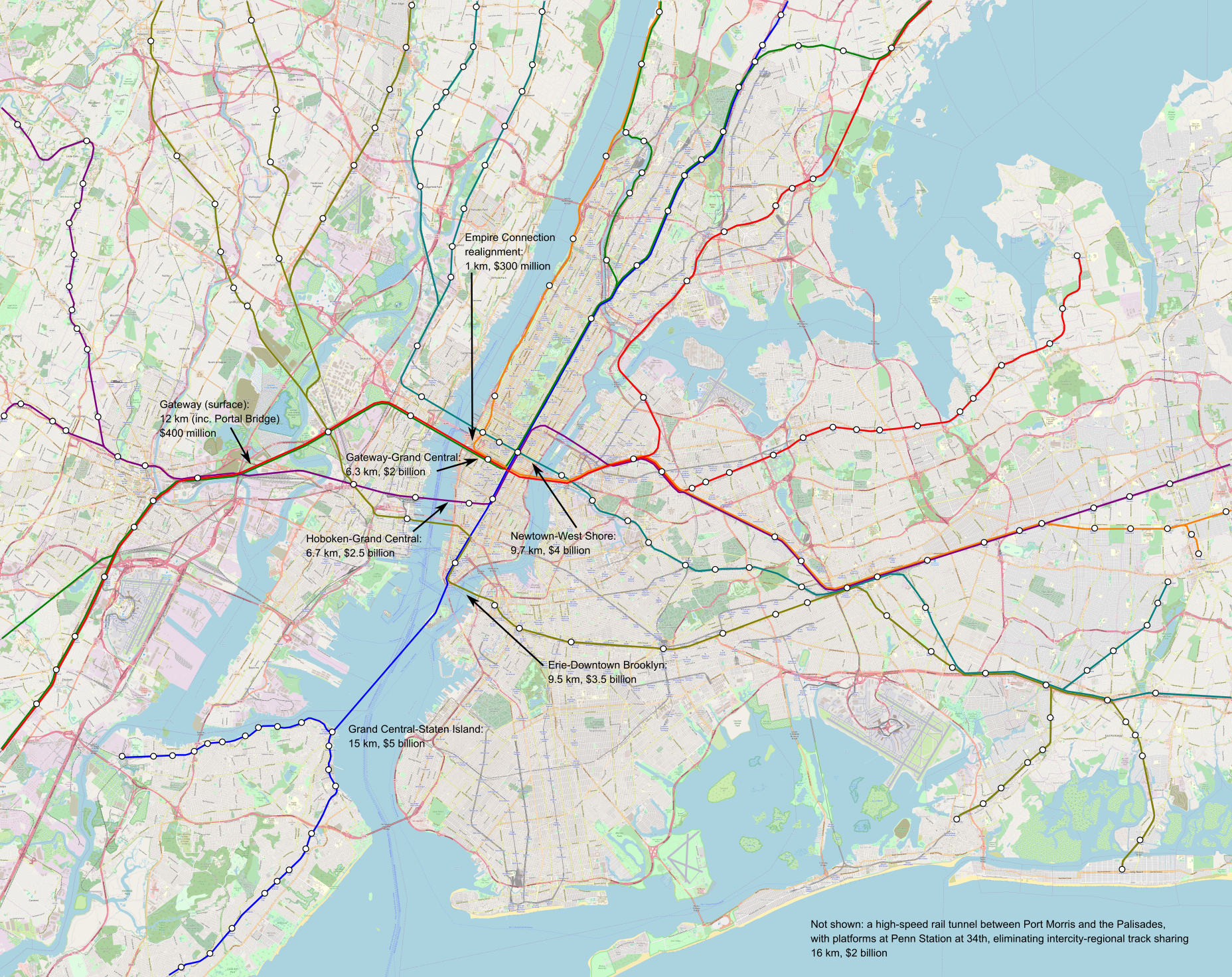

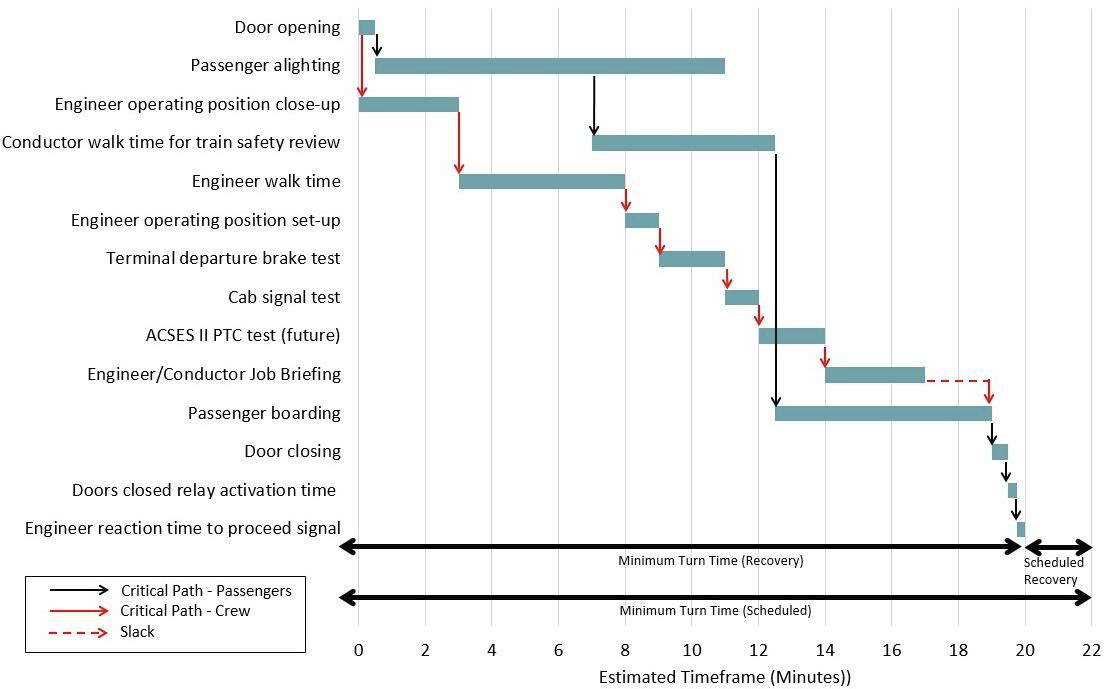




 Pedestrian Observations