Category: Urban Transit
The Wrong Kind of Branching
Transit lines branch. Core routes have more demand than outlying ones, so naturally trains and buses run on trunk lines in the core and then branch farther out, to match frequency to demand. I gave an overview of this years ago. This is both normal across nearly all significant transit systems, and good practice. In this post, I’d like to focus on the opposite kind of branching, which I am going to call reverse branching, when one outlying line splits into two core routes. This is much less common, but exists in multiple cities, and leads to problems including restrictions on capacity and disappointing ridership. Cities should avoid building new lines that reverse branch, and in one famous existing case, London’s Northern line, the city is working on changing the situation by building a new outlying branch.
London’s Northern line, as can be seen on the Underground map, has three branches to the north and two in the center, but just one to the south. The highest ridership demand is in the center, but because both branches feed into just one southern branch, there is less than full capacity on the central branches, about 20 trains per hour each, compared with 30 tph on the southern branch and 33 tph on the Victoria and Jubilee lines. As a result, Transport for London has made recurrent plans to split the line for good: one central branch (through the City of London) using the existing southern branch and two of the northern ones, and one (through Charing Cross) using one northern branch and terminating at Kennington, the junction with the southern branch. An under-construction extension of the line from Kennington to Battersea can then be tied to the Charing Cross branch. There is some NIMBY opposition from a member of Parliament representing a constituency on one of the northern branches, who would like her constituents to have one-seat rides to both branches, but most likely, Transport for London’s need for capacity will make the split inevitable once the Battersea extension opens, ending the reverse branching practice.
In New York, routes branch and recombine, and thus it is common to have trains of different colors (which only denote Manhattan trunks) running together on a branch in Brooklyn, Queens, or the Bronx. The single busiest entry point into the Manhattan core is via 53rd Street Tunnel (connecting to Queens Boulevard), technically a branch since it runs trains connecting to both the Eighth and Sixth Avenue Lines. This, again, causes capacity problems. It’s not so bad on the numbered lines, where four trunk tracks (the Manhattan express trunks, carrying the 2/3 and 4/5) recombine in a different way to four tracks in Brooklyn (pairing the 2/5), but the lettered lines’ reverse branching in Uptown Manhattan and Queens initially forced eight trunk tracks (the Sixth and Eighth Avenue services, the B/D/F and A/C/E) to converge to six branch tracks (the two Queens Boulevard express tracks via 53rd, and the four Central Park West tracks). New subway connections have replaced this situation with twelve trunk tracks (including the Broadway Line’s N/Q/R) splitting to ten, spreading the problem around but not dealing with the fundamental restriction on capacity. The under-construction Second Avenue Subway will connect to the Broadway Line and run Q trains, raising the number of lettered tracks Uptown and in Queens to twelve, but this will not be enough to disentangle the tracks and provide full capacity on each core track; see below for proposed examples.
In Delhi, the Green Line splits into short branches, to provide transfers to two different Metro trunk lines. As seen on the system map, the Green Line does not enter central Delhi, and the current setup allows passengers to travel to central Delhi via two different routes. However, the Phase 4 extension plan extends the one branch to go out of the city in a V-shaped direction (the light green Kirti Nagar-Dwarka Section 28 line on this map), and has an extension that may connect to the other branch (Inderlok-Indraprastha, colored ocher on the map) to connect it to central Delhi, which may cause a serious mismatch in demand on the outlying common segment.
Finally, in Tokyo, subway lines reverse branch in two locations. The Namboku and Mita Lines share their southernmost three stations and the tracks in between. Although most Tokyo subway lines, including Namboku and Mita, run through to commuter lines, which provide the normal kind of branching, the Mita and Namboku Lines only do so either to the north or via the shared segment, as seen on this map, constraining capacity. They run only 12 peak tph each, and have low ridership by Tokyo subway standards. The Fukutoshin and Yurakucho Lines are in a similar situation, but the Fukutoshin Line does run through to a commuter line, the Tobu Tojo Line, without going through the shared segment (it is not depicted on the map, which is a few years out of date). The Fukutoshin Line has low ridership (see last page here), but the Yurakucho Line does not.
In all examples I’ve listed so far, the two core branches serve very central areas (as in London, New York, and Tokyo), or neither of them does (as in Delhi). Tokyo is somewhat of an exception, since the Yurakucho and Mita Lines serve Central Tokyo and the Fukutoshin and Namboku Lines serve secondary centers, but those secondary centers are very dense themselves; the Mita and Namboku Lines in particular are quite close in ridership. I am more wary of proposals to split an outlying line in the core that have one branch serving the CBD and one branch avoiding it, as in Delhi, assuming I understand the proposal correctly.
Also of note, all the examples I’ve listed involve subways. This is because conventional branching, with a core trunk splitting into multiple outlying branches, is more limited on urban rail than on both buses and regional rail. Most subway lines do not have more than two branches feeding into a trunk. In New York, not counting the split in the A, which is inherited from the LIRR, there is exactly one place where three subway routes share tracks: the N, Q, and R from Manhattan to Queens. In Stockholm, with its highly branched subway network, only one line, in one direction, splits into three. This is because even a split into three branches requires limiting off-peak frequency on the branches to less than a train every ten minutes, which is undesirable in large subway systems. The result is that reverse branching can easily create a situation in which there are more tracks in the core than in the outlying areas, as it does in all four cities surveyed above, restricting capacity on each core track.
In contrast, regional rail tends to operate at lower frequency on the branches, and this permits conventional branching with more than two branches per trunk. In addition, there are often turnback facilities at through-stations, and substantial four-track segments on otherwise two-track lines. The result is that reverse branching is possible without any constraint on core track capacity. The Berlin S-Bahn is highly branched in both the conventional and reverse senses. The RER E is being extended to the west, including a takeover of an RER A branch. And the Tokyo commuter rail network has extensive reverse branching, coming from through-service between commuter lines and subway lines but also from the Shonan-Shinjuku Line’s split from the Tokaido and Tohoku commuter lines. In none of these cases is there a significant restriction on core capacity, simply because there’s enough slack in the branches that they can’t fill to track capacity unless the core has filled as well.
In the US, I am familiar with three proposals for new subway lines that involve reverse splits, in Boston, Washington, and New York.
In Boston, the proposal actually involves commuter rail rather than the subway: the Worcester Line would use the Grand Junction Railroad to go through Cambridge to reach North Station, bypassing South Station. See map on page 38 of the statewide transportation capital budget proposal. This would not reduce capacity, since the Worcester Line is nowhere near exhausting the capacity of a two-track railroad, and moreover, the Grand Junction line would terminate at West Station within Boston proper, where there’s a railyard. However, this is still bad transit, for other reasons. West Station serves a residential neighborhood, without enough density to justify a fork toward both North Station and South Station. On top of that, since North Station lies outside the Boston CBD, the proposal is essentially a mixture of a radial and a circumferential line, with all the problems that would bring – and despite running as a circumferential line through Cambridge, there is no transfer planned with the Red Line, although the Grand Junction passes close to the Kendall/MIT station.
It would be better to bag all plans to use the Grand Junction until such time that the state builds the North-South Rail Link, connecting North Station with South Station. Then, the Grand Junction would make an almost perfect alignment for a circular line, with its eastern leg connecting North and South Stations and its western end going through Cambridge, making several stops, including a transfer to Kendall/MIT. This would require high investment – besides being a single-track at-grade line, the Grand Junction would require a new junction to connect to the Worcester Line to go east toward South Station, whereas today it only connects to the west, toward Allston and Brighton – but still a fraction of the cost of the North-South Rail Link, which is getting some serious political support, including from former governors Michael Dukakis and William Weld.
In Washington, there already is some reverse branching: the Yellow and Blue Lines share tracks in Virginia, but run on two different trunk lines in Washington proper, each shared with other lines, so four central tracks become four tracks in Virginia. But now with the opening of the Silver Line, raising the number of Virginia tracks to six, WMATA would like to separate the Blue Line from the Orange Line, which it shares tracks with in Washington, in order to provide six tracks across the District as well. This can only lead to awkward service patterns and wasted core capacity, as Matt Johnson demonstrates on Greater Greater Washington: because the Orange and Silver Line will keep interlining under any plan, reckoned from their split east there are only four tracks in Virginia and not six. Moreover, the Yellow Line interlines with the Green Line in the District, which means that even if it’s separated from the Blue Line, it could not run at full capacity.
Washington built itself into a corner with its Metro route decisions. There’s no corridor in the city that really needs a subway line; unlike New York, Los Angeles, and San Francisco, Washington has no corridor with so much bus ridership that it should be a subway line. A fourth subway line would be useful for service to Georgetown, but that’s about it. So decisions about a fourth line in the District should be based on the capacity needs of the branches, not those of the core. On a list of possible changes that WMATA looked at, Greater Greater Washington included a separated Silver Line, including separation up to the junction with the Orange Line so that they share no tracks. I’ll add that if WMATA wants to go down that route, then it should give the Orange Line its own route through the District and keep the Silver and Blue Lines together; this is because the Orange Line is the busiest of the three, so that it should be the least branched, in this case not branched at all whereas the other two do branch.
Finally, New York. Second Avenue Subway is going to change the nature of the reverse branching used by the lettered lines, for the better. Because the plan for Phases 1 and 2 is to run only the Q train, the city will finally have matching numbers of lettered tracks in and north and east of the Manhattan core: twelve tracks in the core, and twelve in Uptown Manhattan and Queens. Unfortunately, it is impossible to match service, because that would sever too many connections. Second Avenue Subway only connects to the Broadway express line, so to match service there couldn’t be any other service using the Broadway express.
Recall the London NIMBYism mentioned at the beginning of this post: that was about a service change that would give commuters a cross-platform (see comment with diagram) transfer between their branch of the Northern Line and the central segment of the other branch. In New York, the transfers in western Queens involve a lot of walking between platforms, if they even exist. Then all the Broadway locals (the N/R) would go to Queens through 60th Street Tunnel, and thence to the Astoria Line, severing the connection to the Queens Boulevard Line. The Queens Boulevard Line has two ways into Manhattan: 53rd Street, which connects to both Eighth and Sixth Avenues, and 63rd Street, which connects only to Sixth Avenue. Moreover, either all F trains (through 63rd) have to run express in Queens and all E trains local, or the reverse; mixing and matching would produce at-grade conflict at the junction, as seen on the Queens 1 track map on nycsubway.org. The transfer between the E and F would be located at 74th Street in Queens, several kilometers east of the split, which is located just to the east of the westernmost express/local station, Queens Plaza. Neither the E nor the F would have a transfer to the N/R near their respective intersection points. The Q would not have a transfer to the E (it would have one to the F, though). This puts many commuters in an impossible situation and the capacity gains from it are frankly not enough to be worth it.
Instead, the capacity gains would be limited to running some more express trains on the Broadway Line. Before the service cuts in 2010, the N ran express on the Broadway Line, the Q terminated at 57th Street at the north end of Midtown, and a fourth Broadway route, the W, ran local and served the Astoria Line. Once the Q is extended up Second Avenue, the restored W could beef up Broadway Line service. Second Avenue would only get a branch despite its high ridership, but it’s still only a segment of a line.
Then there are Phases 3 and 4 of Second Avenue Subway, serving Midtown and the Lower East Side, where the Q runs on Broadway. The official plan introduces another reverse branching: a new route, the T, is planned to run the entire length of Second Avenue: see map here. When both phases are complete, there will be fourteen lettered tracks in Midtown but only twelve Uptown and in Queens.
To resolve this, the MTA should activate a connection that is included in the Second Avenue Subway plan as a non-revenue connection: a connection from Second Avenue south of the Q/T split at 63rd Street to 63rd Street Tunnel; currently, 63rd Street is the least used connection from Manhattan to Queens, since the reverse branching limits capacity and 63rd Street is the least useful connection since it enters Manhattan north of Midtown. This implies there should be a Queens Boulevard-Second Avenue service, which I will call the U, one letter next to the T. The Queens Boulevard express tracks are filled to capacity and the local ones are not, so the T should run local, cutting the frequencies on the existing local R and M trains a bit to make room. It would still leave New York with twelve Uptown and Queens tracks diverging to fourteen Midtown tracks, but it would distribute the load better, in the same way the present system distributes the load better than the 1930s-era reverse branching from six to eight tracks did.
New York is in a somewhat special case, in that its subway system is based on heavy branching and reverse branching, and moreover it’s historically based on three different systems, with poor transfers between them. Fully untangling the lines after Second Avenue Subway’s Phases 1 and 2 are built is not possible because there are no transfers between the lines that would result, and the station placement is such that any new transfers would involve long walks between platforms.
Other cities, especially cities planning new systems from scratch, should not emulate this feature, and should instead design all lines to either not branch at all or only branch conventionally. A system designed from the ground up could have cross-platform transfers between lines, and even make sure they’re timed, reducing the cost to passengers of having to transfer in lieu of using a reverse branch. It could be coherent, in the sense of making it easy for an unfamiliar passenger to understand how to get from each station to each other station. And it could be built for maximum capacity in the most crowded segments, where it matters the most.
Authoritarian Leaders and Agenda Setting
On Tuesday, Andrew Cuomo proposed a new signature initiative: a $450 million AirTrain to LaGuardia, connecting to the Mets’ stadium on both the 7 train and the LIRR. The proposal has practically no merit even as an airport connector: Ben Kabak and Yonah Freemark both note, with helpful graphics, that the connection is so circuitous it’d be slower than the existing bus-subway options to nearly every destination, including everywhere in Manhattan. Capital New York notes that in general, transit activist reactions to the plan were cold, precisely because it’s such bad transit.
The interesting aspect of this is about the counter-criticism, and the discussion it led to. (In contrast, Cuomo’s general hostility to transit and intercity rail is not news, and it’s unlikely someone with such a history could come up with cost-effective transit plans.) The main reaction to the criticism is not “where would you spend $450 million instead?”. That question has a few answers, all of which are boring: the general MTA capital plan, or, if the money is to go to expansion, Second Avenue Subway Phase 2, the next item on the city’s transit agenda now that Phase 1 is nearing completion.
Instead, the main reaction is “how would you connect to LaGuardia instead?”. That question, too, has a definite answer, which Ben talked about in his post, and which I pointed out in my post about airport connectors last year: an extension of the N to the east, with several stops (for example, at Steinway and Hazen) to serve more of Astoria and not just airport riders. The N takes a direct route to Manhattan, passing through or next to the top areas for LaGuardia passengers, as seen in the second map here. But even that is the wrong question. There are probably more cost-effective subway extensions in New York, having nothing to do with LaGuardia; I have to say probably, since at no point has the MTA proposed large enough a slate of possible extensions that we can compare projected costs per rider and say “this is the best.” There might even be better ways to extend the N eastward than to LaGuardia: an elevated line over Ditmars, a short segment of the Grand Central Parkway, and Astoria Boulevard would serve East Elmhurst, a dense, transit-deprived section of Queens, and would probably produce higher ridership than a swerve from the GCP to the airport.
Such is the power of a governor who’s accountable to nobody: he proposes a scheme, and even the criticism is on the governor’s own terms of providing service to LaGuardia. Yonah compares travel times to various destinations on various alignments for connecting LaGuardia to the subway. Nate Silver’s response has an infographic with travel times from the airport to city hall in various American cities – an infographic that is of little use to New York, where the main destination is far north of city hall, but is well within the general topic of LaGuardia’s airport connections. Even I, cognizant of this agenda-setting power, have to at least mention an alternative LaGuardia connector, knowing readers will want a plan.
The cheeky response to this is that in a democracy, this wouldn’t happen. Now, the US is a democracy. Cuomo has to stand for election every four years. The worst infrastructure disasters tend to be in countries that are authoritarian through and through: Russia’s elevated winter Olympics costs in Sochi and Qatar’s human rights abuses in the World Cup preparations are the two biggest recent examples. But democracies with insufficient checks on political power are susceptible to this as well. This is common in the third world, where corruption is more common – hence the abuses of the World Cup last summer, in a solidly democratic country – but can also happen in developed countries with democratic deficits.
Usually, the phrase democratic deficit refers to the EU, and by analogy other supranational organizations. But in the US, it’s a useful framework for thinking of local and state governments. Rick Scott, Scott Walker, and John Kasich needed nobody’s approval to reject federal funding for intercity rail. Chris Christie did not need anyone’s approval to cancel ARC, or to cause traffic jams in retribution against a mayor who refused to endorse him; in a recent article in New York YIMBY, defending the cancellation of ARC as originally proposed, I made sure to take multiple barbs at Christie, just to avoid playing into the agenda of canceling ARC to posture about government waste while diverting rail money to the New Jersey Turnpike.
Cuomo’s power is if anything even greater: the New York state government works by a three men in a room model, in which the governor, the speaker of the State Assembly (just indicted for corruption), and the majority leader in the State Senate (currently relatively powerless and dependent on Cuomo) wield all practical power. In such a system, Cuomo does not have the power to shoot protesters, thankfully, but does have the power to propose megaprojects that glorify him, without a broad discussion with stakeholders, in which the MTA’s long-term expansion plans and cost-benefit ratios would come into play.
Last year, in writing about elite infrastructure projects that are not about meeting a service need, I noted that talking about such projects in terms of cost-effectiveness is moot, because they were never intended to be about benefiting the wider public. We could discuss where to spend money on transit in New York in the way that would benefit the largest number of riders. We could even discuss what the optimal way of connecting to LaGuardia is, before comparing the best connection with non-airport projects to see where it should lie on the list of future expansions. But it would be pointless, because Cuomo is not interested in spending money on benefiting the largest number of riders; he frankly does not care about transit riders. When the time came to support transit riders, for example in signing a lockbox bill guaranteeing that money the state government had promised the MTA would indeed go to the MTA, he vetoed the bill instead.
In such a climate, as soon as we talk about tweaks to Cuomo’s plan, Cuomo’s already won; whatever happens, he will reap the credit, and use it to buy political capital to keep building unnecessary megaprojects. Even trying to make the best of a bad situation by making the airport connector better is of little use, since Cuomo will support the plan that maximizes his political capital and not the one that maximizes transit usage even within such constraints as “must serve LaGuardia.”
This is evident in his response to criticism among transit activists. After listing the many pundits and activists who oppose the plan, Capital New York included a response from the governor’s office, which said, in so many words, “our plan is better because it doesn’t go through populated neighborhoods, where there would be NIMBYs.” What those of us who want good transit view as a feature – connecting to underserved neighborhoods and not just to the airport – Cuomo regards as a bug. A plan that included additional stops in Astoria might well attract community support, while still offering much faster trip times to Manhattan because of the direct route, but would rely on non-airport ridership, which Cuomo doesn’t care about, to keep the cost per rider reasonable.
Because of this disconnect between what would work for transit users and what would work for Cuomo, the only reasonable answer to the plan is a simple no, which should be said as sharply as possible. No working with the proposal: it’s terrible, a true stone soup. No tweaks: Cuomo wouldn’t want any ingredients that would improve the soup, and would insist on keeping the stone in anyway. (He doesn’t have to eat it, he doesn’t use transit either way.) And, within the parameters of a transit conversation in which people are desperate to see expansions, no discussion that validates Cuomo’s original plan.
Update 7/28: in a joint announcement with Joe Biden, Cuomo has just announced $4 billion in airport improvements at LaGuardia, bundling the rail connector into the larger projects. I have nothing to add that I didn’t already cover in this post and in my older post about elite infrastructure investments.
Mixing Circumferential and Radial Transit
Nearly all rapid transit lines belong to one of two categories: radial lines (a large majority), which connect city center with outlying neighborhoods or suburbs; and circumferential lines (a minority), which go around city center and often serve secondary centers and usually intersect all or nearly all radial lines perpendicularly, such as Paris’s Lines 2 and 6, Moscow’s Circle Line, Seoul’s Line 2, New York’s G train, and Shanghai’s Line 4. In this post, I’m going to discuss an uncommon third category, that of lines that combine circumferential and radial functions: they go toward city center, like a radial line, but then change direction and become circumferential. The G train in New York was like this until 2001, and Line 3 in Shanghai is like this today. This is apropos a proposal by a team Penn Design graduate students to build a variant of Triboro RX in New York that combines Triboro’s circumferential orientation with a radial commuter line. I believe such mixed lines are a recipe for low ridership and strained transfer points, and the Penn Design proposal is inferior to the original Triboro proposal.
First, some details about the mixed lines in question. The example most accessible to most readers is the historical G train in New York. When it first opened in the 1930s as part of the IND, it was designed to both connect Brooklyn and Queens without going through Manhattan and provide local service along radial lines, running alongside express trains that would serve Manhattan. Thus the northern half of the G ran under Queens Boulevard as a local, while the E and F trains provided express service and went to Manhattan. From the start, this arrangement was unstable. Demand for service to Manhattan was much greater than to Brooklyn, so people riding the G inbound changed to the E or F at the first express station after the one they boarded. With overcrowded express trains and undercrowded local ones, the Transit Authority was compelled to build a track connection in 1955 to add a Manhattan-bound local service, and to build a second track connection in 2001 to add another Manhattan-bound local train and remove the G from Queens Boulevard entirely.
In Shanghai, Line 3 was built as an (almost) entirely above-ground line, interlined for part of the way with the circular Line 4. The northern half of Line 3 is radial, running parallel to the overcrowded Line 1. However, where Line 1 enters the traditional center and serves People’s Square, Line 3 swerves west to go around it (missing Lujiazui, the new high-rise CBD to the east of People’s Square), interlining with Line 4, and leaving the loop southward to intersect Line 1 again at Shanghai South Railway Station. Its ridership disappoints not only by the standards of Line 1, but also by those of Line 4: 642,000 on 2014/4/30, the system’s busiest day, compared with 1,384,000 on Line 1 and 907,000 on Line 4. Line 6, which likewise combines a radial function at its northern end with a circumferential one at its center, serving Century Avenue but not Lujiazui or People’s Square, has even lower ridership, 376,000, although this is several times the original projection.
There’s a discussion on Human Transit, in which consensus is that the best circumferential lines connect secondary activity nodes that generate trips in their own right. Now, the G train connects Downtown Brooklyn (the largest business district in New York outside Manhattan) with Long Island City (one of the business districts of Queens), but it lacks the other positive feature of circumferential lines: transfers to the radial lines, to allow one-transfer trips from anywhere to those secondary nodes. The G has good transfers only to other IND lines, and at the Queens end, its transfer to the Queens Boulevard trains was cut in 2001 since, for operational reasons, it was cut not to its old junction with the E and F (Queens Plaza) but one station short (Court Square). Other G transfers are very recent and require a considerable amount of walking.
In contrast to the underperforming G, circumferential lines that both connect important activity nodes and have plenty of radial transfers are backbones of their cities’ transit systems. Shanghai’s Line 4 is fairly busy as noted above. Seoul’s Line 2 is according to a forum post the busiest in the system. Paris’s Lines 2 and 6 are only about average in ridership but combined would be the second busiest after Line 1 (and per route-km are third and fourth, only behind Lines 1 and 4, but are only narrowly ahead of many other lines). The juxtaposition of Shanghai’s Lines 3 and 4 in particular suggests that subway lines shouldn’t try to mix radial and circumferential functions.
Let us go back to the impetus for the post, Triboro RX. The proposal is to largely use existing freight rail lines, all of which are lightly used and could be turned over to the subway, to provide a semicircular line connecting nodes of activity in the Bronx, Queens, and Brooklyn. Because of the focus on using an existing right-of-way to reduce costs, the line misses the most important nodes in Brooklyn and Queens, which are served by the G in any case. However, it passes within half a kilometer of the Hub in the Bronx and, via a short greenfield tunnel, connects to Yankee Stadium, the Bronx’s busiest subway station; it also connects to Brooklyn College and 74th Street/Broadway in Queens, both busy stations if not as central as Downtown Brooklyn or Long Island City. Moreover, it provides direct Bronx-Queens service, which in the existing system requires circuitous routes through Manhattan with difficult transfers, and has reasonable transfers to nearly all subway lines. At the end, the lack of service to Downtown Brooklyn ensures it cannot be a very well-patronized line, but as the right-of-way is almost entirely in place, its cost per rider could be quite low.
In contrast, the Penn Design proposal, called Crossboro, severs the connection to the Hub and Yankee Stadium, and replaces it with service along the Northeast Corridor to Coop City, making sparse stops, at the same locations Metro-North plans to for Penn Station Access; this is 4 stops in 10 km in the Bronx, compared with stops spaced roughly every 800 meters in Queens and Brooklyn, as in the original proposal. The trains would be certified for mainline operation, on the model of the London Overground, rather than segregated from mainline traffic.
The problem with the Crossboro idea is essentially the same as that of the G train until 2001. Most riders at the four Bronx stops are interested in getting to Manhattan, and not to the neighborhoods served by Crossboro, so they’d look for transfer opportunities. The only such opportunity in the Bronx is at Hunts Point, to the 6, which unlike the E and F on Queens Boulevard runs local and provides slow service to Manhattan. With the extra transfer, there is no advantage to Bronx riders over continuing to walk or take the bus to the 2, 5, and 6 trains to Manhattan. Moreover, because of the poor transfers within the Bronx, it’s impossible to use the line to connect from Queens to anywhere in the western half of the Bronx, including Yankee Stadium and the Hub: there’s a connection only to the 6, and none to the 2, 4, 5, or B/D, or to Metro-North.
The principle in action here is that, especially when there are no compelling destinations, it’s critical to make sure the line provides connectivity between large regions. This means connecting to all or almost all radial lines in a region well-served by radial subways but poorly served by preexisting circumferential ones. Not including the 1, which no proposal connects to, the Bronx has five subway lines, all providing radial service to Manhattan; it is a feature of Triboro that it connects to all five (though the connection to the 2/5 requires a long walk), ensuring that people from nearly everywhere in the Bronx can use the line to get to its destinations in Queens and Brooklyn with one transfer. To get from anywhere to anywhere would require two transfers, but to get from a random station in the Bronx to one in Queens or Brooklyn often already requires two transfers, usually at busy Manhattan stations that are out of the way for the crosstown traveler.
Mixing radial and circumferential service interferes with this principle, since the radial component has to come at the expense of completing the circle (or semicircle in a geographically-constrained city like New York). Thus, it’s harder to use the line to get to a large enough variety of points of interest to make up for the fact that it misses the city’s most important destinations. Of course, such a line is also wanting as a radial line, since it misses the center. Thus, ridership underperforms, and the line usually fails to achieve its stated purpose.
Quick Note: High Third-World Construction Cost Examples
Dhaka, the world’s poorest megacity (at least until Kinshasa crosses 10 million and qualifies as a megacity), is building a metro system. Using Japanese financing and Indian consultants, it is planning to build a multi-line system, and getting bids for the first line. This line is going to be elevated, and 20-21 kilometers long; construction costs are 220 billion takas, which is $2.8 billion in exchange rate terms and about $8.5 billion in PPP terms.based on the 2013 conversion factor here. This is a bit more than $400 million per kilometer, which is high for a fully underground line, let alone an elevated line.
Jakarta, which is much richer, but still third-world (Indonesia is slightly poorer than China, as of 2014), is building a metro as well. Its first line’s first phase is mixed underground and above-ground: 15.7 kilometers, of which 9.2 are underground. The cost is $1.4 billion, or about $4.2 billion after PPP conversion, giving $266 million per km, still on the high side for a 59% underground line, but nothing as extreme as in Dhaka.
It’s a reminder that poor countries aren’t just low-cost. Things usually are cheaper in the third world, but by a much smaller factor than the income difference. Bangladesh’s GDP per capita, before any PPP conversion, is about $1,000. It is cheaper than the US and Europe, but not by a factor of forty or fifty, but by a factor of about three. Three is an average – imported electronics cost about the same in exchange rate terms everywhere, whereas rent is much more sensitive to local wages – but, for rapid transit construction cost, the average turns out to level the entire difference between the first and third worlds. Some countries, like China, are still a bit cheaper than Europe, while others, like Bangladesh, overshoot.
What is the MTA Reinventing, Anyway?
In the last few years New York’s MTA has gone through multiple cycles in which a new head talks of far-reaching reform, while only small incremental steps are taken. The latest is the MTA Transportation Reinvention Commission, which has just released a report detailing all the way the MTA could move forward. Capital New York has covered it and hosts the report in three parts. Despite the florid rhetoric of reinvention, the proposals contained in the report are small-scale, such as reducing waste heat in the tunnels and at the stations on PDF-pp. 43-44 of the first part. At first glance they seem interesting; they are also very far from the reinvention the MTA both needs and claims to be engaging in.
Construction costs are not addressed in the report. On PDF-p. 53 of the first part, it talks about the far-reaching suburban Grand Paris Express project for providing suburb-to-suburb rapid transit. It says nothing of the fact that this 200-km project is scheduled to cost about 27 billion euros in what appears to be today’s money, which is not much more than $150 million per km, about a tenth as much as New York’s subway construction. (Grand Paris Express is either mostly or fully underground, I am not sure.) The worst problem for transit in the New York area is that its construction costs are an order of magnitude too high, but this is not addressed in the report.
Instead of tackling this question, the report prefers to dwell on how to raise money. As is increasingly common in American cities, it proposes creative funding streams, on the last page of the first part and the first six pages of the second part: congestion pricing, cap-and-trade, parking fees, a development fund, value capture. With the exception of congestion pricing, an externality tax for which it makes sense for revenues to go to mitigation of congestion via alternative transportation, all of these suffer from the same problem: they are opaque and narrowly targeted, which turns them into slush funds for power brokers. It’s the same problem as the use of cap-and-trade in California.
One of the most fundamental inventions of modern government is the broad-based tax, on income or consumption. Premodern governments funded themselves out of tariffs and dedicated taxes on specific activities (as do third-world governments today), and this created a lot of economic distortion, since not all activities were equally taxed, and politically powerful actors could influence the system to not tax them. The transparent broad-based tax, deeded to general revenue through a democratic process, has to be spent efficiently, because there are many government departments that are looking for more money and have to argue why they should get it. Moreover, the tax affects nearly all voters, so that cutting the tax is another option the spending programs must compete with. The dedicated fund does neither. If the broad-based tax is the equivalent of market competition, a system of dedicated funds for various government programs is the equivalent of a cartel that divides the market into zones, with each cartel member enjoying a local monopoly. In this way there’s a difference between the hodgepodge of taxes the MTA levies and wants to levy and Ile-de-France’s dedicated 1.4-2.6% payroll tax: the payroll tax directly affects all Francilien workers and employers, and were it wasted, a right-wing liberal politician could win accolades by proposing to cut it, the way New York Republicans are attacking the smaller payroll tax used to fund the MTA.
The proposals of where to spend the money to be raised so opaquely are problematic as well. There is a set of reforms, based on best practices in Continental Europe and Japan, that every urban transit system in the first world should pursue, including in their original countries, where often only some of those aspects happen. These include proof-of-payment fare collection on buses, commuter trains, and all but the busiest subway systems; all-door boarding on buses; mode-neutral fares with free transfers; signal priority and bus lanes on all major bus routes, with physically separated lanes in the most congested parts; a coherent frequent bus network, and high off-peak frequency on all trains; and through-service on commuter rail lines that can be joined to create a coherent S-Bahn or RER system. As far as I can tell, the report ignores all of these, with the exception of the vague sentence, “outfitting local bus routes with SBS features,” which features are unspecified. Instead, new buzzwords like resiliency and redundancy appear throughout the report. Redundancy in particular is a substitute for reliability: the world’s busiest train lines are generally not redundant: if they have parallel alternatives those are relief lines or slower options, and a shutdown would result in a major disruption. Amtrak, too, looks for redundancy, even as the busiest intercity rail line in the world, the Tokaido Shinkansen, has no redundancy, and is only about to get some in the next few decades as JR Central builds the Chuo Shinkansen for relief and for higher speeds.
The only foreigners on the Commission are British, Canadian, and Colombian, which may have something to do with the indifference to best industry practices. Bogota is famous for its BRT system, leveraging its wide roads and low labor costs, and Canada and to a lesser extent the UK have the same problems as the US in terms of best industry practices. Swiss, French, German, Japanese, Spanish, and Korean members might have known better, and might also have been useful in understanding where exactly the cost problems of the US in general and New York in particular come from.
The final major problem with the report, in addition to the indifference to cost, the proposal for reactionary funding sources, and the ignorance of best industry practices, is the continued emphasis on a state of good repair. While a logical goal in the 1980s and 90s, when the MTA was coming off of decades of deferred maintenance, the continued pursuit of the maintenance backlog today raises questions of whether maintenance has been deferred more recently, and whether it is still deferred. More oversight of the MTA is needed, for which the best idea I can think of is changing the cycles of maintenance capital funding from five years, like the rest of the capital plan, to one year. Long-term investment should still be funded over the long term, but maintenance should be funded more regularly, and the backlog should be clarified each year, so that the public can see how each year the backlog is steadily filled while normal replacement continues. This makes it more difficult for MTA chiefs to propose a bold program, fund it by skimping on maintenance, and leave for their next job before the ruse is discovered.
I tag this post under both good categories (“good transit” and “good/interesting studies”) and bad ones (“incompetence” and “shoddy studies”) because there are a lot of good ideas in the report. But none of them rises to the level of reinvention, and even collectively, they represent incremental improvement, of the sort I’d expect of a city with a vigorous capital investment program and industry practices near the world’s cutting edge. New York has neither, and right now it needs to imitate the best performers first.
Toward a Tel Aviv S-Bahn
I have been thinking of alternatives to the current plan for a Tel Aviv Subway for several years now; last year I expounded on some principles for a better plan. As I mentioned last year, Tel Aviv’s subway system should be shaped roughly like the letter E, with a single north-south spine paralleling the rail mainline and three east-west lines intersecting the mainline at the city’s three main train stations. Today I would like to give more details about this system, with special focus on commuter rail. While thinking of how to create an optimal system serving the region’s secondary centers, I came upon an important principle used on the Paris RER and the Zurich S-Bahn, which past posts (including my own) on the subject downplayed in favor of city-center tunnels: namely, it is often correct to deviate from legacy alignments for a few kilometers in order to better serve a secondary center, even if it requires some greenfield tunneling.
Before I go on, I will note that this plan is intended to be politically neutral, in the sense of serving the dense primary and secondary urban centers of Gush Dan regardless of ethnicity, and with only weak regard for income. In my view, if there are anti-government riots in response to police shooting of a young minority, this is not a reason to deny service to the area; on the contrary, denial of social services is what creates the social alienation that contributes to rioting. But more than this, this plan assumes everyone travels to the same destinations, a reasonable approximation in a country with the level of social integration of the US or a monolingual European country, but a problematic one in Israel.
About 18% of Israel’s population is Arab, and another 12% is ultra-Orthodox; both groups are highly segregated, and have their own job centers. On 972Mag’s Hebrew-language sister site, Noam Sheizaf reports that MK Hanin Zoabi (the Knesset’s sole Arab woman), best-known for her incendiary rhetoric against the IDF, criticized the state’s emphasis on developing fast transportation to Tel Aviv on the grounds that Arabs, especially Arab women, typically work close to home. Incomes are much lower than those of mainline Jews as well: I have no ultra-Orthodox data, but making mild assumptions on income distribution within each decile from Central Bureau of Statistics data, per capita income from work is about $6,000 per year for Arabs, a bit higher than Romania excluding Bucharest, and $16,500 for Jews, a bit higher than Greece or Southern Italy. The best American analogy I can think of is the development of dedicated buses for Chinese immigrants in New York City proper and ultra-Orthodox Jews in the New York area, as both groups are very poor and have different centers bypassing Midtown and Lower Manhattan.
With this deliberate decision to ignore ethnic composition in mind, my plan is to build an E-shaped subway system, with the E’s southern leg turning north at its western end to provide a second north-south line in Central Tel Aviv. Here is a link to the map I currently think works the best. The brown lines are an electrified commuter rail system running at very high frequency between Tel Aviv HaHagana and Exhibition Center (currently called Tel Aviv University, though the station is quite far from the center of campus). Observe that the lines deviate from the current network in a few places:
* The circumferential service running along the Eastern Line loops to serve Elad better.
* There is a new branch into Kafr Qassem, passing much closer to Rosh HaAyin’s built-up area than the current Rosh HaAyin North station does.
* The Kfar Saba branch is completely redone. There are plans to connect it to the Coastal Railway concurrently with building a freeway along the same alignment, going due west from its current terminus alongside Route 531. The freeway should be scrapped – Israel is building too many of them, and insists of bundling every transit project with a freeway (even the currently proposed Red Line is planned to come together with a freeway tunnel through an alignment near Jaffa Road in South Tel Aviv, forcing the line to go deeper and raising its costs). Moreover, the connection west of Kfar Saba should be more direct. Conversely, east of Kfar Saba there is a right-of-way that can be used to send trains up to Tira, and perhaps farther into the Triangle, into Tayibe or Qalansawe.
* There is a new branch to Glilot and Herzliya Pituah, an edge city located a bit too far from the Herzliya train station to be a comfortable walk, especially along the wide, pedestrian-hostile access road.
* The line enters Netanya along a new alignment, with a short tunnel; the current Netanya station is at the edge of the built-up area.
* There is a reactivated branch serving Tsrifin.
* The route through Rishon LeZion avoids the current plans to connect Rishonim Station (Kiryat Simha on my map, to avoid confusing with Ramat HaSharon Rishonim) to the Ashdod Branch via Route 431, avoiding the Rishon LeZion built-up area. Rishon is a sprawling suburb, but has more than 200,000 people, and secondary centers; it is better to spend a bit more money, tunneling under the center of the city and going above-ground to its west to serve the College of Management Academic Studies, Israel’s largest independent (i.e. non-university) college.
These short tunnels are in line with construction in European cities: the Paris RER’s centerpiece is the connecting tunnels in central Paris, but as seen on this map, which includes chronology, the Charles-de-Gaulle branch opened in 1976, shortly before the RER B it connects to, and the Disneyland branch opened in 1977, concurrently with the RER A. The Zurich S-Bahn includes short greenfield tunnels to access the airport from both directions. The Stockholm commuter rail system includes a tunneled loop serving Arlanda, which was built for the Arlanda Express and then extended and used by the regular commuter trains. Usually these new tunnels serve airports or other new centers such as Disneyland, since the old secondary centers already have legacy lines, but in Israel, most towns’ train stations are located at the edge of the built-up area rather than in the center, and in the larger secondary cities, this justifies some additional tunneling.
On the same principle, the Jabotinsky subway line, which is otherwise elevated outside the Tel Aviv core, tunnels to reach central Petah Tikva, in lieu of the current plan to skirt the center of the city and go in tram mode to Petah Tikva Central Bus Station.
I expect most ridership, and by far most of the cost, to come from the subway lines, colored red, green, blue, and yellow; I call them subways, but out of the system’s 60 km, 27 are above ground and only 33 are underground, mainly in Tel Aviv proper and in the parts of Ramat Gan and Givatayim that do not have wide roads for a right-of-way. I chose names for political reasons: the north-south line is called the Jaffa Line since it passes through Jaffa, a low-income left-wing Arab area; the northern leg of the E is called the Jabotinsky Line since it runs largely along streets named after Zeev Jabotinsky, founder of Revisionist (right-wing) Zionism; the central leg of the E is called HaShalom Line since it intersects the mainline at HaShalom train station, and the peace process (shalom in Hebrew) is a cornerstone of the Zionist left; and the southern leg of the E is called HaTikva Line since it passes through HaTikva, a low-income right-wing Mizrahi neighborhood. I tried to steer clear of politics in the route choice: only the choice of names, constrained by the need to refer to features of the lines, is political.
In the remainder of the post, I will deal with possible objections to the proposal, and with various doubts and drawbacks.
1. Probably the biggest objection I expect is that the system skirts the proposed Tel Aviv CBD, which is District 6 on this map. Unlike the current plan, there are no tunnels under Namir Road, but rather the tunnels are farther west, in the city’s traditional center. This is deliberate. I do not have bus traffic data, but I do have frequency data for the most frequent buses, expressed in daily departures in both directions. It is in Hebrew on the Israeli Bike-to-Bus Rider blog; the key is that a gold medal denotes at least 4 buses per hour, a bronze one denotes at least 3, a silver one denotes at least 3 and at least 4 at and on the shoulders of the peak, and a V on the left column denotes at least 6 at rush hour. The bus route numbers are on the second column from the right. See also this frequent bus map to match route numbers to streets.
While I criticized the use of bus corridors for subway planning last year, noting that buses serve the wider Jerusalem Boulevard through Jaffa and not the narrower but more centrally-located Yefet Street, the map provides a rough guide to which regions and which directions of travel have the most demand. North-south travel along Ben Yehuda, Dizengoff, and Ibn Gabirol Streets and Namir Road is very popular. Ben Yehuda’s routes 4, 104, and 204, which HaTikva Line roughly parallels, have 642 buses per day. Dizengoff’s routes 5, 39, 72, 129, 172, and 239 have 1,071. Route 9, which runs along Ben Yehuda and Dizengoff in a one-way pair, has 162. Ibn Gabirol’s routes 24, 25, 125, 126, 189, and 289 have 986. And Namir Road’s routes 1, 40, 42, 51, 60, 71, 160, 171, 240, and 271 have 1,726. Despite the large number of buses on Namir, these buses closely parallel mainline rail, and moreover, there are 65% more buses on Ibn Gabirol and points west.
2. My plan ignores many active plans made by the state. This is on purpose: until such projects as combined freeway-rail lines are built, they should be opposed, since the road construction will ensure connectivity by road will be faster than by rail, frustrating any attempt to maintain a high public transit mode share. To my understanding, the most expensive portions of the planned subway, namely the underground parts, have not been built, and on the contrary there are constant schedule and budget slips; the current timetable calls for the completion of the Red Line in 2023, and the budget has slipped from 10.7 to 14 to 17 billion shekels; this is $200 million/km, accounting for PPP but not future inflation (if Israel holds to 2% inflation, it will be about $180 million/km), for a line that’s only 43% underground.
3. Four-tracking the mainline rail route through Tel Aviv is going to be expensive, since it requires building over or rerouting the Ayalon River. In the long run, rail growth makes such construction necessary: Israel’s economic geography forces all travel between the north and the south to go through or right next to Tel Aviv, which means potential travel demand is higher than through Stockholm, which is currently four-tracking its main route through T-Centralen to provide for both additional commuter rail and intercity rail service.
In the short run, there are two ways to cut initial costs. First, it may be the case that there is room for four tracks along the Ayalon right-of-way, as long as only two are served by station platforms. If that is true, then HaShalom should be reconfigured as a local station, with two nonstop tracks, while all trains should continue to stop at Tel Aviv Center and HaHagana, both of which already have more than 4 tracks. While HaShalom is Israel’s second busiest train station (see file here, shared by a forum member back in 2008: the leftmost column is total daily entries and exits), high-frequency local commuter rail service connecting it with Tel Aviv Center and HaHagana is an acceptable substitute if it saves a lot of money.
And second, Israel Railways runs very inefficiently, partly because of single-tracking and partly because of the use of slow-accelerating diesel locomotives. Peak traffic on the two-track mainline, excluding the third track (which is run as a captive single-track commuter line), is still in the single digits of trains per hour. While my plan calls for 10-minute peak frequencies on each of 5 branches, I believe that for a long while, several branches could make do with 20 minutes; with high-capacity signaling, and the use of the third track for emergencies if a train is late, 30 trains per hour are possible, permitting space for commuter trains as well as the four hourly intercity trains to Haifa, two to Beer Sheva, and future trains to Jerusalem.
4. Too much service to the north. The way the map is presented, without extra proposed extensions, the best-served part is District 6, which has almost no residential population: counting transfer stations twice and jurisdiction-boundary stations as belonging half to each jurisdiction, it has 1.5 stations for 4,600 residents, or 1 per 3,000. But the second best is District 3, the Old North, and even Herzliya is better-served than District 8, South Tel Aviv. It’s an unfortunate fact that Herzliya’s train station is located on a pedestrian-hostile road, between the two centers of Herzliya and Herzliya Pituah and beyond walking distance to both, requiring considerable additional construction; but it’s also possible to either eliminate the Herzliya Pituah commuter rail branch or cut the Jaffa Line to KKL Junction. The Old North needs this much service, because of the high demand for bus service along both Dizengoff/Ben Yehuda and Ibn Gabirol, as well as the presence of several major retail and entertainment centers, such as the Port, the Marina and waterfront hotels, and Dizengoff Center, making the neighborhood more than just residential.
5. Not enough service to the south, especially Holon. The official plan calls for building a second line going north-south from Tel Aviv University to Holon and Rishon LeZion, giving two north-south branches to the south (including the initial one to Bat Yam) versus one in my plan. I admit that the indirect service to Holon is problematic, but counter that the city is substantially less dense than Bat Yam, and moreover the east-west orientation of the Jaffa Line connects the two cities while giving Holon a transfer to a direct mainline rail connection to Tel Aviv. Rishon LeZion is completely cut from my subway plan, but gains a centrally-located commuter rail station.
South Tel Aviv has relatively little service, too, since the Jaffa Line and HaTikva Line have stops just outside it. The alternative I proposed within the map file, in which HaShalom Line is extended two more stops to Old Jaffa while the Jaffa Line is rerouted along the more southeasterly Shalma Road alignment, provides several more South Tel Aviv stations and makes Central Bus Station the Jaffa/HaTikva transfer point, at the cost of a detour that lengthens end-to-end trips as well as about 3 km of additional tunneling. In either case, the center of South Tel Aviv today is close enough to Central Bus Station to be serviceable, even if it’s only by one line rather than two.
6. Tight timed transfers. Unlike the simply-connected lines branching to the north, the lines to the south have multiple mergers, to be dealt with using timed transfers at Lod and Lod Junction. The plan is, using a 20-minute clockface schedule, to have Airport Branch trains leave 4 minutes before mainline Lod trains, be slowed down by the airport detour and the extra stops, and have a timed transfer with the Eastern Line at Lod Junction, which then has a timed transfer at Lod. This corresponds to a 4-minute slowdown as planned, but requires two successive transfers. I do not know to what extent this is robust, although given relatively low frequency per branch, I do not think it’s a trouble on a railroad with reliable trains and level boarding. Israel’s current diesel rolling stock is unreliable, but this can be fixed with EMUs, and there’s already level boarding.
7. Station locations. I tried keeping station spacing to one per kilometer, but ended up finding more good locations, so station spacing is slightly narrower. More fundamentally, at several spots, mainly east of Ayalon, I chose station locations based on destinations rather than street intersections. The tradeoff is that the destinations can provide better waiting spots than an intersection of two wide roads built for high car speeds, and by definition have something within walking distance, but street intersections make it easier to run connecting buses.
8. Quibbles on termini. These I am happy to be convinced about, including the eastern termini of HaTikva Line (on Twitter, Moshe Schorr proposes avoiding Kiryat Ono, and instead swerving southeast to serve Or Yehuda and Yehud), the southern terminus in Ashdod (it is possible for trains to enter the city on viaducts and serve it more centrally), and extensions or cutbacks to lines already mentioned.
9. Quibbles on routes. As with the termini, I am happy to make changes. These include the route through Ramat Aviv (the current map provides a stop on the south side of the Tel Aviv University campus, but it’s possible to instead take two sharp turns and serve Ramat Aviv Mall), and the routes of HaShalom and HaTikva lines through Ramat Gan and Givatayim, which could both be moved south. There are no compelling destinations west of the eastern anchors at Bar Ilan and the Bakum/Kiryat Ono and east of the neighborhoods abutting Ayalon such as HaTikva, which makes the routes more flexible.
The first two objections are the most fundamental, and the ones I feel the most strongly I am right again. The others are smaller changes, in descending order of importance, and do not conflict with the concept of an E-shaped rapid transit system supporting a single frequent S-Bahn spine.
Pedestrian Observations from Central Stockholm
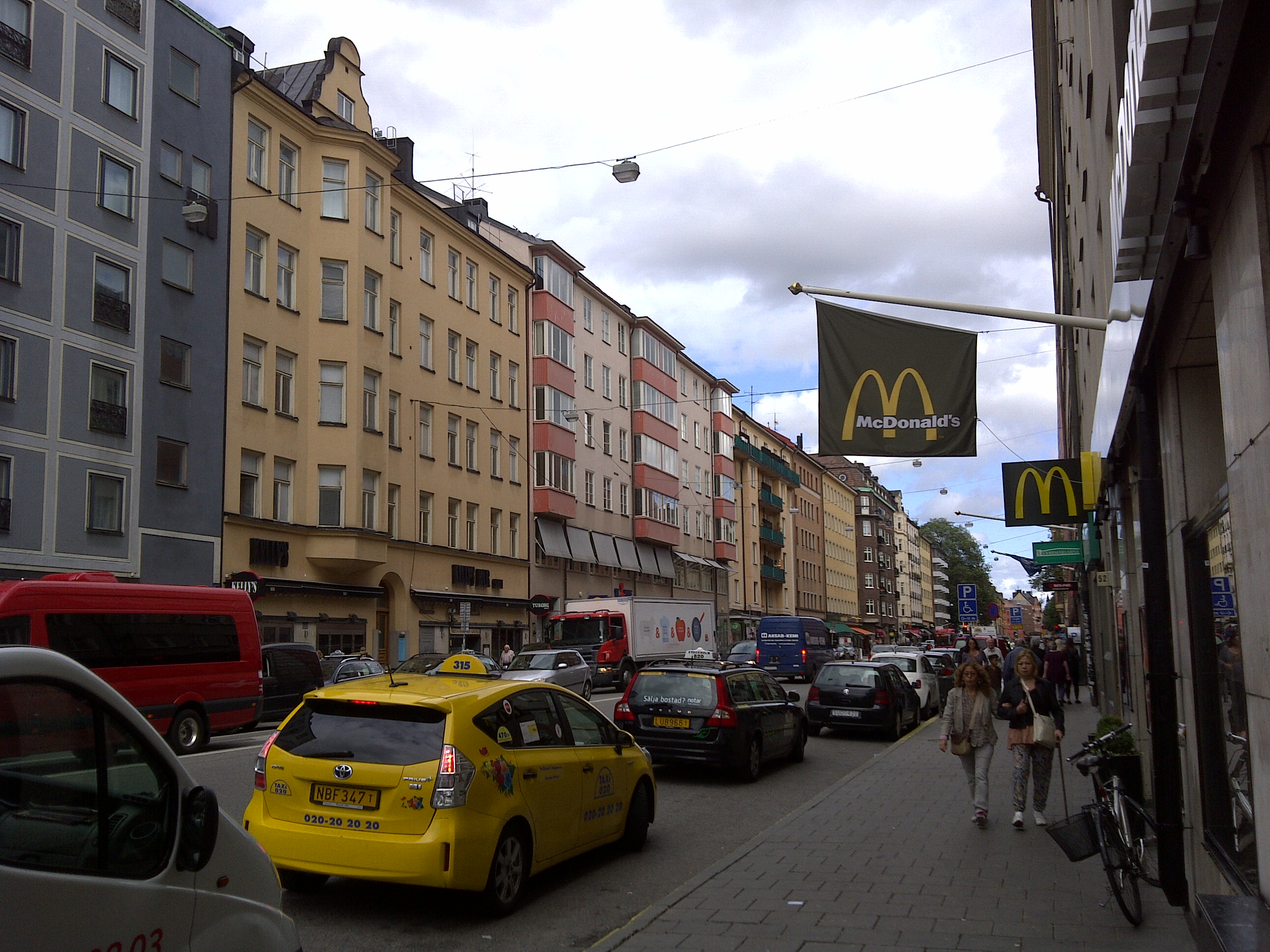
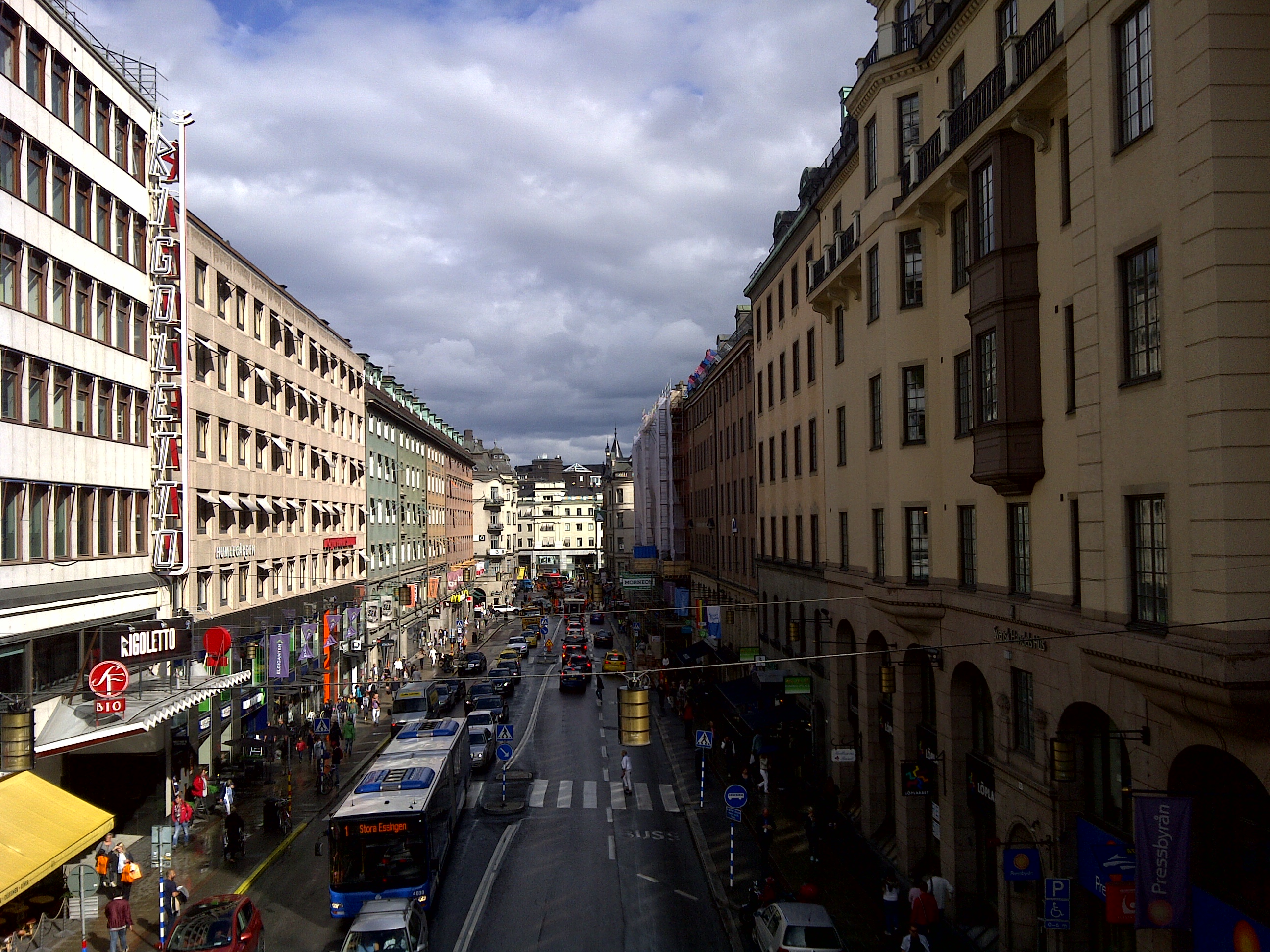
I like Stockholm. There’s something reassuringly familiar about it, despite the language barrier, which I think comes from the fact that the Central Stockholm housing stock is of similar vintage as the residential parts of Manhattan. It even avoids New York’s most annoying (to me) architectural tic, the exposed brick. The buildings here are similar in style to the ones in New York (and more generally northern Europe), but most have smooth exterior, with enough variation of colors between buildings to make it interesting.
The streets here vary a lot in width, but outside the older sections of the city, they are never very narrow. In Gamla Stan (“the old town”), the medieval core of the city that is now a tourist ghetto, complete with stores selling Swedish flags or English-language books, there are some pedestrianized streets with single-digit building-to-building width. But in my part of the city – Roslagstull, near the outer end of what’s considered Central Stockholm – the street width ranges are almost identical to those of Manhattan. My street, Birger Jarlsgatan, is about 30 meters wide, while less important parallel streets are about 15 or 20. Like the rest of city center, it’s lined with almost uniformly mid-rise buildings, six to seven stories tall. See photos here, from Södermalm, and here, from Regeringsgatan, a street that for a portion of its length is elevated over intersecting streets.
A feature of Stockholm streets that I have not seen in other cities is that on-sidewalk bike lanes. While the overall sidewalk width on Birger Jarlsgatan is generous, the sidewalk is broken by the bike lane. The inner side of the bike lane is interrupted by trees, and the outer side by sidewalk cafes, and as a result, sometimes walking in the bike lane is unavoidable if one wishes to avoid walking in zigzags. In any case, cyclist traffic does not seem to be heavy; there is much more pedestrian traffic.
Crossing the street is rarely difficult. There are beg buttons at intersections, but the pedestrian light will turn green even without pressing them. The stoplight phasing is simple: most of Central Stockholm is on one of several grids, and even at intersections of two-way streets (one-way streets are uncommon, at least around Roslagstull), there are only two phases per stoplight cycle. Without grade-separated freeways in the city core, the worst streets for the pedestrians are the occasional freeway-like structure, or one of several excessively wide roads. I walk to work on one of those roads, Valhallavägen, and during the daytime, the cars’ noise and air pollution are uncomfortable unless I walk through the parking lots behind the street or the bus bay in its median.
The transit system is useful, though I almost never take it. This is a combination of very high fares (with my pay-per-ride smartcard, I pay 25 kronor per ride, about PPP$2.70) and a city core that’s small enough and pedestrian-friendly enough that I can get around most of it on foot. The pedestrian orientation of the streets matters: my apartment is 2.3 km from the CBD mall and 1.7 km from Stockholm University; but I will walk to the mall, whereas to get to and from a conference at SU, I didn’t walk on Roslagsvägen (which is almost a full freeway) but instead took the subway from my university, KTH, which is more centrally located within the city.
Of course, most people in the region don’t live in Central Stockholm, and for them the T-bana is a lifeline. Subway ridership here, excluding commuter rail, is about 900,000 per day (not weekday), not much lower than on the U-Bahns of much larger Berlin and Munich. As a curiosity, there are many light rail lines that connect outlying suburbs to a T-bana station, requiring a transfer to get to the CBD; the busiest, Roslagsbanan, is a narrow-gauge commuter rail system terminating next to KTH, with one T-bana branch, the T14, running parallel to it for a few stops before terminating. This is in addition to a mainline commuter rail system, with 267,000 daily passengers; this ratio of about one commuter rail rider to three subway riders is higher than anything most (see first two comments) in North America, but is much lower than in major European transit cities like Paris and London, where commuter rail and the metro have roughly equal ridership levels. Among the transit projects under construction in Stockholm is a new rail tunnel, which will increase the capacity of commuter rail.
Dispersing Expensive Centers: Edge City Version
This is somewhat of an addendum to my post before about dispersal of urban networks toward cheaper cities. I addressed the question of dispersal from rich, expensive metro areas, especially San Francisco, to cheaper ones, as a way of dealing with high housing prices. But more common is dispersal within metro areas: gentrification spilling from a rebounding neighborhood to adjacent neighborhoods that remain cheaper, and office space spilling from the primary CBD to the edge cities. I am going to address the latter issue in this post.
CBDs are expensive. They have intense demand for office space, as well as high-end retail and hotels. In many cities, there’s demand for office space even at the construction costs of supertall skyscrapers, going up to about $5,000-6,000 per square meter in privately-built New York towers. Zoning regimes resist the height required to accommodate everyone, and this is worse in Europe than in North America and high-income East Asia. Paris proper has many towers just above the 100 meter mark, but only three above 120. On a list of the tallest buildings in Sweden, not a single one above 100 meters is in central Stockholm, and the tallest within the zone are not in the CBD but in Södermalm; compare this with Vancouver, a metro area of similar size. But in the US, too, expanding CBDs is difficult in the face of neighborhood opposition, even in Manhattan.
The solution many cities have adopted is to put the skyscrapers in edge cities. Paris famously built La Defense, which has far more skyscrapers than the city proper does; Stockholm is building skyscrapers in Kista; London built Canary Wharf; Washington, the major US city with the tightest CBD height limits, sprouted skyscraper clusters in several suburbs in Maryland and Virginia. Ryan Avent proposed this as one solution to NIMBYism: in new-build areas, there are few residents who could oppose the new development. In contrast, near zoning-constrained CBDs, not only are there many residents, but also the land is so desirable that they are typically high-income, which means they have the most political power to oppose new development.
The problem with this solution is that those secondary CBDs are not public transit hubs. In Paris, this has created an east-west disparity, in which people from (typically wealthy) western suburbs can easily reach La Defense, whereas people from poorer ones need to take long RER trips and often make multiple transfers. In every transit city, the CBD is unique in that it can be reached from anywhere. To give similar accessibility to a secondary center, massive investment is required; Paris is spending tens of billions of euros on circumferential regional rail lines to improve suburb-to-suburb connectivity, expand access in the eastern suburbs, and ameliorate the east-west imbalance (see for example isochrones on PDF-pp. 20-21 of the links here). Those lines are going to be well-patronized: the estimate is 2 million daily passengers. And yet, the east-west imbalance, if nothing else, would be a lesser problem if instead of building La Defense, Paris had built up Les Halles.
The situation in other cities is similar. Kista is on one branch of one subway line, two stops away from its outer terminus. Living in Central Stockholm, my coworkers and I can get to KTH on foot or by bike, but a coworker who teaches at KTH’s satellite campus in Kista has a long commute involving circumferential buses (taking the subway and changing at T-Central would be even longer because of the detour). While many individual sub-neighborhoods of Central Stockholm are quite dense, the overall density in the center is not particularly high, certainly not by the standards of Paris or New York. A similar problem happens in Washington, where the biggest edge city cluster, Tysons Corner, is traditionally auto-oriented and was only just connected to Metro, on a branch. This always affects poorer people the worst, as they can’t afford to live in the CBD, where there is easy access to all secondary destination, and often are pushed to suburbs with long commutes.
There is a political economy problem here, as is usually the case with zoning. (Although in the largest cities skyscraper heights are pushing beyond the point of constant marginal costs, purchase prices at least in New York are much higher than construction costs.) The people living near CBDs, as noted before, are usually rich. The displacement of office space to the suburbs affects them the least, for three reasons. First, if they desire work within walking distance or short subway distance, they can have it, since their firms typically make enough money to afford CBD office rents. Second, since they live in the transit hub, they can access suburban jobs in any direction. And third, if the transit options are lacking, they can afford cars, although of course traffic and parking remain problematic. Against their lack of incentive to support CBD office space, they have reasons to support the status quo: the high rents keep it exclusive and push poor people away, and often the traditional mid-rise buildings are genuinely more aesthetic than skyscrapers, especially ones built in modernist style.
These concerns are somewhat muted in the US, where rich people decamped for the suburbs throughout the 20th century, and have supported zoning that mandates single-family housing in the suburbs, instead of staying in the city and supporting zoning that keeps the city mid-rise. This may have a lot to do with the formation of high-rise downtowns in American cities of such size that in Europe they’d be essentially skyscraper-free.
However, what’s worse in the US is the possibility of short car-free commutes to the edge cities. Where La Defense is flanked by suburbs with high residential density, and Kista’s office blocks are adjacent to medium-density housing projects for working- and middle-class people, American edge cities are usually surrounded by low-density sprawl, where they are easily accessible by car but not by any other mode of transportation. This is because the American edge cities were usually not planned to be this way, but instead arose from intersections of freeways, and developed only after the residential suburbs did. As those edge cities are usually in rich areas, the residents again successfully resist new development; this is the point made in Edgeless Cities, which notes that, in major US metro areas, growth has been less in recognizable edge cities and more in lower-density edgeless cities.
As with the possibility of dispersing innovation clusters from rich, expensive metro areas to poorer and cheaper ones, the already-occurring dispersal from city centers to edge and subsequently edgeless cities has negative effects. It lengthens transit commutes. Although in Tokyo, long commutes first arose as a problem of a monocentric CBD, and the city developed secondary CBDs as a solution, the situation in European cities an order of magnitude smaller is very different. It worsens housing segregation: the development of an edge city tends to be in the direction of the favored quarter, since that’s where the senior managers live, and conversely, higher-income workers can choose to move nearby for the short commute. Although nearly all metro areas have favored quarters, decentralization of jobs thus tends to lengthen the commutes of poor people more than those of rich people.
This is not quite the same as what happens when entire metro areas are forced to disperse due to housing cost. The agglomerations generally stay intact, since an entire industry can move in the same direction: smaller cities have just one major favored quarter with edge cities, and larger ones still only have a few, so that industries can specialize, for example in New York, biotech and health care cluster in the Edison-Woodbridge-New Brunswick edge city. Moreover, the specialized workers are usually high-income enough that they can stay in the central city or migrate to the favored quarter. San Francisco’s programmers are not forced to move individually to faraway poor neighborhoods; they move in larger numbers to ones near already gentrifying ones, spurring a new wave of gentrification in the process; were they to move alone, they’d lose the access to the tech shuttles. The negative effects are predominantly not on richer people, but on poorer people.
The problem is that even among the poor, there is little short-term benefit from supporting upzoning. If Paris, London, and Stockholm liberalize housing and office construction, the first towers built of both kinds will be luxury, because of the large backlogs of people who would like to move in and are willing to pay far in excess of construction costs. I am going to develop this point further in two posts, on what is best called NITBYism – Not In Their Backyard – but this means that the incentive for poor and peripheral populations is not to care too much about development in rich centers. The marginal additional building in a rich city center is going to go to the upper middle class; sufficient construction would trickle to the middle class; only extensive construction would serve the working class, and then not all of it.
In the US, the marginal additional building may actually displace poor people, if no new construction is allowed, simply by removing low-income apartments. It may even create local demand for high-income housing, for example by signaling that the neighborhood has improved. In San Francisco, this is compounded by the tech shuttles, as a critical mass of Silicon Valley-bound residents can justify running shuttles, creating demand for more high-income housing.
The amount of construction required to benefit the bottom half of the national income distribution is likely to be massive. This is especially true in France and the UK, which have sharp income differences between the capital and the rest of the country; their backlogs of people who would like to move to the capital are likely in the millions, possibly the high millions. Such massive construction is beyond the pale of political reality: the current high-income resident population is simply not going to allow it – when forced to share a building with the working class, it pushes for poor doors, so why would it want zoning that would reduce the market-rate rent to what the working class would afford? The only political possibility in the short run is partial plans, but these are not going to be of partial use to the working class, but of no use to it, benefiting the middle class instead. As a result, there is no push by the working class and its social democratic political organs to liberalize construction, nor by the small-is-beautiful green movement.
Ultimately, the attempt to bypass restrictions on urban CBD formation by building edge cities, like every other kludge, is doomed to failure. The fundamental problem of rich people making it illegal to build housing nearby is not solved, and is often made even worse. The commutes get worse, and the inequality in commutes between the rich and the poor grows. Office space gets built, where otherwise it would spread along a larger share of the medium-rise CBD, but for most workers, this is not an improvement, and the environmental effects of more driving have negative consequences globally. And once city center is abandoned to the rich, there is no significant political force that can rectify the situation. What seems like a workaround and an acceptable compromise only makes the situation worse.
Putting Rail Lines in Highway Medians
North Americans are in love with trains that go in highway medians. A large fraction of urban rail construction since World War Two, both light rail and full metro, has used highway medians as cheap at-grade rights-of-way to extend train service, often deep into the suburbs. Some proposed longer-range lines are supposed to go in medians as well: Florida had reserved space in the I-4 median for Orlando-Tampa high-speed rail, and Xpress West planned to go from Las Vegas to the outskirts of the Los Angeles area in the I-15 median. The Texas Central Railway, a private group backed by JR Central planning high-speed rail between Dallas and Houston, is considering several alignments, but markets the route as following I-45 (no mention of median) in some public discussions. In nearly all cases, both urban and intercity, it borders on incompetent to design rail lines in highway medians; intercity lines frequently follow highways on one side, but even that tends to be overrated in American discussions in my experience.
Urban Rail
For urban rail, the reason to use highways is that, in most of North America, they’re everywhere, and they’re usually equipped with generous medians and shoulders, allowing relatively cheap placement of rail tracks. Of note, this is generally not the cheapest option: construction on extant (often disused) rail rights-of-way tends to be cheaper. However, in many cases, a rail right-of-way is unavailable, hosts heavy freight traffic, has been permanently turned into a trail, or has commuter trains without integration into the rest of the urban transit network. Examples include the Dan Ryan half of the Red Line and both halves of the Blue Line in Chicago, the Orange and Silver Lines in Washington, the outer ends of BART, the Spadina line in Toronto, and several light rail lines. Often they run on one side of the road, but more frequently they’re in the median, which was often reserved for it when the road was built (as in Chicago and Calgary).
The problem is that nobody wants to live, work, or hang out next to a busy grade-separated road. Living or working a kilometer or two away, with easy access by car, is great for the driver, but within close walking distance, there is just too much noise, pollution, and blight, and the pedestrian environment is unwelcoming. The transit-oriented development in Metrotown and Arlington could not have happened next to a freeway. Christof Spieler frames this as a decision of spending more money on routing trains near where people live versus staying on the easy rights-of-way. But this isn’t quite right: the Expo Line in Vancouver was assembled out of an interurban right-of-way and a city center tunnel, both out of service; the line’s high ridership comes from subsequent development next to Metrotown and other stations.
Other times, the routing comes from a deliberate decision to integrate the trains with cars, with large park-and-rides at the ends. This is common on newer light rail systems in the US (though not Canada, as Calgary prefers integration with connecting buses) and in the Washington and San Francisco suburbs. This makes things even worse, by extending the radius within which the environment is built for cars rather than for people, and by encouraging the same park-and-ride construction elsewhere, along abandoned railroads and greenfield routes, where the preexisting environment is not car-oriented.
I do not want to categorically say that cities should never build urban rail alongside highways. But I cannot think of a single example in which this was done right. Calgary is a marginal case: it did build light rail along highways, and had some success with transit-oriented development, but those highways are arterials rather than freeways, and this makes the pedestrian environment somewhat better.
The situation is somewhat different for suburban rail, but usually the scale of suburban rail is such that there’s not much new construction, only reappropriation of old lines. These lines are long and the environments low-density, making it hard justify the costs of new lines in most cases. Where new suburban rail is built, for examples the Grand Paris Express, and various airport connectors, it is typically in environments with such expected traffic density that the rules for urban rail apply, and we tend to see more underground construction or usage of extant rights-of-way.
Intercity Rail
The reasons favoring highway alignments intercity rail in the US are somewhat different. Tellingly, HSR in Europe is frequently twinned with motorways. It is not about integration with cars, since those alignments are rarely if ever meant to have major stops in their middle. Instead, it’s about picking a pre-impacted alignment, where there are fewer property takings and fewer NIMBYs. This logic is sound, but I often see Americans take it to extremes when discussing HSR.
The first problem is that roads are almost never as straight as HSR needs to be. The design standards I have seen after briefly Googling give the radius of a motorway capable of about 120 km/h as, at a minimum, 500-700 meters. With these curves, trains, too, are capable of achieving about 120 km/h – less at 500 meters without tilting, more at 700 meters with tilting. The most recent high-speed lines are built with a minimum curve radius of 7 km; about the absolute minimum that can be done, with design compromises and tilting trains, is 4 km. This implies that the trains have to deviate from the motorway alignment whenever it curves. In flat regions the road curves are much gentler than the minimum, but still too sharp for full-speed running. Both Florida HSR and Xpress West noted that the trains would have to slow down whenever the Interstate curved, because the need to run in the median would prevent them from curving gently enough to maintain full speed.
Of note, the European examples of HSR running in motorway alignments have it running alongside the roads, not in the medians. I invite the reader to spend a few minutes following French LGVs on Google Maps and seeing this. This is because there invariably have to be small deviations from the road, which in a rural area are trivial when one runs next to the road but require viaducts when one runs between the road’s two carriages.
There may also be an issue regarding reusing the Interstates. To transit supporters who view HSR as a replacement for freeways, this has an element of poetic justice, or just plain practical reuse of infrastructure they think is obsolete. I chanced upon this while looking up Interstate design standards, but I’ve seen similar proposals elsewhere, as well as dissimilar proposals making use of interstate terminology, as a reminder of past national greatness. It comes from the same place as proposals to reuse auto factories to produce rolling stock: there’s a romantic aspect in addition to or instead of an economic one.
But the most fundamental problem is that the contentious experiences of the freeway revolts and modern-day NIMBYism have soured Americans on any process that involves brazen takings. What I mean by brazen is that carving a new right-of-way, especially through a populated area, looks obvious on a map. In contrast, sticking to a preexisting right-of-way and incrementally widening it or straightening curves is less controversial, even when it involves eminent domain as well, and opposition remains much more local, based on the specific properties being taken, rather than stated in general principles. I am not completely sure why this is so; my suspicion is that widening and straightening are more easily justified as things that must be done, whereas a new right-of-way looks gratuitous.
In either way, Americans have convinced themselves that NIMBYs are a major obstacle to infrastructure construction. While zoning is a notoriously NIMBY-prone process, infrastructure often isn’t. In the English common law world, expropriations are if anything easier than in France, where farmers are especially powerful, or Japan, where rioters threatened to block the construction of Narita Airport. NIMBYs are good at getting their names out in the media, but when it comes to blocking construction, they are relatively powerless; California HSR is facing NIMBYs in the Central Valley, many of whom are conservative and politically opposed to the project regardless of local impact, but so far they have not managed to delay construction.
However, NIMBYs are a convenient bogeyman for public projects, as their motives are openly selfish. They give charismatic, authoritarian leaders the opportunity to portray their infrastructure projects as battles between the common good and backward-looking parochial interests. As I’ve noted multiple times before, New York’s livable streets community (which is similar politically to the set of HSR supporters in the US) tends to overblow the importance of NIMBYs to the point of seeing NIMBYs even when the concerns have nothing to do with NIMBYism: see, for example, the reaction to the opposition of two Harlem politicians to a plan to speed up only the whitest bus route through the neighborhood.
Difficult Transit
Many people have heard that certain regions are well-suited for these projects, for example the Northeast Corridor is unusually good for HSR because it links four major cities and several medium-size ones on a single line. By implication, there has to be a flip side, i.e. regions that are poorly-suited for HSR and cities that are poorly-suited for new rapid transit. If there weren’t – if every region were like the Northeast Corridor – then the ridership models would just have higher first-order estimates. Several proposals I’ve seen in comments and on my blogroll in the last few days are in areas where the urban geography makes it harder to justify such projects. These and a few others are the examples I will use in this post.
As usual, there’s a caveat that difficult does not equal bad. Some of these ideas are worth pursuing, but have more challenges that their easier counterparts do not, and if those challenges are solved, then they can perform well. One of the biggest success stories of modern rail investment, the TGV, is in an urban geography that’s not particularly conducive to rail: France’s secondary cities surround Paris in all directions (although Lyon and Marseille are collinear with Paris), the stub-end layout of stations in Paris and many other cities forces awkward branching, Lyon needed a business district to be built from scratch around Part-Dieu. France made this work, and it’s possible some of the projects on this list can be made to work in similar vein.
High-Speed Rail in Sweden
Project: greenfield HSR lines connecting Stockholm with Sweden’s major secondary cities, Gothenburg and Malmö.
The problem: Stockholm, Gothenburg, and Malmö do not lie on a straight line. The three cities are quite small by the standards of more populated countries: Stockholm has a bit more than 2 million people, Gothenburg has a bit less than a million, Malmö has 700,000. A line connecting just two of them, or even a Y-shaped line, is unlikely to get enough ridership to justify the construction costs of full HSR. There are no large intermediate cities: the largest, Linköping, has about 100,000 people. As noted above, French urban geography is not great for HSR, either, but at least the LGV Sud-Est could serve both Lyon and Marseille, and France’s greater population ensures that its secondary cities are large enough to generate enough traffic to fill an HSR line.
As a silver lining, Malmö is adjacent to Copenhagen, and the difficult part, bridging the Øresund, has already been done. While international lines tend to underperform, the tight cultural and economic connections between the Scandinavian countries make it likely that international projects within Scandinavia would be exceptions to the rule. Copenhagen would add another 2 million people at the end of the line. However, even that is unlikely to generate enough ridership to pay for 500-odd kilometers of greenfield HSR (plus a connection to Gothenburg).
Because of its poor urban geography for conventional HSR, Sweden has investigated cheaper solutions, allowing higher speeds on legacy track or on greenfield tracks built to lower standards. As a result, there is research into the possibility of high-speed tilting trains, running faster than the 250 km/h Pendolino. This research is likely to be useful in the UK and US, where the urban geography is better-suited for HSR but fully greenfield construction is obstructed by suburban development near the rights-of-way and by high construction costs, but the original context was faster speeds within Sweden.
High-Speed Rail in the Pacific Northwest
Project: greenfield HSR connecting Portland, Seattle, and Vancouver. This is not officially proposed anywhere that I know; current plans focus on incremental improvements to the Amtrak Cascades. However, every American HSR fantasy map I’ve seen (including the ones I’ve drawn) includes this link, since at least superficially based on city populations it would succeed.
The problem: getting out of the major cities involves a slog on curvy legacy track in areas where it’s hard to straighten the right-of-way. Heading north of Seattle, the route goes along the water, in terrain that is too hilly for an easy inland cutoff all the way to Everett, 50 km north. Getting out of Vancouver is also hard, because of suburban development in Surrey, and becomes even harder if one wants the Vancouver station to be Waterfront rather than Amtrak’s current stop, the less centrally located Pacific Central. The Northeast Corridor is said to have slowdowns near the major stations, leading to proposals to bypass them with new tunnels, but at no point are there 50 nearly-continuous km of low curve radii; the New Haven Line does not look as curvy, while the Shore Line farther east is easy to bypass on I-95.
The Seattle-Portland segment is much easier: the route heading south of Seattle is not constrained, and north of Portland it is possible to run alongside I-5. However, the most important intermediate cities, Tacoma and Olympia, can only be served with exurban stations, since getting into their centers would require the mainline to detour on curvy alignments.
Through-Run Commuter Rail in Chicago
Project: there are many proposals by transit activists to construct new infrastructure to enable through-running on Metra, analogous to Crossrail, SEPTA Regional Rail, the Paris RER, and multiple S-Bahns. Details differ, but other than the lines through Union Station, through-running generally means connecting Metra Electric to some of the lines feeding into Union Station from the north or the Union Pacific lines; UP-North is especially notable for serving dense neighborhoods and not having any freight traffic.
The problem: the layout of the lines entering the Chicago central business district makes it hard to build a coherent network. What I mean by coherent is that commuter lines can make multiple CBD stops to serve different CBDs, or different parts of the same CBD: in New York, a Penn Station-Grand Central connection would let trains serve both the West Side and the East Side. Look at the map proposed by Sandy Johnston, in the second link above: there is no station on the Near North Side, there is no connection from the West Loop stations to the Loop, and effectively lines are still going to be split between lines bound for the West Loop and lines bound for the Loop in the through-run system.
None of this is the fault of any of the people drawing these maps. To serve both the West Loop and the Loop, a line would have to go east-west in the vicinity of Union Station, where there is no legacy line pointing in the right direction. The options boil down to a long greenfield east-west subway, and an awkward transition to the preexisting east-west lines, BNSF (which is too far south) and UP-West (which is too far north), which to add another complication carry heavy freight traffic.
A system prioritizing north-south connections runs into different dilemmas, concerning the tradeoff between service to the Near North Side and easier connections to the rest of the North Side Metra lines. A north-south line connecting UP-North to Metra Electric through the Near North Side would be beautiful, and miss all other Metra lines and most L lines. Sandy’s proposal has Metra Electric swerving west to meet UP-North just north of its terminus at Ogilvie Transportation Center, meeting all L lines and potentially the North Side Metra lines but missing the job centers in the West Loop and Near North Side.
Rail to LaGuardia
Project: construct some rail extension to LaGuardia Airport. Which rail extension varies based on the proposal. The most mainstream proposal, in the sense that it was supported by Giuliani until it was torpedoed by neighborhood opposition, would have extended the Astoria Line east to airport grounds. More recent proposals from various activists have included not just the Astoria Line extension, but also a Northeast Corridor spur, an AirTrain from the Astoria Line, an AirTrain from Jamaica with JFK connections, a subway shuttle under Junction, and a subway running from the airport to 125th Street along the route of the M60 bus.
The problem: all of the above ideas face the same pair of problems. At the airport end, the airport competes with other urban destinations, rather than complementing them by lying on the same straight line with them. An extension from the west, such as the Astoria Line extension, needs to choose between serving the airport and serving the Astoria Boulevard corridor, which has high residential density and no nearby subway service; Astoria Boulevard itself is so wide that as with Queens Boulevard, an elevated line in its middle would be an improvement. Farther east, there is nothing that a LaGuardia extension could be continued to, because of Flushing Bay. An extension across the bay going to Flushing or College Point could be useful, but an extension of the 7 to College Point would be even more useful and avoid underwater tunneling. The bay, and more generally the Long Island Sound, dooms any proposal for a loop returning to the mainline, in the manner of Zurich Airport, while a spur would again compete for capacity with more important lines. Compare this with LAX, which, going along the Harbor Subdivision, is collinear with Inglewood, the Slauson corridor, and Union Station, and would have an easy connection to El Segundo.
At the other end, the question with every airport extension is, what does it connect the airport to? The answer for LaGuardia has to be the Upper East Side, where as I remember most riders originate; but there is no good way of connecting to the Upper East Side, which has no east-west subway line, and shouldn’t, as there are perhaps a hundred kilometers of higher-priority tunnels in the region. A connection to 125th Street is ruled out by the fact that Second Avenue Subway has an even better connection to 125th. The Astoria Line serves the Midtown hotel cluster well, and has a connection to the Lexington trains to the Upper East Side, but I doubt that it can beat a taxi across the bridge in non-rush-hour traffic.
Providence East Side Tunnel
Project: restore rail service through the East Side Rail Tunnel, with a new connection to Downcity at the western end and connections to new or restored rail lines in and beyond East Providence. In Jef Nickerson’s version, the trains are light rail and drop to the surface at the Downcity end. In mine, they continue elevated through Downcity, with a new station replacing Providence Station for both commuter and intercity rail. All versions include a stop at Thayer Street for Brown University service, should one be constructable at reasonable cost.
The problem: there’s no real need for local or regional service from the east along the tunnel (intercity service could be sped up by about half a minute to a minute by avoiding curves in Pawtucket). Light rail service would run into the problem of incredibly spread-out suburbanization east of Providence. Commuter rail would run into separate problems: the legacy lines go along the water in East Providence and don’t serve the town itself well; beyond East Providence, the line going north serves the same suburbs as the existing Providence Line minus Pawtucket, while the line going south would need extensive and costly restoration work to get to Fall River, and only passes through small and low-density intermediate points.
Cutting off Providence Station to move the city’s main station to the south is useful, but the only rail from Providence to Pawtucket and Woonsocket goes due north of Downcity and would be left out of this system. Shoehorning it to the same station that leads to the East Side Tunnel would produce every adverse impact of viaducts on cities: heavy visual impact coming from elevated-over-elevated grade separation, squeal coming from low curve radii, takings of condo buildings near the existing Providence Station.
 Pedestrian Observations