Category: Urban Transit
Are Express Trains Worth It?
So, you have your urban rail line. It’s mostly above ground, so constructing new express overtakes is feasible. It has decent frequency, and carries trains to destinations at a variety of distances from city center. But it’s not an overcrowded subway line that brushes up against line capacity, requiring all trains to run at the same speed. Do you run express trains?
I’m going to focus on regional rail in this post, since with two Tokyo-area exceptions, proper subways are incapable of running express trains without dedicated express tracks due to their high frequency. On a line with a train every 10 minutes it’s feasible to mix trains of different speeds with timed overtakes; on a line with a train every 2 minutes, it’s not. I’m going to use the LIRR and Caltrain as examples, and then apply the derived general principles to other cases in the US, including future regional rail schemes.
The basic tradeoff of express service is that it provides faster service to the express stations at the cost of frequency at the local ones. This can be done in two ways: expresses that stop once every few stations, and local-then-express patterns. Jarrett Walker calls this limited versus express, based on bus service patterns; with trains, both types are called express. The subway in New York, the Chuo Rapid Line, Seoul Subway Line 1, and Caltrain baby bullets are examples of the first kind; the Caltrain limited-stop trains and the peak-hour trains on some LIRR lines are examples of the second kind.
Express trains of either kind but especially the first reduce line capacity, even with very long overtake segments. If train X overtakes train L, then there needs to be an available slot ahead of train L, and after the overtake there’s a slot opening up behind L. The Chuo Rapid Line runs a mixture of local (“rapid”) and express (“special rapid”) trains for most of the day, but at rush hour, there are only local trains, peaking at 28 trains per hour; on the shoulders of rush hour, there are some express trains, with total traffic of about 20 tph. The LIRR runs 23 tph on the Main Line at the peak, so this is an issue, which the LIRR unsatisfyingly resolves by running trains one-way at rush hour. It’s less an issue on Caltrain given constructable overtake locations, but right now the overtake locations are inconvenient and the trains are pulled by diesel locomotives, increasing the stop penalty and reducing the capacity of a mixed local-express line.
The second kind of express service is bad industry practice and should not be used. It avoids the capacity problems of the first kind at low traffic levels, but at high traffic levels the speed difference is still too large. It is used when the trains are a special CBD shuttle and makes it impossible to serve passengers who are cheap to serve, i.e. those getting off short of city center. Caltrain’s limited-stop trains do this because of capacity problems during rush hour, when they need to get out of the baby bullets’ way. The LIRR does this because of a cultural belief that trains exist only to shuttle people from Long Island to Manhattan and back; due to the same belief, it runs trains one-way at rush hour rather than giving up on rush hour express runs as JR East does.
The first kind of express service may or may not be warranted. It depends on the following questions:
1. What is the line’s expected traffic level? Low traffic, up to about 4 tph for a regional line, favors an all-local configuration to prevent cutting local stations’ frequency unacceptably. Very high traffic favors all-local configuration for capacity reasons, or else investment into long overtakes or even full four-tracking. Intermediate traffic, in the 6-12 tph range, is the best zone for express trains.
2. Have local trains already been sped up by use of good industry practices? Level boarding, high-acceleration EMUs, better track maintenance allowing higher speeds between stations, good timetable adherence allowing less schedule padding, and infrastructure preventing delays on one train from cascading to others allowing even less padding can all significantly reduce the speed difference between local and express trains. In some extreme cases, a local train can end up not much slower than an express train hauled by a diesel locomotive.
3. How long is the line, and how many stations does it have? Longer lines and shorter interstations both favor express trains, all else being equal. Intercity rail, which also has higher stop penalties because of the higher line speed, deserves more than one stopping pattern even at low frequencies.
4. How big is the difference between minor and major stations? It is crucial not to confuse current ridership with ridership potential, since lines with express service often pick winners and losers, after which the better-served express stations steal riders who live closer to bypassed minor stops. This is common on Caltrain, where some but not all express stops are major job centers.
5. Can intercity trains plausible substitute for express service?
It is question 4 that makes the difference in many cases. On the LIRR, the Main Line has a clear distinction between major stops (Mineola, Hicksville) and minor ones (all the rest). The Montauk Line does not. Note the ridership levels of the stations, going eastward from Jamaica to the end of electrification:
Main Line:
Hollis: 114
Queens Village: 791
Floral Park: 1495.5
New Hyde Park: 1725.5
Merillon Avenue: 766.5
Mineola: 5174
Carle Place: 386
Westbury: 1951.5
Hicksville: 8107.5
Syosset: 2748.5
Cold Spring Harbor: 2083
Huntington: 5556.5
Bethpage: 2481.5
Farmingdale: 2312.5
Pinelawn: 25
Wyandach: 1758.5
Deer Park: 2708.5
Brentwood: 1375
Central Islip: 1787
Ronkonkoma: 8639
Montauk Line:
St. Albans: 93.5
Lynbrook: 2738
Rockville Centre: 3425
Baldwin: 3371.5
Freeport: 2514.5
Merrick: 3383.5
Bellmore: 3267.5
Wantagh: 2890.5
Seaford: 1804
Massapequa: 2959.5
Massapequa Park: 1672.5
Amityville: 1542.5
Copiague: 1430.5
Lindenhurst: 1791.5
Babylon: 3293
There are three ends of electrification: Babylon, Huntington, and Ronkonkoma. All have markedly more ridership than nearby stations, especially Ronkonkoma, though in all cases it’s an artifact of their being the ends of electrification, with many people driving in from farther east. Ronkonkoma has nothing nearby that justifies its ridership level, the highest of any suburban LIRR station; it’s a park-and-ride that has a lot of ridership because it’s the end of electrification and has express service.
In contrast, in Mineola and Hicksville, there really is a concentration of activity justifying their status. Both have trivial transit usage as job centers, but there’s enough of a core, especially around Mineola, to justify higher service, and Hicksville is also the junction of the Main Line with the Port Jefferson Branch: see the census bureau’s OnTheMap tool.
But there are no special stations on the Montauk Line. Excluding St. Albans, which is in New York itself and has to compete with cheaper and more frequent if slower bus-to-subway options, the ratio between the busiest and least busy stations is 2.4:1. A similarly flat situation occurs east of Hicksville, excluding the two end-of-electrification stations.
What this means is that the LIRR should only run local trains on the Babylon Branch and east of Hicksville, while maintaining express service on the Main Line west of Hicksville when there’s enough capacity for it. A similar analysis of other lines in the New York area should give the following answers:
Hempstead, West Hempstead, Long Beach, and Far Rockaway Branches: all local due to short length.
Port Washington Branch: probably all local due to short length, but if additional local stations are added in Queens, then some express trains to Great Neck may be warranted.
New Haven Line: very long, sharp distinction between major and minor stops all the way but especially west of Stamford, high frequency, four tracks give enough capacity for everything. The current configuration of nonstop trains to Stamford continuing as local to New Haven and local trains turning at Stamford is fine, except that the express trains should also stop at New Rochelle (a junction with the Hell Gate Line, which deserves service, but also a major stop in and of itself, with the third highest weekday ridership of Metro-North’s suburban stations) and maybe also Greenwich; HSR overtake considerations may require stopping also at Rye and Port Chester.
Harlem Line: generally favors local trains, except that White Plains is a major job center and thus a far more important stop than all others, independently of its better service. There are four tracks south of Wakefield, favoring express trains, but conversely charging subway fares and allowing free transfers to the subway would lead to a ridership spike as people switch from the overcrowded 4 and 5 trains. There’s a big dropoff in ridership north of North White Plains, so the current configuration of locals that turn at North White Plains and expresses that go nonstop south of White Plains is fine, as long as off-peak frequency is raised.
Hudson Line: favors express trains because of length and four-tracking. Although on paper there are more and less important stations, this is an artifact of service patterns. The secondary stations in Yonkers serve higher density than the busier stations in the proper suburbs, and the dense parts near Tarrytown are actually in Sleepy Hollow, about equidistant from the Tarrytown and Philipse Manor stations: see the New York Times’ population density map.
Erie Lines and West Shore Line: probably all local since the population density thins too uniformly going north, with Paterson as the major exception. There are somewhat denser anchors at the outer ends of some lines – Spring Valley and Nyack – but Harlem Line-style nonstops run against a capacity problem, coming from the fact that this part of the network is necessarily highly branched.
Rest of New Jersey Transit: the main lines (Northeast Corridor, Morristown) are very long and have some distinguished suburban job and population centers (Metropark, New Brunswick Morristown) deserving express service, but the branches (North Jersey Coast, Montclair, Gladstone) do not. However, the fare structure and off-peak frequency lead to much less ridership on the inner-urban segments in Newark, Orange, etc., than would be expected based on population density. In addition, the difference between major and minor stops is fairly small on all lines when taking electrification into account, sometimes as small as on the Babylon Branch: see ridership data per line and per station.
Although my initial decision in my regional rail plan to pair the Erie lines with the Atlantic and Babylon Branches of the LIRR was aesthetic, creating a northwest-to-southeast line, in reality the systems are fairly similar in their characteristics. More or less the same can be said about the Staten Island-Harlem system. There are no direct connections to intercity rail except at Jamaica and in the Metro-North tunnel to Grand Central, the lines pass through urban or dense-suburban areas, the interstations are fairly short, and there’s relatively little distinction between major and minor stops. (White Plains is the major exception, and Paterson is a secondary one.) This makes the Lower Manhattan-based system much more RER-like than the Penn Station-based one, which is longer-distance and practically intercity at places.
Finally, the same set of questions in the other three major Northeastern cities generally lead to the conclusion that no express trains are needed.
In Boston, there’s too little difference between major and minor stops on each line (see PDF-page 70) – somewhat more than on the Babylon Branch, but much less than on the LIRR Main Line. The most prominent major station is Salem, but the low-ridership stations farther in on the Rockport/Newburyport Line are in working-class suburbs; the ridership there is depressed because of fare and schedule issues coming from competition with buses, and good regional rail would get much more additional ridership from Lynn and Chelsea than from Salem and the suburbs farther out.
In Washington, current traffic demand is so low that express service would seriously eat away at the frequency offered to local stations. MARC and VRE ridership is so low that any analysis of travel demand has to start from geographic and demographic information rather than from preexisting ridership; the only major outlying destination on any of the lines is Baltimore, which can be connected to Washington by intercity rail, and which conversely has much less Washington-bound commuter traffic than the Washington suburbs. The closest thing to justifiable express service is that when the commuter lines closely parallel Metro, they should have wider stop spacing.
In Philadelphia, on most lines, express service eats away at frequency too much. The one exception is the PRR Main Line, with the SEPTA Main Line a possibility. Many lines have sharp differences between local and express stations: for example, Cornwells Heights on the Trenton Line is much busier than the rest. But a combination of low frequency and lack of easy overtakes (on the Trenton Line, the inner tracks should be mainly used by intercity trains, with only the occasional regional rail overtake if required) makes this not useful. The PRR Main Line actually has less difference between major and minor stops than many others, but it is longer and has short interstations and higher frequency. The SEPTA Main Line has the frequency to support multiple stopping patterns, though the population density near the minor stations is high and the problem, as in other Northeastern cities, is high fares and lack of integration with urban transit.
Comparative Subway Construction Costs, Revised
Here is a list of subway projects in the last 15-20 years, in both developed and developing countries. It’s in addition to my initial lists for developed and developing countries, but includes projects mentioned in past blog posts not on those two lists. This is still not an exhaustive list, due to some cities for which I couldn’t find any information (Moscow), cities for which the information from different sources contradicts itself (Bucharest), and cities for which I couldn’t source numbers beyond Wikipedia (Osaka). My rule is that Wikipedia is an acceptable source for construction timelines and route length but not cost.
While the list is meant to be for urban subways, urban rail projects that are predominantly elevated are also included. As far as possible I have tried using PPP dollars adjusted for inflation to give 2010 dollars (2010 and not 2013, because when I started comparing costs that’s what I used). For core developed countries, because inflation rates are similar, I use American inflation rates, using the CPI (not GDP deflator: the two measures have disagreed for a while, and the CPI points to higher inflation). For other ones, I’ve tried focusing on more recent projects, including even some that are under construction, but I use actual inflation rates.
Bear in mind the data is only as accurate as my sources for it and my PPP conversions. Errors of 10-20% in each direction are to be expected: sources disagree on conversion rates, sometimes the years of construction are not made clear so deflating to the midpoint is not reliable, etc. Even larger errors sometimes crop up, for example if old cost figures are not updated after a cost overrun.
Explicitly, the rates I use today are C$1.25 = S$1 = US$1 = 3.8 yuan = 100 yen = 800 won; £1 = $1.50; €1 = $1.25; CHF1 = $1.65.
Singapore Thomson MRT Line: not yet under construction, expected to open 2019-21, S$18 billion for 30 km. This is $600 million/km, all underground. Included only as a lower bound of costs; costs can rise beyond budget but rarely come significantly under it.
Hong Kong Sha Tin to Central Link: a 1-km segment underground (not underwater) is £270 million, under construction with opening expected in 2018. After converting to PPP using Hong Kong’s conversion rate this is $586 million/km.
Singapore Downtown MRT Line: under construction since around 2008, to be completed in 2017; S$20.7 billion for 42 km: $493 million/km. This line is fully underground. This represents a 70% cost overrun already, announced after I previously reported the original budget of S$12 billion.
Budapest Metro Line 4: under construction since 2006, completion expected in 2014, 400 billion forint for 7.4 km. This is $358 million per km. The line is fully underground.
Fukuoka, Nanakuma Line extension to Hakata: construction expected to begin 2014 with line opening expected in 2020, ¥45 billion for 1.4 km: $321 million/km. I do not know for certain that the extension is fully underground, but this is likely, as the preexisting line is underground and the extension follows busy CBD streets.
Cairo Metro Line 3, Phase 1: opened 2012 with construction since 2006, LE4.2 billion for 4.3 km. This is $310 million/km. The phase is fully underground.
Kawasaki Subway: under construction, opening expected in 2018, ¥433.6 billion for 16.7 km: $260 million/km. The line is fully underground. Update: people in comments explain that the line was actually canceled; the link in this paragraph is just a plan.
Stockholm City Line: to open in 2017, 16.8 billion kronor (2007 prices) for 6 km of tunnel and 1.4 km of bridge: $259 million/km.
Sao Paulo Metro Line 6: construction due to begin in 2014; 7.8 billion reais for 15.9 km: $250 million/km. The line is 84% underground.
Sao Paulo Metro Line 4: construction began in 2004, first phase opened in 2010, completion expected in 2014; 5.6 billion reais for 12.8 km: $223 million/km. The line is fully underground.
Dnipropetrovsk Metro extension: under construction since about 2008, opening expected in 2015, €367 million for 4 km. After PPP conversion this is $214 million/km. It appears to be fully underground.
Malmö City Tunnel: built 2005-10, 9 billion kronor for 4.65 km: $212 million/km. This is a fully underground project.
Bangalore Metro Phase 2: to be opened by 2017, 264 billion rupees for 72.1 km. This is $164 million/km. I do not know what proportion of the project is underground; it does not seem to be large, as the extension of the phase 1 lines are all outbound, and only line 4 seems to have significant tunneling, about 14 km by pure Wikipedia eyeballing.
San Juan Tren Urbano: built 1996-2004, $2.28 billion (2001 figures, see PDF-p. 145) for 17.2 km: $163 million/km. The line is only 7.5% underground by direct inspection on Google Earth.
Lucern Zentralbahn: built 2008-13, CHF250 million for 1.32 km of tunnel: $151 million/km.
Hangzhou: I can’t find any ex post numbers, but in both 2005 and this year (Chinese) officials pegged the cost of future construction as ¥550 million/km: $145 million/km.
Sofia Metro Line 2: built 2008-12, €952 million for 17 km. After PPP conversion, this is $148 million/km. The line appears to be almost fully underground: the numbers here do not fully add up but point to 1.3-2.9 km above ground (7.6-13% of total line length) in one segment while Wikipedia’s line map shows only that segment with above-ground segments.
Thessaloniki: I can’t find any ex post numbers, but in 2005 the budget for the first phase, under construction to be opened in 2016, was €798 million for 9.6 km: $104 million/km. The second phase received bids last year and is expected to open in 2017, with an estimated cost of €518 million for 4.78 km: $135 million/km. Both phases are fully underground.
Vancouver Evergreen Line: under construction since 2012, completion expected 2016; C$1.4 billion for 11 km: $103 million/km. Only 2 km of the system, 18%, is underground, but Vancouver seems to have an unusually low underground construction cost premium.
Dubai Metro (lines 1 and 2): built 2005-11, Dh28 billion ($6.9 billion in PPP2010US$) for 75 km: $92 million/km. Only 13 km of the system, 17%, is underground.
Mexico City Metro Line 12: built 2007-2012, $1.8 billion for 26.4 km. After PPP conversion, this is $90 million/km. From a Google Earth overlay map, this line is 49% underground.
Seoul Sin-Bundang Line: built 2005-11, 1,169 billion won for about 18 km (sources disagree on whether it’s 17.3 or 18.5): $87 million/km. The line is 100% underground according to YouTube videos.
Bangalore Metro, Phase 1: built 2006-11, 8,158 crore rupees for 42.3 km: $93 million/km. Only 8.82 km, or 21% of the project, is underground. See above for Indian construction costs in a heavier-tunneling setting.
Helsinki Westmetro: under construction since 2009 with completion expected in 2015, €714 million for 13.5 kilometers: $66 million/km. The line is fully underground.
Seoul Subway Line 9: opened 2009, 900 billion won for 27 km: $43 million/km. The line is almost fully underground by direct inspection on Google Maps.
Barcelona Sants-La Sagrera tunnel: built 2008-11, €179.3 million for 5.8 km: $39 million/km. This project is intercity but fully underground.
Just from eyeballing the data, spliced together with the two older lists, the biggest correlation of each country’s construction costs is with the construction costs of other lines in the same country. When there is more than one project listed separately in a city – e.g. Seoul, Singapore, Sao Paulo – the projects have similar costs. This persists across different cities in the same country, judging by the similarity between Bangalore Metro’s Phase 2 cost and the Delhi Metro’s cost from a previous list and by the similarity between Hangzhou and Beijing’s costs.
The Problem with Anchoring
A major idea due to Jarrett Walker, adopted with gusto by Vancouver’s Translink, is that transit should be anchored at both ends. That is, transit lines should have busy destinations at both ends, and should strive to reorient development such that the maximum intensity is near the ends. I was skeptical about this from the start, but now that I live in Vancouver and see the practice every time I go to UBC, I realize it’s much worse.
The Translink document justifying the layout has a figure, Figure 10 on PDF-page 15, showing that if development intensity peaks in the middle, then the bus will be overcrowded in the middle and empty at the ends. In contrast, if development intensity peaks at the ends, then the bus will be crowded but not overcrowded the entire way. Or, as Jarrett says, “If a transit line is operating through an area of uniform density, about 50% of its capacity goes to waste.”
Both in theory and in practice, this argument fails to note that a bus with development at the ends will be overcrowded the entire way, because people will travel longer. If UBC were located around Central Broadway instead of at the very west end of the metro area, people would just have shorter travel time; at no point would there be more westbound a.m. crowding because at no point would there be more westbound passengers traveling at the peak. There would be more eastbound a.m. crowding, but that’s not the Broadway buses’ limiting factor. Of the top four routes for passups, which have far more than the fifth route, three are east-west with strong anchors at both end (UBC at the west, the Expo Line at the east) and one, the third worst, is a C-shaped amalgamation of two north-south routes, with peak development downtown, in the middle of the C.
On a theoretical level, development intensity is a result of high land prices justifying high density, and in an urban area high land prices come from proximity to other urban land. In cities without topographic or political constraints on development, the CBD is always near the center of the metro area, and in coastal cities the CBD is usually near the shore but near the center along the axis parallel to the shore. Major secondary nodes usually arise in areas close to many suburbs, often the richer ones, and there’s travel demand to them from all directions: see for examples La Defense near Paris and Shinjuku and the other secondary CBDs in Tokyo. Some of those nodes happen to be near the shore (UBC, Santa Monica and Long Beach, Coney Island) but most aren’t. Any newly-built anchor will sprout further development around it unless there’s very strong local resistance. To connect all those neighborhoods that lie beyond the secondary CBD, unanchored transit lines are then unavoidable.
We’re left then with anchors that are at geographic edges, such as on shores. Those raise travel distances, because people can only live at one direction from them, so for a given residential density they will have to travel longer on average. They look attractive to transit managers because they also make the buses more uniformly full, but they’re worse for passengers who have to travel longer, often standing the entire way because of overcrowding. They’re not even good for transit agency finance, because urban transit invariably has either flat fare (as is the case within Vancouver proper) or fare that depends on distance fairly weakly. Short trips generate as much or almost as much money for the agency while requiring less effort to run because of lower crowding levels. Trips in which most passengers ride end to end are the least efficient, unless they can overcome this with very high crowding levels all day.
Now, what does help finances as well as the passenger experience is bidirectional demand. Anchors are good at that. However, what’s just as useful in cases of asymmetric peak demand is destinations that are short of the most crowded points. For example, in Manhattan the north-south subways fill as they go southward in the a.m. peak. This means that commercial buildings north of Midtown, generating passenger traffic that either is northbound (hence, reverse-peak) or gets off the train before it gets the most crowded within Midtown, add ridership without requiring running more trains. The MTA’s guidelines explicitly call for matching frequency to demand at the most crowded point of each line based on uniform sets of peak and off-peak crowding guidelines. This favors not outlying anchors, but development sprinkled uniformly along transit lines outside the CBD. The same development in the North Bronx would have low transit mode share (UBC has high transit mode share, but it’s at a geographic edge, and on top of that it has a huge body of students), while on the Upper East Side and Upper West Side it would have high transit mode share. The only outer ends where heavy upzoning is appropriate are those that aren’t really ends, such as Flushing and Jamaica, preexisting secondary centers in their own right to which people take the subway from the west and drive from the east.
De facto, Translink makes cost figures available for each bus route, and we can compare costs per boarded passenger on the east-west routes and on the north-south ones. The east-west routes have an initial advantage because they have bidirectional peak demand, whereas the north-south and C-shaped ones do not, and have few destinations short of the CBD, mainly just on Central Broadway or Commercial Drive. Despite this inherent east-west advantage, cost per rider is not lower on the east-west lines. Of the top ten route numbers, there are five balanced east-west routes: 99, 9, 41, 49, 25; and four north-south or C-shaped ones serving downtown: 20, 16, 8, 3. (The 135 is east-west connecting downtown with SFU, and could be included in either category.) Going in the same order as above, the east-west routes cost $0.61, $1.21, $1.10, $1.31, $1.47 per passenger, while the north-south ones cost $1.02, $1.29, $1.09, $1.06. (The 135 costs $1.32.) The three routes that interline to UBC on 4th Avenue – the 4, 84, and 44 – cost $1.62, $1.30, and $0.78 respectively, averaging to $1.30; the 84 is anchored at the Millennium Line, the 44 is anchored downtown, and the 4 is anchored downtown but also continues farther east.
The 99 is much cheaper to run than the other routes despite its high proportion of end-to-end ridership, but it is also critically crowded and benefits from multiple peaks as it serves both a secondary CBD and a university; it is also express, which among the other routes under discussion is only true of the 44, the 84, and the 135. Among the local routes, the north-south routes are actually a bit cheaper to run than the east-west routes even if we exclude the 4 as a not fully anchored exception. The 20, the 8, and the 3 all have their maximum development intensity at the downtown end with some extra development in their inner areas, near SkyTrain and Broadway, and a lot of medium-intensity development at the tail. This provides suitable short-of-CBD destinations adding passengers at low cost.
For one measure of productivity, we can divide the number of boardings per hour by the average load. The result is the reciprocal of the average number of hours spent by each passenger on the bus; a higher number means each passenger spends less time on the bus, indicating higher turnover, or equivalently more revenue relative to crowding. The 99, 9, 41, 49, and 25 have ratios of 2.79, 3.13, 2.65, 1.93, 2.13; the 20, 16, 8, and 3 have ratios of 3.26, 2.73, 3.57, 3.24. The 20, 8, and 3 again look very good here, helping explain their low operating costs and also their low crowding (they rank 12th, 27th, and 20th respectively in passups but 2nd, 6th, and 7th in weekday ridership). The 49 and 25, both highly anchored routes, do not look as good, and indeed have many passups relative to ridership (they rank 1st and 4th in passups but 8th and 10th in weekday ridership); they have the redeeming feature that they protrude slightly into Burnaby, where zonal fares are higher, but judging by a map of the passups, the 25 seems to get a large majority of its ridership strictly within Vancouver, with Nanaimo Station as the eastern anchor rather than Brentwood.
We can extend this analysis further by looking at New York’s bus operating costs. Cap’n Transit laboriously compiled a spreadsheet of operating cost per New York City Transit bus route. Within Manhattan, the pattern is that east-west routes have much lower operating costs per passenger than north-south routes. The M15, the busiest route in Manhattan with ridership comparable to that of the 99 in Vancouver and with the best finances among the north-south routes, almost breaks even on direct operating costs; most of the major east-east routes are outright profitable counting only direct operating costs. The key difference is that the east-west routes are much shorter, so passengers are paying the same amount of money for less distance. In his own analysis, the Cap’n notes that the express bus with the best finances is also one of the shortest, and that in general the profitable-after-direct-operating-costs buses have many transfer points to the subway, which suggests short trips as well.
Having seen more evidence for the theory that good bus finances require short trips rather than endpoint anchors, we can go back to Vancouver and compare more routes. The busiest north-south route not on the above list, the 2/22, works more like the 16 than like the 20, 8, and 3: not only is the 22 C-shaped rather than terminating downtown, but also it serves corridors that are less busy than Commercial and inner Main, reducing the availability of short trips. The shorter 2, overlying the longer 22, has 3.42 boardings per hour per load, but still costs $1.43 per rider; the 22 has only 2.15 boardings per hour per load and costs $1.61 per rider, and also ranks 3rd citywide in passups versus 11th in weekday ridership. On both the 16 and the 22, the north-south legs (Arbutus and Renfrew for the 16, Macdonald and Clark/Knight for the 22) are streets that aren’t very busy by themselves, but instead act as important cross-streets for Broadway and other east-west streets. Here are Knight, Renfrew, Arbutus, and Macdonald, and here are, by contrast, Commercial, Fraser, and Main, all around the same cross avenue (near but not at 16th).
The same is true of the east-west buses. The 99, 9, and 41 have better finances than the 49 and the 25. They also do better on passups, ranking 2nd, 11th, and 10th versus 1st, 3rd, and 4th in ridership. The 99 has much better finances than all other buses, which can be chalked to its overcrowding, but ultimately comes from continuous intense development all over Broadway making it a prime corridor. 41st has some of this development as well: here is how a strip of it looks close to the cross street I live on. Compare this with 49th and King Edward around the same cross street. This is not cherry-picked: 49th and King Edward just aren’t commercial streets, and even where they act as important cross streets such as at Cambie there’s not much development there. Of course 4th does have this commercial development and is almost as expensive as 49th and King Edward, but its commercial development is discontinuous, and the relatively intense section between Granville and Balsam is short enough that people can walk it.
So what this means for transit-friendly development is that it should not worry about anchoring, but instead try to encourage short trips on local transit. In his original post about Vancouver’s anchoring, Jarrett says of Marine Drive, at the southern edge of Vancouver proper, “From a transit efficiency standpoint, it would be a good place for some towers.” This is not good transit: from the perspective of both costs and ridership any residential development south of Broadway in which people take the bus downtown is equivalent, so might as well put it immediately south of Broadway or at King Edward, 41st, or 49th to connect with the east-west bus routes and let people live closer to work. Commercial development, too, is best placed short of downtown, because if it’s on Marine Drive people will drive to it whereas if it’s along the blocks immediately south of Broadway many won’t.
Better would be to do what Vancouver hasn’t done, and encourage medium-intensity development all over the major corridors, of the kind that exists on Commercial, Fraser, Main, and 41st and allows their respective bus routes to serve productive short trips, generating low costs without excessive crowding. Towers on Marine Drive, to the extent that their inhabitants would even use transit instead of driving, would clog all the north-south buses. Mixed-use medium-rise development running continuously along Arbutus (which already has an abandoned rail corridor that could make a relief light rail line if the Canada Line gets too crowded) and the major east-west corridors would have the opposite effect, encouraging local trips that wouldn’t even show up at the most crowded point of the line. I’ve argued before that this urban layout is good for walkability, but it appears to also be good for surface transit productivity.
This is also relevant to upzoning around SkyTrain stations. There has not been so far any upzoning around Cambie, even though the Canada Line has been in operation for 3.5 years and was approved for construction over 8 years ago, but there will be some very soon. Vancouver’s draft plan, as shown on PDF-pages 26-27, permits 4 floors of residential development on the cross streets with the stations, 6 on Cambie itself, and between 6 and 12 with mixed use near the stations themselves. Continuous commercial development will be permitted only on Cambie between 41st and 49th. This will be of some use to the east-west buses because there will be more destinations at Cambie, but it will not create the same variety of small destinations available on Main, Fraser, 41st, Commercial, and Broadway, not without further upzoning near intersections that are nowhere near SkyTrain. It’s better than the towers of the Burnaby stations, but it’s still not very good. There is commercial upzoning near Marine Drive, but that can’t be very transit-oriented given the location, and it can’t do much for north-south bus productivity since in the nearby neighborhoods car ownership is high.
It’s too late to change the rezoning plan to permit more linear commercial development on the cross streets, but it’s possible to do better when Vancouver gets around to building Broadway SkyTrain. On Broadway itself, general intensification, allowing more residential density and replacing residential-only zoning with mixed-use zoning, should suffice. There is continuous commercial development from east of Cambie to west of Arbutus, with a two-block gap to Macdonald, and a one-block gap between Macdonald and Alma; both gaps are within a few hundred meters of the cross streets and can be closed easily. The Alma-Sasamat gap on 10th is probably too hard, though. The Arbutus-Macdonald gap on 4th can also be closed, though those blocks are nearly a kilometer from where the stations would be. But it’s as important to allow commercial zoning extending as far south as possible on the major north-south streets, especially Arbutus. Continuous mixed-use zoning should extend at least as far as 16th, and maximum residential density should be at a minimum 4 floors and ideally 6, as Arbutus, Macdonald, and 16th are very wide and the intersections feel out of scale to the current 1-story development.
Of course, this principle of design is true only of urban transit, both surface and rapid. Once the stop spacing increases to regional rail levels, it is no longer feasible to have continuous commercial development, and usually the street networks of the different suburbs are separate anyway without continuous arterials. In all cases it’s important to allow commercial zoning around stations, but the spiky development characteristic of the Expo and Millennium Lines becomes a better idea the longer the stop spacing is. Endpoint anchoring also becomes more justifiable at near-intercity scales, such as New York-New Haven or Boston-Providence: the fares are closer to proportional to distance, and also neither New Haven nor Providence is sprouting suburbs at such scale and distance that it’s justifiable to extend Metro-North or the MBTA with their usual stop spacing past those cities. But at the scale of urban transit, or even inner regional rail, the natural endpoint of a line is not a secondary anchor, and transit agencies should control peak-to-base ratios by commercial upzoning along corridors and near many stations outside the CBD rather than by making people ride transit kilometers longer than would be necessary if the zoning were different.
Linear Compression: How HSR is Like Rapid Transit
A post from last month on Keep Houston Houston notes how high-speed rail transformed Japanese geography to the point that it’s faster to get from Osaka to Nagano via Tokyo than direct despite a doubling of travel distance. The same comment could equally be made about rapid transit within a city: for example, for some origin-destination pairs in Vancouver, it’s faster to go the long way around the Millennium Line than to take a direct bus, and the same principle works in every other city. For both modes of transportation, this comes from high capital costs and high capacity, which make them useful primarily on the thickest travel markets, which tend to be radial around the largest center.
The next step is to look at the effect this change in transportation on economic geography. As I’ve argued before, in both cases the result reinforces preexisting centralization. This is both feedforward and feedback: a dominant city creates enough travel demand to support an HSR network and a dominant CBD creates enough demand to justify digging subways, while at the same time the quickness of travel along the rapid lines makes people emphasize connections along them and deemphasize others.
Concretely, this means that in Manhattan, with its wealth of north-south subway lines and paucity of east-west lines north of Midtown, people identify with the East Side or the West Side. Although the Upper East Side and Upper West Side are socially and demographically similar and are geographically close to each other, the social connections I’ve seen are primarily north-south. A gaming group I participate in many of whose members have recently moved to New York concentrates on the West Side since the earliest members moved to the Upper West Side, and so more people who were living or looking to live in Brooklyn or Queens are moving to Uptown Manhattan in general and the West Side specifically. The subway helps the Greater Upper West Side project influence as far north as Inwood. In contrast, the east-west connection is deemphasized to the point that people I know talk up the cultural differences between the Upper East Side and the Upper West Side, even ones who are not from either neighborhood and are not from the usual high-income demographic (though, of course, the two neighborhoods are culturally dominant and can discuss their own issues via mass media).
I do not know if the above trend is also the case for countries with developed HSR networks. However, another corollary trend is. The importance of the CBD and areas easily accessible from it is that the CBD becomes the more or less neutral choice for where people from different sectors can meet. Midtown can be easily accessed from the Greater Upper West Side, Greater Williamsburg, Greater Bed-Stuy, and so on. This effect then not only reinforces the rapid transit lines but also their nodes, to the point of creating possible centers around accidental transfer stations. In Vancouver, the Commercial Drive area functions as a major meeting location for social groups that are too widely distributed around the metro area for a place in Burnaby or along the Canada Line to be as acceptable. Although the Commercial Drive area hasn’t turned into a CBD and most likely never will, Midtown Manhattan became a CBD largely because of subway lines leading to Uptown Manhattan and Queens. Social meetings and job centers obey similar geographic rules.
In a fractal manner, in each sector there can also be a relatively neutral meeting location when the primary CBD is too expensive or too far, based on either a highway network (for example, White Plains for Westchester) or a rapid transit network (for example, Downtown Brooklyn for all of Brooklyn except Eastern Brooklyn), or even an arbitrary choice of zoning that then becomes self-reinforcing (for example, Metrotown in Burnaby). It promotes a perverse kind of equality, one in which no sector is favored over others, and the social hierarchy is based on the ease of getting to the center, in a similar manner to how in former British colonies with few whites, English sometimes arises as the politically neutral choice of language (or French in former French colonies, etc.), replacing a hierarchy between speakers of different local languages with a hierarchy between people with varying degrees of English fluency.
The exact same node effect can be observed in HSR. Japan’s become more centralized around Tokyo since the Shinkansen was built. In France and Britain there’s heavy centralization, going back many decades; from the start, the lines connecting the capital to the major secondary cities were treated as fast main lines while the others were slower branches. In South Korea, there’s mixed evidence about the role of the KTX in promoting development in secondary cities, but there has been growth in outer exurbs of Seoul that the KTX put within reasonable commute distance, such as Cheonan and Asan, even beyond the general growth of Seoul’s suburbs in the last 30 or so years. It is likely that of the secondary cities, the one emerging the best from this development is Daejeon, both the closest to Seoul and the junction of the lines to Busan/Daegu and Gwangju; for what it’s worth, even before the KTX opened, its metro area had faster population growth than the other major metro areas, excluding satellite metro areas that should really be thought of as suburbs of larger cities.
The meaning of this analogy is that an urban rapid transit network and a national HSR network will look similar. We can now extend the analogy and think in terms of connecting transportation. S-Bahn/RER-style regional rail generally involves routing preexisting commuter lines through new tunnels to provide rapid transit-style urban service; this is analogous to making HSR use legacy lines at lower speed in parts of the system that don’t justify the construction costs of a new line. Branch regional lines and buses feed people into rapid transit stations, in the same manner that legacy rail lines feed people into HSR stations. Some of the alignment questions, such as whether to tunnel or build complex viaducts to reach secondary city centers or to go around them on easier rights of way to save money, are similar, though the answers are often different (i.e. the benefits of the higher-cost alternative are much higher for rapid transit than for HSR since more people ride local transit than intercity transit, while the extra costs are comparable).
It can even explain some of the political coalitions. Rapid transit and HSR are both high-construction cost, high-capacity, long-term investments. They scale up but not down, and therefore cannot be undertaken by a cheeky entrepreneur with a moderate amount of venture capital; they are instead built by governments or very large conglomerates or sometimes both combined, and require careful planning (for example, upzoning) to ensure economic development patterns can reorient along the new infrastructure. They are also signature investments generating a lot of press, to the point that in some cases they can pursued purely for the ribbon cutting, while other forms of rail usually aren’t unless a politician is trying to oversell them as equivalent to rapid transit or HSR but cheaper.
SkyTrain and UBC
I live about 3 minutes from an express bus stop, where I can get the express bus and be at UBC within 15 minutes, whereupon I can walk from the diesel bus loop to my classroom in 6 minutes. Since I teach at 10 in the morning, it means I should leave around 9:30 or just before and then with rush hour headways I can be guaranteed not to be late to my own class. Unfortunately, because classes start on the hour, everyone wants to ride the last bus that makes the 10 am classes, and by the time this bus gets to my neighborhood, it is full. To guarantee getting on a bus I need to be at the bus stop by 9:20 or not much later, which since I have no real reason to show up to campus 15 minutes ahead of time lengthens my effective commute to 40-45 minutes. A bus that is in principle faster door-to-door than any proposed SkyTrain extension, which would serve my area at a much farther away station, becomes more than 10 minutes slower at the time of day relevant to me.
Vancouver has a general problem with passups – that is, passengers at a bus stop who have to let a full bus go. A list of the bus stops with the most passups is dominated by UBC’s peak caused by classes starting and ending at a synchronized time: eight of the top ten stops are for east-west buses serving UBC, and at those stops the passups are concentrated in the AM peak for westbound buses and the PM peak for eastbound ones. Of those eight stops, two, on the 49, are partially connections to the Canada Line (compare passups east and west of Cambie here), but the six on the 99-B are not, since a sizable fraction of riders ride end to end and there are substantial passups west of Cambie as well.
The demand generated by a traditional CBD can be smoothed with flex-time work and with a general spread of the peak around a peak half hour. With a university this is not feasible: to ensure maximum flexibility for students’ class schedule classes should be synchronized. When I was at NUS, a commuter university like UBC, I had a similar problem with full buses heading from campus to the subway stations after classes. Because UBC is nowhere near SkyTrain, its demand has to be spread among many bus routes, and is so great that it’s clogged not just the 99-B but also parallel routes such as the 25 and relief lines such as the 84.
The only alternative for investment in the Broadway corridor that has enough capacity to meet this demand is a full SkyTrain option. Any option that relies on a connecting bus part of the way not only won’t solve the capacity problem, but might even make it worse by concentrating all the UBC-bound demand at the westernmost SkyTrain station on Broadway, at either Granville or Arbutus. Today, people who take the Millennium Line can use the 84, which is faster than the 99-B; any extension of the Millennium Line west, even just to Cambie to complete the gap from Commercial to the Canada Line, is likely to concentrate demand on one corridor, overwhelming the truncated 99-B even further.
A light rail option probably has enough capacity, but does very little for Central Broadway or for completing the SkyTrain gap, and would also require pedestrian-hostile reconfiguration of stoplights and left turn cycles, making crossing the street even harder than it already is. UBC, which doesn’t care about Vancouver’s own needs, advocates an all-light rail option, while the city, which doesn’t care about UBC’s, wants a subway initially going as far west as Arbutus with a bus transfer to the west. A combo option with SkyTrain to Arbutus and light rail the rest of the way exists (Combo A in the alternatives analysis), but is almost as expensive as a full subway. The ridership projection for the combo option is almost even with that of a full subway, but such a projection is based on optimistic assumptions about transfer penalties and passengers’ willingness to travel on slower transit: the combo option is slower by about 7 minutes than the full subway from most preexisting SkyTrain stations as well as from Central Broadway, and requires an extra transfer for people traveling from the Millennium Line or Central Broadway.
Because the project has a $3 billion price tag, various critics have already begun complaining that it’s needlessly expensive (in reality, the inflation-adjusted projected cost per rider is the same as those of the Millennium, Canada, and Evergreen Lines) and proposing inferior solutions, and I believe that this cost is why the city and Translink are thinking of truncating the extension to Arbutus and only doing the rest later. It’s fine to spend a higher sum on the combination of the Canada and Evergreen Lines, which look nice on a map and make a lot of suburban mayors happy, but when it’s just one line that more or less stays within the city it’s too expensive and needs to be chopped into phases.
The other issue is that SkyTrain extensions have been more about shaping than about serving, i.e. serving areas that can be redeveloped rather than ones that are already dense. Look at the density map by census tract here: the residential density on Central Broadway and in the eastern parts of Kits is high, comparable to that of the census tracts hosting most SkyTrain-oriented developments. Even as far west as Alma there’s fairly high residential density. However, this is low-rise density, distributed roughly uniformly in the census tract, rather than clustered in a few high-rise buildings next to the SkyTrain stations. High-rises are possible throughout the corridor – there already are a few near the future Alma and Sasamat stops – but because of Point Grey’s affluent demographic it’s easy to write it off as not densifiable. Empty or very low-density plots are easier to redo from scratch than an existing neighborhood, even if the neighborhood already has enough development to justify a subway.
I suspect part of the problem comes from the context in which Vancouver’s TOD is located in. The Expo Line follows a private right-of-way with pedestrian-hostile streets connecting to stations, and the Millennium Line is elevated over the mostly sidewalk-free Lougheed Highway. The fastest way to get from some houses that are close to SkyTrain on a map to the station is to walk through mall parking lots. The walking range of SkyTrain stations located in unwalkable parts of Burnaby is not as high as it would be at ones located in a walkable urban context. At the level of how many people would live within a kilometer of SkyTrain, Kits and Central Broadway are already outperforming most of the Expo Line’s TOD, and even at the 500-meter range they do quite well; but in Burnaby the relevant distance is much shorter, and this may affect Translink’s ridership projections elsewhere in the metro area.
The only medium- and long-term solution is to find the $3 billion for the UBC extension, just as the metro region will have spent $3.5 billion in 10 years on the Canada and Evergreen Lines. Nothing else works for both UBC and Central Broadway; the counterarguments are based on generalizing from a different urban context; the difference-splitting intermediate solutions make some of the transit problems even worse than they are. It is always wrong to downgrade projects just because of a sticker shock, and if a very large project still has a good cost-benefit ratio then it’s a good investment to raise taxes or borrow money to fund it.
C-Shaped Lines
The ideal rapid transit line looks something like a straight line. It can have deviations, but on a map it will be more or less a line with a definitive direction. Most rapid transit lines are indeed linear, or failing that circular (to provide circumferential service) or L-shaped. In most cities there are just a handful of C-shaped exceptions: London has just one (the Piccadilly Line), Tokyo two (the Marunouchi Line and the Yokosuka-Sobu Line), Paris one (the RER C; Metro 2 and 6 should really count as a circle), Seoul one (Line 6). In contrast, in some cities, such as New York, there are many C-shaped lines. Since most people aren’t traveling in semicircles, it’s worth talking about reasons why cities may build lines that don’t have the most efficient shape.
Reason 1: water
Cities right next to a large body of water may have lines that double back. Chicago has the Blue Line, Toronto has the Yonge-University-Spadina Line, San Francisco has the Daly City-Dublin and Daly City-Fremont BART routes and the T-Third Muni route. If Boston extends the Green Line to Somerville, the Green Line will form a C. Tokyo’s Yokosuka-Sobu through-line is in this category as well. Usually, the transit operator doesn’t expect anyone to take the line for its full length; Toronto is planning a crosstown line bridging the far ends of the C. Such lines are C-shaped because they are really two interlined lines coming from the same direction.
Reason 2: two separate lines joined at the outer end for operational reasons
This can be similar to reason 1 in that nobody is expected to take the line along its full length, but here the joining occurs at the outer end. Singapore’s North-South Line and Vancouver’s Millennium Lines are both examples of this. In Singapore’s case this comes from an international boundary; in Vancouver’s it comes from the need to connect the line to the Expo Line so that trains can go to the maintenance yard, and it proved too hard to connect the lines at the inner end, at Broadway/Commercial. In both examples, what should really be two separate lines are joined by an outer loop that functions as somewhat of a circumferential, but the lines were not planned to provide circumferential service and are not good at connecting to anything other than the two joined lines. (Singapore built a separate circumferential, the Circle Line.) Arguably, the RER C falls into this category too, except the connection between the lines is too inner.
Reason 3: a half-formed circumferential
Hong Kong’s Kwun Tung Line is circumferential in the sense that it doesn’t serve Hong Kong Island, just Kowloon; partially because of water, it is C-shaped. New York’s G route used to be in this category back when it ran to Forest Hills, but in 2001 it was truncated to Court Square and became linear. Other lines in this category are hypothetical: if Paris’s Metro 2 and 6 count as C-shaped, then they fall into this category; Boston’s busiest bus, Line 66, is vaguely C-shaped, acting as a circumferential in the southwestern arc from Harvard to Dudley; and if New York builds Triboro RX then it will fall into this category, too. In this case, usually another reason, or a pure ridership concern, is what prevents completing the line as a full circle, but the line is configured to be useful for interchanges. The Kwun Tung Line is useful for end-to-end trips, but the other hypothetical cases aren’t: Triboro RX would be useful for short trips, but to get from the Bronx to southern Brooklyn, the D is much faster.
Reason 4: administrative boundaries
In regions without much intergovernmental cooperation, administrative boundaries can be as sharp as coastlines. Everything proceeds as in reason #1, but this time the inefficiency is entirely preventable. This specifically affects New York and SEPTA Regional Rail. Morally, New York’s north-south lines should connect the Bronx with Brooklyn and the east-west lines should connect Queens with New Jersey. But because New Jersey is administratively separate, the Queens lines loop back into Brooklyn, creating some awkward shapes on the F, the R, and especially the M both before and after its recent combination with the V. (Some Bronx-Brooklyn lines are also awkwardly shaped, but this is because of water). Likewise, SEPTA Regional Rail barely goes into New Jersey, and only in Trenton; PATCO, serving Camden, is separate, and as a result, while the system had the R# designations, the R5 and R6 were C-shaped and the R7 and R8 self-intersected, helping ensure there was not much suburb-to-suburb ridership.
Reason 5: aberrations
In some cases, such as the Marunouchi Line or Singapore’s self-intersecting Downtown Line, there’s no apparent reason, and in that case the two branches combine to form a C-shaped line for essentially random reasons. Maybe the ideal route through city center is one that connects two branches in the same direction; maybe there is more demand to one direction than to the other.
Of the above five reasons, it is reason 4 that is the most angering. Jersey City and the hill cities to its north have as long a history of ferry-oriented New York suburbanization as Brooklyn. But because of administrative reasons, they never got as much rapid transit, stunting their development. New York’s subway plans never really made any use of the Hudson Tubes, and even the unrealized plans for a North Jersey subway network made surprisingly little use of existing infrastructure. The result: 12 km out of Manhattan, at the same distance as Flushing, New Jersey only has Bogota, Rutherford, and Hackensack; 20 km out, at the same distance as still fairly dense Cambria Heights, New Jersey has Paramus and Montclair.
It’s of course too late for New York to do things right, but for a city just beginning to build a subway network, it’s important to make sure that lines are straight and hit developing suburbs in all directions, so that they can develop as high-density transit-oriented communities, and not as low-density auto-oriented ones.
Asymmetric Mode Choice
In most models I have seen, ridership and mode choice are assumed to be symmetric: if I take the bus to work, I will also take it back home. Of course those models distinguish home from work: if a bus is full inbound in the morning it’s not expected to be full outbound in the morning. But the assumptions are that if the bus is full inbound in the morning, it should be full outbound in the afternoon. To a first-order approximation this is fine, but there are multiple situations in which people can choose differently in each direction. This is less relevant when discussing cars and bikes, because if you use them in one direction you must use them in the other, but it’s relevant to car-share, bike-share, various kinds of buses and trains, walking, and flying.
Most of this post will take the form of anecdotes. I have not seen any model that accounts for these cases, or any discussion elsewhere. The only exception is when large changes in grade are involved: people walk or bike down more easily than up, and this means that in bikeshare systems, the operators sometimes have to tow bikes back to high-elevation neighborhoods because people persistently take them downhill more than uphill. However, in addition to asymmetry caused by physical geography, there’s asymmetry caused by urban layout and transit system layout, as well as asymmetry caused by different characteristics of trips.
Case 1: Frequency Splitting
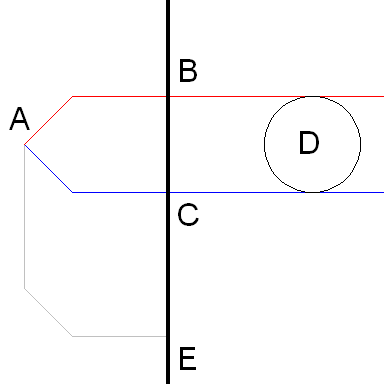
Consider the above image of a transit network. Point A is a major destination; area D is a neighborhood, and point E is an origin. The thick black line is a rapid transit line, passing through and stopping at B, C, and E. The red and blue lines going east from A are frequent rapid bus lines. The gray line going from A to E is a lower-grade bus line: less frequent, and/or slower.
In this image, traveling between A and either D or E, the frequent buses will be more useful going away from A than toward A. For an A-D trip, if I live in neighborhood D and travel to A, then I need to choose which of the two parallel streets to stand on, whereas going back from A to D, I can stand at the bus terminal and take whichever bus comes first. For an A-E trip, if I live at E and am going to A, then again I need to choose which of the two bus lines to use, that is whether to get off the rapid transit line at B or C, whereas going back this is not an issue. On the margin, I might choose to take the lower-grade but direct bus from E to A but not back.
Neither of the situations is hypothetical. When I went to college at NUS, my situation was similar to the A-E case: while the subway has since reached campus, in the mid-2000s the campus was connected by buses to two separate subway stops, Clementi and Buona Vista, and although some parts were definitely closer to one than to the other, the connecting buses served all parts of campus relevant to me. There was no equivalent of the gray bus, and I’d almost always take a taxi to campus, but usually take transit back. Now that I’m in Vancouver and work at UBC, where bus lines converge from parallel east-west streets, my situation is similar to the A-D case, since I can take Broadway buses as well as 4th Avenue buses; there is no alternative to the buses for me, but if there were, for example bikeshare, or walking if I lived closer to campus, I might well use it.
In those examples the asymmetry is for the most part unavoidable, coming from urban layout. In Vancouver, there are multiple east-west streets on the West Side that deserve frequent bus service. Consolidating everything on one street can come from the opening of a Broadway subway to UBC, but because the asymmetry is a second-order effect, the main argument for the subway has little to do with it.
Case 2: Waiting Facilities
Some bus and train stations are notorious for being unpleasant to wait at. Tel Aviv’s Central Bus Station is dark and labyrinthine. In New York, Penn Station and Port Authority are both unpopular. Many older airports are infamous for their poor amenities and confusing layouts. Because people need to wait going outbound but not inbound, this could affect mode choice.
In Vancouver, UBC has two separate bus loops, one for generally express diesel buses, and one for local electric buses; each loop has buses going on multiple streets, as in the above image. I find the diesel loop noisy and disorienting, and therefore avoid it, waiting at the electric loop or the next stop after the loops. Therefore, I usually take electric buses back home from UBC, while I almost always take diesels toward UBC. I have no direct experience with Kennedy Plaza, but other Providence-based bloggers think little of it; I think it was Jef Nickerson who noted that buses going on the same trunk routes are not co-located there. This could induce a similar asymmetry.
It gets worse when bus stops do not have shelter from the elements. Sheltered stops should be included in any bundle of best industry practices, but when they are present only downtown or at major stations, they can bias me to take the bus in just one direction.
Transit agencies can eliminate this asymmetry by making their facilities better. Usually the cost of shelter, clear signage, a bus bay layout that makes identifying the correct bays easy, and similar improvements is negligible, and the benefits are large. Of course, independently of any asymmetry there is no excuse for not having passable facilities, but in some cases, such as the UBC diesel loop, the situation on the ground is worse than it appears on planning maps and this worsens the passengers’ experience.
Case 3: Stress for Time
For some trips – going to an airport or intercity train or bus station, going to a meeting, going to class, going to a workplace where I need to be there at a specific time – there’s a more pressing need for timeliness in one direction than in the other. This biases in favor of more punctual or faster vehicles, even if they’re more expensive or less pleasant. This manifests itself in airport choice (when flying out of New York, I strongly prefer rail-accessible JFK, while my preference for flying in is much weaker), willingness to transfer to save a few minutes of trip time, willingness to ride a more expensive but faster train (for example, the LIRR versus the E), and bus versus train decisions (trains are almost invariably more reliable, often by a large margin). The few times I used transit to get to NUS, I used the subway, whereas when I went back home I’d often use a trunk bus, which was slower but had a station much closer to where I lived.
In this case, there’s not much the transit agency can do. If the bus versus rail issue is persistent, the best thing that can be done is encourage more mixed-use zoning and more symmetric morning travel demand, so that buses would be used in both peaks and not just in the afternoon peak and vice versa for trains.
Case 4: One-Way Routes
To the extent that the transit activist community has an opinion, it is strongly against one-way pairs, going back at least to Jane Jacobs’ criticism in The Death and Life. I’ve written briefly about them; Jarrett has written more extensively. One more issue is that if a bus route runs one-way on different streets (as a consistent one-way pair as in New York, or in a more complex arrangement as in Tel Aviv and Singapore) and I live closer to one direction than to the other, I might take it in just one direction. In Tel Aviv it was not a major problem because the bus I took to middle school run two-way in the segment relevant to me, but in Singapore it was an issue in both middle school and college: I lived next to a very wide one-way street without nearby crosswalks, and getting to the other direction of the buses required crossing it and walking some extra distance; this helped bias me for taking the bus only in the return direction.
The Effects on the Margins
Since asymmetry is small enough an effect that models can ignore it and still come very close to predicting actual ridership, its effect on transit planning is only on decisions that are very close to begin with.
I believe the most common case is the one in the image. A city that transitions from an idiosyncratic network of infrequent direct buses to a regular frequent grid where passengers are expected to transfer needs to decide which of the infrequent buses to keep. It might even have a few peak-only express buses it is considering keeping. In this case, it’s useful to note in which directions the infrequent or peak-only buses are more likely to get passengers, and potentially have an asymmetric number of trips on those in each direction, recycling the equipment for nearby routes whose asymmetry goes in the other direction.
Construction Costs and Perceptions
While looking for South Korean cost data for a major update of my construction costs posts, I stumbled upon a newspaper article excoriating Seoul’s extravagant construction, comparing it unfavorably with the US. Per Joong-Ang, the US neglect of infrastructure is a form of frugality that South Korea should imitate; the National Mall’s poorly maintained, weedy lawns are treated as something to admire. Moreover, Seoul subway construction is more extravagant than in the Washington Metro:
I got on a train at the Smithsonian Metro station. All the stations there have the same architectural styles. They are the 1976 creation of American architect Harry Weese. High ceilings and open spaces are their trademarks. They are known for their practicality. But they are very modest compared to the subway stations of Seoul. The platforms are dimly lighted. It’s hard to read a book there. The walls are concrete, with none of Korea’s flashing signboards. The architecture is very quiet.
After I returned to Seoul, I got on the subway at Guryong Station in Gangnam District, southern Seoul. Marble proliferates at the entrance. A public table is covered with glass. Every day, about 3,600 people use the station, which cost 55 billion won ($51.2 million) to build.
Of course, in reality, Korean construction costs are a fraction of American ones. Guryong Station is an infill subway station in a dense urban neighborhood, opening about a year after the rest of the Bundang Line; it cost about $75 million in 2010 PPP dollars. The US sometimes builds at-grade infill commuter stations for more than that, and those do not have marble entrances or glass tables (update: New York Avenue in Washington is another example of more expensive US infill, this time an elevated station). Building just the shell of an infill subway station on the 7 extension simultaneously with the rest of the extension was estimated at $500 million. Similarly, the Sin-Bundang Line, a driverless rapid transit line, cost 1,169 billion won, about $1.4 billion, for about 18 km; the line is described as “largely underground,” fully underground, and its city terminus is under a dense secondary CBD. In contrast, in Washington, the suburban Silver Line, with very little tunneling, is $6.8 billion (in 2009-2018 dollars) for 37 km. $183 million per km versus about $80.
There are two takeaway lessons from this. The first is that to gauge whether something is cheap or extravagant we need to know the normal range of costs and compare, rather than looking at the quality of construction. Seoul may build very extravagant-looking stations, but it builds them cheaply for some reason.
The second, more important lesson is that people perceive costs the way they perceive local corruption. The US is indeed the world’s most expensive country to build transit in, which Americans can easily believe since they do not trust their government very much. At the opposite corner, Switzerland is quite cheap: a rejected mountain tunneling project in Neuchatel was CHF 850 million for 17 km, and a recently completed urban tunnel in Lucern was CHF 250 million for 1.32 km; accounting for the Swiss franc’s 87% overvaluation relative to PPP, these are $28 and $121 million per km respectively. And as far as I hear from Swiss commenters, the Swiss are proud of the success of their public transportation system. Indeed, Swiss levels of trust in government and institutions are very high.
In contrast, in cheap countries where people do not trust the government, people do not readily accept that construction costs are low. When I talk to Spaniards who are not railfans, they talk about corrupt and extravagant infrastructure projects, and do not believe that both high-speed rail and subway construction costs in Spain are so low. (It doesn’t help that Barcelona’s L9/10, despite still being about average-cost, went over budget by a factor of over 3.) This is no different from the Joong-Ang attitude toward Korean costs: the government self-evidently doesn’t work, and so a $75 million infill subway station is self-evidently a boondoggle.
The situation in the opposite corner – high trust/low perceptions of corruption, high costs – exists as well, in Singapore. The sixth MRT line, soon to begin construction, is S$18 billion for 30 km; the PPP exchange rate between Singapore and US dollars is about 1:1. The line is automated and fully underground, but about half of it is under very wide arterial roads and portions of it are in undeveloped rather than built-up land; it shouldn’t cost this much. The fifth line, currently under construction, is cheaper, S$12 billion for 40-42 km, but still much more expensive than the non-Anglophone average.
And yet, although Singapore’s not far behind Japan in its construction costs, I doubt Singaporeans are as willing to consider their construction practices expensive as Americans, Britons, and Japanese are. I know for a fact that international commentators who hold Singapore in high regard for its efficient government would not be willing to think of it as an expensive-construction country.
All this makes good transit activism somewhat frustrating, in that people will not usually recognize efficient government in absolute numbers. Percentages, certainly – people understand cost overruns and (much less common) cost underruns, and as we’ve seen in Canada people can compare different technologies. But absolute numbers are not as well-understood, and neither are international comparisons of the same technology, where cost differences revolve around questions of project management, contracting practices, labor rules, and details of geology and surrounding infrastructure; people have only recently begun to think in terms of per-km costs in New York, and in the rest of the US I have not seen such thinking. When a transit agency proposes a project, people automatically think it’s expensive, and some will also say it’s necessary, regardless of whether it actually is either. I don’t think reactions to Second Avenue Subway at $5 billion would be materially different from what they were when Phase 1 alone grew to $5 billion.
The upside is that in budget negotiations, the amounts given to transportation are based on absolute shares of the budget rather than on the needs of specific megaprojects, which means that lower costs would translate to more projects built for the same budget. People might not notice that costs have gone down, and might still complain that every subway line is a boondoggle, but more lines would be built and more people would ride those lines. Just the perception of government competence would not change.
Branching
S-Bahns and similar systems have two defining features. One has been hashed to death on this blog: they reuse legacy rail lines, allowing urban rapid transit to extend arbitrarily deep into suburbia. The other, common also to many other transit technologies, is that they branch extensively, allowing them to run many services on the outer ends, where there’s no demand for rapid transit frequency, while interlining to produce high frequency in the center, where there is.
Since branching is a service planning decision independent of technology, any technology could branch. The branching-friendliest technology is subway-surface: the central subway segment has higher capacity measured in trains per hour than the outer surface segments, and this requires branching. For examples, consider the Boston Green Line, Muni Metro, the Frankfurt U-Bahn, and SEPTA’s Subway-Surface lines. However, even when the entire line is rapid transit, branching is useful to ensure higher service where there is higher demand, and infrastructure improvements will typically focus on boosting capacity in the center. For example, the RER A has moving-block signaling allowing 30 peak-direction trains per hour in the center, but fixed-block signaling on the branches, which do not need such capacity.
Even when rapid transit is built separate from both light rail and mainline rail, branching is useful for lines going into the suburbs or even outer-urban neighborhoods. This is practiced in both New York and London, both of which have extensive branching. Observe further that in both cities, the lines reaching farthest out – the A in the Queens-bound direction and the Metropolitan line in the west – are also the most highly branched.
It’s the opposite situation that is weird. When lines do not branch, there must be a strong outer anchor, or else trains need to run empty outside the center. The alternative is short-turns, and if there’s no space for this, the resulting service patterns can be awkward. Shanghai, which has little branching, runs Line 2 in two segments, a central segment with higher frequency and longer trains and an eastern one with lower frequency and shorter trains; trains do not run through. Beijing has a similar awkwardness with the split between Line 1 and the Batong Line, and Toronto has a split between the Bloor-Danforth line and the technologically incompatible Scarborough rapid transit. (The Sheppard line suffers from the same problem today, but it has the excuse that it was planned to continue west to the Spadina subway rather than stub-ending at Yonge.) Paris has little branching on the Métro as well, but the Metro only serves inner parts of the metro area, many lines have strong outer anchors (for example, La Défense on Line 1), and two others providing some of the farthest-out service branch. The RER branches much more heavily, as befits a suburban system. Tokyo has little branching on the subway proper, but the subway is for the most part inner-urban, and lines continue to the suburbs along commuter lines, which do branch.
In North America, this configuration has been common across a variety of new-build systems, especially ones that should have been S-Bahns. BART does this the most extensively, but the Washington Metro is also highly branched for its size, MARTA branches, the light rail systems branch once more than one line is built, and so on. BART in particular imitated the service planning aspect of commuter rail perfectly, and is an S-Bahn in all but the cost of extending the system further.
The problem with any branching is that it reduces frequency on the branches, potentially scaring away ridership. When a single rapid transit line splits in two it’s rarely a problem, and when city-center service splits into suburban services even more is easy to justify. I think the main issue in urban or inner-suburban cases is that with typical rapid transit frequencies (3-minute peak service or slightly better, a peak-to-base ratio of 2:1 or somewhat less) the trunk has about 5-minute off-peak service, and if it splits into two branches, this means 10-minute service on the branches. If the branching occurs early enough that dense neighborhoods with short-distance travel demand are on branches, it may be too little. In addition, if one branch has much more demand than the other, then it’s usually hard to match frequency on each branch to demand, since it requires trains to be unevenly spaced.
The issue is that branch frequency, 10-15 minutes, is in the transition zone between urban show-up-and-go frequency, where schedules do not matter, and suburban frequency, where they do. It’s perhaps less relevant in small cities with small enough transit systems that even 10-minute service is considered very good, but in large cities, people expect more, creating somewhat of an inner-urban metro envy effect.
That said, 10-minute suburban and outer-urban service can be done clockface, making the average wait much smaller. It is done on the RER A in the midday off-peak, with three 10-minute branches, and could be done with two 10-minute branches quite easily. Likewise, it could be done for 15-minute branches (the RER B already does this); the two A branches in New York have close to 15-minute frequency each, and if New York City Transit’s service planning considered it as a factor instead of focusing more on headway management it could ensure predictable schedules at Ozone Park and the Rockaways.
Transit and Place
There is a large class of transit supporters who think that every right-of-way that can be used for transit should be preserved for this purpose, even if it is not very useful. A few overzealous railfans on the message boards opposed the opening of the High Line park and wanted the viaducts to be used for an extension of the 7 train. This is extreme and nowadays the transit activists I know support the High Line while opposing schemes to recreate it in an inferior context. But even serious bloggers like Cap’n Transit, Ben Kabak, and John Morris are opposing plans to create a Low Line out of the abandoned trolley terminal at the Essex/Delancey subway stop, on the grounds that it could be useful for transit one day.
Now, it’s possible that the Low Line idea is bad because people would not want to go to an underground park. But it’s not a problem for transit; the Williamsburg Bridge doesn’t need trolleys since it has a subway running on (and because the bridge is high there is no way a bus could cross it without passing within two blocks of Marcy, the subway stop at the Brooklyn end of the bridge). The lines running on it are in fact underused: as can be seen on PDF-pages 65-73 of the latest Hub Bound Travel Data report, peak-hour traffic on the J/M/Z entering the Manhattan core was one of the lower in the system as of 2010 – higher than the bottom two track pairs (8th Avenue local and Montague) but in a near-tie for third lowest with several others. So there’s not much use for the trolley terminal as a modern Williamsburg Bridge bus (or trolley) terminal.
But what is more important than just the Low Line is place. To succeed, transit needs not only to exist, which it already does in the area in question, but also to have places to connect to. If for some reason the trolley terminal would need to be demolished to build room for foundations for several skyscrapers, it would be an unambiguous win for transit, since it would create more destinations for people to take the existing J/M/Z and F trains to. The surrounding neighborhood might disagree regarding the implications for urbanism, though I’d argue that Midtown-like skyscrapers would be better-integrated into the streetscape than the projects east and south of the station. If the Low Line succeeds as a park, it will be similar: not in the sense of providing jobs for tens of thousands of people, but in the sense of creating a place for people to go to. (In fact, a park has less peaky demand than offices, so it could be better for subway finances even at relatively low levels of usage.)
Last year, I brought up the question of the infrastructure’s highest value mainly as a way of deciding which kind of service (regional, intercity, etc.) should get first priority on any given rail line, but the same is true about transit versus place. In an area with enough transit and not enough place, it’s more important to create more development, for both good urbanism and more successful transit.
This does not mean every proposal to turn a rail right-of-way into a park is good. Despite my skepticism that the Rockaway Cutoff can be a successful rail line, I’m even more skeptical about its value as a park; it’s not in an area that can ever draw many people, since the density (of both residences and jobs) is not high by New York standards and it is far from other destinations that could draw people from outside the nearby neighborhoods. However, in areas that are lacking in good parks, or could use new development, it is better to concentrate on creating place.
For examples of this elsewhere, consider the railyards in Long Island City, Hoboken, and Sunnyside. Two of my earliest posts proposed to build a regional rail station in Sunnyside and then develop the area around it with air rights over the railyard; this is what should be done in an area that needs both transit and place. But in Hoboken and Long Island City, there’s ample transit, and the only use of the railyards is to park trains that can’t do to Manhattan because of lack of electrification or lack of capacity in the approach tunnels. Since parking trains is an inefficient use of space, and both areas have good connections to Manhattan by subway or PATH, there should be plans to remove the railyards and redevelop them to create more place, leaving just enough rail infrastructure to run through-trains, to be parked in lower-value areas. This development can be either parkland or buildings, depending on what is in demand in the area. Based purely on Google Earth tourism, I believe Hoboken does not need additional parks and so development there should be just a new secondary CBD on top of the PATH station, while Sunnyside and Long Island do, and so development there should include parks as well as high-density office and residential construction.
Instead of worrying about turning unused and for the most part unusable transit infrastructure into place, good transit activists should focus on preserving infrastructure that could potentially be used. In the New York area, probably the most useful piece of infrastructure that isn’t currently used is the Bergen Arches, allowing the Erie lines to enter Jersey City at Pavonia/Newport, a more central location than Hoboken; this is one of four options for a location for a new regional rail tunnel from New Jersey to Lower Manhattan, and is arguably the best option for an integrated regional rail network.
In the 1990s there were plans to reuse the Bergen Arches for a roadway, since modified to include both a road option and a rail option, and in 2011 the Christie administration allocated some money to further studies; an analysis from 2004 scored various road and transit options, not including a regional rail network, and gave the highest score to a roadway with a single high-occupancy vehicle and bus lane per direction. (A trail got the second lowest score, after no-build.) Since Jersey City (and the entire region) needs more transit from the north and west, while further formation of place will and should cluster around the waterfront, it’s important to fight any plan to give the Bergen Arches to a non-railroad use unless and until a regional rail plan is formulated that places the New Jersy-Lower Manhattan tunnel at another location.
In contrast, the Low Line should not be a priority. On the contrary, if the park plan is even partially sound, or the place could be reused as another place if the park idea fails, then good transit advocates should support the idea, since it’d be good urbanism. With a few exceptions, good transit requires good urbanism and vice versa.
 Pedestrian Observations

