Travel Time to Work

The Census Bureau has a new publication about commuting in the US as of the 2009 American Community Survey. There isn’t much change from 2000 that’s mentioned, but one table of commute time piqued my interest. This is figure 8, on page 11, showing mean travel time to work by mode of transportation and time of departure to go to work.

It is well-known that commutes on transit take much more time than commutes in a car, but the breakdown based on time of departure defied my expectations. I thought transit trips take the least amount of time at rush hour, when frequencies are the highest, and the most amount of time late at night; car trips should be the opposite. Since people with very long commutes would leave earlier, perhaps around 7 to get to work at 9, the longest commutes by car should be for people leaving to go to work between 6 and 7 or between 7 and 8.

However, it turns out that by all modes, late-night commuters travel the longest. Trip-to-work time declines monotonically with departure time until the 9 am-noon category, where it’s at a minimum (my guess is that people in this category are disproportionately academics and other flex-time professionals who live close to work). This is close to expectation for transit, but for cars, it’s weird: why would people take longer to drive when the roads are clear than when they are congested?

I’d reject an explanation based on leaving very early to work. Insignificantly few people travel 3 hours to work. Instead, the only answer I can think of is that the groups of people who travel to work at rush hour and late at night are of different social classes, and this is reflected in commute times. Late-night commuters are usually low-paid service workers at gas stations, casinos, etc.; those also live on the wrong side of their metro area or in low-income exurbs, and need to drive considerable distances to the favored quarter.

Observe that the long late-night commute trend is the sharpest for carpoolers, who in general skew poor and nonwhite: eyeballing the graph, carpoolers who leave for work between midnight and 5 am travel twice as much time a those who leave between 9 am and noon, compared with a 50% time premium for single drivers (who are wealthier) and transit riders (who tend to work in CBDs, which are equally accessible from all directions).

Obviously, I’m going on partial data here; anyone with access to fuller data could potentially trivially refute my theory. If the theory is true, then two things will be observed in a fuller set of data. First, the late-night time premium will be the longest in large metro areas with favored and unfavored quarters, such as Los Angeles and Washington, and shortest in metro areas with less edge city-favored quarter development, such as New York. And second, if the departure time is broken into more granular categories, then the peak travel time will be at night rather than very early in the morning.

The Option of Profitable Transit

David Levinson’s post saying that transit should strive to restructure and be profitable stirred much discussion on neighboring blogs, including Human Transit (which broadly agrees with the idea if not the libertarian tone) and The Transport Politic (which does not), as well as multiple commenters who chimed in noting that it’s ridiculous to require transit to break even when cars get so many subsidies. While I agree with Levinson and Jarrett’s sentiments about core versus welfare services in principle, in practice the causes of transit losses are orthogonal to the subjects under discussion; the actual issues are somewhat related to what the commenters mention, but those commenters don’t go nearly far enough.

In the original post, Levinson proposes the following distinction:

Mass transit systems in the United States are collectively losing money hand over fist. Yet many individual routes (including bus routes) earn enough to pay their own operating (and even capital costs). But like bad mortgages contaminating the good, money-losing transit routes are bogging down the system.

We can divide individual systems into three sets of routes:

1. Those routes break-even or profit financially (at a given fare). This is the “core”.

2. Those lines which are necessary for the core routes to break-even, and collectively help the set of routes break-even. These are the “feeders”.

3. Those lines which lose money, and whose absence would not eliminate profitability on other routes. These money-losers are a welfare program. We might politely call them “equity” routes.

Jarrett, whose work has focused on priorities, not only agrees with the distinction but also downplays the importance of routes in category #2, and has often advocated that agencies let go of low-performing routes and concentrate on trunk frequency. While Jarrett is right and this distinction is critical when an agency needs to reduce its expenditure, it’s not going to make any agency profitable.

The number of routes in the US that break even financially is minimal. It’s easy enough to come up with routes that cover their avoidable costs, but transit has enough fixed costs that retreating to them is not going to be enough. For a New York example, see this spreadsheet, due to Cap’n Transit: although multiple bus routes are portrayed as profitable, once one checks the more detailed spreadsheet the Cap’n links to, it turns out that when including both direct and indirect operating costs, the best-performing route, the M86, drops from an operating ratio of 172% to one of 91%. Moreover, the best-performing routes do not form a trunk system, but are for the most part short-hop crosstown buses, with very high ridership per kilometer of route length. Most networks that actually are profitable consist of buses feeding into the Lincoln Tunnel, a choke point that has an exclusive bus lane in the morning rush hour.

Since in some other parts of the world urban transit is in fact profitable, we need to address causes other than the existence of lesser-used routes. I propose that instead of classifying American lines into profitable and unprofitable ones, a division in which one category is going to be very lonely, we classify whole networks according to what makes them lose so much money. I believe the following list of causes is relatively uncontroversial for good transit advocates:

1. High labor costs, predominantly overstaffing, but at some agencies (for example, Muni) also very high salaries.

2. Poor design, e.g. of intermodal transfers.

3. Low fares on some networks, which exist predominantly to provide minimal mobility of last resort rather than core transportation.

4. Bad regulations, especially when it comes to regional rail.

5. An auto-oriented policy.

Cause #5 is the elephant in the room. It’s not just ongoing auto subsidies and such mandates as Euclidean zoning and free parking. It’s also a decades-long history promoting auto-centric development, as a result of which uses are too widespread and low-intensity for transit to be of much use on most trips. Even edge cities are too dense sometimes; if you can find Robert Lang and Jennifer LeFurgy’s sadly now behind paywall article Edgeless Cities, read it for a quick explanation of the limitations of the relatively intense but auto-centric development form of Tysons Corner or White Plains.

The best analogy I can give here is a growing industry or industrial zone. Early on in a country’s development, it will want industrial policy: subsidies, tax breaks, protectionism. The US railroads got it, most Japanese exporters got it, Samsung and Hyundai got it. As a country becomes richer and its economy becomes more mature, those industries become profitable and suddenly start advocating free trade and free markets, even for themselves, and whine loudly at the suggestion that rich regions or industries should subsidize poor ones.

There are plenty of routes in the US that, while unprofitable now, could be made profitable with better management and operating practices. This is usually what I write about. Those are causes #1, 2, and 4. Cause #3 applies to some but not the most relevant agencies; fares in large US cities tend to be average or high by international standards, though perhaps lower than the revenue-maximizing fares. Altogether, fixing what are essentially issues of competence is going to raise transit use, possibly to acceptable levels. But it will not turn New York into Tokyo, Boston into Taipei, or Providence into Zurich.

Passenger-Miles Are Overrated

One of the pushbacks I got about my post on road boondoggles is that I didn’t control for passenger-miles of travel, and the number for car subsidies is much lower when one divides it by the appropriate number of trillions. This is not the first time I hear people talk about passenger-miles as a measure of inherent worth, but it doesn’t make it any better.

Passenger-miles don’t vote. They’re not a unit of deservedness of subsidy. They’re one unit of transportation consumption. They’re like tons of staple as a unit of food production, or calories as a unit of consumption. We don’t subsidize food based on cents per calorie.

Even as a unit of consumption, there are flaws in passenger-miles as a concept, when it comes to intermodal comparisons. The reason: at equal de facto mobility, transit riders travel shorter distances than drivers. It’s very obvious when comparing total passenger-miles in transit cities and car cities (see e.g. page 36 here). Transit is slower than driving on uncongested roads, but has higher capacity than any road. In addition, transit is at its best at high frequency, which requires high intensity of uses, whereas cars are the opposite. The result is that transit cities are denser than car cities – in other words, need less passenger-miles.

What passenger-miles are more useful for is measuring intercity transportation. At intercity distance, mode choice has less influence over travel distance (though, even then, HSR and driving are shorter-range than flying, and thus passenger-miles can overstate the importance of flying over ground transportation). It is also a proxy for revenue, whereas on urban transit the fare is either flat or weakly dependent on distance. As a result, intercity railroads usually cite passenger-miles or passenger-km, and urban transit operators usually cite passengers.

But when it comes to local transportation, it doesn’t work very well. A country’s mode share expressed in passenger-miles is lower than that expressed in passengers, and this is going to make transit and especially walking look much less significant than they actually are.

Who’s Migrating to the Sunbelt?

It’s well-known that people have been moving from coastal US states to the Sunbelt for many years now. But who’s moving? Is it the upper middle class fleeing higher taxes or searching for cheaper houses, or perhaps the poor fleeing high costs of living? Put another way, is the above-average growth in per capita income in many Northeastern and West Coast metropolitan areas a matter of actual growth, or simply of pushing the poor out to the Sunbelt, whose per-capita income growth is often anemic?

All data in this post is courtesy of Aaron Renn’s Telestrian service, which cribs numbers from the IRS, Census Bureau, and other sources and presents them in a reasonably searchable manner. The IRS keeps track of intranational migration in the form of tax exemptions, which allows us to figure out the migration trends in terms of people (exemptions), households (returns), and income (adjusted gross income). This way we can figure out if the people moving out of a region are richer or poorer than the average. Although the IRS misses a lot of people and much income, it is still the best available source in the US for migration statistics. The more accurate American Community Survey tabulates very coarse migration statistics.

Observe also that the IRS data is given per year, which allows us to look at zoomed-in trends. For example, here is California’s migration with each state as well as the rest of the world from 2000 to 2009. Here is somewhat worse-presented data for New York State. It turns out that migration marginally increased California’s per capita income, and had practically no effect on New York’s; in other words, their growth is real, and doesn’t come from pushing the poor away.

More precisely, we have the following observations:

– In both California and New York, the difference in income between immigrants and emigrants is very small; immigrants are slightly richer in California, $27,098 vs. $26,209, and slightly poorer in New York, $29,876 vs. $30,810.

– Overall both immigrants and emigrants are slightly poorer than the statewide per capita income. However, the effect is very small: according to the IRS, California’s per capita income in 2009 was $28,569 and New York’s was $31,617. Were it not for migration – that is, if people had lived in 2009 where they’d lived in 2000 but still earned the same income – California’s per capita income would’ve been $28,243, i.e. 1% lower, and New York’s would’ve been $31,689, i.e. 0.1% higher.

– The richest migration occurs between high-cost coastal states, especially between New York and California, while migration between those states and the Sunbelt is much poorer.

– The poorest large group of immigrants in both states is international immigrants. In both cases they were about 9% of total immigrants, so they can’t have dominated the numbers too much. Thus Jane Jacobs’ story that great cities take in poor immigrants and churn out a middle class, considered on the state level, is only partially confirmed by this data.

– Emigration to the Sunbelt’s bubble states – from California to Arizona and Nevada and from New York to Florida – was predominantly a 2005-7 phenomenon, and decreased markedly after the bubble crashed.

– Emigration to other Sunbelt states was more of a mixed bag. Georgia and North Carolina, both partial bubble states, also look like partial bubble states in the migration numbers, with emigration from New York and California peaking in 2005-8, but less prominently than with the proper bubble states. Emigration from California to Texas looks like that to a bubble state, despite Texas’s strong economy through the recession; but emigration from New York to Texas and from both states to Colorado remains steady.

– The biggest difference between immigrants and emigrants is not income but household size – emigrating households were much bigger (1.95 vs. 1.7 in California), but still much smaller than the statewide average (2.23 according to the IRS, much lower than the actual average but comparable with the above numbers). This is only partially consistent with the explanation that those regions attract singles and DINKs and turn away families.

The story I started this investigation with is that New York and California predominantly turn away the middle class, which would be seen in middle-class emigration and low-income immigration; my recollection, coming from merely eyeballing the data, had been that immigrants were much poorer. This should be consistent with the breakdown of the cost of living in dense city regions: housing is unaffordable if your ideal of how to live is having a car and a single-family detached house that’s less than an hour away from work; if you’re flexible about car ownership and don’t mind small apartments, then New York and California are quite affordable.

But what we actually see is that both immigration and emigration between those states and the rest of the world is middle-class. The people moving to the Sunbelt really are being priced out. It’s hard to distinguish pricing out from cashing in on high housing prices, but the lower-income characteristic of this emigration suggests the former. The upshot is that policies reducing the cost of housing could stem this tide while at the same time having no effect on poverty and the need for social services. While it’s heinous to try to price out the poor, as the richer parts of the Bay Area and many other regions do, this is not what is being done here.

Let me close by linking without much comment to the same data for Texas. The IRS recorded a total income of $475,109,477 in 2009 and a total population of 19,235,926, i.e. a per capita income of $24,699. As in California, immigrants are a little poorer than emigrants and both are a little poorer than the average. Controlling for this effect as above would raise per capita income to $25,002, a 1.2% rise.

Quick Note: Comfort

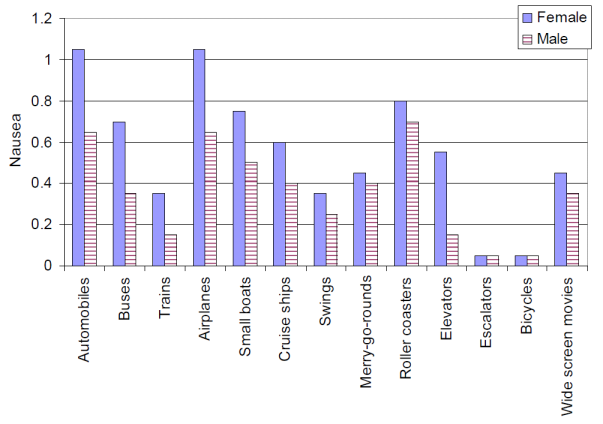
While reading a thesis about tilting trains, I saw a comparison of passenger comfort on different modes of transportation. This includes the following graph (p. 30), which the thesis sources to a study of motion sickness in US children and teenagers:

The scale is originally 0-3: this study polled a sample aged 9-18 and asked whether they feel nauseous on any of the above modes, where 0 is “never” and 3 “always.”

Selective Application of Smeed’s Law

A few months ago, in response to the Raquel Nelson case, author Tom Vanderbilt found an FHWA study from 2005 that finds that on wide, busy roads, pedestrian death rates are higher on marked crosswalks than on unmarked ones. The study itself is worth reading; its explanation of the finding is that,

These results may be somewhat expected. Wide, multilane streets are difficult for many pedestrians to cross, particularly if there is an insufficient number of adequate gaps in traffic due to heavy traffic volume and high vehicle speed. Furthermore, while marked crosswalks in themselves may not increase measurable unsafe pedestrian or motorist behavior (based on the Knoblauch et al. and Knoblauch and Raymond studies) one possible explanation is that installing a marked crosswalk may increase the number of at-risk pedestrians (particularly children and older adults) who choose to cross at the uncontrolled location instead of at the nearest traffic signal.

An even greater percentage of older adults (81.3 percent) and young children (76.0 percent) chose to cross in marked crosswalks on multilane roads compared to two-lane roads. Thus, installing a marked crosswalk at an already undesirable crossing location (e.g., wide, high-volume street) may increase the chance of a pedestrian crash occurring at such a site if a few at-risk pedestrians are encouraged to cross where other adequate crossing facilities are not provided. This explanation might be evidenced by the many calls to traffic engineers from citizens who state, “Please install a marked crosswalk so that we can cross the dangerous street near our house.” Unfortunately, simply installing a marked crosswalk without other more substantial crossing facilities often does not result in the majority of motorists stopping and yielding to pedestrians, contrary to the expectations of many pedestrians.

This is a rather standard application of Smeed’s law and similar rules governing traffic, whose one-line form is that traffic fatalities are determined primarily by psychology. This is not a problem; the problem is why such issues are only ever brought up in case of pedestrian fatalities.

In 1949, R. J. Smeed found a simple explanation for traffic fatalities: they depend less-than-linearly on the number of cars on the road. In the 1980s John Adams revised this to a more accurate rule based on VMT rather than the number of cars, and based on a constant decline in per-VMT accidents over time. Safety improvements do not bend or break the general trend. Quoting Adams again, the introduction of seat belts caused no reduction in traffic fatalities, and on the contrary caused pedestrian fatalities to temporarily inch up, as drivers felt safer and drove more recklessly. The only way to reduce the number of car accident victims is to reduce traffic.

And yet, government reaction is consistently on the side of accepting Smeed’s law when it implies there’s no need to improve pedestrian facilities, and rejecting it when its implication is bad for cars or good for pedestrians and cyclists. Local governments in the US routinely argue that safety is at stake when they want to upgrade a road with grade crossings into a full freeway. The FHWA helpfully adds that intersections are responsible to half of all car crashes and “FHWA will identify the most common and severe problems and compile information on the applications and design of innovative infrastructure configurations and treatments.”

In reality, all building freeways does is create more traffic, and cause more people to die in crashes. The average per-VMT death rate in the US has declined by 3.3% per year, but in the years following the Interstate Highway Act, it was practically flat – in other words, building freeways did nothing to accelerate the trend for reduction in per-VMT accident deaths. Although an individual freeway is undoubtedly safer than an individual road with intersections, the road network has to be viewed as a system: increase safety in one area and people will drive more recklessly elsewhere.

This systemwide view is clearly present in the case of pedestrians: the FHWA isn’t claiming that crosswalks are inherently unsafe, only that they cause more at-risk pedestrians to cross. In other words, the problem is that they cause too many of the wrong kind of pedestrians to cross. The implication is never used for roads. Traffic is never treated as variable, and if people shoot down freeway upgrades on the grounds that they’ll induce more traffic, it’s always on environmental or community grounds rather than on safety grounds.

Obama Proposes $4 Billion for HSR

President Obama’s new jobs bill includes $50 billion for infrastructure construction, including $10 billion for an infrastructure bank, $4 billion for high-speed rail, and $2 billion for Amtrak. Assuming it can get past the Republican Congress and that it will not be watered down as it already has been since the beginning of the year, the question arises: where to spend the money?

Fortunately, the separate grant for Amtrak suggests that the Northeast Corridor will be funded from a separate pile of money. This means that it’s more feasible to spend 100% of the HSR money in California. I claim that, in light of California’s present funding situation, this is the best possible use of the money, and, furthermore, the federal government should let California know of this as soon as possible, before it lets contracts out to tender.

Recall that California’s present HSR money is sufficient to build from Bakersfield to a point between Fresno and Merced, at least in principle, as the Environmental Impact Report projects slightly higher costs. Recall further that the $8 billion that could be made available to California – Obama’s $4 billion plus matching funds from Proposition 1A – are more or less enough to build from Bakersfield to Sylmar.

More precisely, the cost estimate for Bakersfield-LA is $12.6 billion, but according to CARRD, which independently of this also thinks the cost is going to be $18.6 billion, Palmdale-Sylmar is half the cost of Palmdale-LA, and as a result adding up Bakersfield-Sylmar using the 2009 Business Plan numbers works out to just under $9 billion. The approximately $1 billion in missing funds could either be obtained from local or private sources, or diverted from the plans to build north of Fresno; the segment that goes through and north of Fresno is expected to cost $1-2 billion, and diverting all north-of-Fresno money to Bakersfield-Sylmar should suffice to build the system from Sylmar to Fresno, with a cheap electrified legacy onward connection to LA.

Alternatively, if it turns out that going from Bakersfield to the LA Basin through Tejon Pass rather than through Palmdale is cheaper, then it’s possible to terminate the line in Santa Clarita and have trains continue further south at lower speed. This is in principle possible even through Palmdale, but then the legacy segment of the line would be both longer and curvier.

In other words, by spending all possible HSR money in California now, the Obama administration can guarantee a useful initial operating segment from LA to Fresno. On the margin the benefit of this is much bigger than its share of the cost, since it makes the difference between an upgraded San Joaquins train and a Phase 0 high-speed line.

If the administration funds California in full, then people will be able to ride a fairly long segment at full speed, connecting at lower speed to a major city. Some people are still going to call this a train to nowhere until it connects to San Francisco, but fewer people will use this epithet on LA-Fresno than on Bakersfield-Merced.

The primary problem with American transportation planning is that there is no transportation policy in the US. There is an industrial policy, a jobs policy, and construction for pizzazz on both sides, as well as the joy of hippie-punching among conservatives. An open HSR segment that is not a complete cost or ridership disaster could at least blunt the hippie-punching, if not develop local expertise that could eventually lead to transportation policy. In countries where HSR is in operation, or something close enough to it, the conservatives do not oppose its construction, even quite right-wing ones such as Berlusconi and Cameron.

The worst thing that can be done is spreading the money thin. The not-really-high-speed lines funded elsewhere, or, even worse, funding to Amtrak’s massively overpriced Vision plan, can only lead to small, barely noticeable improvements, ensuring there are plenty of disaffected people to continue the treatment of intercity transportation as a cultural political football. The only place where $4 billion in federal money makes a difference between having a usable system and not having one is California, and this is the basket the administration should put its eggs in.

The Rail-Trail Scam

I recently learned that a writer for the Adirondack Explorer has the following proposal to create a new rail-trail: demolish a line that’s in use by a heritage railroad, pave it over, and convert it to a bicycle trail. The arguments in the piece are your standard hatchet job considering only the costs of rail and only the benefits of the alternative, and are downright uninteresting; what’s interesting is that this is just the culmination of the misuse of the original concept of rail-trails.

Originally, rail-trails were created to preserve railroads for future use. Their mandate includes “to preserve established railroad rights-of-way for future reactivation of rail service.” In reality, restoration almost never happens. The Rails-to-Trails Conservancy’s review of railbanking points to success that a full nine railbanked corridors have had rail service restored, out of 301. The rest have been paved over, and often have enough non-railroad users that any restoration would be politically difficult in practice; I suspect that this is why the Providence Foundation makes no mention of restoring service on the second, now-abandoned track between Providence and Woonsocket in its regional rail study.

Another problem with railbanking is that it focuses on what’s useful as a trail, and not on what would be useful as a railroad later. There are pleasant exceptions, such as the Milwaukee Railroad’s route in most of Washington State, but in Rhode Island, the rights-of-way that have been preserved are those that would be easiest and least expensive to rebuild from scratch: the line to Hartford through West Warwick and Coventry, the line from East Providence to Bristol, and the aforementioned second track to Woonsocket. In contrast, many major pieces of infrastructure were demolished. Downtown Providence’s connection to East Providence was cut and would require new urban viaducts to be restored, and it’s sheer luck that the bridge over the Blackstone estuary is still there. Newport’s only rail connection to the mainline was railbanked but removed, which means restoration would face fewer regulations than starting new service from scratch, but only after rebuilding a bridge from the island to the mainland.

This is not intentional, but it’s neglectful of the needs of any mode other than the car as regular transportation; even bikes only get the nod for recreational use. The document coming out of Rails-to-Trails Conservancy, Railbanking and Rail-Trails: a Legacy for the Future, makes this thinking clear, when one reads between the lines. Here are some touted benefits of rail-trails:

The USDA’s Dietary Guidelines recommend at least 60 minutes of daily exercise for children and teens and at least 30-60 minutes everyday for adults. Trails provide close, safe, traffic-free paths for walkers, joggers, inline skaters [and] cyclists. Rail-trails are also part of a nationwide initiative launched by Congressman James L. Oberstar (D.-Minn.) to create safe routes that will encourage school children to walk and bike to school.

The first sign of utter disregard for alternative transportation as everyday transportation is the touting of “traffic-free paths.” Segregation of different modes of travel into different rights-of-way is the thinking of the traffic engineer and the freeway builder, not of the urbanist. The second is the fact that, in practice, the placement of those trails follows ideal corridors for the needs of trains, not bicycles or pedestrians. One does not use a mode of transportation that averages 60 km/h and loses 2 minutes every time it stops the same way one uses a mode that averages 25 km/h and can stop where you want. You can look at the northern end of the aforementioned West Warwick trail on Streetsview or on satellite and judge for yourself how useful it is for a cyclist’s daily work trip; a train would just blast through at full speed.

There’s already an ideal place for pedestrians are cyclists: the streets. Those are the strange linear alignments used by cars and fronted by actual residences and jobs. Away from urban areas, those are the country roads that go through small towns. A policy that aimed at reducing car use and getting people to use more active transportation would impose walkability and bikability standards on streets, which are where the exact addresses people want to go to are. A policy that didn’t care would turn railroads into recreational trails and greenwash it by saying they’re usable by pedestrians and cyclists. And I think we all know which of the two the rail-trail scam is.

Consensus and Immigration

This is the final installment in my series about consensus. For the first two posts, see Consensus and Cities, and Democratic Versus Elite Consensus.

There’s a pervasive view that, far from a consequence of extreme diversity, consensus is in fact a feature of homogeneous societies. For example, the popular view in Scandinavia is that the traditional high-trust society is under assault by immigrants who do not share the same social values as the native-born. Robert Putnam goes further and shows that diversity is associated with less trust and social capital, which made many racists joyful that here, there was a scientific basis for hate. The conclusion they as well as many ordinary members of the elite draw is that immigrants are a problem for society to deal with.

Before presenting an alternative view, let me point out that in fact, some of the world’s most famous consensus societies are also the most diverse. The Netherlands had a sharp division between Catholics, Protestants, and secular socialists for a century; Dutch consensus democracy is based in part on the need for those communities to coexist. Belgium is practically two separate countries – one Flemish, one Walloon. Switzerland, too, is diverse, though the German-speaking community has a majority. Those societies are all deeply suspicious of immigrants, but their attitude to the diversity they have built natively is positive, and, in the Netherlands, one attempt at integration involved creating a separate pillar for Muslims.

The diversity in those countries is discounted today by Americans and even Europeans who have grown to seeing the West as a single coherent civilization in opposition to others, but back when they developed their model of inter-ethnic consensus, Protestant vs. Catholic and other internal European divisions were critical. By analogy, it would have been senseless to talk about Jews, Irish, and Italians in New York in 1900 as one undifferentiated white mass.

The negative attitudes toward immigrants in the most diverse European countries, as seen in the rise of the SVP and Geert Wilders’ PVV and in the success of their nativist programs, suggests the reason for the xenophobia is not fear of diversity, but fear of change. Consensus government works slowly – and, at any rate, the mainstreaming of democratic consensus has gotten to a point that there’s a strong elite consensus for not dealing with incendiary issues. Rapid entry of new people into an area causes NIMBYism everywhere; when those people are distinguished by skin color or religion, the result is racism.

It is not my intention to excoriate racism here, much less European racism – it is pointless. However, let me suggest ways for social and political leaders to avoid the above problems – to build a consensus in favor of more social integration and acceptance. This is especially important in diverse cities, where immigrants tend to cluster, and where there’s preexisting diversity making it feasible to avoid majority-minority politics.

First, immigrants are not a problem. Neither is immigration. The problem is racism. This is the mistake of the elites in every European country: they whitewash the existence of discrimination and make little attempt to fix it. A good reference is Why the French Don’t Like Headscarves, portraying French governments as knowing exactly how many Muslims there are in their communities when it comes to discussing gender-segregated swimming pools but not knowing or discussing discrimination. Alternatively, read these two New York Times articles published in the wake of the French riots.

Second, in the long run, diverse communities become stronger, and the trend of hunkering down dissipates. It’s a long process, and the goal should be to make it shorter, and avoid the risk of long-term divisions as occurred between blacks and whites in the US over the centuries. Putnam himself notes it in his study; his three examples include black-white integration in the army following desegregation, Catholic/Protestant intermarriage from the postwar period to the 1980s, and the turning of ethnic whites from disparate nationalities into Americans in the first half of the 20th century.

Third, it’s imperative to make integration a matter of local consensus rather than a political play by one party, either a liberal party looking for patronage voters or a conservative party looking for strikebreakers. In other words, immigrants are a group of people, not a solution or a problem.

A good example of a mayor who seems to abide by the first two principles but not the third, viewing immigrants as a solution, is Schenectady’s Al Jurczynski. After hearing that the Guyanese don’t accept welfare, Jurczynski began a concerted campaign of luring them in from New York and giving them free housing that would otherwise have to be demolished. Many of Jurczynski’s actions, such as going to Guyanese areas of Queens and going on a Guyanese radio show, are a good example of what political leaders must do to make immigrants feel like part of the city; however, the consensus he created exists purely among the business class, and therefore has drawn animosity from other groups within the city, including existing minorities, who feel slighted by the implication. It was a political play, much like Nixon and Pat Buchanan’s strategy of appealing to Catholics.

It’s not hard to redefine Americanness (or Britishness, or Dutchness) along more inclusive lines – it’s been done before in the face of new waves of immigration, often in order to maintain a majority of those defined as white Americans but using methods that could be generalized to decrease rather than increase animosity.

A mayor who wants to promote integration rather than create an ethnic group captive to his political needs will not engage in such divisive politics. He will walk in the ethnic enclaves of his own city first, making people already in the city feel welcome. He will make a positive effort to hire qualified minorities and listen to communities on the issues relevant to them, including, for example, making an effort to integrate the police force in order to reduce racist brutality.

Democratic Versus Elite Consensus

This is part 2 of my series on consensus, following Consensus and Cities.

Early-20th century America was a nation with remarkable consensus about cities. The progressive reformers, the populists, and the environmental movement all agreed that cities were bad, and the only solution to their problem was widespread destruction of slums. It’s this general agreement that gave autocrats like Robert Moses their power. Obviously, this consensus missed one key piece of the puzzle – namely, the consent of the urban dwellers who were being discussed as objects rather than as participants. Thus, a good consensus has to involve everyone, and not just the elites, or else it at best degenerates into elite vs. populist politics, and at worst leads to virtual colonialism.

The distinction between democratic or popular consensus and elite consensus is important, because in places that have only had the latter, including the US, people can form their views of consensus around features that are really special to elite consensus, as represented by insider publications such as the Washington Post, most of the New York Times, and a horde of Washington-area trade journals. For one, elite speech is very measured, and phrased in reasonable-sounding ways: concerned but understanding of limits, haughty-sounding and wonky but still reducible to soundbites for the lay reader, and always phrased in an understated way. Those are Krugman’s Very Serious People, and the National Review’s liberal elite. The US has come a long way since the 1950s and enough people see this elite as a distinct faction rather than as a real national consensus, but many of the elite’s values have percolated and taint the notion of consensus.

In contrast, democratic consensus is a messy affair. What’s happening right now in the Israeli J14 housing protests – or, even more so, what happened a month ago, before the protest became an institution by itself – is exactly the process of consensus-formation. Tents representing all social and ethnic groups in the country are present. The protest began with culturally liberal Tel Avivis, but has Haredi tents; it’s majority-Jewish, but has had Arab speakers in Jewish towns and spread to Arab towns. On the ground, the dialogue is the exact opposite of that of the Washington Post: people yell and argue until the small hours of the night, debating different views of how to improve the housing situation, and listening to one another. They tolerate trolls who maliciously propose settlement expansion as the solution but do not feed them; they have more important things to discuss. The consensus ideas they’ve formed for how to deal with the housing situation involve concerns of all groups – two of the protesters’ demands are specific to Arab and Bedouin minorities, and, unlike the mishmash of demands one sees in the US at ANSWER protests, those demands are relevant to the issue at hand.

In the US, any attempt to discuss things in the manner of J14 rather than in the manner of the Washington Post is immediately lumped together with unserious partisanship. Even people who know how rotten elite consensus is have gotten used to its discourse: thus, Michael Lind exalts the attitudes of what he calls post-consensus America in a hippie-punching piece against public transportation and environmentalism.

Ironically, calls for technocracy are sometimes a reaction against this elite domination, when the elites put themselves on the other side of expert consensus, as they do on climate issues (see Lind’s other piece on the matter, or anything on the subject by George Will), and prefer to talk in terms of platitudes about unpredictability and how scientists may be wrong. There are sizable and growing organizations and pundits criticizing consensus from this technocratic point of view – for one, anything involved in the new atheist movement.

The properties of consensus are orthogonal to those of elitism, and are different from the properties of the combination of both. The most important is listening to people with different points of view without sneering. How messy or orderly the discussions are is not relevant – it speaks only to how different the parties involved are from one another and how much they initially disagree. It’s the process of listening, of forming conversation, that makes for productive and consensus-building debate. How nice people are to one another is only tangentially important. I submit that if you compare a Room for Debate piece on transportation with a thread of the same length on a transportation blog – even a repetitive fight over Altamont vs. Pacheco Pass on the California High-Speed Rail Blog, let alone the ideological arguments about financing on The Transport Politic – you’ll find that the blog is going to be more informative. Lay people talking to each other will beat thinktank fellows and professional pundits talking at each other any day.

The problem with extending this to urbanism is that cities’ power structure makes it very hard to give ordinary people the voice they deserve. People who are not part of the elite, by definition, are less powerful. And being elite by itself changes how one thinks, leading to factional interests different from those of ordinary people, independently of questions such as which social and ethnic groups the elites are drawn from. (Communist Party elites, high-income elites, and racial elites are equally unconcerned with the average person.)

Only in a city with a completely gated establishment can major media organizations refer to slum dwellers as “a city within a city” when they outnumber people living in formal neighborhoods, and quote researchers as saying crime is a big problem in the slums when it in fact isn’t. Unfortunately, as Robert Neuwirth‘s experience in Mumbai shows, such cities exist.

As mentioned in Part 1 of this series, democratic consensus is possible, by slowly persuading all stakeholders in a community that one’s solution is good and in line with community values. Usually, within a small enough community, the problem of democratic vs. elite consensus is less acute. Some groups are privileged over others – for example, long-term residents versus recent immigrants – but arguably no more so than in citywide politics. Where localism is oppressive is in treatments of minorities in situations with a defined majority group, but when it comes to participatory inclusion, it’s no worse than appealing to the power brokers and hoping for good. In a diverse neighborhood with multiple factions of which none can dominate, this problem is usually quite small. The local elites are not so powerful that one can’t approach them on more or less equal footing.

However, the only way to systematically unleash the power of democratic consensus is via populism, as the example of J14 shows us. It by itself is not purely consensus-based – it comes from a partisan fight between the people and those in power in which the people are acting as one bloc – but the result usually involves a fair amount of consensus, since anything else would lead to divide-and-rule politics. In the US – as well as Israel, and other developed countries I’m somewhat familiar with the discourse of – such populism can come off as polarizing and anti-consensual, because of the misidentification of what are really features of elitism with consensus.

Of course, to many people, populism is not a dirty word. The Tea Party, and its right-wing populist equivalents around Europe, has had many successes precisely because there’s a segment of the US that wants neither consensus nor the current elite. The same can be said of any proto-populism on the left. But there are plenty of people who do want government to work, and do like dialogue, and they can be turned off by what they perceive as unserious attitudes.

The way to create a situation in which both the relatively secure middle class and more radical factions – both ideological and socioeconomic – are willing to cast aside elite values is then to wait until things get bad enough. But it’s easier to imagine such consensus happening today than in 1965, and not just because of reduced racial animosities. It’s as if Marx was right except that, instead of a violent revolution, the dispossessed fight for social reforms that make their economic situation more secure.

The time could already be right. And the process of replacing elite bipartisanship – or hyper-partisan fights between parties that are unconcerned with actually governing – can be pursued on the local level, in parallel, to allow for time to create bottom-up institutions to take a more prominent role in the future. It could be that the US is waiting for its own tents in New York and Washington to lead to nationwide demonstrations.