On Hierarchy and the Civil Service

Some argument on a military history blog with good posts and terrible comments led me down a rabbit hole of talking about different models of how large, hierarchical organizations function.

The origin of this is that I’ve been reading the same things about military organization and the chain of command, in different variations. Here, via Quora, is the best encapsulation of how a multi-layer hierarchy works, on a submarine:

The CO never gives orders directly to watch standers. He works through the OOD or EOOW (officer of the deck and engineering officer of the watch). 99.9% of the time through the OOD. – He/She must re enforce their authority and not hijack it. It will cause confusion. If a Captain gives an order to a watch stander he/she assumes the conn. but not the deck. (See my other postings about this.)

The contrast is with personalistic managerial styles, in which the top person in the hierarchy constantly subverts and undermines their direct subordinates, by changing plans at the last minute, giving orders to low-rank people directly, or openly scolding the direct subordinates as out of touch. Think, for example, about the common cultural stereotypes of middle management; upper management that invoke such stereotypes against middle management is unlikely to be able to implement any long-term corporate culture, because the people responsible for implementing it know that they can be sniped by the top at any moment.

I bring this up here because populist politicians, or politicians in populist systems, love so undermining their own instruments of governance. The civil service is one such instrument, and is what’s relevant for infrastructure – but this undermining also includes other instruments.

For example, in the 2018 Senate race, Beto O’Rourke visited college students to induce them to turn out to vote for him and against Ted Cruz – and let people know that political consultants recommended against this move. Needless to say, O’Rourke uses consultants just like everyone else (and in US politics, at least for the Democrats, all candidates use the same pool of consultants – there’s no separation into, say, ones advising more left-wing and ones advising more centrist candidates). But he still felt it was necessary to scold his own instruments of campaigning.

So this isn’t even about the trend in the US, and in some countries with democratic backsliding, of replacing the apolitical civil service with party institutions. Personalistic politicians (and the US encourages personalism even in non-populists) undermine the instruments of ideological party governance, too.

The upshot of all of this is that a city like New York can have large civil service departments, but it won’t really have a strong civil service if the mayor keeps publicly undermining it. If planners know that whatever they work on will get sniped on a whim, they will not give their best; they’ll adopt punch-clock behavior, doing just the minimum until they qualify for a pension. If planners know that whatever they do, they’ll face a glass ceiling and have to answer to an inexperienced aide to a political appointee, they’ll leave as soon as they can. The most talented workers will go to the private sector, and everyone who can leave the city will as services atrophy.

Our Webinar, and Penn Reconstruction

Our webinar about the train station 3D model went off successfully. I was on video for a little more than two hours, Michael a little less; the recording is on YouTube, and I can upload the auto-captioning if people are okay with some truly bad subtitles.

I might even do more webinars as a substitute for Twitch streams, just because Zoom samples video at similar quality to Twitch for my purposes but at far smaller file size; every time I upload a Zoom video I’m reminded that it takes half an hour to upload a two-hour video whereas on Twitch it is two hours when I’m in Germany. (Internet service in other countries I visit is much better.)

The questions, as expected, were mostly not about the 3D model, but about through-running and Penn Station in general. Joe Clift was asking a bunch of questions about the Hudson Tunnel Project (HTP) and its own issues, and he and others were asking about commuter rail frequency. A lot of what we talked about is a preview of a long proposal, currently 19,000, by the Effective Transit Alliance; the short version can be found here. For example, I briefly mentioned on video that Penn Expansion, the plan to demolish a Manhattan block south of Penn Station to add more tracks at a cost of $17 billion, provides no benefits whatsoever, even if it doesn’t incorporate through-running. The explanation is that the required capacity can be accommodated on four to five tracks with best American practices for train turnaround times and with average non-US practices, 10 minutes to turn; the LIRR and New Jersey Transit think they need 18-22 minutes.

There weren’t questions about Penn Reconstruction, the separate (and much better) $7 billion plan to rebuild the station in place. The plan is not bad – it includes extra staircases and escalators, extra space on the lower concourse, and extra exits. But Reinvent Albany just found an agreement between the various users of Penn Station for how to do Penn Reconstruction, and it enshrines some really bad practices: heavy use of consultants, and a choice of one of four project delivery methods all of which involve privatization of the state; state-built construction is not on the menu.

In light of that, it may make sense to delay Penn Reconstruction. The plan as it is locks in bad procurement practices, which mean the costs are necessarily going to be a multiple of what they could be. It’s better to expand in-house construction capacity for the HTP and then deploy it for other projects as the agency gains expertise; France is doing this with Grand Paris Express, using its delivery vehicle Société du Grand Paris as the agency for building RER systems in secondary French cities, rather than letting the accumulated state capacity dissipate when Grand Paris Express is done.

This is separate from the issue of what to even do about Penn Station – Reconstruction in effect snipes all the reimaginings, not just ours but also ones that got more established traction like Vishaan Chakrabarti’s. But even then it’s not necessarily a bad project; it just really isn’t worth $7 billion, and the agreement makes it clear that it is possible to do better if the agencies in question learn what good procurement practices are (which I doubt – the MTA is very bought in to design-build failure).

Different Models of Partial Through-Running

I gave a very well-attended webinar talk a few hours ago, in which a minority of the time was spent on the 3D model and a majority about through-running and related modernization elements for commuter rail. I will talk more about it when the video finishes uploading, which will take hours in the queue. But for now, I’d like to talk about different conceptions of how through-running should work. I was asked what the difference is between my vision (really our vision at ETA, including that of people who disagree with me on a lot of specifics) and the vision of Tri-State and ReThink.

One difference is that I think a Penn Station-Grand Central connection is prudent and they don’t, but it’s at the level of detail. The biggest difference is how to react to a situation where there isn’t enough core capacity to run every line through. Tri-State and ReThink prefer connecting as many lines as possible to the through-running trunk; I prefer only connecting lines insofar as they can run frequently and without interference with non-through-running lines.

Partial through-running

To run everything in New York through, it’s necessary to build about six different lines. My standard six-line map can be seen here, with Line 7 (colored turquoise) removed; note that Line 7’s New Jersey branches don’t currently run any passenger service, and its Long Island branches could just be connected to Line 5 (dark yellow). The question is what to do when there are no six through-lines but only two or three. Right now, there is only one plausible through-line; the Gateway tunnel/Hudson Tunnel Project would add a second, if it included some extra infrastructure (like the Grand Central connection); the realigned Empire Connection could be a third. Anything else is a from-scratch project; any plan has to assume no more than two or three lines.

The question is what to do afterward. I am inspired by the RER, which began with a handful of branches, on which it ran intense service. For example, here is Paris in 1985, at which point it had the RER A, B, and C, but no D yet: observe that there were still large terminating networks at the largest train stations, including some lines that weren’t even frequent enough to be depicted – the RER D system out of Gare de Lyon visible starting 1995 took over a preexisting line that until then missed the map’s 20-minute midday frequency cutoff.

The upshot that whenever I depict a three-line New York commuter rail system, it leaves out large portions of the system; those terminate at Grand Central (without running through to Penn Station), Brooklyn, or Hoboken. The point is to leverage existing lines and run service intensely, for example every 10 minutes per branch (or every 20 on outer tails, but the underlying branches should be every 10).

Tri-State uses a map of the RER in its above-linked writeup, but doesn’t work this way. Instead, it depicts a trunk line from Secaucus to Penn Station to Sunnyside with branches in a few directions. ReThink is clearer about what it’s doing and is depicting every possible branch connecting to the trunk, even the Hudson and Harlem Lines, via a rebuilt connection to the Hell Gate Bridge.

The issue of separation

The other issue for me – and this is a long-term disagreement I have with some other really sharp people at ETA – is the importance of separating through- from terminating lines. Paris has almost total segregation between RER and terminating Transilien trains; on the most important parts of the network, the RER A and B, there is only track sharing on one branch of the RER A (with Transilien L to Saint-Lazare), and only at rush hour. London likewise uses Crossrail/Elizabeth Line trains to connect to the slow lines of the Great Eastern and Great Western Main Lines, more or less leaving the fast lines for terminating trains. Berlin has practically no track sharing between the S-Bahn and anything else, just one short branch section.

With no contiguous four-track lines, New York can’t so segregate services while keeping to the Parisian norm that shorter-range lines run through and longer-range ones terminate. Any such scheme would necessarily involve extensive sharing of trunk tunnels between terminating and through trains, which would make Penn Station’s schedules even more fragile than they are today.

This means that New York is compelled to run through at fairly long range. For example, trains should be running through on the Northeast Corridor all the way to Trenton fairly early, and probably also all the way to New Haven. This makes a lot of otherwise-sympathetic agency planners nervous; they get the point about metro-like service at the range of Newark, Elizabeth, and New Rochelle, but assume that farther-out suburbs would only see demand to Manhattan and only at rush hour. I don’t think that this nervousness is justified – the outer anchors see traffic all day, every day (New Haven is, at least on numbers from the 2010s, the busiest station in the region on weekends, edging out Stamford and Ronkonkoma). But I get where it’s coming from. It’s just a necessary byproduct of running a system in which some entire lines run through and other entire lines do not.

On the New Jersey side, this compels a setup in which the Northeast Corridor and North Jersey Coast Line run through, even all the way to the end. The Morris and Essex Lines and the Montclair-Boonton Line would then be running to the Gateway tunnel, running through if the tunnel connected to Grand Central or anything else to the east. The Raritan Valley Line can terminate at Newark with a transfer, or be shoehorned into either the Northeast Corridor (easier infrastructure) or Morris and Essex system (more spare capacity) if extensive infrastructure is built to accommodate this. The Erie lines, planned to have an awkward loop at Secaucus, should just keep terminating at Hoboken until there’s money for a dedicated tunnel for them – they’re already perfectly separated from the Northeast Corridor and tie-ins, and can stay separate.

On the LIRR side, this means designating different lines to run to Penn Station or Grand Central, and set up easy connections at Jamaica or a future Sunnyside Junction station. I like sending the LIRR Main Line to Grand Central, the Atlantic lines (Far Rockaway and Long Beach) to Brooklyn, the Port Washington Branch to the same trunk as the Northeast Corridor, and the remaining lines to the northern East River Tunnel pair (with Empire Connection through-running eventually), but there are other ways of setting it up. Note here that the line that through-runs to New Jersey, Port Washington, is the one that’s most separated from the rest of the system, which means there is no direct service from New Jersey to Jamaica, only to Flushing; this is a cost, but it balances against much more robust rail service, without programmed conflicts between trains.

And on the Metro-North side, it means that anything that isn’t already linked to a through-line goes to Grand Central and ends there. I presume the New Haven Line would be running through either via Grand Central or via the Hell Gate Line, the Harlem Line would terminate, and the Hudson Line depends on whether the Empire Connection is built or not; as usual, there are other ways to set this up, and the tradeoff is that the Harlem Line is the most local in the Bronx whereas the New Haven Line already has to interface with through-running so might as well shoehorn everything there into the system.

I’m Giving a Webinar Talk About Penn Station

The model that I’ve been blogging about is going to be the subject of a Zoom webinar, on Thursday 9-28, at 19:00 Berlin time or 13:00 New York time.

The talk will be in conversation with New York Daily News reporter and editor Michael Aronson, who has been very passionate in private conversations with us about improving rail service in the area and criticizing poor project management and high costs. In particular, he may yet save the Gateway Project three years, advancing capacity that much faster.

Specifically, the issue is that the existing tunnels between New Jersey and New York, the North River Tunnels, were heavily damaged in Hurricane Sandy, and require long-term repairs. The preferred alternative is long-term shutdowns of one track at a time, which is not possible until the Gateway tunnel (the Hudson Tunnel Project) is completed and would take a total of three years across both tracks then. The alternative is to do those repairs during weekend shutdowns. It is commonly believed that already there is repair work every weekend, and the timetables through the tunnel are written with the assumption that traffic can fit on a single track every weekend, giving a 55-hour shutdown period once a week. However, Michael found out that over a four-year period ending in 2020, the full shutdown for repairs was only done 13 times, or once every three months, and most of those shutdowns were not for repairing the tunnels themselves; in the following year, no shutdowns were done due to corona, and subsequently, the sluggish pre-corona rate has continued. If the repairs are done every weekend as the timetable permits, then it should be possible to wrap up simultaneously with the completion of the new tunnel, saving those three years of shutdown.

Penn Station Followup with Blueprints

People have been asking about the Penn Station 3D model I posted at the beginning of the week (for a direct link, go here again and use letsredothis as a password). This post should be viewed as a combination of some addenda, including a top-down 2D blueprint and some more comments on how this can be built, and also some graphics contributed by Tunnelbuilder in comments, who sent some Grand Central profiles to me for posting to argue that it’s difficult to impossible to punch through to the station’s stub-end tracks and build through-running infrastructure.

The rebuilt Penn Station blueprint

This version highlights the underlying map of columns (which I flagrantly disrespect in the main block of the station):

The platforms are in magenta. The ochre paths are tracks and areas immediately next to them, 3.4 m wide since the track center to platform edge distance is 1.7 m in the American loading gauge; this leaves an uncolored strip, 1.1 m wide, for generous 4.5 m track centers (German standards allow 4 m). The elevators are in green with black Xes; staircases and escalators are in different shades of red. Partly transparent gray denotes streets and East and West Walkways. Partly transparent dark green denotes West and East End Corridors, the former about two-thirds deep (same as the subway passageways) and the latter one-third deep (same as the subway platforms); the green connection between them is the existing Connecting Concourse, portrayed as changing grade, with potential changes if it’s decided to place East End Corridor on the same grade as the West End. Partly transparent light blue denotes the footprint of Moynihan Train Hall. The scale is 10 pixels = 1 meter, with the black cube helping show scale.

How to build this

The sequence for construction should be as follows:

  1. Madison Square Garden just got a five-year operating permit extension; previously it had always gotten 10-year permits. There is real impetus for change, at least at the level of City Council. This means that there are five years to work on the design and find MSG a new site in the city. In 2028, it should begin demolition, also including Two Penn Plaza.
  2. The superblock between 31st Street, 7th Avenue, 33rd Street, and 8th Avenue should be hollowed out with direct access to the existing concourses. At this stage, East and West Walkways should be built, by a method that is either independent of what is below them (such as a tied arch) or is supported by columns at the middle of the future platform locations. In the latter case, it is necessary to take out some tracks out of service early, as the columns would hit them: tracks 10, 13, and 20 are all aligned near the centers of future platforms.
  3. Temporary escalators and stairs should be dropped from the walkways to the existing platforms, as the concourses between the street and platform levels are removed and the tracks daylit.
  4. Tracks should be closed in stages to permit moving the platforms according to the blueprint. The first stage should be the southernmost tracks, 1-4 or 1-5, because they don’t run through to the east, and in this period (early 2030s), most to all New Jersey Transit trains should be running through to the New Haven Line or the LIRR. If tracks 10, 13, and 20 are closed, then construction of future platforms 4, 5, and 8 can be accelerated, since tracks 8A and 8B are aligned with 19 and 21, and tracks 5A and 5B are aligned with 12 and 14.
  5. After tracks 1-5 are replaced and platforms 1 and 2 are built, or potentially simultaneously, middle- and high-numbered platforms should be progressively replaced. With good operating practices, trains to and from New Jersey can be accommodated on six tracks (four New Jersey Transit tracks, two Amtrak), and LIRR trains using the tunnels under 33rd Street can be accommodated on about six or potentially four (current service fits on four, especially with the high capacity of tracks 18-21). This means that of tracks 6-21, 12 need to be operational at a given time, or maybe 10 in a crunch if there are compromises on LIRR capacity. Tracks 1, 3, 6, 9, 12, 14, 15, 17, 19, 21 are aligned with tracks 1A, 1B, 3A, 4A, 5A, 5B, 6A, 6B, 8A, 8B and may be able to stay in service for the duration of construction, in which case the process becomes much easier, requiring just two stages; in the worst case, four stages are required.

The deadline for this is that the Gateway tunnel (the Hudson Tunnel Project) is slated to open in 2035. The current plan is to then shut down the preexisting North River Tunnels for three years for repairs, but in fact, the repairs can be done on weekends; the New York Daily News found that only 13 times in four years did Amtrak in fact conduct any repairs in the tunnel, even though the weekend timetable is designed for one of the two tracks to be out for an entire weekend continuously. The new tunnel points toward the southern end of the Penn Station complex, and thus the new platforms 1 and 2 need to be in operation by 2035, giving seven years to build this part; the other tracks can potentially follow later, and tracks 18-21 in particular may be kept as they are longer, since the current platform 10 (tracks 18-19) is fairly wide and the current platform 11 (tracks 20-21) has many access points to the Connecting Concourse.

The Grand Central complication

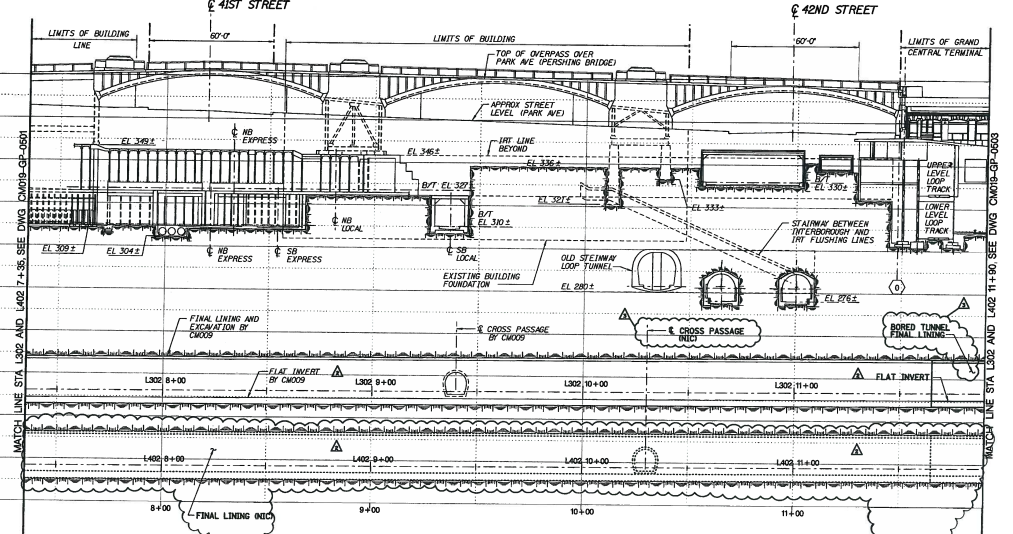
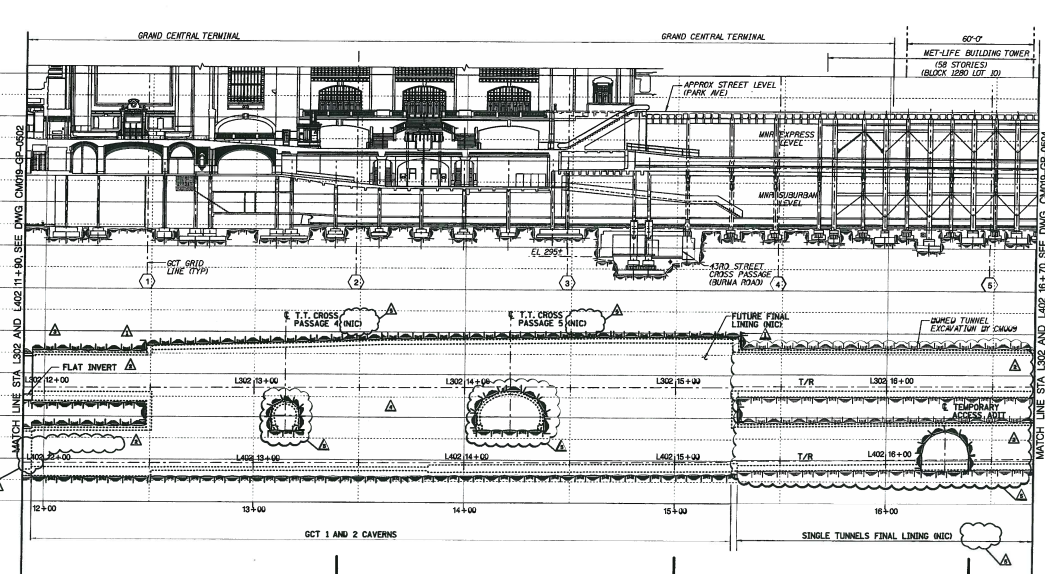
The through-running plan implied in this design is that platforms 1 and 2 should connect to the Grand Central Lower Level, where Metro-North trains terminate (the Upper Level has additional Metro-North tracks, generally used by longer-distance trains). This requires the tunnel to thread between older tunnels, including subway tunnels. The following two diagrams are in profile, going south (left) to north (right); the second diagram continues north of the first one.

It’s possible to punch south (left) of the Lower Level while respecting every constraint, but not all of them at once. Two constraints are absolute:

  • No interference with the 7 train tunnels
  • No interference with the 6 train tunnel (labeled “SB local”)

These can be satisfied easily. However, all other constraints, which are serious, require some waivers, or picking and choosing:

  • Keeping absolute grades to 4%, forcing the tunnel to go above the 7 and not below it (which requires clearing around 15 m in around 150 m of distance)
  • Respecting the Lower Level loop track
  • Respecting the disused Steinway Loop tunnel

If the latter two constraints are waivable, then the tunnel needs to clear around 1.5 m, for 6 m of diameter minus 4.5 m between the roof of the 7 tunnel and the floor of the 6 tunnel, in what looks like 40 horizontal m; it’s doable but with centimeters of slack, and may require waiving the 4% grade (though over such a short length it doesn’t matter – what matters is vertical curve radius, and the vertical curves can be built north of the 7 and south of the 6).

Rail Reactivation in Suburbs vs. Rural Areas

On Mastodon, a longtime mutual by the nickname of Pony made a point that regional rail reactivation is a complement to road construction rather than a competitor. The context is that a study by Greenpeace has been making European media about unequal investment between roads and railways (for example, in Germany the ratio going back to 1998 has been 2.11:1), complaining specifically that rail networks have shrunk; in practice, all the shrinkage has been in very low-use rural lines. The issue is that network length isn’t a great measurement, precisely because it misses what makes public transport work; Jon Worth points out that during this era of road investment and rail shrinkage, German rail ridership has grown 40%.

The issue is that rail and road transport scale differently. Rail scales up better, cars scale down better. In low-density places, such as rural environments, trains can exist as money-losing tourist vehicles or transportation for a small, shrinking share of the population. Successful reactivation of lines outside urban areas occurs as these areas urbanize. Pony points this out:

It’s even funnier, lot of the line reopenings, the holy grail of this school of “thought”, is largely enabled by the new roads that have delivered needed demographic and economic changes to make some rail operations viable again, you’re not reopening branchlines against or to compete with new roads, you’re piggybacking on them…

We’re not doing [transit-oriented development] really, partially because the backlog of missing transit options for already existing development, partially because of incompetency, but that’s still mostly urban thing, for the most railway branchline reopenings, they are in more rural places and they are not in spite, competition or anything to road improvements, they directly correlate with them, they are not happening because someone got to their senses and figured they are going to take trains instead, but mostly because people got new economic connections through the roads that there is again enough demand for a train, but to celebrate that as somehow “reducing” and “competing with” road traffic is generally nonsense, they only do it once the road traffic hugely grew compare to the baseline during closure anyway.

This is relevant to the three German regional rail reactivation successes mentioned by Hans-Joachim Zierke as inspiration for some American proposals: the Schönbuchbahn and Ammertalbahn near Stuttgart, and Neumünster-Bad Segeberg near Hamburg.

None of these three lines leads to the main city, which is why they all lay dormant for so long, but once reactivated, they succeeded. Moreover, traffic has kept growing: the Ammertalbahn grew from 5,000 daily riders at reactivation in 1999 to 8,600 in 2019, and has recently been double-tracked and electrified. But this is not meaningfully a rural line. Herrenberg, at one end, is a Stuttgart S-Bahn terminus, with a train every 15 minutes taking 39 minutes to get to Stuttgart Hauptbahnhof and an hourly regional train doing the same trip in 31 minutes. Tübingen, at the other end, is a city, with steady if not stellar growth in both the city and the district. Herrenberg’s district, Böblingen, is adjacent to Stuttgart and has grown with the growth of the city’s economy, which is one of the wealthiest in Germany. This is a suburban orbital line, not a rural line.

The Schönbuchbahn’s history is essentially the same. Ridership grew rapidly in the 2000s until it hit the capacity of a single-track diesel line, leading to electrification in 2019 and double-track to increase frequency to a train every 15 minutes, growing ridership further. But like the Ammertalbahn, this is not rural rail reactivation. One of the Schönbuchbahn’s termini is Böblingen, the town that the district is named after; it’s a rail junction, on the same S-Bahn line that ends at Herrenberg, with additional S-Bahn service in a different direction every half hour, and additional fast regional and intercity service to Stuttgart. The line is for all intents and purposes a branch of the Stuttgart S-Bahn, with a forced transfer at Böblingen.

Finally, Neumünster and Bad Segeberg are both in the orbit of Hamburg, but are not as well connected as Herrenberg and Böblingen are to Stuttgart. Neumünster has two trains per hour to Hamburg, not running on a half-hourly Takt but rather having 43 minutes of offset; Bad Segeberg is on an hourly Takt to Hamburg. The line between them is an orbital, still unelectrified (it’s about to run battery-electric trains): it has ridership, but these are evidently not as intertwined with Hamburg as Böblingen is with Stuttgart, so the line is nowhere near so strong.

The upshot of all of this is that examples of successful rail reactivation should not be taken as evidence that rail can succeed outside major cities. It cannot: at most, it can succeed in places that, despite their protestations to the contrary, are embedded in major metropolitan areas, as those areas grow.

This is important, because much of the green movement in Europe shrugs off investments in urban rail tunnels, preferring to invest in tourist trains into rural areas or bring back night trains. There’s a lot of nostalgia and rural romanticism in a movement that exists largely in major cities and largely among people under the age of 30 (at the climate protest in 2019, the median age looked around 20). The problem is that rural rail doesn’t really work; in regions with no traffic congestion and not enough density for walkability, cars will beat trains to most destinations. Regional reactivation can work if it’s suburban as above – those towns can identify in opposition to the big city but for all intents and purposes they’re like city neighborhoods except at lower density (Böblingen even has a Green mayor).

Instead of trying to reach truly rural areas with rail, climate policy regarding rail should be to grow the cities and their immediate suburbs where rail is viable. The modal split in Berlin is high, and even in Brandenburg it is higher than the Germany-wide average (source, p. 76), due to the large number of Berlin-bound commuters. Densification of rail networks in growing regions is warranted, but this is distinct from trying to extend the mode into truly exurban places, where public transport cannot succeed.

Penn Station 3D Model

As part of our high-speed rail program at Marron, I designed and other people made a 3D model of the train station I referenced in 2015 in what was originally a trollish proposal, upgraded to something more serious. For now there’s still a password: letsredothis. This is a playable level, so have a look around.

The playable 3D model shows what Penn Station could look like if it were rebuilt from the ground up, based on best industry practices. It is deliberately minimalistic: a train station is an interface between the train and the city it serves, and therefore its primary goal is to get passengers between the street or the subway and the platform as efficiently as possible. But minimalism should not be conflated with either architectural plainness (see below on technical limitations) or poor passenger convenience. The open design means that pedestrian circulation for passengers would be dramatically improved over today’s infamously cramped passageways.

Much of the design for this station is inspired by modern European train stations, including Berlin Hauptbahnhof (opened 2006), the under-construction Stuttgart 21 (scheduled to open 2025), and the reconstruction of Utrecht Central (2013-16); Utrecht, in turn, was inspired by the design of Shinagawa in Tokyo.

As we investigate which infrastructure projects are required for a high-speed rail program in the Northeast, we will evaluate the place of this station as well. Besides intangible benefits explained below in background, there are considerable tangible benefits in faster egress from the train to the street.

Moreover, the process that led to this blueprint and model can be reused elsewhere. In particular, as we explain in the section on pedestrian circulation, elements of the platform design should be used for the construction of subway stations on some lines under consideration in New York and other American cities, to minimize both construction costs and wasted time for passengers to navigate underground corridors. In that sense, this model can be viewed not just as a proposal for Penn Station, but also as an appendix to our report on construction costs

Background

New York Penn Station is unpopular among users, and has been since the current station opened in 1968 (“One entered the city like a God; one scuttles in now like a rat” -Vincent Scully). From time to time, proposals for rebuilding the station along a better or grander design have been floated, usually in connection with a plan for improving the track level below.

Right now, such a track-level improvement is beginning construction, in the form of the Gateway Project and its Hudson Tunnel Project (HTP). The purpose of HTP is to add two new tracks’ worth of rail capacity from New Jersey to Penn Station; currently, there are only two mainline tracks under the Hudson, the North River Tunnels (NRT), with a peak throughput of 24 trains per hour across Amtrak’s intercity trains and New Jersey Transit’s (NJT) commuter trains, and very high crowding levels on the eve of the pandemic; 24 trains per hour is usually the limit of mainline rail, with higher figures only available on more self-contained systems. In contrast, going east of Penn Station, there are four East River Tunnel (ERT) tracks to Long Island and the Northeast Corridor, with a pre-corona peak throughput of not 48 trains per hour but only about 40.

Gateway is a broader project than HTP, including additional elements on both the New Jersey and Manhattan sides. Whereas HTP has recently been funded, with a budget of $14-16 billion, the total projected cost of Gateway is $50 billion, largely unfunded, of which $20 billion comprises improvements and additions to Penn Station, most of which are completely unnecessary.

Those additions include the $7 billion Penn Reconstruction and the $13 billion Penn Expansion. Penn Reconstruction is a laundry list of improvements to the existing Penn Station, including 29 new staircases and escalators from the platforms to the concourses, additional concourse space, total reconstruction of the upper concourse to simplify the layout, and new entrances from the street to the station. It’s not a bad project, but the cost is disproportionate to the benefits. Penn Expansion would build upon it and condemn the block south of the station, the so-called Block 780, to excavate new tracks; it is a complete waste of money even before it has been funded, as scarce planner resources are spent on it.

The 3D model as depicted should be thought of as an alternative form of Penn Reconstruction, for what is likely a similar cost. It bakes in assumptions on service, as detailed below, that assume both commuter and intercity trains run efficiently and in a coordinated manner.

Station description

The station in the model is fully daylit, with no obstruction above the platforms. There are eight wide platforms and 16 tracks, down from 11 platforms and 21 tracks today. The station box is bounded by 7th Avenue, 31st Street, 8th Avenue, and 33rd Street, as today; also as today, the central platforms continue well to the west of 8th Avenue, using the existing Moynihan Train Hall. No expansion of the footprint is required. The existing track 1 (the southernmost) becomes the new track 1A and the existing track 21 becomes the new track 8B.

The removal of three platforms and five tracks and some additional track-level work combine to make the remaining platforms 11.5 meters wide each, compared with a range of 9-10 meters at some comparable high-throughput stations, such as Tokyo.

With wide platforms, the platforms themselves can be part of the station. A persistent difference between American and European train stations is that at American stations, even beloved ones like Grand Central, the station is near where the tracks are, whereas in Europe, the station is where the tracks are. Grand Central has a majestic waiting hall, but the tracks and platforms themselves are in cramped, dank areas with low ceilings and poor lighting. The 3D model, in contrast, integrated the tracks into the station structure: the model includes concessions below most escalator and stair banks, which could offer retail, fast food, or coffee. Ticketing machines can be placed throughout the complex, on the platforms as well as at places along the access corridors that are not needed for rush hour pedestrian circulation. This, more than anything, explains the minimalistic design, with no concourses: concourses are not required when there is direct access between the street and the platforms.

For circulation, there are two walkways, labeled East and West Walkways; these may be thought of as 7⅓th and 7⅔th Avenues, respectively. West End Corridor is kept, as is the circulation space under 33rd Street connecting West End Corridor and points east, currently part of the station concourse. A new north-south corridor called East End Corridor appears between the station and 7th Avenue, with access to the 1/2/3 trains.

What about Madison Square Garden?

Currently, Penn Station is effectively in the basement of Madison Square Garden (MSG) and Two Penn Plaza. Both buildings need to come down to build this vision.

MSG has come under attack recently for competing for space with the train station; going back to the early 2010s, plans for rebuilding Penn Station to have direct sunlight have assumed that MSG should move somewhere else, and this month, City Council voted to extend MSG’s permit by only five years and not the expected 10, in effect creating a five-year clock for a plan to daylight Penn Station. There have been recent plans to move MSG, such as the Vishaan Chakrabarti vision for Penn Station; the 3D model could be viewed as the rail engineering answer to that architecture-centric vision.

Two Penn Plaza is a 150,000 m^2 skyscraper, in a city where developers can build a replacement for $900 million in 2018 prices.

The complete removal of both buildings makes work on Penn Station vastly simpler. The station is replete with columns, obstructing sight lines, taking up space between tracks, and constraining all changes. The 3D model’s blueprint takes care to respect column placement west of 8th Avenue, where the columns are sparser and it’s possible to design tracks around them, but it is not possible to do so between 7th and 8th Avenues. Conversely, with the columns removed, it is not hard to daylight the station.

Station operations

The operating model at this station is based on consistency and simplicity. Every train has a consistent platform to use. Thus, passengers would be able to know their track number months in advance, just as in Japan and much of Europe, train reservations already include the track number at the station. The scramble passengers face at Penn Station today, waiting to see their train’s track number posted minutes in advance and then rushing to the platform, would be eliminated.

Each approach track thus splits into two tracks flanking the same platform. This is the same design used at Stuttgart 21 and Berlin Hauptbahnhof: if a last-minute change in track assignment is needed, it can be guaranteed to face the same platform, limiting passenger confusion. At each platform, numbered south to north as today, the A track is to the south of the B track, but the trains on the two tracks would be serving the same line and coming from and going to the same approach track. This way, a train can enter the A track at a station while the previous train is still departing the B track, which provides higher capacity.

The labels on the signage are by destination:

  • Platform 1: eastbound trains from the HTP, eventually going to a through-tunnel to Grand Central
  • Platform 2: westbound trains to the HTP, connecting from Grand Central
  • Platform 3: eastbound trains from the preexisting North River Tunnels (NRT) to the existing East River Tunnels (ERT) under 32nd Street
  • Platform 4: eastbound intercity trains using the NRT and ERT under 32nd Street
  • Platform 5: westbound intercity trains using the NRT and ERT under 32nd Street
  • Platform 6: westbound trains from the ERT under 32nd Street to the NRT
  • Platform 7: eastbound trains to the ERT under 33rd Street and the LIRR, eventually connecting to a through-tunnel from the Hudson Line
  • Platform 8: westbound trains from LIRR via the ERT under 33rd Street, eventually going to a through-tunnel to the Hudson Line

Signage labels except for the intercity platforms 4 and 5 state the name of the commuter railway that the trains would go to. Thus, a train from Trenton to Stamford running via the Northeast Corridor and the under-construction Penn Station Access line would use platform 3, and is labeled as Metro-North, as it goes toward Metro-North territory; the same train going back, using platform 6, is labeled as New Jersey Transit, as it goes toward New Jersey.

Such through-running is obligatory for efficient station operations. There are many good reasons to run through, which are described in detail in a forthcoming document by the Effective Transit Alliance. But for one point about efficiency, it takes a train a minimum of 10 minutes to turn at a train station and change direction in the United States, and this is after much optimization (Penn Station’s current users believe they need 18-22 minutes to turn). In contrast, a through-train can unload at even an extremely busy station like Penn in not much more than a minute; the narrow platforms of today’s station could clear a full rush hour train in emergency conditions today in about 3-4 minutes, and the wide platforms of the 3D model could do so in about 1.5 minutes in emergencies and less in regular operations.

Supporting infrastructure assumptions

The assumption for the model is that the HTP is a done deal; it was recently federally funded, in a way that is said to be difficult to repeal in the future in the event of a change in government. The HTP tunnel is slated to open in 2035; the current timetable is that full operations can only begin in 2038 after a three-year closure of NRT infrastructure for long-term repairs, but in fact those repairs can be done in weekend windows—indeed, present-day rail timetables through the NRT assume that one track is out for a 55-hour period each weekend, but investigative reporting has shown that Amtrak takes advantage of this outage only once every three months. If repairs are done every weekend, then it will be possible to refurbish the tunnels by 2035, for full four-track operations in 12 years.

The HTP approach to Penn Station assumes that trains from the tunnel would veer south, eventually to tracks to be excavated out of Block 780 for $13 billion. However, nothing in the current design of the tunnel forces tracks to veer so far south to Penn Expansion. There is room, respecting the support columns west of 8th Avenue, to connect the HTP approach to the new platforms 1 and 2, or for that matter to present-day tracks 1-5.

It is also assumed that Penn Station Access (PSA) is completed; the project’s current timeline is that it will open in 2026, offering Metro-North service from the New Haven Line to Penn Station. As soon as PSA opens, trains should run through to New Jersey, for the higher efficiency mentioned above.

The additional pieces of major infrastructure required for this vision are a tunnel from Penn Station to Grand Central, and an Empire Connection realignment.

The Penn Station-Grand Central connection (from platforms 1 and 2) has been discussed for at least 20 years, but not acted upon, since it would force coordination between New Jersey Transit and Metro-North. Such a connection would offer riders at both systems the choice between either Manhattan station—and the choice would be on the same train, whereas on the LIRR, the same choice offered by East Side Access cuts the frequency to each terminal in half, which has angered Long Island commuters.

Overall, it would be a tunnel of about 2 km without stations. It would require some mining under the corner of Penn 11, the building east of 7th Avenue between 31st and 32nd Street, but only to the same extent that was already done in the 1900s to build the ERT under 32nd Street. Subsequently, the tunnel would nimbly weave between older tunnels, using an aggressive 4% grade with modern electric trainsets (the subway even climbs 5.4% out of a station at Manhattan Bridge, whereas this would descend 4% from a station). The cost should be on the order of hundreds of millions of dollars, not billions—the billions of dollars in per-km cost in New York today are driven by station construction rather than tunnels, and by poor project delivery methods that can be changed to better ones.

The Empire Connection realignment is a shorter tunnel, but in a more constrained environment. Today, Amtrak trains connect between Penn Station and Upstate New York via the existing connection, going in tunnel under Riverside Park until it joins the tracks of the current Hudson Line in Spuyten Duyvil. Plans for electrifying the connection and using it for commuter rail exist but are not yet funded; these should be reactivated, since otherwise there’s nowhere for trains from the 33rd Street ERT to run through to the west.

It is necessary to realign the last few hundred meters of the Empire Connection. The current alignment is single-track and connects to more southerly parts of the station, rather than to the optimal location at the northern end. This is a short tunnel (perhaps 500 meters) without stations, but the need to go under an active railyard complicates construction. That said, this too should cost on the order of hundreds of millions of dollars, not billions.

Finally, platforms 3-6 all feed the same approach tracks on both sides, but in principle they could be separated into two. There are occasional long-term high-cost plans to fully separate out intercity rail tracks from commuter tracks even in New York, with dedicated tunnels all the way. The model does not assume that such plans are actualized, but if they are, then there is room to connect the new high-speed rail approach tunnel to platforms 4 and 5 at both ends.

Overall, the model gives the station just 20 turnouts, down from hundreds today. This is a more radical version of the redesign of Utrecht Station in the 2010s, which removed pass-through tracks, simplified the design, and reduced the number of turnouts from 200 to 70, in order to make the system more reliable; turnouts are failure-prone, and should be installed only when needed based on current or anticipated train movements.

Pedestrian circulation

The station in the model has very high pedestrian throughput. The maximum capacities are 100 passengers/minute on a wide escalator, 49 per minute per meter of staircase width, and 82 per minute per meter of walkway width. A full 12-car commuter train has about 1,800 passengers; the vertical access points—a minimum of seven up escalators, five 2.7 meter wide staircases, and three elevators per platform—can clear these in about 80 seconds. In the imperfect conditions of rush hour service or emergency evacuation, this is doable in about 90 seconds. A 16-car intercity train has fewer passengers, since all passengers are required to have a seat, and thus they can evacuate even faster in emergency conditions.

Not only is the throughput high but also the latency is low. At the current Penn Station, it can take six minutes just to get between a vertical access point and an exit, if the passenger gets off at the wrong part of the platform. In contrast, with the modeled station, the wide platforms make it easier for passengers to choose the right exit, and connect to a street corner or subway entrance within a maximum of about three minutes for able-bodied adults.

This has implications for station design more generally. At the Transit Costs Project, we have repeatedly heard from American interviewees that subway stations have to have full-length mezzanines for the purposes of fire evacuation, based on NFPA 130. In fact, NFPA 130 requires evacuation in four minutes of throughput, and in six minutes when starting from the most remote point on the platform; at a train station where trains are expected to run every 2-2.5 minutes at rush hour and unload most of their passengers in regular service, it is dead letter.

Thus, elements of the platform design can be copied and pasted into subway expansion programs with little change. A subway station could have vertical circulation at both ends of the platform as portrayed at any of the combined staircase and escalator banks, with wider staircases if there’s no need for passengers to walk around them. No mezzanine is required, nor complex passageways: any train up to the size of the largest New York City Subway trains could satisfy the four-minute rule with a 10-meter island platform (albeit barely for 10-car lettered lines).

Technical limitations and architecture

The model is designed around interactivity and playability. This has forced us to make some artistic compromises, compared with what one sees in 3D architectural renderings that are not interactive. To run on an average home machine, the design has had to reduce its polygon count and limit the detail of renderings that are far from the camera position.

For the same reason, the level shows the exterior of Moynihan Station as an anchor, but not the other buildings across from the station at 31st Street, 33rd Street, or 7th Avenue.

In reality, both East and West Walkways would be more architecturally notable than as they are depicted in the level. Our depiction was inspired by walkways above convention centers and airport terminals, but in reality, if this vision is built, then the walkways should be able to support themselves without relying too much on the tracks. Designs with massive columns flanking each elevator are possible, but so are designs with arches, through-arches, or tied arches, the latter two options avoiding all structural dependence on the track level.

Some more architectural elements could be included in an actual design based on this model, which could not be easily modeled in an interactive environment. The platforms certainly must have shelter from the elements, which could be simple roofs over the uncovered parts of the platform, or large glass panels spanning from 31st to 33rd Street, or even a glass dome large enough to enclose the walkways.

Finally, some extra features could be added. For example, there could be more vertical circulation between 7th Avenue and East End Corridor (which is largely a subway access corridor) than just two elevators—there could be stairs and escalators as well. There is also a lot of dead space as the tracks taper from the main of the station to the access tunnels, which could be used for back office space, ticket offices, additional concessions, or even some east-west walkways functioning as 31.5th and 32.5th Streets.

Don’t Romanticize Traditional Cities that Never Existed

(I’m aware that I’ve been posting more slowly than usual; you’ll be rewarded with train stations soon.)

I saw a tweet by Strong Towns that compared traditional cities with the suburbs, and the wrongness of everything there reminded me of how much urbanists lie to themselves about what cities were like before cars. Strong Towns is more on the traditional urbanism side (to the point of rejecting urban rail on the grounds that it leads to non-gradual development), but a lot of what I’m critiquing here is, regrettably, commonly believed across the urbanist spectrum.

The basic problem with this comparison is that there was never such a thing as traditional urbanism. There are others; all of the claims in the comparison are false – for example, the line about “makes communities brittle” misses how little community empowerment cities had in the 19th and early 20th centuries, before zoning, and the line about top-down versus bottom-up energy misses how centralized coal and hydroelectric plants were at the turn of the century whereas left-voting NIMBY suburbs today are the most reliable place to find decentralized rooftop solar plants. But the fundamental problem is that Strong Town, and most urbanists, assume that there was a relatively fixed urban model around walkability, which cars came in and wrecked in the 20th century.

What’s true is that before mass motorization, people didn’t use cars to get around. But beyond that tautology, every principle of urban walkability was being violated in one pre-automobile urban typology or another.

Local commuting

Pre-automobile industrial cities were not 15-minute cities by any means. Marchetti’s constant of commuting goes back to at least the early 19th century; people in pre-automobile New York or London or Berlin commuted to a commercializing city center. This was to some extent understood in the second half of the 19th century: the purpose of rapid transit in New York, first steam els and then the subway, was to provide a fast enough commute so that the working class of the Lower East Side would get out of its tenements and into lower-density houses where they’d be turned from hyphenated Jews and Italians into proper Americans.

There has been a real change in that, in Gilded Age New York (and, I believe, in third-world cities today like Nairobi), people worked either locally or in city center. There was very little crosstown commuting, and so the Commissioners’ Plan for Manhattan in 1811 emphasized north-south commuting to Lower Manhattan, while private streetcar concessionaires likewise built routes to city center and rarely crosstown. Nor was there much long-distance travel except by the people who did work in city center: there were people who lived their entire lives in Brooklyn without visiting Manhattan, which became unthinkable by the early 20th century already. But this hardly makes Gilded Age Brooklyn a 15-minute city, any more than a modern suburb where most people do not visit city center out of fears of crime is anything but a suburb of the city, living off of the income generated by people who do commute in.

In truly premodern city, the situation depended on the time and place. Medieval European cities famously had little commuting – shopkeepers would live in the same building that housed their store, sleeping on an upper floor. But in Tang-era Chang’an, people did commute (my reference is the History of Imperial China series, no link, sorry). This is very far from the result of thousands of years of tinkering, when each time and place did something different before industrialization, and then went to yet another set of layouts after.

Local infrastructure

Pre-automobile industrial cities mixed top-down and bottom-up approaches, same as today. The grid plans favored in the United States, China, and the Roman Empire were more top-down than the unplanned street networks of most medieval and Early Modern European cities, each designed for a different cultural context. (In Imperial Rome much of the context was about following military manuals, for those cities that descend from forts.) In the medieval Muslim world, cities had cul-de-sacs long before cars, because this way each clan could have its own walled garden, so to speak.

Widely divergent contexts

Premodern cities developed in widely divergent contexts. Based on these contexts, they could look radically different. The comparison mentions war and peace; well, defensive walls were a fixture in many cities, and these mattered for their urban development. They were not nice strolls the way some embankments are today. There aren’t any good examples of walls in North America, but there are star forts, and they’re not usually pleasant walks – their purpose was to make the day of besieging troops as bad as possible, not to make tourists feel good about the city’s history. Medieval walls were completely different from star forts, and didn’t make for a walkable environment, either – in Paris I would routinely walk to the park and to the exterior of the Château de Vincennes, and while the park was pleasant, the castle has a moat and none of the street uses that activate a street, like retail or windows. The modern equivalents of such fixtures should be compared with prisons and modern military bases (some using the historic star forts), not touristy palaces.

Even the concept of city center is, as mentioned above on commuting, neither timeless (it didn’t exist in premodern Europe) nor a product of cars (it did exist in 19th-century America and Europe). Joel Garreau points out, either in Edge City or in some of the articles he’s written about the concept, that the traditional downtown was really only a fixture for a few generations, from the early 19th century to the middle of the 20th.

The issue of fragility

The entire comparison is grating, but smoehow the thing that bothers me most there is not the elementary errors, but the last point, about how traditional cities were antifragile for millennia before modern suburbia came in and wrecked them with debt.

This, to be very clear, is bullshit. Premodern cities could depopulate with one plague, famine, or war; these often co-occurred, such as when Louis XIV’s wars led to such food shortages that 10% of France’s population died in two famines spaced 15 years apart (put another way: France underwent a Reign of Terror’s worth of deaths every two weeks for a year and a half, and then a second for somewhat less than a year). In 1793, 10% of Philadelphia’s population died of yellow fever within the span of a few months. After repeated sacks and economic decline, Jaffa was abandoned in much of the Early Modern era.

Industrial cities generally do not undergo any of these things. (They can be subjected to genocide, like the Jews of Europe in the Holocaust, but that’s not at all about urbanism.) But that’s hardly a millennia-old tradition when it only goes back to about the middle of the 19th century, after the Great Hunger. In the UK, the Great Hunger affected rural areas like Ireland and Highland Scotland, but in a country that was at the time majority-rural – Britain would only flip to an urban majority in 1851 – it’s hardly a defense. Nor did the era after 1850 feature much stability in the cities; boom-and-bust cycles were common and the risk of unemployment and poverty was constant.

Mineta Shows How not to Reduce Construction Costs

There’s a short proposal just released by Joshua Schank and Emma Huang at the Mineta Transportation Institute, talking about construction costs. It’s anchored in the experience of Los Angeles more than anything, and is a good example of what not to do. The connections the authors have with LA Metro make me less confident that Los Angeles is serious about reforming in order to be able to build cost-effective infrastructure. There are three points made in the proposal, of which two would make things worse and one would be at best neutral.

What’s in the proposal?

The report links to the various studies done about construction cost comparison, including ours but also Eno’s and Berkeley Law’s. It does so briefly, and then says,

Often overlooked are the inefficiencies and shortcomings inherent in the transportation planning process, which extend far beyond cost, to the quality of the projects, outcomes for the public, and benefits to the region. Rather than propose sweeping, but politically unfeasible, policy changes to address these issues, we focused on more attainable steps that agencies can take right now to improve the process and get to better outcomes.

Mineta’s more attainable steps, in lieu of what we say about project delivery and standardization, are threefold:

  1. Promise Outcomes, not Projects: instead of promising a concrete piece of infrastructure like a subway, agencies should promise abstract things: “mode-agnostic mobility solutions that ‘carried x riders per day’ or ‘reduced emissions by x%’ or ‘reduced travel time by x minutes,'” which may be “exclusive bus lanes, express bus services, or microtransit.”
  2. Separate the Planning and Environmental Processes: American agencies today treat the environmental impact statement (EIS) process as the locus of planning, and instead should separate the two out. The planning process should come first; one positive example is the privatized planning of the Sepulveda corridor in Los Angeles.
  3. Integrate Planning, Construction, and Operations Up Front: different groups handling operations and construction are siloed in the US today, and this should change. There are different ways to do it, but the report spends the longest time on a proposal to offload more responsibilities to public-private partnerships (PPPs or P3s), which should be given long-term contracts for both construction and maintenance.

Point #2 is not really meaningful either way, and the Sepulveda corridor planning is not at all a good example to learn from. The other two points have been to various extents been done before, always with negative consequences.

What’s the problem with the proposal?

Focusing on outcomes rather than projects is called functional procurement in the Nordic countries. The idea is that the state should not be telling contractors what to do, but only set broad goals, like “we need 15,000 passengers per hour capacity.” It’s a recent reform, along many others aiming to increase the role of the private sector in planning.

In truth, public transport is a complex enough system that it’s not enough to say “we need X capacity” or “we need Y speed.” Railways have far too many moving parts, to the point that there’s no alternative to just procuring a system. Too many other factors depend on whether it is a full metro, a tramway, a tram-train (in practice how American light rail systems function), a subway-surface line, or a commuter train. In practice, functional procurement in Sweden hasn’t brought in any change.

In the case of Sepulveda, LA Metro did send some of the high-level P3 proposals to Eric and me. What struck me was that the vendors were proposing completely different technologies. This is irresponsible planning: Sepulveda has a lot of different options for what to do to the north (on the San Fernando Valley side) and south (past LAX), and not all of them work with new technology. For example, one option must be running it through to the Green Line on the 105, but this is only viable if it’s the same light rail technology.

The alternative of microtransit is even worse. It does not work at scale; over a decade of promises by taxi companies that act like tech companies have failed to reduce the cost structure below that of traditional taxis. However, it does open the door for politicians who think they’re being innovative to bring in inefficient non-solutions that are getting a lot of hype. The report brings the example of a New York politician who was taking credit for (small) increases in subway frequency; well, many more politicians spent the 2010s saying that San Francisco’s biggest nonprofit, Uber, was the future of transportation.

The point recommending P3s for their integration of operations and infrastructure is even worse. The privatization of state planning has been an ongoing process in certain parts of the world – it’s universal in the English-speaking world and advancing in the Nordic countries. The outcomes are always the same: infrastructure construction gets worse.

The top-down Swedish state planning of the third quarter of the 20th century built around 104 km of the T-bana, of which 57 are underground, for $3.6 billion in 2022 prices. The present process, negotiated over decades with people who don’t like an obtrusive state and are inspired by British privatization, is building about 19 underground km, for $4.5 billion. This mirrors real increases in absolute costs (not just overruns) throughout Scandinavia. The costs of Sweden in the 1940s-70s were atypically low, but there’s no need for them to have risen so much since then; German costs have been fairly flat over this period, Italian costs rose to the 1970s-80s due to corruption and have since fallen, Spanish costs are still very low.

As we note in the Swedish case report, Nordic planners take it for granted that privatization is good, and ding Germany for not doing as much of it as the UK; of these two countries, one can build and one can’t, and the one that can is unfortunately not the one getting accolades. The United Kingdom, was building subways for the same costs as Germany and Italy in the 1960s and 70s, but its real costs have since grown by a factor of almost four. I can’t say for certain that it’s about Britain’s love affair with P3s, but the fact that the places that use P3s the most are the worst at building infrastructure should make people more critical of the process.

Britain Remade’s Report on Construction Costs

The group Britain Remade dropped a report criticizing Britain for its high infrastructure construction costs three days ago. I recommend everyone read Sam Dumitriu and Ben Hopkinson’s post on the subject. Sam and Ben constructed their own database. Their metro tunneling costs mostly (but not exclusively) come from our database but include more detail such as the construction method used; in addition, they have a list of tram projects, another list of highway projects, and a section about rail electrification. Over the last three days, this report has generated a huge amount of discussion on Twitter about this, with appearances in mainstream media. People have asked me for my take, so here it is. It’s a good report, and the recommendations are solid, but I think it would benefit from looking at historical costs in both the US and UK. In particular, while the report is good, the way it’s portrayed in the media misses a lot.

What’s in the report

Sam and Ben’s post talks about different issues, affecting different aspects of the UK, all leading to high costs:

NIMBYism

The report brings up examples of NIMBYs slowing down construction and making it more expensive, and quotes Brooks-Liscow on American highway cost growth in the 1960s and 70s. This is what has been quoted in the media the most: Financial Times call it the “NIMBY tax,” and the Telegraph spends more time on this than on the other issues detailed below.

The NIMBYs have both legal and political power. The legal power comes from American-style growth in red tape; the Telegraph article brings up that the planning application for a highway tunnel under the Thames Estuary is 63,000 pages long and has so far cost 250 million £ in planning preparations alone (the entire scheme is 9 billion £ for 23 km of which only 4.3 are in tunnel). The political power is less mentioned in the report, but remains important as well – High Speed 2 has a lot of gratuitous tunneling due to the political power of the people living along the route in the Home Counties.

Start-and-stop construction

British rail electrification costs are noticeably higher than Continental European ones. The report points out that construction is not contiguous but is rather done in starts and stops, leading to worse outcomes:

Lack of standardization

Sam and Ben bring up the point Bent Flyvbjerg makes about modularization and standardization. This is the least-developed point in the report, to the point that I’m not sure this is a real problem in the United Kingdom. It is a serious problem in the United States, but while both American and British costs of infrastructure construction are very high, not every American problem is present in the UK – for example, none of the British consultants we’ve spoken to has ever complained about labor in the UK, even though enoguh of them are ideologically hostile to unions that they’d mention it if it were as bad as in the US.

What’s not in the report?

There are some gaps in the analysis, which I think compromise its quality. The analysis itself is correct and mentions serious problems, but would benefit from including more things, I believe.

Historical costs

The construction costs as presented are a snapshot in time: in the 21st century, British (and Canadian, and American) costs have been very high compared with Continental Europe. There are no trends over time, all of which point to some additional issues. In contrast, I urge people to go to my post from the beginning of the year and follow links. The biggest missing numbers are from London in the 1960s and 70s: the Victoria and Jubilee lines were not at all atypically expensive for European subway tunnels at the time – at the time, metro construction costs in London, Italian cities, and German cities were about the same. Since then, Germany has inched up slightly, Italy has gone down due to the anti-corruption laws passed in the 1990s, and the United Kingdom has nearly quadrupled its construction costs over the Jubilee, which was already noticeably higher than the Victoria.

The upshot is that whatever happened that made Britain incapable of building happened between the 1970s and the 1990s. The construction cost increase since the 1990s has been real but small: the Jubilee line extension, built 1993-9, cost 218.7 million £/km, or 387 million £/km in 2022 prices; the Northern line extension, built 2015-21, cost 375 million £/km, or 431 million £/km in 2022 prices. The Jubilee extension is only 80% underground, but has four Thames crossings; overall, I think it and the Northern extension are of similar complexity. It’s a real increase over those 22 years; but the previous 20 years, since the original Jubilee line (built 1971-9), saw an increase to 387 million £/km from 117 million £/km.

The issue of soft costs

Britain has a soft costs crisis. Marco Chitti points out how design costs that amount to 5-10% of the hard costs in Italy (and France, and Spain) are a much larger proportion of the overall budget in English-speaking countries, with some recent projects clocking in at 50%. In the American discourse, this is mocked as “consultants supervising consultants.” Every time something is outsourced, there’s additional friction in contracting – and the extent of outsourcing to private consultants is rapidly growing in the Anglosphere.

On Twitter, some people were asking if construction costs are also high in other Anglo countries, like Australia and New Zealand; the answer is that they are, but their cost growth is more recent, as if they used to be good but then learned bad practices from the metropole. In Canada, we have enough cost history to say that this was the case with some certainty: as costs in Toronto crept up in the 1990s, the TTC switched to design-build, supposed inspired by the Madrid experience – but Spain does not use design-build and sticks to traditional design-bid-build; subsequently, Toronto’s costs exploded, going, in 2022 prices, from C$305 million/km for the Sheppard line to C$1.2 billion/km for the Ontario Line. Every cost increase, Canada responds with further privatization; the Ontario Line is a PPP. And this is seen the most clearly in the soft cost multiplier, and in the rise in complaints among civil servants, contractors, and consultants about contracting red tape.

Britain Remade’s political recommendations

Britain Remade seems anchored not in London but in secondary cities, judging by the infrastructure projects it talks most about. One of its political recommendations is,

Britain is one of the most centralised countries in the world. Too often, Westminster prioritises investments in long-distance intercity rail such as HS2 or the Northern Powerhouse Rail when they would be better off focusing on cutting down commuting times. Local leaders understand local priorities better than national politicians who spend most of their time in Westminster. If we really devolved power and gave mayors real powers over spending, we’d get the right sort of transport more often.

Britain Remade is campaigning for better local transport. We want to take power from Westminster and give it to local leaders who know better. But, we also want to make sure transport investment stretches further. That’s why we are calling for the government to copy what other countries do to bring costs down, deliver projects on time, and build more.

https://www.britainremade.co.uk/building_better_local_transport

Devolution to the Metropolitan counties – those covering Birmingham, Manchester, Liverpool, Leeds, Sheffield, and Newcastle – has been on the agenda in the UK for some time now. This reform is intended to give regions more power over spending, inspired by the success of devolution to London, where Transport for London has good operating practices and plenty of in-house capacity. More internationally-minded Brits (that is, to say, European-minded – there’s little learning from elsewhere except when consultants treat Singapore and Hong Kong as mirrors of their own bad ideas) will even point out the extensive regional empowerment in the Nordic countries: Swedish counties have a lot of spending power, and it’s possible to get all stakeholders in the room together in a county.

And yet, the United States is highly decentralized too, and has extreme construction costs. Conversely, Britain knew how to build infrastructure in the 1960s and 70s, under a centralized administrative state. Devolution to the Metropolitan counties will likely lead to good results in general, but not in infrastructure construction costs.

The media discourse

The report raises some interesting points. The start-and-stop nature of British electrification is a serious problem. To this, I’ll add that in Denmark, electrification costs are higher than in peer Northern European countries because its project, while more continuous, suffered from political football and was canceled and then uncanceled.

Unfortunately, all media discussion I can see, in the mainstream as well as on Twitter, misses the point. There’s too much focus on NIMBYism, for one. Britain is not the United States. In the United States, the sequence is that first of all the system empowered NIMBYs politically and legally starting in the 1960s and 70s, and only then did it privatize the state. In the United Kingdom, this is reversed: the growth in NIMBY empowerment is recent, with rapid expansion of the expected length of an environmental impact statement, and with multiplication of conflicting regulations – for example, there are equity rules requiring serving poor and not just rich neighborhoods, but at the same time, there must be a business case, and the value of time in the British benefit-cost analysis rules is proportional to rider income. This explosion in red tape is clearly increasing cost, but the costs were very high even before it happened.

Then, there are the usual incurious ideas from the Twitter reply gallery, including some people with serious followings: Britain must have stronger property rights (no it doesn’t, and neither does the US; look at Japan instead), or it’s related to a general cost disease (British health care costs are normal), or what about Hong Kong (it’s even more expensive).