Berlin’s U-Bahn Expansion Plan
An obscure change in German benefit-cost analysis regulations has led to expansive proposals for urban rail construction in Germany. In Berlin, where ongoing coalition negotiations between CDU and SPD are leading in a developmentalist cars-and-trains direction, this led BVG to propose a massive program for growing the U-Bahn from its current 155 km of route-length to 318. The BVG proposal is split fairly evenly between good lines and lines that duplicate the S-Bahn and have little transportation value, and yet I’ve not seen much discussion of the individual technical merit of the program. Instead, anti-developmental activists who think they’re being pro-environment, such as BUND, regurgitate their anti-U-Bahn conspiracy theories and go to the point of associating subway tunneling with the Nazis. (I, unlike native Europeans, associate the Nazis with the Holocaust instead.)
What is the BVG proposal?
A number of media outlets have produced maps of the proposal; here is Tagesspiegel’s, reproduced here because it shows S-Bahn and regional lines as thin but visible lines.

All nine lines of the U-Bahn are to be extended, most in both directions; U3 and U4, currently a branch of U1 and a low-ridership shuttle line respectively, are to be turned into full main lines via Mitte. In addition, a ring line called U0 is to be built, duplicating the Ringbahn on its western margin and taking over some lines currently planned as radial extensions to Tegel, and running as a circumferential at consistently larger radius than the Ring to the south, east, and north.
Background
The immediate news leading BVG to propose this plan is a combination of federal and city-level changes. The federal change is obscure and I only saw it discussed by one low-follower account on Twitter, Luke Horn. Luke points out that after years of red tape, the federal government finally released its updated benefit-cost analysis regulations. As those are used to score projects, city and state governments are required to follow exact rules on which benefits may be counted, and at what rate.
One of these benefits is modal shift. It’s notoriously hard to measure, to the point that anti-U-Bahn advocates argued based on one low-count measurement that U-Bahn construction generated more emissions than it saved through modal shift; their study has just been retracted for overestimating construction emissions, but the authors are unrepentant.
At any rate, on the 21st, the new federal rules were finally published. Greenhouse gas emissions avoided through modal shift are to be counted as a benefit at the rate of 670€ per metric ton of CO2 (see PDF-p. 243). This is a high number, but it’s only high when it comes to pushing carbon taxes through a political system dominated by old climate denialists; by scientific consensus it’s more reasonable – for example, it’s close to the Stern Report estimates for the 2020s. If Germany imposed a carbon tax at this rate, and not the current rate of 55€/t, the fuel price here would grow by around 1.50€/liter, roughly doubling the price and helping kill the growing market for SUVs and luxury cars. If that is the rate at which modal shift is modeled, then even with an undercount of how urban rail construction substitutes for cars, many otherwise marginal lines pencil out.
The city-level change is that Berlin just had a redo of the 2021 election, and while technically the all-left coalition maintained its majority, CDU got the most votes, which gave Mayor Franziska Giffey (SPD) the excuse she needed to break the coalition and go into a grand coalition negotiation with CDU. Giffey had had to resign from the federal cabinet in the late Merkel era when it turned out that she had plagiarized her thesis, leading the university to revoke her degree, but out of shamelessness she remained Berlin SPD’s mayoral candidate and won in 2021. The Greens thought little of having to serve under such a scandalized mayor, and out of personal pettiness, Giffey, politically well to the right of most SPD voters anyway, accused them of personally disrespecting her and went into negotiations with CDU.
The importance of this is that the Greens (and Die Linke) are a pro-tram, anti-U-Bahn, NIMBY party. When CDU and SPD said they’d finally develop the parade of Tempelhofer Feld with housing, an advisor to a Green Bundestag member accused them of wanting to develop the area out of personal spite, and not, say, out of wanting Berlin to have more housing. Under the all-left coalition, U-Bahn planning continued but at a slow pace, and by far the most important extension on a cost per rider basis, sending U8 north to Märkisches Viertel, was deprioritized; CDU’s campaign in the election was mostly about parking and opposition to road diets, but it also hit the Greens on their opposition to U-Bahn development.
The plan as it stands has a few sops to CDU. The U0 ring is the most significant: in a country where the median age is 45, under-18s can’t vote, and CDU is disproportionately an old people’s party, CDU’s median voter was an adult through the era of the Berlin S-Bahn Boycott, as both halves of the S-Bahn were run by the East during the Cold War. Where CSU supports the Munich S-Bahn as a vehicle for conservatives to move away from the left-wing city while still having access to city jobs, Berlin CDU is uniquely more negative toward the S-Bahn. Thus, the plan has a line that mostly duplicates the Ring. The U2 expansion to the west duplicates the S-Bahn as well, especially west of Spandau. Finally, the proposed western terminus of U1 is explicitly billed as a park-and-ride, which type of service Berlin CDU has long supported.
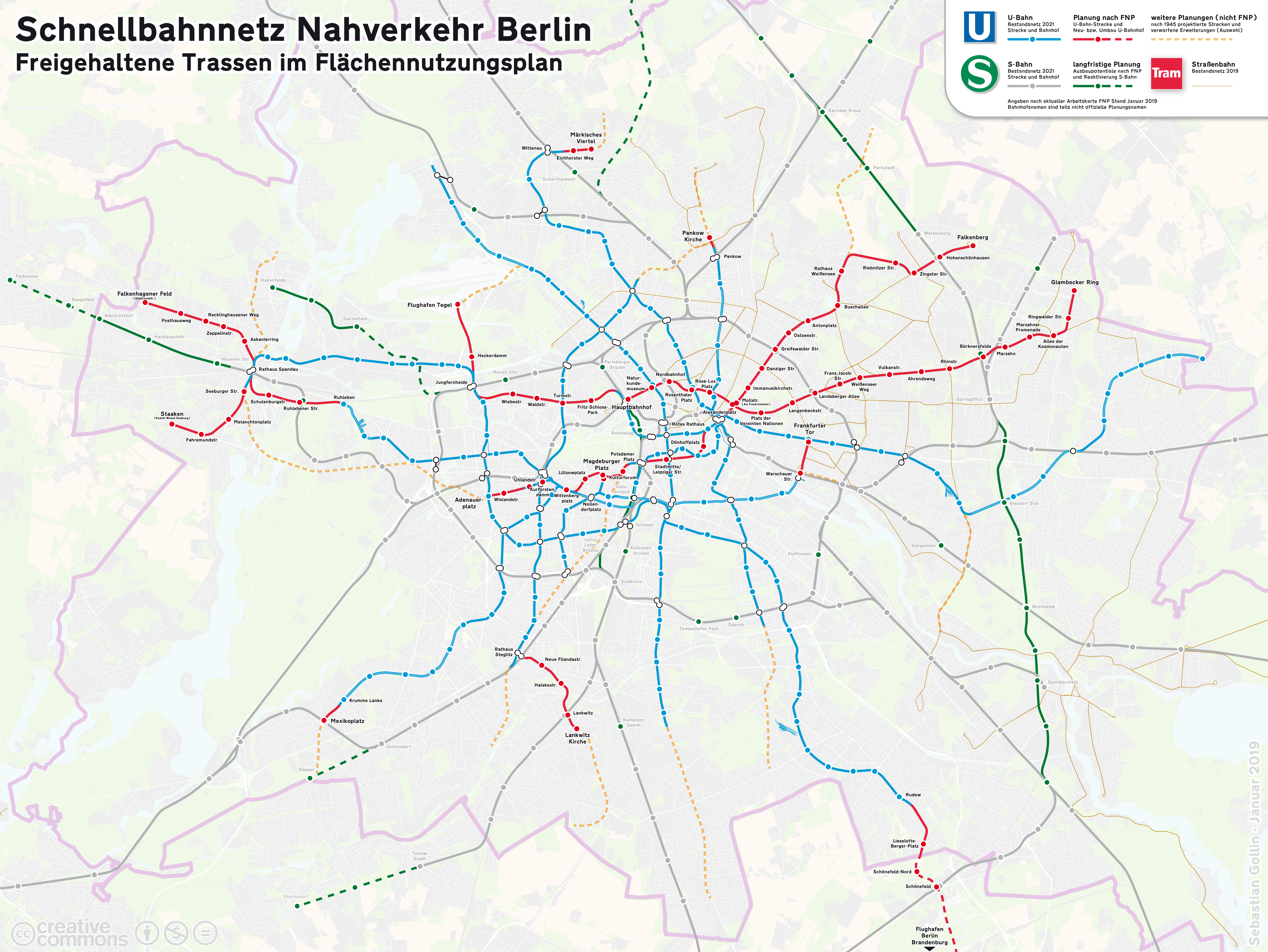
But other than the U0 ring, the plan is not too different from things that have long been planned. The longest segment other than U0 is the U3 extension to the northeast; this was part of the 200 km plan already in the 1950s, except originally the plan for this extension was not to hook into U3 as on post-Cold War plans but to run along an alignment closer to that of U9, whose southern terminus at Rathaus Steglitz was even built with room for this line, then numbered U10. A fair number of other sections on BVG’s map have a long history of languishing in unfavorable benefit-cost ratios. Other than U0, the plan is rather similar to what was studied in 2019:
However, this history has not prevented people from literally comparing BVG’s plan to the Nazis. The more prosaic reality is that the 1938 Welthauptstadt Germania U-Bahn expansion plan, other than its ring (built inside of the Ringbahn, the opposite of U0), made it to the 200 km plan and most of the lines it proposed were built, the largest change being that Cold War realities made West Berlin build U7 and U9 to serve the center of West Berlin at the Zoo rather than as additional lines serving Mitte.
The issue of costs
I have not seen an official cost estimate. BUND, which opposes the plan on the grounds that building tramways is better, says that it would cost 35 billion euros. Judging by recent construction costs of realized and proposed lines in Berlin, I think this estimate is broadly correct, if the project is run well.
The estimate is then about 210 million €/km, which looks realistic. The construction of the U5 extension from Alexanderplatz to Brandenburger Tor opened in 2020 at a cost of 280 million €/km in 2022 prices, but that was in the very center of the city, including a station at Museumsinsel mined directly beneath the Spree, for which BVG had to freeze the sandy soil. Conversely, the estimates of outer extensions that were already under planning before a week ago are lower: U7, the most advanced of these, is projected at 890 million € for about 8 km, or 110 million €/km, in an unusually easy (not really urbanized) tunneling environment.
The risk is that such a large project, done all at once, would strain the planning capacity of Berlin and Brandenburg. This exact risk happened in Paris: at 205 million €/km for 80% underground construction Grand Paris Express is more expensive per km than smaller Métro extensions built in the 2010s as it’s so large the region ran out of in-house planning capacity, and its response, setting up a British-style special purpose delivery vehicle (SPDV) along the lines of Crossrail, has resulted in British-style permanent loss of state capacity. Now, even the short Métro extensions, like the planned eastern M1 extension, cost more like GPE and not like similar projects from 10 years ago.
Notably, while France and the Nordic countries are seeing growing construction costs (France from a medium-low level and the Nordic countries from a very low one), Germany is not. I haven’t been able to find historic costs for Berlin with few exceptions. One of those exception, the last section of U9, cost 235 million € in 2022 prices for 1.5 or 1.6 km, or around 150 million €/km; this was built in 1968-74, in a relatively easy area, albeit with extra costs as noted above preparing for the U10 line. Another exception is the final section of U7 to Spandau, which cost around 800 million € for 4.9 km, or around 160 million €/km. Taken together with some numbers I posted here, it’s notable that in the 1970s, the construction costs per km in Italy, Germany, and the UK were all about the same but since then German costs have stayed the same or at worst inched up, Italian costs have fallen due to the anti-corruption laws passed in the wake of mani pulite, and British costs have quadrupled.
The most frustrating part of this discourse is that I’ve yet to see a single German rail advocate express any interest in the issue of costs. The critics of U-Bahn and other rail transport expansion plans who cite costs, of which BUND is a prime example, never talk about how to make metro construction in Germany cheaper; instead, they use it as an argument for why building underground railways is a waste of money, and urban rail must take the form of streetcars, which are held to be not only cheaper but also more moral from a green point of view as they annoy drivers. The same problem crops up in the discourse on high-speed rail, where Germany makes fairly easily fixable mistakes, generally falling under the rubric of over-accommodation of NIMBYs, and thus instead of figuring out how to build more lines, advocates write the idea off as impractical and instead talk about how to run trains on slow lines.
Can Berlin make do with streetcars?
No.
The problem with streetcars is that, no matter how much priority they get over other street traffic, they’re still slow. T3 in Paris, about the most modern urban tramway I’ve seen, running in a grassy reservation in the middle of the 40 meter wide Boulevards des Maréchaux, averages 18 km/h. The Berlin streetcars average 17.6 km/h; they don’t have 100% dedicated lanes at places, but for the most part, they too are run to very high standards, and only minor speedups can be seriously expected. Meanwhile, the U-Bahn averages 30.5 km/h, which is on the high side for the 780 m stop spacing, but is without driverless operations, which raised Paris’s average speed on M1 with its 692 m interstation from 24.4 to 30 km/h, at least in theory. The best Berlin can do with tramway modernization is probably around 20 km/h; the best it can do with the U-Bahn is probably 35 km/h, and with the S-Bahn maybe 45 km/h.
And Berlin is already large enough to need the speed. Leipzig is a good example of an Eastern city maintaining modal split with no U-Bahn, just streetcars and a recently-opened S-Bahn tunnel; in 2018, its modal split for work trips was 47% car, 20% public transport, 22% bike, 11% pedestrian (source, p. 13). But most of the walkable urban area of Leipzig is contained within a four kilometer radius of the main train station, a large majority of the city’s population is within six, and by eight one is already in the suburbs. Slow transportation like bikes and trams can work at that scale, to an extent.
In contrast with Leipzig’s smaller scale, I live four km from Berlin Hauptbahnhof and I’m still in Mitte, albeit at the neighborhood’s southeastern corner where Hbf is at the northwestern one. From the most central point, around Friedrichstrasse, both the Zoo and Warschauer Strasse are four km away, and both have high-rise office buildings. At eight km, one finally gets to Westkreuz and ICC-Messe, Steglitz, Lichtenberg, and the former airport grounds of Tegel; Gropiusstadt, a dense housing project built as transit-oriented development on top of U7, is 13 km from Friedrichstrasse by straight line.
The actual average speed, door-to-door, is always lower than the in-vehicle average speed. There’s access time, which is independent of mode, but then wait times are shorter on a high-intensity metro system than on a more diffuse streetcar network, and extra time resulting from the fact that rail lines don’t travel in a straight line from your home to your destination scales with in-vehicle travel time.
Leipzig’s modal split for work trips is 47% car, 20% public transport. Berlin’s is 28% car, 40% public transport. This is partly because Berlin is bigger, but mostly related to the city’s U-Bahn network; closer to Leipzig’s size class, one finds Prague, with a larger per capita urban rail ridership than Berlin or even Paris, with a system based on metro lines fed by streetcars and high-intensity development near the metro.
Berlin’s multiple centers make this worse. The same tram-not-subway NIMBYs who oppose U-Bahn development believe in building polycentric cities, which they moralize as more human-scale than strong city centers with tall buildings (apparently, Asia is inhuman). The problem is that when designing transportation in a polycentric city, we must always assume the worst-case scenario – that is, that an East Berliner would find work near the Zoo or even at ICC and a Spandauer would find it in Friedrichshain. The Spandauer who can only choose jobs and social destinations within streetcar distance for all intents and purposes doesn’t live in Berlin, lacking access to any citywide amenities or job opportunities; not for nothing, Spandauers don’t vote for NIMBYs, but for pro-development politicians like Raed Saleh.
Truly polycentric cities are not public transport-oriented. Upper Silesia is auto-oriented while Warsaw has one of Europe’s strongest surface rail networks. In Germany, the Rhine-Ruhr is an analog: its major cities have strong internal Stadtbahn networks, but most of the region’s population doesn’t live in Cologne or Essen or Dortmund or Dusseldorf, and the standard way to get between two randomly-selected towns there, as in Silesia, is by car.
The reason BUND and other NIMBYs don’t get this is a historical quirk of Germany. The Stadtbahn – by which I mean the subway-surface mode, not the Berlin S-Bahn line – was developed here in the 1960s and 70s, at a time of rapidly rising motorization. The goal of the systems as built in most West German cities was to decongest city center by putting the streetcars underground; then, the streetcar lines that fed into those systems were upgraded and modernized, while those that didn’t were usually closed. The urban New Left thus associates U-Bahn construction with a conspiracy to get trains out of cars’ way, and Green activists have reacted to the BVG plan by saying trams are the best specifically because they interfere with cars.
That belief is, naturally, hogwash. The subway-surface trolley, for one, was invented in turn-of-the-century Boston and Philadelphia, whose centers were so congested by streetcars, horsecars, and pedestrians that it was useful to bury some of the lines even without any cars. The metro tunnel was invented in mid-Victorian London for the same reason: the route from the train terminals on Euston Road to the City of London was so congested with horsecars there was demand for an underground route. Today, there’s less congestion than there was then, but only because the metro has been invented and the city has spread out, the latter trend raising the importance of high average speed, attainable only with full grade separation.
BUND and others say that the alternative to building 170 km of U-Bahn is building 1,700 km of streetcar. Setting aside that streetcars tend to be built in easier places and I suspect a more correct figure than 1,700 is 1,000 km, Berlin can’t really use 1,700 or 1,000 or even 500 km of tramway, because that would be too slow. Saturating every major street within the Ring with surface rail tracks would run into diminishing returns fast; the ridership isn’t there, getting it there requires high-density development that even SPD would find distasteful and not just the Greens, and streetcars with so many intersections with other streetcars would have low average speed. I can see 100-200 km of streetcar, organized in the Parisian fashion of orbital lines feeding the U- and S-Bahn; M13 on Seestrasse is a good example. But the core expansion must be U- and S-Bahn.
Okay, but is the BVG plan good?
Overall, it’s important for Berlin to expand its U- and S-Bahn networks, both by densifying them with new trunk lines and by expanding them outward. However, some of the lines on the BVG map are so out there that the plan is partly just crayon with an official imprint.
Core lines
The way I see it, the proposal includes 2.5 new trunk lines: U3 (again, formerly planned as U10), U4, and the western extension of U5.
Of those, U3 and U5 are unambiguously good. Not for nothing, they’ve been on the drawing board for generations, and many of their difficult crossings have already been built. Jungfernheide, where U5 would connect with U7, was built with such a connection in mind; the plan was and to an extent remains to extend U5 even further, sending it north to what used to be Tegel Airport and is now a planned redevelopment zone as the Urban Tech Republic, but the new BVG proposal gives away the Tegel connection to the U0 ring.
The U3 and U4 trunks in fact are planned along the routes of the two busiest tramways in the city, the M4 and combined M5/M6/M8 respectively (source, p. 7). The U3 plan thus satisfies all criteria of good subway construction – namely, it’s a direct radial line, in fact more direct than U2 (built around and not on Leipziger Strasse because the private streetcar operator objected to public U-Bahn development on its route), replacing a busy surface route. The U4 expansion mostly follows the same criterion; I am less certain about it because where M5 and M6 today serve Alexanderplatz, the proposed route goes along that of M8, which passes through the northern margin of city center, with some employment but also extensive near-center residential development near the Mitte/Gesundbrunnen boundary. I’m still positive on the idea, but I would rate it below the U3 and U5 extensions, and am also uncertain (though not negative) on the idea of connecting it from Hbf south to U4.
The U5 extension parallels no streetcar, but there’s high bus ridership along the route. The all-left coalition was planning to build a streetcar instead of an U-Bahn on this route. If it were just about connecting Jungfernheide to Hbf I’d be more understanding, but if the Urban Tech Republic project is built, then that corner of the region will need fast transportation in multiple directions, on the planning principle outlined above that in a polycentric city the public transport network must assume the worst-case scenario for where people live and work.
Outward extensions
All of Berlin’s nine U-Bahn lines are planned with at least one outward extension. These are a combination of very strong, understandable, questionable, and completely drunk.
The strongest of them all is, naturally, the U8 extension to Märkisches Viertel. In 2021, it was rated the lowest-cost-per-rider among the potential extensions in the city, at 13,160€/weekday trip; the U7 extension to the airport is projected to get 40,000 riders, making it around 22,000€/trip. It has long been to the city’s shame that it has not already completed this extension: Märkisches Viertel is dense, rather like Gropiusstadt on the opposite side of the city except with slightly less nice architecture, and needs a direct U-Bahn connection to the center.
Several other extensions are strong as well – generally ones that have been seriously planned recently. Those include U7 to the airport, the combination of the one-stop expansion of U2 to Pankow Kirche and the northeastern extension of U9 to intersect it and then terminate at the S-Bahn connection at Pankow-Heinersdorf, and U7 to the southwest to not just the depicted connection to U1 at Gatower Strasse but also along the route that the new plan gives to U1 to Heerstrasse.
The U3 expansion to the southwest is intriguing in a different way. It’s a low-cost, low-benefit extension, designed for network completeness: a one-stop extension to the S-Bahn at Mexikoplatz is being planned already, and the BVG plan acknowledges near-future S-Bahn plans adding a new southwestern branch and connect to it at Düppel.
Unfortunately, most of the other radial extensions go in the opposite direction from U3: where U3 acknowledges S-Bahn expansion and aims to connect with it, these other plans are closely parallel to S-Bahn lines that are not at capacity and are about to get even more capacity soon. Spandau, in particular, sees a train every 10 minutes; the Stadtbahn’s core segment has three trains in 10 minutes, with more demand from the east than from the west, so that a train every 10 minutes goes to Spandau, another goes to Potsdam, and a third just turns at Westkreuz since demand from the west is that weak. Creating more demand at Spandau would rebalance this system, whereas building additional U-Bahn service competing with current S-Bahn service (especially the U1 plan, which loses benefit west of the Ring) or with future expansion (such as U2 – compare with the expansion on the 2019 plan) would just waste money.
The southern extensions are a particularly bad case of not working with the S-Bahn but against it. The North-South Tunnel has 18 peak trains per hour, like the Stadtbahn; this compares with 30 on the trunk of the Munich S-Bahn. The ongoing S21 project should divert southeast, but as currently planned, it’s essentially a second North-South Tunnel, just via Hbf and not Friedrichstrasse, hence plans to beef up service to every five minutes to Wannsee and add branches, such as to Düppel. This massive increase in S-Bahn capacity is best served with more connections to the S-Bahn south of the Ring, such as east-west streetcars feeding the train; north-south U-Bahn lines, running more slowly than the S-Bahn, are of limited utility.
Finally, the extension of U1 to the northeast is a solution looking for a problem. U1’s terminus is frustratingly one S-Bahn stop away from the Ring, and perhaps the line could be extended east. But it points north, and is elevated, and past the U5 connection at Frankfurter Tor there’s no real need to serve the areas with another line to Friedrichshain.
The ring
The radial component of the BVG plan includes good and bad ideas. In contrast, the U0 ring is just a bad idea all around. The problem is that it doesn’t really hit any interesting node, except Tegel and Westkreuz, and maybe Steglitz and Pankow; Alt-Mariendorf, for example, is not especially developed. Berlin is polycentric within the Ring, but the importance of destinations outside it is usually low. This should be compared with Grand Paris Express’s M15 ring, passing through La Défense and the Stade de France.
Where circumferential service is more useful is as a feeder to S- and U-Bahn lines connecting people with the center. However, metro lines don’t make good feeders for other metro lines; this is a place where streetcars are genuinely better. The required capacity is low, since the constraints are on the radial connection to the center. The expected trip length is short and a transfer is required either way, which reduces the importance of speed – and at any rate, these outer circumferential routes are likely less congested, which further reduces the speed difference. The differences in cost permit streetcars to hit multiple stations on each line to connect with (though this means two parallel lines, not ten); this is not the same as fantasies about 1,700 km of streetcar in areas where people vote Green.
Is this a good plan?
Well, it’s about half good. Of the 163 km in BVG’s proposal, I think around 68 are good, and the rest, split between the U0 ring and the less useful outer extensions, should be shelved. That’s the crayon element – parts of the plan feel like just drawing extra extensions, by which I mean not just U0 but also the southern extensions.
However, substantial expansion of the U-Bahn is obligatory for Berlin to maintain healthy growth without being choked by cars. NIMBY fantasies about deurbanizing workplace geography would make the city more like Los Angeles than like their ideal of a 15-minute bikable small city center. Berlin needs to reject this; small is not beautiful or sustainable, and the city’s transport network needs to grow bigger and better with a lot more subway construction than is currently planned.
What’s more, the fact that construction costs in Germany are fundamentally the same in real terms as they were 40-50 years ago means that the country should accelerate its infrastructure construction program. Benefits for the most part scale with national GDP per capita – for example, the value of time for commuters, students, and other travelers so scale. Ignoring climate entirely, lines that were marginal in 1980 should be strong today; not ignoring climate, they are must-builds, as is high-density housing to fill all those trains and enable people to live in a desirable city with low car usage.
 Pedestrian Observations