Amtrak Releases Bad Scranton Rail Study

There’s hot news from Amtrak – no, not that it just announced that it hired Andy Byford to head its high-speed rail program, but that it just released a study recommending New York-Scranton intercity rail. I read the study with very low expectations and it met them. Everything about it is bad: the operating model is bad, the proposed equipment is bad and expensive, the proposed service would be laughed at in peripheral semi-rural parts of France and Italy and simply wouldn’t exist anywhere with good operations.

This topic is best analyzed using the triangle of infrastructure, rolling stock, and schedule, used in Switzerland to maximize the productivity of legacy intercity line, since Swiss cities, like Scranton, are too small to justify a dedicated high-speed rail network as found in France or Japan. Unfortunately, Amtrak’s report falls short on all three. There are glimpses there of trying and failing, which I personally find frustrating; I hope that American transportation planners who wish to imitate European success don’t just read me but also read what I’ve read and proactively reach out to national railways and planners on this side of the Atlantic.

What’s in the study?

The study looks at options for running passenger trains between New York and Scranton. The key piece of infrastructure to be used is the Lackawanna Cutoff, an early-20th century line built to very high standards for the era, where steam trains ran at 160 km/h on the straighter sections and 110 km/h on the curvier ones. The cutoff was subsequently closed, but a project to restore it for commuter service is under construction, to reach outer suburbs near it and eventually go as far as the city’s outermost suburbs around the Delaware Water Gap area.

Amtrak’s plan is to use the cutoff not just for commuter service but also intercity service. The cutoff only goes as far as the Delaware and the New Jersey/Pennsylvania state line, but the historic Lackawanna continued west to Scranton and beyond, albeit on an older, far worse-built alignment. Thus, the speed between the Water Gap and Scranton would be low; with no electrification planned, the projected trip time between New York and Scranton is about three hours.

I harp on the issue of speed because it’s a genuine problem. Google Maps gives me an outbound driving time of 2:06 right now, shortly before 9 pm New York time. The old line, which the cutoff partly bypassed, is curvy, which doesn’t just reduce average speed but also means a greater distance must be traversed on rail: the study quotes the on-rail length as 134 miles, or 216 km, whereas driving is just 195 km. New York is large and congested and has little parking, so the train can afford to be a little slower, but it’s worth it to look for speedups, through electrification and good enough operations so that timetable padding can be minimized (in Switzerland, it’s 7% on top of the technical travel time).

Operations

The operations and timetabling in the study are just plain bad. There are two options, both of which include just three trains a day in each direction. There are small French, Italian, and Spanish towns that get service this poor, but I don’t think any of them is as big as Scranton. Clermont-Ferrand, a metro area of the same approximate size as Scranton, gets seven direct trains a day to Paris via intermediate cities similar in size to the Delaware Water Gap region, and these are low-speed intercities, as the area is too far from the high-speed network for even low-speed through-service on TGVs. In Germany and Switzerland, much smaller towns than this can rely on hourly service. I can see a world in which a three-hour train can come every two hours and still succeed, even if hourly service is preferable, but three roundtrips a day is laughable.

Then there is how these three daily trains are timetabled. They take just less than three hours one-way, and are spaced six hours apart, but the timetable is written to require two trainsets rather than just one. Thus, each of the two trainsets is scheduled to make three one-way trips a day, with two turnarounds, one of about an hour and one of about five hours.

Worse, there are still schedule conflicts. The study’s two options differ slightly in arrival times, and are presented as follows:

Based on the results of simulation, Options B and D were carried forward for financial evaluation. Option B has earlier arrival times to both New York and Scranton but may have a commuter train conflict that remains unresolved. Option D has later departure times from New York and Scranton and has no commuter train conflicts identified.

All this work, and all these compromises on speed and equipment utilization, and they’re still programming a schedule conflict in one of the two options. This is inexcusable. And yet, it’s a common problem in American railroading – some of the proposed schedules for Caltrain and high-speed rail operations into Transbay Terminal in San Francisco proposed the same.

Equipment and capital planning

The study does not look at the possibility of extending electrification from its current end in Dover to Scranton. Instead, it proposes a recent American favorite, the dual-mode locomotive. New Jersey Transit has a growing pool of them, the ALP-45DP, bought most recently for $8.8 million each in 2020. Contemporary European medium-speed self-propelled electric trains cost around $2.5 million per US-length car; high-speed trains cost about double – an ongoing ICE 3 Neo procurement is 34 million euros per eight-car set, maybe $6 million per car in mid-2020s prices or $5 million in 2020 prices.

And yet somehow, the six-car dual-mode trains Amtrak is seeking are to cost $70-90 million between the two of them, or $35-45 million per set. Somehow, Amtrak’s rolling stock procurement is so bad that a low-speed train costs more per car than a 320 km/h German train. This interacts poorly with the issue of turnaround times: the timetable as written is almost good enough for operation with a single trainset, and yet Amtrak wants to buy two.

There are so many things that could be done to speed up service for the $266 million in capital costs between the recommended infrastructure program and the rolling stock. This budget by itself should be enough to electrify the 147 km between Dover and Scranton, since the route is single-track and would carry light traffic allowing savings on substations; then the speed improvement should allow easy operations between New York and Scranton every six hours with one trainset costing $15 million and not $35-45 million, or, better yet, every two hours with three sets. Unfortunately, American mainline rail operators are irrationally averse to wiring their lines; the excuses I’ve seen in Boston are unbelievable.

The right project, done wrong

There’s an issue I’d like to revisit at some point, distinguishing planning that chooses the wrong projects to pursue from planning that does the right projects wrong. For example, Second Avenue Subway is the right project – its benefits to passengers are immense – but it has been built poorly in every conceivable way, setting world records for high construction costs. This contrasts with projects that just aren’t good enough and should not have been priorities, like the 7 extension in New York, or many suburban light rail extensions throughout the United States.

The intercity rail proposal to Scranton belongs in the category of right projects done wrong, not in that of wrong projects. Its benefits are significant: putting Scranton three hours away from New York is interesting, and putting it 2.5 hours away with the faster speeds of high-reliability, high-performance electric trains especially so.

As a note of caution, this project is not a slam dunk in the sense of Second Avenue Subway or high-speed rail on the Northeast Corridor, since the trip time by train would remain slower than by car. If service is too compromised, it might fail even ignoring construction and equipment costs – and we should not ignore construction or equipment costs. But New York is a large city with difficult car access. There’s a range of different trips that the line to Scranton could unlock, including intercity trips, commuter trips for people who work from home most of the week but need to occasionally show up at the office, and leisure trips to the Delaware Water Gap area.

Unfortunately, the project as proposed manages to be both too expensive and too compromised to succeed. It’s not possible for any public transportation service to succeed when the gap between departures is twice as long as the one-way trip time; people can drive, or, if they’re car-free New Yorkers, avoid the trip and go vacation in more accessible areas. And the sort of planning that assumes the schedule has conflicts and the dispatchers can figure it out on the fly is unacceptable.

There’s a reason planning in Northern Europe has converged on the hourly, or at worst two-hourly, frequency as the basis of regional and intercity timetabling: passengers who can afford cars need the flexibility of frequency to be enticed to take the train. With this base frequency and all associated planning tools, this region, led by Switzerland, has the highest ridership in the world that I know of on trains that are not high-speed and do not connect pairs of large cities, and its success is slowly exported elsewhere in Europe, if not as fast or completely as it should be. It’s possible to get away without doing the work if one builds a TGV-style network, where the frequency is high because Paris and Lyon are large cities and therefore frequency is naturally high even without trying hard. It’s not possible to succeed on a city pair like New York-Scranton without this work, and until Amtrak does it, the correct alternative for this study is not to build the line at all.

No, the Anglosphere isn’t Especially NIMBY

There’s an article going around social media on Financial Times, by John Burn-Murdoch, making the case that slow housing growth, with consequent rises in rents, is a pan-Anglosphere phenomenon. A non-paywalled summary can be found on New York Magazine by Eric Levitz, reproducing the FT graphs showing changes in the number of housing units per capita in various developed countries, and making some general comments about Anglo culture. The problem with this analysis is that it’s completely false. As someone who did once err in an analysis of the Anglo problem of high construction costs – a problem that Britain did not have until the 1990s and Canada and Australia until the 2000s or even 2010s – let me throw some cold water on this Anglo NIMBY theory.

Housing construction rates

Housing construction rates per capita show no generic Anglosphere effect. The highest rates are in Austria, the Nordic countries and Canada, New Zealand, and Australia. Here are the numbers as far as I’ve been able to find, all expressed in dwelling completions per 1,000 people in 2021:

Australia (starts): 9
Austria: 7.9
New Zealand: 6.9
Finland: 6.8
Denmark: 6.1
Canada: 5.8
Norway: 5.3
Switzerland: 5.2
Sweden: 5
Belgium: 4.9
France (starts): 4.7
Netherlands: 4.1
Ireland: 4.1
US: 4
Germany: 3.5
UK: 3
Portugal: 2.2
Spain: 1.7
Italy: 1.5

The FT article’s data mostly ends in 2020, whereas the above list is from 2021. But looking at earlier years doesn’t change much. The annual average in 2016-20, relative to 2018 and not 2021 population, was 8.2 in Australia, 5.8 in New Zealand, and 5.2 in Canada – slightly lower per capita than in 2021, and yet higher than in all comparison countries. In those other comparison countries the numbers are usually fairly stable as well going back to the mid-2010s recovery from the Great Recession; the only notable changes are in Spain, Portugal and Denmark, which saw sharp rises in construction from the mid-2010s (in Spain’s case, still a far cry from pre-Great Recession rates).

Some trends can be discerned. Southern Europe has low construction rates, owing to the poor state of its economy – but note that Europe’s top builder, Finland, was hit hard by the Great Recession, when coincidentally the smartphone revolution devastated Nokia, and took until last year to recover to its pre-recession GDP per capita. Germany builds the least in Northern Europe; Austria builds the most, for which difference I have no explanation. However, there is no trend separating the Anglosphere into its own group. The US and UK build less than most countries they’re like to be compared with, but those comparison countries include their Anglo peers.

So why does Burn-Murdoch think there’s an Anglo trend here?

FT’s statistics

Burn-Murdoch uses a different statistic from construction rates per capita. He instead looks at the rate of change in the overall number of dwellings per capita in the above countries I listed, minus Austria and Switzerland. The Anglo countries have stagnated at 400-450 dwellings per 1,000 people since the 1980s; the non-Anglo European countries have kept developing housing and are now in the 500-550 range.

The problem is that housing per capita is the wrong measure to use. It’s influenced by both housing construction rates and population growth, the latter coming from birthrates and immigration. Canada, Australia, and New Zealand are all notable for their high immigration rates, and therefore Canada and Australia have seen slow rises in dwellings per capita and New Zealand has even seen decreases. The same is true of Sweden and Norway, which build a fair amount of housing but are not seeing a large increase in the dwelling stock per capita, because people keep coming in to fill these new apartments.

Instead, on FT’s graphic of growth in housing per capita in the last 10 years, the standouts are France, Portugal, Italy, and Finland. Finland indeed builds a lot of housing, but its issue is that its weak economy in the last 15 years has not been able to attract as many immigrants as Sweden and Norway. Italy and Portugal are literally the two lowest per capita builders on this list, and have negative population growth thanks to weak economies and very low birthrates, so their per capita housing stock looks like it’s doing well.

Where is the housing built?

A real distinction, motivating YIMBY movements even in fast builders like Canada, is where the housing is built. This is an important question at both the national level and the regional level. At the national level, one should expect housing to be built where there is the most demand, typically in the richest city regions. At the regional level, one should likewise expect housing to be built in the areas with the best access to work, which can be infill near city center, or new areas opened by the construction of urban rail lines.

The links on the list above often include subnational breakdowns that one can peruse. Thus, for example, in Norway, we find that Oslo built less housing per capita than the rest of the country in 2021, only 3.7/1,000 people, but Viken, a gerrymandered county collecting Oslo’s suburbs, built more, 7.5/1,000, averaging to 6.2 regionwide. France is less certain, since my regional data is approvals and not starts or completions. In Ile-de-France in 2021, the approval rate for new dwellings was 5.9/1,000 people, with Paris itself at a pitiful 1.2, and same source gives the national rate as 7/1,000. But going a few years back, the French rate is still around 5/1,000, whereas the Francilien one is about 7/1,000 (still with little construction in the city).

A uniquely American misfeature is that while the overall rate of housing construction is below average for a growing country rather than terrible, the interregional pattern of where housing is built is awful. The richest regions of the United States don’t build very much, with the exception of Seattle. New York, the largest by far of these regions, builds well below the national average. Thus, while in stagnant Italy, Spain, and Portugal (or for that matter Japan) the rich main cities are still growing, in the United States the richest city regions have below-average population growth, which is seen at every congressional reapportionment once per decade.

But even this is not an Anglo feature: there’s a detailed local breakdown for England, and while London does build less than the rest of the country, it’s not by a large margin, about 2.5/1,000 people averaged over the last few years versus 3 overall. And in Canada, there’s a detailed local breakdown by metro area and within each such region, and there we see 2021 completion rates of 7.3/1,000 in Toronto, 4.8/1,000 in Toronto’s suburbs, 7/1,000 in Calgary, 9.1/1,000 in Edmonton, and 9.5/1,000 in Metro Vancouver (of which 9.9/1,000 were in Vancouver proper – this isn’t sprawl).

To temper my praise for Vancouver and its high growth rates, I should specify that while Canada is building housing in decent if not eye-popping quantities, in the regions where it’s most needed, it’s not building housing in the neighborhoods where it’s most needed. Metro Vancouver builds transit-oriented development on SkyTrain but not in its richest places: the West Side of the city remains strongly NIMBY, despite its excellent location between city center and UBC, forcing students into hour-long commutes; an indigenous West Side housing project built without needing to consult local NIMBYs is deeply controversial among those same NIMBYs.

That said, “housing is not built in rich urban neighborhoods” is not a national-scale statistic, nor a particularly Anglo one (very little housing is built in Paris proper). So why is it so appealing to posit NIMBYism as a uniquely Anglo problem?

The false appeal of deep roots

Middlebrow writers love talking about deep roots – that is, processes that are said to be part of a shared cultural heritage that stretches a long way back, and is therefore by implication hard to impossible to change through policy. An American bestselling book argued that the South’s political institutions come from its unique history of Scottish rather than English settlement (and not from, say, slavery) – institutions that are nowhere in sight in modern Scotland. Often (but not always!), it’s a thin veneer for racism, normalizing the idea that non-Westerners could never perform on a par; until the growth of the Asian Tigers was impossible to ignore, there was a common belief in the West that Confucianism was a deeply-rooted obstacle to growth, which now has flipped to an argument that it’s a deeply-rooted accelerator of growth.

In the case of housing, it’s therefore important to note that even in the US and UK, there’s no longstanding pattern of NIMBYism beyond what’s found in every non-city-state. The US had rapid urban growth around the turn of the century, which romantics found offensive – but that’s little different from the concurrent urbanization of Germany. Romantic and nationalistic interests fought against this urban growth throughout this era, from the 1870s to World War Two. Japan and South Korea today are famous in YIMBY circles for their high capital-region housing growth rates, but neither country is happy with its capital-centricity, and South Korea is even relocating capital functions to a new city in the far suburbs of Seoul.

There’s a real longstanding difference between London and comparable Continental cities like Paris and Berlin, in that London’s housing typology, the rowhouse, is much less dense than the mid-rise apartment blocks of the Continent. This goes back to early industrialization, when Paris, Berlin, and other Continental cities were walled for tax purposes and British cities were not. Thus, Britain evolved a culture of “gentlemen don’t live on shelves” whereas the French and German urban middle classes were happy with mid-rise apartments.

However, New York behaves in exactly the same way as Continental cities: there were historic impediments to urban sprawl coming from the width of the Hudson and East Rivers, leading to a mid-rise urban form and the now-familiar pattern in which middle-class city residents live in a single-story apartment in a multistory building (British dwellings were multistory even for the working class). And New York’s elite hated the city, fleeing to segregated suburbs more than a 100 years ago far away from Jewish and Catholic immigrants, and inventing modern zoning to keep Jews out of Fifth Avenue department stores. The city is fiercely NIMBY today, building little housing by the standards of Berlin or of Paris with its inner suburbs.

Very little of the problem of NIMBYism in either Britain or the US – or for that matter Germany – is especially deeply rooted. The US has an unusual problem with democratic deficit at the local level, which YIMBYs seek to resolve through disempowering local actors and creating national networks that push for more pro-development policy; they are starting to see some success in California. New Zealand, without federalism, imitated some of the California YIMBYs’ proposals and is seeing a wave of new construction and falling rents in parts of the country. Germany is the NIMBYest place in Northern Europe, but high rents are understood as a problem and so SPD has, in its usual slow pace, sought to embrace YIMBYism, Olaf Scholz pledging to increase the housing construction rate here from 250,000 units a year (3/1,000) to 400,000 (4.8/1,000) and the party’s next generation within Jusos openly calling themselves YIMBYs. The UK has a parliamentary casework system that lets petty actors constrain the otherwise unitary state, but not when the state makes something a priority, and so Labour runs on increasing housing production.

In fact, in the US, UK, and Germany, we’re even seeing the same political pattern emerge: in response to slow housing production and high rents, national and nationally-looking center-left forces are politicizing the issue in order to flush out urban NIMBYs, who vote center-left as well but are locally rather than nationally rooted and so have opinions out of touch with those of the median voter or party supporter. Even there, we see a difference: the UK also has center-right thinktanks pushing for the same on neoliberal grounds, and this is also seen in Canada, whereas CSU is proudly NIMBY and the Republicans are, from their origin of embracing housing construction in Texas, slowly trending that way too.

None of this is deeply-rooted or Anglo. Sometimes, social trend evolve in parallel in multiple countries. It’s easy to pattern-match this to Anglo or not; I do this for infrastructure construction costs and have to constantly remind people that until the 1990s, London built urban rail tunnels for the same per-km cost as Milan and Rome, and Canadian cities only lost their ability to build efficiently 10-20 years ago. The same is true of housing: first of all, there’s no Anglo-wide pattern at all, the UK and US differing profoundly from Canada, Australia, and New Zealand, and second of all, their shared characteristics are also shared with Germany.

New York Can’t Build, LaGuardia Rail Edition

When Andrew Cuomo was compelled to resign, there was a lot of hope that the state would reset and finally govern itself well. The effusive language I was using at the time, in 2021 and early 2022, was shared by local advocates for public transportation and other aspects of governance. A year later, Governor Hochul has proven herself to be not much more competent than Cuomo, differing mainly in that she is not a violent sex criminal.

Case in point: the recent reporting that plans for rail to LaGuardia Airport are canceled, and the option selected for future development is just buses, makes it clear that New York can’t build. It’s an interesting case in which the decision, while bad, is still less bad than the justification for it. I think an elevated extension of the subway to LaGuardia is a neat project, but only at a normal cost, which is on the order of maybe $700 million for a 4.7 km extension, or let’s say $1 billion if it’s mostly underground. At New York costs, it’s fine to skip this. What’s not fine is slapping a $7 billion pricetag on such an endeavor.

LaGuardia rail alignments

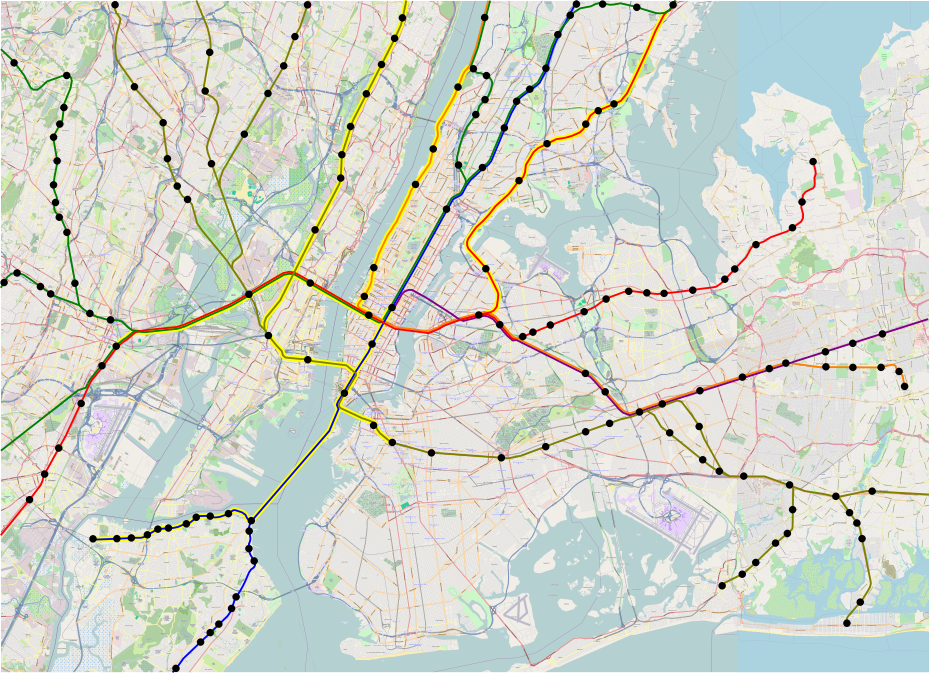
On my usual base map of a subway system with some lines swapped around to make the system more coherent but no new construction, here are the various rail alignments to the airport:

A full-size image can be found here. All alternatives are depicted as dashed lines; the subway extension is depicted in yellow in the same color as the Astoria Line, and would be elevated until it hit airport grounds, while the other two options, depicted as thinner black lines, are people movers or air trains. The air train option going east of airport grounds was Cuomo’s personal project and, since it went the wrong way, away from Manhattan, it was widely unpopular among anyone who did not work for Cuomo and was for all intents and purposes dead shortly after Hochul took office.

The issue of construction costs

Here’s what the above-linked New York Times article says about the rail alignments.

The panel’s three members — Janette Sadik-Khan, Mike Brown and Phillip A. Washington — said in a statement that they were unanimous in recommending that instead of building an AirTrain or extending a subway line to the airport, the Port Authority and the transportation authority should enhance existing Q70 bus service to the airport and add a dedicated shuttle between La Guardia and the last stop on the N/W subway line in Astoria.

The panel agreed that extending the subway to provide a “one-seat ride” from Midtown was “the optimal way to achieve the best mass transportation connection.” But they added that the engineers that reviewed the options could not find a viable way to build a subway extension to the cramped airport, which is hemmed in by the Grand Central Parkway and the East River.

Even if a way could be found to extend the subway that would not interfere with flight operations at La Guardia, the analysis concluded, it would take at least 12 years and cost as much as $7 billion to build.

The panel realized that the best option is an extension of the subway. Such an extension would be about 4.7 km long and around one third underground, or potentially around 5 km and entirely above-ground if for some reason tunneling under airport grounds were cost-prohibitive. This does not cost $7 billion, not even in New York. We know this, because Second Avenue Subway phase 1 was, in today’s money, around $2.2 billion per km, and phase 2 is perhaps a little more. There are standard subway : elevated cost ratios out there; the ones that emerge from our database tend to be toward the higher end perhaps, but still consistent with a ratio of about 2.5.

Overall, this is in theory pretty close to $7 billion for a one-third underground extension from Astoria to the airport. But in practice, the tunneling environment in question is massively easier than both phases of Second Avenue Subway – there’s plenty of space for cut-and-cover boxes in front of the terminal, a more controllable utilities environment, and not much development in the way of the elevated sections, which are mostly in an industrial zone to be redeveloped.

Does New York want to build?

New York can’t build. But to a significant extent, New York doesn’t even want to build. The report loves finding excuses why it’s not possible: they are squeamish about tunneling under the runways, they are worried an above-ground option would take lanes from the Grand Central Parkway (which a rail link would substitute for at higher capacity), they are worried about federal waivers.

In truth, in a constrained city, everything is under a waiver. In comments years ago, Richard Mlynarik pointed out that the desirable standard for railroad turnouts is that they should be straight – that is, the straight path should be on straight track, while the speed-restricted diverging path should curve away. But in practice, German train stations are full of curved turnouts, on which both paths are on a curve, because in a constrained urban zone it’s not possible to realize the desired standard, and a limit value is required. The same is true of any other engineering standard for a railroad, such as curve radii.

The issue of waivers is not limited to engineering or to rail. Roads are supposed to follow design standards, but land-constrained urban motorways are routinely on waivers. Even matters of safety can be grandfathered occasionally on a case-by-case basis. Financial and social standards are waived so often for urban megaprojects that it’s completely normal to decide them on a case-by-case basis; the United States doesn’t even have formal benefit-cost analyses the way Europe does.

And I’ve seen how American agencies are reluctant to even ask for waivers for things that politicians don’t really care about. Richard again brings up the example of platform heights on the San Francisco Peninsula: Caltrain rebuilt all platforms to a standard that didn’t have any level boarding, on the grounds that high platforms would interfere with oversize freight, which does not run on the line, and which the relevant state regulator, CPUC, indicated that they’d approve a waiver from if only the railroad asked. I have just seen an example of a plan to upgrade some stations in the Northeast that is running into trouble because the chosen construction material isn’t made in the United States, and even though “there’s no suitable made in America alternative” is legal grounds for a waiver from Buy America rules, the agency doesn’t so far seem interested in asking.

In general, New York can’t build. But in this case, it seems uninterested in even trying.

The bus alternative

Instead of a rail link, the plan now is to improve bus service. Here’s the New York Times story again:

The estimated $500 million in capital spending would also go toward creating dedicated bus lanes along 31st Street and 19th Avenue in Queens and making the Astoria-Ditmars Blvd. station on the N and W lines accessible to people with disabilities, the Port Authority said. Some of that money could also be spent to create a mile-long lane exclusive to buses on the northbound Brooklyn-Queens Expressway between Northern Boulevard and Astoria Boulevard, the Port Authority said.

Among the criticisms of the AirTrain plan was its indirect route. Arriving passengers bound for Manhattan would have had to travel in the opposite direction to catch a subway or L.I.R.R. train at Willets Point. The Port Authority chose that route, alongside the parkway, to minimize the need to acquire private property. Community groups were also concerned about the impact on property values in the neighborhoods near La Guardia in northern Queens.

To be very clear, it does not cost $500 million to make a station wheelchair-accessible. In New York, the average cost is around $70 million in 2021 dollars, with extensive contingency, planned by people who’d rather promise 70 and deliver 65 than promise 10 and deliver 12. In Madrid, the cost is around 10 million euros per station, with four elevators (the required minimum is three), and in Milan, shallow three-elevator station retrofits are around 2 million per station. Transfer stations cost more, proportionately to the number of lines served, but Astoria-Ditmars is not a transfer station and has no such excuse. So where is the other $430 million going?

The answer cannot just be bus lanes on 31st Street (on which the Astoria Line runs) or 19th Avenue (the industrial road the indicated extension on the map would run on). Bus lanes do not cost $430 million at this scale. They don’t normally cost anything – red paint and “bus only” markings are a rounding error, and bus shelter is $80,000 per stop with Californian cost control (to put things in perspective, I heard a $10,000-15,000 quote, in 2020 dollars, from a smaller American city).

The Issue of Curiosity

We’ve been talking to a lot of Americans in positions of power when it comes to transportation investment about our cost reports, and usually the conversations go well, but there’s one issue that keeps irking me. They ask good questions about corner cases, about some specific American problems (which we do want to revisit soon), about our prognosis for the future. But they don’t usually express curiosity about the non-American cases – and even journalists who write investigative pieces sometimes insist on only using London and Paris as proper comparanda for New York. This is not everyone, and I do know of some civil servants who are interested and have made sure to read the Italy, Stockholm or Istanbul cases. But it is a large majority of Americans we talk to, including ones who are clearly interested in doing better – even they think acquiring fluency in how things work in low-cost countries is irrelevant and are far more passionate about all the barely relevant groups that can block change than about how Stockholm, Milan, and other such cities build cost-effective infrastructure.

Incuriosity and consultants

I recently saw a transit manager in North America who I’d previously had tepidly positive opinion of tell me, with perfect confidence, that “The standard approach to construction in most of Europe outside Russia is design-build.”

To be very clear, this is bunk. Design-build is not used in Southern Europe or in the German-speaking world. Ant6n has only been able to find one such contract in Germany, for the signaling of Stuttgart 21. There’s more use of design-build in France, the Low Countries, and the Nordic countries, and the tendency is toward doing more of it, but,

  • The process of privatization of the state is in its infancy in these countries – for example, Nya Tunnelbanan is mostly procured as build contracts
  • Costs in the Nordic countries are rising rapidly, albeit from very low levels, and this also seems to be happening in France – this minority of Europe that uses design-build (which, again, correlates with other elements of state privatization) isn’t seeing good results
  • As a consequence of the above two points, the current and former civil servants in those countries that I’ve spoken with are familiar with the more traditional system of project delivery and don’t generally think it is inferior to alternative systems that reduce the role of the state and increase that of private consultants, and thus they are familiar with how to do traditional project delivery well
  • Even with the ongoing privatization of the Nordic and French states, more institutional knowledge is retained in the public sector, to ensure it can supervise the consultants, in contrast with the American and British models, where the consultants are supervised by other consultants and the in-house public-sector employees lack the technical knowledge to do proper oversight

So why did this person think design-build is standard, where the majority of Western Europe by population does not use it?

The answer is incuriosity. This person is a generalist Anglo consultant. What they know of Europe is what Anglo consultants know. They never stopped to think if perhaps places that build infrastructure cost-effectively publicly would ever have any reason to be legible to international English-speaking consultancies. Why would they? Infrastructure construction is almost entirely at the level of countries, not the European Union; the weakness of cross-border rail planning is so notable that I know a green activist devoted specifically to that issue. If you’re building in and for Germany, you have no real reason to publish in English trade journals or interact with British or American consultants. Another consultant that Eric and I spoke with had the insight to point out, when we asked about a comparison of High Speed 2 with the TGV, that their company gets no work in France since France does it in-house, but the transit manager who shall remain unnamed did not.

The good ones

I am sad to say that, for the most part, the mark of a good American transit manager, official, or regulator isn’t that they display real willingness to learn. Too few do. Rather, the mark is that they don’t say obviously false things with perfect confidence; they recognize their limits.

This is frustrating, because many of these people genuinely want to make things better – and at the federal level this even includes some political appointees rather than career civil servants. The typical cursus honorum for federal political appointees involves long stints doing policy analysis, usually in or near the topic they are appointed to, or running state- or city-level agencies; I criticize some of them for having failed in their previous jobs, but that’s not the same as the problem of a generalist overclass that jumps between entirely different fields and has no ability to properly oversee whichever field whose practitioners have had the misfortune to be subjected to its control.

The good ones ask interesting questions. Some are easy to answer, others are genuine challenges that require us to think about our approach more carefully. And yet, three things bother me.

They are not technical

Traditional American business culture looks down on technical experts, treating them as people who will forever work for a generalist manager – and this is a culture that treats working for someone else as a mark of inferiority.

The most innovative American industries don’t do this – software-tech and biotech both expect workers to be technical, and the line workers do not often respect managers who are technically illiterate; tech and biotech entrepreneurs likewise have a technical background (Mark Zuckerberg coded Facebook’s prototype, Noubar Afeyan is a biochemical engineering Ph.D., etc.), and Elon Musk, one of the less technical ones, still has a physics degree, wrote code in the 1990s, and goes to great pain to affect being part of the culture of tech workers.

However, the government at all levels does do this. The overclass comprises lawyers and public policy grads; engineers, architects, and planners can be trusted civil servants but are expected to lower their gaze in the presence of an elite lawyer (and one such lawyer told us, again with perfect confidence, something that not only was wrong, but was wrong about American law in their field).

The upshot is that even the good ones don’t ask technical questions. I don’t remember having had to answer questions from even the most curious American officials about grouting, about egress capacity, about ventilation, about construction techniques. It’s rare to even see economic questions about managing public-sector risk, about the required size of an in-house construction agency, about how one implements traditional project delivery effectively; we volunteer some numbers but I don’t remember being asked “how many engineers does RATP employ?” (the answer is around 1,200 across all fields combined).

They nudge and do not do

The American federal government is uncomfortable with the notion of doing things directly. One is supposed to make general rules and nudge others. Even regulations take a nudge form – often instead of direct compulsion (say, installing a safety system), the federal government would nudge private actors by threatening to withhold funds or other support if they don’t do it.

One consequence is that federal agencies don’t really try to learn how to do things themselves. I caution that one official who I spoke with and have a good impression of reacted well when I pointed out how, in Sweden, there’s mobility among the civil servants between state and county governments, so some of the people who built Citybanan working for the Swedish state are now building Nya Tunnelbanan for Stockholm County. This official said they were working on a program that doesn’t quite do this but does something similar, which stands to be successful if done well; I don’t know if it will be done well but there was not enough time in that conversation to get enough detail and I reserve judgment even on the aspects I am more pessimistic about until I know more. So it’s possible that this criticism I have of the federal government is going to do away in the next few years, and if so, I do expect better federal infrastructure investment, perhaps for intercity rail on the Northeast Corridor, which is a federal-led program.

This is not purely an American problem. The EU has the same problem, which is related to the poor state of cross-border rail; even when the European public wants more integration (see, for example, polling on an EU army), eurocrats respond with soporific abstraction, not out of political fear of backlash, but because none of them can actually do anything more than a light nudge – the doers remain at the member state level. The difference between us and the US is that member states like Germany do have some doers around, whereas New York can’t do anything.

They still only look inward

This is the part that I am most worried about in the future. I’ve had to take interesting questions about policy from people who, again, I think well of – if I didn’t, I’d speak of them the way I do of the official in the section on consultants above.

And then none of these questions is about, say, how Italy has set up its bureaucracy for protection of monuments, ensuring there is no risk to millennia-old Roman ruins under the aegis of professional archeologists and historians rather than third-party lawsuits. There’s ample interest among Americans in how to do better, reaching the highest levels among the people I’ve directly talked to, but so far it’s based entirely on internal thinking. Foreign examples can inform them but are not to be investigated as closely. I do know of some officials who’ve read the non-American reports we’ve put out, but it’s not common even among the good ones.

The problem, I think, is twofold. First, Americans are used to being in charge in their interactions with foreigners, and Western Europeans are about the least impressed people in the world by American pride. Why look up to a country that we know has worse public transportation and is, on net, probably about comparable in overall living standards? (Yes, Americans, I am aware that your SUVs are larger.) The average Western European doesn’t think about the United States much and when they do they’re not awed, so the American who asks questions puts themselves in an inferior position, and this is hard to handle.

The second issue is that the public sector draws from within the country’s borders, in almost all cases. The pipelines into working for Deutsche Bahn are completely different from those into working for any American outfit. This means that an official in a country has weak ties to other countries. This, again, is also a European problem – there’s too little knowledge of France in Germany and vice versa, too little curiosity about Southern Europe in higher-cost Northern Europe, and too little curiosity about Asia with disastrous results. But the European railroads have exchange programs among them and even with Japanese railroads, and Americans don’t participate in either; the insularity I see in Germany when I mention the capabilities of high-speed trains in France and Japan is considerably less bad than what I see among the worst Americans and Britons.

We Gave a Talk About Our Construction Costs Report

Here are the slides; they are not in Beamer format but in Google Slides. They’re largely a summary of the New York report with analysis informed by the overview with more direct comparisons with other cities, and for example the recommendation section won’t tell you anything you didn’t know if you’ve read the overview or heard me talk about this issue before.

But I want to highlight one addition: the cost history of New York, on slides 5-8. Costs were elevated even in the 1930s; the references are JRTR for New York, Pascal Désabres for Paris, and Tube History for London. Midcentury New York costs are sourced to New York Magazine, with a Wikipedia article providing some references that match those numbers. The excessive costs of works in the 1930s ensured that the budget would not be sufficient to build desirable lines like Second Avenue Subway, an extension of the Nostrand Avenue Line to Sheepshead Bay, and a line under Utica; those costs kept growing into the 1950s and 60s, and the total amount of money at hand for Second Avenue Subway in the 1950s, about a fifth of the intended budget, would have built the entire line at the then-current costs of Milan or Stockholm. At even semi-reasonable costs, the budget identified for Second Avenue Subway in the late 1990s would have built the entire line, where instead it was cut into four phases with the money only sufficient to build the first.

The overall presentation was a bit stressful for me, especially at the beginning; the talk started at 3 in the afternoon and we finished the slide deck around 2:45. It was better afterward. One caution is that while the talk was recorded, it was a cellphone recording from the back, so Elif and I were not easy to hear. Another is that there were people I was hoping to talk to after the presentation that I didn’t get to; the attendance was on the order of 80 people, and we needed the full two hours we had the room booked for the presentation and Q&A afterward.

A number of people asked us if anything was changing. Eric seems more optimistic that people are listening. I’m less so; we’re talking to some people at government agencies but I can’t tell how important they are (I do not speak Washingtonian and cannot tell from the name and title of someone I talk to where they are on the spectrum of “someone who follows me on social media” to “Pete Buttigieg’s closest confidant”). At the MTA, things are not changing for the better; union head John Samuelsen is under the impression that French employers don’t have to pay pensions, MTA Construction and Development head Jamie Torres-Springer thinks the Second Avenue Subway stations have higher ridership than the stations of Citybanan, MTA head Janno Lieber is in full denial mode, and so on. The excuses might be getting more sophisticated, but, fundamentally, an American manager whose gut reaction to any kind of global benchmarking is to assert with perfect confidence that European employers don’t have to pay benefits needs to be fired and retrained, not given advice on how to come up with more plausibly-sounding excuses. Lieber and Torres-Springer are worth negative billions of dollars to the city and the state while they remain employed.

While some things are improving, the procurement problems are getting worse due to the growing privatization of the state, and, fundamentally, none of those people is willing to admit their mistake. There are some ongoing experiments in New York with itemized costs, but only as part of a PPP privatization, and only as pilots, where the place where itemizing costs and technical scoring are the most helpful is in the biggest and most complex contracts. Government-by-pilot doesn’t work any more than any of the other gimmicks that dimwitted political appointees use to avoid taking responsibility for decisions.

I’m Giving a Talk in New York on 3/3

We’re launching the Transit Costs Project conclusion and New York case this Friday at 3 pm. Unlike the October panel, this will not be moderated – Eric, Elif, and I will just talk about our report and take questions from the audience. While the talk will almost certainly be recorded, if you’re in the area you should still come in-person in order to be able to ask questions and interact.

As in our October event, the location is room 1201 of 370 Jay Street in Brooklyn, right on top of the subway stop that carries its name with A/C, F, and R service, and not far from other Downtown Brooklyn stops like Borough Hall on the 2/3/4/5, DeKalb Avenue on the B/Q, and Hoyt-Schermerhorn on the G. The building has access control so please tell us your name and email on this RSVP form so that security will know you can get in. If you crash the event you may still be allowed in but I won’t know until the day of, so do RSVP if you think you may attend; technically the room is capped at 180 people, around half seated, but I don’t expect to fill to even seated capacity, so don’t worry about taking someone else’s place.

The Issue of Consultants

Henry Grabar at Slate just wrote about our construction costs report. He centers the issue of consultants; the article is called Consultants Gone Wild, and he includes quotes from Eric and from our report about the contrast between in-house capacity and the privatization of the state to private engineering firms. I was asked for a followup, since the exact wording of our synthesis does not explicitly say “consultants” very much. And yet, Henry is broadly correct; the overuse of consultants is a problem, and should be restrained in most cases in favor of a professional civil service, unencumbered by politicization or an overclass of political appointees.

The formula for high New York construction costs

Based on around 100 interviews and many diagrams and reports, we managed to decompose the New York construction cost premium over low-cost countries, which is about a full order of magnitude, into the following items:

  • The stations are overbuilt by a factor of 3, which contributes an overall factor of 2 cost premium
  • The systems are not standardized, which contributes a factor of about 2.3 cost premium for the systems and 1.35 overall
  • Labor costs (including supervisors and other white-collar workers) are 50% of hard costs in New York where they should be about 25%, contributing a factor of 3 premium on labor costs and 1.5 overall
  • Procurement problems including the privatization of risk, change order risk, agency micromanagement of contractors, general red tape, and profit stemming from too little competition double overall costs
  • Soft costs are depending on what one counts either 21% on top of hard costs where they should be 7%, or 46% where they should be 20%

Where are the consultants?

On its face, nothing in the above formula says “consultants.” At most, the soft costs can be attributed to them – but the comparison cases involve some use of external consultants as well, they just charge 7-8% of the hard costs in fees rather than 21%. So what gives?

So, first of all, the difference between 21% and 7% is significant. It’s in fact more significant than 1.21/1.07, because the 21% is on top of an inflated base cost, some of whose items (namely, labor) don’t create more work for the consultants, so in effect some of the labor premium should be thought of as an extra consultant premium that is allocated to the hard costs.

The reason for this difference is poor oversight capability. In most cases, some use of external consultants is unavoidable: in Spain, famous in the comparative cost community for its low costs, ADIF projects employ consultants, who charge 5% extra, and then a small force account adds a few percent on top of that. The difference is that competent managers can competently supervise consultants. The use of consultants in Italy, France, Spain, Turkey, and Sweden coexists with strong internal capacity by agencies led by technocrats and professionals.

In contrast, the American (and British) way is to privatize the state to consultants root and stem. The agency managers are generalists who look down on technical people and treat the consultants as an infinite resource, who they can ask to study everything. Eric is quoted as saying “They studied everything” of Second Avenue Subway: every conceivable possibility was studied just in case, and there was nobody in charge who knew enough about planning or engineering to prune the search tree and save some money. In effect, what we’re seeing is unusually low office productivity, in tandem with low blue-collar laborer productivity in tunneling.

The connection with procurement

Okay, so the soft cost factor is still only about 1.2, which is nowhere near enough to explain an order of magnitude’s worth of cost difference.

However, procurement is another factor of 2, and has much of the same cause. The same technically illiterate overclass (Janno Lieber, Jamie Torres-Springer, etc.) that treats consultants as an infinite resource also abuses contractors with red tape. This overclass leashes the technical experts – the planners, engineers, even the economists who study these issues and conclude transparent itemization produces lower final costs – and won’t let them make quick decisions about contracts. This leads to the red tape and micromanagement that the contractors, consultants, and technical agency staff constantly complain about.

Because this overclass can’t adjudicate geotechnical disputes and doesn’t trust those who can, it prefers mechanisms that privatize risk to huge design-build contracts, a system that we call the globalized system in the synthesis and the Sweden report and has led to a large increase in absolute costs wherever it was tried (which is approximately every place legible to the Anglo-American overclass, which is unemployable in a place like Germany or Italy or France, where the pipeline to managerial jobs is local). Then, when costs rise, those political appointees react by including a large contingency factor, at times rising to 40-50%, nearly all of which will be spent.

Bring back the bureaucrats

I hesitate to say back because the United States never really had an apolitical civil service; in the 1950s already it had thousands of political appointees forming an overclass. But the rest of the Anglosphere only lost its mind in the last generation, in my lifetime. I’m encouraged especially by some things I’m hearing in the United Kingdom, which seems interested in moving on, perhaps because it was the first place to adopt the globalized system, perhaps because it has less cultural cringe than Canada or Australia (if anything, Britain’s problem is the opposite: excessive pride), perhaps because it is more proximate to Continental Europe with its lower construction costs.

In such environments, what’s needed isn’t to literally get rid of consultants. But the role of consultants must shrink. The state must hire a large in-house team, sized based on the magnitude of expected projects, and retain the team in the long run to enable public-sector learning. This team can use consultants but must be able to do the work itself if needed, and should be technical enough to know how to answer questions about the scope of work and avoid both micromanagement and underspecification.

Ironically, the consultants themselves prefer it that way. Yes, they get more money out of a project run as poorly as American procurement is than out of one run as well as in our non-Anglo comparison cases. But they also have to do more work and take more risk, and the projects rarely actually end and provide a sense of closure. They charge more money precisely because it’s such bad work, and governments should take heed and build in-house state capacity to make sure the oversight can be smoother and more technical.

The RENFE Scandal and Responsibility

I’ve been repeatedly asked about a RENFE scandal about its rolling stock purchase. The company ordered trains too big for its rolling stock, and this has been amplified to a scandal that is said to be “incompetence beyond imagination” leading to several high-level resignations, including that of the ministry of transport’s chief civil servant, former ADIF head Isabel Pardo de Vera Posada. In reality, this is a real scandal but not a monumental one, and Pardo de Vera is not at fault; what it does show is both a culture of responsibility and a degree of political deflection.

What is the scandal?

RENFE, the state-owned Spanish rail operating firm, ordered regional trains for service in Asturias and Cantabria on a meter-gauge mountain railway with many narrow tunnels of nonstandard sizes. RENFE did not properly spec out the loading gauge, which vendor CAF noticed in 2021, shortly after the order was tendered but before manufacturing began; thereafter, both tried fixing the error, which has not led to any increase in cost, but has led to a delay in the entry of the under-construction equipment into service from 2024 to 2026.

The head of the regional government of Cantabria, Miguel Ángel Revilla Roiz, demanded that heads roll over the spectacular botch and delay. The context is that regional rail service outside Madrid and Barcelona has been steadily deteriorating, and people outside those two regions have long complained about the domination of the economy and society by those two cities and the depopulation of rural areas. Frequency is low and lines are threatened with closure due to the consequent poor ridership, and there is deep mistrust of the central government (a mistrust that is also common enough in Barcelona, where it is steered toward Catalan nationalism).

The other piece of context is the election at the end of this year. Nearly all polls have the right solidly defeating the incumbent PSOE; Revilla is a PSOE ally and so Asturias head Adrián Barbón Rodríguez is a PSOE member, and both are trying to save their political support by distinguishing themselves from the central government, which is unpopular due to the impact of corona on the Spanish economy.

What is Pardo de Vera’s role?

She was at ADIF when the contract came down; ADIF manages infrastructure, not operations. She was viewed as a consummate technocrat, and I became aware of her work through Roger Senserrich’s interview with her; as such, she was elevated to the position of secretary of state for transport, the chief civil servant in the ministry. Once the ministry became aware of the scandal in 2021, she tried to fix the contract, leading to the current result of a two-year delay; she is now under fire for not having been transparent with the public about it, as the story only became public after a local newspaper broke it.

This needs to be viewed not as incompetence on her part. The scandal is real, but moderate in scope; delays of this magnitude are unfortunately common, and Berlin is having one on the U-Bahn due to vendor lawsuits. Rather, the success of Spain in infrastructure procurement (if not in rail operations, where it unfortunately lags) has created high expectations. In the United States, where standards are the worst, a similar mistake by the MBTA in the ongoing process of procuring electric trains – the RFI did not properly specify the catenary height – is leading to actual increases in costs and it’s not even viewed as a minor problem as in Berlin but as just how expensive electrification is.

I urge Northern European and American agencies to reach out to Pardo de Vera. In Spain she may be perceived as scandalized, but she has real expertise in infrastructure construction, engineering, and procurement. Often boards, steering committees, and review panels comprise retired agency heads who left for a reason; she left for a reason that is not her fault.

Cost and Quality

From time to time, I see people assume that low-construction cost infrastructure must compromise on quality somehow. Perhaps it’s inaccessible: at a Manhattan Institute event from 2020, Philip Plotch even mentioned wheelchair accessibility as one factor leading to the increase in costs since the early 1900s; one of my long-term commenters on Twitter just repeated the same point. Perhaps the stations are cramped: I can’t count how many times I’ve heard the “transit riders deserve great stations” point from various Americans (there are several such examples in the thread in the last link alone), or for that matter from the people who built the Green Line Extension, and even Korean media got in on the action, falsely assuming that the spartan, brutalist stations of the Washington Metro were cheap (in fact, Washington is building an above-ground infill station for around an order of magnitude higher cost than Seoul’s cost for an underground infill station).

Please, stop.

If you want to know what very low-cost metro construction looks like, recall that the existing about 104 km (about 57 underground) Stockholm Metro was built in the middle of the 20th century for $3.6 billion in 2022 dollars. Here’s how the stations look:

Source: Wikipedia, by Tim Adams; description in text below

Stockholm is famous for its exposed rock: the hard gneiss forms natural arches, and the T-bana elected to paint it over from the inside, producing the bright blue-and-white contrast with dark blue leaf paintings depicted above at T-Centralen. The stations look drastically different from one another, with many examples available from UrbanRail.Net, Flickr user Dyorex, Flickr user Kotka Molokovich, and the travel site Walk Slow Run Wild.

Swedish construction costs today are several times higher, but remain below world average, and are nearly a full order of magnitude lower than in New York. The stations remain artistic, but this coexists with consistent, standardized engineering specs, modified based on local conditions only when necessary. Citybanan’s Odenplan is not at all spartan; the entire station, berthing 214 meter trains mined below the T-bana station by the same name, cost $250 million in 2022 dollars, which cost includes not just the station but also 2 km of mined tunnel. The data that I’ve seen while researching our Sweden case suggests that Nya Tunnelbanan station costs are dominated by civil infrastructure and not systems or finishes, which look like they’re about a quarter of overall station costs, rather than nearly half as in New York. Nice art is not expensive; for that matter, New York’s subway stations have pretty tiles, and this includes old stations predating the 1930s’ cost explosion.

Moreover, I doubt it was the case when the system was first built, but nowadays the entire T-bana is accessible to wheelchair users. In fact, a number of metro systems have made themselves fully accessible or are in the process of doing so, generally at low costs; I have some numbers from 2019, and the programs cited for Berlin and Madrid are behind schedule, but Berlin seems to be sticking to a budget of 2 million € for an ordinary station, and even taking into account inflation that Berlin needs one elevator per station and most cities need three, this isn’t quite $10 million per station, a cost similar to that of Madrid’s ongoing program. In New York, the cost cited for accessibility is $70 million per station.

What goes on here isn’t really a matter of high quality for high cost. In fact, when Eric, Elif, and I researched the New York case, we were stricken by how little of the problem concerned actual quality or safety regulations (for example, the fire code in New York in practice requires mezzanines at the depth of Second Avenue, but does not require them to be full-length). The oversize stations are neither grand public atria nor revenue-generating commercial spaces, but rather conventional stations flanked by excessive amounts of back office space. The lack of standardization concerns fittings, not art. The massive costs of New York elevator installation are barely about redundancy (a requirement driven by low but fixable reliability) and largely about utility conflicts, bad-and-worsening project delivery, and the soft costs crisis.

Making the user experience worse is an easy way to signal that one is cutting costs. It’s a combination of vice-signaling and prudence theater. It also has little to do with how actually low-cost infrastructure construction programs look like. They can be highly standardized even without the artistic component found in Sweden and Finland, and then people may complain that the system looks bland and corporate – but bland and corporate is not the same as spartan, it just means it looks like the 21st century and not the imagined 20th.

Good systems are certainly not willing to make compromises on human rights and build inaccessible infrastructure. In Seoul, there are massive protests by disabled people demanding that the Seoul subway go from 93% to 100% accessible and that the bus fleet immediately be transitioned to low-floor equipment, and meanwhile, New York and London both loiter around 25-30% accessibility. The conservative governments of the state and the city both dither, but past competence by Korea has led to high expectations by users, in the same manner that people in developed country protest inequality and poverty even fully knowing that it’s nowhere near as bad as in the third world. While I don’t know Seoul’s accessibility costs, I do know a deep-bored Line 9 extension with an undercrossing of Line 5 is budgeted at $180 million/km.

The Transit Lobby and Fares

Randal O’Toole has a weird blog post about our construction costs report. I say weird, because it complains that we didn’t ask certain questions that we actually did, in the executive summary: “what kind of political and decision-making process allows for such expensive projects to be approved in the first place?” in his language. It also is under the impression that Sweden and Italy are authoritarian states. I bring this up because the post suggests two reasons: the transit lobby, and user fees. These are both wrong, and I’d like to cover why.

The user fee issue

O’Toole harps on user fees:

At heart, and I keep harping on this, the real problem is the disassociation of costs from user fees. If costs have to be paid for out of user fees, then expensive and obsolete technologies will automatically be rejected. But if there is no relationship between costs and real measurable benefits, then there is no need to control costs at all. Any agency leader who supports lower-cost solutions loses out because their agency’s budget will be smaller and any politician who tries to control costs loses out because they bring less money into the pockets of potential campaign contributors.

The reason we don’t talk about this in the report is that high-subsidy transit systems don’t generally cost more to build and operate than low-subsidy ones. The norms in Asia are that rapid transit service should be operationally profitable; Japan won’t even build subways unless they can show a 30-year payback period, i.e. 3.3% financial return on investment in an economy whose natural rate of interest is maybe 1.5%. The norms in Europe are that intercity rail should be profitable but anything else is a social service that should receive subsidies.

And as it happens, there’s no systemic cost difference between Europe and rich Asia. Construction costs span the entire non-US range in both places: South Korea has very low construction costs and so do Southern Europe, Turkey, and the Nordic countries; Singapore and Hong Kong compete for highest costs outside the United States and so does Britain. In Hong Kong, if anything, the MTR’s development profits have enabled it to waste more money on construction, since it still gets state money for construction on top of the development profits, which have no accountability.

Transit ideology and modal warfare

O’Toole and other Americans with similar pro-car, anti-rail views like Wendell Cox and Robert Poole has an obsession with counting some kind of subsidy metrics. He talks about the transit lobby, and he ends up misunderstanding how the politics of mass transit works elsewhere. But, in short, modal warfare is not usually about construction of subway lines, but about road diets and bike lanes.

For example, in Germany, Kai Wegner just did very well in the Berlin election on a platform of more parking spots and opposition to everything the Green Party does. CDU came first for the first time since 1999. But Wegner supports more U-Bahn construction and attacked the left-wing coalition for dithering on the subject. His transport ideology is not the same as that of American mode warriors; it’s cars-and-trains urbanism, with cars getting more attention than trains. Social democracy for that matter has the same ideology, but with a greater role for trains – and it’s this ideology that built around 100 km of majority-underground metro in Stockholm for $3.6 billion in 2022 dollars.

I bring up Germany because we’re seeing the linkage between fares and operations vanish in real time, due to fallout from the 9€ ticket from last summer; see coverage on this blog here and here. Before corona, public transport fares covered around half of operating costs Germany-wide (source, p. 36), and some of the big city rapid transit system broke even (at least the Berlin U-Bahn and I think also the Munich U-Bahn). The perceived success of the 9€ ticket is changing Germany’s transit advocacy ideology – but in the exact opposite direction from more construction, whatever the cost. No: the same advocates who center low fares oppose subway construction, viewing it as a sop to cars-and-trains urbanism and preferring surface light rail instead. The same is true in the United States: the sort of people who support free transit and sue agencies that raise fares usually also think rail investment is racist and money for transit should go to bus operations.

The transit lobby

As soon as it’s clear that there are different ideologies of mass transit, the question of the transit lobby gets murkier. O’Toole, rooted in modal warfare, says of construction costs “The real answer, I suspect, is that the transit lobby has persuaded the public that transit is all good and no bad. This in turn persuaded politicians that they can spend as much as they want on transit (unlike freeways) with no political backlash.” But there’s a strong lobby in support of urban rail construction everywhere, across the entire cost range, including in our low-cost examples.

The US doesn’t really have a stronger transit lobby than Sweden or Italy or Turkey (or Germany or France or Japan, etc.), unless one defines “transit lobby” as “builds unusually expensive transportation infrastructure.” The typical federal funding formula in the United States is 80% cars, 20% transit; in Germany it was around 55% cars, 42% rail, 3% canals in the Grand Coalition. In Sweden, cities have transitioned to tolerating more disruption for drivers and less for pedestrians on the feminist grounds that drivers are disproportionately men. The ability of transit riders to both get a larger share of the funding and make the cities more walkable and bikable at the expense of the convenience of car drivers is unusually weak in the United States by developed-world standards.

In some cases, it goes the other way: a weak transit lobby leads to higher costs, due to political impositions. In Tampa, an attempt by the transit agency to increase bus frequency somewhat and provide bus shelter had to be pitched as BRT, and then the DOT extracted surplus and demanded that the agency get federal BRT funding for repaving all lanes used by the buses with concrete – lanes that were to be shared with cars and trucks, rather than dedicated to bus service. This has led some advocates to propose that a stronger transit lobby is what’s needed to improve transit efficiency… except that New York is the worst.

There are real political reasons for why the US has such high infrastructure construction costs; this is not just transit – road tunnels cost a lot more per km in Boston and Seattle than in Berlin and Stockholm and Paris and Madrid. We go over them in the report. I urge people to go read it and focus on issues of politicization, bad-and-worsening procurement norms, lack of interest in interagency coordination, and the subordination of expert civil servants to incurious political appointees. The modal warfare that O’Toole engages in is pretty irrelevant in either direction; in countries with functional infrastructure construction programs, people who are that political never have any input other than a very broad yes-or-no decision over megaprojects, and not even that level of input over smaller projects (Nordic decisionmaking about road construction is notably depoliticized).