The Limit of Circles in the Suburbs
In dense urban cores, it’s valuable to run circular rail lines. They connect dense near-center neighborhoods to one another without going through the more congested center, and help make transferring between parallel lines more efficient, again through avoiding central business district congestion. Some of the largest cities in the world even support multiple circles, line Lines 2 and 10 in Beijing, or the various overlapping circles of Moscow, Tokyo, and soon Paris. However, this system of radial lines through the center and circular lines around the center cannot go on forever. There is a limit to how far out one can build circles, which is much sharper than the limit of how far radial lines can go. Lower-density suburbs can have radial lines connecting them to city center or to near-center nodes of activity, but circumferential lines are likely to be weak.
For a concrete example, take Berlin. It has the Ring through fairly dense neighborhoods, supporting 5-minute frequency on the S-Bahn during most of the day. But it also has the Outer Ring, built in the 1950s through East Berlin and the Brandenburg suburbs to surround West Berlin and permit the construction of the Wall; today it runs regional trains, and one segment through East Berlin runs the S75 every 10 minutes, but there is no train making the entire orbit, just trains using short segments to position themselves to a better radial entry into the center of Berlin. It looks frustrating – there is circular infrastructure, why not use it? But there’s a solid reason not to run it as a true circle.
See map below:

A schematic of service patterns can be seen here.
The line’s origin as a bypass means it doesn’t serve any of the nodes near its radius, like Potsdam (too built-up), Spandau (in West Berlin), or Märkisches Viertel (also in West Berlin). The only node it does pass through is the soon-to-close Schönefeld airport, which only became important well into the Cold War; moreover, a branch parallel to the line to the southeast serves the soon-to-open Berlin-Brandenburg Airport, with plans to run many different kinds of regional services entering Berlin from both the Stadtbahn and the North-South Main Line. So a circular service would, by itself, just connect various outlying areas like Marzahn, Hennigsdorf, and Falkensee to the airport. By itself, this doesn’t support very high frequency.
Now, what the line could do is work as a network together with radial lines, connecting to them to facilitate travel not passing through the center of Berlin. However, there is not much point in transfers unless they are either high-frequency or timed. High-frequency transfers are out – the radial lines that penetrate the Outer Circle run 2-3 trains per hour. This forces the transfers to be timed.
Timed connections on lines that intersect crosswise rather than parallel with cross-platform transfers are completely possible. The trains can’t be too long, but that’s fine, a 4-car train with stair and elevator connections could have 2-3 minute transfer windows and still exchange passengers in all directions. It’s worth establishing at sufficiently important stations where a cross-platform transfer is not possible; as a four-way transfer, it’s not even that much more involved than a cross-platform transfer with timed wrong-direction transfers like Wittenbergplatz between U2 and U1/3. However, this is for one station.
All of this goes out the window when a circle intersects 12 different radial lines. Such a scheme can only work if all of the transfers are timed, or at least a large majority of them. Otherwise, people might as well take the train through the center and connect at Berlin Hauptbahnhof, or even stay on the same train if it runs through like RE 1 or RE 3.
In theory, you can time a short succession of transfers on the same line. All it really takes is to make sure that the circular line takes a half-integer multiple of the takt interval between every pair of transfer points, allowing both-direction transfers everywhere. On a few stretches of the line, it’s even plausible, with a 20-minute takt – the line would be fast because it’s so far out and has to few stops, so 7-10 km in 8 minutes (10 minus 2 for the transfer window) is not outside the realm of possibility.
Except that some segments between transfer points are still bad, like between the two just west of Spandau, or on both sides of the crossing with S5 and RE 1 in Lichtenberg. And even if they weren’t, this runs into the problem that trains are not infinitely punctual. Having 12 knots between a circular line and radials around Berlin, or even just 10 if weak ones are dropped, means that suburban Berlin would have more knots every 20 minutes than Switzerland has today every half hour (8), and not too many fewer than Switzerland is planned to have every half hour in the 2030s. The required schedule discipline is intense, especially in a big city defined by crowded rush hour trains.
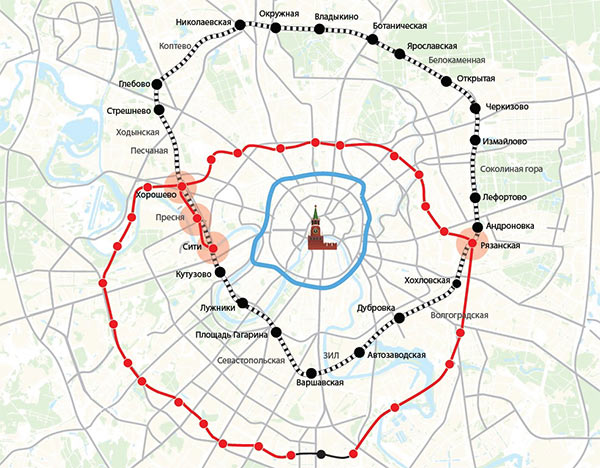
This has implications elsewhere. Paris has its Grande Ceinture, which is tempting for a regional rail ring, but the frequency at which it can support a full RER line is not high; instead, the region is breaking the line into segments, to be turned over into tram-trains, with some segments diverging from the mainline to serve nodes near but not on the line.
In general, what this means is that if you’re not connecting to a major city center, there’s only so much service you can run. If you’re within the densely built-up area, as the Ring is or as the various orbitals Paris has (M2/M6, T3) or plans (M15), then it’s fine – untimed transfers are fine when trains come every 5 minutes, and overlapping one-seat rides like Prenzlauer Berg-Neukölln and Ostkreuz-Tempelhof and so on can help fill the train as well. But once frequency drops below about a train every 10 minutes, untimed transfers no longer work, which means that services that rely on connections only work if the connections are at a handful of key points, not at 12 different radii around the city.

 Pedestrian Observations


