The French Way of Building Rapid Transit
It’s been a while since I last wrote this series, where I covered the American, Soviet, and British traditions of building urban rail. I’d like to return by focusing attention on the French tradition, which has been influential not just within France itself but also to some extent former French colonies, especially Quebec.
An issue I hope to return to soon is the extent to which France has not truly decolonized; former French colonies in Africa, especially the Maghreb, rely on French technical expertise for construction, and often outsource their monetary policy (as with the CFA franc, but Morocco too has a peg to a dollar and euro mix). This matters, because this means the French way of building urban transit is influential in former French colonies in Africa, whereas the British tradition’s impact on India, Nigeria, and so on is limited.
The history of Paris
Like Britain, the USSR, and the US, France has a dominant financial center that its smaller cities aim to imitate. This imitation has been much more extensive than in the US and UK – to the extent that secondary French cities diverge in design principles from the capital, they do things that were fashionable in Paris at the time they built out their rail networks rather than things that were fashionable in Paris when Paris built the Métro. Thus, it is especially valuable to look at the history of urban rail in Paris.
The Paris Métro opened in 1900, as the world’s fifth metro system. Already then, it had a critical feature that the previous four (London, Budapest, Chicago, Glasgow) lacked: it was a centrally planned multi-line system. The city planned a coordinated system of what would become Lines 1-6, in the shape of a # in a circle: Lines 1 and 3 would run east-west, Lines 4 and 5 would run north-south, and Line 2, eventually split into Lines 2 and 6, would run the trace of the wall that delineated the city’s pre-1860 boundary.
The Métro was a municipal effort run by the municipal CMP, designed around the city’s needs, which included not just good transportation but also separation from the working-class suburbs. Whereas the London Underground was mostly technologically compatible with the mainline system, the Métro was deliberately designed not to be, to protect the urban middle class from transport integration with the suburban poor. This led to the following features:
- The trains are extremely narrow, 2.4-2.44 meters wide, compared with about 2.9 m on the mainline; the deep Tube trains in London, held to have the narrowest loading gauge on a standard-gauge railway, are 2.68 m wide.
- The interstation distance is very short, 562 meters on average. Paris is compact and dense and the short interstations are only a real problem in the suburbs.
- The trains run on the right, like French road traffic, whereas French trains run on the left.
- No legacy lines were incorporated into the system, unlike in New York and London, and thus the shape of the network looks much more like how one would design a metro network from scratch and less like how old West London branches or Brooklyn excursion lines looked.
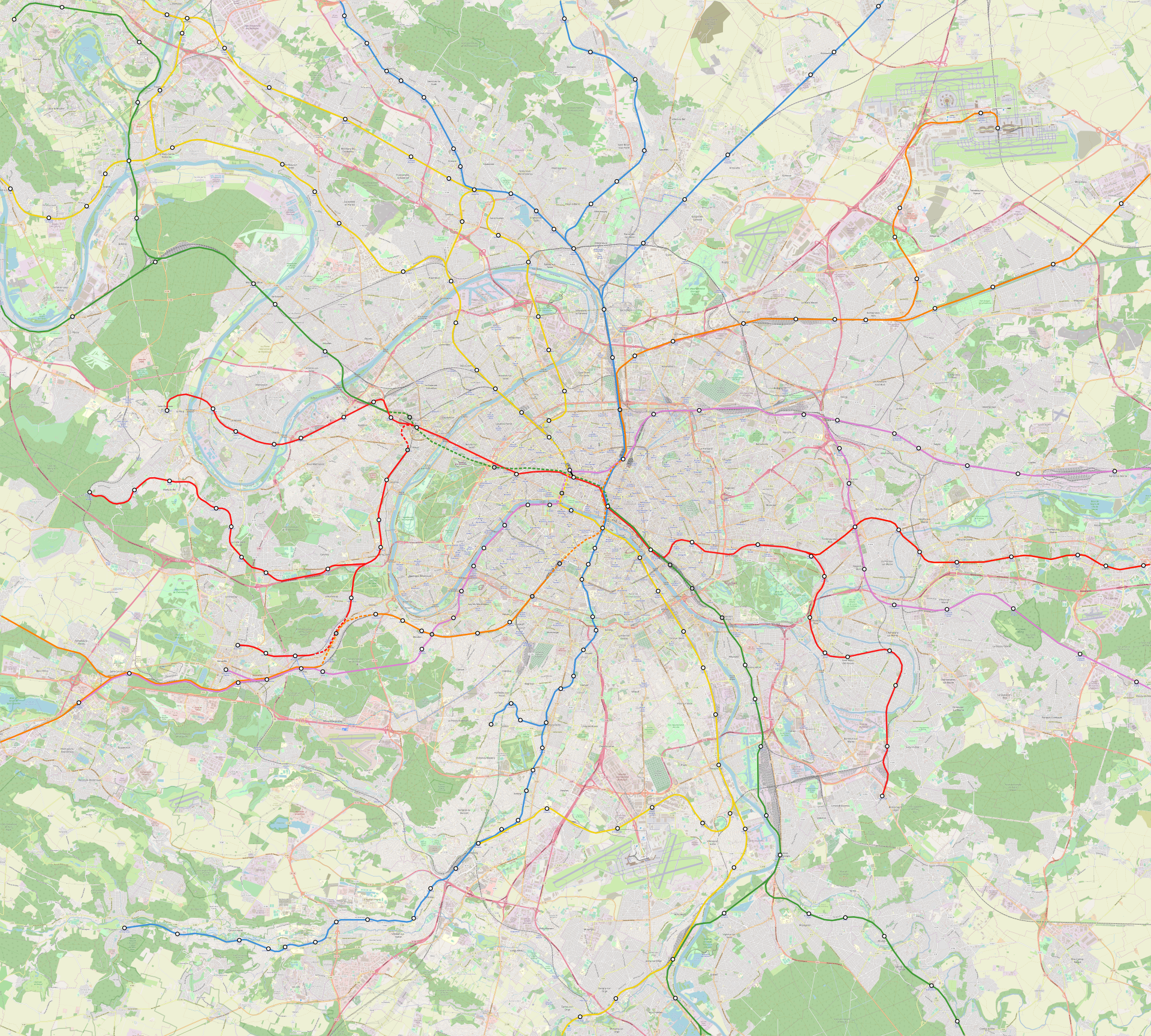
Like New York and Berlin and unlike London, Paris built the Métro cut-and-cover. The lines built before the 1990s all closely follow streets except when they cross the river – and in the 1900s the Line 4 river crossing was the hardest part of the system to build, opening in 1908 whereas the rest of the network had opened by 1906. This was done entirely by hand, forcing the lines to curve where the streets did, which led to two notable warts. First, while most of the system had a design standard of 60 meter curve radii, Line 1 goes down to 40 at Bastille. And second, Line 5, which crosses the Seine on a bridge, cannot serve Gare de Lyon; the engineers could not get it to curve that way while still running through to Gare d’Austerlitz and the Left Bank, so instead the transfer point between Lines 1 and 5 is Bastille, and more recently the RER A and Line 14 both cross Line 5 without a transfer as they run express from Gare de Lyon to Châtelet.
That said, the missed connection between Lines 5 and 14 is the only one in the system, though two more are under construction on Line 14 extensions. Only one among the major metro systems of the world runs entirely without missed connections, the Mexico City Metro, which has unusually low line density in the core and unusually many tangential lines.
The suburbs and the RER
The Métro’s deliberate exclusion of the suburbs made sense from the point of view of a middle-class Parisian in 1900 who was mortally afraid of the working class. But by the 1930s, it was leading to serious design constraints. Further Métro extensions both densified the network and extended it outward, and in the 1930s, lines began to extend past city limits, to such suburbs as Lilas, Issy, Neuilly, and Montreuil. The short interstations made longer extensions infeasible, and some solution involving regional rail was needed.
In 1938, CMP bought and electrified the Ligne de Sceaux, which alone among the Paris commuter lines had reached close to city center, terminating at Jardin du Luxembourg rather than at the farther away rail stations, which are located at or just inside the M2/M6 ring. Then after the war, as suburbanization intensified and commuter traffic at Gare Saint-Lazare grew increasingly congested, CMP’s successor RATP collaborated with SNCF on connecting regional rail branches to form an express system, that is the RER; the Ligne de Sceaux became the southern half of the RER B, while a similar branch going east paired with one of the Saint-Lazare lines to form the RER A. Through-service opened in 1977, roughly at the same time as the German S-Bahn through-tunnels, but the system grew much larger as Paris was and remains far larger than any German city.
But it is not exactly correct to view the RER as identical to a German S-Bahn, or to one of the RER’s inspirations, the Tokyo through-running system. A number of features characterize it, some shared with other urban regional rail systems, some not:
- There are multiple trunk lines through the city, which form something like a coherent network among themselves, and do not share rolling stock. The biggest warts are that the RER B and D share tracks (but no platforms) on one interstation, and that the RER C mostly stays on the Left Bank, legacy of when planning in Paris conceived of the area around Saint-Michel as a central area to be served, where in reality it is decidedly secondary to the CBD stretching from Les Halles to Champs-Elysées.
- It runs largely, though not entirely, on separate tracks from non-RER lines.
- It is locally viewed as deficient to Métro service – researchers who use the RER B to get to IHES think of it as lower-quality, lower-class service than the Métro in the city and its immediate suburbs. I suspect that this is why Grand Paris Express is designed around Métro standards rather than as intensification of RER service, while RER expansion has fallen to the wayside.
- RER-Métro integration is imperfect: the fares are integrated but there are still barriers between RER and Métro platforms, and there are many missed RER-Métro connections, whereas in Berlin the S-Bahn and U-Bahn have only one missed connection between them.
- The interstation is around 2-3 km, but it’s actually slightly longer on the new urban tunnels build for the RER A, B, D, and E than on the legacy lines in the inner suburbs; this feature also exists in a much more extreme form in the United States, but in Berlin and Tokyo it is completely absent.
Exporting Parisian ideas
Parisian metro planning influenced Montreal, Mexico City, and the smaller French cities, in chronological order. We see any of the following features in those cities:
- Rubber-tired metros. This technology was in vogue in postwar Paris, which converted Lines 1, 4, and 11 to it figuring this was just better than steel wheels, and also Line 6, figuring that an elevated line would benefit from a quieter propulsion system.
- Non-radial network design. London and the systems inspired by it, including all Eastern bloc systems, have radial design, with nearly all lines entering a relatively small city center. Paris expanded its #-in-a-circle system to a combination of a radial network and a grid, with a large number of pairs of parallel lines. Mexico City, the largest system inspired by Paris, is rich in tangential lines but has only three lines serving city center, which are by far the three busiest.
- Short interstations, though this is truer domestically than in Montreal and Mexico City.
- Driverless operations. This technology became popular in the 1980s, starting with the Lille Metro, and France has used it on new lines in Paris (M14) and elsewhere (Lyon Line D, both lines in Toulouse), also innovating in converting manual lines to automatic on Paris M1 and now M4. While the Parisian lines are full-size metro lines, the other ones are light metro running shorter vehicles, often with extensive elevated service.
- Separation between regional rail and metro service. Montreal is sufficiently North American to have given up on regional rail entirely, but Lyon and Marseille are investing in better regional rail, run separately from the local urban transit system but with some degree of integration.
- Light rail. France’s modern light rail systems do not originate in Paris – Nantes opened its system in 1985, suburban Paris only in 1992 – but Paris has a notable feature that isn’t common elsewhere in Western Europe: it is a mixed system with some Métro lines and some tram lines filling in the gaps. This mixed system is also present in Lyon, Marseille, and Toulouse, whereas Bordeaux, Strasbourg, and Nice have entirely tram-centric systems. But in no case is there any subway-surface running as in the United States or Germany: lines are either clearly trams or clearly metros, rather than mixtures, and it is the system that is mixed, not the individual line.
Has France decolonized?
Like Britain, France did not take its geopolitical disempowerment at the end of World War Two easily. Both countries have maintained superpower pretensions, decolonizing but trying to treat their former colonies as their spheres of influence as much as possible. In Britain, this relationship broke down – the ex-colonies were being too loud in the Commonwealth, leading the country to seek to join the EU instead. In France, this relationship remains in Africa, and notable not in Southeast Asia, where Vietnam is buildings its urban rail networks with Chinese and Japanese financing.
But France is not just providing financing to infrastructure projects in its former (or current?) African colonies. It has a permanent presence. In researching Arab rail infrastructure, Anan Maalouf has noted that Alstom has had a subsidiary operating in Algeria since 2002, which does not exist elsewhere in the Arab world. This way, French firms maintain close knowledge of the situation in the Maghreb, where incomes and productivity levels are much lower than in France, so that different methods are optimal from those common in rich countries.
Nonetheless, what they build remains noticeably French. For example, the Sfax tramway does not look too different from what Bordeaux or Nice has. The Tunis Métro looks rather like a French tramway system too, despite the name; of note, even though the Tunis Métro branches, and has some underground segments, those segments are not on line trunks and thus the system does not form a subway-surface or Stadtbahn network.
I haven’t gone too much into intercity rail, but it is worth mentioning that Morocco has a high-speed rail system, built with French technical assistance and running TGV equipment.
Does this work?
Yes and no.
The Paris system works. It is not perfect, and in particular the integration between the Métro and the RER could be better; at least one tram line should be a full metro line (a completed T3 ring), and suburban extensions should generally use the RER, with more investment in RER capacity within the city as well. That said, public transport usage is higher in Paris than in its closest comparison, that is London; Paris’s system is also superior in both overall usage and future prospects to that of another megacity in Europe, Moscow. Only Istanbul could potentially do better in the future, in the context of extremely low construction costs.
That said, Paris is a giant that casts a long shadow, which doesn’t always work well for secondary cities. Lyon, Marseille, Toulouse, and the other secondary French cities aren’t too different in modal split from similar-size British cities, and are behind Vancouver, a North American city with extensive postwar growth. German cities in the Lyon size class do a lot better. See for example data here and here.
The weird features of France, like the love for rubber tires, are not that relevant overall, but do point out that France is relatively insular, and mostly adopts domestic ideas developed in Paris rather than ideas from elsewhere in Europe, let alone Asia. (Yes, I know about Japanese influence on the initial RER; however, there have been 50 years of divergence since, same as with German tram-trains and American light rail.) This has been especially problematic with regional rail. France does not have frequent takts anywhere – even Paris only has takt timetables off-peak, running a separate schedule at rush hour, whereas the German takt plan is repeated throughout the day and the peak can only have supplemental service.
The issue is that Paris does not need to think in terms of repeating schedules, because it is so big that the RER trunks run every 5 minutes off-peak. It thinks of the RER as mostly separate trunk lines with dedicated fleets, because the primary problem is train capacity through city center. In Lyon, let alone smaller cities, this is not the main issue. There do exist a handful of individual lines running an off-peak takt elsewhere in France, but integration with urban rail remains imperfect and a comparison with Vienna, Copenhagen, Zurich, Stuttgart, and Hamburg would not be favorable. It matters that, like Britain, France has such a dominant capital that it doesn’t know how to scale down to provide rail service in a metropolitan area where if the transfers aren’t perfectly timed, people won’t ride.