Reverse-Branching on Commuter Rail
Koji asked me 3.5 days ago about why my proposal for New York commuter rail through-tunnels has so much reverse-branching. I promised I’d post in some more detail, because in truth, reverse-branching is practically inevitable on every commuter rail system with multiple trunk lines, even systems that are rather metro-like like the RER or the S-Bahns here and in Hamburg.

This doesn’t mean that reverse-branches, in this case the split from the Görlitzer Bahn trunk toward the Stadtbahn via S9 and the Ring in two different directions via S45/46/47 and S8/85, are good. It would be better if Berlin invested in turning this trunk into a single trunk into city center, provided it were ready to build a third through-city line (in fact, it is, but this project, S21, essentially twins the North-South Tunnel). However, given the infrastructure or small changes to it, the current situation is unavoidable.
Moreover, the current situation is not the end of the world. The reasons such reverse-branches are not good for the health of the system are as follows:
- They often end up creating more frequency outside city center than toward it.
- If there is too much interlining, then delays on one branch cascade to the others, making the system more fragile.
- If there is too much interlining, then it’s harder to write timetables that satisfy every constraint of a merge point, even before we take delays into account.
All of these issues are more pressing on a metro system than on a commuter rail system. The extent of branching on commuter rail is such that running each line as a separate system is unrealistic; tight timetabling is required no matter what, and in that case, the lines could reverse-branch if there’s no alternative without much loss of capacity. The S-Bahn here is notoriously unreliable, but that’s the case even without cascading delays on reverse-branches – the system just assumes more weekend shutdowns, less reliable systems (28,000 annual elevator outages compared with 1,800 on the similar-size U-Bahn), and worse maintenance practices.
So, on the one hand, the loss from reverse-branching is reduced. On the other hand, it’s harder to avoid reverse-branching on commuter rail. The reason is that, unlike a metro (including a suburban metro), the point of the system is to use old commuter lines and connect them to form a usable urban and suburban service. Because the system relies on old lines more, it’s less likely that they’re at the right places for good connections. In the case of Berlin, it’s that there’s an east-west imbalance that forces some east-center-east lines via S8, which was reinforced by the context of the Cold War and the Wall.
In the case of New York, consider this map:
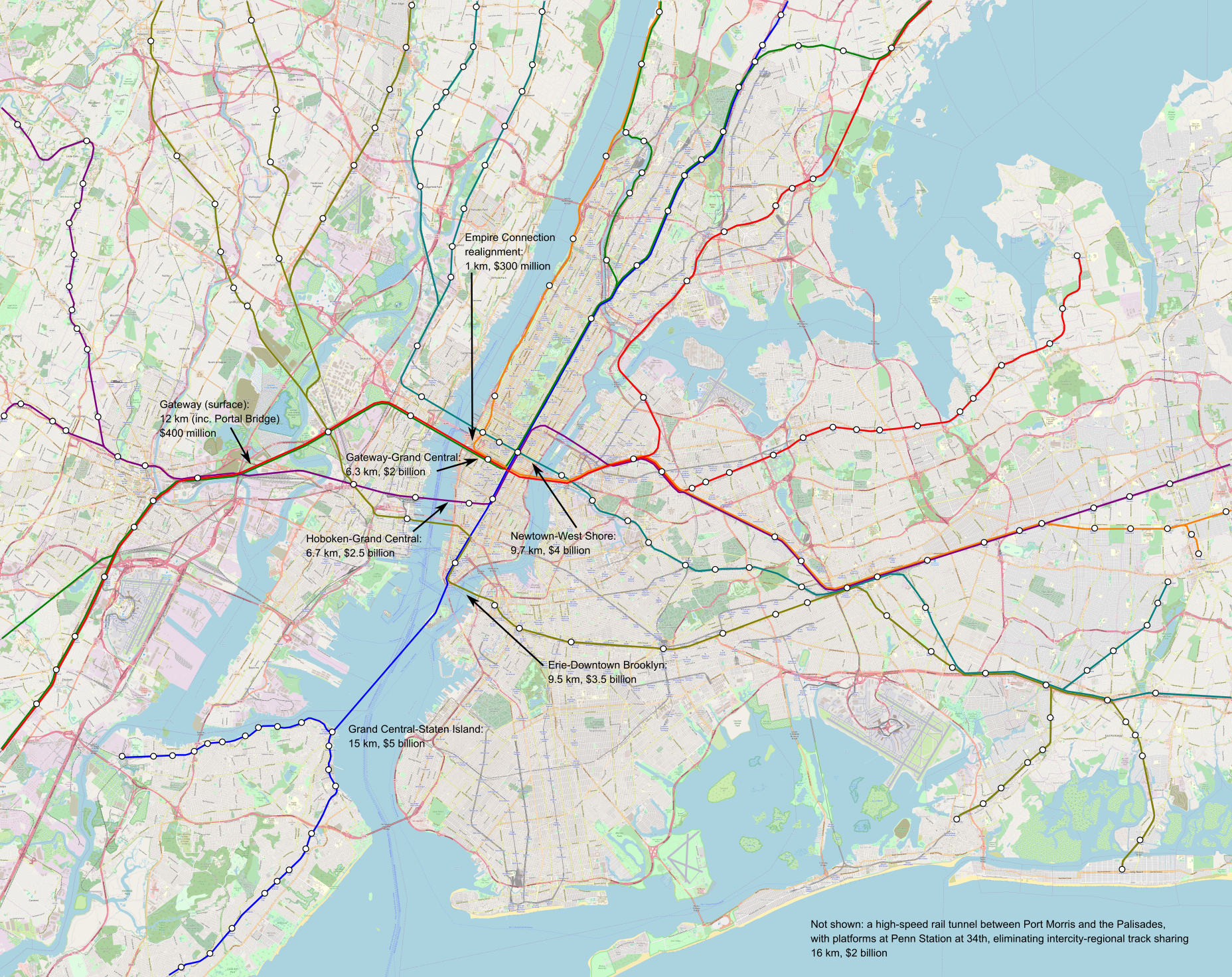
The issue is that too much traffic wants to use the Northeast Corridor lines in both New Jersey and Connecticut. Therefore, it’s not possible to segregate everything, with lines using the preexisting North River Tunnels and the new Gateway tunnels having to share tracks. It’s not optimal, but it’s what’s possible.
 Pedestrian Observations

Ever thought about the reverse branching between Utrecht and Amsterdam Centraal vs Zuid?
To add context: intercity trains from Arnhem and ‘s-Hertogenbosch go through Utrecht and get direct connections to both Amsterdam Zuid/Schiphol and Amsterdam Centraal. It would be politically controversial to break these direct connections. Research shows that passengers experience a best-case 5 minute cross-platform transfer (with the ~90% punctuality in the Netherlands) as 15 minutes in-vehicle time.
The long term plans to move from 6 to 8tph (so 12 to 16 on the shared part) will simplify the timetable a bit into two/four 15 minute patterns in the central areas, but there will still be services to both Schiphol/Zuid and Amsterdam Centraal from both Arnhem and ‘s-Hertogenbosch.
I don’t even know how the commuter trains in Holland are run, only vaguely about some ICs using Utrecht as an interchange point.
I think also reverse branches enable you to reach more destinations which isn’t necessarily bad. And people do prefer direct service.
That is part of the trade off. You can reach more destinations, but if you want to get to the other train it takes longer to get to where you want to be because you have to wait longer for your train.
I always advocate better transfers and more frequent service, but that itself implies compromises. In the real world you have to live with the system someone else left us and it is often a better use of money to fix something elsewhere. Also transfers cost time and so if the transfer isn’t useful (meaning people are getting off not just to use the other line, but also to connect to something else – perhaps a local bus) it might not be worth it.
If you give me infinite money and political power I will redesign your whole system to be much better for everyone without branches. However you can’t give me that and so branches are sometimes a good compromise. I still won’t like them.
If a train goes every 30 minutes then the average wait time is 15 minutes, if you can make some degree of optimisation then let’s say the average wait in reality is 10 minutes or a little less.
If a train goes every 15 minutes the average wait time is 7.5 minutes, with some optimisation probably in reality 5 minutes or a little more.
If a stop costs you maybe 2 minutes which is very aggressive if you have to choose between a non-stop train every 30 minutes to the big city or a train every 15 minutes with 2 stops then its basically a wash between them including wait time. If you say that wait time is ‘better to optimise’ than riding time then maybe the optimisation works out a bit different, but not massively.
It’s also much easier to schedule service every 30 minutes rather than more frequently as there is much more scope for running stopping services between them and allowing extra time at the country end for services to be late. With half hourly services you can also have maybe three speeds of service to make the trip times short for a range of destinations – that would be tough to deliver for more frequent service.
I really don’t think you should underestimate how much people don’t like changing trains as well. I saw a list of all the non-London station pairs based on frequency in the UK and the only top ones with a change are the Thames Valley branches from London to Henley, Windsor and Marlow and Oxford – Bath/Bristol – of course there is probably timetable space to run the latter with a direct service as it is away from London.
That 30 minute service is good enough for getting to work. When you get home at night you drive your car to whatever you have in the evening just like “normal people” (tm?). When you do anything on the weekend you also drive your car (with the possible exception of a major league sports game downtown).
If we want transit to be useful for things other than going to work we need to make it a lot more frequent than that. People who go to the niche store to get their icecream cannot be expected to time the line at the store so they don’t miss the train and have their expensive ice cream melt. (common ice cream can be bought at your local store which maybe you walk to – though in the suburbs I really want the bus to be frequent enough that you don’t have to drive just more than walking distance for groceries) Being 15 minutes early to your softball game is fine, but half an hour is too early, so again you are forcing a lot of people to drive.
Still if your imagination of what people do on transit is limited to just getting to work then a reverse branch and check the schedule is good enough. Only when you want to support getting wherever whenever do you start to realize why branches of any sort wreck your ability to create the system you want. (again we don’t live in the ideal world and so sometimes I’m forced to accept a branch but it isn’t the system I want)
Certainly people are using the merely 30 minute service to socialise in London.
Causation can produce correlation, you know.
Prioritization of reliable train transfers has to be a fundamental institutional value, consistently, over decades, because good transfers require correct infrastructure, in addition to the obvious operating culture of schedule adherance.
It’s no surprise that a network that basically “doesn’t do” changing trains doesn’t do at all well the ones that do happen to happen, nor that passengers vote with their feet against being subjected to poorly coordinated services, nor that train operators respond by attempting to run direct services between highest demand pairs regardless of coordinated alternatives, thus continuing the downward spiral.
@Richard, only the Japanese I think really don’t run everywhere to everywhere direct service. Certainly the French, Germans and Swiss do.
Matthew, in what sense do you mean that? In Tokyo at least, the most recent projects (e.g the Fukutoshin line and related projects) have tended towards offering more one-seat rides, no? Why wouldn’t you, when you aren’t capacity constrained 😉
I think in Tokyo you can clearly see the limits of heavily (reverse) branched lines.
There is still a lot more separation of different lines than there is in Europe.
Some comments/questions:
Does this plan which builds a dedicated tunnel for HSR also include six tracking the Northeast Corridor along the New Haven Line, as well as the brief four-track narrows in Newark and Elizabeth? If the HSR shares tracks with express commuter trains, then I’d think you could only run it at half capacity, but doing all that 4 tracking would be really expensive.
Is there really much reverse branching required in this plan? If the HSR is no longer sharing tracks with the red line, then you can run 12tph over Penn Station Access. Wouldn’t that be sufficient to serve the local tracks of the New Haven Line, allowing the red and green lines to be kept separate there? Similarly, do the Northeast Corridor and North Jersey Coast Line need more than a combined 24 trains per hour? If not then the corridor could just be 6 tracked up to the junction with the Raritan Valley Line to let trains from another trunk serve that without requiring track sharing between commuter rail and HSR. And if there was some way to terminate locals at Yonkers, you could have the orange line trains run express through the two stations between spuyten duyvil and Yonkers, then terminate the green trains there and let the local orange trains have the local tracks to themselves.
Good question! The issue is that the Assume Normal Costs map only really looks at New York and very close-in suburbs, whereas the NEC project looks corridor-wide and assumes nothing except Gateway is built and maybe the Empire Connection realignment.
In the situation of the Assume Normal Costs map, yes, it’s useful to give the NEC, NJC, and RV Lines a combined frequency of around 36 tph (plus 12 intercity tph if there’s no separate intercity tunnel). Jersey is building housing, if not as much as actually YIMBY-ish, let alone actually YIMBY, places, and already has a large installed base of housing that would over time be turned over to people working in Manhattan. I’m not too worried about the trains filling over time given minimal levels of willingness to do TOD.
Yeah that makes sense. I think in the long run either having three Newark-NYC commuter lines, one of which shares tracks with HSR, or having 2 Newark-NYC commuter lines and one dedicated Newark-NYC high speed rail line makes sense, I was just questioning the need for both 3 commuter lines and a dedicated HSR line, although if New Jersey was willing to build more TOD that was 12 stories instead of just 4, then it might become necessary.
For the umpteenth time they have build 20 billion, with a B like in Brainless, dollars of mixed use skyscrapers over it. It is not going to be moved. Not at a depth were is can connect with any track in the existing Penn Station.
There are 8 times as many people along a very straight route through Long Island. Take a deep breath and notice, looking at the hilarious commuter map, that intercity trains could then go to the third or fourth largest central business district in the country, Wall Street. Which, if it’s third, is bigger than any other business district along the Northeast Corridor. Or the country, that isn’t Midtown Manhattan or Chicago’s Loop. Bigger than dragging HSR to Los Angeles Union Station or Houston Union Station or
https://en.wikipedia.org/wiki/Category:Union_stations_in_the_United_States
I realize that railfans think Stamford is the navel of the universe. There are 951,558 people in what used to be Fairfield County Connecticut. Almost all of them own cars and will drive to the station when they want to use the train. Many of them will just drive. There are 2,736,074 people in Brooklyn. Many of them living in car free households. With subway service to Atlantic Ave. or East New York. The ones in car free households are far less likely to drive…. anywhere… Most of the intercity trains could then stop In Jamaica. I’ll leave it up to Alon to figure out how many people live in Eastern Queens.
Very unlikely. Mostly because cramming more cubicles into Manhattan is getting very very expensive. Alternately women have discovered birth control and it’s unlikely that there will ever be 20 million people in New Jersey.
The map is hilarious. Something reasonable would be connecting Jersey City to Brooklyn to divert traffic out of Midtown. Because the goal is to divert people out of Midtown. Unlike most places where the goal is Union Station. Four tracks between New Jersey and Midtown and two between New Jersey and Downtown is 72 an hour in each direction. 12 intercity in some far off future leaves 60 for metro area trains. 15 heading towards Rockland County, 15 heading towards Broad Street Newark and beyond, means 42 through Penn Station Newark. 21 per hour per track. Until the Raritan Valley trains divert off. The train to Scranton, the train to Allentown and the intercity train using the West Trenton line can be finagled with the express commuter trains. Or sumptin. We will all be dead by the time it’s anyone’s concern.
The express train doesn’t have to pass through the platforms for the local. Someday far far in the future when they want to speed up service between Philadelphia and New York they can dig short tunnels here and there so the high speed trains can go on a very straight line, For instance through Elizabeth without demolishing Downtown. Or, without tunnels, out along Interstate 495 in Delaware and the trains that are going to stop in Wilmington aren’t slowed down by the curves because…. they are going to stop…
Isn’t this easily fixable by just running services that stay only on the reverse branch? For example, the Seibu Ikebukuro Line reverse branches between its historic terminal tracks at Ikebukuro and Tokyo Metro through running, but there’s extra services just on the reverse branch between Ikebukuro and Toshimaen.
This setup is more fragile than running the line to the historic terminal completely separately from the Tokyo Metro through run services, but it provides more direct connections and still good frequencies.
In theory, yes. But in practice, the sort of places that end up as reverse branch points, like New Rochelle, are built out and can’t easily be retrofited with the infrastructure for short-turning local trains.
I wouldn’t characterize New Rochelle as fully built out, at least in comparison to Nerima, Yoyogi-uehara, Nakano, etc….
I’d agree it wouldn’t be an easy retrofit to support short turning local trains. However it’s an absolutely possible retrofit, if only really justified if NYC was doing Tokyo levels of transit oriented development.
Turn them at Larchmont. I’m sure someone pointed out that building the parking garage at the edge of the New Rochelle platforms would constrain future reconfiguration. It’s a pity they did. That’s too bad.
Just because Amtrak stops there today doesn’t mean the intercity trains will be stopping there forever and ever and ever either. I’d lean towards stopping them in Rye. Where the enormous parking garages can be in the wasteland between the New England Thurway, the Cross Westchester Expressway and U.S. 1/Boston Post Road.
The Japanese approach where ~0 trains are more than 2 minutes behind schedule and where the top speeds are also super low allows a lot of approaches that wouldn’t work anywhere near as well anywhere else.
The top speed of the Seibu Ikebukuro Line is actually a touch faster than the top speed of Berlin S-Bahn, and reverse branching exists even in Tokyo’s standard gauge S-Bahn network that deals with 160km/h trains.
Punctuality is important of course, but commuter rail tends to be the most punctual parts of a country’s mainline rail network. Deutsche Bahn might be a mess but Berlin S-Bahn is like 97% on time.
Depends I guess on what we mean by commuter rail! For the lines coming into London from 50km away a lot of the lines have a top speed of 100mph/160km/h.
When your top speed is maybe 100km/h then the express train can be maybe a minute behind the stopping service so the stopping service maybe needs to stop for 75-90 seconds in total to leave enough room for the express train to pass at full speed, maybe that is 30-60 seconds more than it would normally.
With 160km/h plus lower reliability you are probably talking the express train being timetabled 2-3 minutes behind to allow tolerance for delays so it’s a much longer stop. All in all you probably need two stations and the track in between for it to work.
And also what does 97% on time mean in a German context? Within 5 or even 10 minutes of the expected arrival time?
E.g. the train from Salerno to Paestum leaving at 10:24am in the summer stops for 16 minutes at Battipaglia to let two express services past. And the Italian trains in general are pretty reliable.
If you want to be taken seriously stop posting hilarious crayon scrawl maps.
Thanks for the response and for the context! I suppose I’ll be less angsty about the Tokaido/Shonan-Shinjuku/Yokosuka-Sobu reverse-branchings as well (although I do still think it’s insane that reverse-branching results in the city-centre tunnel between Shinagawa and Tokyo only being used for 9 trains/hour during the morning rush)