Quick Note: Commuter Rail and Urban Bus Hubs
I’d like to introduce the concept of bus hubs with commuter rail connections, but in an urban rather than suburban context. This comes from the project we’re working on to about Queens buses on the assumption that LIRR is modernized, but it should generalize. The suburban bus context is a town center that buses converge on from many directions; the urban one is embedded in a much larger street network that must have multiple stops, and therefore the hub must be planned around both bus and rail service at once, rather than in a rail-first hierarchy.
The importance of two-way planning here is that within an urban grid, there usually aren’t obvious town centers, unless they are built. The topic of this discussion is not city center but outer areas where the commuter trains provide walk-on service, or would if they ran at modern (i.e. non-American) frequencies and charged the same fares as the buses and subway. For example, take Eastern Queens in and east of Jamaica:
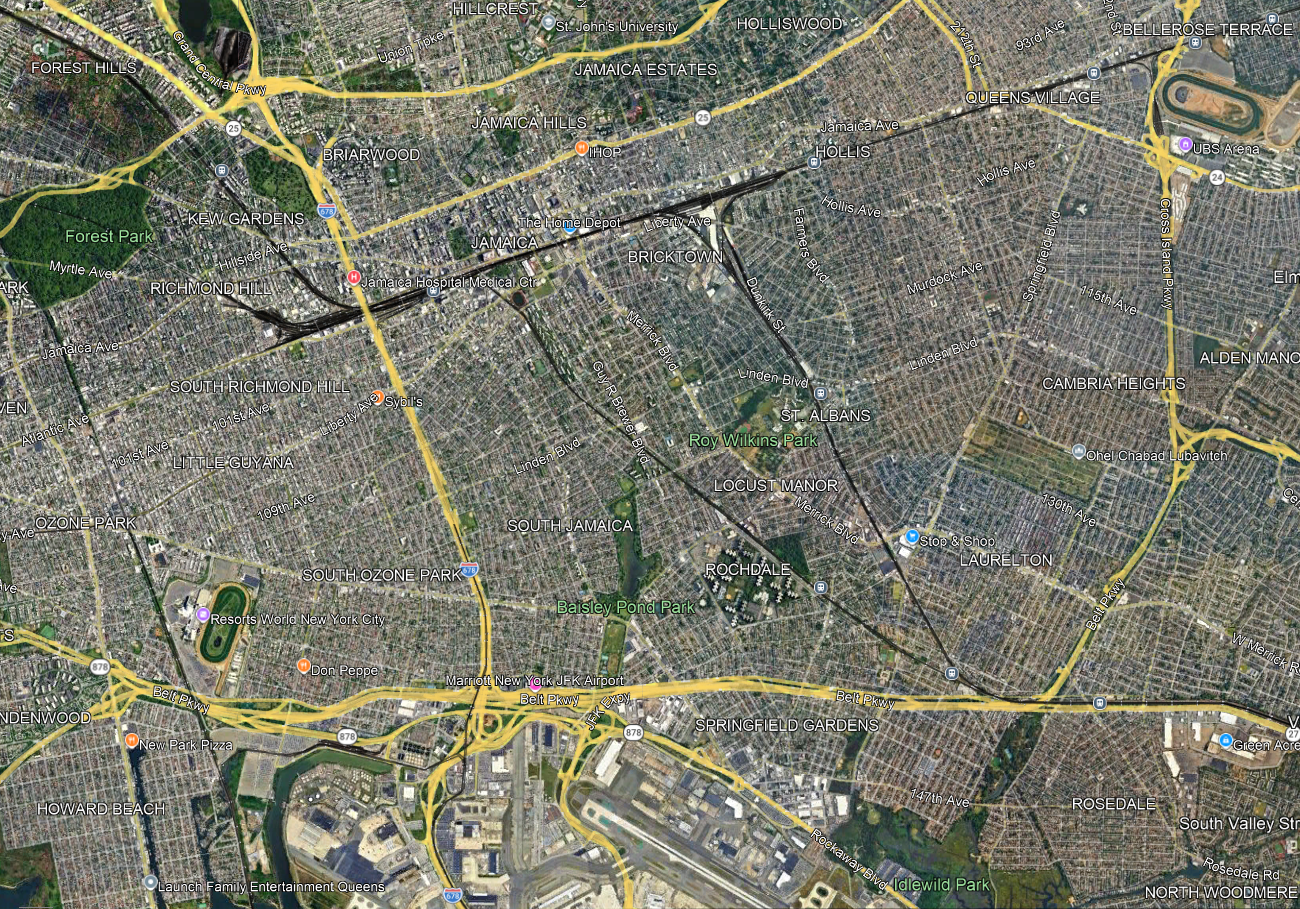
Jamaica is an obvious node, and nearly all LIRR trains already stop there and the rest should, but farther east, it’s a question of how to set up the LIRR to interact better with the city, including its buses. A lot of questions and tradeoffs have to be addressed all at once:
- Stop spacing, trading off station access time with trip times. The LIRR on the Main Line has four tracks through Floral Park so any infill station would be local-only, but that still matters for riders from points east like Floral Park and Hempstead. On the Atlantic Branch and the Montauk Line there are only two tracks, and extensive suburban ridership that would be slowed down by additional stops.
- Intersections with main arterial streets that make for natural bus connection points. The Queens Village LIRR station is at the intersection with Springfield Boulevard, but a little to its west Francis Lewis intersects the Main Line without an LIRR stop, while Hollis is not so well integrated with the street network (it’s near Farmers Boulevard, which more or less parallels the Monrauk Line). On the Montauk Line and Atlantic Branch, strong east-west bus connection points are useful; St. Albans is at the intersection with Linden, but the Atlantic Branch has no such stop at the intersection with Linden.
- Stops that permit buses to avoid congested nodes, in this case Jamaica; farther north, off-map, the same is true of Flushing. One of the goals of bus redesigns replacing traditional radial networks with grid is to get buses out of the areas where they are the slowest; this was explicit in the replacement of the radial network with the Nova Xarxa grid, increasing average speed even without any other interventions like bus lanes and stop consolidation.
- Some bus routes duplicate rail routes and could be removed or curtailed, if enough infill stops are built: for example, Merrick and Guy R. Brewer Boulevards are very closely parallel to the Montauk Line and Atlantic Branch respectively.
Without doing more detailed work yet, I suspect that the speed-access tradeoff encourages more infill stops on the Main Line and Atlantic Branches and fewer or even none on the Montauk Line, since the Atlantic Branch only continues to fairly close-in suburbs whereas Montauk carries the Babylon Branch on it, and that the buses can then be moved to a grid to connect with these stations. But the point is that this is not a decision that can be made rail-first, unlike timed connections in secondary cities and suburban town centers. The top-down hierarchy that for example Marco Chitti brings up when setting up a Takt system breaks down when one does coordinated bus-rail planning within the city.
 Pedestrian Observations
New static GTFS bus schedules were recently released by the MTA. Comparing the April 1-7 dates for 2025 and 2026 reveals the following for Queens local/limited/sbs routes (those starting with ‘Q’ but not ‘QM’).
Data for Before Queens Bus Redesign (1-7 Apr 2025)
VRM: 675,469.83
VRH: 71,123.13
Stops: 3,573,214
Trips: 56,205
Avg MPH: 9.50
Avg Stop Dist (ft): 998.1
Data for After Queens Bus Redesign (1-7 Apr 2026)
VRM: 679,403.69
VRH: 73,982.51
Stops: 2,457,745
Trips: 56,911
Avg MPH: 9.18
Avg Stop Dist (ft): 1459.6
The point being that stop consolidation did not increase the average speed?
“The point being that stop consolidation did not increase the average speed?”
Stop consolidation resulted in slightly decreased average speed despite increases in number of trips and VRM. The MTA’s real time speed data on their open portal site shows a similar decline.
Any solution that involves redesigning the bus network to make greater use of the LIRR should rely more on actual real world limitations and less on theoretical ideals. Three big limitations are: the bus network unwillingness to conform with textbook improvement solutions; the capacity of the East River Tunnels; and the unwillingness of Nassau and Suffolk County residents to mix with Queens’ unwashed masses.
That’s weird. I wonder if single door boarding and contactless cards are to blame. I haven’t used the MTA’s contactless system much, but I’ve used NJ Transit’s, and it is very unreliable, and even when it works correctly, it can take multiple seconds to accept a card. All riders except those paying cash are supposed to tap in using the contactless system, but because it is so buggy, NJ bus drivers will just tell you to hold up your ticket so that they can see it, saving a lot of time. Some NJ bus drivers don’t even bother to check if passengers have tickets. If New York’s system is similarly buggy, and if the bus drivers there actually make each passenger tap in with the system, the stop penalty could be dominated by the contactless payment system, rather than by the time it requires for the bus to open/close doors and accelerate/decelerate.
I have never seen the NJ system, but on the Vancouver system I (and many others) just waved their card by the reader as they get on and don’t even slow down since it can read/verify as fast as people can get on. They have all door boarding too. So I know card readers can work and be fast. NJ needs to find a system that works just as well.
Outstanding work, Citizen!
Your alacritous unpaid labour in support of the revenue goals of Cubic Systems Inc may, possibly!, not go un-noticed! Perhaps you will be spared. Perhaps.
Always be prepared to have your (sole-sourced!) papers prepared for inspection! By sole-sourced inspection devices, provided by us, your sole-sourced benefactors! Only thus shall you avoid inconveniencing your all fellow prepared-for-inspection citizens!
Duty to your fellows unites with duty to your overlord. Present your credentials with greatest alacrity so that all may experience lowered “read/verify bliss”. You do not wish to be the one ostracized by lowering read-verify throughput! Do not be that one!
More credential-validation devices procured from Cubic means less pain for you and your fellow citizens. And who would wish greater pain upon one’s fellow citizens? (Aside from corporations for whom “infliction-of-pain” on others is a massively profitable business model, that it?) Duty behooves you to present your card with upmost rapidity.
(Never mention that “on the Vancouver system” there was exactly zero “read/verify” overhead, for anybody, until rent-seeking big-rigging pig-fucking sub-human US defense contractor Cubic Systems, Inc, got involved in ensuring that there was, in fact, a Cubic-profiting step involved in each and every trip, every time, for ever and ever.)
Oyster uses Cubic systems technology without these boarding delays.
And if you use an alternative supplier FeliCa is another option that is very rapid.
You should calculate the correlation between stop spacing and average vehicle speed among large transit operators in the US, before you consider the Queens Bus Redesign experience weird. One possibility you omitted in your list is that the effect of stop spacing has been exaggerated. There’s ample evidence to the effect that operations that are more closely spaced than NYC have higher operating speeds. Here’s a link to one article that shows bus stop spacing among many US operators. You will note that many have stops more closely spaced but have higher average operating speeds.
https://findingspress.org/article/27373-distributions-of-bus-stop-spacings-in-the-united-states
I don’t see any data on operating speed in the study linked below.
I’m sorry. I thought everyone was familiar with comparative bus speeds. Here’s a link that that shows bus speeds by various operators.
https://comptroller.nyc.gov/reports/the-other-transit-crisis-how-to-improve-the-nyc-bus-system/#_ednref44
You will note that bus stops are more closely spaced in Philadelphia and Chicago than NYC but that their bus speeds are higher.
A more direct way would be to use the NTD’s monthly passenger ridership report, which can be downloaded from this site:
https://www.transit.dot.gov/ntd/data-product/monthly-module-adjusted-data-release
There are VRM (vehicle-revenue-miles) and VRH (vehicle-revenue-hours) tabs. The average speed is the quotient of VRM divided by VRH.
London buses average 9.1mph and you’d expect New York should be able to beat that as a newer city.
Real Americans(tm) drive everywhere on cheap gasoline. Traffic is awful in New York City.
How much of average bus speeds in major western cities is compositional effects? I suspect the London average bus speed is presumably for City of London + Greater London, while the NYC average bus speed is for NYC proper, an area half the size. The larger suburban region included in London average bus speed calculations would skew the average speed up.
It’s difficult to obtain London’s precise scheduled bus speed because TfL like most most transit agency do not include shape files in their GTFS. The reverse is true for most transit operators in the US. There is a workaround, based on the assumption that if one cannot be good at least one should be consistent.
All GTFS schedules contain stop times and stop location data. One comparison would be to connect the stop locations by straight lines to approximate the distance between stops. This consistency would permit comparing averages for both distances between stops and a average speed. The distances and the vehicle speed upon which they are based would be underestimated.
Using this method and the latest GTFS schedules, the average distance between stops in NYC is 343 vs. 329 meters in London. The average speeds are 12.8 vs. 13.8 km/hr, respectively. The figures for RATP bus operations in Paris are: 331 m and 12.6 km/hr.
The similarity of these results makes me question oft stated: “The root of the problem is that in North America, transit agencies have standardized on 200-250 meters as the typical spacing between bus stops. In Europe, Australasia, and East Asia, the standard is instead 400-500 meters.”
https://pedestrianobservations.com/2017/08/23/anti-infill-on-surface-transit/#:~:text=The%20root%20of%20the%20problem,stops%20and%20takes%2016%20minutes.
I’d be curious to find out the basis for this “standard” and how many operators follow it? Most major North American operators have stop distances that fall in the 300-350 m distance. These distances have an low bias, so the 200-250 meter distance assertion is definitely questionable.
They can consistently move 20 trains an hour through the East River or North River tunnels. They can make it appear to be more at the peak of the peaks by running one tunnel in both directions or running one in the “wrong” direction for short periods. ( Whichever way you want to look at it.) The weekend NJTransit/Amtrak schedules are arranged to work with only one tunnel open over the weekend. Feel free to look up all the schedules and check what happens. I’ve read that the infamous 40 minute gap isn’t 40 minutes anymore. And I don’t care because when I want to go to Morristown knowing when the Amtrak regional departs for Washington D.C. isn’t useful.
It takes time for a train to slow down so it can stop. So the doors can open and close. And time to get back up to speed. There are 8 tracks of railroad within a block of Continental Ave. and Austin St., in Forest Hills. It’s okay if people from Suffolk County don’t stop there. The few who do want to get there can change trains in Jamaica. The E train runs frequently all day long. Just a block north of Continental and Austin. Instead of a block south of Continental and Austin.
If the westbound train is full when it leaves Mineola why does it have to stop between there and Manhattan? There can be other trains that do stop. And different trains that originate in … Floral Park.. and make all the local stops in Queens. That people on the express from Ronkonkoma are unaware of because their train didn’t stop. Which means it’s didn’t slow down so it could stop. Or waste time opening and closing it’s doors. Which means it gets to Manhattan faster. Which frees up capacity on other trains for other people to use.
Apparently the view across Sutton Place is as dim and hazy as the one across Ninth Ave. Things east of the Van Wyck Expressway are as suburban as they are along the Cross Island Parkway.
Having actually been in Floral Park, the way to tell the difference between Floral Park NY, an incorporated village in Nassau County and Floral Park Queens, a state of mind, is the color of the street signs. If “suburban” is single family housing, both are.
I got the impression you have been in Manhattan. They are at the railroad stations. A.k.a. the subway. Outside of Manhattan it works the same way. Even in places where the railroad stopped running passenger trains decades ago.
I’m mentioning Eastern Queens specifically because the hubs there are at Jamaica and Flushing, but not the other stations. Even on the subway, the stations on the F aren’t huge hubs or anything.
I just performed a quick and dirty query on the MTA’s Open Data Portal page for subway hourly ridership.
https://data.ny.gov/Transportation/MTA-Subway-Hourly-Ridership-Beginning-2025/5wq4-mkjj/about_data
for March 2026 and restricted to Queens stations, the largest number of transfers was at Main St with 372K which represented 38% of the fares entering the station. It was followed by Jamaica Center with 196K @ 45%. The next two were: Jackson Hts-Roosevelt Ave-74th St with 153K @ 16% and Kew Gardens-Union Tpk with 150K @ 43%. Jamaica-179th rounded out the top 5 with 114K @ 44%. No other Queens station experienced more than 100K nor more than 30% transfers.
N.B. the total number of transfers at both 179th and Jamaica Ctr was 310K, which means that Flushing is the more immediate problem than Jamaica.
I know, I know, I was just looking at the Jamaica-centric network because infill stations are likely necessary there whereas the stop spacing on the Port Washington Branch past Flushing is fine so it’s just a matter of fare integration and frequency there.
Because from York Ave. you can’t see them. People lead fulfilling lives without going to Manhattan.
There are little clumps of retail at most stations just like there are little clumps of retail near outer borough subway stops. It took me all of 47 seconds to use Google Streetviw to surf up and down Bell Blvd to see that yes, indeed, there is a clump of retail on either side of the Bayside LIRR station. Like there is at the Newkirk Plaza stop on the Brighton line. Or Tenafly. Which was offered service on the Hudson/Bergen light rail but having railroad pass by their former railroad station would cause the fabric of the universe to rend. So it won’t. That hasn’t stopped the clump of retail that grew up around the railroad station from still clumping there.
The MTA publishes all sort of interesting ridership data. which F station? Again apparently the view across Sutton Place is hazy. Some stations will be busier than other ones for whatever reasons. If Flushing occasionally makes it into the top ten busiest stations. That doesn’t mean someone who lives in Franklin Square want to take the LIRR to Manhattan or even Woodside to get to work in Rego Park.
And even harder to see from Beekman Place, I know it might be hard to believe, people in eastern Queens have Flushing or Jamaica as their destination and don’t give flying fuck about the LIRR or the subway.
If you look at https://en.wikipedia.org/wiki/List_of_bus_and_coach_stations_in_London there are by my count 42 bus stations in London plus Victoria Coach Station.
There are lots of stations in London without a bus station and that’s fine. I think even some terminals don’t have a bus station.
If the LIRR wants to add some sensible infill stations then the bus routes along the road that the infill station is built should stop, and perhaps some nearby ones should be redirected?
Why? Other than to satisfy some railfannery?
Someday far in the future the LIRR is proposing to send 20 trains an hour to Grand Central and 30 an hour to Penn Station. And the same amount back out. How many of them are going to go to the Port Washington branch? Someone who actually thinks about it for a moment realizes that there will be more than 20 trains an hour between Penn Station and Jamaica. And except for railfans with the stopwatch app open on their smartphone no one will care if the trains comes every 3.1 minutes instead of every 3. Or two every 6 minutes with a four minute gap when the other trains going someplace-Not-Long Island are going there.
If the east bound train arriving in Jamaica is already full it doesn’t have to stop there. It doesn’t have to stop anywhere in Queens or Nassau for that matter because there will be other trains that do stop. For a few an hour. It’s just awful that you might actually have to think about how to get from Columbus Circle to Hicksville.
…. and it can not-stop on a track without platforms which means other trains that are stopping can berth at a platform. It’s too bad it offends your … uncomplicated… view of the world.
There are four tracks between Jamaica and Floral Park. And four tracks between Jamaica and Valley Stream.
People expressing between Valley Stream and Jamaica don’t care if the train does-not-stop in St. Albans or does-not-stop in Locust Valley. Or that it does-not-stop at the few infill stations you confect.
The people scheduling trains can use their magical mystical train scheduling powers to have a west bound express head to Jamaica via St. Albans followed by a local. And the next express/local pair do the same through Locust Valley. The following express on the St Albans branch will be leaving Valley Stream when the preceding local is reallllly really far away. A really quick glance at the Long Beach branch schedule makes it appear it would work out. Because there are four tracks between Jamaica and Floral Park. And four tracks between Jamaica and Valley Stream.
Someday far in the future when local service to Valley Stream, Floral Park and ideally Great Neck get taken over by trains to Brooklyn and Wall street they can think about adding tracks to one of the branches. The right of way appears to be wide enough.
Something you hand wave away when you want to “deinterline” Central Park West or have LIRR trains, in western Queens or Brooklyn, stop as frequently as parallel subway lines.