The RPA Publishes Bad Report Against Through-Running
The Regional Plan Association released a new report, called New York Penn Station: Constraints and Considerations for Meeting Future Demand. It argues against through-running on the grounds that it would reduce capacity, and asserts that any solution to station capacity after the Gateway tunnel, the Hudson Tunnel Project, opens in the late 2030s must include “station expansion or some other form of system expansion.” There’s something disappointing about this report, not because it’s wrong (although it is) but because it seems to just rehash past arguments without seriously addressing past criticisms of the $17 billion Penn expansion.
The lead author Rachel Weinberger and I talked about Penn Station capacity issues in 2024, after I wrote these two blog posts attacking Amtrak for its assumptions that imply additional tracks are required at Penn Station. Since then, the Effective Transit Alliance has done additional work, modeling the interfaces between the trains, the Penn Station platforms, and the concourses to arrive at feasible dwell times and capacities. Unfortunately, the RPA isn’t really engaging with any of that work, and retreats to just asserting that through-running would reduce capacity at Penn Station.
Capacity and dwell times
The most advanced technical work on the subject of capacity at Penn Station, the question being whether the bare Hudson Tunnel Project can perhaps with minor facelifts provide enough capacity to run 48 trains per hour between New Jersey and New York and the answer being yes, was done in the above-linked ETA report. We found the source of past claims by Amtrak that very long dwell times are necessary and deconstructed their assumptions, and modeled based on the current (post-Moynihan Station project) capacity of vertical circulation elements how long it would take passengers to clear each platform under rush hour assumptions.
The interface between the train and the platform itself is not the limiting factor; my two above linked blog posts from 2024 go over this and find a very short minimum dwell time, of 2 minutes or even less. The limiting factor is vertical circulation between the infamously narrow platforms and the concourses. Nonetheless, passengers can clear these in about 3 minutes. Notably, the narrowest of the platforms, platform 9, is compliant with NFPA 130 and its requirement that passengers be able to clear the platform in case of a fire in 4 minutes; the other platforms (except the wide platform 10) are not compliant, because they have two adjacent tracks and NFPA 130 assumes both tracks can be occupied, in which case the load doubles. Across all platforms, the one with the highest clearing time, platform 4, can clear a 1,620 passenger NJT bilevel in 4.83 minutes. Writing timetables to cycle trains between the platforms so that no platform comes close to having queuing between trains, is a routine exercise.
The report instead asserts that,
The time that the train dwells at the platform is 7 minutes in reasonable operating conditions: 5 minutes to unload passengers, 1 minute to check for stray passengers and then 1 minute for schedule recovery. There’s an additional 2.5 minutes to clear the interlockings and for train safety separations.
Accounting for all these aspects, under reasonable operating conditions, each track can accommodate 6 trains inbound per hour using drop-and-go service.
There is no citation for the model used, nor justification for either the 5 minute figure or for why an additional minute for schedule recovery is required. There is no explanation for why the 2.5 minutes to clear the interlockings matter to the capacity of each platform – once a train is past the platform, it’s gone and the capacity to measure is that of running track, not the platform. On outbound trains, it ominously says that,
The process of bringing an empty train into Penn Station, loading passengers and then departing takes 9 minutes in reasonable operating conditions during the PM peak period. This includes 7 minutes for passengers to hear the track announcement, descend to the platform and load into the train and 2 minutes for schedule recovery.
“Hear the track announcement” is an Americanism. In Germany, the track numbers are printed on one’s ticket, even on intercity trains, even at capacity-constrained stations with track shortages like Köln Hbf. The track for each fixed branch should be scheduled months in advance and known by regular passengers. Precisely because demand is asymmetric – toward Manhattan in the morning, away from Manhattan in the afternoon – the on and off peaks do not coincide at all, and encouraging passengers to get to the platform even before the train arrives would not overload the platform or the access and egress points.
The report completely missed the consequence of the asymmetry of demand when it finally asserted, based on modeling for which the report provides no details, that,
It would take an estimated 6 minutes for passengers to deboard, clear the platform and reach the concourse and another 4 minutes for passengers to descend to the platform and board the train during the AM peak. 2 additional minutes must be added to provide a buffer that ensures schedule adherence. The trains also require 2.5 minutes for clearing interlockings and safety separation, resulting in an hourly capacity of 4 trains per track and potentially 8 per platform.
A good rule of thumb here is that if Munich manages to slot 7 numbered branches, rising to 9 when one includes sub-branches, through one central trunk tunnel with 30 peak trains per hour, and comparable ridership to all three New York commuter rail systems combined, then nobody needs to add 2 minutes to the dwell time for schedule recovery, or 2.5 minutes for interlockings. The RPA is welcome to release its model for why it should take 10 minutes for passengers to board and alight; ours is open for inspection on GitHub and finds that the busier of the two can be done in 3 with a bit of buffer time and the less busy of the two is essentially free since so few passengers ride reverse-peak, and the train can leave even if some passengers that got off it are still on the platform on their way to the escalators.
The Parisian issue
The RPA report doesn’t talk about Paris. It doesn’t rebut the point that the RER is a good comparison case for New York commuter rail capacity, but it’s clearly lurking in the background. It does mention the RER as an ill comparison for the benefits of through-running (see section below), on the grounds that “trains follow each other along the same paths,” whereas in New York there is more and, measured by number of stations if not distance, earlier branching. But it doesn’t really address the point that if the RER can run 24-27 trains per hour per track in each direction, and the Munich S-Bahn can run 30, then so can through-running paths at Penn Station.
Reverse-engineering from what the report does say and from what the biggest points of contention have been when I talked to the RPA on this, they clearly think it matters that the European comparison cases have multiple city center stations to spread the load. Penn Station, in contrast, is the single central business district station, in a high-kurtosis city with far higher job density within walking distance of the station than can be found in any European city.
And yet, as I explained in my second original post from 2024, the effect coming from New York’s single city center station versus Paris’s multiplicity thereof largely cancels out the effect of much higher overall ridership on the RER than on New York commuter rail. Averaged over the peak four hours, the highest resolution I have for Paris, the sum of peak boardings and alightings per train is actually a bit higher on the RER E at Haussmann-Saint-Lazare, as of the 2010s when it was still a terminal, than it was at Penn Station in 2019 just before corona. The same sum at each of Gare du Nord and Gare de Lyon on the RER D is respectively 20% and 15% less than at Penn Station; on the RER B at Gare du Nord, it’s also 20% less. The Gare du Nord numbers are unlinked, so passengers interchanging across the platform between the RER B and D are counted in both trains’ ridership, but from the perspective of the train-to-platform interface, this is still a flow that the train and its doors and platforms must accommodate. If that’s doable in a 55 second dwell time, then trains at Penn Station can unload in 2 minutes at the peak and the rest is just a matter of counting platform-to-concourse vertical circulation elements and adding up their capacities as in the model described in the above section.
The benefits of through-running
Through-running works ideally when there are multiple city center stations, allowing the trains to function as urban rail as well as distribute passengers across multiple destinations. This is well-known to any group pushing through-running in New York, which is why so many such groups advocated for a tunnel connecting Penn Station with Grand Central, the so-called Alternative G in the ARC era in the 2000s, and why Tri-State’s proposal showcases a trunk line from Newark Penn Station to Sunnyside, and why ReThink heavily markets Secaucus and Sunnyside as secondary business centers. Here’s what ETA produced in 2023:
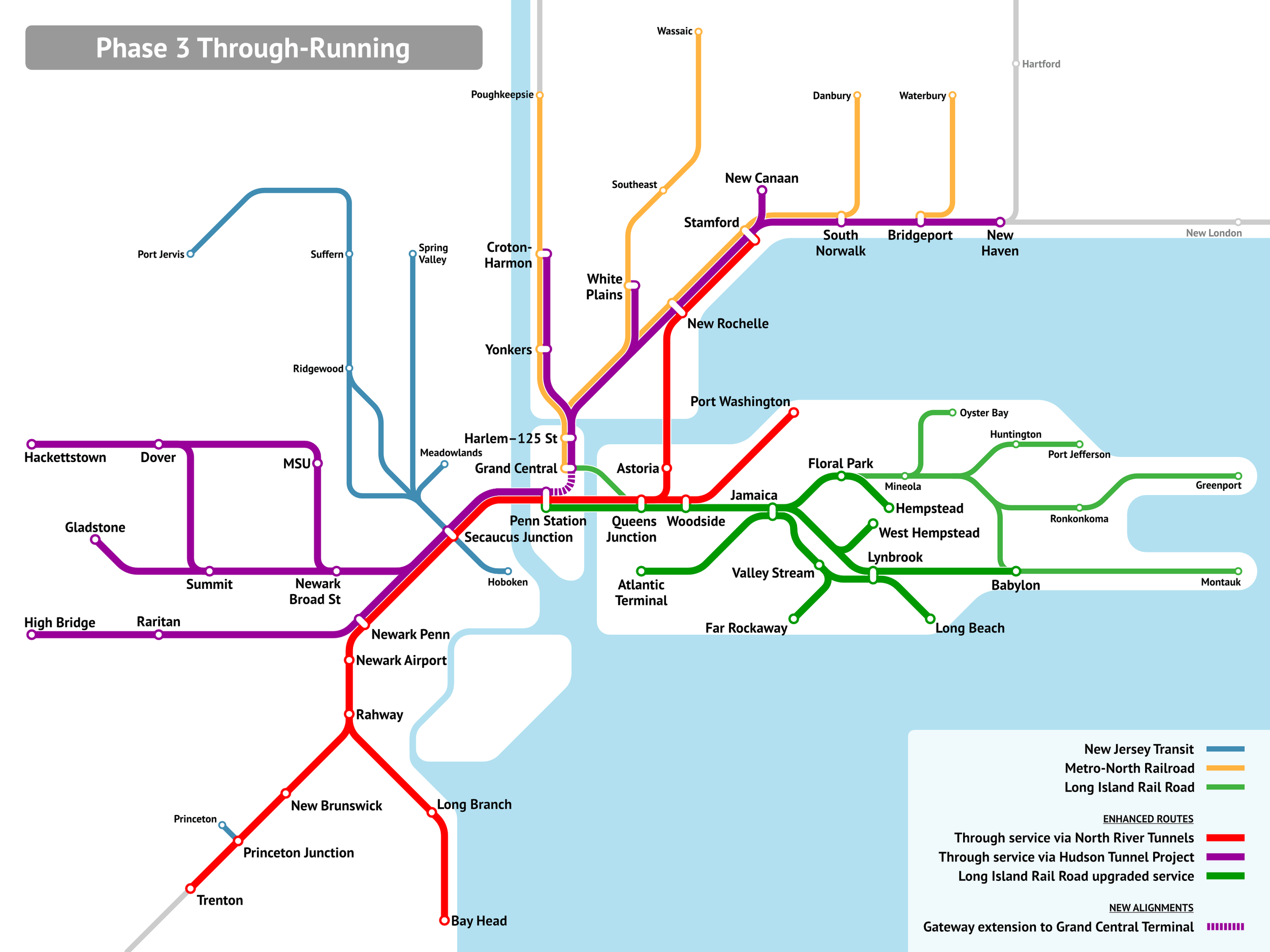
The upshot of this is that even with the dominance of Manhattan, any reasonable through-running system cobbled from existing and under construction infrastructure would unlock commutes from east of the Hudson to Downtown Newark, and from west of the Hudson to Long Island City (the station labeled Queens Junction is essentially Sunnyside Junction, walkable to a large fraction of Long Island City jobs), Flushing, and Jamaica.
It’s important context to understand why the RPA graphics denigrating through-running as limited in use don’t work:
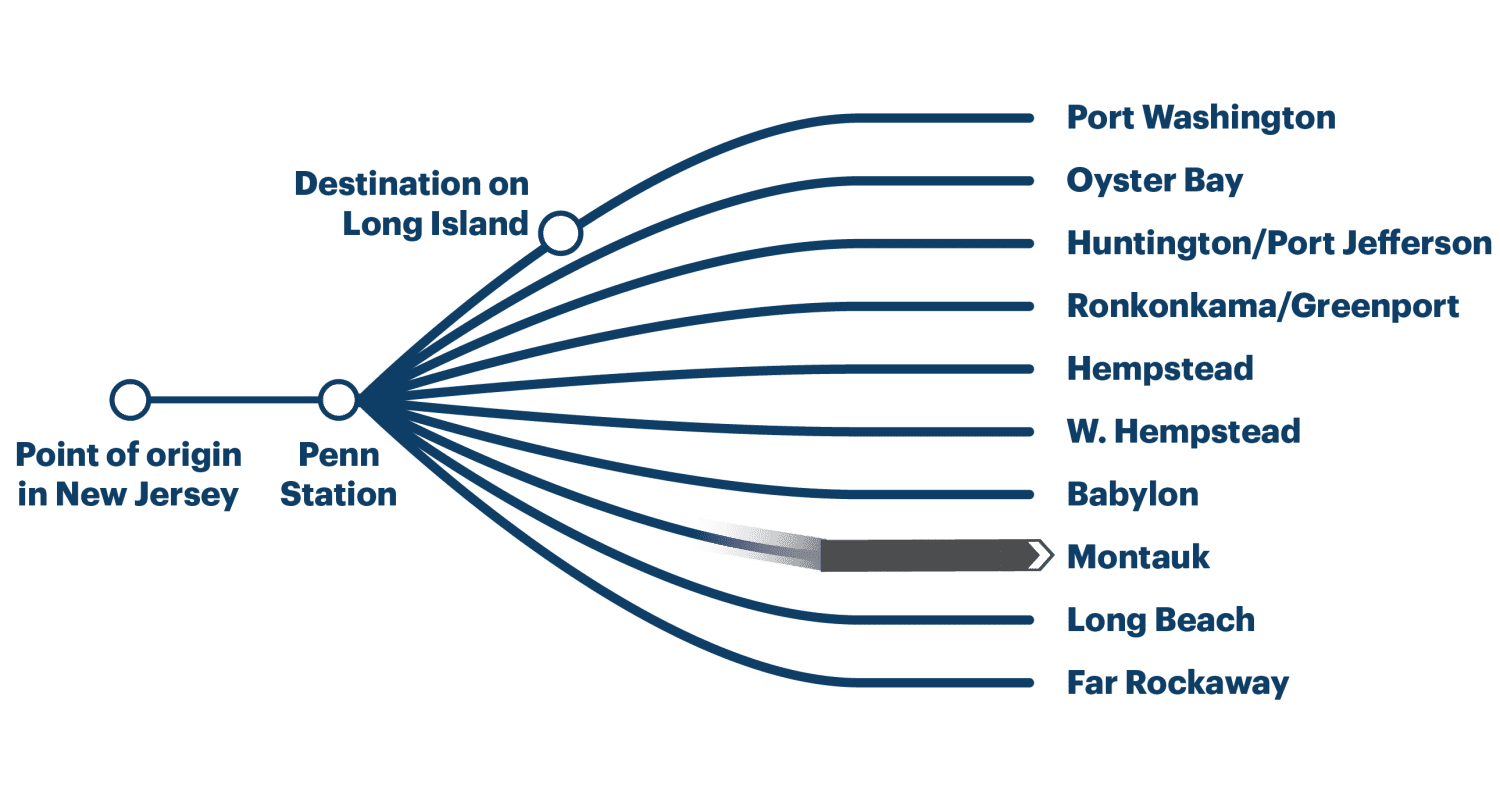
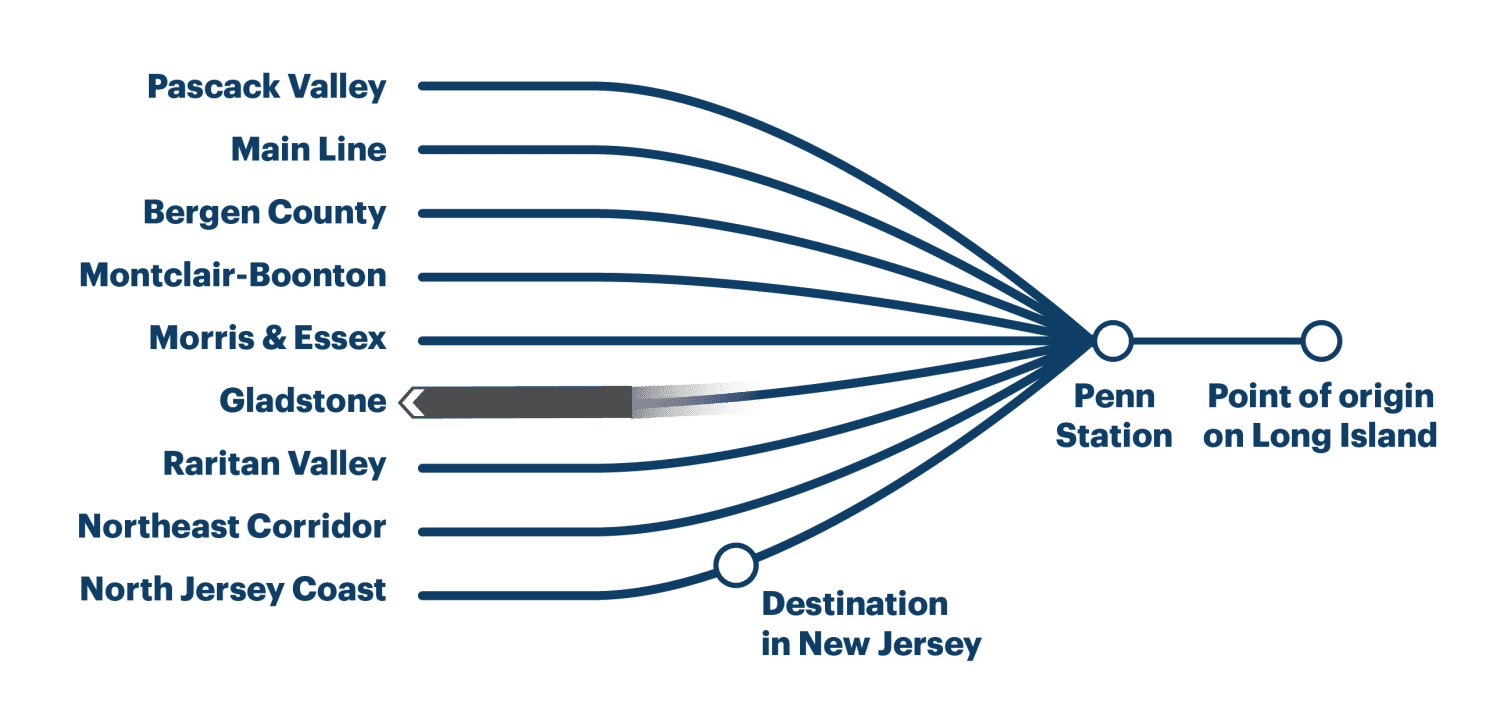
In truth, even setting aside a Penn-Grand Central tunnel (which is doable at MTA construction costs at a lower cost than Penn expansion), the destination in New Jersey is likely to be not just on the North Jersey Coast Line as depicted, but on any of the Northeast Corridor, North Jersey Coast, and Raritan Valley Lines. At present, the first two carry 14 trains per hour at the peak, and are decently likely to be one’s pair east of the Hudson. Similarly, one’s destination east of Penn Station is unlikely to be Long Island as commonly defined to exclude Brooklyn and Queens but rather to be on the trunk in Long Island City or on multiple branches within the city or perhaps on the New Haven Line.
The upshot is a hefty share of the total through-Manhattan market would in fact be served by a through-running system, usually with one-seat rides, or if not then with transfers at Sunnyside or Secaucus rather than New York. Through-running is not about those mythical trips from Oyster Bay to the Jersey Shore that Adirondacker in the comments section mocks, just as it isn’t about trips from Aulnay to IHES on the RER B or from the Marne-la-Vallée branch of the RER A to Saint-Germain-en-Laye. It’s about the overlapping near-center markets, individually small compared with commutes to the central business district and yet collectively significant.


If they were to expand the station, then “Penn North” would be far better as its almost all commercial, with lots of low rise cheap retail, and there is a proposal to MSG over there anyways and build a super-tall on Herald Square. So dig a big hole for the concrete box and then build MSG and super-talls above that. Penn South in contrast takes outs many residences, as much retail, a church, historic power house, and a nice beaux-arts office building.
But I’m not really in favor of pouring billions and billions into Penn Station when that money could be used to fulfill a lot of the infrastructure improvements in the ‘Momentum Report’ from electrification to high-level platforms. Better operations to increase capacity seems a much better choice, and I’m glad the Andy Byford seems to take it seriously.
The amount of above ground destruction plus the sky-high costs have always made me a big skeptic of Penn South, that just not good urbanism, if I learned any thing at university, I learned that, don’t repeat the mistakes of the 1950-60s. Yes, we need to build, we need to new things, but we don’t need to wipe out larger urban neighborhoods to do so. Through-running is thus the much better solution.
Except Penn South can be built with no Federal money as the property tax from the millions of square feet of overbuild that would replace the frankly garbage building stock that is currently there would pretty much pay for it and is already slated, thanks to Cuomo who allocated future tax revenue from a whole slew of potential new structures around Penn, to the rebuild of Penn Station. And the current procurement for a Master Developer includes equity injection from that developer to minimize drain on the taxpayers purse….. how well that works of course, remains to be seen.
No it can’t, the property taxes from Hudson Yards weren’t quite enough for the $2.1 billion 7 extension (the city had to give tax breaks), and this is $17 billion and not $2 billion. The only solution on Penn expansion is a formal cancellation.
Its a 35 year design, operate and maintain contract for the Penn Station Master Developer.
Just because you don’t like it, and just because the RPA report does not agree with your conclusions does not mean that the south expansion project cannot be mostly financed through the newbuilds. The overall project with a rebuilt Penn cannot and would require Fed funds, but the Southern Expansion can be financed through property tax over that period.
A 35 year design contract still needs $17 billion that were never available for the 7 extension and its supposed increase in property taxes. Making the contract last longer isn’t going to conjure new money, just let politicians lie to the public that the money is there so that their successors will have to scrounge the tax money for it. In a country with the rule of law and an independent judiciary, which the United States clearly isn’t, this would land agency heads and even elected officials in prison.
I’m sure the people and business there appreciate that sentiment that they live and work in “garbage”. I will note that the office building has big tech companies as tenants, so how much garbage can it be? But if you believe that, it seems to equally apply to the north with a 1970s office tower, lots of low-rise retail, and a big hole where the Hotel Pennsylvania, the super-tall to replace it being put off by Vornado. If — you have to expand the station with cut-and-cover construction – going north seems politically much more viable, and just better urban development intervention, that could be tied into moving MSG and providing sites for super-talls by Vornado, who actually own a lot of that property already, as opposed to the south.
Have you looked at Block 780, its garbage. The best thing about is the church and the Heritage facade of Penn Station Service building.
Has any near-contemporary North American “TOD” scam ever come remotely close to delivering 20% of the added up-front public costs in private payback?
As far as I’ve seen in the last thirty years this is all counter-factual blather from “transit advocate” useful idiots and on-the-take earmark-maximizing consultant scum.
It never pencils out. Never.
Oh let’s bury a train station box under a road under big box sewers under a fucking fucking mezzanine RIGHT NEXT TO THE EXISTING UNENCUMBERED RAIL RIGHT OF WAY because, um, like, $3 million of real estate proceeeds, maybe, and um, something something “vital communities”. Just die in a fire.
Well when private equity is being asked to contribute I assume they do their calculations accordingly. As for consultant scum, just get a life. Plus its not even TOD, its other sites around the location that have been earmarked for redevelopment anyway that will be contributing to whatever scheme is eventually chosen at Penn.
At no point in the chain of “we have private funding” messages is any of the actors under any duty to tell the truth, and the recent history of private equity-funded rail in the US is one of broken promises on timelines and costs. Remember how Texas Central was going to build high-speed rail with no public funds? The opacity is great for corrupt politicians who know the US doesn’t have the institutional capacity to do a mani pulite on them, so they get to say whatever and then get their successors to realize that there’s no money and the line is quarter-built and they’ll get blamed. Rule of law, sadly, faces the same Not Invented Here problem in the US as Takt schedules and rail electrification.
Well “mani pulite” is a new phrase for me! 😀 Building up “Institutional Capacity” is where a lot effort needs to be focused and if we are going to improve the results for passenger rail in the United States. Texas Central was not a public project, but private one, State of Texas was pretty antagonistic about it. But its an accurate description of California High Speed Rail and the mess it is in now. Texas Central is like a replay of the American High Speed Rail Corporation in the early 1980s, just without Gov. Jerry Brown as a cheer leader, the Texas Republican Party being pretty anti-HSR. I’m sure some one made money off it, consultants, salaries, etc… don’t know how much of a good faith effort it was.
The AHSRC was founded by former Amtrak executives (Alan S. Boyd) with seed money from Amtrak with further funding from Ryōichi Sasakawa; a Japanese businessman, far-right politician, class A war criminal, and philanthropist. You can’t make this stuff up. Online you can watch the 1982 NOVA documentary “Tracking the Super Trains” which covers in part the effort to build a Shinkansen between Los Angeles and San Diego along the Surf Line. “The Atchison Topeka and the Shinkansen…”
Thank you for your service to private equity. They may correctly assume you do your calculations according to the assumed protocols.
Oh, and when I rhetorically questioned whether “any near-contemporary North American “TOD” scam ever come remotely close to delivering 20% of the added up-front public costs in private payback?” I was being hyperbolic.
I should have asked for any example of a 5% payback.
Go ahead. Have at it. Document and memorialize your finest examples.
Private Equity salutes you. Keep on diggging.
I’m sure the trio of developers who are in the running for Penn redevelopment are focused on minimizing taxpayer subsidies. It’s not like at least two of the three bidders have connections to the Trump Administration. It’s not like Byford and Amtrak aren’t making the selection criteria public. It’s not like Trump himself holds ultimate authority over who gets selected. It’s not like the entire process has advanced in near-total secrecy. It’s not like every dollar of taxpayer subsidy the selected bidder can wrangle goes directly to the developer’s bottom line.
OH WAIT
https://nyc.streetsblog.org/2026/01/22/amtrak-quietly-fast-tracking-trump-penn-station-transformation
https://nyc.streetsblog.org/2026/04/29/amtrak-wont-make-key-trump-penn-station-documents-public
No it can’t be built with just the tax dollars. If it could Amtrak wouldn’t have come hat in hand to the DoT asking for money to build it.
to clarify Amtrak’s current belief is that they need 18 billion to build a 2nd hudson tube. Then another 17 billion (including an expensive change over to that tube) to do expansion. On top of that they need another 10 billion more between Newark and the Hudson tunnel portals. None of that includes necessary work to upgrade the lines in New Jersey to allow high frequency service at peak.
If the trains go to Grand Central they can’t run through to Long Island. They can’t run through to the New Haven line. They can’t run through to RER B or S-tog or a funicular in Pittsburgh or Lisbon. If it’s going to Grand Central that’s not the wonders of Flushing or Jamaica or some 23rd Century redevelopment of Sunnyside.
What? Gateway trains run to Grand Central, North River Tunnel trains go to Stamford, some going to Port Washington, and LIRR trains go to other destinations on Long Island. Last time i checked there were multiple services at NYP.
Yep!
I don’t understand why you don’t understand.
The train arriving at my suburban station is going to one terminal. Not all of them.
If the train on my suburban New Jersey branch goes to the New Haven branch, it goes to the New Haven branch. It doesn’t go to Grand Central, it doesn’t go to Flushing, It doesn’t go Jamaica. It doesn’t paddle down the Grand Canal in Venice or go through the BART tunnel under San Francisco Bay either. If it goes to the Port Washington Branch it doesn’t go to Grand Central. It doesn’t go to the New Haven line or Jamaica. Or around the Loop in Chicago or arrive in Union Station in Toronto. If they go to Grand Central they aren’t going to the New Haven Line, Sunnyside, the Flushing or Jamaica. I don’t know why this is so difficult to grasp.
Why can’t a Penn to Grand Central train through-run to the New Haven Line?
More than that, why can’t it thru-run Grand Central and then cross to LI? I assume any such line will be like the RER and be deep-bore tunnel, so it can easily loop up to GC (under Central Park) and then cross the river and loop wherever it needs to go to join up with existing ROW to LI. It is not limited by the street grid least of all going north-south on 5th avenue …
Because people aren’t stupid and they would take trains that go to directly – and are therefore faster – to Queens? Without building tunnels anywhere. Which is cheaper than building tunnels.
No, it would be subsurface to go to Park Avenue and Metro-North. It’s easier to build to that level than to the much deeper East Side Access level, and also NJ-LIRR through-running is possible without that.
Instead of building a deep cavern for New Jerseyans near Grand Central have the New Jerseyans share with the Long Islanders and use the the money for a deep cavern the New Jerseyans – different ones – can share with Long Islanders – different ones – vaguely under Fulton Street downtown.
No its easier to get to ESA than GCT level.
Wikipedia says the tail tracks go all the way down to 38th. Which tells me they avoid the subway on 42nd. And they avoid the support activities under the station. Turn East Side Access into PATH-East Side.
But railfans apparently think skyscrapers sit on the dirt at sidewalk level and they along with subway tunnels can hover while construction goes on. And that there is dirt under the floor in Grand Central. Not support that eventually gets all the way done to the place where the electricity comes from.
In addition to what’s been said about costs, I believe the problem with Penn-GC-LI is the question about whom it serves. NJ to GC is quite common, and NJ to LI is a good growth opportunity; those are served by NJT to Metro North and NJT to Port Washington or Penn Access respectively under the ETA plan (+ 1 subway ride to parts of LIC). LI to GC is accomplished by GC Madison. LI to Penn/NJ can be accomplished by subway or through running likewise.
So Penn-GC-LI is not very useful. That said, I do think GC Madison should be a through running station eventually. If I had control of the crayons and infinite funding at MTA, I would run GC Madison either to Hoboken with a deep station around Union Square or Chelsea, or to downtown Manhattan and then on to Jersey City and Staten Island. This would be equivalent to RER B or Elizabeth Line (right angle to RER A or Thameslink).
GCM’s natural extension is down to Union Sq and then west to Hoboken, where it can connect with the Morris and Essex Lines. The major benefit is that it doesn’t duplicate PATH and it relieves the (4) (5) between 14 and 42 Sts.
In the medium term, the LIRR Atlantic Branch should be extended towards GCT. Long-term, it turns west after Fulton St towards Hoboken to connect with the electrified NJT Hoboken Division lines, while GCT trains head south towards Staten Island.
I’m sure there would be dozens and dozens of dedicated railfans, everyday, who will take long escalator rides down to the LIRR level so they can go one stop to take long escalator rides up.
Mindless crayon scrawl rears it’s ugly head. The trains between Wall Street and New Jersey have to duplicate PATH to relieve the overcrowding on PATH. To Newark where the demand is. Not Hoboken.
So that Long Islanders have two ways to get Grand Central? A fast one and slow one? I suppose the Long Islanders who are stupid enough to take the slow route can meet up with the New Jerseyans who took the slow route, in Grand Central. Which is very intriguing. They are going to get off trains that run though Penn Station on their way to Grand Central to change to trains that take a slower route to Grand Central? I’m intrigued.
I’m intrigued by the possibility of a train to New Jersey being the same place at the same time in the same tunnel as train to Brooklyn. Did both of them merge together before arriving at the platform in Grand Central? This is all quite intriguing.
In practice, I don’t really think a narrow U-shaped line is great. Though the only one I can think of off the top of my head is the Washington DC Red line. Looks like Alon has an old post about that as well. Contrast with Paris 8 and SF BART green, which have a U shape but quite a wide U shape (SF BART green looks narrow, but I believe it is in practice wide due to the bay). LIRR Atlantic branch should probably head towards New Jersey.
If LIRR Atlantic branch goes towards Newark, then it is a good combination for GCM to head to Hoboken.
People who want to go to Hoboken can use a different train. When there are four or more tracks of railroad there can be express trains that don’t make all of the stops. All of the trains don’t have to go all of the places.
There’s been a way to get from the New Haven Line to Penn Station since 1917 and they don’t need a second one?
There are subways under 42nd Street? There are ten stories of support services under where 43rd St. should be? Railfans imagine the antigravity devices will hold up skyscrapers until Reardon Metal can be put into place to support them and without that I’m not sure what they are hallucinating?
Long Islanders who want to go to the West Side take trains that go to the West Side. And when they want to get to East Side they take different trains that go to the East Side. Something city residents have been doing since 1918. New Jerseyans, clever clever New Jerseyans have been taking downtown trains when they want to go downtown and different trains when they want to go uptown since 1908. Very soon, sometime before 2050 at the rate they are moving this along, people on the New Haven line who want to go to the West Side will be able to get on trains that go there directly.
…. why does the train to East Side have to stop on the West Side? Other than that railfans who don’t grasp the scale want all the trains to stop all the places?
Since the late 19th century the great railway cities have built Metro lines to link their mainline railway stations. It’s nothing to do with whether they are East or West but that they are the major rail termini in NYC.
But there’s only one terminus in NY, Grand Central, Penn is not a terminus and once MNR service starts into Penn you will be able to get from Penn to the New Haven Line on a commuter line and not just on Amtrak. Why anyone believes that linking Penn to GCT makes any kind of sense is beyond comprehension.
There are more jobs closer to GCT than NYP per census data. For NJ travelers bound for east side destinations, there would be significant trip time savings from not having to alight at NYP and take a subway or bus to the east side. This is the reason GCM was built in the first place for the reciprocal situation with LIRR.
While PSA allows for New Haven Line commuters to get to NYP there is no single service currently from NJ direct to GCT.
Penn acts as a terminal station for NJT and LIRR presently.
I’m more than well aware of the job density around GCT compared to Penn, I also spent 10 years commuting into Penn from Dover, NJ and then getting to GCT or Queens to work on the East Side Access project via subway, not the end of the world. The only problem is the connection between Penn and GCT or GCM depending on which level you want to connect to would even by NY standards be so ludicrously expensive its unlikely to happen any time soon. I mean you would need to bring tracks from Tracks 1-4 in Penn, then pass under the East River tunnel approaches on 33rd and 32nd, unless you want to build a new interlocking from the 33rd St East River Tunnel approaches meaning you could only use ERT Lines 3 and 4 to get from Penn to GC, and then somehow navigate the Lex Line, the Park Ave Tunnel, City Water tunnel #1, ESA, the 42st sheet shuttle, Steinway tunnel amongst other stuff to somehow thread into the upper level of Grand Central, the only option if you want to connect to the NH line.
So your objection is cost, not need or technical feasibility then. That’s a big difference from what you originally said, which was an objection to the utility.
You think the cost/benefit doesn’t make sense. Fair enough, but then we’d better have some numbers in the conversation.
So when they get off the 20th Century Limited, collect their bags, they and their porter can use the Hudson and Manhattan change to the Broadway Limited? Or the Phoebe Snow in Hoboken? Or Lake Cities in Jersey City?
Because they are yokels from the hinterlands who think all the trains have to go all of the places. Like the Toonerville trolley they once rode?
Even after it’s been explained that all the trains don’t have to go all the places. And wily wily New Yorkers have been selecting the train that goes where they want to go versus any train that happens to show up for over a century.
New Jerseyans, changing to the Hudson and Manhattan instead of ferry since 1911.
People in the outer boroughs when the original subway was split into East Side/Lexington Ave. lines and West Side/7th Ave lines. It was even more complex back then because elevated trains served stations in the Bronx and Queens.
Recently Long Islanders who want the East Side can get there without going to the West Side.
…. nope all the trains have to go all the places. I suspect so the porter can take the bags,,, Maybe Nick and Nora Charles will have Asta on a leash instead of in a crate!
Which is neither here nor there if you are working in the World Trade Center. It’s neither here nor depending on you origin and destination too.
Rockefeller Center is closer to Grand Central than it is to Penn Station. If your train runs through Penn Station to Grand Central do you hike from Grand Central or do you change trains in Penn Station to the 1 and walk a bit more than a block from 50th Broadway or walk a block to Herald Square and use the next Sixth Ave. train to get to Rockefeller Center?
If your train runs through to Port Washington do you change to a Grand Central train and hike or do you use the subway to get to Rockefeller Center faster?
A few minutes of Google map surfing found Tokio Marine. With offices on Lexington Ave. between 52nd and 53rd. And offices scattered all over the U.S. Including a few in Westchester or Fairfield. And one hovering over the Newport PATH station in Jersey City. Someday, far far in the future, someone leaving the Jersey City office traveling to the Lexington Ave office could take a southbound PATH train to the next station, change to a train going to Newark, change in Penn Station Newark for a train going to Grand Central and hike from there. Or could take a train going uptown and change to the Sixth Ave train going to 53rd and Lex….
Which is too complicated for naive railfans who want all the trains to go all of the places.
Let’s assume for the sake of argument that there is no demand for through-running service, and that. everyone is going to or coming from somewhere in Midtown Manhattan, or changing to/from the Subway there.
Even so, there’s still an advantage to be had to have trains that go to both Penn Station and Grand Central. That’s because dwell time at a central station platform is a scarce resource, and distributing that dwell time between two stations instead of just one reduces the total dwell time, because dwell time doesn’t just have a constant term for the stop and a linear term for getting passengers through the door, but also a quadratic term for what we might call turbulent passenger flow, both on the train and (mostly) on the platform. This is why old systems with narrow platforms like the London Underground and JR East and West urban districts go out of their way to manage platform passenger flow.
More directly, this is how you get 1 minute dwells at Suburban Station vs 8+ minute dwells at Penn Station, when SEPTA has fewer doors per car and per rider than NJT or LIRR. SEPTA obviously has 3-5 central stations to distribute across, depending on how you count, which New York will have to struggle mightily to match, but I believe in them.
No there isn’t. I won’t embarrass you listing the reasons, again.
Pity that there is no station on the Gateway project under Hoboken. This would increase the usefulness of a through running service to Grand Central.
Gateway doesn’t go anywhere near Hoboken. All the trains cannot go all of the places.
Not at 300ft below ground surface its not. And anyway all you need to do is change at Newark Penn onto PATH or other NJT service if for some unknown reason you need to go to Hoboken…..
Hoboken as a commuter station becomes obsolete if the trains go directly into Manhattan. That doesn’t stop railfans from wanting the trains to stop every ten blocks in all the places. The 33rd-Journal Square trains can be extended to Secaucus or the 33rd-Hoboken trains can be. Taking out the really tight curve between the bumpers in Hoboken and the tunnel towards Newport might mean an extra train or two per hour. Before they redevelop the obsolete railroad yard into something else. Like they did at Exchange Place and what is now called Newport. Or Hudson Bergen Light Rail can use the obsolete tunnels to go to Secaucus.
….. nope all the trains have to go all the places and stop every ten blocks.
I don’t believe anyone else is doing dwells that short. 4 or more minutes minimum is typical in Europe for long distance service at big stops (e.g. Brussels south, Barcelona Sants, Birmingham New Street)
Even on regional service with e.g Thameslink/Elizabeth line there are 5 city centre stops for each service, with a typical dwell at each of 1 minute whereas New York is going to have one or two stops in its city centre.
With Japan yes the Shinkansen has a timetabled stop of 2 minutes at Shin Osaka, but Kansai has 3 stops to split the load and anyway it’s a Shinkansen so it will arrive a minute early and leave a minute late, so much closer to Europe anyway in typical operation.
Presumably this is somewhat optimistic with typical very weak German reliability.
Japan and Taiwan also have the luggage transfer service that we don’t have in the west which also helps to speed up boarding.
Acela makes 5 stops in the NYC metro area, and Northeast Regional makes 13.
And it’s high platforms, so again, is more comparable to intercity rail in Japan.
Sounds like a pretty generous reading of “New York metropolitan area” if there’s that many when I can only think of Penn Station and Newark.
I went with “gets direct commuter trains to Manhattan” as the criteria so New Haven-Trenton, which comes out to about 100km away from Manhattan in either direction along the northeast corridor. To your credit that is more Maibara-Aioi than Kyoto-Shin-kobe, though doesn’t change my point.
Crafting a definition more similar to Kyoto-Shin-kobe would be Stamford-Metropark. 4 stops Acela, 6 stops Regional.
If you look at the JR Central figures then Shin-Osaka has 160,000 passengers a day. The JR West total including the conventional services comes to 138,000 passengers a day, but even if 3/4s of the JR West passengers were using the Shinkansen then the total using the Shinkansen is 264,000 a day.
Kyoto has 84,000 Shinkansen passengers a day and Shin Kobe has 19,000, so between them they have at least 40% of the ridership of Shin-Osaka. That is a higher ratio than the other stops in the New York area compared to Penn Station.
160k passengers per day is 4.5x that of Amtrak at NY Penn Station. Kyoto Station (and Shinagawa, and Shin-Yokohama for that matter) is 2x. NY Penn Station ridership is a lot closer to Shin-Kobe than Kyoto much less Shin-Osaka.
In that sense, Amtrak’s operation at NY Penn is most comparable to the Shinkansen at Hiroshima, with consistent 1 minute dwell times, aside from waiting to be passed.
Sure. I mean if you are also going to run 300-400 16 car trains a day so you have similar numbers of passengers per carriage and have Yamato transit to take bags between places for $5/bag.
Also the Japanese trains depart at the end of the minute and arrive at the beginning. So a train arriving at 17:19 and leaving at 17:20 actually has a 2 minute dwell.
Shinkansen frequency drops as you get further west. Hiroshima only gets like 100-200 Shinkansen trains per day, also much like Amtrak at NY Penn Station (Amtrak has been claiming 450 on some documents, but idk where they are getting that number). And people who ship their bags are definitely the minority by far.
And if you’re still unhappy with Hiroshima as the natural comparison point, then there are stations both more busy by passengers and less busy by trains, Hakata and Sendai (50k ish passengers, 80 ish trains).
Internal schedules are managed with sub-minute granularity, not all arrivals at the start of the minute and all departures at the end.
2 minutes is a reasonable target for NY Penn Station intercity train dwell times. This, as other replies have mentioned, is also supported by examples from The Netherlands, and from low speed intercity trains in Japan.
Amtrak’s long dwell times are a result of poor operational practices, poor rolling stock design, and padding. They haven’t even taken the obvious steps to improve things like buying trains with more doors, and running “this will be a brief stop please be ready to get off the train before it comes to a stop” announcements.
I have a Shinkansen book from 2006, and Hiroshima had 213 trains a day, Hakata had 185 and Sendai has 163. Maybe those numbers have dropped a lot since, but given there have been extensions in both directions it seems pretty unlikely.
If we assume 10m Shinkansen passengers at Hiroshima (which seems plausible – not sure where you got the figure from) then that is 27k per day or 137 per train assuming 200 trains a day, assuming an average of 12 cars per train that would be 12 people per car or 6 per door getting on and off.
Now sure you are going to get some degree of range on that, but fundamentally there are 4 big intermediate stops on the Sanyo Shinkansen plus three smaller ones that get fewer services, meaning passenger numbers are always going to be fairly evenly spread between them.
The same is true on the Tokaido Shinkansen where there are a decent number of large stops to spread the demand.
In contrast in New York City an intercity train could very very easily see basically the entire carriage get off and fill up again with new passengers, and you could very easily also have a couple of families with small children and a tonne of bags and the elderly getting onto the same carriage who each take 30 seconds to board, plus everyone else.
But the service is there, and it isn’t in the West, so the passengers who are likely to be slow like families with small children and the elderly are going to be inclined to use it.
I actually added it up on the mobile app as it wasn’t quite as hard as I thought. Today there are 48 Nozomi’s to Hakata, plus 28 Sakura/Mizuho’s going south, plus 17 Nozomi’s that terminate at Hiroshima. If we assume all services also are mirrored in reverse that makes 186 services. On top of that there are 28 Kodama/Hikari services – this gives a grand total of 242 trains a day.
Outside Golden Week admittedly it is lower.
39 Nozomi’s to Hakata, 14 Nozomi’s that terminate at Hiroshima, 28 Kodama/Hikari’s and 26 Sakura/Mizuho’s. Or a total of around 214 in both directions. Basically identical to 2006.
Ah sorry, I forgot that most Japanese numbers are for one direction, not both, so yeah it makes sense that Sendai would get 160ish trains. 1.5x as many passengers with about 1.5x as many trains as Penn Station (and a lot of short trains compared to down south as well), makes Sendai probably the best Shinkansen comparison point for Amtrak NY Penn Station dwell times. Though Shin-Osaka with 4.5x as many passengers on less than 4.5x as many trains is still a good candidate.
So 2 minutes, in line with what is reasonable based on comparisons with Europe and with low speed intercity trains in Japan. It’s nice when many comparison points point toward the same reasonable number.
Families with small children/etc. in the US are much more likely to drive instead of take the train at all. The service in Japan exists to solve a problem that people in the US don’t really have in the first place, as people are just much less likely to take the train in the situations such service would be most useful.
Do not forget that the trip times from Kyoto-Shin Osaka are elongated. They are timed to take 13 or 14 minutes, but theoretically should take 11.25 or something. So there’s quite a lot of padding.
There’s not exactly small amounts of padding between Shin-Osaka and Shin-Kobe, with it theoretically taking 10 minutes – perhaps a fraction longer as there’s a slow throat at Shin-Osaka but being timetabled for 12-13.
No-one is doing 2 minute dwells at a large stop in Europe for long distance service. That’s the whole reason I am disagreeing and saying it is impossible for the United States to do it. 4-5 minutes is at the lower end for Europe with e.g. Birmingham New Street and Brussels South being in that sort of range.
The train on the North East Corridor in the United States does have a reasonable market share.
Birmingham New Street is also only managing 4-5 minutes after a delay with Cross Country or Avanti West Coast for example. It is usually timetabled with a stop of 7-14 minutes to allow catching up from delays. And that is typically with what would be considered in Europe to be aggressive 10% padding on running times.
And yes Japan beats that, but it has a stronger culture of being on time and also has complete separation for its high speed services which would be extremely unlikely in the United States.
Anecdotes, but stops a Sendai in Golden Week:
With that, I think a 2 minute dwell full (100% off 100% on) turnover is barely possible in Japan. Trains definitely are NOT scheduled to arrive at the start of the minute and depart at the end either.
Less than full turnover leaves time to spare. Due to cars being longer and wider, the seat to door ratio of E5 vs Acela NextGen is about the same. With best practices to encourage readiness to alight, lining up on the platform prior to boarding, and no fighting between alighting and boarding, 2 minute dwells should be possible with current rolling stock.
With 2 door per car per side trains, 2 minute dwells at Penn Station would have plenty of breathing room for a less orderly process.
It seems like double decker trains in The Netherlands without level boarding are scheduled for 1-3 minute dwells though they occasionally take longer. Admittedly intercity trains in The Netherlands have very little luggage, but again, double deckers without level boarding.
So 100% off, 0% on needs 2 minutes in Japan with no delay recovery time.
So Manhattan which could have close to 100% off and 100% on would need 4 minutes plus delay recovery assuming Japanese efficiency at getting on and off.
Birmingham New Street isn’t really far off that with 4-5 minutes plus delay recovery and with more luggage and probably in the worst carriage 80% on 80% off or something.
100% off 0% on takes about 1 minute (or less depending on how many vestibule standers there were), so extrapolating 100% off 100% on would be about 2 minutes. Maybe schedule it for 2:30 if you’re so worried, but Golden Week peak Sendai seems scheduled for 2 minutes as in actually 120 seconds and it works fine.
And is NY Penn really 100% off and 100% on that often? It’s hard to believe that you aren’t trying to pretend an edge case is normal. Even just looking at Amtrak’s schedule, the travel demand of NY Penn is clearly asymmetric north and south. And while 2 samples is not really data, I didn’t witness a full 100% off 100% on in Sendai, a station with about 50% more intercity trains and 50% more intercity passengers, even during a peak travel season.
It’s not the Shinkansen with a platform in each direction. At any of the major stations. With four or more tracks of railroad between New Haven Connecticut and Wilmington Delaware.
@Sassy
It’s pretty close to total, but not 100%.
I have done Connecticut (various stations) to DC for a couple of decades, and most of the train disembarks in NYP, northbound or southbound.
Here are some statistics to back up my anecdotal experience:
https://www.railpassengers.org/site/assets/files/3453/5.pdf
https://www.railpassengers.org/site/assets/files/3480/1.pdf
As you can see, NY figures prominently in the city pairs by ridership or revenue tables, which represents origin-destination data.
I have a couple of trips coming up, I think I’ll do what you did and do some timing! 🙂
So for Japan to handle 100% off, ~nobody on or the reverse takes 2 minutes.
So for 100% off, 100% on then 4 minutes would be reasonable for Japan, and somewhat longer for other countries who aren’t used to it.
It would be close to that in Tokyo if Ueno and Shingawa were closed and there were through services – and that’s the equivalent.
Don’t forget the limiting factor is the worst carriage or maybe even the worst half carriage and not the whole train. So if the worst half carriage is 100% off, 100% on then the train has to wait for them.
For the gazillonth time.
Each tunnel can reliably move 20 trains an hour. There are 21 platforms at Penn Station New York. 20 trains in two tunnels is 40. 20 trains out two tunnels is 40. 40 plus 40 is 80. 80 divided by 20 is 4. or 20 divided by 80 is .25. .25 of an hour is 15 minutes. The arriving trains crossing the first switch has 15 minutes until it crosses the last switch leaving the platform. It’s not a problem. Youse trainspotters can continue to pick lint out of your navels or choose reality. It’s not a problem.
The throooooooooooooooguh running geeks would want you to take the local to Newark and change trains there. The hard core ones don’t want the long distance trains to stop anywhere except New Haven and make the peons not in New Haven change trains.
The crew brings their bladders, bowels and stomachs with them. They don’t pick up the keys for the train two minutes before departure. By the time they reach Penn Station, it’s time for lunch. They don’t bring their family and house with them either. They work a train going back HOME. The crews originating in New York eat lunch in D.C. or Boston.
Just because it’s an average of 15 minutes from the time a train crosses the first switch to the time it crosses the last switch doesn’t mean every train has to do that. many of them do it faster a few of them can be slower. …. I suspect the terminating trains leave as soon as the crew has checked the train is empty….
The Birmingham commuter ones seem to be able to do Birmingham new street in 2 minutes if there’s a delay and are timetabled for 3 minutes. So yes less time than 15 minutes for through running commuter service is very possible.
https://www.realtimetrains.co.uk/service/gb-nr:P05638/2026-05-11/detailed#allox_id=0 is an example.
The cat was very nice and let me use her bed to cushion the desk while I banged my head on it.
Just because an average train can take up to 15 minutes to cross the station does not mean it will.
It can go FASTER. And they do. Faster means it’s less than 15 minutes. And dwell time at the platforms is not the constraint. It’s the tunnels. For the gazillionth time.
I don’t know why none of you seem to be able to comprehend that.
Both cases I looked at, there was plenty of dead time with no one getting on or off. There’s plenty of slack with a 2 minute scheduled dwell if it’s not 100% off 100% on, the schedule just says 2 minutes in case there was (and maybe a different carriage indeed had that happen, just not mine).
Given that almost 100% off (or maybe 100% off if the vestibule was packed with standees) took 50s, 2 minutes for a full 100% off 100% on seems reasonable.
Play a melody with enough time for people to try and get on at a different carriage and walk a bit more once inside the train. The final stragglers are going to do that anyways, since they don’t have enough time between arriving on the platform and departure to get to their carriage on the platform.
Even in the US, intercity trains are walk through.
At Tokyo, JR East schedules 2 mins disembarkation, 7 mins cleaning, and 3 min boarding times for a turn of 12 mins. So 2 mins for 100% on and 100% is too optimistic, it should be around 4-5 mins for 100% on and 100% off. Regardless. Penn has more than enough platforms to cope. Whether we want to get rid of some tracks to widen the platforms and provide faster egress from the platforms is another matter.
And at Penn Station New York Amtrak schedules Acela for 9 or 10 minutes.
Utrecht Centraal timetables some 2, some 3 minute dwells for IC trains to/from Amsterdam Centraal. These are double deckers with 2 wide doors per car, no level boarding, so that the interface between train and platform is the limiting factor. During rush hour they empty out for about 75% and then completely fill up again. In those case the dwell sometimes takes 3-4 minutes.
For a train with one-way traffic 2 minutes sounds reasonable with this in mind.
A more direct comparison would be how long conventional limited express services dwell at major stations, while still managing to thread around commuter services on the same tracks.
What are we measuring here in Barcelona Sants? Trains in the high speed section have long dwell times because of the airline-style boarding system which, even though it’s more agile than a plane, still doesn’t allow for people to wait for the train at the platform before it arrives. If we talk time to exit the train, my sensation is that this depends mostly on the circulation inside the train, once passengers are in the platform the train is free to board, move, load food, whatever they want.
For non-high speed trains, Sants is a through running station with only two tracks per direction and tunnel, in the most congested part of the network, therefore the dwell time needs to be minimal (like, 1 minute or less, just a bit longer than a subway stop). If the train stays in there longer, it is because even when things are running smoothly the trains from different branches are 3-6 minutes late (and they’re often not smooth), and they need to adjust timetables on the fly. Sants is part of a thread of through-running stations in an urban continuum so in no Rodalies station there is a dynamic of “all inbound people leave and all outbound people board”, because in the few stub stations the trains arrive fairly emptied beforehand.
The capacity problem comes because all trains from many branches and stopping patterns are funneled into the same tunnel, with a minimum distance between them of 3 minutes (they say 2,5 if stretching it, which I guess it means “we set all signals as permissive, so drivers are told to drive through, and pray to stop on time if they see a train in front after a blind turn”). Since trains don’t come into a margin of error of 0,5 minutes, the timetable is more a “initial intention to allocate trains and drivers” than an actual description of the traffic.
There is a “stub in the center” situation with the non-mainline railway in Catalunya, reaching 32 trains per hour and direction in peak hour using four tracks of the terminal, but that came after years of simplifying the services, adapting platforms and trains for fast and level boarding, and a general process of “subwayification”.
I’m talking about the commuter trains. The intercity train dwells can be longer, segregated to one platform (likely platform 6).
Of course Thameslink and the Elizabeth line have multiple city center stops, but they also have much higher ridership than the New York commuter lines. That’s why I bring up exact counts of peak ons and offs per train at the city center stations on the SNCF-RER (the RATP-RER doesn’t break down ridership by time of day) and compare them with Penn Station.
IF we can bulldoze MSG all of the support pillars currently obstructing the platforms go away. As to linking Hoboken to Grand Central, implementing the long ago planned PATH (then known as H&M) 9th St branch to a transfer station at Astor Place opens many more travel options.
The forest of columns in Penn Station, at platform level, are holding up the concourses which don’t have columns. Madison Square Garden is over the concourses. It’s not 1906 anymore, other people are using PATH and other people are using the subway.
Having used NYP extensively in the 60s before and after MSG was built, I believe if ALL of the street level and above garbage (MSG, Felt Forum, etc) were removed, many of those pillars would no longer have any purpose.
Yes, PATH, and subway usage have changed and grown since I moved west in late 1970. The 1st Ave Station on 14th Street was lonely at any hour, but my point about building the planned 9th St branch of PATH is precisely to respond to your described need for Hoboken to GCT trips. Unless all these riders boarding at Hoboken are only interested in the immediate area of GCT, a connection to the Eastside IRT at Astor should still be useful.
Having used Penn Station since they built the Garden over it I can see across the concourses. Without any columns in the way.
Things have changed since 1906 when someone somewhere fantasized about connecting to the IRT on Fourth Ave. The H&M even had space reserved for it at Grand Central. The trains were going to go up Sixth and directly to Grand Central. The city then proposed putting it under the local tracks of the replacement for the Sixth Ave. El. The Great Depression trimmed back the aspirations to what you see today. And the porter isn’t going to accompanying a passenger from the 20th Century Limited to the Broadway Limited. And no one would be stupid enough to take an infrequent PATH train to Fourth Ave to get to Grand Central because there are faster options. And it would be infrequent because other people are using the tracks to get other places.
Not quite, the subway boxes under 7th and 8th still need supporting as does 2 Penn. That imposes some constraints on track alignment, although these structures could all be underpinned and supported but they would still need columns.. Plus if you have a concourse level above the track level, you know for passenger circulation and other essential services to service a station you will still need columns, self supporting floors are not a thing yet. There are actually not that many columns specifically for MSG, the loads were mostly transferred to existing Penn Station columns. Even when Penn was Penn there were still columns through the platforms for the train shed, levels A, B, C and 31st and 33rd street. The basic problem at the current Penn is that the platforms are really too narrow, there’s not enough vertical circulation which compromises the ability to clear the platform or load a new train.
MSG is about 1/4 of the pillars. 8th ave subway, the Farley Post Office, and various other overbuilds also contribute.
Un huh and railfans think that tearing down Madison Square Garden will flood the platforms under the Post Office. Even at midnight. I don’t understand the obsession with sunlight. The last time sunlight made it’s way to platforms at Grand Central was before World War One. No one complains about Grand Central.
There are some points in that RPA report that you can run with for your lobbying efforts: they admit that through-running can increase capacity in some cases, and they admit that there is a lack of yard capacity near Penn Station to accommodate future growth. Seems like enough justification to start planning a first phase of through-running.
I find it funny that they mention needing a minute to sweep the train for stray passengers. Surely having a handful of counter peak passengers standing in the way and boarding takes less time than that?
When the evacuees open the emergency egress doors the river doesn’t flood in drowning them. I suppose doing that under the Hudson or East River would put out the fire they are trying to escape.
They all go east of the Hudson. That is where Manhattan is. Perhaps you fantasize east of Manhattan?
If seven of them go to Grand Central they don’t get east of Third Ave. They don’t go to New Haven, Flushing, Jamaica or to the 23rd century redevelopment over Sunnyside Yards. Or the nuclear physics lab in Parkchester or the symphony orchestra in Hollis or…
@adirondacker: Both of the below options are impractical in the context of an S-Bahn trunk, but I thought you should know that in the appropriate contexts, they are in daily use:
To summarize: yes each train can go to all the places, and stop at every plum tree while doing so, if doing so is sufficiently valuable.
These aren’t trains from Obscuraburg and Nowherestadt. And they aren’t going to Kleinbahnhof. They are standing room only 12 car trains. That compete with other branches that have 12 car standing room only trains. That aren’t stubby narrow European loading gauges. 1,000 feet/300 meters long carrying 2,000 people. So much demand that they went and spent billions of dollars to send Long Islanders directly to Grand Central so New Haven line passengers could go to Penn Station directly. So that other people on the New Haven can use the freed up capacity to go to Grand Central. The people in New Jersey, like the people on Long Island or the New Haven and someday the Hudson Line can trains that go directly to Grand Central or different trains that go to Penn Station. Buy some clues.
The RER A trains carry around 2,000 passengers each at the peak. “Standing room only”? Try “considerably worse crowding per m^2 than the Lex.”
The double-deck trains of RER-A can carry 2,600 pax at peak. Congestion should have already reduced a bit since the first part of the western extension of RER-E opened late 2024 but biggest relief will come when the next western extension to take over the RER-A Poissy line opens next year.
To those who think it is idiocy linking NY’s two mainline stations (one of which is claimed to be the busiest in the Western world at 600k pax pd), and adirondacker who doesn’t believe in linking everything to everything: (Wiki)
Now that’s how to build a thru-running high-capacity transit line that brings suburbanites from their distant lands into a big city and distributes them efficiently. Or those arriving from all over the country and Europe at Gare du Nord etc and heading to, say, La Defense, the largest fin centre in Europe. No doubt some Stanley Tucci/Eric Dale-like engineer on those systems could do a “I built a bridge” monologue about how many millions of hours this line saves travellers.
The way Penn gets to 600,000 is by adding the subway and commuter rail ridership (which is double-counted) and then adding boardings and alightings. The mainline station has around 180,000 boardings/weekday on pre-corona numbers, which is a lot but is not The Busiest In The Western World (Gare du Nord is more, for one). New Yorkers just have an overly inflated sense of their city, so they assume things there are necessarily bigger and busier than elsewhere, and don’t care enough to figure out if any of this is true.
Yes, I had my doubts about that World’s Greatest claim. But my point was that both Penn and GC are busy (busiest in North America?) so easily justifying the link.
One can also note that all the Paris mainline stations, except Montparnasse, will have lost numbers due to the huge success of the thru-running RERs. Of course they have gained too, from TGV, Eurostar and general growth.
I see that the double-deck Sydney trains (8 cars) also have massive capacity: 2150 “fully loaded” with about 900 seats and the rest standing in the two large foyers/vestibules. I generally avoid peak times but it seems they work quite well. One feature you may like is that the seats (in the trans position) are reversible in a way I haven’t seen before: the backs swing and people do swing them to face direction of travel as the train changes direction at terminals. (I cannot remember Paris as I hardly used the A, and B was always single level in my time.)
The much vaunted RER, doesn’t link everything to everything. There is a hint in the name Express. Which I know confuses yokels from the hinterlands who think all the trains have to go all the places. It’s an Express. Which means there are places it does not stop. Making it an Express. Because if the train makes all the stops in is not an Express.
And it doesn’t express to all the places. Which is why some of them are RERA and some are RERB and C, D and E. And even though I’m sure it disturbs yokels from the hinterlands who think all the trains have to go all the places, and if I’m reading the map correctly, RER A does not go to Gare du Nord. Parisians, cope with changing trains. Because there are a lot of them. And they all can’t go all the places. And there are so many of them that only a few of them stop at every station and other ones skip them.
I would dispute that the Sydney double-deckers work well. The 2000 capacity figure is theoretical only. In reality once they hit about 1200 (900 seated, 300 standees) they run into unacceptably long dwell-times at the heavily used underground stations. Standing passengers bunch in the vestibules and the stairs to the upper and lower levels impede boarding/alighting.
As such, they can’t reliably run headways under three minutes, so their peak capacity is actually lower than a comparable metro line running 160m trains at 30tph (although metro has a higher proportion of standees).
Basically, all of the network except for outer suburban and interurban trains running into the terminus platforms at Central station should be converted to single-decker, metro-style trains as the current rolling stock is retired. Unfortunately the current government is uninterested in looking at this.
I agree that the 2000 figure is probably an exaggeration, however your figure implies an upper limit of <20 standing in each vestibule and I believe it often exceeds that (includes the bit with longitudinal seating).
But I remain unconvinced about this double-decker versus single deck issue. Part of it is that I remain unconvinced it is a great idea to try to run trains at 30tph which is the only way to even begin to argue that the single-deckers perform better. With the double-deckers in Paris you can see one entering the station while the previous train is still leaving. In any case I have never seen anything like 30tph in Sydney on any system. If anything one seems to wait longer for a Metro than a regular T.
I rarely have cause to use the new NW (and soon SW) Metro but while ok at off-peak, any time at all popular–including on Sundays (!)–the seats fill up very quickly so you have to stand for most journeys. And the standing room fills up quickly too so I am not sure the capacity is adequate or meets the hype. There were reports in the media at the time of opening that some from the distant Hills district (prime reason d’être for the Metro) have gone back to their cars because who wants to stand for a 50km journey? I don’t even like to sit for long journeys on the longitudinal seats.
Anyway, because I live here now I am going to do my own observations. Of course that will involve specific trips because I generally avoid peak times. However I have trapped myself several times in the journey on T8 back to CBD at peak times–when it also has a lot of pax with huge wheelie luggage from the airport–and it has worked without problems. I think you exaggerate the issue because the reality is the rush hour crowds are dispersed across 4 main stations (Central, Town Hall, Wyndham and Martin Place; and T2, T3, T8 have Circular Quay, St James & Museum in addition).
The government is not paying attention to the noise by certain lobbies for the single-deck trains because they know that people prefer the doubles. Me too. Now that I use them regularly I think they are brilliant (and until the last iteration, they were built in Oz which I can hardly believe!) The choice of single-deck trains for the NW Metro was entirely political so that trains from the existing network could not operate on the new line which the conservatives quasi-privatised (run by HKMTRC) as a prelude to full privatisation (ain’t gonna happen). I reckon people’s experience on the Metro will have confirmed their view that the double-deckers are better, especially for the many long trips in sprawled Sydney.
It’s possible get more than 1200 on a Sydney double-decker, but then reliability goes out the window. I’ve seen this first-hand in peak-hour on too many occasions to mention. Dwells at Town Hall/Wynyard blowing out to 70-90 seconds, when metro can disperse a whole train in under 30 seconds.
Most people I know love the metro, which is a qualitatively better transport experience than the unreliable Sydney Trains network. The existing metro line has capacity for 30tph, but at present only runs 15tph in peak, and only 6tph on weekends, which is ridiculously low.
So you’re right on one level: Sydney has ended up with things back-to-front: metro out to far-flung Rouse Hill, while dense inner-city locations like Newtown and Bondi have double-deckers totally unsuited to the task. But that’s because the whole planning system has become poisonously politicised. And while I’m generally pro-union the RTBU hasn’t helped there.
End of the world as we know it!!
And of course you are comparing apples with oranges if we compared the IRL thru-put. I am not going to do it for the Sydney trains but for very comparable situation that Alon set out ages ago, I calculated this (for the busiest commuter line in the western world, RER-A, carrying more than the entire Sydney network):
Seats per hour:
……………………………30tph ……..25tph ……..15tph
bi-level MI09 trains: …..28,440 ……23,700……14,220
1-level MI84 trains: …..18,720……15,600…….9,360
CrossRail(short train):..13,500……..11,250……….6,750
Total pax per hour (standing + seated):
……………………………30tph ……..25tph ……..15tph
RER-A MI09 trains: …..78,000.……65,000…….39,000
CrossRail(short train):..45,000……..37,500………22,500
…………
Under no circumstance do the single-deck trains outperform the doubles. OK, when they finally get full-length trains … but then perhaps they’ll discover that with much higher pax numbers, including wheelchairs, mothers with prams, old and frail people, trying to force 30-35 tph doesn’t account for, or provide any leeway for RL. At the time* I predicted that Elizabeth Line would rapidly, if not instantly, run into congestion problems. What do you think** actually happened? Even with your magical single-deck, all-standing, level-boarding, super-short dwell-time trains? (Matthew H. needs to refresh his memory too.) Oh, and be forced to stand on long journeys.
You guys are like tech-bros who don’t give a damn about passengers except as virtual units to be manipulated in a spreadsheet.
and:
Actually 100% of lines have far-flung reaches. Once I went out to Macarthur, literally the edge of Sydney and halfway to Canberra! No one worries about standing from Newtown because it is just a few stops to the city. Bondi doesn’t have the train because the government gave in to NIMBYs and snobs (not wanting Western Sydney yobs access to “their” beach; same reason why Northern Beaches has awful transit). You mean Bondi Junction (an absurd few km from the beach!) which is all of 3 stops to the CBD. A person on that T4 train told me that if the trains were really busy at peak he would take a train from CBD heading to eastern suburbs (terminus Bondi Jctn) just to swap back at the first stop (Kings Cross) so he could get a seat for his longer ride to the western suburbs.
Yes, the unions cause problems in the Anglosphere. Apparently their demand for two staff on the 2-carriage trains has held up the start of service for 18 months on the new UK East-West line. It’s odd isn’t it that in France where the cantankerous workers rampage seemingly at random, they manage to seamlessly introduce driverless trains etc.
The solution to Paris’ super-congested RER-A with its 300m+ pax pa is not single-level trains trying to do 35tph but to expand the system. Doh! It’s taken London 45y to do the same and then they can’t get it right. Meanwhile Paris has extended M14 to the north to relieve M13 plus RER-A. RER-E has brought relief from La Defense and will make a big impact on A when it takes over one of A’s branches. Oh, and look at the E trains: they may be single-deck but they have lots of seating … in the transverse mode!
Michael, the RER E Z58000 trains have single level cars at both ends with easy access for wheelchair users. The four middle cars are bilevel with two wide doors per side. The Z58000 variant for the RER D will have five intermediate cars.
df1982, the reliability problems you describe in Sydney were present on the RER A. They became a national issue with center right Président Sarkozy and Île-de France socialist administration blaming each other. Thanks to a combination of GoA2 automatization on the central core and the use of the bilevel MI09 ordered in 2009, the A, the least punctual of the 5 RER in 2016, the last year single level trains were still in use, was the most punctual in 2022. The MI09 has three wide doors per car side, occupying 26.7% of the train’s length. Drivers start opening the doors before complete stop. The MI09 also benefit from faster acceleration thanks to larger motors. Power to mass ration is 13.54 kW/t, almost twice as much as on Sydney’s Waratah trains. Overall, the time penalty of larger capacity was minimized to less than one minute for a 12-stop Le Châtelet-Cergy-le-Haut run. Commutes are slightly longer but more users can find a seat. Polling of RER users by the Région had the A in last place in 2016, 67,7% describing themselves satisfied with the service, and first place in 2022 at 82.2%, with RER B users asking why they are the only ones still using single level trains.
Interesting. I did mention some of that in ancient posts on Alon’s rant against bilevels, eg. the large doors to improve egress etc.
The Sydney Waratah trains were a debacle of wishful penny-pinching and PPPs in which the private sector were supposed to shoulder more of the risk. Naturally it went bust, or was about to when the NSW bailed it out and the loss was probably in billions. Possibly inspired by the Brit’s PFI that was supposed to build HS1 but collapsed at huge government expense.
A problem with Sydney’s transit network is that, prior to the NW & SW Metro, the most recent new line was the Bondi T4 (but only to Bondi Junction FFS!) which I believe was in 1979. It is remarkable it is as good as it is, and much relies on the original scheme of Bradfield (he who “built” the famous bridge)., even though the government was extremely tardy in building it.
What I don’t understand is why there is such variation in the “mind the gap” with the same train at different stations. In some stations/trains it is almost level boarding while in others there is a huge gap and/or height change. They warn parents with small children to board carefully because the gap could actually swallow a child!
Bondi has gone backwards in transit, compared to the 60s when the famous Bondi “tram to the beach” stopped running. I was amazed the first time I was on the T4 train that terminates at Bondi Junction, at peak hour to see half of the train rush out and up the escalators to catch the bus for the final few kms. Massive queues for the buses.
Aargh, I posted a Wiki extract that had a dozen links in it, so it has been trapped in the spam filter …
Focus. Nobody is going to splitting and joining trains on a regular basis on track 12 in Penn Station. Or anywhere else in Manhattan.
Alon, I think NY Penn Station had 107.4 million boardings + alightings in 2017. Its ranking in the world is of no particular importance in comparison with its relative inefficiency.
The Regional Plan Association tells us that NYP, a station with 11 platforms and 21 tracks, “currently operates at three times its design capacity”. NYP’s design capacity is therefore lower than the 38 million annual ridership attained without fuss by RATP at its Gare de Lyon RER A station, a single underground platform surrounded by two tracks. The RPA doesn’t see anything wrong with that and just wants more of the same for NYP. On the other hand, its costly plan is actually allowing a thru running operation in NJ where it would offer-one seat rides to and from Manhattan for many commuters now having to change in Hoboken.
Tottenham Court Road Elizabeth line has 68 million passengers a year without fuss on two platforms, which is even more.
From what I have seen in pictures, it looks great too.
A 35 year design contract still needs $17 billion that were never available for the 7 extension and its supposed increase in property taxes. Making the contract last longer isn’t going to conjure new money, just let politicians lie to the public that the money is there so that their successors will have to scrounge the tax money for it. In a country with the rule of law and an independent judiciary, which the United States clearly isn’t, this would land agency heads and even elected officials in prison.
No it would not end up with people in jail, stop making stupid comments. I appreciate its frustrating for the through running advocates to have a report come out that is not slavishly agreeing with them, and its also frustrating that the people who have to make decisions are not perhaps listening to the through running advocates as much as you would like, but that’s reality. You want to influence the decisions go and work for the entities that actually have to make the decisions. Who knows what the costs will be, who knows what scheme will move forward but ultimately the decision is going to be made between Trump, Dolan who owns MSG and Steve Roth from Vornado…….. about the only entity that has power to decide what happens to MSG is I believe one of the NY City Agencies who issues the operating license, which has currently got I think 2 years to run….. pull that and MSG no longer has a function.
Also its a 35 design, build, operate and maintain concession…….
Also to be fair the through running is a bit less good in New York than London and Paris as there’s currently one single big stop.
Through running from Hoboken to Atlantic Terminal via 1 or 2 stops in Manhattan would be more like the RER/Elizabeth line.
People who want to go to Hoboken can use trains that go to Hoboken. People who want to go to Manhattan can express through without stopping which makes their trip to Manhattan faster.
French and English use the same word for trains that make fewer stops. Express. As in Réseau Express Régional. What part of express is difficult for youse people to understand? Why is it difficult to understand that all the trains don’t have to go all of the places?
The operations and maintenance are not profitable, so the money has to come from somewhere, and 35 years of property taxes are not enough to cover this because if they were then they’d have been far more than enough to cover the 7 extension.
The problem with the “you have to work with the decisionmakers” line is that the decisionmakers have collectively chosen not to fund Penn expansion. Amtrak is hoping to include it in some future package, but as of now it’s unfunded and isn’t requesting funds. Pointing out they are unqualified to work in transportation planning (since their experience is entirely American and they’re too monolingual to know how professionals do it) annoys people who expect a certain level of decorum (and let’s not talk about how many different capital crimes the American president has committed), but decorum isn’t getting $17 billion.
Ya got what you wanted. Why are you complaining about getting what you wanted?
They collect sales taxes in the high end mall. Lots and lots of sales taxes. And the high end sales people pay lots and lots of income taxes. As do the highly paid people typing and typing and typing away in the offices. Though some of them, like few people at Coach, may actually engage in useful work that doesn’t involve a keyboard. Lots and lots of taxes.
Criminal behavior in Washington D.C doesn’t greatly affect tax collection in Manhattan. A lot more of it in the block east of 11th Ave between 30th and 33rd than there is west of it. And while the Supreme Court seems to be of the opinion that Dear Leader can shoot someone on Fifth Ave without any consequences the administration changes at noon on January 20th 2029. When I’m sure the Supreme Court will decide the Democrat has to follow all the rules strictly. Which gives you years and years to come up with alternate plans that are equally hilarious.