Category: New York
Sorry Eno, the US Really Has a Construction Cost Premium
There’s a study by Eno looking at urban rail construction costs, comparing the US to Europe. When it came out last month I was asked to post about it, and after some Patreon polling in which other posts ranked ahead, here it goes. In short: the study has some interesting analysis of the American cost premium, but suffers from some shortcomings, particularly with the comprehensiveness of the non-American data. Moreover, while most of the analysis in the body of the study is solid, the executive summary-level analysis is incorrect. Streetsblog got a quote from Eno saying there is no US premium, and on a panel at Tri-State a week ago T4A’s Beth Osborne cited the same study to say that the US isn’t so bad by European standards, which is false, and does not follow from the analysis. The reality is that the American cost premium is real and large – larger than Eno thinks, and in particular much larger than the senior managers at Eno who have been feeding these false quotes to the press think.
What’s the study?
Like our research group at Marron, Eno is comparing American urban rail construction costs per kilometer with other projects around the world. Three key differences are notable:
- Eno looks at light rail and not just rapid transit. We have included a smattering of projects that are called light rail but are predominantly rapid transit, such as Stadtbahns, the Green Line Extension in Boston, and surface portions of some regional rail lines (e.g. in Turkey), but the vast majority of our database is full rapid transit, mostly underground and not elevated. This means that Eno has a mostly complete database for American urban rail, which is by construction length mostly light rail and not subways, whereas we have gaps in the United States.
- Eno only compares the United States with other Western countries, on the grounds that they are the most similar. There is a fair amount of Canada in their database, one Australian line, and a lot of Europe, but no high-income Asia at all. Nor do they look at developing countries, or even upper-middle-income ones like Turkey.
- Eno’s database in Europe is incomplete. In particular, it looks by country, including lines in Britain, Spain, Italy, Germany, Austria, the Netherlands, and France, but even there it has coverage gaps, and there is no Switzerland, little Scandinavia (in particular, no ongoing Stockholm subway expansion), and no Eastern Europe.
The analysis is similar to ours, i.e. they look at average costs per km controlling for how much of the line is underground. They include one additional unit of analysis that we don’t, which is station spacing; ex ante one expects closer station spacing to correlate with higher costs, since stations are a significant chunk of the cost and this is especially notable for very expensive projects.
The main finding in the Eno study is that the US has a significant cost premium over Europe and Canada. The key here is figure 5 on takeaway 4. All costs are in millions of PPP dollars per kilometer.
| Tunnel proportion | Median US cost | Median non-US cost |
| 0-20% | $56.5 | $43.8 |
| 20-80% | $194.4 | $120.7 |
| 80-100% | $380.6 | $177.9 |
However, the study lowballs the US premium in two distinct ways: poor regression use, and upward bias of non-US data.
Regression and costs
The quotes saying the US has no cost premium over Europe come from takeaways 2 and 3. Those are regression analyses comparing cost per km to the tunnel proportion (takeaway 3) or at-grade proportion (takeaway 2). There are two separate regression lines for each of the two takeaways, one looking at US projects and one at non-US ones. In both cases, the American regression line is well over the European-and-Canadian line for tunneled projects but the lines intersect roughly when the line goes to 0% underground. This leads to the conclusion that the US has no premium over Europe for light rail projects. Moreover, because the US has outliers in New York, the study concludes that there is no US premium outside New York. Unfortunately, these conclusions are both false.
The reason the regression lines intersect is that regression is a linear technique. The best fit line for the US construction cost per km relative to tunnel proportion has a y-intercept that is similar to the best fit line for Europe. However, visual inspection of the scattergram in takeaway 3 shows that at 0% underground, most US projects are somewhat more expensive than most European projects; this is confirmed in takeaway 4. All this means that the US has an unusually large premium for tunneled projects, driven by the fact that the highest-cost part of the US, New York, builds fully-underground subways and not els or light rail. If instead of Second Avenue Subway and the 7 extension New York had built high-cost els, for example the plans for a PATH extension to Newark Airport, then a regression line would show a large US premium for elevated projects but not so much for tunnels.
I tag this post “good/interesting studies” and not just “shoddy studies” because the inclusion of takeaway 4 makes this clear: there is a US premium for light rail, it’s just smaller than for subways, and then regression analysis can falsely make this premium disappear. This is an error, but an interesting one, and I urge people who use statistics and data science to study the difference between takeaways 2 and 3 and takeaway 4 carefully, to avoid making the same error in their own work.
Upward bias
Eno has a link to its dataset, from which one can see which projects are included. It’s notable that Eno is comprehensive within the United States, but not in Europe. Unfortunately, this introduces a bias into the data, because it’s easier to find information about expensive projects than about cheap ones. Big projects are covered in the media, especially if there are cost overruns to report. There is also a big-city premium because it’s more complicated to build line 14 of a metro system than to build line 1, and this likewise biases incomplete data because it’s easier to find what goes on in Paris than to find what goes on in a sleepy provincial town like Besançon. Yonah Freemark thankfully has good coverage of France and includes low-cost Besançon, but Eno does not – its French light rail database is heavy on Paris and has big gaps in the provinces. French Wikipedia in fact has a list, and all of the listed systems, which are provincial, have lower costs than Paris.
There is also no coverage of German tramways; we don’t have such coverage either, since there are many small projects and they’re in small cities like Bielefeld, but my understanding is that they are not very expensive. Traditionally German rail advocates held the cost of a tramway to be €10 million/km, which is clearly too low for the 2010s, but it should lower the median cost compared to the Paris-heavy, Britain-heavy Eno database.
Is Remote Work Viable?
No, not in the long run.
This has big implications for cities in the future, because it means firms will want to cluster more near production amenities – that is, other high-productivity firms. A city like New York manifestly has very weak consumption amenities, because in the spring it proved that its government is dangerously incompetent in a crisis – but its production amenities are likely to grow, because more firms will want to locate there and in other big, rich cities.
Remote work and the tech industry
The tech industry has long been familiar with remote work. The big multinationals have offices worldwide and some teams are remote, and some small firms are even all-remote. Much of this is an adaptation to the industry’s inability to bring everyone to San Francisco and Silicon Valley, where housing is too expensive and work visas are scarce. This has led to a big internal debate about the future of work; for decades now there have been predictions that the Internet would facilitate remote work and therefore reduce the need for cities to exist as office work centers.
The industry also reacted to corona slightly faster than the rest of the Western world. I’m not sure why – usually the American tech industry sneers at anything that comes out of Asia. But for whatever reason, Google sent its workers home in early March, and has been on work-from-home since, as have the other tech employers.
However, this was always intended to be a temporary arrangement. Workers were told to go back to the office when the crisis ended, at a date that keeps being pushed back and is now September 2021. Moreover, it appears that the industry wants to consolidate rather than disperse: Google, Amazon, Facebook, and Apple are all buying up office space in Manhattan, planning to add 22,000 jobs there. This is not San Francisco, but it’s the closest thing: New York is the United States’ second richest metropolitan region, and (I believe) the second biggest tech job center, with New York hosting the largest non-Bay Area Google office.
The problems with remote work
I have asked a number of people to talk to me about their experience with working from home. All are American professionals; this is far and away the easiest socioeconomic class to do an ethnography of. At no point did anyone ever tell me that everyone in their office is as productive working from home as they had been working as a team at the office. The work from home productivity loss is real; it does not affect everyone, but it affects enough people to be noticeable.
Specific problems I was told include,
- Corona specifically is a very stressful event, so everyone is on edge and less productive than the usual.
- Without continuous office work, it’s harder to onboard junior workers, even when senior workers are fine at home. Junior workers also lose the benefits of close mentoring.
- Parents with children have to take on additional care duties, and without a stay-at-home parent this is difficult.
- I believe in one case I was told the opposite of the above – that given that children are at home, it’s easier for parents than for non-parents.
- At least per the CEO of United, who is obviously biased on this, firms perceive in-person sales to be more successful than virtual ones. In general, I’ve been told that work facing clients is less productive when it’s virtual and law firms can work remotely in the short run with their existing client base but in the long run they need the office.
The standard production theory, articulated for example by Alain Bertaud, is that working from home is less productive because there are no spontaneous interactions, and this seems true although I don’t recall anyone telling me this exact thing literally, but very similar problems are apparent.
What does this mean for cities?
Before corona, it was not always clear whether advances in telecommunications would make remote work viable. It increasingly looks like the answer is no, and therefore the most productive firms are likely to center around their usual clusters, just as the tech firms are buying up Manhattan office space. The upshot, then, is that high-cost, high-productivity city centers are likely to see more commercial demand in the medium and long runs.
One model that I’ve heard from multiple sources is mixed, for example 2-4 days a week at the office, 1-3 days remote. If this happens, then it will mean that people commute fewer days. This has opposite effects on office and residential geography: fewer commutes mean it’s more acceptable to live farther out and have longer work trips on work-at-office days, which encourages either suburbanization or hopping over to the next city over; for the exact same reason, it’s also more acceptable to site offices in areas with more traffic congestion, that is city center.
What does this mean for public transportation?
More urban job concentration universally requires better public transportation, since rapid transit is far and away the most efficient mode of transportation measured in capacity provided per unit of right-of-way width. However, the details are subtle. Most importantly, the American upper middle class mostly does not work 9 to 5 at the most productive firms. The tech industry tends toward shifted hours, especially on the East Coast in order to overlap Silicon Valley better, and even for the same reason in Israel. So the impact of more tech employment in Midtown is not that New York desperately needs more subway capacity, but rather that it needs to broaden the peak to last until 10 in the morning rather than 9. This conclusion does not depend much on whether workers show up at the office every day or only 3-4 days a week, because 60-80% of rush hour traffic still requires peak or near-peak train throughput.
There were many Americans who, back when corona seemed to be first and foremost a New York problem, predicted the end of cities, or the conversion of cities to spaces of consumption. Joel Kotkin even blamed New York’s density for corona and praised Los Angeles’s sprawl; now that Los Angeles is running out of hospital beds, nobody in the US blames density anymore. (One could also point out Seoul and Tokyo’s density, but not even 460,000 deaths and counting will make Americans say “our country needs to be more like other countries.”)
But this is not looking to happen. The most productive firms in the US are urbanizing – and those are the most productive firms in the world; it averages out with horrific American public-sector inefficiency to about the same GDP per hour as in Germany. And this means that going forward, the richest, most productive, and most expensive cities will remain spaces of high-end production, and will need to build sufficient numbers of office towers and residences and improve public transportation infrastructure to accommodate.
Costs Matter: Some Examples
A bunch of Americans who should know better tell me that nobody really cares about construction costs – what matters is getting projects built. This post is dedicated to them; if you already believe that efficiency and social return on investment matter then you may find these examples interesting but you probably are not looking for the main argument.
Exhibit 1: North America
Vancouver
I wrote a post focusing on some North American West Coast examples 5 years ago, but costs have since run over and this matters from the point of view of building more in the future. In the 2000s and 10s, Vancouver had the lowest construction costs in North America. The cost estimate for the Broadway subway in the 2010s was C$250 million per kilometer, which is below world median; subsequently, after I wrote the original post, an overrun by a factor of about two was announced, in line with real increases in costs throughout Canada in the same period.
Metro Vancouver has always had to contend with small, finite amounts of money, especially with obligatory political waste. The Broadway subway serves the two largest non-CBD job centers in the region, the City Hall/Central Broadway area and the UBC, but in regional politics it is viewed as a Vancouver project that must be balanced with a suburban project, namely the lower-performing Surrey light rail. Thus, the amount of money that was ever made available was about in line with the original budget, which is currently only enough to build half the line. Owing to the geography of the West Side, half a line is a lot less than half as good as the full line, so Vancouver’s inability to control costs has led to worse public transportation investment.
Toronto
Like Vancouver, Toronto has gone from having pretty good cost control 20 years ago to having terrible cost control today. Toronto’s situation is in fact worse – its urban rail program today is a contender for the second most expensive per kilometer in the world, next to New York. The question of whether it beats Singapore, Hong Kong, London, Melbourne, Manila, Qatar, and Los Angeles depends on project details, essentially on scoring which of these is geologically and geographically the hardest to build in assuming competent leadership, which is in short supply in all of these cities. I am even tempted to specifically blame the most recent political interference for the rising costs, just as the adoption of design-build in the 2000s as an in-vogue reform must be blamed for the beginning of the cost blowouts.
The result is that Toronto is building less stuff. It’s been planning a U-shaped Downtown Relief Line for decades, since only the Yonge-University-Spadina (“YUS”) line serves downtown proper and is therefore overcrowded. However, it’s not really able to afford the full line, and hence it keeps downgrading it with various iterations, right now to an inverted L for the Ontario Line project.
Los Angeles
Los Angeles’s costs, uniquely in the United States, seemed reasonable 15 years ago, and no longer are. This, as in Canada, can be seen in building less stuff. High-ranking officials at Los Angeles Metro explained to me and Eric that the money for capital expansion is bound by formulas decided by referendum; there is a schedule for how to spend the money as far as 2060, which means that anything that is not in the current plan is not planned to be built in the next 40 years. Shifting priorities is not really possible, not with how Metro has to buy off every regional interest group to ensure the tax increases win referendums by the required 2/3 supermajority. And even then, the taxes imposed are rising to become a noticeable fraction of consumer spending – even if California went to majority vote, its tax capacity would remain very finite.
New York
The history of Second Avenue Subway screams “we would have built more had costs been lower.” People with deeper historic grounding than I do have written at length about the problems of the Independent Subway System (“IND”) built in the 1920s and 30s; in short, construction costs were in today’s terms around $140 million per km, which at the time was a lot (London and Paris were building subways for $30-35 million/km), and this doomed the Second System. But the same impact of high costs, scaled to the modern economy, is seen for the current SAS project.
The history of SAS is that it was planned as a single system from 125th Street to Hanover Square. The politician most responsible for funding it, Sheldon Silver, represented the Lower East Side. But spending capacity was limited, and in particular Silver had to trade that horse for East Side Access serving Long Island, which was Governor George Pataki’s base. The package was such that SAS could only get a few billion dollars, whereas at the time the cost estimate for the entire 13-km line was $17 billion. That’s why SAS was chopped into four phases, starting on the Upper East Side. Silver himself signed off on this in the early 2000s even though his district would only be served in phase four: he and the MTA assumed that there would be further statewide infrastructure packages and the entire line would be complete by 2020.
Exhibit 2: Israel
Israel is discussing extending the Tel Aviv Metro. It sounds weird to speak of extensions when the first line is yet to open, but that line, the Red Line, is under construction and close enough to the end that people are believing it will happen; Israelis’ faith that there would ever be a subway in Tel Aviv was until recently comparable to New Yorkers’ faith until the early 2010s that Second Avenue Subway would ever open. The Red Line is a subway-surface Stadtbahn, as is the under-construction Green Line and the planned Purple Line. But metropolitan Tel Aviv keeps growing and is at this point an economic conurbation of about 3-4 million people, with a contiguous urban core of 1.5 million. It needs more. Hence, people keep discussing additions. The Ministry of Finance, having soured on the Stadtbahn idea, bypassed the Ministry of Transport and introduced a complementary three-line underground driverless metro system.
The cost of the system is estimated at 130-150 billion shekels, which is around $39 billion. This is not a sum Israelis are used to seeing for a government project. It’s about two years’ worth of IDF spending, and Israeli is a militarized society. It’s about 10% of annual GDP, which in American or EU-wide terms would be $2 trillion. The state has many competing budget priorities, and there are so many other valid claims on the state coffers. It is therefore likely that the metro project’s construction will stretch over many years, not out of planning latency but out of real resource limits. People in Israel understand that Gush Dan has severe traffic congestion and needs better transportation – this is not a point of political controversy in a society that has many. But this means the public is willing to spend this amount of money over 15-20 years at the shortest. Were costs to double, in line with the costs in most of th Anglosphere, it would take twice as long; were they to fall in half, in line with Mediterranean Europe, it would take half as long.
Exhibit 3: Spain
As the country with the world’s lowest construction costs for infrastructure, Spain builds a lot of it, everywhere. This includes places where nobody else would think to build a metro tunnel or an airport or a high-speed rail line; Spain has the world’s second longest high-speed rail network, behind China. Many of these lines probably don’t even make sense within a Spanish context – RENFE at best operationally breaks even, and the airports were often white elephants built at the peak of the Spanish bubble before the 2008 financial crisis.
One can see this in urban rail length just as in high-speed rail. Madrid Metro is 293 km long, the third longest in Europe behind London and Moscow. This is the result of aggressive expansion in the 1990s and 2000s; new readers are invited to read Manuel Melis Maynar’s writeup of how when he was Madrid Metro’s CEO he built tunnels so cheaply. Expansion slowed down dramatically after the financial crisis, but is starting up again; the Spanish economy is not good, but when one can build subways for €100 million per kilometer, one can build subways that other cities would not. In addition to regular metros, Madrid also has regional rail tunnels – two of them in operation, going north-south, with a third under construction going east-west and a separate mainline rail tunnel for cross-city high-speed rail.
Exhibit 4: Japan
Japan practices economic austerity. It wants to privatize Tokyo Metro, and to get the best price, it needs to keep debt service low. When the Fukutoshin Line opened in 2008, Tokyo Metro said it would be the system’s last line, to limit depreciation and interest costs. The line amounted to around $280 million/km in today’s money, but Tokyo Metro warned that the next line would have to cost $500 million/km, which was too high. The rule in Japan has recently been that the state will fund a subway if it is profitable enough to pay back construction costs within 30 years.
Now, as a matter of politics, on can and should point out that a 30-year payback, or 3.3% annual interest, is ridiculously high. For one, Japan’s natural interest rate is far lower, and corporations borrow at a fraction of that interest; JR Central is expecting to be paying down Chuo Shinkansen debt until the 2090s, for a project that is slated to open in full in the 2040s. However, if the state changes its rule to something else, say 1% interest, all that will change is the frontier of what it will fund; lines will continue to be built up to a budgetary limit, so that the lower the construction costs, the more stuff can be built.
Conclusion: the frontier of construction
In a functioning state, infrastructure is built as it becomes cost-effective based on economic growth, demographic projections, public need, and advances in technology. There can be political or cultural influences on the decisionmaking process, but they don’t lead to huge swings. What this means is that as time goes by, more infrastructure becomes viable – and infrastructure is generally built shortly after it becomes economically beneficial, so that it looks right on the edge of viability.
This is why megaprojects are so controversial. Taiwan High-Speed Rail and Korea Train Express are both very strong systems nowadays. Total KTX ridership stood at 89 million in 2019 and was rising on the eve of corona, thanks to Korea’s ability to build more and more lines, for example the $69 million/km, 82% underground SRT reverse-branch. THSR, which has financial data on Wikipedia, has 67 million annual riders and is financially profitable, returning about 4% on capital after depreciation, before interest. But when KTX and THSR opened, they both came far below ridership projections, which were made in the 1990s when they had much faster economic convergence before the 1997 crisis. They were viewed as white elephants, and THSR could not pay interest and had to refinance at a lower rate. Taiwan and South Korea could have waited 15 years and only opened HSR now that they have almost fully converged to first-world Western incomes. But why would they? In the 2000s, HSR in both countries was a positive value proposition; why skip on 15 years of good infrastructure just because it was controversially good then and only uncontroversially good now?
In a functioning state, there is always a frontier of technology. The more cost-effective construction is, the further away the frontier is and the more infrastructure can be built. It’s likely that a Japan that can build subways for Korean costs is a Japan that keeps expanding the Tokyo rail network, because Japan is not incompetent, just austerian and somewhat high-cost. The way one gets more stuff built is by ensuring costs look like those of Spain and Korea and not like those of Japan and Israel, let alone those of the United States and Canada.
What Suburban Poverty?
Myth: American cities have undergone inversion, in which poorer people are more suburban than richer people.
Reality: at least on the level of people commuting to city center, wages generally rise with commute distance. In particular, the phenomenon of supercommuters – people traveling very long distances to work – is a middle- and high-income experience more than a low-income one. This is true even in Los Angeles, a Sunbelt city with more of a drive-until-you-qualify history than the Northeastern cities. The only exception among the largest US cities is San Francisco, and there too, the poorest distance is 5-10 km out of the Financial District.
All data in this post comes from OnTheMap and is as of 2017, the latest year for which there is data. The methodology is to define a central business district, generally a looser one than in past post but still much smaller than the entirety of the city, and look at people who work in it and live within annuli of increasing radius from a specific central point within the CBD. OnTheMap puts jobs into three income buckets, the boundary points being $1,250 and $3,333 per month; we look at the proportion of jobs in the highest category.
I report the annuli in kilometers, but technically they’re in multiples of 3.11 miles, which is very close to 5 km.
| City | New York | Los Angeles | Chicago | Washington | San Francisco | Boston |
| CBD | 3rd, 60th, 9th, 30th | I-10, I-110, river | Congress, I-90, Grand | 6th, R, river, E | Broadway, Van Ness, 101, 16th | I-90, water, Arlington |
| Point | Grand Central | 7th/Metro Center | State/Madison | Farragut | Market/2nd | Downtown Crossing |
| Jobs | 1,017,175 | 310,111 | 558,379 | 249,707 | 441,104 | 241,775 |
| 40k+ % | 68.7% | 68.8% | 70.4% | 69.8% | 73.2% | 71.7% |
| 0-5 km | 211,910 | 22,557 | 67,348 | 56,578 | 86,845 | 41,912 |
| 40k+ % | 79.8% | 44.6% | 84% | 75.1% | 76.6% | 70.5% |
| 5-10 km | 205,215 | 38,986 | 91,332 | 56,154 | 67,063 | 52,499 |
| 40k+ % | 63.6% | 53.2% | 70.1% | 61.5% | 68.3% | 64.3% |
| 10-15 km | 172,117 | 42,391 | 88,604 | 38,233 | 49,111 | 30,619 |
| 40k+ % | 51.9% | 65.1% | 58.8% | 66.2% | 73.6% | 73.3% |
| 15-20 km | 101,543 | 41,229 | 67,620 | 23,589 | 35,692 | 20,444 |
| 40k+ % | 62% | 71.3% | 67.3% | 69.8% | 74.5% | 76.8% |
| 20-30 km | 92,871 | 53,809 | 68,571 | 27,921 | 40,170 | 29,271 |
| 40k+ % | 74.4% | 75.6% | 73.5% | 75.8% | 76.9% | 79% |
| 30-40 km | 61,236 | 33,051 | 49,374 | 15,568 | 33,395 | 17,511 |
| 40k+ % | 81.1% | 77.6% | 76.1% | 78% | 80.1% | 77.8% |
| 40-50 km | 37,931 | 17,561 | 41,745 | 8,403 | 20,509 | 12,738 |
| 40k+ % | 82.1% | 81% | 78.7% | 82% | 82.4% | 78.7% |
| 50-60 km | 26,746 | 13,853 | 25,872 | 3,346 | 15,981 | 9,321 |
| 40k+ % | 81.3% | 82.3% | 74.9% | 76.7% | 78.7% | 76.9% |
| 60-70 km | 21,860 | 8,561 | 14,940 | 2,596 | 14,682 | 6,101 |
| 40k+ % | 80.3% | 83.6% | 74.5% | 76.9% | 73.3% | 71.5% |
| 70-80 km | 14,007 | 7,720 | 5,471 | 1,444 | 9,151 | 4,757 |
| 40k+ % | 77.8% | 79.7% | 72.4% | 79.3% | 69.8% | 74.2% |
In all six metro areas above except Los Angeles, the income in the innermost 5-km circle is higher than in the 5-10 km annulus. In Chicago that inner radius is in fact the wealthiest, but in Boston it’s below average, and in New York, Washington, and San Francisco it is poorer than wide swaths of suburbia. There is always a large region of poverty in an urban radius, which is roughly the inner 15 km in Los Angeles, the 5-20 km annulus in New York, the 10-15 km radius in Chicago, and so on.
This of course does not take directionality into account. In Chicago, it is especially important – to the north, there is wealth at all radii, and to the south, there is mostly poverty. In contrast, in New York directionality is less important, and it is in a way the purest example of the poverty donut model, in which the center is rich, the suburbs are rich, and the in-between neighborhoods are poor, without wedges that form favored quarters or wedges that form ill-favored quarters.
The importance of this is that because the inner and outer limits of the poverty donut are slowly moving outward, there is talk of suburbanization of poverty – or, rather, there was in the decade leading up to corona, but I suspect it will return once mass vaccination happens. However, even now, American cities are not Paris or Stockholm, where wealth mostly decreases as distance from the center increases, even though both cities have intense directionality (rich northeast, poor south and west in Stockholm, and the exact opposite in Paris). The poorest place remains the inner city, just beyond the near-downtown zone at what I would call biking range from city center jobs if any American city had even semi-decent biking infrastructure.
This contrasts with various schemes to subsidize suburbs that assume poverty has already suburbanized. Massachusetts, where even in the inner 5 km radius the $40,000+ share is below average, has a concept called Gateway Cities, defined to mean roughly “low- and lower-middle-income cities that aren’t Boston.” Of those, about one, Chelsea, is inner-urban, while the others include Springfield and various ex-industrial cities that are generally no poorer than Boston and lie amidst suburban wealth, like Lowell and Haverhill. Based on the idea that Massachusetts poverty is in the Gateway Cities and not in Boston itself, it justifies vast place-based subsidies that mostly go to people who are decently well-off while Dorchester has to beg for slightly better public transportation to Downtown Boston.
In New York, one likewise hears more about the poverty of Far Rockaway than about that of Harlem. There’s this widespread belief that Harlem is no longer poor, that it’s fully gentrified because there’s one bagel shop on 116th Street that caters to a mostly white middle-class clientele. This is related to the stereotype of the Real New Yorker, weaponized so that the cop or the construction worker who is a third-generation New Yorker and lives at the outermost edge of the city is an inherently more moral person than the Manhattanite or the immigrant and is the very definition of the working class while earning $90,000 a year. This goes double if this Real New Yorker lives on Long Island, usually with some catechism about how the city is too expensive even though the suburbs are about equally costly. The one place-based policy that would benefit the city, having the state integrate its schools with those of the generally better-resourced suburbs, is unthinkable.
It’s notable that this discourse that overrates how poor American suburbia is comes exclusively from people who tend to sympathize with the poor. People with Thatcherist attitudes toward the poor abound in the United States, and tend to correctly believe that the inner city is poorer than the suburbs, and if anything to overrate the extent of urban poverty. In either case, the conclusion groups of Americans reach is that the government must subsidize the suburbs further; all else is just motivated reasoning.
In reality, if one has the Thatcherist or Old Tory moralistic attitude that poverty is a personal failure then, with reservations, one should continue believing the large American city is inherently immoral. But if one has the attitude that poverty is a social failure that is solvable with social programs, then one must realize that there is more of this in central cities than in their suburbs, even faraway suburbs that are called drive-until-you-qualify because they are slightly poorer than some other suburbs, and therefore if anti-poverty programs must be place-based then they should be urban.
When Should Cities Separate Short- and Long-Range Commuter Rail?
There’s a big difference between the various regional rail proposals I’ve made for New York and similar examples in Paris and Berlin: the New York maps go a lot further, and incorporate the entirety of regional rail, whereas the RER and the Berlin S-Bahn both focus on shorter-range, higher-frequency lines, with separate trains for longer-range service, generally without through-running. A number of New York-area rail advocates have asked me why do this, often suggesting shorter-range alternatives. Yonah Freemark made a draft proposal many years ago in which through-running trains went as far as New Brunswick, White Plains, and a few other suburbs at that range, on the model of the RER. But I believe my modification of the system used here and in Paris is correct for New York as well as the other American cities I’ve proposed regional rail in.
The reason boils down to a track shortage making it difficult to properly segregate S-Bahn/RER-type service from RegionalBahn/Transilien-type service. These are two different things in Paris, Berlin, Hamburg, and Munich, and Crossrail in London is likewise planned to run separately from longer-range trains, but in Zurich and on Thameslink in London these blend together. Separate operations require four-track mainlines without any two-track narrows at inconvenient places; otherwise, it’s better to blend. And in New York, there are no usable four-track mainlines. Philadelphia and Chicago have them, but not on any corridor where it’s worth running a separate RegionalBahn, which is fundamentally a short-range intercity train, and not a suburban train.
Scale maps
Here is a map of the Berlin S-Bahn (in black) and U-Bahn (in red) overlaid on the New York metropolitan area.

The reach of the S-Bahn here is about comparable to the size of New York City, not that of the metropolitan area. Even taking into account that Berlin is a smaller city, the scope is different. Service to suburbs that are not directly adjacent to Berlin the way Potsdam is is provided by hourly RegionalBahn trains, which do not form a neat network of a frequent north-south and a frequent east-west line through city center.
Here is the same map with the Paris Métro and RER; a branch of the RER D runs off the map but not much, and the RER E branches going east, still within the map box, go further but only every half hour off-peak.

The Parisian Transilien lines are not shown; they all terminate at the legacy stations, and a few have frequent trunks, generally within the scope of the box, but they don’t form axes like the east-west RER A and north-south RER B.
So what I’m proposing is definitely a difference, since I’ve advocated for through-running everything in New York, including trains going from Trenton to New Haven. Why?
Four-track lines and track segregation
In most of Berlin, the infrastructure exists to keep local and longer-range rail traffic separate. The Stadtbahn has four tracks, two for the S-Bahn and two for all other traffic. The North-South Tunnel has only two tracks, dedicated to S-Bahn service; the construction of Berlin Hauptbahnhof involved building new mainline-only tunnels with four tracks. Generally, when the S-Bahn takes over a longer line going out of Berlin, the line has four tracks, or else it is not needed for intercity service. The most glaring exception is the Berlin-Dresden line – the historic line is two-track and given over to the S-Bahn, requiring intercity trains to go around and waste 20 minutes, hence an ongoing project to four-track the line to allow intercity trains to go directly.
In Paris, there are always track paths available. Among the six main intercity terminals, the least amount of infrastructure is four-track approaches, at Gare de Lyon and Gare d’Austerlitz, with two tracks given over to the RER and two to everything else. Of note, the entirety of the Austerlitz network has been given to the RER, as has nearly all of the Lyon network, which is why the lines go so far to the south. The other terminals have more: Saint-Lazare and Nord each have 10 tracks, making segregation very easy. Only subsidiary regional-only stations have two-track approaches, and those are entirely given over to the RER, forming the eastern part of the RER A, the southern part of the RER B, and the western part of the RER C.
New York has a shortage of approach tracks. The reason for this is that historically the mainlines mostly terminated outside Manhattan, so the four-track approaches only went as far as Newark, Jersey City, etc. The LIRR has a four-track mainline into Penn Station from the east, which is why I’ve advocated for some segregation, but even that should eventually involve the express trains via East Side Access through-running to New Jersey; see the second map in this post.
On the New Jersey side there are plans for four tracks with new tunnels across the Hudson, but two tracks have to be shared with intercity trains, and there’s no easy way to neatly separate service into two S-Bahn tracks and two RegionalBahn tracks. In the short run, two of these tracks would have to include trains diverting west to the Morris and Essex Lines, which have a three-track main and therefore cannot segregate their own locals and expresses. In the long run, with the M&E system given its own tunnel across the Hudson, you could theoretically do two local and two express tracks, but that runs into a different issue, which is that east of Penn Station, there are two paths to New Rochelle, both of which have local stops.
The issue of having two paths between the city center station and an important suburban junction, both with local stations, is also a problem in London. North of the Thames, most mainlines are at least four-track, making segregation easy, hence the plans for Crossrail. The only exception is the Lea Valley lines. But in South London, lines are two-track – historically, railways that needed more capacity did not widen one line to four tracks but instead built a parallel two-track lines with its own local stations, often arranging the local stations in a loop. The result is a morass of merging and diverging lines reducing capacity, and London is only slowly disentangling it. In either case, it makes segregation difficult; Thameslink can’t just take over the slow lines the way Crossrail is, and therefore there are Thameslink trains going as far as Bedford and Brighton.
What does this mean?
It’s somewhat unusual for New York to get a regional rail network in which every train, even ones going to distinct cities like New Haven, is part of a central system of through-running. But it’s not unheard of – Thameslink works like this, so does the Zurich S-Bahn, and so does Israel’s national network with its Tel Aviv through-running – and it’s an artifact of a real limitation of the region’s mainline rail system.
But this should not be viewed as a negative. New York really does have suburban sprawl stretching tens of kilometers out. It should have suburban rail accompanying all these suburbs, and wherever possible, it should run on a schedule that is useful to people who are not just 1950s-style 9-to-5 commuters. Moreover, New York lacks either the vast terminals of Paris or the Ringbahn’s mushroom concept, which means trains from outer suburbs have nowhere to go but Manhattan, so they might as well be turned over into a through-running system.
More on Station Costs
Talking to Marco Chitti about the history of Italian construction always fills me with hope. He’s been gathering data about metro construction in Milan and Rome, and told Elif, Eric, and me about the issue of building through constrained areas. Historic city centers are constrained because tunneling can damage buildings – the first two lines in Milan, built in the 1950s and 60s at abnormally low costs, caused some damage to buildings, since they involved cut-and-cover under streets only 12-15 meters wide. The good news is that tunneling with a tunnel boring machine is fine now. Stations remain an enormous challenge – but the conversation did fill me with optimism about future construction in cities that were not global imperial capitals 2,000 years ago.
TBM technology
Tunnel-boring machines have advanced to the point of being archeology-safe. Italian heritage protection laws from the 2000s forbid any risk to historic buildings and historic sites, but TBM technology at this point allows preserving artifacts. It involves injecting a gel ahead of the cutting edge, which is not supposed to be a cost-raiser.
The result is that tunneling is cheap. This is not a matter of low wages – in fact, Marco cites higher wages for Italian skilled workers who staff TBMs, up to €4,500 a month net, which rises to about €9,000 gross with social contributions. These are based on a nationwide scale that only weakly varies with location, which helps explain why Naples costs are not low despite the region’s low incomes.
Station construction
Station construction costs vary immensely by location. In Rome, on the same project, stations in a suburban part of the city might be €60-70 million. This does not mean construction is trivially easy: Rome’s suburbs still often host historic sites, having been home to patrician villas in Antiquity, and in fact the word suburb dates to that era. However, it’s relatively safe, and I don’t think Line C ran into such sites.
Then in the most constrained parts of the city, things are different. The extension plans for Line C deeper into city center have station costs in the €400-600 million range. This is not what things cost everything within Rome, or even everywhere within the densely-built parts of the city. But the Line C extension passes through the most historic sites. An already-under construction segment will go to the Colosseum, and a planned extension deeper into city center is to go to Piazza Venezia, at the Wedding Cake, and it is that station that is projected to cost €600 million.
The reason for the high cost is that it is not possible to do archeology- and building-safe cut-and-cover. Piazza Venezia doesn’t quite have enough room for a cut-and-cover dig of a full-length station. It is fed by a wide street, the Via Fori Imperali, and I asked Marco why not build cut-and-cover there, but he pointed out that the street goes through the historic Forum. It is in fact elevated over the ruins; any cut-and-cover there would endanger the Forum, and is not acceptable.
Without cut-and-cover, the only alternative is to mine the stations. Rome investigated the option of large-diameter TBMs on the Barcelona L9 model and found it infeasible, since the tunnels are so big they might themselves cause some building damage. Once the stations are mined from a small shaft, their costs explode. Second Avenue Subway built stations using the same method, and had similar per-station construction costs.
The good news
Mined station construction is in practically all cases not necessary. New Yorkers talk about the city’s high built-up density as a reason why costs are high. But in terms of actual stuff in the way of a tunnel, there’s less in New York than in Rome or Istanbul, which has even lower construction costs.
In fact, there is a line in Rome that is rather similar in urban geography to Second Avenue Subway: the Line B1 branch. It runs under a 27 meter wide street flanked by modern buildings that are about 9 stories tall above ground but also have underground parking, Italy having such a car culture that the middle class expects to own cars even in Rome. The cost: €527 million for 3.9 km, in 2010-15.
Moreover, the hard rock in New York should make it easier to build stations while maintaining building safety. Manhattan’s schist is brittle and therefore requires concrete lining, unlike the more uniform gneiss of Stockholm, famously forming natural arches that are pretty to look at from within the tunnels. However, it is still better soil for construction than the sand of Berlin’s U5 extension, to be opened next month, or the alluvial soil of Amsterdam.
The explanation Marco gives concerning station construction is physical and not institutional. This means it should transplant well into another setting – which it does!
In Berlin, the city-center U5 extension, including U55, is in today’s money around €240 million/km. The stations look like cut-and-cover to me, and if they’re not then it comes from severe NIMBYism since the line goes under the very wide Unter den Linden, but one of the stations is basically under the river and another is under U6 and involves moving the U6 station, and the sandy soil is genuinely bad to tunnel through. Suburban extensions in Berlin, with easy cut-and-cover stations, are consistently in the €100-150 million/km range, which is barely higher than the non-Forum Italian range. So Berlin looks fine, and just needs to invest resources into U- and S-Bahn extensions and not into extending the A 100 motorway.
Can New York have what Italy has?
Almost certainly! Second Avenue is not an old or narrow street by Italian standards. Nor are any of the other streets slated for subway construction in New York, such as Nostrand, Utica, and even 125th. Importing construction techniques from Italy and Germany should be feasible. There may be problems with local politics – New Yorkers absolutely hate admitting that another city may be better than theirs in any way, and this makes learning harder. But it is not impossible, and so far there do not seem to be any physical or economic obstacles to doing so.
Governance in Rich Liberal American Cities
Matt Yglesias has a blog post called Make Blue America Great Again, about governance in rich liberal states like New York and California. He talks about various good government issues, and he pays a lot of attention specifically to TransitMatters and our Regional Rail project for the Boston region, so I feel obliged to comment more on this.
The basic point Matt makes is that the quality of governance in rich liberal American states is poor, and as a result, people do not associate them with wealth very consistently. He brings up examples about the quality of schools and health care, but his main focus is land use and transportation: the transportation infrastructure built in New York, California, etc. is expensive and not of high quality, and tight zoning regulations choke housing production.
That said, I think there’s a really important screwup in those states and cities that Matt misses: the problem isn’t (just) high costs, but mostly total unwillingness to do anything. Do-nothing leaders like Charlie Baker, Andrew Cuomo, Gavin Newsom, and Bill de Blasio aren’t particularly interested in optimizing for costs, even the first two, who project an image of moderation and reason.
The Regional Rail proposal’s political obstacles are not exactly a matter of cost. It’s not that this should cost $4 billion (without the North-South Rail Link) but it was estimated at $15 billion and therefore there’s no will to do it. No: the Baker administration seems completely uninterested in governing, and has published two fraudulent studies making up high costs for both the North-South Rail Link and rail electrification, as well as a more recent piece of fraud making up high costs for Boston-Springfield intercity rail. The no comes first, and the high costs come second.
This history – no first, then high costs – is also the case for New York’s subway accessibility program. The MTA does not want it; the political system does not care either. Therefore, when disability rights advocates do force some investment, the MTA makes up high costs, often through bundling unnecessary investments that it does want, like rebuilding station interiors, and charging these projects to the accessibility account. A judge can force an agency to build something, but not to build it competently and without siphoning money.
I want to emphasize that this does not cover all cases of high American costs. Second Avenue Subway, for example, is not the result of such a sandbag: everyone wants it built, but the people in charge in New York are not competent enough to build it affordably. This does accord with Matt’s explanation of poor Northeastern and West Coast governance. But not everything does, and it’s important to recognize what’s going on.
The other important point is that these do-nothing leaders are popular. Baker is near-tied for the most popular governor in the United States with another do-nothing Northeastern moderate Republican, Maryland’s Larry Hogan. Andrew Cuomo’s approval rate has soared since he got 43,000 people in the state killed in the corona crisis.
People who live in New York may joke that the city has trash on the street and cockroaches in apartments, but they’re pretty desensitized to it. They politically identify as Democrats, and once corona happened they blamed Trump, as did many people elsewhere in the United States, and forgave Democrats who mismanaged the crisis like Cuomo. Baker and Hogan are of course Republicans, but they perform a not-like-the-other-Republicans persona, complete with open opposition to Trump, and therefore Massachusetts Democrats who have a strong partisan identity in federal elections are still okay with do-nothing Republicans. People who really can’t stand the low quality of public services leave.
Construction cost reform is pretty drastic policy, requiring the destruction of pretty powerful political forces – the system of political appointments, state legislators and mayors with a local rather than national-partisan identity, NIMBYs, politically-connected managers, the building trades, various equity consultants (such as many Los Angeles-area urbanists). They are not legally strong, and a governor with a modicum of courage could disempower them, but to be a moderate in the United States means to be extremely timid and technologically conservative. Matt himself understands that last point, and has pointed this out in connection with moderates who hold the balance of power in the Senate, like Joe Manchin and Susan Collins, but use it only to slightly shrink proposed changes and never to push a positive agenda of their own.
So yes, this is a construction cost crisis, but it’s not purely that. A lot of it is a broader crisis of political cowardice, in which non-leftist forces think government doesn’t work and then get elected and prove it (and leftists think real change comes from bottom-up action and the state is purely for sinecures, courtesy of the New Left). I warned in the spring that corona is not WW2 – the crisis is big enough to get people to close ranks behind leaders, but not to get them to change anything important. These states are rich; comfortable people are not going to agitate for the destruction of just about every local political power structure just to get better infrastructure.
Stadtbahn Systems
I made an off-hand remark about subway-surface systems, called Stadtbahn in German (as is, confusingly, the fully grade-separated east-west Berlin S-Bahn line), regarding a small three-line single-tail network that Brooklyn could build. I also talked about it in a little more detail last year. I want to go more deeply into this now. It’s a public transportation typology that’s almost nonexistent outside Germany and Belgium; Tel Aviv is building one line, and the US has three but two of those are from more than 100 years ago. But there are interesting examples of good places to use this technology elsewhere, especially elsewhere in Europe.
What is the Stadtbahn?
The Stadtbahn (“city rail”), or the subway-surface line in US usage, is an urban line running light rail vehicles, with grade separation in city center and street running outside city center. All examples I know of are in fact underground in city center, but elevated lines or lines running in private rights-of-way could qualify too, and in Cologne, there’s a semi-example over a bridge dropping to the surface at both ends.
It’s best illustrated as a 2*2 grid:
| Slow in center | Fast in center | |
| Slow in outlying areas | Tramway | Stadtbahn |
| Fast in outlying areas | Tram-train | Rapid transit |
The terms fast and slow are relative to general traffic, so a mixed-traffic bus in a low-density city that averages 30 km/h is slow whereas the Paris Métro, which averages 25 km/h, is fast; the speed in km/h may be higher on the bus, but the speed in destinations accessed per hour is incomparably higher on the Métro.
The tram-train is confusingly also called Stadtbahn in Germany, for example in Karlsruhe; this is nearly every light rail built in North America. It is not the topic of this post.
What is the purpose of the Stadtbahn?
Historically, Stadtbahn systems evolved out of pure surface tramways. City center congestion made the streetcars too slow, so transit agencies put the most congested segments underground. This goes back to Boston in 1897 with the Tremont Street Subway and Philadelphia in 1906 with the Subway-Surface Lines. The contrast both in that era and in the era of Stadtbahn construction in Germany from the 1960s to the 80s is with pure subways, which are faster but cost more because the entire route must be underground.
Stadtbahns always employ surface branching. This is for two reasons. First, there’s more capacity underground than on the surface, so the higher-capacity rapid transit segment branches to multiple lower-capacity tramways to permit high throughput. And second, there’s generally less demand on the outer segments than in the center – lines with very strong demand all the way tend to turn into full subways.
This is therefore especially useful for cities that are not huge. In a city the size of Cologne or Stuttgart or Hanover, there isn’t and will never be demand for a rapid transit system with good citywide coverage. Instead, there is something like a sector principle. For example, in Cologne, the Deutz side of the city, on the right bank of the Rhine, has service to city center on the S-Bahn, on tramway lines over the Deutzer Bridge branching on the surface, and on tramway lines over the Mülheimer and Severin Bridges feeding into the north-south ring Stadtbahn. Smaller cities have simpler systems – Hanover for has three underground trunk lines meeting at one central station, and Dortmund has three meeting in a Soviet triangle. This maintains good coverage even without the budget for many rapid transit lines.
Where are Stadtbahns appropriate?
Cities should consider this technology in the following cases:
- The city should not be too big. Tel Aviv is too big for this, and people in Israel are starting to recognize this fact and, in addition to the under-construction three-line Stadtbahn system are proposing a larger-scale three-line fully grade-separated metro system. If the city is big enough, then a full metro system is justified.
- There should be a definitive city center for substantial traffic to funnel to. The purpose of the Stadtbahn is to have comparable throughput to that of a metro, albeit with shorter trains.
- There should be wide swaths of sectors of the city where having multiple parallel lines is valuable. This, for example, is the case in cities that are not exceptionally dense and cannot expect transit-oriented development to completely saturate one metro corridor.
- The street network should not be too gridded, because then the sector-based branching is more awkward, and the combination of rapid transit to city center and a surface transit grid can be powerful, as in Toronto.
- There should be too much city center congestion for a pure surface system to work, for example if most streets are very narrow and traffic funnels to the few streets that can use
These circumstances are all common to German urbanism: city centers here are strong, but residential density peaks at 15,000/km^2 or thereabouts in near-center neighborhoods and drops to 3,000-6,000/km^2 farther out. Moreover, Germany lacks huge cities, and of the largest four urban cores – Berlin, Hamburg, Munich, Frankfurt – three have full rapid transit systems. Finally, grids are absent here except at very small scale, as in Mannheim.
However, these are not unique features to Germany. They’re common around Europe. European cities are not very big, and the only ones that can genuinely fill any subway line with transit-oriented development are a handful of very big, very rich ones like London and Paris. Even Stockholm and Munich have to be parsimonious; they have have full metro systems with branching.
The French way of building rapid transit does not employ the Stadtbahn, and perhaps it should. In a city the size of Bordeaux or Nice, putting a tramway underground in city center and then constructing new branches to expand access would improve coverage a lot.
This is likely also the case in Italian cities below the size class of Milan or Rome. Many of these cities are centered around Renaissance cores with very narrow streets, which are nonetheless auto-centric with impossibly narrow sidewalks, Italy having nearly the highest car ownership in Europe. Finding one to three good corridors for a subway and then constructing tramways funneling into them would do a lot to speed up public transit in those cities. Bologna, for example, is planning a pure surface tramway, but grade-separated construction in the historic center would permit trams to have decent coverage there without having to slow down to walking speed.
Are there good examples outside Europe?
Yes! From my original post from 2016, here is one proposal for New York:
The B41 could be a tramway going between City Hall and Kings Plaza, using two dedicated lanes of the Brooklyn Bridge. In that case, the line would effectively act as subway-surface, or more accurately elevated-surface: a surface segment in Brooklyn, a grade-separated segment between Manhattan and Brooklyn. Subway-surface lines should branch, as all current examples do (e.g. Boston Green Line, Muni Metro, Frankfurt U-Bahn), because the subway component has much higher capacity than the surface components. This suggests one or two additional routes in Brooklyn, which do not have strong buses, but may turn into strong tramways because of the fast connection across the river to Manhattan. The first is toward Red Hook, which is not served by the subway and cut off from the rest of the city by the Gowanus Expressway. Unfortunately, there is no really strong corridor for it – the streets are not very wide, and the best for intermediate ridership in Cobble Hill and Carroll Gardens require additional twists to get into the core of Red Hook. Court Street might be the best compromise, but is annoyingly a block away from the F/G trains, almost but not quite meeting for a transfer. The second possible route is along Flushing Avenue toward the Navy Yard; it’s not a strong bus by itself, but the possibility of direct service to Manhattan, if a Flatbush tramway preexists, may justify it.
Note that this proposal is opportunistic: Brooklyn Bridge just happens to be there and point in the right direction for at least one strong surface route in Brooklyn, and conversely would connect too awkwardly to the subway. In a city the size of New York, Stadtbahn lines must be opportunistic – if the region intentionally builds new river crossings then they must carry the highest-capacity mode of transportation, which is rapid transit, not a light rail variant.
American cities smaller than New York are often very big by European standards, but also very decentralized. This hurts the Stadtbahn as a mode – it really only works for a monocentric city, because if there are multiple centers, then all but the primary one get slow transit. The Rhine-Ruhr notably uses the S-Bahn, which is rapid transit, to connect its various cities, and only run Stadtbahn service internally to each center, like Cologne or Dortmund.
There are a number of places in the United States where burying a light rail line in city center is advisable, but this is for the most part conversion of a tram-train to rapid transit, for examples in Portland and Dallas. The only example that come to mind of a decent Stadtbahn in the US that doesn’t already exist is Pittsburgh, converting the BRT system to rail.
Outside the United States, I get less certain. Canada is bad geography for a Stadtbahn because of its use of grid networks; Ottawa may be good for a Stadtbahn using the Confederation Line tunnel, but that’s probably it. Australia may be better, combining decently strong city centers with very low residential density; transit-oriented development potential there is very high, but it could plausibly come around multiple distinct corridors as well as regional rail stations. Melbourne’s tramways thus may be a candidate for Stadtbahn conversion.
In both East Asia and in the developing world, it’s likely best to just build full metros. East Asian cities are big and have high rates of housing construction (except Hong Kong). I can see a Stadtbahn succeed in Taichung, extending the under-construction Green Line on the surface and building intersecting lines, but that’s probably it. Kaohsiung already has a (very underused) subway, what I think is Daejeon’s best next corridor on top of Line 1 and the planned Line 2 is unusually bad for a Stadtbahn because the streets are too gridded west of the center, Daegu is too gridded as well.
A similar set of drawbacks is also true for the developing world. The urban population of the developing world tends to cluster in huge cities. Moreover, these cities tend to have high residential density but low city center job concentration; the Addis Ababa light rail is bad at serving people’s work trips because so few people work in the center. Finally, the developing world has high rates of increase in urbanization, which make future-proofing systems with higher capacity more valuable.
Public Transportation in Megacities
I’ve been talking so much lately about integrated timed transfer in the context of Boston that people started asking me if it’s also applicable to New York. The answer is that the basic principles are not scale-dependent, but the implementation is, so in very large cities, public transport planning should not look like in Switzerland, a country whose largest metro area is staring at 2 million people from the bottom.
The one caveat here is that most cities are not huge. The developed world has seven megacities: Tokyo, Seoul, New York, Los Angeles, Osaka, London, Paris. And Los Angeles doesn’t really have public transportation, so we’re down to six. The middle-income world has a bunch more for sanity checking – Mexico City, São Paulo, Rio de Janeiro, Buenos Aires, Johannesburg, Moscow, Istanbul, Tehran, Beijing, Shanghai, Guangzhou, Shenzhen, Bangkok – but all are either still in convergence mode building up their networks or (mostly in Latin America) have given up. So much of this comes down to the idiosyncrasies of six cities, of which the largest three networks are substantially in the same planning tradition.
Demand is huge
Big cities have big centers, which can’t really be served by any mode except rapid transit. Even in Los Angeles, what passes for a central business district has around a 50% public transport modal split. This means that the transport network has to deliver high throughput to a relatively small city center. Even in a low-kurtosis city like Paris, most Métro lines converge on a narrow area ranging from Les Halles to Saint-Lazare; in a high-kurtosis one like New York or Tokyo, there are a few square kilometers with 200,000 jobs per km^2, which require an exceptionally dense network of rapid transit lines.
Some other network design principles follow from the need to amply serve city center. Specifically, high frequency is rarely a worry, because there’s so much demand even off-peak that usually megacity subway systems do not venture into the frequency range where long waits deter traffic; New York’s 10-minute midday gaps are bad, but that’s unusual and it comes from a combination of the legacy of postwar fear of subway crime suppressing demand and excessive branching.
But other principles require careful planning still.
Electronics before concrete, megacity version
The driverless lines in Paris support peak throughput of 42 trains per hour – a train every 85 seconds. CBTC on Line 13 without driverless operation supports 38 tph, and London’s CBTC-equipped lines support 36 tph when the branching isn’t too complex. It is imperative for other cities to learn from this and do whatever they can to reach similar headways. The difference between 21 tph, as in Shanghai, and Paris’s 42, is equivalent to building a brand new subway line. And what’s more, in a city in the size class we’re talking about, the primary concern is capacity – coverage is already good, so there really is no reason to build two 21 tph lines instead of one 42 tph one.
The situation in Paris is in a context with self-contained lines. That said, extremely busy self-contained lines do exist in other megacities – London has a bunch with near-Parisian levels of throughput, New York has some, Tokyo has a few, Seoul and Osaka are both more self-contained than Tokyo is.
Throughput and organization
The primacy of throughput means that it’s worthwhile to build small infrastructure upgrades, even with concrete, if they help with capacity. Right now the Northern line reverse-branches with the branches to the north recombining with those in the center, and Transport for London would like to split the line in two, reducing branching complexity, which would increase capacity. But doing so requires improving pedestrian circulation in the corridors of the branch point, Camden Town, where TfL expects very large transfer volumes if there’s a split and already there are circulation problems today without a split. Hence the plan in the medium term is to upgrade Camden Town and then split.
If there are bumper tracks at the end of a line, as at 8th Avenue on the L or Flushing-Main Street on the 7, then it’s useful to dig up the street for another block just to add some tail tracks. That way, trains could enter the station at full speed. This increases throughput, because the terminal interlocking has trains heading in opposite directions crossing each other at-grade, which imposes schedule constraints; it’s best if trains can go through the interlocking as fast as possible to reduce the time they’re in a constrained environment, but that in turn requires short tail tracks so that an overrun of a few meters is not catastrophic. Ideally the tail tracks should even extend a full train length past the platform to place the interlocking on the other side of it, as is done in Paris and Moscow; in that case, trains cross the interlocking out of service, when it’s easier to control their exact timings.
Such projects are disruptive, but the disruption is very localized, to just one transfer station for a deinterlining project as in London or one terminal as in New York, and the impact on capacity is very large, if not quite as large as the full suite of signaling and track upgrades that make the difference between a train every 3 minutes and a train every 1.5 minutes.
Network design
The ideal metro network is radial. Megacities already support that just because so many lines have to serve city center. However, it’s important to make sure every pair of lines intersects, with a transfer. No large metro network in the world achieves this ideal – Mexico City’s network is the largest without missed connections, but it is not radial and its only three radial lines are overburdened while the other lines have light ridership. Paris has just a single missed connection on the Métro proper, not counting the RER, but it has many pairs of lines that do not intersect at all, such as M1 and M3. London is more or less a pure radial, but there are a handful of misses, including one without any transfer between the two lines anywhere, namely the Metropolian line (including Hammersmith and City) and the Charing Cross branch of the Northern line.
Big cities that plan out a metro network have to make sure they do better. Missed connections reduce passenger ridership and lead riders to overload the lines that do get connections; for example, in Tokyo one reason cited for the high ridership of the Tozai Line is that until Fukutoshin opened it was the only one with a transfer to every other subway line, and in Shanghai, Line 1 was extremely congested as long as the alternatives going north either had critical missed connections (like Line 8) or avoided city center (like Line 3).
The role of regional rail
Regional rail as a basic concept is mostly scale-invariant. However, the design principles for trains that come every half hour are not the same as those for trains that come every 5 minutes. If trains come every half hour, they had better connect cities in a roundtrip time equal to an integer number of half hours minus turnaround times, so that they don’t have to loiter 25 minutes at a terminal collecting dust and depreciating. If they come every 5 minutes, they’re not going to loiter 25 minutes anyway, and the difference between a 5-minute turnaround and a 7-minute turnaround is not really relevant.
The design principles are then mostly about throughput, again. The most important thing is to build independent trunk lines for trains to serve city center. Even in a huge city, the finances of building a purely greenfield subway deep into suburbia are poor; Tokyo has done it with the Tsukuba Express but it’s mostly above-ground, and for the most part regional lines there and elsewhere come from taking existing suburban lines and linking them with city center tunnels.
Tokyo’s insistence on making these city center tunnels also form a coherent metro network is important. Only one non-Tokyo example is worth mentioning to add to all of this: this is Berlin, which is not a megacity but has three independent S-Bahn trunk lines. Berlin, unlike London and Paris, painstakingly made sure the S-Bahn lines would have transfers with the U-Bahn; its network has only one U-Bahn/S-Bahn missed connection, which is better than the situation in Tokyo, Paris, or (with Thameslink and Crossrail) London.
The role of development
All first-world megacities, and I believe also all megacities elsewhere, have high housing demand by domestic standards. All are very wealthy by domestic standards except Los Angeles, and Los Angeles is still incredibly expensive, it just doesn’t have the high wages to compensate that London and New York and Paris have. In such an environment, there’s no need to try to be clever with steering development to transit-oriented sites. Anywhere development is legal, developers will build, and the public transport system has a role to play in opening more land for more intense development through fast trips to the center.
A laissez-faire approach to zoning is useful in such an environment. This contrasts with smaller cities’ reliance on finger plans, like the original one in Copenhagen or the growing one in and around Berlin. No limits on development anywhere are required. The state’s planning role remains strong through transportation planning, and the suburbs may well form natural finger plans if developers are permitted to replace single-family houses with apartment buildings anywhere, since the highest-value land is near train stations. But state planning of where housing goes is counterproductive – high transit ridership comes from the impossibility of serving a large central business district by cars, and the risk of politicization and policy capture by homeowners is too great.
The advantage of this approach is also that because in a high-demand city public transport can to some extent shape and not just serve development, it’s okay to build lines that are good from the perspective of network coherence, even if the areas they serve are a bit light. This principle does not extend indefinitely – subway and regional rail lines should still go where people are – but for example building key transfer points in near-center neighborhoods that are not in high demand is fine, because demand will follow, as is building lines whose main purpose is to close some gap in the network.
Construction costs
The larger the city, the more important cost control is. This may sound counterintuitive, since larger cities have more demand – only in Manhattan could a $1.7 billion/km extension like Second Avenue Subway pencil out – but larger cities also have a bigger risk of cost blowouts. Already Tokyo has stopped building new rapid transit in the core despite very high crowding levels on the existing network, and London builds next to nothing as well. New York’s poor cost control led Philip Plotch to entitle his book about Second Avenue Subway The Last Subway. Even Paris builds mostly in the suburbs. Extensive city center and near-center construction continues in Seoul, in the context of very low construction costs.
The flip side is that a New York (or even London) that can build subways at the cost of Paris, let alone Seoul, is one that can rapidly solve all of its transport problems. My Assume Nordic Costs map fixates on a region of the world with small cities, but the construction costs in South Korea are if anything lower than in the Nordic countries. And even that map, given free reins for developers, is underbuilt – some lines would look ridiculous at current costs and zoning but reasonable given low costs and liberal zoning, for example something meandering through currently industrial parts of New Jersey.
Small cities designed their public transportation philosophy around scarcity: Switzerland really can’t just draw crayon and build it, because housing and transport demand there are finite and limited. Cities like New York and London, in contrast, should think in terms of abundance of infrastructure and housing, provided their regulations are set up in a way that permits the state to build infrastructure at low costs and private homebuilders to redevelop large swaths as they become easily accessible to city center.
More on Suburban Circles
In the last post, I criticized the idea of large-radius suburban circle, using the example of the Berlin Outer Ring, at radius 10-26 km from city center. In comments, Andrew in Ezo brought up a very good point, namely that Tokyo has a ring at that radius in the Musashino Line, and ridership there is healthy enough to fill a train every 10 minutes off-peak. Of course, the Musashino Line’s intersections with the main JR East lines, like Nishi-Kokubunji and Minami-Urawa, have the ridership of a city center station in Germany rather than that of a station 25 km out. So to discuss this further, let’s drop midsize cities like Berlin and look at an actually large city: New York. Consider the following possible circle in New York, at radius 20-25 km:
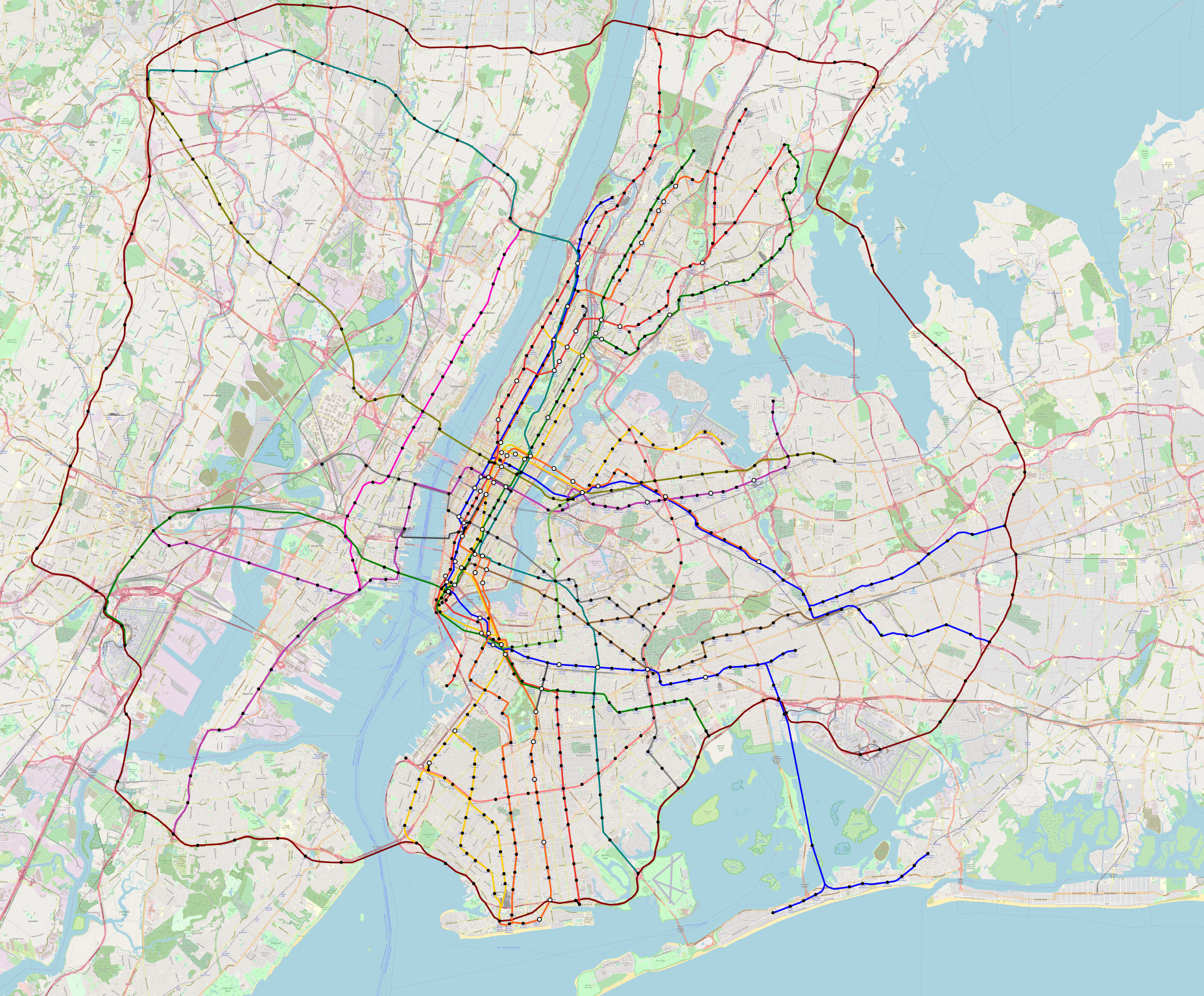
See full-size version here (warning: 55 MB).
Most of the radial extensions I’ve already discussed in previous posts – for example, here. Here these extensions go somewhat further in order to meet the ring, including at Newark Airport, on Staten Island, in Bay Ridge, at Floyd Bennett Park, in Canarsie, at Starrett City, near the Queens/Nassau County line, and in Yonkers.
The ring is 151 km, of which around 87 km would be above ground, mostly replacing highways like the Belt Parkway to reduce costs. Of note, this cannot be done adjacent to an extant highway – the fast car traffic deters nearby development, making transit-oriented development impossible. So key road links around the region have to go, which is fine, since people should be transitioning from driving to taking trains. With some additional elevated construction including through City Island, across the Long Island Sound, and in low-density parts of North Jersey where demolishing houses even at $1 million per unit is cheaper than tunneling, construction costs could be reduced further. But it’s still a $20-25 billion project at average world costs, maybe $15 billion at Nordic or Korean or Southern European or Turkish costs.
The only way to pay off the costs of such a line, not to mention to fill enough trains to support frequency that can take untimed transfers (at worst a train every 10 minutes), is to have very high ridership, on the order of 400,000-500,000 per day. This is for a line that misses Manhattan and all of the big secondary job centers, like Downtown Brooklyn and Long Island City. Is this plausible?
The answer is not an obvious no. Sufficiently aggressive TOD could plausibly create ridership. But it’s still questionable. There are really a few different forces pulling such a line in different directions:
- Using existing rights-of-way to reduce costs, hence the use of the Belt Parkway and not the denser development around Avenue U or even Flatlands.
- Serving secondary nodes like JFK, Coney Island, EWR, and Yonkers. Potentially it would be plausible to veer inward in New Jersey in order to hit Downtown Newark, at the cost of a few extra kilometers of tunnel, making the line radial from Newark’s perspective, whereas the line as depicted above is circumferential from Newark’s perspective since it goes around city center.
- The need to connect to radial subway and commuter rail lines, which means serving stations, opening plausible infill stations, and extending some lines toward the ring.
There are different ways to resolve this tension; the line I depicted is not the only one. For example, a higher-cost, higher-ridership version could veer inward in the Bronx and Queens, aiming to connect to Flushing and Jamaica and then replace the AirTrain JFK, leading to a ring of radius closer to 16 km than to 20-25.
I only bring this up to point out how many things have to work if you want such a ring to work out. Keeping costs to even semi-reasonable levels requires demolishing highways and engaging in aggressive TOD, which is only possible in an environment of total political victory over NIMBY and pro-car interests (note: these two are not the same!).
This is not the history of the Musashino Line. The Musashino Line originates in a freight bypass around the built-up area of Tokyo, which eventually turned into a circumferential passenger line. This is why it connects to the radial lines near but not at the busiest regional stations – at Nishi-Kokubunji and not Kokubunji, at Minami-Urawa and not Urawa, at Shin-Matsudo and not Matsudo or Kashiwa.
But even when the line is new, there are always compromises on right-of-way. Uncompromised right-of-ways are 100% possible, but not at 25 km radius, because the cost is too high to always go to the most important secondary centers. They happen when the radius is smaller, like Paris’s 8-10 km for M15, because then ridership can be high enough (M15 projects nearly a million riders a day). Farther away, ridership drops and costs rise because the line gets longer faster than per-km costs drop, so compromises are inevitable.
I am not proposing the ring above as a definitive crayon. I’m just mentioning it as something that highlights the difficulties of circumferential public transportation in the suburbs. Even as it is, the strongest segment of the ring is most likely the one in the city taking over the Belt Parkway, which could replace busy buses like the B15, B1, B3, B6, and B82. The suburban segments are weaker – there isn’t that much commuting across the Hudson that far north, and building up such commuting requires heavy commercial TOD in Yonkers, Mount Vernon, and New Rochelle.
 Pedestrian Observations