Category: Studies
Skewed North Shore BRT/LRT Proposal (Hoisted from Comments)
The MTA produced an alternatives analysis for transit service on the North Shore of Staten Island. The study contains zingers and various factors making the cost many times higher than it should be, but the agency response to all comments is Decide, Announce, Defend. Commenter Ajedrez reports from a public meeting on the subject on Second Avenue Sagas:
I went for part of the meeting (from about 18:30 to 19:45), and this is a rundown of what happened:
* They discussed the updates from the last meeting. They eliminated the ferry option (that didn’t even make sense), and they eliminated the heavy rail option.
* The people were given the opportunity to ask questions and make comments. This one woman (the same woman from last time) ranted on and on about something historical at Richmond Terrace/Alaska Street that would be destroyed if they paved over it.
Then a few more people made some comments, and I asked why they eliminated the heavy rail option (for those of you who are wondering, I was the kid in the yellow jacket and blue/black striped shirt. Then again, I was the only kid in the room)
* Then we went to the back to talk with the people from the consulting firm. I discussed the heavy rail more in depth, and asked why it was needed if the West Shore Light Rail would supposedly cover the Teleport. I then made a couple of suggestions for the short-term (reverse-peak S98 service, my S93 extension, cutting back more S46s to Forest Avenue) and I gave them the name of a person at the MTA who they could contact.
To elaborate on my statement about heavy rail, they said that they took it completely off the table. It just amazed me that they originally had a ferry line as one of the options, but they didn’t even have heavy rail as an option south of Arlington.
Let me think, you have an abandoned rail line (and a heavy rail line at that), and you want to put a ferry line there. What sense does that make? I could understand maybe having the ferry supplement the rail line, but doing that would have the whole thing go to waste.
I said that the current SIR is heavy rail and the South Shore is more auto-oriented than the North Shore. And I said that it provides better integration with the current SIR (they said they could put light rail in the Clifton Yard, but it’s probably automatically cheaper if you don’t have to retrofit the yard). And I also said that there’s higher capacity than light rail, so in case there’s growth, it is better equipped to handle it
So they said “Well, it was too expensive (because one of the goals was to serve the Teleport) so we didn’t even consider it.” And then they said that SI doesn’t have Brooklyn-type density to support heavy rail (but somehow the South Shore does?). And if you limit it to light rail, you’re actually limiting SI’s growth potential. Think about it: before 1900, Brooklyn had some streetcar lines, but not a whole lot of ridership. When the subway was extended, the population exploded. But if they just extended some streetcar lines from Brooklyn to Manhattan, the population would be nowhere near the 2.5 million it has today.
And then they said “Oh, well during the last meetings (which I attended, so I know they’re not being completely truthful) people expressed a sentiment for light rail”. They didn’t. They expressed a sentiment against a busway, There’s a difference. They didn’t say “Oh, it shouldn’t be heavy rail”. They just said they want rail rather than buses.
I mean, the argument I should’ve made (besides the ones I already did) was the fact that there was heavy rail there before, and the population was smaller back then. I think it’s pretty obvious.
And when I made that statement, everybody was surprised at how young I was (16). One woman said “You should be the one studying this project”, and they actually tried to avoid responding to me (they were like “Thank you. Next question”, and then everybody said “But you didn’t answer his question”, and that’s when they made up the response about expenses)
Besides the wretched DAD attitude, the cost projections and the route choice doesn’t even make sense. The proposal is to use the abandoned B&O right-of-way along the North Shore, from St. George to Arlington, and then cut over to South Avenue and serve West Shore Plaza. Here is satellite imagery of South Avenue: observe that it is almost completely empty.
Here we have a line that consists of 8.5 kilometers of abandoned trackage, which can be restored for service remarkably cheaply, and 5.5 of an on-street segment, which tends to be much more expensive to construct. Compare the costs of regional rail restoration in Germany or Ottawa’s O-Train with those of French LRT lines (including Lyon’s cheaper line). In addition, the areas along the abandoned trackage are of moderate density by non-New York standards, while those along South Avenue aren’t even suburban. And yet, the MTA is convinced that the per-km cost of an option that terminates at Arlington is higher than that of an option that goes to West Shore Plaza ($56 million/km vs. $41/km).
While the cost range proposed is only moderately high for light rail – the French average is a little less than $40 million/km – this is misleading because of the nature of the lines. French tramways tend to be on-street, involving extensive street reconstruction. Sometimes they need a new right-of-way along a boulevard or a highway. In contrast, the North Shore Branch is a mostly intact rail right-of-way, which means that the land grading and the structures, the most expensive parts of any rail project, are already in place. It shouldn’t cost like a normal light rail project; it should cost a fraction.
On top of this, to inflate the cost, the MTA is talking about a train maintenance shop. It says a light rail option allows merely modifying the maintenance shop for the Staten Island Railway. Not mentioned is the fact that SIR-compatible heavy rail would allow the trains to be maintained in the same shops without modification, to say nothing of leveraging New York City Transit’s bulk buying to obtain cheaper rolling stock.
The O-Train’s cost – C$21 million for 8 km of route – included three three-car DMUs, piggybacking on a large Deutsche Bahn order; judging by the cost of a more recent expansion order from Alstom, a large majority of the original $21 million was rolling stock. New York should be able to obtain cheaper trains, using its pricing power and sharing spares with the SIR. The electrification costs would add just a little: electrification can be done for €1 million per route-km, and in high-cost Britain it can be done for £550,000-650,000 per track-km (p. 10).
For an order of magnitude estimate of the cost of a well-designed SIR-compatible North Shore Branch, we have, quoting my own comment on SAS:
For an order-of-magnitude estimate of what’s needed, figure $20 million for electrification, $5 million for high-platform stations, and $25 million for six two-car trains plus a single spare. Go much higher and it’s not a transportation project, but welfare for contractors.
In retrospect would add about $10-20 million for trackwork, since the line is abandoned. On the other hand, fewer trains could be used: I was assuming 10-minute headways and a 25-minute travel time to Port Ivory; with 15-minute headways and a travel time under 17.5 minutes to Arlington, which is realistic given subway speeds (the MTA study says 15), only three trains plus a spare would be required.
On a related note, the loading gauge excluding station platform edges should be rebuilt to mainline standards, to allow future regional rail service to replace the SIR. Eventually Staten Island is going to need a long tunnel to Manhattan or Brooklyn if it’s to look like an integral part of the city, and once such a tunnel is built, it might as well be used to provide RER-style service across the city.
In contrast, the MTA proposal has no concern for cost cutting, and looks like lip service to the community. It’ll be an especial tragedy if the line is permanently ripped up to make room for a busway, which will likely underperform and turn into a highway. The contractors are going to get well paid no matter what: the busway is cheaper, but not by an order of magnitude. It’s just the riders who will not have good transit on Staten Island’s North Shore.
Disappointment 2050
The political transit bloggers are talking about the new RPA/America 2050 report on high-speed rail published by the Lincoln Institute, which recommends a focus on the Northeast and California. Unfortunately, this is not an accurate description of the report. Although it does indeed propose to start with the Northeast and California, that’s not the focus of the report; instead, the focus is to argue that HSR is everything its boosters claim it is and then some more, and demand more money for HSR, from whatever source.
Look more closely at the section proposing to focus on New York and California. Although the authors say the US should prioritize, minimal argument was offered for why these are the best options. The report shows the map from the RPA’s study on the subject, which proposes a few other priorities and isn’t that good to begin with (it grades cities on connecting transit based on which modes they have, not how much they’re used). But it says nothing more; I’d have been interested to hear about metro area distribution questions as discussed on pages 113-5 in Reinhard Clever’s thesis and pp. 10-11 of his presentation on the same topic, and alignment and regional rail integration questions such as those discussed by the much superior Siemens Midwest study, but nothing like that appears in this report.
The report then pivots to the need to come up with $40 billion for California and $100 billion for the Northeast Corridor, under either the RPA’s gold-plated plan or Amtrak’s equally stupid Vision. The RPA first came up with the idea of spending multiple billions on brand new tunnels under Philadelphia, which was then copied by the Vision, and wants trains to go through Long Island to New Haven through an undersea tunnel. Clearly, cost-effectiveness is not the goal. Since the methodology of finding the best routes is based on ridership per km, offering a gold-plated plan is the equivalent of trying to connect much longer distances without a corresponding increase in ridership, which goes against the original purpose of the RPA study.
Together with the neglect of corridors that scored high on the RPA’s study but have not had official high-speed rail proposals costing in the tens of billions (the SNCF proposal and the above-mentioned Siemens report are neither official nor affiliated with the RPA), the conclusion is not favorable. The most charitable explanation is that the RPA was looking for an official vehicle to peddle its own Northeast HSR plan but actually believes it has merit. The least charitable is that the RPA wants to see spending on HSR megaprojects regardless of cost-effectiveness.
The treatment of other issues surrounding HSR is in line with a booster mentality, in which more is always better. Discussing station placement, the report talks about the development benefits that come from downtown stations and the lack of benefit coming from exurban stations, as nearly all stations on LGVs are. It does not talk about the tradeoff in costs and benefits; others have done so, for example the chief engineer of Britain’s High Speed 2, who also talks about other interesting tradeoffs such as speed versus capacity versus reliability, but the report prefers to just boost the most expensive plan.
More specifically, the report contrasts CBD stations, suburban stations, and exurban stations. In reality, many stations are outside the CBD but still in the urban core with good transit connections, such as Shin-Osaka, Lyon Part-Dieu, and 30th Street Station, but those are implicitly lumped with beet field stations. This helps make spending billions on tunnels through Philadelphia, as both the RPA and Amtrak propose, look prudent, when in reality both Japan and France are happy to avoid urban tunneling and instead build major city stations in conveniently urban neighborhoods. In fact, Japan’s own boosters and lobbyists crow about the development around such stations.
In line with either view of the report’s purpose, the literature it studies is partial. Discussing the effect of HSR on development, it quotes a study about the positive effect of HSR on small towns in Germany on the Cologne-Frankfurt line, but not other studies done in other countries. For example, in Japan, the effect of the Shinkansen on the Tohoku and Joetsu regions was decidedly mixed. The report also quotes the positive story of Lille’s TGV-fueled redevelopment, which was not replicated anywhere else in France, where cities just passively waited for infrastructure to rescue them. But instead of talking about Lille’s program of redevelopment, the report contrasts it with failed development cases in cities with exurban stations, never mind that no city achieved what Lille did, even ones with downtown stations, like Marseille. It’s not quite a Reason-grade lie, but it’s still very misleading.
Finally, the section about how to fund the $100 billion Northeast system and California’s $43 billion starter line has suggestions that are so outlandish they defy all explanation. The authors propose the following:
1. Raise the gas tax by 15 cents a gallon or more. Several cents could be devoted to passenger rail.
2. Add a $1 surcharge on current passenger rail tickets to produce approximately $29 million annually.
3. Shift from a national gas tax to a percentage tax on crude oil and imported refined petroleum products. RAND estimated that an oil tax of 17 percent would generate approximately $83 billion a year. Five billion dollars of this amount could be dedicated to passenger rail.
Of these, proposal #2 is by far the stupidest. Amtrak receives subsidies; to tax tickets is to propose shifting some change from the left pocket to the right pocket. Why not go ahead and propose to reduce Amtrak’s subsidy by the same amount and require it to raise fares or improve efficiency?
But proposals #1 and 3 are equally bad. Wedding train funding to a steady stream of gas taxes has been the status quo for decades; the result is that APTA is so used to this unholy marriage that it opposed a climate change bill that would tax gas without diverting the funds back to transportation. (That by itself should be reason for good transit advocates to dismiss APTA as a hostile organization, just one degree less malevolent than Reason and Cato and one degree less obstructionist than the FRA.) And if it were a wise long-term choice, if it were politically feasible to add to the gas tax just to build competing trains, the US political climate would look dramatically different, and instead of talking about focus, we’d be talking about how to extend the under-construction Florida HSR line.
A report that was serious about a mode shift from cars to cleaner forms of transportation would not talk about 15 cents per gallon; it would talk in terms of multiple dollars per gallon, as gas is taxed in Europe and high-income Asia. The best explanation I can think of for the funding mechanisms is that the RPA has internalized the tax-as-user-fee model of ground transportation, one that has never worked for cars despite the AAA’s pretense otherwise and that won’t work for anything else.
The overall tone of the report slightly reminds me of Thomas MacDonald’s Highway Education Board, with its industry-sponsored “How Good Roads Help the Religious Life of My Community” essay contests. It reminds me of Thomas Friedman’s “win, win, win, win, win” columns even more – which is unsurprising since I think of Friedman as the archetypal booster – but when this boosterism applies not to a policy preference but to spending very large amounts of public money, I begin to suspect that it’s advertising rather than optimism. Friedman for all his faults crows about American and Indian entrepreneurs inventing new things rather than about extracting $100 billion from the Northeast to pay for unnecessary greenfield tunneling.
Therefore, good transit activists should dismiss this report, and avoid quoting it as evidence that prioritizing is necessary. This was not what the RPA was preaching back when it thought it could get away with proposing more, and the rest of the report is so shoddy it’s not a reliable source of analysis. There may be other reasons to focus on those corridors, but the RPA did not argue them much, instead preferring to literally go for big bucks.
Quick Note: Comfort
While reading a thesis about tilting trains, I saw a comparison of passenger comfort on different modes of transportation. This includes the following graph (p. 30), which the thesis sources to a study of motion sickness in US children and teenagers:
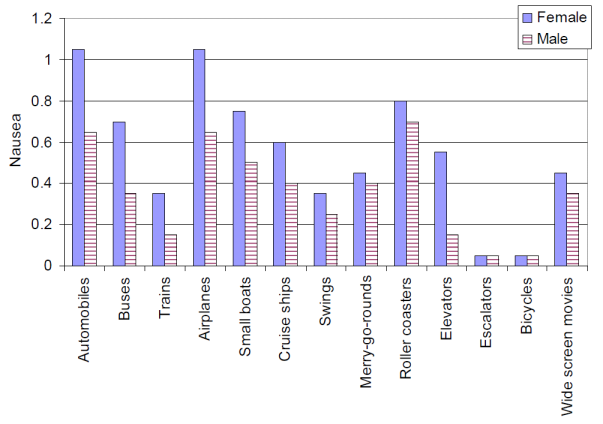
The scale is originally 0-3: this study polled a sample aged 9-18 and asked whether they feel nauseous on any of the above modes, where 0 is “never” and 3 “always.”
Selective Application of Smeed’s Law
A few months ago, in response to the Raquel Nelson case, author Tom Vanderbilt found an FHWA study from 2005 that finds that on wide, busy roads, pedestrian death rates are higher on marked crosswalks than on unmarked ones. The study itself is worth reading; its explanation of the finding is that,
These results may be somewhat expected. Wide, multilane streets are difficult for many pedestrians to cross, particularly if there is an insufficient number of adequate gaps in traffic due to heavy traffic volume and high vehicle speed. Furthermore, while marked crosswalks in themselves may not increase measurable unsafe pedestrian or motorist behavior (based on the Knoblauch et al. and Knoblauch and Raymond studies) one possible explanation is that installing a marked crosswalk may increase the number of at-risk pedestrians (particularly children and older adults) who choose to cross at the uncontrolled location instead of at the nearest traffic signal.
An even greater percentage of older adults (81.3 percent) and young children (76.0 percent) chose to cross in marked crosswalks on multilane roads compared to two-lane roads. Thus, installing a marked crosswalk at an already undesirable crossing location (e.g., wide, high-volume street) may increase the chance of a pedestrian crash occurring at such a site if a few at-risk pedestrians are encouraged to cross where other adequate crossing facilities are not provided. This explanation might be evidenced by the many calls to traffic engineers from citizens who state, “Please install a marked crosswalk so that we can cross the dangerous street near our house.” Unfortunately, simply installing a marked crosswalk without other more substantial crossing facilities often does not result in the majority of motorists stopping and yielding to pedestrians, contrary to the expectations of many pedestrians.
This is a rather standard application of Smeed’s law and similar rules governing traffic, whose one-line form is that traffic fatalities are determined primarily by psychology. This is not a problem; the problem is why such issues are only ever brought up in case of pedestrian fatalities.
In 1949, R. J. Smeed found a simple explanation for traffic fatalities: they depend less-than-linearly on the number of cars on the road. In the 1980s John Adams revised this to a more accurate rule based on VMT rather than the number of cars, and based on a constant decline in per-VMT accidents over time. Safety improvements do not bend or break the general trend. Quoting Adams again, the introduction of seat belts caused no reduction in traffic fatalities, and on the contrary caused pedestrian fatalities to temporarily inch up, as drivers felt safer and drove more recklessly. The only way to reduce the number of car accident victims is to reduce traffic.
And yet, government reaction is consistently on the side of accepting Smeed’s law when it implies there’s no need to improve pedestrian facilities, and rejecting it when its implication is bad for cars or good for pedestrians and cyclists. Local governments in the US routinely argue that safety is at stake when they want to upgrade a road with grade crossings into a full freeway. The FHWA helpfully adds that intersections are responsible to half of all car crashes and “FHWA will identify the most common and severe problems and compile information on the applications and design of innovative infrastructure configurations and treatments.”
In reality, all building freeways does is create more traffic, and cause more people to die in crashes. The average per-VMT death rate in the US has declined by 3.3% per year, but in the years following the Interstate Highway Act, it was practically flat – in other words, building freeways did nothing to accelerate the trend for reduction in per-VMT accident deaths. Although an individual freeway is undoubtedly safer than an individual road with intersections, the road network has to be viewed as a system: increase safety in one area and people will drive more recklessly elsewhere.
This systemwide view is clearly present in the case of pedestrians: the FHWA isn’t claiming that crosswalks are inherently unsafe, only that they cause more at-risk pedestrians to cross. In other words, the problem is that they cause too many of the wrong kind of pedestrians to cross. The implication is never used for roads. Traffic is never treated as variable, and if people shoot down freeway upgrades on the grounds that they’ll induce more traffic, it’s always on environmental or community grounds rather than on safety grounds.
Cost Overruns: How I Learned to Stop Worrying and Hate Bent Flyvbjerg
Let me preface this post by saying I have nothing against Bent Flyvbjerg or his research. My problem is purely with how it’s used in the public media, and frequently even in other academic studies, which assume overruns take place even when they do not.
Stephen Smith sent me a link to an article in The Economist complaining about cost overruns on the California HSR Central Valley segment. The article gets its numbers wrong – for one, the original cost estimate for Merced-Bakersfield was never $6.8 billion, but instead was $7.2 billion in 2006 dollars and $8 billion in YOE dollars, according to CARRD, and as a result it portrays a 25% overrun as a 100% overrun. But the interest is not the wrong numbers, but the invocation of Flyvbjerg again.
Nowhere does the article say anything about actual construction costs – it talks about overruns, but doesn’t compare base costs. It’s too bad; Flyvbjerg himself did a cost comparison for rapid transit, on the idea that the only way to reliably estimate costs ex ante is to look at similar projects’ ex post costs. His paper has some flaws – namely, the American projects he considers are older than the European projects, and there’s no systematic attempt at controlling for percentage of the line that’s underground, both resulting in underestimating the US-Europe cost difference – but the method is sound. Unfortunately, this paper is obscure, whereas his work on cost overruns is famous.
In the case of high-speed rail, it seems to me, from pure eyeballing, that there is a difference between countries in how much costs run over, and that this correlates strongly with high construction costs. German train projects, including the one example cited by the Economist, run over a lot. French and Spanish high-speed lines do not, and also cost much less.
Of course, this by itself doesn’t mean this correlation should keep holding: up until Barcelona Line 9, originally budgeted at €1.9 billion but now up to €6.5 billion, Spanish subway lines were built within budget. France has not yet had a factor-of-3 overrun on a major project, but it might in the future, and I’m not going to bet my life that it won’t. But what this does suggest is that looking at German overruns as if they’re typical rather than extremal cases is deeply misleading.
There’s an argument to be made that California’s inability to rein in the contractors will in fact lead to German cost overruns. California HSR’s projected costs look downright reasonable, whereas rapid transit projects in the state are unusually expensive. The proposed BART to San Jose tunnel is $4 billion for 8 km – very high by general subway standards, and unheard of for a subway in low-density suburbia. Going by Flyvbjerg’s own attempts to find ex ante cost estimates that are reliable, this could be used as evidence for future cost escalations; general overruns couldn’t, not without being more specific.
Shoddy Study Claims Light Rail Increased Congestion in Paris (Hoisted from Comments)
Jarrett points us to a just-published paper in World Transit Research that contends that Paris’s new T3 light rail line caused traffic congestion on the adjacent freeway, the Boulevard Périphérique, to increase, thereby causing a net increase in environmental damage and a negative social rate of return. Reading it at its original source requires academic access; here is a mirror on this blog, and thanks to ant6n for sending it. The study does not produce much evidence that an increase in traffic congestion indeed happened. As Angus Grieve-Smith explains in the comments on Human Transit:
It’s important to note that the authors did not measure traffic on the Périph. They just observed that average speeds on the highway declined from 45.9 km/h to 43.5 km/h, and that “many witnesses of the public hearing on the extension of the tramway to Porte de la Chapelle testified their fears to see an analogous shift increasing the congestion on Eastern Périphérique.” In other words, bullshit.
The fact is that a large portion of the traffic on the Périph is going from one side of the city to the other. If some of the drivers on the Maréchaux transfered to the Périph, increasing congestion there, some of the drivers on the Périph would take commuter trains across town instead. Some of the drivers would find it more convenient to take the metro instead of the tramway, or to drive an alternate route that doesn´t involve the Périph, possibly one of the parallel boulevards closer to the center of the city.
The study spends very little time arguing that an increase in traffic happened. It almost takes it for granted. The evidence it provides is that the average speed on the entire Périphérique went down 5%, from 45.9 to 43.5 km/h, whereas the average speed on the southern segment, which parallels the T3 line, went down 10%, from 37.9 to 33.9 km/h.
Instead of arguing that the reduction in speed represents extra traffic coming from the lanes removed to make room for the T3, the study assumes that 100% of the reduction in traffic on the Maréchaux, the boulevard on which the T3 runs, was transferred to the Périphérique. This is unlikely: the phenomenon of reduced demand is attested in the literature – see references here. Traffic shifts to less congested times of day, and sometimes disappears entirely as drivers choose not to take the trip. For one example, when the West Side Highway collapsed, about half its traffic disappeared; this percentage is high, presumably because Manhattan has good transit options, just like Paris.
It’s in fact worse than Angus says. Although the paper provides traffic counts on the Maréchaux, it provides no such counts for the Périphérique, although such counts should be very easy to find. Its computation of the traffic increase on the Périphérique comes entirely from prior assumptions about the traffic that disappeared from the Maréchaux. Another, more minor sleight of hand is the choice of years. For the Maréchaux, the paper argues for comparing present traffic to traffic in 2003, just before the tram’s construction began; for the Périphérique, the numbers provided use 2000 as a baseline.
Most of the paper’s effort is spent not on trying to prove that traffic increased, but on computing the social costs and benefits under questionable assumptions. Doing that is difficult to say the least without knowing more about the nature of traffic on the Périphérique, and the study makes even more questionable assumptions there. To be fair, the biggest smoking guns do not concern the social cost that according to the study is by far the highest, slower traffic speeds; those follow from the assumptions. Instead, they serve to showcase a careless and even biased thought process.
First, the difference in carbon emissions between free-flowing traffic at 38 km/h and 34 km/h is small; what causes fuel consumption to rise in traffic jams is not lower average speed but rather stop-and-go traffic. Thus, even a first-order estimate of extra fuel consumption is impossible given the study’s numbers and assumptions. Fortunately for the study, the carbon cost it uses is so low (€25/ton) and the overall effect posited not large enough that the overall magnitude posited is negligible.
Second, in its computation of economic costs, the study makes the following observation about the project’s cost:
Available information on the monetary costs associated with the project is scarce. One has only the ex ante costs envisioned in the official preliminary Public Inquiry: 341.8M€ for the initial investment and 43.9M€ for the exploitation of the tramway. Experience suggests that ex post costs are likely to be appreciably higher (Flyvbjerg et al. 2002).
For the record, it took me all of three minutes to search on Railway Gazette and Google and find ex post costs amounting to €311.5 million. Worse, the paper says it chooses to use the original cost estimate for lack of other numbers, but then multiplies the original budget by 1.3, the standard factor for public projects in France. As far as I can tell, the reason for multiplying budgets by 1.3 is to cushion against small budget overruns, which could turn slightly beneficial projects into net liabilities; it’s a more honest way of including a contingency budget. In other words, the paper claims that costs probably ran over but its cost estimate for net benefit purposes assumes they didn’t, while in reality they didn’t run over while the paper assumes they did.
Carbon Costs May Be Far Higher Than Previously Thought
A pair of economists at Economics for Equity and the Environment (E3) have just released a study positing that the social cost of carbon is far higher than previous estimates, by up to an order of magnitude. The official estimate used by the US government is $21 per metric ton of CO2 as of 2010, and various estimates go up to about $100-200, e.g. the Swedish carbon tax is 101 Euros per ton, and James Hansen recommended $115 per ton. In contrast, the E3 study’s range, using newer estimates of damages, goes up to $900 per ton of CO2 as of 2010, escalating to $1,500 in 2050, when the discount rate is low and the price is based on a worst case scenario (95th percentile) rather than the average.
One should bear in mind that the discount rate used to get the high numbers is 1.5%, in line with what was used by the economists at Bjorn Lomborg’s Copenhagen Consensus to arrive at the conclusion that climate change mitigation was a waste of time. It’s not a radical estimate, although some commentators have wrongly confused it with zero discount rate; it’s in line with the long-term risk-free bond yields. Even using average rather than worst-case damages (but still averages coming from the newer, higher estimates) would give a carbon tax of $500 as of 2010, escalating to $800 by 2050.
The carbon content of gasoline is such that a $900/ton tax would be almost to $8 per gallon of gasoline, or $2 per liter. For diesel, make it $9 per gallon. Good transit advocates are engaging in fantasy if they think this, even together with other costs such as air pollution, would eliminate driving; however, it would severely curtail it, inducing people to take shorter trips, switch some trips to public transportation, and drive much more fuel-efficient cars. All three are necessary: not even in Switzerland has the transit revival gotten to the point of abolishing the car. However, the current US car mode share – 86% for work trips – is unsustainable and has to go down under any scenario with a high carbon tax.
More intriguing would be the effect on electricity consumption and generation. Current coal-fired plants in the US would see an average tax of about $0.89 per kWh; natural gas plants would be taxed $0.49 per kWh. Cities already have an advantage there – New York City claims 4,700 kWh of annual electricity consumption per capita, while the current US average is about 13,000. Obviously, in both cases, fossil-fired electricity consumption would crash, while solar and wind power would become a bargain, but it would be easier to do this in large cities. But again, urban revival has its limits; suburban houses would still exist, just with much more passive solar design and extensive solar panels.
Rumors of the Death of HSR Greatly Exaggerated
Aaron Renn has a post on New Geography pronouncing American high-speed rail dead. His reasoning: the stimulus spread the money around too much, Republican Governors rejected the HSR stimulus money, rail advocates have called 110 mph legacy lines high-speed rail, the FRA hobbles good passenger rail. All of those factors are true – though some cancel out, e.g. the 110 mph pretend-HSR lines in Wisconsin and Ohio were the first on the chopping block – but California HSR marches on.
Reading California HSR Blog gives an impression that the project is controversial, but in no real risk of disappearing. While some of the money from the canceled lines went to chaff, a lot went to California, which already has enough money to build a demonstration line in the Central Valley and is already looking at leveraging other money it will get to reach either Los Angeles or the Bay Area. Moreover, although the authority still carries over a lot of past incompetence, the current administration of Roelof van Ark is looking at alternatives to reduce costs, such as reducing the number and length of viaducts and even revisiting past alignment decisions. The adults are more firmly in charge today than a year and a half ago.
There’s still NIMBYism, particularly from Central Valley farmers and from suburbs on the San Francisco Peninsula, but the former is no big deal by the standards of what TGV construction has to go through, and the latter has simply led the authority to focus on connecting HSR track to Los Angeles first and use legacy track at slightly lower speed with much less local impact to get to San Francisco. Whether the project will ultimately have a useful starter line or remain a Bakersfield-Fresno-Merced shuttle depends on how much private funding it can attract, but Japan promised to fund 50% of the line, and the authority has had meetings with Spain and China. It’d be enough to do at least LA-Fresno, which is quite useful, if not as good as LA-Fresno-San Francisco.
Moreover, calling HSR dead on New Geography and saying it’s because Republican Governors rejected the money is ironic, in light of who owns the site. Aaron is interested in reform and efficiency; the same can’t be said of New Geography executive editor Joel Kotkin, an anti-urbanist so uninformed and desperate he blamed megacities for AIDS.
Kotkin may be just uninformed, but contributing editor Wendell Cox goes further: he and fellow Reason transportation hack Robert Poole wrote a report claiming, on flimsy evidence, that Florida’s high-speed rail line would have huge cost overruns and ridership shortfalls (a later report released by professional consultants said in fact the line would have been more profitable than expected). The report is a lie, and Rick Scott’s cancellation of the Florida HSR line, based on the report, involved additional lying to the court.
My explanation, hoisted from a comment I wrote on the subject on the Infrastructurist, responding to commenter Colin Prime:
1. The executive summary – i.e. what most people would read – says, “This report estimates that the cost to Florida taxpayers could be $3 billion more than currently projected.” As it turns out, in the body of the report in the section on Flyvbjerg the report says $0.54-2.7 billion, with $1.2 billion as the likeliest. None of these lower figures appears in the executive summary. That alone suggests massive deception.
2. In fact, Flyvbjerg either talks about megaprojects in general or focuses on urban rail. HSR projects don’t run over budget frequently, and when they do, it’s not by 100%. In Norway, a 50% cost overrun on the HSR line to the airport (coming from geological problems) was considered so unusual it triggered a government investigation.
3. Here’s the report on California [the projected per-km cost of the Central Valley segment is much higher than that of the Florida line]: “The California segment is not being built to full high-speed rail standards, because of a legal requirement that the line be usable by conventional Amtrak services if the Los Angeles to San Francisco project is not completed. The line would be upgraded to full high-speed rail standards when and if the much longer route is completed.”
This is technically known as “a lie.” Making the line Amtrak-usable is actually a cost raiser rather than a cost saver, because Amtrak trains are heavier and therefore elevated structures would have to be beefed up. Otherwise the line is built to HSR standards in terms of the expensive bits, i.e. track geometry and physical infrastructure; the only component that may not be included in California in this round is electrification, which is a fraction of the total cost of HSR ($3 million per
milekilometer at Acela costs).4. In general, of the 11 factors cited for California-Florida differences, the ones on which Florida would be more expensive than California are all small things like stations and electricity; the big items involve physical infrastructure, and there Florida would be cheaper.
5. To support the assertion that HSR can suffer from a ridership shortfall, the report mentions Eurostar and THSR. Unmentioned are the many TGV lines that exceeded projections. The report also makes a spurious comparison to the Acela; it even doubles-down on the Acela comparison, and uses a false comparison to make the Florida line look slow. Florida’s travel time is compared not with end-to-end travel time on the average fast train (an average of 80 mph on the Acela NY-DC, and 140 mph on the Sanyo Shinkansen) but with the fastest intermediate segment on the fastest train of the day, connecting two small cities (100 and 170, respectively). On top of it, the Acela is priced for premium travel, with coach travel provided by the 66 mph Regional.
6. To add insult to injury, Cox and Poole dismiss Florida’s tourism as such: “The metropolitan areas in both markets [NEC and Florida] have substantial tourist volumes.” In reality, the tourist volumes in Florida relative to the metro area size are much larger than in the Northeast, and the Florida line directly serves tourist attractions (airport to Disneyland) whereas the Acela does not (minimal airport service, premium brand).
Given the above issues the study, I’d say calling it a lie is fair.
High-speed rail has challenges, many correctly identified by Aaron. The FRA is an obstacle (though the people most interested in changing it tend to be good transit activists); spreading the money around was a problem. But right-wing populists who can’t govern soon become unpopular, and are thus an ephemeral phenomenon. Rick Scott’s approval rate is 27%, John Kasich‘s is 35%, Scott Walker‘s is 37%. And it’s deeply troubling to go on a website and say that high-speed rail is dead when one of the reasons it’s dead is shoddy or dishonest work done by another contributor to the same website.
Fortunately, in California, the real obstacle is so far not a huge deal (California is planning to run on dedicated tracks, or at least on tracks shared only with commuter trains), and the ephemeral obstacle lost the gubernatorial election. Money is a problem and so is incompetence, but the incompetence seems to be waning, albeit slowly, and the money is likely to materialize. Don’t count HSR out yet.
Quick Note: Are HSR Transfers Acceptable?
When SNCF built the first TGV line, it did not have funding to complete the full line from Paris to Lyon. Instead, it built two thirds of the line’s length, with the remaining third done on legacy track at reduced speed. The travel time was 4 hours; when the full line was completed a few years later, it was reduced to 2. The one-seat ride remains the TGV’s current operating model, to the point that one unelectrified branch got direct service with a diesel locomotive attached to the trains at the end, and was only electrified recently.
In Japan, transfers are more common, because of the different track gauges. At the outer ends of the Shinkansen, it is common for people to transfer to a legacy express train at the northern end of the line, though on two branches JR East built two Mini-Shinkansen lines, regauging or dual-gauging legacy track to make TGV-style through-running possible. In Germany, the entire system is built on transfers, typically timed between two high-speed trains.
I mention this because the California HSR activists are talking about the possibility of transfers as an initial phase. Some politicians occasionally hint about forced transfers at San Jose, even though it is relatively easy (in fact, planned) to electrify Caltrain and run trains through to San Francisco, but more intriguing is Clem Tillier and Richard Mlynarik’s proposal about running to Livermore first:
This is predicated on prioritizing the San Francisco to Los Angeles connection. It has nothing to do with Sacramento or the East Bay… those are just the cherry on top. Focus on the cake, not the cherry.
LA – Livermore HSR 2:06
Transfer in Livermore 0:10
Livermore – SF Embarcadero BART 0:57
TOTAL SF-LA via Altamont/Livermore BART 3:13LA – Gilroy HSR 1:57
Transfer in Gilroy 0:10
Gilroy – SF 4th & King by Caltrain 2:00
TOTAL SF-LA via Pacheco/Gilroy Caltrain 4:07It’s simply not a contest. Even for San Jose, LA – SJ downtown times would be approximately equivalent via Livermore BART once BART to SJ is built. So let me reiterate: No other alternative, least of all Pacheco, provides such a “Phase Zero” access to SF.
The one possible problem: Livermore’s quality of service will be low after BART goes there. From their 1982 opening until 1985, the Tohoku and Joetsu Shinkansen only served Omiya, located 30 km north of central Tokyo; however, Omiya was already connected to Tokyo by multiple high-capacity rapid transit lines, and an additional line was built at the same time as mitigation for the line’s construction impacts.
Quick Note: Midwest HSR Study
I’m usually skeptical of industry-funded studies about the value of megaprojects, but despite the involvement of Siemens I recommend reading the 2011 Economic Study for Midwest high-speed rail.
Building up on previous ideas for the 110 mph Midwest high-speed rail and on SNCF’s proposal, the study goes through all the nitty-gritty details that are often missing from publications geared toward investors and urban boosters. The technical report addresses questions about alignment, transfer convenience, integration with commuter rail, and FRA regulations. It discusses such issues as how to build a tunnel for Metra providing useful regional rail service, why the FRA is likely to let lightweight high-speed trains operate in the US, or whether to route trains through Eau Claire along I-94 or through La Crosse and Rochester on a greenfield alignment.
The proposed cost of the project is $83.6 billion, in 2010 dollars (compare $69 billion in SNCF’s proposal, or $117 billion in year of construction in Amtrak’s one third as long Northeast Corridor proposal). It works out to $35 million per kilometer, which isn’t outrageous but still a little higher than normal for flat terrain; the total contingency in the proposal’s budget is 35% of the base, which is higher than the norm, which is 25%. Construction costs on the French LGV Est‘s second phase are $24 million per km, and those on Belgium’s HSL 3 were $29 million per km.
 Pedestrian Observations
