Category: Transportation
Why High Speed 2 and Other European Lines Make Fewer Stops than the Shinkansen
At a meeting last week, Borners was asking me why High Speed 2 is designed not to make any stops between London and Birmingham. This distance, about 150 km between Old Oak Common and Birmingham Interchange, would have around 4.5 interstations on the Shinkansen, but in the UK, it runs nonstop. More generally, in Europe similarly long stretches without stations are observed, but not in Japan. This post goes over why; it is not due to poor design on the part of either side, but rather a response to the respective geographies of the countries in question.
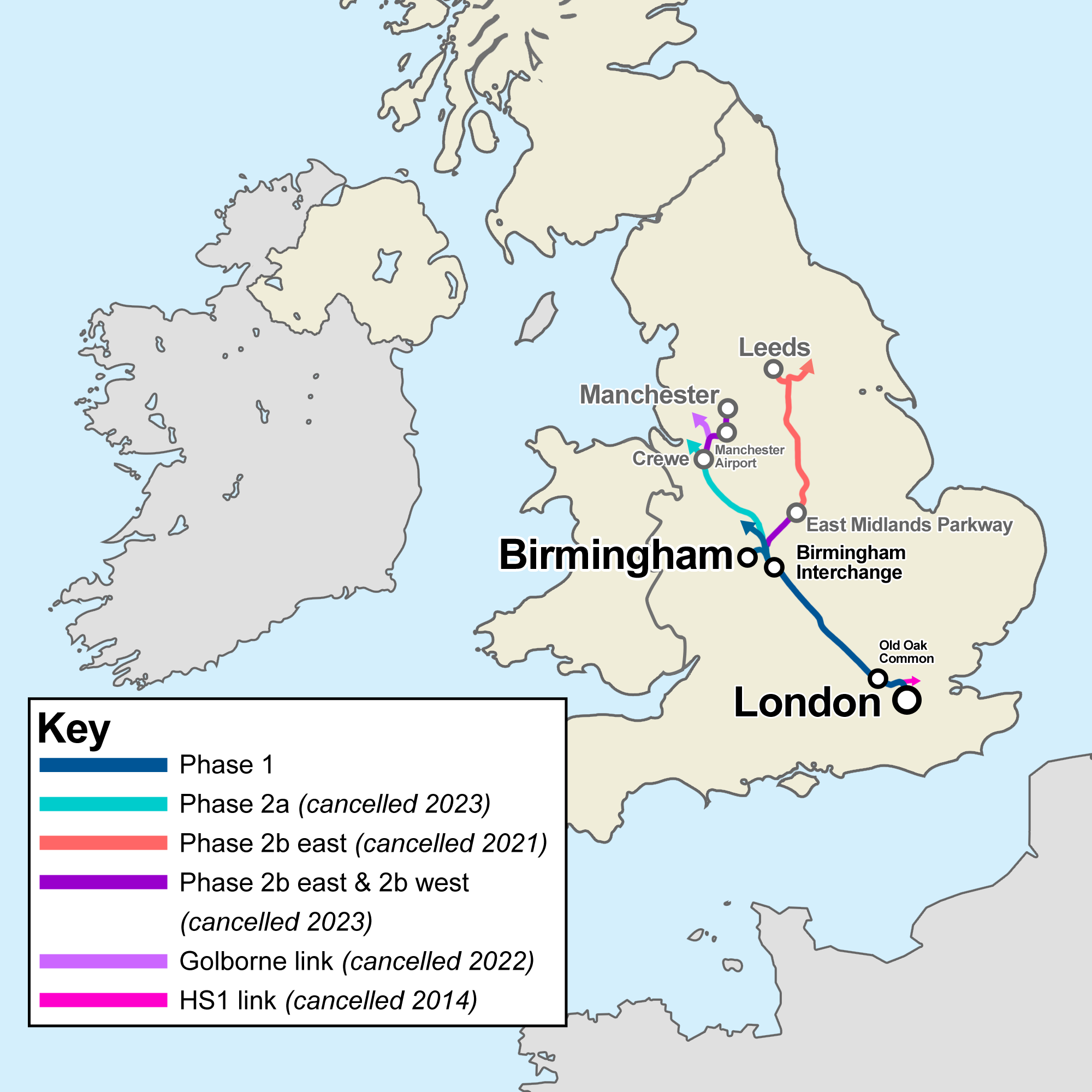
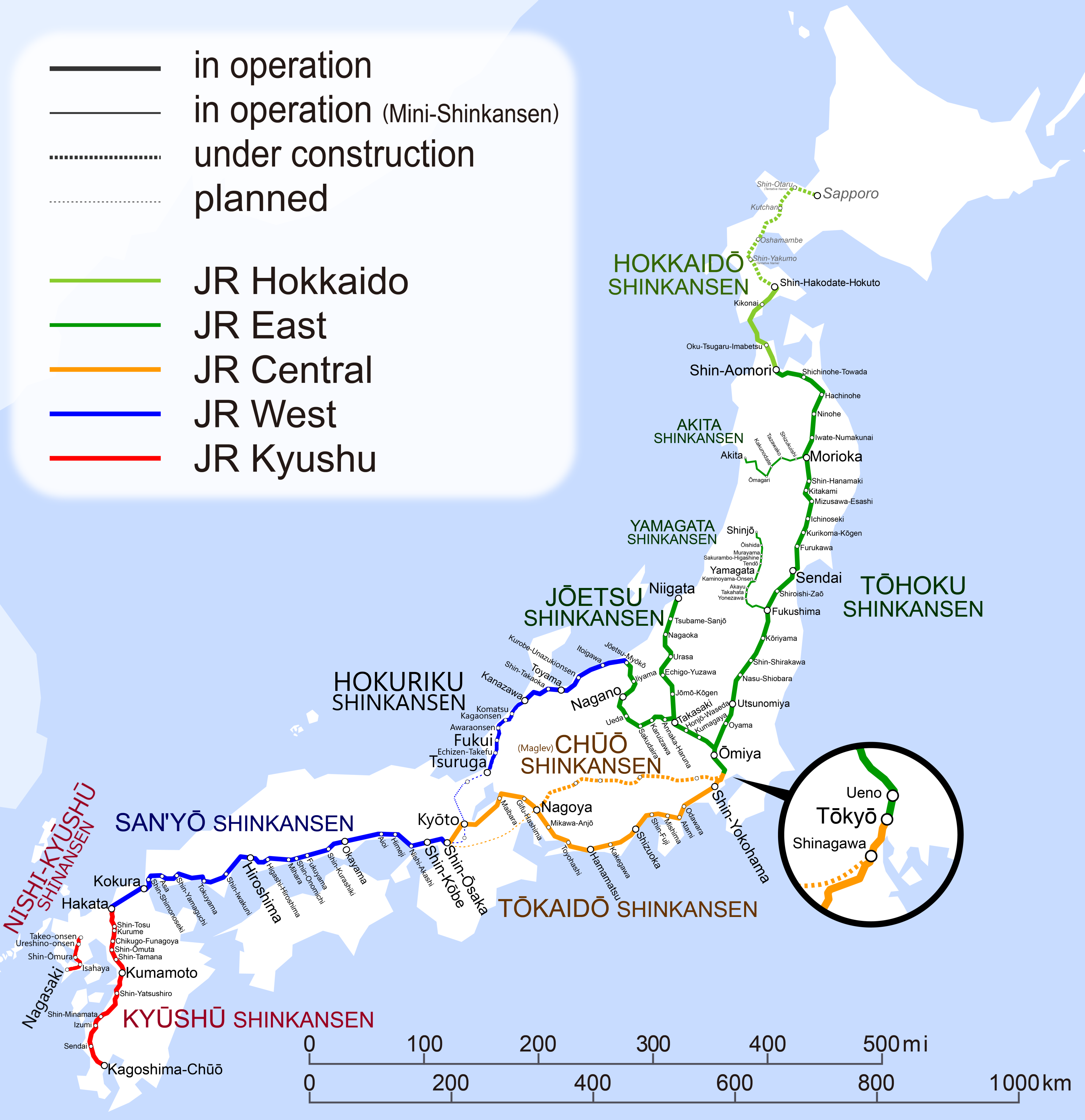
Speed classes on the rail network
Modern intercity rail networks have multiple speed classes, comprising not just separation between high-speed trains and trains on the classical lines but also local and express trains on the same line, often the same track. Here, it is useful to go over the difference between Japan and Europe in general and Britain in particular.
On the Tokaido Shinkansen, the fastest trains, stopping only in Tokyo and its immediate suburbs, then Nagoya, then Kyoto, and then Shin-Osaka are called Nozomi and average 210 km/h end-to-end; trains making additional stops are called Hikari and average 178 km/h; trains making all Shinkansen stops are called Kodama and average 132 km/h. Below that class are limited express trains on the narrow-gauge network, all much slower. The original Kodama, inaugurated in 1958 just before the Shinkansen began construction, did the Tokyo-Osaka trip at an average speed of 80 km/h. The fastest trains on classical lines in Japan average around 100-110 km/h, on lines without Shinkansen, while lines parallel to Shinkansen, such as the Tokaido Main Line, are slower as they prioritize regional traffic at an average speed of 60 km/h or so.
Britain, in contrast with Japan, has rather fast trains on its classical network, as do other countries that chose to invest in upgrading their existing network rather than in building high-speed rail on it. The intercity trains today connect London with the major cities of the Midlands and North at average speeds of about 130 km/h, depending on city and line. The West Coast and East Coast Main Lines are both straight, built in the 1830s and 40s when it wasn’t clear trains could even round significant curves without derailing, in one of Europe’s flattest geographies, the exact opposite of Japan with its mountainous terrain and narrow-gauge lines. Both lines were four-tracked in the 19th century, more or less allowing fast intercity trains to run alongside slower regional lines without interference. In effect, trains offering Kodama speeds are available in Britain today.
Germany is in a similar situation to Britain. The topography here is hillier and the lines built slightly later, after engineers figured out that sharp curves were fine at the speeds of mid-19th century steam trains, but it’s possible to squeeze decent speed out of some of them, especially in flatter northern Germany. Berlin-Hamburg, exceptionally, averages around 160 km/h entirely on classical track, with timetabled overtakes between intercity and regional trains and extensive schedule padding to allow for recovery from cascading delays. Other lines average 120-130 km/h, for example to Leipzig and Cologne, so that Kodama speeds are already available, again, and the focus when high-speed rail is built is on the Hikari/Nozomi speed range.
Finally, France, like Japan and unlike Britain and Germany, chose to invest in high-speed rail more than to upgrade its classical lines. But it, too, already had high speeds on its classical lines: from Paris to Marseille and Nice, trains averaged 120 km/h before the TGV opened. Short-range intermediate cities like Dijon already had fairly good service available, so serving them was less important than maximizing the speed of longer-range connections like Paris-Lyon and Paris-Marseille.
The urban geography of Japan, were it in Europe, would thus be serviceable on classical lines. In contrast, the lower speed of classical trains in Japan means that exurban centers like Odawara, Mishima, Utsunomiya, and Takasaki greatly benefit from having local Shinkansen trains available. England is denser than Japan; there are places at similar range from London on or near the main lines, such as Milton Keynes and Northampton, but they already have fairly fast trains to the capital, and will have even faster trains when High Speed 2 opens even though they don’t get stations, because the removal of the intercity trains from the West Coast Main Line will allow for schedule rewrites reducing timetable padding and allowing for faster trip times between London and such intermediate points, which today are lower priorities than higher average speeds to Birmingham and points north.
City size and prioritization
On the one hand, as outlined above, there is less need for Kodama-speed service to intermediate cities in Europe than there is in Japan. On the other hand, regardless of need, such service must take lower priority in Europe, due to differences in urban geography.
In Japan, the Tokaido Shinkansen prioritizes Tokyo-Nagoya-Kyoto-Osaka traffic, as those cities outshine all others. Kodama trains could do the trip significantly faster than they do today, but are held at local stations to let Nozomi pass, and most trains are Nozomi rather than Hikari or Kodama. However, north of Tokyo, the situation flips. There is extensive commuter traffic, seen in much shorter average trips than on the Tokaido Shinkansen. The northern exurbs of Tokyo furnish extensive traffic, while the cities beyond commute range are too small to drive traffic all by themselves.
In the Tohoku region, by far the largest major metropolitan area is Sendai, population 2.3 million. The only other major metropolitan area served by the Tohoku or Joetsu Shinkansen, Niigata, has 1.4 million. The other cities don’t qualify as MMAs; the largest, Toyama on the Hokuriku Shinkansen, has an urban employment area of 1 million, while the others, such as Fukushima, Morioka, and Nagano, have around 500,000 each. Utsunomiya and the Takasaki-Maebashi region have 1.3 and 1.1 million respectively, enough that their needs should drive service planning as much as those of the cities to their north.
Britain is the exact opposite. Its metro area listings are somewhat outdated – I can only find 2001 data, compared with 2015 for Japan in the above paragraph – but we can compute based on metropolitan counties, designed to approximate metropolitan areas for the major secondary cities of England. Birmingham’s West Midlands and Greater Manchester are 3 million each, Leeds’ West Yorkshire is 2.4 million, Liverpool’s Merseyside is 1.5 million; at longer range, counting cities to be served on long extensions on classical lines at lower speed, Newcastle’s Tyne and Wear is 1.2 million, Edinburgh is 900,000, and Glasgow is depending on definitions between 1 and 1.8 million. In contrast with those, there is nothing that populous justifying its own station between London and Birmingham. Milton Keynes is too small, and an exurban station at the intersection with the under construction East West Rail between Oxford and Cambridge would not provide much added benefit over the existing direct express trains from Oxford and Cambridge to London.
The British situation generalizes. In Germany, not only does every line have quite a number of midsize cities at its end and beyond it, but also no city is so large that it sprouts subsidiary metro areas the size of Utsunomiya and Maebashi. When intermediate stops are built on high-speed lines, such as Montabaur on the Cologne-Frankfurt line, they are weak, and serve mostly for political purposes to defray NIMBYism; two such political stations are likewise included in the Hanover-Hamburg line. Even then, with stations that raise construction costs and compromise the alignment and timetable for no good technical reason, the stop spacing on these lines is wider than on the Shinkansen, which speaks to the difference in geography between Europe and Japan.
EU, Germany to Accelerate Rail Investment in Response to Iran War
As the American war on Iran led Iran to close the Straits of Hormuz, taking 20% of global oil deliveries offline, the German government and the EU have both promised that they are going to implement short- and long-term measures to reduce oil consumption and the national security risks it involves. These include investment in electric vehicles and German and European infrastructure packages on public transportation to reduce the extent of driving. Sources close to Chancellor Friedrich Merz added that even if the war is resolved soon and oil deliveries resume, the long-term package will reduce Russia’s oil and gas export revenues and improve European security.
In Germany, deficit spending will be used; members of the SPD left assure the coalition that there will be a two-thirds majority for it as Die Linke is opposed to the Iran war and supportive of both the green transition and visible decoupling from the American-led world order, and the Greens have long been supportive of such investments. The package is said to total 100 billion € in capital construction for urban, regional, and intercity rail, and negotiations are ongoing over the split, with the coalition insisting that nearly all money be spent on U- and S-Bahn extensions including future park-and-rides with electric vehicle charging stations and on high-speed rail lines and negotiators for the Greens demanding more money for regional trains and trams. The Greens’ working group on transportation insists on prioritizing regional trains, since the point of the program is to provide alternatives to the car where the current quality is too low, rather than to make already strong intercity lines stronger.
At the EU level, a package will be used to construct high-speed rail on the core cross-border lines in Western and Central Europe; farther east, financing for member state-led projects will be made available with member states choosing their own priorities, which can even be about issues other than transportation. The highest-priority lines are said to be Utrecht-Rhine-Ruhr, a connection from the LGV Est to Saarbrücken and Frankfurt via Metz and to Karlsruhe and Stuttgart via Strasbourg, completion of high-speed rail across the gaps in Belgium, an acceleration of construction of the connecting high-speed lines on the German and Austrian side of the Brenner Base Tunnel, an acceleration of the remaining gap from Perpignan to the rest of the TGV network, a new line from Bordeaux and Dax to Irún and the Spanish network, and a connection from Berlin to Poznań and the under-construction Polish network toward Warsaw. The German government assures the EU Commission that its own package will include a Berlin-Dresden connection to link with the base tunnel to be built to Czechia, where the Czech network will connect from it to Prague and the rest of the country.
The total cost of all of these lines at the EU level is said to be 50 billion €, but the package is expected to be much larger to include electric vehicle infrastructure and grants to the cohesion countries. Hungary may be included with especial subsidies in the event Péter Magyar wins the election this month, in order to provide him with more economic legitimacy, in which case a program connecting Budapest with the major secondary cities of Hungary as well as Bratislava and Vienna will be announced, a total of 600 km of Hungarian construction at what is estimated to cost 20 billion €.
Quick Note: Commuter Rail and Urban Bus Hubs
I’d like to introduce the concept of bus hubs with commuter rail connections, but in an urban rather than suburban context. This comes from the project we’re working on to about Queens buses on the assumption that LIRR is modernized, but it should generalize. The suburban bus context is a town center that buses converge on from many directions; the urban one is embedded in a much larger street network that must have multiple stops, and therefore the hub must be planned around both bus and rail service at once, rather than in a rail-first hierarchy.
The importance of two-way planning here is that within an urban grid, there usually aren’t obvious town centers, unless they are built. The topic of this discussion is not city center but outer areas where the commuter trains provide walk-on service, or would if they ran at modern (i.e. non-American) frequencies and charged the same fares as the buses and subway. For example, take Eastern Queens in and east of Jamaica:
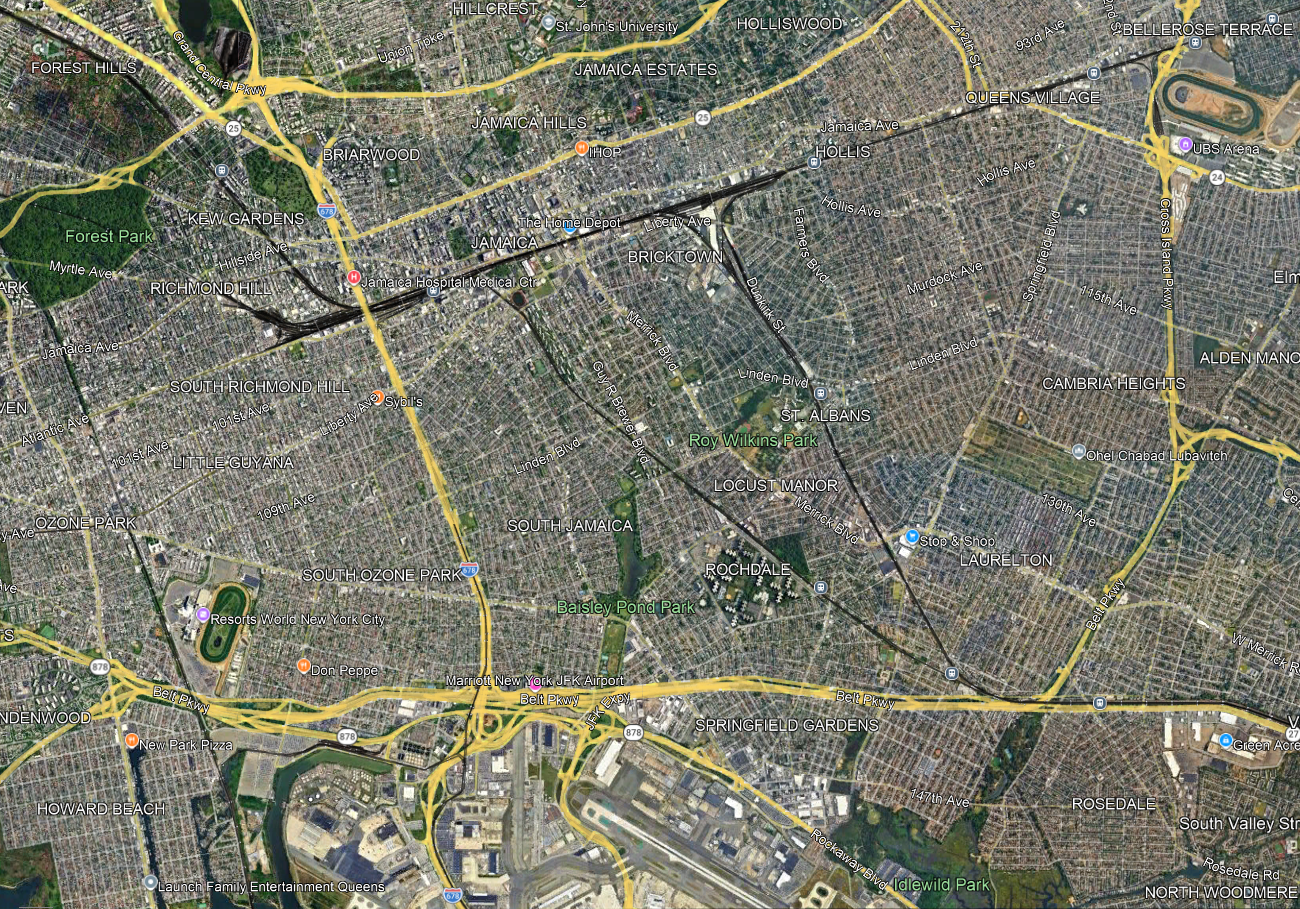
Jamaica is an obvious node, and nearly all LIRR trains already stop there and the rest should, but farther east, it’s a question of how to set up the LIRR to interact better with the city, including its buses. A lot of questions and tradeoffs have to be addressed all at once:
- Stop spacing, trading off station access time with trip times. The LIRR on the Main Line has four tracks through Floral Park so any infill station would be local-only, but that still matters for riders from points east like Floral Park and Hempstead. On the Atlantic Branch and the Montauk Line there are only two tracks, and extensive suburban ridership that would be slowed down by additional stops.
- Intersections with main arterial streets that make for natural bus connection points. The Queens Village LIRR station is at the intersection with Springfield Boulevard, but a little to its west Francis Lewis intersects the Main Line without an LIRR stop, while Hollis is not so well integrated with the street network (it’s near Farmers Boulevard, which more or less parallels the Monrauk Line). On the Montauk Line and Atlantic Branch, strong east-west bus connection points are useful; St. Albans is at the intersection with Linden, but the Atlantic Branch has no such stop at the intersection with Linden.
- Stops that permit buses to avoid congested nodes, in this case Jamaica; farther north, off-map, the same is true of Flushing. One of the goals of bus redesigns replacing traditional radial networks with grid is to get buses out of the areas where they are the slowest; this was explicit in the replacement of the radial network with the Nova Xarxa grid, increasing average speed even without any other interventions like bus lanes and stop consolidation.
- Some bus routes duplicate rail routes and could be removed or curtailed, if enough infill stops are built: for example, Merrick and Guy R. Brewer Boulevards are very closely parallel to the Montauk Line and Atlantic Branch respectively.
Without doing more detailed work yet, I suspect that the speed-access tradeoff encourages more infill stops on the Main Line and Atlantic Branches and fewer or even none on the Montauk Line, since the Atlantic Branch only continues to fairly close-in suburbs whereas Montauk carries the Babylon Branch on it, and that the buses can then be moved to a grid to connect with these stations. But the point is that this is not a decision that can be made rail-first, unlike timed connections in secondary cities and suburban town centers. The top-down hierarchy that for example Marco Chitti brings up when setting up a Takt system breaks down when one does coordinated bus-rail planning within the city.
Why IBX Shouldn’t Connect to LaGuardia
Benjamin Schneider has an interestingly wrong proposal for how to extend the Interborough Express, currently designed to run between Southern Brooklyn and Jackson Heights, toward LaGuardia Airport. I know he cares a lot about urbanist issues and public transportation, so I’d like to explain what’s in this proposal, how it errs, and how it is similar to other problematic proposals, for example by the Regional Plan Association in the Third and Fourth Regional Plans in how it tries to make one centerpiece do too many things. We considered a similar plan for inclusion in A Better Billion and chose not to, and instead connect to the airport via the Manhattan-facing Astoria Line carrying the N and W trains.
What’s the proposal?
The idea is to extend IBX to the airport, in the following way:
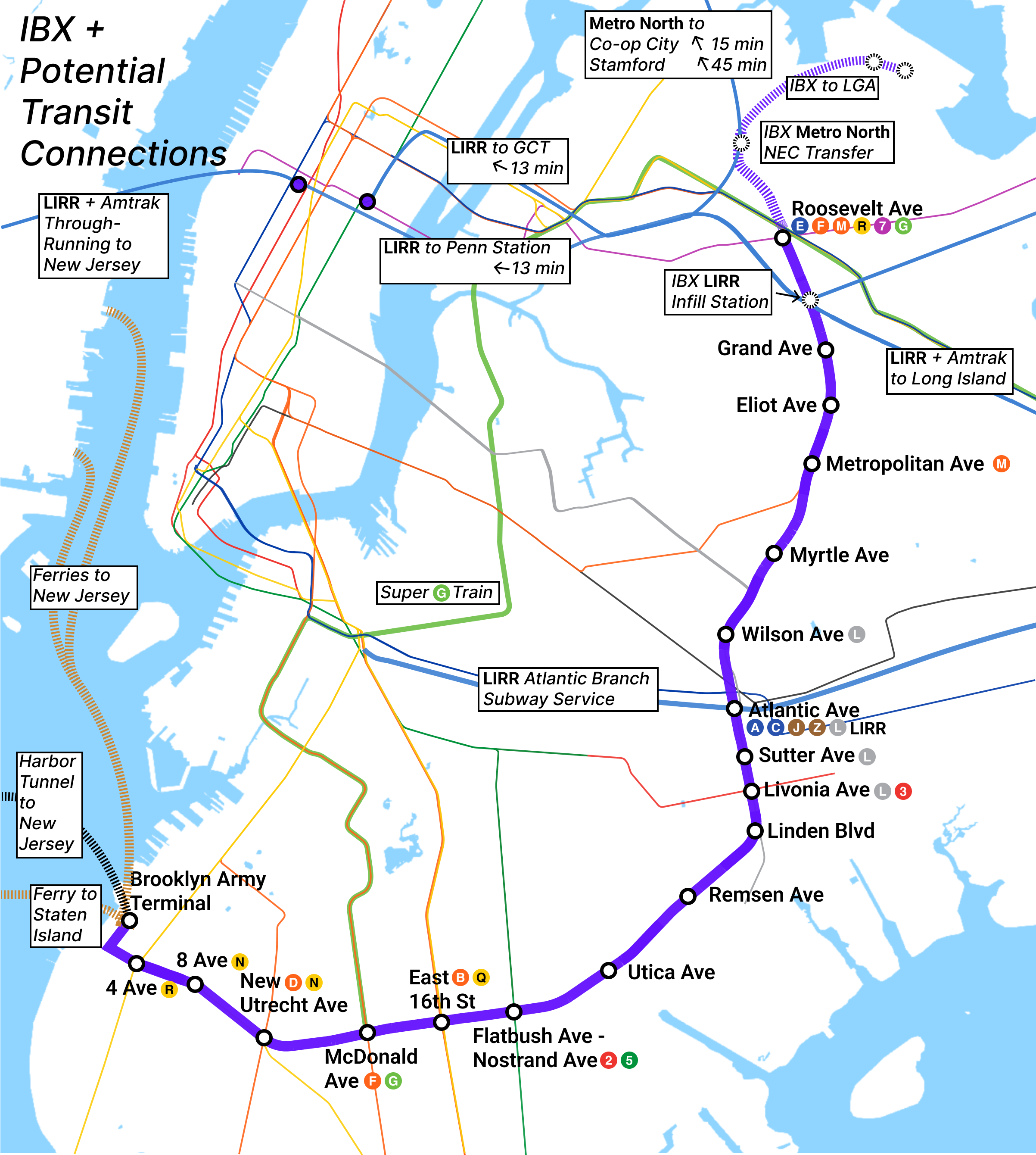
The plan adds an infill station for a transfer to the LIRR and extends the line in a slightly roundabout way to connect to an infill Northeast Corridor station before veering to the airport. This distinguishes it from early ideas that didn’t make it to A Better Billion, namely a Y from IBX to both the airport and Harlem. The point of this is not just to connect IBX with the airport but also create a hub by connecting IBX to more things, in this case a transfer station designed to connect people from the entirety of the New Haven Line to LaGuardia.
Why doesn’t this work?
The general answer is that subway lines should be radial or circumferential and not mixed, and this is a mix – IBX is circumferential, connecting stations at a fairly consistent distance from Manhattan, and the extension to the Northeast Corridor (or even Harlem, well north of Midtown) would maintain this character, but a tail veering to the airport would suddenly be radial. Such lines always underperform, because they fail at both the function of a radial line, namely connecting outlying areas to city center, and those of a circumferential, namely connecting lines to one another better and providing near-center neighborhoods with additional service orthogonal to the radial direction.
The more specific answer is that we know where passenger demand to LaGuardia is, and it’s nowhere on IBX or for that matter on the New Haven Line. Airport passenger demand is extremely Manhattan-centric, and within Manhattan it centers on Midtown and the Upper East Side:
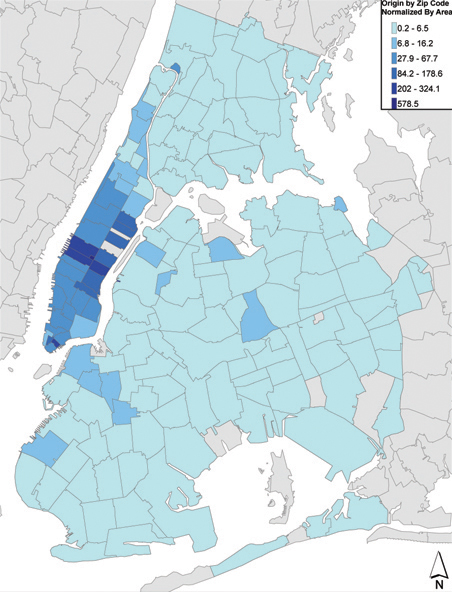
At the proposed IBX-NEC transfer point, just about every passenger from the airport would transfer to the commuter trains. The required infrastructure to build this might as well be used on a commuter rail branch, going to East Side Access as it is more central for air travelers than Penn Station based on the above map. IBX is more or less useless. Or, better yet, the Astoria Line can be extended as we propose, along an easier alignment that can be done largely above ground.
Now, what about airport workers? Those are usually mentioned, almost always as an afterthought, in various justifications for lines; I heard transit advocates use that line to argue for Andrew Cuomo’s backward air train idea back when he was still governor. Those are still poorly served by an IBX extension. On a map of airport employee residential density, it looks almost good:
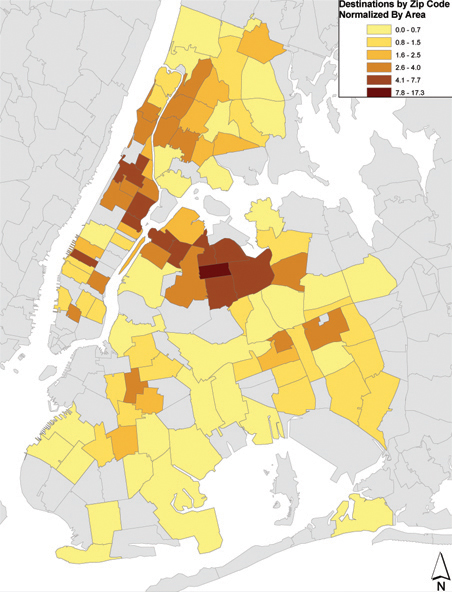
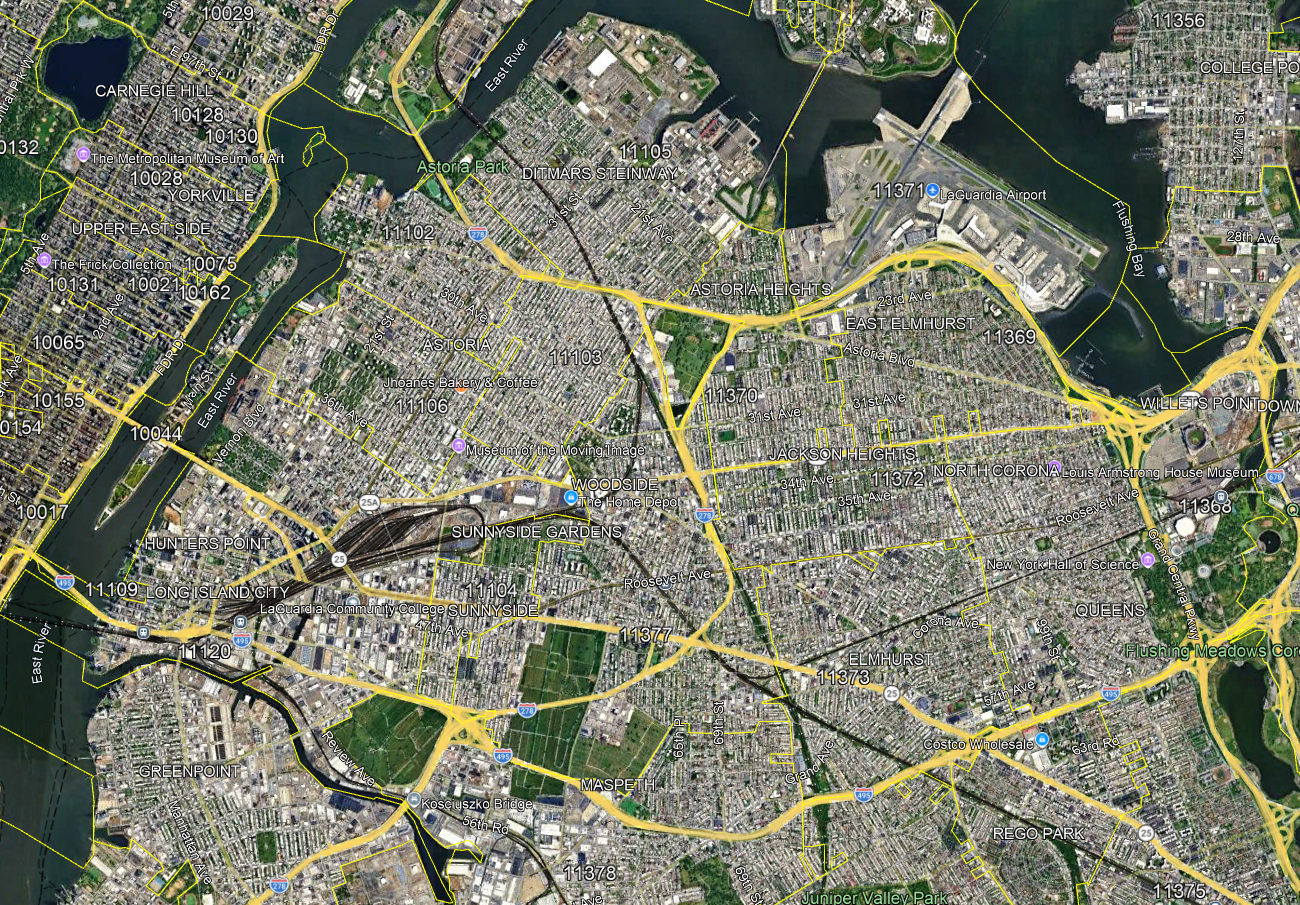
The highest-density zip code on the map above is 11372, whose southwest corner is Jackson Heights. But what’s unclear from the picture above is just how circuitous a swing from Jackson Heights to almost Astoria to LaGuardia is. The straight line distance from Jackson Heights to the nearest potential transfer station location to Terminal B is almost twice that of the direct straight line distance from Jackson Heights to Terminal B. The street grid isn’t straight but neither would an IBX extension be, needing to keep going northwest before turning 120 degrees to the east to get to the terminals. For most people in these neighborhoods, IBX would not provide a trip time improvement over buses.
But more conceptually than this, rail improvements aiming to serve airport workers are generally a bad idea, because airport workers never cluster in one residential place on which a line can be built. The paired density maps are at different scales, and the ratio between the densest and least dense colors is much higher for the air traveler density map than for the airport employee one. OnTheMap gives, as of 2023, 11,000-12,000 airport workers, depending on whether one counts hotel workers across the Grand Central Parkway from the airport in the total. Out of 11,666 on a more generous count, only 3,200 even live in Queens and only 1,182 live in Brooklyn. The blob of seven high-density zip codes of worker origin plus the medium-density one between them (11377, just west of Jackson Heights) only furnishes 1,000 airport workers from all eight zip codes combined.
How does this relate to previous proposals?
There’s a tendency in New York planning, at all levels of officialness from the RPA down, to take one big project that’s politically agreed on and hang everything on it. The Third Regional Plan tried to tie in everything to Second Avenue Subway, to the point of bloating it to a four-track line (by the 1990s all planning was for a two-track line). Even commuter rail, in this case a LIRR Atlantic Branch connection to Lower Manhattan, was shoehorned into it, with through-service onto the subway. The Fourth Plan did the same with its Triboro proposal running through to Metro-North in the Bronx and with commuter rail through-tunnels trying to work around Gateway.
The result of such schemes is proposals that try to have a single line do work it cannot possibly do and would be compromised to the point of unusability if it were forced. In Los Angeles, for example, this is leading to a squiggle of a subway extension of the K (Crenshaw light rail) Line through West Hollywood, 6 km longer than it needs to be. In New York, this is leading to taking IBX, as pure a circumferential as one can be, and lading it with tunnels to destinations for which it doesn’t make sense.
It’s important to resist this temptation. If rail service to LaGuardia is desired, it should use the subway line that already points in that direction, whose alignment allows for an elevated extension, just marginal enough to the residential parts of Astoria to avoid NIMBYs, just close enough to still serve the neighborhood well. The overall planning complexity of two good lines is less than that of one bad line – the cost doesn’t magically increase just because the rail link from Astoria to LaGuardia is categorized as “N/W extension” rather than “IBX extension,” and it’s easier to supervise more, smaller projects if they’re parallelizable.
Why Building Metros is Necessary for the Green Transition Away from Cars
There’s controversy in Germany over building U- and S-Bahn extensions, in which environmentalists argue against them on the grounds that people can just take trams and the environmental benefits of urban rail are not high. For example, the Ariadne project prefers push factors (green regulations and taxes) to pull factors (building better alternatives), BUND opposes U- and S-Bahn expansion, and a report endorsed by Green politicians argued based on shoddy analysis leading to retraction that the embodied carbon emissions of tunneling exceeded any savings, which it estimated at only 714 t-CO2 per underground km built. Against this, it’s important to sanity-check car and public transport ridership to arrive at more solid figures.
To start with, virtually everyone travels by car or by public transport. There’s a notable exception for cycling, but cycling is typically done at short ranges, and the metro expansions under discussion here (all outside the Ring) are beyond that range. In Berlin, the modal split for cycling peaks in the 1-3 km range and is small past 10 km. Beyond the scale of a neighborhood or maybe a college town, cars and mass transit are substitutes for each other.
Nor does public transport expansion lead to hypermobility, in which overall trips grow longer as people commute from farther away and car use doesn’t decline or only weakly declines. If anything, the ratio of substitution for passenger-km rather than trips is that a p-km by metro substitutes for more than one p-km by cars, because metro-oriented cities can be denser and allow for shorter commute trips. Berliners average 3.3 4.6-km trips per day, or 15 km/day; Germany-wide, it’s 35.5 km/day (see table 11 of MiD). If anything, the presence of a large city core also shortens the average car trip by reducing exurb-to-exurb driving at low density.
Nor does polycentricity solve the problem. Indeed, ridership in polycentric regions is weaker than in monocentric ones. MiD has data by state and Verkehrsverbund in Germany, with modal splits by trips (all trips, not just work trips) and passenger-km, the latter measure having far less in the way of cycling and walking. From this, we have the following table:
| Geography | Transit % (trips) | Car % (trips) | Transit % (p-km) | Car % (p-km) |
| Berlin | 27 | 24 | 47 | 40 |
| Brandenburg | 9 | 51 | 22 | 71 |
| Mecklenburg-Vorpommern | 7 | 52 | 14 | 80 |
| Saxony-Anhalt | 9 | 48 | 12 | 81 |
| Saxony | 11 | 56 | 16 | 77 |
| Thuringia | 9 | 55 | 16 | 79 |
| Hamburg | 22 | 29 | 43 | 47 |
| Bremen | 14 | 33 | 30 | 60 |
| Schleswig-Holstein | 8 | 56 | 14 | 79 |
| Lower Saxony | 8 | 53 | 15 | 77 |
| Nordrhein-Westfalen | 10 | 55 | 18 | 74 |
| Rheinland-Pfalz | 9 | 57 | 19 | 75 |
| Saarland | 10 | 65 | 15 | 79 |
| Hesse | 12 | 52 | 19 | 74 |
| Baden-Württemberg | 9 | 53 | 17 | 75 |
| Bavaria | 10 | 56 | 18 | 75 |
| Munich (city) | 25 | 29 | 39 | 51 |
| Frankfurt (city) | 24 | 29 | 38 | 52 |
| Stuttgart (city) | 23 | 36 | 33 | 60 |
| Munich (MVV) | 19 | 41 | 31 | 61 |
| Hamburg (HVV) | 16 | 33 | 29 | 63 |
| Hanover (Region) | 15 | 42 | 25 | 66 |
| Rhine-Main (RMV) | 13 | 49 | 22 | 71 |
| Rhine-Neckar (VRN) | 10 | 51 | 17 | 75 |
| Rhine-Ruhr (VRR) | 12 | 53 | 20 | 73 |
| Rhine-Sieg (VRS) | 12 | 49 | 22 | 70 |
Berlin is by all measures the most public transport-oriented and least car-oriented part of Germany. The source doesn’t explicitly break out VBB, but VBB comprises Berlin and Brandenburg, whose population ratio is 59:41, so we get a modal split by trips of 20% transit, 35% car; a similar computation for p-km is less certain since Brandenburgers, many of whom commute to Berlin, have longer trip lengths, but it’s likely Berlin and Brandenburg’s combined modal split is slightly better than those of MVV and HVV, both monocentric. Brandenburg, notably, has the highest modal split by p-km outside the city-states, owing to the Berlin commuters.
In contrast, the polycentric regions – Rhine-Neckar (Mannheim), Rhine-Ruhr (excluding Cologne), Rhine-Sieg (Cologne-Bonn), and to a large extent also Rhine-Main (Frankfurt) – all have weak modal splits. The cities themselves have healthy usage of public transport, judging by the data that’s available and by ridership on their Stadtbahn systems, but most of the Rhine-Ruhr’s population doesn’t live in Düsseldorf, Duisburg, Essen, Dortmund, or Wuppertal, and this population drives.
The upshot is that rail development that strengthens city center at the expense of suburban job clusters should be considered a positive development for transitioning from cars to public transport. Job clusters outside city center do not reduce commuting, but instead make commuting more auto-oriented.
This, in turn, creates serious estimation problems for the diversion rate, which is why environmental benefit-cost analyses underrate the effect of urban rail construction. An expansion of a north-south line like U8 would not just increase the residential connectivity of Märkisches Viertel but also, on the margins, increase the commercial connectivity of Alexanderplatz and other central stations served by the line. This, in turn, should induce additional ridership on lines nowhere near Märkisches Viertel, for example, east-west lines like U5 and U2. At the neighborhood level, the construction of the line would create a lot of induced trips and not have a high diversion rate from cars. But at the city level, little examples of diversion as more work and non-work destinations cluster in Mitte would multiply, never enough for an easy comparison, and yet enough that, as we see, more people would be living and working here without driving, where otherwise they’d be driving between two Kreise elsewhere in Germany.
Taken all together, the diversion rate at the level of trips should be considered 100%: at large enough scale, every trip by public transport is a trip not done by car, perhaps in the city, perhaps elsewhere in the country. Every p-km by public transport is multiple p-km not done by car, since dense cities allow for shorter trips without the traffic congestion problems caused by trying to fit high density and also a high modal split for driving.
With that in mind, a calculation of a first-order diversion rate is in order. A daily trip by rail is a daily trip not done by car. The average trip length in Germany by all modes is 12 km, but this is weighed down by short walking and biking trips; the average daily driving rate per car is 26 km (see table 21 of MiD) when the car is in use, and is 10,000 km/year per car. If we take 10,000 v-km to be the diversion rate per 3 public transport trips, we get that, at the emissions intensity of 2017, a daily public transport trip represents an annual emissions reduction of 0.43 t-CO2. The Märkisches Viertel extension of U8, estimated to get 25,000 trips/day, would reduce Germany-wide emissions by 10,000 t/year, which is nearly an order of magnitude more than the carbon critique of Berlin U-Bahn expansion got. At the current 670€/t cost used in German benefit-cost analyses this is around a 2% rate of return on cost purely from the carbon savings, never mind anything else – and usually green policy uses a low discount rate due to the long-term effects of greenhouse gas emissions, 1.4% in the Stern review.
Against Land Value Capture
An otherwise-good video by the Joint Transit Association about A Better Billion criticizes us for not proposing value capture to fund the scheme. I’ve seen other otherwise-good American transit advocates back this, and I’ve seen many a thinktank propose it and similar nonconventional schemes to fund public transit, in lieu of taxes. Taxes are political. Taxes annoy voters. So why not get around them by taxing development behind the scenes? It’s attractive on the surface, but in truth, broad taxes are the only way to fund government and expect it to perform as expected; value capture is so opaque that it is very easily wasted, to the point that 100% of the funds it provides can sometimes be wasted on excess construction costs, as has been the case in Hong Kong. Good transit advocates should reject this scheme and demand that funding be as straightforward as possible, with the understanding that the part about taxes that annoys voters is what ensures the money is spent well.
What is value capture?
Value capture is the name for any of a set of programs aiming to fund infrastructure by taxing the development that it would unlock – in other words, to capture some of the value gained by the private sector. This contrasts with broad-based taxes, which capture value from the entire economy and not just from specific developments or developments in specific areas. The idea is that the infrastructure generates value not just for the broad economy but also specifically in the area it serves, so it’s right to tax that area.
In practice, value capture schemes are most common when there’s perception that raising broad taxes is too difficult politically, or undesirable otherwise. Hong Kong extensively uses value capture to fund MTR expansion, not because its taxes are too high but because it wishes to keep its taxes very low. American cities have begun looking into such schemes in much higher-tax environments, with limited willingness to fund things out of the general budget; the 7 extension in New York was built with bonds tied to tax increment financing (TIF), which promised that the higher property taxes generated by Hudson Yards development would pay the bonds back.
Which projects are funded by value capture?
Naturally, value capture and TIF systems favor projects that have the most real estate value to capture. In New York, this meant the 7 extension but not Second Avenue Subway, which the real estate advisors to Bloomberg denigrated on the grounds that the Upper East Side was already developed.
This already creates biases, in favor of not just wealthier areas (the Upper East Side is after all rather rich) but also ones with high redevelopment potential, for example because they are underbuilt. This, in turn, favors worse projects, because they serve lower preexisting density.
The dominant benefit of public transportation in benefit-cost analyses, which are not undertaken in the United States, is the benefit to passengers, representing social surplus. For an example that was just sent to me, a study from last month analyzing a further Nuremberg U-Bahn extension classifies the total benefits of the chosen alternative on p. 30 as 5.73 million €/year in passenger benefits, plus about 3 million €/year in various externalities of which the biggest are reduced accident costs and reduced traffic congestion. Similarly, Börjesson et al’s ex post analysis of the T-bana, finding a benefit-cost ratio of 6, has consumer surplus dominating the benefits of the system. Land use changes are helpful, but the main purpose of a subway is to be ridden rather than to stimulate real estate development. A Better Billion looks at the possibilities of development unlocked by new lines, but not for nothing, we also look at existing bus ridership and subway capacity problems in analyzing which projects to recommend; development-oriented transit can work but only as a secondary option, and value capture overemphasizes it in preference to other needs.
Value capture and costs
Hong Kong is famous in the core English-speaking world for linking development with MTR construction. It’s also a very good example of what not to do. I complained mightily about value capture in 2017, but if anything I pulled punches, because while I did talk about Hong Kong’s use of MTR value capture as a corrupt slush fund, I didn’t know enough to connect this with Hong Kong’s other problems:
- Very high infrastructure construction costs. They are so high that value capture only covers about half the project costs, and the other half, funded directly by the government, is still more per kilometer than the world average cost. Hong Kong, moreover, has been ground zero for the adoption of the consultant-centric globalized system of procurement – British consultants who were there in the 1980s and 90s workshopped the system and then brought it home, leading to a cost explosion that rendered first London, then Australian and Canadian cities, incapable of building urban rail. In this sense, value capture is an attempt to paper over the inability to build by using a tool perfected in the city that has extreme construction costs and can only build anything because, with car ownership suppressed by taxes, it has atypically high demand.
- Overcrowding, likely the worst in the developed world. The data out of Hong Kong isn’t quite comparable to the most overcrowded cities in the democratic world (Paris averages 31 m^2/capita). Hong Kong reports median rather than mean housing size: its median is 16 m^2, and while it has a lot of inequality, it doesn’t produce nearly a factor of 2 of a mean-median spread. Hong Kong has atypically high inequality, but even that only produces a mean-to-median income ratio of 0.67, and housing surface area is distributed more equally than income. So it’s almost certain Hong Kong is the first world’s overcrowding capital, all because the state doesn’t develop enough land or housing (net annual housing growth is 3.8 dwellings/1,000 people, low for East Asia) in order to create more profits for the MTR to fund ever growing construction costs.
The way forward
Value capture and other nonconventional funding strategies should be categorically rejected. They lead to poor project selection, high construction costs through opacity, and, in the most extreme cases, other governance problems including Hong Kong’s legendarily bad overcrowding. The only legitimate way to fund public transportation and other infrastructure project is through broad-based taxes, either directly as in some dedicated payroll and sales taxes found in both the United States and Europe or, better yet, through the general budget, debated at the highest responsible level of government (municipal, provincial, or national), itself funded largely by broad taxes.
Against Free Buses
Much of the public discussion over A Better Billion, our proposal to increase New York’s subway construction spending by $1 billion a year in lieu of Zohran Mamdani’s free bus plan, has taken it for granted that free buses are good, and it’s just a matter of arguing over spending priorities. Charlie Komanoff, who I deeply respect, proposes to combine subway construction with making the buses free. And yet, free buses remain a bad idea, regardless of funding, because of the effects of breaking fare integration between buses and the subway. If there is money for making the buses free, and it must go to fare reductions rather than to better service, then it should go to a broad reduction in fares, especially if it can also reduce the monthly rate in order to align with best practices.
Planning with fare integration
The current situation in New York is that buses and the subway have nearly perfect fare integration: the fares are the same, the fare-capped passes apply to both modes equally, and one free transfer (bus-bus or bus-subway) is allowed before the passenger hits the cap. Regular riders who would be taking multi-transfer trips are likely to be hitting the cap anyway so that restriction, while annoying, doesn’t change how passengers travel.
Under this regime of fare integration, buses and the subway are planned together. The bus network is not planned to connect every pair of points in the city, because the subway does that at 2.5 times the average speed. Instead, it’s designed to connect subway deserts to the subway, offer crosstown service where the subway only points radially toward the Manhattan core, and run service on streets with such high demand that buses get high ridership even with a nearby subway. The same kinds of riders use both modes.
The bus network has accumulated a lot of cruft in it over the generations and the redesigns are half-measures, but there’s very little duplication of service, if we define duplication as a bus that is adjacent to the subway and has middling or weak ridership. For example, the B25 runs on Fulton on top of the A/C, and the B37 and B63 run respectively on Third and Fifth Avenues a block away from the R, and all have middling traffic. In contrast, the Bx1/2 runs on Grand Concourse on top of the B/D but is one of the highest-ridership buses in the system. B25-type situations are rare, and most of the bus service that needs to be cut as part of system modernization is of a different form, for example routes in Williamsburg that function as circulators with maybe half the borough’s average ridership per service hour.
In this schema, the replacement of a bus with a train is an unalloyed good. The train is faster, more reliable, more comfortable. Owing to those factors, the train can also support higher ridership and thus frequency. If the train stops every 800 meters and averages 30 km/h and the bus stops every 400 and averages 15 (the current New York average is much lower; 15 is what is possible with stop consolidation from 200 to 400 meter interstations and other treatments), then it takes a 2.5 km trip for the replacement to be worth it on trip time even for a passenger living right on top of the deleted bus stop, and a 5 km one if we take into account the walk penalty – and that’s before we include all the bonuses for rail travel over bus travel, which fall under the rubric of rail bias.
The consequences of differentiated fares
All of the above planning goes out the window if there are large enough differences in fares that passengers of different classes or travel patterns take different modes. Commuter rail, not part of this system of fare integration in New York or anywhere else in the United States, is not planned in coordination with the subway or the buses, and fundamentally can’t be until the fares are fixed. Indeed, busy buses run in parallel to faster but more expensive and less frequent commuter lines in New York and other American cities, and when the buses happen to feed the stations, as at Jamaica Station on the LIRR or some Metro-North stations or at some Fairmount Line stations in Boston, interchange volumes are limited.
Commuter rail has many problems in addition to fares. But when the subway charges noticeably higher fares than the bus to the point that passengers sort by class, the same planning problems emerge. In Washington, the cheap, flat-fare bus and more expensive, distance-based fare on Metro led to two classes of users on two distinct classes of transit. When Metro finally extended to Anacostia with the opening of the Green Line in 1991, an attempt to redesign the buses to feed the station rather than competing with Metro by going all the way into Downtown Washington led to civil rights protests and lawsuits alleging that it was racist to force low-income black riders onto the more expensive product.
Whenever fares are heavily differentiated, any shift toward the higher-fare service involves such a fight. One of the factors behind the reluctance of the New York public transit advocacy sphere to come out in favor of commuter rail improvements is that those are white middle class-coded because that’s the profile of the LIRR and Metro-North ridership, caused by a combination of high fares and poor urban service. Fare integration is a fight as well, but it’s one fight per city region rather than one fight per rail project.
And more to the point, New York doesn’t even need to have that one fight at least as far as subway-bus integration is concerned, because the subways and buses are already fare integrated. What’s more, free bus supporters like Mamdani and Komanoff aren’t proposing this out of belief that fares should be disintegrated, but out of belief that it’s a stalking horse for free transit, a policy that Komanoff has backed for decades (he proposed to pair it with congestion pricing in the Bloomberg era) and that the Democratic Socialists of America have been in favor of. The latter is loosely inspired by 1960s movements and by reading many tourist-level descriptions in the American press of European cities with too weak a transit system for revenue to matter very much. Free buses in this schema are on the road to fully free transit, but then the argument for them involves the very small share of transit revenue contributed by buses rather than the subway. In effect, an attempt to make the system free led to a proposal that could only ever result in disintegrated fares, even though that is not the intent.
But good intent does not make for a good program. That free buses are not proposed with the intent of breaking fare integration is irrelevant; if the program is implemented, it will break fare integration, and turn every bus redesign into a new political fight and even create demand for buses that have no reason to exist except to parallel subway lines. The program should be rejected, not just because it costs money that can be better spent on other things, but because it is in itself bad.
A Better Billion and the Cost Model versus the 125th Street Subway Extension
We released a new report called A Better Billion. It was covered rather positively in the New York Times yesterday, with quotes from other transit advocacy groups. The idea for our report is that Zohran Mamdani promised free buses in his successful primary campaign, and promised free and fast buses in his successful general election campaign for mayor, so let’s take the $1 billion a year this could cost in forgone revenue and see how to spend it on subway expansion instead.
There’s been a lot of discussion in the article and on social media about the idea of free buses, but instead I want to talk about our proposal’s cost model, in the context of a rather incompetent plan the MTA released recently for a subway extension of Second Avenue Subway under 125th Street, at twice the per-km cost of Second Avenue Subway Phases 1 and 2, and twice the cost we project. Our model is not based on non-Anglo costs, but rather on real New York costs, modified to incorporate the one major cost saving coming from our previous reports, namely, shrinking station size. Based on everything combined, we came up with the following medium cost model:
| Item | Cost (2025 prices) |
| Tunnel (1 km) | $530 million |
| Tunnel, underwater (1 km) | $1,050 million |
| El or trench (1 km) | $260 million |
| Station, cut-and-cover | $510 million |
| Station, mined | $770 million |
| Station, el or trench | $240 million |
These costs include apportioned soft costs and not just hard costs. Altogether, an extension of Second Avenue Subway from Park Avenue to Broadway, a distance of 2 km with three mined stations at the intersections with the north-south subway lines, should cost $3.4 billion. This is not much less per kilometer than Second Avenue Subway Phases 1 and 2, which can be explained by the denser stop spacing and the need for mined stations at the undercrossings. If everything else were done in the right way rather than the American way, the low cost model would apply and costs would be reduced further by a factor of about 3, but the per-km cost would remain one of the highest outside the Anglosphere for those geotechnical reasons.
But the MTA and its consultants, in this case AECOM, project $7.7 billion, not $3.4 billion. Why?
Worse project delivery
We’ve assumed the existing project delivery systems the MTA is familiar with. However, what doesn’t move forward moves backward, and the procurement strategy at the MTA is moving backward rapidly, for which the primary culprit is Janno Lieber, first in his role at MTA Capital Construction (now Construction and Development), and then in his role as MTA head, pushing alternative delivery methods, especially design-build and increasingly progressive design-build (unfortunately legalized in New York last year). Such methods add to the procurement costs and especially to the soft costs. Second Avenue Subway Phase 1 had an overall soft cost multiplier of about 1.5: the total cost including soft costs was 1.5 times the hard costs (Italy: 1.2-1.25 times). This proposal, in contrast, has a multiplier of 1.75: the hard costs are estimated at $4.4 billion, and the total costs are 75% higher, technically including rolling stock except rolling stock at current New York costs is $80 million.
Contingency
The soft costs include a federally mandated 40% contingency. The FTA mandates excessive contingencies – the norm in low-cost countries is 10-20%, and anything more than that is just wasted. The contingency figure varies by phase of design and decreases as it advances, but in the earliest phase it is 40%, and it’s in that phase that budgeting is done. However, 40% is only required over hard costs based on standardized cost categories (SCCs), and not over past ex post costs that incorporated contingency themselves. In effect, the estimation method the MTA and AECOM prefer bakes in a 40% overrun at each stage, letting project delivery get worse over time as the globalized system of procurement takes deeper roots in New York.
Overdesign and overbuilding
Based on our recommendations, the MTA shrank the station overages in Second Avenue Subway Phase 2. Phase 1 had station digs 100% longer than the platforms, based on standards that were both extravagant to the taxpayer and spartan to the end user – the extra space is not usable by passengers but instead for unnecessary break rooms, separated by department. By Phase 2, this was reduced to a 50% overage, and we hoped that proactive design around best practices would reduce this further.
Unfortunately, the overages are still substantial, 50% at St. Nicholas and 25% at the other two stations (Italy, Sweden, France, Germany, China: 3-20%). Moreover, the stations still have full-length mezzanines. This a longstanding New York tradition, going back to the 1930s with the opening of the IND lines starting with the A on Eighth Avenue in 1933. And like all other New York subway building traditions that conflict with how things are done in more advanced, non-English speaking countries, it belongs in the ashbin of history. Mined stations’ costs are sensitive to dig volume, and there is little need for such additional circulation space, for passenger comfort or fire safety. Mezzanines are essentially free if the stations are built cut-and-cover, in which case they are used for back-of-the-house space in advanced countries, but not if the stations are mined, in which case the best place for break rooms is under stairs and escalators.
Moreover, as we will explain soon at the Effective Transit Alliance, mined stations and bored tunnel require a minimum spacing from the street and from other tunnels – but the proposal includes much more space than necessary, forcing the stations to be deeper, more expensive, and less convenient as it takes a full five minutes to transfer between platforms or to get from the platform to the street. It’s possible to ge even shallower with shoring techniques used in China to reduce tunnel and station depth in complex urban undergrounds.
Proactive and reactive cost control
When the MTA announced cost savings and station size shrinkage in Phase 2, we were excited. But on hindsight, costs in effect fell from $7 billion to $7 billion. The savings were entirely reactive, designed to limit further cost overruns, and are not proactively incorporated into further projects.
No doubt, if a $7.7 billion project is approved against any honest benefit-cost analysis (which is not required in American law), then shrinkage in station footprint and reduction in mezzanine length will be found to be saving money in 2032, and the successor of Lieber, hired from the same pipeline of people whose takes on other countries are “I had a kid who did a semester abroad in Stockholm,” will be proud of reducing costs from $7.7 billion to $7.7 billion.
The path forward must instead incorporate cost savings proactively. There’s a way of building subway stations cost-effectively, and instead of quarter-measures, the MTA should adopt it; we have blueprints from a growing selection of examples, all in places that have avoided the destruction of subway building capacity infecting the entire English-dominant world in the last 25 years. The MTA can even hire people with direct transport official-to-transport official communication with peers at other agencies (for example, through COMET) and with the language skills to read documents produced in lower-cost countries, instead of people whose best skill is giving interviews to softball interviewers and talking about sports.
British Construction Costs and Centralization
There’s an ongoing conversation in the United Kingdom right about state capacity and centralization. The United Kingdom is notable for how centralized it is compared with peer first-world democracies of similar size. It also has weak state capacity on matters including infrastructure construction, which quite a lot of analysts and thinktanks assume is connected. Most recently, I’ve seen conversations on Bluesky in British media, talking about how the loss of state capacity in the UK in the last 45 years has really been about centralization of functions that local and county governments used to do and therefore the solution is to devolve some functions in England to counties or regions. Much of this discourse is by people I deeply respect, like the Financial Times’ Stephen Bush, pointing out sundry services Greater London ran before Margaret Thatcher’s anti-local government reforms in the 1980s. And yet none of this is relevant to infrastructure construction costs and the country’s inability to build more than a half-phase high-speed line at costs that would be high for a subway.
English centralization…
England has been very centralized for a long time, since the Early Middle Ages. It never really had anything like the German or Italian states, or even French provinces, not have its reforms to local government established anything like the French regions. Scotland, Wales, and Northern Ireland have extensive devolution, but 85% of the population lives in England, and the overall character of the state is never driven by peripheral regions comprising 15% of it. Indeed, in the OECD, by one measure, the United Kingdom has the single largest share of taxes going to the central government, and the second largest share of spending decided by the central government behind New Zealand. The other reasonable measure of centralization would be to do the same but assign social security to the central government, since it invariably either is national or comes with extensive equalization payments; then a few small countries like Israel and Ireland end up more centralized, but none of the European countries of comparable population.
How to fund and what to devolve to local government in England has been a complex issue over the last few generations. Local taxation is weak, and there is nothing like the German system in which the federal government, which collects 95% of taxes, distributes the taxes to the states by formula to do with as they please. The succession of local council tax programs to fund such governments culminated in Margaret Thatcher’s community charge, better known as the poll tax, which was so unpopular it led to her overthrow in a palace coup; at the time, Labour was polling 20% ahead due to backlash against the proposal.
Thatcher herself worked to disempower regional governance that had been established in the two decades before she took office. She aimed to destroy three institutions that she believed were keeping Britain socialist and thus backward: unions, public-sector bureaucracies, and regional governments. On the last point, she led a reform that eliminated regional governance in the Metropolitan Counties, creating a unique situation in which the constituent municipalities of these counties are single-tier municipalities with no level of governance between them and the state. Anything else would permit powerful Labour regions to challenge state privatization and deunionization schemes. Indeed, reforms by the New Tories to undo this and devolve some functions to the Met Counties created elected mayors, and now the mayor of Greater Manchester, Andy Burnham, has arisen as a powerful Labour politician who is mooted by many (including the Green Party) as a potential replacement for Keir Starmer in an intra-party palace coup.
…is not the reason for high costs
The truth is that while the United Kingdom is atypically centralized, at least in England, the exact same problems are seen across the Anglosphere, with roughly the same origin (except in the United States, whose problems have a different origin). British costs exploded in the 1990s, and Canadian and Australian costs followed suit in the 2000s and 2010s, imitating bad British practices. Australia and Canada both have some of the fiscally strongest states/provinces in the OECD, the exact opposite of the United Kingdom.
Across Europe, subtracting the United Kingdom, there isn’t an obvious relationship between centralization and poor state capacity. The Nordic countries are both rather devolved for small unitary states, managing health care and education subnationally. For example, in Finland it’s done in 21 health care regions, with ongoing debates over reducing the number of regions, but no attempt to eliminate devolution and make it a national system, in a country that after all has about the same population as Scotland. On the other hand, Italy is not much less centralized than the United Kingdom, and its infrastructure construction program is excellent, limited by money and uncertain growth prospects but perfectly capable of building a national high-speed rail network for less than half the budget of the 225 km High Speed 2. In democratic Europe, the strongest correlate of high costs is exposure to the United Kingdom and its way of doing things, with the Netherlands having the worst costs and most compromised infrastructure construction.
The privatization of state planning
At the Transit Costs Project, we are putting together a cost report on London, largely about Crossrail but also other recent urban rail expansion including the Docklands Light Railway and the Northern line extension. And what comes out of this history is that it’s not really about centralization. Rather, the United Kingdom invented what I called in the Stockholm report the globalized system, in which planning functions are privatized to large consultant firms while the role of the state is reduced to at most light oversight.
The explosion in costs in the 1990s, producing the Jubilee line extension at nearly four times the real per-km cost of the original Jubilee line, was part of this transition. It was easy to miss the first time we looked because the telltale signs of the globalized system, like design-build contracts, weren’t there yet. If anything, DLR was more privatized in its project delivery, and had reasonable costs until the Bank extension. And yet, delving more deeply, we (by which I mean Borners) found that beneath the surface it did have quite a lot of those negative features.
For example, while the Jubilee line extension was designed with in-house planning, it was understood that future projects would transition to more privatized planning. Thus, there was no expectation that the knowledge gained while building the extension would stick around, and at any rate, there was pressure to build like in Hong Kong, where pro-privatization British consultants cut their teeth in the 1980s and early 1990s. In effect, while the extension was designed in-house, it had all the features of a special purpose delivery vehicle (SPDV, or SPV), the preferred British and increasingly pan-Anglosphere way of delivering large projects: each project’s team is specific to the project itself and after completion the employees, drawn from a mix of private consultancies and public agencies, scatter and are not reassembled as a team for future projects. DLR was if anything the opposite: it was nominally private in its delivery but the same designers were involved throughout, moving between private employers and functions, so it was not de facto an SPDV, whereas the Jubilee line extension de facto was one.
Why do Brits blame centralization?
High costs in the United Kingdom cannot have much to do with the extent of devolution. Australia and Canada have adopted the same way of planning, after all. The British system in which big decisions can only be made by the minister and not by senior, let alone mid-level, civil servants, can be implemented regardless of scale, and Canadian provinces and Australian states are thus without exception not capable of building infrastructure for costs that were routine as late as 20 years ago.
But it can look like centralization, for all of the following reasons:
- The United Kingdom really does have issues with overcentralization and underempowerment of regional governments, though the latter is being fixed to some extent, at least for the Met Counties. It is natural to see two governance problems that cooccur and assume they’re related.
- The origin of the British cost explosion is, ideologically, the same process that also disempowered regional governments. It took some work to figure out the exact process, which was not at all the same as the conversion of the Met Counties to single-tier authorities. Indeed, in Canada the disempowerment of local or regional authorities never happened, but the transition to privatized planning with political rather than civil service oversight did happen, with large design-build contracts with more consultant involvement.
- The implementation of centralization in the United Kingdom has relied on ministerial approvals, and those genuinely bottleneck the state. A better system of centralization, such as in Italy, relies on trust in the civil service. But a prime minister whose favorite television show was Yes, Minister would never have produced such a system.
But that it may be reasonable for a Brit who doesn’t look too closely at how Canada and Australia fail in parallel ways to assume that it’s about centralization does not mean that it is in fact about centralization. Centralized states that don’t speak English routinely build infrastructure efficiently and highly devolved ones that do are incapable of relieving the most important bottlenecks in their city centers.
Fare Practices
Here’s a table of urban public transport fares for various cities, covering the United States, Canada, parts of Europe, Turkey, and Japan. Included are single fares, multi-ride discounts, day passes, weeklies, and monthlies, with the last three shown with their ratios to single fares. As far as possible we’ve tried doing fares as of 2026, but it’s possible a few numbers are not updated and depict 2025 figures.
The thing to note is that in Continental Europe, there are steeply discounted monthlies – only two cities in the table charge for a monthly more than for 30 single-trips (Paris at 35.5, Bari at 35). Most Italian cities cluster around 20, and Barcelona, Lisbon, and especially Porto are even lower. Berlin used to have a multiplier of 32 before the 9€ monthly and the subsequent Deutschlandticket but the current multiplier is 15.75 within the city. Stockholm has a monthly multiplier of 24.7. Prague’s multiplier is 12.
Japanese monthly fares are strange by Western standards, in the sense that they are station-to-station, with subsegments allowed but no trips outside the segment; subject to this constraint the multiplier is 30-40, with small additional discount for buying 3-6 months in advance, but the unrestricted monthly fare is very high. London and Istanbul functionally do not have monthlies, in the sense that the multiplier is so high (78.5 Istanbul-wide, and it’s not truly unlimited but is capped at 180 trips/month) that except for trips within Central London it might as well not exist.
American and Canadian monthly fares are usually higher than in Continental Western Europe, with multipliers in the 30s. New York’s multiplier was especially high, about 46, and the MTA has just abolished the monthly fare entirely and phased out the MetroCard (as of the new year, starting in two hours), making people use the weekly cap with OMNY instead, which has a multiplier of 11.7 and, over a 30-day month, forces a monthly multiplier of 50. Toronto has a very high monthly multiplier as well, 46.6. This is bad practice: a high monthly discount functions as a technologically simple off-peak discount (indeed, London pairs its stingy monthly discount with a substantial off-peak discount), and OMNY itself is buggy to the point that fare inspectors on the buses can’t tell if someone has actually paid except by looking at debit card statements, which do not show one as having paid if one has a valid transfer or has reached the weekly cap (and not tapping in this case is still illegal fare dodging in New York law).
The practice of the cap, increasingly popular in the US under London influence, is rare as well. London’s fare cap originates in its complex zone system: the Underground has nine zones with zone 1 only covering Central London so that passengers taking multiple trips per day can expect to take trips across different zones that they may not be familiar with; there isn’t fare integration, but rather there’s a special surcharge on some commuter train trips and a discount on buses; peak and off-peak fares are different. Thus, the calculation for the passenger of whether to buy tickets one at a time or get a pass is difficult, so Oyster does this calculation automatically to give the most advantageous fare. In a Continental city where fares are either flat regionwide or have zones with limited granularity (often the entire metro is in the innermost zone) and monthly discounts are steep, the calculation is simple: an even semi-regular rider should always get a monthly.
American and Canadian cities typically have flat fares or a simple zone system, good fare integration between buses and the subway or light rail, and commuter rail that’s functionally unusable for urban trips rather than resembling the subway with a $2 surcharge. The use case of London does not apply to such cities. New York should not have a fare cap, but a heavily surcharged single trip, perhaps $5, and an attractive flat monthly fare, perhaps $130. This system ensures passengers are incentivized to pay and there is little opportunistic fare dodging as the user has already prepaid for the entire month, so it pairs well with proof-of-payment fare collection, common in many of the European examples (though metro systems outside Germany and its immediate vicinity do have faregates).
The overall level of the fare is determined by the willingness of the government at various levels to subsidize public transport; the table can be used to compare these at PPP rates as well. However, the distribution of fares across different products and distances is not a matter of subsidy but a matter of good and bad industry practices, and the best practice for simple fare collection is to offer a prepaid monthly at a heavy discount compared with the single ride.
 Pedestrian Observations