Category: Incompetence
Against Land Value Capture
An otherwise-good video by the Joint Transit Association about A Better Billion criticizes us for not proposing value capture to fund the scheme. I’ve seen other otherwise-good American transit advocates back this, and I’ve seen many a thinktank propose it and similar nonconventional schemes to fund public transit, in lieu of taxes. Taxes are political. Taxes annoy voters. So why not get around them by taxing development behind the scenes? It’s attractive on the surface, but in truth, broad taxes are the only way to fund government and expect it to perform as expected; value capture is so opaque that it is very easily wasted, to the point that 100% of the funds it provides can sometimes be wasted on excess construction costs, as has been the case in Hong Kong. Good transit advocates should reject this scheme and demand that funding be as straightforward as possible, with the understanding that the part about taxes that annoys voters is what ensures the money is spent well.
What is value capture?
Value capture is the name for any of a set of programs aiming to fund infrastructure by taxing the development that it would unlock – in other words, to capture some of the value gained by the private sector. This contrasts with broad-based taxes, which capture value from the entire economy and not just from specific developments or developments in specific areas. The idea is that the infrastructure generates value not just for the broad economy but also specifically in the area it serves, so it’s right to tax that area.
In practice, value capture schemes are most common when there’s perception that raising broad taxes is too difficult politically, or undesirable otherwise. Hong Kong extensively uses value capture to fund MTR expansion, not because its taxes are too high but because it wishes to keep its taxes very low. American cities have begun looking into such schemes in much higher-tax environments, with limited willingness to fund things out of the general budget; the 7 extension in New York was built with bonds tied to tax increment financing (TIF), which promised that the higher property taxes generated by Hudson Yards development would pay the bonds back.
Which projects are funded by value capture?
Naturally, value capture and TIF systems favor projects that have the most real estate value to capture. In New York, this meant the 7 extension but not Second Avenue Subway, which the real estate advisors to Bloomberg denigrated on the grounds that the Upper East Side was already developed.
This already creates biases, in favor of not just wealthier areas (the Upper East Side is after all rather rich) but also ones with high redevelopment potential, for example because they are underbuilt. This, in turn, favors worse projects, because they serve lower preexisting density.
The dominant benefit of public transportation in benefit-cost analyses, which are not undertaken in the United States, is the benefit to passengers, representing social surplus. For an example that was just sent to me, a study from last month analyzing a further Nuremberg U-Bahn extension classifies the total benefits of the chosen alternative on p. 30 as 5.73 million €/year in passenger benefits, plus about 3 million €/year in various externalities of which the biggest are reduced accident costs and reduced traffic congestion. Similarly, Börjesson et al’s ex post analysis of the T-bana, finding a benefit-cost ratio of 6, has consumer surplus dominating the benefits of the system. Land use changes are helpful, but the main purpose of a subway is to be ridden rather than to stimulate real estate development. A Better Billion looks at the possibilities of development unlocked by new lines, but not for nothing, we also look at existing bus ridership and subway capacity problems in analyzing which projects to recommend; development-oriented transit can work but only as a secondary option, and value capture overemphasizes it in preference to other needs.
Value capture and costs
Hong Kong is famous in the core English-speaking world for linking development with MTR construction. It’s also a very good example of what not to do. I complained mightily about value capture in 2017, but if anything I pulled punches, because while I did talk about Hong Kong’s use of MTR value capture as a corrupt slush fund, I didn’t know enough to connect this with Hong Kong’s other problems:
- Very high infrastructure construction costs. They are so high that value capture only covers about half the project costs, and the other half, funded directly by the government, is still more per kilometer than the world average cost. Hong Kong, moreover, has been ground zero for the adoption of the consultant-centric globalized system of procurement – British consultants who were there in the 1980s and 90s workshopped the system and then brought it home, leading to a cost explosion that rendered first London, then Australian and Canadian cities, incapable of building urban rail. In this sense, value capture is an attempt to paper over the inability to build by using a tool perfected in the city that has extreme construction costs and can only build anything because, with car ownership suppressed by taxes, it has atypically high demand.
- Overcrowding, likely the worst in the developed world. The data out of Hong Kong isn’t quite comparable to the most overcrowded cities in the democratic world (Paris averages 31 m^2/capita). Hong Kong reports median rather than mean housing size: its median is 16 m^2, and while it has a lot of inequality, it doesn’t produce nearly a factor of 2 of a mean-median spread. Hong Kong has atypically high inequality, but even that only produces a mean-to-median income ratio of 0.67, and housing surface area is distributed more equally than income. So it’s almost certain Hong Kong is the first world’s overcrowding capital, all because the state doesn’t develop enough land or housing (net annual housing growth is 3.8 dwellings/1,000 people, low for East Asia) in order to create more profits for the MTR to fund ever growing construction costs.
The way forward
Value capture and other nonconventional funding strategies should be categorically rejected. They lead to poor project selection, high construction costs through opacity, and, in the most extreme cases, other governance problems including Hong Kong’s legendarily bad overcrowding. The only legitimate way to fund public transportation and other infrastructure project is through broad-based taxes, either directly as in some dedicated payroll and sales taxes found in both the United States and Europe or, better yet, through the general budget, debated at the highest responsible level of government (municipal, provincial, or national), itself funded largely by broad taxes.
A Better Billion and the Cost Model versus the 125th Street Subway Extension
We released a new report called A Better Billion. It was covered rather positively in the New York Times yesterday, with quotes from other transit advocacy groups. The idea for our report is that Zohran Mamdani promised free buses in his successful primary campaign, and promised free and fast buses in his successful general election campaign for mayor, so let’s take the $1 billion a year this could cost in forgone revenue and see how to spend it on subway expansion instead.
There’s been a lot of discussion in the article and on social media about the idea of free buses, but instead I want to talk about our proposal’s cost model, in the context of a rather incompetent plan the MTA released recently for a subway extension of Second Avenue Subway under 125th Street, at twice the per-km cost of Second Avenue Subway Phases 1 and 2, and twice the cost we project. Our model is not based on non-Anglo costs, but rather on real New York costs, modified to incorporate the one major cost saving coming from our previous reports, namely, shrinking station size. Based on everything combined, we came up with the following medium cost model:
| Item | Cost (2025 prices) |
| Tunnel (1 km) | $530 million |
| Tunnel, underwater (1 km) | $1,050 million |
| El or trench (1 km) | $260 million |
| Station, cut-and-cover | $510 million |
| Station, mined | $770 million |
| Station, el or trench | $240 million |
These costs include apportioned soft costs and not just hard costs. Altogether, an extension of Second Avenue Subway from Park Avenue to Broadway, a distance of 2 km with three mined stations at the intersections with the north-south subway lines, should cost $3.4 billion. This is not much less per kilometer than Second Avenue Subway Phases 1 and 2, which can be explained by the denser stop spacing and the need for mined stations at the undercrossings. If everything else were done in the right way rather than the American way, the low cost model would apply and costs would be reduced further by a factor of about 3, but the per-km cost would remain one of the highest outside the Anglosphere for those geotechnical reasons.
But the MTA and its consultants, in this case AECOM, project $7.7 billion, not $3.4 billion. Why?
Worse project delivery
We’ve assumed the existing project delivery systems the MTA is familiar with. However, what doesn’t move forward moves backward, and the procurement strategy at the MTA is moving backward rapidly, for which the primary culprit is Janno Lieber, first in his role at MTA Capital Construction (now Construction and Development), and then in his role as MTA head, pushing alternative delivery methods, especially design-build and increasingly progressive design-build (unfortunately legalized in New York last year). Such methods add to the procurement costs and especially to the soft costs. Second Avenue Subway Phase 1 had an overall soft cost multiplier of about 1.5: the total cost including soft costs was 1.5 times the hard costs (Italy: 1.2-1.25 times). This proposal, in contrast, has a multiplier of 1.75: the hard costs are estimated at $4.4 billion, and the total costs are 75% higher, technically including rolling stock except rolling stock at current New York costs is $80 million.
Contingency
The soft costs include a federally mandated 40% contingency. The FTA mandates excessive contingencies – the norm in low-cost countries is 10-20%, and anything more than that is just wasted. The contingency figure varies by phase of design and decreases as it advances, but in the earliest phase it is 40%, and it’s in that phase that budgeting is done. However, 40% is only required over hard costs based on standardized cost categories (SCCs), and not over past ex post costs that incorporated contingency themselves. In effect, the estimation method the MTA and AECOM prefer bakes in a 40% overrun at each stage, letting project delivery get worse over time as the globalized system of procurement takes deeper roots in New York.
Overdesign and overbuilding
Based on our recommendations, the MTA shrank the station overages in Second Avenue Subway Phase 2. Phase 1 had station digs 100% longer than the platforms, based on standards that were both extravagant to the taxpayer and spartan to the end user – the extra space is not usable by passengers but instead for unnecessary break rooms, separated by department. By Phase 2, this was reduced to a 50% overage, and we hoped that proactive design around best practices would reduce this further.
Unfortunately, the overages are still substantial, 50% at St. Nicholas and 25% at the other two stations (Italy, Sweden, France, Germany, China: 3-20%). Moreover, the stations still have full-length mezzanines. This a longstanding New York tradition, going back to the 1930s with the opening of the IND lines starting with the A on Eighth Avenue in 1933. And like all other New York subway building traditions that conflict with how things are done in more advanced, non-English speaking countries, it belongs in the ashbin of history. Mined stations’ costs are sensitive to dig volume, and there is little need for such additional circulation space, for passenger comfort or fire safety. Mezzanines are essentially free if the stations are built cut-and-cover, in which case they are used for back-of-the-house space in advanced countries, but not if the stations are mined, in which case the best place for break rooms is under stairs and escalators.
Moreover, as we will explain soon at the Effective Transit Alliance, mined stations and bored tunnel require a minimum spacing from the street and from other tunnels – but the proposal includes much more space than necessary, forcing the stations to be deeper, more expensive, and less convenient as it takes a full five minutes to transfer between platforms or to get from the platform to the street. It’s possible to ge even shallower with shoring techniques used in China to reduce tunnel and station depth in complex urban undergrounds.
Proactive and reactive cost control
When the MTA announced cost savings and station size shrinkage in Phase 2, we were excited. But on hindsight, costs in effect fell from $7 billion to $7 billion. The savings were entirely reactive, designed to limit further cost overruns, and are not proactively incorporated into further projects.
No doubt, if a $7.7 billion project is approved against any honest benefit-cost analysis (which is not required in American law), then shrinkage in station footprint and reduction in mezzanine length will be found to be saving money in 2032, and the successor of Lieber, hired from the same pipeline of people whose takes on other countries are “I had a kid who did a semester abroad in Stockholm,” will be proud of reducing costs from $7.7 billion to $7.7 billion.
The path forward must instead incorporate cost savings proactively. There’s a way of building subway stations cost-effectively, and instead of quarter-measures, the MTA should adopt it; we have blueprints from a growing selection of examples, all in places that have avoided the destruction of subway building capacity infecting the entire English-dominant world in the last 25 years. The MTA can even hire people with direct transport official-to-transport official communication with peers at other agencies (for example, through COMET) and with the language skills to read documents produced in lower-cost countries, instead of people whose best skill is giving interviews to softball interviewers and talking about sports.
British Construction Costs and Centralization
There’s an ongoing conversation in the United Kingdom right about state capacity and centralization. The United Kingdom is notable for how centralized it is compared with peer first-world democracies of similar size. It also has weak state capacity on matters including infrastructure construction, which quite a lot of analysts and thinktanks assume is connected. Most recently, I’ve seen conversations on Bluesky in British media, talking about how the loss of state capacity in the UK in the last 45 years has really been about centralization of functions that local and county governments used to do and therefore the solution is to devolve some functions in England to counties or regions. Much of this discourse is by people I deeply respect, like the Financial Times’ Stephen Bush, pointing out sundry services Greater London ran before Margaret Thatcher’s anti-local government reforms in the 1980s. And yet none of this is relevant to infrastructure construction costs and the country’s inability to build more than a half-phase high-speed line at costs that would be high for a subway.
English centralization…
England has been very centralized for a long time, since the Early Middle Ages. It never really had anything like the German or Italian states, or even French provinces, not have its reforms to local government established anything like the French regions. Scotland, Wales, and Northern Ireland have extensive devolution, but 85% of the population lives in England, and the overall character of the state is never driven by peripheral regions comprising 15% of it. Indeed, in the OECD, by one measure, the United Kingdom has the single largest share of taxes going to the central government, and the second largest share of spending decided by the central government behind New Zealand. The other reasonable measure of centralization would be to do the same but assign social security to the central government, since it invariably either is national or comes with extensive equalization payments; then a few small countries like Israel and Ireland end up more centralized, but none of the European countries of comparable population.
How to fund and what to devolve to local government in England has been a complex issue over the last few generations. Local taxation is weak, and there is nothing like the German system in which the federal government, which collects 95% of taxes, distributes the taxes to the states by formula to do with as they please. The succession of local council tax programs to fund such governments culminated in Margaret Thatcher’s community charge, better known as the poll tax, which was so unpopular it led to her overthrow in a palace coup; at the time, Labour was polling 20% ahead due to backlash against the proposal.
Thatcher herself worked to disempower regional governance that had been established in the two decades before she took office. She aimed to destroy three institutions that she believed were keeping Britain socialist and thus backward: unions, public-sector bureaucracies, and regional governments. On the last point, she led a reform that eliminated regional governance in the Metropolitan Counties, creating a unique situation in which the constituent municipalities of these counties are single-tier municipalities with no level of governance between them and the state. Anything else would permit powerful Labour regions to challenge state privatization and deunionization schemes. Indeed, reforms by the New Tories to undo this and devolve some functions to the Met Counties created elected mayors, and now the mayor of Greater Manchester, Andy Burnham, has arisen as a powerful Labour politician who is mooted by many (including the Green Party) as a potential replacement for Keir Starmer in an intra-party palace coup.
…is not the reason for high costs
The truth is that while the United Kingdom is atypically centralized, at least in England, the exact same problems are seen across the Anglosphere, with roughly the same origin (except in the United States, whose problems have a different origin). British costs exploded in the 1990s, and Canadian and Australian costs followed suit in the 2000s and 2010s, imitating bad British practices. Australia and Canada both have some of the fiscally strongest states/provinces in the OECD, the exact opposite of the United Kingdom.
Across Europe, subtracting the United Kingdom, there isn’t an obvious relationship between centralization and poor state capacity. The Nordic countries are both rather devolved for small unitary states, managing health care and education subnationally. For example, in Finland it’s done in 21 health care regions, with ongoing debates over reducing the number of regions, but no attempt to eliminate devolution and make it a national system, in a country that after all has about the same population as Scotland. On the other hand, Italy is not much less centralized than the United Kingdom, and its infrastructure construction program is excellent, limited by money and uncertain growth prospects but perfectly capable of building a national high-speed rail network for less than half the budget of the 225 km High Speed 2. In democratic Europe, the strongest correlate of high costs is exposure to the United Kingdom and its way of doing things, with the Netherlands having the worst costs and most compromised infrastructure construction.
The privatization of state planning
At the Transit Costs Project, we are putting together a cost report on London, largely about Crossrail but also other recent urban rail expansion including the Docklands Light Railway and the Northern line extension. And what comes out of this history is that it’s not really about centralization. Rather, the United Kingdom invented what I called in the Stockholm report the globalized system, in which planning functions are privatized to large consultant firms while the role of the state is reduced to at most light oversight.
The explosion in costs in the 1990s, producing the Jubilee line extension at nearly four times the real per-km cost of the original Jubilee line, was part of this transition. It was easy to miss the first time we looked because the telltale signs of the globalized system, like design-build contracts, weren’t there yet. If anything, DLR was more privatized in its project delivery, and had reasonable costs until the Bank extension. And yet, delving more deeply, we (by which I mean Borners) found that beneath the surface it did have quite a lot of those negative features.
For example, while the Jubilee line extension was designed with in-house planning, it was understood that future projects would transition to more privatized planning. Thus, there was no expectation that the knowledge gained while building the extension would stick around, and at any rate, there was pressure to build like in Hong Kong, where pro-privatization British consultants cut their teeth in the 1980s and early 1990s. In effect, while the extension was designed in-house, it had all the features of a special purpose delivery vehicle (SPDV, or SPV), the preferred British and increasingly pan-Anglosphere way of delivering large projects: each project’s team is specific to the project itself and after completion the employees, drawn from a mix of private consultancies and public agencies, scatter and are not reassembled as a team for future projects. DLR was if anything the opposite: it was nominally private in its delivery but the same designers were involved throughout, moving between private employers and functions, so it was not de facto an SPDV, whereas the Jubilee line extension de facto was one.
Why do Brits blame centralization?
High costs in the United Kingdom cannot have much to do with the extent of devolution. Australia and Canada have adopted the same way of planning, after all. The British system in which big decisions can only be made by the minister and not by senior, let alone mid-level, civil servants, can be implemented regardless of scale, and Canadian provinces and Australian states are thus without exception not capable of building infrastructure for costs that were routine as late as 20 years ago.
But it can look like centralization, for all of the following reasons:
- The United Kingdom really does have issues with overcentralization and underempowerment of regional governments, though the latter is being fixed to some extent, at least for the Met Counties. It is natural to see two governance problems that cooccur and assume they’re related.
- The origin of the British cost explosion is, ideologically, the same process that also disempowered regional governments. It took some work to figure out the exact process, which was not at all the same as the conversion of the Met Counties to single-tier authorities. Indeed, in Canada the disempowerment of local or regional authorities never happened, but the transition to privatized planning with political rather than civil service oversight did happen, with large design-build contracts with more consultant involvement.
- The implementation of centralization in the United Kingdom has relied on ministerial approvals, and those genuinely bottleneck the state. A better system of centralization, such as in Italy, relies on trust in the civil service. But a prime minister whose favorite television show was Yes, Minister would never have produced such a system.
But that it may be reasonable for a Brit who doesn’t look too closely at how Canada and Australia fail in parallel ways to assume that it’s about centralization does not mean that it is in fact about centralization. Centralized states that don’t speak English routinely build infrastructure efficiently and highly devolved ones that do are incapable of relieving the most important bottlenecks in their city centers.
New York Isn’t Special
A week ago, we published a short note on driver-only metro trains, known in New York as one-person train operation or OPTO. New York is nearly unique globally in running metro trains with both a driver and a conductor, and from time to time reformers have suggested switching to OPTO, so far only succeeding in edge cases such as a few short off-peak trains. A bill passed the state legislature banning OPTO nearly unanimously, but the governor has so far neither signed nor vetoed it. The New York Times covered our report rather favorably, and the usual suspects, in this case union leadership, are pissed. Transportation Workers Union head John Samuelsen made the usual argument, but highlighted how special New York is.
“Academics think working people are stupid,” [Samuelsen] said. “They can make data lie for them. They conducted a study of subway systems worldwide. But there’s no subway system in the world like the NYC subway system.”
Our report was short and didn’t go into all the ways New York isn’t special, so let me elaborate here:
- On pre-corona numbers, New York’s urban rail network ranked 12th in the world in ridership, and that’s with a lot of London commuter rail ridership excluded, including which would likely put London ahead and New York 13th.
- New York was among the first cities in the world to open its subway – but London, Budapest, Chicago (dating from the electrification and opening of the Loop in 1897), Boston, Paris, and Berlin all opened earlier.
- New York has some tight curves on its tracks, but the minimum curve radius on Paris Métro Line 1, 40 meters, is comparable to the New York City Subway’s.
- The trains on the New York City Subway are atypically long for a metro system, at 151 meters on most of the A division and 183 on most of the B division, but trains on some metro systems are even longer (Tokyo has some 200 m trains, Shanghai 180 m trains) and so are trains on commuter rail systems like the RER (204 m on the B, 220 m on the A), Munich S-Bahn (201 m), and Elizabeth line (205 m, extendable to 240).
- New York has crowded trains at rush hour, with pre-Second Avenue Subway trains peaking at 4 standees per square meter, but London peaks at 5/m^2 and trains in Tokyo and the bigger Chinese cities at more than that. Overall ridership, irrespective of crowding, peaked around 30,000 passengers per direction per hour on the 4 and 5 trains in New York, compared with 55,000 on the RER A.
New York is not special, not in 2025, when it’s one of many megacities with large subway systems. It’s just solipsistic, run by managers and labor leaders who are used to denigrating cities that are superior to New York in every way they run their metro systems as mere villages unworthy of their attention. Both groups are overpaid: management is hired from pipelines that expect master-of-the-universe pay and think Sweden is a lower-wage society, and labor faces such hurdles with the seniority system that new hires get bad shifts and to get enough workers New York City Transit has had to pay $85,000 at start, compared with, in PPP terms, around $63,000 in Munich after recent negotiations. The incentive in New York should be to automate aggressively, and look for ways to increase worker churn and not to turn people who earn 2050s wages for 1950s productivity be a veto point to anything.
Why is Janno Lieber Constantly Blaming Other People for Problems?
The Editorial Board posted an interview with MTA head Janno Lieber about sundry public transit-related issues. His answers for the most part aren’t bad until he gets to construction costs (and misgenders me), but alongside other recent news about Penn Station Access, they reveal a pattern: Lieber loves blaming other people for problems – nothing is ever the MTA’s fault, everything is someone else’s fault. Nor is he curious about acquiring expertise, to the point that everything is defensive, and everything is about reducing transparency and accountability. Someone like this should not be heading a public transit agency.
Penn Station Access
Penn Station Access, the project to run Metro-North trains from New Rochelle to Penn Station via the Hell Gate Line currently used only by Amtrak, was announced earlier this month to be delayed by a further two years, from 2028 to 2030. The MTA blames Amtrak, which owns most of the line, for not giving it enough work windows.
And, excuse me, but this is bullshit for two separate reasons. The first is that the opening date was said to be 2027 until this year and then 2028. Other people made plans based on MTA announcements; quite a lot of behind-the-scenes advocacy was designed specifically around this date. The state was among those other people: in March, it decided to buy new battery-powered locomotives, each costing $23.45 million (about the same as an eight-car EMU set), on the grounds that it would take too long to acquire new EMUs that were compatible with the different electrification systems used on the line. It’s not at all hard to get new EMUs compatible with both the 12 kV 60 Hz electrification used on most of the line and the 12 kV 25 Hz system used in the last few km into Penn Station based on current New York lead times if the project opens in 2030. But the state made a decision based on the assumption it would need this well before 2030.
In other words, the MTA only discovered that there would be Amtrak-induced delays around two and a half years before planned opening for a project that had been going on for three years and approved for six – and now it’s blaming it on Amtrak instead of on its own poor project management and lack of transparency.
The second reason it’s bullshit is that the relationship between Amtrak and the MTA is mutually abusive. Amtrak is not giving the MTA enough work windows on the Hell Gate Line; the MTA is slowing down Amtrak trains on the New Haven Line between New Rochelle and New Haven, where it owns the tracks, the only part of the Northeast Corridor that is both owned and dispatched by a commuter railroad and not Amtrak (in Massachusetts the MBTA owns the tracks but Amtrak controls dispatching). The maximum allowed cant deficiency on Metro-North territory is based on unmodernized Metro-North values and not based on the modern values that Amtrak rolling stock has been tested for, and there is no attempt to keep Amtrak and Metro-North trains separate east of Stamford, where there are four tracks and light enough traffic that it’s possible, that the top speeds can have a mismatch.
In other words, the MTA complains about being abused by Amtrak, and is likely correct, but refuses to stop abusing Amtrak where it does have control. It could manage this relationship better, but it doesn’t and Lieber isn’t competent enough to know how to do it better.
Fares
The conversation in The Editorial Board heavily features talking about fares, in context of fare evasion and mayoral frontrunner Zohran Mamdani’s proposal for free buses. Lieber is suggesting that instead of free buses, buses can have all-door boarding without free fares, unlocking the speed benefits without forgoing the revenue. He’s right and I want to sympathize with his critique of free buses. But it was Lieber who scuttled plans by Andy Byford to install back-door OMNY card readers and enable all-door boarding without free fares. He calls for all-door boarding as an alternative to free buses now, but when all-door boarding was available as an internally developed plan, he killed it.
He speaks about Europe this and Europe that in the interview, but he’s too ignorant and incurious to understand how things go here and how we make all-door boarding work with proof-of-payment. And the best way to see that is his abominable line, “had a kid who did a semester abroad in Stockholm, and you see them all over in Europe.” That’s his only reference – his kid did a semester abroad. He didn’t ring up any transit agency to ask how to do it. It’s all superficial, almost tourist-level understanding of better-run systems.
This is especially bad in context of what he says about construction costs at the end. He says,
I don’t accept the Alon Levy theory, which, you know, you’re articulating — that somehow, if we just had like this massive in-house force, we would be building everything way, way cheaper. That’s like, hiring— you cannot compete with private-sector engineering. And we don’t have one project after another, like he loves, like Madrid, which built all these subways in a row.
Setting aside the fact that calling me “he” in New York, a city with better access to gender-neutral bathrooms than my own, is obnoxious, we didn’t do a report on Madrid, but did do one on Stockholm. He’s aware of the report (and of the points it makes about ridership per station, the excuse he uses farther down the line for bigger stations). And he still reduces Stockholm to where his kid did a one-semester study abroad to give a little anecdote on fare evasion, which boils down to Americans being so detached from internal national discourses in Europe (except maybe the UK) that they don’t know that we’ve had to deal with the same questions they did, we just have public agencies run by competent people who sometimes make the right decisions and not by people like Janno Lieber.
How One Bad Project Can Poison the Entire Mode
There are a few examples of rail projects that fail in a way that poisons the entire idea among decisionmakers. The failures can be total, to the point that the project isn’t built and nobody tries it again. Or the outcome can be a mixed blessing: an open project with some ridership, but not enough compared with the cost or hassle, with decisionmakers still choosing not to do this again. The primary cases I have in mind are Eurostar and Caltrain electrification, both mixed blessings, which poisoned international high-speed rail in Europe and rail electrification in the United States respectively. The frustrating thing about both projects is that their failures are not inherent to the mode, but rather come from bad project management and delivery, which nonetheless is taken as typical by subsequent planners, who benchmark proposals to those failed projects.
Eurostar: Flight Level Zero airline
The infrastructure built for Eurostar is not at all bad: the Channel Tunnel, and the extensions of the LGV Nord thereto and to Brussels. The UK-side high-speed line, High Speed 1, had very high construction costs (about $160 million/km in today’s prices), but it’s short enough that those costs don’t matter too much. The concept of connecting London and Paris by high-speed rail is solid, and those trains get a strong mode share, as do trains from both cities to Brussels.
Unfortunately, the operations are a mess. There’s security and border control theater, which is then used as an excuse to corral passengers into airline-style holding areas with only one or two boarding queues for a train of nearly 1,000 passengers. The extra time involved, 30 minutes at best and an hour at worst, creates a serious malus to ridership – the elasticity of ridership with respect to travel time in the literature I’ve seen ranges from -1 to -2, and at least in the studies I’ve read about local transit, time spent out of vehicle usually counts worse than time spent on a moving train (usually a factor of 2). It also holds up tracks, which is then used as an excuse not to run more service.
The excusemaking about service is then used to throttle the service offer, and raise prices. As I explain in this post, the average fare on domestic TGVs is 0.093€/passenger-km, whereas that on international TGV services (including Eurostar) is 0.17€/p-km, with the Eurostar services costing more than Lyria and TGV services into Germany. This includes both Eurostar to London and the services between Paris and Brussels, which used to be called Thalys, which have none of the security and border theater of London and yet charge very high fares, with low resulting ridership.
The origin of this is that Eurostar was conceived as a partnership between British and French elites, in management as well as the respective states. They thought of the Chunnel as a flashy project, fit for high-end service, designed for business travelers. SNCF management itself believes in airline-style services, with fares that profiteer off of riders; it can’t do it domestically due to public pressure to keep the TGV affordable to the broad public, but whenever it is freed from this pressure, it builds or recommends that others build what it thinks trains should be like, and the results are not good.
What rail advocates have learned from this saga is that cross-border rail should decenter high-speed rail. Their first association of cross-border high-speed rail is Eurostar, which is unreasonably expensive and low-ridership even without British border and security theater. Thus, the community has retreated from thinking in terms of infrastructure, and is trying to solve Eurostar’s problem (not enough service) even on lines where they need competitive trip times before anything else. Why fight for cross-border high-speed rail if the only extant examples are such underperformers?
This dovetails with the mentality that private companies do it better than the state, which is dominant at the EU level, as the eurocrats prefer not to have any visible EU state. This leads to ridiculous press releases by startups that lie to the public or to themselves that they’re about to launch new services, and consultant slop that treats rail services as if they are airlines with airline cost structures. Europe itself gave up on cross-border rail infrastructure – the EU is in panic mode on all issues, the states that would be building this infrastructure (like Belgium on Brussels-Antwerp) don’t care, and even bilateral government agreements don’t touch the issue, for example France and Germany are indifferent.
Caltrain: electrification at extreme costs
In the 2010s, Caltrain electrified its core route from San Francisco to Tamien just south of San Jose Diridon Station, a total length of 80 km, opening in 2024. This is the only significant electrification of a diesel service in the United States since Amtrak electrified the Northeast Corridor from New Haven to Boston in the late 1990s. The idea is excellent: a dense corridor like this with many stations would benefit greatly from all of the usual advantages of electrification, including less pollution, faster acceleration, and higher reliability.
Unfortunately, the costs of the project have been disproportionate to any other completed electrification program that I am aware of. The entire Caltrain Modernization Project cost $2.4 billion, comprising electrification, resignaling (cf. around $2 million/km in Denmark for ETCS Level 2), rolling stock, and some grade crossing work. Netting out the elements that are not direct electrification infrastructure, this is till well into the teens of millions per kilometer. Some British experiments have come close, but the RIA Electrification Challenge overall says that the cost on double track is in the $3.8-5.7 million/km range in today’s prices, and typical Continental European costs are somewhat lower.
The upshot is that Americans, never particularly curious about the world outside their border, have come to benchmark all electrification projects to Caltrain’s costs. Occasionally they glance at Canada, seeing Toronto’s expensive electrification project and confirming their belief that it is far too expensive. They barely look at British electrification projects, and never look at ones outside the English-speaking world. Thus, they take these costs as a given, rather than as a failure mode, due to poor design standards, poor project management, a one-off signaling system that had very high costs by American standards, and inflexible response to small changes.
And unfortunately, there was no pot of gold at the end of the Caltrain rainbow. Ridership is noticeably up since electric service opened, but is far below pre-corona levels, as the riders were largely tech workers and the tech industry went to work-from-home early and has still not quite returned to the office, especially not in the Bay Area. This one failure, partly due to unforeseen circumstances, partly due to poor management, has led to the poisoning of overhead wire electrification throughout the United States.
Did the Netherlands Ever Need 300 km/h Trains?
Dutch high-speed rail is the original case of premature commitment and lock-in. A decision was made in 1991 that the Netherlands needed 300 km/h high-speed rail, imitating the TGV, which at that point was a decade old, old enough that it was a clear success and new enough that people all over Europe wanted to imitate it to take advantage of this new technology. This decision then led to complications that caused costs to run over, reaching levels that still hold a European record, matched only by the almost entirely tunneled Florence-Bologna line. But setting aside the lock-in issue, is it good for such a line to run at 300 km/h?
The question can be asked in two ways. The first is, given current constraints on international rail travel, did it make sense to build HSL Zuid at 300 km/h?. It has an easy answer in the negative, due to the country’s small size, complications in Belgium, and high fares on international trains. The second and more interesting is, assuming that Belgium completes its high-speed rail network and that rail fares drop to those of domestic TGVs and ICEs, did it make sense to build HSL Zuid at 300 km/h?. The answer there is still negative, but the reasons are specific to the urban geography of Holland, and don’t generalize as well.
How HSL Zuid is used today
This is a schematic of Dutch lines branded as intercity. The color denotes speed and the thickness denotes frequency.

The most important observation about this system is that HSL Zuid is not the most frequent in the country. Frequency between Amsterdam and Utrecht is higher than between Amsterdam and Rotterdam; the frequency stays high well southeast of Utrecht, as far as Den Bosch and Eindhoven. The Dutch rail network is an everywhere-to-everywhere mesh with Utrecht as its central connection point, acting as the main interface between Holland in the west and the rest of the country in the east. HSL Zuid is in effect a bypass around Utrecht, faster but less busy than the routes that do serve Utrecht.
This needs to be compared with the other small Northern European country with a very strong legacy rail network, Switzerland. The map, with the same thickness and color scheme but not the same length scale, is here:
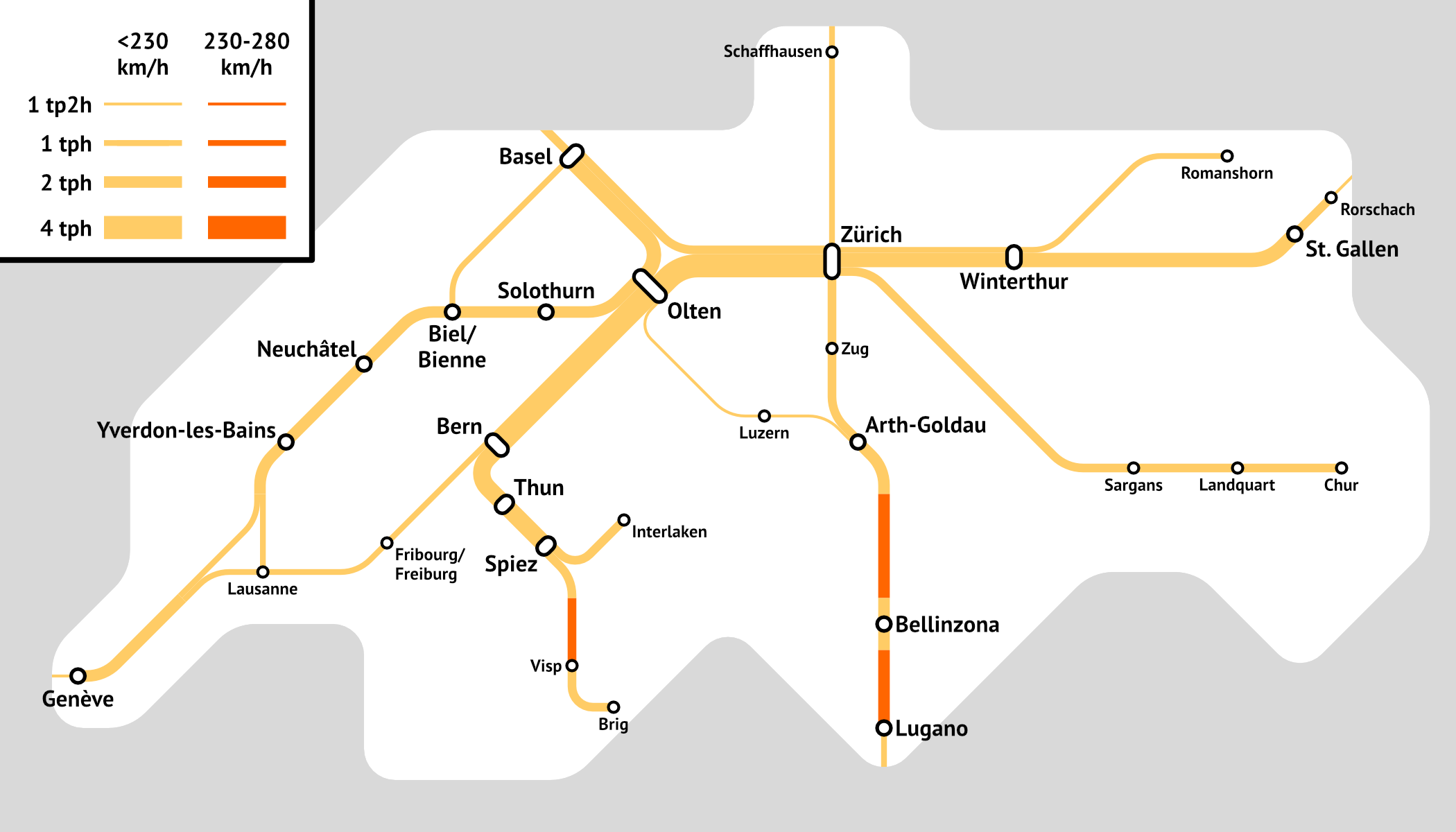
The orange segments are Alpine base tunnels, with extensive freight rail. The main high-cost investment in passenger-dedicated rail in Switzerland is not visible on the map, because it was built for 200 km/h to reduce costs: Olten-Bern, with extensive tunneling as well as state-of-the-art ETCS Level 2 signaling permitting 110 second headways. The Swiss rail network is centered not on one central point but on a Y between Zurich, Basel, and Bern, and the line was built as one of the three legs of the Y, designed to speed up Zurich-Bern and Basel-Bern trains to be just less than an hour each, to permit on-the-hour connections at all three stations.
By this comparison, HSL Zuid should not have been built this way. It is not useful for a domestic network designed around regular clockface frequencies and timed connections, in the Netherlands as much as in Switzerland. There is little interest in further 300 km/h domestic lines – any further proposals for increasing speeds on domestic trains are at 200 km/h, and as it is the domestic trains only go 160. In a country this size, so much time is spent on station approaches that the overall benefit of high top speed is reduced. Indeed, from Antwerp to Amsterdam, Eurostar trains take 1:20 over a distance of 182 km, an average speed comparable to the fastest classical lines in Europe such as the East Coast Main Line or the Southern Main Line in Sweden. The heavily-upgraded but still legacy Berlin-Hamburg line averages about 170 km/h when the trains are on time, and if German trains ran with Dutch punctuality and Dutch padding it would average 190 km/h.
What about international services?
The fastest trains using HSL Zuid are international, formerly branded Thalys, now branded Eurostar. They are also unfathomably expensive. Where NS’s website will sell me Amsterdam-Antwerp tickets for around 20€ if I’m willing to chain trips on slow regional trains, or 27€ on intercities doing the trip in 1:37 with one transfers, Eurostar charges 79-99€ for this trip when I look up available trains in mid-August on a weekday. For reference, the average domestic TGV trip over this distance is around 18€ and the average domestic ICE trip is around 22€. It goes without saying that the line is underused by international travelers – the fares are prohibitive.
Beyond Antwerp, the other problem is that Belgium has built HSL 1 from the French border to Brussels, HSL 2 and 3 from Leuven to the German border, and HSL 4 from Antwerp to the Dutch border, but has not bothered building a fast line between Brussels and Antwerp (or Leuven). The 46 km line between Brussels South and Antwerp Central takes 46 minutes by the fastest train. A 200 km/h high-speed line would do the trip in about 20, skipping Brussels Central and North as the Eurostars do.
But what if the fares were more reasonable and if Belgian trains weren’t this slow? Then, we would expect to see a massive increase in ridership, since the line would be connecting Amsterdam with Brussels in 1:40 and Paris in slightly more than three hours, with fares set at rates that would get the same ridership seen on domestic trains. The line would get much higher ridership.
And yet the trip time benefits of 300 km/h on HSL Zuid over 250 km/h are only 3 minutes. While much of the line is engineered for 300, the line is really two segments, one south of Rotterdam and one north of it, totaling 95 km of 300 km/h running plus extensive 200 and 250 km/h connections, and the total benefit to the higher top speed net of acceleration and deceleration time is only about 3 minutes. The total benefit of 300 km/h relative to 200 km/h is only about 8 minutes.
Two things are notable about this geography. The first is that the short spacing between must-serve stations – Amsterdam, Schiphol, Rotterdam, Antwerp – means that trains never get the chance to run fast. This is partly an artifact of Dutch density, but not entirely. England is as dense as the Netherlands and Belgium, but the plan for HS2 is to run nonstop trains between London and Birmingham, because between them there is nothing comparable in size or importance to Birmingham. North Rhine-Westphalia is about equally dense, and yet trains run nonstop between Cologne and Frankfurt, averaging around 170 km/h despite extensive German timetable padding and a slow approach to Cologne on the Hohenzollernbrücke.
The second is that the Netherlands is not a country of big central cities. Randstad is a very large metropolitan area, but it is really an agglomeration of the separate metro areas for Amsterdam, Rotterdam, the Hague, and Utrecht, each with its own set of destinations. The rail network needs to serve this geography with either direct trains or convenient transfers to all of the major centers. HSL Zuid does not do that – it has an easy transfer to the Hague at Rotterdam, but connecting to Utrecht (thus with the half of the Netherlands that isn’t Holland) is harder.
In retrospect, the Netherlands should have built more 200 and 250 km/h lines instead of building HSL Zuid. It could have kept the higher speed to Rotterdam but then built direct Rotterdam-Amsterdam and Rotterdam-Utrecht lines topping at 200 km/h, using the lower top speed to have more right-of-way flexibility to avoid tunnels. Separate trains would be running from points south to either Amsterdam or Utrecht, and fares in line with those of domestic trains would keep demand high enough that the frequency to both destinations would be acceptable.
In contrast, 300 km/h lines, if there are no slow segments like Brussels-Antwerp in their midst and if fares are reasonable, can be successful, if the single-core cities served are larger and the distances between stations are longer. The distances do not need to be as long as on some LGVs, with 400 km of nonstop running between Paris and Lyon – on a 100 km nonstop line, such as the plans for Hanover-Bielefeld including approaches or just the greenfield segment on Hamburg-Hanover, the difference between 200 and 300 km/h is 9 minutes, so about twice as much as on HSL Zuid and HSL 4 relative to their total length. This works, because while western Germany is dense much like the Netherlands, it is mostly a place of larger city cores separated by greater distances. The analogy to HSL Zuid elsewhere in Europe is as if Germany decided to build a line to 300 km/h standards internally to the Rhine-Ruhr region, or if the UK decided to build one between Liverpool and Manchester.
The Hamburg-Hanover High-Speed Line
A new high-speed line (NBS) between Hamburg and Hanover has received the approval of the government, and will go up for a Bundestag vote shortly. The line has been proposed and planned in various forms since the 1990s, the older Y-Trasse plan including a branch to Bremen in a Y formation, but the current project omits Bremen. The idea of building this line is good and long overdue, but unfortunately everything about it, including the cost, the desired speed, and the main public concerns, betray incompetence, of the kind that gave up on building any infrastructure and is entirely reactive, much like in the United States.
The route, in some of the flattest land in Germany, is a largely straight new high-speed rail line. Going north from Hanover to Hamburg, it departs somewhat south of Celle, and rejoins the line just outside Hamburg’s city limits in Meckelfeld. The route appears to be 107 km of new mainline route, not including other connections adding a few kilometers, chiefly from Celle to the north. An interactive map can be found here; the map below is static, from Wikipedia, and the selected route is the pink one.

For about 110 km in easy topography, the projected cost is 6.7 billion € per a presentation from two weeks ago, which is about twice as high as the average cost of tunnel-free German NBSes so far. It is nearly as high as the cost of the Stuttgart-Ulm NBS, which is 51% in tunnel.
And despite the very high cost, the standards are rather low. The top speed is intended to be 250 km/h, not 300 km/h. The travel time savings is only 20 minutes: trip times are to be reduced from 79 minutes today to 59 minutes. Using a top speed of 250 km/h, the current capabilities of ICE 3/Velaro trains, and the existing top speeds of the approaches to Hamburg and Hanover, I’ve found that the nonstop trip time should be 46 minutes, which means the planned timetable padding is 28%. Timetable padding in Germany is so extensive that trains today could do Hamburg-Hanover in 63 minutes.
As a result, the project isn’t really sold as a Hamburg-Hanover high-speed line. Instead, the presentation above speaks of great trip time benefits to the intermediate towns with local stops, Soltau (population: 22,000) and Bergen (population: 17,000). More importantly, it talks about capacity, as the Hamburg-Hanover line is one of the busiest in Germany.
As a capacity reliever, a high-speed line is a sound decision, but then why is it scheduled with such lax timetabling? It’s not about fitting into a Takt with hourly trip times, first of all because if the top speed were 300 km/h and the padding were the 7% of Switzerland, the Netherlands, and Sweden then the trip time would be 45 minutes, and second of all because Hamburg is at the extremity of the country and therefore it’s not meaningfully an intercity knot that must be reached on the hour.
Worse, the line is built with the possibility of freight service. Normal service is designed to be passenger-only, but in case of disruptions on the classical line, the line is designed to be freight-ready. This is stupid: it’s much cheaper to invest in reliability than to build a dual-use high-speed passenger and freight line, and the one country in the world with both a solid high-speed rail network and high freight rail usage, China, doesn’t do this. (Italy builds its high-speed lines with freight-friendly standards and has high construction costs, even though its construction costs in general, e.g. for metro lines or electrification, are rather low.)
Cross-Border Rail and the EU’s Learned Helplessness
I’m sitting on a EuroCity train from Copenhagen back to Germany. It’s timetabled to take 4:45 to do 520 km, an average speed of 110 km/h, and the train departed 25 minutes late because the crew needed to arrive on another train and that train was late. One of the cars on this train is closed due to an air conditioner malfunction; Cid and I rode this same line to Copenhagen two years ago and this also happened in one direction then.
This is a line that touches, at both ends, two of the fastest conventional lines in Europe, Stockholm-Malmö taking 4:30 to do 614 km (136 km/h) and Berlin-Hamburg normally taking 1:45 to do 287 km (164 km/h) when it is on time. This contrast between good lines within European member states, despite real problems with the German and Swedish rail networks, and much worse ones between them, got me thinking about cross-border rail more. Now, this line in particular is getting upgraded – the route is about to be cut off when the Fehmarn Belt Line opens in four years, reducing the trip time to 2:30. But more in general, cross-border and near-border lines that slow down travel that’s otherwise decent on the core within-state city pairs are common, and so far there’s no EU action on this. Instead, EU action on cross-border rail shows learned helplessness of avoiding the only solution for rail construction: top-down state-directed infrastructure building.
The upshot is that there is good cross-border rail advocacy here, most notably by Jon Worth, but because EU integration on this matter is unthinkable, this advocacy is forced to treat the railroads as if they are private oligopolies rather than state-owned public services. Jon successfully pushed for the incoming EU Commission of last year to include passenger rights in its agenda, to deal with friction between different national railroads. The issue is that SNCF and DB have internal ways of handling passenger rights in case of delays, due to domestic pressure on the state not to let the state railroad exploit its users, and they are not compatible across borders: SNCF is on time enough not to strand passengers, DB has enough frequency and extreme late-night timetable padding (my connecting train to Berlin is padded from 1:45 to 2:30, getting me home well past midnight) not to strand passengers; but when passengers cross from Germany to France, these two internal methods both fail.
At no point in this discussion was any top-down EU-level coordination even on the table. The mentality is that construction of new lines doesn’t matter – it’s a megaproject and these only generate headaches and cost overruns, not results, so instead everything boils down to private companies competing on the same lines. That the companies are state-owned is immaterial at the EU level – SNCF has no social mission outside the borders of France and therefore in its international service it usually behaves as a predatory monopoly profiteering off of a deliberately throttled Eurostar/Thalys market.
If there’s no EU state action, then the relationship between the operator, which is not part of the state, and the passenger, is necessarily adversarial. This is where the preference for regulations that assume this relationship must be adversarial and aim to empower the individual consumer comes from. It’s logical, if one assumes that there will never be an EU-wide high-speed intercity rail network, just a bunch of national networks with one-off cross-border megaprojects compromised to the point of not running particularly quickly or frequently.
And that is, frankly, learned helplessness on the part of the EU institutions. They take it for granted that state-led development is impossible at higher level than member states, and try to cope by optimizing for a union of member states whose infrastructure systems don’t quite cohere. Meanwhile, at the other end of the Eurasian continent, a continental-scale state has built a high-speed rail network that at this point has higher ridership per capita than most European states and is not far behind France or Germany, designed around a single state-owned network optimized for very high average speeds.
This occurs at a time when support for the EU is high in the remaining member states. There’s broad understanding that scale is a core benefit of the union, hence the regulatory harmonization ensuring that products can be shipped union-wide without cross-border friction. But for personal travel by train, these principles go away, and friction is assumed to only comprise the least important elements, because the EU institutions have decided that solving the most important ones, that is speed and frequency, is unthinkable.
Second Avenue Subway Phase 2 Station Design is Incompetent
A few hours ago, the MTA presented on the latest of Second Avenue Subway Phase 2. The presentation includes information about the engineering and construction of the three stations – 106th, 116th, and 125th Streets. The new designs are not good, and the design of 116th in particular betrays severe incompetence about how modern subway stations are built: the station is fairly shallow, but has a mezzanine under the tracks, with all access to or from the station requiring elevator-only access to the mezzanine.
What was in the presentation?
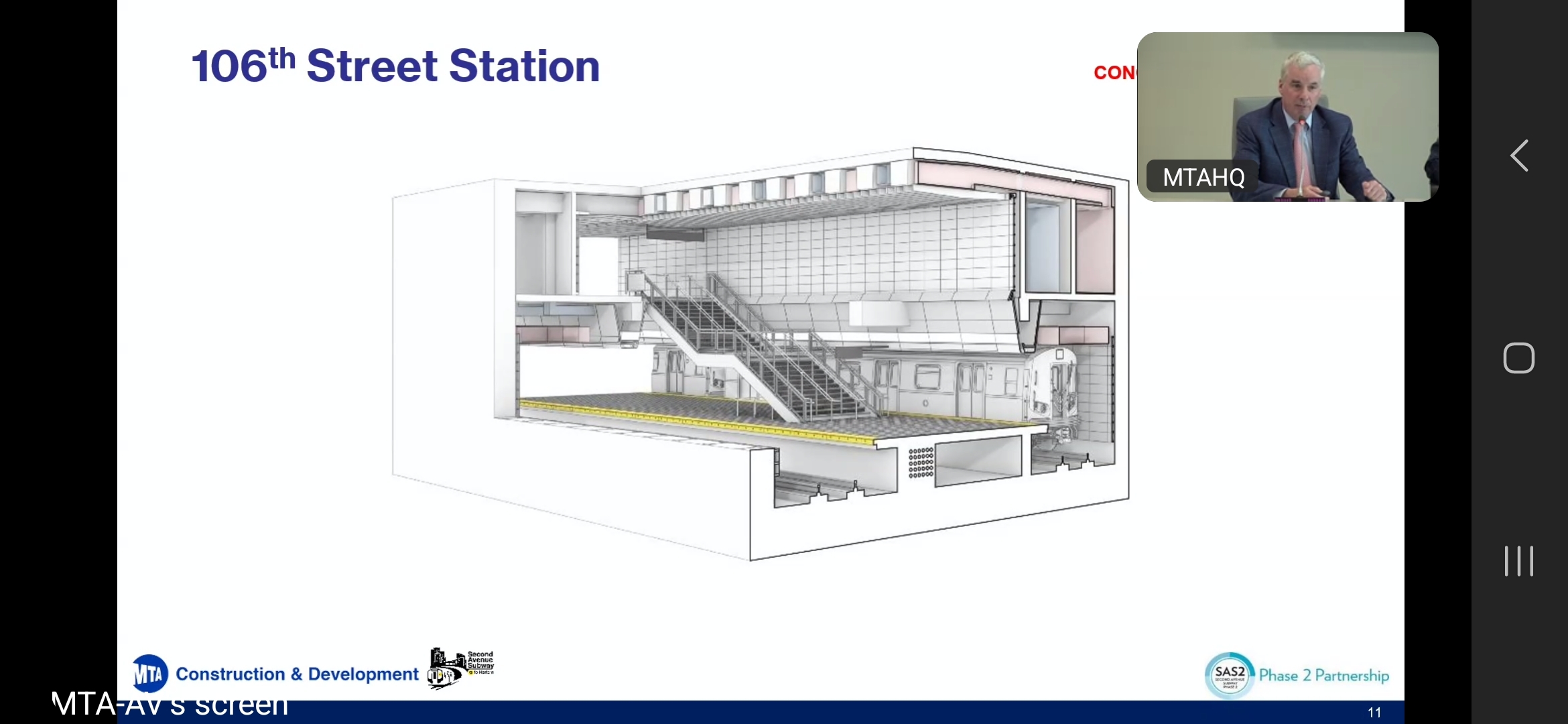
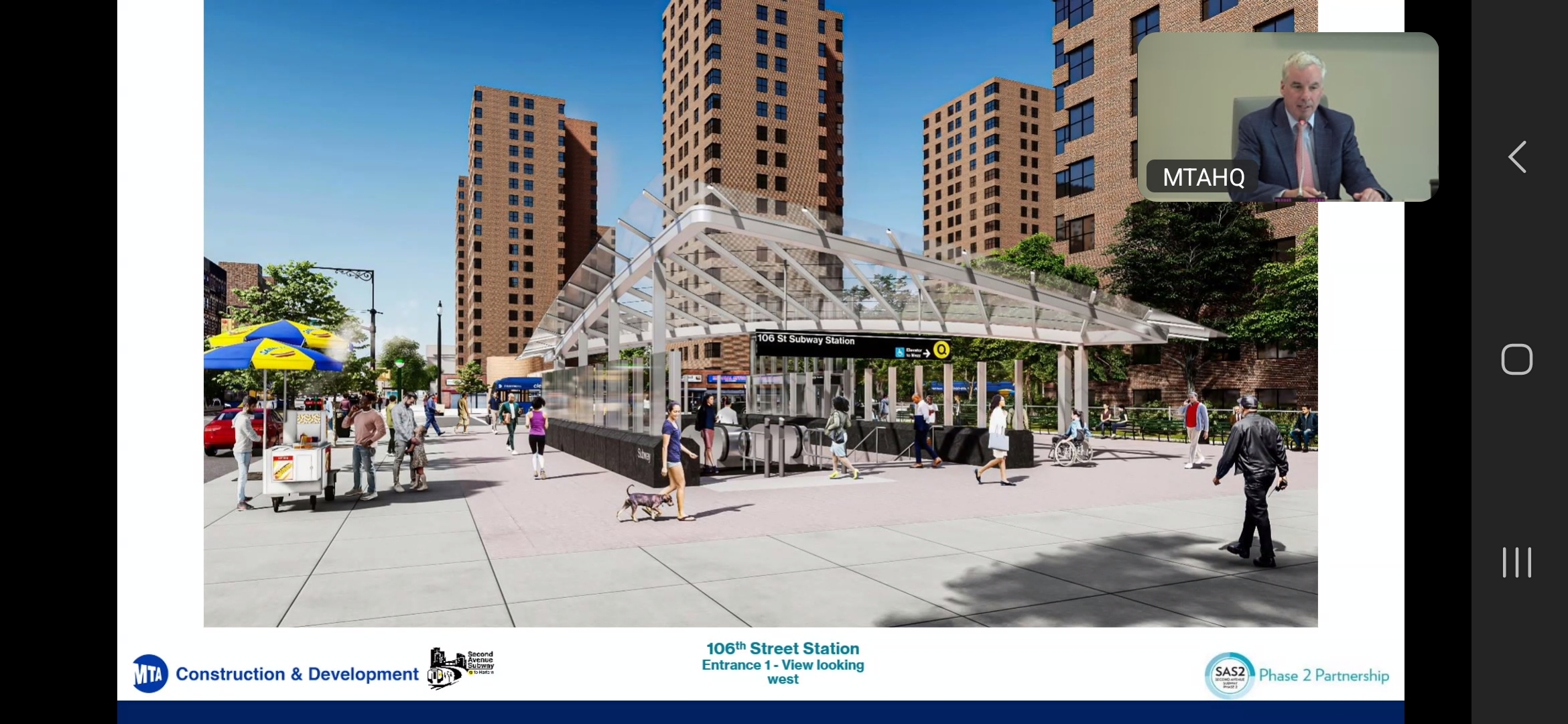
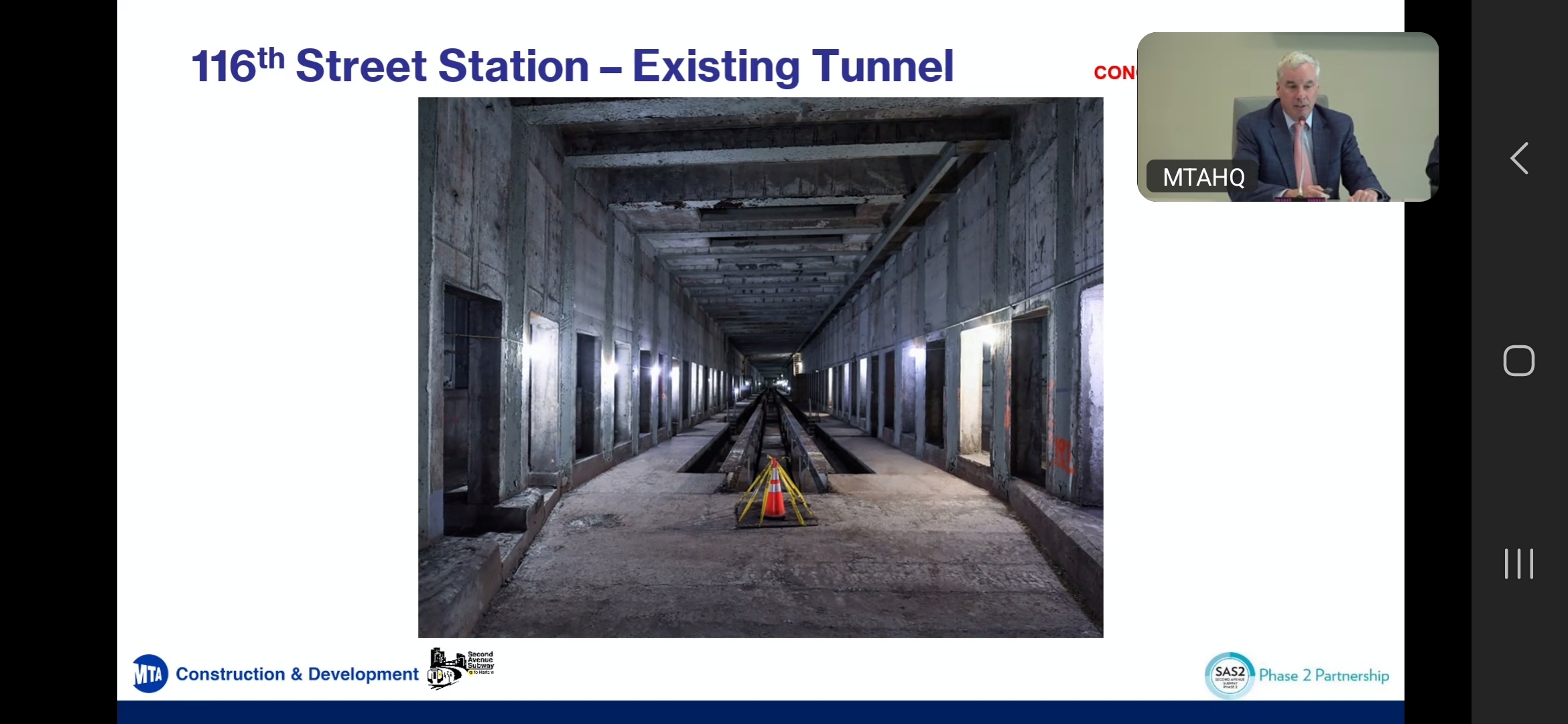
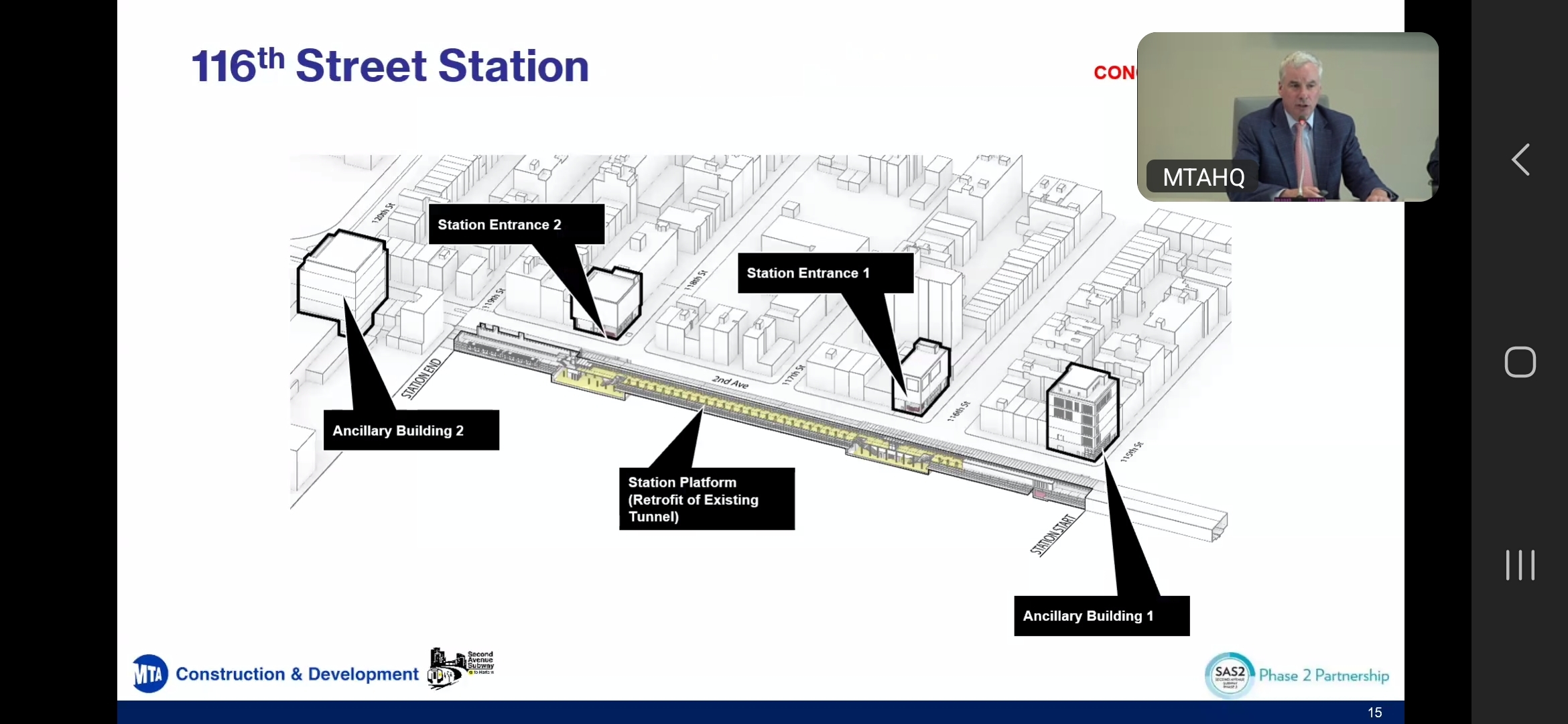
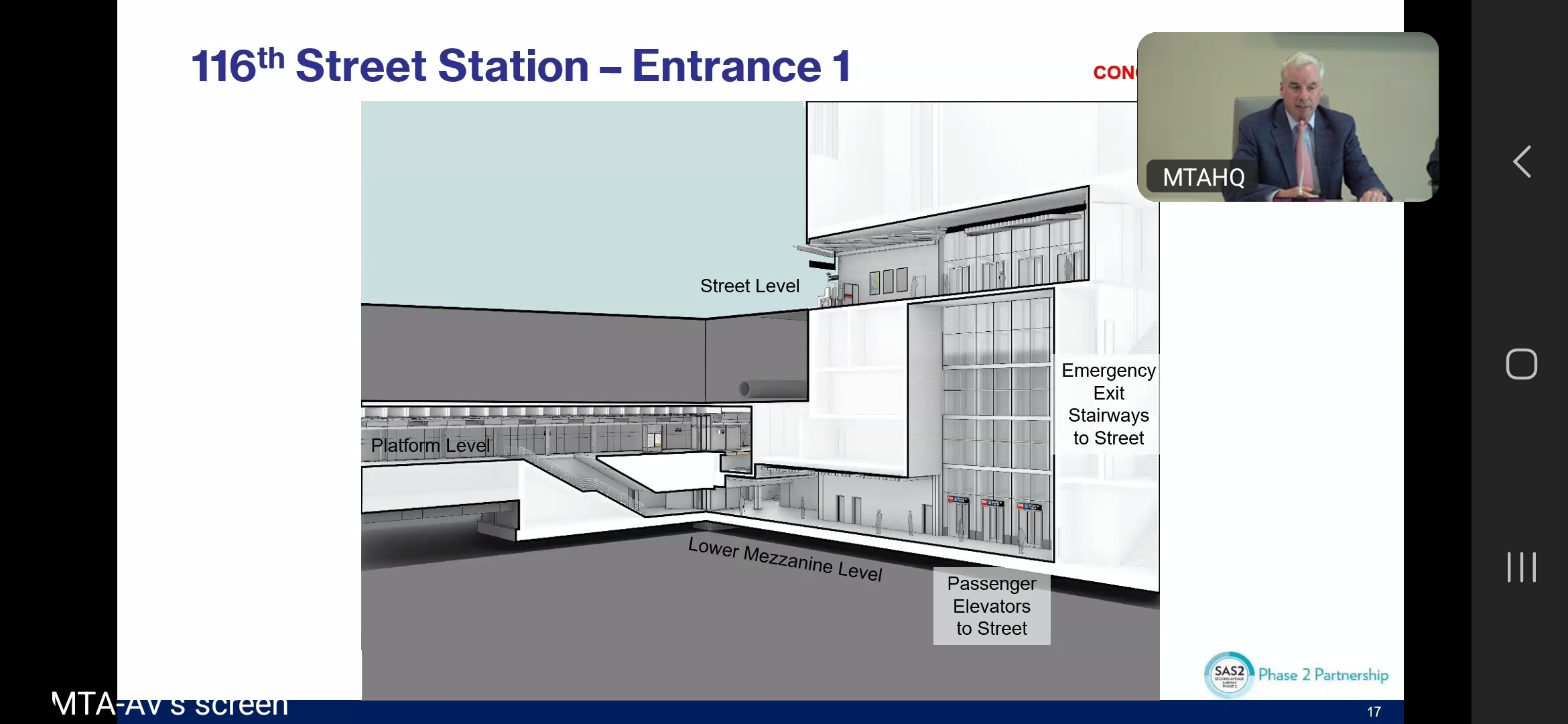
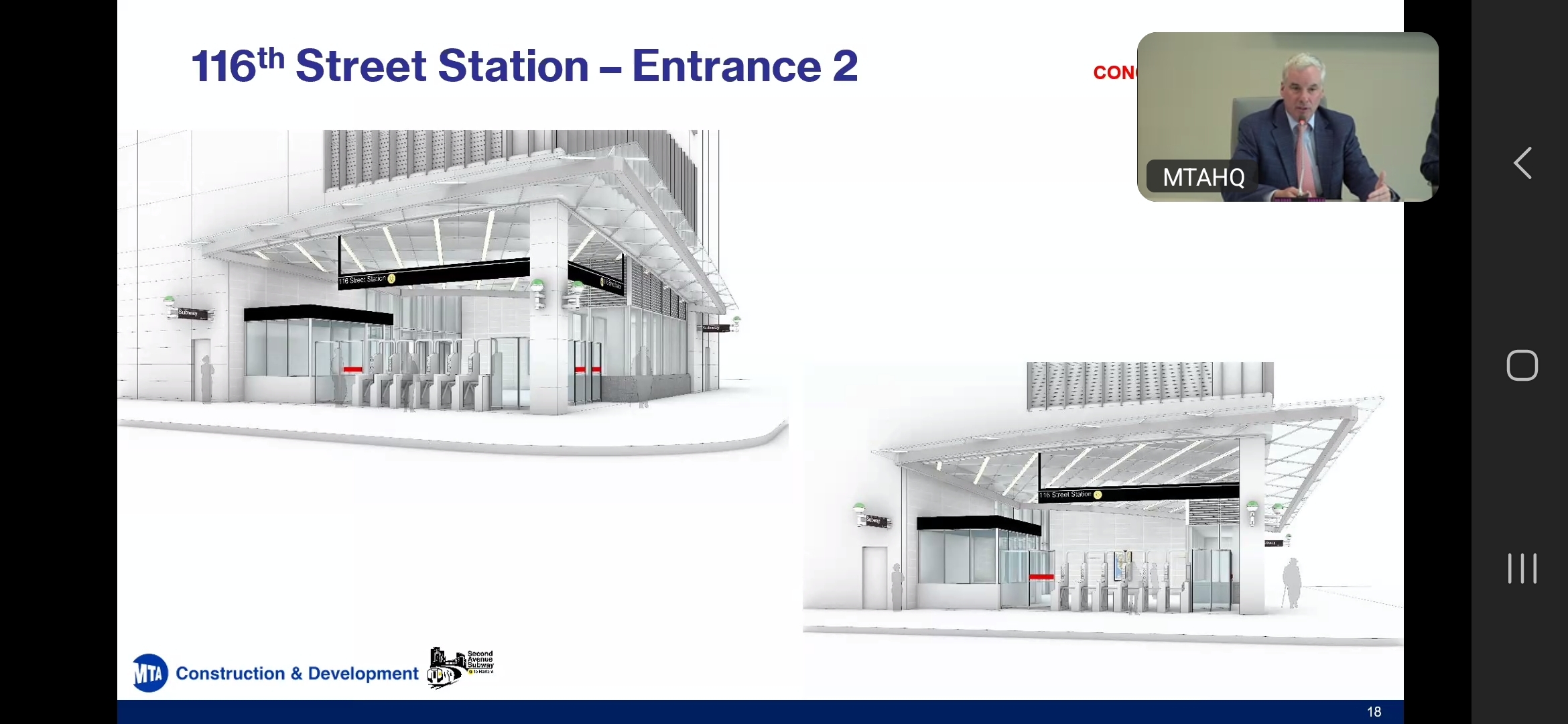
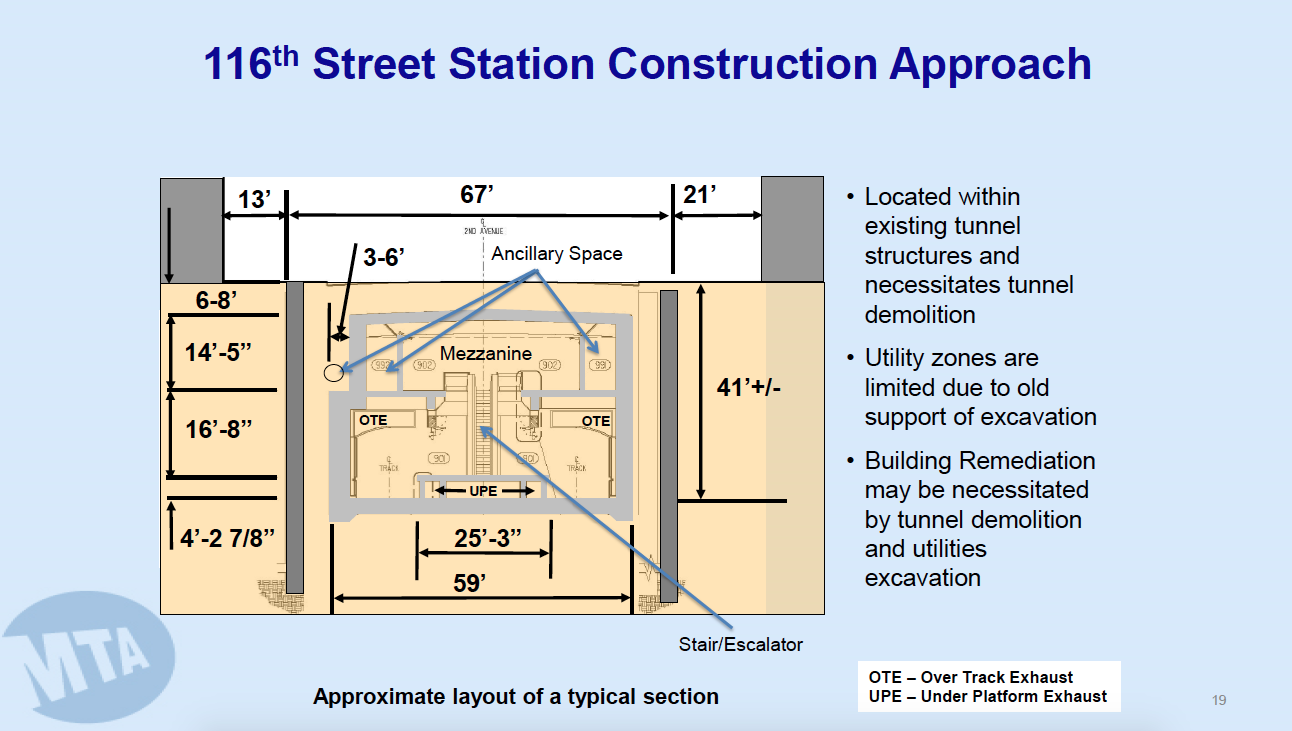
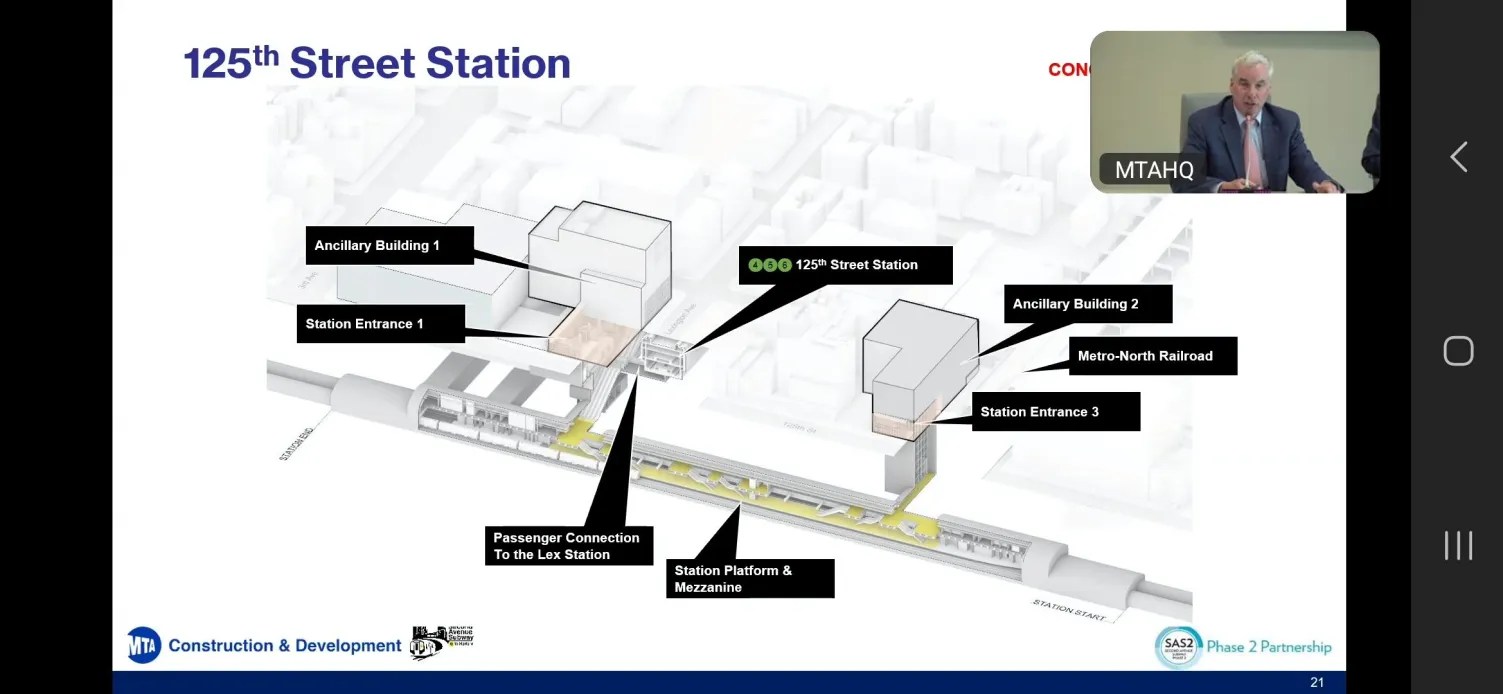
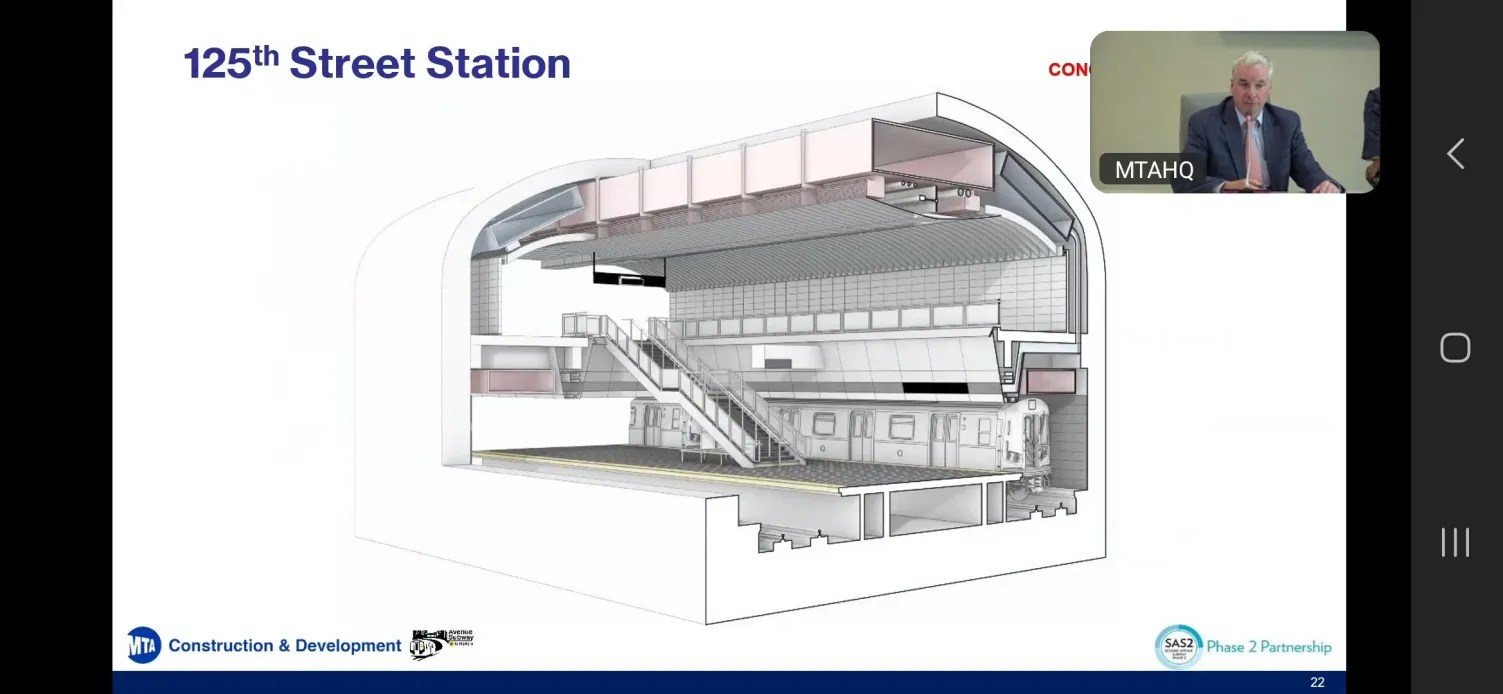
Here is a selection of slides, describing station construction. 106th Street is to be built cut-and-cover; 116th is to use preexisting construction but avoid cut-and-cover to reach them from the top and instead mine access from the bottom; 125th is to be built deep-level, with 125′ deep (38 m) platforms, underneath its namesake street between Lexington and Park Avenues.

The problems with 116th Street
Elevator-only access
Elevator-only access is usually stupid. It’s especially stupid when it’s at a shallow station; as the page 19 slide above shows, the platforms are about 11.5 meters below ground, which is an easy depth for both stair and escalator access.
Now, to be clear, there are elevator-only stations built in countries with reasonable subway construction programs. Sofia on Nya Tunnelbanan is elevator-only, because it is 100 meters below street level, due to the difficult topography of Södermalm and Central Stockholm, in which Sofia, 26 meters above sea level, is right next to Riddarfjärden, 23 meters deep. Emergency access is provided via ramps to the sea-level freeway hugging the north shore of Södermalm, used to construct the mined cavern in the first place. Likewise, the Barcelona L9 construction program, by far the most expensive in Spain and yet far cheaper than in any recent English-speaking country, has elevator-only access to the deep stations, in order to avoid any construction outside a horizontal or vertical tunnel boring machine.
The depth excuse does not exist in East Harlem. 11.5 meters is not an elevator-only access depth. It’s a stair access depth with elevators for wheelchair accessibility. Stairs are planned to be provided only for emergency access, without public usage. Under NFPA 130 the stairs are going to have to have enough capacity for full trains, much more than is going to be required in ordinary service, and they’d lead passengers to the same street as the elevators, nothing like the freeway egress of Sofia.
Below-platform mezzanines
To avoid any shallow construction, the mezzanines will be built below the platforms and not above them. As a result, access to the station means going down a level and then going back up to the platform level. In effect, the station is going to behave as a rather deep station as far as passenger access time to the platforms is concerned: the planned depth is 57′, or 17.4 meters, which means that the total vertical change from street level is around 23.5 meters, twice the actual depth of the platforms.
Dig volume
Even with the reuse of existing infrastructure, the station is planned to have too much space north and south of the platforms, as seen with the locations of the ancillary buildings.
I think that this is due to designs from the 2000s, when the plan was to build all stations with extensive back-of-the-house space on both sides of the platform. Phase 1 was built this way, as we cover in our New York case, and after we yelled at the MTA about it, it eventually shrank the footprint of the stations. 116th’s station start and end are four blocks apart, a total of about 300 meters, comparable to 86th Street; the platform is 186 m wide and the station overall has no reason to be longer than 190-200. But it’s possible the locations of the ancillary buildings were fixed from before the change, in which case the incompetence is not of the current leadership but of previous leadership.
Why?
On Bluesky, I’m seeing multiple activists I think well of assume that this is because the MTA is under pressure to either cut costs or avoid adverse community impact. Neither of these explanations makes much sense in context. 106th Street is planned to be built cut-and-cover, in the same neighborhood as 116th, with the same street width, which rules out the community opposition explanation. Cut-and-cover is cheaper than alternatives, which also rules out the cost explanation.
Rather, what’s going on is that MTA leadership does not know how a modern cut-and-cover subway station looks like. American construction prefers to avoid cut-and-cover even for stations, and over time such stations have been laden with things that American transit managers think are must-haves (like those back-of-the-house spaces) and that competent transit managers know they don’t need to build. They may want to build cut-and-cover, as at 106th, but as soon as there’s a snag, they revert to form and look for alternatives. They complain about utility relocation costs, which are clearly not blocking this method at 106th, and which did not prevent Phase 1’s 96th Street from costing about 2/3 as much as 86th and 72nd per cubic meter dug.
Under pressure to cut costs and shrink the station footprint, the MTA panicked and came up with the best solution the political appointees, that is to say Janno Lieber and Jamie Torres-Springer and their staff, and the permanent staff that they deign to listen to, could do. Unfortunately for New York, their best is not good enough. They don’t know how to build good stations – there are no longer any standardized designs for this that they trust, and the people who know how to do this speak English with an accent and don’t earn enough to command the respect of people on a senior American political appointee’s salary. So they improvise under pressure, and their instincts, both at doing things themselves and at supervising consultants, are not good. To Londoners, Andy Byford is a workhorse senior civil servant, with many like him, and the same is true in other large European cities with large subway systems. But to Americans, the such a civil servant is a unicorn to the point that people came to call him Train Daddy, because this is what he’s being compared with.
 Pedestrian Observations