Category: Incompetence
Negative Exceptionalism and Fake Self-Criticism
Yesterday, Sandy Johnston brought up a point he had made in his thesis from 2016: riders on the Long Island Rail Road consider their system to be unusually poorly-run (PDF-pp. 19-20), and have done so for generations.
The 100,000 commuters on Long Island—the brave souls who try to combine a job in New York City with a home among the trees—represent all shades of opinion on politics, religion, and baseball. But they are firmly agreed on one thing—they believe that the Long Island Rail Road, which constitutes their frail and precarious life line between home and office, is positively the worst railroad in the world. This belief is probably ill considered, because no one has ever made a scientific survey, and it is quite possible that there are certain short haul lines in the less populous parts of Mongolia or the Belgian Congo where the service is just as bad if not worse. But no Long Islander, after years of being trampled in the crowded aisles and arriving consistently late to both job and dinner, would ever admit this.
(Life, 1948, p. 19)
The quoted Life article goes over real problems that plagued the LIRR even then, such as absent management and line worker incompetence stranding passengers for hours. This kind of “we are the worst” criticism can be easily mistaken for reform pressure and interest in learning from others who, by the critic’s own belief, are better. But it’s not. It’s fake self-criticism; the “we are the worst” line is weaponized in the exact opposite direction – toward entrenchment and mistrust of any outside ideas, in which reformers are attacked as out of touch far more than the dispatcher who sends a train to the wrong track.
Negative exceptionalism
The best way to view this kind of fake self-criticism is, I think, through the lens of negative exceptionalism. Negative exceptionalism takes the usual exceptionalism and exactly inverts it: we have the most corrupt government, we have the worst social problems, we are the most ungovernable people. The more left-wing version also adds, we have the worst racism/sexism. In all cases, this is weaponized against the concept of learning from elsewhere – how can we learn from countries where I spent three days on vacation and didn’t feel viscerally disgusted by their poor people?
For example, take the political party Feminist Initiative, which teetered on the edge of the electoral threshold in the 2014 election in Sweden and won a few seats in municipal elections and one in the European Parliament. It defined itself in favor of feminism and against racism, and talked about how the widespread notion that Sweden is a feminist society is a racist myth designed to browbeat immigrants, and in reality Sweden is a deeply sexist place (more recently, Greta Thunberg would use the same negative exceptionalism about environmentalism, to the point of saying Sweden is the most environmentally destructive country). The party also advocated enforcing the Nordic model of criminalization of sex work on the rest of the EU; the insight that Sweden is a sexist society does not extend to the notion that perhaps it should not tell the Netherlands what to do.
Sweden is an unusually exceptionalist society by European standards. The more conventional Sweden-is-the-best exceptionalism is more common, but doesn’t seem to produce any different prescriptions regarding anything Sweden is notable for – transit-oriented development, criminalizing sex work, taking in large numbers of refugees, deliberately infecting the population with corona, building good digital governance. This mentality passes effortlessly between conventional and negative exceptionalism, and at no point would anyone in Sweden stop and say “maybe we have something to learn from Southern Europe” (the literature I’ve consulted for the soon-to-be-released Sweden case of the Transit Costs Project is full of intra-Nordic comparisons, and sometimes also comparisons with the UK and the Netherlands, but never anything from low-cost Southern Europe).
And of course, the United States matches or even outdoes Sweden. The same effortless change between we’re-the-best and we’re-the-worst is notable. Americans will sometimes in the same thread crow about how their poorest states are richer than France and say that poor people in whichever country they’ve visited last are better-behaved than the American poor (read: American tourists can’t understand what they’re saying) and that’s why those countries do better. They will in the same thread say the United States is uniquely racist and also uniquely anti-racist and in either case has nothing to learn from other places. The most outrage I’ve gotten from left-wing American activists was when I told them my impression of racism levels in the United States is that they are overall similar to levels in Western Europe; the US is allowed to be uniquely racist or uniquely anti-racist, but not somewhere in the middle.
The situation in New York
New York’s exceptionalism levels are extreme even by American standards. This, again, includes both positive and negative exceptionalism. New Yorkers hold their city to be uniquely diverse (and not, say, very diverse but at levels broadly comparable with Toronto, Singapore, Gush Dan, or Dubai), but look down on the same diversity – “they don’t have the social problems we do” is a common refrain about any non-US comparison. Markers of socioeconomic class are local, regional, or national, but not global, so a New Yorker who visits Berlin will not notice either the markers of poverty that irk the German middle class or general antisocial German behavior. For example, in Berlin, rail riders are a lot worse at letting passengers get off the train before getting on than in New York, where subway riders behave more appropriately; but New York fears of crime are such that “Germans are better-behaved than New Yorkers” is a common trope in discussion of proof of payment and driver-only trains.
This use of negative exceptionalism as fake criticism with which to browbeat actual criticism extends to the lede from Life in 1948. Sandy’s thesis spends several more pages on the same article, which brings up the informal social camaraderie among riders on those trains, where the schedules were (and still are) bespoke and commuters would take the same trains every day and sit at the same location with the same group of co-commuters, all of the same social class of upper middle-class white men. These people may hold themselves as critics of management, but in practice what they demanded was to make the LIRR’s operating practices even worse: more oriented around their specific 9-to-5 use case, and certainly not service akin to the subway, which they looked down, as did the planners.
Fake criticism as distraction from reform
The connection between negative exceptionalism and bad practices is that negative exceptionalism always tells the reformer: “we’re ungovernable, this can’t possibly work here.” The case of proof-of-payment is one example of this: New York is the greatest city in the world but it’s also the most criminal and therefore New Yorkers, always held to be different from (i.e. poorer than) the speaker who after all is a New Yorker too, must be disciplined publicly and harshly. Knowledge of how POP works in Germany is irrelevant to New York because Germans are rulebound and New Yorkers are ungovernable. Knowledge of how street allocation works in the Netherlands is irrelevant to the United States because the United States is either uniquely racist (and thus planners are also uniquely racist) or uniquely antiracist (and thus its current way of doing things is better than foreign ways). Knowledge of integrated timetable and infrastructure planning in Switzerland or Japan is irrelevant because New York has a uniquely underfunded infrastructure system (and not, say, a $50 billion five-year MTA capital plan).
More broadly, it dovetails into New Right fake criticism of things that annoy the local notables. The annoyance is real, but because those local notables are local, they reject any solution that is not taken directly from their personal prejudices; they lack the worldliness to learn and implement best practices and they know it, and so their status depends on the continuation of bad practices. (Feminist Initiative is not a New Right party, or any kind of right, but its best national result was 3%; decline-of-the-West parties more rooted in the New Right do a lot better.)
The good news for New York at least is that the LIRR and Metro-North are genuinely bad. This means that even a program of social and physical bulldozing of the suburban forces that keep those systems the way they are generates real physical value in reliability and convenience to compensate some (not all) for the loss of status. The complaints will continue because the sort of person who announces with perfect confidence that their commute is the worst in the world always finds things to complain about, but the point is not to defuse complaints, it’s to provide good service, and those people will adjust.
But that’s specific to one case. The system of kvetching that empowers middle-class rider camaraderie, or for that matter the camaraderie of an overstaffed, overpaid workforce with a seniority system, imposes real costs in making change politically hard. Only when things are so bad are the benefits of breaking the tradition so large that it becomes politically advantageous to push for the necessary reforms. Two people may do the job of one and the negative exceptionalists would rail while resisting any improvement, but when five people do the job of one, there is a large enough pot of gold at the end of that rainbow.
Penn Station Expansion is Based on Fraud
New York is asking for $20 billion for reconstruction ($7 billion) and physical expansion ($13 billion) of Penn Station. The state is treating it as a foregone conclusion that it will happen and it will get other people’s money for it; the state oversight board just voted for it despite the uncertain funding. Facing criticism from technical advocates who have proposed alternatives that can use Penn Station’s existing infrastructure, lead agency Empire State Development (ESD) has pushed back. The document I’ve been looking at lately is not new – it’s a presentation from May 2021 – but the discussion I’ve seen of it is. The bad news is that the presentation makes fraudulent claims about the capabilities of railroads in defense of its intention to waste $20 billion, to the point that people should lose their jobs and until they do federal funding for New York projects should be stingier. The good news is that this means that there are no significant technical barriers to commuter rail modernization in New York – the obstacles cited in the presentation are completely trivial, and thus, if billions of dollars are available for rail capital expansion in New York, they can go to more useful priorities like IBX.
What’s the issue with Penn Station expansion?
Penn Station is a mess at both the concourse and track levels. The worst capacity bottleneck is the western approach across the river, the two-track North River Tunnels, which on the eve of corona ran about 20 overfull commuter trains and four intercity trains into New York at the peak hour; the canceled ARC project and the ongoing Gateway project both intend to address this by adding two more tracks to Penn Station.
Unfortunately, there is a widespread belief that Penn Station’s 21 existing tracks cannot accommodate all traffic from both east (with four existing East River Tunnel tracks) and west if new Hudson tunnels are built. This belief goes back at least to the original ARC plans from 20 years ago: all plans involved some further expansion, including Alt G (onward connection to Grand Central), Alt S (onward connection to Sunnyside via two new East River tunnel tracks), and Alt P (deep cavern under Penn Station with more tracks). Gateway has always assumed the same, calling for a near-surface variation of Alt P: instead of a deep cavern, the block south of Penn Station, so-called Block 780, is to be demolished and dug up for additional tracks.
The impetus for rebuilding Penn Station is a combination of a false belief that it is a capacity bottleneck (it isn’t, only the Hudson tunnels are) and a historical grudge over the demolition of the old Beaux-Arts station with a labyrinthine, low-ceiling structure that nobody likes. The result is that much of the discourse about the need to rebuild the station is looking for technical justification for an aesthetic decision; unfortunately, nobody I have talked to or read in New York seems especially interested in the wayfinding aspects of the poor design of the existing station, which are real and do act as a drag on casual travel.
I highlight the history of Penn Station and the lead agency – ESD rather than the MTA, Port Authority, or Amtrak – because it showcases how this is not really a transit project. It’s not even a bad transit project the way ARC Alt P was or the way Gateway with Block 780 demolition is. It’s an urban renewal project, run by people who judge train stations by which starchitect built them and how they look in renderings rather than by how useful they are for passengers. Expansion in this context is about creating the maximum footprint for renderings, and not about solving a transportation problem.
Why is it believed that Penn Station needs more tracks?
Penn Station tracks are used inefficiently. The ESD pushback even hints at why, it just treats bad practices as immutable. Trains have very long dwell times: per p. 22 of the presentation, the LIRR can get in and out in a quick 6 minutes, but New Jersey Transit averages 12 and Amtrak averages 22. The reasons given for Amtrak’s long dwell are “baggage” (there is no checked baggage on most trains), “commissary” (the cafe car is restocked there, hardly the best use of space), and “boarding from one escalator” (this is unnecessary and in fact seasoned travelers know to go to a different concourse and board there). A more reasonable dwell time at a station as busy as Penn Station on trains designed for fast access and egress is 1-2 minutes, which happens hundreds of times a day at Shin-Osaka; on the worse-designed Amtrak rolling stock, with its narrower doors, 5 minutes should suffice.
New Jersey Transit can likewise deboard fast, although it might need to throw away the bilevels and replace them with longer single-deck trains. This reduces on-board capacity somewhat, but this entire discussion assumes the Gateway tunnel has been built, otherwise even present operations do not exhaust the station’s capacity. Moreover, trains can be procured for comfortable standing; subway riders sometimes have to stand for 20-30 minutes and commuter rail riders should have similar levels of comfort – the problem today is standees on New Jersey Transit trains designed without any comfortable standing space.
But by far the biggest single efficiency improvement that can be done at Penn Station is through-running. If trains don’t have to turn back or even continue to a yard out of service, but instead run onward to suburbs on the other side of Manhattan, then the dwell time can be far less than 6 minutes and then there is much more space at the station than it would ever need. The station’s 21 tracks would be a large surplus; some could be removed to widen the platform, and the ESD presentation does look at one way to do this, which isn’t necessarily the optimal way (it considers paving over every other track to widen the platforms and permit trains to open doors on both sides rather than paving over every other track pair to widen the platforms much more but without the both-side doors). But then the presentation defrauds the public on the opportunity to do so.
Fraudulent claim #1: 8 minute dwells
On p. 44, the presentation compares the capacity with and without through-running, assuming half the tracks are paved over to widen the platforms. The explicit assumption is that through-running commuter rail requires trains to dwell 8 minutes at Penn Station to fully unload and load passengers. There are three options: the people who wrote this may have lied, or they may be incompetent, or they be both liars and incompetent.
In reality, even very busy stations unload and load passengers in 30-60 seconds at rush hour. Limiting cases reaching up to 90-120 seconds exist but are rare; the RER A, which runs bilevels, is the only one I know of at 105.
On pp. 52-53, the presentation even shows a map of the central sections of the RER, with the central stations (Gare du Nord, Les Halles, and Auber/Saint-Lazare) circled. There is no text, but I presume that this is intended to mean that there are two CBD stations on each line rather than just one, which helps distribute the passenger load better; in contrast, New York would only have one Manhattan station on through-trains on the Northeast Corridor, which requires a longer dwell time. I’ve heard this criticism over the years from official and advocate sources, and I’m sympathetic.
What I’m not sympathetic to is the claim that the dwell time required at Penn Station is more than the dwell time required at multiple city center stations, all combined. On the single-deck RER B, the combined rush hour dwell time at Gare du Nord and Les Halles is around 2 minutes normally (and the next station over, Saint-Michel, has 40-60 second rush hour dwells and is not in the CBD unless you’re an academic or a tourist); in unusual circumstances it might go as high as 4 minutes. The RER A’s combined dwell is within the same range. In Munich, there are six stations on the S-Bahn trunk between Hauptbahnhof and Ostbahnhof – but at the intermediate stations (with both-sides door opening) the dwell times are 30 seconds each and sometimes the doors only stay open 20 seconds; Hauptbahnhof and Ostbahnhof have longer dwell times but are not busier, they just are used as control points for scheduling.
The RER A’s ridership in 2011 was 1.14 million trips per weekday (source, p. 22) and traffic was 30 peak trains per hour and 24 reverse-peak trains; at the time, dwell times at Les Halles and Auber were lower than today, and it took several more years of ridership growth for dwell times to rise to 105 seconds, reducing peak traffic to 27 and then 24 tph. The RER B’s ridership was 983,000 per workday in 2019, with 20 tph per direction. Munich is a smaller city, small enough New Yorkers may look down on it, but its single-line S-Bahn had 950,000 trips per workday in 2019, on 30 peak tph in each direction. In contrast, pre-corona weekday ridership was 290,000 on the LIRR, 260,000 on Metro-North, and around 270,000 on New Jersey Transit – and the LIRR has a four-track tunnel into Manhattan, driving up traffic to 37 tph in addition to New Jersey’s 21. It’s absurd that the assumption on dwell time at one station is that it must be twice the combined dwell times at all city center stations on commuter lines that are more than twice as busy per train as the two commuter railroads serving Penn Station.
Using a more reasonable figure of 2 minutes in dwell time per train, the capacity of through-running rises to a multiple of what ESD claims, and through-running is a strong alternative to current plans.
Fraudulent claim #2: no 2.5% grades allowed
On pp. 38-39, the presentation claims that tracks 1-4 of Penn Station, which are currently stub-end tracks, cannot support through-running. In describing present-day operations, it’s correct that through-running must use the tracks 5-16, with access to the southern East River Tunnel pair. But it’s a dangerously false assumption for future infrastructure construction, with implications for the future of Gateway.
The rub is that the ARC alternatives that would have continued past Penn Station – Alts P and G – both were to extend the tunnel east from tracks 1-4, beneath 31st Street (the existing East River Tunnels feed 32nd and 33rd). Early Gateway plans by Amtrak called for an Alt G-style extension to Grand Central, with intercity trains calling at both stations. There was always a question about how such a tunnel would weave between subway tunnels, and those were informally said to doom Alt G. The presentation unambiguously answers this question – but the answer it gives is the exact opposite of what its supporting material says.
The graphic on p. 39 shows that to clear the subway’s Sixth Avenue Line, the trains must descend a 2.45% grade. This accords with what I was told by Foster Nichols, currently a senior WSP consultant but previously the planner who expanded Penn Station’s lower concourse in the 1990s to add platform access points and improve LIRR circulation, thereby shortening LIRR dwell times. Nichols did not give the precise figure of 2.45%, but did say that in the 1900s the station had been built with a proviso for tracks under 31st, but then the subway under Sixth Avenue partly obstructed them, and extension would require using a grade greater than 2%.
The rub is that modern urban and suburban trains climb 4% grades with no difficulty. The subway’s steepest grade, climbing out of the Steinway Tunnel, is 4.5%, and 3-3.5% grades are routine. The tractive effort required can be translated to units of acceleration: up a 4% grade, fighting gravity corresponds to 0.4 m/s^2 acceleration, whereas modern trains do 1-1.3 m/s^2. But it’s actually easier than this – the gradient slopes down when heading out of the station, and this makes the grade desirable: in fact, the subway was built with stations at the top of 2.5-3% grades (for example, see figure 7 here) so that gravity would assist acceleration and deceleration.
The reason the railroaders don’t like grades steeper than 2% is that they like the possibility of using obsolete trains, pulled by electric locomotives with only enough tractive effort to accelerate at about 0.4 m/s^2. With such anemic power, steeper grades may cause the train to stall in the tunnel. The solution is to cease using such outdated technology. Instead, all trains should be self-propelled electric multiple units (EMUs), like the vast majority of LIRR and Metro-North rolling stock and every subway train in the world. Japan no longer uses electric locomotives at all on its day trains, and among the workhorse European S-Bahn systems, all use EMUs exclusively, with the exception of Zurich, which still has some locomotive-pulled trains but is transitioning to EMUs.
It costs money to replace locomotive-hauled trains with EMUs. But it doesn’t cost a lot of money. Gateway won’t be completed tomorrow; any replacement of locomotives with EMUs on the normal replacement cycle saves capital costs rather than increasing them, and the same is true of changing future orders to accommodate peak service expansion for Gateway. Prematurely retiring locomotives does cost money, but New Jersey Transit only has 100 electric locomotives and 29 of them are 20 years old at this point; the total cost of such an early retirement program would be, to first order, about $1 billion. $1 billion is money, but it has independent transportation benefits including faster acceleration and higher reliability, whereas the $13 billion for Penn Station expansion have no transportation benefits whatsoever. Switzerland may be a laggard in replacing the S-Bahn’s locomotives with EMUs, but it’s a leader in the planning maxim electronics before concrete, and when the choice is between building a through-running tunnel for EMUs and building a massive underground station to store electric locomotives, the correct choice is to go with the EMUs.
How do they get away with this?
ESD is defrauding the public. The people who signed their names to the presentation should most likely not work for the state or any of its contractors; the state needs honest, competent people with experience building effective mass transit projects.
Those people walk around with their senior manager titles and decades of experience building infrastructure at outrageous cost and think they are experts. And why wouldn’t they? They do not respect any knowledge generated outside the New York (occasionally rest-of-US) bubble. They think of Spain as a place to vacation, not as a place that built 150 kilometers of subway 20 years ago for the same approximate cost as Second Avenue Subway phases 1 and 2. They think of smaller cities like Milan as beneath their dignity to learn about.
And what’s more, they’ve internalized a culture of revealing as little as possible. That closed attitude has always been there; it’s by accident that they committed two glaring acts of fraud to paper with this presentation. Usually they speak in generalities: the number of people who use the expression “apples-to-apples” and provide no further detail is staggering. They’ve learned to be opaque – to say little and do little. Most likely, they’re under political pressure to make the Penn Station reconstruction and expansion look good in order to generate what the governor thinks are good headlines, and they’ve internalized the idea that they should make up numbers to justify a political project (and in both the Transit Costs Project and previous reporting I’d talked to people in consulting who said they were under such formal or informal pressure for other US projects).
The way forward
With too much political support for wasting $20 billion at the state level, the federal government should step in and put an end to this. The Bipartisan Infrastructure Law (BIL) has $66 billion for mainline rail; none of this money should go to Penn Station expansion, and the only way any money should go to renovation is if it’s part of a program for concrete improvement in passenger rail function. If New York wishes to completely remodel the platform level, and not just pave over every other track or every other track pair, then federal support should be forthcoming, albeit not for $7 billion or even half that. But it’s not a federal infrastructure priority to restore some kind of social memory of the old Penn Station. Form follows function; beautiful, airy train stations that people like to travel through have been built under this maxim, for example Berlin Hauptbahnhof.
To support good rail construction, it’s obligatory that experts be put in charge – and there aren’t any among the usual suspects in New York (or elsewhere in the US). Americans respect Germany more than they do Spain but still less than they should either; unless they have worked in Europe for years, their experience at Berlin Hbf and other modern stations is purely as tourists. The most celebrated New York public transportation appointment in recent memory, Andy Byford, is an expert (on operations) hired from abroad; as I implored the state last year, it should hire people like him to head major efforts like this and back them up when they suggest counterintuitive things.
Mainline rail is especially backward in New York – in contrast, the subway planners that I’ve had the fortune to interact with over the years are insightful and aware of good practices. Managers don’t need much political pressure to say absurd things about gradients and dwell times, in effect saying things are impossible that happen thousands of times a day on this side of the Pond. The political pressure turns people who like pure status quo into people who like pure status quo but with $20 billion in extra funding for a shinier train hall. But both the political appointees and the obstructive senior managers need to go, and managers below them need to understand that do-nothing behavior doesn’t get them rewarded and (as they accumulate seniority) promoted but replaced. And this needs to start with a federal line in the sand: BIL money goes to useful improvements to speed, reliability, capacity, convenience, and clarity – but not to a $20 billion Penn Station reconstruction and expansion that do nothing to address any of these concerns.
Deutsche Bahn’s Meltdown and High-Speed Rail
A seven-hour rail trip from Munich to Berlin – four and a half on the timetable plus two and a half of sitting at and just outside Nuremberg – has forced me to think a lot more about the ongoing collapse of the German intercity rail network. Ridership has fully recovered to pre-corona levels – in May it was 5% above 2019 levels, and that was just before the nine-euro monthly ticket was introduced, encouraging people to shift their trips to June, July, and August to take advantage of what is, among other things, free transit outside one’s city of residence. But at the same time, punctuality has steadily eroded this year:
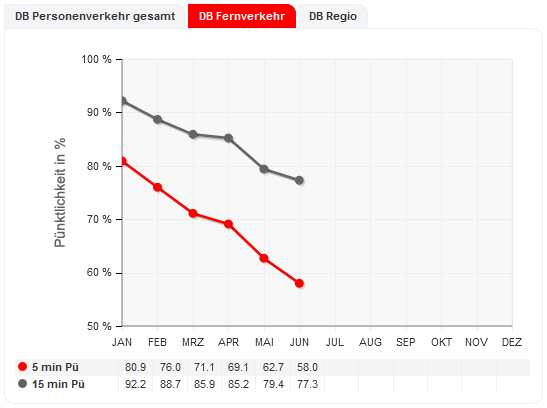
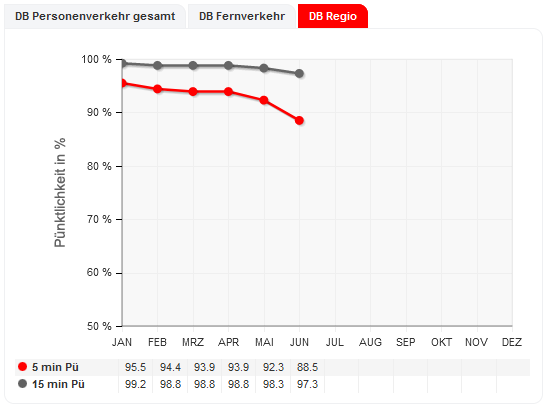
It’s notable that the June introduction of the 9€ ticket is invisible in the graphic for intercity rail; it did coincide with deterioration in regional rail punctuality, but the worst problems are for the intercity trains. My own train was delayed by a mechanical failure, and then after an hour of failed attempts to restart it we were put on a replacement train, which spent around an hour sitting just outside Nuremberg, and even though it skipped Leipzig (saving 40 minutes in the process), it arrived at Berlin an hour and a half behind its schedule and two and a half behind ours.
Sometimes, those delays cascade. It’s not that high ridership by itself produces delays. The ICEs are fairly good at access and egress, and even a full train unloads quickly. Rather, it’s that if a train is canceled, then the passengers can’t get on the next one because it’s full beyond standing capacity; standing tickets are permitted in Germany, but there are sensors to ensure the train’s mass does not exceed a maximum level, which can be reached on unusually crowded trains, and so a train’s ability to absorb passengers on canceled trains as standees is limited.
But it’s not the short-term delays that I’m most worried about. One bad summer does not destroy a rail network; riders can understand a few bad months provided the problem is relieved. The problem is that there isn’t enough investment, and what investment there is is severely mistargeted.
Within German discourse, it’s common to assert superiority to France and Southern Europe in every possible way. France is currently undergoing an energy crisis, because the heat wave is such that river water cannot safely cool down its nuclear power plants; German politicians have oscillated between using this to argue that nuclear power is unreliable and the three remaining German plants should be shut down and using this to argue that Germany should keep its plants open as a gesture of magnanimity to bail out France.
Rail transport features a similar set of problems. France has a connected network of high-speed lines, nearly all of which are used to get between Paris and secondary cities. Germany does not – it has high-speed lines but the longest connection between major cities allowing more than 200 km/h throughout is Cologne-Frankfurt, a distance of 180 km.
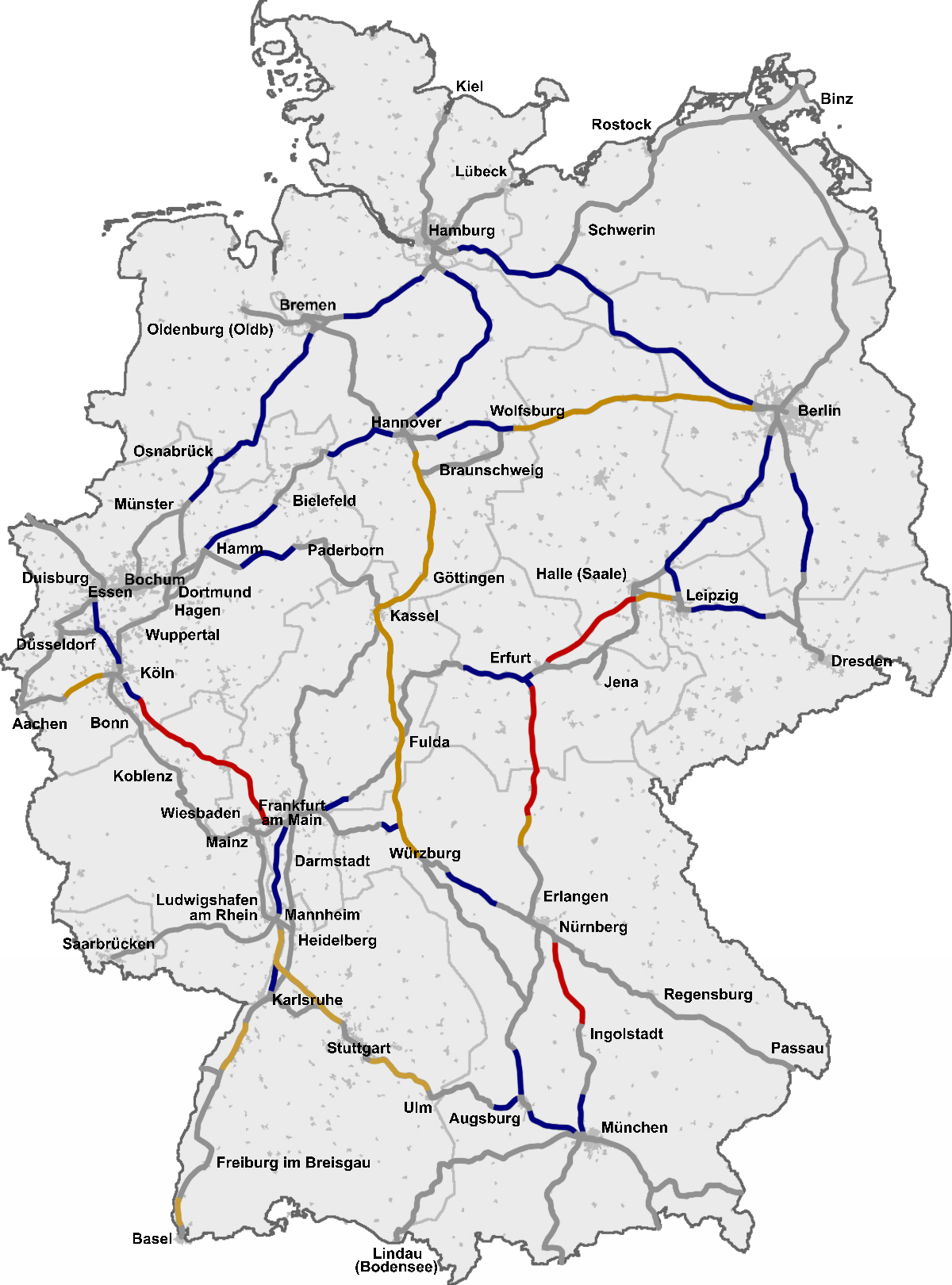
The natural response of most German rail advocates is to sneer at the idea of high-speed rail; France has genuine problems with punctuality, neglect of legacy rail lines, and poor interconnections between lines (it has nothing like the hourly or two-hour clockface timetables of German intercity rail), and those are all held as reasons why Germany has little to learn from France. Instead, those advocates argue, Germany should be investing in network-wide punctuality, because reliability matters more than speed.
The problem is that the sneering at France is completely unjustified. A French government investigation into punctuality in 2019-20 found that yes, French intercity trains suffered from extensive delays – but in 2019 intercity trains were on-time at the terminus 77.4% of the time, compared with 73.8% in Germany. Germany did better in 2020 when nobody was riding, but went back to 75% in 2021 as ridership began to recover. High-speed trains were the most punctual in Spain and the Netherlands, where they do not run on classical lines for significant stretches, unlike in France, Germany, or Italy.
Moreover, German trains are extremely padded. Der Spiegel has long been a critic of poor planning in German railways, and in 2019 it published a comparison of the TGV and ICE. The selected ICE connections were padded more than 20%; only Berlin-Munich was less, at 18%. The TGV comparisons were padded 11-14%; these are all lines running almost exclusively on LGVs, like Paris-Bordeaux, rather than the tardier lines running for significant distances on slow lines, like Paris-Nice. And even 11-14% is high; Swiss planning is 7% on congested urban approaches, with reliability as the center of the country’s design approach, while JR East suggested 4% for Shinkansen-style entirely dedicated track in its peer review of California High-Speed Rail.
Thus, completing a German high-speed rail network is not an opposed goal to reliability. Quite to the contrary, creating a separate network running only or almost only ICEs to connect Berlin, Hamburg, Hanover, Bremen, the main cities of the Rhine-Ruhr, Frankfurt, Munich, and Stuttgart means that there is less opportunity for delays to propagate. A delayed regional train would not slow down an intercity train, permitting not just running at high punctuality but also doing so while shrinking the pad from 25% to 7%, which offers free speed.
Cutting the pad to 7% interacts especially well with some of the individual lines Germany is planning. Hanover-Bielefeld, a distance of 100 km, can be so done in 27-28 minutes; this can be obtained from looking at the real performance specs of the Velaro Novo, but also from a Japanese sanity check, as the Nagoya-Kyoto distance is not much larger and taking the difference into account is easy. But the current plan is to do this in 31 minutes, just more than half an hour rather than just less, complicating the plan for regular timed connections on the half-hour.
German rail traffic is not collapsing – quite to the contrary. DB still expects to double intercity ridership by the mid-2030s. This requires investments in capacity, connectivity, speed, and reliability – and completing the high-speed network, far from prioritizing speed at the expense of the other needs, fulfills all needs at once. Half-hourly trains could ply every connection, averaging more than 200 km/h between major cities, and without cascading delays they would leave the ongoing summer of hell in the past. But this requires committing to building those lines rather than looking for excuses for why Germany should not have what France has.
What Does Pete Buttigieg Think the US has to Teach the World?
On the 27th, Secretary of Transportation Pete Buttigieg announced the creation of a new program called Momentum, to export what he calls best practices around the world. Buttigieg said he invites global civil society to engage with USDOT, linking to the Momentum website – not so that the US can learn from the rest of the world, but so that the rest of the world can learn from the United States on matters of transportation and climate change.
It’s remarkable that the areas covered by Momentum are consistently ones on which the only thing to learn from the United States is what not to do. There are seven target areas: transport infrastructure projects, climate change mitigation, transport safety, regional corridors, logistics supply chains, emerging tech (e.g. smart cities), good regulatory practices.
That the US has the world’s worst urban rail construction costs is just the beginning. Climate change, so central to this plan, is another example of American failure; Wikipedia’s list has the US near the top in CO2 emissions per capita, and the US is lagging in not just decarbonizing transport, which the entire developed world is failing at, but also in installing renewable energy (or nuclear power). Transport safety is almost always better in rich countries than in poor ones, but in 2018 the US had the highest per capita car accident death rate in the developed world, and rates rose during corona (in Germany, they fell). The supply chain issues in the US are often localized to the one country – the baby formula shortage is worse than in Europe. Good regulatory practices are to be learned from countries with strong apolitical civil service apparatuses, and not from the US, with its grabbing-hand regulators and government by lawsuit.
There is approximately one thing the US has to teach other countries, but it’s nowhere within USDOT’s portfolio: people who are familiar with the history of infrastructure construction in the early 20th century, when it was labor-intensive because everything was labor-intensive then by today’s standards, should teach these methods to countries with similar GDP per capita to Gilded Age and Progressive Era America, like India or Nigeria, so that they can use their advantage in low-cost labor and avoid importing expensive machinery or use techniques that only make sense with modern first-world wages.
However, exporting that history requires taking the exact opposite approach of Momentum. Momentum tells other places “you can be like the US!”. The historical approach tells them “your GDP per capita is $5,000, get over your cultural cringe and your tendency toward isomorphic mimicry and think how to get from $5,000 to $20,000.” As it is, any country that participates in the Momentum program is likely to be importing bad practices, including a politicized civil service, anti-housing NIMBYism, slow government that is supposed to protect civil rights and environmental standards but doesn’t, and a can’t-do attitude.
I don’t know where the idea for such a stupid scheme came. I know USDOT was interested in dialog with other countries to learn best practices, but I don’t know how far up that idea went. Not knowing Washingtonian well, I can’t tell from Buttigieg’s language whether his junket trip to Germany impressed him with how public transport here is run. But somewhere in that game of telephone, the notion that the US should learn from other countries turned into that the US should teach other countries, and that’s just wrong.
I’ve heard the Momentum program analogized to having Saudi Arabia export its human rights practices. And this analogy, unfortunately, goes further than intended. It’s not just that Saudi Arabia is a notorious human rights abuser and the US is (among people with comparative knowledge) notorious for the poor state of its transport infrastructure. It’s that Saudi Arabia does in fact export its human rights practices – dictators all over the world are impressed by Mohammed bin Salman and wish they had the ability to murder international journalists with a US green card. Countries with wealth or cultural cachet have soft power like this.
And unfortunately, this is not just hypothetical when it comes to infrastructure. A lot of public transit construction badness originates in the United Kingdom, where the privatization of the state in the late 20th century exerts considerable soft power anywhere that interacts with the London elite. The peripheral Anglosphere learned those practices and has subsequently seen its construction costs explode: Canada, Singapore, and Hong Kong all built subways at reasonable costs until, depending on the country, 15-25 years ago, and in Canada the explosion can be traced to the adoption of bad practices like design-build contracts and poor oversight of consultants. The Nordic countries and France are British-curious as well – the bibliography of the Stockholm cost report, to appear very soon, is replete with papers discussing how Sweden should privatize infrastructure construction and maintenance on the British model, written by the Swedish civil service or by academics who are contracted to do research for it, none questioning whether such privatization is wise.
The US has fortunately not been able to export its own variety of dysfunction so far, which differs in some key ways from the British dysfunction that consultants so often recommend. This is because Americans have been insular in both directions so far; after the failure of programs in the 1960s to create heaven on Earth (and defeat communism) within the span of one presidential administration, the US reduced its global presence, and now it’s much more likely that a poor country seeking infrastructure advice will buy Japanese or Chinese dysfunction (and almost never the positive things in those countries’ infrastructure – Chinese investments in African railways build palatial stations outside city centers, but not actual high-speed rail).
Unfortunately, Momentum seems set up to export this dysfunction after decades of neglect. And even more unfortunately, American dysfunction is worse than British dysfunction and much worse than Japanese or Chinese dysfunction. Japan builds subways domestically for maybe $400 million per km – more in Central Tokyo, less in very suburban areas; Japanese-financed projects elsewhere in Asia, such as the Jakarta, Ho Chi Minh, and Dhaka Metros, are largely elevated, but correcting for that, they’re more expensive, and the mostly-but-not-wholly-underground Dhaka MRT manages to get up to $600 million per km even without such correction. But Los Angeles, San Jose, and Seattle are all worse than this, and New York is worse than all three with its $2 billion/km projects. Far from acknowledging that these are all failures, the Biden administration named San Jose’s Nuria Fernandez as the head of the Federal Transit Administration, and in her capacity as FTA head, Fernandez gave a keynote talk at Eno’s symposium on construction costs that displayed total indifference to the problem and consisted of a litany of excuses.
I hope that nobody should make the mistake of participating in the Momentum program. USDOT should take it down and replace its pretense of teaching the world with the humility of learning from it. The Bipartisan Infrastructure Law touted by Buttigieg in the video spends tens of billions on urban mass transit and tens more on intercity rail. Done right – that is, done not in the American way – it can create amazing things for American transportation and set up a success that will leave Americans wanting more and then going ahead and building more. But the US needs to lower its head and learn from places that build urban rail for $150 million/km instead of stepping on a soapbox and towering over everyone else.
Quick Note: Bureaucratic Legalism in the United States
After I wrote about the absurdly high construction cost of wheelchair accessibility in New York and the equally absurd timeline resulting from said cost, I got some criticism from people I respect, who say, in so many words, that without government by lawsuit, there’s no America. Here, for example, is Alex Block extolling the notion of accessibility as a right, and talking about how consent decrees can compel change.
But in reality, accessibility is never a right. Accessibility is a feature. The law can mandate a right to certain standards, but the practice of accessibility law in the United States is a constant negotiation. The Americans with Disabilities Act mandated full accessibility everywhere – but even the original text included a balancing test based on the cost of compliance. In practice, legacy public transportation providers negotiated extensive grandfather clauses, and in New York the result was an agreement to make 100 key stations accessible by 2020. Right now, the negotiation has been extended to making 95% of the system accessible by 2055.
And this is why adversarial legalism must be viewed as a dead-end. The courts are not expert on matters of engineering or planning, and in recognizing their technical incompetence they remain extremely deferential to the state on matters of fact. If the MTA says “we can’t,” the courts are not going to order the system shut down until it is compliant, nor do they have the ability to personally penalize can’t-do or won’t-do managers. They can impose consent decrees but the people implementing those decrees can remain adversarial and be as difficult as possible when it comes to coordinating plans; the entire system assumes the state cannot function, and delivers as intended.
So as adversarial legalism is thrown into the ashbin of history as it should be, what can replace it? The answer is, bureaucratic legalism. This already has plenty of precedents in the United States:
- Drug approval is a bureaucratic process – the courts were only peripherally involved in the process of corona vaccination policy.
- The US Army Corps of Engineers can make determinations regarding environmental matters, for example the wetlands that the deactivated railway to be restored for South Coast Rail passes through, with professional opinions about mitigations required through Hockomock and Pine Swamp.
- Protection of National Parks is a bureaucratic process: the National Park Service can impose regulations on the construction of infrastructure, and during the planning for the Washington Metro it demanded that the Red Line cross Rock Creek in tunnel rather than above ground to limit visual impact.
- While the ADA is said to be self-enforcing via the courts, in practice many of the accessibility standards in the US, such as ramp slope, maximum gap between train and platform, elevator size, maximum path of travel, and paratransit availability are legislative or regulatory.
Right now, there’s an attempt by the FTA to improve public transit access to people with limited English proficiency. This, too, can be done the right way, that is bureaucratically, or the wrong way, that is through lawsuits. Last year, we wrote a response to an RFI about planning for equity highlighting some practices that would improve legibility to users who speak English poorly. Mandating certain forms of clarity in language to be more legible to immigrants who speak poor English and recommending others on a case-by-case basis does not involve lawsuits. It has no reason to – people who don’t speak the language don’t have access to the courts except through intermediaries, and if intermediaries are needed, then they might as well be a regulator with ethnographic experience.
What’s more, the process of government by lawsuits doesn’t just fail to create value (unless 95% accessibility by 2055 counts as value). It also removes value. The constant worry about what if the agency gets sued leads to kludgy solutions that work for nobody and often create new expected and unexpected problems.
Adversarial Legalism and Accessibility
New York State just announced that per the result of a legal settlement, it is committing to make 95% of the subway accessible… by 2055. Every decade, 80-90 stations will be made accessible, out of 472. Area advocates for disability rights are elated; in addition to those cited in the press release or in the New York Times article covering the news, Effective Transit Alliance colleague Jessica Murray speaks of it as a great win and notes that, “The courts are the only true enforcement mechanism of the Americans with Disabilities Act.” But to me, it’s an example not of the success of the use of the courts for civil rights purposes, in what is called adversarial legalism, but rather its failure. The timeline is a travesty and the system of setting the government against itself with the courts as the ultimate arbiter must be viewed as a dead-end and replaced with stronger administration.
The starting point for what is wrong is that 2055 is, frankly, a disgrace. By the standards of most other old urban metro systems, it is a generation behind. In Berlin, where the U-Bahn opened in 1902, two years before the New York City Subway did, there has been media criticism of BVG for missing its 2022 deadline for full accessibility; 80% of the system is accessible, and BVG says that it will reach 100% in 2024. Madrid is slower, planning only for 82% by 2028, with full accessibility possible in the 2030s. Barcelona is 93% accessible and is in the process of retrofitting its remaining stations. Milan has onerous restrictions such that only one wheelchair user may board each train, but the majority of stations have elevators, and 76% have elevators or stairlifts. In Tokyo, Toei is entirely accessible, and so is nearly the entirety of Tokyo Metro. Even London is 40% accessible, somewhat ahead of New York. Only Paris stands as a less accessible major world metro system.
The primary reason for this is costs. The current program to make 81 stations accessible by 2025 is $5.2 billion. This is $64 million per station, and nearly all are single-line stations requiring three elevators, one between the street and the outside of fare control and one from just inside fare control to each of two side platforms. Berlin usually only requires one elevator as it has island platforms and no fare barriers, but sometimes it needs two at stations with side platforms, and the costs look like 1.5-2 million € per elevator. Madrid the cost per elevator is slightly higher, 3.2 million €. New York, in contrast, spends $20 million, so that a single station in New York is comparable in scope to the entirety of the remainder of the Berlin U-Bahn.
And this is what adversarial legalism can’t fix. The courts can compel the MTA to install elevators, but have no way of ensuring the MTA do so efficiently. They can look at capital plans and decree that a certain proportion be spent on accessibility; seeing $50 billion five-year capital plans, they can say, okay, you need to spend 5-10% of that on subway accessibility. But if the MTA says that a station costs $64 million to retrofit and therefore there is no room in the budget to do it by 2030, the courts have to defer.
This, in turn, is a severe misjudgment of what the purpose of civil rights legislation is. Civil rights laws giving individuals and classes the right to sue the government already presuppose that the government may be racist, sexist, or ableist. This is why they confer individual and group rights to sue under Title VI (racial equality in transportation and other facilities), Title IX (gender equality in education), and the ADA. If the intention was to defer to the judgment of government agencies, no such laws would be necessary.
And yet, the nature of adversarial legalism is that on factual details, courts are forced to defer to government agencies. If the MTA says it costs $64 million to retrofit a station, the courts do not have the power to dismiss managers and hire people who can do it for $10 million. If the MTA says it has friction with utilities, the courts cannot compel the utilities to stop being secretive and share the map of underground infrastructure in the city or to stop being obstructive and start cooperating with the MTA’s contractors when they need to do street work to root an elevator. Judges are competent in legal analysis and incompetent in planning or engineering, and this is the result.
Worse, the adversarial process encourages obstructive behavior. The response to any request from the public or the media soon becomes “make me”; former Capital Construction head and current MTA head Janno Lieber said “file a Freedom of Information request” to a journalist who asked what 400 questions federal regulators asked regarding congestion pricing. Nothing goes forward this way, unless accessibility in 33 years counts, and it shouldn’t.
No New Washington Union Station, Please
A new presentation dropped for Amtrak’s plans to rebuild Union Station. It is mostly pictorial, but even the pictures suggest that this is a very low-value project, one with little to no transportation value and limited development value. The price tag is now $10 billion (it was $7 billion 10 years ago; the increase is somewhat more than cumulative inflation), but even if two zeros are cut from the budget it’s not necessarily worth it.
What are the features of good train stations?
A train station is interface between passengers and trains. Everything about their construction must serve this purpose. This includes the following features:
- Platforms that can effectively connect to the trains (Union Station has a mix of high and low platforms; all platforms used by Northeast Corridor trains must be raised).
- Minimum distance from platform to street or to urban transit.
- Some concessions and seats for travelers, all in an open area.
- Ticketing machines.
- An information booth with maps of the area and station facilities.
- Nothing more.
In particular, lavish waiting halls not only waste of money but also often have negative transport value, as they either force passenger to walk longer between street and platform or steer them to take an option that involves a longer walk; the new Moynihan Train Hall in New York is an example of the latter failure. Berlin Hauptbahnhof, a rare example of a major urban station built recently in a rich country, has extensive shopping, but it’s all designed around fast street-platform and S-Bahn-intercity connections.
What are the features of Washington Union Station expansion?
The presentation highlights the following features:
- A new concourse beneath the platforms.
- A new concourse on H Street with a prominent headhouse, with bus and streetcar connections.
- An enclosed bus facility.
- Underground parking.
- Future air rights development.
All of the above are wasteful. Connections to H Street can be handled through direct egress points from the platforms to the street, and passengers can get between H Street and the main historic station via those egress points and the platforms themselves. The platforms are key circulation spaces at a train station and using them for passenger movements is normal; I can see an argument against that if the platforms are unusually narrow or crowded, as is the case in New York, but in Washington there is no such excuse.
Nor is Union Station a major node for city buses. Washington’s surface transit network serves the station, but it’s not a major bus node – only a handful of buses terminate there and they don’t run frequently – and even if it were, a surface bus loop akin to what Ostbahnhof has in Berlin would have sufficed. Thus, the bus infrastructure should be descoped, and buses should keep using the streets.
So, none of the transit connections have any value. Parking, moreover, has negative value, as it encourages access to the area by car, displacing transit trips. Union Station already has a Metro connection as well as some surface transit. Better rail operations would also improve commuter rail access for intercity rail riders. Unfortunately, the plan does not improve those operations, nor is there any plan for much needed capital investment to go alongside better mainline rail operations, such as Virginia electrification and high platforms.
What about the air rights?
They are a poor use of money. Building towers on top of active railyards is more difficult and more expensive than building them on firma. Hudson Yards projects in New York came in at around $12,000 per square meter in hard costs, twice the cost of Manhattan skyscrapers on firma except those associated with the World Trade Center, which were unusually costly.
Nor is the location just north of the historic Union Station so desirable that developers would voluntarily pay the railyard premium to be there. The commercial center of Washington is well to the west of the site, comprising Metro Center and Farragut. More office towers around Union Station would be nice for rebalancing and for generating demand for future mainline rail improvements, but the place for them is on firma around the existing station and not on top of the approach tracks.
What should be done?
The plan should be rejected in its entirety and no further funding should be committed to it. Good transit activists should demand that spending on public transportation and intercity rail go to those purposes and not toward building unnecessary train halls. Moreover, it is unlikely the managers at Amtrak who pushed for it and who still are the client for the project understand modern rail operations, nor is it likely that they will ever learn. With neither need nor use for the project, it should be canceled and the people involved in its management and supervision laid off.
Intercity Rail Frequency and the Perils of Market Segmentation
SNCF loves market segmentation. Run by airline execs, the company loves to create different trains for different classes of people. Not only do individual trains have opaque pricing run on the basis of yield management, in which similar seats on the same train at the same time of day and day of week may have different fares, but also there are separately-branded trains for separate fare classes, the higher-fare InOui and the lower-fare OuiGo. On international trains, SNCF takes it to the limit and thus Eurostar and Thalys charge premium fares (both about twice as high as domestic TGVs per passenger-km) and don’t through-ticket with domestic TGVs. This has gotten so bad that in Belgium, some advocates have proposed a lower-priced service on the legacy Paris-Brussels line, which would have to be subsidized owing to the high cost of low-speed intercity rail service.
But why is market segmentation on rail so bad? The answer has to do with frequency and cost structures that differ from those of airlines. Both ensure that the deadweight loss from market segmentation exceed any gains that could be made from extracting consumer surplus.
The issue of frequency
A segmented market like that of domestic TGVs reduces frequency on each segment. To maintain segmentation, SNCF has to make the segments as difficult to substitute for each other as possible. OuiGo serves Marne-la-Vallée instead of Gare de Lyon and forcing passengers onto a 20-minute RER connection, or even longer if they’re arriving in Paris and the wave of 1,000 TGV riders creates long lines at the ticketing machines; on other LGVs it serves the traditional Parisian station and thus the segments are more substitutable.
The situation of Eurostar and Thalys reduces frequency as well: the high fares discourage ridership and send much of it to intercity buses or suppress travel. Fewer riders, or fewer riders per segment as in the case of domestic TGVs, lead to fewer trains. What’s the impact of this on ridership?
The literature on high-speed rail ridership elasticities has some frequency estimates. In Couto’s thesis (PDF-p. 225), it is stated that passenger rail ridership has an elasticity of 0.53 with respective to overall service provision. There are also multiple papers estimating the elasticity with respect to travel time: in Cascetta-Coppola the elasticity ranges from -1.6 to -2.2, in Börjesson it is -1.12, and in a Civity report it is stated based on other work that it is -0.8 to -2. The lowest values in Börjesson are associated with the premium-fare AVE, while the range for the original TGV, priced at the same level as the slower trains it replaced, is -1.3 to -1.6. The upshot is that halving frequency through market segmentation reduces ridership by a factor of 2^0.53 = 1.44, which is far more than the benefit yield management is claimed to have, which is a 4% increase in revenue per SNCF’s American proposals from 2009.
Why are trains different?
Planes and buses happily use yield management. High-speed trains do not, except for those run by SNCF or RENFE – and ridership in France isn’t really higher than in fixed-fare Northern Europe or East Asia while ridership in Spain is much lower. Why the difference?
The reason has to do with the ratio of waiting time to trip time. Thalys connects Paris and Brussels in 1.5 hours, every half hour at rush hour and every 2 hours midday. At rush hour, frequency is sort of noticeable; off-peak, it dominates travel time. This is nothing like planes – even short-distance trips involve hours of access, waiting, and egress time, and therefore trips are not usually spontaneous, and day trips are rare except for business travelers.
Buses, finally, are so small that a market like New York-Philadelphia supports multiple competitors each running frequently, and passenger behavior is such that different companies are substitutable, so that the effective frequency is multiple buses per hour.
Cost structure and bad incentives
It’s typical to price high-speed rail higher than legacy rail, even when otherwise there is no yield management. This is bad practice. The operating costs of high-speed rail are lower than those of slow trains. The crew is paid per hour; electricity costs are in theory higher at higher speed but in practice greenfield high-speed lines are constant 300 km/h cruises whereas legacy lines have many acceleration and deceleration cycles; high-speed trainsets cost much more than conventional ones (by a factor of about 2 in Europe) but also depreciate by the hour and not by the km and therefore are somewhat cheaper per seat-km.
This is comparable to the bad practice, common in the United States and in developing and newly-industrialized countries, of pricing urban rail higher than a bus. The metro is nicer for consumers than a bus, but it also has far lower operating costs and therefore a wise transit agency will avoid incentivizing passengers to take buses and instead use integrated fares. The same is true for slow and fast trains: the solution proposed by the Belgian advocates is to incentivize passengers to take a high-cost, low-price train over a low-cost, high-price one, and therefore is no solution at all.
Moreover, the cost structure of trains is different from that of planes. Planes don’t pay much for fixed infrastructure; in effect, every plane trip costs money, and then the challenge is to fill all the seats. High-speed railways instead pay a lot for infrastructure, while their above-the-rails costs are a few cents per passenger-km (€0.06/seat-km on the TGV, including trainset costs and a lot of labor inefficiency). Their challenge is how to fill the tracks with trains, not how to fill the trains with passengers. This is why the fixed clockface frequency common in Germany, Switzerland, Austria, and the Netherlands is so powerful: the off-peak trains are less full, but that’s fine, as the marginal operating cost of an off-peak train is low.
Just lower the fares
Bear in mind that frequency is not exogenous – it is set based on demand. This means that anything that affects ridership has its impact magnified by the frequency-ridership spiral. An exogenous shock, such as improvement in trip time or fare reduction, is magnified through the spiral, by a factor of 1/(1-0.53) = 2.13. In other words, every elasticity estimated in isolation must be multiplied by a factor of about 2.
And once this is understood, suddenly the optima for service look very different from what Thalys has settled on. The optimum is to charge fares to pay infrastructure costs but not much more – especially if you’re SNCF and the railway workers’ union will extract all further profit through strikes, as it did 10 years ago. And this means making sure that except at very busy times, known in advance, Paris-Brussels tickets should be 30€, not 50-100€.
The Northeastern United States Wants to Set Tens of Billions on Fire Again
The prospect of federal funds from the Bipartisan Infrastructure Bill is getting every agency salivating with desires for outside money for both useful and useless priorities. Northeastern mainline rail, unfortunately, tilts heavily toward the useless, per a deep dive into documents by New York-area activists, for example here and here.
Amtrak is already hiring project management for Penn Station redevelopment. This is a project with no transportation value whatsoever: this is not the Gateway tunnels, which stand to double capacity across the Hudson, but rather a rebuild of Penn Station to add more tracks, which are not necessary. Amtrak’s current claim is that the cost just for renovating the existing station is $6.5 billion and that of adding tracks is $10.5 billion; the latter project has ballooned from seven tracks to 9-12 tracks, to be built on two levels.
This is complete overkill. New train stations in big cities are uncommon, but they do exist, and where tracks are tunneled, the standard is two platform tracks per approach tracks. This is how Berlin Hauptbahnhof’s deep section goes: the North-South Main Line is four tracks, and the station has eight, on four platforms. Stuttgart 21 is planned in the same way. In the best case, each of the approach track splits into two tracks and the two tracks serve the same platform. Penn Station has 21 tracks and, with the maximal post-Gateway scenario, six approach tracks on each side; therefore, extra tracks are not needed. What’s more, bundling 12 platform tracks into a project that adds just two approach tracks is pointless.
This is a combined $17 billion that Amtrak wants to spend with no benefit whatsoever; this budget by itself could build high-speed rail from Boston to Washington.
Or at least it could if any of the railroads on the Northeast Corridor were both interested and expert in high-speed rail construction. Connecticut is planning on $8-10 billion just to do track repairs aiming at cutting 25-30 minutes from the New York-New Haven trip times; as I wrote last year when these plans were first released, the reconstruction required to cut around 40 minutes and also upgrade the branches is similar in scope to ongoing renovations of Germany’s oldest and longest high-speed line, which cost 640M€ as a once in a generation project.
In addition to spending about an order of magnitude too much on a smaller project, Connecticut also thinks the New Haven Line needs a dedicated freight track. The extent of freight traffic on the line is unclear, since the consultant report‘s stated numbers are self-contradictory and look like a typo, but it looks like there are 11 trains on the line every day. With some constraints, this traffic fits in the evening off-peak without the need for nighttime operations. With no constraints, it fits on a single track at night, and because the corridor has four tracks, it’s possible to isolate one local track for freight while maintenance is done (with a track renewal machine, which US passenger railroads do not use) on the two tracks not adjacent to it. The cost of the extra freight track and the other order-of-magnitude-too-costly state of good repair elements, including about 100% extra for procurement extras (force account, contingency, etc.), is $300 million for 5.4 km.
I would counsel the federal government not to fund any of this. The costs are too high, the benefits are at best minimal and at worst worse than nothing, and the agencies in question have shown time and time again that they are incurious of best practices. There is no path forward with those agencies and their leadership staying in place; removal of senior management at the state DOTs, agencies, and Amtrak and their replacement with people with experience of executing successful mainline rail projects is necessary. Those people, moreover, are mid-level European and Asian engineers working as civil servants, and not consultants or political appointees. The role of the top political layer is to insulate those engineers from pressure by anti-modern interest groups such as petty local politicians and traditional railroaders who for whatever reasons could not just be removed.
If federal agencies are interested in building something useful with the tens of billions of BIL money, they should instead demand the same results seen in countries where the main language is not English, and staff up permanent civil service run by people with experience in those countries. Following best industry practices, $17 billion is enough to renovate the parts of the Northeast Corridor that require renovation and bypass those that require greenfield bypasses; even without Gateway, Amtrak can squeeze a 16-car train every 15 minutes, providing 4,400 seats into Penn Station in an hour, compared with around 1,700 today – and Gateway itself is doable for low single-digit billions given better planning and engineering.
Trains are not Planes
Trains and planes are both scheduled modes of intercity travel running large vehicles. Virgin runs both kinds of services, and this leads some systems to treat trains as if they are planes. France and Spain are at the forefront of trying to imitate low-cost airlines, with separately branded trains for different classes of passengers and yield management systems for pricing; France is even sending the low-cost OuiGo brand to peripheral train stations rather than the traditional Parisian terminals. This has not worked well, and unfortunately the growing belief throughout Europe is that airline-style competition on tracks is an example of private-sector innovation to be nourished. I’d like to explain why this has failed, in the context of trains not being planes.
How do trains and planes differ?
All of the following features of trains and planes are relevant to service planning:
| Trains | Planes |
| Stations are located in city center and are extremely inconvenient to move | Airports can be located in a wider variety of areas in the metro area, never in the center |
| Timetables can be accurate to the minute | Timetables are plus or minus an hour |
| Linear infrastructure | Airport infrastructure |
| High upfront costs, low variable costs | High upfront costs but also brutal variable costs in fuel |
| Door-to-door trip times in the 1.5-5 hour range | Door-to-door trip times starting around 3 hours counting security and other queues |
| In a pinch, passengers can stand | Standing is never safe |
| Interface with thousands of local train stations | All interface with local transport is across a strict landside/airside divide |
| Travel along a line, so there’s seat turnover at intermediate stops | Point-to-point travel – multi-city hops on one plane are rare because of takeoff and landing costs |
Taken together, these features lead to differences in planning and pricing. Plane and train seats are perishable – once the vehicle leaves, an unsold seat is dead revenue and cannot be packaged for later. But trains have low enough variable costs that they do not need 100% seat occupancy to turn a profit – the increase in cost from running bigger trains is small enough that it is justified on other grounds. Conversely, trains can be precisely scheduled so as to provide timed connections, whereas planes cannot. This means the loci of innovation are different for these two technologies, and not always compatible.
What are the main innovations of LCCs?
European low-cost carriers reduce cost per seat-km to around 0.05€ (source: the Spinetta report). They do so using a variety of strategies:
- Using peripheral, low-amenity airports located farther from the city, for lower landing fees (and often local subsidies).
- Eliminating such on-board services as free meals.
- Using crew for multiple purposes, as both boarding agents and air crew.
- Flying for longer hours, including early in the morning and later at night, to increase equipment utilization, charging lower fares at undesirable times.
- Running a single class of airplane (either all 737 or all 320) to simplify maintenance.
They additionally extract revenue from passengers through hidden fees only revealed at the last moment of purchase, aggressive marketing of on-board sales for ancillary revenue, and an opaque yield management system. But these are not cost cutting, just deceptive marketing – and the yield management system is in turn a legacy carrier response to the threat of competition from LCCs, which offer simpler one-way fares.
How are LCC innovations relevant to trains?
On many of the LCC vs. legacy carrier distinctions, daytime intercity trains have always been like LCCs. Trains sell meals at on-board cafes rather than providing complimentary food and drinks; high-speed rail carriers aim at fleet uniformity as much as practical, using scale to reduce unit maintenance costs; trains have high utilization rates using their low variable operating costs.
On others, it’s not even possible to implement the LCC feature on a railroad. SNCF is trying to make peripheral stations work on some OuiGo services, sending trains from Lyon and Marseille to Marne-la-Vallée and reserving Gare de Lyon for the premium-branded InOui trains. It doesn’t work: the introduction of OuiGo led to a fall in revenue but no increase in ridership, which on the eve of corona was barely higher than on the eve of the financial crisis despite the opening of three new lines. The extra access and egress times at Marne-la-Vallée and the inconvenience imposed by the extra transfer with long lines at the ticketing machines for passengers arriving in Paris are high enough compared with the base trip time so as to frustrate ridership. This is not the same as with air travel, whose origins are often fairly diffuse because people closer to city center can more easily take trains.
What innovations does intercity rail use?
Good intercity train operating paradigms, which exist in East Asia and Northern Europe but not France or Southern Europe, are based on treating trains as trains and not as planes (East Asia treats them more like subways, Northern Europe more like regional trains). This leads to the following innovations:
- Integration of timetable and infrastructure planning, taking advantage of the fact that the infrastructure is built by the state and the operations are either by the state or by a company that is so tightly linked it might as well be the state (such as the Shinkansen operators). Northern European planning is based on repeating hourly or two-hourly clockface timetables.
- Timed connections and overtakes, taking advantage of precise timetabling.
- Very fast turnaround times, measured in minutes; Germany turns trains at terminal stations in 3-4 minutes when they go onward, such as from north of Frankfurt or Leipzig to south of them with a reversal of the train direction, and Japan turns trains at the end of the line in 12 minutes when it needs to.
- Short dwell times at intermediate stops – Shinkansen trains have 1-minute dwell times when they’re not sitting still at a local station waiting to be overtaken by an express train.
- A knot system in which trips are sped up so as to fit into neat slots with multiway timed connections at major stations – in Switzerland, trains arrive at Zurich, Basel, and Bern just before the hour every half hour and depart just after.
- Fare systems that reinforce spontaneous trips, with relatively simple fares such that passengers don’t need to plan trips weeks in advance. East Asia does no yield management whatsoever; Germany does it but only mildly.
All of these innovations require public planning and integration of timetable, equipment, and infrastructure. These are also the exact opposite of the creeping privatization of railways in Europe, born of a failed British ideological experiment and a French railway that was overtaken by airline executives bringing their own biases into the system. On a plane, my door-to-door time is so long that trips are never spontaneous, so there’s no need for a memorable takt or interchangeable itineraries; on a train, it’s the exact opposite.
 Pedestrian Observations