Category: Transportation
Institutional Issues: Transparency
Continuing with my series on institutional factors relevant to construction costs, I’d like to turn to a culture of transparency, or lack thereof. It’s unfortunate that the exact breakdown of costs by items and factors that we’ve seen in Italy and Turkey and are seeing in Sweden does not exist in the English-speaking world. It’s further unfortunate that there is an adversarial relationship in the Anglosphere between the civil service and academic researchers like us or the broad public.
It’s a delicate subject, because the cultures of opacity we’ve encountered, the American and the British, certainly correlate with high costs, but we cannot be perfectly certain that they cause them. The peripheral Anglosphere learns many things from the US and UK, so it could just be part of the general correlation between Anglosphere membership and high costs.
That said, we do have reasons to believe this matters. The opacity we’ve encountered in the US and UK is so severe that it ensures there is no proper oversight. A system that punishes junior workers for reporting problems will just not know they exist. It’s best viewed as the Xi Jinping school of governance: demand that people follow the line and not air out problems, until subordinates lie to you just as much as you lie to the public, and local party officials arrest doctors who report to the public about corona while Taiwan is already warning the world about it.
The organization of information
Many episodes of Yes, Minister prominently feature the red boxes of papers for the minister to review. The civil service prepares documents every night for review, and the minister, who thinks he is a reformer, demands to know everything – so the permanent secretary’s office gives him interminable work to look at, down to and including stationery requisition. Needless to say, the minister does not come out of this experience informed about the department’s workings.
One of the obstacles we’ve encountered to a clean itemized comparison of construction costs is that in the US (and apparently also the UK), the information either does not exist or is not made public. We know how much Second Avenue Subway cost; we know how much individual stations cost and even how the stations break down between the civil work and the finishes, but each of these is still $200-500 million in unitemized costs, given as a lump sum contract. There are independent itemized estimates used as a benchmark, but they’re confidential, since the MTA uses them to rate contractor bids.
Any further breakdown we’ve seen is at the level of the minister’s red boxes, stating individual salaries and contracts for concrete and widgets; it’s not even complete information, since most of the work is subcontracted, and what’s subcontracted is opaque even to the independent cost estimators. To the extent we have estimates at a level that’s at all useful, that is high single-digit millions to low tens of millions, they’re cobbled together from many different examples, to the great frustration of people who were hoping for a perfect recipe for them to solve the cost problem.
I must stress that this is in a relatively cooperative environment. I don’t think Janno Lieber is sitting on a detailed breakdown of contracts to tranches of about $30 million and is just making sure we don’t know it. I doubt that this information exists in an organized fashion at all – it lives in the lore of numerous private-sector middle managers each of whom knows a few items.
An example from Italy
Italy has a well-known problem with tax evasion. Pellegrino-Zingales consider tax evasion among small businesses to be one of the root causes behind Italy’s economy stagnation in the last generation, arguing that it encourages firms to hire and promote by loyalty and nepotism (alongside patronage-based credit networks) rather than by merit, and that this has been an especial drag in the age of IT.
More recently, D’Agostino-de Benedetto-Sobbrio consider this question from the other end: what makes people choose to evade taxes? They look at the impact of government spending, proposing two opposed theories: the government as a grabbing hand, which taxpayers perceive as out to get them, and the government as a helping hand, whose spending helps ordinary taxpayers. The grabbing hand model predicts that bigger government leads to more tax evasion, the helping hand model predicts the opposite. While Chinese tax evasion follows the grabbing hand model, Italian tax evasion follows the helping hand model: Italian government spending induces the taxpayers to perceive the Italian state as on their side, reducing tax cheating.
All of this should be treated as background to the fact that, in Italy, the public data on construction costs and their breakdown is of very high quality. Marco Chitti has obtained breakdowns at the level that is useful for us for the upcoming Italian case study, and having read a draft of his report, I can speak with relative confidence (less than he can, of course) about wages, staffing levels, techniques, relative costs, and what the problem sections are.
Transparency and openness
That Sweden has very high-quality public data is probably not surprising to readers who know even a little bit about Nordic institutions. Here, for example, is the published breakdown of one set of contracts for Nya Tunnelbanan. Nordic transparency is a general feature, seeping to so many places, to the point that academic hiring committees in Sweden produce public-facing spreadsheets of all applicants and brief comments on them, and if the comments are positive, along the lines of “almost makes our shortlist but we have too many good candidates this year,” then applicants use that in their next application.
But when it comes to infrastructure megaprojects, we’ve found high transparency wherever we’ve looked in Continental Europe. Italy has the same information quality – because the Italian state works for the people of Italy rather than lording over them in secret.
This transparency extends to analysis of problems. The cost overruns on Grand Paris Express have led to a report by the Cour des Comptes about what happened, with detailed analysis and cost breakdowns (albeit not at granular enough level for our case studies). The report is earnest because the French state, elitist as it is, still works for the public, and acknowledges errors. Likewise, academic work in Italy on cost problems, such as Paolo Beria’s paper on the high costs of Italian high-speed rail, is in wide circulation. In Sweden, there is not only academic student work about the cost overruns of Nya Tunnelbanan but also a brief report a civil servant involved in the project sent us explaining the issue of mid-project changes in regulations.
Then there are the UK and US, where the situation is different. The UK, and countries it influences like Australia, barely even informs the public of the expected cost of a project until it is time to approve it; David Levinson told me that in Australia all communication about costs comes from leaks and trial balloons, unlike in the more open US. Even learning the highest-level breakdown of Crossrail costs required using a freedom of information request, and project-level questions about the cost of individual stations are often redacted (Crossrail 2 made available information about relative costs of stations, not a specific number per station). Reports about critical technological change like driverless trains, increasingly adopted in Paris, are not available to the public in London except through leaks. American governance is somewhat more transparent in the early stages, but key information about choices is hidden in confidential documents; the freedom of information process takes forever and officials freely redact documents or reject handing them over. The American and British freedom of information process screams, the government doesn’t work for you – its relationship with you is adversarial.
Transparency and language
In the last year or so, observing ever more central circles of political activism in the United States, I’ve realized something important: federal policymakers, and state policymakers who interface with them, speak an inscrutable language of bureaucrats who nudge but do not do. This is best illustrated with examples:
- The Bipartisan Infrastructure Framework has a line item about federal funding for previously funded but canceled projects, inserted by Maryland’s senators in order to fund the Baltimore Red Line, which Governor Hogan canceled for racist reasons in 2017. Instead of openly including it as an earmark, or else letting the federal process play it out, the language uses a circumlocution.
- At a meeting with activists, another advocate asked Beth Osborne of Transportation for America (T4America) about bus shelter. Instead of dealing with the direct issue, she gave a soporific answer about the need for federal standards, which may be Washingtonian for what in English would be rendered as “yes, I’ll do what I can to make sure the feds fund bus shelters,” or it may be Washingtonian for endless process and yet another round of red tape; not speaking the language, I could not and still cannot tell.
The contrast is with the concrete, plain language I see elsewhere from civil servants, to the point that it’s easier for me to go through the Cour des Comptes report, in a language I speak imperfectly, than to try to translate from Washingtonian to English. All of this matters – the use of a form of language designed to speak only to Beltway insiders is itself a form of opacity and American civil servants need to train themselves to on the one hand be more technical when necessary but on the other hand be very clear about what they’re doing.
Transparency as a goal
The path forward must involve treating transparency not as an imposition to be fulfilled through checklists, which produce red boxes, but as a positive goal. It involves ensuring agencies are helpful to regulators, academics, and the broad public, rather than hiding decisions behind walls, often because the reasoning behind such decisions is weak. An academic is expected to make data available to peers and the public, and so must agencies and regulators.
Trust in the civil servants is crucial for public infrastructure to succeed. Results can speak for themselves even in a low-trust system – streets really do come before trust – but the US and UK have poor results. The adversarial relationship with the public produces bad outcomes, and people whose expertise is in stonewalling and making excuses must be replaced with people whose expertise is in building things and accurately reporting on what they’re doing so that others can replicate their success.
Institutional Issues: Professional Oversight
Continuing my series on institutional issues concerning infrastructure costs and quality, after the issue of procurement, I’d like to discuss the issue of the quality of public-sector oversight. It is critical to have extensive in-house expertise inside an apolitical civil service empowered to make technical decisions. The role of the political layer is to set up broad rules, not to micromanage. Conversely, while the top people should avoid micromanagement, they should be expert enough to be capable of making specific decisions.
Civil service and oversight
The importance of civil service to oversight is that it’s the professional layer that has to supervise planners, engineers, architects, and construction teams. There are too many small decisions for a single elected political layer, say a minister and a policy team the minister directly appoints and supervises.
In my procurement post, I was basing my recommendations on common threads I’d seen or read about in low- and medium-cost European countries, and to some extent practice in South Korea, a low-cost country on a par with Southern Europe. All of these make use of professional civil servants to make any of the following decisions:
- In-house planning. The macro-level decisions on funding levels are political (and never devolved to the agency through dedicated slush funds, unlike for US highways), but the decisions at the level just below, such as what programs to ask the politicians to fund, are made by professional agencies. High-speed rail was invented this way in Japan and then reinvented in France, while upgraded legacy rail was so invented in Germany and perfected in Switzerland.
- Design and engineering. Those can be done in-house or outsourced to consultants, or more likely some mixture of the two, but even if the design is contracted out, it’s the agency that owns the product and is responsible for it.
- Contractor selection. It is irresponsible to award a megaproject design contract based on the lowest bid. A technical score is used nearly universally in the low- and medium-cost examples we have looked at, and this means someone needs to come up with sound criteria for scoring and then evaluate each proposal. This has to be done more intelligently than just by rubric. A British source told us of a problem with British technical scoring: every large project is parceled out between different consultants, and thus all consultants can claim experience on the same project, making it impossible at that level to tell which companies do better work than others, even as industry insiders know who does bad work. The same source, when I asked about French comparisons, said that France has extensive in-house expertise and therefore doesn’t hire their consultancy.
- Contract supervision. Change orders are inevitable, especially for underground projects. Not coincidentally, in Eno’s database the American premium for subways is higher than for at-grade light rail, which is technically more predictable. It’s on the client agency to decide whether to accept or reject changes coming from unpredictable factors, and this requires extensive knowledge of the field.
In my procurement post, I spoke of flexibility. No client can have flexibility without oversight – flexibility without oversight is an anything-goes game in which the contractor abuses the client, the client abuses the contractor, or, most likely, both. And this oversight is necessarily detailed enough that it requires civil service.
An example from Sweden
I spoke to an experienced Swedish project manager earlier this year. The project manager talked to me about the major issues with the construction of Citybanan, the regional rail tunnel Stockholm opened 4 years ago, shortly after I left the country. This included issues of construction techniques (but for further engineering question my source referred me to an engineer) but also competition policy, negotiation, change orders, etc.
At one point in the interview, I asked about something a previous Swedish source told me about, called functional procurement. In functional procurement, the agency maximizes flexibility by specifying only the function of the project, such as the required capacity and schedule, and letting the contractors make suggestions as to how to fulfill it; this is similar to the military concept of mission command, stressing flexibility and training intermediate officers in how to use it in a hierarchical organization.
The project manager said of this growing trend in Swedish procurement: “I can’t say it makes it easier.” The manager then explained the constraints involved – railways have technical specs that make a functional contract not too different from a conventional one, where the design is already figured out and the contractors have to build to it with only minor modifications.
Let’s unpack what happened in that interview. A Swedish manager who does not know me, who I have never met, first of all talked to me in technically adept language, and second of all was willing to go on the record criticizing a trend in infrastructure construction procurement, a trend that the person who put us in contact had mentioned to me as a positive.
I have never heard this kind of internal criticism from American sources, unless they knew me well enough and were trying to get me to publish their internal problems in the media. And quite often, the criticism I would hear from the US was much more pungent, complaining about politics or a bad manager. “We have been trying this trend but I don’t think it’s working,” in exactly the tone you can imagine emerge from the style of quotation, is not a line I recall hearing from an American. The civil servants who criticize something are far more frantic, far more afraid. Sweden will trust its civil servants to literal death. The US (and UK) will not trust them to do anything but follow orders.
Is Sweden unique?
No. Strong traditions of professional civil service exist everywhere we’ve looked outside the US. Even the UK has a semblance of it; the problem there is that the topmost layer of civil servants – the Sir Humphreys – consists of lifelong generalist elites rather than domain experts.
In Italy, the situation is especially lopsided. The political layer of the government is weak because party control changes so often and ministers do not last, and there are so few political appointments that even with political instability, the civil service lasts across those changes. If anything, the instability makes the professional layer stronger.
Apolitical experts
It’s critical to ensure the civil service is not political. This doesn’t just mean that it should not be partisan. There are enough dominant-party jurisdictions in which it’s understood that the civil service exists to implement a predictable political agenda, which can be left-wing (Berlin, New York, California) or right-wing (Bavaria, Texas). Those jurisdictions all have problems coming from the lack of meaningful political competition, but those problems come from politicians, not civil servants. No: political noninterference goes much deeper, and means sidelining issues of petty personal priorities.
The ideal civil service has as few political appointees as possible. Those are neither elected nor meritorious. By their nature, they lack the legitimacy of both the politicians above them and the deep layer of domain experts below them. If they’re selected from among people with industry and operating experience then this is fine – technically senior generals are political appointments in both the US and Israel subject to the usual military norms, and Andy Byford was an external hire for New York City Transit with experience in the industry but not the agency. But letting generalist managers selected for political loyalty parachute in charge of agencies is a recipe for disaster.
The word for people who are always to be managed by people who are not from within their own social group is servants. Such people, knowing that their manager will always be someone who has other priorities that are not always transparent to them, will learn to lower their heads rather than proactively looking for ways to improve their institution.
A scientist working at a federal institution explained it to me this way: “There’s absolutely ways to speed things up, but they need cover from the political appointees at the top. A career officer understands their role to be following an existing plan, laid down in writing by either congress or by a planning process involving the top (i.e. political appointee) officers of the agency.”
This was meant to explain the sluggish FDA corona vaccine approval process, but can equally apply to infrastructure and operations of public transportation. Any variation from a plan written long ago by people who were often not even at the frontier of knowledge then requires political approval.
Trusting the civil service
A low-trust society isn’t one in which common people don’t trust the elites. It’s one in which the elites don’t trust the common people. In the context of civil service, it’s crucial to set up a system in which the top people affirm rather than scourge those below them.
Byford did it well, setting up a system encouraging employees to complain and suggest improvements, much to the surprise of managers at other MTA agencies who preferred scourging their subordinates. At the topmost level, it means the political layer needs to affirm the authority and expertise of the civil servants; in conflict between a petty actor such as a community advocate and the junior members of the state, the state must support its own, while internally ensuring that the proposal has technical merit. (Political merit is judged by elections, not by who screams the most loudly at midday community meetings.)
Civil servants who see that their superiors are hired and promoted from within the ranks or among peers, and judged for their ability to work with those below them and not just those above them (in the tech industry, a managerial hire spends some interview time with the team they are to supervise), will soon learn that they can show initiative. The ones with bad intuition will fail, whereas the ones whose initiative is more successful will be able to rise and transmit their ideas to the group. It goes without saying that this also requires staffing up to normal levels and paying competitive wages. This way, the state can ensure it can oversee its own projects competently; there is no alternative.
Institutional Issues: Procurement
This is the start of a multi-post series, of undecided length, focusing on institutional, managerial, and sociopolitical issues that govern the quality of infrastructure. I expect much of the content to also appear in our upcoming construction costs report, with more examples, but this is a collation of the issues that I think are most pertinent at the current state of our work.
Moreover, in this and many posts in the series, the issues covered affect both price and quality. These are not in conflict: the same institutions that produce low construction costs also produce rigorous quality of infrastructure. The tradeoffs between cost and quality are elsewhere, in some (not all) aspects of engineering and planning.
The common theme of much (but not all) of this runs through procurement. It’s not as exciting as engineering or architecture or timetables – how many railfans write contracts and contracting regulations for fun? – but it’s fundamental to a large fraction of the difference in construction costs between different countries. Some of the subheadings in this post deserve full treatments by themselves later, and thus this writeup is best viewed as an introductory overview of how things tie together.
What is procurement?
Procurement covers all issues of how the state contracts with providers of goods and services. In the case of public transportation, these goods and services may include consulting services, planning, design, engineering, construction services, equipment, materials, and operating concessions. The providers are almost always private-sector, but they can also be public companies in some cases – for example, Milan Metro provides consulting services for other Italian cities and Delhi Metro does for other Indian ones, and state-owned companies like RATP, SNCF/Keolis, and DB/Arriva sometimes bid on private contracts abroad.
The contracting process can be efficient, or it can introduce inefficiencies into the system. In the worst case I know of, that of New York, procurement problems alone can double the cost of a contract, independently of any other issue of engineering, utilities, labor, or management quality. In contrast, low-cost examples lack any such inefficiencies in construction.
The issue of oversight
On the list of services that are procured, some are more commonly contracted out than others. Construction is as far as I can tell always bid out to private-sector competition, including equipment (nobody makes their own trains), materials, and physical construction. Design and engineering may be contracted out to consultants, depending on the system. Planning never is anywhere I know of, except some unusually high-cost American examples in which public-sector planning has been hollowed out.
The best practice from Southern Europe as well as Scandinavia is that planning and oversight always stay with the public sector. Even with highly privatized contracts, there’s active in-house oversight over the entire process.
The issue of competition
It is necessary to ensure there’s healthy competition between contractors. This requires casting as wide a net as possible. This is easier to do in environments where there is already extensive private- and public-sector construction going on: Turkey builds about 1 million dwellings a year and many bridges, highways, and rail lines, and therefore has a thick domestic market. In Turkish law, it is required that every public megaproject procurement get at least three distinct bids, or else it must be rebid. This rule is generally easy to satisfy in the domestic market.
But if the domestic market is not enough, it is necessary to go elsewhere. This is fine – foreign bidders are common where they are allowed to participate, always with local oversight. Turkish contractors in Northern Europe are increasingly common, following all of the local labor laws, often partnering with a domestic firm.
Old boy networks, in which contractors are required to have a preexisting relationship with the client, are destructive. They lead to groupthink and stagnation. A Turkish contractor held an Android in front of me and, describing work in Sweden, said, “If a Swede said it’s an iPhone, the Swedes would accept that it’s an iPhone, but if I did, they’d check, and see it’s an Android.” In Sweden at least the domestic system is functional, but in a high-cost environment, it is critical to look elsewhere and let foreigners outcompete domestic business.
It is even more important to make sure the experience of bidding on public contracts is positive. A competent contractor has a choice of clients, and a nightmare client will soon lose its business. Such a loss is triple. First, the contractor would have done a good job at an affordable price. Second, the negative experience, such as micromanagement or stalling, is likely to increase costs and reduce the quality of work. And third, the loss of any contractor reduces competition. In the United States, we have repeatedly heard this complaint from contractors and their representatives, that they always have to deal with the “agency factor,” where the agency can be the MTA or any other transit agency, making things difficult and leading to higher bids.
Good client-contractor relations
The issue of avoiding being a nightmare client deserves special scrutiny. It is critical for agencies to make sure to be pleasant clients. This includes any of the following principles:
- Do not change important regulations midway through the project. In Stockholm, the otherwise-good Nya Tunnelbana project has had cost overruns due to new environmental regulations that required disposal of waste rock to the standards of toxic waste, introducing new costs of transportation.
- Avoid difficult change order process (see below for more details on itemization). It should be everyone against the project, not the agency against the contractors or one contractor against another.
- Avoid any weird process or requirements. The RFPs should look like what successful international contractors are used to; this has been a recent problem of American rolling stock procurement, which has excessively long RFPs defining what a train is, rather than the most standard documents used in Europe. This rule is especially important for peripheral markets, such as the entire United States – the contractor knows what they’re doing better than you, so you should adapt to them.
- Require some experience and track record to evaluate a bid, but do not require local experience. A contractor with extensive foreign experience may still be valuable: Israel’s rail electrification went to such a contractor, SEMI, and the results are positive in the sense that the bid was well below expectations and the only problems stem from a nuisance lawsuit launched by a competitor that bid higher and felt entitled to the contract.
- For a complex contract, the best practice here is to have an in-house team score every proposal for technical merit and make that the primary determinant of the final score, not cost. Across most of the low- and medium-cost examples we have looked at, the technical score is 50-70% of the total and cost 30-50%.
- Do not micromanage. New York’s lowest bid rules lead to a thick book of regulations that force the bids to be as similar to one another as possible in quantity and type of goods, to the point of telling contractors what materials they are allowed to use. This is bad practice. Oversight should always be done with flexibility and competent in-house engineers working in conversation with the stakeholders and never with a long checklist of rules.
Flexibility
Contracts should permit as much flexibility as practical, to allow contractors to take advantage of circumstances for everyone’s benefits and get around problems. This is especially important for underground construction and for construction in a constrained city, where geotechnical surprises are inevitable.
Most of the English-speaking world, and some parts of the rest (Copenhagen, to some extent Grand Paris Express) interpret flexibility to mean design-build (DB) contracts, in which the same firm is given a large contract to both design a project and then build it. However, DB is not used in the lowest-cost examples I know of, and rarely in medium-cost ones. If design is contracted out, then there are almost always two contracts, in what is called design-bid-build (DBB). Sources in Sweden say they use single build contracts, but they often use consultants for supplementary engineering and thus they are in practice DBB; Italy is DBB; Turkish sources claim to do design-build, but in reality there are two contracts, one for 60% design and another for going to 100% and then doing construction.
The Turkish system is a good example of how to ensure flexibility. Because the construction contractor is responsible for the finalized (but not most) design, it is possible to make little changes as needed based on market or in-the-ground conditions. In Italy and Spain, the DBB system is traditional, but the building contractor is allowed to propose changes and the in-house oversight team will generally approve them; this is also how the more functional American DBB contracts work, typically for small projects such as individual train stations, which are within the oversight capacity of the existing in-house teams.
DBB can be done inflexibly – that is, wrong – and often when this happens, everyone gets a bitter taste and comes out with the impression that DB is superior. If the building contractor has to go through onerous process to vary from the design, or is excessively incentivized to follow the design to the letter, then problems will occur.
One example of inflexibility comes from Norway. Norwegian construction costs are generally low, but the Fornebu Line’s cost is around $200 million/km, which is not as low as some other Nordic lines. Norway uses DBB, but its liability system incentivizes rigidly adhering to the design: any defect in the construction is deemed to be the designer’s fault if the builder followed the design exactly but the builder’s fault if the builder made any variation. This means small changes do not occur, and then the design consultants engage in defensive design, rather than letting the building contractor see later what risks are likely based on meter-scale geology.
Itemization and change orders
Change orders, and defensive design therefor, are a huge source of cost overruns and acrimony. Moreover, because of the risks involved, any cost overruns are transmitted back into the overall budget – that is, every attempt to clamp down on overruns will just increase absolute costs, as bidders demand more money in risk compensation. California is infamous for the way change orders drive up costs. New York only avoids that by imposing large and growing risk on the bidders (including, recently, a counterproductive blacklisting system called disbarment, a misplaced effort by Andrew Cuomo to rein in cost overruns); the bidders respond by bidding much higher.
Instead of the above morass, contracts should be itemized rather than lump-sum. The costs of materials are determined by the global, national, and local markets, and the contractor has little control over them; in fact, one of the examples an American source gave me of functional change orders in a DBB system is that the bench at a train station can be made of wood, metal, or another material, depending on what costs the least when physical construction happens.
Labor costs depend on large-scale factors as well, including market conditions and union agreements. The use of union labor ensures that the wages and benefits of the workers are known in advance and therefore unit costs can be written into the contract easily. Spain essentially turns contracts into cost-plus: costs depend on items as bid and as required by inevitable changes, and there is a fixed profit rate based on a large amount of competition between different construction firms.
The upshot is that itemized costs prevent the need to individually negotiate changes. If difficult ground conditions or unexpected utilities slow down the work, the wages of the workers during the longer construction period are already known. It is especially important to avoid litigation and the threat thereof – questions of engineering should be resolved by engineers, not lawyers.
Here, our results, based on qualitative interviews with industry experts, mirror some quantitative work in economics, including Ryan and Bolotnyy-Vasserman. Itemization reduces risk because it pre-decides some of the disputes that may arise, and therefore the required profit rate to break even net of risk is lower, reducing overall cost.
The impact of bad procurement practices
One of our sources told us that procurement problems add up to a factor of 2 increase in New York construction costs. Five specific problems of roughly equal magnitude were identified:
- A regulation for minority- and woman-owned businesses (MWB), which none of the pre-qualified contractors in the old boy network is.
- The MTA factor.
- Change order risk.
- Disbarment risk.
- Profit in a low-competition environment.
MWB and disbarment are New York-specific, but the other three appear US-wide. In California, the change order risk is if anything worse, judging by routine cost overruns coming from change orders. California, moreover, is very rigid whenever a contractor suggests design improvements, as Dragados did for its share of California High-Speed Rail, even while giving contracts to contractors that engage in nuisance change orders like Tutor Perini.
Aligning American procurement practice with best practice is therefore likely to halve construction costs across the board, and substantially reduce equipment costs due to better competition and easier contractor-client relations.
Get Rid of Failed Leaders, Publicly
Richard Mlynarik is too nice. He uses expressions like “we’re doomed” and “inexplicably not indicted” and “grossly corrupt,” but I get the feeling that it’s not quite as heavy a grudge as it should be.
The problem with retaining failed leaders and failing projects, you see, is that they exercise soft power. This is seen repeatedly for American rail projects, from BART to San Jose to California High-Speed Rail. But it’s not just infrastructure and not just the United States.
Anders Tegnell’s mass manslaughter
Sweden infamously rejected the typical European approach to corona, which included lockdowns of various levels of intensity and mask mandates. Its chief public health bureaucrat, Anders Tegnell, believed the only solution was herd immunity, that is infecting everyone under retirement age in order to produce herd immunity protecting high-risk populations. None of this happened: no herd immunity was achieved despite his false claims to the contrary, and the virus got into Swedish nursing homes. I computed excess deaths through the beginning of May of this year (and the death toll since has not been high enough to matter); Sweden’s amount to 16.1% of its annual death toll, compared with about 2.5-6% for Norway, Finland, and Denmark, its Nordic peers.
And because Sweden never publicly drew a line and removed Tegnell for his gross incompetence, he gets to keep peddling his denialism, globally. Early on, he was even trying to get Finland not to engage in any lockdowns, explicitly in order to infect more people and reach herd immunity; Finland wisely did not listen and became, together with Norway, the closest thing Europe had to a corona fortress. Sweden enjoys good reputation in the world, which Tegnell abused domestically and in developing countries, counseling a strategy of mass infection in Brazil and India.
The imprimatur of Sweden has enabled him to keep making excuses. He and other defenders of Sweden’s failure say that Sweden has had fewer deaths than the US or Southern European countries; in reality, 22.4% of Swedes age 18-34 lived with parents in 2019, which proportion is similar in other Nordic countries, but in Italy it’s 69.4% and in Spain 64.5% – as with much else, Southern Europe is poor, rather than poorly-governed. He’s even taken to making racist excuses, saying that Sweden has an unusually difficult problem with immigration compared with Norway – but the two countries have similar immigration levels, Sweden just thinks it’s exceptionally open and blames its various social problems (high rape rates, detriorating schools) on immigrants. But the arguments are not what’s relevant. They are weak, but so long as he stays, they seem serious, because a person with a serious position makes them. Sweden is not only mass killing its own residents very day it fails to remove this deadly failure, but also exporting mass death through force of argument.
Excuses in transportation and the people who make them
The head of the Federal Transit Administration is Nuria Fernandez, formerly of San Jose’s transit agency, VTA. This is not the job Fernandez should have. The ideal job for Fernandez is none. She has a record of failure – the San Jose extension of BART, planned and built by VTA and not by BART, is seeing prices skyrocket, currently $9.1 billion, or $950 million per kilometer in an easy environment that is not even 100% underground, only 83%. Fernandez herself, I am told, signed off on questionable design decisions, namely the use of a large-diameter single bore (as in Barcelona’s L9) with oversize station halls (unlike Barcelona) to avoid cut-and-cover construction.
And there’s the rub. One could make arguments why VTA is bad. Richard has made them in comments for many years, foreseeing that the San Jose extension was beeing built without regard for its utility. The engineering decisions are clearly unusual and indefensible; the Barcelona method’s use case is for lines slaloming under older metro lines, not for a city’s first subway, especially not one going underneath wide streets. But as long as the project keeps going, and as long as the FTA is led by a political appointee who came from VTA, the full power of the federal government screams “this is okay.” It doesn’t have the global cachet of Sweden, not in infrastructure, but domestically it sets the tone.
In theory, she could accept that she had failed and work to be better. But she hasn’t. Quite to the contrary. At Eno’s symposium about construction costs and project delivery, she gave the keynote, which decision I had already been suspicious of, but her talk was even worse. While Eno’s experts talked about the need to minimize costs at many panels and about how to do it, she talked about balancing costs with environmental impact (as if there are no environmental protections in Southern Europe) and community needs. It was a boilerplate talk, unrepentant about the fact that she is the wrong person for the job – in fact any job in transportation, management, or government.
The system and the person
The need to remove failures is true at both the level of morally repugnant incompetents like Tegnell and Fernandez and overall systems. At California High-Speed Rail, moral offenders like Quentin Kopp and Rod Diridon are long gone. But their influence persists, as does the basic structure of a politicized board using the project as other people’s money (OPM) for local priorities.
And once again, the survival of the project exerts toxic influence. The state paused it on “let’s be real” grounds during the Trump era, even as Governor Gavin Newsom (himself morally loathsome for flagrantly breaking his own lockdown rule and dining indoors with donors) insisted the project would go as planned and connecting Bakersfield with Fresno was a worthy achievement. So the project was in effect mothballed, but not officially, and so all planning has operated under the assumption that bad decisions from 15 years ago are set in stone and, more importantly, the process that produced them is an acceptable way of building infrastructure.
The need for harshness
People do not exert effort in a social vacuum. They do so for any number of personal or social reasons:
- A sense of personal achievement and ambition
- The desire for peer approval
- The desire for broader social status
- Money
The higher up they are the managerial hierarchy, the weaker all these reasons become. They are paid too well to be curious of other organizational cultures, especially ones they’ve been brought up to believe are inferior to their own, like Southern Europe to both the US and Northern Europe. Their personal success is testimony to them and to their peers that no fluency in peer organizational cultures is necessary for one’s career, and their retention in important positions affirms that society views their contributions positively.
This is why quiet change is not possible. Sweden adopted mass masking in late 2020, but by then it was too late. Moreover, it keeps Tegnell around, which sends everyone in Sweden a message: we did fine, and as a public health bureaucrat you should aspire to be like Tegnell. A street criminal can be gotten rid of quietly – in some cases having his mother shame him is enough, no legal punishment needed, because said street criminal inspires nobody. A failed official of high public stature cannot, because said official inspires followers, unless removed loudly, clearly, and humiliatingly by a higher authority. In extreme cases like Tegnell’s (but not Fernandez’s), prosecution and lengthy imprisonment are ideal to communicate the gravity of the offense.
And this is equally true at the systemic level, that is that of the project. A small project, like a particular train station rebuild or a short tramway extension, can be postponed quietly. A megaproject cannot – a visible hulk still inspires people who argue in favor of the authority of the state, which de jure keeps the project on the books, and who invent excuses why the project is in fact good and its particular decisions are defensible. It can be built as is, or it can be formally canceled with all the humiliation that implies for the agency involved and the state, or it can be formally canceled and immediately restarted with the implication that all prior decisions are subject to review (as happened with the Green Line Extension in Boston).
There’s always thee temptation to walk back things slowly and quietly. Someone in a high position of power, or a project with symbolic significance for the state or a political movement, is deemed too important to be thrown away. But that’s precisely why throwing failures away is so important. Anyone deemed too important will never challenge themselves or grow, and end up occupying a seat someone with better understanding of the modern global situation should have; anything deemed too important will likewise systemically stagnate and acquire cruft, raising cots and reducing utility. It’s an error to make such people and such projects safe, and in some cases the failure to acknowledge and punish failure can kill tens of thousands.
The TransitMatters Rail Electrification Report
At TransitMatters, we’ve just released a report about the costs and benefits of rail electrification. It’s anchored to our proposal to electrify and modernize the commuter rail system in the Boston area, but much of the analysis is broader than that. The non-Bostonian reader may still be interested in the description of construction costs of electrification and the short case studies of Israel, Denmark, Norway, New Zealand, Britain, Canada, and the United States. The latter two, covering Toronto and the Bay Area, are unusually expensive and we go over why that came to be and how it is possible to avoid them. The section on alternatives and why they are all inferior to stringing wire and running EMUs is of general interest as well, and I hope European policymakers read over and take it as a sign they should electrify more lines (ideally, all of them, as is being done right now in South Korea, India, and China).
The Toronto problem
When we came up with the cost range of $800 million to $1.5 billion, there was a lot of skepticism. The Reddit thread‘s two most common kinds of comment are “great, this can’t happen fast enough” and “it will cost billions because of unspecified MBTA problems.” As I said in responding to one of the comments, the higher-cost comparison cases all have specific reasons for their higher costs: Britain has clearance restrictions that do not exist anywhere else in the world, and Caltrain had unusual managerial incompetence regarding the related signaling project where the MBTA is actually doing well. But Toronto still looms large.
As I said on Reddit,
I’m not too worried about Caltrain’s errors, which were truly bespoke. Toronto worries me more, because while the specifics are avoidable, the ultimate cause is reproduced: Toronto and Boston are both huge cities with heavy peak commuter rail traffic and should have electrified generations ago, so now the benefits of electrification are so high that managers can afford to be careless about costs and still have above-water benefit-cost ratios.
So it is important to be careful and avoid Toronto’s problems with cost control. This means baking cost control into the program from the start, and aggressively protecting the budget from use by other actors as OPM:
- The budget should be set at a standard level with standard contingencies. Do not aim for the ceiling; aim for average. Nor should anyone include 100% contingency as used by Toronto; if you budget money for the project it will be used, so optimize for minimizing overall cost rather than for just-in-case funding.
- Designs should be standard, and variations should be accommodated only based on cost minimization. Basically, if it’s good enough for Germany, France, Denmark, Norway, Israel, etc.,, it’s good enough for the United States.
- If NIMBYs push back, the state should fight back. They want noise walls? Nope, EMUs are a lot quieter than diesels, quality of life will improve. They want trenches? Nope, that’s too expensive.
- Under no circumstances should passenger rail electrification money be used for corporate welfare for freight rail companies. They can pay their own way for clearance for double-stacked containers.
The importance of maximum electrification
Based on the observations that the lifecycle costs of DMUs are about twice those of EMUs, and that operating and capital costs are both driven by the peak rather than off-peak, it’s possible to establish financial rates of return on electrification. Not counting the speed and reliability benefits to passengers, the ROI is around 0.3-0.5% per US-size car per hour at the peak. Lines that run 8-car trains every 15 minutes at rush hour run 32 cars per hour and so have an ROI of 10-16%; this is why outside the US and Canada, cities that run such long trains at such frequency have long electrified their tracks.
The problem is that electrification is relatively unfamiliar in North America. It exists, but is sporadic, and there have been very few recent projects, so managers think it’s a Herculean task. In Boston I’ve seen reticence to wire more track due to institutional conservatism, even in plans that spend comparable amounts of money on things the region is more used to, like station platform upgrades and extra tracks. Worse, I’ve seen this in New Jersey, which is largely already electrified but uninterested in finishing the job.
Against such conservatism, it’s important to remember that failure to undertake a high-value investment isn’t any more moral than a large investment that goes to waste. When your ROI hits double digits, you waste public benefits by avoiding or even just delaying the project – and the above calculation comes just from savings on operating, maintenance, and capital acquisition costs, without the large benefits to passengers, the environment, etc.
Can large cities afford not to electrify? Yes. They have money for many kinds of waste, including for forgoing the benefits of commuter rail electrification. But just because they can afford to waste money and social benefits doesn’t mean they should. So, please, no talk of DMUs, or bi-modes, or pilot programs, or batteries – just wire your system already and import some high-quality EMUs.
Early Commitment
I want to go back to the problem of early commitment as I explained it two months ago. It comes out of research done by Chantal Cantarelli and Bert van Wee about Dutch cost overruns, but the theory is more generally applicable and once I heard about it I started seeing it in play elsewhere. The short version is that politically committing to a megaproject too early leads to lock in, which leads to compromised designs and higher costs. The solution, then, is to defer commitment and keep alternatives open as much as possible.
The theory of lock in
The papers to read about it are Cantarelli-Flyvbjeerg-Molin-van Wee (2010), and Cantarelli-Oglethorpe-van Wee (2021). Both make the point that when the decision to build is undertaken, it imposes psychological constraints on the planners. They are not long or difficult papers to read and I recommend people read them in full and perhaps think of examples from their own non-Dutch experience – this problem is broader than just the Netherlands.
For example, take this, from the 2010 paper:
Decision-makers show evidence of entrapment whenever they escalate their commitment to ineffective policies, products, services or strategies in order to justify previous allocations of resources to those objectives (Brockner et al, 1986). Escalating commitment and justification are therefore important indicators of lock-in. The need for justification is derived from the theories of self-justification and the theory of dissonance which describe how individuals search for confirmation of their rational behaviour (Staw, 1981; Wilson and Zhang, 1997). This need arises due to social pressures and “face-saving” mechanisms. The involvement of interest groups and organizational pushes and pulls can also introduce pressures into the decision-making process, threatening the position of the decision-makers, who may feel pressure to continue with a (failing) project in order to avoid publicly admitting what they may see as a personal failure (McElhinney, 2005). “People try to rationalize their actions or psychologically defend themselves against an apparent error in judgment” (Whyte, 1986) (“face-saving”). When the support for the decision is sustained despite contradicting information and social pressures, the argumentation for a decision is based on the need for justification.
The focus on face-saving behavior leading to escalation is not unique to the literature on transportation. In international relations, it is called audience cost and refers to the domestic backlash a political leader suffers in case they back down from a confrontation they were involved in earlier; this way, small escalations turn into bigger ones and eventually to war, or perhaps to a forever occupation.
There are a number of consequences of lock in:
- Projects will follow designs set long ago, especially ones that were hotly contentious. For example, California High-Speed Rail has stuck with the decision to build its alignments via Palmdale and Pacheco Pass, since the possibilities of changing Palmdale to the Grapevine/Tejon alignment and Pacheco to Altamont Pass both loomed large (there was a NIMBY lawsuit trying to force a change to Altamont). However, at the same time, there are plans to potentially run the partially-built system without electrification, since that issue was never in contention and is not part o the audience cost.
- There are unlikely to be formal cancellations. California is again a good example: high-speed rail lives as a hulk, not formally canceled even when the governor said of the idea to complete it, back during the Trump administration, “let’s be real,” defending the initial construction segment between Bakersfield and Fresno as valuable in itself. Formal cancellation is embarrassing; a forever construction project is less visible a failure.
- Prioritization is warped to tie into real or imagined connections with the already-decided project. California is not as clear an example of this as of the other two points, but in New York, once the real (if not yet formal) decision to go forward with Second Avenue Subway was made in the 1990s, the Regional Plan Association tied in every proposed expansion plan to that one line.
Surplus extraction
Cantarelli-van Wee treat early commitment as a problem of bad planners, who become psychologically wedded to potentially incorrect solutions. However, it is instructive to shift the locus of moral blame to surplus extraction by political actors, such a local politicians, power brokers, and NIMBYs.
In the story of HSL Zuid, much of the extra cost should be blamed on excessive tunneling. In the flat terrain of Holland and near-coastal Brabant, no tunneling should have been needed. And yet, the line is 20% underground, partly to serve Schiphol, partly to avoid taking any farmland in the Groene Hart. The Groene Hart tunneling has to be understood in context of rural NIMBYism (since at-grade solutions to habitat loss exist in France).
In this formulation, the problem with lock in is not just at the level of planners (though they share most of the blame in California). It’s at the level of small actors demanding changes for selfish reasons, knowing that the macro decision has already been made and the stat cannot easily walk away from the project if costs rise. These selfish actors can be NIMBY, but they can equally be local power brokers wanting a local amenity like a detour to serve them or a station without commercial justification. In Germany, an extra layer of NIMBYism (albeit not on connected with lock in – we have late commitment here) is demands to include freight on high-speed lines, in order to take it off legacy lines, which design forces gratuitous tunneling on high-speed lines in order to moderate the grade.
California is a good example of a non-NIMBY version of this. The state politically committed to building high-sped rail in the 2008 election, for which it showed clear maps of the trains detouring via Palmdale and going to San Francisco via Pacheco Pass. By the time further environmental design showed that the Los Angeles-Palmdale route would require tens of km more tunneling through Soledad Canyon than anticipated to avoid impact to an ecologically sensitive area, the state had already pitched Palmdale as a key high-speed commuter suburb, and Los Angeles County made housing plans accordingly. The county subsequently kept agitating for retaining Palmdale even as other alignment changes in the area were made, turning Palmdale into its pet project.
The planning literature undertheorizes and understudies problems arising from localism. In conversations with people in the European core as well as the United States, there’s an unspoken assumption that the community is good and the state is bad. If the community demands something, it must represent correction of a real negative externality, rather than antisocial behavior on behalf of self-appointed community leaders who the state can and should ignore. It doesn’t help that the part of Europe with the least community input is the Mediterranean countries, which Northern European planners look down on, believing any success there must be the result of statistical fudging.
The solution: late commitment
To reduce costs and improve projects, it’s best to delay political commitment as late as possible. This means designing uncertain projects and only making the decision to build at advanced stages of design – maybe not 100% but close enough that major revisions are not likely. The American situation in which there is no regular design budget so agencies rely on federal funding for the design of the projects they use the same federal funding for leads to bad outcomes over and over. California, which went to referendum without completing the environmental design first, takes the cake.
Late commitment is thankfully common in low- and medium-cost countries. Germany does not commit to high-speed rail lines early, and, judging by Berlin’s uncertainty over which U-Bahn extensions to even build, it doesn’t commit to subways early either. Sweden is investigating the feasibility of high-speed rail but rail planners who I talk to there make it clear that it’s not guaranteed to happen and much depends on politics and changes in economic behavior; overall, Nordic infrastructure projects are developed by the civil service beyond the concept stage and only presented for political negotiation and approval well into the process. Southern European planners com up with their own extension programs and politically commit close to the beginning of construction.
Intercity Rail Routes into Boston
People I respect are asking me about alternative routes for intercity trains into Boston. So let me explain why everything going into the city from points south should run to South Station via Providence and not via alternative inland routes such as Worcester or a new carved-up route via Woonsocket.
As an explanation, here is a map of the region’s commuter rail network; additional stations we’re proposing for regional rail are in turquoise, and new line segments are dashed.
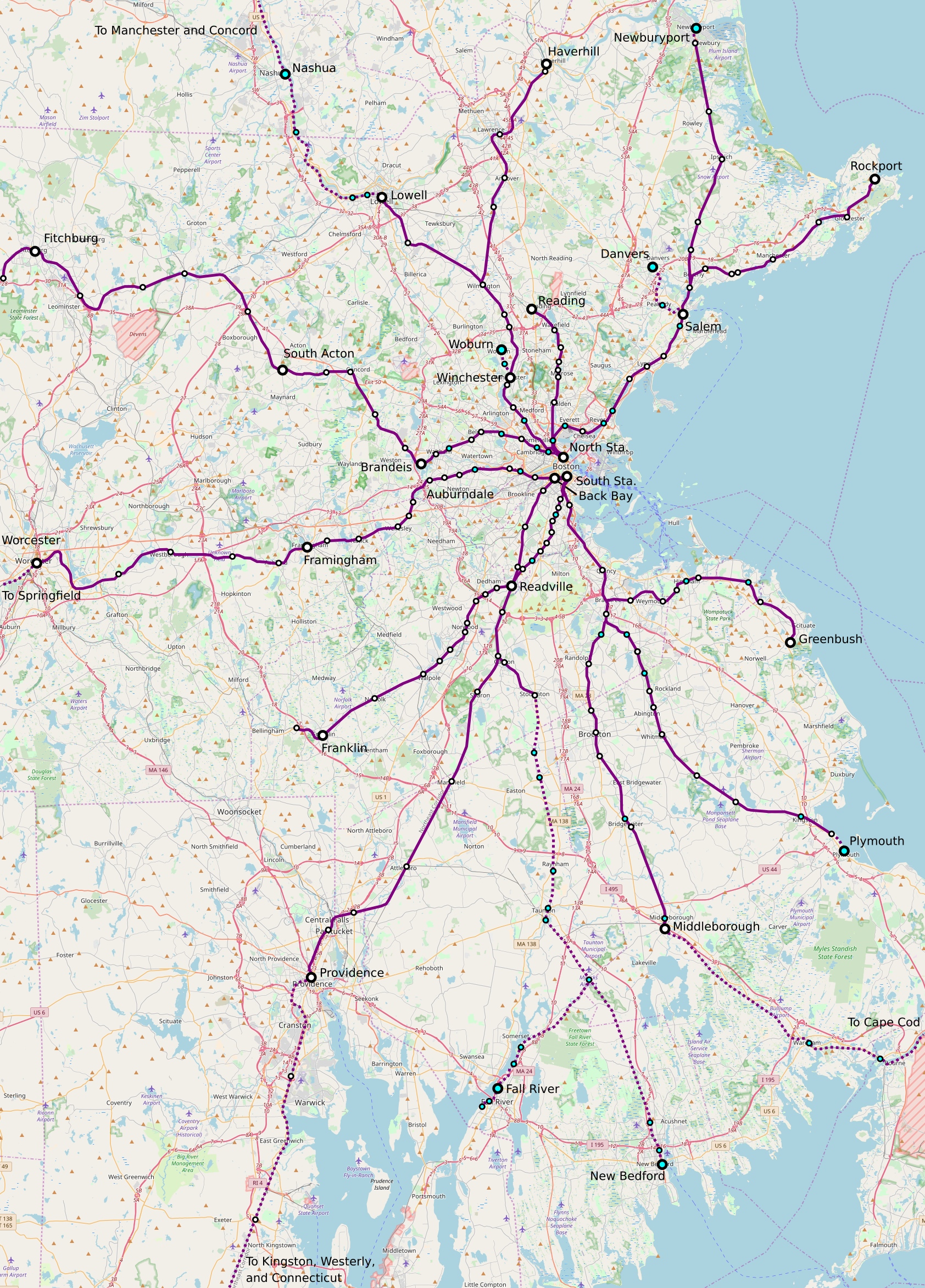
Observe that the Providence Line, the route currently used by all intercity trains except the daily Lake Shore Limited, is pretty straight – most of it is good for 300+ km/h as far as track geometry goes. The Canton Viaduct near that Canton Junction station is a 1,746 meter radius curve, good for 237 km/h with active suspension or 216 km/h with the best non-tilting European practice. This straightness continues into Rhode Island, separated by a handful of curves that are to some extent fixable through Pawtucket. The fastest segment of the Acela train today is there, in Massachusetts and Rhode Island.
The Worcester Line is visibly a lot curvier. Only two segments allow 160 km/h running in our regional rail schedules, around Westborough and immediately west of Grafton. This is why, ignoring intercity rail, our timetables have Boston-Providence trains taking 47 minutes where Boston-Worcester express trains take 45 minutes with 4 fewer stops or 57 minutes with 5 more, over the same route length. And the higher the necessary top speed, the larger the trip time mismatch is due to curves.
Going around the curves of the Worcester Line is possible, if high-speed rail gets a bypass next to I-90. However, this introduces three problems:
- More construction is needed, on the order of 210 km between Auburndale and New Haven compared with only 120 between Kingston and New Haven.
- Bypass tracks can’t serve the built-up area of Worcester, since I-90 passes well to its south. A peripheral station is possible but requires an extension of the commuter rail network to work well. Springfield and Hartford are both easy to serve at city center, but if only those two centers are servable, this throws away the advantage of the inland route over Providence in connecting to more medium-size intermediate cities.
- The two-track section through Newton remains the stuff of nightmares. There is no room to widen the right-of-way, and yet it is a buys section of the line, where it is barely possible to fit express regional rail alongside local trains, let alone intercity trains. Fast intercity trains would require a long tunnel, or demolition of two freeway lanes.
There’s the occasional plan to run intercity rail via the Worcester Line anyway. This is usually justified on grounds of resiliency (i.e. building too much infrastructure and running it unreliably), or price discrimination (charging less for lower-speed, higher-cost trains), or sheer crayoning (a stop in Springfield, without any integration with the rest of the system). All of these justifications are excuses; regional trains connecting Boston with Springfield and Springfield with New Haven are great, but the intercity corridor should, at all levels of investment, remain the Northeast Corridor, via Providence.
The issue is that, even without high-speed rail, the capacity and high track quality are on Providence. Then, as investment levels increase, it’s always easier to upgrade that route. The 120 km of high-speed bypass between New Haven and Kingston cost around $3-3.5 billion at latter-day European costs, save around 25 minutes relative to best practice, and open the door to more frequent regional service between New Haven and Kingston on the legacy Shore Line alongside high-speed intercity rail on the bypass. This is organizationally easy spending – not much coordination is required with other railroads, unlike the situation between New Haven and Wilmington with continuous track sharing with commuter lines.
If more capacity is required, adding strategic bypasses to the Providence Line is organizationally on the easy side for intercity-commuter rail track sharing (the Boston network is a simple diagram without too much weird branching). There’s a bypass at Attleboro today; without further bypasses, intercity trains can do Boston-Attleboro in 11 fewer minutes than regional trains if both classes run every 15 minutes, which work out to 25 minutes per our schedule and around 32 between Boston and Providence. To run intercity trains faster, in around 22 minutes, a second bypass is needed, in the Route 128-Readville area, but that is constructible at limited cost. If trains are desired more than very 15 minutes, then a) further four-tracking is feasible, and b) an intercity railroad that fills a full-length train every 15 minutes prints money and can afford to invest more.
This system of investment doesn’t work via the inland route. It’s too curvy, and the bypasses required to make it work are longer and more complex to build due to the hilly terrain. Then there’s the world-of-pain segment through Newton; in contrast, the New Haven-Kingston bypass can be built zero-tunnel. But that’s fine! The Northeast Corridor’s plenty upgradable, the inland route is bad for long-distance traffic (again, regional traffic is fine) but thankfully unnecessary.
The Scope and Future of Our Project on Costs
I was on a panel at Eno’s symposium on costs, talking with other teams investigating comparative construction costs. We worked off a list of questions Eno’s Robert Puentes had sent us before, knowing that the list was too long for five people (me, Eric, Laura Tolkoff, Ethan Elkind, Romic Aevaz) to cover in an hour. So for more completeness, here are my responses – and pay attention specifically to issues of scope and what we should be doing in the future. In particular, as we’re getting funded to do other things, we will likely have room in the budget to add a few more cases, and hire people who can put them together.
What were your key takeaways on the extent of our cost premium, and key cost drivers?
I blogged this just before the panel. The only major headers I’ll add are poor interagency coordination in the United States, especially for projects that are or touch commuter rail, and a political system full of real and imagined veto points. The imagined veto points are not unique to the US – the UK, Germany, and the Netherlands all have visible problems with excessive tunneling on high-speed rail projects coming from NIMBY demands, NIMBY demands that at least in the first two cases are paper tigers that the state can ignore if it doesn’t mind a few news cycles with negative headlines.
Questions on scope
There were three separate questions on this, since our approaches differ – Eno has more cases covered in less depth (and we made sure to pick disjoint comparison cases from theirs), Berkeley focuses on California projects. So we went through questions about what our respective scopes and limitations are:
- Could you walk us through the general scope and bounds of your work?
- What were some of the limitations you ran into when collecting information on costs/timeline, and what recommendations would you have to improve data reporting for projects?
- What are some of the lingering questions or areas for future study that your teams have flagged?
The answer to all three is that our scope – the six cases – looks at specific issues rather than general ones. The forest comprises trees and cannot be studied as an ecosystem until one understands the biology of the tree species therein. But then, understanding the biology of the tree species requires understanding the ecosystem they have evolved in; the reason we do cases simultaneously is that hearing about issues arising in one place informs our work on other places.
That said, I think it matters that none of our six cases is typical. Medium-cost environments like France, Germany, and Japan are unfortunately not in scope; I’ve read a lot of work on cot issues plaguing Grand Paris Express, but unfortunately not in any global or even just European comparative sense. All of our cases are Western (for infrastructure purposes Turkey is a Western country); this matters because, while European and East/Southeast Asian costs are broadly the same, both covering the entire global range short of American costs, there are notable differences in how they build, so it’s plausible that there re things one side does right that the other doesn’t in both directions. All of our cases are first-world or, in Istanbul’s case, 1.5th-world.
This means that we would like to add cases. Attractive targets include anything in Spain, to beef up our set of low-cost examples, and then cases that represent examples we didn’t study, that is places that are medium-cost, non-Western, or not in or in the penumbra of the developed world. My suspicion is that medium-cost examples will interpolate practices – Germany and France both vaguely appear to mix good Scandinavian or Southern European behavior with bad British and American behavior, each in its own way. But I do not know and that’s why we’d like to add cases. In middle-income countries like Russia, Mexico, Brazil, and China, and in low-income ones like India or the Philippines, I do not really know what to expect and my only explanation so far is completely different from any first-world pattern.
We should have a budget for this, but I don’t yet know how many cases we can juggle in addition to where we’re going to shift the main of our attention starting in early 2022, that is high-speed rail and a synthesis for the Northeast Corridor. Most likely other people will write the cases (for pay of course) and we will supervise in between looking at the history and technical data of the Northeast Corridor.
Consensus and Costs
I’m in the middle of an online symposium at Eno about construction costs; I talked on Tuesday and I think there will be a recording made available later. The conference is good by a lot of standards, including the “do they tell me things I don’t know about costs” standard. But for now, I want to address one point made repeatedly in interviews re some low-cost cities: the argument from consensus. It’s wrong, and leads to very wrong conclusions.
What is the argument from consensus?
In Eno’s lowest-cost comparison cities, like Madrid, there’s political consensus in favor of building more subways. Repeated panels gave this example of how in the 1990s and 2000s, PP and PSOE both supported subway construction and promised to build more in their election campaigns for the Community of Madrid. PSOE in fact attacked PP saying its proposals were unrealistically ambitious, but then the Madrid Metro expansion opened as planned. In such a political environment, no wonder planners had leeway to build the system without much interference.
Why is this wrong?
Britain has bipartisan political consensus in favor of both Crossrail and High Speed 2, both of which are explicitly supported in both parties’ manifestos. Its construction costs are still Europe’s highest.
More to the point, the United States is not uniformly an environment where public transportation is a partisan flashpoint, because in most of the cities that build subways, the Republican Party does not exist. The closest thing to a Republican Party in New York is the Manhattan Institute, which criticizes unions incessantly but does not call for ending public support for the subway and refrains from making the anti-transit arguments made by national Republican outfits like Reason and Cato. The last Republican mayor, Rudy Giuliani [sic], tried to expand the subway to LaGuardia. I’ve met New Yorkers who view Giuliani as a savior and who are ant-immigration climate denialists and thy too think the city and state should make the subway better – if anything they treat its poor state as evidence that the Democrats can’t govern.
This consensus does not lead to low costs. Why would it? There is no respect for planners or engineers. The consensus in New York means every governor installs their political cronies at the head of the agencies involved. None of the mechanisms that make Madrid Metro work is present.
The consequences
Just having more political support for subway construction is not going to by itself make things better. American states where investment is safe from cancellation do not do better than ones where one election could spell doom for the investment program. Sea changes are required, not just more public support.
Express Rail Tunnels and Regional Rail Capacity
In three cities that I know of, there are plans to deal with an incipient regional rail capacity crunch by building a new tunnel: Tel Aviv, Hamburg, London. The route in question in all cities already has regional rail service making frequent urban stops as well as longer-distance intercity trains. Setting Tel Aviv aside – new tracks are not necessary there at all – both Hamburg and London have a choice of what to build in the tunnel. In both cases, the answer must be intercity rail and not regional rail. This affects Crossrail 2 in London, currently shelved but still in active planning, as well as plans for Hamburg Hauptbahnhof-Altona capacity improvements.
The dominant factor in the cost of an expensive urban railway in a constrained environment is the stations. Low-cost countries build very cheap stations, but that’s true in outlying areas, urban as they may be, and not in city center areas under and around older subways. What’s more, Britain and Germany are not low-cost countries. German costs are somewhat higher than the global median, British costs among the world’s highest. Thus, keeping down station costs is paramount – and express tunnels have fewer stations than local tunnels.
Normally, the express vs. local issue is not relevant to a new urban rail line. Yes, more stations are more expensive, but on a line designed to open up service to a new area, more stations also provide more access, so the extra cost is often worth it. This is true even for urban subways that act as relief lines, like Second Avenue Subway, a relief line for the Lexington Line: more stations provide better local access and therefore increase the line’s relief value.
However, when the problem comes from regional or longer-distance capacity, all of this goes out the door. Crossrail 2 includes a long tunnel from Central London all the way to Wimbledon not because of purely local needs but because of very high rail usage along the South West Main Line. In Hamburg the problem is similarly about the main line between Hauptbahnhof and Altona – local traffic is saturated on the S-Bahn, and all other trains have to squeeze on the remaining two tracks of the Verbindungsbahn. Thus, capacity expansion should involve a tunnel with the fewest number of stations, on the most express services.
And yet both cities are doing it wrong. Hamburg is planning an S-Bahn tunnel, with the existing S-Bahn route then given over to regional trains, to be segregated away from the intercity trains. But there are already two Hauptbahnhof-Altona S-Bahn routes – that’s not where the service need is. Instead, new tunnels should go between the stations without stopping, to reduce costs, hosting intercity trains while regional trains take over the existing intercity tracks.
London is likewise planning on an undulating connection between Clapham Junction and Wimbledon, with links to other parallel north-south lines in the area. This is not good planning – those new stations are inordinately expensive and not needed for network connectivity. If there is no way to six-track the South West Main Line above-ground by replacing the sloped berm with retaining walls, it’s the fastest trains that should go underground, to save money on stations. Crossrail 2 is a £31.2 billion project; I don’t think Paris has spent this money on all Métro and RER lines in the region to date combined, and Grand Paris Express, at a broadly similar cost, includes 160 km of tunnel. It’s necessary to economize and build the tunnels that are necessary, and not the ones London would like to have.
 Pedestrian Observations