Category: Transportation
Hong Kong Construction Costs
I think we have found the #2 city in urban rail construction costs, behind only New York. This is Hong Kong, setting a world record for the most expensive urban el and encroaching on Singapore for most expensive non-New York subway.
As we look for more data to add to our transit costs website, I looked at Hong Kong to see what was going on. I remembered that its costs were high, but didn’t remember details – I think the project I was thinking of was the longest, the Sha Tin to Central link, but I looked at all recent, under construction, and planned MTR lines. I summarized the results on Twitter, but I’d like to cover this in more detail here.
The projects and their costs
Tung Chung Line extension: a planned line for construction in 2023-30, a total of 1.8 km underground, HK$18.7 billion, or around US$3.1 billion, or $1,730 million per km. Even giving it 1.8 km seems like I’m doing Hong Kong a favor – the extension is 1.3 km, and the other 500 meters are overrun tracks at the Hong Kong Island end, which I don’t ever count elsewhere since it is not in-service trackage. In addition to the tunneling (and single underground station), there is a single at-grade infill station, whose contribution to the budget is approximately zero.
West Island Line: 3 km underground, HK$18.5 billion. This is around US$3.4 billion, or $1,130 million per km. Only six lines globally are more expensive than this: phase 6 of the Circle line in Singapore, and the five New York lines, of which three are not even open yet. This is not even regional rail, but construction is entirely within the Hong Kong CBD, explaining why it is so expensive even by local standards.
Sha Tin-Central: 17 km, HK$87.3 billion, or around US$14.5 billion. This is $850 million per km. The line is not even fully underground, just 90%: the northernmost segment, totaling around 10%, is elevated. This line near-ties Crossrail and the Melbourne Metro Tunnel for most expensive line in the world longer than about 5 km – New York is building short lines, the longest (Gateway) around 5 km depending on source. The line is partially regional rail: it includes a 6 km extension of the East Rail Line under Victoria Harbour toward Admiralty, but the other 10 km is not regional rail.
Tuen Mon South Extension: 2.4 km, HK$11.4 billion, all elevated, in an outlying residential area. This is $790 million per km, making it the world’s most expensive el – New York’s most recent els, the JFK and Newark Airport connectors, were positively reasonable by this standard, only around $270 million/km adjusted for inflation (but don’t worry, the PATH estimates in the near future are a lot worse).
Kwun Tong Line extension: 2.6 km, HK$7.2 billion (same source as West Island). This is around US$1.3 billion, or $500 million per km. It’s the standard high cost of projects around the world, common for regional rail tunnels and CBD tunneling, except that this is strictly on the Kowloon side without as much older infrastructure to cross – it even misses a connection to the East Rail Line.
South Island Line (East): 7 km, HK$16.9 billion, around US$3 billion – see same source as West Island, or SCMP reporting. This is $430 million per km. This is not a fully underground line: as explained here, 2 km is on viaduct, serving Ap Lei Chau. Notice also that the original cost estimate was HK$7 billion, but by the time construction rose the budget had risen to $12.4 billion, and the final budget was $16.9 billion.
Is Hong Kong in the Anglosphere?
I’ve argued before that the single biggest predictor of an urban rail project’s cost is whether it is in the Anglosphere – the correlation of an Anglosphere dummy in our database is 0.54, more than even whether the project is underground or elevated. So it’s worth asking, is Hong Kong in the Anglosphere? There are arguments both ways, but I believe the preponderance of evidence points to yes.
- Hong Kong was under British rule until 1997.
- The legal system is traditionally based on English common law, even if there’s been a recent shift toward Chinese law.
- There is extensive exchange of knowledge with the core (white) Anglosphere, with managers who’ve moved around like Jay Walder, political leaders who have second passports in the UK (like Carrie Lam) or sometimes Canada or Australia, and Anglo media that reprints MTR press releases about its property development model.
- The design layout of the MTR has obvious British influences, including for example the use of cross-platform transfers between the core lines. Similarities with China are the result of convergent evolution (China is influenced by the USSR, which was influenced by Britain). There are some similarities with Japan, like the smartcard system’s use as electronic money, but they are smaller.
- Hong Kong’s love of privatization and high inequality is very Thatcherite. Again, the similarities with Japan are smaller – Japan’s privatization is slower, and Japanese corporations rely on mutual obligations whereas Hong Kong (like Singapore) expects brutal working hours of employees without offering them lifetime employment in return.
The one non-British aspect of the MTR is its use of property development subsidies (and before anyone asks: no, the costs above are just infrastructure, not property development). MTR expansion is funded by a mixture of property development, for which the MTR receives land at below-market rates, and more direct subsidies.
However, this is still more an Anglo aspect than an Asian one. Democratic East Asia notably does not give corporations land for below-market prices, not in the 21st century. Moreover, the British fascination with the Hong Kong model, which fascination is not present in France or Germany or probably anywhere else with reasonable construction costs and democratic constraints on the state, suggests that the elites in Britain and the US would like to be governed this way, just as many would like to be governed by the Lee clan. There is, in contrast, almost no curiosity about democratic East Asian governance, even after that 200 million people region proved itself to deal with corona better than any other.
Corona is a little awkward to bring in because Hong Kong’s infection numbers look like those of an East Asian democracy (it has the civil service of one), whereas the most similar country to Hong Kong on most matters, Singapore, has those of a Gulf state full of indentured migrant workers who got infected at extremely high rates. But for engineering, it doesn’t seem terribly important what the immigration numbers are – for example, Sweden and Norway are extremely similar to Finland even though they have way more immigrants, and likewise Saudi Arabia is similar to the other, immigrant-heavier Gulf states. So overall, Hong Kong’s public transport situation can be seen as very similar to Singapore’s – and Singapore has very high costs as well.
What does this mean?
I don’t know. Singapore and Hong Kong’s costs are probably higher than those of the core Anglosphere, but I am uncertain – Singapore’s big projects are not unusually expensive by Canadian or British standards, and the Sha Tin-Central link is legitimately difficult, the kind that Sweden would build for $250 million/km rather than for $130 million/km. So it’s hard to tell whether there is something about Hong Kong that goes beyond standard Anglo dysfunction.
I do not know what Hong Kong’s historic costs were. I expect them not to be so high – Singapore’s weren’t through phases 1-5 of the Circle line, and only exploded with the Downtown and Thomson lines, and Canada’s only exploded in the late 2000s and 2010s as it decided to privatize state planning and adopt design-build contracting.
However, in the present and near future, Hong Kong is a model to study purely for its failures, much like Singapore. The leaders of Hong Kong, in their rush to emulate Chinese repression tactics, should perhaps also learn something from Chinese construction techniques – or, ideally, Korean ones, Korea being the only Asian country among the world’s cheapest. People in other countries should aim to study Hong Kong’s infrastructure construction as an example to avoid, and not one to emulate.
The Costs of Subways and Els
I’m probably going to write this up more precisely with Eric and send this to a journal, but for now, I’d like to use our construction costs database to discuss the cost ratio of subways to elevated lines. The table I’m working from can be found here; we’re adding projects and will do a major update probably at the end of the month, but I don’t expect the new data to change the conclusion. Overall, the data is consistent with a subway : el cost ratio in the 2-2.5 range, but it’s not possible to get more precise estimates despite the breadth of the data.
Crude averages
Our database has 11,559 km of total length, but not all of that comes with cost estimates yet; subtracting lines for which we don’t have costs, we get 11,095 km. The total cost of all the lines in our database is, in PPP-adjusted but not inflation-adjusted dollars, $2.302 trillion, for an average of $207 million/km. Nearly all of the items are recent – the majority by length are still under construction, and only 10% opened by 2010. So inflation adjustment is minor, though nontrivial.
Moreover, looking only at 100% underground lines, we get 3955.3 km, for a cost of $945.3 billion, averaging $239 million/km. The other lines are mixed or elevated. The purely elevated lines total 2490.4 km, for a cost of $408.1 billion, or $164 million.
To be slightly fancier but use the same underlying data, the linear estimate of cost per km, treating the tunnel proportion as the independent variable, is 153.1406 + 117.5787*tunnel-proportion; this has a larger spread than just averaging pure subways and pure els, coming from both the inclusion of more data and from not weighting by line length.
However, even the larger spread has a subway : el cost ratio of 1.77, lower than found elsewhere in the literature. Why?
Els are disproportionately build in higher-cost countries
The most important quantitative fact coming out of the analysis of construction costs is that the most important independent variables are country-level dummies. The correlation between the tunnel proportion and cost per km is just 0.163; the correlation between cost per km and a dummy variable that takes the value 1 in the US, Canada, Britain, Australia, New Zealand, and Singapore and 0 elsewhere, is 0.543. If we instead set the dummy variable to take the value 1 in the countries I consider cheap – Spain, Portugal, Italy, Greece, Bulgaria, Switzerland, Sweden, Norway, Denmark, Finland, Turkey, South Korea – then the correlation with plain cost is -0.18, and since linear correlation is better at detecting high outliers than low-but-positive ones, we can take the reciprocal of cost and then the correlation is 0.258.
So it’s useful to figure out where the most els are being built. For example, China has 5,933 km in our database – that is, a slight majority – of which 3,851 are confirmed tunnel and another 1,046 are unconfirmed (Hangzhou in particular is bad about reporting tunnel proportions). Excluding lines with unconfirmed information, we have 9,842.6 km of which 6,436.4 are in tunnel, or 65% – but China is 3,851/4,887, or 79%.
In the lowest-cost countries, els are not common. In Spain, 205.7 km out of 253.8 in our database are underground, or 81%. The Korean lines in our database are 100% underground, and as we add more data, this will hardly change. Overall, the countries I consider cheap have 927 km of rapid transit in the database, which number will rise as we add more Korean data, and of those, 730.1 are underground, a total of 79%. What’s more, one third of the non-underground length in cheap countries consists of a single 63 km item, tagged CR3, consisting of surface improvements for Marmaray (the tunnel is costed separately, as BC1); 63 km is hefty, but as a single item, it is less visible to unweighted correlation estimates like the regression.
So if els are uncommon in China and in cheap countries, where are they common? The answer is high-cost developing countries and Gulf states. India has 1,046.7 km in the database, of which only 235.8 are underground, or 23%; when I continue my series of posts on rapid transit traditions and get to India, I will of course mention the predominance of els. Moreover, these Indian els are spread across many items – there are 29 Indian items, since individual lines in Mumbai and phases in other cities each get their own lines, which matters for unweighted correlation estimates. Similarly, Thailand is 20% underground, Vietnam 50%, Pakistan’s single line 6%, Bangladesh 48%, the Philippines 55%, Malaysia 22%, Indonesia’s single line 38%, Panama 12%, Saudi Arabia 14%, the UAE 22% – and all of these are high-cost. In the developed world, the el-happiest country is Taiwan, only 40% underground in our database, and it’s on the expensive side, its average cost at 40% underground still amounting to $240 million/km, and its three all-underground lines averaging $375 million/km.
It makes sense when you think about it. If construction costs in a country are higher, then it will look for ways to cut costs by building less visually desirable els (typically in developing countries) or slower light rail lines (as in the United States). If we included at-grade light rail lines, then our table would also have a wealth of high-cost American lines; as it is, we’re likely to add some at-grade heavy rail lines like the Silver Line in Washington and, if it actually begins construction, the planned PATH extension to Newark Airport.
Country-internal averages
So instead of averaging in the entire database, let’s look internally to countries, chosen to be big enough to have a mix of projects with different underground proportions. I’m also going to ignore some cases where I worry about comparability – for example, in France, above-ground lines are represented mostly by a metro extension in Toulouse and by the most outlying parts of Grand Paris Express, and I worry about comparing those with Parisian and inner-suburban tunnels. The worst exclusion has to be that of China: while there is a wealth of data there, China built more els 15-20 years ago than it does now, so comparing subways to els in (say) Shanghai is to some extent a comparison of costs in the 2010s to costs in the late 1990s and early 2000s. In that, China is hardly different from the United States – New York built many els from the 19th century until the mid-1920s, but subsequently built an almost 100% underground system.
Japan
In Japan, we go back to the 1990s, so using dollar amounts does have inflation artifacts. Thankfully, the yen has had no inflation, so we can just plug in raw yen numbers and convert at the 2020 rate of 100:1. The 100% underground lines in Japan have averaged $382 million per km, the elevated ones $123 million/km; the ratio is 3.1. The regression estimate, again using ¥100 = $1 throughout, is cost = 149.8978 + 255.9496*tunnel-proportion; the ratio using this method is 2.7.
India
India has a single 100% underground line in the database, Line 3 in Mumbai, built for $449 million/km. The pure els in India cost $158 million/km, for a subway : el ratio of 2.8. Looking only at els in Mumbai, the average inches up to $167 million/km, a ratio of 2.7. Inflation adjustment would have marginal impact as all of these lines are recent, the earliest priced in 2011 terms. The regression estimate (for all of India, not just Mumbai) is cost = 151.6146 + 222.2716*tunnel-proportion, which yields a ratio of 2.5.
Taiwan
As mentioned above, Taiwan’s three pure subways average $375 million/km. But as a note of caution, they are all regional rail tunnels, and we know from evidence in countries that build 100% underground metros and regional rail tunnels (Finland, Sweden, France, Britain, Germany…) that the latter are more expensive.
With that caveat, the four pure above-ground lines in Taiwan average $170 million/km, a ratio of 2.2. The regression estimate is cost = 183.3252 + 163.0895*tunnel-proportion, a ratio of 1.9. This is a lower ratio than in India and Japan, despite the caveat; the reason could be that the underground lines in the dataset are in Kaohsiung, Taoyuan, and Tainan, whereas the lines in Taipei and New Taipei are elevated, as the database so far does not include the older Taipei MRT lines with their city-center tunnels.
Thailand
There are no pure subways in Thailand; even the underground MRT’s extension is only 20% underground. However, the under-construction Orange Line is 75% underground, and costs $531 million/km. Overall, the regression estimate is 155.9491 + 350.2821*tunnel-proportion, which includes a number of lines in Bangkok and a cheaper half-underground line in Chiang Mai. This is a ratio of 3.2; excluding the one Chiang Mai line, this rises to 3.9.
Conclusion
Our database is consistent with the observation in the literature that the subway : el cost ratio is about 2-2.5. But a crude averaging of global costs would lead to an underestimate, since higher-cost countries are more likely to be building els. This is partly coincidence – former colonies in the developing world tend to have high costs and also wide throughfares where els are more politically acceptable – and partly the use of els to reduce costs where the country’s ability to afford subways is limited.
This reinforces the need to look at other treatments for reducing costs more carefully. It’s plausible that some policy treatments are not found in low-cost countries because those treatments are undesirable for some reason but do reduce costs. Thus, it is critical to look at both the best industry practices and the variation in practices within the parts of the world one considers best.
More on Suburban Circles
In the last post, I criticized the idea of large-radius suburban circle, using the example of the Berlin Outer Ring, at radius 10-26 km from city center. In comments, Andrew in Ezo brought up a very good point, namely that Tokyo has a ring at that radius in the Musashino Line, and ridership there is healthy enough to fill a train every 10 minutes off-peak. Of course, the Musashino Line’s intersections with the main JR East lines, like Nishi-Kokubunji and Minami-Urawa, have the ridership of a city center station in Germany rather than that of a station 25 km out. So to discuss this further, let’s drop midsize cities like Berlin and look at an actually large city: New York. Consider the following possible circle in New York, at radius 20-25 km:
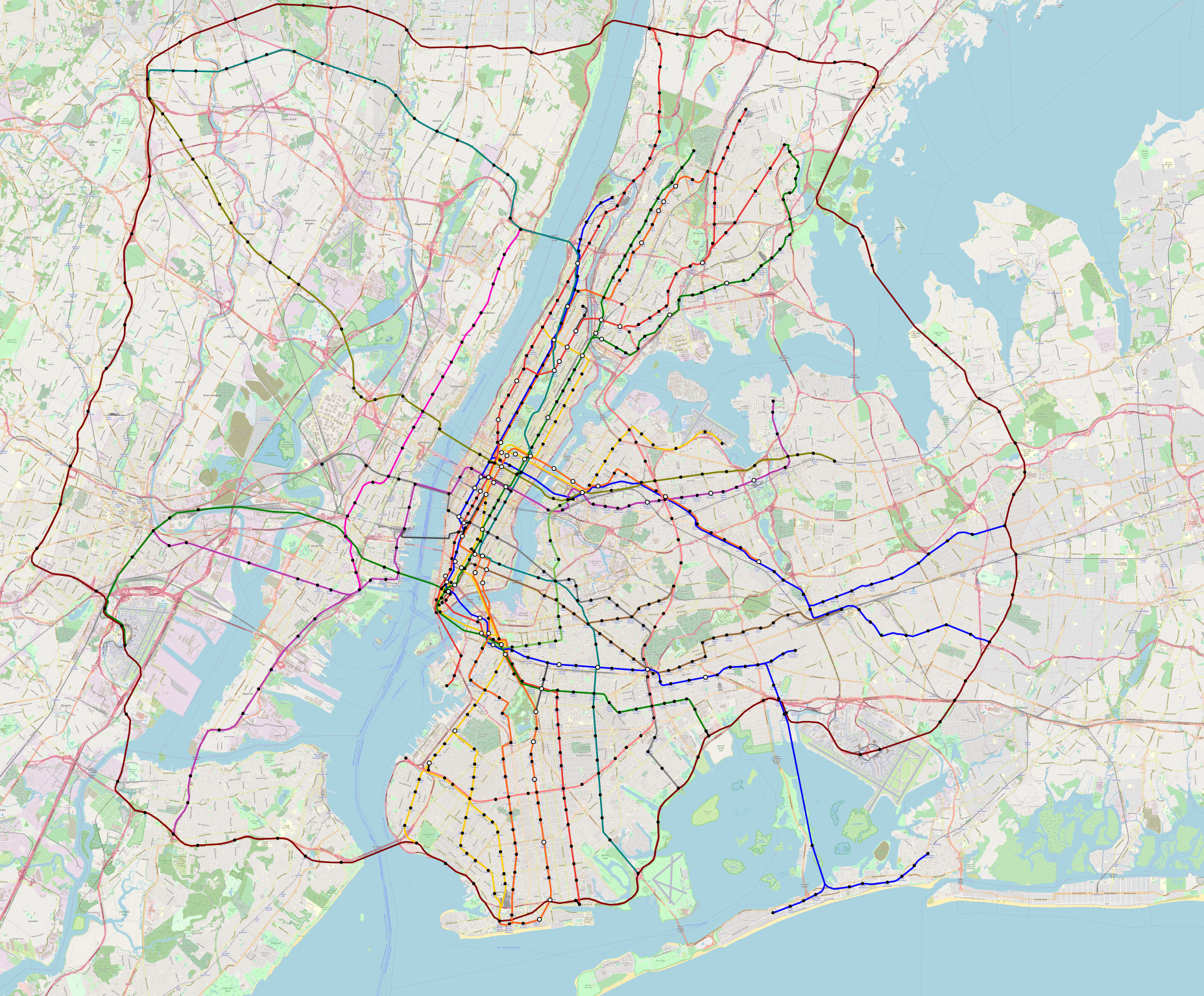
See full-size version here (warning: 55 MB).
Most of the radial extensions I’ve already discussed in previous posts – for example, here. Here these extensions go somewhat further in order to meet the ring, including at Newark Airport, on Staten Island, in Bay Ridge, at Floyd Bennett Park, in Canarsie, at Starrett City, near the Queens/Nassau County line, and in Yonkers.
The ring is 151 km, of which around 87 km would be above ground, mostly replacing highways like the Belt Parkway to reduce costs. Of note, this cannot be done adjacent to an extant highway – the fast car traffic deters nearby development, making transit-oriented development impossible. So key road links around the region have to go, which is fine, since people should be transitioning from driving to taking trains. With some additional elevated construction including through City Island, across the Long Island Sound, and in low-density parts of North Jersey where demolishing houses even at $1 million per unit is cheaper than tunneling, construction costs could be reduced further. But it’s still a $20-25 billion project at average world costs, maybe $15 billion at Nordic or Korean or Southern European or Turkish costs.
The only way to pay off the costs of such a line, not to mention to fill enough trains to support frequency that can take untimed transfers (at worst a train every 10 minutes), is to have very high ridership, on the order of 400,000-500,000 per day. This is for a line that misses Manhattan and all of the big secondary job centers, like Downtown Brooklyn and Long Island City. Is this plausible?
The answer is not an obvious no. Sufficiently aggressive TOD could plausibly create ridership. But it’s still questionable. There are really a few different forces pulling such a line in different directions:
- Using existing rights-of-way to reduce costs, hence the use of the Belt Parkway and not the denser development around Avenue U or even Flatlands.
- Serving secondary nodes like JFK, Coney Island, EWR, and Yonkers. Potentially it would be plausible to veer inward in New Jersey in order to hit Downtown Newark, at the cost of a few extra kilometers of tunnel, making the line radial from Newark’s perspective, whereas the line as depicted above is circumferential from Newark’s perspective since it goes around city center.
- The need to connect to radial subway and commuter rail lines, which means serving stations, opening plausible infill stations, and extending some lines toward the ring.
There are different ways to resolve this tension; the line I depicted is not the only one. For example, a higher-cost, higher-ridership version could veer inward in the Bronx and Queens, aiming to connect to Flushing and Jamaica and then replace the AirTrain JFK, leading to a ring of radius closer to 16 km than to 20-25.
I only bring this up to point out how many things have to work if you want such a ring to work out. Keeping costs to even semi-reasonable levels requires demolishing highways and engaging in aggressive TOD, which is only possible in an environment of total political victory over NIMBY and pro-car interests (note: these two are not the same!).
This is not the history of the Musashino Line. The Musashino Line originates in a freight bypass around the built-up area of Tokyo, which eventually turned into a circumferential passenger line. This is why it connects to the radial lines near but not at the busiest regional stations – at Nishi-Kokubunji and not Kokubunji, at Minami-Urawa and not Urawa, at Shin-Matsudo and not Matsudo or Kashiwa.
But even when the line is new, there are always compromises on right-of-way. Uncompromised right-of-ways are 100% possible, but not at 25 km radius, because the cost is too high to always go to the most important secondary centers. They happen when the radius is smaller, like Paris’s 8-10 km for M15, because then ridership can be high enough (M15 projects nearly a million riders a day). Farther away, ridership drops and costs rise because the line gets longer faster than per-km costs drop, so compromises are inevitable.
I am not proposing the ring above as a definitive crayon. I’m just mentioning it as something that highlights the difficulties of circumferential public transportation in the suburbs. Even as it is, the strongest segment of the ring is most likely the one in the city taking over the Belt Parkway, which could replace busy buses like the B15, B1, B3, B6, and B82. The suburban segments are weaker – there isn’t that much commuting across the Hudson that far north, and building up such commuting requires heavy commercial TOD in Yonkers, Mount Vernon, and New Rochelle.
The Limit of Circles in the Suburbs
In dense urban cores, it’s valuable to run circular rail lines. They connect dense near-center neighborhoods to one another without going through the more congested center, and help make transferring between parallel lines more efficient, again through avoiding central business district congestion. Some of the largest cities in the world even support multiple circles, line Lines 2 and 10 in Beijing, or the various overlapping circles of Moscow, Tokyo, and soon Paris. However, this system of radial lines through the center and circular lines around the center cannot go on forever. There is a limit to how far out one can build circles, which is much sharper than the limit of how far radial lines can go. Lower-density suburbs can have radial lines connecting them to city center or to near-center nodes of activity, but circumferential lines are likely to be weak.
For a concrete example, take Berlin. It has the Ring through fairly dense neighborhoods, supporting 5-minute frequency on the S-Bahn during most of the day. But it also has the Outer Ring, built in the 1950s through East Berlin and the Brandenburg suburbs to surround West Berlin and permit the construction of the Wall; today it runs regional trains, and one segment through East Berlin runs the S75 every 10 minutes, but there is no train making the entire orbit, just trains using short segments to position themselves to a better radial entry into the center of Berlin. It looks frustrating – there is circular infrastructure, why not use it? But there’s a solid reason not to run it as a true circle.
See map below:

A schematic of service patterns can be seen here.
The line’s origin as a bypass means it doesn’t serve any of the nodes near its radius, like Potsdam (too built-up), Spandau (in West Berlin), or Märkisches Viertel (also in West Berlin). The only node it does pass through is the soon-to-close Schönefeld airport, which only became important well into the Cold War; moreover, a branch parallel to the line to the southeast serves the soon-to-open Berlin-Brandenburg Airport, with plans to run many different kinds of regional services entering Berlin from both the Stadtbahn and the North-South Main Line. So a circular service would, by itself, just connect various outlying areas like Marzahn, Hennigsdorf, and Falkensee to the airport. By itself, this doesn’t support very high frequency.
Now, what the line could do is work as a network together with radial lines, connecting to them to facilitate travel not passing through the center of Berlin. However, there is not much point in transfers unless they are either high-frequency or timed. High-frequency transfers are out – the radial lines that penetrate the Outer Circle run 2-3 trains per hour. This forces the transfers to be timed.
Timed connections on lines that intersect crosswise rather than parallel with cross-platform transfers are completely possible. The trains can’t be too long, but that’s fine, a 4-car train with stair and elevator connections could have 2-3 minute transfer windows and still exchange passengers in all directions. It’s worth establishing at sufficiently important stations where a cross-platform transfer is not possible; as a four-way transfer, it’s not even that much more involved than a cross-platform transfer with timed wrong-direction transfers like Wittenbergplatz between U2 and U1/3. However, this is for one station.
All of this goes out the window when a circle intersects 12 different radial lines. Such a scheme can only work if all of the transfers are timed, or at least a large majority of them. Otherwise, people might as well take the train through the center and connect at Berlin Hauptbahnhof, or even stay on the same train if it runs through like RE 1 or RE 3.
In theory, you can time a short succession of transfers on the same line. All it really takes is to make sure that the circular line takes a half-integer multiple of the takt interval between every pair of transfer points, allowing both-direction transfers everywhere. On a few stretches of the line, it’s even plausible, with a 20-minute takt – the line would be fast because it’s so far out and has to few stops, so 7-10 km in 8 minutes (10 minus 2 for the transfer window) is not outside the realm of possibility.
Except that some segments between transfer points are still bad, like between the two just west of Spandau, or on both sides of the crossing with S5 and RE 1 in Lichtenberg. And even if they weren’t, this runs into the problem that trains are not infinitely punctual. Having 12 knots between a circular line and radials around Berlin, or even just 10 if weak ones are dropped, means that suburban Berlin would have more knots every 20 minutes than Switzerland has today every half hour (8), and not too many fewer than Switzerland is planned to have every half hour in the 2030s. The required schedule discipline is intense, especially in a big city defined by crowded rush hour trains.
This has implications elsewhere. Paris has its Grande Ceinture, which is tempting for a regional rail ring, but the frequency at which it can support a full RER line is not high; instead, the region is breaking the line into segments, to be turned over into tram-trains, with some segments diverging from the mainline to serve nodes near but not on the line.
In general, what this means is that if you’re not connecting to a major city center, there’s only so much service you can run. If you’re within the densely built-up area, as the Ring is or as the various orbitals Paris has (M2/M6, T3) or plans (M15), then it’s fine – untimed transfers are fine when trains come every 5 minutes, and overlapping one-seat rides like Prenzlauer Berg-Neukölln and Ostkreuz-Tempelhof and so on can help fill the train as well. But once frequency drops below about a train every 10 minutes, untimed transfers no longer work, which means that services that rely on connections only work if the connections are at a handful of key points, not at 12 different radii around the city.
Transit Costs Website
Go here to see the our construction costs website. The static dataset is here, but I encourage people to go to the site, which has some interesting mapping – in particular, because the coverage is close to comprehensive, it is easier to see where many subways are being built (China!) and where they are not.
There are still gaps in coverage, plus some numbers that I am not perfectly certain about because the projects are still under construction. Please email us if you have corrections or additional data, whether it’s current or historic. For example, I wish I had complete historical data for Paris, Berlin, and Tokyo – in all three cities I have current data, and in the first two I also have early 20th century costs, but I don’t know what the postwar costs were, or the 1930s costs in Berlin. (In London and New York I have better though still imperfect historical costs, they’re just not integrated into the site yet.)
And please thank everyone who has worked on this. The lines in the database that I added are not even a plurality of the database – the Chinese data comes from Yinan Yao, the Arab data comes from Anan Maalouf, we’re adding massive amounts of current and historic Korean data due to Abdirashid Dahir, Marco Chitti has added some Italian data, Eric has been invaluable in checking some of the Spanish-language numbers, and the Turkish data comes from Elif Ensari, who also built the website and is responsible for the data visualization and mapping.
Meme Weeding: Climate Resilience
I recently heard of state-level American standards for climate resilience that made it clear that, as a concept, it makes climate change worse. The idea of resilience is that catastrophic climate change is inevitable, so might as well make the world’s top per capita emitter among large economies resilient to it through slow retreat from the waterfront. The theory is bad enough – Desmond Tutu calls it climate apartheid – but the practice is even worse. The biggest, densest, and most desirable American cities are close to the coast. Transit-oriented development in and around those cities is the surest way of bringing green prosperity, enabling emissions to go down without compromising living standards. And yet, on a number of occasions I have seen Americans argue against various measures for TOD and transit improvements on resilience grounds.
The worst exhibit is Secaucus Junction. The station is a few kilometers outside Manhattan, on New Jersey Transit’s commuter rail trunk, with excellent service. So close to city center, it doesn’t even matter that the trains are full – the seats are all occupied but there’s standing room, which may not appeal to people living 45 minutes out of Midtown but is fine at a station that is around 10 minutes away today and should be 6 minutes away with better scheduling and equipment.
The land use around Secaucus is also very conducive to TOD. Most of the area around the station is railyards and warehouses, which can pretty easily be cleaned up and replaced with high-density housing, retail, and office development. A small section of the walkshed is wetlands, but the large majority is not and can be built up to be less ecologically disturbing than the truck traffic the current storage development generates.
Politically, this is also far from existing NIMBY suburbia. In North America, the single-family house is held to be sacrosanct, and even very YIMBY regions like Vancouver only redevelop brownfields, not single-family neighborhoods; occasionally there are accessory dwelling units, but never anything that has even medium density or visibly looks like an apartment building. Well, Secaucus Junction is far from the residential areas of Secaucus, so the most common form of NIMBYism would be attenuated.
And yet, there is no concerted effort at TOD. This is not even just a matter of unimaginative politicians. Area advocacy orgs don’t really push for it, and I’m forgetting whether it was ReThinkNYC or the RPA that told me explicitly that their regional rail proposal omits Secaucus TOD on climate adaptation grounds. The area is 2 meters above sea level, and building there is too risky, supposedly, because a 2 meter sea level rise would only flood tens of millions of South Asians, Southeast Asians, and Africans, and those don’t count.
This goes beyond just wasting money on needless infrastructure projects like flood walls, or leaving money on the table that could come from TOD. In the 2000s, New York City was emitting 7 metric tons of CO2 per capita, which was better than Germany and a fraction of the US average. This must have gotten better since – New York had an abnormally high ratio of building emissions (i.e. energy) to transportation emissions (i.e. cars), and in every developed country I’m aware of, only energy emissions have fallen, not car emissions.
A bigger New York, counting very close-in suburbs as New York, is an important part of the American green transition. To have the emissions of the inner parts of the city within the city is a luxury people pay $3,000 a month in rent for; to have it in exurbia means having a smaller car than everyone else in an environment in which accumulating lots of stuff is the only way one can show off status. Breaking the various interests that prevent New York (and Los Angeles, and San Francisco, and Boston, and Washington) from growing denser is a valuable political fight. But here, no such breaking is even needed, because the anti-growth interests think locally, and the only locals around Secaucus Junction live in one high-rise development and would if anything welcome more such buildings in lieu of the warehouses.
And yet, Americans argue from the position of climate resilience against such densification. Normally it’s just a waste of money, but this would not just waste money (through leaving money on the table) but also lead to higher emissions since housing would be built in other metropolitan regions of the US, where there is no public transportation. Once adaptation and resilience became buzzwords, they took over the thinking on this matter so thoroughly that they are now directly counterproductive.
Somehow, the goal of avoiding catastrophic climate change has fallen by the wayside, and the usual American praxis of more layers of red tape before every decisions can be made (about climate resilience, design for equity, etc.) takes over. The means justify the ends: if the plan has the word climate then it must be environmentally progressive and sensitive, because what matters is not outcome (it’s too long-term for populists, and all US discourse is populist) but process: more lawsuits, more red tape, more accretion of special rules that everyone must abide by.
Recession and Efficiency
Question. In what ways can a recession be useful for forcing inefficient public-sector agencies to lay off redundant workers and reduce bloat?
Answer. None.
Every recession, going at least back to the Great Depression, you get economists and others who are certain that high unemployment can discipline firms into greater productivity. Back in the 1930s, this was Joseph Schumpeter saying that there was no need to fear a depression because it was good, like “a cold douche.” Liquidating unproductive firms and forcing the rest to get leaner was supposed to improve economy-wide efficiency. Today, you can find people arguing the same for inefficient public-sector agencies strapped by budget cuts.
It doesn’t happen. Productivity decreases in bad economic times; labor-saving productivity improvements happen when wages are high, not when sales are low. Cash-strapped firms do not have the ability to invest for the long run – they just sell portions of themselves and shrink to be easier to manage, to limit the loss.
In public-sector public transportation, this really is the same. The best time for converting a metro line to driverless operation is when unemployment is 3%, not when it’s 15%. When unemployment is 3%, it’s possible to place workers in the private sector, which means they’ll work well through the transition. This goes doubly so when the productivity improvement lets one person do a job that previously took three rather than eliminating the job entirely: workers can go on strike if they’re unhappy, and transit as an industry is very amenable to unionization, to the point that unions have succeeded in organizing the tech shuttles in Silicon Valley in an otherwise union-hostile setting. (Of note, American public-sector anti-union successes have mostly been about screwing young workers, who are already the least empowered within the union, rather than doing anything to 20-year veterans who are about to retire with a full pension.)
The issue here is that very, very few workers are redundant on a next-day basis, even in severely overstaffed agencies. New York can eliminate subway conductors but requires some planning in advance to do so, for example to move mirrors around and place CCTV cameras to enable drivers to see the platform and close the doors. American commuter rail agencies can eliminate rail conductors, in what is as close to next-day redundancy as I can think of, but even that requires hiring fare inspectors for proof of payment checks and often also buying ticketing machines at outlying stations where previously passengers bought tickets directly on the train.
More often, eliminating a large amount of waste requires spending a bit more money in the short run. It can be on capital, like more ticketing machines. It can be on labor, like more dispatchers to make the buses run more regularly to reduce delays and bus driver overtime. But it’s usually not something that can be done by the Chainsaw Al school of management. It takes time, and in a lot of cases, the cooperation of the workforce is necessary.
Time and time again, we see transit managers who think in terms of just cutting avoid making long-term investments to improve efficiency. We see hiring freezes, wage freezes, reticence to engage in any long-term hiring and planning even in temporary recessions, and hostility to electrification even among American governors who propose to spend billions of dollars on parking more trains in city center between the morning and afternoon peaks. Even below the top political level, managers who develop a siege mentality never think in terms of long-term improvement. That’s not what will get them ahead; avoiding short-term controversy will, and they adapt to bad practices readily.
The workers adapt, too. If they expect sudden layoffs, their morale will tank and so will their productivity doing anything but the most routinized work. Maintenance workers will skip things – nobody will notice until it’s too late. Cleaners will slack, and if the message sent from the top is that it’s time to retrench, it will be hard to argue for aggressive standards for cleanliness. Even absent unionization, productivity will flounder, and there will not be much room to replace truly lazy workers if there is a hiring slowdown.
So what works for increasing efficiency? The answer is growth. Kopicki-Thompson’s report on best practices for rail privatization has a chapter about the history of the breakup of Japan National Railways in the 1980s, which makes the connection between growth and efficiency clear. Between 1980 and the breakup of JNR into seven constituent JRs in 1987, the company laid off two-thirds of its workforce, after complex negotiations with the unions, some of which were militant socialists. Japanese work culture is that a man is expected to work for the same firm for his entire working life, from age 22 for a university graduate to retirement at 65; JNR had to place these workers in the private sector for a mid-career layoff. This could happen because Japan’s economic growth in that era was famously high, to the point that Americans soon bought business books about how to think like a Japanese manager.
It is best to instead use weak periods to plan for the long term. If there’s stimulus spending, take it and go build things. Even if there isn’t, remember that the recession won’t last forever and plan in advance. Part of the plan should be knowing which workers are supernumerary and making a plan to place them at private-sector jobs as soon as they become available. But don’t expect to be able to send masses of pink slips in a recession; that must be saved for when jobs elsewhere in the economy are plentiful.
Overlapping Circles
I’ve been looking at a lot of big city metro maps recently while checking the construction cost database line by line, and I noticed a regrettable pattern in a number of megacities: they’re so big their metro networks have multiple circles in service or under construction, and instead of neat concentric circles they have overlaps.
What are overlapping circles?
Here is Moscow, for example. The map shows three circles: in blue is the Circle Line, or Line 5; in black is the Moscow Central Circle; and in red is the under-construction Big Circle Line, or Line 11.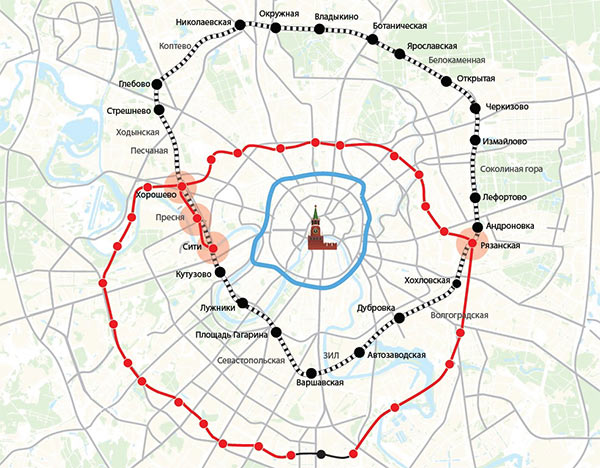
The reason for this is that the Central Circle uses a legacy regional rail alignment. In isolation, with no legacy rail to speak of, circles tend to be more orderly, as in Beijing with its two concentric circles (Lines 2 and 10). However, if there is a legacy alignment, it may not be perfectly aligned with where, absent any legacy rail, it would make the most sense to place an orbital. This is the case above in Moscow: the Central Circle is close to the Circle Line in the south but abuts farther away in the north, and the Big Circle Line is built to be the opposite.
This is not unique to Moscow. Here is Tokyo:

The Oedo Line, in magenta, is a ring with a tail. The Yamanote Line, in light green, is a full ring, taller than it is wide so as to really be two north-south lines joined at both ends.
Why is this bad?
The point of a circumferential line is to provide public transit in the orthogonal direction to that of city center. This has any of the following uses:
- To provide service on strong corridors that happen to be orthogonal to the direction of city center, such as Uptown Manhattan streets, Beijing ring roads, traces of former city walls in Paris, etc.
- To connect strong near-center neighborhoods to one another, at a radius that balances the density close to the center with the greater need for a circumferential farther away to avoid the inconvenience of walking or taking a two-seat ride on radial metro lines.
- To connect outlying areas with strong near-center neighborhoods that lie on different lines.
- To facilitate interchanges between different radial lines, especially ones that are close to each other, without too much backtracking and without overloading central transfer points.
This works best if the circumferential service is at approximately equal radius from the center. If it is not, then some segment of it may be partially radial, which means it will have all of the problems of radials (peakiness) and none of the benefits (service to city center). In extreme cases, an operational circle may literally pass through city center, as is the case for the Yamanote Line, or a nominal circumferential may pass close enough to count, as is the case for the East London line at Shoreditch, and then the problem is that one side of the region doesn’t get any circumferential service, that is Shitamachi and East London.
If there are multiple circles, then all of the above aspects get better if those circles are concentric, for the same reason. Having many circumferential lines closely parallel to each other can create a local grid in an especially large city; I proposed such a system for Lagos, which is both enormous and a tabula rasa.
Why does this keep happening?
The Moscow Central Circle and the Yamanote Line are both historic legacy commuter lines. Paris is in a similar situation, except the legacy is more recent and evolved over a generation: plans for a circumferential line beyond the M2/M6 ring go back generations, but nothing was done until recently, and the first effort in that direction was the early tramways. So there’s an incomplete ring formed by T1 and T2, another incomplete ring formed by T3, and the under construction M15 ring, the M15 ring intersects the T1/T2 ring because the T1/T2 alignments were based on where convenient surface roads or rights-of-way were available.
That this is so common in the largest cities in the world does not mean it is good. Sound prior planning should figure out locations for such circles in advance. In the case of Paris, there could have been the M2/M6 ring, and then the T3 ring beyond it (as a subway, not light rail) replacing the closely parallel Petite Ceinture, which is no longer useful since the radial Métro lines don’t have stops at the correct locations, and then the M15 ring, and then the orbital tramways of the Grande Ceinture. But I’m not going to use the incompetence tag if in the 1980s a city isn’t sure what its rail network will look like in the 2030s.
In a way, it’s like missed connections between metro lines. It comes from bad planning. It’s hard to avoid – the largest metro network without missed connections is Mexico City, which is unusually poor in radial lines, and even networks that have very few of these, like Paris, Beijing, and Seoul, keep building more. Overlapping circles are likewise present in Tokyo, Moscow, and soon Paris, and absent in only one city with multiple circles, the near-tabula rasa Beijing. However, planners should still aim to avoid this network awkwardness, figuring out network designs well in advance that create neat radials with city center meets and concentric circles for circumferential service.
New York as a Six-Minute City
What would it take to improve public transportation in New York so that all or nearly all routes would run at worst even six minutes during midday? Today, frequencies are tailored to individual routes; a bunch of subway lines are a 10-minute city (and the A branches are a 15-minute city), and in Brooklyn, the median midday bus headway is 12 minutes, with wide variations.
The bus origin of six minutes
Six minutes is not an arbitrary number. It comes from Eric’s and my Brooklyn bus redesign; speeding up routes through stop consolidation, dedicated lanes, and off-board fare collection, and pruning and recombining some routes, lets every bus run every six minutes from 6 am to 10 pm all day every day, with higher frequency on those routes that already have it today because they are too busy for just ten buses per hour. We didn’t study the other boroughs as deeply, but a quick doodle suggested the six-minute standard could be met in Manhattan and the Bronx as well, and a Bronx bus grid could even dip into a five-minute city.
Queens is a wildcard and I’m going to disappoint readers by not talking about it. It is clearly possible given the operational treatment we propose to make most of Queens a six-minute city, but at the price of long route spacing in Eastern Queens, and I don’t know what is optimal. It’s a hard question and I’m not going to tackle it unless I’m actually working on a longer-term project to do a Queens bus redesign.
Six minutes on the subway
The subway right now is a 10-minute city. A lettered or numbered route runs every 10 minutes off-peak, sometimes every 12 on Sundays and at night; the busier routes, especially the four that do not share tracks with other routes (1, 6, 7, L), run more frequently, but 10 minutes is the base frequency on large swaths of the network. The A branches in Ozone Park and the Rockaways even run every 15 minutes, but that’s unusual enough – evidently, nowhere else does one letter or number denote a route with its own branches – that it can be excluded.
For comparison, Berlin’s rail network is a 10-minute city, with some outer S-Bahn branches running every 20 minutes. Within the Ring, Berlin is a 5-minute city for the most part, excluding just a two-hour midday dip to 10 minutes on the Ring and 10-minute frequencies on the U1/U3 branches and the practically useless U4 route. Paris makes no effort to run different routes at the same intervals – French rapid transit planning has self-contained lines with their own fleets and schedules, so for example the RER A is on 10-minute off-peak takts and the RER B on 15-minute ones. So frequency there greatly depends on where in the region one lives and on what line. The Métro is a 5-minute city for the most part, as are the intramural RER trunks; intramural buses can be ignored. The suburbs are more or less a 15-minute city.
The reason New York is a 10-minute city on the subway is partly about interlining. The trunks in theory run every 5 minutes or better, but the trains do not come evenly because sometimes trains with different frequencies share the same trunk, and delays propagate easily. Interlining really doesn’t work unless all trains come at the same frequency; this is familiar in German planning, but not in American planning (or French planning, but there’s barely any interlining in Paris).
Putting every subway route on a 10-minute takt, with double service on the four non-interlined services, is possible but would lead to a lot of crowding on the busiest lines. About the worst possible frequency that works for everything is a train every 7.5 minutes; this lets the two A branches run on 15-minute takts, and everything else run on a 7.5-minute takt. But even then, New York has so many missed connections that it’s useful to do better. The six-minute city, matching buses, turns most of Manhattan and inner Brooklyn and Queens into a three-minute city.
Running all trains on the same takt also means timed connections. Trains that run every 5 or 6 minutes can routinely be timetabled to be at predictable places at predictable times, which facilitates local/express transfers on branches, for example in Southern Brooklyn. Even trunk transfers can be timed – 3-minute trains can still run on a timetable, and the most valuable transfers are local/express ones at 96th/Broadway, 125th/St. Nicholas, and 125th/Lex, all far enough north so as to not have the huge tidal crowds of Times Square or Grand Central.
What would it take?
On the buses, just good redesign, as long as the city is willing to exclude Staten Island from the six-minute city. In Queens, some increase in bus service is probably warranted.
On the subway, this requires on the order of 110-120 million revenue train-km a year, which is 1 billion car-km. The current figure is 560 million car-km/year. There is a lot of unnecessary expenditure on the subway, but fixing that requires something a lot deeper than a bus redesign. The cut in operating costs would be to levels that are well within first-world levels, and some of it would just come from better off-peak service making crew scheduling easier, without split shifts or wasted time. But it does require serious changes, especially in maintenance.
Quick Note: Timed Orbital Buses
Outside a city core with very high frequency of transit, say 8 minutes or better, bus and train services must be timetabled to meet each other with short connections as far as possible. Normally, this is done through setting up nodes at major suburban centers where trains and buses can all interchange. For example, see this post from six months ago about the TransitMatters proposal for trains between Boston and Worcester: on the hour every half hour, trains in both directions serve Framingham, which is the center for a small suburban bus system, and the buses should likewise run every half hour and meet with the trains in both directions.
This is a dendritic system, in which there is a clear hierarchy not just of buses and trains, but also of bus stops and train stations. Under the above system, every part of the Framingham area is connected by bus to the Framingham train station, and Framingham is then connected to the rest of Eastern New England via Downtown Boston. This is the easiest way to set up timed rail-bus connections: each individual rail line is planned around takt and symmetry such that the most important nodes can have easy timed bus connections, and then the buses are planned around the distinguished nodes.
However, there’s another way of doing this: a bus can connect two distinct nodes, on two different lines. The map I drew for a New England high- and low-speed rail has an orbital railroad doing this, connecting Providence, Worcester, and Fitchburg. Providence, as the second largest city center in New England, supplies such rail connections, including also a line going east toward Fall River and New Bedford, not depicted on the map as it requires extensive new construction in Downtown Providence, East Providence, and points east. But more commonly, a connection between two smaller nodes than Providence would be by bus.
The orbital bus is not easy to plan. It has to have timed connections at both ends, which imposes operational constraints on two distinct regional rail lines. To constrain planning even further, the bus itself has to work with its own takt – if it runs every half hour, it had better take an integer multiple of 15 minutes minus a short turnaround time to connect the two nodes.
It is also not common for two suburban stations on two distinct lines to lie on the same arterial road, at the correct distance from each other. For example, South Attleboro and Valley Falls are at a decent distance, if on the short side, but the route between them is circuitous and it would be far easier to try to set up a reverse-direction timed transfer at Central Falls for an all-rail route. The ideal distance for a 15-minute route is around 5-6 km; bus speeds in suburbia are fairly high when the buses run in straight lines, and if the density is so high that 5-6 km is too long for 15 minutes, then there’s probably enough density for much higher frequency than every half hour.
The upshot is that connections between two nodes are valuable, especially for people in the middle who then get easy service to two different rail lines, but uncommon. Brockton supplies a few, going west to Stoughton and east to Whitman and Abington. But the route to Stoughton is at 8.5 km a bit too long for 15 minutes – perhaps turning it into a 30-minute route, either with slightly longer connections or with a detour to Westgate (which the buses already take today), would be the most efficient. The routes to Whitman and Abington are 7 km long, which is feasible at the low density in between, but then timetabling the trains to set up knots at both Brockton and Abington/Whitman is not easy; Brockton is an easy node, but then since the Plymouth and Middleborough Lines are branches of the same system, their schedules are intertwined, and if Abington and Whitman are served 15 minutes away from Brockton then schedule constraints elsewhere lengthen turnaround times and require one additional trainset than if they are not nodes and buses can’t have timed connections at both ends.
Planners then have to keep looking for such orbital bus opportunities. There aren’t many, and there are many near-misses, but when they exist, they’re useful at creating an everywhere-to-everywhere network. It is even valuable to plan the trains accordingly provided other constraints are not violated, such as the above issue of the turnaround times on the Old Colony Lines.
 Pedestrian Observations