Category: Transportation
Amtrak’s Failure
An article in Streetsblog by Jim Mathews of the Rail Passengers Association talking up Amtrak as a success has left a sour taste in my mouth as well as those of other good transit activists. The post says that Amtrak is losing money and it’s fine because it’s a successful service by other measures. I’ve talked before about why good intercity rail is profitable – high-speed trains are, for one, and has a cost structure that makes it hard to lose money. But even setting that aside, there are no measures by which Amtrak is a successful, if one is willing to look away from the United States for a few moments. What the post praises, Amtrak’s infrastructure construction, is especially bad by any global standard. It is unfortunate that American activists for mainline rail are especially unlikely to be interested in how things work in other parts of the world, and instead are likely to prefer looking back to American history. I want to like the RPA (distinct from the New York-area Regional Plan Association, which this post will not address), but its Americanism is on full display here and this blinds its members to the failures of Amtrak.
Amtrak ridership
The ridership on intercity rail in the United States is, by most first-world standards, pitiful. Amtrak reports, for financial 2023, 5.823 billion passenger-miles, or 9.371 billion p-km; Statista gives it at 9.746 billion p-km for 2023, which I presume is for calendar 2023, capturing more corona recovery. France had 65 billion p-km on TGVs and international trains in 2023.
More broadly than the TGV, Eurostat reports rail p-km without distinction between intercity and regional trains; the total for both modes in the US was 20.714 billion in 2023 and 30.89 billion in 2019, commuter rail having taken a permanent hit due to the decline of its core market of 9-to-5 suburb-to-city middle-class commuting. These figures are, per capita, 62 and 94 p-km/year. In the EU and environs, only one country is this low, Greece, which barely runs any intercity rail service and even suspended it for several months in 2023 after a fatal accident. The EU-wide average is 955 p-km/year. Dense countries like Germany do much better than the US, as do low-density countries like Sweden and Finland. Switzerland has about the same mainline rail p-km as the US as of 2023, 20.754 billion, on a population of 8.9 million (US: 335 million).
So purely on the question of whether people use Amtrak, the answer is, by European standards, a resounding no. And by Japanese standards, Europe isn’t doing that great – Japan is somewhat ahead of Switzerland per capita. Amtrak trains are slow: the Northeast Corridor is slower than the express trains that the TGV replaced, and the other lines are considerably slower, running at speeds that Europeans associate with unmodernized Eastern European lines. They are infrequent: service is measured in trains per day, usually just one, and even the Northeast Corridor has rather bad frequencies for the intensely used line it wants to be.
Is this because of public support?
No. American railroaders are convinced that all of this is about insufficient public funding, and public preference for highways. Mathews’ post repeats this line, about how Amtrak’s 120 km/h average speeds on a good day on its fastest corridor should be considered great given how much money has been spent on highways in America.
The issue is that other countries spend money on highways too. High American construction costs affect highway megaprojects as well, and thus the United States brings up the rear in road tunneling. The highway competition for Amtrak comprises fairly fast, almost entirely toll-free roads, but this is equally true of Deutsche Bahn; the competition for SNCF and Trenitalia is tollways, but then those tollways are less congested, and drivers in Italy routinely go 160 km/h on the higher-quality stretches of road.
Amtrak itself has convinced itself that everyone else takes subsidies. For example, here it says “No country in the world operates a passenger rail system without some form of public support for capital costs and/or operating expenses,” mirroring a fraudulent OIG report that compares the Northeast Corridor (alone) to European intercity rail networks. Technically it’s true that passenger rail in Europe receives public subsidies; but what receives subsidies is regional lines, which in the US would never be part of the Amtrak system, and some peripheral intercity lines run as passenger service obligation (PSO) with in theory competitive tendering, on lines that Amtrak wouldn’t touch. Core lines, equivalent to Chicago-Detroit, New York-Buffalo, Washington-Charlotte-Atlanta, Los Angeles-San Diego, etc., would be high-speed and profitable.
But what about construction?
What offends me the most about the post is that it talks up Amtrak’s role as a construction company. It says,
Today, our nationalized rail operator is also a construction company responsible for managing tens of billions of dollars for building bridges, tunnels, stations, and more – with all the overhead in project-management staff and capital delivery that this entails.
The problem is that Amtrak is managing those tens of billions of dollars extremely inefficiently. Tens of billions of dollars is the order of magnitude that it took to build the entire LGV network to day ($65.5 billion in 2023 prices), or the entire NBS network in Germany ($68.6 billion). Amtrak and the commuter rail operators think that if they are given the combined cost to date of both networks, they can upgrade the Northeast Corridor to be about as fast as a mixed high- and low-speed German line, or about the fastest legacy-line British trains (720 km in 5 hours).
The rail operations are where Amtrak is doing something that approximates good rail work – lots of extraneous spending, driving up Northeast Corridor operating costs to around twice the fares on German and French high-speed trains, probably around 3-4 times the operating costs on those trains. But capital construction is a bundle of bad standards for everything, order-of-magnitude cost premiums, poor prioritization, and agency imperialism leading Amtrak to want to spend $16 billion on a completely unnecessary expansion of Penn Station. The long-term desideratum of auto-tensioned (“constant-tension”) catenary south of New York, improving reliability and lifting the current 135 mph (217 km/h) speed limit, would be a routine project here, reusing the poles with their 75-80 meter spacing; an incompetent (since removed) Amtrak engineer insisted on tightening to 180′ (54 m) so the project is becoming impossibly expensive as the poles have to be replaced during service. “Amtrak is also doing construction” is a derogatory statement about Amtrak.
Why are they like this?
Americans generally resent having to learn about the rest of the world. This disproportionately affects industries where the United States is clearly ahead (for example, software), but also ones where internal American features incline Americans to overfocus on their own internal history. Railroad history is rich everywhere, and the relative decline of the railway in favor of the highway lends itself to wistful alternative history, with intense focus on specific lines or regions. New Yorkers are, in the same vein, atypically provincial when it comes to the subway’s history, and end up making arguments, such as about the difficulty of accessibility retrofits on an old system, that can be refuted by looking at peer American systems, not just foreign ones.
The upshot is that an industry and an advocacy ecosystem that both intensely believe that railroad decline was because government investment favored roads – something that’s only partly true, since the same favoring of roads happened more or less everywhere – will want to learn from their own local histories. Quite a lot of advocacy by the RPA falls into the realm of trying to revive the intercity rail system the US had in the 1960s, before the bankruptcies and near-bankruptcies that led to the creation of Amtrak – but this system was what lost out to highways and cars to begin with. The innovations that allowed East Asia to avoid the same fate, and the innovations that allowed Western Europe to partly reverse this fate, involve different ideas of how to build and operate intercity rail.
And all of this requires understanding that, on a basic level, Amtrak is best described as a mishmash of the worst features of every European and East Asian railway: speed, fares, frequency, reliability, coverage. Each country that I know of misses on at least one of these aspects – Swiss trains are slow, the Shinkansen is expensive, the TGV has multi-hour midday gaps, German trains barely run on a schedule, China puts its train stations at inconvenient locations. Amtrak misses on all of those, at once.
And while Amtrak misses on service quality in operations, it, alongside the rest of the American rail construction industry, practically defines bad capital planning. Cities can build the right project wrong, or build the wrong project right, or have poor judgment about standards but not project delivery or the reverse, and somehow, Amtrak’s current planning does all of these wrong all at once.
Quick Note: Rural Drivers Aren’t Being Oppressed
A new paper is making the round arguing that Spanish rural automobility is a response to peripheralization. It’s a mix of saying what is obvious – in rural areas there is no public transportation and therefore cars are required for basic mobility – and proposing this as a way of dealing with the general marginalization of people in rural areas. The more obvious parts are not so much wrong as underdeveloped – the paper is an ethnography of rural drivers who say they need to drive to get to work and to non-work destinations like child care. But then the parts talking about peripheralization are within a program of normalizing rural violence against the state and against urban dwellers, and deserves a certain degree of pushback.
The issue here is that while rural areas are poorer than urban ones, making them economically more peripheral, they are not at all socially peripheral. This can be seen in a number of both economic and non-economic issues:
- Rural areas are showered with place-based subsidies to deal with poverty, on top of the usual universal programs (like health care and pensions) that redistribute money from rich to poor regardless of location. This includes farm subsidies, like the Common Agricultural Policy, and infrastructure subsidies in which there’s more investment relative to usage in rural than in urban areas. The automobility of rural areas is itself part of this program: urban motorways can fund themselves from tolls where they need to, but national programs of road improvements end up improving the mobility options of rural areas out of almost exclusively urban taxes. In public transport, this includes considerable political entitlement, such as when Spanish regional governors made a botched train procurement into a national scandal and demanded that the chief of staff of the national transport ministry, Isabel Pardo de Vera Posada, resign over something she’d had nothing to do with.
- Rural poverty is culturally viewed as the fault of other people than the residents. Poor urban neighborhoods are called no-go zones; I am not familiar enough with Spanish discourse on this but I doubt it’s different from French, German, and Swedish discourses, in which poor rural areas are never so called. A German district with neo-Nazi groups and majority public sympathy with extremism is called a victim of globalization in media, even left-leaning media, and not a no-go zone.
- Rural areas, regardless of income, are socially treated as more authentic representatives of proper values, with expressions like Deep England or La France profonde contrasting with constant scorn for London, Paris, and Berlin.
- Rural violence is treated as almost respectable. Political and media reactions to farmer riots with tractors as of late have been to shower the rioters with understanding. In France, the government acceded to the demands, and then-minister of the interior Gérald Darmanin forced law enforcement to act with restraint. In contrast, urban riots by racial minorities lead to mass arrests, the occasional fatal shooting of a rioter, and a discourse that treats riots as fundamentally illegitimate, for example just a few months prior.
The paper denigrates rural policies formed with “barely any understanding of how they are conditioned” and says that “an understanding of socio-spatial cohesion needs to look beyond the traditional objectives of equalizing agricultural incomes to consider how these accessibility gaps affect depopulation, young people’s skills, unemployment and low incomes.” But the issue isn’t understanding. Rural areas are not misunderstood. They are dominant, capable of steering specific subsidies their way that are not available to urbanites at equal income levels.
More broadly, I think it’s difficult for critical urbanism to deal with this issue of the permission structure for rural violence, because the urban-rural dynamic is not the same as the classical dynamic between social classes, or between white and black Americans, in which the socioeconomically dominant group is also the politically dominant one. It’s instead better to analogize it in ethnic terms not to American anti-black racism, or to European anti-immigrant racism, but to anti-Semitism, in which the social acceptance of a base level of violence coexists with the fact that Jews are often a more educated and richer group, leading anti-Semites to promulgate conspiracy theories.
The permission structure for rural drivers to commit violence in demand of government subsidies and government protection from competition is the exact opposite of peripheralization. It’s not a periphery; it’s a political and cultural center that faces a fundamental challenge in that it provides no economic or social value and is in effect a rapacious mafia using violence to extract protection money from an urban society that, due to misplaced sentimental values, responds with further subventions rather than with the full force of law as used against urban and suburban rioters with migration background.
Large Cars are a Positional Good
Americans have, over the last generation, gotten ever larger cars, to the point that the market is dominated by crossovers, pickup trucks, and SUVs and barely has sedans. Europe is not far behind, with the sedan market having collapsed and half of new sales comprising SUVs. Considerable resources are spent on these larger cars, which are more expensive to purchase, maintain, and refuel. The benefits at this point, however, are rather positional. The benefit of larger cars at this point is not about the comfort or performance of the car, but about being larger than other road users. Streets for All’s Michael Schneider described it as an arms race; this arms race that wastes resources and produces pollution and greenhouse gas emissions, without benefits even to individuals writ large, precisely the kind of problem that government regulation can solve.
The benefits of larger cars
The usual benefit drivers cite for why they want a larger car is comfort. The increase in car size from (say) the Fiat 500 or the Beetle or the 1970s Civic to modern midsize cars like the Accord and Camry has led to obvious improvements in comfort: four doors rather than two, ample front and rear passenger legroom, more trunk space.
And beyond this point, the relationship between car size and comfort saturates. Luxury sedans are still larger than midsize ones, but not by much; where the 500 had a curb weight of about 500 kg, the modern Accord is 1.4 t and the Camry is 1.6 t, barely less than a C-Class at 1.7 t and not much less than a 2.1 t 7 Series. A family car does not need to be larger than this, and when I talk to people about their vehicle purchases, at least the ones who tell me they’re getting SUVs do not cite comfort, not in the 2010s-20s.
The main selling point of luxury cars is performance. It’s this high-performance segment that Tesla competes with – electric cars have better performance specs, and where the older automakers tried to base their electric car offerings on preexisting platforms (like the Leaf, based on the Tiida), Tesla instead started by building high-performance luxury cars and expanded from there. But here there is no benefit to size – the Model 3 is around 1.7 t curb weight, and that includes batteries, which together weigh nearly half a ton.
Larger cars can also haul more goods, but the SUVs and pickups are expressly designed not to do that. The F-150’s bed has decreased with every new generation of the car; the Kei truck, specialized to have a large bed relative to the rest of the car, looks so weird to Americans that Massachusetts at one point banned it for being unsafe, while Americans on social media mocked the users as trying to prove an environmental point. The minivan, specialized to carry seven to eight passengers, has been unfashionable for at least a generation, losing out to the similarly large but lower-capacity SUV.
Instead, what I do hear from people telling me why they want a big car is purely positional: “I get to see over the other cars,” or alternatively “I can’t be the shortest car on the road because then I can’t see anything.” People are also recorded modifying their cars to be taller for the same reasons. The visibility in question does not improve if all cars get bigger; only the relative size matters. In the case of car accidents, this is even worse: in a collision between two cars the larger one is safer for the occupants, but making all the cars larger doesn’t improve traffic safety, and makes it much worse for pedestrians, and there’s some evidence of risk compensation by drivers of larger cars increasing the overall number of crashes.
The discourse on social benefits tends to exclude individual ones; thus, it’s easy to say that something that provides tangible individual benefits (such as larger dwellings) does not provide social ones. But this is something different. A purely private good does not provide positive externalities or improve the usual indicators that are usually the realm of public policy, like public health, but it improves the living standards of the owner, without negative externalities. But here, the benefit of the SUV or pickup truck to the user is purely the arms race on the road; the improvement in the quality of life of the owner is entirely about externalizing a fixed or even rising risk of car crashes to other road users. There isn’t even a social benefit here in the sense of the sum total of private individual benefits.
The costs of larger cars
While larger cars do not improve societal well-being on average, they have high individual and social costs.
The social costs are easier to explain: those cars emit much more pollution and greenhouse gases. The Camry has a fuel economy of maybe 37 miles per gallon (6.35 l/100 km) in the US; the F-150 gets less than half that, around 17.5 mpg (13.4 l/100 km). The fuel consumption ratio, 2.1, is somehow larger than the mass ratio – the F-150 doesn’t weigh 3.4 t but rather not much more than 2 t depending on model. Air pollution emissions are, for modern cars with modern petrol engines, proportional to greenhouse gas emissions; a car with twice the fuel consumption is going to also emit twice the particulate matter.
Then there is the danger of crashes. The United States has seen an increase in traffic fatalities lately, especially for pedestrians. The pedestrian fatality rate, in turn, comes from the form of pickups and larger SUVs: they have larger hoods, which hit pedestrians in the chest or (for children) the head rather than in the legs, and which also reduce visibility. Here it’s not an issue of mass but one of hood shape, but these come from the same fundemantal issue of an arms race to be larger and taller than the other cars, to the exclusion of spending on personal comfort.
Those social costs are not the tradeoff of some individual benefit. There is a benefit to the driver of the larger car, but there is no benefit to the driver of the average car on a road with larger cars. Instead, the driver of said average car incurs significant individual costs, coming from the need to buy, maintain, and refuel a larger machine. The low fuel economy costs the drivers money; most of the costs are external, but not all. The purchase price of a larger car is larger, because it is a larger piece of machinery, requiring more workers and more capital to put together; Edmunds’ price range for the F-150 is 50-100% higher than that for the Accord or Camry. Consumers routinely spend more money for better products, but here the product is not better except positionally.
The way forward
Government regulations to curb the arms race can directly limit or tax the size of cars, or instead go after their negative externalities. The latter should be preferred; in particular, a tax on car size would create a situation in which people can pay for a road that is safer for them and more dangerous for others, which is likely to lead to both much more aggressive driving by the largest cars on the road and to populist demands for large cars for everyone.
Specific taxes on large cars may still be appropriate in specific circumstances, like parking; Paris charges SUVs more for parking, justified by the fact that these vehicles don’t fit in the usual street parking spots, which are designed for the typical European car and not for the largest ones.
But outside the issue of parking, it’s better to be tighter about regulations and taxes on pollution, and about accidents. In the United States, it’s necessary to get rid of the system in which cars are perennially underinsured, with most states requiring liability coverage of $50,000 (Cid’s car accident, which was medium-term disabling but not fatal, incurred around $1 million in bills, and the insurance value of human life in the United States is $7.5 million). On both sides of the Atlantic, it’s necessary to tax or regulate pollution more seriously; the EU is ramping up fines on automakers that produce excessively polluting vehicles, but Robert Habeck, who is rather rigid on issues like nuclear power and the Autobahn speed limit, wants to suspend those fines since German automakers lag in electric cars.
On the matter of safety, it’s best to require cars to meet high standards of visibility and pedestrian safety in crashes, measured for example by survival rates at typical city speeds like 30 and 50 km/h. A car that fails these standards should not be on the road, just as cars are tested for occupant safety. If it means that the high, deep hood characteristic of the pickup truck no longer meets regulations, then fine; safety regulators should not compromise just because some antisocial drivers are acculturated to playing Carmageddon on real roads.
The key here is that regulations on emissions and personal injury liability suppress investment in larger cars, and that is good. There are other forms of capital investment in the economy competing for funding, which are not purely positional, for example housing, where German investment has been lagging due to high interest rates. Externalities are a real market failure and sometimes they get to the point that the product is, at scale, a net negative for society.
Quick Note: High-Speed Rail and Decarbonization
I keep seeing European advocates for decarbonizing transportation downplay the importance of big infrastructure, especially high-speed rail. To that end, I’d like to proffer one argument for why high-speed rail decarbonizes transportation even when it induces new trips. Namely: induced leisure trips come at the expense of higher-carbon travel to other destinations. In the 2010s discussion on High Speed 2, for example, induced trips were counted as raising greenhouse gas emissions (while having economic benefits elsewhere), and with this understanding I think that that is wrong. This becomes especially important with the growing focus on flight shaming in Europe. A 1,000 km high-speed rail link doesn’t just compete with flying on the same corridor, but also with flying to a different destination, which may be much farther away, and thus its effect on decarbonizing transport is much larger than a model of corridor-scale competition with cars and planes predicts.
Aviation emissions
A common argument for high-speed rail in the 2000s was that it would displace on-corridor flights, reducing greenhouse gas emissions. In the American version, this argument awkwardly coexisted with a separate argument for high-speed rail, namely that it would decongest airports and allow more flight slots to faraway destinations. In the 2010s and in this decade, this contradictory thinking fell away – the United States hasn’t built anything, China builds for non-environmentalist reasons, Europe gave up on cross-border rail construction and its activists became more interested in trams-and-bikes urbanism. This is also reflected in research: for all of the hype about high-speed rail as a substitute for aviation, researchers like Giulio Mattioli point out that aviation emissions are dominated by long-distance flights, with <500 km flights comprising only 5% of aviation fuel burn and >4,000 km ones comprising 39%. Activist response to policies like France’s ban on flights competing with <2.5 hour TGVs has been to mock it as the gimmick that it is.
For this and other reasons, on-corridor competition with air travel is no longer considered an important issue. This is now being taken in the direction of arguing against 300 km/h lines; the thinking is that high speed is only really needed to compete with flights, whereas competing with cars requires something else. But that argument misses the importance of off-corridor competition. Passengers don’t just choose what mode to take on a fixed corridor; they also choose where to travel, and transport options matter to that choice.
The limits of ridership models
Ridership models tend to be local. SNCF uses a gravity model, in which the ridership between a pair of cities with populations 


The issue is that the model is local: if I live in Berlin and want to go to Munich, the model looks only at what’s between Berlin and Munich, and doesn’t consider that I can go to other cities instead if they’re more convenient to get to. One consequence of this is that the model probably overpredicts ridership in larger milieus than in smaller ones for this reason (the Tokyo resident can go to Osaka but also to Tohoku, etc.). But an equal consequence is that off-corridor competition is global.
The limits of leisure travel
Leisure travel is discretionary, and limited by vacation time. Building new high-speed lines does not mean that the country is offering workers more vacation days. The upshot is that every new line competes off-corridor with other lines, but also with other modes. A tightly integrated national high-speed rail system offers domestic tourism by rail, competing not just with flying on longer corridors like Berlin-Cologne, where the trains take four hours and are unreliable, but also with flying to places that the train doesn’t get to.
This has implications to a Europe-wide system as well. Right now, flights from Northern Europe to Southern Europe are on corridors where rail travel is only viable if you are an environmental martyr, really like 14-hour train trips, or ideally both. High-speed rail would by itself not compete on most of these corridors – those Spanish coastal cities are too far from Northern Europe for a mode other than flying, for one. But it would offer reasonable service to other places in Southern Europe with warm climate. Speeding up the Paris-Nice TGV means Parisians would choose to travel to Nice more and to islands less. Building high-speed rail approaches connecting to the base tunnels across the Alps means Germans, especially Southern Germans, could just go to large Italian cities instead of flying to islands or to Turkey. Even business travel may be affected, through replacement of flights to other continents.
One- and Two-Dimensional Rail Networks
As people on social media compare the German and American rail networks, I’m going to share two graphics from the upcoming Northeast Corridor report, made by Kara Fischer. They are schematic so it’s not possible to speak of scale, but the line widths and colors are the same in both; both depict only lines branded as Amtrak or ICE, so Berlin-Dresden, where the direct trains are branded IC or EuroCity, is not shown, and neither are long-range commuter lines even if they are longer than New Haven-Springfield.


The Northeastern United States has smaller population than that of Germany but not by much (74 million including Virginia compared with 84 million), on a similar land area. Their rail networks should be, to first order, comparable. Of course they aren’t – the map above shows just how much denser the German rail network is than the American one, not to mention faster. But the map also shows something deeper about rail planning in these two places: Germany is two-dimensional, whereas the Northeastern US is one-dimensional. It’s not just that the graph of the Northeastern rail network is acyclic today, excluding once-a-day night trains. More investment in intercity rail would produce cycles in the Northeastern network, through a Boston-Albany line for one. But the cycles would be peripheral to the network, since Boston, New York, Philadelphia, and Washington are collinear on the Northeast Corridor, and the smallest of these four metro areas, Philadelphia, is larger than all those on the branches depicted above, combined.
The most important effect on network planning is that it turns the Northeast Corridor into easy mode. We would not be able to come up with a coherent timetable for Germany on the budget that our program at Marron had. In the Northeast, we did, because it’s a single line, the main difficulty being overtakes of commuter trains that run along subsections.
This, in turn, has two different implications, one for each place.
The one-dimensionality of the Northeast
In the Northeast, the focus has to be on compatibility between intercity and commuter trains. Total segregation of tracks requires infrastructure projects that shouldn’t make the top 50 priorities in the Northeast, especially at the throats of Penn Station, South Station, and Washington Union Station. Total segregation of tracks not counting those throats requires projects that are probably in the top 50 but not top 20. Instead, it’s obligatory to plan everything as a single system, with all of the following features:
- Timed overtakes, with infrastructure planning integrated into timetable design so that the places with overtakes, and only the places with overtakes, get extra tracks as necessary.
- Simpler commuter rail timetabling, so that the overtakes can be made consistent, and so that trains can substitute for each other as much as possible in case of train delays or cancellation.
- Higher-performance commuter rail rolling stock, to reduce the speed difference between commuter and intercity trains; the trains in question are completely routine in German regional service, where they cost about as much as unpowered coaches do in the United States, but they are alien to the American planning world, which does not attend InnoTrans, does not know how to write an RFP that European vendors will respect, and does not know what the capabilities of the technology are.
- Branch pruning on commuter rail, which comes at a cost for some potential through-running pairs – trains from New Jersey, if they run through to points east of Penn Station, should be going to the New Haven Line and Port Washington Branch, and probably not to Jamaica; Newark-Jamaica service is desirable, but it would force dependency between the LIRR and intercity trains, which may lead to too many delays.
In effect, even an intercity rail investment plan would be mostly commuter rail by spending. The projects mentioned in this post are, by spending, almost half commuter rail, but they come on top of projects that are already funded that are commuter rail-centric, of which the biggest is the Hudson Tunnel Project of the Gateway Program. This is unavoidable, given the amount of right-of-way sharing between intercity trains and the busiest commuter rail lines in the United States. The same one-dimensionality that makes intercity rail planning easier also means that commuter rail must use the same non-redundant infrastructure that intercity rail does, especially around Penn Station.
The two-dimensionality of Germany
A two-dimensional network cannot hope to put all of the major cities on one line, by definition. Germany’s largest metro areas are not at all collinear. In theory, the Rhine-Ruhr, Frankfurt, Stuttgart, and Munich are collinear. In practice, not only does this still exclude Berlin and Hamburg, which is not at all like how Northeastern US collinearity works, but also the Rhine-Ruhr is a two-dimensional polycentric region, and Frankfurt is a terminal station oriented in such a way that a Stuttgart 21-style through-running project would allow for through-service from Stuttgart or from Cologne to points east but not from Stuttgart to Cologne. There’s also a tail of regions in the 1-1.5 million population range – Leipzig, Dresden, Nuremberg, Hanover, Karlsruhe – that are collectively larger than the largest single-core region (Berlin), even if they’re still smaller collectively than the eight-core Rhine-Ruhr region. The highest-demand link, Frankfurt-Mannheim, is a bottleneck between many city pairs, and is not at all dominant over other links in frequency or demand.
This makes for a network that is, by necessity, atypically complex. Train delays between Frankfurt and Mannheim can cascade as far as Berlin and Hamburg. There are timed connections, timed overtakes of slower regional trains on shared links (more or less everything in yellow on the map), and bypasses around terminal stations including Frankfurt and Leipzig as well as around Cologne, which is a through-station oriented east-west permitting through-service from Belgium and Aachen to the rest of Germany but not between Frankfurt and Dusseldorf.
Not for nothing, Deutsche Bahn has not really been able to make all of this work. The timetable padding is around 25%, compared with 10-13% on the TGV, and even so, delays are common and the padding is evidently not enough to recover from them.
The solution has to be reducing the extent of track sharing. The yellow lines on the map should not be yellow; they should be red, with dedicated passenger-only service, turning Germany into a smaller version of China. The current paradigm pretends Germany can be a larger version of Switzerland instead. But Switzerland builds tunnels galore to go around strategic bottlenecks, and even then makes severe compromises on train speeds – the average speeds between Zurich, Basel, and Bern are around 100 km/h, which works for a country the size of Switzerland but not for one the size of Germany, in which even the current 130-150 km/h average speeds are enough to get rail advocates to never take any other mode but not enough to get other people to switch.
In effect, the speed vs. reliability tradeoff that German rail advocates think in terms of is fictional. The two-dimensionality of Germany means that the only way to run reliably is not to have high frequency of both fast and slow trains on the same tracks between Berlin and Halle, between Munich and Ingolstadt, between Hanover and Hamburg, etc. Eliminating the regional trains is a nonstarter, so this means the intercity trains need to go on passenger-dedicated tracks.
In contrast, careful timetabling of intercity and regional trains on the same line has limited value in Germany. The regional trains in question have low ridership – the core of German commuter rail is S-Bahn systems that run in dedicated city center tunnels and have limited track sharing with the rest of the network, much less with the ICEs. If there’s high regional traffic on a particular link, it comes from combining hourly trains on many origin-destination pairs, in which case trains cannot possibly substitute for one another during traffic disturbances, and timetabling with low padding is unlikely to work.
Like Takt-based planning for Americans, building a separate intercity rail network for Germans comes off as weird and foreign. France and Southern Europe do it, and Germans look down on France and Southern Europe almost to the same extent that Americans look down on Europe. But it’s the only path forward. If anything, this combination of speed with reliability means that completing an all-high-speed connection on a major trunk line, like Berlin-Munich or Cologne-Munich, would permit cutting the timetable padding to more reasonable levels, which would save time on top of what is saved by the higher top speed. Germany could have TGV average speeds as part of this system, if it realized that these average speeds are both necessary and useful for passengers.
Consultant Slop and Europe’s Decision not to Build High-Speed Rail
I’m sitting on a series of three trains to Rome, totaling 14 hours of travel. If a high-speed rail network is built connecting those cities, the trip can be reduced to about 7.5 hours: 2.5 Berlin-Munich (currently 4), 2 Munich-Verona (currently 5.5), around 2.75 Verona-Rome (currently 3.5), around 0.25 changing time (currently 1). The slowest section is being bypassed with the under-construction Brenner Base Tunnel, but not all of the approaches to the tunnel are, and Germany is happy with its trains averaging slightly slower speeds than the 1960s express Shinkansen.
I bring this up because it’s useful background for a rather stupid report by Transport and Environment that was making the rounds on European social media, purporting to rank the different intercity rail operators of Europe, according to criteria that make it clear nobody involved in the process cares much about infrastructure construction or about what has made high-speed rail work at the member state level. It’s consultant slop, based on a McKinsey report that conflicts with the published literature on intercity rail ridership elasticity, which makes it clear that speed matters greatly. Astonishingly, even negative discourse about the study, by people who I respect, talks about the slop and about the problems of privatization, but not about the need to actually go ahead and build those high-speed connections, without which there are sharp limits to the quality of life available to the zero-carbon lifestyle, limits that make people avoid that lifestyle and instead fly and drive. In effect, Europe and its institutions have made a collective decision over the last 10 or so years not to build high-speed rail, to the point that activism suggesting it reverse course and do so is treated as self-evidently laughable.
The T&E study
The T&E study purports to rank the intercity rail operators of Europe. There are 27 operators so ranked, which do not exactly correspond to the 27 member states, but instead omit some peripheral states, include British and Swiss options, and have some private operators, including inexplicably treating OuiGo as separate from the rest of the TGV. The ranking is of operators rather than infrastructure systems; there is no attention given to planning infrastructure and operations together. Trenitalia comes first, followed by a near-tie between RegioJet and SBB; Eurostar is last. Jon Worth had to pour cold water on the conclusions and the stenography in various European newspapers about them.
In fact, the study fits so perfectly into my post about making up rankings that it is easy to think I wrote the post about T&E – but no, the post is from 2.5 years ago. The issue is that it came up with such bad weighting in judging railways that one is left to wonder if it specifically picked something that would sound truthy and put SBB at or near the top just to avoid raising too many questions. The criteria used are as follows:
- Ticket prices: 25%
- Special fares and reductions: 15%
- Reliability: 15%
- Booking experience: 15%
- Compensation policies: 10%
- Traveler experience (speed and comfort): 10%
- Night trains and bicycle policy: 5%
None of this is even remotely defensible, and none of this passes any sanity check. No, it is not 1.5 times as important to have special reductions in fares for advance bookings or other forms of price discrimination as to have a combination of speed and comfort. The Shinkansen has fixed fares and is doing fine, thank you very much; SNCF’s own explanations of its airline-style yield management system portray it as a positive but not essential feature – its reports from 2009 recommending high-speed rail development in the United States cite yield management as a 4% increase in revenue, which is good but not amazing.
But more broadly, it is daft to set a full 50% of the weight on fares and fare-related issues (i.e. compensation), and 15% on the booking experience, and relegate speed to part of an issue that is only 10%. That’s not how high-speed rail ridership works. Cascetta-Coppola find a ridership elasticity with respect to trip time of about -2, but only -0.37 with respect to fares. Börjesson finds a much narrower spread, -1.12 and -0.67 respectively, but still the same directionally. Speed matters.
And yet, T&E doesn’t seem to care. The best hints for the reason why are in the way it compares operators rather than national networks, and relies on a McKinsey report pitched at private entrants and not at member state policymakers, who do not normally outsource decisionmaking to international consultants. It doesn’t think in terms of systems or networks, because it isn’t trying to make a pitch at how a member state can improve its rail network, but rather at how a private competitor should aim to make a profit on infrastructure built previously by the state.
The need for state planning
Every intercity rail network worth its name was built and planned publicly, by a state empowered to do so. In East Asia, this comprises the high-speed rail networks of China, Japan, Korean, and Taiwan, all funded publicly, even if Japan subsequently privatized Shinkansen operation (though not construction) to regional monopolies that, while investor-owned, are too prestigious to fail. In Europe, some networks have high-speed rail at their core, like France, and others don’t, like Switzerland or the Netherlands, but the latter instead optimize state planning at lower speed, with tightly timed connections, strategic investments to speed up bottlenecks, and integration between rolling stock, the timetable, and infrastructure.
This feature of the main low-speed European rail network frustrates some attempts at disaggregating the effects of different inputs on ridership and revenue. At the level of a sanity check, there does not appear to be a noticeable malus to French rail ridership from its low frequency at outlying stations. But then France relies on one-seat rides from Paris to rather small cities, which do not have convenient airport access, and in its own way integrates this operating paradigm with rolling stock (bilevels optimized for seating capacity, not fast egress or acceleration) and infrastructure (bypasses around intermediate cities, even Lyon). Switzerland, in contrast, has these timed connections such that the effective frequency even on three-seat rides is hourly, with guaranteed short waits at the transfers, and this provides an alternative way to connect small cities with not just large ones but also each other.
But in both cases, the operating paradigm is connected with the infrastructure, and this was decided publicly by the state, based on governmental financial constraints, imposed in the 1970s in France (leading to extraordinarily low construction costs for the LGV Sud-Est) and the 1980s in Switzerland (leading to the hyper-optimized operations of Bahn 2000 in lieu of a high-speed rail system). A private operator can come in, imitate the same paradigm that the infrastructure was built for, and sometimes achieve lower operating costs by being more aggressive about eliminating redundant positions that a state operator may feel too constrained by unions to. But it cannot innovate in how to run trains. Even in Italy and Spain, where private competition has led to lower fares and higher ridership, all the private competitors have done is force service to look more like the TGV as it is and less like the TGV as SNCF management would like it to be internationally. Even there, they do not innovate, but merely imitate what the TGV already had purely publicly, on infrastructure that was designed for TGV or ICE service intensity all along.
The idea that the private sector can innovate in intercity rail comes from the same imitation of airline thinking that led to the failure of Eurostar, with its high fares and airline-style boarding and queuing. In the airline business, integration between infrastructure and operations is weak, and private airlines can innovate in aircraft utilization, fast boarding, no-frills service, and other aspects that led low-cost carriers to success. Business analysts drawn from that world keep trying to make this work for trains, and fail; the Spinetta Report mentions that OuiGo tanked TGV revenues, and ridership did not materially increase when it was introduced due to inconveniences imposed by the system of segmenting the market by fare.
Europe’s decision not to build high-speed rail
In the 2000s, there was semi-official crayon, such as the TEN-T system, for EU-wide high-speed rail, inspired by the success of the TGV. Little of it happened, and by the 2010s, it became more common to encounter criticism alleging that it could not be done, and it was more important to focus on other things – namely, private competition, the thing that cannot innovate in rail but could in airlines.
At no point was there a formal decision not to build high-speed rail at a European scale. Projects just fell aside, unless they were megaproject tunnels across mountains like the Brenner Base Tunnel or water like the Fehmarn Belt Tunnel, and then there is underinvestment in the approaches, so that the average speed remains shrug-worthy. The discourse shifted from building infrastructure to justifying not building it and pitching on-rail competition instead. This, I believe, is due to factors going back to the 1990s:
- The failure of Eurostar to produce high ridership. It underperformed expectations; it also underperforms domestic city pairs. SNCF is happy to collect monopoly profits from international travelers, and, in turn, potential travelers associate high-speed rail with high fares and inconvenience and look elsewhere. One failed prominent project can and does poison the technology, potentially indefinitely.
- The anti-state zeitgeist at the EU level. This can be described as neoliberalism, but the thoroughly neoliberal Blair/Brown and Cameron cabinets happily planned High Speed 2. The EU goes beyond that: it is too scared to act as a state on matters other than trade, and that leads people in EU policy to think in terms of government-by-nudge, rather like the Americans.
- SNCF and DB’s profiteering off of cross-border travelers in different ways turns them into Public Enemies #1 and #2 for people who travel between different member states by rail, who are then reluctant to see them as successes domestically.
For all of these reasons, it’s preferred at the level of EU policymaking and advocacy not to build infrastructure. Infrastructure requires there to be a public sector, and the EU only does that on matters of trade and regulatory harmonization.
Jon Worth has done a lot of work on getting a passenger rights clause into the agenda for the new EU Parliament, to deal with friction between DB and SNCF when each blames the other when a cross-border passenger is stranded (roughly: DB blames SNCF for running low frequencies so that if DB’s last train is delayed the passenger is stranded, SNCF blames DB for being so delayed in the first place). This is a good kind of regulatory harmonization. It reminds me of the EU’s role in health care: there’s reciprocity among the universal health care systems of Europe, for example allowing EU immigrants but not non-European ones to switch to the Kasse upon arrival; but at the same time, the EU has practically no role in designing or providing these universal health care system or even, as the divergent responses to corona showed in 2020, in coordinating non-pharmaceutical interventions for public health in a pandemic.
But health care does not require large coordinating bodies, and infrastructure does. Refugee camps tended to by UN agencies that have to pay bribes and protection fees to local gangs can have surprisingly good health care outcomes. Cox’s Bazar’s Rohingya camps have infant mortality rates comparable to those of Bangladesh and Burma; Gaza had good if worse-than-Israeli life expectancy and infant mortality until the war started. But nobody can build infrastructure this way. Top-down state action is needed to coordinate, which means actual infrastructure construction, not just passenger rights.
The thinking at the EU level is that greater on-rail competition can improve service quality. But that’s just a form of denial. The EU has no willingness to actually build the high-speed rail segments required to enable rail trips across borders, and so various anti-state actors, most on the center-to-center-right but not all, lie to themselves that it’s okay, that if the EU fails to act as a state then the private sector can step in if allowed to. That’s where the T&E study comes in: it rates operators on how to act like a competitive flight level-zero airline, going with this theory of private-sector innovation to cope with the fact that cross-border rail isn’t being built and try to salvage something out of it.
But it can’t be salvaged, not in this field; the best the private sector can do is provide equivalent service to a good state service on infrastructure that the state built. The alternative to the state is not greater private initiative. In infrastructure, the political alternative is that people who are not Green voters, which group comprises 92.6% of the European Parliament, are going to just drive and fly and associate low-carbon transportation with being contained to within biking distance of city center. The economic alternative is that ties between European cities will remain weak, to the detriment of the European economy and its ability to scale up.
Meme Weeding: Costs and Office Productivity
One of the arguments I’ve seen from time to time excusing high construction costs in English-speaking countries is that their salaries are so high, it drags all other costs up. It’s a rather bad excuse, since there is very little correlation between construction costs and GDP per capita globally: he United States and Singapore are both very rich and very expensive to build metros in, but then Switzerland and the Scandinavian countries are also very rich and fairly cheap to build metros in, and the UK is expensive without being especially rich by European standards. But then I’ve more recently seen people in the US and UK try to specialize their argument to professional services productivity, to take into account that this is a sector where London is very strong and the cities of Germany are not. However, even this doesn’t explain construction cost patterns well. The pattern in which the Anglosphere is uniformly bad has to be understood not as a matter of high wages or productivity, but as a matter of the UK and US developing bad practices for somewhat different reasons and the other English-speaking countries imitating them out of cultural cringe.
The issue here is that while London is a global financial center with high office work productivity and a wealth of professional services, this isn’t true of the rest of the Anglosphere with the exception of the United States. Dublin is not a global financial center; Ireland has high GDP per capita but most of it is profits of corporations owned by foreigners, and local incomes average the same as in Italy. Dublin has a large tech industry for its size – American tech companies have hubs there to justify setting their global headquarters in Ireland to take advantage of a mutual loophole in American and Irish tax laws – but programmers are not usually a substitute for the sort of procurement experts, planners, and overseeing civil servants who are relevant for project delivery, and barely are a substitute for the mechanical and civil engineers who design station standards. Toronto is Canada’s financial center, but Canadian banks are not especially important outside Canada, so in that sense it is substantially less important for professional services than Paris.
What connects all of those Anglosphere cities – and also ones not mentioned above, like Sydney, Melbourne, and Auckland, not to mention Singapore and Hong Kong – is that they all have branch offices of British and American consultancy firms, so they’re more visible in their roles as centers of professional services. But that is not about professional services, but about their ties to British and American global corporate cultures. This is relevant to their high costs, not because the presence of a strong professional services industry raises costs, but because those countries all pick up American and British ideas about the superiority of the international consultancy to the state and then implement a project delivery system that seeks to empower such consultancies. As a usually intended consequence, this system also empowers personalist politicians, who get to micromanage those billion-dollar contracts, and would lack the institutional capacity to manage more normal-size contracts, which they would have to outsource to the permanent civil service rather than to their own political staffers.
In fact, the stereotype that high-cost, low-income-by-first-world-standards countries like Ireland, New Zealand, and Canada are hubs of professional services is itself part of the broader problem. Paris is a giant hub of corporate headquarters and professional services. They are not specialized to finance the way London’s companies are, but the banking profession isn’t more in competition for good managers with the public procurement profession than any other professional service. France is not a particularly industrialized country, unlike Germany or Italy; the good jobs there all involve managing other office workers, as in the US and UK. It’s just a different ecosystem of professional services firms from the British and American one, so it’s worse-known to Americans and Brits.
Similarly, Dublin may be a large tech hub due to its tax haven status, but Zurich has Google’s largest foreign office, at least as of the late 2010s. Zurich is also a rather large banking center for its size. Swiss wages and prices are legendarily high, and Switzerland is almost as deindustrialized as the US or France, but this has not driven Swiss infrastructure construction costs up. To the contrary, Switzerland feels at the top of the world, with little need to privatize its rail services or delivery; not being an EU country, it does not fall under the EU open access mandate, and has not imitated it in its intercity rail planning, because from its perspective, it has the best rail network in Europe by traffic and modal split, so it has little reason to imitate British managerial practices (or, for that matter, French speed; Swiss average rail speeds are low).
So the stereotype that high Anglosphere costs come from high professional services productivity, like the myth that Anglosphere countries other than the US and Singapore are exceptionally rich, is false. It persists because it helps people in the US and UK cope: their high costs, in this schema, are not an inferiority that they should fix, but rather a regrettable but livable side effect of superiority. It’s not the only place where this coping exists; I’ve seen Americans excuse their combination of the highest health care costs in the world and the lowest life expectancy in the developed world sensu stricto by appealing to their high wages, an appeal that’s entirely invisible if one looks at the developed world omitting the US (Nordic life expectancy is high with health costs at the EU average).
In truth, high costs in the English-speaking world are not an aspect of superiority – quite to the contrary. They coexist with some other more positive aspects, in the same way that each country or cluster of countries has its own set of social problems, averaging with positive aspects to a reasonable first-world living standard. But they don’t follow from wealth, democracy, or anything else that Americans and Brits are proud of, whether or not it’s even true. They’re a genuine problem, for which the solution must be to, to an extent, de-Anglicize and de-Americanize and instead pick up the better practices of the rest of the developed world.
Quick Note: Commuter Rail Rolling Stock Costs
ETA just published a report on New York rolling stock costs for commuter rail. In the report, we talk about the need to electrify the entire system, and, if there are unelectrified tails (which there shouldn’t be), the solution for them is not more diesel locomotives. For the purposes of this post, I’d instead like to talk about the difficulties of getting some of this information; the rolling stock database that we have at the Transit Costs Project is growing, but is far from complete, and has gaps, with some information including cost missing for critical orders. What I think from the available data is that alternatives to electrification are far more expensive – the one with the most reliable cost data, battery-electric trains (BEMUs), costs close to 2.5 times as much, while dual-mode diesel-electric multiple units (DEMUs) cost less than BEMUs and more than regular electric multiple units (EMUs). But this is based on imperfect data and I’d like to discuss this issue more.
To the point on EMU costs: something is seriously screwed up with some of the orders. There’s that diva effect for large cities that I’ve talked about for years, in which large cities with old systems prefer to buy custom designs, for example the X’Trapolis in Paris, or the Berlin U- and S-Bahn orders. These are the largest orders, so the average cost Europe-wide is pulled up by these cases. In contrast, standard regional EMU orders are more routine and cheaper; two recent FLIRT orders, for Hanover and Bremen, were respectively $110,000/meter of length and $104,000/meter. But even then, there are variations, and Coradia Stream orders vary by a factor of about 2, for reasons that I don’t quite get.
Then BEMUs are not ordered in a large quantity, but when they are, the costs appear high – the database has a $249,000/m order by ÖBB; there’s an even more expensive order for NAH.SH, both FLIRT Akkus. Another fairly large order, for Pfalznetz, does not have cost data anywhere that I can see; Stadler is putting up a technical sheet for it, but not for ÖBB, but then whenever I look up costs for the Pfalznetz Akku I only get the NAH.SH one and I don’t know why.
There’s a Metra Akku order, whose costs are murky, depending on how one counts them. The procurement order lists the cost as $12.635 million for a two-car BEMU set, which is about $250,000/m, but then the option order includes trailer cars at about $2.5 million apiece. A four-car train so formed would only be around $176,000/m, but would also be severely underpowered. The Stadler technical sheet for the Metra Akku lists its power rating as 1 MWh, which is the wrong unit, but could plausibly be a typo for 1 MW; no weight is listed, but the two-car NAH.SH Akku is 96 t – but then the Metra Akku uses a power pack, which may yield somewhat different results, so the exact numbers are unclear, even if the general result that the Metra Akkus are likely to have a power-to-weight ratio in the vicinity of 6 is close enough, and damning enough. In general, American orders sometimes do that, using multiple-unit trains as locomotives with seats and diluting them with unpowered cars, just because their acquisition costs are so high that they can’t run trains with good performance specs (and, given how conservative the schedules are, they don’t think it’s important anyway).
Low Spanish Costs are not About Decentralization
An article by Ben Hopkinson at Works in Progress is talking about what Madrid has been doing right to build subways at such low costs, and is being widely cited. It sounds correct, attributing the success to four different factors, all contrasted with the high-cost UK. The first of these factors, decentralization in Spain compared with its opposite in England, is unfortunately completely wrong (the other three – fast construction, standardized designs, iterative in-house designs – are largely right, with quibbles). Even more unfortunately, it is this mistake that is being cited the most widely in the discussion that I’m following on social media. The mentality, emanating from the UK but also mirrored elsewhere in Europe and in much of the American discourse, is that decentralization is obviously good, so it must be paired with other good things like low Spanish costs. In truth, the UK shares high costs with more decentralized countries, and Spain shares low ones with more centralized ones. The emphasis on decentralization is a distraction, and people should not share such articles without extensive caveats.
The UK and centralization
The UK is simultaneously expensive to build infrastructure in and atypically centralized. There is extensive devolution in Scotland, Wales, and Northern Ireland, but it’s asymmetric, as 84% of the population lives in England. Attempts to create symmetric devolution to the Regions of England in the Blair era failed, as there is little identity attached to them, unlike Scotland, Wales, or Northern Ireland. Regional identities do exist in England, but are not neatly slotted at that level of the official regions – Cornwall has a rather strong one but is only a county, the North has a strong one but comprises three official regions, and the Home Counties stretch over parts of multiple regions. Much of this is historic – England was atypically centralized even in the High Middle Ages, with its noble magnates holding discontinuous lands; identities that could form the basis of later decentralization as in France and Spain were weaker.
People in the UK understand that their government isn’t working very well, and focus on this centralization as a culprit; they’re aware of the general discourse from the 1960s onward, associating decentralization with transparency and accountability. After the failure of Blair-era devolution, the Cameron cabinet floated the idea of doing devolution but at lower level, to the metropolitan counties, comprising the main provincial cities, like Greater Manchester or the West Midlands (the county surrounding Birmingham, not the larger official region). Such devolution would probably be good, but is not really the relevant reform, not when London, with its extreme construction costs, already has extensive devolved powers.
But in truth, the extreme construction costs of the UK are mirrored in the other English-speaking countries. In such countries, other than the US, even the cost history of similar, rising sharply in the 1990s and 2000s with the adoption of the more privatized, contractor-centric globalized system of procurement. The English story of devolution is of little importance there – Singapore and Hong Kong are city-states, New Zealand is small enough there is little reason to decentralize there, and Canada and Australia are both highly decentralized to the provinces and states respectively. The OECD fiscal decentralization database has the UK as one of the more centralized governments, with, as of 2022, subnational spending accounting for 9.21% of GDP and 19.7% of overall spending, compared with Spain’s 20.7% and 43.6% respectively – but in Australia the numbers are 17.22% and 46.2%, and in Canada they are 27.8% and 66.5%.
American construction costs have a different history from British ones. For one, London built for the same costs as German and Italian cities in the 1960s and 70s, whereas New York was already spending about four times as much per km at the time. But this, too, is an environment of decentralization of spending; the OECD database doesn’t mention local spending, but if what it includes in state spending is also local spending, then that is 19.07% of American GDP and 48.7% of American government spending.
In contrast, low-cost environments vary in centralization considerably. Spain is one of the most decentralized states in Europe, having implemented a more or less symmetric system in response to Catalan demands for autonomy, but Italy is fairly centralized (13.9% of GDP and 24.8% of government spending are subnational), and Greece and Portugal are very centralized and Chile even more so (2.77%/8.1%). The OECD doesn’t include numbers for Turkey and South Korea so we can merely speculate, but South Korea is centralized, and in Istanbul there are separate municipal and state projects, both cheap.
Centralization and decisionmaking
Centralization of spending is not the same thing as centralization of decisionmaking. This is important context for Nordic decentralization, which features high decentralization of the management of welfare spending and related programs, but more centralized decisionmaking on capital city megaprojects. In Stockholm, both Citybanan and Nya Tunnelbanan were decided by the state. Congestion pricing, in London and New York a purely subnational project, involved state decisions in Stockholm and a Riksdag vote; the Alliance victory in 2006 meant that the revenue would be spent on road construction rather than on public transport.
In a sense, the norm in unitary European states like the Nordic ones, or for that matter France, is that the dominant capital has less autonomy than the provinces, because the state can manage its affairs directly; thus, RATP is a state agency, and until 2021 all police in Paris was part of the state (and the municipal police today has fewer than 10% of the total strength of the force). In fact, on matters of big infrastructure projects, the state has to do so, since the budgets are so large they fall within state purview. Hopkinson’s article complaining that Crossrail and Underground extensions are state projects needs to be understood in that context: Grand Paris Express is a state project, debated nationally with the two main pre-Macron political parties both supporting it but having different ideas of what to do with it, not too different from Crossrail; the smaller capitals of the Nordic states have smaller absolute budgets, but those budgets are comparable relative to population or GDP, and there, again, state decisionmaking is as unavoidable as in London and Paris.
The purest example of local decisionmaking in spending is not Spain but the United States. Subway projects in American cities are driven by cities or occasionally state politicians (the latter especially in New York); the federal government isn’t involved, and FTA and FRA grants are competitive and decided by people who do not build but merely regulate and nudge. This does not create flexibility – to the contrary, the separation between builders and regulators means that the regulators are not informed about the biggest issues facing the builders and come up with ideas that make sense in their heads but not on the ground, while the builders are too timid to try to innovate because of the risk that the regulators won’t approve. With this system, the United States has not seen public-sector innovation in a long while, even before it became ideologically popular to run against the government.
In finding high American costs in the disconnect between those who do and those who oversee, at multiple levels – the agencies are run by an overclass of political appointees and directly-reporting staff rather than by engineers, states have a measure of disconnect from agencies, and the FTA and FRA practice government-by-nudge – we cannot endorse any explanation of high British costs that comes from centralization.
If the policy implications of such an explanation are to devolve further powers to London or a Southeast England agency, then they are likely to backfire, by removing the vestiges of expertise of doers from the British state; the budgets involves in London expansion are too high to be handled at subnational level. Moreover, reduction in costs – the article’s promise of a Crossrail 2, 3, and 4 if costs fall – has no chance of reducing the overall budget; the same budget would just be spent on further tunnels, in the same manner the lower French costs lead to a larger Grand Paris Express program. Germany and Italy in the same schema have less state-centric decisionmaking in their subway expansion, for the simple reason that both countries underbuild, which can be seen in the very low costs per rider – a Berlin with the willingness to build infrastructure of London or Paris would have extended U8 to Märkisches Viertel in the 1990s at the latest.
One possible way this can be done better is if it’s understood in England that decentralization only really works in the sense of metropolitanization in secondary cities, where the projects in question are generally below the pay grade of state ministers or high-level civil servants. In the case of England, this would mean devolution to the metropolitan counties, giving them the powers that Margaret Thatcher instead devolved to the municipalities. But that, by itself, is not going to reduce costs; those devolved governments would still need outside expertise, for which public-sector consultants, in the British case TfL, are necessary, using the unitariness of the state to ensure that the incentives of such public-sector consultants are to do good work and push back against bad ideas rather than to just profit off of the management fees.
The first-line effect
The article tries to argue for decentralization so much it ends up defending an American failure, using the following language:
But the American projects that are self-initiated, self-directed, self-funded, self-approved, and in politically competitive jurisdictions do better. For example, Portland, Oregon’s streetcar was very successful at regenerating the Pearl District’s abandoned warehouses while being cutting-edge in reducing costs. Its first section was built for only £39 million per mile (inflation adjusted), half as much as the global average for tram projects.
To be clear, everything in the above paragraph is wrong. The Portland Streetcar was built for $57 million/4 km in 1995-2001, which is $105.5 million/4 km in 2023 dollars, actually somewhat less than the article says. But $26.5 million/km was, in the 1990s, an unimpressive cost – certainly not half as much as the global average for tram projects. The average for tram projects in France and Germany is around 20 million euros/km right now; in 2000, it was lower. So Portland managed to build one very small line for fairly reasonable costs, but they were not cutting edge; this is a common pattern to Western US cities, in that the first line has reasonable costs and then things explode, even while staying self-funded and self-directed. Often this is a result of overall project size – a small pilot project can be overseen in-house, and then when it is perceived to succeed, the followup is too large for the agency’s scale and then things fall apart. Seattle was building the underground U-Link for $457 million/km in 2023 dollars; the West Seattle extension, with almost no tunneling, is budgeted at $6.7-7.1 billion/6.6 km, which would be a top 10 cost for an undeground line, let alone a mostly elevated one. What has changed in 15 years since the beginning of U-Link isn’t federal involvement, but rather the scope of the program, funded by regional referendum.
The truth is that there’s nothing that can be learned from American projects within living memory except what not to do. There’s always an impulse to look for the ones that aren’t so bad and then imitate them, but they are rare and come from a specific set of circumstances – again, first light rail lines used to be like this and then were invariably followed by cost increases. But the same first-line effect also exists in the reasonable-cost world: the three lowest-cost high-speed rail lines in our database built to full standards (double track, 300+ km/h) are all first lines, namely the Ankara-Konya HST ($8.1 million/km in 2023 PPPs), the LGV Sud-Est ($8.9 million/km), and the Madrid-Seville LAV ($15.4 million/km); Turkey, Spain, and France have subsequently built more high-speed lines at reasonable costs, but not replicated the low costs of their first respective lines.
On learning from everyone
I’ve grown weary of the single case study, in this case Madrid. A single case study can lead to overlearning from the peculiarities of one place, where the right thing to do is look at a number of successes and look at what is common to all of them. Spain is atypically decentralized for a European state and so the article overlearns from it, never mind that similarly cheap countries are much more centralized.
The same overall mistake also permeates the rest of the article. The other three lessons – time is money, trade-offs matter and need to be explicitly considered, and a pipeline of projects enables investment in state capacity, are not bad; much of what is said in them, for example the lack of NIMBY veto power, is also seen in other low-cost environments, and is variable in medium-cost ones like France and Germany. However, the details leave much to be desired.
In particular, one the tradeoffs mentioned is that of standardization of systems, which is then conflated with modernization of systems. The lack of CBTC in Madrid is cited as one way it kept construction costs down, unlike extravagant London; the standardized station designs are said to contrast with more opulent American and British ones. In fact, neither of these stories is correct. Manuel Melis Maynar spoke of Madrid’s lack of automation as one way to keep systems standard, but that was in 2003, and more recently, Madrid has begun automating Line 6, its busiest; for that matter, Northern Europe’s lowest-construction cost city, Nuremberg, has automated trains as well. And standardized stations are not at all spartan; the lack of standardization driving up costs is not about nice architecture, which can be retrofitted rather cheaply like the sculptures and murals that the article mentions positively, but behind-the-scenes designs for individual system components, placement of escalators and elevators, and so on.
The frustrating thing about the article, then, is that it is doing two things, each of which is suspect, the combination of which is just plain bad. The first is that it tries to overlearn from a single famous case. The second is that it isn’t deeply aware of this case; reading the article, I was stricken by how nearly everything it said about Madrid I already knew, whereas quite a lot of what it said about the UK I did not, as if the author was cribbing off the same few reports that everyone in this community has already read and then added original research not about the case study but about Britain.
And then the discourse, unfortunately, is not about the things in the article that are right – the introduction in lessons 2-4 into how the civil service in Madrid drives projects forward – but about the addition of the point about centralization, which is not right. Going forward, reformers in the UK need far better knowledge of how the low- and medium-construction cost world looks, both deeper and broader than is on display here.
Commuter Rail to Staten Island
A debate in my Discord channel about trains between Manhattan and Staten Island clarified to me why it’s so important that, in the event there is ever rail service there, it should use large commuter trains rather than smaller subway stations. The tradeoff is always that the longer trains used on commuter services lead to higher station construction costs than the smaller trains used on captive subway lines. However, the more difficult the tunnel construction is, and the fewer stations there are, the smaller the cost of bigger trains is. This argues in favor of commuter trains across the New York Harbor, and generally on other difficult water or mountain crossings.
When costing how much expansive commuter rail crayon is, like my Assume Normal Costs map, I have not had a hard time figuring out the station costs. The reason is that the station costs on commuter rail, done right, are fairly close to subway station costs, done wrong. As we find in the New York construction cost report, Second Avenue Subway’s 72nd and 86th Street stations were built about twice as large as necessary, and with deep-mined caverns. If you’re building a subway with 180 m long trains under Second Avenue, then mining 300-400 m long stations is an extravagance. If you’re building a regional rail tunnel under city center, and the surface stations are largely capable of 300 m long trains or can be so upgraded, then it’s normal. Thus, a cost figure of about $700 million per station is not a bad first-order estimate in city center, or even $1 billion in the CBD; outside the center, even large tunneled stations should cost less.
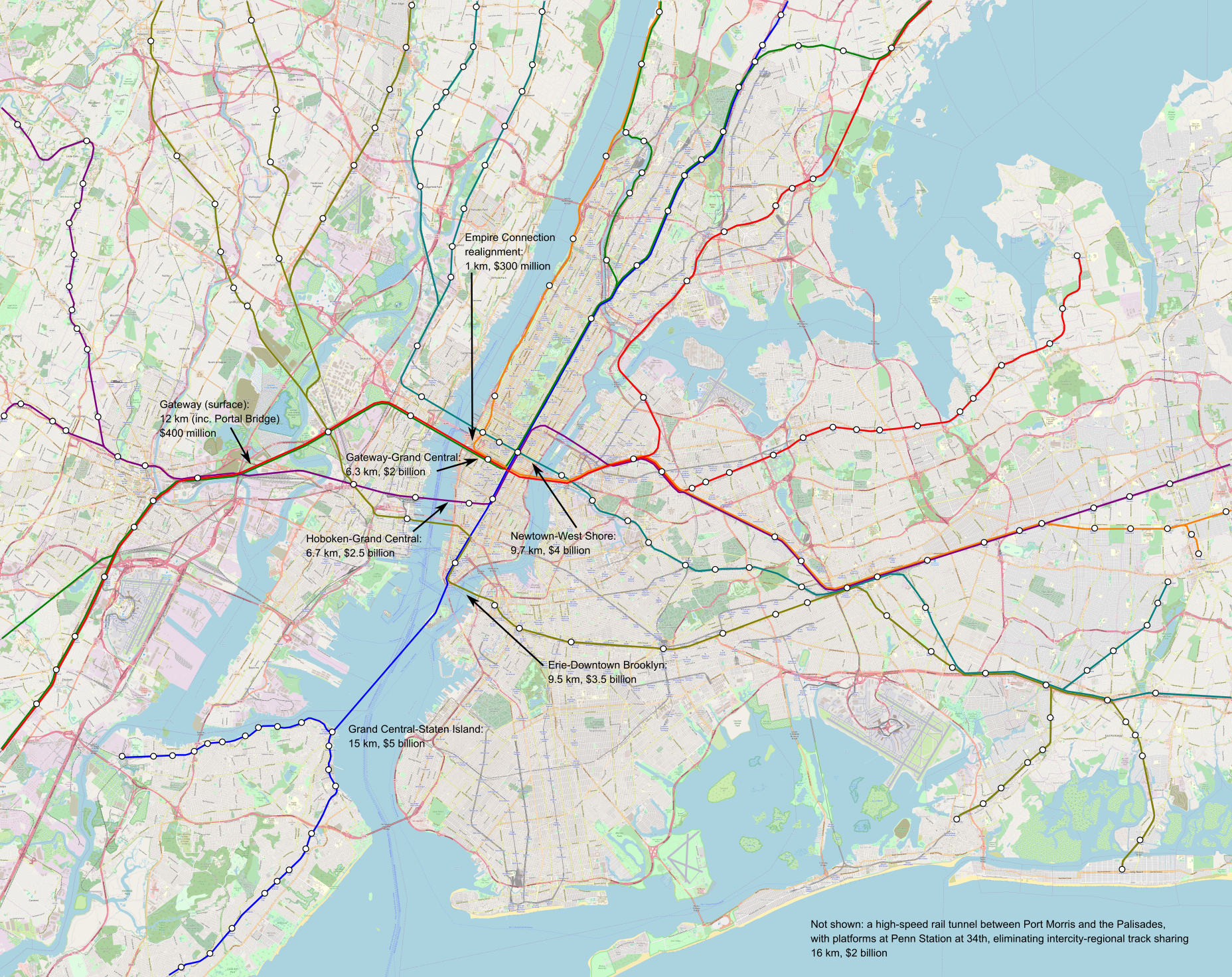
The cost above can be produced, for example, by setting the Union Square and Fulton Street stations at a bit less than $1 billion each (let’s say, $1.5 billion each, with each colored line contributing half), and a deep station under St. George at $500 million, totaling $2 billion. The 15 km of tunnel are then doable for $3 billion at costs not far below current New York tunneling costs. Don’t get me wrong, it still requires cost control policies on procurement and systems, but relative to what this includes, it’s not outlandish.
This, in turn, also helps explain the concept of regional rail tunnels. These are, in our database, consistently more expensive than metros in the same city; compare for example RER with Métro construction costs, or London Underground extensions with Crossrail, or especially the Munich U- and S-Bahn. The reason is that the concept of regional rail tunneling is to only build the hard parts, under city center, and then use existing surface lines farther out. For the same reason, the stations can be made big – there are fewer of them, for example six on the original Munich S-Bahn and three on the second trunk line under construction whereas the Munich U-Bahn lines have between 13 and 27, which means that the cost of bigger stations is reduced compared with the benefit of higher capacity.
This mode is then appropriate whenever there is good reason to build a critical line with relatively few stations. This can be because it’s a short connection between terminals, the usual case of most RER and S-Bahn lines; in the United States, the Center City Commuter Connection is such an example, and so is the North-South Rail Link if it is built. This can also be because it’s an express line parallel to slower lines, like the RER A. But it can also be because it doesn’t need as many stations because it crosses water, like any route serving Staten Island.
The flip side is that whenever many stations are required on an urban rail tunnel, it becomes more important to keep costs down by, potentially, shrinking the station footprint through using shorter trains. In small enough cities, as is the case in some of the Italian examples discussed in that case, like Brescia and Turin, it’s even possible to build very short station platforms and compensate by running driverless trains very frequently, producing an intermediate-capacity system. In larger cities, this trick is less viable, but sometimes there are corridors where there is no alternative to a frequent-stop urban tunnel, such as Utica in New York, and then, regional rail loses value. But in the case of Staten Island, to the contrary, commuter rail is the most valuable option.
 Pedestrian Observations
