Category: Transportation
Amtrak Uses Climate Adaptation as an Excuse to Waste More Money
When the Gateway tunnel project began at the start of this decade, it was justified on the same grounds as the older ARC project: more capacity for trains across the Hudson. This justification continued even after the existing tunnels suffered damage in Hurricane Sandy. As costs mounted and it became clear there was no political will to round up $25 billion of federal and state money for capacity, the arguments changed. An engineering report softly recommended long-term tunnel closure for maintenance, without comparing the cost of new tunnels to that of continuing to close the tunnels one tube at a time on weekends, and subsequently both the funding requests and the press releases shifted in tone to “we must close the tunnels or else they’ll collapse.” Unfortunately, this racket is now spreading to other parts of the American mainline rail network – namely, Amtrak and its high-speed rail program.
Case in point: in an internal report, leaked to the press via a belated public records request, Amtrak fearmongers about the impact of rising sea levels on its infrastructure. Bloomberg helpfully includes maps of rising sea levels inundating part of the Northeast Corridor’s infrastructure in low-lying parts of Connecticut, Delaware, and Maryland.
What Bloomberg does not say is that the Northeast Corridor is slightly elevated over the parts shown as inundated, due to river crossings. There’s even an attached photo of the station in Wilmington, clearly showing the train running above ground on a viaduct, at what looks like about five meters above sea level. There are no photos from other areas along the corridor, but regular riders as well as people looking closely at satellite photos will know that through the flood-prone parts of Secaucus, the Northeast Corridor is already on a berm, crossing over intersecting roads, and the same is true in most of Connecticut. On Google Earth, the lowest-lying parts of the route, passing through southeastern Connecticut and parts of Maryland, are 3-4 meters above sea level.
The rub is that a sea level rise of 3-4 meters is globally catastrophic to an extent that doesn’t make Amtrak any of the top thousand priorities. Cities would be flooded, as helpfully shown by photos and images depicting the railroad running above street level. Entire countries would be wiped off the map, like the Maldives. Low-lying coastal floodplains, so crucial for high-intensity agriculture, would disappear. In Bangladesh alone, a sea level rise of a single meter would flood 17.5% of the country, which with today’s demographics would displace about 25 million people; the sea level rise required to threaten the Northeast Corridor is likely to produce a nine-figure global refugee crisis.
To Amtrak’s credit, it’s somewhat pushing back against the apocalyptic language – for now. The Bloomberg article tries to demagogue about how unconcerned Amtrak is with climate change-related flooding, but at least the quotes given in the piece suggest Amtrak views this as a concern, just not one it’s going to talk about while the president openly says climate change is a Chinese conspiracy. Once the political winds will shift, Amtrak as portrayed by a close reading of the article will presumably shift its rhetoric.
However, the credit Amtrak gets for not pushing this line right now is limited. Sarah Feinberg, a former FRA administrator who was also on the panel for Governor Cuomo’s MTA genius grant competition, is described as saying talking about climate change won’t fly in Congress. In other words, in Feinberg and Amtrak’s view, “we need money to flood-proof the Northeast Corridor” is not a preposterous proposition, but a demand to be reserved until the Democrats are in charge of the federal government.
In the 2000s, Amtrak fired David Gunn from his position as CEO, since he wouldn’t succumb to political pressure to skimp on maintenance in order to achieve on-paper profitability so that Amtrak could be privatized. In his stead, the Amtrak board installed the more pliable Joe Boardman. Then Obama replaced Bush and economic stimulus replaced domestic spending cuts, and suddenly Amtrak discovered a backlog of maintenance, demanding billions of dollars that could have built 350 km/h high-speed rail between Boston and Washington already for state of good repair instead. The backlog has increased ever since, as it became clear Amtrak could just ask for more money without having to show any work for it as long as it was couched in language about maintenance.
The same mentality is still in place today. The required response of the American transportation complex to climate change: an immediate end to any public spending on roads and airports and massive spending on public transportation, intercity rail, and electric car charging stations, in that order. Amtrak has a role to play in advocating for more rail use as mitigation of transportation emissions, which are currently the largest single source of greenhouse gas emissions in the United States.
However, responding this way would require Amtrak to run better service. It would require it to stop playing agency turf games with other railroad agencies – after all, the planet does not care who owns which piece of track on the Northeast Corridor. It would require it to show visible improvements in speed, capacity, coverage, and reliability. It is not capable of producing these improvements and neither do other federal organs dealing with passenger rail, such as the FRA-led NEC Future effort. Thus, it is preparing the way to argue for a massive increase in spending that is explicitly not designed to produce any tangible benefit.
There is a way forward, but not with any of the people in charge today. They are incapable of managing large projects or even smoothly running a railroad in regular service, and should be replaced by people who have the required experience. Feinberg is a political operative who before her appointment as FRA head in 2015 had no background in transportation; evidently, together with the other judges of the genius grant she greenlit manifestly impossible projects.
Evidently, when New York City Transit hired a chair with a strong transportation background, namely Andy Byford, suddenly plans became more than just the state of good repair black hole plus court-mandated accessibility retrofits. Byford insists on specific positive improvements, which lay riders can judge in the coming decade as they see more elevator access and higher train frequency, provided his plan’s very high cost is funded.
With Amtrak, in contrast, there is only a black hole. There is an extremely expensive high-speed rail plan out there, but the first segment Amtrak wants to build, Gateway, wouldn’t provide any tangible benefit in speed or even capacity (the current state of Gateway is a $11 billion tunnel without additional surface tracks, so the two-track bottleneck would remain). A project that was once a critical capacity increase has since been downgraded into the state of good repair black hole, in which many tens of billions of dollars can disappear without showing anything. As the NEC Future process evolves, any calls for high-speed rail in the Northeast are likely to evolve in the same direction: no improvement, just endless money poured on the same service quality as today, justified in terms of adaptation or resilience.
What Does “On Demand” Mean, Anyway?
One of the tech industry’s buzzwords for transportation is “on demand” – that is, available to the passenger immediately, without fixed schedules. When I said something about schedules at my Hyperloop One interview, the interviewers gently told me that actually, they intend their system to be on-demand; I forget what I said afterward, but I do remember I didn’t press the point. More commonly, people who insist on using ride-hailing apps rather than public transit talk about how great it is that they don’t have to follow fixed schedules.
But what does this really mean? Calling a cab, or hailing one via a TNC app, does not mean it comes immediately. There’s a wait time of several minutes. How many minutes depends on time of day and which city one is in. A Dallas air travel blog describes wait times of around 10 minutes. In and around Boston, Patreon supporter Alexander Rapp says “2-7 minutes is the typical range” with New York waits slightly longer. In Los Angeles, a dissertation studying racial bias finds that the average predicted wait times are 6-7 minutes for black people and 5-6 minutes for others (PDF-p. 147); both the absolute numbers and the difference are much higher for street-hailed cabs. In 2014, the median wait time in New York was 3 minutes.
On an urban transit line, an average wait of 10 minutes is equivalent to a 20-minute frequency, and an average wait of 5 minutes is equivalent to a 10-minute frequency. At the lower end, the fixed schedule is actually better – a well-run transit system with 20-minute frequencies publicly posts clockface schedules and sticks to them, so people know in advance how to time themselves to the bus or train’s arrival time.
Even the wait times of 2014’s New York, not since achieved in the city or elsewhere, are only equivalent to a subway train that comes every 6 minutes, which is decidedly mediocre. The outer subway branches in New York get a train every 8-10 minutes off-peak, but they are not what TNCs compete with. Bruce Schaller’s report alleging that TNCs are responsible for the decline in subway ridership uses data from mid-2016, when 56% of TNC trips in New York were in Manhattan south of West 110th and East 96th Streets and another 22% were in inner-ring neighborhoods, mostly before the subway branch points. And subway frequency in New York is not good for how busy the system is; during the daytime, longer headways than 5 minutes are rare on the Paris Metro and on the trunks in London and Stockholm. Milan, hardly a transit city, runs its driverless metro line every 4 minutes off-peak.
All of the comparable waits get longer outside the city. Stockholm’s highly-branched metro system runs every 10 minutes on some branches off-peak, and Tube waits go up to 10 minutes on some branches as well. Commuter rail waits start from 10 minutes on the busiest branches, like those of the RER A, and go up from there, sometimes even to a train every half hour off-peak in suburbs of respectable European transit cities. But the branches are not where people ride TNCs. Just as in New York the vast majority of TNC trips are downstream of the branch points, in London as of 2013, 74% of taxi trips were within Inner London; if New York’s subsequent evolution is any indication, TNC traffic is somewhat less dominated by the center, but has only differed from street-hailed cab traffic patterns in degree rather than kind.
This calculation does not mean that transit is better than TNCs on out-of-vehicle times. It is not. Walk times to stations are considerable. Trips that require transfers have extra wait time. In New York, there appear to be about 1.6 unlinked trips per linked trip, but most likely multiple-seat rides have shorter waits on average, because they include local-express transfers, which passengers make preferentially if the waits are short. In London, judging by the origin-destination matrix, 61% of trips do not require any interchange, and another 34% require just one. So even with transfers, frequent subways are still a little bit ahead, but then the walk time to the station makes a big difference in favor of TNCs.
But here’s the thing: tech workers who talk about the greatness of on-demand transportation do not talk about station access time. Evidently, Hyperloop One, which has to use stations, talks about on-demand service. The company did try to think about how to branch in the cities in order to reduce station access time, but reduce does not mean eliminate. Moreover, the same kind of branching is already available to trains and even more so to intercity buses, and yet they rarely make use of it: intercity buses do not make milk runs within cities, leading to awkward situations in which a person in Upper Manhattan traveling to Boston has to take the subway to Midtown and then get on a bus that slogs through Manhattan streets going toward Upper Manhattan on its way to the freeways to Boston.
So what’s going on here? There’s a legitimate advantage to cars over transit in that they don’t require you to travel to a subway station or transfer, but that’s not the argument that opponents of transit who talk about TNCs and app-hailed services and on-demand travel make. They talk about wait times, never mind that well-run urban transit offers shorter wait times than app-hailed TNCs.
My suspicion is that this involves business culture. Urban transit is extremely Fordist: it has interchangeable vehicles and workers, relentlessly regular schedules, and central allocation of resources based on network effects. The tech industry has corners that work like this as well, like Amazon’s monitoring its warehouse workers’ bathroom breaks, but for the most part the industry comes from a post-Fordist world. The idea that there should be people writing down precise schedules for service is alien, as is any coordinated planning; order should be emergent, and if it doesn’t work at the scale of a startup, then it’s not worth pursuing.
There have been positive examples of using better software technology to improve public transportation. The Internet itself has been amazing at improving access to information; the single most important technology for transit reform in lagging regions like North America is Google search, followed by Wikipedia, and even in places with healthy transit these tools are valuable. Within schedule planning, new software tools make it easier to track delays. Tech is a tool, and as such it has been very useful for transit, as for many other industries.
However, all of this occurs within the usual culture of transportation planning. In contrast with this culture, most companies that produce software use a culture of startups, which have to work at a small scale to get anywhere. Where network effects are required, as with social media, it’s necessary to find a small, high-prestige network of early adopters, e.g. Harvard students for Facebook. Anything that requires more initial capital than a VC is willing to risk on a single firm is out; thus Hyperloop One views itself as a consultancy developing a technology rather than as a railroad actually building its own Hyperloop infrastructure.
A corollary of this is that people within the tech industry dismiss schedules out of hand. Thus they insist that transportation be on-demand, even when in practice the wait is longer than on a competing mode of travel that is scheduled. The idea of on-demand travel is reassuring, and because Swiss scheduling precision is alien to the American tech entrepreneur, it’s not a big deal if on-demand means a promised 5-minute wait and an actual 10-minute wait.
But what reassures the tech entrepreneur does not reassure the average rider. By overwhelming numbers, people who have a choice between even mediocre public transportation and TNCs slog through 9-minute bus and train frequencies; people who have access to good public transportation keep taking it where available. In New York, where transit isn’t even that great by the standard of large European cities, there is an ongoing panic about a 2% decline in annual subway ridership, which Schaller wrongly attributes to TNCs rather than to internal decline in subway service quality. Ultimately, the experience of waiting a few minutes for a train is annoying and passengers try to avoid it, but over time they don’t find it any more annoying than the experience of waiting for the app-hailed car driver to show up. Rhetoric about on-demand service aside, passengers do notice how long they’re actually waiting.
Difficult Urban Geography Part 1: Narrow Streets
I did a complex Patreon poll about series to write about. People voted for general transit network design, and more posts about national traditions of transit in the mold of the one about the US. Then I polled options for transit network design. There were six options, and people could vote up or down on any. Difficult urban geography was by far the most wanted, and three more alternatives hover at the 50% mark. To give the winning option its due course, I’m making it a mini-series of its own.
There are cities that, due to their street layout, make it easy to run transit on them. Maybe they are flat and have rivers that are easy to bridge or tunnel under. Maybe they have a wealth of wide arterials serving the center, with major cross streets at exactly the right places for stations and an underlying bus grid. Maybe they spread out evenly from the center so that it’s easy to run symmetric lines. Maybe their legacy mainline rail network is such that it’s easy to run interpolating buses and urban rail lines.
And then there are cities that are the exact opposite. In this post I’m going to focus on narrow or winding streets and what they mean for both surface and rapid transit. The good fortune for transit planners is that the city that invented urban rapid transit, London, is a prime example of difficult urban geography, so railway engineers have had to deal with this question for about 150 years, inventing some of the necessary technology in the process.
Rapid transit with narrow streets
The easiest ways to build rapid transit are to put it on a viaduct and to bury it using cut-and-cover tunneling. Both have a minimum street width for the right-of-way – an el requires about 10 meters, but will permanently darken the street if it is not much wider, and a tunnel requires about 10 meters for the tracks but closer to 18 for the stations.
Nonetheless, even cities with narrow streets tend to have enough streets of the required width. What they don’t always have is streets of the required width that are straight and form coherent spines. The labyrinth that is Central London does have wide enough streets for cut-and-cover, but they are not continuous and often miss key destinations such as major train stations. The Metropolitan line could tunnel under Euston Road, but the road’s natural continuation into the City is not so wide, forcing the line to carve a trench into Farringdon. Likewise, the District line could tunnel under Brompton Road or King’s Road, but serving Victoria and then Westminster would have required some sharp curves, so the District Railway carved a right-of-way, demolishing expensive Kensington buildings at great expense.
While London is the ur-example, as the city that invented the subway, this situation is common in other cities with large premodern cores, such as Rome, Milan, and Istanbul. Paris only avoided this problem because of Haussmann’s destruction of much of the historic city, carving new boulevards for aesthetics and sewer installation, which bequeathed the Third Republic a capital rich in wide streets for Metro construction.
Dealing with this problem requires one of several solutions, none great:
Deep-bore tunneling
London’s solution was to invent the tunnel boring machine to dig deep Tube lines, avoiding surface street disruption. With electric-powered trains and reliable enough TBMs to bore holes without cave-ins, London opened the Northern line in 1890, crossing the Thames to provide rapid transit service to South London. Subsequently, London has built nearly all Underground lines bored, even in suburban areas where it could have used cut-and-cover.
The main advantage to TBMs is that they avoid surface disruption entirely. Most first-world cities use them to bore tunnels between stations, only building stations cut-and-cover. The problem is that TBMs are more expensive to use than cut-and-cover today. While turn-of-the-century London built Tube lines for about the same cost per km as the Metropolitan line and as the cut-and-cover Paris Metro and New York City Subway, in the last half century or so the cost of boring has risen faster than that of shallow construction.
The worst is when the stations have to be mined as well. Mining stations has led to cost blowouts in New York (where it was gone gratuitously) and on London Crossrail (where it is unavoidable as the tunnel passes under the older Underground network). A city that cannot use cut-and-cover tunnels needs to figure out station locations that are easily accessible for vertical digging.
The alternative is the large-diameter TBM. Barcelona is using this technique for Line 9/10, which passes under the older lines; the city has a grid of wide boulevards, but the line would still have to pass under the older metro network, forcing the most difficult parts to be deep underground. The large-diameter TBM reduces the extent of construction outside the TBM to just an elevator bank, which can be dug in a separate vertical TBM; if higher capacity is desired, it’s harder but still possible to dig slant bores for escalators. The problem is that this raises construction costs, making it a least bad solution rather than a good one; Barcelona L9, cheap by most global standards, is still expensive by Spanish ones.
Carving new streets
Before the 1880s, London could not bore the Underground, because the steam-powered trains would need to be close to surface for ventilation. Both the Metropolitan and District lines required carving new right-of-way when streets did not exist; arguably, the entire District line was built this way, as its inner segment was built simultaneously with the Victoria Embankment, under which it runs. The same issue happened in New York in the 1910s and again in the 1920s: while most of the city is replete with straight, wide throughfares, Greenwich Village is not, which forced the 1/2/3 to carve what is now Seventh Avenue South and later the A/C/E to carve the southern portions of Sixth Avenue.
This solution is useful mostly when there are wide streets with absolutely nothing between them that a subway could use. The reason is that demolishing buildings is expensive, except in very poor or peripheral areas, and usually rapid transit has to run to a CBD to be viable. If the entire route is hard to dig, a TBM is a better solution, but if there are brief narrows, carving new streets New York did could be useful, especially if paired with improvements in surface transit.
Looking for station sites
Milan built its first metro lines cut-and-cover. However, lacking wide streets, it had to modify the method for use in a constrained environment. Instead of digging the entire street at a sloped angle and only then adding retaining walls, Milan had to dig the retaining walls first, allowing it to dig up streets not much wider than two tracks side by side. This method proved inexpensive: if I understand this article right, the cost was 30 billion lire in 1957-1964 prices, which is €423 million in 2018 prices, or €35 million per km. Milan’s subsequent construction costs have remained low, even with the use of a TBM for Metro Line 5.
The problem with this method is that, while it permits digging tunnels under narrow medieval streets, it does not permit digging stations under the same streets. Milan is fortunate that its historical center is rich in piazzas, which offer space for bigger digs. One can check on a satellite map that every station on Lines 1 and 2 in city center is at a piazza or under a wide street segment; lacking the same access to easy station sites, Line 3 had to be built deeper, with tracks stacked one under the other to save space.
I have argued in comments that Paris could have used this trick of looking for less constrained sites for stations when it built Metro Line 1, permitting four tracks as in New York as long as the express stations under Rue de Rivoli stuck to major squares like Chatelet. However, Paris, too, is rich in squares, it just happens to be equally rich in wide streets so that it did not need to use the Milan method. London is not so fortunate – its only equivalent of Milan’s piazzas is small gardens away from major streets. It could never have built the Central line using the Milan method, and even the Piccadilly line, which partly passes under wide streets, would have been doubtful.
Surface transit
Rapid transit benefits from being able to modify the shape of the street network to suit its needs. Surface transit in theory could do the same, running in short tunnels or widening streets as necessary, but the value of surface modes is not enough to justify the capital expense and disruption. Thus, planners must take the street network as it is given. The ideal surface transit route runs in the street median on two dedicated lanes, with boarding islands at stops; creating a parking lane, a moving lane, and a transit lane in each direction on a street plus some allowance for sidewalks requires about 30 meters of street width or not much less. Below 25, compromises are unavoidable.
Cutting car lanes
A lane is about 3 meters wide, so removing the parking lanes reduces the minimum required street width by about 6 meters. Contraflow lanes instead allow the street to have the same four lanes, but with a moving lane and a parking lane in one direction only. In extreme cases it’s possible to get rid of the cars entirely; a transit mall is viable down to maybe 12-15 meters of street width. The problem is that deliveries get complicated if the city doesn’t have alleyways or good side street access, and this may force compromises on hours of service (perhaps transit doesn’t get dedicated lanes all day) or at least one parking lane in one direction.
Single-track streetcars
Some city cores with very narrow streets don’t have double-track streetcars. A few have one-way pairs, but more common is single-track segments, or segments with two overlapping tracks so that no switching is needed but trams still can’t pass each other. Needless to say, single-tracking is only viable over short narrows between wider streets, and only when the network is punctual enough that trams can be scheduled not to conflict.
On longer stretches without enough room for two tracks or two lanes, one-way pairs are unavoidable; these complicate the network, and unless the streets the two directions of the bus or tram run on are very close to each other they also complicate interchanges between routes. New York has many one-way pairs on its bus network, even on wide and medium-width streets in order to improve the flow of car traffic, and as a result, some crosstown routes, such as the B35 on Church, are forced to stop every 250 meters even when running limited-stop. While New York’s network complexity is the result of bad priorities and can be reversed, cities with premodern street networks may not even have consistent one-way pairs with two parallel streets on a grid; New York itself has such a network in Lower Manhattan.
Bus network redesign
The best way to avoid the pain associated with running buses on streets that are not designed for fast all-mode travel is not to run buses on such streets. Boston has very little surface transit in city center, making passengers transfer to the subway. In Barcelona, part of the impetus for Nova Xarxa was removing buses from the historic core with its narrow streets and traffic congestion and instead running them on the grid of the Eixample, where they would not only provide a frequent system with easy transfers but also run faster than the old radial network.
However, this runs into two snags. First, there must be some radial rapid transit network to make people connect to. Boston and Barcelona both have such networks, but not all cities do; Jerusalem doesn’t (it has light rail but it runs on the surface). And second, while most cities with a mixture of wide and narrow streets confine their narrow streets to premodern historic cores, some cities have streets too narrow for comfortable bus lanes even far out, for example Los Angeles, whose north-south arterials through the Westside are on the narrow side.
What not to do: shared lanes
It’s tempting for a transit agency to compromise on dedicated lanes whenever the street is too narrow to feature them while maintaining sufficient auto access. This is never a good idea, except in outlying areas with little traffic. The reason is that narrow streets fed by wide streets are precisely where there is the most congestion, and thus where the value of dedicated transit lanes is the highest.
In New York, the dedicated bus lanes installed for select bus service have sped up bus traffic by around 30 seconds per kilometer on all routes Eric Goldwyn and I have checked for our Brooklyn bus redesign project, but all of these figures are averaged over long streets. Within a given corridor, the short narrows that the transit agency decides to compromise on may well feature greater time savings from dedicated lanes than the long arterial stretch where it does set up dedicated lanes. This is almost certainly the case for the Silver Line in Boston, which has unenforced dedicated lanes most of the way on Washington Streets but then uses shared lanes through Downtown Boston, where streets are too narrow for dedicated lanes without reducing auto access.
Urban Transit Vs. Commuter Transit
The Geary corridor in San Francisco is a neat model for transit ridership. The Golden Gate Park separates the Richmond District from the Sunset District, so the four east-west buses serving the Richmond – the 38 on Geary itself and the closely parallel 1 California, 31 Balboa, and 5 Fulton – are easy to analyze, without confounding factors coming from polycentric traffic. Altogether, the four routes in all their variations have 114,000 riders per weekday. The 38 and 1 both run frequently – the 1 runs every 5-6 minutes in the weekday off-peak, and the 38 runs every 5 minutes on the rapid and every 8 on the inner local.
I was curious about the connection between development and travel demand, so I went to OnTheMap to check commute volumes. I drew a greater SF CBD outline east of Van Ness and north of the freeway onramp and creek; it has 420,000 jobs (in contrast, a smaller definition of the CBD has only 220,000). Then I looked at how many people commute to that area from due west, defined as the box bounded by Van Ness, Pacific, the parks, and Fell. The answer is 28,000. Another 3,000 commute in the opposite direction.
Put another way: the urban transit system of San Francisco carries about twice as many passengers on the lines connecting the Richmond and Japantown with city center as actually make that commute: 114,000/2*(28,000 + 3,000) is 1.84. This represents an implausible 184% mode share, in a part of the city where a good number of people own and drive cars, and where some in the innermost areas could walk to work. What’s happening is that when the transit system is usable, people take it for more than just their commute trips.
The obvious contrast is with peak-only commuter rail. In trying to estimate the potential ridership of future Boston regional rail, I’ve heavily relied on commute volumes. They’re easier to estimate than overall trip volumes, and I couldn’t fully get out of the mindset of using commuter rail to serve commuters, just in a wider variety of times of day and to a wider variety of destinations.
In Boston, I drew a greater CBD that goes as far south as Ruggles and as far west as Kendall; it has a total of 370,000 jobs. Of those, about 190,000 come from areas served by commuter rail and not the subway or bus trunks, including the southernmost city neighborhoods like Mattapan and Hyde Park, the commuter rail-adjacent parts of Newton, and outer suburbs far from the urban transit system. But MBTA commuter rail ridership is only about 120,000 per weekday. This corresponds to a mode share of 32%.
I tried to calculate mode shares for the MBTA seven years ago, but that post only looked at the town level and excluded commuter rail-served city neighborhoods and the commuter rail-adjacent parts of Newton, which contribute a significant fraction of the total commute volume. Moreover, the post included suburban transit serving the same zones, such as ferries and some express buses; combined, the mode share of these as well as commuter rail ranged from 36% to 50% depending on which suburban wedge we are talking about (36% is the Lowell Line’s shed, 50% is the Providence Line’s shed). Overall, I believe 32% is consistent with that post.
Part of the difference between 32% and 184% is about the tightness of economic integration within a city versus a wider region. The VA Hospital in San Francisco is located in the Outer Richmond; people traveling there for their health care needs use the bus for this non-commuter trip. On a regional level, this never happens – people drive to suburban hospitals or maybe take a suburban bus if they are really poor.
That said, hospital trips alone cannot make such a large difference. There are errand trips that could occur on a wider scale if suburban transit were better. Cities are full of specialty stores that people may travel to over long distances.
For example, take gaming. In Vancouver I happened to live within walking distance of the area gaming store, but during game nights people would come over from Richmond; moreover, the gaming bar was in East Vancouver, and I’d go there for some social events. In Providence I’d go to Pawtucket to the regional gaming store. In the Bay Area, the store I know about is in Berkeley, right on top of the Downtown Berkeley BART station, and I imagine some people take BART there from the rest of the region.
None of this can happen if the region is set up in a way that transit is only useful for commute trips. If the trains only come every hour off-peak, they’re unlikely to get this ridership except in extreme cases. If the station placement is designed around car travel, as is the case for all American commuter lines and some suburban rapid transit (including the tails of BART), then people will just drive all the way unless there’s peak congestion. Only very good urban transit can get this non-work ridership.
In-Motion Charging
While electric cars remain a niche technology, electric buses are surging. Some are battery-electric (this is popular in China, and some North American agencies are also buying into this technology), but in Europe what’s growing is in-motion charging, or IMC. This is a hybrid of a trolleybus and a battery-electric bus (BEB): the bus runs under wire, but has enough battery to operate off-wire for a little while, and in addition has some mechanism to let the bus recharge during the portion of its trip that is electrified.
One vendor, Kiepe, lists recent orders. Esslingen is listed as having 10 km of off-wire capability and Geneva (from 2012) as having 7. Luzern recently bought double-articulated Kiepe buses with 5 km of off-wire range, and Linz bought buses with no range specified but of the same size and battery capacity as Luzern’s. Iveco does not specify what its range is, but says its buses can run on a route that’s 25-40% unwired.
Transit planning should be sensitive to new technology in order to best integrate equipment, infrastructure, and schedule. Usually this triangle is used for rail planning, but there’s every reason to also apply it to buses as appropriate. This has a particular implication to cities that already have large trolleybus networks, like Vancouver, but also to cities that do not. IMC works better in some geographies than others; where it works, it is beneficial for cities to add wire as appropriate for the deployment of IMC buses.
Vancouver: what to do when you’re already wired
Alert reader and blog supporter Alexander Rapp made a map of all trolleybus routes in North America. They run in eight cities: Boston, Philadelphia, Dayton, San Francisco, Seattle, Vancouver, Mexico City, Guadalajara.
Vancouver’s case is the most instructive, because, like other cities in North America, it runs both local and rapid buses on its trunk routes. The locals stop every about 200 meters, the rapids every kilometer. Because conventional trolleybuses cannot overtake other trolleybuses, the rapids run on diesel even on wired routes, including Broadway (99), 4th Avenue (44, 84), and Hastings (95, 160), which are in order the three strongest bus corridors in the area. Broadway has so much ridership that TransLink is beginning to dig a subway under its eastern half; however, the opening of the Broadway subway will not obviate the need for rapid buses, as it will create extreme demand for nonstop buses from the western end of the subway at Arbutus to the western end of the corridor at UBC.
IMC is a promising technology for Vancouver, then, because TransLink can buy such buses and then use their off-wire capability to overtake locals. Moreover, on 4th Avenue the locals and rapids take slightly different routes from the western margin of the city proper to campus center, so IMC can be used to let the 44 and 84 reach UBC on their current route off-wire. UBC has two separate bus loops, one for trolleys and one for diesel buses, and depending on capacity IMC buses could use either.
On Hastings the situation is more delicate. The 95 is not 25-40% unwired, but about 60% unwired – and, moreover, the unwired segment includes a steep mountain climb toward SFU campus. The climb is an attractive target for electrification because of the heavy energy consumption involved in going uphill: at 4 km, not electrifying it would brush up against the limit of Kiepe’s off-wire range, and may well exceed it given the terrain. In contrast, the 5 km in between the existing wire and the hill are mostly flat, affording the bus a good opportunity to use its battery.
Where to add wire
In a city without wires, IMC is the most useful when relatively small electrification projects can impact a large swath of bus routes. This, in turn, is most useful when one trunk splits into many branches. Iveco’s requirement that 60-75% of the route run under wire throws a snag, since it’s much more common to find trunks consisting of a short proportion of each bus route than ones consisting of a majority of route-length. Nonetheless, several instructive examples exist.
In Boston, the buses serving Dorchester, Mattapan, and Roxbury have the opportunity to converge to a single trunk on Washington Street, currently hosting the Silver Line. Some of these buses furthermore run on Warren Street farther south, including the 14, 19, 23, and 28, the latter two ranking among the MBTA’s top bus routes. The area has poor air quality and high rates of asthma, making electrification especially attractive.
Setting up wire on Washington and Warren Streets and running the Silver Live as open BRT, branching to the south, would create a perfect opportunity for IMC. On the 28 the off-wire length would be about 4.5 km each way, at the limit of Kiepe’s capability, and on the 19 and 23 it would be shorter; the 14 would be too long, but is a weaker, less frequent route. If the present-day service pattern is desired, the MBTA could still electrify to the northern terminus of these routes at Ruggles, but it would miss an opportunity to run smoother bus service.
In New York, there are examples of trunk-and-branch bus routes in Brooklyn and Queens. The present-day Brooklyn bus network has a long interlined segment on lower Fulton, carrying not just the B25 on Fulton but also the B26 on Halsey and B52 on Gates, and while Eric Goldwyn’s and my plan eliminates the B25, it keeps the other two. The snag is that the proportion of the system under wire is too short, and the B26 has too long of a tail (but the B52 and B25 don’t). The B26 could get wire near its outer terminal, purposely extended to the bus depot; as bus depots tend to be polluted, wire there is especially useful.
More New York examples are in Queens. Main Street and the Kissena-Parsons corridor, both connecting Flushing with Jamaica, are extremely strong, interlining multiple buses. Electrifying these two routes and letting buses run off-wire on tails to the north, reaching College Point and perhaps the Bronx on the Q44 with additional wiring, would improve service connecting two of Queens’ job centers. Moreover, beyond Jamaica, we see another strong trunk on Brewer Boulevard, and perhaps another on Merrick (interlining with Long Island’s NICE bus).
Finally, Providence has an example of extensive interlining to the north, on North Main and Charles, including various 5x routes (the map is hard to read, but there are several routes just west of the Rapid to the north).
IMC and grids
The examples in New York, Providence, and Boston are, not coincidentally, ungridded. This is because IMC interacts poorly with grids, and it is perhaps not a coincidence that the part of the world where it’s being adopted the most has ungridded street networks. A bus grid involves little to no interlining: there are north-south and east-west arterials, each carrying a bus. The bus networks of Toronto, Chicago, and Los Angeles have too little interlining for IMC to be as cost-effective as in New York or Boston.
In gridded cities, IMC is a solution mainly if there are problematic segments, in either direction. If there’s a historic core where wires would have adverse visual impact, it can be left unwired. If there’s a steep segment with high electricity consumption, it should be wired preferentially, since the cost of electrification does not depend on the street’s gradient.
Overall, this technology can be incorporated into cities’ bus design. Grids are still solid when appropriate, but in ungridded cities, trunks with branches are especially attractive, since a small amount of wire can convert an entire swath of the city into pollution-free bus operation.
Green New Deal
American progressive media is talking about the possibility of a Green New Deal, which involves spending money in a way that reduces greenhouse gas emissions. So far details are scant, and most likely no real plan is likely to emerge for a number of years, since the proposal is pushed by the Democratic base, which is no more supportive of cooperation with President Trump than I am. Because the plan is so early, people are opining about what should go in it. My purpose in this post is to explain what I think the main priorities should be, and to leave to others the politics of how to package them.
The primacy of transportation
The main sources of greenhouse gas emissions are transportation, electricity generation, and industry. In the US this is in descending order, transportation having just overtaken power generation; the reduction in coal burning and the collapse in solar power production costs are such that in the long term, electricity generation should be viewed as a solved problem in the long term. Lingering issues with storage and base load are real, but the speed of progress is such that ordinary taxes on carbon should be enough to fix whatever is left of the problem.
Transportation is the exact opposite. American transportation emissions fell in the 2007-8 oil price spike and ensuing economic crisis but are now increasing again. Newer cars have higher fuel efficiency, but Americans are buying bigger cars and driving more. Electric cars, the favored solution of people who think spending $50,000 on a new car is reasonable, are still a niche luxury market and have trouble scaling up. Scratch an American futurist who looks exclusively at electric cars and denigrates mass transit and you’ll wound a solipsist who looks for excuses to avoid the humiliation of having to support something where other countries lead and the US lags.
The upshot is that the primary (but not the only) focus of any green push has to be expansion of public transportation. This includes ancillary policies for urban redevelopment and livable streets, which have the dual effects of buttressing public transit and reducing residential emissions through higher-density living. Overall, this turns any such program into a large public works project.
Spend money right
It’s paramount to make sure to avoid wasting money. A large infrastructure program would run into an appreciable fraction of federal spending; money is always a constraint, even when the goal is to spend funds on economic stimulus. The first lesson here is to keep construction costs under control. But an equally fundamental lesson is to make sure to spend money on transit expansion and not other things:
Don’t spend money on roads
A large majority of American public spending on transportation is on roads. Adding in subsidies for cars makes the proportion go even higher. It reflects current travel patterns, but if the goal is to reduce the environmental footprint of driving, the government can’t keep pumping money into road infrastructure. Accept that in developed countries the generally useful roads have already been built, and future construction just induces people to suburbanize further and drive longer distances.
Congress spends transportation money in multi-year chunks. The most recent bill passed in 2015 for five years, totaling $300 billion, of which $50 billion went to public transit and $200 billion went to highways. Raiding the road fund should be the primary source of additional transit funding: most of the line workers and engineers can build either, and even the physical act of building a freeway is not too different from that of building a high-speed railway. In contrast, outside of a deep recession, increasing total spending on transportation infrastructure requires hiring more workers, leading to large increases in costs as the program runs up against the limit of the available construction labor in the country.
$60 billion a year on public transit is a decent chunk of money for a long-term program, especially with expected state matches. Over the next decade it would be $600 billion, and around a trillion with state and local matches, if they are forthcoming (which they may not be because of how political incentives are lined up). That is, it’d a decent chunk of money if the federal government understands the following rule:
Fund expansion, not maintenance or operations
The sole legitimate source of regular budgeting for public transit is regular spending at the relevant level of government, which is state or local in the United States. Outside infusions of money like federal spending are bad government, because they incentivize deferring maintenance when the federal government is stingy and then crying poverty when it is generous. Amtrak did just that in the 2000s: faced with pressure from the Bush administration to look profitable for future privatization, Amtrak fired David Gunn, who wouldn’t defer maintenance, and replaced him with the more pliable Joe Boardman; then in the economic crisis and the stimulus, it discovered a multi-billion dollar backlog of deferred maintenance, permitting it to ask for money without having to show any visible results.
If the federal government credibly commits to not funding state of good repair backlogs or normal replacement, and to penalizing agencies that defer maintenance and giving them less money for expansion, it can encourage better behavior. Unlike ongoing maintenance, capital expansion is not necessary for continued operations, and thus if funding dries up and a transit agency stops expanding, there will not be problems with service cancellation, slow zones, frequency-ridership spirals, and other issues familiar to New Yorkers in the 1970s or Washingtonians today.
One potential way to change things is to federally fund expansion without expecting much if any local match, provided the agency commits to spending the required operating funds on running the service in question. This separation of federal and local responsibility also reduces the political incentives to grandstand by rejecting federal money in order to make the president look bad.
Build the rail lines that are appropriate
Each region in the US should be getting transit expansion money in rough proportion to its population. However, the meaning of transit depends on the local and regional geography:
- In big cities it means rapid transit expansion: new lines for the New York City Subway, the Chicago L, etc. In somewhat smaller cities with light rail-based systems it means light rail expansion, which may also involve upgrading at-grade light rail to full rapid transit: Dallas is considering a downtown tunnel for its light rail network and Los Angeles is already building one, and those could lead to upgrading capacity elsewhere on the system to permit longer trains.
- In suburbs and some smaller cities with large mainline rail networks, it means commuter rail. It’s especially valuable in the Northeast and secondarily in the Midwest and the odd older Southern city: cities like Milwaukee and Cincinnati don’t really have compelling corridors for greenfield urban rail, but do have interesting S-Bahn corridors.
- In periurban and rural areas, it means longer-range regional rail, transitioning to intercity rail in lower-density areas. In some smaller metro areas, it means actual intercity rail to bigger cities. Examples include Colorado Springs and Fort Collins, both of which can be connected with Denver, and Hans-Joachim Zierke’s proposed regional rail line for Medford, Oregon.
I focus on rail and not buses for two simple reasons: rail has higher capital and lower operating costs, so it’s more relevant for a capital program, and rail gets higher ridership for reasons including better right-of-way quality and better ride quality.
Transmit knowledge of best practices
The federal government has the ability to assimilate best practices for both limiting construction costs and designing good transit networks. Local governments can learn the same, but for the most part they don’t care. Instead they run their transit systems in manage-the-decline mode, only occasionally hearing about something done in London, hardly the best-run European transit city.
The best practices for network design are especially important given the magnitude of the program. The US is not spending $60 billion nationwide a year on transit expansion. The NTD says annual spending on capital among the top 50 American transit agencies was $14.6 billion as of 2016 (source, PDF-p. 11), and a lot of that (e.g. most of the MTA’s $3.5 billion capital expenditure) is the black holes that are state of good repair and normal replacement. $60 billion a year apportioned by population is on the order of $2 billion for New York City annually, which is $20 billion over 10 years, and the city doesn’t necessarily know how to spend that money even at today’s construction costs, let alone rational construction costs.
At least New York has an internal bank of enthusiasts at the MTA and at shadow agencies like the RPA who have ideas for how to spend this money. Smaller cities for the most part don’t. Does Cleveland have any idea what it would do with $5 billion over ten years for regionwide transit expansion? Does Tampa? The federal government has to play an educational role in giving regions sample zoning codes for TOD, network design guidelines, and procurement guidelines that help reduce costs.
Start planning now
A large infrastructure bill planned for 2021 has to be planned now. Its proponents do not intend for it to be a regular jobs program based on existing local wishlists: they intend for it to represent a shift in national priorities, which means that each item of spending has to be planned in advance, mostly from scratch. It means the political work of aligning various interest groups toward the same goal has to start early, which seems to be what the proponents are doing; even the name Green New Deal evokes progressive nostalgia for olden days before neoliberalism.
But alongside the political work, there must be good technical work. Regional planning agencies have to be aware this may be coming and have to have solid ideas for how they’d like to spend a few billion dollars over the decade. Simultaneously, organs including federal offices like the GAO, transit agencies, shadow agencies, and thinktanks have to learn and transmit a culture of good operating and capital practices. A government that plays a bigger role in the economy or in society has to become more competent; managerial competence is required for any program that allocates money with any precision, and very good cost control is a must to make sure the available budget goes to a green transition and isn’t wasted on red tape.
New York City Subway Expansion Proposal
I wrote a post proposing disentangling the subway in New York a few months ago. On the same basis, I’ve drawn some extra lines that I think should be built in the event the region can get its construction costs under control:
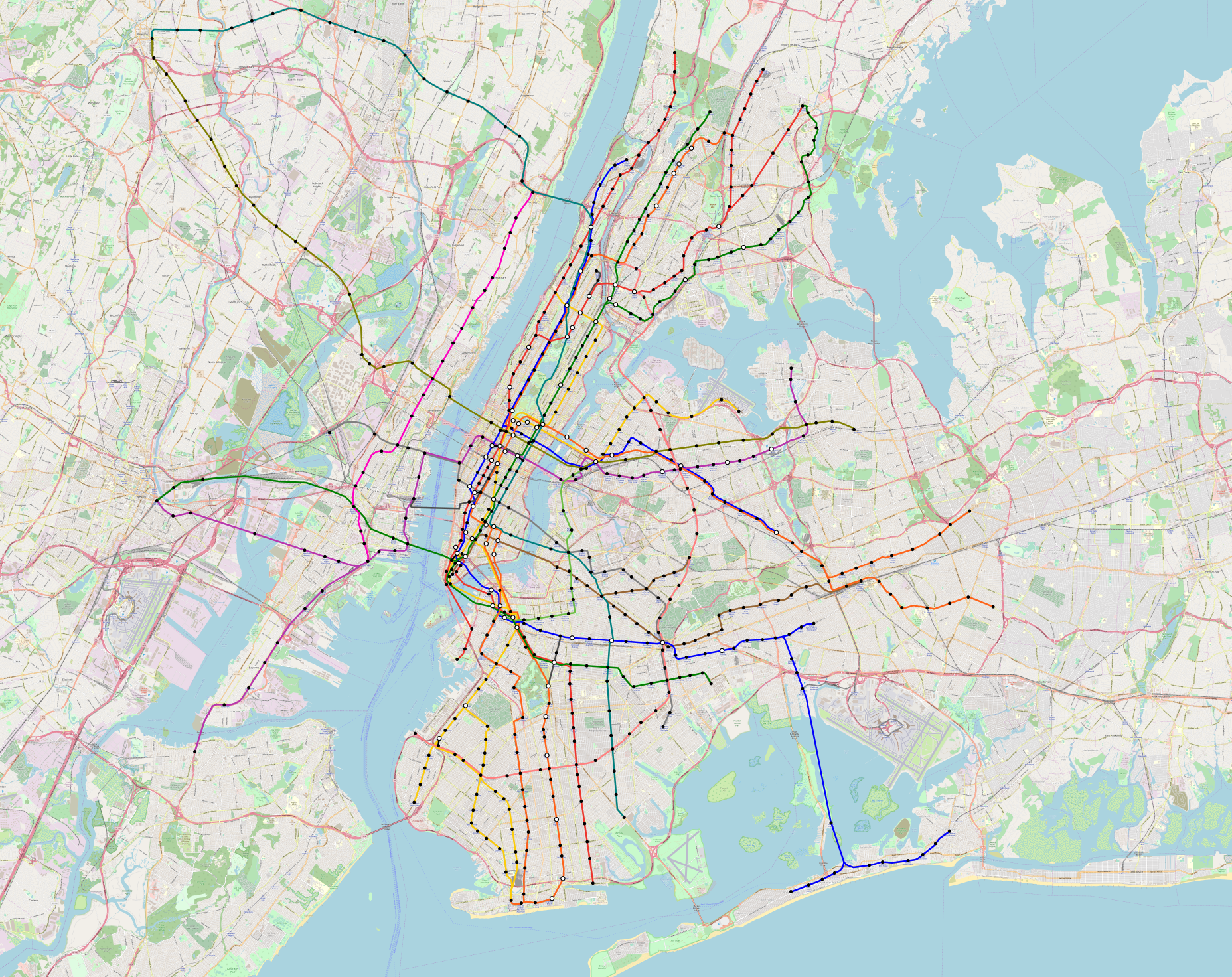
A higher-resolution image (warning: 52 MB) can be found here. The background image is taken from OpenStreetMap. Python 2.7 code for automatically downloading tiles and pasting them into a single image can be found here. Make sure you get PIL or else the paste.py file won’t run; first run tiles.py, and choose whichever tiles you’d like (the boundaries I used for this image are given in the paste.py code as x1, x2, y1, y2), and then run paste.py, changing the x1, x2, y1, y2 variables in the code as needed. As a warning, pasting images together makes them much bigger – the sum of the individual tiles I used is 15 MB but pasted together they became 46 MB.
Legend
Local stations are denoted by black circles, express stations by bigger circles with white filling. On four-track lines and three-track lines with peak-direction express trains (that is, the 2, 6, and D in the Bronx and the 7 in Queens), the local/express designation is straightforward. Two-track tails are denoted as all local; for the most part the trains continue as express on the three- or four-track lines, but on the Brighton Line the expresses keep turning at Brighton Beach while the locals are the trains that go into Coney Island. On a few two-track segments stations are denotes as express and not local, for example the 2 in Harlem or the A in Lower Manhattan and Downtown Brooklyn: this occurs when a two-track line turns into a three- or four-track line farther out, so that people don’t get the impression that these are local-only stations that the express trains skip.
The local and express patterns are barely changed from today. On Eastern Parkway trains run local east of Franklin Avenue, without skipping Nostrand and Kingston-Throop as the 4 does today. Skip-stop on the J train is eliminated, as is express-running between Myrtle and Marcy Avenues. On Queens Boulevard and Central Park West, the trains serving Sixth Avenue (i.e. the orange ones) run express and the ones serving Eighth (i.e. the blue ones) run local, but I’m willing to change my mind on at least one of these two designations; on Queens Boulevard, 36th Street is also turned into an express station, so that passengers can transfer to 63rd or 53rd Street.
As far as possible, I’ve tried to be clear about which stations are connected and which aren’t. The rule is that circles that touch or are connected by a black line denote transfer stations. However, in the lower-resolution version it may hinge on a single pixel’s worth of separation in Downtown Manhattan. The only new interchanges in Downtown Manhattan connect the 1 with PATH in the Village and at World Trade Center (and the latter connection also connects to the R, E, and 2/3).
No existing subway station is slated for closure. If an existing subway station is missing a circle, it’s an error on my part. Edit: I found one mistaken deletion – the 9th Street PATH station (which should be connected with West 4th, but the West 4th circle doesn’t touch PATH).
New lines
Most of this map should be familiar to people who have followed discussions among railfans in New York (and not just myself) about the next priorities after Second Avenue Subway. Utica and Nostrand are there, with stops that match nearly all of the east-west buses. Northern Boulevard, which Yonah Freemark pointed is a denser corridor than Utica, is also there. Triboro RX is there: the route through the Bronx includes a little more tunneling to connect with the 2 train better, forced by incursions onto the right-of-way farther north. LaGuardia gets an elevated extension of the N, which I’ve periodically argued is superior to other alignments and sound in its own right. Second Avenue Subway continues west under 125th Street, providing crosstown service on a street where buses are very busy despite being slower than walking.
In New Jersey, a hefty proportion of the lines already exist, as part of PATH or the Hudson-Bergen Light Rail. PATH is completely dismembered in this proposal: the line from Newark to World Trade Center is connected with the 6 train, an idea that I don’t think is a top priority but that some area advocates (such as IRUM) have proposed; most of the rest is turned into a 7 extension and connected with the two southern HBLR branches, both of which are extended, one to Staten Island and one to Newark; what remains is reduced to a shuttle from Hoboken to Sixth Avenue. Note that the 6-PATH train also gets an infill stop at Manhattan Transfer for regional rail connections.
The other extensions come from a number of different places:
- The 6 is extended to Co-op City, the 7 is extended to College Point, and the 1 to the edge of the city. The first two are big ridership generators, and all three also extend lines beyond their bumper tracks, increasing turnback capacity.
- The Queens Boulevard express trains branch in Jamaica, as they do today, and both branches are extended to near city limits. The southern extension also increases turnback capacity (some E trains run to Jamaica-179th and not Jamaica Center today for this reason), but the primary purpose is to improve coverage to areas of the city that are already at worst missing middle density and redevelopable as mid-rise apartment blocks, and have very long commutes today.
- The 1 is extended to Red Hook. This was proposed by AECOM a few years ago; my alignment differs somewhat in that it doesn’t connect Red Hook with the subway within Brooklyn, but does connect it directly with South Brooklyn, where in the event of such a subway extension a high-frequency bus (the B71) could run onward.
- Instead of the periodically mooted 7 extension to Secaucus, the L is extended there, with a four-track tunnel under the Hudson providing for easy 7/L transfers.
- There’s a preexisting bellmouth for connecting the C train to New Jersey across the George Washington Bridge; it is activated in this plan, with an extension to Paterson elevated over Route 4, with tunneling within Paterson itself. Route 4 is a freeway, but it’s flanked by shopping centers in Paramus, has good regional rail connections and good potential connections if the Northern Branch and West Shore Line are reactivated, and terminates in a dense working-class city.
- The old Erie Main Line gets converted to subway operations, running elevated through the built-up area of Secaucus.
- To connect some of the new lines to one another, two new Manhattan trunk lines, both two-track, are built: under 50th Street, and under Third Avenue, the latter substituting for phases 3 and 4 of Second Avenue Subway in order to avoid reverse-branching. Third then connects to the northern reaches of Eighth Avenue Line via a super-express line, with new stations at 110th and 125th; the alignment through Central Park is designed to allow cheap cut-and-cover construction.
- Bergenline Avenue, where traffic fills a bus every 2 minutes, gets a subway. One station is designed for a commuter rail transfer to new Hudson tunnels with a Bergenline stop. The segment south of Journal Square is weaker and can be removed from scope, but as it can be done in an existing above-ground right-of-way, it’s also cheaper than the rest.
- The D train gets a two-stop extension to the north to connect to Metro-North at Williams Bridge and the 2 train at Gun Hill Road.
Conspicuous absences
There is no subway connection to JFK or Newark Airport on this map. The JFK AirTrain is adequate with better regional rail and fare integration; so is a Newark connection at the current commuter rail station. A direct JFK regional rail connection may be included in a 9-line regional rail map (for reference, the map I usually peddle has 5 or 6 trunk lines, not 9). A Newark rapid transit connection may be included in a much more expansive version, but even then it’s unlikely – the only reason to build such a connection is for extra capacity, and it’s better to resolve mainline rail capacity crunches by building more mainline rail.
There is no R train to Staten Island, an extension that some railfans (including myself many years ago) periodically call for; this could be added, but is a low priority, as regional rail could provide faster service to Downtown Brooklyn with a transfer than the R train ever could.
But the biggest absence is Second Avenue Subway phases 3 and 4. Phase 3 is replaced with a subway under Third Avenue, and phase 4 is omitted entirely. The reason for this omission is, as mentioned above, to avoid reverse-branching, and permit the new system to consist of separate lines without track-sharing, which is more reliable than today’s heavily interlined system.
Phase 4 is also difficult and not all that useful. Lower Manhattan construction is sometimes necessary but should be avoided when it isn’t, as the area has narrow rights-of-way, complex underground station footprints, and archeology going back to the 17th century. There is no capacity crunch heading to Lower Manhattan – southbound trains unload in Midtown in the morning peak – and the area is so small and has so many subways that there is no coverage gap that Second Avenue Subway would fill. Even phase 3 mostly duplicates the Lexington Avenue Line, but serves a large and growing business district in East Midtown where trains do have a capacity crunch, hence the Third Avenue subway.
Scope and costs
The map has around 110 km of new subway and 100 km of new els and other open-air lines (such as the Triboro and Erie rights-of-way). Some of the subways can be built cut-and-cover given sufficient political cajoling, including Nostrand, most of Bergenline, parts of Third and Utica, Northern, and the outer Queens extension. But many cannot: there are 6 new river crossings (50th*2, 7, L, Utica, 1), a kilometer of pure pain in connecting the 6 with PATH, another PATH pain involving a new Exchange Place dig for platforms for the 7, and some new stations that have to be mined (e.g. 50th Street).
At what I consider a normal first-world cost, the tunnels would be around $25 billion in last decade’s money, so maybe $30 billion in today’s money, and the els would add around $10 billion. To put things in perspective, the current five-year MTA capital program is spending $33 billion, nearly all of which is routine maintenance. It’s affordable within a decade if the region gets its construction costs under control.
No Pelosi-Trump Infrastructure Deal, Please
After the midterm election 2.5 weeks ago, there began calls for an infrastructure deal. The details, as always, were always vague, but the idea is that congressional Democrats and President Trump will agree on a bill to spend about a trillion dollars on infrastructure. What infrastructure is at stake is not specified, except that some New York-based commentators (and Senator Schumer) are calling for federal funding of the Gateway project; whether to pay for the program with deficit spending, tax hikes, or cutting other spending is not specified either. The good news is that such a deal isn’t likely to happen, for roughly the same reasons such a deal would be a bad idea in the first place. However, just in case some people reading this blog might like the idea of such a grand bargain, I’d like to spell the reasons why such a deal would be a waste of money.
What is the purpose of an infrastructure deal, anyway?
Given around a year of something approaching full-time work, I could identify a trillion dollars’ worth of useful public transportation investment in the United States. Given that I’d also look for ways to cut construction costs (which I’m almost certain Congress has not seriously tried), and given that there are other infrastructure priorities than transit, it should not be hard to come up with a long-term 13-figure program.
However, I’m fairly certain there hasn’t been any serious attempt to list infrastructure projects that should be covered under this plan. The main clue is that if there were any, the people trying to sell the public on such a deal would mention them as concrete benefits. This has happened with Gateway: people around the New York area are desperate for federal funding to cover the project’s extreme cost, and do not shy from mentioning it as a beneficiary of a grand bargain. But with anything else, there’s nothing.
For example, nobody in California has said anything about federal funds for the state’s flagging high-speed rail project, even though it would be a natural candidate for a bipartisan deal between Trump and congressional Democrats (the state’s Republican delegation opposed the project, but much of it was wiped out in the midterm). Elsewhere, there are both road and transit projects in red state cities that are hungry for funding, some of which were on the Trump administration’s list of projects to fund last year, in one of the interminable Infrastructure Week pushes that went nowhere. Nothing comparable has surfaced this month.
The lack of detail about the plan suggests it’s not really serious policy. It’s a trial balloon – one that’s failing because of the political situation. But in the event anything comes out of it, it will be a half-thought plan, created for the purpose of spending money and doing something that gives the appearance of bipartisan consensus.
The US economy is not in a recession
The point of a Keynesian stimulus is to prop up the economy during recessions. The American economy right now has 3.7% unemployment, which is more or less full employment, and 2.5% inflation, which is a hair above target. Additional spending would be great for me – it would strengthen the dollar, personally helping me as someone who earns dollars and spends euros. But for the putative target of the bill – the American people – the only effect would be fiscal constraints. The country needs to think about reducing the deficit, not about increasing it in a show of bipartisan unity.
Worse, the stimulus effect of new government spending comes from the net change in annual spending, whereas the deficit effect comes from overall annual spending. A big infrastructure bill would only act as economic stimulus in the earliest phases, when the spending rate would ramp up. Subsequently, it would have no effect on growth or on employment. David Dayen made this point regarding the 2009 stimulus: it had a big effect on American economic growth in 2009, but as the spending rate reached its maximum in 2010, the net effect of federal spending on growth turned negative in the third quarter of 2010, even before the Republican victory in the midterm, long before most stimulus funds were actually spent.
This does not mean that infrastructure funding is out of the question. A serious bill that is crafted to be deficit-neutral in the short as well as long term could do good; it is also close to impossible. Some Democratic pundits have trolled the conversation by proposing pairing it with repealing Trump’s tax cuts, but the probability of a grand bargain that raises taxes to pay for extra spending is approximately zero. Cutting other spending is extremely unlikely as well – unlike state and local governments, domestic federal spending doesn’t have enough waste to fund a trillion-dollar infrastructure bill, and what waste does exist is locked up in Medicare, which is politically untouchable.
The state of the American economy is such that it’s a great idea to design an infrastructure bill, to be deployed at the next recession. There could be a list of priority projects for public transportation (or other forms of infrastructure) chosen for a combination of cost-effectiveness and nationwide spread. While designing this plan, the federal government would make the process open, to let local and state governments know what is happening and offer them the opportunity to submit their choice projects for consideration. The federal government should also insist that they not defer maintenance now hoping to score state of good repair money later – for example, I would propose to credibly commit to only funding expansion but not maintenance, and to defund projects run by agencies that defer maintenance (such as Boardman-era Amtrak). The plan would be funded, with deficit spending, at the next recession, which analysts expect to start in the next few years.
The federal government is unusually corrupt
If the above plan of coming up with a measured infrastructure plan, with incentives to encourage good behavior among state and local governments, sounds like science fiction, it’s because the federal government today doesn’t have the capability of carrying out such a program. Part of it is generic public-sector weakness within the United States, making it hard to make long-term plans; the civil service is weak, and politicians make capricious decisions, so nothing like the TGV, Grand Paris Express, High Speed 2, and Crossrail – all bipartisan projects within their respective countries – can happen.
But there’s a bigger problem now: Trump. Trump himself is corrupt in ways that go far beyond the affairs of scandal-ridden past presidents like Clinton and George W. Bush, and this affects how people think of infrastructure. The US has a public transportation cost premium of nearly a full order of magnitude over comparable countries. Such a premium must have multiple causes, but one cause is corruption: we’ve already seen how political interference by Schumer helped double the cost of Amtrak’s rolling stock procurement. Trump’s scandals easily surpass Schumer’s.
This goes beyond partisanship. Atrios has been a partisan Democrat since his blog’s early days, and yet he’s called for SUPERTRAINS (always in caps) since mid-2008, when the idea of stimulus became part of the American public conversation. At the time Obama was ahead in the polls, but he was not guaranteed to win, and years of Bush had gotten the Democratic base used to opposing anything a Republican president did; and yet, center-left writers like Atrios and Matt Yglesias (at the time transitioning from the Republican bloggers’ favorite Democrat to a conventional partisan liberal Democrat) were fine endorsing an infrastructure program in an uncertain partisan climate.
In theory, the extent of Trump’s corruption is small compared with the magnitude of the program. It’s billions of dollars at worst versus a trillion. In practice, the presence of the current president at the helm of any program screams at contractors, “make an effort to stay at Trump hotels and Mar-a-Lago, not to make a cheap and technically sound bid.” The extra cost coming from contractors slouching in the bidding and construction phases can easily soak up hundreds of billions of dollars out of the trillion: in Brian Rosenthal’s article about high New York costs, contractors quoted a premium of about 25% just from MTA red tape, and Trump’s personal corruption is probably on the same order of magnitude.
Ultimately, it’s fine to wait
In late 2008 and early 2009, the American economy was spiraling into the deepest recession since 1946; in that climate, rushing the stimulus was desirable. The situation today is not like that at all. There’s time to develop an infrastructure plan based on one’s combination of political preference and belief about the future (e.g. will Trump be reelected?, and who will control Congress after 2020?). There’s no point in passing a plan that exists purely to spend money and to show that Congress can enact big policies.
Since there’s no rush, and no need to deficit-spend right now, there’s grounds for demanding better of the government. Any infrastructure plan should be based on clear needs: that is, a national blueprint (such as reducing greenhouse gas emissions, or spreading infrastructure funding to poor states, or a similar political goal), a list of items designed to maximize cost-effectiveness within the blueprint’s parameters, and a federal civil service that can implement the construction of these items with maximum efficiency.
The incompetent and the corrupt should have no role to play in this program, and this begins with the current president. If it’s not possible to remove deadwood from the federal government, it’s fine to indefinitely postpone any big federal infrastructure plan. Nothing there would be indispensable; if Congress wants to deficit-spend money to create jobs, it can choose policies that are less sensitive to public-sector competence, such as tax cuts, unemployment benefits (not a big factor today but by definition a big one in a recession), and aid to states. With infrastructure that most of the developed world laughs at the US still manages to be one of the richest countries in the world; filling in the gap in public transportation is desirable, but the country won’t collapse if the gap persists.
FRA Reform is Here!
Six and a half years ago, the Federal Railroad Administration announced that it was going to revise its passenger train regulations. The old regulations required trains to be unusually heavy, wrecking the performance of nearly every piece of passenger rolling stock running in the United States. Even Canada was affected, as Transport Canada’s regulations mirrored those south of the border. The revision process came about for two reasons: first, the attempt to apply the old rules to the Acela trains created trains widely acknowledged to be lemons and hangar queens (only 16 out of 20 can operate at any given time; on the TGV the maximum uptime is 98%), and second, Caltrain commissioned studies that got it an FRA waiver, which showed that FRA regulations had practically no justification in terms of safety.
The new rules were supposed to be out in 2015, then 2016, then 2017. Then they got stuck in presidential administration turnover, in which, according to multiple second-hand sources, the incoming Republican administration did not know what to do with a new set of regulations that was judged to have negative cost to the industry as it would allow more and lower-cost equipment to run on US tracks. After this limbo, the new rules have finally been published.

What’s in the new regulations?
The document spells out the main point on pp. 13-20. The new rules are similar to the relevant Euronorm. There are still small changes to the seats, glazing, and emergency lighting, but not to the structure of the equipment. This means that unmodified European products will remain illegal on American tracks, unlike the situation in Canada, where the O-Train runs unmodified German trains using strict time separation from freight. However, trains manufactured for the needs of the American market using the same construction techniques already employed at the factories in France, Germany, Switzerland, and Sweden should not be a problem.
In contrast, the new rules are ignoring Japan. The FRA’s excuse is that high-speed trains in Japan run on completely dedicated tracks, without sharing them with slower trains. This is not completely true – the Mini-Shinkansen trains are built to the same standards as the Shinkansen, just slightly narrower to comply with the narrower clearances on the legacy lines, and then run through to legacy lines at lower speed. Moreover, the mainline legacy network in Japan is extremely safe, more so than the Western European mainline network.
On pp. 33-35, the document describes a commenter who most likely has read either my writings on FRA regulations or those of other people who made the same points in 2011-2, who asked for rules making it possible to import off-the-shelf equipment. The FRA response – that there is no true off-the-shelf equipment because trains are always made for a specific buyer – worries me. The response is strictly speaking true: with a handful of exceptions for piggybacks, including the O-Train, orders are always tailored to the buyer. However, in reality, this tailoring involves changes within certain parameters, such as train width, that differ greatly within Europe. Changes to parts that are uniform within Europe, such as the roofing, may lead to unforeseen complications. I don’t think the cost will be significant, but I can’t rule it out either, and I think the FRA should have been warier about this possibility.
The final worry is that the FRA states the cost of a high-speed train is $50 million, in the context of modification costs; these are stated to be $300,000 for a $50 million European high-speed trainset and $4.7 million for a Japanese one. The problem: European high-speed trainsets do not cost $50 million. They cost about $40 million. Japanese sets cost around $50 million, but that’s for a 16-car 400-meter trainsets, whereas European high-speed trainsets are almost always about 200 meters long, no matter how many cars they’re divided into. If the FRA is baking in cost premiums due to protectionism or bespoke orders, this is going to swamp the benefits of Euronorm-like regulations.
But cost concerns aside, the changes in the buff strength rules are an unmitigated good. The old rules require trainsets to resist 360-945 metric tons of force without deformation (360 for trains going up to 200 km/h, 945 beyond 200 km/h), which raises their mass by several tons per cars – and lightweight frames require even more extra mass. The new ones are based on crumple zones using a system called crash energy management (CEM), in which the train is allowed to deform as long as the deformation does not compromise the driver’s cab or the passenger-occupied interior, and this should not require extra train mass.
How does it affect procurement?
So far, the new rules, though telegraphed years in advance, have not affected procurement. With the exception of Caltrain, commuter railroads all over the country have kept ordering rolling stock compliant with the old rules. Even reformers have not paid much attention. In correspondence with Boston-area North-South Rail Link advocates I’ve had to keep insisting that schedules for an electrified MBTA must be done with modern single-level EMUs in mind rather than with Metro-North’s existing fleet, which weighs about 65 metric tons per car, more than 50% more than a FLIRT per unit of train length.
It’s too late for the LIRR to redo the M9, demanding it be as lightweight as it can be. However, New Jersey Transit’s MultiLevel III is still in the early stages, and the railroad should scrap everything and require alternate compliance in order to keep train mass (and procurement cost) under control.
Moreover, the MBTA needs new trains. If electrification happens, it will be because the existing fleet is so unreliable that it becomes attractive to buy a few EMUs to cover the Providence Line so that at least the worst-performing diesels can be retired. Under no circumstance should these trains be anything like Metro-North’s behemoths. The trains must be high-performance and as close as possible to unmodified 160 km/h single-level regional rail rolling stock, such as the DBAG Class 423, the Coradia Continental, the Talent II, or, yes, the FLIRT.
Metra is already finding itself in a bind. It enjoys its antediluvian gallery cars, splitting the difference between one and two decks in a way that combines the worst of both worlds; first-world manufacturers have moved on, and now Metra reportedly has difficulty finding anyone that will make new gallery cars. Instead, it too should aim at buying lightly modified European trains. These should be single-level and not bilevel, because bilevels take longer to unload, and Chicago’s CBD-dominant system is such that nearly all passengers would get off at one station, Millennium Station at the eastern edge of the Loop, where there are seven terminating tracks and (I believe) four approach tracks.
Ultimately, on electrified lines, the new rules permit trains that are around two thirds as heavy as the existing EMUs and have about the same power output. Substantial improvements in train speed are possible just from getting new equipment, even without taking into account procurement costs, maintenance costs, and electricity consumption. Despite its flaws, the new FRA regulation is positive for the industry and it’s imperative that passenger railroads adapt and buy better rolling stock.
The American Way of Building Rapid Transit
I’ve sporadically discussed how some countries or regions have traditions of how to build rapid transit. For example, in a City Metric article last year I made an off-hand comment about how communist bloc metros, from Europe to North Korea, have widely-spaced stops just like Moscow, while French metros and French-influenced Montreal Metro have short stop spacing just like Paris. I intend to write some posts covering different traditions, starting from one I’ve barely discussed as such: the American one. There are commonalities to how different American cities that build subways choose to do so, usually with notable New York influences, and these in turn affect how American transit activists think about trains.
For the most part, the American tradition of rapid transit should be viewed as one more set of standards, with some aspects that are worth emulating and others that are not. Most of the problems I’ve harped on are a matter of implementation more than a matter of standards. That said, that something is the local tradition does not immediately mean it works, even if on the whole the tradition is not bad. Some of the traditions discussed below definitely increase construction costs or reduce system effectiveness.
The situation in New York
A large majority of American rapid transit ridership, about two thirds, is in New York. The city’s shadow is so long that the systems built in the postwar era, like the Washington Metro and BART, were designed with New York as a reference, whether consciously or not. Only the Boston subway and Chicago L are old enough to avoid its influence – but then their elevated system design still has strong parallels in New York, whether due to direct influence or a common zeitgeist at the end of the 19th century. Thus, the first stop on the train of thought of the American rapid transit tradition must be New York practice.
New York has nine subway main lines. Five are north-south through Manhattan and four-track, three are east-west and two-track, and one avoids Manhattan entirely. Nearly all construction was done cut-and-cover between 1900 and 1940, forcing lines to hew to the street network. As New York has wide, straight streets, a trait shared with practically all American cities, this was not a problem, unlike in London, where carving right-of-way for the Underground was so difficult that every line from the third onward was built deep-bore.
With four tracks on most of the Manhattan trunks, there is local and express service. This allows trains to go around obstacles more easily, increasing redundancy. It’s in this context that New York’s 24/7 service makes sense: there is no absolute need for nighttime maintenance windows in which no train runs. This approach works less well on the two-track lines, and the L, the only one that’s two-track the entire way, has occasional work orders with very low train frequency because of single-tracking.
Outside the core of the city as it was understood during construction, lines run elevated. The standard New York el is an all-steel structure, which reduces construction costs – the First Subway’s subway : el cost ratio was 4:1, whereas today the average is about 2.5:1 even though tunneling uses the more expensive boring technique – at the cost of creating a boombox so noisy that it’s impossible to have a conversation under the tracks while a train is passing. Moreover, splitting the difference between two and four tracks, the standard el has three tracks, which allows peak-direction express service (on the 2/5, 6, and 7) or more space for trains to get around obstacles (on the 1, 4, and N/W).
Because the els are so noisy, the city stopped building them in the 1920s. The lines built in the 1930s were all underground, with the exception of one viaduct over an industrial shipping channel.
Moreover, from the 1930s onward, stations got bigger, with full-length mezzanines (the older stations had no or short mezzanines). Track standards increased, leading to an impressive and expensive array of flying junctions, contrasting with the flat junctions that characterize some older construction like the Chicago L or some foreign examples like much of the London Underground.
Finally, while New York has nine separate subway colors, its number of named lines is far greater. The system comprises several tens of segments called lines, and each route combines different lines, with complex branching and recombination. The infrastructure was never built for discrete lines with transfers between them, but rather for everywhere-to-everywhere one-seat rides, and service choices today reinforce this, with several outer lines reverse-branching to an East Side and a West Side Manhattan trunk.
The desire for 24/7 service
I know of five urban rail networks with 24/7 service. One is the Copenhagen Metro, which is driverless and built with twin bores, making it easy for service to single-track at night for maintenance. The other four are American: the New York City Subway, PATH, PATCO, and the Chicago L. Moreover, the LIRR runs 24/7, which no other commuter rail system I know of does, even ones where an individual outlying station has comparable ridership to the entire LIRR.
The other systems have somewhat of a 24/7 envy. I’ve heard lay users and activists in Washington and the Bay Area complain that the Washington and BART shut down overnight; BART itself feels it has to justify itself to the users on this question. Right now, BART’s decision to temporarily add an hour to the nighttime shutdown window to speed up maintenance is controversial. People are complaining that service is being cut despite increases in funding. In Washington, the more professional activists understand why 24/7 service is unviable, but like BART feel like they have to explain themselves.
Local and express trains
New York is full of four-track mainlines, running both local and express trains. Chicago and Philadelphia have them as well on one line each. The other rapid transit networks in the US don’t, but like 24/7 service desire it. Washington has enough complaints about it that regular reader and Patreon supporter DW Rowlands had to write an article for Greater Greater Washington explaining why it would not be all that useful.
BART is the more interesting case. In any discussion of BART extensions, people bring up the fact that BART can’t skip stops – never mind that its stop spacing is extremely wide owing to its function as suburban rail. The average speed on BART is 57 km/h per the National Transit Database; the RER A, which is the express service here, averages around 50. At BART’s speed, the single longest express segment in New York not crossing water, the A/D between 125th and 59th Streets, would take 7 minutes; in fact it takes about 9. If anything, BART errs in having too few stations in Oakland and San Francisco.
On new-build systems, four tracks are understandable and desirable, provided the construction method is cut-and-cover, as it was in early-20th century America. The earliest subway lines built in New York had little cost premium over London and Paris even though the tunnels were twice as wide for twice as many tracks. However, cut-and-cover is no longer used in developed countries owing to its heavy impact on merchants and residents along the way; already during WW2, Chicago dug the tunnels for the Red and Blue Lines of the L using deep boring. A city that bores tunnels will find that four-track tunnels cost twice as much as two-track tunnels, so it might as well built two separate lines for better coverage.
The shadow of steel els
New York, Boston, Philadelphia, and Chicago all built all-steel els. While cheaper, these structures are so noisy that by the 1930s they became untenable even in far-out neighborhoods, like on the Queens Boulevard Line. New lines in New York were underground; existing els were removed, quickly in New York and more slowly in Boston.
The newer systems built in the US avoided els entirely. BART planned to build one in Berkeley, but community opposition led to a change to an underground alignment; unlike subsequent examples of NIMBYism, Berkeley was willing to pay the cost difference. When tunnels are infeasible due to cost, American rail networks prefer at-grade rights-of-way, especially freeway medians. Rail rights-of-way are popular where available, such as on the realigned Orange Line in Boston, but freeway medians are common where rail alignments don’t exist.
The next generation of American urban rail systems, unable to tunnel in city center, turned to light rail in order to keep things at-grade. Across the border, in Canada, Vancouver built els to cover gaps in the right-of-way that turned into the Expo Line, and then built concrete els on the Millennium Line and outer Canada Line to reinforce the system. These brutalist structures are imposing, but I’ve had conversations under the viaducts in Richmond, just as I have in Paris under the mixed concrete and steel structures or in Sunnyside next to New York’s one concrete el.
Reverse-branching
New York did not invent reverse-branching. London has had it since the 1860s, when most South London railways ran separate trains to the City (at Cannon Street, London Bridge, or Blackfriars) or the West End (at Victoria or Charing Cross), and multiple North London railways ran trains to their traditional terminals or to the North London Railway for service to Broad Street. Paris has had it since even earlier: the railways operating out of Gare Saint-Lazare and Gare Montparnasse merged in 1851 and treated the two stations as reverse-branches allowing cities farther west to access both the Right Bank and the Left Bank. In both cities, this situation makes it harder to run coherent regional rail – in London the railways are spending considerable resources on disentangling the lines to increase frequency to South London’s many branches, and in Paris the fact that Montparnasse and Saint-Lazare serve similar destinations frustrated plans to connect the two stations with an RER tunnel.
Where New York innovated is in copying this practice on rapid transit, starting with the Dual Contracts era. In Brooklyn, existing as well as new outlying lines could be routed to any number of new crossings to Manhattan; in the Bronx and Eastern Brooklyn, a desire to give branches service to both the West Side and East Side led to reverse-branching even on the numbered lines, which were built from scratch and did not involve older suburban railroads.
Reverse-branching spread across the United States. Boston had it until it removed the Atlantic Avenue El, and even today, railfans occasionally talk about reverse-branching the Red Line along Massachusetts Avenue to Back Bay and Roxbury. Chicago occasionally has it depending on the arrangement of trains on the North Side; today, the Purple and Brown Lines share tracks at rush hour but then go in opposite directions on the Loop. The Broad Street Line in Philadelphia reverse-branches to Chinatown. The Washington Metro has reverse-branches in Virginia, limiting train frequency due to asymmetry at the merge points. BART designed itself to force a three-way wye in Oakland pointing toward San Francisco, Berkeley and Downtown Oakland, and East Oakland on which every pair of destinations has a direct train, or else East Oakland residents would have to change trains to access their own city center – and current plans for a second trans-Bay tube add further reverse-branches instead of using the extra capacity as an opportunity to fix the Oakland junction.
Outside the United States, I know of four reverse-branches on rapid transit that is not historically regional rail: the Delhi Green Line, the Namboku and Mita Lines in Tokyo, the Yurakucho and Fukutoshin Lines also in Tokyo, and the Northern line’s two trunks in London. Of those, the last one is slowly being disentangled: its southern end will be two separate lines once the Battersea extension opens, and its northern end will, severing the line in two, once upgrades to pedestrian circulation are completed at the branch point. Historically Toronto had a three-way wye on the subway, like BART, but it caused so many problems it was discontinued in favor of running two separate lines.
Regional rail
The most prominent feature of American rail networks is not what they do, but what they lack. American (and Canadian, and Chinese) regional rail networks remain unmodernized, run for the exclusive benefit of upper middle-class suburban office workers at the primary CBD. Details differ between cities, but even when management is theoretically part of the same agency as the rapid transit network, as in Boston, New York, and Philadelphia, in practice the commuter railroads are autonomous. There is no hint of fare integration or schedule integration.
This fact influences network design more than anything else, even the low quality of steel els. Service to any destination beyond the dense urban core, which is small outside a handful of relatively dense cities, requires building new rail from scratch. This favors low-cost, low-capacity light rail, often in freeway medians. Smaller cities, unable to afford enough light rail to convince entire counties to tax themselves to build transit, downgrade service one step further and build bus rapid transit, typically treated as a weird hybrid of Latin American busways and European bus lanes.
Does any of this work?
In one word, no. The American tradition of rapid transit clearly doesn’t work – just look at the weak ridership even in old cities like Boston and Philadelphia, whose mode shares compare with medium-size urban regions in the French sunbelt like the Riviera or Toulouse.
Or, more precisely, it doesn’t work in early-21st century America. In the rare occasion an American city manages to round up funding to build a new subway line, I would recommend looking abroad for models of both construction methods and network design. For example, as BART keeps working on designing the second tube, I would strongly advise against new branches on the East Bay – instead, one of the two tubes (old and new) should permanently serve East Oakland, with a new Downtown Oakland transfer station, and the other should serve Berkeley and Concord.
Moreover, the United States owes it to itself to aggressively modernize its mainline passenger rail network. It’s too important to let Amtrak, the LIRR, Metro-North, Metra, and other dinosaurs do what they’ve always done. Toronto’s modernization of GO Transit, named the Toronto RER after the Western world’s premier regional rail network, had wide support among transit planners, but the engineers at GO itself were against it, and Metrolinx had to drag them into the 21st century.
Where the American tradition does work is in contexts that the United States has long left behind. Booming third-world cities direly need rapid transit, and while American construction costs are not to be emulated, the concept of opening up major throughfares, laying four tracks, and covering the system is sound. The mix of underground construction in city center and elevated construction farther out (using concrete structure, not louder steel ones) is sound as well, and is already seeing use in China and India. This is especially useful in cities that have little to no legacy regional rail, in which category India and China do not qualify, but most of the rest of the third world does.
Globalization makes for grand shuffles like this one. Experts in the United States should go to Nigeria, Bangladesh, Pakistan, Colombia, Kenya, Tanzania, Angola, and the Philippines and advise people in these countries’ major cities about how to emulate rapid transit designs from early-20th century America. But in their home country these same experts should instead step aside and let people with experience in the traditions of Japan, South Korea, and the various distinct countries of Western and Central Europe make decisions.
 Pedestrian Observations