Category: Transportation
Disappointment 2050
The political transit bloggers are talking about the new RPA/America 2050 report on high-speed rail published by the Lincoln Institute, which recommends a focus on the Northeast and California. Unfortunately, this is not an accurate description of the report. Although it does indeed propose to start with the Northeast and California, that’s not the focus of the report; instead, the focus is to argue that HSR is everything its boosters claim it is and then some more, and demand more money for HSR, from whatever source.
Look more closely at the section proposing to focus on New York and California. Although the authors say the US should prioritize, minimal argument was offered for why these are the best options. The report shows the map from the RPA’s study on the subject, which proposes a few other priorities and isn’t that good to begin with (it grades cities on connecting transit based on which modes they have, not how much they’re used). But it says nothing more; I’d have been interested to hear about metro area distribution questions as discussed on pages 113-5 in Reinhard Clever’s thesis and pp. 10-11 of his presentation on the same topic, and alignment and regional rail integration questions such as those discussed by the much superior Siemens Midwest study, but nothing like that appears in this report.
The report then pivots to the need to come up with $40 billion for California and $100 billion for the Northeast Corridor, under either the RPA’s gold-plated plan or Amtrak’s equally stupid Vision. The RPA first came up with the idea of spending multiple billions on brand new tunnels under Philadelphia, which was then copied by the Vision, and wants trains to go through Long Island to New Haven through an undersea tunnel. Clearly, cost-effectiveness is not the goal. Since the methodology of finding the best routes is based on ridership per km, offering a gold-plated plan is the equivalent of trying to connect much longer distances without a corresponding increase in ridership, which goes against the original purpose of the RPA study.
Together with the neglect of corridors that scored high on the RPA’s study but have not had official high-speed rail proposals costing in the tens of billions (the SNCF proposal and the above-mentioned Siemens report are neither official nor affiliated with the RPA), the conclusion is not favorable. The most charitable explanation is that the RPA was looking for an official vehicle to peddle its own Northeast HSR plan but actually believes it has merit. The least charitable is that the RPA wants to see spending on HSR megaprojects regardless of cost-effectiveness.
The treatment of other issues surrounding HSR is in line with a booster mentality, in which more is always better. Discussing station placement, the report talks about the development benefits that come from downtown stations and the lack of benefit coming from exurban stations, as nearly all stations on LGVs are. It does not talk about the tradeoff in costs and benefits; others have done so, for example the chief engineer of Britain’s High Speed 2, who also talks about other interesting tradeoffs such as speed versus capacity versus reliability, but the report prefers to just boost the most expensive plan.
More specifically, the report contrasts CBD stations, suburban stations, and exurban stations. In reality, many stations are outside the CBD but still in the urban core with good transit connections, such as Shin-Osaka, Lyon Part-Dieu, and 30th Street Station, but those are implicitly lumped with beet field stations. This helps make spending billions on tunnels through Philadelphia, as both the RPA and Amtrak propose, look prudent, when in reality both Japan and France are happy to avoid urban tunneling and instead build major city stations in conveniently urban neighborhoods. In fact, Japan’s own boosters and lobbyists crow about the development around such stations.
In line with either view of the report’s purpose, the literature it studies is partial. Discussing the effect of HSR on development, it quotes a study about the positive effect of HSR on small towns in Germany on the Cologne-Frankfurt line, but not other studies done in other countries. For example, in Japan, the effect of the Shinkansen on the Tohoku and Joetsu regions was decidedly mixed. The report also quotes the positive story of Lille’s TGV-fueled redevelopment, which was not replicated anywhere else in France, where cities just passively waited for infrastructure to rescue them. But instead of talking about Lille’s program of redevelopment, the report contrasts it with failed development cases in cities with exurban stations, never mind that no city achieved what Lille did, even ones with downtown stations, like Marseille. It’s not quite a Reason-grade lie, but it’s still very misleading.
Finally, the section about how to fund the $100 billion Northeast system and California’s $43 billion starter line has suggestions that are so outlandish they defy all explanation. The authors propose the following:
1. Raise the gas tax by 15 cents a gallon or more. Several cents could be devoted to passenger rail.
2. Add a $1 surcharge on current passenger rail tickets to produce approximately $29 million annually.
3. Shift from a national gas tax to a percentage tax on crude oil and imported refined petroleum products. RAND estimated that an oil tax of 17 percent would generate approximately $83 billion a year. Five billion dollars of this amount could be dedicated to passenger rail.
Of these, proposal #2 is by far the stupidest. Amtrak receives subsidies; to tax tickets is to propose shifting some change from the left pocket to the right pocket. Why not go ahead and propose to reduce Amtrak’s subsidy by the same amount and require it to raise fares or improve efficiency?
But proposals #1 and 3 are equally bad. Wedding train funding to a steady stream of gas taxes has been the status quo for decades; the result is that APTA is so used to this unholy marriage that it opposed a climate change bill that would tax gas without diverting the funds back to transportation. (That by itself should be reason for good transit advocates to dismiss APTA as a hostile organization, just one degree less malevolent than Reason and Cato and one degree less obstructionist than the FRA.) And if it were a wise long-term choice, if it were politically feasible to add to the gas tax just to build competing trains, the US political climate would look dramatically different, and instead of talking about focus, we’d be talking about how to extend the under-construction Florida HSR line.
A report that was serious about a mode shift from cars to cleaner forms of transportation would not talk about 15 cents per gallon; it would talk in terms of multiple dollars per gallon, as gas is taxed in Europe and high-income Asia. The best explanation I can think of for the funding mechanisms is that the RPA has internalized the tax-as-user-fee model of ground transportation, one that has never worked for cars despite the AAA’s pretense otherwise and that won’t work for anything else.
The overall tone of the report slightly reminds me of Thomas MacDonald’s Highway Education Board, with its industry-sponsored “How Good Roads Help the Religious Life of My Community” essay contests. It reminds me of Thomas Friedman’s “win, win, win, win, win” columns even more – which is unsurprising since I think of Friedman as the archetypal booster – but when this boosterism applies not to a policy preference but to spending very large amounts of public money, I begin to suspect that it’s advertising rather than optimism. Friedman for all his faults crows about American and Indian entrepreneurs inventing new things rather than about extracting $100 billion from the Northeast to pay for unnecessary greenfield tunneling.
Therefore, good transit activists should dismiss this report, and avoid quoting it as evidence that prioritizing is necessary. This was not what the RPA was preaching back when it thought it could get away with proposing more, and the rest of the report is so shoddy it’s not a reliable source of analysis. There may be other reasons to focus on those corridors, but the RPA did not argue them much, instead preferring to literally go for big bucks.
Quick Note: California HSR Could Save $4 Billion on the Grapevine
California HSR’s just-released July progress report, as reported on bakersfield.com, contains the pleasant surprise that switching the alignment from the Tehachapis and Palmdale to the I-5 alignment on the Grapevine could save $4 billion.
Furthermore, the study indicating such cost savings “identified more than one feasible alignment over the mountain pass.” The Grapevine option was rejected in 2005 because the preliminary engineering found only one feasible alignment that crosses known faults at-grade and has a maximum tunnel length of 6 miles and maximum 3.5% grade, compared with hundreds through the Tehachapis. Therefore finding multiple alignments, such that even if further meter-scale geological studies discover new faults then some option will make it through, is likely to tilt the field back toward the Grapevine.
Robert Cruickshank is surprisingly pessimistic about the Grapevine, on the grounds that Palmdale is an important market to serve. In reality, Palmdale is a small commuter market – i.e. it has a strong peak and low revenue per rider – so giving it up is a small deal, probably fully canceled out by the gain of about 10 minutes’ trip time on the shorter Grapevine.
But most importantly, it’s most important to get an initial operable segment ready, and this means connecting the Central Valley to the LA Basin. As I’ve explained before, a major advantage of the Grapevine is that it allows connecting to the legacy Metrolink line at Santa Clarita rather than at Palmdale, avoiding tens of kilometers of sharp curves on the climb between the LA Basin and Antelope Valley.
I’m unable to find the progress report, so I don’t know to what extent “$4 billion in savings” literally means coming in $4 billion under budget. If it does, it means that theoretically, the money available suffices to build from Los Angeles to a point between Bakersfield and Fresno; Obama’s now-moribund $4 billion for HSR, matched 50:50, would be more than enough to build from Los Angeles to Fresno.
Update: here is the progress report. The relevant section is on page 27. It says only that “an alternative via the Grapevine may save between $1B and $4B in capital cost” – still unclear whether it means coming $1-4 billion under budget, or staying within budget while avoiding a $1-4 billion cost overrun on the Tehachapis.
It’s too bad the approximate amount remains unclear. The required budget is on the same order as the amount that may become available in the next two years depending on Congressional machinations, and so it’s important for California to know how much it should be asking for. For example, if it were made clear that an additional $2.5 billion in federal funding were enough to complete LA-Fresno, then Dianne Feinstein might try to include the full amount for high-speed rail in the transportation bill for 2012 rather than just $100 million.
Travel Time to Work
The Census Bureau has a new publication about commuting in the US as of the 2009 American Community Survey. There isn’t much change from 2000 that’s mentioned, but one table of commute time piqued my interest. This is figure 8, on page 11, showing mean travel time to work by mode of transportation and time of departure to go to work.
It is well-known that commutes on transit take much more time than commutes in a car, but the breakdown based on time of departure defied my expectations. I thought transit trips take the least amount of time at rush hour, when frequencies are the highest, and the most amount of time late at night; car trips should be the opposite. Since people with very long commutes would leave earlier, perhaps around 7 to get to work at 9, the longest commutes by car should be for people leaving to go to work between 6 and 7 or between 7 and 8.
However, it turns out that by all modes, late-night commuters travel the longest. Trip-to-work time declines monotonically with departure time until the 9 am-noon category, where it’s at a minimum (my guess is that people in this category are disproportionately academics and other flex-time professionals who live close to work). This is close to expectation for transit, but for cars, it’s weird: why would people take longer to drive when the roads are clear than when they are congested?
I’d reject an explanation based on leaving very early to work. Insignificantly few people travel 3 hours to work. Instead, the only answer I can think of is that the groups of people who travel to work at rush hour and late at night are of different social classes, and this is reflected in commute times. Late-night commuters are usually low-paid service workers at gas stations, casinos, etc.; those also live on the wrong side of their metro area or in low-income exurbs, and need to drive considerable distances to the favored quarter.
Observe that the long late-night commute trend is the sharpest for carpoolers, who in general skew poor and nonwhite: eyeballing the graph, carpoolers who leave for work between midnight and 5 am travel twice as much time a those who leave between 9 am and noon, compared with a 50% time premium for single drivers (who are wealthier) and transit riders (who tend to work in CBDs, which are equally accessible from all directions).
Obviously, I’m going on partial data here; anyone with access to fuller data could potentially trivially refute my theory. If the theory is true, then two things will be observed in a fuller set of data. First, the late-night time premium will be the longest in large metro areas with favored and unfavored quarters, such as Los Angeles and Washington, and shortest in metro areas with less edge city-favored quarter development, such as New York. And second, if the departure time is broken into more granular categories, then the peak travel time will be at night rather than very early in the morning.
The Option of Profitable Transit
David Levinson’s post saying that transit should strive to restructure and be profitable stirred much discussion on neighboring blogs, including Human Transit (which broadly agrees with the idea if not the libertarian tone) and The Transport Politic (which does not), as well as multiple commenters who chimed in noting that it’s ridiculous to require transit to break even when cars get so many subsidies. While I agree with Levinson and Jarrett’s sentiments about core versus welfare services in principle, in practice the causes of transit losses are orthogonal to the subjects under discussion; the actual issues are somewhat related to what the commenters mention, but those commenters don’t go nearly far enough.
In the original post, Levinson proposes the following distinction:
Mass transit systems in the United States are collectively losing money hand over fist. Yet many individual routes (including bus routes) earn enough to pay their own operating (and even capital costs). But like bad mortgages contaminating the good, money-losing transit routes are bogging down the system.
We can divide individual systems into three sets of routes:
1. Those routes break-even or profit financially (at a given fare). This is the “core”.
2. Those lines which are necessary for the core routes to break-even, and collectively help the set of routes break-even. These are the “feeders”.
3. Those lines which lose money, and whose absence would not eliminate profitability on other routes. These money-losers are a welfare program. We might politely call them “equity” routes.
Jarrett, whose work has focused on priorities, not only agrees with the distinction but also downplays the importance of routes in category #2, and has often advocated that agencies let go of low-performing routes and concentrate on trunk frequency. While Jarrett is right and this distinction is critical when an agency needs to reduce its expenditure, it’s not going to make any agency profitable.
The number of routes in the US that break even financially is minimal. It’s easy enough to come up with routes that cover their avoidable costs, but transit has enough fixed costs that retreating to them is not going to be enough. For a New York example, see this spreadsheet, due to Cap’n Transit: although multiple bus routes are portrayed as profitable, once one checks the more detailed spreadsheet the Cap’n links to, it turns out that when including both direct and indirect operating costs, the best-performing route, the M86, drops from an operating ratio of 172% to one of 91%. Moreover, the best-performing routes do not form a trunk system, but are for the most part short-hop crosstown buses, with very high ridership per kilometer of route length. Most networks that actually are profitable consist of buses feeding into the Lincoln Tunnel, a choke point that has an exclusive bus lane in the morning rush hour.
Since in some other parts of the world urban transit is in fact profitable, we need to address causes other than the existence of lesser-used routes. I propose that instead of classifying American lines into profitable and unprofitable ones, a division in which one category is going to be very lonely, we classify whole networks according to what makes them lose so much money. I believe the following list of causes is relatively uncontroversial for good transit advocates:
1. High labor costs, predominantly overstaffing, but at some agencies (for example, Muni) also very high salaries.
2. Poor design, e.g. of intermodal transfers.
3. Low fares on some networks, which exist predominantly to provide minimal mobility of last resort rather than core transportation.
4. Bad regulations, especially when it comes to regional rail.
5. An auto-oriented policy.
Cause #5 is the elephant in the room. It’s not just ongoing auto subsidies and such mandates as Euclidean zoning and free parking. It’s also a decades-long history promoting auto-centric development, as a result of which uses are too widespread and low-intensity for transit to be of much use on most trips. Even edge cities are too dense sometimes; if you can find Robert Lang and Jennifer LeFurgy’s sadly now behind paywall article Edgeless Cities, read it for a quick explanation of the limitations of the relatively intense but auto-centric development form of Tysons Corner or White Plains.
The best analogy I can give here is a growing industry or industrial zone. Early on in a country’s development, it will want industrial policy: subsidies, tax breaks, protectionism. The US railroads got it, most Japanese exporters got it, Samsung and Hyundai got it. As a country becomes richer and its economy becomes more mature, those industries become profitable and suddenly start advocating free trade and free markets, even for themselves, and whine loudly at the suggestion that rich regions or industries should subsidize poor ones.
There are plenty of routes in the US that, while unprofitable now, could be made profitable with better management and operating practices. This is usually what I write about. Those are causes #1, 2, and 4. Cause #3 applies to some but not the most relevant agencies; fares in large US cities tend to be average or high by international standards, though perhaps lower than the revenue-maximizing fares. Altogether, fixing what are essentially issues of competence is going to raise transit use, possibly to acceptable levels. But it will not turn New York into Tokyo, Boston into Taipei, or Providence into Zurich.
Passenger-Miles Are Overrated
One of the pushbacks I got about my post on road boondoggles is that I didn’t control for passenger-miles of travel, and the number for car subsidies is much lower when one divides it by the appropriate number of trillions. This is not the first time I hear people talk about passenger-miles as a measure of inherent worth, but it doesn’t make it any better.
Passenger-miles don’t vote. They’re not a unit of deservedness of subsidy. They’re one unit of transportation consumption. They’re like tons of staple as a unit of food production, or calories as a unit of consumption. We don’t subsidize food based on cents per calorie.
Even as a unit of consumption, there are flaws in passenger-miles as a concept, when it comes to intermodal comparisons. The reason: at equal de facto mobility, transit riders travel shorter distances than drivers. It’s very obvious when comparing total passenger-miles in transit cities and car cities (see e.g. page 36 here). Transit is slower than driving on uncongested roads, but has higher capacity than any road. In addition, transit is at its best at high frequency, which requires high intensity of uses, whereas cars are the opposite. The result is that transit cities are denser than car cities – in other words, need less passenger-miles.
What passenger-miles are more useful for is measuring intercity transportation. At intercity distance, mode choice has less influence over travel distance (though, even then, HSR and driving are shorter-range than flying, and thus passenger-miles can overstate the importance of flying over ground transportation). It is also a proxy for revenue, whereas on urban transit the fare is either flat or weakly dependent on distance. As a result, intercity railroads usually cite passenger-miles or passenger-km, and urban transit operators usually cite passengers.
But when it comes to local transportation, it doesn’t work very well. A country’s mode share expressed in passenger-miles is lower than that expressed in passengers, and this is going to make transit and especially walking look much less significant than they actually are.
Quick Note: Comfort
While reading a thesis about tilting trains, I saw a comparison of passenger comfort on different modes of transportation. This includes the following graph (p. 30), which the thesis sources to a study of motion sickness in US children and teenagers:
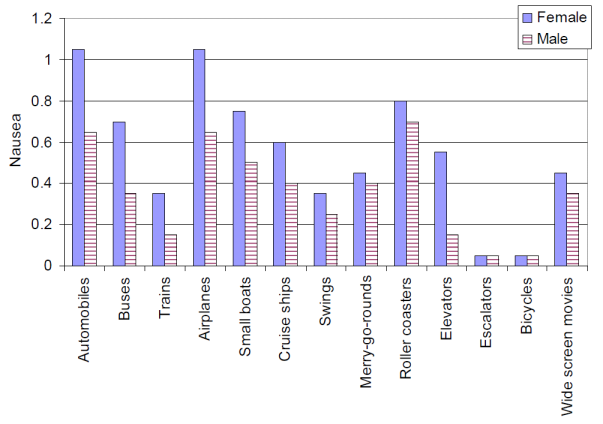
The scale is originally 0-3: this study polled a sample aged 9-18 and asked whether they feel nauseous on any of the above modes, where 0 is “never” and 3 “always.”
Selective Application of Smeed’s Law
A few months ago, in response to the Raquel Nelson case, author Tom Vanderbilt found an FHWA study from 2005 that finds that on wide, busy roads, pedestrian death rates are higher on marked crosswalks than on unmarked ones. The study itself is worth reading; its explanation of the finding is that,
These results may be somewhat expected. Wide, multilane streets are difficult for many pedestrians to cross, particularly if there is an insufficient number of adequate gaps in traffic due to heavy traffic volume and high vehicle speed. Furthermore, while marked crosswalks in themselves may not increase measurable unsafe pedestrian or motorist behavior (based on the Knoblauch et al. and Knoblauch and Raymond studies) one possible explanation is that installing a marked crosswalk may increase the number of at-risk pedestrians (particularly children and older adults) who choose to cross at the uncontrolled location instead of at the nearest traffic signal.
An even greater percentage of older adults (81.3 percent) and young children (76.0 percent) chose to cross in marked crosswalks on multilane roads compared to two-lane roads. Thus, installing a marked crosswalk at an already undesirable crossing location (e.g., wide, high-volume street) may increase the chance of a pedestrian crash occurring at such a site if a few at-risk pedestrians are encouraged to cross where other adequate crossing facilities are not provided. This explanation might be evidenced by the many calls to traffic engineers from citizens who state, “Please install a marked crosswalk so that we can cross the dangerous street near our house.” Unfortunately, simply installing a marked crosswalk without other more substantial crossing facilities often does not result in the majority of motorists stopping and yielding to pedestrians, contrary to the expectations of many pedestrians.
This is a rather standard application of Smeed’s law and similar rules governing traffic, whose one-line form is that traffic fatalities are determined primarily by psychology. This is not a problem; the problem is why such issues are only ever brought up in case of pedestrian fatalities.
In 1949, R. J. Smeed found a simple explanation for traffic fatalities: they depend less-than-linearly on the number of cars on the road. In the 1980s John Adams revised this to a more accurate rule based on VMT rather than the number of cars, and based on a constant decline in per-VMT accidents over time. Safety improvements do not bend or break the general trend. Quoting Adams again, the introduction of seat belts caused no reduction in traffic fatalities, and on the contrary caused pedestrian fatalities to temporarily inch up, as drivers felt safer and drove more recklessly. The only way to reduce the number of car accident victims is to reduce traffic.
And yet, government reaction is consistently on the side of accepting Smeed’s law when it implies there’s no need to improve pedestrian facilities, and rejecting it when its implication is bad for cars or good for pedestrians and cyclists. Local governments in the US routinely argue that safety is at stake when they want to upgrade a road with grade crossings into a full freeway. The FHWA helpfully adds that intersections are responsible to half of all car crashes and “FHWA will identify the most common and severe problems and compile information on the applications and design of innovative infrastructure configurations and treatments.”
In reality, all building freeways does is create more traffic, and cause more people to die in crashes. The average per-VMT death rate in the US has declined by 3.3% per year, but in the years following the Interstate Highway Act, it was practically flat – in other words, building freeways did nothing to accelerate the trend for reduction in per-VMT accident deaths. Although an individual freeway is undoubtedly safer than an individual road with intersections, the road network has to be viewed as a system: increase safety in one area and people will drive more recklessly elsewhere.
This systemwide view is clearly present in the case of pedestrians: the FHWA isn’t claiming that crosswalks are inherently unsafe, only that they cause more at-risk pedestrians to cross. In other words, the problem is that they cause too many of the wrong kind of pedestrians to cross. The implication is never used for roads. Traffic is never treated as variable, and if people shoot down freeway upgrades on the grounds that they’ll induce more traffic, it’s always on environmental or community grounds rather than on safety grounds.
Obama Proposes $4 Billion for HSR
President Obama’s new jobs bill includes $50 billion for infrastructure construction, including $10 billion for an infrastructure bank, $4 billion for high-speed rail, and $2 billion for Amtrak. Assuming it can get past the Republican Congress and that it will not be watered down as it already has been since the beginning of the year, the question arises: where to spend the money?
Fortunately, the separate grant for Amtrak suggests that the Northeast Corridor will be funded from a separate pile of money. This means that it’s more feasible to spend 100% of the HSR money in California. I claim that, in light of California’s present funding situation, this is the best possible use of the money, and, furthermore, the federal government should let California know of this as soon as possible, before it lets contracts out to tender.
Recall that California’s present HSR money is sufficient to build from Bakersfield to a point between Fresno and Merced, at least in principle, as the Environmental Impact Report projects slightly higher costs. Recall further that the $8 billion that could be made available to California – Obama’s $4 billion plus matching funds from Proposition 1A – are more or less enough to build from Bakersfield to Sylmar.
More precisely, the cost estimate for Bakersfield-LA is $12.6 billion, but according to CARRD, which independently of this also thinks the cost is going to be $18.6 billion, Palmdale-Sylmar is half the cost of Palmdale-LA, and as a result adding up Bakersfield-Sylmar using the 2009 Business Plan numbers works out to just under $9 billion. The approximately $1 billion in missing funds could either be obtained from local or private sources, or diverted from the plans to build north of Fresno; the segment that goes through and north of Fresno is expected to cost $1-2 billion, and diverting all north-of-Fresno money to Bakersfield-Sylmar should suffice to build the system from Sylmar to Fresno, with a cheap electrified legacy onward connection to LA.
Alternatively, if it turns out that going from Bakersfield to the LA Basin through Tejon Pass rather than through Palmdale is cheaper, then it’s possible to terminate the line in Santa Clarita and have trains continue further south at lower speed. This is in principle possible even through Palmdale, but then the legacy segment of the line would be both longer and curvier.
In other words, by spending all possible HSR money in California now, the Obama administration can guarantee a useful initial operating segment from LA to Fresno. On the margin the benefit of this is much bigger than its share of the cost, since it makes the difference between an upgraded San Joaquins train and a Phase 0 high-speed line.
If the administration funds California in full, then people will be able to ride a fairly long segment at full speed, connecting at lower speed to a major city. Some people are still going to call this a train to nowhere until it connects to San Francisco, but fewer people will use this epithet on LA-Fresno than on Bakersfield-Merced.
The primary problem with American transportation planning is that there is no transportation policy in the US. There is an industrial policy, a jobs policy, and construction for pizzazz on both sides, as well as the joy of hippie-punching among conservatives. An open HSR segment that is not a complete cost or ridership disaster could at least blunt the hippie-punching, if not develop local expertise that could eventually lead to transportation policy. In countries where HSR is in operation, or something close enough to it, the conservatives do not oppose its construction, even quite right-wing ones such as Berlusconi and Cameron.
The worst thing that can be done is spreading the money thin. The not-really-high-speed lines funded elsewhere, or, even worse, funding to Amtrak’s massively overpriced Vision plan, can only lead to small, barely noticeable improvements, ensuring there are plenty of disaffected people to continue the treatment of intercity transportation as a cultural political football. The only place where $4 billion in federal money makes a difference between having a usable system and not having one is California, and this is the basket the administration should put its eggs in.
The Rail-Trail Scam
I recently learned that a writer for the Adirondack Explorer has the following proposal to create a new rail-trail: demolish a line that’s in use by a heritage railroad, pave it over, and convert it to a bicycle trail. The arguments in the piece are your standard hatchet job considering only the costs of rail and only the benefits of the alternative, and are downright uninteresting; what’s interesting is that this is just the culmination of the misuse of the original concept of rail-trails.
Originally, rail-trails were created to preserve railroads for future use. Their mandate includes “to preserve established railroad rights-of-way for future reactivation of rail service.” In reality, restoration almost never happens. The Rails-to-Trails Conservancy’s review of railbanking points to success that a full nine railbanked corridors have had rail service restored, out of 301. The rest have been paved over, and often have enough non-railroad users that any restoration would be politically difficult in practice; I suspect that this is why the Providence Foundation makes no mention of restoring service on the second, now-abandoned track between Providence and Woonsocket in its regional rail study.
Another problem with railbanking is that it focuses on what’s useful as a trail, and not on what would be useful as a railroad later. There are pleasant exceptions, such as the Milwaukee Railroad’s route in most of Washington State, but in Rhode Island, the rights-of-way that have been preserved are those that would be easiest and least expensive to rebuild from scratch: the line to Hartford through West Warwick and Coventry, the line from East Providence to Bristol, and the aforementioned second track to Woonsocket. In contrast, many major pieces of infrastructure were demolished. Downtown Providence’s connection to East Providence was cut and would require new urban viaducts to be restored, and it’s sheer luck that the bridge over the Blackstone estuary is still there. Newport’s only rail connection to the mainline was railbanked but removed, which means restoration would face fewer regulations than starting new service from scratch, but only after rebuilding a bridge from the island to the mainland.
This is not intentional, but it’s neglectful of the needs of any mode other than the car as regular transportation; even bikes only get the nod for recreational use. The document coming out of Rails-to-Trails Conservancy, Railbanking and Rail-Trails: a Legacy for the Future, makes this thinking clear, when one reads between the lines. Here are some touted benefits of rail-trails:
The USDA’s Dietary Guidelines recommend at least 60 minutes of daily exercise for children and teens and at least 30-60 minutes everyday for adults. Trails provide close, safe, traffic-free paths for walkers, joggers, inline skaters [and] cyclists. Rail-trails are also part of a nationwide initiative launched by Congressman James L. Oberstar (D.-Minn.) to create safe routes that will encourage school children to walk and bike to school.
The first sign of utter disregard for alternative transportation as everyday transportation is the touting of “traffic-free paths.” Segregation of different modes of travel into different rights-of-way is the thinking of the traffic engineer and the freeway builder, not of the urbanist. The second is the fact that, in practice, the placement of those trails follows ideal corridors for the needs of trains, not bicycles or pedestrians. One does not use a mode of transportation that averages 60 km/h and loses 2 minutes every time it stops the same way one uses a mode that averages 25 km/h and can stop where you want. You can look at the northern end of the aforementioned West Warwick trail on Streetsview or on satellite and judge for yourself how useful it is for a cyclist’s daily work trip; a train would just blast through at full speed.
There’s already an ideal place for pedestrians are cyclists: the streets. Those are the strange linear alignments used by cars and fronted by actual residences and jobs. Away from urban areas, those are the country roads that go through small towns. A policy that aimed at reducing car use and getting people to use more active transportation would impose walkability and bikability standards on streets, which are where the exact addresses people want to go to are. A policy that didn’t care would turn railroads into recreational trails and greenwash it by saying they’re usable by pedestrians and cyclists. And I think we all know which of the two the rail-trail scam is.
Followup on the Providence Line and Woonsocket Trains
There’s a pretty bad mistake in my post about MBTA-HSR compatibility: the length of the Boston-Providence line is 70 kilometers, not 67 as stated in the post. In my defense, 67 (42 miles) is what the official mileposts say, on Wikipedia and on the catenary poles along the line. In calculating travel times I used a mix of milepost and Google Earth data, leading me to slightly understate the travel time difference between future high-speed trains on the corridor and improved regional rail. The difference is small, but is important for choosing overtake locations.
The correct technical travel times for nonstop 300 km/h HSR and 160 km/h regional trains making all current MBTA stops are 19.25 and 38.75 minutes, respectively. It’s offset by just half a minute from the technical time I originally thought was correct, but more of the difference occurs near Providence than near Boston. The upshot is that the single-overtake option in Sharon is loose in the north, allowing an additional Boston-area stop, and extremely tight in the south, requiring 200 km/h trains and not necessarily allowing regional trains to stop at Pawtucket.
This doesn’t directly affect Woonsocket trains, for which my example schedule is based on Google Earth lines and should be considered accurate given the assumptions. However, in a comment, I’ve been linked to a 2009 Providence Foundation study of the feasibility of a regional train to Woonsocket, under present FRA regulations, achieving similar trip times to those I propose but with fewer stops. The service proposed is very good relative to the regulatory and organizational environment it has to deal with – the projected cost per rider is about $25,000, fairly low by US standards.
The Providence Foundation study also includes a timed transfer at Pawtucket between Woonsocket and Boston, something I did not originally think of. Since the exercise on this blog assumes organizational competence on the MBTA’s behalf, we can choose an overtake option that makes this work optimally with short turnaround and transfer times. We should also include fare integration in the scenario, something that doesn’t currently exist even just between the MBTA and Amtrak. Under some HSR operating scenarios, it could charge the same fare as low-speed rail on the same corridor and have integrated ticketing, making a Pawtucket transfer less useful than an HSR transfer at Providence. Under others – for example, an HSR fare surcharge as currently practiced on the Shinkansen or ICE – it is not possible, and while integrated ticketing is still possible and desirable, cost-conscious commuters would need a solution not involving intercity trains.
It turns out that a single-overtake option does not accommodate Pawtucket transfers well, even if a Pawtucket stop could be squeezed into the schedule. Consider the following 200 km/h schedule north of Providence, with the 7% pad, rounded to a half-minute:
| Providence | 0:11:30 |
| Pawtucket-Central Falls | 0:15 |
| South Attleboro | 0:18 |
| Attleboro | 0:22:30 |
| Mansfield | 0:28 |
| Sharon | Arrive 0:33:30, Depart 0:37:30 |
| Canton Junction | 0:40 |
| Route 128 | 0:44 |
| Readville | 0:46:30 |
| Hyde Park | 0:48:30 |
| Ruggles | 0:54 |
| Back Bay | 0:56 |
| Boston South | 0:58 |
It’s possible to replace Readville with Forest Hills; the point is that there’s room in the schedule for it. The times above were chosen to make :00 the symmetry axis – i.e. southbound regional trains leave Boston at :02. Moving the symmetry axis is possible but requires giving up through-service to Warwick – the timetable would be too tight. Under this schedule, southbound regional trains would arrive in Pawtucket at :45, and HSR trains would arrive immediately after, at about :48; thus, southbound Woonsocket trains would arrive at the earliest at :50 and :20, timing them to just miss the northbound connection to Boston. Clearly, under such an option, the only way to provide satisfactory Woonsocket-Boston service is to connect to HSR at Providence.
The two-overtake schedule looks much better. It’s a tighter fit for Woonsocket trains between the faster MBTA and HSR trains, but once they fit, the transfer works well. Consider the following 160 km/h two-overtake schedule, with four-tracking between Readville and Route 128:
| Providence | 0:07 |
| Pawtucket-Central Falls | 0:10:30 |
| South Attleboro | 0:13:30 |
| Attleboro | Arrive 0:18, Depart 0:22 |
| Mansfield | 0:27:30 |
| Sharon | 0:33:30 |
| Canton Junction | 0:36:30 |
| Route 128 | Arrive 0:40, Depart 0:41 |
| Readville | Arrive 0:43, Depart 0:45 |
| Hyde Park | 0:47 |
| Forest Hills | 0:51:30 |
| Ruggles | 0:54 |
| Back Bay | 0:56 |
| Boston South | 0:58 |
Southbound MBTA trains arrive at Pawtucket at :49:30 and southbound HSR trains pass by Pawtucket at :44. Southbound Woonsocket trains have a window of about 1.5 minutes – they can arrive at Pawtucket between :51:30 (after the MBTA) and :53 (before the next HSR) to fit in on the same track pair used by the MBTA and HSR – but within that window they have a convenient transfer: 2.5-4 minutes to the next northbound MBTA train, at :55:30. Note that even in the off-peak, when MBTA trains would come every 30 minutes rather than every 15 minute, this works – we can just shift the slots used by MBTA and Woonsocket trains. Earlier arrival is good for the entire turnaround schedule for Woonsocket trains, which based on trip times would “like” to arrive at Providence at :58 and at Pawtucket at :51, though, if the Mineral Spring stop for Woonsocket trains is dropped, then :52 arrival is very comfortable at all ends.
The inclusion of Woonsocket service also favors ant6n’s proposed no-overtake schedule, in which Boston-Providence trains run at 200 km/h and skip stops near Boston and let Stoughton trains provide local service, and trains run every 20 minutes. It’s tight if MBTA trains stop at Pawtucket, but gives Woonsocket trains ample time for anything. Assuming a Pawtucket stop can be squeezed, for :58 Boston arrival northbound regional trains would depart Pawtucket at :27, i.e. southbound MBTA trains would depart at :33 and HSR would pass by at :35, right on their heels. Woonsocket trains could be slotted anytime between :37 and :47:30, where :41 would be optimal for their own turnaround times and :45-46 would provide the shortest robust connection.
 Pedestrian Observations