Category: Regional Rail
Quick Note: Regional Rail and the Massachusetts State Legislature
The Massachusetts state legislature is shrugging off commuter rail improvements, and in particular ignoring calls to spend some starter money on the Regional Rail plan. The state’s climate bill ignores public transportation, and an amendment proposing to include commuter rail electrification in the plan has been proposed but not yet included in the plan. Much of the dithering appears to be the fault of one politician: Will Brownsberger, who represents Watertown, Belmont, Back Bay, and parts of Brighton.
What is Regional Rail?
Regional Rail is a proposal by TransitMatters to modernize the MBTA commuter rail network to align it with the standards that have emerged in the last 50-60 years. The centerpiece of the plan is electrification of the entire network, starting from the already-wired Providence Line and the short, urban Fairmount Line and inner Eastern Line (Newburyport/Rockport Lines on timetables).
Based on comparable projects in peer countries, full electrification should cost $0.8-1.5 billion, and station upgrades to permit step-free access should cost on the order of $2 billion; rolling stock costs extra upfront but has half the lifecycle costs of diesels. An investment program on the order of high hundreds of millions or very low billions should be sufficient to wire the early-action lines as well as some more, such as the Worcester Line; one in the mid-single digit billions should be enough to wire everything, upgrade all stations, and procure modern trains.
Benefits include much faster trips (see trip planner here), lower operating and maintenance costs, higher reliability, and lower air and noise pollution and greenhouse gas emissions. For a city the size of Boston, benefits exceed costs by such a margin that in the developed world outside North America, it would have been fully wired generations ago, and today’s frontier of commuter rail electrification is sub-million metro areas like Trondheim, Aarhus, and Cardiff.
Who is Will Brownsberger?
Brownsberger is a Massachusetts state senator, currently serving as the Senate’s president pro tempore. His district is a mix of middle-class urban and middle-class inner-suburban; the great majority of his district would benefit from commuter rail modernization.
He has strong opinions on commuter rail, which are what someone unaware of any progress in the industry since roughly 1960 might think are the future. For example, here’s a blog post he wrote in 2019, saying that diesel engines are more reliable than electric trains because what if there’s a power outage (on American commuter rail systems that operate both kinds of vehicles, electric trains are about an order of magnitude more reliable), and ending up saying rail is an outdated 20th century concept and proposing small-scale autonomous vehicles running on the right-of-way instead. More recently, he’s told constituents that rail electrification with overhead wire is impossibly difficult and the only option is battery-electric trains.
Because he’s written about the subject, and because of his position in the State Senate and the party caucus, he’s treated as an authority on the subject. Hence, the legislature’s lack of interest in rail modernization. It’s likely that what he tells constituents is also what he tells other legislators, who follow his lead while focusing on their own personal interest, such as health policy, education policy, taxes, or any other item on the liberal policy menu.
Why is he like this?
I don’t know. It’s not some kind of nefarious interest against modernization, such as the trenchant opposition of New York suburbanites to any policy that would make commuter trains useful for city residents, who they look down on. Brownsberger’s district is fairly urban, and in particular Watertown and Belmont residents would benefit greatly from a system that runs frequently all day at 2020s speeds and not 1920s speeds. Brownsberger’s politics are pretty conventionally liberal and he is interested in sustainability.
More likely, it’s not-invented-here syndrome. American mainline passenger rail is stuck in the 1950s. Every innovation in the field since then has come from outside North America, and many have not been implemented in any country that speaks English as its primary language. Brownsberger lacks this knowledge; a lifetime in politics does not lend itself well to forming a deep web of transnational relationships that one can leverage for the required learning.
Without the benefit of around 60 years of accumulated knowledge of French, German, Swiss, Swedish, Dutch, Japanese, Korean, Austrian, Hungarian, Czech, Turkish, Italian, and Spanish commuter rail planning, any American plan would have to reinvent the wheel. Sometimes it happens to reinvent a wheel that is round and has spokes; more often, it invents a wheel with sharp corners or no place to even attach an axle.
When learning happens, it is so haphazard that it’s very easy to learn wrong or speculative things. Battery-electric trains are a good example of this. Europe is currently experimenting with battery-electric trains on low-traffic lines, where the fact that battery-electrics cost around double what conventional electric multiple units do is less important because traffic is that light. The technology is thus on the vendors’ mind and so when Americans ask, the vendors offer to sell what they’ve made. Boston is region of 8 million people running eight- and nine-car trains every 15 minutes at rush hour, where the places in Europe that experiment with battery tech run an hourly three-car train, but the without enough background in how urban commuter rail works in Europe, it’s easy for an American agency executive or politician to overlook this difference.
Is there a way forward?
Yes!
Here is a proposed amendment, numbered Amendment 13, by Senator Brendan Crighton. Crighton represents some of the suburbs to the northeast of Boston, including working-class Lynn and very posh Marblehead; with only four years in the State Senate and three in the Assembly, he’s not far up the food chain. But he proposed to require full electrification of the commuter rail network as part of the climate bill, on a loose schedule in which no new diesels may be procured after 2030, and lines would be electrified by 2028 (the above-named early action lines) to 2035 (the rest of the system). There are so far four cosponsors in addition to Crighton, and good transit activists in Massachusetts should push for more sponsorship so that Amendment 13 makes it into the climate package and passes.
How High-Speed and Regional Rail are Intertwined
The Transit Costs Project will wrap up soon with the report on construction cost differences, and we’re already looking at a report on high-speed rail. This post should be read as some early scoping on how this can be designed for the Northeast Corridor. In particular, integration of planning with regional rail is obligatory due to the extensive track sharing at both ends of the corridor as well as in the middle. This means that the project has to include some vision of what regional rail should look like in Boston, New York, Philadelphia, and Washington. This vision is not a full crayon, but should have different options for different likely investment levels and how they fit into an intercity vision, within the existing budget, which is tens of billions thanks to the Bipartisan Infrastructure Framework.
Boston
In Boston, commuter rail and intercity rail interact via the Providence Line, which is double-track. The Providence Line shares the same trunk line into Boston with the Franklin Line and the Stoughton Line, and eventually with South Coast Rail services.
The good news is that the MBTA is seriously looking at electrifying the trains to a substantial if insufficient extent. The Providence Line is already wired, except for a few siding and yard tracks, and the MBTA is currently planning to complete electrification and purchase EMUs on the main line, and possibly also on the Stoughton Line; South Coast Rail is required to be electrified when it is connected to this system anyway, for environmental reasons. If there is no further electrification, then it signals severe incompetence in Massachusetts but is still workable to a large extent.
Options for scheduling depend on how much further the state invests. The timetables I’ve written in the past (for an aggressive example, see here) assume electrification of everything that needs to be electrified but no North-South Rail Link tunnel. An NSRL timetable requires planning high-speed rail in conjunction with the entirety of the regional rail system; this is true even though intercity trains should terminate on the surface and not use the NSRL tunnel.
Philadelphia
Philadelphia is the easiest case. Trenton-Philadelphia is four-track, and has sufficiently little commuter traffic that the commuter trains can be put on the local tracks permanently. In the presence of high-speed rail, there is no need for express commuter trains – passengers can buy standing tickets on Trenton-Philadelphia, and those are not going to create a capacity crunch because train volumes need to be sized for the larger peak market into New York anyway.
On the Wilmington side, the outer end of the line is only triple-track. But it’s a short segment, largely peripheral to the network – the line is four-track from Philadelphia almost all the way to Wilmington, and beyond Wilmington ridership is very low. Moreover, Wilmington itself is so slow that it may be valuable to bypass it roughly along I-95 anyway.
The railway junctions are a more serious interface. Zoo Interlocking controls everything heading into Philadelphia from points north, and needs some facelifts (mainly, more modern turnouts) speeding up trains of all classes. Thankfully, there is no regional-intercity rail conflict here.
Washington
In some ways, the Washington-Baltimore Penn Line is a lot like the Boston-Providence line. It connects two historic city centers, but one is much larger than the other and so commuter demand is asymmetric. It has a tail behind the secondary city with very low ridership. It runs diesel under catenary, thanks to MARC’s recent choice to deelectrify service (it used to run electric locomotives).
But the Penn Line has significant sections of triple- and quad-track, courtesy of a bad investment plan that adds tracks without any schedule coordination. The quad-track segment can be used to simplify the interface; the triple-track segment, consisting of most of the line’s length, is unfortunately not useful for a symmetric timetable and requires some strategic quad-track overtakes. The Penn Line must be reelectrified, with high-performance EMUs minimizing the speed difference between regional and intercity trains. There are only five stations on the double- and triple-track narrows – BWI, Odenton, Bowie State, Seabrook, New Carrollton – and even figuring differences in average speed, this looks like a trip time difference between 160 km/h regional rail and 360 km/h HSR of about 15 minutes, which is doable with a single overtake.
New York
New York is the real pain point. Unlike in Boston and Washington, it’s difficult to isolate different parts of the commuter rail network from one another. Boston can more or less treat the Worcester, Providence+Stoughton, Fairmount, and Old Colony Lines as four different, non-interacting systems, and then slot Franklin into either Providence or Fairmount, whichever it prefers. New York can, with current and under-construction infrastructure, plausibly separate out some LIRR lines, but this is the part of the system with the least interaction with intercity rail.
Gateway could make things easier, but it would require consciously treating it as total separation between the Northeast Corridor and Morris and Essex systems, which would be a big mismatch in demand. (NEC demand is around twice M&E demand, but intercity trains would be sharing tracks with the NEC commuter trains, not the M&E ones; improving urban commuter rail service reduces this mismatch by loading the trains more within Newark but does not eliminate it.)
It’s so intertwined that the schedules have to be done de novo on both systems – intercity and regional – combined. This isn’t as in Boston and Washington, where the entire timetable can be done to fit one or two overtakes. This isn’t impossible – there are big gains to be had from train speedups all over and there. But it requires cutting-edge systems for timetabling and a lot of infrastructure investment, often in places that were left for later on official plans.
Penn Station Tracks
In 2015, I argued that New York Penn Station should be replaced with a hole in the ground, and such a station would have sufficient capacity. I will defend those posts: in the 21st century, elaborate stations are not required for high-quality rail service, and it’s more important to have good passenger egress and intermodal connections than a signature station. The topic of this post is more niche: which rail lines should connect to Penn Station?
The three-line system
In all writing I’ve done on the subject since around 2010, I’ve assumed that Penn Station should be a three-line stations. In blog posts about regional rail for New York I’ve consistently called them Lines 1, 2, and 3; one map can be found in this post, with slightly less expansive version on Google Maps, and, consistently, Line 1 (red) is the existing Northeast Corridor, Line 2 (green) runs along the same route but uses the Gateway tunnel across the Hudson and then goes via Grand Central, and Line 3 (orange) connects the Empire Connection to the LIRR via a slightly realigned approach, otherwise using existing tracks.
At the station, their order from south to north is 2, 1, 3; the numbers are chronological (1 preexists, 2 is a higher priority to build than 3). Gateway is to enter Penn Station south of the existing tunnel and the room for a Grand Central connection is to the south (31st Street), forcing that line to be the southernmost. The East River Tunnels go under 32nd and 33rd, each as a track pair going in opposite directions rather than 32nd running eastbound and 33rd westbound, and the track pair under 33rd has a better connection to the LIRR while that under 32nd has a better connection across the Hudson; the Empire Connection loops under the Hudson tunnel to connect to southern tracks, but that’s a single-track link and needs to be doubled anyway, so it might as well be realigned.
With three lines and six approach tracks, Penn Station should have 12 platform tracks: each approach track should split into two and the two tracks should serve the same platform, a solution used for the expensive but operationally sound Stuttgart 21 project. There should not be any flexibility, save perhaps some emergency crossovers at the station, not to be used in service: the required throughput is so extensive that such flexibility is fake, reducing capacity by almost as much as the full closure of a track.
The footprint of the station looks around 155 meters wide gross, or around 145 net, corresponding to 24 per platform. The total width of the tracks is 1.7 (track center to platform) plus 4.5 (distance between track centers; Shinkansen regulations say 4.3) plus around 2 if a safety zone between each track pair is desired, which is a total of about 8 meters. The platform width is then 24 – 8 = 16. If a heavy column between two tracks adjacent to different platforms is required, this adds about another meter to maintain the safety zones, for a total of 9, resulting in 15-meter platforms.
15-meter platforms are extremely wide. Châtelet-Les Halles’s RER A and B platforms are 17 meters, and are wider than necessary; they in contrast have insufficient vertical circulation at rush hour. At 15 meters, there’s room for six escalators per access point and possibly also a staircase; at 16, there’s definitely room for the staircase. Six escalators can run without any rush hour variation, always three up and three down, and would still clear a full train with many standees in a minute. I do not foresee any capacity problems at the station if it is built this way.
But this leads to the question: since the platforms are so oversize, perhaps it is useful to have more of them at lower width?
The four-line system
Penn Station could potentially serve not three lines but four. Right now it only has infrastructure for a line and a half, and with Gateway it would have one and two halves; even three looks like a generational project. But there’s good cause to think even farther ahead and make room for a fourth line: a dedicated intercity railway. The four-line system would maintain Lines 1, 2, and 3 as above, but then add an unnumbered line with no regional trains, only intercity train.
This comes out of my ridership model for high-speed rail for the United States: at full buildout, the system would be difficult to fit into an approach track with regional trains, and regional trains would only be able to run every 5 minutes or even worse, rather than every 2 or 2.5. Moreover, once high-speed rail exists on the Northeast Corridor, the return on investment on extensions is so great that it is likely that such extensions will happen. Politics make such extensions even more favorable: high-profile investment in the Northeast’s intercity rail and in New York is likely to lead to demand for such investment in other regions, regardless of the business case, and it is fortunate that the business case for such extensions is strong independently of the politics.
I presume that, from south to north, the platform order should be Line 2 eastbound, Line 2 westbound, intercity eastbound, Line 1 eastbound, Line 1 westbound, intercity westbound, Line 3 eastbound, Line 3 westbound. The problem here is that Penn Station’s footprint is only adjacent to three east-west streets, not four, and so the intercity tunnels have to duck under private property, and the best place for them going east is to act as 31.5th and 32.5th Streets. Using the existing tunnels and then displacing regional rail to new tunnels is also possible, but less desirable: the existing tunnels have small diameter, and so it’s easier to keep them lower-speed while the new tunnels get to be bigger and support 200 km/h while maintaining enough free air to avoid creating pressure problems in passengers’ ears.
Under this system, the existing footprint of Penn Station is wide enough for 18 meters gross per each of the eight platforms, or 10 meters net. This is not out of the question, and would ordinarily be completely fine: it’s enough for four escalators per access point, or three and a staircase. At Penn Station I am slightly squeamish purely because on Lines 1 and 3 it’s the only city center station, and thus more crowded than the usual for a regional train station.
But it’s possible to slightly widen the footprint. Under no circumstances should there be any digging past the footprint of 31st and 33rd Streets: the cost of construction under existing buildings is too high. Plans for demolishing the block between 30th and 31st Streets (Block 780) are in an advanced stage, related to both a real estate deal with Vornado and plans for Penn Station South expansion, but they are extraordinarily expensive (around $10 billion at this point), and redevelopment of the block is easier on firma than over rail tracks. For all intents and purposes, the maximum usable footprint is between the lot lines of 31st and 33rd, which is 175 meters gross, perhaps 160 net with some distance between the dig and the lot line.
With 160 net meters, there are 20 meters per platform with tracks, or 12 per platform alone. This is wide enough for anything: four escalators and a staircase fit, which has enough capacity (albeit with some compromises) with permanent escalator directionality and more than enough if escalators run three-and-one at rush hour.
The benefits of creating about two extra meters per platform should be weighed against the cost of adding to the footprint of Penn Station, which is not $10 billion but also not zero, and I don’t want to make pronouncements without seeing a reliable estimate. This also depends on the difficulty of building intercity rail tunnels under private property.
Coordinated planning
A coordinated Penn Station rebuild plan should be considered together with some plan for how to use those tracks. Infrastructure investment must always come with a precise service plan, with sample timetables to the minute shared with the public for democratic review.
The upshot is that Penn Station rebuild must come with a good idea of how much service the region expects to run. A high-speed rail plan argues in favor of the four-line system, provided the cost of the extra tunnels is reasonable (low-to-mid single-digit billions; $10 billion is far too high). Otherwise, the three-line system is better.
Why is Princeton Trying to Downgrade the Dinky?
Regular users of the Northeast Corridor in New Jersey know that there is a short branch off the line serving Princeton. Mainline trains do not use it – they continue between New York and Trenton – but a two-car shuttle, affectionately called the Dinky, connects the city with the train station. Historically, this is because the Northeast Corridor in New Jersey is a then-high-speed rail cutoff from 1863, which cut off Princeton from the old line. Trains run back and forth, with timed connections between New York (but not Trenton) and Princeton.
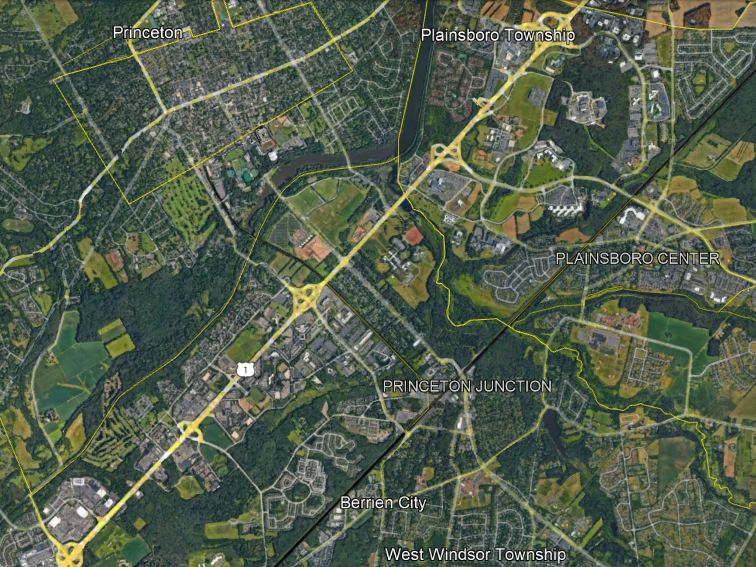
The Princeton stop on the Dinky, as can be seen in the satellite image, lies just outside the historic municipal limits of Princeton (since merged with the surrounding township). It serves the university fairly well, but is 800 meters at closest approach to the town’s main street, Nassau Street. So there has been a study for what to do to improve city access, in which a tram-train option was studied, looked good, and was dropped anyway. There are two options left: status quo, and a downgrade of the right-of-way to light rail with buses using the same corridor.
Unfortunately, transit advocates I respect, like Sandy Johnston, think the downgrade is an upgrade. So let me explain why in fact the light rail and bus option is inferior to current commuter rail operations.
The current use of the Dinky is as a connector to the Northeast Corridor. There is approximately nothing else at Princeton Junction: it’s one of the two busiest suburban stations in New Jersey, but like the other top station, Metropark, it’s a park-and-ride, designed exclusively for car-train interface. People who ride the Dinky do so to get to New York.
This means that the timed transfer with the mainline trains is critical. Frequency on the Dinky is irrelevant: all ridership from Princeton Junction into the town is going to be on the first train or bus after the mainline trains arrive, and almost all ridership to the junction is going to be on the last train that makes the connection. While frequency is not important except insofar as it matches that of the mainline, on-train capacity is important. My 2015 recollection is that off-peak ridership on the Dinky is maybe enough to fill an articulated bus (which New Jersey Transit only runs in Newark), maybe enough for a standard bus, depending on time of day – standees are likely, and standing on a bus is an awful passenger experience. At rush hour, the Dinky runs three-car trains (update 2022-2-18: no, it’s two-car trains) and they’re full.
The timed transfer is so important that the discussion of how to improve service must center how to make the transfer more efficient. The ideal improvement should be to regularize the timetable on the mainline commuter trains, and ensure that trains in opposite directions serve Princeton Junction around the same time (this is called a knot) so that the Dinky can connect to Trenton too, and even to Philadelphia with another timed transfer at Trenton or even through-service if that fits the New Jersey Transit and SEPTA schedules.
Sandy points out to me that while the Dinky only connects Princeton with the mainline, the right-of-way of the Dinky can serve more destinations – namely, the Route 1 job cluster, visible on the map as a line of office parks.
However, bus service from town to Route 1 is unlikely to succeed. It’s going to struggle to run sufficient frequency for what it needs, even as lower-frequency rail is sufficient for the Dinky’s current role:
- Route 1 is not on the way between town and the station – there would have to be separate buses to Route 1 from the service to the train station (which I presume will stay on rail even if the downgrade is picked). This means there’s no bundling of destinations – the buses to Route 1 have to live off of Princeton-Route 1 trips.
- Route 1 is a freeway with destinations located somewhat away, at automobile scale. Buses can stop on the side of the road but the walk is not great on the same side of the road and hostile and unsafe if crossing the road is required. A more pleasant experience is only possible if buses turn onto side roads, splitting frequency or increasing trip times.
- Route 1 is not a large job center. OnTheMap says that between the route of the Dinky and the junction with I-295 beyond the above satellite image, which ends at Quakerbridge Road, there are 21,000 jobs. The origins of those jobs are dispersed – only 5,000 come from within the county, and only 368 come from within Princeton.
- Conversely, the short distance traveled means that high frequency is crucial. A one-way trip from the townhouses just north of Nassau Street to the center of the Route 1 cluster along the right-of-way of the Dinky is 5.5 km, which at BRT and freeway speed is around 10 minutes one-way; a bus running less than once every 10 minutes might as well not run – but there is no chance for such a bus to fill at current demand.
Of course, the analysis of Route 1 assumes current development patterns stay with no or moderate change. A bigger change, such as greater development along Route 1 with sprawl repair, can make this option pencil out; O&D volumes need to rise by a factor of 3 assuming 100% transit modal split, or more if modal split is lower (which it invariably is, Route 1 is not Manhattan).
But then that raises the question – why engage in development in sprawl around a plan to downgrade a rail service?
If sprawl repair is plausible, then make Princeton more bikable and then set up bike lanes on Route 1 so that people can cycle to Route 1 jobs. The same bike lanes can also connect to the Dinky, with bike parking at the station, or even potentially at Princeton Junction if it’s faster to bike those 4 km than to ride a train and transfer. In the long run, all buses are going to have to be replaced by bikes anyway – bus operating costs are only going to go up.
And if redevelopment is plausible, look again at the satellite image and see what the land use at the existing train stations is like. Princeton is one of the most expensive places in the United States, and the Dinky station has a golf course on one side; that’s 0.5 km^2 of land, or, as I prefer to think of it, 50,000 housing units. Another 0.05 km^2 consists of parking lots right near the station, and can and should be redeveloped as a town center extension for a population that can swamp the existing town population by a factor of 4. The parking lots at Princeton Junction and the undeveloped land between them are another 0.4 km^2 of prime real estate.
In general, I cannot think of any railway where service would be improved by a downgrade from mainline rail to bus. But the Dinky has specific issues making such a downgrade especially deleterious for current users, namely the need for a timed connection, while the proposed source of new trips, namely Route 1, is too weak to be worth much. Thankfully, a no-build option keeping the status quo is still under consideration, and I hope that the region chooses it and invests in making the Dinky better rather than in replacing it.
New York Publishes a Bad Benchmarking Report
I’ve grown to intensely dislike benchmarking reports. It’s not that the idea of benchmarking bad. It’s that they omit crucial information – namely, the name of the system that one is compared with. The indicators always have a wide variety of values, and not being able to match them with systems makes it impossible to do sanity-checks, such as noticing if systems with high costs per car-km are consistently ones that run shorter trains. This way, those anonymized reports turn into tools of obfuscation and excusemongering.
The MTA in New York recently published such a report, including both US-wide and international benchmarking for the subway as well as commuter rail. The US benchmarking is with comparable American systems – exactly the ones I’d compare, with the systems listed by name as NTD data is wisely not anonymized. The international benchmarking for the subway is with CoMET, which includes most of the larger global systems as well as a handful of smaller ones, like Vancouver; for commuter rail, it’s with ISBeRG, which has an odd list of systems, omitting the RER (which is counted in CoMET), all of Japan except JR East, and any S-Bahn, skipping down to Australian systems, Cape Town, and Barcelona.
That, by itself, makes much of the international benchmarking worthless. The standard metric for operating costs is per car-km. This is covered in pp. 8-9, showing that New York has fairly average costs excluding maintenance, but the second highest maintenance costs. But here’s the problem: I’m seeing a comparison to an undifferentiated mass of other systems. One of them is an outlier in maintenance costs, even ahead of New York, but I do not know which it is, which means that I cannot look at it and see what it does wrong – perhaps it has an unusually old fleet, perhaps it is small and lacks scale, perhaps it is domestically viewed as scandal-ridden.
Far more useful is to look at complete data by name. For example, JICA has complete operating cost data for Japanese metro systems. Its tables are complete enough that we can see, for example, that overall operating costs are around $5/car-km for all systems, regardless of scale; so scale should not be too important, or perhaps Tokyo’s wealth exactly cancels out the scale effect. There are, on table 2.37 on PDF-p. 117, headcounts for most systems from which we can impute labor efficiency directly, using train-km data on PDF-p. 254; Yokohama gets 1,072 train-hours a year per driver at 35 km/h (the rough average speed I get from Hyperdia).
And here’s the thing: without the ability to fill in missing data like average speed, or to look at things the report didn’t emphasize, the report is not useful to me, or to other independent researchers. It’s a statement of excuses for New York’s elevated operating and maintenance cost, with officious proclamations and intimidating numbers.
For example, here’s the excuse for high maintenance costs:
High maintenance costs for NYCT are largely attributable to 24-hour service. Most COMET peer agencies shut down every night, allowing for four hours of continuous daily maintenance. In comparison, NYCT subway’s 24-hour service requires maintenance to occur within 20-minute windows between late night trains, reducing work efficiencies. Additionally, maintenance costs for NYCT have risen recently to support the improvements as part of the Subway Action Plan, which have led to a significant improvement to on-time performance year over year since inception.
Okay, so here we’re seeing what starts like a reasonable explanation – New York doesn’t have regular nighttime maintenance windows. But the other American systems studied do and they’d be above global average too; Boston has regular nighttime work windows but still can’t consign all track maintenance to them, and has almost the same maintenance cost per car-km as New York. Moreover, track maintenance costs per car-km should feature extensive scale effects – only at freight rail loads is the marginal track wear caused by each additional car significant – and New York runs long trains.
Then there is the Subway Action Plan line, which is a pure excuse. Other systems do preventive maintenance too, thank you very much. New York is not unusually reliable by global standards, and the benchmarking report doesn’t investigate questions like mean distance between failures or some measure of the presence of slow restrictions – and because it is anonymized, independent researchers can’t use what it does have and get answers from other sources.
The study has a section on labor costs, showing New York’s are much higher than those of some peer cities. Thankfully, that part is not anonymized, which means I can look at the cities with overall labor costs that are comparable to New York’s, like London, and ignore the rest; New York’s construction labor costs are higher than London’s by a factor of about 2, despite roughly even regionwide average wages. Unfortunately, a key attribute is missing: labor efficiency. The JICA study does better, by listing precise headcounts; but here the information is not given, which means that drawing any conclusion that is not within the purview of MTA’s endless cold war on its unions is not possible. As it happens, I know that New York is overstaffed, but only from other sources, never anonymized.
It’s worse with commuter rail. First of all, at the level of benchmarking, the study’s list of comparisons is so incomplete and so skewed (three Australian systems, again) that nothing it shows can be relevant. And second, commuter rail in North America comes with its own internal backward-looking culture of insularity and incompetence.
The report even kneecaps itself by saying,
While it is true that benchmarking provides useful insights, it is also important to acknowledge that significant differences exist among the railroads that pose challenges for drawing apples-to-apples conclusions, particularly when it comes to comparisons with international peers. Differing local economies, prevailing wages and collective bargaining agreement provisions can have dramatic impacts on respective labor costs. Government mandates, including safety regulations, vary widely, and each railroad exists in a unique operating environment, often with different service schedules, geographic layouts and protocols. Together these factors have also have a significant impact on relative cost structures.
To translate from bureaucratic to plain English, what they’re saying is that American (and Canadian) practices for commuter rail are uniquely bad, but controlling for them, everything is fine. The report then lists the following excuses, all of which are wrong:
• Hours of Operation: LIRR provides 24 hours of service 7 days per week, and MNR provides 20-22 hours of service 7 days a week
• Ungated System: Neither LIRR nor MNR operate gated systems, therefore they require onboard fare validation/collection
• Branch Service: Both LIRR and MNR run service to and from a central business district (New York City) and do not have ability to offer through-running service
• Electrification: Both LIRR and MNR operate over both electrified and non-electrified territory, thereby requiring both electric and diesel fleets
It’s impressive how much fraud – or, more likely, wanton indifference and incuriosity – can fit into just four bullet points. Metro-North’s hours of service are long, but so are those of the JR East commuter lines; the Yamanote Line runs 20 hours a day, which means the nighttime maintenance window is shorter. Ungated systems use proof-of-payment ticketing throughout Europe – I don’t know if Rodalies de Catalunya runs driver-only trains, but the partly-gated RER and the ungated S-Bahns in the German-speaking world do. Through-running is a nice efficiency but not all systems have it, and in particular Melbourne has a one-way loop system akin to that of the Chicago L instead of through-running. Finally, electrification on the LIRR and Metro-North is extensive and while their diesel tails are very expensive, they also sometimes exist in Europe, including in London on a line that’s partly shared with the Underground, though I don’t know if they do in the report’s comparison cases.
The report does not question any of the usual assumptions of American mainline rail: that it must run unusually heavy vehicles, that it run with ticket-punching conductors, etc.
For a much more useful benchmarking, without anonymization, let’s look at German S-Bahns briefly. There is a list of the five largest systems – Berlin, Munich, Hamburg, Frankfurt, Stuttgart – with ridership and headcounts; some more detail about Berlin can be found here. Those five systems total 6,200 employees; the LIRR has 7,671 and Metro-North 6,773. With 2,875 employees, the Berlin S-Bahn has more train-hours than the LIRR, Metro-North, and New Jersey Transit combined; about as many car-km pro-rated to car length as the LIRR times 1.5; and more ridership than all American commuter rail systems combined. The LIRR in other words has more workers than the largest five German S-Bahns combined while the Berlin S-Bahn has more riders than all American commuter rail systems combined.
The excuses in the report highlight some of the reasons why – the US sticks to ticket-punching and buys high-maintenance trains compliant with obsolete regulations – but omits many more, including poor maintenance practices and inefficient scheduling of both trains and crew. But those are not justifications; they are a list of core practices of North American commuter rail that need to be eliminated, and if the workers and managers cannot part with them, then they should be laid off immediately.
Institutional Issues: Coordination
In this installment of institutional issues, I’m going to talk about coordination, following up from procurement, professional oversight, transparency, proactive regulations, and dealing with change.
The state is to a large extent a coordinating body. Even the more extractive aspects of it, like historically the military, succeeded or failed not by who was the most brutal (they all were brutal) but by who was most efficient at organizing large groups of people.
Coordination in public transit is especially important, because it’s a system with many moving parts: infrastructure, equipment, timetable, development. These do not accrete spontaneously, not in any society that has also invented cars; transit-oriented development in the 21st century looks different from historic development before mass motorization. Organizational capacity makes the difference between a state that grows around mass transit, like Japan or South Korea or Switzerland or Sweden or increasingly France, and one that grows around cars even when the goal is nominally transit first, as is common in the United States but also most of Southeast Asia.
So in general, better coordination means overall better public transit. But it specifically means better investment – more targeted at the right places. And this is especially visible in mainline rail, which is less self-contained than urban metro lines. The right way to plan is to get different bodies to cooperate, such as different railroads and government agencies. And then there is the wrong, American way.
Coordination versus wishlists
In theory, the United States has mechanisms to get different agencies to talk to one another. The Northeast Corridor planning process understands that the corridor has many users and owners: Amtrak, MBTA, Connecticut DOT, MTA, New Jersey Transit, SEPTA, MARC. To ensure they collaborate, there are layers set on top of them, like the NEC Commission.
And yet, the NEC Commission’s plans are not worth the paper they are written on, and the people involved should not work in this field or in government again. The problem is that their idea of coordination is to ask each of the above agencies what its wishlist is, collate the responses, and staple them together.
The wishlist staple job is the opposite of coordination. Coordination means sitting down with intercity and regional rail operators, figuring out their service needs, and writing down a timetable with associated infrastructure plan that maximizes service at minimum cost. Even the accidental moves toward coordination that do exist, like the MBTA plan to complete electrification of the Providence Line and run modern EMUs rather than diesels under catenary, do not figure into the plan: Amtrak still wants a third track on the Providence Line, which such electrification obviates even if Amtrak cuts its Boston-Providence trip time in half. The third track was said to cost $400 million years ago; I do not know if it is still its budget or whether costs are higher now. One such unnecessary project at a time is what it takes to turn what should be a $15 billion project into three-figure billions.
This wishlist mentality is present whenever bad planners (e.g. all Americans) try to do something that involves more than one agency. It’s assumed that different parts of the government must constantly be at one another’s throats. Unless one agency dominates, the only solutions in this mentality are either to do a staple job, or subordinate all agencies to one new hierarchy, typically run by people who have never run transit service and do not respect those who have.
How to plan mainline rail better
Three of the legs of coordinated planning – infrastructure, rolling stock, timetable – are coordinated in an excellent way in Switzerland. (Switzerland is unfortunately too NIMBY for modern TOD.) This does not mean slavishly copying every single Swiss decision, but it does mean that it behooves planners to learn how Swiss rail planners got Europe’s best rail network on a limited (though not quite austerity) budget.
The way it should work is that everything begins from the timetable. Trains must run on the same fixed interval – typically hourly, but denser services should be planned around shorter intervals like 30 minutes or smaller divisors of the hour. This provides the base level of coordination: connections between trains at major stations are to be done at times that are compatible with this interval.
If the trip time between major stations (“Knoten”) is just a bit too long for timed connections at both ends, it means that the trains should be sped up. This is the run trains as fast as necessary maxim, beloved by many high-speed rail opponents who bring up that maxim far more often than they bring up how much rail tunneling Switzerland has built.
Everything must come based on this plan. The choice of rolling stock must be compatible. Switzerland chose bilevel EMUs, because its use case is urban stations with a surplus of platform tracks but limited platform length; the bilevel trades off higher on-train capacity per unit of train length for lower egress capacity, and in a country where the main train station has 26 tracks, the bilevel is the correct choice. Maybe in another environment it is and maybe it isn’t; in New York it is not.
The slate of infrastructure projects must likewise be based on total integration of operations and capital planning. This means being able to trace delays to their source, using data to figure out what the most problematic areas are, and fixing them. Swiss trains are not inherently punctual; delays in the 5 minute range are routine. What sets them apart is that the infrastructure has been designed, at minimum cost, to ensure that delays don’t propagate, whereas in Germany, cascading delays are more common, and the less said about the United States, the better.
Swiss integration, to be clear, operates in an environment that is highly federal, has a smattering of private railroads interoperating with SBB, is stingy about public spending, and has in most cases Western Europe’s most privatized economy. And yet there is no separation of infrastructure and operations, in contrast with the trend in Britain and the EU.
Coordination and saying no
A planning agency that has to work with operators to ensure they all collaborate has to mediate conflict in many cases. This is the origin of the wishlist mentality: by planning overly expensive systems with maximum separation between operators, conflict is avoided, at the minor cost of an order of magnitude increase in the budget.
A better way to mediate is to either propose compromises, or outright saying no. Investment that is not part of the coordinated plan is extra and infrastructure plans should not burden the taxpayers with it. If different bodies conflict, sometimes one is right and the other is wrong, and the infrastructure planners should say so; sometimes who is right and who is wrong is consistent, sometimes it isn’t. Moreover, if bodies refuse to coordinate, it’s important to be able to say no to overall plans.
All of this interfaces with previous posts on this subject. In particular, the infrastructure investment program, whether it’s a regional Verkehrsverbund or an intercity system like the NEC Commission, should consist of subject matter experts. Senior politicians should understand that those experts are paid to maximize the efficiency of an enormous infrastructure program and therefore defend their expertise against attacks.
The TransitMatters Rail Electrification Report
At TransitMatters, we’ve just released a report about the costs and benefits of rail electrification. It’s anchored to our proposal to electrify and modernize the commuter rail system in the Boston area, but much of the analysis is broader than that. The non-Bostonian reader may still be interested in the description of construction costs of electrification and the short case studies of Israel, Denmark, Norway, New Zealand, Britain, Canada, and the United States. The latter two, covering Toronto and the Bay Area, are unusually expensive and we go over why that came to be and how it is possible to avoid them. The section on alternatives and why they are all inferior to stringing wire and running EMUs is of general interest as well, and I hope European policymakers read over and take it as a sign they should electrify more lines (ideally, all of them, as is being done right now in South Korea, India, and China).
The Toronto problem
When we came up with the cost range of $800 million to $1.5 billion, there was a lot of skepticism. The Reddit thread‘s two most common kinds of comment are “great, this can’t happen fast enough” and “it will cost billions because of unspecified MBTA problems.” As I said in responding to one of the comments, the higher-cost comparison cases all have specific reasons for their higher costs: Britain has clearance restrictions that do not exist anywhere else in the world, and Caltrain had unusual managerial incompetence regarding the related signaling project where the MBTA is actually doing well. But Toronto still looms large.
As I said on Reddit,
I’m not too worried about Caltrain’s errors, which were truly bespoke. Toronto worries me more, because while the specifics are avoidable, the ultimate cause is reproduced: Toronto and Boston are both huge cities with heavy peak commuter rail traffic and should have electrified generations ago, so now the benefits of electrification are so high that managers can afford to be careless about costs and still have above-water benefit-cost ratios.
So it is important to be careful and avoid Toronto’s problems with cost control. This means baking cost control into the program from the start, and aggressively protecting the budget from use by other actors as OPM:
- The budget should be set at a standard level with standard contingencies. Do not aim for the ceiling; aim for average. Nor should anyone include 100% contingency as used by Toronto; if you budget money for the project it will be used, so optimize for minimizing overall cost rather than for just-in-case funding.
- Designs should be standard, and variations should be accommodated only based on cost minimization. Basically, if it’s good enough for Germany, France, Denmark, Norway, Israel, etc.,, it’s good enough for the United States.
- If NIMBYs push back, the state should fight back. They want noise walls? Nope, EMUs are a lot quieter than diesels, quality of life will improve. They want trenches? Nope, that’s too expensive.
- Under no circumstances should passenger rail electrification money be used for corporate welfare for freight rail companies. They can pay their own way for clearance for double-stacked containers.
The importance of maximum electrification
Based on the observations that the lifecycle costs of DMUs are about twice those of EMUs, and that operating and capital costs are both driven by the peak rather than off-peak, it’s possible to establish financial rates of return on electrification. Not counting the speed and reliability benefits to passengers, the ROI is around 0.3-0.5% per US-size car per hour at the peak. Lines that run 8-car trains every 15 minutes at rush hour run 32 cars per hour and so have an ROI of 10-16%; this is why outside the US and Canada, cities that run such long trains at such frequency have long electrified their tracks.
The problem is that electrification is relatively unfamiliar in North America. It exists, but is sporadic, and there have been very few recent projects, so managers think it’s a Herculean task. In Boston I’ve seen reticence to wire more track due to institutional conservatism, even in plans that spend comparable amounts of money on things the region is more used to, like station platform upgrades and extra tracks. Worse, I’ve seen this in New Jersey, which is largely already electrified but uninterested in finishing the job.
Against such conservatism, it’s important to remember that failure to undertake a high-value investment isn’t any more moral than a large investment that goes to waste. When your ROI hits double digits, you waste public benefits by avoiding or even just delaying the project – and the above calculation comes just from savings on operating, maintenance, and capital acquisition costs, without the large benefits to passengers, the environment, etc.
Can large cities afford not to electrify? Yes. They have money for many kinds of waste, including for forgoing the benefits of commuter rail electrification. But just because they can afford to waste money and social benefits doesn’t mean they should. So, please, no talk of DMUs, or bi-modes, or pilot programs, or batteries – just wire your system already and import some high-quality EMUs.
Express Rail Tunnels and Regional Rail Capacity
In three cities that I know of, there are plans to deal with an incipient regional rail capacity crunch by building a new tunnel: Tel Aviv, Hamburg, London. The route in question in all cities already has regional rail service making frequent urban stops as well as longer-distance intercity trains. Setting Tel Aviv aside – new tracks are not necessary there at all – both Hamburg and London have a choice of what to build in the tunnel. In both cases, the answer must be intercity rail and not regional rail. This affects Crossrail 2 in London, currently shelved but still in active planning, as well as plans for Hamburg Hauptbahnhof-Altona capacity improvements.
The dominant factor in the cost of an expensive urban railway in a constrained environment is the stations. Low-cost countries build very cheap stations, but that’s true in outlying areas, urban as they may be, and not in city center areas under and around older subways. What’s more, Britain and Germany are not low-cost countries. German costs are somewhat higher than the global median, British costs among the world’s highest. Thus, keeping down station costs is paramount – and express tunnels have fewer stations than local tunnels.
Normally, the express vs. local issue is not relevant to a new urban rail line. Yes, more stations are more expensive, but on a line designed to open up service to a new area, more stations also provide more access, so the extra cost is often worth it. This is true even for urban subways that act as relief lines, like Second Avenue Subway, a relief line for the Lexington Line: more stations provide better local access and therefore increase the line’s relief value.
However, when the problem comes from regional or longer-distance capacity, all of this goes out the door. Crossrail 2 includes a long tunnel from Central London all the way to Wimbledon not because of purely local needs but because of very high rail usage along the South West Main Line. In Hamburg the problem is similarly about the main line between Hauptbahnhof and Altona – local traffic is saturated on the S-Bahn, and all other trains have to squeeze on the remaining two tracks of the Verbindungsbahn. Thus, capacity expansion should involve a tunnel with the fewest number of stations, on the most express services.
And yet both cities are doing it wrong. Hamburg is planning an S-Bahn tunnel, with the existing S-Bahn route then given over to regional trains, to be segregated away from the intercity trains. But there are already two Hauptbahnhof-Altona S-Bahn routes – that’s not where the service need is. Instead, new tunnels should go between the stations without stopping, to reduce costs, hosting intercity trains while regional trains take over the existing intercity tracks.
London is likewise planning on an undulating connection between Clapham Junction and Wimbledon, with links to other parallel north-south lines in the area. This is not good planning – those new stations are inordinately expensive and not needed for network connectivity. If there is no way to six-track the South West Main Line above-ground by replacing the sloped berm with retaining walls, it’s the fastest trains that should go underground, to save money on stations. Crossrail 2 is a £31.2 billion project; I don’t think Paris has spent this money on all Métro and RER lines in the region to date combined, and Grand Paris Express, at a broadly similar cost, includes 160 km of tunnel. It’s necessary to economize and build the tunnels that are necessary, and not the ones London would like to have.
Good Practices for State Planning and Local Public Transportation
Earlier this week, I complained about the OPM (other people’s money) problem: federal funding of American public transportation, which is managed locally, leads to cost-raising behavior as local and state governments seek to maximize federal infusion of cash. This is a companion post about more positive and fruitful interactions of government at different levels on this side of the Pond. The examples here often look pointless or acrimonious by local standards, but at the end of the day, they produce cost-effective infrastructure and are positive examples to learn from.
Of note, all the examples below are from unitary, not federal states. This is just an artifact of where I have talked to the most people about this – from what I know of Germany, Austria, Switzerland, and Belgium, they all fall within the spectrum spanned by Italy, Turkey, France, and Sweden when it comes to state-local funding allocation. Moreover, the extent of subnational fiscal autonomy in Germany is not greater than that of Sweden, where there are extensive county and municipal taxes funding subnational government, whereas in Germany nearly all taxes are federal and the Länder mostly rely on transfers.
This is a theme I’ve been investigating ever since I talked to a planner at DOTr. Philippine construction costs are high, although that’s mainly for subways, while elevated lines have fairly average costs. The planner explained to me how planning and procurement are done and specifically how it contrasts with the role of the federal government in the US. Manila Metro projects are planned and designed by DOTr, and ever since that conversation I’ve learned to interpret interviews with European experts in that light.
Sweden: state-local negotiation
The Nordic states practice consensus government. This means that decisions are done by majority vote without veto points, but also there’s no such thing as a majority. In practice, infrastructure involves negotiations between different stakeholders. Bigger projects, including the subway megaprojects we study, require funding from different sources, creating more stakeholders in the process.
In the case of Stockholm, it’s instructive to compare Citybanan and Nya Tunnelbanan. Citybanan is a regional rail tunnel, and therefore the lead agency was the state’s Trafikverket – but even then, Stockholm County had extensive input. Regions send wishlists to the state, and compete for a fixed pot of funding for grants, but there are further negotiations about project details. Nya Tunnelbanan is a subway project led by the county’s SL, but funding comes 25% from local sources, 25% from the county, and 50% from the state.
Crucially, Trafikverket builds rather than just nudges. It has a strong professional civil service capable of designing and supervising the construction of infrastructure megaprojects – and the same pool of civil servants move between agencies within the Swedish public sector, so that some of the people I’ve spoken to have moved between Trafikverket and SL. The example planners I have in mind are mid-level, not top management – this is not a case of a mobile executive suite lording over mid- and low-level career bureaucrats who can’t move between agencies easily.
There is also integration of transport and housing, in the sense that residential upzoning in Stockholm County focuses on areas that have or will soon have urban rail access. Construction rates in Stockholm County are some of the highest in Europe: per SCB, annual completions were around 6.5-7 per 1,000 people in the five years before corona. I’ve been told that it’s a consensual process, with no further elaboration; in Oslo, in contrast, the state has to compel wealthy NIMBY municipalities to upzone as a precondition of giving them subway expansion, but state-local coordination is as far as I can tell otherwise similar to the situation in Stockholm.
Turkey: state-local competition, but no OPM
Turkey has one of the world’s lowest construction cost levels; more details will be available in a report to appear soon, led by Elif Ensari. Wages in Turkey are low by European standards and social protections are weak, but the direct labor share of subway construction is small enough that it is a secondary contributor to the low costs; Turkey dos some things more efficiently than Sweden and others less efficiently.
The situation of state-local relations there is the exact opposite of Sweden’s. There is no collaboration – rather, there are metro tunnels in Istanbul funded and built by the state and others funded and built by the city.
The city is not quite local – the municipality covers the entire metropolitan area of 15.5 million people, and Istanbul politics has an ideological left (i.e. anti-Erdoğan) vs. right (i.e. pro-Erdoğan) characteristic rather than the hyperlocal ties of New York and other American cities. Moreover, now that AKP lost the municipal election and the mayor is CHP’s Ekrem İmamoğlu, who will likely challenge Erdoğan in the 2023 presidential election, there is friction between the state and the city, each trying to argue that it builds more and better infrastructure. There are arguments between pro- and anti-Erdoğan sources over who is to blame, but the city has much less access to state financing now than before İmamoğlu’s victory, which it has been able to replace with financing from the European Investment Bank and other sources of loans, like JICA and Deutsche Bank.
In this situation, there is no coordination, and this is a drag on efficiency – one of the ways Istanbul has been able to keep costs down is finding parks and state land to use for station footprint to keep station construction costs down. However, because there is direct responsibility for the state or the city for infrastructure, there is no OPM problem – İmamoğlu’s political career depends in part on his ability to build infrastructure, and Erdoğan’s ability to interfere is real but limited.
Housing construction is extremely rapid. Istanbul has a housing surplus thanks to the construction of around 160,000 annual housing units; neighborhood character is not a priority there. But I do not know whether it is integrated with subway construction as in Sweden.
France: the capital is the state
France has a convoluted set of local and regional governing mechanisms. However, in Paris, much of the power remains in state and state-appointed organs. The transport association Ile-de-France Mobilités, which would be called a Verkehrsverbund in Germany, is coordinated by the Ile-de-France region, but its two largest components, SNCF and RATP, are both state-owned (though SNCF-RATP agency turf battles remain). Public services that elsewhere in France might be devolved are in Paris often run by the state – for example, the Paris Police Prefecture is part of the National Police, and it’s smaller cities, for example in the Riviera, that have local police departments.
This is not unique to France. In infrastructure, Sweden too exhibits more state involvement in urban rail planning in the capital than in smaller cities – Västlänken in Gothenburg is a Trafikverket project but more of the planning and funding come from the county than was the case for Citybanan. London is a mix: TfL is run by the mayor, offering much more devolution than the Metropolitan Counties of England have, but conversely the construction of infrastructure megaprojects like Crossrail is really within the purview of UK-wide politics.
The issue here is one of scale. Grand Paris Express is a 200 km, 80% tunneled project, and France is a medium- rather than low-cost country. Even the state barely has enough planning capacity for it – the Cour des Comptes report on the cost overruns, not seen before for smaller Métro extensions, blamed the insufficient size of existing planning organs, but unfortunately, the solution arrived at, the special-purpose delivery vehicle (SPDV) GPE, is not good, and is either in imitation of or evolved toward convergence with Crossrail. Nothing below the level of the state could build such a project.
And because the project is so large, it’s been forced into a situation that rhymes with Sweden’s intergovernmental negotiation. It’s also been discussed as part of national politics, with some redesigns stemming from the Sarkozy-Hollande transition. In some cases, this has led to OPM – namely, M18 is unpopular among the region’s public transportation advocates and remains because of pressure by the high-income suburbs it would serve. However, there is no visible impact on unit costs; it’s notable that the OPM the state would dispense is additional infrastructure at per-rider costs that are high for France but common in the United States, rather than extras of little use like signature stations or more expensive construction methods.
Finally, housing construction in Ile-de-France is, as in Stockholm County, among the YIMBYest in Europe. Yonah Freemark’s paper on the subject is indispensable: stating around 2017, the annual construction rate rose to 80,000 units regionwide, around 6.5/1,000 people. Construction is largely in the Petite Couronne suburbs, and not the city, and focuses on regions with current or future urban rail extensions, as in Stockholm.
Italy: state planning and austerity
A full report on Italy will appear soon, on a similar timeline as Turkey, written by Marco Chitti. In Italy, there has been a transition from municipal funding and planning of metros to state funding; in Rome, there was always more state involvement as I understand it.
The situation leading up to the Financial Crisis had similarities with the United States: state funding, municipal or regional responsibility for construction. However, the state always exercised far more oversight. The Italian state builds rather than just nudging. State regulation is done through administrative rather than judicial mechanisms, and thus questions of environmental and historical protection are decided by civil servants trained in engineering, archeology, history, and ecology; there are clear rules, providing similar final outcomes to the Nordic process of negotiation and superior ones to the American process of lawsuit.
More recently, the state has devolved some of the funding to regional, provincial, and municipal governance. This was an artifact of post-Crisis austerity, so the state would fund the majority (I believe 70%) of each project’s budget but not all of it. The result has not been positive – subnational governments have no money, not even wealthy ones like Milan, and to fill in for missing state funding they’ve resorted to PPP financing, which has not impacted construction costs but in effect required hidden loans at high interest bonded to future revenue.
Paris, World Capital of Expensive Regional Trains
I have found something a European city does worse than the United States in public transit. Paris has just announced its new bilevel design for the RER B, currently the only line running single-deck trains due to restricted clearances. The new double-deckers, dubbed MI 20, are expected to cost 2.56b€ for 146 trainsets, each 104 meters long, for a total of 168,600€ per meter of train length.
I’ve criticized Paris’s use of double-deckers in the past. The cost premium for a double-decker, usually around 25-50%, at best matches the gain in seated capacity, and leads to other capacity problems with access and egress, which are of especial importance on urban rail like the RER. Not for nothing, bilevel trains are not used in Tokyo except for the occasional first-class car (“green car”), which is less crowded by design than the legendarily crowded subway and regional rail cars.
However, this is a lot worse than the usual premium. The only comparably expensive bilevel I can find is the Stadler KISS order for Caltrain, which at $230,000/m for the base order (and only $160,000/m for an equal-size option) comes at a large premium over usual KISSes (both around 130,000€/m) due to client interference and micromanagement coming from low competence by American railroaders.
But the KISS is a high-performance train, at the expensive end in Europe, too. Moreover, it is fully bilevel, whereas the MI 20 has a mix of single- and double-deck cars, with high-platform boarding. Comparable split-level trains go well below 130,000€/m. Canalblog has a compendium of recent Coradias: the single-level example for Milan is 6.25m€ per 84-meter train, or 74,400€/m, and the mixed single- and double-deck examples are 96,700€/m in Luxembourg and 117,600€/m in Germany. The mixed-deck Siemens Desiro HC has a range of costs: its RRX order is 1.7b€ for 82 150-meter trainsets, which is 138,200€/m, but a smaller order for the Berlin RegionalBahn is 300m€ for 21 six-car and 2 four-car trainsets, or 89,600€/m, which is a high but not unheard of cost for a single-decker, let alone a double-decker. The Desiro HC is being delivered to Israel as well, at a cost of 900m€ for 60 trainsets totaling 330 cars, or 109,100€/m.
There’s nothing special about Paris that justifies such a cost – the highest in the world so far, even beating the Americans. Rather, the problem is most likely that Paris thinks it’s special and won’t buy a standard platform. Canalblog points out that the Coradia Duplex formed the basis of the X’Trapolis, currently delivered for the RER D and E – and the X’Trapolis’s first tranche spent 29% of its budget on design and engineering, driving the cost up to a stratospheric 21.83m€ per train of length 112 or 130 meters. Even averaged over the entire order of 255 trainsets, at which point economies of scale kick in and the bespoke design is less harmful, the cost is 121,400€/m, which is 25% more than the more standard Luxembourg design.
Update: Clem Tillier asked me about Madrid’s recent Cercanías order. This is a mix of Stadler trains and Coradias, both mixed single- and double-deck; the Coradias, using the same platform as the Paris X’Trapolis trains and built in Spain rather than in France, cost 1.447b€/152 trainsets, or 95,200€/m, and the Stadlers, mixing KISS and FLIRT technology, cost 998m€ for 24 100-meter trains and 35 200-meter trains, or 106,200€/m.
In a megacity like Paris, it’s tempting to think one is special and must have special equipment. But the resulting high costs are particularly damaging in such a city. The RER B runs every 3 minutes at rush hour, which means that high rolling stock costs are proportionally a bigger problem than on a less frequent system. The cost premium of the order over standard single-deck trains is a factor of around 2; half the cost is 1.3b€, which would be enough to build some necessary tunnel extensions, like quad-tracking the combined two-track tunnel for the RER B and D between Châtelet-Les Halles and Gare du Nord, or if RER investment is not desired then around 6 km of tunnel for Grand Paris Express after the latest cost overruns.
France needs to let go of its pride and recognize that Paris is merely the largest city in the Union, with the same standards and regulations as the other 440 million of us who do not live in Ile-de-France. Vanilla Coradias and Desiros that work elsewhere should also work for the RER, with minor tweaks to take into account high platforms and the loading gauge, both of which the vendors are experienced in dealing with due to common intra-European variation. The people who sign extravagant contracts may feel special about the train design, but the passengers who end up not getting the investment the cost premium would have gone to are going to keep feeling packed on rush hour RERs. The region ought to do better and hire managers who are better than this.


