Category: Development
Vancouver, Stockholm, and the Suburban Metro Model
I was asked by an area advocate about SkyTrain, and this turned into a long email with various models to compare Vancouver with. In my schema contrasting suburban metro systems and S-Bahns, Vancouver is firmly in the first category: SkyTrain is not commuter rail, and Vancouver’s commuter rail system, the West Coast Express, is so weak it might as well not exist. The suburban metro model forces the region to engage in extensive transit-oriented development, which Vancouver has done. Has it been successful? To some extent, yes – Vancouver’s modal split is steadily rising, and in the 2016 census, just before the Evergreen Line opened, was 20%; supposedly it is 24% now. But it could have done better. How so?
Could Vancouver have used the S-Bahn model?
No.
There is a common line of advocacy; glimpses of it can be found on the blog Rail for the Valley, by a writer using the name Zweisystem who commented on transit blogs like Yonah and Jarrett‘s in the 2000s. Using the name of Karlsruhe’s tram-train as inspiration, Zwei has proposed that Vancouver use existing commuter rail corridors in suburban and exurban areas and streetcars in the urban core.
The problem with this is that Vancouver has very little legacy mainline rail infrastructure to work with. There are two mainlines serving city center: the Canadian Pacific, and Canadian National. The CP line hugs the coast, full of industrial customers; the CN line is farther inland and has somewhat more fixable land use, but the Millennium Line partly parallels it and even after 20 years its ridership is not the strongest in the system. Most of the urban core is nowhere near a rail mainline.
This is completely unlike the Central European S-Bahn-and-streetcars systems, all of which have legacy commuter lines radiating in all directions, and use legacy streetcars rather than newly-built light rail lines. In the last generation they’ve expanded their systems, building connections and feeding rapid transit, but none of these is a case of completely getting rid of the streetcars and then restoring them later; the busiest system that’s entirely new, that of Paris, is largely orbitals and feeders for the Métro and RER.
Vancouver did in fact reuse old infrastructure for the suburban metro concept. The Expo Line involved very little greenfield right-of-way use. Most of the core route between the historic core of Vancouver and New Westminster is in the private right-of-way of a historic BC Electric interurban; this is why it parallels Kingsway but does not run elevated over it. The tunnel in Downtown Vancouver is a disused CP tunnel; this is why the tracks are stacked one over the other rather than running side by side – the tunnel was single-track but tall enough to be cut into two levels. This limited the construction cost of the Expo Line, which the largely-elevated Millennium Line and the partly underground, partly elevated Canada Line could not match.
The Stockholm example
In my post about S-Bahns and suburban metros, I characterized Stockholm as an archetypal suburban metro. Stockholm does have an S-Bahn tunnel nowadays, but it only opened 2017, and ridership so far, while rising, is still a fraction of that of the T-bana.
Stockholm’s choice of a full metro system in the 1940s, when it had about a million people in its metro area, had its critics at the time. But there wasn’t much of a choice. The trams were fighting growing traffic congestion, to the point that some lines had to be put in a tunnel, which would later be converted for the use of the Green Line as it goes through Södermalm. Working-class housing was overcrowded and there was demand for more housing in Stockholm, which would eventually be satisfied by the Million Program.
And there were too few commuter lines for an S-Bahn system. Swedes were perfectly aware of the existence of the S-Bahn model; Berlin and Hamburg both had S-Bahns running on dedicated tracks, and Copenhagen had built its own system, called S-Tog in imitation of the German name. But they didn’t build that. None of this was the integrated Takt timetable that Munich would perfect in the 1970s, in which branches could be left single-track or shared with intercity trains provided the regular 20-minute headways could be scheduled to avoid conflicts; the track sharing required in the 1940s would have been too disruptive. Not to mention, Stockholm had too few lines, if not so few as Vancouver – only two branches on each of two sides of city center, with most of the urban core far from the train.
So Stockholm built the T-bana, with three highly branched lines all meeting at T-Centralen, the oldest two of the three having a cross-platform transfer there and at the two stations farther south. The roughly 104 km system (57 km underground) cost, in 2022 US dollars, $3.6 billion. Stockholm removed all the regular streetcars; a handful running all or mostly in private rights-of-way were retained with forced transfers at outlying T-bana stations like Ropsten, as was the narrow-gauge Roslagsbana (with a forced transfer at KTH, where I worked for two years).
At the same time the T-bana was under construction, the state built the Million Program, and in the Stockholm region, the housing projects were designed to be thoroughly oriented around the system. The pre-Million Program TOD suburb of Vällingby was envisioned as part of a so-called string of pearls, in which towns would radiate from each T-bana station, with local retail and jobs near the station surrounded by housing. In 2019, the T-bana had 1,265,900 riders per workday, Citybanan had 410,300, and the remaining lines 216,100; Sweden reports modal split for all trips and not just work trips, but the commute modal split appears to be 40% or a little higher, a figure that matches Paris, a metro area of 13 million that opened its first metro line in 1900.
So why is Stockholm better?
There are parallels between Stockholm and Vancouver – both are postwar cities with 2.5 million people in their metropolitan areas with rapid growth due to immigration. Their physical geographies are similar, with water barriers inhibiting the contiguous sprawl of many peers. Both extensively employed TOD to shape urban geography around the train: Stockholm has Vällingby and other, less famous examples of TOD; Vancouver has Metrotown and smaller examples of residential TOD along the Expo Line, alongside a famously high-rise downtown. But the T-bana has more than twice the annual ridership of SkyTrain, and Stockholm has around twice the modal split of Vancouver – this is not a matter of Canadians riding buses more than Europeans do. So what gives?
Part of it is about TOD models. Stockholm is an exceptionally monocentric city, and this has created a lot of demand for urban rail to Central Stockholm. But Vancouver’s high-rise city center has a lot of jobs, and overall, around 30% of Metro Vancouver jobs are in the city or the University Endowment Lands (that is, UBC), and the proportion of Stockholm County jobs within an equivalent area is similar. Vancouver has never built anything as massive as the Million Program, but its housing growth rate is one of the highest in the world (around 11 gross units/1,000 people per year in the 2010s), and much of that growth clusters near the Expo Line and increasingly also near the worse-developed Millennium and Canada Lines.
I suspect that the largest reason is simply the extent of the systems. SkyTrain misses the entire West Side of Vancouver west of Cambie, has poor coverage in Surrey and none in Langley, and does not cross the Burrard Inlet. The T-bana has no comparable lacunae: Roslag is served by Roslagsbanan, and the areas to be served by the under-construction extensions are all target TOD areas with much less present-day density than North Vancouver, the cores of Fairview and Kitsilano, or the town centers in Surrey other than Whalley.
What’s more, Stockholm’s construction costs may be rising but those of Vancouver (and the rest of Canada) are rising even faster and from a higher base. Nya Tunnelbanan is currently budgeted at $3.6 billion in PPP terms – 19 underground km for about the same cost as the existing 104 – but Vancouver is building half of the most critical SkyTrain extension, that under Broadway, for C$2.83 billion (US$2.253 billion in PPP terms) for just 5 km, not all underground. The projected cost per rider is still favorable, but it’s less favorable for the planned extension to Langley, and there’s no active plan for anything to the North Shore.
The silver lining for Vancouver is that the West Side is big and underdeveloped. The region has the money to extend SkyTrain not just to Arbutus as is under construction but all the way to UBC, and the entire swath of land between Central Broadway and UBC screams “redevelop me.” The current land use is a mix of mid-rise, townhouses (“missing middle”), and single-family housing; Shaughnessy, whose northern end is within a kilometer of under-construction SkyTrain stations, is single-family on large lots, and can be redeveloped as high-rise housing alongside closer-in areas. Canada does not have Europe’s allergy to tall buildings, and this is a resource that can be used to turn Vancouver into a far more transit-oriented city along the few corridors where it can afford to build. The suburban metro is always like this: fewer lines, more development intensity along them.
Quick Note: How to Incentivize Transit-Oriented Development
The Biden administration recently put out a statement saying that it would work to increase national housing production. It talks about the need to close the housing shortfall, estimated at 1.5 million dwellings, and proposes to use the Bipartisan Infrastructure Law (BIL) to dole out transport funding based on housing production. This is a welcome development, and I’d like to offer some guidelines for how this can be done most effectively.
Incentives mean mistrust
You do not need to give incentives to trustworthy people. The notion of incentives already assumes that the people who are so governed would behave poorly by themselves, and that the governing body, in this case the federal government, surveils them loosely so as to judge them by visible metrics set in advance. Once this fundamental fact is accepted – the use of BIL funding to encourage housing production implies mistrust of all local government to build housing – every other detail should be set up in support of it.
Demand conflict with community
Federal funding should, in all cases, require state and local governments to discipline community groups that fight housing and extract surplus from infrastructure. Regions that cannot or do not do so should receive less funding; the feds should communicate this in advance, stating both the principle and the rules by which it will be judged. For example, a history of surrender to local NIMBYs to avoid lawsuits, or else an unwillingness to fight said lawsuits, should make a region less favored for funds, since it’s showing that they will be wasted. In contrast, a history of steamrolling community should be rewarded, showing that the government is in control and prioritizes explicit promises to the feds and the voters over implicit promises to the local notables who form the base of NIMBYism.
Spend money in growth regions
In cities without much housing demand, like Detroit and Cleveland, the problem of housing affordability is one of poverty; infrastructure spending wouldn’t fix anything. This means that the housing grant should prioritize places with growth demand, where current prices greatly exceed construction costs. These include constrained expensive cities like New York and San Francisco, but increasingly also other wealthy cities like Denver and Nashville, whose economic booms translate to population increase as well as income growth, but unfortunately housing growth lags demand. Even poorer interior cities are seeing rent increases as people flee the high prices of richer places, and encouraging housing growth in their centers is welcome (but not in their suburbs, where housing is abundant and not as desirable).
Look at residential, not commercial development
In the United States, YIMBY groups have focused exclusively on residential development. This is partly for political reasons: it’s easier to portray housing as more moral, benefiting residents who need affordable housing even if the building in question is market-rate, than to portray an office building as needing political support. In some cases it’s due to perceived economic reasons – the two cities driving the American YIMBY discourse, New York and San Francisco, have unusually low levels of job sprawl for the United States, and in both cities YIMBY groups are based near city center, where jobs look especially plentiful. At the local and state level, this indifference to commercial YIMBY is bad, because it’s necessary to build taller in city center and commercialize near-center neighborhoods like the West Village to fight off job sprawl.
However, at the federal level, a focus on residential development is good. This is a consequence of the inherent mistrust assumed in the incentive system. While economically, American cities need city centers to grow beyond the few downtown blocks they currently occupy, politically it’s too easy for local actors to bundle a city center expansion with an outrageously expensive urban renewal infrastructure plan. In New York, this is Penn Station redevelopment, including some office towers in the area that are pretty useful and yet have no reason to be attached to the ill-advised Penn Station South project digging up an entire block to build new tracks. Residential development is done at smaller scale and is harder to bundle with such unnecessary signature projects; the sort of projects that are bundled with it are extensions of urban rail to new neighborhoods to be redeveloped, and those are easier to judge on the usual transport metrics.
Microapartments for Students
Charlie Munger’s deservedly mocked plan for a university dorm with windowless bedrooms got me thinking about small studios for students. The size of the proposed Munger Hall – 156,000 m^2 for 4,500 students – is pretty reasonable for a large building housing students, provided the students get their own rooms with windows. But this raises interesting questions about building depths and apartment plans.
This post is best read as a companion for my posts about building depth and a high-density euroblock design. In the post on building depths, I argued that the higher ratio of apartment area to window frontage ought to be understood as an adaptation to larger apartments for wealthier people than those who lived in the cities of 100 years ago. This post can be seen as a practical demonstration, illustrating the limits of deep buildings in the use case of microapartments for students.
The parameters of student housing
Student housing has specific needs:
- Students have little disposable income, so space per capita is likely to be limited. Microapartments of 20-30 m^2 are reasonable, and in some cases they can even be smaller.
- University is a deracinating, equalizing institution, so a high level of uniformity of design is desirable, making modernist forms more palatable than for middle-class families. Nor is there much worry about intrusion and criminality, since the students form a community. In this sense, university is akin to the military.
- Unlike the military, university as an institution promotes individualism, and has no need for communal barracks. Social spaces are desirable, but the priority should be on individual living space.
- Students are young and sexually active, and in recognition of that, high levels of privacy are desirable. Not only should students get individual rooms (which is also useful for minimizing respiratory infections), but also they should have their own bathrooms, showers, and kitchen facilities.
Those requirements interact well with the high-density euroblock (or courtyard building) form I’ve pushed before. Munger speaks of fixing the mistakes made by modernist housing, name-checking Le Corbusier – but the social problems of modernist towers were specific to deracinated working-class families, and not students. When people criticize modernist design of universities, it’s not about the modernist style of student housing but about hostile architecture for class and administrative buildings designed to quell student riots.
The euroblock
The euroblock is a form of housing common in Central and Northern Europe, in which residential buildings enclose an internal courtyard. Bigger cities, like Berlin, traditionally had many interior courtyards to a block, overlooked by interior wings with a view of the courtyard but not the street; smaller and richer cities tend to have bigger courtyards and no wings, and much of Berlin has demolished the wings in the postwar era as well. Here’s a wingless example from Stockholm:

The width of the building in this case is exactly twice the ratio of apartment size to window frontage, ignoring internal corridors. This building has a width of 14.6 meters, which is pretty typical for the wingless forms; winged ones are shallower, since the corners of the wings are windowless, in all cases producing a ratio of about 7.5 m. Some higher-end buildings, including some newer North American condos using the courtyard design, go up to a width of 20 m, for a ratio of 10 m.
Populating the euroblock with student housing
The proposed Munger Hall at UCSB is to sit on a site of about 120*120 meters, so let’s start with that. Munger Hall is to be solid with no interior courtyard because the dorm rooms are windowless; to have the same floor area, we need to go taller, but that’s no obstacle for our purposes. Let’s consider both a 20 meters deep design and a winged 15 meters deep one.

The light gray at the outer corners represents social spaces with corner windows; the windowless inner corners are four elevator lobbies, the high capacity necessary due to the high density of the design and the synchronized class times. If units are 2.5*10 in theory, and closer to 2.4*9 in practice, then we get a unit per 2.5 m of window frontage, which is 288 per floor (interior sides are 80 m long, exterior ones 100 m); a total of 81% of floor area is student apartments, which is low by high-rise standards, but we’re deliberately giving the outer corners to social spaces, and with the corners added back in it’s a healthy 86%.
Note that the courtyard in the middle is massive. Any larger and half of it would be a regulation football pitch. So let’s add wings, and also add function spaces in the interior corners created by the wings, possibly sacrificing some adjacent units for windows for the function spaces.

Still at one apartment per 2.5 m of window frontage, we now have 352 units per floor, but also our efficiency has dramatically fallen – only 73%, and if we add the four exterior corners back it’s still only 77%. This is only desirable if massive function spaces are important – and those can then cannibalize the near-corner apartments for window space. This is very much an upper limit to the building depth – it averages a ratio of 11.25 m.
Let’s now look at a 15 m deep design with even more wings:

Everything is scaled down for the shallower building, but that’s okay – 7.5*7.5 still makes for a staircase with some elevators, and the four interior areas can have as big elevator banks as needed. Let’s say that, ignoring corridors, apartments are 3 1/3 m by 7.5, and in practice more like 3.2*6.7. We have three apartments per 10 m of window frontage, so a total of 340 per floor. We can even squeeze more apartments this way, by offsetting the courtyard-facing apartments by one, so that there are not six to a 20 m courtyard frontage but seven, with the outer two only having half the window space, giving 376 units, at 78% efficiency. As we will see below, window width is not the constraining factor – historically, masonry buildings had small windows. Nonetheless, the courtyards are small enough that a building of about 15 floors would have a high ratio of height to courtyard size, without much direct sunlight.
Apartment plans
To be very clear, this is austere student housing. People who are not students would only live in such conditions in situations of very high housing prices, such as what I experienced in Stockholm. Here is what I might mock up of 2.5 by 9 or 3 1/3 by 6 2/3:
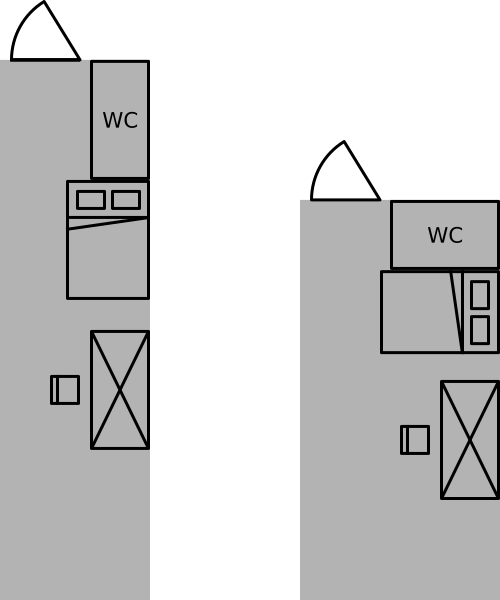
The elongated floor plan turns the studio’s left side into a kind of corridor, and the longer the unit, the more space is wasted on said corridor. The version on the right can fit a mini-fridge doubling as a bedside table next to the bed; the version on the left can too but a foot-side table is less convenient (this is how my grad school dorm room was set up due to lack of alternatives). Both apartments can set up a stove and kitchen sink; the natural location is below the table (to the right from the perspective of someone sitting in the chair). But the version on the left can only do so by eating into free space to move around in, where the version on the right doesn’t.
This is a matter of length-width ratios and the long corridor forcing the door to be on the short side. This is why high-end apartments can maintain the depth on the left without a problem – a middle-class one-person apartment is 40-50 m^2, so around double the micro-unit depicted above. A building designed around such studios would have the floor plate of the wingless 20 m euroblock but with half as many apartments, and then there’s ample room for everything with enough left to move around. Such a larger unit can even be set up as a one-bedroom, with the bedroom taking half the window frontage.
Note also that this problem of elongated microapartments doesn’t affect bedrooms in family dwellings. A family dwelling can be set up with rooms fronting 2.5 m of window space but with doors on the long side coming in via a central living room, which means there’s no need for a long corridor for access to the bathroom and the bed.
Rapid Transit as an Amenity
An urban rapid transit system needs to be understood as both a consumption amenity and a production amenity. As a consumption amenity, it lets people have access to more of the city, for work as well as recreational travel; people pay a premium to live close to the subway. As a production amenity, it makes it easier to build dense office clusters and expect that people can get to work without too much traffic; businesses pay a premium to locate in city center. This means that such infrastructure is generally good for the city’s economy and the well-being of the people in it, without prominent distributional impact.
City center and rapid transit
I wrote a thread two years ago about CBD job concentration. The thread looks at the total number of jobs in the central 100 km^2 of a metro area, which figure is used because it’s about the land area of Paris plus La Défense and INSEE data only exists at the level of the commune or arrondissement (see for example here). Pointing out that Dallas and Atlanta’s central 100 km^2 have only about as many jobs as Vancouver’s and half as many as San Francisco’s, I talked about the need to build bigger CBDs to entice higher transit ridership.
This looks weird to people who immediately associate European cities with short buildings and polycentricity and American ones with tall buildings and monocentricity. But at the scale of 100 km^2, European cities are far more centralized. Paris has 2.2 million jobs in the central 100 km^2, the Bay Area 850,000, Dallas and Atlanta 400,000 each.
And as I threaded about this, it was pointed out to me that Dallas does not have very strong demand for office space in city center. Parisian commercial rents in the 8th are very high, indicating demand for taller buildings than Europeans find acceptable; Texan commercial rents in city centers indicate no such pent-up demand, and the Dallas CBD has high vacancy rates. In Los Angeles, the center is weak as well – in a metro region 50% larger than Paris, the most gerrymandered central blob, not at all centered on Downtown Los Angeles but rather reaching from Downtown to Century City and UCLA, has around 800,000 jobs. The highest pent-up demand in Downtown LA is residential and not commercial.
I bring this up because this indicates rapid transit is a strong amenity for producers: they pay a premium to locate in city center, provided a large system exists to feed commuters to their offices. This is the case in New York, Paris, and other transit cities, but notably not in large auto-oriented cities like Los Angeles and Dallas.
…but it’s not just about work
Transit cities are not just places of production. The city is simultaneously a production amenity and a consumption amenity. Pure production amenities, like the quality of the harbor, the location relative to logistics facilities, and the tax rate on businesses, do not draw in people except insofar as they lead to higher wages. But transit cities do draw people in – residential rents are higher where job access is better and even where general access to non-work destinations is better.
This effect happens at several levels. The highest level is the regional one: a transit city is less polluted than an auto-oriented alternative of the same size, and clean air is a consumption amenity. The lowest level is the block: the construction of rapid transit raises property values near stations. In between, there are the benefits of access, which like the regionwide benefits are diffuse; it’s hard to point out an exact set of winners and losers.
This is not just a matter of job access. A transit city is good at access to special amenities, of the type that people do not go to very regularly. Ones that people do go to regularly do not require public transit: an auto-oriented medium-size metropolitan region can perfectly well provide high-quality retail choices with plenty of variety. I don’t recall missing anything at the shopping centers of the French Riviera, nor hearing complaints about same from Americans in similar-size regions.
But once the options get more specialized, size and transit accessibility become important. Los Angeles notably has amazing restaurants from just about every ethnic and regional tradition on the planet and also it takes two hours to drive to them because they’re strewn about five counties with no fast transit options. It’s nothing like New York and Paris, which have plentiful options as well but they’re within 30-60 minutes by train.
Specialized restaurants are a convenient example – they won’t cluster in city center because that’s expensive, but they’d like to be in near-center areas, perhaps in the central 100 or 200 or 500 km^2 but not the central 5 or 10 km^2. But the same issue occurs for everything else: museums, visits to friends throughout the region, etc.
The implication of dual amenities
Rapid transit is annoying to analyze in that it doesn’t break down neatly as for one group or another. It’s incredibly diffuse, and the only definitive interest group that benefits from its existence more than anyone else, the providers, is small and doesn’t always benefit from making it more efficient. There are no distributional impacts to mitigate or take advantage of; the environmental impacts are uniformly positive because of the competition with cars and auto-oriented development; the local benefits of access are real but require building an expansive system with hundreds of stations each generating local benefits in a small radius.
The result is that it bores people who enjoy conflict. There is not much there for the marketer to bite on – transit as a product is optimized when everyone uses it. The upshot of the fact that rapid transit is simultaneously a production amenity and a consumption amenity is that there is nothing there for people who enjoy dwelling on class conflict or on postmaterialist New Left notions of conflict, either. Socialist states have built great transit systems once things have settled down and it’s time to rebuild, but would-be socialist revolutionaries in non-socialist states find it boring. Likewise, New Left green politics is much more interested in pure consumption amenities like bike paths and street redesign than in dual amenities like rapid transit, which also benefits the staid corporations green voters define themselves against. From the other direction, people whose political identity is indifference to the needs of anyone who’s not a business don’t find transit interesting, even though it clearly benefits business, because it doesn’t offer opportunity to engage in right-populist or Thatcherite politicking: it’s possible to run the system like a business, but actually kicking out visibly poor people fragments the market and reduces frequency.
I Voted, but There’s no YIMBY Politics in Germany
It’s the first time in my life I’m eligible to vote in a national election. I thought it would be faster than it was; the line took 1:10, of which the first 10 minutes were taken standing in the wrong line – there were two precincts at the same physical location. It felt weird, feeling out of place and yet knowing, approximately for the first time in my life (unless one counts the European Parliament election), that I had a right to be there no matter what.
I voted Green, up and down the ballot, which is a vote for prioritizing public transportation over cars and climate protection over coal jobs and cheap Russian natural gas, but is not a YIMBY vote. And there’s the rub: a YIMBY political party does not exist here, and neither does even a YIMBY movement.
YIMBY is not exactly a movement about more development. It’s specifically about development in the most in-demand urban areas, through infill. It’s about aggressive transit-oriented development; when YIMBYs cite a success case, it’s the TOD of Tokyo and Seoul, and to a lesser extent what’s happening in Stockholm (where the term YIMBY originates) and the Paris suburbs, and not the equally fast but exclusively suburban and auto-oriented development in the Austin area.
And this does not exist here. SPD supports building housing in Tempelhofer Feld; the Greens are against it, treating it as common parkland, where in reality the treeless field makes a poor park and is adjacent to actual wooded parks in Kreuzberg and Neukölln. So in that sense SPD is the YIMBYer party – but SPD also built a freeway cutting through Neukölln last decade, going into coalition with CDU rather than with the Greens in order to build it. The Greens, in contrast, oppose freeways and support bike lanes and road diets – but they oppose new housing, want to downscope a proposed high-rise building in Alexanderplatz, and prefer bike lanes and city center tram expansion to extending the U- and S-Bahn.
And there’s the rub. The central tenet of YIMBYism is that cities are predominantly loci of production, and people choose where to move based on work more than anything else; building more housing is the central policy proposal, in recognition that economic production is done predominantly in city centers. And this does not exist, because every political faction that wants to build more housing pairs this with more roads and more peripheral locations for new development. The idea that post-car cities represent growth rather than stagnation does not exist in German politics, at least not yet. People still think of cars as the industrial future, rather than as what people thought the future would be 70 years ago, about as relevant to the world of tomorrow as what people thought of agriculture in the 19th century was in the middle of the 20th. The Greens just want to slow that industrial future down instead of building the information future – and nobody in German politics wants to build that future, the right preferring more cars and more gas.
I suspect there’s room for such YIMBY politics in Germany, cobbled together from the most left-wing fringes of FDP, the younger and less NIMBY Greens, and sundry SPD members. Already, most Green voters in Berlin support Tempelhof redevelopment, albeit at much narrower margins than SPD, FDP, and CDU voters. At the climate march two years ago, I saw a single anti-nuclear sign carried by two older people; new nuclear is out of the question here due to costs, but it matters that younger Greens aren’t animated by Green boomers’ anti-nuclear activism. There was a bigger sign carried by a few people opposing urban development, but it was one sign, not the thousands of generic signs about climate change and many hundreds opposing coal power, oil, and cars. Up the Elbe, younger G/EFA parties like the Czech Pirates are pro-digital.
I Gave a Talk About Canadian Construction Costs
There was a conference I got invited to, consisting of three talks, two about state capacity by me and by Tyler Cowen, and one by a Canadian extramural Conservative politician named Ginny Roth (she’s a columnist but her talk was about how Conservatives could use the insights of state capacity to win elections, hence my appellation). It was run by entrepreneurs named Chris and Matt Spoke, doing a series of online meetings trying to introduce fresh ideas to what they hope will be the next crop of Tory leaders; there’s going to be one on housing in the future, and the YIMBY comments I made seemed popular with the crowd.
Here is a link to my slides. They shouldn’t be too surprising given my usual talk on construction costs and what I said before about the growth in Canadian costs. But I made sure to put the increase in costs in Canada all together in two slides, one about Toronto, sourced to Stephen Wickens, and one about the rest of Canada, sourced to both our database and to a comparison of Calgary’s costs through the 2000s with Calgary’s West LRT costs.
The organizers are in Toronto, so I didn’t talk too much about the situation in Vancouver. I said a few sentences about how I can see there was a real increase in costs from a difference between the half-elevated Canada Line and the 87% underground Broadway subway under construction, but I didn’t go into the history of the Canada Line’s cut-and-cover method or the cost estimates from the early 2010s, which had the Broadway subway costing C$250 million/km. I talked more about Toronto, where the increase in costs is larger; Vancouver, even with the cost increases, remains North America’s lowest-construction-cost city, since the other cities have had even bigger increases, including Toronto, Los Angeles, and Seattle.
I want to highlight, as I brought up 1.5 years ago, that while Canada has American (i.e. bad) mainline rail, and Americanizing construction costs, it is YIMBYer than both the US and Europe. I worry it won’t last for long, because the style of Canadian redevelopment is at fairly small radius from an arterial or a subway station and those will eventually run out, forcing upzoning of large swaths of single-family land for the benefit of everyone except the handful of aggrieved homeowners who dominate municipal politics. (There was not enough time to talk about the importance of high-level decisionmaking, that is at the provincial level and not the municipal one.)
How to Get Rich Off Low Construction Costs
A country or region that is good at manufacturing cars can export them globally and earn hard cash. But what about public transportation? How can a city that has the ability to build good, low-cost public transport get rich off of it? There is an answer, but it is more complicated than “export this,” mirroring the fact that public transport itself is a more complex system to run than cars. This in turn relates to housing growth rates and urban economies of scale, making this the most useful in a large city with high housing production rates, of which the best example is Seoul. The good news is that the world’s largest and richest cities could gain tremendously if they had better public transport as well as high housing growth rates.
Infrastructure is not exportable
I wrote more than two years ago about the difference between dirty and clean infrastructure. Cars, car parts, and oil are exportable, so the majority of the cost of cars as a system are exportable, making dedicated regions like Bavaria, Texas, and the Gulf states rich. Green tech is not like that – the bulk of the cost is local labor. A large majority of the operating costs of a subway system are local wages and benefits; in New York, depreciation on rolling stock is less than 10% of overall operating costs. Construction costs are likewise almost entirely local labor and management, which is why they are determined by where the project takes place, rather than by which engineering firm builds the project.
The upshot is that Madrid and other low-cost cities can’t just get rich by building other cities’ infrastructure for them. They can’t build turnkey systems for New York and London at Spanish prices – the problems with New York and London come from local standards, management, and regulations, and while a Spanish engineering firm could give valuable advice on what high-cost cities need to change, it’s not going to reap more than a fraction of the construction cost saving in consulting fees.
Good transit as an amenity
What a city can do with low-cost construction is build a large subway network like Madrid, and use that as infrastructure to help local economic production. This works as both a consumption amenity and a production amenity. As a consumption amenity, it enables people to commute without needing to own a car, which reduces living costs and lets employers get away with paying less in nominal terms; this is a bigger influence on local firms, because international ones tend to use cost of living adjustments that make profligate lifestyle assumptions and factor in car costs even in cities where car ownership is low, like Singapore or New York.
As a production amenity, public transit also enables work concentration in city centers. This is separate from the observation that it allows workers to commute more cheaply – if a large city produces in a concentrated center, then without rapid transit, workers can’t get in at all. About 23% of people entering the Manhattan core on a weekday do so by car per the Hub Bound Report, but at the peak hour, 8-9 am, this falls to 9%, because the road capacity is capped around 55,000 cars an hour and a maximum number of parking spots for them. Auto-centric cities of New York’s approximate size exist, not by building massive road capacity to support comparable city centers, but by not having strong city centers to begin with. Los Angeles has maybe 400,000 people in the widest definition of its central business district, where in the same area New York has more than 2 million – and Los Angeles’s secondary centers, like Century City, top in the mid-5 figures before they get completely choked with traffic.
So what a city can do with cheap infrastructure is build a large subway network and support a large high-rise central business district and then use that to produce more efficiently. This is possible, but more complex than just exporting cars or oil, because to export cars one just needs to be good at making cars, and to export oil one just needs to have oil underground, whereas to produce out of public transit one also needs a solid economy in other sectors that can make use of the better infrastructure. I suspect that this is why Southern Europe keeps not growing economically despite building high-quality public transport – the Madrid Metro is great but there isn’t enough of a private economy to make use of it.
The connection with development
To maximize the use of a subway for its economy, a city needs to make sure development can follow it. This means that city center needs high job density, which includes high-rise office towers at the busiest intersections, and many mid-rise office buildings in a radius of a few kilometers. Neither the typical European pattern in which there are few skyscrapers nor the American pattern in which there are skyscrapers for a few blocks and then the rest of the city is subject to strict residential zoning is ideal for this. It’s better to have a city whose central few square kilometers look like Midtown and whose surrounding few tens of square kilometers look like Paris, with the occasional secondary cluster of skyscrapers at high-demand nodes; let’s call this city “Tokyo.”
Residential development has to keep up as well. A city region that has a strong private economy but doesn’t build enough housing for it will end up with capped production. Normally it’s the lowest-end jobs that get exported. However, two problems make it more than a marginal reduction in production. First, expensive cities have political pressure to allocate apartments by non-market processes like rent control, keeping less productive but politically favored people; a large gap between market rent and construction costs creates plenty of surplus to extract, and a mass exodus of firms from cities like San Francisco in such a situation starts from thee least profitable ones, and by the time it affects the most profitable on, the system is entrenched. And second, breaking a firm’s chain between high-end headquarters jobs in a rich city center and lower-end subsidiary jobs elsewhere reduces firmwide productivity, since many connections have to be remote; Google has problems with all-remote teams and tries to center teams in the Bay Area when it gets too unwieldy.
For one example of a city that does everything right, look at Seoul. It has low construction costs, around $150 million per kilometer for urban subways. Thanks to its low costs and huge size, it keeps building up its system even though it already has one of the largest systems in the world, probably third in ridership after Tokyo and Osaka when one includes all commuter lines. It also has high density, high-rise CBDs, and fast housing construction; in 2019 the Seoul region built around 10 units per 1,000 people, representing a decline since the mid-2010s, and the state has plans to accelerate construction, especially in the city, to curb rising prices. This is till a better situation than the weak economy and flagging construction in much of Europe, or the NIMBY growth rates of both much of the rest of Europe and the richest American cities.
Is Remote Work Viable?
No, not in the long run.
This has big implications for cities in the future, because it means firms will want to cluster more near production amenities – that is, other high-productivity firms. A city like New York manifestly has very weak consumption amenities, because in the spring it proved that its government is dangerously incompetent in a crisis – but its production amenities are likely to grow, because more firms will want to locate there and in other big, rich cities.
Remote work and the tech industry
The tech industry has long been familiar with remote work. The big multinationals have offices worldwide and some teams are remote, and some small firms are even all-remote. Much of this is an adaptation to the industry’s inability to bring everyone to San Francisco and Silicon Valley, where housing is too expensive and work visas are scarce. This has led to a big internal debate about the future of work; for decades now there have been predictions that the Internet would facilitate remote work and therefore reduce the need for cities to exist as office work centers.
The industry also reacted to corona slightly faster than the rest of the Western world. I’m not sure why – usually the American tech industry sneers at anything that comes out of Asia. But for whatever reason, Google sent its workers home in early March, and has been on work-from-home since, as have the other tech employers.
However, this was always intended to be a temporary arrangement. Workers were told to go back to the office when the crisis ended, at a date that keeps being pushed back and is now September 2021. Moreover, it appears that the industry wants to consolidate rather than disperse: Google, Amazon, Facebook, and Apple are all buying up office space in Manhattan, planning to add 22,000 jobs there. This is not San Francisco, but it’s the closest thing: New York is the United States’ second richest metropolitan region, and (I believe) the second biggest tech job center, with New York hosting the largest non-Bay Area Google office.
The problems with remote work
I have asked a number of people to talk to me about their experience with working from home. All are American professionals; this is far and away the easiest socioeconomic class to do an ethnography of. At no point did anyone ever tell me that everyone in their office is as productive working from home as they had been working as a team at the office. The work from home productivity loss is real; it does not affect everyone, but it affects enough people to be noticeable.
Specific problems I was told include,
- Corona specifically is a very stressful event, so everyone is on edge and less productive than the usual.
- Without continuous office work, it’s harder to onboard junior workers, even when senior workers are fine at home. Junior workers also lose the benefits of close mentoring.
- Parents with children have to take on additional care duties, and without a stay-at-home parent this is difficult.
- I believe in one case I was told the opposite of the above – that given that children are at home, it’s easier for parents than for non-parents.
- At least per the CEO of United, who is obviously biased on this, firms perceive in-person sales to be more successful than virtual ones. In general, I’ve been told that work facing clients is less productive when it’s virtual and law firms can work remotely in the short run with their existing client base but in the long run they need the office.
The standard production theory, articulated for example by Alain Bertaud, is that working from home is less productive because there are no spontaneous interactions, and this seems true although I don’t recall anyone telling me this exact thing literally, but very similar problems are apparent.
What does this mean for cities?
Before corona, it was not always clear whether advances in telecommunications would make remote work viable. It increasingly looks like the answer is no, and therefore the most productive firms are likely to center around their usual clusters, just as the tech firms are buying up Manhattan office space. The upshot, then, is that high-cost, high-productivity city centers are likely to see more commercial demand in the medium and long runs.
One model that I’ve heard from multiple sources is mixed, for example 2-4 days a week at the office, 1-3 days remote. If this happens, then it will mean that people commute fewer days. This has opposite effects on office and residential geography: fewer commutes mean it’s more acceptable to live farther out and have longer work trips on work-at-office days, which encourages either suburbanization or hopping over to the next city over; for the exact same reason, it’s also more acceptable to site offices in areas with more traffic congestion, that is city center.
What does this mean for public transportation?
More urban job concentration universally requires better public transportation, since rapid transit is far and away the most efficient mode of transportation measured in capacity provided per unit of right-of-way width. However, the details are subtle. Most importantly, the American upper middle class mostly does not work 9 to 5 at the most productive firms. The tech industry tends toward shifted hours, especially on the East Coast in order to overlap Silicon Valley better, and even for the same reason in Israel. So the impact of more tech employment in Midtown is not that New York desperately needs more subway capacity, but rather that it needs to broaden the peak to last until 10 in the morning rather than 9. This conclusion does not depend much on whether workers show up at the office every day or only 3-4 days a week, because 60-80% of rush hour traffic still requires peak or near-peak train throughput.
There were many Americans who, back when corona seemed to be first and foremost a New York problem, predicted the end of cities, or the conversion of cities to spaces of consumption. Joel Kotkin even blamed New York’s density for corona and praised Los Angeles’s sprawl; now that Los Angeles is running out of hospital beds, nobody in the US blames density anymore. (One could also point out Seoul and Tokyo’s density, but not even 460,000 deaths and counting will make Americans say “our country needs to be more like other countries.”)
But this is not looking to happen. The most productive firms in the US are urbanizing – and those are the most productive firms in the world; it averages out with horrific American public-sector inefficiency to about the same GDP per hour as in Germany. And this means that going forward, the richest, most productive, and most expensive cities will remain spaces of high-end production, and will need to build sufficient numbers of office towers and residences and improve public transportation infrastructure to accommodate.
Quick Note: Consumption and Production Theories of Berlin
I’ve periodically written about consumption and production theories of cities – that is, whether people mostly move to cities based on consumption or production amenities. The production theory is that what matters is mostly production amenities, that is, jobs, and this underlies YIMBYism. Consumption theory is that people move for consumption amenities, and, moreover, these amenities are not exactly consumption in the city, for example good health outcomes, but consuming the city itself, that is neighborhood-level amenities in which who lives in the city matters. The latter theory, for example promulgated by Richard Florida, is that jobs follow consumption amenities like gay bars, and not the other way around. It is wrong and production theory is right, and I’d like to give some personal examples from Berlin, because I feel like Berliners all believe in consumption theory.
The situation in Berlin
Berlin is an increasingly desirable city. After decades in which it was economically behind, the city is growing. Unemployment, which stood at 19% in 2005, was down to 7.8% last year. With higher incomes come higher rents, and because Berlin for years built little housing as there was little demand, rents rose, and it took time for housing growth to catch up; on the eve of corona, the city was permitting about 6 annual dwellings per 1,000 people, up from about 1 in the early 2000s.
This is generally attributed to tech industry growth. There are a lot of tech startups in the city. I don’t want to exaggerate this too much – Google’s biggest Germany office is by far Munich’s, and the Berlin office is mostly a sales office with a handful of engineers who are here because of a two-body problem. But the smaller firms are here and the accelerator spaces are very visible, in a way that simply didn’t exist in Paris, or even in Stockholm.
Berlin’s production amenities
I might not have thought that Berlin should attract so much tech investment. My vulgar guess would be that tech would go to cities with many preexisting engineers, like Munich and Stuttgart, or maybe to Frankfurt for the international flight connections. But Berlin does make sense in a number of ways.
English
The city is mostly fluent in English. Jakub Marian’s map has France 39% Anglophone and Germany 56%, which doesn’t seem too outlandish to me. But Paris seems in line with the rest of France, whereas in Berlin, service workers seem mostly Anglophone, which is not the case in (say) Mainz or Munich.
The global tech industry is Anglophone, and good command of English is a huge production amenity. Other English-dependent industries seem to favor Anglophone European cities as well, for example various firms fleeing Brexit moved their European headquarters not to Paris but to Amsterdam or maybe Dublin.
The capital
The federal government is here. This is not relevant to tech – the startups here don’t seem to be looking for lobbying opportunities, and at any case German lobbying works differently from American lobbying and firm-level proximity to the capital is unimportant. However, the government stimulates local spending, which has increased employment. The government’s move here has been gradual, with institutions that during division were spread all over West Germany slowly migrating to Berlin.
Good infrastructure
The quality of infrastructure in Berlin is very good. The urban rail network was built when Berlin was Western Europe’s third largest city, after London and Paris, and has even grown after the war because the West built U7 and U9 to bypass Mitte. This means that commute pain here is not serious, especially on any even vaguely middle-class income. Moreover, Berlin has benefited from post-reunification investment, including Hauptbahnhof and two high-speed rail lines.
Consumption theory and the counterculture
The queer counterculture that I am involved with in Berlin tells a different story. To hear them tell it, Berlin has a quirky, individualistic, nonconforming culture, unlike the stifling normality of Munich. Artists moved here, and then other people moved here to be near the artists, paying higher rents until the artists could no longer afford the city. This story is told at every scale, from Berlin as a city to individual neighborhoods like Prenzlauer Berg and Neukölln. A lot of the discourse about Berlin repeats this uncritically, for example Feargus O’Sullivan at CityLab/Bloomberg Cities writes about the cool factor and about gentrification of old buildings.
It is also a completely wrong story. This is really important to understand: nobody that I know in the sort of spaces that are being blamed for gentrification, that is the tech industry and its penumbra, has any interest in the counterculture. I go to board games meetups full of tech workers who are fluent in English and often don’t know any German, and they have no connections at all to the local counterculture. They interact with immigrant culture spaces, not with the 95%+ white counterculture as defined by queer spaces in Neukölln that complain about gentrification in a neighborhood undergoing white flight at the rate of postwar New York (compare 2019 data, PDF-pp. 25 and 28, with 2016, PDF-pp. 28 and 31). Occasionally there are crossovers, as when an American comedian hosted live standup in February and then there were tech workers and said American also interacts with the counterculture, but a standup comic is not why Berliners complain.
Nor do I find foreign tech workers especially interested in German minutiae comparing Berlin with Munich. By my non-German standards, Berliners already jaywalk at indescribably lower rates, and I gather that Munich is stuffier but that’s not why I’m here and not there, the rents and the language are.
We’re not even particularly oppositional to the counterculture. I personally am because seeing queer space after queer space host indoor events during corona without masks was a horrifying experience; I went to a queer leftist meetup in late October in which people huddled together maskless and I was the only one with a mask on, except for one trans Australian physicist who drank a beer and then masked after finished. But the rest? They don’t care, nor should they. The counterculture is not the protagonist or the antagonist of Berlin’s story; it’s barely a bystander. Consumption theory is just what it promotes in order to convince itself that it’s important, that it spreads ideas and not viruses.
Job Sprawl as Deurbanization
A few years ago, Aaron Renn was writing, I think about the General Electric headquarters’ move from suburban New York to Downtown Boston in 2016, that in the future, city center jobs would go to high-value industries like corporate HQs and professional services, and then lower-end stuff like call centers would go in suburban office parks. At the time I didn’t understand the full meaning of this – I was still thinking of employment in a narrow city center of a few blocks rather than a broader region, like the 100 km^2 zone I use to compare the US with Canada and France because that’s the most granular data I have in the latter two countries. But in retrospect, Aaron was getting at a dangerous trend in which job markets deurbanize. This is not a new trend – office park sprawl goes back to the 1970s, and industrial sprawl even earlier – and to some extent it’s less about deurbanization and more about the urban job market reaching maximum size. But whatever the history of it, it’s a serious threat to economic performance – and the solution to it requires better public transportation.
Cities as job markets
I’ve written before about production theory. The only thing I have to add on the theory side is that since I wrote that post, I was at a talk that Alain Bertaud gave at Marron, about urbanization. The main topic of the talk was about urban growth and sprawl in the developing world, but at the beginning of the presentation, he gave some remarks about cities and corona. Zoom meetings like the one we had, he warned, were fine, but cities are fundamentally job markets that succeed through spontaneous interaction, and this spontaneity does not exist with remote work. This is to a large extent the new urban geography thesis of Paul Krugman or the work of Ed Glaeser – cities exist as places of production first, and this production requires close proximity.
Now, close proximity depends on technology. In a city with the transport technology of London circa 1800, close proximity means the scope of the City of London, and even 5 km is uncomfortably far. In a city with cars and highways, the distance is much greater – but it is not the same as commute distance. A half-hour drive is not spontaneous. When I asked American friends and coworkers about their productivity through the spring corona lockdowns, a Boston lawyer told me that lawyers wouldn’t even travel midday for clients for 20-30 minutes, since their time was too valuable – they’d schedule conference calls.
This does not mean that the entire work market has to be within such a short distance. It certainly helps, but different industries can cluster in different parts of the city. But there is a maximum distance within which the city is recognizably a single job market.
Aaron Renn’s bifurcation
Aaron talks about bifurcation a lot, between winners and losers. He relates the move of large corporate HQs to city centers to this bifurcation: city centers win by having higher-value added, higher-paying jobs, everyone else gets saddled with lower-end jobs. Moreover, these lower-end jobs are commodities – a call center can be anywhere – and therefore they compete on price and not quality, frustrating the attempt of any region on the margins of the US to climb up the value chain.
That said, even the sort of job sprawl of the 1970s, spearheaded by big companies’ move out of city centers to rich suburbs like GE to Fairfield and IBM to Armonk, represents the same threat to urban productivity. That was driven by snobbishness – the elite suburbanized, and then dragged jobs outside the city with it, for example GE did partly on spurious grounds of resilience in face of nuclear war destroying city centers. Today, the city gains higher-end jobs at the expense of the suburbs, the opposite of the situation in the 1970s. But the same situation of jobs outside one major core persists.
Is this polycentricity?
No. It’s become fashionable to speak of polycentric cities as the next evolution, to decongest old cores. But doing so requires the urban geography to have centers. I pointed out previously that Los Angeles may claim to be polycentric but is just weak-centered – the secondary centers have a few tens of thousands of jobs each at most. This is not like the big city centers one finds in Kyoto, Osaka, and Kobe, or even in the Rhine-Ruhr or Randstad.
Keihanshin, the Rhine-Ruhr, and Randstad are all agglomerations of historic cities. It is possible to also form polycentric regions out of new development – for example, Yokohama was founded as a 19th-century treaty port and then grew as a Tokyo suburb. Both New York and Paris have moved their central business districts by a few kilometers gradually, New York from Lower Manhattan to Midtown and Paris from Les Halles to around the Opera; both also have near-center business centers, like Long Island City or La Défense. Even then there’s likely to be some efficiency loss in decentralizing city center jobs this way, but it’s still easier to shuttle between Times Square and World Trade Center than between either and New Brunswick.
The public transit solution
In the 1970s, the abandonment of city centers was motivated by a desire to escape their poverty and a belief that the suburbs were the future. Urban poverty still exists but inner-urban wealth is considerable and increasing, and the belief that the suburbs were the future turned out to be incorrect – one cannot be a suburb of nowhere.
The model of suburbanization that can be sustained is one built from the late 19th century to about the 1950s and early 60s: jobs stay in the city, people go wherever.
Doing so requires three things: offices, dwellings, and a way of getting between them.
Offices mean commercial upzoning – some American cities are good about it, but the ones with the most demand, like New York, aren’t. In general there’s little appetite for commercializing near-center neighborhoods in the US, whereas Europe is looser about it and therefore new firms can sprout a few subway stops outside the primary center, for example Spotify two stops outside T-Centralen. Residences likewise require upzoning, especially for mid- and high-rise apartment buildings near subway stations where they exist and have capacity.
But in many cases, it’s required to also build up public transportation. Big central business districts feature hundreds of thousands of people converging on a small area at the peak, and the biggest go up into the millions. The highest-capacity form of transportation is required, which is rapid transit, never cars or surface transit.
Rapid transit and city centers are symbiotic, now as in 1910. An expansive rapid transit system, with high service quality, is required to serve city centers from multiple directions; and city centers are required to give people something to take the trains to, or else they’ll just drive everywhere and only take the train to the sports stadium or the airport.
And ultimately, city centers are required for economic efficiency, because of the importance of proximity for spontaneous economic and social interactions. Rapid transit also benefits from high efficiency – it’s very cheap to operate compared with the cost of car ownership. The alternative is a kind of deurbanization, in which people may live at high density relative to travel speeds but don’t form large clusters enabling the highest productivity.

