Trucking and Grocery Prices

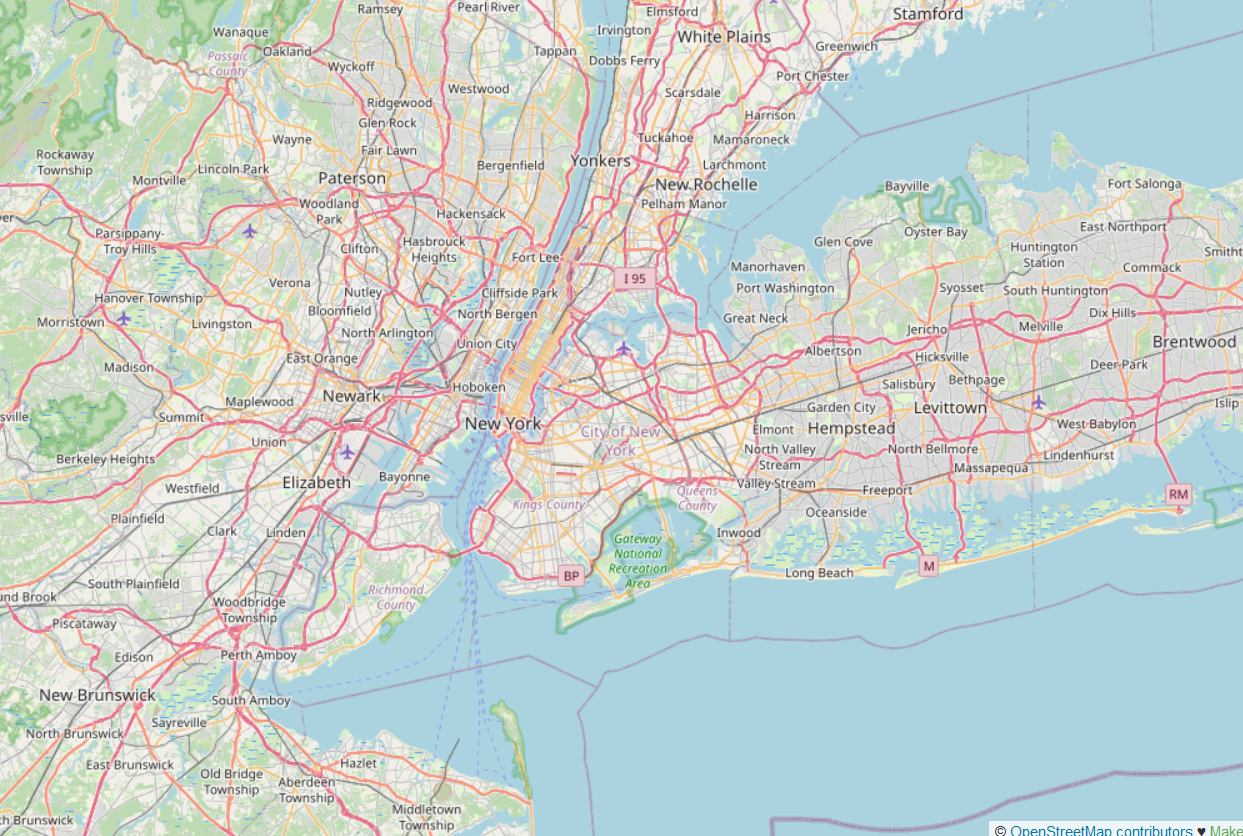
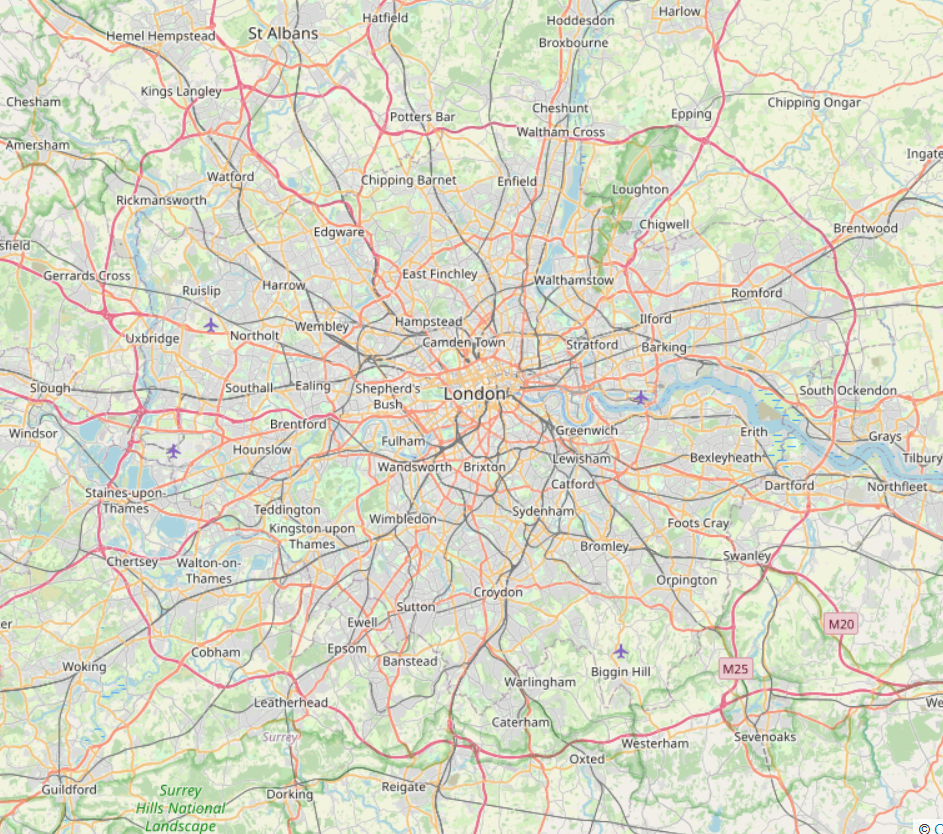
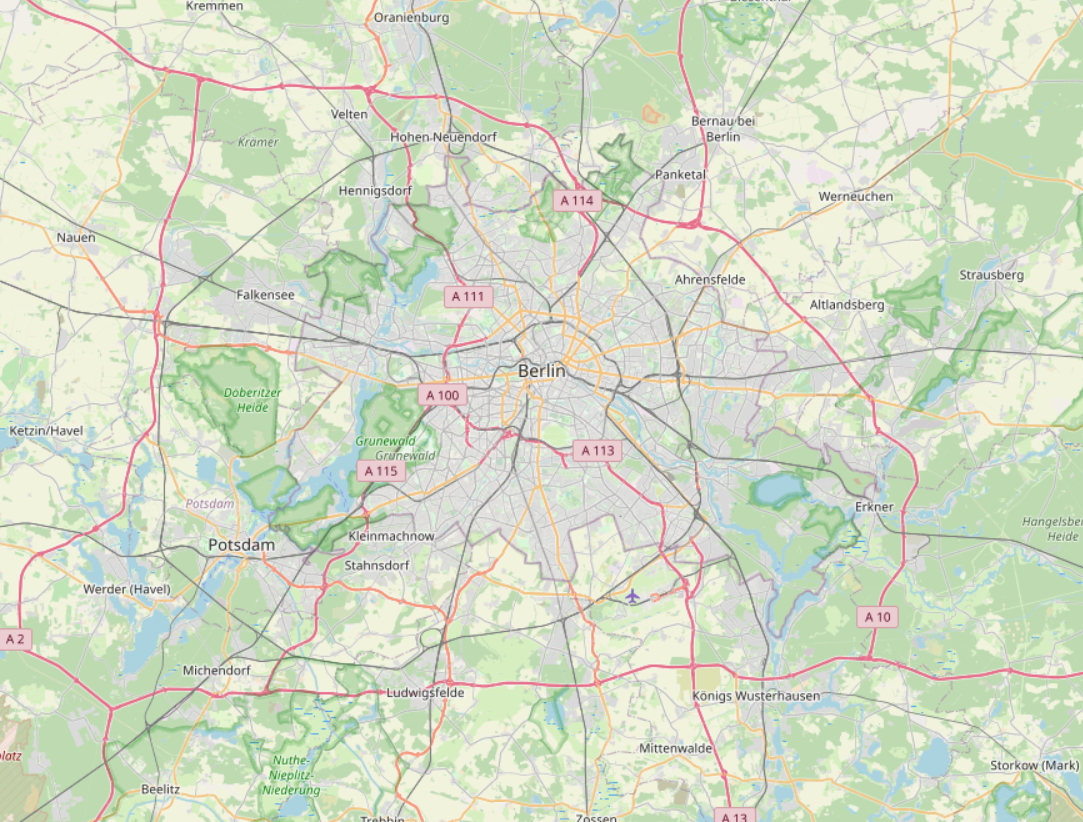
In dedication to people who argue in favor of urban motorways on the grounds that they’re necessary for truck access and cheap consumer goods, here are, at the same scale, the motorway networks of New York, London, Paris, and Berlin. While perusing these maps, note that grocery prices in New York are significantly higher than in its European counterparts. Boston is included as well, for an example of an American city with fewer inherent access issues coming from wide rivers with few bridges; grocery prices in Boston are lower than in New York but higher than in Paris and Berlin (I don’t remember how London compares).

The maps

The scale isn’t exactly the same – it’s all sampled from the same zoom level on OpenStreetMaps; New York is at 40° 45′ N and Berlin is at 52° 30′ N, so technically the Berlin map is at a 1.25 times closer zoom level than the New York map, and the others are in between. But it’s close. Motorways are in red; the Périphérique, delineating the boundary between Paris and its suburbs, is a full freeway, but is inconsistently depicted in red, since it gives right-of-way to entering over through-traffic, typical for regular roads but not of freeways, even though otherwise it is built to freeway standards.

Discussion

The Périphérique is at city limits; within it, 2.1 million people live, and 1.9 million work, representing 32% of Ile-de-France’s total as of 2020. There are no motorways within this zone; there were a few but they have been boulevardized under the mayoralty of Anne Hidalgo, and simultaneously, at-grade arterial roads have had lanes reduced to make room for bike lanes, sidewalk expansion, and pedestrian plazas. Berlin Greens love to negatively contrast the city with Paris, since Berlin is slowly expanding the A100 Autobahn counterclockwise along the Ring (in the above map, the Ring is in black; the under-construction 16th segment of A100 is from the place labeled A113 north to just short of the river), and is not narrowing boulevards to make room for bike lanes. But the A100 ring isn’t even complete, nor is there any plan to complete it; the controversial 17th segment is just a few kilometers across the river. On net, the Autobahn network here is smaller than in Ile-de-France, and looks similar in size per capita. London is even more under-freewayed – the M25 ring encloses nearly the entire city, population 8.8 million, and within it are only a handful of radial motorways, none penetrating into Central London.

The contrast with American cities is stark. New York is, by American standards, under-freewayed, legacy of early freeway revolts going back to the 1950s and the opposition to the Lower Manhattan Expressway, which would have connected the Holland Tunnel with the Manhattan and Williamsburg Bridges; see map here. There’s practically no penetration into Manhattan, just stub connections to the bridges and tunnels. But Manhattan is not 2.1 million people but 1.6 million – and we should probably subtract Washington Heights (200,000 people in CB 12) since it is crossed by a freeway or even all of Upper Manhattan (650,000 in CBs 9-12). Immediately outside Manhattan, there are ample freeways, crossing close-in neighborhoods in Brooklyn, Queens, the South Bronx, and Jersey City. The city is not automobile-friendly, but it has considerably more car and truck capacity than its European counterparts. Boston, with a less anti-freeway history than New York, has penetration all the way to Downtown Boston, with the Central Artery, now the Big Dig, having all-controlled-access through-connections to points north, west, and south.

Grocery prices

Americans who defend the status quo of urban freeways keep asking about truck access; this played a role in the debate over what to do about the Brooklyn-Queens Expressway’s Downtown Brooklyn section. Against shutting it down, some New Yorkers said, there is the issue of the heavy truck traffic, and where it would go. This then led to American triumphalism about how truck access is important for cheap groceries and other goods, to avoid urban traffic.

And that argument does not survive a trip to a New York (or other urban American) supermarket and another trip to a German or French one. German supermarkets are famously cheap, and have been entering the UK and US, where their greater efficiency in delivering goods has put pressure on local competitors. Walmart, as famously inexpensive as Aldi and Lidl (and generally unavailable in large cities), has had to lower prices to compete. Carrefour and Casino do not operate in the US or UK, and my impression of American urbanists is that they stereotype Carrefour as expensive because they associate it with their expensive French vacations, but outside cities they are French-speaking Walmarts, and even in Paris their prices, while higher, are not much higher than those of German chains in Germany and are much lower than anything available in New York.

While the UK has not given the world any discount retailer like Walmart, Carrefour, or Lidl, its own prices are distinctly lower than in the US, at least as far as the cities are concerned. UK wages are infamously lower than US wages these days, but the UK has such high interregional inequality that wages in London, where the comparison was made, are not too different from wages in New York, especially for people who are not working in tech or other high-wage fields (see national inequality numbers here). In Germany, where inequality is similar to that of the UK or a tad lower, and average wages are higher, I’ve seen Aldi advertise 20€/hour positions; the cookies and cottage cheese that I buy are 1€ per pack where a New York supermarket would charge maybe $3 for a comparable product.

Retail and freight

Retail is a labor-intensive industry. Its costs are dominated by the wages and benefits of the employees. Both the overall profit margins and the operating income per employee are low; increases in wages are visible in prices. If the delivery trucks get stuck in traffic, are charged a congestion tax, have restricted delivery hours, or otherwise have to deal with any of the consequences of urban anti-car policy, the impact on retail efficiency is low.

The connection between automobility and cheap retail is not that auto-oriented cities have an easier time providing cheap goods; Boston is rather auto-oriented by European standards and has expensive retail and the same is true of the other secondary transit cities of the United States. Rather, it’s that postwar innovations in retail efficiency have included, among other things, adapting to new mass motorization, through the invention of the hypermarket by Walmart and Carrefour. But the main innovation is not the car, but rather the idea of buying in bulk to reduce prices; Aldi achieves the same bulk buying with smaller stores, through using off-brand private labels. In the American context, Walmart and other discount retailers have with few exceptions not bothered providing urban-scale stores, because in a country with, as of 2019, a 90% car modal split and a 9% transit-and-active-transportation modal split for people not working from home, it’s more convenient to just ignore the small urban patches that have other transportation needs. In France and Germany, equally cheap discounters do go after the urban market – New York groceries are dominated by high-cost local and regional chains, Paris and Berlin ones are dominated by the same national chains that sell in periurban areas – and offer low-cost goods.

The upshot is that a city can engage in the same anti-car urban policies as Paris and not at all see this in retail prices. This is especially remarkable since Paris’s policies do not include congestion pricing – Hidalgo is of the opinion that rationing road space through prices is too neoliberal; normally, congestion pricing regimes remove cars used by commuters and marginal non-commute personal trips, whereas commercial traffic happily pays a few pounds to get there faster. Even with the sort of anti-car policies that disproportionately hurt commercial traffic more than congestion pricing, Paris has significantly cheaper retail than New York (or Boston, San Francisco, etc.).

And Berlin, for all of its urbanist cultural cringe toward Paris, needs to be classified alongside Paris and not alongside American cities. The city does not have a large motorway network, and its inner-urban neighborhoods are not fast drive-throughs. And yet in the center of the city, next to pedestrian plazas, retailers like Edeka and Kaufland charge 1€ for items that New York chains outside Manhattan sell for $2.5-4. Urban-scale retail deliveries are that unimportant to the retail industry.

Venture Capital Firms Shift to Green Infrastructure

Several Bay Area major venture capital firms announce that they will shift their portfolios toward funding physical green infrastructure, including solar and wind power generation, utility lines, hydroelectric dams, environmental remediation projects for dams, and passenger and freight rail.

One founder of a firm in the public transit industry, speaking on condition of anonymity because the deal is still in process, points out that other VC investments have not been successful in the last 10-15 years. Cryptocurrencies, NFTs, and other blockchain technologies have not succeeded in transforming the finance sector; the Metaverse flopped; AI investments in driverless cars are still a long way from deployment, while LLMs are disappointing compared with expectations of artificial general intelligence. In contrast, the founder explains, there are great opportunities for new passenger rail lines and renewable and at places nuclear power.

Another founder points out the example of Brightline West and says that with upcoming reforms in permitting, pushed by many of the same VCs, it will be profitable to complete new domestic and international intercity rail lines between cities; a $15 billion investment in connecting Chicago, Detroit, and Cleveland is underway.

On Sand Hill Roads, VC attitudes to the new investment are jubilant. One VC admits to never having heard much about public transit, but, after a three-day factfinding mission can tell you everything you could possibly want to know about the Singapore MRT. Other VCs say that Peter Thiel and Mark Zuckerberg are both especially interested in funding public transit initiatives after Elon Musk retweeted the X account TruthSeeker1488 saying that public transit is a conspiracy by international finance communists.

Local and Intercity Rail are Complements

An argument in my comments section is reminding me of a discussion by American transit advocates 15 years ago, I think by The Overhead Wire, about the tension between funding local transit and high-speed rail. I forget who it was – probably Jeff Wood himself – pointing out that the argument in 2008-9 about whether the priority was local transit or intercity rail didn’t make much sense. There are separate questions of how to allocate funding for intercity transportation and how to do the same for local transportation, and in both cases the same group of activists can push for a more favorable rail : car funding ratio. Jeff was talking about this in the sense of political activism; the purpose of this post is to explain the same concept from the point of view of public transportation connectivity and network effects. This is not an obvious observation, judging by how many people argue to the contrary – years ago I had a debate with Noah Smith about this, in which he said the US shouldn’t build high-speed rail like the Shinkansen before building urban rail systems like those of Japanese cities (see my side here and here).

I’ve written about related issues before, namely, in 2022 when I recommended that countries invest against type. For example, France with its TGV-centric investment strategy should invest in connecting regional lines, whereas Germany with its hourly regional train connections should invest in completing its high-speed rail network. It’s also worthwhile to reread what I wrote about Metcalfe’s law for high-speed rail in 2020, here and here. Metcalfe’s law is an abstract rule about how the value of a network with n nodes is proportional to n^2, and Odlyzko-Tilly argue strongly that it is wrong and in fact the value is n\log n; my post just looks at specific high-speed rail connections rather than trying to abstract it out, but the point is that in the presence of an initial network, even weaker-looking extensions can be worth it because of the connections to more nodes. Finally, this builds on what I said five days ago about subway-intercity rail connections.

The combined point is that whenever two forms of local, regional, or intercity public transportation connect, investments in one strengthen the case for investments in the other.

In some edge cases, those investments can even be the same thing. I’ve been arguing for maybe 12 years that MBTA electrification complements Northeast Corridor high-speed rail investment, because running fast electric multiple units (EMUs) on the Providence Line and its branches instead of slow diesel locomotive-hauled trains means intercity trains wouldn’t get stuck behind commuter trains. Similarly, I blogged five years ago, and have been doing much more serious analysis recently with Devin Wilkins, that coordinating commuter rail and intercity rail schedules on the New Haven Line would produce very large speed gains, on the order of 40-45 minutes, for both intercity and commuter trains.

But those are edge cases, borne of exceptionally poor management and operations by Amtrak and the commuter railroads in the Northeast. Usually, investments clearly are mostly about one thing and not another – building a subway line is not an intercity rail project, and building greenfield high-speed rail is not a local or regional rail project.

And yet, they remain complements. The time savings that better operations and maintenance can produce on the New Haven Line are also present on other commuter lines in New York, for example on the LIRR (see also here, here, and here); they don’t speed up intercity trains, but do mean that people originating in the suburbs have much faster effective trips to where they’d take intercity rail. The same is true for physical investments in concrete: the North-South Rail Link in Boston and a Penn Station-Grand Central connection in New York both make it easier for passengers to connect to intercity trains, in addition to benefits for local and regional travel, and conversely, fast intercity trains strengthen the case for these two projects since they’d connect passengers to better intercity service.

Concretely, let’s take two New York-area commuter lines, of which one will definitely never have to interface with intercity rail and one probably will not either. The definitely line is the Morristown Line: right now it enters New York via the same North River Tunnels as all other trains from points west, intercity or regional, but the plan for the Gateway Tunnel is to segregate service so that the Morris and Essex Lines use the new tunnel and the Northeast Corridor intercity and commuter trains use the old tunnel, and so in the future they are not planned to interact. The probably line is the LIRR Main Line, which currently doesn’t interface with intercity trains as I explain in my post about the LIRR and Northeast Corridor, and which should keep not interfacing, but there are Amtrak plans to send a few daily intercities onto it.

Currently, the trip time from Morristown to New York is around 1:09 off-peak, with some peak-only express trains doing it in 1:01. With better operations and maintenance, it should take 0:47. The upshot is that passengers traveling from Morristown to Boston today have to do the trip in 1:09 plus 3:42-3:49 (Acela) or 4:15-4:35 (Regional). The commuter rail improvements, which other than Gateway and about one unfunded tie-in do not involve significant investment in concrete, turn the 4:51 plus transfer time trip to 4:29 plus transfer time – say 5 hours with the transfer, since the intercities run hourly and the transfers are untimed and, given the number of different branches coming in from New Jersey, cannot be timed. High-speed rail, say doing New York-Boston in 2 hours flat (which involves an I-95 bypass from New Haven to Kingston but no other significant deviations from the right-of-way), would make it 2:47 with a transfer time capped at 10 minutes, so maximum 2:57. In effect, these two investments combine to give people from Morristown an effective 41% reduction in trip time to Boston, which increases trip generation by a factor of 2.87. Of course, far more people from Morristown are interested in traveling to New York than to Boston, but the point is that in the presence of cheap interventions to rationalize and speed up commuter rail, intercity rail looks better.

The same is true from the other direction, from the LIRR Main Line. The two busiest suburban stations in the United States are on 2000s and 10s numbers Ronkonkoma and Hicksville, each with about 10,000 weekday boardings. Ronkonkoma-Penn Station is 1:18 and Hicksville-Penn Station is 0:42 off-peak; a few peak express trains per day do the trip a few minutes faster from Ronkonkoma by skipping Hicksville, but the fastest looks like 1:15. If the schedule is rationalized, Ronkonkoma is about 0:57 from New York and Hicksville 0:31, on trains making more stops than today. I don’t have to-the-minute New York-Washington schedules with high-speed rail yet, but I suspect 1:50 plus or minus 10 minutes is about right, down from 2:53-3:01 on the Acela and 3:17-3:38 on the Regional. So the current timetable for Ronkonkoma-Washington is, with a half-hour transfer time, around 4:45 today and 2:57 in the future, which is a 38% reduction in time and a factor of 2.59 increase in the propensity to travel. From Hicksville, the corresponding reduction is from 4:09 to 2:31, a 39% reduction and a factor of 2.72 increase in trip generation. Again, Long Islanders are far more interested in traveling to Manhattan than to Washington, but a factor of 2.59-2.72 increase in trip generation is nothing to scoff at.

The issue here is that once the cheap upgrades are done, the expensive ones start making more sense – and this is true for both intercity and regional trains. The New York-Boston timetable assumes an I-95 bypass between New Haven and Kingston, saving trains around 24 minutes, at a cost of maybe $5 billion; those 24 minutes matter more when they cut the trip time from 2:24 to 2:00 than when the current trip time is about 3:45 and the capacity on the line is so limited any increase in underlying demand has to go to higher fares, not more throughput. For suburban travelers, the gains are smaller, but still, going from 5:00 to 4:36 matters less than going from 3:21 to 2:57.

Conversely, the expensive upgrades for regional trains – by which I mean multi-billion dollars tunnels, not $300 million junction grade separations like Hunter or the few tens of millions of dollars on upgrading the junction and railyard at Summit – work better in a better-operated system. Electronics before concrete, not instead of concrete – in fact, good operations (i.e. good electronics) create more demand for megaprojects.

At no point are these really in competition, not just because flashy commuter rail projects complement intercity rail through mutual feeding, but also because the benefits for non-connecting passengers are so different that different funding mechanisms make sense. The North-South Rail Link has some benefits to intercity travel, as part of the same program with high-speed rail on the Northeast Corridor, and as such, it could be studied as part of the same program, if there is enough money in the budget for it, which there is not. Conversely, it has very strong local benefits, ideal for a funding partnership between the federal government and Massachusetts; similarly, New York commuter rail improvements are ideal for a funding partnership between the federal government, New York State, New Jersey, and very occasionally Connecticut.

In contrast, intercity rail benefits people who are far away from where construction is done: extensive bypasses built in Connecticut would create a small number of jobs in Connecticut temporarily, but the bigger benefits would accrue not just to residents of the state (through better New Haven-Boston and perhaps New Haven-New York trip times) but mostly to residents of neighboring states traveling through Connecticut. This is why there’s generally more national coordination of intercity rail planning than of regional rail planning: the German federal government, too, partly funds S-Bahn projects in major German cities, but isn’t involved in planning S21 S15 or the second S-Bahn trunk in Munich, whereas it is very involved in decisions on building high-speed rail lines. The situation in France is similar – the state is involved in decisions on LGVs and on Parisian transit but not on provincial transit, though it helps fund the latter; despite the similarity in the broad outlines of the funding structure, the outcomes are different, which should mean that the differences between France and Germany do not boil down to funding mechanisms or to inherent competition between intercity rail funds and regional rail funds.

The United States Has Too Few Road Tunnels

The Francis Scott Key Bridge in Baltimore collapsed after a drifting freighter hit one of its supports; so far, six people are presumed dead. Immediately after the disaster, people were asking if it could be prevented, and it became clear that it is not possible to build a bridge anchor that can withstand the impact of a modern ship, even at low speed. However, it was then pointed out to me on Mastodon that it’s not normal in Europe to have such a bridge over a shipping channel; instead, roads go in tunnel. I started looking, and got to a place that connects my interest in construction costs with that of cross-cultural learning. Europe has far more road tunneling than the US does, thanks to the lower construction costs here; it also has better harmonization of regulations of what can go in tunnels and what cannot. The bridge collapse is a corner case of where the American system fails – it’s a once in several decades event – but it does showcase deep problems with building infrastructure.

Road tunnels

The United States has very little road tunneling for its size. This list has a lot of dead links and out of date numbers, but in the US, the FHWA has a current database in which the tunnels sum to 220 km. Germany had 150 km in 1999, and has tendered about 170 km of new tunnel since 2000 of which only 48 are still under construction. France has 238 km of road tunnel; the two longest and the 10th longest, totaling 28 km, cross the Alpine border with Italy, but even excluding those, 210 is almost as much as the US on one fifth the population. Italy of course has more tunneling, as can be expected from its topography, but France (ex-borders) and Germany are not more mountainous than the US, do not have fjords and skerries like Norway, and don’t even have rias like Chesapeake Bay and the Lower Hudson. Japan, with its mountainous island geography, has around 5,000 km of road tunnel.

The United States builds so few tunnels that it’s hard to create any large database of American road tunnels and their costs. Moreover, it has even fewer urban road tunnels, and the few it does have, like the Big Dig and more recently the Alaskan Way Viaduct replacement tunnel, have become bywords for extreme costs, creating distaste even among pro-highway urban politicians for more and leading to project cancellations. With that in mind, the State Route 99 tunnel replacing the Alaskan Way Viaduct is 3 km long and cost $2.15 billion in 2009-19, which is $2.77 billion in 2023 dollars and $920 million/km, with just four lanes, two in each direction.

In Europe, this is not at all an exhaustive database; it represents where I’ve lived and what I’ve studied, but these are all complex urban tunnels in dense environments:

  • Stockholm: the six-lane Förbifart Stockholm project to build long bypass roads in Stockholm using congestion pricing money, after acrimonious political debates over how to allocate the money between roads and public transport, comprises 17 km of tunnel (plus 4 km above-ground) including underwater segments, for an updated cost of 51.5 billion kronor in 2021 prices, or $6.97 billion in 2023 PPPs, or $410 million/km. The project is well underway and its current cost represents a large overrun over the original estimate.
  • Paris: the four-lane A86 ring road was completed in 2011 with 15.5 km of new tunnel, including 10 in a duplex tunnel, at a cost of 2.2 billion €. I’ve seen sources saying that the cost applies only to the duplex section, but the EIB claims 1.7 billion € for the duplex. Physical construction was done 2005-7; deflating from 2006 prices, this is $4.18 billion in 2023 PPPs, or $270 million/km. This is a tunnel with atypically restricted clearances – commercial vehicles are entirely banned, as are vehicles running on compressed natural gas, due to fire concerns after the Mont-Blanc Tunnel fire.
  • Berlin: the four-lane 2.4 km long Tunnel Tiergarten Spreebogen (TTS) project was dug 2002-4, for 390 million €, or $790 million in 2023 PPPs and $330 million/km. This tunnel goes under the river and under the contemporarily built Berlin Hauptbahnhof urban renewal but also under a park. The controversial A100 17th segment plan comprises 4.1 km of which 2.7 are to be in tunnel, officially for 800 million € but that estimate is out of date and a rougher but more current estimate is 1 billion €. The exchange rate value of the euro today belies how much stronger it is in PPP terms: this is $1.45 billion, or $537 million/km if we assume the above-ground section is free, somewhat less if we cost it too. The 17th segment tunnel is, I believe, to have six lanes; the under-construction 16th segment has six lanes.

Crossing shipping channels

The busiest container ports in Europe are, by far, Rotterdam, Antwerp, and Hamburg, in this order. Rotterdam and Antwerp do not, as far as I’ve been able to tell from Google Earth tourism, have any road bridge over the shipping channels. Hamburg has one, the Köhlbrandbrücke (anchored on land, not water), on the way to one of the container berths, and some movable bridges like the Kattwykbrücke on the way to other berths – and there are plans to replace this with a new crossing, by bridge, with higher clearance below, with a tunnel elsewhere on the route. The next tranche of European ports are generally coastal – Le Havre, Bremerhaven, Valencia, Algeciras, Piraeus, Constanța – so it is not surprising the shipping channels are bridge-free; but Rotterdam, Antwerp, and Hamburg, are all on rivers, crossed by tunnel.

American ports usually have bridges over shipping channels, even when they are next to the ocean, as at the Ports of Los Angeles and Long Beach. This is not universal – crossings in Hampton Roads have tunnels – but it’s the trend. Of note, the US does occasionally tunnel under deep channels (again, Hampton Roads); that the Netherlands tunnels in Rotterdam is especially remarkable given how Holland is a floodplain with very difficult tunnel construction in alluvial soil.

Hazardous material regulations

Tunnels do not permit all traffic, due to fire risk. For example, the Mont-Blanc Tunnel requires vehicles heavier than 3.5 tons to undergo a safety inspection before entering to ensure they don’t carry prohibited dangerous goods. In Europe, this is governed by the ADR; all European countries are party to it, even ones not in the EU, and so are some non-European ones. Tunnels can be classified locally between A (no restrictions) and E (most restrictive).

The United States is not party to the ADR. It has its own set of regulations for transportation of hazardous materials (hazmat), with different classifications – and those differ by state. Here are the rules in Maryland. They’re restrictive enough that significant road freight had to use the Key Bridge, because the alternative routes have tunnels that it is banned from entering. Port Authority has different rules, permitting certain hazmat through the Lincoln Tunnel with an official escort. Somehow, the rules are not uniform in the United States even though it is a country and Europe is not; Russia and Ukraine may be at war with each other, but they have the same transportation of dangerous goods regulations.

Subway-Intercity Rail Connections

Something Onux said in comments on yesterday’s post, about connecting Brooklyn to intercity rail, got me thinking more about how metro lines and intercity rail can connect better. This matters for mature cities that build little infrastructure like New York or Berlin, but also for developing-world cities with large construction programs ahead of them. For the most part, a better subway system is automatically one that can also serve the train station better – the train station is usually an important destination for urban travel and therefore, usually the same things that make for a stronger subway system also make for better subway-intercity rail connections.

Subways and commuter trains

Like gender, transit mode is a spectrum. There are extensive systems that are clearly metro and ones that are clearly commuter rail, but also things in between, like the RER A, and by this schema, the Tokyo and Seoul subways are fairly modequeer.

The scope of this post is generally pure subway systems – even the most metro-like commuter lines, like the RER A and the Berlin S-Bahn, use mainline rail rights-of-way and usually naturally come to connect with intercity train stations. Of note, RER A planning, as soon as SNCF got involved, was modified to ensure the line would connect with Gare de Lyon and Gare Saint-Lazare; previous RATP-only plans had the line serving Bastille and not Gare de Lyon, and Concorde and not Auber. So here, the first rule is that metro (and metro-like commuter rail) plans should, when possible, be modified to have the lines serve mainline train stations.

Which train stations?

A city designing a subway system should ensure to serve the train station. This involves nontrivial questions about which train stations exactly.

On the one hand, opening more train stations allows for more opportunities for metro connections. In Boston, all intercity trains serve South Station and Back Bay, with connections to the Red and Orange Lines respectively. In Berlin, north-south intercity trains call not just at Hauptbahnhof, which connects to the Stadtbahn and (since 2020) U5, but also Gesundbrunnen and Südkreuz, which connect to the northern and southern legs of the Ringbahn and to the North-South Tunnel; Gesunbrunnen also has a U8 connection. In contrast, trains into Paris only call at the main terminal, and intercity trains in New York only stop at Penn Station.

On the other hand, extra stations like Back Bay and delay trains. The questions that need to be answered when deciding whether to add stations on an intercity line are,

  • How constructible is the new station? In New York, this question rules out additional stops; some of the through-running plans involve a Penn Station-Grand Central connection to be used by intercity trains, but there are other reasons to keep it commuter rail-only (for example, it would make track-sharing on the Harlem Line even harder).
  • How fast is the line around the new station? More stations are acceptable in already slow zones (reducing the stop penalty), on lines where most trips take a long time (reducing the impact of a given stop penalty). Back Bay and Südkreuz are in slow areas; Gesundbrunnen is north of Hauptbahnhof where nearly passengers are going south of Berlin, so it’s free from the perspective of passengers’ time.
  • How valuable are the connections? This depends on factors like the ease of internal subway transfers, but mostly on which subway lines the line can connect to. Parisian train terminals should in theory get subsidiary stations because internal Métro transfers are so annoying, but there’s not much to connect to – just the M2/M6 ring, generally with no stations over the tracks.

Subway operations

In general, most things that improve subway operations in general also improve connectivity to the train station. For example, in New York, speeding up the trains would be noticeable enough to induce more ridership for all trips, including access to Penn Station; this could be done through reducing flagging restrictions (which we briefly mention at ETA), among other things. The same is true of reliability, frequency, and other common demands of transit advocates.

Also in New York, deinterlining would generally be an unalloyed good for Penn Station-bound passengers. The reason is that the north-south trunk lines in Manhattan, other than the 4/5/6, either serve Penn Station or get to Herald Square one long block away. The most critical place to deinterline is at DeKalb Avenue in Brooklyn, where the B/D/N/Q switch from a pattern in which the B and D share one track pair and the N and Q share another to one in which the B and Q share a pair and the D and N share a pair; the current situation is so delicate that trains are delayed two minutes just at this junction. The B/D and N/Q trunk lines in Manhattan are generally very close to each other, so that the drawback of deinterlining is reduced, but when it comes to serving Penn Station, the drawback is entirely eliminated, since both lines serve Herald Square.

If anything, it’s faster to list areas where subway service quality and subway service quality to the train station specifically are not the same than to list areas where they are:

  • The train station is in city center, and so circumferential transit, generally important, doesn’t generally connect to the station; exceptions like the Ringbahn exist but are uncommon.
  • If too many lines connect to the one station, then the station may become overloaded. Three lines are probably fine – Stockholm has all three T-bana lines serving T-Centralen, adjacent to the mainline Stockholm Central Station, and there is considerable but not dangerous crowding. But beyond that, metro networks need to start spreading out.
  • Some American Sunbelt cities if anything have a subway connection to the train station, for example Los Angeles, without having good service in general. In Los Angeles, the one heavy rail trunk connects to Union Station and so does one branch of the Regional Connector; the city’s problems with subway-intercity rail connections are that it doesn’t really have a subway and that it doesn’t really have intercity rail either.

Intercity Trains and Long Island

Amtrak wants to extend three daily Northeast Corridor trains to Long Island. It’s a bad idea – for one, if the timetable can accommodate three daily trains, it can accommodate an hourly train – but beyond the frequency point, this is for fairly deep reasons, and it took me years of studying timetabling on the corridor to understand why. In short, the timetabling introduces too many points of failure, and meanwhile, the alternative of sending all trains that arrive in New York from Philadelphia and Washington onward to New Haven is appealing. To be clear, there are benefits to the Long Island routing, they’re just smaller than the operational costs; there’s a reason this post is notably not tagged “incompetence.”

How to connect the Northeast Corridor with Long Island

Map of the Northeast Corridor and LIRR Main Line; the Northeast Corridor is depicted with extensive bypasses in Connecticut and small curve modifications in New Jersey and Pennsylvania

The Northeast Corridor has asymmetric demand on its two halves. North of New York, it connects the city with Boston. But south of New York, it connects to both Philadelphia and Washington. As a result, the line can always expect to have more traffic south of New York than north of it; today, this difference is magnified by the lower average speed of the northern half, due to the slowness of the line in Connecticut. Today, many trains terminate in New York and don’t run farther north; in the last 20 years, Amtrak has also gone back and forth on whether some trains should divert north at New Haven and run to Springfield or whether such service should only be provided with shuttle trains with a timed connection. Extending service to Long Island is one way to resolve the asymmetry of demand.

Such an extension would stop at the major stattions on the LIRR Main Line. The most important is Jamaica, with a connection to JFK; then, in the suburbs, it would be interesting to stop at least at Mineola and Hicksville and probably also go as far as Ronkonkoma, the end of the line depicted on the map. Amtrak’s proposed service makes exactly these stops plus one, Deer Park between Hicksville and Ronkonkoma.

The entire Main Line is electrified, but with third rail, not catenary. The trains for it therefore would need to be dual-voltage. This requires a dedicated fleet, but it’s not too hard to procure – it’s easier to go from AC to DC than in the opposite direction, and Amtrak and the LIRR already have dual-mode diesel locomotives with third rail shoes, so they could ask for shoes on catenary electric locomotives (or on EMUs).

The main benefit of doing this, as opposed to short-turning surplus Northeast Corridor trains in New York, is that it provides direct service to Long Island. In theory, this provides access to the 2.9 million people living on Long Island. In practice, the shed is somewhat smaller, because people living near LIRR branches that are not the Main Line would be connecting by train anyway and then the difference between connecting at Jamaica and connecting at Penn Station is not material; that said, Ronkonkoma has a large parking lot accessible from all of Suffolk County, and between it and significant parts of Nassau County near the Main Line, this is still 2 million people. There aren’t many destinations on Long Island, which has atypically little job sprawl for an American suburb, but 2 million originating passengers plus people boarding at Jamaica plus people going to Jamaica for JFK is a significant benefit. (How significant I can’t tell you – the tools I have for ridership estimation aren’t granular enough to detect the LIRR-Amtrak transfer penalty at Penn Station.)

My early Northeast Corridor ideas did include such service, for the above reasons. However, there are two serious drawbacks, detailed below.

Timetabling considerations

Under current plans, there is little interaction between the LIRR and the Northeast Corridor. There are two separate routes into Penn Station from the east, one via 32nd Street (“southern tunnels”) and one via 33rd (“northern tunnels”), each a two-track line with one track in each direction. The North River Tunnels, connecting Penn Station with New Jersey and the rest of the United States, face the southern tunnels; the Gateway tunnels under construction to double trans-Hudson capacity are not planned to pair with the northern tunnels, but rather to connect to stub-end tracks facing 31st Street. For this reason, Amtrak always or almost always enters Penn Station from the east using the southern tunnels; the northern tunnels do have some station tracks that connect to them and still allow through-service to the west, but the moves through the station interlocking are more complex and more constrained.

As seen on the map, east of Penn Station, the Northeast Corridor is to the north of the LIRR. Thus, Amtrak has to transition from being south of the LIRR to being north of it. This used to be done at-grade, with conflict with same-direction trains (but not opposite-direction ones); it has since been grade-separated, at excessive cost. With much LIRR service diverted to Grand Central via the East Side Access tunnel, current traffic can be divided so that LIRR Main Line service exclusively uses the northern tunnels and Northeast Corridor (Amtrak or commuter rail under the soon to open Penn Station Access project) service exclusively uses the southern tunnels; the one LIRR branch not going through Jamaica, the Port Washington Branch, can use the southern tunnels as if it is a Penn Station Access branch. This is not too far from how current service is organized anyway, with the LIRR preferring the northern (high-numbered) tracks at Penn Station, Amtrak the middle ones, and New Jersey Transit the southern ones with the stub end:

The status quo, including any modification thereto that keeps the LIRR (except the Port Washington Branch) separate from the Northeast Corridor, means that all timetabling complexity on the LIRR is localized to the LIRR. LIRR timetabling has to deal with all of the following issues today:

  • There are many different branches, all of which want to go to Manhattan rather than to Brooklyn, and to a large extent they also want to go on the express tracks between Jamaica and Manhattan rather than the local tracks.
  • There are two Manhattan terminals and no place to transfer between trains to different ones except Jamaica; an infill station at Sunnyside Yards, permitting trains from the LIRR going to Grand Central to exchange passengers with Penn Station Access trains, would be helpful, but does not currently exist.
  • The outer Port Jefferson Branch is unelectrified and single-track and yet has fairly high ridership, so that isolating it with shuttle trains is infeasible except in the extreme short run pending electrification.
  • All junctions east of Jamaica are flat.
  • The Main Line has three tracks east of Floral Park, the third recently opened at very high cost, purely for peak-direction express trains, but cannot easily schedule express trains in both directions.

There are solutions to all of these problems, involving timetable simplification, reduction of express patterns with time saved through much reduced schedule padding, and targeted infrastructure interventions such as electrifying and double-tracking the entire Port Jefferson Branch.

However, Amtrak service throws multiple wrenches in this system. First, it requires a vigorous all-day express service between New York and Hicksville if not Ronkonkoma. Between Floral Park and Hicksville, there are three tracks. Right now the local demand is weak, but this is only because there is little local service, and instead the schedule encourages passengers to drive to Hicksville or Mineola and park there. Any stable timetable has to provide much stronger local service, and this means express trains have to awkwardly use the middle track as a single track. This isn’t impossible – it’s about 15 km of fast tracks with only one intermediate station, Mineola – but it’s constraining. Then the constraint propagates east of Hicksville, where there are only two tracks, and so those express trains have to share tracks with the locals and be timetabled not to conflict.

And second, all these additional conflict points would be transmitted to the entire Northeast Corridor. A delay in Deer Park would propagate to Philadelphia and Washington. Even without delays, the timetabling of the trains in New Jersey would be affected by constraints on Long Island; then the New Jersey timetabling constraints would be transmitted east to Connecticut and Massachusetts. All of this is doable, but at the price of worse schedule padding. I suspect that this is why the proposed Amtrak trip time for New York-Ronkonkoma is 1:25, where off-peak LIRR trains do it in 1:18 making all eight local stops between Ronkonkoma and Hicksville, Mineola, Jamaica, and Woodside. With low padding, which can only be done with more separated out timetables, they could do it in 1:08, making four more net stops.

Trains to New Haven

The other reason I’ve come to believe Northeast Corridor trains shouldn’t go to Jamaica and Long Island is that more trains need to go to Stamford and New Haven. This is for a number of different reasons.

The impact of higher average speed

The higher the average speed of the train, the more significant Boston-Philadelphia and Boston-Washington ridership is. This, in turn, reduces the difference in ridership north and south of New York somewhat, to the point that closer to one train in three doesn’t need to go to Boston than one train in two.

Springfield

Hartford and Springfield can expect significant ridership to New York if there is better service. Right now the line is unelectrified and runs haphazard schedules, but it could be electrified and trains could run through; moreover, any improvement to the New York-Boston line automatically also means New York-Springfield trains get faster, producing more ridership.

New Haven-New York trips

If we break my gravity model of ridership not into larger combined statistical areas but into smaller metropolitan statistical areas, separating out New Haven and Stamford from New York, then we see significant trips between Connecticut and New York. The model, which is purely intercity, at this point projects only 15% less traffic density in the Stamford-New York section than in the New York-Trenton section, counting the impact of Springfield and higher average speed as well.

Commutes from north of New York

There is some reason to believe that there will be much more ridership into New York from the nearby points – New Haven, Stamford, Newark, Trenton (if it has a stop), and Philadelphia – than the model predicts. The model doesn’t take commute trips into account; thus, it projects about 7.78 million annual trips between New York and either Stamford or New Haven, where in fact the New Haven Line was getting 125,000 weekday passengers and 39 million annual passengers in the 2010s, mostly from Connecticut and not Westchester County suburbs. Commute trips, in turn, accrete fairly symmetrically around the main city, reducing the difference in ridership between New York-Philadelphia and New York-New Haven, even though Philadelphia is the much larger city.

Combining everything

With largely symmetric ridership around New York in the core, it’s best to schedule the Northeast Corridor with the same number of trains immediately north and immediately south of it. At New Haven, trains should branch. The gravity model projects a 3:1 ratio between the ridership to Boston and to Springfield. Thus, if there are eight trains per hour between New Haven and Washington, then six should go to Boston and two to Springfield; this is not even that aggressive of an assumption, it’s just hard to timetable without additional bypasses. If there are six trains per hour south of New Haven, which is more delicate to timetable but can be done with much less concrete, then two should still go to Springfield, and they’ll be less full but over this short a section it’s probably worth it, given how important frequency is (hourly vs. half-hourly) for trips that are on the order of an hour and a half to New York.

Trains on the Moon

The US government is contracting defense contractor Northrop Grumman to develop a concept for passenger and freight rail on the Moon, the idea being to use this to transport resources and perhaps build rockets for travel to the rest of the Solar System. Upon seeing this, I immediately set to try figuring out design standards, and it looks like such a railway would have a much harder time developing an alignment than on Earth, because of the impact of low gravity.

The issue is that lunar gravity is 1.6 m/s^2, and not 9.8 as on Earth. This turns out to affect how vehicles can round corners. The formula connecting speed, lateral acceleration, and the curve radius is the same everywhere:

v^2 = r\cdot a

The value of a is measured in the horizontal plane; curves are normally banked (canted/superelevated), so that gravity countermands centrifugal force, but normally, trains are run faster than the perfect balancing speed, since some lateral acceleration in the plane of the body of the train is acceptable. For much more detail, see old of posts of mine here and here.

In rail engineering, lateral acceleration is usually measured not in units of acceleration, but in units of distance, corresponding to how far the track is canted vertically (cant), and to how much the track would need to be canted further to achieve perfect balancing speed (cant deficiency). These units follow the formula

a = (e/k)g

Here, e is total equivalent cant (cant plus cant deficiency), k is the track gauge from the middle of the rail to middle of the rail (around 60 mm more than the usual value of track gauge, which is measured from inner rail to inner rail), and g is gravitational acceleration. On Earth, on standard-gauge railways, this reduces to the formula that 1 m/s^2 of lateral acceleration is equal to 150 mm of total equivalent cant.

The issue with all of this is that the safety limits of both cant and cant deficiency are better expressed in units of distance rather than acceleration, as gravitational acceleration changes; equivalently, the limit value of a is proportional to g. The reason is that cant deficiency is limited by the ability of the train to round the curve safely, without toppling; if the combined force vector of weight and centrifugal force points too far off-center, then the swaying of the train can lead to derailment and catastrophic damage, including deaths. Thus, the limit value of acceleration in the plane of the tracks is best expressed as a proportion of gravitational acceleration, rather than in absolute units. The limit value of cant, in turn, is related to the safety limit of the ability of the train to stand still on canted track in an emergency.

This analysis can be seen in two distinct places in existing rail design standards and speed limits:

  • When the train rounds a vertical curve, there is a minimum curve radius too, governed by both safety and passenger comfort. The minimum curve radius is higher on a crest than on a sag, because on a crest the train’s vertical acceleration slightly countermands gravity, and thus the train does not grip the tracks so well, whereas on a sag the vertical acceleration adds to gravity.
  • The maximum values of cant and cant deficiency are usually fairly close for a given train. Two notable exceptions are high-speed rail, and tilting trains. High-speed rail has higher maximum cant than cant deficiency – German standards are 180 and 130 mm respectively – because cant deficiency is a limiting factor when the train is moving at 300 km/h (and thus potentially sways more) whereas cant is a limiting factor when the train sits still. Tilting trains are the exact opposite: the maximum cant deficiency is very high, reaching 270 mm on some high-maintenance Pendolino sets designed to be light enough and have low enough center of mass to be able to round corners safely, because when the train sits still on canted track the tilt system is assumed not to be working.

The upshot is that a standard-gauge railway on the Moon can expect to have a maximum total equivalent cant of 300 mm or somewhat more, same as on Earth – but that is compatible with a value of a of 0.33 m/s^2. In effect, curve radii have to be six times wider, assuming equal technology. The viaducts required to build such a straight right-of-way are easier to build on the Moon, since they don’t need to support as much weight for a given mass, but more and taller viaducts are still needed, and going around obstacles is not easy.

How Residential is a Residential Neighborhood?

Last post, I brought up the point that the neighborhoods along the Interborough Express corridor in New York are residential. An alert commenter, Teban54transit, pointed out that this should weaken the line, since subway lines should connect residential neighborhoods with destinations and not just with other residential neighborhoods. To explain why this is not a major problem in this case, I’d like to go over what exactly is a residential neighborhood and what exactly is a destination. In short, a predominantly residential neighborhood may still have other functional uses, turning it into a destination. It’s imperfect in the case of IBX, but the relative ease of using the right-of-way makes the line still viable.

Residential-but-mixed neighborhoods

Residential neighborhoods always have nonresidential uses, serving the local population: supermarkets, schools, doctors’ offices, restaurants, pharmacies, clothing stores. These induce very few trips from out of the neighborhood, normally. But things are not always normal, and some residential areas end up getting a cluster of destinations.

In New York, the most common way such a cluster can form is as an ethnic center, including Harlem and several Chinatowns. People in and around New York travel to Harlem for specifically black cultural events, for example the shows at the Apollo Theater; they travel to Chinatown and Flushing for Chinese restaurants and supermarkets. Usually the people who so travel are members of the same ethnic community who live elsewhere; this way, in Washington Metro origin-and-destination travel data, one can see a few hundred extra trips a day between black neighborhoods east of the Anacostia River and Columbia Heights, whereas no noticeable bump is seen in work trips between those two areas on OnTheMap.

On the IBX route, this is Jackson Heights. It’s on net a bedroom community, whereas Flushing has within 1 km of Main and Roosevelt 43,000 jobs and 29,000 employed residents, but such ethnic cultural centers over time grow into destinations. People travel to the neighborhood for Indian restaurants, groceries, and cultural events, and it’s likely that over time the area will also get more professional services that cater to the community, creating more non-work and work destinations. The growth of Flushing as a job center is recent and has to be understood as part of this process: in 2007, on the eve of the Global Financial Crisis, there were only 17,000 jobs within 1 km of Main and Roosevelt. Jackson Heights, too, has seen growth in jobs from 2007 to 2019, though much less, by 27%, or 50% excluding Elmhurst Hospital, which over this period saw a small decrease in jobs.

Not only ethnic neighborhoods have this pattern. A neighborhood can grow to become mixed out of proximity to a business district, for example the Village, or out of a particular destination, for example anything near a university. On IBX, there’s nothing like the Village or Long Island City, but Brooklyn College is a destination in and of itself.

Building neighborhood-scale destinations

New public transit lines can help build neighborhoods into destinations. At the centers of cities, central business districts and rapid transit systems tend to co-evolve with each other: a high degree of centralization creates demand for more lines as the only way to truly serve all of those jobs, while a larger rapid transit system in turn can encourage the growth of city center as the place best served by the network. The same is true for secondary centers and junctions of other lines.

This, to be clear, is not a guarantee. Broadway Junction is very easily accessible by public transportation from a large fraction of New York. It’s also more or less the poorest area of the city, where working-class Bangladeshi immigrants living several to a room to save money on rent are considered a sign of gentrification and growth in rent. Adding IBX there is unlikely to change this situation.

But in Jackson Heights and around Brooklyn College, a change is more likely. Jackson Heights already has large numbers of residents using the radial subway lines to get to Manhattan for work, and a growing number of nonresidents who use its specialized businesses and cultural events. The latter group is the greatest beneficiary from circumferential transit, if it connects to the radial lines well; strong radial transit is a prerequisite, but in Jackson Heights, there already is such transit. Brooklyn College is already a destination, in a neighborhood that’s much better off than East New York and already draws widely because of the university trips; I expect that rapid transit service in three directions, up from the one direction available today (toward Manhattan), would encourage the growth of university-facing amenities, which generate their own trips.

Where to build circumferential rail

The best alignment for circumferential rail remains one that connects strong secondary destinations. However, that is strictly in theory, because usually such destinations don’t form a neat circle around city center, especially not in a city so divided by water like New York. If we were to draw the strongest secondary destinations in the city outside the Manhattan core excluding Downtown Brooklyn and Long Island City on the G, we’d get Morningside Heights for Columbia (centered on 116th), maybe 125th Street, the Bronx Hub, LaGuardia, Flushing, Jamaica, and Kings County Hospital/SUNY Downstate. These barely even form a coherent line if dug entirely underground by tunnel boring machine, diagonally under private blocks. And this is without taking into account destinations in New Jersey on the waterfront, which don’t form any neat circle with those city destinations (for example, Fort Lee is well to the north of Morningside Heights and Harlem).

In practice, then, circumferential lines have to go where it is possible, making compromises along the way. This is why it’s so important to connect to every radial, with as short a walk as practical: they never connect the strongest destinations and therefore have to live off of transfers. The G, which does connect the two largest job centers in the region outside Manhattan, fails because of the poor transfers. IBX works as a compromise alignment, connecting to interesting secondary destinations, with transfers to the most important ones, like Flushing and Jamaica. It is fortunate that the route is not purely residential: the neighborhoods are all on net bedroom communities, but some have the potential to grow to be more than that through both processes that are already happening and ones that good rapid transit can unlock.

Land Use Around the Interborough Express

Eric and Elif are working on a project to analyze land use around the corridor of the planned Interborough Express line in New York. The current land use is mostly residential, and a fascinating mix of densities. This leads to work on pedestrian, car, and transit connectedness, and on modal split. As might be expected, car ownership is fairly high along the corridor, especially near the stations that are not at all served by the subway today, as opposed to ones that are only served by radial lines. Elif gave a seminar talk about the subject together with João Paulouro Neves, and I’d like to share some highlights.

The increase in transit accessibility in the above map is not too surprising, I don’t think. Stations at both ends of the line gain relatively little; the stations that gain the most are ones without subway service today, but Metropolitan Avenue, currently only on the M, gains dramatically from the short trip to Roosevelt with its better accessibility to Midtown.

More interesting than this, at least to me, is the role of the line as a way to gradually push out the boundary between the transit- and auto-oriented sections of the city. For this, we should look at a density map together with a modal split map.

At the seminar talk, Elif described IBX as roughly delineating the boundary between the auto- and transit-oriented parts of the city, at least in Brooklyn. (In Queens, the model is much spikier, with ribbons of density and transit ridership along subway lines.) This isn’t quite visible in population density, but is glaring on the second map, of modal split.

Now, to be clear, it’s not that the IBX route itself is a boundary. The route is not a formidable barrier to pedestrian circulation: there are two freight trains per day in each direction, I believe, which means that people can cross the trench without worrying about noise the way they do when crossing a freeway. Rather, it’s a transitional zone, with more line density to the north and less to the south.

The upshot is that IBX is likely to push this transitional zone farther out. There is exceptionally poor crosstown access today – the street network is slow, and while some of the crosstown Brooklyn buses are very busy, they are also painfully slow, with the B35 on Church Avenue, perennially a top 10 route in citywide ridership, winning the borough-wide Pokey Award for its slowness. So we’re seeing strong latent demand for crosstown access in Brooklyn with how much ridership these buses have, and yet IBX is likely to greatly surpass them, because of the grade-separated right-of-way. With such a line in place, it’s likely that people living close to the line will learn to conceive of the subway system plus the IBX route as capable of connecting them in multiple directions: the subway would go toward and away from Manhattan, and IBX orthogonally, providing enough transit accessibility to incentivize people to rely on modes of travel other than the car.

This is especially important since the city’s street network looks differently by mode. Here is pedestrian integration by street:

And here is auto integration:

The auto integration map is not strongly centered the way the pedestrian map is. Quite a lot of the IBX route is in the highest-integration zone, that is with the best access for cars, but the there isn’t really a single continuous patch of high integration the way Midtown Manhattan is the center of the pedestrian map. East Williamsburg has high car integration and is not at all an auto-oriented area; I suspect it has such high integration because of the proximity to the Williamsburg and Kosciuszko Bridges but also to Grand Street and Metropolitan Avenue toward Queens, and while the freeways are zones of pedestrian hostility, Grand and Metropolitan are not.

What this means is that the red color of so many streets along the IBX should not by itself mean the area will remain auto-oriented. More likely, the presence of the line will encourage people to move to the area if they intend to commute by train, and I suspect this will happen even at stations that already have service to Manhattan and even among people who work in Manhattan. The mechanism here is that a subway commuter chooses where to live based on commuter convenience but also access to other amenities, and being able to take the train (for example) from Eastern Brooklyn to Jackson Heights matters. It’s a secondary effect, but it’s not zero. And then for people commuting to Brooklyn College or intending to live at one of the new stops (or at Metropolitan, which has Midtown access today but not great access), it’s a much larger effect.

The snag is that transit-oriented development is required. To some extent, the secondary effect of people intending to commute by train coming to the neighborhood to commute from it can generate ridership by itself; in the United States, all ridership estimates assume no change in zoning, due to federal requirements (the Federal Transit Administration has been burned before by cities promising upzoning to get funding for lines and then not delivering). But then transit-oriented development can make it much more, and much of the goal of the project is to recommend best practices in that direction: how to increase density, improve pedestrian accessibility to ensure the areas of effect become more rather than less walkable, encourage mixed uses, and so on.

Is There Room for Optimism About New York Construction Costs?

This year, there have been some positive signs about things changing in New York on subway construction – and yet, I’m uncertain about them. There are some signs that construction costs for Second Avenue Subway Phase 2 are coming under control. The New York Post broke in January that the MTA is eying smaller station designs, to reduce costs, to the tun of $300 million; an article released a few hours ago adds that there may be another $600 million in potential savings. So, in theory, costs are going down, and they’re going down as the MTA implements something we’ve been screaming about at the Transit Costs Project, so we should be happy.

And yet, I’m uncertain – not negative, but still somewhat pessimistic about whether this portends an era in which New York can finally build more subways. The main reason isn’t even some mistrust in the MTA at this point – the reduction in station footprints is a genuinely good thing, and to the extent it’s incomplete, it’s because it’s a longstanding project with older designs. Rather, it’s a combination of what this means for future projects, and how it interacts with federal funding. In brief, federal funding is at the level of the project rather than agency, and this makes it hard for cost savings to be plugged into the most straightforward benefit – namely, being able to build more on the same budget.

How is the money being saved?

The New York Post is relying on an MTA presentation from January that defends the cost structure but talks about how to reduce station costs through reducing back-of-house space. Phase 1 of Second Avenue Subway built two deep-mined intermediate stations, at 72nd and 86th Streets; the platforms are 610′ (187 meters) long, and there are no serious prospects of ever running longer trains since the line is an extension of older lines, but the station caverns are, respectively, 398 and 295 meters long, where the norm in the European comparison cases we’ve seen is that the station dig is 3-15% longer than the platforms, not twice as long.

Both stations have extensive back-of-house space, which New York City Transit demanded so that each department using the station would have its own space; 72nd also has a crossover inherited from older designs that would have permitted some trains from the south to terminate there on a third station track, which was later removed from scope to reduce costs. (The terminal station, the cut-and-cover 96th Street, is a 485 meter long dig, but that’s an artifact of block-level geology: the northern end had to go as far as 99th in order to connect with an older tunnel built in the 1970s, whereas the southern end had to go as far as 92nd because the underground geology changes abruptly there and it was easier to start boring at 92nd than at 96th.)

The plan for Phase 2 initially included much longer digs than the platform, for the same reason. However, it has since changed, and now the digs are substantially reduced. The MTA’s presentation looks like the overage at 125th Street is reduced from somewhat more than 100% in the 2004 plan to about 40-50% in the 2023 plan, and the overage at 106th and 116th is somewhat less than that, maybe 30-40%. While the 125th Street station dig is still as deep as in prior plans, the deep-mined station will also extend less far up, reducing the extent of space required to be outfit with systems.

The MTA could shrink the stations’ footprint further and save more money, but it’s fairly late in the design, and thus the opportunity to take full benefit of this improvement is for future projects. If this establishes precedent for future station construction, then it’s an unmixed blessing.

Money is saved. So what?

The broader issue is that the savings from shrinking the stations’ footprint – totaling potentially $1 billion out of a budget of $7 billion – don’t have much to go. The rub is that the project already has a Full Funding Grant Agreement. If the MTA manages to do it for less, then the most obvious, and most pessimistic, answer to where the money goes is “preventing future overruns.” The savings, in the worst case, then transfer waste from one basket, namely oversize stations, to other baskets, which could be future conflict with contractors, last-minute design changes, or betterments to the neighborhood.

That said, there are plans to spend it on something useful. But the problem is that this is limited by the scope of the project itself. Second Avenue Subway in its current iteration dates to the 1990s, and is reusing some infrastructure from the 1970s. The intention in the 1990s was to do the entire thing, or at least Phases 1 and 2, together, and the project was only chopped into four phases due to high costs. There was design work done 20 years ago or more, and the environmental impact statement is roughly that old.

I suspect the reason the cost saving from shrinking the stations is $1 billion and not much more – we estimated that Phase 1’s cost would have been halved if the stations had been only as long as the platforms – is that the designs are already spoken for, with 20 years of optimization involved. Thus the change is reducing the hard costs of construction, but not the soft costs. It will not surprise me if a postmortem will reveal an elevated ratio of soft to hard costs, purely because the cost savings are happening at such a late stage; in this case, and only in this case, it is important to forgive a high ratio of soft to hard costs, since it portends that future designs will be cheaper, and future cost savings larger. Normally, a high soft-to-hard cost ratio suggests red tape and waste involving consultants, but in this one case, it would suggest something else; I highlight this so that watchdogs for government waste, including the New York Post, realize what is going on and avoid hitting the project if it turns out to indeed have a high soft-to-hard cost ratio as I expect.

Current plans include potentially continuing the tunnel boring under 125th Street. Governor Hochul expressed some interest in a subway extension under 125th Street, extending Phase 2 from 125th/Lexington to the Hudson, with stops at the intersections with the subway lines, at Lenox (2/3), St. Nicholas (A/B/C/D), and Broadway (1 and also potential commuter rail). Such an extension was long on the wishlist of New York-area railfans, and an operations planner mentioned it to me as a future desire more than 10 years ago, unprompted. But there is no way to just reallocate $1 billion to this line; that’s not how federal funding works. At best, it will be possible to continue boring the tunnel all the way to the west, and leave the systems and stations to a future project.

My pessimism is that the cost figure given for the 125th Street extension is $7.6 billion, around $3.3 billion per kilometer. Even taking into account future inflation, it’s costlier than Second Avenue Subway Phases 1 and 2. Now, this is an early number, one that hasn’t really made it into any plans. I hope that the current cost savings are then plugged into the 125th Street extension plan, and that this project is pursued seriously at a much lower cost figure; since all stations would have to be complex digs underneath older north-south subway lines, the benefits of shrinking station footprint are especially large. But I worry that this will not happen; I’ve had hopes dashed before – for example, FRA reform did not lead American commuter rail agencies to start buying alt-compliant vehicles. We’ll see what happens if there’s more detailed work on the 125th Street extension proposal.

Funding projects vs. funding agencies

The current way federal funding works for public transportation in the United States is that the government funds specific capital projects. The MTA can ask for funding for big-ticket items like Second Avenue Subway Phase 1, Phase 2, a future 125th Street subway, the Interborough Express, or any similar such line. It can also ask for a rolling program of improvements, for example installing elevators at stations to make them accessible in line with the Americans with Disabilities Act. But the federal government does not make it easy to move money between such projects.

Phase 2 is just one project, but imagine that there are three subway lines funded concurrently: Phase 2, a subway extension under Nostrand, and a subway extension under Utica. If the MTA finds 25% cost savings, it can’t easily flex the money to a fourth line, say under 125th. It would need to start the planning process early, which is so cumbersome and expensive that it wouldn’t do so for a project it wasn’t certain it wanted to do; there is no shelf of subway extensions that are approved and are just waiting for money.

This makes the incentives for cost savings uncertain: cost savings could be used to establish the agency’s bona fides with a distrustful public, or to establish a warchest guarding against future cost overruns, or to trial new ways of working that could lead to bigger cost savings in the future, but the most straightforward benefit of cost savings – building more infrastructure on the same budget – is not generally available. For Phase 2, the best that can happen is, again, continuing boring the tunnel to the western end of 125th Street, which could be connected with the current project because the geology under the street is the same from Second Avenue to Broadway so might as well future-proof it.

And unfortunately, in the United States, the current examples of funding agencies rather than projects have been lacking. The programs in Los Angeles and Seattle, funded by sales taxes, in effect fund the agencies. There are long lists of projects in both metro areas that are funded from them, but they come from the same pool of money in each region. The situation in Los Angeles is that there’s a decided priority list, with money allocated through the end of the 2050s; if Los Angeles figures out how to cut costs significantly, all of the opening dates will be moved closer and additional lines could be planned and built with the money (the planning and environmental review process takes years, not decades, so by 2050 they will have reviews for the additional subways they could build).

And yet, the same process that’s produced lush agency-level funding in both regions has also led to bad prioritization. New York may have the world’s highest construction costs, but at least what it’s building is what it should be building: Second Avenue Subway Phase 2 is indeed the highest priority right now, and among the next priorities, the Interborough Express and 125th Street are solid choices, according to most area rail advocates two of the top five, and potentially even the top two (the other three are Nostrand, Utica, and an elevated extension of the Astoria Line to LaGuardia). In contrast, Los Angeles is prioritizing the wrong projects. The same ballot proposition process there that produces agency-level funding also requires the agency to bribe local actors who care little for public transportation or for ideological politics with lines to their own subregions of the county, not because they or their constituents will ride the trains, but because they will be able to tell their constituents “I managed to force the county to give us infrastructure money.” This way, each region of the county gets a light rail extension, no matter how lightly-ridden, while the core of the system receives little investment: while the busiest bus corridor in Los Angeles, Wilshire, is getting a subway in the D (Purple) Line Extension, the next two busiest, Vermont and Western, are not getting any rail through the 2050s, despite calls from advocates to built a line on Vermont to turn the B (Red) Line into a north-south line rather than a branch with the Purple Line.

Incentives for the future

The MTA is clearly capable of saving money. The question is now how to incentivize doing more of it. First of all, I urge New York-area advocates to pursue the 125th Street extension, and demand that the cost savings identified for Phase 2 apply to it too. The savings may even potentially be relevant to the Interborough Express, though with at-grade and above-ground stations, the impact is greatly reduced. The Phase 2 savings are reactive; applying them to future lines is proactive.

Second, I urge both the MTA and advocates to look for cost savings in areas where it is easier to flex money – namely, ADA accessibility. Being able to make a station accessible not for the current budget of about $70 million per station with contingency but the $25 million of Boston or $10 million of Madrid would enable New York to have an all-accessible subway system not in the 2050s but in the early 2030s.

Finally, at the federal level, it is useful to figure out how to fund agencies with a positive track record and not just specific projects. Potentially, agencies could be encouraged to submit wishlists of future projects that may be cleared in case money becomes available on short notice; this is useful not just in the case of cost savings, but also in the case of an unexpected infrastructure stimulus – neither the scope of the 2009 stimulus in the early Obama era nor that of 2021 under Biden had been telegraphed until shortly before, and so agencies have not always been able to take maximum advantage of the additional funds.