Cost and Quality
From time to time, I see people assume that low-construction cost infrastructure must compromise on quality somehow. Perhaps it’s inaccessible: at a Manhattan Institute event from 2020, Philip Plotch even mentioned wheelchair accessibility as one factor leading to the increase in costs since the early 1900s; one of my long-term commenters on Twitter just repeated the same point. Perhaps the stations are cramped: I can’t count how many times I’ve heard the “transit riders deserve great stations” point from various Americans (there are several such examples in the thread in the last link alone), or for that matter from the people who built the Green Line Extension, and even Korean media got in on the action, falsely assuming that the spartan, brutalist stations of the Washington Metro were cheap (in fact, Washington is building an above-ground infill station for around an order of magnitude higher cost than Seoul’s cost for an underground infill station).
Please, stop.
If you want to know what very low-cost metro construction looks like, recall that the existing about 104 km (about 57 underground) Stockholm Metro was built in the middle of the 20th century for $3.6 billion in 2022 dollars. Here’s how the stations look:
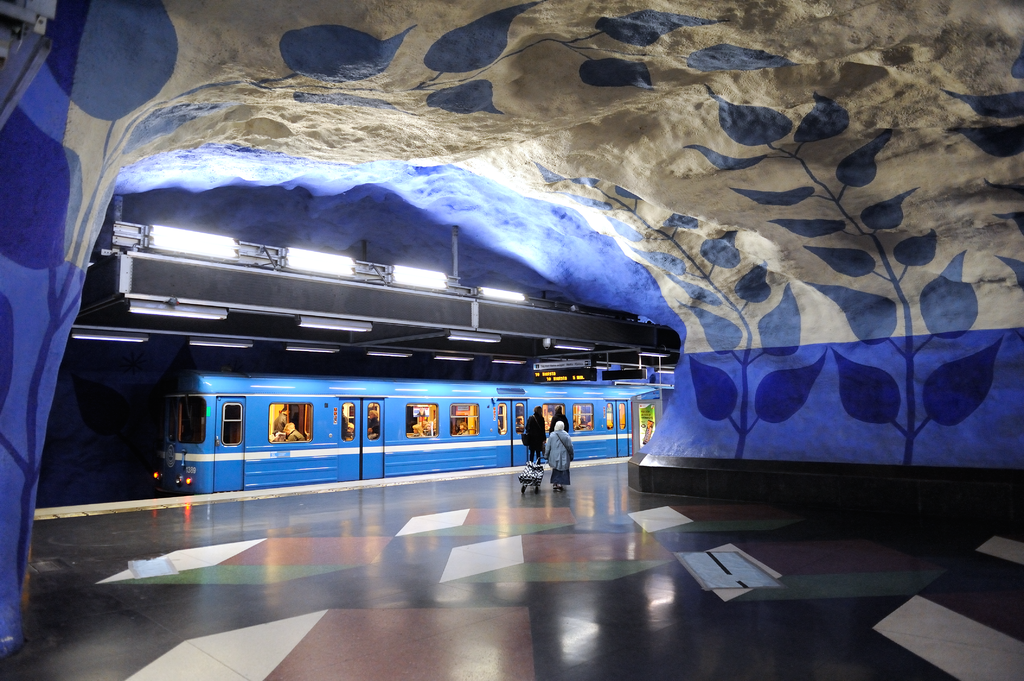
Stockholm is famous for its exposed rock: the hard gneiss forms natural arches, and the T-bana elected to paint it over from the inside, producing the bright blue-and-white contrast with dark blue leaf paintings depicted above at T-Centralen. The stations look drastically different from one another, with many examples available from UrbanRail.Net, Flickr user Dyorex, Flickr user Kotka Molokovich, and the travel site Walk Slow Run Wild.
Swedish construction costs today are several times higher, but remain below world average, and are nearly a full order of magnitude lower than in New York. The stations remain artistic, but this coexists with consistent, standardized engineering specs, modified based on local conditions only when necessary. Citybanan’s Odenplan is not at all spartan; the entire station, berthing 214 meter trains mined below the T-bana station by the same name, cost $250 million in 2022 dollars, which cost includes not just the station but also 2 km of mined tunnel. The data that I’ve seen while researching our Sweden case suggests that Nya Tunnelbanan station costs are dominated by civil infrastructure and not systems or finishes, which look like they’re about a quarter of overall station costs, rather than nearly half as in New York. Nice art is not expensive; for that matter, New York’s subway stations have pretty tiles, and this includes old stations predating the 1930s’ cost explosion.
Moreover, I doubt it was the case when the system was first built, but nowadays the entire T-bana is accessible to wheelchair users. In fact, a number of metro systems have made themselves fully accessible or are in the process of doing so, generally at low costs; I have some numbers from 2019, and the programs cited for Berlin and Madrid are behind schedule, but Berlin seems to be sticking to a budget of 2 million € for an ordinary station, and even taking into account inflation that Berlin needs one elevator per station and most cities need three, this isn’t quite $10 million per station, a cost similar to that of Madrid’s ongoing program. In New York, the cost cited for accessibility is $70 million per station.
What goes on here isn’t really a matter of high quality for high cost. In fact, when Eric, Elif, and I researched the New York case, we were stricken by how little of the problem concerned actual quality or safety regulations (for example, the fire code in New York in practice requires mezzanines at the depth of Second Avenue, but does not require them to be full-length). The oversize stations are neither grand public atria nor revenue-generating commercial spaces, but rather conventional stations flanked by excessive amounts of back office space. The lack of standardization concerns fittings, not art. The massive costs of New York elevator installation are barely about redundancy (a requirement driven by low but fixable reliability) and largely about utility conflicts, bad-and-worsening project delivery, and the soft costs crisis.
Making the user experience worse is an easy way to signal that one is cutting costs. It’s a combination of vice-signaling and prudence theater. It also has little to do with how actually low-cost infrastructure construction programs look like. They can be highly standardized even without the artistic component found in Sweden and Finland, and then people may complain that the system looks bland and corporate – but bland and corporate is not the same as spartan, it just means it looks like the 21st century and not the imagined 20th.
Good systems are certainly not willing to make compromises on human rights and build inaccessible infrastructure. In Seoul, there are massive protests by disabled people demanding that the Seoul subway go from 93% to 100% accessible and that the bus fleet immediately be transitioned to low-floor equipment, and meanwhile, New York and London both loiter around 25-30% accessibility. The conservative governments of the state and the city both dither, but past competence by Korea has led to high expectations by users, in the same manner that people in developed country protest inequality and poverty even fully knowing that it’s nowhere near as bad as in the third world. While I don’t know Seoul’s accessibility costs, I do know a deep-bored Line 9 extension with an undercrossing of Line 5 is budgeted at $180 million/km.


