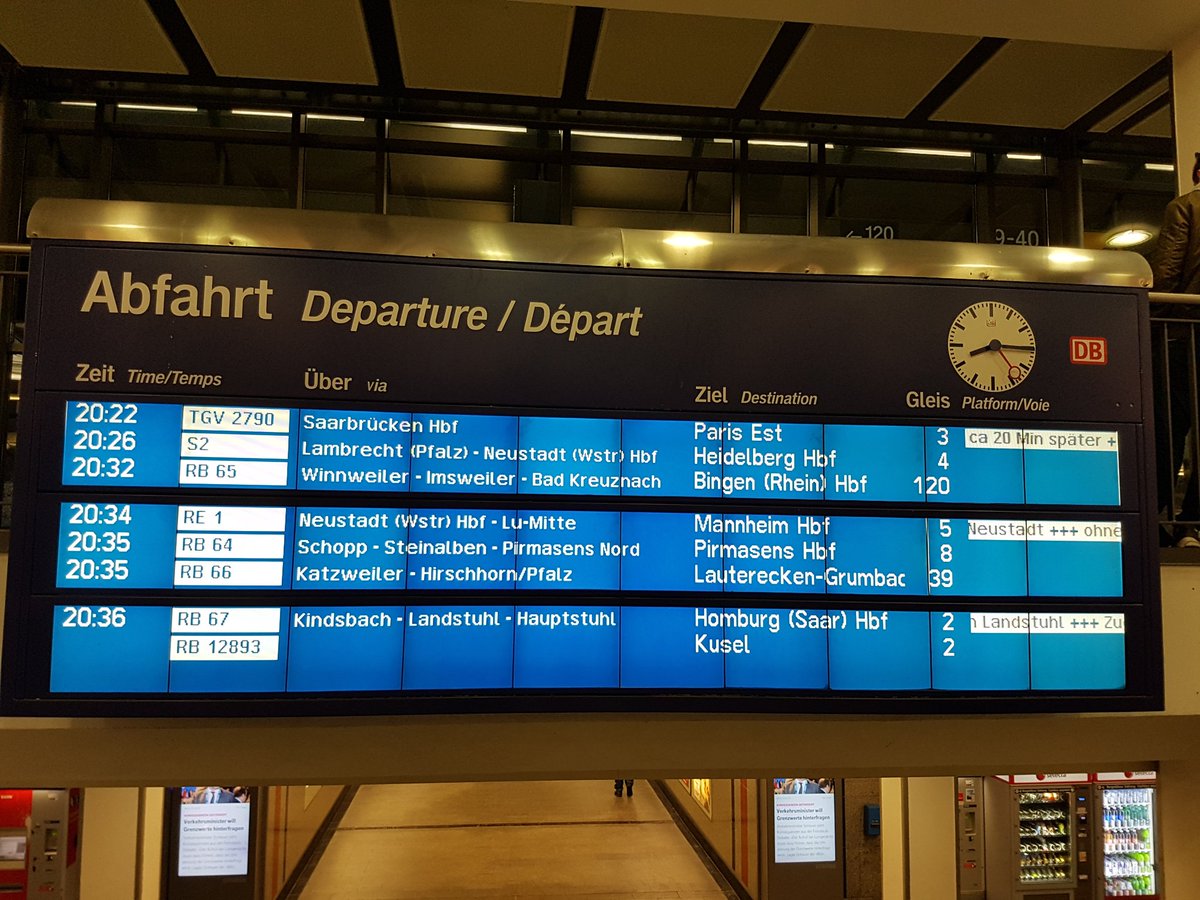
No Cafe Cars, Please

European and American intercity train planning takes it as a given that every train must have a car dedicated to cafeteria service. This is not the only way to run trains – the Shinkansen doesn’t have cafe cars. Cafe cars waste capacity that could instead be carrying paying passengers. This is the most important on lines with capacity limitations, like the Northeast Corridor, the West Coast Main Line, the LGV Sud-Est, and the ICE spine from the Rhine-Ruhr up to Frankfurt and Mannheim. Future high-speed train procurement should go the Shinkansen route and fill all cars with seats, to maximize passenger space.

How much space do cafe cars take?

Typically, one car in eight is a cafe. The standard European high-speed train is 200 meters long, and then two can couple to form a 400-meter train, with two cafes since the two 200-meter units are separate and passengers can’t walk between them. In France, the cars are shorter than 25 meters, but a TGV has two locomotives and eight coaches in between, so again one eighth of the train’s potential passenger space does not carry passengers but rather a support service. Occasionally, the formula is changed: the ICE4 in Germany is a single 12-car, 300-meter unit, so 1/12 of the train is a cafe, and in the other direction, the Acela has six coaches one of which is a cafe.

A 16-car Shinkansen carries 1,323 passengers; standard class has 5-abreast seating, but even with 4-abreast seating, it would be 1,098. The same length of a bilevel TGV is 1,016, and a single-level TGV is 754. The reasons include the Shinkansen’s EMU configuration compared with the TGV’s use of locomotives, the lack of a cafe car in Japan, somewhat greater efficiency measured in seat rows per car for a fixed train pitch, and a smaller share of the cars used for first class. An intermediate form is the Velaro, which is an EMU but has a cafe and three first-class cars in eight rather than the Shinkansen’s three in 16; the Eurostar version has 902 seats over 16 cars, and the domestic version 920.

The importance of the first- vs. second-class split is that removing the cafe from a European high-speed train means increasing seated capacity by more than just one seventh. The bistro car is an intermediate car rather than an end car with streamlining and a driver’s cab, and if it had seats they’d be second- and not first-class. A German Velaro with the bistro replaced by a second-class car would have around 1,050 seats in 16 cars, almost even with a 4-abreast Shinkansen even with four end cars rather than two and with twice as many first-class cars.

How valuable are cafes to passengers?

The tradeoff is that passengers prefer having a food option on the train. But this preference is not absolute. It’s hard to find a real-world example. The only comparison I am aware of is on Amtrak between the Regional (which has a cafe) and the Keystone (which doesn’t), and Regional fares are higher on the shared New York-Philadelphia segment but those are priced to conserve scarce capacity for profitable New York-Washington passengers, and at any rate the shared segment is about 1:25, and perhaps this matters more on longer trips.

Thankfully, the Gröna Tåget project in Sweden studied passenger preferences in more detail in order to decide how Sweden’s train of the future should look. It recommends using more modern seats to improve comfort, making the seats thinner as airlines do in order to achieve the same legroom even with reduced pitch, and a number of other changes. The question of cafes in the study is presented as unclear, on PDF-p. 32:

Food and RefreshmentsWillingness to Pay
Coffee machine (relative to no service at all)3-6%
Free coffee and tea in each car6%
Food and drink trolley11%
Cafeteria14%
Restaurant with hot food17%

Put another way, the extra passenger willingness to pay for a cafeteria compared with nothing, 14%, is approximately equal to the increase in capacity on a Velaro coming from getting rid of the bistro and replacing it with a second-class car. The extra over a Shinkansen-style trolley is 3%. Of course, demand curves slope down, so the gain in revenue from increasing passenger capacity by 14% is less than 14%, but fares are usually held down to a maximum regulatory level and where lines are near capacity the increase in revenue is linear.

Station food

Instead of a bistro car, railroads should provide passengers with food options at train stations. In Japan this is the ekiben, but analogs exist at major train stations in Europe and the United States. Penn Station has a lot of decent food options, and even if I have to shell out $10 for a pastrami sandwich, I don’t think it’s more expensive than a Tokyo ekiben, and at any rate Amtrak already shorts me $90 to travel to Boston. The same is true if I travel out of Paris or Berlin.

Even better, if the station is well-designed and placed in a central area of the city, then passengers can get from the street to the platform very quickly. At Gare de l’Est, it takes maybe two minutes, including time taken to print the ticket. This means that there is an even broader array of possible food options by buying on the street, as I would when traveling out of Paris. In that case, prices and quality approach what one gets on an ordinary street corner, without the premium charged to travelers when they are a captive market. The options are then far better than what any bistro car could produce, without taking any capacity away from the train at all.

The Need to Remove Bad Management

I’ve talked a lot recently about bad management as a root cause of poor infrastructure, especially on Twitter. The idea, channeled through Richard Mlynarik, is that the main barrier to good US infrastructure construction, or at least one of the main barriers, is personal incompetence on behalf of decisionmakers. Those decisionmakers can be elected officials, with levels of authority ranging from governors down to individual city council members; political appointees of said officials; quasi-elected power brokers who sit on boards and are seen as representative of some local interest group; public-sector planners; or consultants, usually ones who are viewed as an extension of the public sector and may be run by retired civil servants who get a private-sector salary and a public-sector pension. In this post I’d like to zoom in on the managers more than on the politicians, not because the politicians are not culpable, but because in some cases the managers are too. Moreover, I believe removal of managers with a track record of failure is a must for progress.

The issue of solipsism

Spending any time around people who manage poorly-run agencies is frustrating. I interview people who are involved in successful infrastructure projects, and then I interview ones who are involved in failed ones, and then people in the latter group are divided into two parts. Some speak of the failure interestingly; this can involve a blame game, typically against senior management or politics, but doesn’t have to, for example when Eric and I spoke to cost estimators about unit costs and labor-capital ratios. But some do not – and at least in my experience, the worst cases involve people who don’t acknowledge that something is wrong at all.

I connect this with solipsism, because this failure to acknowledge is paired with severe incuriosity about the rest of the world. A Boston-area official who I otherwise respect told me that it is not possible to electrify the commuter rail system cheaply, because it is 120 years old and requires other investments, as if the German, Austrian, etc. lines that we use as comparison cases aren’t equally old. The same person then said that it is not possible to do maintenance in 4-hour overnight windows, again something that happens all the time in Europe, and therefore there must be periodic weekend service changes.

A year and a half ago I covered a meeting that was videotaped, in which New Haven-area activists pressed $200,000/year managers at Metro-North and Connecticut Department of Transportation about their commuter rail investments. Those managers spoke with perfect confidence about things they had no clue about, saying it’s not possible that European railroads buy multiple-units for $2.5 million per car, which they do; one asserted the US was unique in having wheelchair accessibility laws (!), and had no idea that FRA reform as of a year before the meeting permitted lightly-modified European trains to run on US track.

The worst phrase I keep hearing: apples to apples. The idea is that projects can’t really be compared, because such comparisons are apples to oranges, not apples to apples; if some American project is more expensive, it must be that the comparison is improper and the European or Asian project undercounted something. The idea that, to the contrary, sometimes it’s the American project that is easier, seems beyond nearly everyone who I’ve talked to. For example, most recent and under-construction American subways are under wide, straight streets with plenty of space for the construction of cut-and-cover station boxes, and therefore they should be cheaper than subways built in the constrained center of Barcelona or Stockholm or Milan, not more expensive.

What people are used to

In Massachusetts, to the extent there is any curiosity about rest-of-world practice, it comes because TransitMatters keeps pushing the issue. Even then, there is reticence to electrify, which is why the state budget for regional rail upgrades in the next few years only includes money for completing the electrification of sidings and platform tracks on the already-electrified Providence Line and for short segments including the Fairmount Line, Stoughton Branch, and inner part of the Newburyport and Rockport Lines. In contrast, high platforms, which are an ongoing project in Boston, are easier to accept, and thus the budget includes more widespread money for it, even if it falls short of full high-level platforms at every station in the system.

In contrast, where high platform projects are not so common, railroaders find excuses to avoid them. New Jersey Transit seems uninterested in replacing all the low platforms on its system with high platforms, even though the budget for such an operation is a fraction of that of the Gateway tunnel, which the state committed $2.5 billion to in addition to New York money and requested federal funding. The railroad even went as far as buying new EMUs that are compatible not with the newest FRA regulations, which are similar to UIC ones used in Europe, but with the old ones; like Metro-North’s management, it’s likely NJ Transit’s had no idea that the regulations even changed.

The issue of what people are used to is critical. When you give someone authority over other people and pay them $200,000 a year, you’re signaling to them, “never change.” Such a position can reward ambition, but not the ambition of the curious grinder, but that of the manager who makes other people do their work. People in such a position who do not know what “electronics before concrete” means now never will learn, not will they even value the insights of people who have learned. The org chart is clear: the zoomer who’s read papers about Swiss railroad planning works for the boomer who hasn’t, and if the boomer is uncomfortable with change, the zoomer can either suck it up or learn to code and quit for the private sector.

You can remove obstructionist managers

From time to time, a powerful person who refuses to use their power except in the pettiest ways accidentally does something good. Usually this doesn’t repeat itself, despite the concrete evidence that it is possible to do things thought too politically difficult. For example, LIRR head Helena Williams channeled Long Island NIMBYism and opposed Metro-North’s Penn Station Access on agency turf grounds – it would intrude on what Long Islanders think is their space in the tunnels to Penn Station. But PSA was a priority for Governor Andrew Cuomo, so Cuomo fired Williams, and LIRR opposition vanished.

This same principle can be done at scale. Managers who refuse to learn from successful examples, which in capital construction regardless of mode and in operations of mainline rail are never American and rarely in English-speaking countries, can and should be replaced. Traditional railroaders who say things are impossible that happen all the time in countries they look down on can be fired; people from those same countries will move to New York for a New York salary.

This gets more important the more complex a project gets. It is possible, for example, to build high-speed rail between Boston and Washington for a cost in the teens of billions and not tens, let alone hundreds, but not a single person involved in any of the present effort can do that, because it’s a project with many moving parts and if you trust a railroad manager who says “you can’t have timed overtakes,” you’ll end up overbuilding unnecessary tunnels. In this case, managers with a track record of looking for excuses why things are impossible instead of learning from places that do those things are toxic to the project, and even kicking them up is toxic, because their subordinates will learn to act like that too. The squeaky wheel has to be removed and thrown into the garbage dumpster.

And thankfully, squeaky wheels that get thrown into the dumpster stop squeaking. All of this is possible, it just requires elected officials who have the ambition to take risks to effect tangible change rather than play petty office politics every day. Cuomo is the latter kind of politician, but he proved to everyone that a more competent leader could replace solipsists with curious learners and excusemongers with experts.

I Gave a Talk at Transit Con

An online conference just concluded in which I gave a half-hour presentation about construction costs. Instead of giving my usual spiel, showing parts of our growing database and pointing out patterns, I spent a lot of time on why this is important. I’d written about this before, twice, but I’ve since looked more carefully at an example of two countries that are similar enough in their rail and public transit tradition that their large difference in costs must be the primary reason one has a bigger and more successful urban rail system than the other. I focused on developed countries, that is countries that manifestly have high incomes, good public health, good education, and so on; however, I believe the importance of costs is also a big reason behind delays in public transportation in high-cost developing countries like India.

You can read the slides here; this was recorded, and I’ll update this post with a link when it gets published.

Fare Control and Construction Costs

Proof-of-payment with ungated train stations is a useful technique for reducing construction costs. It simplifies the construction of stations, since there is no need for a headhouse or mezzanine – people can go directly from the street to the platform. A station without fare control requires just a single elevator, or two if side platforms are desired, and can be built shallowly using cut-and-cover. Cities across the size spectrum, perhaps only stopping short of hypercities, should take heed and use this to build urban rail more cheaply.

Is this a common cost control technique?

No. The vast majority of low-construction cost countries use faregates, which is why I was reticent to recommend proof-of-payment as a cost mitigation strategy. Spain, Italy, Korea, and Sweden are all faregated; among the world’s lowest-cost countries, I believe only Finland and Switzerland use proof-of-payment fare collection on urban rail.

However, there are exceptions. In Italy, the Brescia Metro uses proof-of-payment. This is not typical for the country or the region – Italian metros have fare control, like the vast majority of systems outside Germany and Germany-influenced countries. However, because Brescia is small, the system was forced to engage in value engineering, removing scope that would be routine in larger cities like Milan. The majority was built cut-and-cover or above-ground; the typical urban Italian metro is entirely bored. Italian metro systems prefer short stations on new lines to minimize costs and provide capacity through automated operations and extremely high frequency; Brescia takes this to an extreme and has 30-meter trains. Among these cost minimization tactics is the lack of fare control. The result of this entire package is that Brescia spent 915 million euros on a 13.7 km metro system.

Station size and station cost

So far, we believe that the cost of the station, excavation excluded, should be proportional to the floor area. This is based on something told to us in an interview about electrical system costs for the Boston Green Line Extension, which is light rail in a trench rather than a tunneled metro system, so I recommend caution before people repeat this uncritically.

Moreover, on somewhat more evidence, it appears that the cost of station excavation should be proportional to the volume excavated. Some of the evidence for this is circumstantial: media reports and government reports on the construction of such urban rail projects as Second Avenue Subway, Grand Paris Express, and the RER specify the volume of excavation as a measure of the difficulty of construction. But it’s not just circumstantial. In Paris, the depth of some of the GPX stations has led to some construction complications. Moreover, preliminary interviews in Paris suggest, albeit not definitively, that station construction costs are predominantly a matter of dig volume. Finally, the insistence on short platforms and high frequency as a cost saving technique on new-build metro systems in Italy as well as in Denmark and on the Canada Line in Vancouver is suggestive too, even if it says nothing about whether the relationship between volume and cost is linear, degressive, or superlinear.

How does one minimize station costs with POP?

Proof-of-payment means that there is no fare control between the street and the station. This means any of the following ways of constructing station access become available:

  • Cut-and-cover with the platform on level -1, with direct stair and elevator access from the street. The Berlin U-Bahn is built this way, with access points in street medians where available, such as U8 on Brunnenstrasse. It’s easy to build staircases at each end of the platform to increase access, with an elevator in the middle.
  • Bored tunnel with large enough bores to fit the platform within the bore. The Barcelona method for this is to use 12-meter bores, but smaller, cheaper versions exist with smaller trains, for example in Milan. It’s also possible to use double-O-tube TBMs for this, but ordinarily they are more expensive than twin bores. Access involves vertical bores down to the platform with elevators or slant bores with escalators; there is no need for intermediate levels or entry halls.
  • Bored tunnel with cut-and-cover stations, with no mezzanine levels. Here, the dig volume is unchanged, and the saving from lack of fare control is only in the finishes and elevator costs, not the excavation.

It is noteworthy that the most common technique for metro construction, by far, is the last one, where the savings from POP are the smallest. The vast majority of world metros have fare control, including in low-cost countries, and this perhaps makes metro builders not notice how two separate ways of reducing costs – cut-and-cover and POP – interact especially well together. Nonetheless, this is a real saving.

What does this mean?

A technique can be uncommon in low-cost countries and yet be useful in reducing construction costs. It is useful to think of the way Madrid, Milan, Turin, Stockholm, Oslo, Helsinki, and Seoul build their urban rail systems as good, but not always perfect. A trick that these cities might not pay attention to may still be good. The caveat is that it requires a good explanation for why they have not employed it; in the case of Italy, I believe it’s simply that the non-German world views fare control as the appropriate way to run a metro system and POP as a light rail technique and therefore only good for low-volume operations. There may also be backward compatibility issues – Brescia is a new build, like POP Copenhagen, whereas Milan is building extensions on top of a gated system.

Nonetheless, the evidence from station costs, the success of POP operations in Germany even on very busy lines, and the experience of Brescia all suggest that POP is good for metro construction in general. Cities smaller than New York building new systems should use it exclusively, and cities that already have faregates should tear them down to improve passenger circulation and facilitate the construction of POP lines in the future at lower cost.

KWCIMBY

KWCIMBY, or Kowloon Walled City in My Backyard, is a refrain used by some YIMBYs to make it clear that we favor high density and not the missing middle self-compromise. This is not about the literal KWC, which was poor and hideously overcrowded – the floor area ratio from photos looks like it averaged around 8 counting open space, so the density meant it had maybe 6.5 square meters of built-up space per capita. Rather, it’s about the concept of going as high as possible, using higher floor area ratios (the Upper East and West Sides of New York have 12 residential FAR on the avenues) and generous first-world urban living arrangements to create high urban density. This post is about how it might look.

One possible built form is this:

This is 100*100 meter blocks, with 20-meter wide streets; this is not intended to be a city for cars, but at high residential density it’s useful to widen the streets somewhat to provide ample walking and cycling space and to allow very tall buildings while keeping the building height-to-street width ratio reasonable. The buildings are in dark gray, in euroblock form with the courtyards denoted in green.

Internal building layout

The building is 20-meter thick, which is wider than normal for Berlin euroblocks but compensates by not having internal wings, so that the apartments’ area-to-window frontage ratio is about 9 meters, which figure exists in Berlin and Paris. The inner corners feature elevator lobbies, depicted as 10*10 meters, but they can safely be made smaller. Let’s Go LA’s post about high-rise floorplates in Los Angeles, Seattle, and Vancouver shows some examples of elevator lobbies with scissor stairs and some extra corridor space at 63 m^2, and here scissor stairs aren’t needed for fire safety because each of the corners is redundant with the other three.

The footprint of the built-up area is 4,800 m^2. Of that, 722 are circulation space, or 15%; this is not amazing, and it’s possible to do better by having somewhat narrower corridors than 2 meters and somewhat smaller elevator lobbies, reaching about 90% efficiency instead of 85%. If the lobbies remain 10*10, they may include additional functions, such as trash rooms with chutes, or maybe laundry rooms in cities where it’s not normal for people to own washing machines.

The apartment floor plates are forced to be rectangular and not terribly interesting, with rooms opening to windows. My presumption is that each window space is 2.5 meters wide, so a bedroom or an office occupies one window, a living room one to two windows, and unusually large bedroom two. Kitchens can take a full window or be in an open plan with the living room. Bathrooms don’t normally get window space, and the depth of the apartment is such that every bedroom can have an attached bathroom.

An austere apartment is around one window per person, or around 22.5 m^2 per person; a spacious one is around two per person if it’s a family, or 45 m^2 per person, or even three for a single person who wants a guestroom. 45 is normal by Northern European standards and if anything on the low side by American ones, but it’s in practice degressive in household size and American NIMBYism is such that families rarely live in big cities, a household in which half the people are children and therefore do not work not really being able to compete for scarce urban land with a household in which all members work. If there’s abundant space, then middle-class families will take 8-window, 180 m^2 apartments in such buildings, and working-class ones will take 4-window apartments.

So what’s the density?

The courtyard is fully enclosed, so the limit to how much sunlight the bottom apartments get is the ratio of the building’s height to the courtyard width, which is 40 m. In Berlin and Paris one finds many euroblocks with wings such that the ratio of the height to the courtyard width is around 1.8, and a fair number in the 2-2.5 range. Our building can have 25-30 floors, or a height of 75-90 meters, while respecting this ratio. This is a building height-to-street width ratio of about 4, which is not common in Paris and Berlin (I see a bunch of 2 but not 4), but does exist in central residential areas in Tokyo and I think also Taipei, and in commercial ones in New York and London.

25 floors times a little more than 4,000 net m^2 per floor is 102,000 net m^2. If it’s 30 floors, make it 122,000. Figure exactly 45 net m^2 per person, with the more austere floor plans canceling out with vacant apartments, with empty nester apartments, and with three-window, 67.5 m^2 singles. This is 2,265 people per hectare at 25 floors, or 2,718 at 30 floors. Per km^2, this is 226,500, or 271,800 at 30 floors.

The vast majority of built-up space is residential, but with buildings this tall, the ground floor is presumably retail. One trick that can be done is to have retail, such as a supermarket, occupy the entire 80*80 block not including the street, and then put the courtyard on the roof of the supermarket, allowing one or two more residential floors.

A percentage of the buildings is entirely non-residential, such as schools, hospitals, office buildings, and emergency services. Schools are, in British standards, 5.13 m^2/primary student (p. 9), 7.81 m^2/secondary student (p. 10), and 9.28 m^2/16+ student (p. 11), all assuming maximum school size. Schools can be bigger than the maximum assumed in the UK – New York’s Specialized High Schools are each around 1,000 students per grade, and Singapore’s secondary schools and junior colleges have around 700-800 per grade. A 12-story euroblock will fit 6 grades generously at 1,000 students per grade, which is compatible with a base population of around 80,000 at equilibrium, so a square kilometer with 200,000 people needs 2.5 primary and 2.5 secondary schools, or 5 out of 100 blocks used for non-residential purposes. This is the biggest nonresidential, noncommercial use, I believe – everything else is probably 1 building out of 100 each, and maybe a handful of blocks can be parks, with a total of 10 blocks in 100 neither residential nor commercial.

Non-euroblock forms

Instead of euroblocks, it’s possible to use building forms without internal courtyards. For example, one can break each 100*100 block into 50*50 blocks, still with 20 m street width, giving 30*30 buildings:

Instead of 4,800 m^2 of built-up area per hectare one gets 3,600, but the floor plate efficiency, again stolen from the standards in the Let’s Go LA post (this time, with scissor stairs), is more than 90%, and the building sizes are completely standard for high-rises in Tel Aviv or Vancouver. With no internal courtyards, one can get 30 floors or so, which at 45 m^2/person is 222,900 people/residential km^2, or maybe a little less because of ground floor retail.

There’s also the modernist form of linear buildings, typical of communist-era blocks in Eastern Europe, and some postwar public housing projects in the Western Bloc, especially France (but the United States preferred cruciform buildings).

The street width in the direction parallel to the building widens, which in cities that retrofit such forms can be seen as generous setbacks, allowing the same amount of light to reach the lower floors with taller buildings. The overall built up area is 3,200 m^2 per floor, of which 2,864 is net. If we keep to a 4-to-1 height-to-street width ratio we can reach 40 floors now, which is 254,600 people per residential km^2.

The streets in this case can be set up to create long parallel blocks, or to do the opposite, alternating the orientation of the buildings to break the wind. And of course, all building forms can be mixed, so one block is a euroblock, the next is four 30*30 buildings, the one after is two linear blocks, and perhaps the one next to that is two 30*30s and a linear block.

Where is this appropriate?

Construction costs for buildings are not entirely linear in building height. The reason one would build 30-story buildings one after the other rather than single-story houses is that the area has high demand. So your town of 200,000 people has no chance of fitting in one km^2 with such buildings – nobody needs such a built form, even if there are no cars, because if there are no cars then every street is automatically a bike lane and then the town’s range is maybe 10 kilometers and it doesn’t really need multistory apartments except maybe right near the center.

So this is a way of organizing large cities. The use of buildings that are not just tall but also big reinforces the size of the city as well – a city of 100 buildings is a city with severe monopoly problems among developers and landlords, whereas one with 5,000 is one where people are upset at large developers but there is meaningful competition for tenants. Cities that are large but not hug would presumably use the 30*30 building form in preference to the euroblock just because it can be done by smaller developers.

In practice, it’s also a way of organizing large, growing cities, or cities that will grow if development is liberalized. One doesn’t easily replace heterogeneous blocks with big buildings without a lot of demand. Tel Aviv and Vancouver have 30*30 skyscrapers because they are medium-size, high-demand cities, so any site near city center with a few small buildings can be redeveloped; of note, neither uses this building form much outside city center, except perhaps at transit-oriented development sites around designated town centers like Metrotown.

So the isotropic picture at the beginning of the post is an abstraction. In practice, there are always gradients in density, and that’s fine. Some areas get 40-story buildings, other gets smaller ones, or no redevelopment at all; that’s why, even in environments with liberalized zoning like Tokyo and Seoul, neighborhood-scale zones do not reach 200,000/km^2 at developed-world crowding levels. KWC was a unique situation, a tiny no man’s land, and even though Hong Kong is the developed world’s overcrowding capital and has tall buildings to boot, its built-up density has not recurred.

That said, KWCIMBY building forms remain valuable for urban design. City centers genuinely need more development, and while the very center of the city should mostly have offices, one doesn’t need to go too far to get to areas that are mostly residential and mostly very desirable. Tall, densely spaced buildings reaching 200,000 people/km^2 would facilitate comfortable living in the post-car city, and it’s useful to plan for them in the near future.

High Costs are not About Scarcity

I sometimes see a claim in comments here or on social media that the reason American costs are so high is that scarcity makes it hard to be efficient. This can be a statement about government practice: the US government supposedly doesn’t support transit enough. Sometimes it’s about priorities, as in the common refrain that the federal government should subsidize operations and not just capital construction. Sometimes it’s about ideology – the idea that there’s a right-wing attempt to defund transit so there’s siege mentality. I treat these three distinct claims as part of the same, because all of them really say the same thing: give American transit agencies more money without strings attached, and they’ll get better. All of these claims are incorrect, and in fact high costs cannot be solved by giving more money – more money to agencies that waste money now will be wasted in the future.

The easiest way to see that theories of political precarity or underresourcing are wrong is to try to see how agencies would react if they were beset mostly by scarcity as their defenders suggest. For example, the federal government subsidizes capital expansion and not operations, and political transit advocates in the United States have long called for operating funds. So, if transit agencies invested rationally based on this restrictions, what would they do? We can look at this, and see that this differs greatly from how they actually invest.

The political theory of right-wing underresourcing is similarly amenable to evaluation using the same method. Big cities are mostly reliant not on federal money but state and local money, so it’s useful to see how different cities react to different threat levels of budget cuts. It’s also useful to look historically at what happened in response to cuts, for example in the Reagan era, and spending increases, for example in the stimulus in the early Obama era and again now.

How to respond to scarcity

A public transit agency without regular funding would use the prospects of big projects to get other people’s money (OPM) to build longstanding priorities. This is not hypothetical: the OPM effect is real, and for example people have told Eric and me that Somerville used the original Green Line Extension to push for local amenities, including signature stations and a bike lane called the Community Path. In New York, the MTA has used projects that are sold to the public as accessibility benefits to remodel stations, putting what it cares about (cleaning up stations) on the budget of something it does not (accessibility).

The question is not whether this effect is real, but rather, whether agencies are behaving rationally, using OPM to build useful things that can be justified as related to the project that is being funded. And the answer to this question is negative.

For every big federally-funded project, one can look at plausible tie-ins that can be bundled into it that enhance service, which the Somerville Community Path would not. At least the ongoing examples we’ve been looking at are not so bundled. Consider the following misses:

Green Line Extension

GLX could include improvements to the Green Line, and to some extent does – it bundles a new railyard. However, there are plenty of operational benefits on the Green Line that are somewhere on the MBTA’s wishlist that are not part of the project. Most important is level boarding: all vehicles have a step up from the platform, because the doors open outward and would strike the platform if there were wheelchair-accessible boarding. The new vehicles are different and permit level boarding, but GLX is not bundling full level boarding at all preexisting stations.

East Side Access and Gateway

East Side Access and Gateway are two enormous commuter rail projects, and are the world’s two most expensive tunnels per kilometer. They are tellingly not bundled with any capital improvements that would boost reliability and throughput: completion of electrification on the LIRR and NJ Transit, high platforms on NJ Transit, grade separations of key junctions between suburban branches.

The issue of operating expenses

More broadly, American transit agencies do not try to optimize their rail capital spending around the fact that federal funding will subsidize capital expansion but not operations. Electrification is a good deal even for an agency that has to fund everything from one source, cutting lifecycle costs of rolling stock acquisition and maintenance in half; for an agency that gets its rolling stock and wire from OPM but has to fund maintenance by itself, it’s an amazing investment with no downside. And yet, American commuter rail agencies do not prioritize it. Nor do they prioritize high platforms – they invest in them but in bits and pieces. This is especially egregious at SEPTA, which is allowed by labor agreement to remove the conductors from its trains, but to do so needs to upgrade all platforms to level boarding, as the rolling stock has manually-operated trap doors at low-platform stations.

Agencies operating urban rail do not really invest based on operating cost minimization either. An agency that could get capital funding from OPM but not operating funding could transition to driverless trains; American agencies do not do so, even in states with weak unions and anti-union governments, like Georgia and Florida. New York specifically is beset by unusually high operating expenses, due to very high maintenance levels, two-person crews, and inefficient crew scheduling. If the MTA has ever tried to ask for capital funding to make crew scheduling more efficient, I have not seen it; the biggest change is operational, namely running more off-peak service to reduce shift splitting, but it’s conceivable that some railyards may need to be expanded to position crews better.

Finally, buses. American transit agencies mostly run buses – the vast majority of US public transport service is buses, even if ridership splits fairly evenly between buses and trains. The impact of federal aid for capital but not operations is noticeable in agency decisions to upgrade a bus route to rail perhaps prematurely in some medium-size cities. It’s also visible in bus replacement schedules: buses are replaced every 12 years because that’s what the Federal Transit Administration will fund, whereas in Canada, which has the same bus market and regulations but usually no federal funding for either capital or operations, buses are made to last slightly longer, around 15 years.

It’s hard to tell if American transit agencies are being perfectly rational with bus investment, because a large majority of bus operating expenses are the driver’s wage, which is generally near market rate. That said, the next largest category is maintenance, and there, it is possible to be efficient. Some agencies do it right, like the Chicago Transit Authority, which replaces 1/12 of its fleet every year to have long-term maintenance stability, with exactly 1/12 of the fleet up for mid-life refurbishment each year. Others do it wrong – the MTA buys buses in bunches, leading to higher operating expenses, even though it has a rolling capital plan and can self-fund this system in years when federal funds are not forthcoming.

Right-wing budget cuts

Roughly the entirety of the center-right policy sphere in the United States is hostile to public transportation. The most moderate and least partisan elements of it identify as libertarian, like Cato and Reason, but mainstream American libertarianism is funded by the Koch Brothers and tends toward climate change denial and opposition to public transportation even where its natural constituency of non-left-wing urbane voters is fairly liberal on this issue. The Manhattan Institute is the biggest exception that I’m aware of – it thinks the MTA needs to cut pension payments and weaken the unions but isn’t hostile to the existence of public transportation. In that environment, there is a siege mentality among transit agencies, which associate any criticism on efficiency grounds as part of a right-wing strategy to discredit the idea of government.

Or is there?

California does not have a Republican Party to speak of. The Democrats have legislative 2/3 majorities, and Senate elections, using a two-round system, have two Democrats facing each other in the runoff rather than a Democrat and a Republican. In San Francisco, conservatism is so fringe that the few conservatives who remain back the moderate faction of city politics, whose most notable members are gay rights activist and magnet for alt-right criticism Scott Wiener, (until his death) public housing tenant organizer Ed Lee, and (currently) Mayor London Breed, who is building homeless shelters in San Francisco over NIMBY objections. The biggest organized voices in the Bay Area criticizing the government on efficiency grounds and asserting that the private sector is better come from the tech industry, and usually the people from that industry who get involved with politics are pro-immigration climate change hawks. Nobody is besieging the government in the Bay Area. Nor is anybody besieging public transit in particular – it is popular enough to routinely win the required 2/3 majority for tax hikes in referendums.

In New York, this is almost as true. The Democrats have a legislative 2/3 majority as of the election that just concluded, there does not appear to be a serious Republican candidate for either mayor or governor right now, and the Manhattan Institute recognizes its position and, on local issues of governance, essentially plays the loyal opposition. The last Republican governor, George Pataki, backed East Side Access, trading it for Second Avenue Subway Phase 1, which State Assembly Speaker Sheldon Silver favored.

One might expect that the broad political consensus that more public transportation is good in New York and the Bay Area would enable long-term investment. But it hasn’t. The MTA has had five-year capital plans for decades, and has known it was going to expand with Second Avenue Subway since the 1990s. BART has regularly gotten money for expansion, and Caltrain has rebuilt nearly all of its platforms in the last generation without any attempt at level boarding.

How a competent agency responds to scarcity

American transit agencies’ extravagant capital spending is not in any way a rational response to any kind of precarity, economic or political. So what is? The answer is, the sum total of investment decisions made in most low-cost countries fits the bill well.

Swiss planning maxims come out of a political environment without a left-wing majority; plans for high-speed rail in the 1980s ran into opposition on cost grounds, and the Zurich U-Bahn plans had lost two separate referendums. The kind of planning Switzerland has engaged in in the last 30 years to become Europe’s strongest rail network came precisely because it had to be efficient to retain public trust to get funds. The Canton of Zurich has to that end had to come up with a formula to divide subsidies between different municipalities with different ideas of how much public services they want, and S-Bahn investment has always been about providing the best passenger experience at the lowest cost.

Elsewhere in Europe, one sees the same emphasis on efficiency in the Nordic countries. Scandinavia as a whole has a reputation for left-wing politics, because of its midcentury social democratic dominance and strong welfare states. But as a region it also practices hardline monetary austerity, to the point that even left-led governments in Sweden and Finland wanted to slow down EU stimulus plans during the early stages of the corona crisis. There is a great deal of public trust in the state there, but it is downstream of efficiency and not upstream of it – high-cost lines get savaged in the press, which engages in pan-Nordic comparisons to assure that people get value for money.

Nor is there unanimous consensus in favor of public transportation anywhere in Europe that I know of, save Paris and London. Center-right parties support cars and oppose rail in Germany and around it. Much of the Swedish right loathes Greta Thunberg, and the center-right diverted all proceeds from Stockholm’s congestion charge to highway construction. The British right has used the expression “war on the motorist” even more than the American right has the expression “war on cars.” The Swiss People’s Party is in government as part of the grand coalition, has been the largest party for more than 20 years, and consistently opposes rail and supports roads, which is why the Lötschberg Base Tunnel’s second track is only 1/3 complete.

Most European transit agencies have responded effectively to political precarity and budget crunches. They invest to minimize future operating expenses, and make long-term plans as far as political winds permit them to. American transit agencies don’t do any of this. They’re allergic to mainline rail electrification, sluggish about high platforms, indifferent to labor-saving signaling projects, hostile to accessibility upgrades unless sued, and uncreative about long-term operating expenses. They’re not precarious – they’re just incompetent.

More on Eno and Construction Costs

I spoke with Paul Lewis yesterday about the Eno study of construction costs that I criticized over a statistical error, and he pointed something out to me: the line that there is no US cost premium does not come from him or from elsewhere at Eno. Streetsblog’s coverage was just bad – it claims there is little to no US premium and quotes Lewis, but the quotations from Lewis do not actually say that, it’s Streetsblog’s own editorializing.

What’s more, Streetsblog took this editorializing into directions that were not mentioned by Eno or by me. On top of calling high US costs “a persistent myth” and “mostly bunk,” it turns it into a labor issue, saying that other countries get away with paying lower wages by linking to an article about construction costs in China, and talking about “hard-won wages of union construction workers.” Streetsblog even does so while linking to a 3-year-old article of mine in CityLab that states clearly that,

European subway construction uses union labor, just like American construction, but the work rules that have accumulated over the decades permit higher productivity and fewer workers doing each task.

The other source that transformed Eno’s analysis into “the US doesn’t really need to learn more from foreign countries” hurt more than Streetsblog. This was Beth Osborne, who spoke on a panel for Tri-State alongside BART’s president of the board of directors Lateefah Simon and consultant Peter Peyser. Osborne and Simon generally said the right things on the panel, while Peyser seemed pretty useless. But in between talking about good transit reforms, Osborne took my audience question about costs and said that per the Eno study there may not be a US cost premium – if I remember correctly her exact words were “there is no need to self-flagellate.”

Well, there is a need to self-flagellate. American mainline rail planners are barely aware of trends in other American cities; $200,000/year managers are unaware that FRA regulations permit buying standard European train, and people all over the industry say things are impossible that happen thousands of times daily in Central and Northern Europe. In urban transit the situation is better but not by much. Agencies make assumptions that are unwarranted about station footprint, fare collection, and similar engineering-level cost raisers and are usually unaware of economic research into best procurement practices.

And there’s the rub. Eno wrote a study – one that seems honest, even if it did make a statistical error of the kind that every data scientist abstractly knows they must avoid and yet every data scientist still makes. The clear text of the study – and I want to emphasize that Eno’s direct quotes to the media are in line with the clear text – is that the US has a small premium for light rail and a large one for subways. This turned into a screed about how the US cost premium is a myth and people just say this out of hate for organized labor. To the sort of American who has no interest in learning how the rest of the world works, everything boils down to internal American politics, it can’t possibly be that someone might get curious about why the Nordic countries do infrastructure so efficiently or how Italy brought down construction costs in the 1990s as part of the mani pulite process.

And the reason it hurts the most when it’s Beth Osborne is, she’s generally good on transit reform. I’ve never met her, and the panel alone was not enough to make an impression, but I know people who’ve met her who would not have a reason to give unwarranted praise, and they describe her as curious and sharp. American public transportation advocates who I trust were hopeful that she might even get appointed secretary of transportation in President Joe Biden’s administration, until Biden announced he picked Pete Buttigieg. And even she can’t get into a mindset in which the US really needs to learn to imitate places with lower costs and better outcomes.

In a sense, then, it’s not Eno’s fault, even unintentionally. In the last few months I’ve gotten to meet a number of American advocates who I otherwise think highly of who seem completely closed to any discussion of construction costs. They tell me that nobody cares, by which they mean they don’t care. They also insist, for political reasons, on including domestic and not foreign comparisons even when foreign ones work better. There’s so much demand out there in the American advocacy sphere for someone to come in and say that the US is doing fine, all it needs is more money with no oversight, that any criticism of high costs is equivalent to pro-car advocacy. Eno didn’t even say that, but Streetsblog could squint its eyes until it found something in there approximating the desired conclusion, and it appears that, regrettably, so did Osborne.

Poor Rich Countries and Isomorphic Mimicry

A curious pattern can be found in subway construction costs around the world, based on GDP per capita. On the one hand, poor countries that have severe cultural cringe, such as former colonies, have high construction costs, and often the worst projects are the ones that most try to imitate richer countries, outsourcing design to Japan or perhaps China. On the other hand, poor-rich countries, by which I mean countries on the periphery of the developed world, have similar cultural cringe and self-hate for their institutions, and yet their imitation of richer countries has been a success; for example, Spain copied a lot of rail development ideas from Germany and France. This can be explained using the development economic theory of isomorphic mimicry; the rub here is that a poor country like India or Ethiopia is profoundly different from the richer countries it tries to imitate, whereas a poor-rich country like Spain is actually pretty similar to Germany by global standards.

What is isomorphic mimicry?

In the economic development literature, the expression isomorphic mimicry refers to when a poor country sets up institutions that aim to imitate those of richer countries in hope that through such institutions the country will become rich too, but the imitation is too shallow to be useful. A common set of examples is well-meaning regulations on safety, labor, environmental protection, and anti-corruption that are not enforced due to insufficient state capacity. Here is a review of the concept by Andrews, Pritchett, and Woolcock, with examples from Mozambique, Uganda, and India, as well as some history from the American private sector. More examples using the theory can be found in Turczynowicz, Gautam, Rénique, Yeap, and Sagues concerning Peru’s one laptop per child program, in Evans’ interpretation of Bangladesh’s domestic violence laws, and in Rajagopalan and Tabarrok on India’s poor state of public services.

While the theory regarding institutions is new, analogs of it for tangible goods are older. Postwar developmental states engaged in extensive isomorphic mimicry, building dams, steel plants, and coal plants hoping that it would transform them into wealthy states like the United States, Western Europe, and Japan; for the most part, they had lower economic growth than did the developed world until the 1980s. The shift within international development away from tangible infrastructure and toward trying to fix institutions came about because big projects like the Aswan Dam failed to create enduring economic growth and often had ill side effects on agriculture, the environment, or human rights.

How does isomorphic mimicry affect public transportation?

The best example of isomorphic mimicry leading to bad transit that I know of is the Addis Ababa light rail system. This is funded by China, whose ideas of global development are similar to those of the postwar first and second worlds, that is providing tangible physical things, like railroads. Unfortunately, usage is low, because of problems that do not exist in middle-income or rich countries but are endemic to Ethiopia. Christina Goldbaum, the New York Times’ transit reporter, who lived in East Africa and reported from Addis Ababa, mentioned four problems:

  1. Electricity is unreliable, so the trains sometimes do not work. In early-20th century America, electric railroads and streetcar companies built their own power supply and were sometimes integrated concerns providing both streetcar and power service; but in more modern countries, there is reliable power for urban rail to tap.
  2. Not many people work in city center rather than in the neighborhood they live in. This, again, has historical analogs – there were turn-of-the-century Brooklynites who never visited Manhattan. Thus, a downtown-centric light rail system won’t get as much ridership as in a more developed city.
  3. The train is expensive relative to local incomes, so many people stick with buses or ride without paying.
  4. The railroad cuts through streets at-grade, to save money, and blocks off pedestrian paths that people use.

The Addis Ababa light rail system at least had reasonable costs. A more typical case for countries that poor is to build urban rail at premium cost, and the poorer the country, the higher the cost. The reason is most likely that such countries tend to build with Chinese or Japanese technical assistance, depending on geopolitics, and therefore import expensive capital for which they pay with weak currencies.

In India, the most functional and richest of the countries in question, there is much internal and external criticism that its economic growth is not labor-intensive, that is the most productive firms are not the ones employing the most people, and this stymies social development and urban growth. I suspect that this also means there is reluctance to use labor-intensive construction methods, that is cut-and-cover with headcounts that would be typical in New York, Paris, and Berlin in the early 20th century, or perhaps mid-20th century Milan and Tokyo. International consultancies are centered on the rich world and recommend capital-intensive methods to avoid hiring too many sandhogs at a fully laden employment cost of perhaps 8,000€ a month; in India, that is the PPP-adjusted gross salary of an experienced construction worker per year, and if capital is imported then multiply its cost by 3 to account for the rupee’s exchange rate value.

Poor-rich countries

Poor-rich countries are those on the margin of the developed world, such as the countries of Eastern and Southern Europe, Turkey, Israel, to a lesser extent South Korea, and the richer countries of Latin America such as Chile. These are clearly poorer than the United States or Germany. Their residents, everywhere I’ve asked, believe that they are poorer and institutionally inferior; convincing a Spaniard or an Italian that their country can do engineering better than Germany is a difficult task. Thus, these countries tend to engage in mimicry of those countries that they consider the economic center, which could be Germany in Southern Europe, Japan in South Korea, or the US or Spain in Spanish America.

However, being a poor-rich country is not the same as being a poor country. Italy is, by American or German standards, poor. Wages there are noticeably lower and living standards are visibly poorer, and not just in the South either. But those wages remain in the same sphere as American and German wages. The labor-capital cost ratios in Southern Europe are sufficiently similar to those of Northern Europe that it’s not difficult to imitate. Spain even mixed and matched, using French TGV technology for early high-speed rail but preferring the more advanced German intercity rail signaling system, LZB, to the French one.

Such imitation leads to learning. Spain imported German and French engineering ideas but not French tolerance for casual rioting or German litigiousness, and therefore can build infrastructure with less NIMBYism. Turkey invited Italian consultants to help design the early lines of the Istanbul Metro, but subsequently refined their ideas domestically in order to build more efficiently, for example shrinking station footprint and tunnel diameter to reduce costs. Seoul has a subway system that looks like Tokyo’s in many ways, but has a cleaner network shape, with far fewer missed connections between lines. As a result, all three countries – Spain, Turkey, Korea – now have innovative domestic programs of rail construction and can even export their expertise elsewhere, as Spain is in Ecuador.

Openness to novelty

Andrews-Pritchett-Woolcock stress the importance of openness to novelty in the public sector, and cite examples of failure in which bureaucrats at various levels refused to implement any change, even one that was proven to be positive, because their goal was not to rock the boat.

Cultural cringe is in a way a check on that. Isomorphic mimicry is an attempt to combine agenda conformity and closeness to novelty with a desire to have what the richest countries have. But in poor-rich countries, isomorphic mimicry is real imitation – there is ample state penetration in a country like Spain or Turkey rather than outsourcing of state capacity to traditional heads of remote villages, and education levels are high enough that many people know how Germany works and interact with Germany regularly. A worker who earns 2,000€ a month net and a worker who earns 3,000€ a month can exchange tips about how to apply for jobs, how to prepare food, what brands of consumer goods to buy, and where to go on vacation. They cannot have this conversation with a worker who earns 10,000€ a month net.

Within the rich world, what matters then is the realization that something is wrong and the solution is to look abroad. It doesn’t matter if it’s a generally poor-rich region like Southern Europe or a region with a poor-rich public sector like the United States – there’s enough private knowledge about how successful places work, but what’s needed is a public acknowledgement and social organization encouraging imitation and lifting voices that are most expert in implementing it.

And for all the jokes about how the United States or Britain is like a third-world country, they really aren’t. Their public-sector dysfunctions are real, but are still firmly within the poor-rich basket; remember, for example, that despite its antediluvian signaling capacity, the New York City Subway manages to run 24 trains per hour per track at the peak, which is better than Shanghai’s 21. Health and education outcomes in the United States are generally better than those of middle-income and poor countries on every measure. This is a public sector that compares poorly with innovation centers in Continental Europe and democratic East Asia, but it still compares; to try to do the same comparison in a country like Nigeria would be nonsensical.

The upshot then is that implementing best practices in developed countries that happen to be bad at one thing, in this case public transportation in the United States, can work smoothly, much like Southern Europe’s successful assimilation of and improvements on Northern European engineering, and unlike the failures in former colonies in Africa and Asia. But people need to understand that they need to do it – that the centers of innovation are abroad and are in particular in countries that speak English non-natively.

Sorry Eno, the US Really Has a Construction Cost Premium

There’s a study by Eno looking at urban rail construction costs, comparing the US to Europe. When it came out last month I was asked to post about it, and after some Patreon polling in which other posts ranked ahead, here it goes. In short: the study has some interesting analysis of the American cost premium, but suffers from some shortcomings, particularly with the comprehensiveness of the non-American data. Moreover, while most of the analysis in the body of the study is solid, the executive summary-level analysis is incorrect. Streetsblog got a quote from Eno saying there is no US premium, and on a panel at Tri-State a week ago T4A’s Beth Osborne cited the same study to say that the US isn’t so bad by European standards, which is false, and does not follow from the analysis. The reality is that the American cost premium is real and large – larger than Eno thinks, and in particular much larger than the senior managers at Eno who have been feeding these false quotes to the press think.

What’s the study?

Like our research group at Marron, Eno is comparing American urban rail construction costs per kilometer with other projects around the world. Three key differences are notable:

  1. Eno looks at light rail and not just rapid transit. We have included a smattering of projects that are called light rail but are predominantly rapid transit, such as Stadtbahns, the Green Line Extension in Boston, and surface portions of some regional rail lines (e.g. in Turkey), but the vast majority of our database is full rapid transit, mostly underground and not elevated. This means that Eno has a mostly complete database for American urban rail, which is by construction length mostly light rail and not subways, whereas we have gaps in the United States.
  2. Eno only compares the United States with other Western countries, on the grounds that they are the most similar. There is a fair amount of Canada in their database, one Australian line, and a lot of Europe, but no high-income Asia at all. Nor do they look at developing countries, or even upper-middle-income ones like Turkey.
  3. Eno’s database in Europe is incomplete. In particular, it looks by country, including lines in Britain, Spain, Italy, Germany, Austria, the Netherlands, and France, but even there it has coverage gaps, and there is no Switzerland, little Scandinavia (in particular, no ongoing Stockholm subway expansion), and no Eastern Europe.

The analysis is similar to ours, i.e. they look at average costs per km controlling for how much of the line is underground. They include one additional unit of analysis that we don’t, which is station spacing; ex ante one expects closer station spacing to correlate with higher costs, since stations are a significant chunk of the cost and this is especially notable for very expensive projects.

The main finding in the Eno study is that the US has a significant cost premium over Europe and Canada. The key here is figure 5 on takeaway 4. All costs are in millions of PPP dollars per kilometer.

Tunnel proportionMedian US costMedian non-US cost
0-20%$56.5$43.8
20-80%$194.4$120.7
80-100%$380.6$177.9

However, the study lowballs the US premium in two distinct ways: poor regression use, and upward bias of non-US data.

Regression and costs

The quotes saying the US has no cost premium over Europe come from takeaways 2 and 3. Those are regression analyses comparing cost per km to the tunnel proportion (takeaway 3) or at-grade proportion (takeaway 2). There are two separate regression lines for each of the two takeaways, one looking at US projects and one at non-US ones. In both cases, the American regression line is well over the European-and-Canadian line for tunneled projects but the lines intersect roughly when the line goes to 0% underground. This leads to the conclusion that the US has no premium over Europe for light rail projects. Moreover, because the US has outliers in New York, the study concludes that there is no US premium outside New York. Unfortunately, these conclusions are both false.

The reason the regression lines intersect is that regression is a linear technique. The best fit line for the US construction cost per km relative to tunnel proportion has a y-intercept that is similar to the best fit line for Europe. However, visual inspection of the scattergram in takeaway 3 shows that at 0% underground, most US projects are somewhat more expensive than most European projects; this is confirmed in takeaway 4. All this means that the US has an unusually large premium for tunneled projects, driven by the fact that the highest-cost part of the US, New York, builds fully-underground subways and not els or light rail. If instead of Second Avenue Subway and the 7 extension New York had built high-cost els, for example the plans for a PATH extension to Newark Airport, then a regression line would show a large US premium for elevated projects but not so much for tunnels.

I tag this post “good/interesting studies” and not just “shoddy studies” because the inclusion of takeaway 4 makes this clear: there is a US premium for light rail, it’s just smaller than for subways, and then regression analysis can falsely make this premium disappear. This is an error, but an interesting one, and I urge people who use statistics and data science to study the difference between takeaways 2 and 3 and takeaway 4 carefully, to avoid making the same error in their own work.

Upward bias

Eno has a link to its dataset, from which one can see which projects are included. It’s notable that Eno is comprehensive within the United States, but not in Europe. Unfortunately, this introduces a bias into the data, because it’s easier to find information about expensive projects than about cheap ones. Big projects are covered in the media, especially if there are cost overruns to report. There is also a big-city premium because it’s more complicated to build line 14 of a metro system than to build line 1, and this likewise biases incomplete data because it’s easier to find what goes on in Paris than to find what goes on in a sleepy provincial town like Besançon. Yonah Freemark thankfully has good coverage of France and includes low-cost Besançon, but Eno does not – its French light rail database is heavy on Paris and has big gaps in the provinces. French Wikipedia in fact has a list, and all of the listed systems, which are provincial, have lower costs than Paris.

There is also no coverage of German tramways; we don’t have such coverage either, since there are many small projects and they’re in small cities like Bielefeld, but my understanding is that they are not very expensive. Traditionally German rail advocates held the cost of a tramway to be €10 million/km, which is clearly too low for the 2010s, but it should lower the median cost compared to the Paris-heavy, Britain-heavy Eno database.

Friends Don’t Let Friends Build PPPs

Three examples of public-private partnerships screwing up urban transit are on my mind. The Canada Line in Vancouver is not new to me – I was poking around a few years ago. But the other two in this post are. The Maryland Purple Line in the suburbs of Washington was supposed to be the smooth PPP offering low-risk orbital light rail connecting suburbs to other suburbs without having to go through Downtown Washington, and now it is in shambles because the contractor walked away. Milan is not a new example either, but it is new to me, as we’ve discovered it during the construction costs project comparing high American (and British) costs to low Southern European ones; even there, the PPP bug bit, leading not so much to high capital costs but to high future operating charges. In no case is such a PPP program good government; the bulk of construction and risk must always lie in the public sector, and if your public sector is too incompetent to build things itself, as in the United States, then it’s equally incompetent at overseeing a PPP, as we’re seeing in Maryland. Don’t do this.

Washington: the Purple Line

Maryland planned on building two major urban rail projects last decade, stretching into the current one: the Red Line and the Purple Line. The Red Line was to be a conventional public project to build a subway in Baltimore, mostly serving low-income West Baltimore neighborhoods. The Purple Line, a light rail project in the DC suburbs acting as an orbital for Metro, was designed as a PPP. Governor Larry Hogan canceled the Red Line, most likely for racist reasons. The physical construction costs per rider were higher on the Red Line, but the overall disbursement including very high operating charges made the Purple Line more expensive, and yet Hogan kept the more expensive system and tossed the cheaper one.

One might expect that the PPP structure of the Maryland Purple Line would allow it to at least resist cost escalation – the risk was put entirely on the private contractor. And yet, the opposite happened. Costs turned out to be higher than expected, so the contractor just quit. Once the contract is signed, no matter what it says, the risk is in practice public, and this is no exception. The contractor stopped all work and left the region with a linear swath of ripped up roads; eventually the concessionaire and the state came into a settlement in which the state would pay $250 million extra and the concessionaire would hire a new contractor. The cost overrun was $800 million and the state said that the deal was going to save taxpayers $500 million, but what it signals is that even with very high public-sector payouts over decades that intend to put the entirety of the risk on the private concession, the public sector shares a high proportion of the risk, and the private bidders know this. This is a lose-lose situation and under no circumstances should countries put themselves in it.

Vancouver

Vancouver provides another good example of PPPs and operating costs. SkyTrain operates driverless equipment throughout the system, which means that operating costs should be low, and, moreover, should not depend on train size much. The Expo and Millennium Lines, built and operated publicly, cost C$3.20 to run per car-km, cheaper than on any system for which I have data (mostly very large ones plus Oslo) and less than half as expensive as the major European systems. But the Canada Line, operated by a concessionaire as part of a PPP scheme, costs $17.90/car-km, which is considerably worse than any system for which I have data except PATH. Even taking into account that the Canada Line cars are somewhat bigger, this is a difference of a factor of more than 3.

This is not a matter of economies of scale. The Canada Line’s trunk runs every 3.5 minutes most of the day, which is better than the vast majority of non-driverless systems I am familiar with off-peak, so the high costs there cannot be ascribed to poor utilization. In fact, before the Evergreen extension of the Millennium Line opened in 2016, the two systems’ total operating costs were almost identical but the operating costs per car-km were about 3.5 times worse on the Canada Line – economies of scale predict that unit costs should be degressive, not almost flat.

Milan

Marco Chitti is busy collecting information and conducting interviews regarding subway construction in Italy as part of our construction costs report. Italian costs are low, which makes it feasible to build metros even in very small cities like Brescia, where per Wikipedia the cost of the metro was around €65 million per km and €15,000 per weekday rider. However, the use of PPPs has not been good in the places where it happened, due to fiscal austerity following the Great Recession.

  • What is the impact on the cost of the PPP? The impact on costs of the potential transfer of risk from the Public to the Private is hard to calculate, but it appears to have an impact more on higher gross operational costs (the fee that the Municipality will pay in the 26 years of the concession for the operation and pay back a return to the private operators) than on the actual construction cost. But that is unclear yet. A bit of detail: the municipality will pay to the concessionaire a 1.09 €/passenger as a minimum granted fee up to 84 million passengers/year, 0.45€/passenger for each additional user up to a maximum determined as an increase of the IRR of 2 percentage points more than the “base IRR” of 5.93%. That means that this is basically the rate at which the private investors are de facto borrowing the money to the municipality, with most of the risk from low ridership transferred to the municipality. What makes calculations complicate is that the city is directly a majority stakeholder of the concessionaire Metro M4 S.p.A. and also, indirectly, as the owner of ATM, which will be the “private” operator. It’s very blurred compared to other PPP schemes where the concessionaire is 100% private (like M5).
  • PPP emerges as a stratagem to finance the project without increasing the municipal public debt. The PPP schemes is used to compensate for the lack of local public funds matching the national ones, limited due to the debt cap imposed by the so-called “internal Stability Compact”, an austerity measure implemented after the 2011 debt crisis, which strongly limits the capacity of local governments to borrow money for infrastructure projects. It was suspended in 2016.

Note that contra the plan to build the system without public debt, the PPP does in fact include borrowing. It’s opaque, but the payment per rider is a form of borrowing. Driverless metro operating costs are lower than €1.09 per unlinked trip. The Expo and Millennium Lines cost C$1.55, which in PPP terms is about €0.90, and feature much longer trips, as the Expo Line is 36 km long and one-tailed, which means many people ride end-to-end, whereas Milan M4 is to be 15 km and two-tailed, which means few trips are longer than half the total. In effect, this is high-interest borrowing, kept off the books in an atmosphere of strict budgetary austerity

Don’t do this

PPP-built lines do not have to have high construction costs. The Canada Line was cheap to build – it was Canada’s last reasonable-cost subway, and since then costs have exploded around the country. M4 in Milan is inexpensive as well, around €110 million per kilometer at current estimates even while going underneath older subways in city center. The current annual ridership projection of M4, 87 million, means that the current projected cost per weekday trip is €6,000, which represents an enormous social surplus in a region that builds up to around €30,000-40,000 before even pro-transit activists demand cancellation.

But in those cases, the structure of the contract keeps the operating costs artificially high, privatizing what should be public-sector profit from building a very inexpensive-to-operate system. This is especially bad if it is bundled into construction costs as an up-front payment, as in Maryland. In Maryland, the extra operating costs raised the construction cost well above the maximum level that is acceptable to the public transportation community over here, and in the United States too, such lines tend to be under threat of cancellation from fiscally conservative governors if they are not portrayed as pro-market PPPs. But those PPPs then have higher costs and, through poor risk allocation, lead to the worst of both worlds: the private concessionaire increases costs in order to deal with the risk of escalation, but if the risk exceeds prior estimates, then the state remains on the hook.

Don’t do this. One can to some extent understand why Italy was forced into this position at the bottom of the financial crisis. This isn’t such a situation – all countries in Europe are engaging in large discretionary deficit spending nowadays, as the market appears to believe that not only will corona pass, but also the new vaccines developed will help prevent the common cold and the flu in the near future, increasing future health outcomes and improving productivity through less lost sick time. In the United States, a $2 trillion stimulus is sold as just the first of two steps, because there’s fiscal room. You, even as a state or local government, can find money in the budget for more spending – raise taxes or sell bonds, and do so transparently. Don’t take opaque high-interest loans just to tell the public that you haven’t borrowed on the open market. It’s not worth it.