European Urbanism and High-Speed Rail
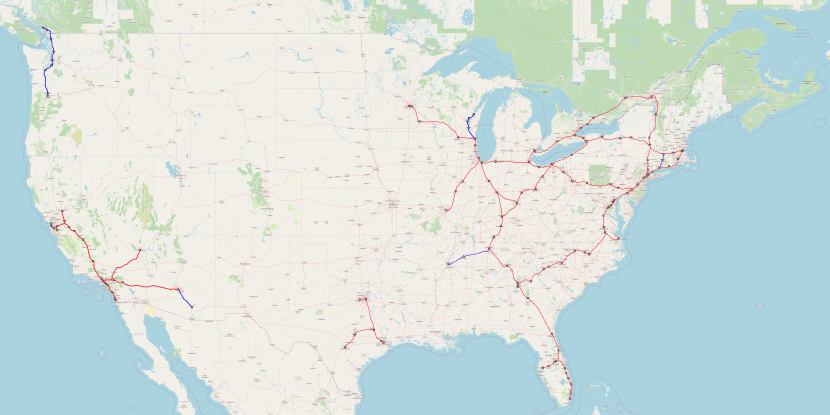
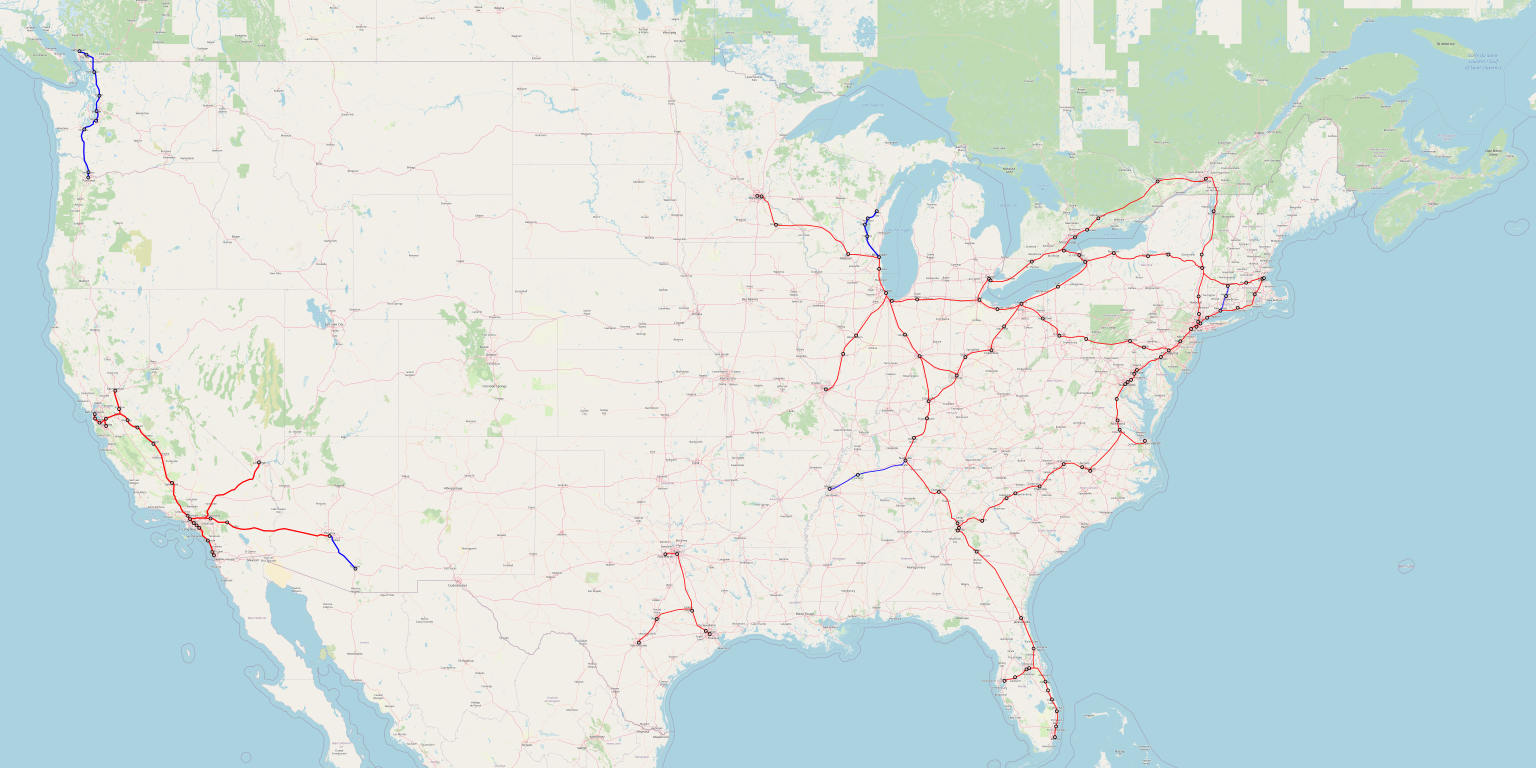
Europe has a number of strong national high-speed rail networks, providing much inspiration internally as well as abroad, including in the United States. With Americans looking at an infrastructure bill including high-speed rail funding, there’s a lot of discussion about what can port, hence my proposal map. That said, caution is required when doing naive comparisons with Europe. European urbanism doesn’t work the same as American urbanism, in two ways. First, European cities are more compact and transit-oriented than most American cities, which is why I somewhat discount American lines unless at least one city connected has public transit. And second, Europe has more, smaller cities than the rest of the urbanized world. This post concerns the second issue.
French and American urbanism: an example
A few months ago I poked around European and East Asian metro area lists. The upshot is that whereas in the three East Asian democracies 70% of the population lives in metropolitan areas larger than 1 million, in France only 33% does, and the median resident sorted by metro area size lives in a metro region of 350,000.
We can apply the same analysis to the United States. At the CSA level, the median American lives in Sacramento, population 2.6 million, and 68% live in metro areas of at least 1 million; at the MSA level, the median is Milwaukee, population 1.6 million, and 56% live in metro areas of at least 1 million. American metropolitan areas are unusually weakly-centered, especially at the CSA level, but otherwise they’re pretty typical of the urbanized world; it’s Europe that’s unusual in having such small cities.
The upshot is that people who are not used to this peculiarity of Europe who look at a map of European cities focus on million-plus metro areas, which are not the whole story here, especially not in France. This makes Europe look emptier than it is, which can lead people to overrate how much ridership a high-speed rail network would have at a fixed population.
France and the Midwest
Scott Hand posted a map on Twitter superimposing France on the Midwest with Chicago taking the place of Paris, arguing that they are similar in population and area:
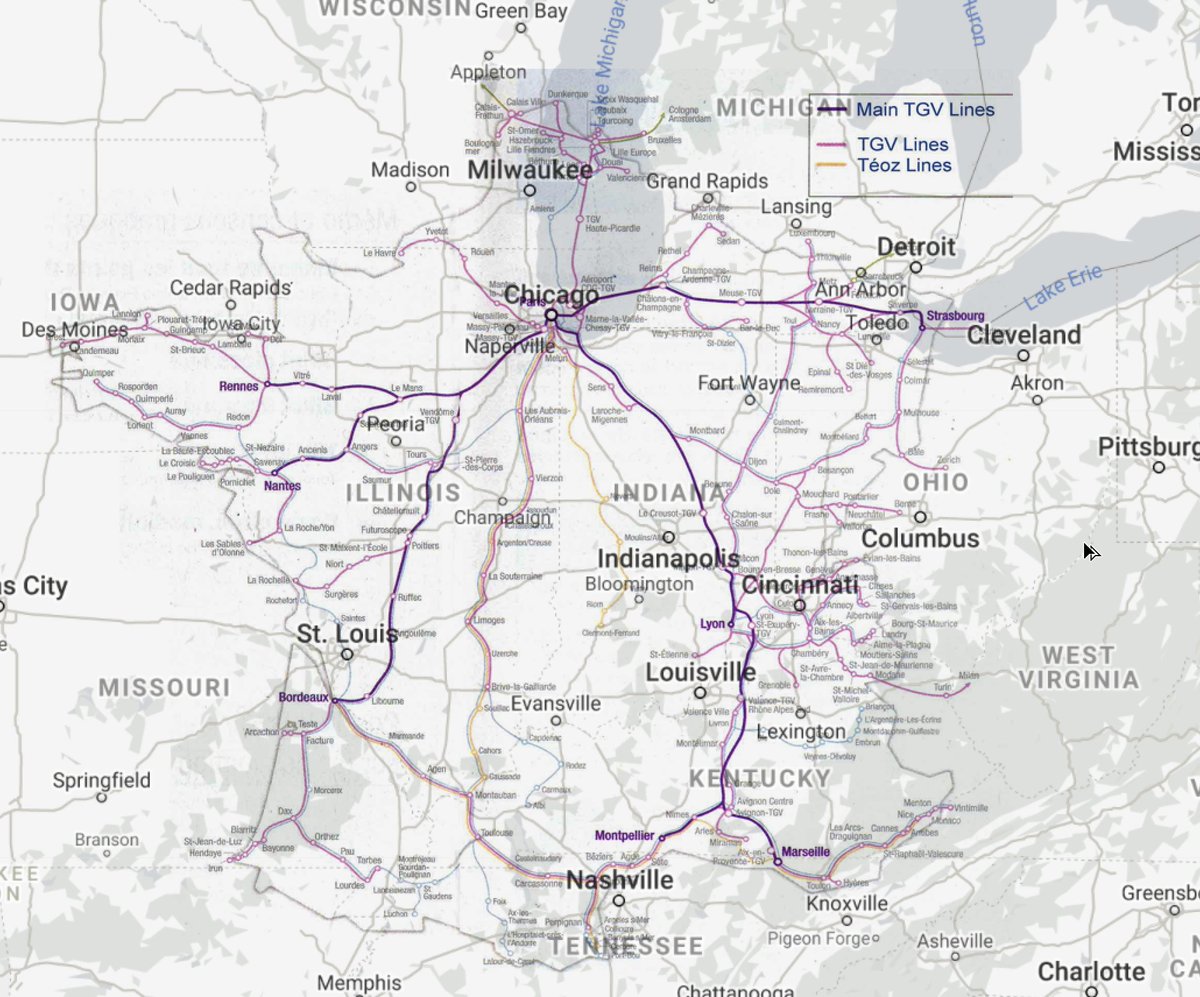
This is a good sanity check: your Midwestern network should be of comparable magnitude to the TGV network, rather than much larger. It’s easy to say, Lyon has 2.5 million people, Detroit has 5 million people, so clearly a line to Detroit is twice as good as one to Lyon, right? But no: French urbanism supplies many more small cities, which must be accounted for as well. At the end of the day, the populations are similar, even though, in addition to Chicago, the map has three cities (Detroit, St. Louis, Cleveland) with larger metro areas than Lyon and six more larger than Marseille (Milwaukee, Indianapolis, Nashville, Cincinnati, Columbus, Pittsburgh).
The LGV Sud-Est
It’s tempting to compare Paris-Lyon to Chicago-St. Louis. Yonah Freemark did this in 2009, and Jarrett Walker already pointed out in comments that the LGV Sud-Est was always about much more than this. On hindsight, I’ll add that even that sells the LGV Sud-Est short. High-speed rail between Paris and Lyon unlocked fast service from Paris to not just Lyon but also the following metro areas, all with 2016 populations:
- Dijon (385,000), demoted from the PLM mainline to a branch but still served
- Grenoble (688,000)
- Saint-Etienne (520,000)
- Chambéry (225,000)
- Annecy (236,000)
- Valence (187,000)
- Vienne (115,000)
- Bourg-en-Bresse (128,000), not on any direct train but still close enough by regional connection or car
What’s more, TGVs would branch from Part-Dieu along legacy lines to serve these smaller cities, albeit at low frequency. Now, with the LGV extending as far south as Marseille, Valence has a through-station on an LGV just outside the built-up area. There’s also Lyria service to thee major Swiss cities; Geneva, a metro area of 1 million, lies on a low-speed extension of the LGV Sud-Est, 3:11 from Paris.
Other than Geneva, which is invisible on the map because it is farther away, the other cities listed are all very small. In the United States, people don’t usually think of metropolitan areas of such size as urban, because they are extremely dispersed and socially identify as not-urban, and because metropolitan America operates at much larger size classes. But they have recognizable urban cores and their populations must be put into any ridership model trying to train data on TGV ridership. In fact, a gravity model with exponent 0.8 predicts that the combined TGV ridership from Paris to all the above cities, excluding Lyon, is nearly twice the ridership on Paris-Lyon.
And in this context, Chicago-St. Louis simply doesn’t compare. St. Louis is somewhat larger than Lyon, yes, but within 60 km, within which radius Lyon has independent Saint-Etienne, Vienne, Bourg, and Mâcon, St. Louis only has its own exurbs. To find a proper Midwestern comparison for the LGV Sud-Est and its extensions toward Marseille, one must go east of Chicago, toward Detroit and Cleveland. Within 60 km Detroit too only has its own CSA plus Windsor, but that CSA has 5 million people, and the same line also reaches Cleveland (CSA population 3.5 million), Toledo (900,000), and Pittsburgh (2.6 million) and points east.
What this means
Having fewer, larger cities doesn’t make it harder to build high-speed rail. On the contrary – it’s easier to serve such a geography. Asia lives off of such geography; Japan and Taiwan serve nearly their entire populations on just a single line, and Korea does on one mainline with a branch. An Asianized France would be able to serve nearly its entire population on the LGV network as-is without needing low-frequency branches to Chambéry- and Valence-scale cities, and an Asianized Germany would be able to just build an all-high-speed network and connect nearly everyone and not just half the population.
There are small cities that happen to lie on convenient corridors between larger cities, the way Valence is between Lyon and Marseille, or Augsburg and Ulm are between Stuttgart and Munich. Other small cities are close enough to large cities that they’re decently-served by a large city-focused rail network, like Saint-Etienne. Those cities are compact, so a large share of the population has access to the train – this is the explanation for the 0.8 exponent in the gravity model of ridership. But overall, most cities of that scale are strewn haphazardly around the country: examples include Limoges, Amiens, and Caen in France, and Osnabrück, Chemnitz, and Rostock here.
However, this doesn’t mean that, in analyzing the impact of population on ridership, we should just pretend the small cities don’t exist. They do, and they supply extra ridership that isn’t visible if one thinks city = metro area of 1 million or more. It’s an understandable way of thinking, but Europe has a lot of ridership generated from intermediate cities and from cities that have a regional rail connection to a big city or a less frequent direct intercity train, and the models have to account for it.
So yes, that the US has so many large-by-European-standards cities means high-speed rail would work well there. However, it equally means that a naive model that just says “this looks like the LGV Sud-Est” would underperform. A better model has to account for specific city pairs. American city pairs still look okay, even with extreme levels of sprawl at the outer ends, but ultimately this means the US can have a network of approximately the same scope of the LGV network, rather than one that is much denser.