The Problems of not Killing Penn Expansion and of Tariffs

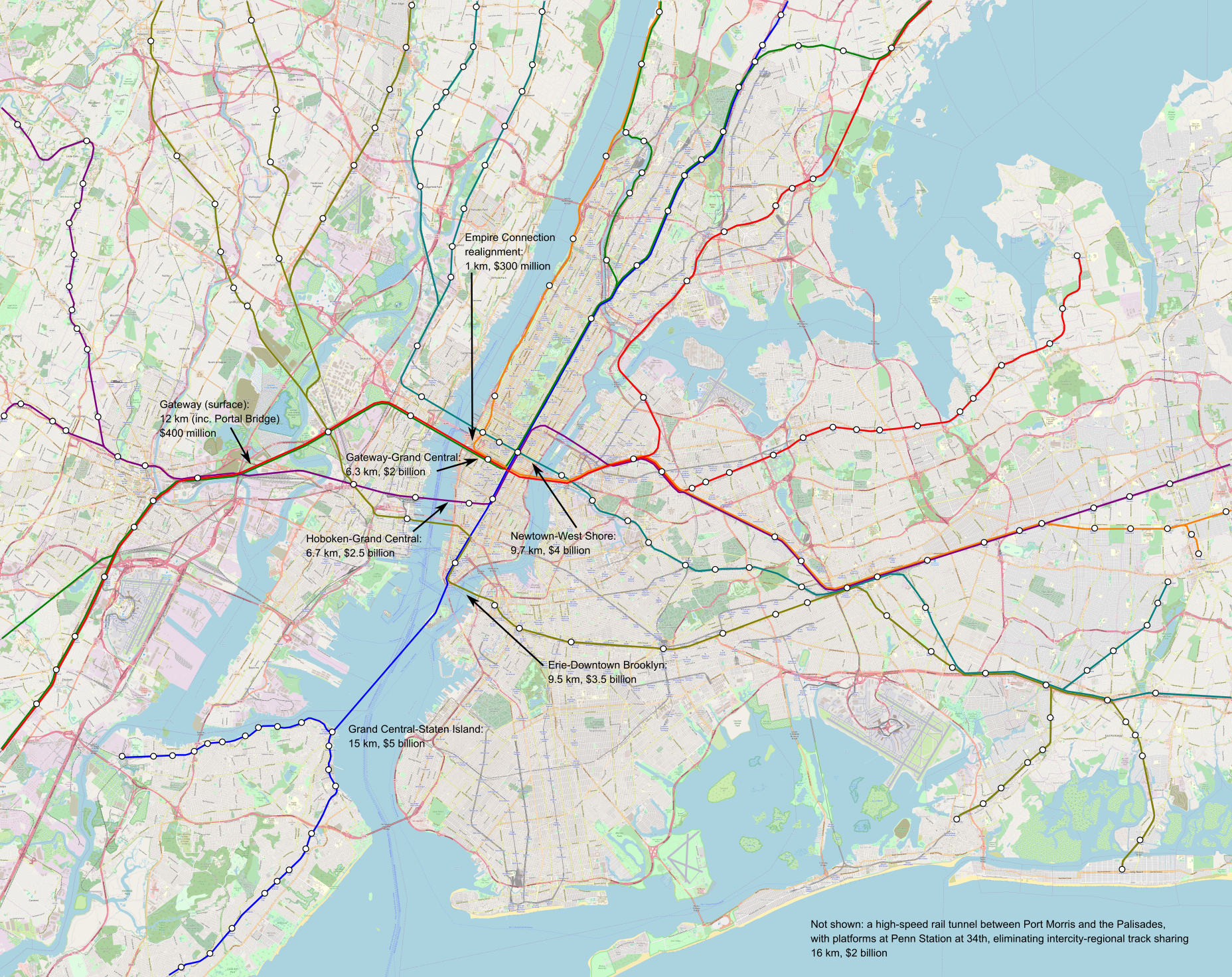
Penn Station Expansion is a useless project. This is not news; the idea was suspicious from the start, and since then we’ve done layers of simulation, most recently of train-platform-mezzanine passenger flow. However, what is news is that the Trump administration is aiming to take over Penn Reconstruction (a separate, also bad project) from the MTA, in what looks like the usual agency turf battles, except now given a partisan spin. I doubt there’s going to be any money for Reconstruction (budgeted at $7 billion), let alone expansion (budgeted at $17 billion), and overall this looks like the usual promises that nobody intends to act upon. The problem is that this project is still lurking in the background, waiting for someone insane enough to say what not a lot of people think but few are willing to openly disagree with and find some new source of money to redirect there. And oddly, this makes me think of tariffs.

The commonality is that free trade is not just good, but is more or less an unmixed blessing. In public transport rolling stock procurement, the costs of tariffs are so high that a single job created in the 2010s cost $1 million over 4-6 years, paying $20/hour. In infrastructure, in theory most costs are local and so it shouldn’t matter, but in practice some materials need to be imported, and when they run into trade barriers, they mess entire construction schedules. Boston’s ability to upgrade commuter rail stations with high platform was completely lost due to successive tightening of the Buy America waiver process under Trump and then Biden, to the point that even materials that were just not made in America (steel, FRP) could not be imported. The problem is that nobody was willing to say this out loud, and instead politicians chose to interfere with bids to get some photo-ops, getting trains that are overpriced and fail to meet schedule and quality standards.

Thus, the American turn away from free trade, starting with Trump’s 2016 campaign. During the Obama-Trump transition, the FTA stopped processing Buy America waivers, as a kind of preemptive obedience to something that was never written into the law, which includes several grounds for waivers. During the Trump-Biden transition, the standards were tightened, and waivers required the approval of a political office at the White House, which practiced a hostile environment, hence the above example of the MBTA’s platform problems. Now there are general tariffs, at a rate that changes frequently with little justification. The entire saga, especially in the transit industry, is a textbook example not just of comparative advantage, but of the point John Williamson made in the original Washington Consensus that trade barriers were a net negative to the country that imposes them even if there’s no retaliation, purely from the negative effects on transparency and government cleanliness. This occurred even though tariffs were not favored in the political elite of the United States, or even in the general public; but nobody would speak out except special interests and populists who favored trade barriers.

And Penn Expansion looks the same. It’s an Amtrak turf game, which NJ Transit and the MTA are indifferent to. NJ Transit’s investment plan is not bad and focuses on actual track-level improvements on the surface. The MTA has a lot of problems, including the desire for Penn Reconstruction, but Penn Expansion is not among them. The sentiments I’m getting when I talk to people in that milieu is that nobody really thinks it’s going to happen, and as a result most people don’t think it’s important to shoot down what is still a priority for Amtrak managers who don’t know any better.

The problem is that when the explicit argument isn’t made, the political system gets the message that Penn Expansion is not necessarily bad, but now is not the time for it. It will not invest in alternatives. (On tariffs, the alternative is to repeal Buy America.) It will not cancel the ongoing design work, but merely prolong it by demanding more studies, more possibilities for adding new tracks (seven? 12? Any number in between?). It will insist that any bounty of money it gets go toward more incremental work on this project, and not on actually useful alternatives for what to do with $17 billion.

This can go on for a while until some colossally incompetent populist of the type that can get elected mayor or governor in New York, or perhaps president, decides to make it a priority. Then it can happen, and $17 billion plus future escalation would be completely wasted, and further investment in the system would suffer because everyone would plainly see that $17 billion buys next to nothing in New York so what’s the point in spending a mere $300 million here and there on a surface junction? If it were important then Amtrak would have prioritized that, no? Even people who get on some level that the agencies are bad with money will believe them on technical matters like scheduling and cost estimation over outsiders, in the same manner that LIRR riders think the LIRR is incompetent and also has nothing to learn from outsiders.

The way forward is to be more formal about throwing away bad ideas. Does Penn Expansion have any transportation value? No. So cancel it. Drop it from the list of Northeast Corridor projects, cancel all further design work, and spend about 5 orders of magnitude less money on timetabling trains at Penn Station within its existing footprint. Don’t let it lurk in the background until someone stupid enough decides to fund it; New York is rather good lately at finding stupid people and elevating them to positions of power. And learn to make affirmative arguments for this rather than the usual “it will just never happen” handwringing.

New York Mayoral Race Thrown Wide Open as Cuomo is Prosecuted, Adams Removed

The June 24th Democratic primary for mayor of New York City has been thrown wide open as both the incumbent mayor Eric Adams and the frontrunner, former governor Andrew Cuomo, have been dealt serious blows. State prosecutors announced an indictment of Cuomo on multiple charges including sexual assault and corruption stemming from his response to the coronavirus pandemic in 2020. Shortly after the indictments were handed, Governor Kathy Hochul announced that in light of the corruption charges against the mayor, she would exercise her gubernatorial prereogative to suspend him for 30 days, and unless new exculpatory evidence came to light would remove him subsequently. The winner of the June primary, she said, will then be appointed as interim mayor until an election can be held.

The governor’s power to remove local officials, including mayors, has not been used since 1932, when governor and president-elect Franklin D. Roosevelt removed New York City Mayor Jimmy Walker following a corruption trial in which he served as prosecutor, judge, and jury. However, it remains part of the state constitution, and is not limited by the judiciary. Political operatives speculate that Hochul refrained from using this power against Adams partly because it had been so rarely used in the past but also partly to avoid empowering the wrong figures. With the new indictments against the former governor, it is speculated that the removal of Adams is intended to send a message to Cuomo that he’s a target as well should he become mayor.

Political figures in the city who have endorsed Cuomo in the primary express shock. A federally elected Democrat says that with Cuomo gone, there is a real risk of the anti-Israel Zohran Mamdani winning, and moderates and liberals should unite around a pro-Israel candidate, who the source did not yet name. The Brooklyn Democratic Party organization released a statement attacking Hochul for interfering with the election and saying that Cuomo’s handling of the pandemic was exemplary.

The remaining candidates in the primary who have made statements by the time this article has gone to press all reacted positively but reservedly. The two who have been running the deepest in the recent polls are Mamdani and City Comptroller Brad Lander, and who have so far refrained from responding to the shifting situation by attacking each other, both focusing on saying that Cuomo and Adams are not appropriate for leading New York.

Quick Note: Report on Electrification and Medium-Speed Rail Upgrades

Nolan Hicks has wrapped up nearly a year of work at Marron on a proposal called Momentum, to upgrade mainline rail in the United States with electrification, high platforms, and additional tracks where needed, short of high-speed rail. The aim is to build low- or perhaps medium-speed rail; the proposed trip times are New York-Albany in 2:05 (averaging 109 km/h) and New York-Buffalo in 5:38 to 5:46 (averaging 123 km/h). The concept is supposed to be used US-wide, but the greatest focus is on New York State, where the plan devotes a section to Network West, that is New York-Buffalo, and another to Network East, that is the LIRR, in anticipation of the upcoming state budget debate.

The costs of this plan are high. Nolan projects $33-35.6 billion for New York-Buffalo, entirely on existing track. The reasoning is that his cost estimation is based on looking at comparable American projects, and there aren’t a lot of such upgrades in the US, so he’s forced to use the few that do exist. A second track on single-track line is costed cheaply with references to various existing projects (in Michigan, Massachusetts, etc.), but third and fourth tracks on a double-track line like the Water Level Route are costed at $30 million/km, based on a proposal in the built-up area of Chicago to Michigan City.

In effect, the benefits are a good way of seeing what upgrades to best American industry practices would do. The idea, as with the costing, is to justify everything with current or past American plans, and the sections on the history of studies looking at electrification projects are indispensable. This covers both intercity and regional rail upgrades, and we’ve used some of the numbers in the drafts at ETA to argue, as Nolan does, against third rail extensions and in favor of catenary on the LIRR and Metro-North.

(Update 4-3: and now the full proposal is out, see here.)

Open BRT

BRT, or bus rapid transit, can be done in one of two ways: closed and open. Closed systems imitate rail lines, in that there is a BRT route along the entire length of the corridor; open ones instead take a trunk route, upgrade it with dedicated lanes and other BRT features, and let routes run through from it to branches that are not so equipped, perhaps because there is less traffic on the branches. I complained 14 years ago that New York City Transit was planning closed BRT in the form of SBS on Hylan Boulevard on Staten Island, a good route for open BRT. Well, now the MTA is planning BRT on the disused North Shore Branch of the Staten Island Railway, arguing that it is better than reactivating rail service because buses could use it as an open corridor – except that this is a poor corridor for open BRT. This leads to the question: which corridors are good for open BRT to begin with?

Trunks and branches are good

Open BRT can be analogized to a Stadtbahn system, fast in the core and slow outside it. Like a Stadtbahn, it works best where several branches can converge onto a single route, where the high traffic both requires higher capacity and justifies higher investment; just as grade separation increases the throughput of a rail line, BRT treatments increase those of a bus through greater separation from other traffic and regularity of service.

Unlike a Stadtbahn, open BRT remains a bus. This means two things:

  1. The trunk route must itself be a strong surface route. It had better be a wide street with room for physically separated bus lanes, or else a city center route that could be turned into a transit mall. A Stadtbahn system puts the fast central portion underground and could do it independently of the street network, or even run under a slow narrow street like Tremont Street in Boston.
  2. The connections from the trunk route to the branches must themselves be strong bus links. If the bus needs to zigzag on narrow residential streets to get between two wider arterials, then it will be unreliable and slow even if one of the wider arterials gets dedicated lanes. A Stadtbahn system can tunnel a few hundred meters here and there to ensure the onramps are adequate, but a surface bus system cannot, not without driving its cost structure to that of a subway but with few of the benefits of underground running.

The North Shore Branch could pass a modified version of criterion 1, but fails criterion 2. In general, former rail lines are bad for such BRT systems, since the street network was never set up for such connections. In contrast, street networks with a central artery and streets of intermediate importance between it and residential side streets emanating from it, which were never used for grade-separated rail lines, are more ideal for this treatment.

Grids are bad

Street grids eliminate the branch hierarchy of traditional street networks. There is still a hierarchy of more and less important grid streets – in Manhattan, the avenues and two-way streets are wider and more used for traffic than the one-way streets – but there is little branching. Bus networks can still branch if they move between streets, which happens in Manhattan, but it’s not usually a good idea: Barcelona’s Nova Xarxa uses the grid to run mostly independent bus routes, each route mostly sticking to a grid arterial, and the extent of branching on the Brooklyn, Queens, and Bronx bus networks is limited to a handful of short segments like the Washington Bridge.

In situations like this, open BRT would not work. Hylan is possibly the only route in New York that has any business running open BRT. For this reason, our Brooklyn bus redesign proposal, and any work we could do for Queens, Manhattan, or the Bronx, eschews the open BRT concept. The buses are upgraded systemwide, since features like off-board fare collection and wider stop spacing are not really special BRT features but are rather normal in, for example, the urban German-speaking world. Center bus lanes are provided wherever there is need and room. There is more identification of a bus route with the street it runs on, but it isn’t really closed BRT, which is a series of treatments giving the BRT routes dedicated fleets and stations, for example with left-side doors to board from metro-style island platforms like Transmilenio.

What this means more broadly is that the open BRT is not a good fit for most of North America, with its grid routes. Occasionally, a diagonal street could act as a trunk if available, but this is uncommon. Broadway is famous for running diagonally to the Manhattan grid, but that’s not a BRT route but a subway route.

Tokyo Construction Costs

Here is a list of Japanese subways and their construction costs, courtesy of Borners, who has been working on this as well as on a deep dive about London construction costs. I’d been looking for this data for years; someone in comments posted a link to a different sheet summarizing the same data years ago but I couldn’t find it.

Unfortunately, the list isn’t quite good enough to be used for all subway lines. The problem is that the numbers are given in nominal yen for the costs of constructing entire lines, including ones that opened in phases over many years during which inflation was significant. The table of lines and their construction costs in units of 100 million yen/km is as follows, with my best attempt at deflating to 2023 prices, still in units of 100 million yen/km; to convert to millions of dollars per km, the 2022 PPP rate is $1 = ¥94.93, so add 5.3% to all numbers in the penultimate column.

LineCost/kmFirst worksFirst openingFinal openingYear of pricesCost/km (real)Confidence
Marunouchi181951195419621956114Medium
Asakusa461956196019681961257Medium
Hibiya321959196119641961179High
Tozai411962196419691965181High
Mita911965196820001975182Low
Chiyoda691966196919791970236Low
Yurakucho1671970197419881979261Low
Hanzomon2551972197820031983336Low
Shinjuku2351971197819891976433Low
Namboku2621986199120011993291High
Oedo3111986199120001994343High
Fukutoshin2822001200820082005314High

The confidence level is a combination of the length of time it took to build the line and the inflation rate over that period. The Oedo and Namboku Lines opened in stages over a decade, but during that decade Japan had no inflation, and as a result price level adjustments are easy. In contrast, inflation in the 1960s was high but the Hibiya and Tozai Lines were built quickly, so that the uncertainty based on picking a year to deflate to is maybe 10%. The in between lines – Mita, Chiyoda, Yurakucho, Hanzomon – all opened in stages over a long period of time with significant inflation. This makes it hard to use them to answer the question, what was Tokyo’s cost history?

What the numbers suggest is that by the 1970s, construction costs were not much lower than they’d be in the 2000s; Japan having grown steadily in the 1970s and 80s, this means that its ability to afford new subways after the bubble burst in the 1990s was actually greater than in the 1970s. Construction costs have risen since – an extension of the Namboku Line to Shinagawa is budgeted at ¥131 billion/2.5 km and a branch extension of the Yurakucho Line from Toyosu to Sumiyoshi is budgeted at ¥269 billion/4.8 km. Toyosu-Sumiyoshi is in Shitamachi and has multiple canal crossings justifying an elevated cost, but Shirokane-Takanawa-Shinagawa is in easier topography, and while it has multiple subway crossings over a short length, so did the lines built in the 1990s and 2000s – the Fukutoshin Line has, over 9 km, five subway crossings and complex connections at both ends with through-running.

Cos Cob Bridge Replacement

The Northeast Corridor has eight movable bridges in Connecticut; other than one that was replaced in the 1990s, all are considered by Amtrak and Connecticut DOT to be both critical priorities for replacement and also major undertakings. The Bipartisan Infrastructure Law funded two, on the Connecticut and the Norwalk Rivers. The costs are enormous, beyond any justification: the Walk Bridge replacement is funded at $1 billion for a four-track bridge of 200 meters, and the replacement will still be a movable bridge rather than a fixed span with enough clearance below for boat traffic. The cost can be compared with an order of magnitude of tens of millions of dollars for comparable or longer bridges, for examples $50 million for one of the Rhone bridges on the LGV Méditerranée and $32 million for an 800 m viaduct on the Erfurt-Nuremberg line.

The goal of this post is to focus on the Cos Cob Bridge on the Mianus River. Among the eight bridges, it is the one with the least advanced plans for rehabilitation, such that no cost figure is given, but rumors put it in the mid-single digit billions for a viaduct of about 1 km, crossing about 250 m of water. Among the bridges west of New Haven, it is also the one with the most constrained alignment making replacement more necessary to fix the right-of-way geometry: the bridge itself is straight but flanked by two short, sharp curves, and replacement should be bundled with a wider curve.

The NEC Webtool outlines one alignment, with a wide curve, 2,400 meters in radius. The snag is the vertical alignment. The bridge needs to be high enough to clear boat traffic below; I-95 slightly upriver has a clearance below of 14.9 meters (Wikipedia says 21 meters but that’s the top of the deck, not the bottom), and with a typical deck thickness of 1.5 meters it means top of rail needs to be about 16.5 meters above sea level – but the Riverside station 450 meters east of the midpoint of the river has top of rail 10 meters above sea level and the Cos Cob station under the I-95 overpass 450 meters west of the midpoint is 8 meters above sea level. To build it as a high span thus requires rising 8.5 meters over 450 meters.

The current Northeast Corridor plans hew to a much lower ruling grade. The Walk Bridge is being replaced with another movable bridge and not a high fixed span because the standards call for a 1% grade. This is, frankly, dumb. The passenger trains are electric, either commuter rail EMUs or powerful intercity trains capable of climbing 4% grades over a short section, even the medium-speed Northeast Regionals. The freight trains are long enough that what matters isn’t so much the maximum grade as the maximum grade averaged over the length of a train, in which case peaking at 4% over a length of 450 meters is not at all problematic.

With a 4% standard, the question is not about the grade, but about the vertical curve radius. Standards for those are tighter than for horizontal curves. Vertical and horizontal curve radii both follow the formula ar = v^2, but the acceleration limit a is much tighter since there is no tilting or superelevation, and on a crest a high speed also reduces the effective weight acceleration and thus reduces train stability. In Germany, a is limited to 0.482 on a crest and 0.594 on a hallow, both requiring special permission; in Sweden, the German crest value is the minimum limit, with no special dispensation on a hallow. The upshot is that at 250 km/h, the exceptional vertical curve radius is 10,000 m and thus it takes 400 meters just to get to 4%; over a length of 450 meters, the maximum average gradient is 1.125% if the higher acceleration rate on a hallow isn’t used or 1.25% if is and the tracks can only rise respectively 5 or 5.5 meters. To make it 8.5, the speed limit needs to be reduced: at 200 km/h, the vertical curve radius is 6,400 meters and then over 225 meters the trains can get up to 3.5% and, if it’s symmetric, over 450 they can climb 7.9 meters, and if it’s asymmetric then they can climb more than the required 8.5%. It’s dirty but it does work.

The issue is then how this affects construction. I don’t know why the Connecticut bridge replacements are so expensive, beyond the observation that everything in Connecticut is exceptionally expensive, usually even by the standards of other Northeastern American rail projects (for example, infill stations), let alone European ones. The local press articles talk about staging construction to avoid disturbing the running track, and if this is the main difficulty, then building a new bridge 50 meters upriver should be much easier, since then the only part of the project interfacing with the existing track is the track connections on firma.

Whatever it is, a multi-billion dollar pricetag is not believable given the required scope. More difficult construction has been done for two orders of magnitude less on this side of the Pond. On a different mode but in the same region, the 10-lane 1.4 km long Q Bridge cost $554 million, around $790 million today, which, relative to the size of the bridge, is still around an order of magnitude cheaper than Walk and more than an order of magnitude cheaper than what Cos Cob is rumored to be.

YIMBY First, Building Reform Second

Last night I asked the American building reform advocates on Bluesky about different layouts and why developers don’t build them. I got different answers from different advocates about why the layout I’d just mocked of family-size apartments with two staircases isn’t being built in the US, some about regulations, but Mike Eliason said what I was most afraid of hearing: it’s doable but it’s more profitable to build small apartments. My conclusion from this is that while American and Canadian building regulations remain a problem and need to be realigned with European and Asian norms, they are a secondary issue, the primary one remaining how much housing is permitted to be built in the first place. Developers will keep building the most profitable apartment forms until they run out of the most profitable tenants.

The mockup

The following mockup has a scale of 1 meter = 20 pixels, so the building is overall 18 meters by 30. This is a point access block rather than a double-loaded corridor (see definitions here), but it also has two staircases, emanating from the central access block. Each floor has four apartments, each with three bedrooms and two bathrooms, the ellipses in the image denoting bathtubs. The windows are top and bottom, but not left and right; these are single-aspect apartments, not corner apartments.

On Bluesky, I said the floorplate efficiency is 94%; this comes from assuming the step width and landing length are 1.1 meters each, a metrization of the International Building Code’s 44″, but to get to 94% assumes the staircase walls are included in the 1.1 meter width, so either it’s actually 90 cm width or, counting wall thickness, the efficiency is only 92.5%. The IBC allows 90 cm steps in buildings with an occupancy limit of up to 50, which this building would satisfy in practice at six stories (a three-bedroom apartment marketed to a middle-class clientele averages closer to two than four occupants due to empty nests, divorces, guest rooms, and home offices) but not as a legal limit. Regardless, 92.5% is average by the standards of European point access blocks, whose efficiency is reduced because the apartments are smaller, and very good by those of American double-loaded corridors.

Now, to be clear, this is still illegal in many American jurisdictions, as Alfred Twu pointed out in @-replies. The building mockup above has two means of egress, but the typical American code also requires minimum separation between the two staircases’ access points. This is an entirely useless addition – the main fire safety benefits of two staircases are that a single fire can’t interpose between residents and the stairs if the two staircases are at opposite ends of the building, but that’s not legally required (quarter-point staircases are routine), and that the fire department can vent smoke through one staircase while keeping the other safe, which does not require separation. Nonetheless, this is not the primary reason this isn’t getting built even where it is legal, for example in jurisdictions that permit scissor stairs or have a smaller minimum distance between the two staircases, like Canada.

I was hoping the answer I’d get would be about elevator costs. The elevator in the mockup is European, 1.6*1.75 meters in exterior dimensions; American codes require bigger elevators, which is by itself a second-order issue, but then installation costs rise to the point that developers prefer long buildings on corridors for the lower ratio of elevators to apartments. But nobody mentioned that as a reason.

The rent issue

Mike Eliason responded to my question about why buildings like the above mockup aren’t being built by talking about market conditions. The above building, with 540 m^2 of built-up area per floor, can host four three-bedroom apartments, each around 127 m^2, or it can host 16 studios, each around 29 m^2. In Seattle, the studio can rent for $1,500/month; the three-bedroom will struggle to earn the proportionate $6,000/month.

It’s worth unpacking what causes these market conditions. The three-bedroom is marketed to a family with children. The children do not earn money, and, until they reach kindergarten age, cost thousands of dollars a month each in daycare fees; if they don’t go to daycare then it means the family only has one income, which means it definitely can’t afford to compete for building space with four singles who’d take four studios, or it has parents in the immediate vicinity, which is rare in a large, internally mobile country. The family has options to outbid the four singles, but they’re limited and require the family to be rather wealthy – two incomes are obligatory, at high enough levels to be able to take the hit from taxes and daycare; the family would also need to be wedded to living in the city, since the suburbs’ housing is designed entirely for families, whereas the singles take a serious hit to living standards from suburbanizing (they’d have to get housemates). In effect, the broad middle and lower middle classes could afford the studios as singles, but only the uppermost reaches of the middle class can pay $6,000/month for the three-bedroom.

In economic statistics, imputation of living standards for different household sizes takes this degressivity of income – $6,000/month for a family of four is a struggle, $1,500/month for a single is affordable on the average US wage – and uses a hedonic adjustment for household sizes. example by taking the square root of household size as the number of true consumption units. To INSEE, a family of four has 2.1 equivalent consumption units; elsewhere, it’s a square root, so it has 2 consumption units. A rental system that maintains a 4:1 ratio has no way for the family to compete.

The upshot is that the developers need to run out of the tenants who can most easily afford rent before they build for the rest. Normally it’s treated as a matter of distribution of units among different social classes, but here it’s a matter of the physical size of the unit. This is why YIMBY first is so important: eventually developers will run out of singles and then have to build for families.

16-Car Trains on the Northeast Corridor

The dominant length of high-speed rail platforms in China, Japan, South Korea, and Europe is 400 meters, which usually corresponds to 16-car trains. The Northeast Corridor unfortunately does not run such long trains; intercity trains on it today are usually eight cars long, and the under construction Avelia Liberty sets are 8.5 cars long. Demand even today is high enough that trains fill even with very high fares, and so providing more service through both higher frequency and longer trains should be a priority. This post goes over what needs to happen to lengthen the trains to the global norm for high-speed rail. More trains need to be bought, but also the platforms need to be lengthened at many stations, with varying levels of difficulty.

The station list to consider is as follows:

  • Boston South Station
  • Providence
  • New London-HSR
  • New Haven
  • Stamford
  • New York Penn Station
  • Newark Penn Station
  • Trenton
  • Philadelphia 30th Street
  • Wilmington
  • Baltimore Penn Station
  • BWI
  • Washington Union Station

Some of these are local-only stations – the fastest express trains should not be stopping at New London or BWI, and whether any train stops at Stamford or Trenton is a matter of timetabling (the headline timetable we use includes Stamford on all trains but I am not wedded to it). In order, allowing 16-car trains at these stations involves the following changes.

Boston

South Station’s longest platforms today are those between tracks 8 and 9 and between tracks 10 and 11, both 12 cars long. To their immediate south is the interlocking, so lengthening would be difficult.

Moreover, the best platforms for Northeast Corridor trains to use at South Station are to the west. The best way to organize South Station is as four parallel stations, from west to east (in increasing track number order) the Worcester Line, the Northeast Corridor and branches, the Fairmount Line, and the Old Colony Lines, with peak traffic of respectively 8, 12 or 16, 4 or 8, and 6 trains per hour. This gives the Northeast Corridor tracks 4-7 or possibly 4-9; 4-7 means the Franklin Line has to pair with the Fairmount Line to take advantage of having more tracks, and may be required anyway since pairing the Franklin Line with the Northeast Corridor (Southwest Corridor within the city of Boston) would constrain the triple-track corridor too much, with 12 peak commuter trains and 4 peak intercity trains an hour.

The platform between tracks 6 and 7 is 11 cars long, but to its south is a gap in the tracks as the interlocking leads tracks 6 and 7 in different directions, and thus it can be lengthened to 16 cars within its footprint. The platform between tracks 4 and 5 is harder to lengthen, but this is still doable if the track that tracks 5 and 6 merge into south of the station is moved in conjunction with a project to lengthen the other platform.

Of note, the other Boston station, Back Bay, is rather constrained, with nearly the entire platforms under an overbuild, complicating any rebuild.

Providence

Providence has 12-car platforms. The southern edge is under an overbuild with rapid convergence between the tracks and cannot reasonably be extended. But the northern edge is in the open air, and lengthening is possible. The northern edge would be on rather tight curves, which is not acceptable under most standards, but in such a constrained environment, waivers are unavoidable, as is the case throughout urban Germany.

New London

This is a new station and can be built to the required length from the start.

New Haven

The current station platforms are only 10 cars long, but there is space to expand them in both directions. The platform area is in effect a railyard, a good example of the American tradition in which the train station is not where the trains are (as in Europe) but rather next to where the trains are.

A rebuild is needed anyway, for two reasons. First, it is desirable to build a bypass roughly following I-95 to straighten the route beginning immediately north of the station, even cutting off State Street in order to go straight to East Haven rather than curve to the north as on the current route. And second, the current usage of the station is that Amtrak uses tracks 1-4 (numbered west to east as in Boston) and Metro-North uses tracks 8-14, which forces Amtrak and Metro-North trains to cross each other at grade from their slow-fast-fast-slow pattern on the running line to the fast-fast-slow-slow pattern at the station. In the future, the station should be used in such a way that intercity trains either divert north to Hartford or Springfield or go immediately east on a flying junction to the high-speed bypass toward Rhode Island, without opposed-direction flat junctions; the flying junction is folded into the cost of the bypass and dominates the cost of rebuilding the platforms, as the space immediately north and south of the platforms is largely empty.

Stamford

Stamford has 12-car platforms. Going beyond that is hard, to the point that a more detailed alternatives analysis must include the option of not having intercity trains stop there at all, and instead running 12-car express commuter trains, lengthening major intermediate stops like South Norwalk (currently 10 cars long) and Bridgeport (currently 8) instead.

To keep the mainline option of stopping at Stamford, a platform rebuild is needed, in two ways. First, the station today has five tracks, a both literally and figuratively odd number, not useful for any timetable, with the middle track, numbered 1 (from north to south the numbers are 5, 3, 1, 2, 4), not served by a platform. And second, the platform between tracks 3 and 5 can at best be lengthened to 14 cars, while that between tracks 2 and 4 cannot be lengthened without moving tracks on viaducts. This means that some mechanism to rebuild the station should be considered, to create four tracks with more space between them so that 16-car platforms are viable; this should be bundled with a flying junction farther east to grade-separate the New Canaan Branch from the mainline.

A quick-and-dirty option, potentially viable here but almost nowhere else, is selective door opening, at the cost of longer dwell times. Normally selective door opening should not be used – it confuses passengers, for one. However, here it may be an option, as intercity traffic here is unlikely to be high; traffic today is 323,791 in financial 2023, the lowest of any station under consideration in this post unless one counts New London. The only reason to stop here in the first place is commuter ridership, in which case mechanisms such as restricting unreserved seats to the central 12 cars can be used.

New York

Penn Station has multiple platforms already long enough for 16- and even 17-car trains, including the one we pencil for all high-speed intercity trains in the proposal, platform 6 between tracks 11 and 12, as well as the two adjacent platforms, 5 and 7. (Note that unlike at New Haven and Boston, platform numbers at Penn increase south to north, that is right to left from the perspective of a Boston-bound traveler.)

Thank the god of railways, since platform expansion requires a multi-billion dollar project to remove the Madison Square Garden overbuild in the most optimistic case; in a more pessimistic case, it would also require removing the Moynihan Station overbuild.

Newark

Newark Penn Station’s platforms are in a grand structure about 14.5 cars long. Thankfully, they extend a bit south of it, producing about 16 cars’ worth of platform on the west (southbound) side, between tracks 3 and 4; as in New York, track numbers increase east to west. On the east side, PATH interposes between the two tracks, which have a cross-platform transfer from northbound New Jersey Transit trains to PATH. The platform structures and their extensions do have enough length to allow 16-car trains – indeed they go as long as 18 – but the southern ends are currently disused and would require some rehabilitation.

Trenton

Trenton has a 12.5 car long southbound platform and an 11.5 car long northbound platform. There is practically no room for an expansion if no tracks are moved. If tracks are moved, then some space can be created, but only enough for about 14 cars, not 16.

However, traffic is low, the second lowest among stations under consideration next to Stamford. The suite of Stamford solutions is thus most appropriate here: selective door opening with only the middle 12 cars (naturally the same as at Stamford) open to commuters, or just not stopping at this station at all. The only reason we’re even considering stopping here is timetabling-related: trains should be running every 10 minutes around New York but every 15 between Baltimore and Washington, or else significant expansion of quad-tracking on the Penn Line is required, and so a local stop should be added as a buffer, which can be Trenton or BWI, and BWI has twice the current Amtrak traffic of Trenton.

Philadelphia

30th Street Station has 14-car platforms. Selective door opening is basically impossible given the high expected traffic at this station, and instead platform expansion is required. There is an overbuild, but the tracks stay straight and only begin curving after a few tens of meters, which gives room for extension; from the north end to the overbuild to where the tracks begin curving toward one another to the south is 15.5 cars, and there is room north of the overbuild between the tracks.

Whatever reconstruction project is needed is helped by the low traffic at these platforms. SEPTA uses the upper level of the station, with tracks oriented east-west. The north-south lower level is only used by Amtrak, which could be easily reduced to three platform tracks (two Northeast Corridor, one Keystone) if need be, out of 11 today. Thus, staging construction can be done easily and intrusively, with no care taken to preserve track access during the work, as half the station platforms can be closed off at once.

Wilmington

Wilmington is frustrating, in that there is platform space for 16 cars rather easily, but it’s on inconsistent sides of the tracks. Track numbers increase south to north; track 1 has a side platform, there’s an island platform between tracks 2 and 3, and then track 3 also has a side platform on the other side, extending well to the east of the island platform. The island platform and the track 1 platform are about 12.5 cars long, and the track 3 side platform is 13.5 cars long. Thus, an extension, selective door opening, or a station rebuild is required.

The island platform can be extended about one car in each direction, so it cannot be the solution without selective door opening. Both side platforms can be extended somewhat to the west: the track 1 platform can be extended to 16 cars, but it would need to be elevated in the narrow space between the track viaduct and the station parking garage; the track 3 platform can be extended in both directions, avoiding a new elevated extension over North King Street.

If for some reason an extension of the track 1 platform is not possible, then selective door opening can be used, but not as reliably as at lower-traffic Stamford or Trenton, and overall I would not recommend this solution. A station rebuild then becomes necessary: the station has three tracks but doesn’t need more than two if SEPTA and Amtrak can be timetabled right, and then the removal of either track 1 or track 2 would create space for a longer platform.

Baltimore

Baltimore Penn has seven tracks, numbered from south to north 1, 3, 4, 5, 6, 7, F. Their platforms are 10 to 13 cars long. Northbound trains are more or less forced to use the platform between tracks 1 and 3, since the way the route tapers to a three-, then four-track line to the east forces all eastbound trains to use mainline track 1; this platform is rather narrow at its east end but has space to the west for a 16-car extension. Westbound trains can use either the platform between tracks 4 and 5 or that between tracks 6 and 7, with tracks 4 and 6 preferred over 7 as they reach the express westbound track (track 5 stub-ends). Both platforms can be extended, with the platform between tracks 6 and 7 requiring a one-car extension to the east where a ramp down to track level for track workers exists whereas that between tracks 4 and 5 has ample unused space to its west.

BWI

The two side platforms at BWI are just under 13 cars long. However, nowhere else on the corridor is an extension easier: the station is located in an undeveloped wooded area, with space cleared on both sides of the track so that tree cutting is likely unnecessary west of the tracks and certainly unnecessary east of them.

The station itself needs a rebuild anyway, due to already existing plans to widen it from three to four tracks. This is required to enable intercity trains to overtake commuter trains anyway, unless delicate timetabling on triple track is used or another part of the Penn Line is set up as a four-track overtake. The plans are rather advanced, but platform extensions can be pursued as an add-on, without disturbing them due to the easy nature of the right-of-way.

Washington

Washington is set up as two separate stations, a high-platform terminal to the west and a low-platform through-station to the east on a lower level. Track numbers increase west to east, the western part taking 7-20 (though only 9-20 are high and wired) and the eastern part 23-30. None of the western platforms is long enough, but multiple options still exist:

  • The platform between tracks 9 and 10 has room for an extension.
  • The platforms between tracks 15 and 16 and between tracks 16 and 17 look like they already have extensions, if not open for passengers.
  • The platforms between track 17 and track 18 and between tracks 19 and 20 are only 12 cars long, but tracks could be cannibalized in the open air to make a long enough platform, especially since the reason track numbers 21 and 22 are skipped is that there used to be tracks there and now there’s empty space.
  • The platform between tracks 25 and 26 is long enough, and could be raised to have level boarding.

The existing platforms that can be extended easily are sufficient in number, but probably not in location – it’s ideal for the platforms to be close together, to simplify the interlocking as trains have to be scheduled to enter and leave the station without opposite-direction conflicts. If it’s doable even with a split between platforms separated by multiple tracks then it’s ideal, but otherwise, the extra work on tracks 17-20 may be necessary, converting a part of the station that presently has six tracks and four platforms into likely four tracks and two platforms.

Conclusion

All of this looks doable. The hardest station, Stamford, is skippable if selective door opening is unviable after all and a rebuild is too expensive. Among the other stations, light rebuilds are needed at Boston, Wilmington, and maybe Washington; New Haven needs a more serious rebuild as part of the bypass, but the station platforms are a routine extension where there is already room between the tracks. The most untouchable station, New York, already has multiple platforms of the required length at the required location within the station.

Northeast Corridor Profits and Amtrak Losses

In response to my previous post, it was pointed out to me that Amtrak finances can’t really be viewed in combination, but have to be split between the Northeast Corridor, the state-supported routes, and the long-distance trains. Long-distance is defined by a 750 mile (1,200 km) standard, comprising the night trains plus the Palmetto; these trains have especially poor financial performance. The question is what level of Northeast Corridor profitability is required to cover those losses.

In financial 2024 (ending 2024-09-30), Amtrak finances per route category were as follows, in millions of dollars or passenger-km or in dollars per p-km:

CategoryRidershipP-kmCostCost/p-kmRevenueRevenue/p-km
NEC144,053.31,146.80.2831,414.60.349
State-supported14.52,972.61,110.70.374859.20.289
Long-distance4.33,505.81,261.20.36626.10.179

The long-distance trains don’t actually have higher cost structure than the state-supported ones. Their greater losses are because fares are degressive in distance, and so the longer distances traveled translate to lower revenue per kilometer. This is also observable on some high-speed routes in Europe – the fares on TGVs using the LGV Sud-Est are very degressive, with little premium on Paris-Nice over Paris-Lyon despite the factor of 2.5 longer distance and factor of almost 3 longer time.

Revenue per passenger-km in France and Germany is around $0.15, as I explain in this post with links, and revenue per passenger-km in Japan is $0.25, both with average trip lengths similar to those of the Northeast Corridor and state-supported trains. Getting operating costs for just high-speed trains in France and Germany is surprisingly tricky; the Spinetta report says the TGV costs 0.06€/seat-km without capital, which at current seat occupancy is around 0.08€/p-km or around $0.11/p-km.

The upshot is that Northeast Corridor profits need to be $886.6 million a year to cover losses elsewhere, and if the operating costs on the corridor were the same as on the TGV, this could be achieved now with no further increases in service.

Now, in reality, high-speed rail would both massively increase ridership and also have to involve reducing fares to more normal levels than $0.35/p-km. If the revenue is $0.15/p-km and the cost is $0.11/p-km, then traffic in p-km has to rise to 22.165 billion/year, a fivefold increase, to cover. This is less implausible than it sounds – my gravity-based ridership model predicts about that ridership. Potentially, operating costs could be lower than on the TGV, if the entire corridor is (relatively) fast, with no long sections on slow lines as in France, and if traffic is less peaky than in France. But to first order, the answer to the profits question should be “probably but not certainly.”

Amtrak’s Failure

An article in Streetsblog by Jim Mathews of the Rail Passengers Association talking up Amtrak as a success has left a sour taste in my mouth as well as those of other good transit activists. The post says that Amtrak is losing money and it’s fine because it’s a successful service by other measures. I’ve talked before about why good intercity rail is profitable – high-speed trains are, for one, and has a cost structure that makes it hard to lose money. But even setting that aside, there are no measures by which Amtrak is a successful, if one is willing to look away from the United States for a few moments. What the post praises, Amtrak’s infrastructure construction, is especially bad by any global standard. It is unfortunate that American activists for mainline rail are especially unlikely to be interested in how things work in other parts of the world, and instead are likely to prefer looking back to American history. I want to like the RPA (distinct from the New York-area Regional Plan Association, which this post will not address), but its Americanism is on full display here and this blinds its members to the failures of Amtrak.

Amtrak ridership

The ridership on intercity rail in the United States is, by most first-world standards, pitiful. Amtrak reports, for financial 2023, 5.823 billion passenger-miles, or 9.371 billion p-km; Statista gives it at 9.746 billion p-km for 2023, which I presume is for calendar 2023, capturing more corona recovery. France had 65 billion p-km on TGVs and international trains in 2023.

More broadly than the TGV, Eurostat reports rail p-km without distinction between intercity and regional trains; the total for both modes in the US was 20.714 billion in 2023 and 30.89 billion in 2019, commuter rail having taken a permanent hit due to the decline of its core market of 9-to-5 suburb-to-city middle-class commuting. These figures are, per capita, 62 and 94 p-km/year. In the EU and environs, only one country is this low, Greece, which barely runs any intercity rail service and even suspended it for several months in 2023 after a fatal accident. The EU-wide average is 955 p-km/year. Dense countries like Germany do much better than the US, as do low-density countries like Sweden and Finland. Switzerland has about the same mainline rail p-km as the US as of 2023, 20.754 billion, on a population of 8.9 million (US: 335 million).

So purely on the question of whether people use Amtrak, the answer is, by European standards, a resounding no. And by Japanese standards, Europe isn’t doing that great – Japan is somewhat ahead of Switzerland per capita. Amtrak trains are slow: the Northeast Corridor is slower than the express trains that the TGV replaced, and the other lines are considerably slower, running at speeds that Europeans associate with unmodernized Eastern European lines. They are infrequent: service is measured in trains per day, usually just one, and even the Northeast Corridor has rather bad frequencies for the intensely used line it wants to be.

Is this because of public support?

No. American railroaders are convinced that all of this is about insufficient public funding, and public preference for highways. Mathews’ post repeats this line, about how Amtrak’s 120 km/h average speeds on a good day on its fastest corridor should be considered great given how much money has been spent on highways in America.

The issue is that other countries spend money on highways too. High American construction costs affect highway megaprojects as well, and thus the United States brings up the rear in road tunneling. The highway competition for Amtrak comprises fairly fast, almost entirely toll-free roads, but this is equally true of Deutsche Bahn; the competition for SNCF and Trenitalia is tollways, but then those tollways are less congested, and drivers in Italy routinely go 160 km/h on the higher-quality stretches of road.

Amtrak itself has convinced itself that everyone else takes subsidies. For example, here it says “No country in the world operates a passenger rail system without some form of public support for capital costs and/or operating expenses,” mirroring a fraudulent OIG report that compares the Northeast Corridor (alone) to European intercity rail networks. Technically it’s true that passenger rail in Europe receives public subsidies; but what receives subsidies is regional lines, which in the US would never be part of the Amtrak system, and some peripheral intercity lines run as passenger service obligation (PSO) with in theory competitive tendering, on lines that Amtrak wouldn’t touch. Core lines, equivalent to Chicago-Detroit, New York-Buffalo, Washington-Charlotte-Atlanta, Los Angeles-San Diego, etc., would be high-speed and profitable.

But what about construction?

What offends me the most about the post is that it talks up Amtrak’s role as a construction company. It says,

Today, our nationalized rail operator is also a construction company responsible for managing tens of billions of dollars for building bridges, tunnels, stations, and more – with all the overhead in project-management staff and capital delivery that this entails.

The problem is that Amtrak is managing those tens of billions of dollars extremely inefficiently. Tens of billions of dollars is the order of magnitude that it took to build the entire LGV network to day ($65.5 billion in 2023 prices), or the entire NBS network in Germany ($68.6 billion). Amtrak and the commuter rail operators think that if they are given the combined cost to date of both networks, they can upgrade the Northeast Corridor to be about as fast as a mixed high- and low-speed German line, or about the fastest legacy-line British trains (720 km in 5 hours).

The rail operations are where Amtrak is doing something that approximates good rail work – lots of extraneous spending, driving up Northeast Corridor operating costs to around twice the fares on German and French high-speed trains, probably around 3-4 times the operating costs on those trains. But capital construction is a bundle of bad standards for everything, order-of-magnitude cost premiums, poor prioritization, and agency imperialism leading Amtrak to want to spend $16 billion on a completely unnecessary expansion of Penn Station. The long-term desideratum of auto-tensioned (“constant-tension”) catenary south of New York, improving reliability and lifting the current 135 mph (217 km/h) speed limit, would be a routine project here, reusing the poles with their 75-80 meter spacing; an incompetent (since removed) Amtrak engineer insisted on tightening to 180′ (54 m) so the project is becoming impossibly expensive as the poles have to be replaced during service. “Amtrak is also doing construction” is a derogatory statement about Amtrak.

Why are they like this?

Americans generally resent having to learn about the rest of the world. This disproportionately affects industries where the United States is clearly ahead (for example, software), but also ones where internal American features incline Americans to overfocus on their own internal history. Railroad history is rich everywhere, and the relative decline of the railway in favor of the highway lends itself to wistful alternative history, with intense focus on specific lines or regions. New Yorkers are, in the same vein, atypically provincial when it comes to the subway’s history, and end up making arguments, such as about the difficulty of accessibility retrofits on an old system, that can be refuted by looking at peer American systems, not just foreign ones.

The upshot is that an industry and an advocacy ecosystem that both intensely believe that railroad decline was because government investment favored roads – something that’s only partly true, since the same favoring of roads happened more or less everywhere – will want to learn from their own local histories. Quite a lot of advocacy by the RPA falls into the realm of trying to revive the intercity rail system the US had in the 1960s, before the bankruptcies and near-bankruptcies that led to the creation of Amtrak – but this system was what lost out to highways and cars to begin with. The innovations that allowed East Asia to avoid the same fate, and the innovations that allowed Western Europe to partly reverse this fate, involve different ideas of how to build and operate intercity rail.

And all of this requires understanding that, on a basic level, Amtrak is best described as a mishmash of the worst features of every European and East Asian railway: speed, fares, frequency, reliability, coverage. Each country that I know of misses on at least one of these aspects – Swiss trains are slow, the Shinkansen is expensive, the TGV has multi-hour midday gaps, German trains barely run on a schedule, China puts its train stations at inconvenient locations. Amtrak misses on all of those, at once.

And while Amtrak misses on service quality in operations, it, alongside the rest of the American rail construction industry, practically defines bad capital planning. Cities can build the right project wrong, or build the wrong project right, or have poor judgment about standards but not project delivery or the reverse, and somehow, Amtrak’s current planning does all of these wrong all at once.