Commuter Rail to Staten Island
A debate in my Discord channel about trains between Manhattan and Staten Island clarified to me why it’s so important that, in the event there is ever rail service there, it should use large commuter trains rather than smaller subway stations. The tradeoff is always that the longer trains used on commuter services lead to higher station construction costs than the smaller trains used on captive subway lines. However, the more difficult the tunnel construction is, and the fewer stations there are, the smaller the cost of bigger trains is. This argues in favor of commuter trains across the New York Harbor, and generally on other difficult water or mountain crossings.
When costing how much expansive commuter rail crayon is, like my Assume Normal Costs map, I have not had a hard time figuring out the station costs. The reason is that the station costs on commuter rail, done right, are fairly close to subway station costs, done wrong. As we find in the New York construction cost report, Second Avenue Subway’s 72nd and 86th Street stations were built about twice as large as necessary, and with deep-mined caverns. If you’re building a subway with 180 m long trains under Second Avenue, then mining 300-400 m long stations is an extravagance. If you’re building a regional rail tunnel under city center, and the surface stations are largely capable of 300 m long trains or can be so upgraded, then it’s normal. Thus, a cost figure of about $700 million per station is not a bad first-order estimate in city center, or even $1 billion in the CBD; outside the center, even large tunneled stations should cost less.
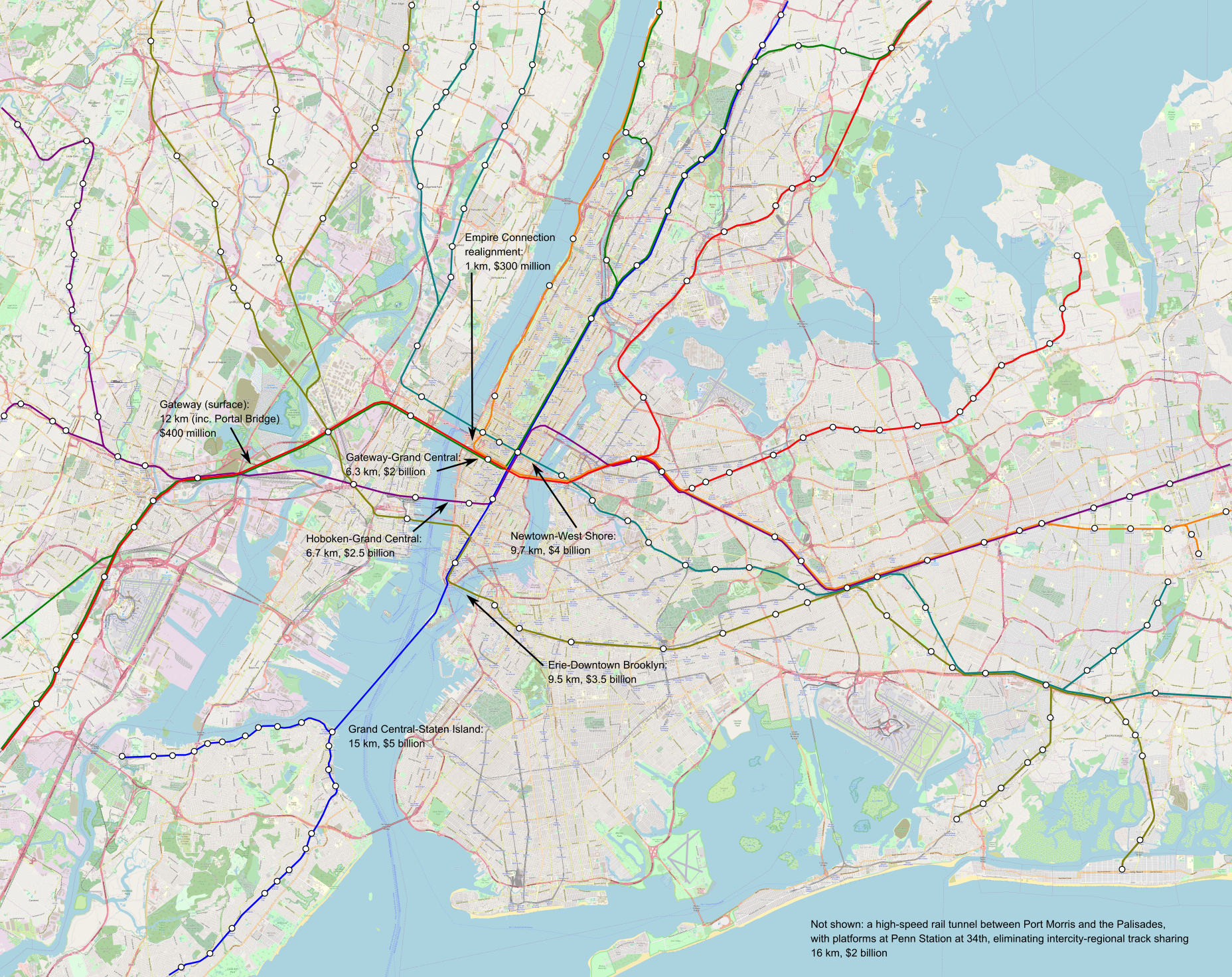
The cost above can be produced, for example, by setting the Union Square and Fulton Street stations at a bit less than $1 billion each (let’s say, $1.5 billion each, with each colored line contributing half), and a deep station under St. George at $500 million, totaling $2 billion. The 15 km of tunnel are then doable for $3 billion at costs not far below current New York tunneling costs. Don’t get me wrong, it still requires cost control policies on procurement and systems, but relative to what this includes, it’s not outlandish.
This, in turn, also helps explain the concept of regional rail tunnels. These are, in our database, consistently more expensive than metros in the same city; compare for example RER with Métro construction costs, or London Underground extensions with Crossrail, or especially the Munich U- and S-Bahn. The reason is that the concept of regional rail tunneling is to only build the hard parts, under city center, and then use existing surface lines farther out. For the same reason, the stations can be made big – there are fewer of them, for example six on the original Munich S-Bahn and three on the second trunk line under construction whereas the Munich U-Bahn lines have between 13 and 27, which means that the cost of bigger stations is reduced compared with the benefit of higher capacity.
This mode is then appropriate whenever there is good reason to build a critical line with relatively few stations. This can be because it’s a short connection between terminals, the usual case of most RER and S-Bahn lines; in the United States, the Center City Commuter Connection is such an example, and so is the North-South Rail Link if it is built. This can also be because it’s an express line parallel to slower lines, like the RER A. But it can also be because it doesn’t need as many stations because it crosses water, like any route serving Staten Island.
The flip side is that whenever many stations are required on an urban rail tunnel, it becomes more important to keep costs down by, potentially, shrinking the station footprint through using shorter trains. In small enough cities, as is the case in some of the Italian examples discussed in that case, like Brescia and Turin, it’s even possible to build very short station platforms and compensate by running driverless trains very frequently, producing an intermediate-capacity system. In larger cities, this trick is less viable, but sometimes there are corridors where there is no alternative to a frequent-stop urban tunnel, such as Utica in New York, and then, regional rail loses value. But in the case of Staten Island, to the contrary, commuter rail is the most valuable option.
 Pedestrian Observations
Nice article Alon. However, whatever happened to the plan which had been about at the time to build a railway tunnel from Bay Ridge 95 Street BMT subway station in Brooklyn under the Narrows to connect the BMT with the Staten Island lines and coaches were built for the Staten Island electrification which would also be of dimensions to run on the BMT should a connection be built.
Unfortunately it never was built and today one of the world’s greatest suspension bridges, the Verranzano-Narrows bridge is a vehicular link in a place near the planned tunnel. That was all planned back in 1925, which will be 100 years ago, and the express bus network is already maxed-out as well.
Had this line and tunnel been built, this would have been positive for the many people of Staten Island as well.
Have a nice Thanksgiving weekend as well.
Alon does include this in the plan the above map is from (https://pedestrianobservations.com/2023/06/18/assume-normal-costs-an-update/). See the R extension from Bay Ridge-95 St to Grasmere on SIR.
But it’s important to also have this direct connection to Manhattan across the harbor. The R from 95 St to Cortlandt (near Fulton) is 38 min on the R, and you could optimistically save ~5-6 min by transferring to the N at 59th and back again at Atlantic. And the R from 95 St to Times Sq is 43 min with a transfer to the N at 59th. And the 95 St to SI (Fort Wadsworth) tunnel would take about 3 min (1.7 mi at 40 mph average speed, quite high for the subway). Alternatively, the regional rail tunnel from St George to Fulton (6 km) would take 3 min assuming a FLIRT-like train and a top speed of 100-125 mph. Continuing to midtown with stops at Union Sq and GCT would bring you to about 7-8 min. So if you compare 3 min SI to downtown Manhattan vs. 41 min, or 8 min SI to midtown vs. 46 min, the regional rail tunnel is astoundingly faster. This is measuring from Fort Wadsworth vs. St George, but the time difference is so large that the regional rail tunnel will win in almost all cases, save for those in southern Brooklyn. Even downtown Brooklyn (Atlantic) would be about 10 min from St George with a transfer to the LIRR regional rail to Atlantic, vs. 21 min on the R and N from Ford Wadsworth. Even if you measure both from Grasmere with current SIR speeds (FLIRTs will likely be somewhat faster), regional rail would be 20 min vs. 25 min on the R and N.
The trains and stations have to be the same size or problems ensue. Especially if the trains are wider/taller than the stations. Except that BMT/IND cars are shorter, and have more doors, what’s the difference between LIRR/Metro North cars and BMT/IND cars?
Crayonista love to draw lines. Passenger railroads exist to move passengers not trains. The demand in Staten Island is never going to balanced with all of Metro North. It wouldn’t be balanced with one subway line.
There is also that pesky pesky pesky problem that if you send all of Metro North to New Jersey there can’t be any trains going to Staten Island. And none go to Long Island. Pesky.
Apparently you didn’t look very carefully at the map in the post, which shows 2 of the 4 Metro North tracks going to Staten Island, and the other 2 to New Jersey. And it’s not a “problem” that there would be no direct trains from Metro North to Long Island, because there are good transfers at Grand Central etc.
I looked carefully enough at the map to see that it would make sense in some dystopian future where there are no automobiles.
If you send half of them to New Jersey that means very few of the people in New Jersey can get to Grand Central without changing to very crowded trains. They still can’t go to Grand Central and Long Island at the same time.
This plan has approximately 60 trains per hour (green and purple lines) from NJ to Grand Central nonstop. “Very few” lol.
Also 60 tph from Grand Central to Long Island (purple and teal lines).
Also 90 tph from New Jersey to Long Island (red, purple, teal lines).
Just because it’s east of Fifth Ave doesn’t mean the teal line goes to Grand Central. The cost estimate is… unrealistic.. Send 40 trains an hour eastbound under the Hudson it can’t be 40 trains an hour to Grand Central and 40 trains an hour to Long Island. Pesky pesky pesky arithmetic.
Considering that Manhattan already has high modal share I think I’ll change my mind and decide that even without automobiles it’s an excessive amount of capacity even for an especially frothy crayonista on a very enthusiastic day.
Here on planet Earth people in the suburbs lead rich and fufilling lives without going to Manhattan or crossing it to get to the same kind of chain stores they have nearby. There is also a limit to how many cubicles you can shove into Manhattan before relocating to Columbus Ohio starts to look good.
There might be someday two more tunnels from New Jersey to Midtown. And someday, because Midwesterners keep moving to Jersey City or Bushwick a connection between the LIRR and NJTransit through “Wall Street”. And at that point unless people are commuting from Ohio and Virginia that’s enough capacity.
@adirondacker How can you say for sure that that is “too much” capacity? If you take Paris as an example, it’s you only count the RER, as I understand it that’s like 104 through-running trains per hour (RER A 24, RER B/D 32, RER C 24, RER E 24). Considering NYC’s metro area is much larger, the six 24tph through running lines in the map don’t seem unreasonable! Obviously the circumstances are different, but the order of magnitude seems right.
New York City has an RER. Has had it since the first subway opened with… express …. service. To the farmland in the outer boroughs. Would you be happier if they called Columbus Circle, La Defense and the A train RER A1 when it’s headed to Lefferts Blvd? RER A2 when it’s headed to Far Rockaway and RER A3 when it’s headed to Rockaway Park? They could build a pyramidal greenhouse in Battery Park too. Plant more trees along Broadway and rename it Champs Elysee?
Another set of tunnels to Midtown would be 50 percent more capacity. More than 50 percent because PATH trains are short and narrow. And more than doubling the capacity of the lonely only set of PATH tracks if the LIRR and NJTransit connect through Brooklyn. Because PATH trains are short and narrow.
It’s splattering crayon lines for the sake of splattering lines.
As you rightly point out, the NYC subway doesn’t go everywhere (e.g. to NJ). Also keep in mind that the stop spacing and line speed of the Paris RER is much higher than for the existing subway expresses. The same would be true of Alon’s proposed through running lines, probably even more so. Thus they wouldn’t serve the same purpose, and shouldn’t be seen as being in competition.
Adirondacker is correct that the New York Subway express lines do a lot of what the RER does. The Paris Metro is extremely compact, with lines ending 8-10km from Les Halles. The RER stretches out around 25-35km. NYS lines end about 15-20km from Times Sq (excepting Far Rockaway). Much of what the RER does in moving people from inner suburbs to the core the NYS already does.
Adirondacker is completely wrong in most of his analysis of Alon’s proposed lines. The teal line does in fact go to Grand Central because . . . it runs right through the station marker where Grand Central is. A child could grasp this instantly by looking at the map. The plan sends lines Grand Central from NJ and four lines from NJ to LI (the teal line does both) – again, even the simplest person should be able to understand this by looking at the line colors. Adirondacker saying “pesky arithmetic” over and over doesn’t change this.
Where Adirondacker is right again is that this level of commuter rail is overkill. Six tracks from NJ (two Penn-LI, two Penn-GCT, two Hoboken to Brooklyn via Wall St) is more than sufficient. If you send the other LIRR tracks up the Empire Connection this would be 96 tph through running, plus up to another 48 tph terminating at GCT (24 from Metro North, 24 from LIRR via East Side Access). That is a lot of capacity. Two brand new Hudson crossings (teal and purple) plus associated cross town tunneling plus a cross harbor line to Staten Island is just more than is needed right now.
@Eric2 You should assume 24 tph for a mainline commuter rail system, not 30 tph like a subway. RER B only manages 32 tph because its two track section is between two four track sections and has no stations. Also there are 4 lines NJ to LI, red/purple/teal through midtown and olive through downtown.
Arithmetic is cruel cruel cruel mistress. You can’t send 40 trains eastbound under the Hudson River and have 20 of them go to Grand Central, 30 of them go to Long Island and 6 of them go to New Haven. Railfans have to take their collective thumbs out of their nether regions and come to terms with arithmetic and reality. Sending 20 of them to Grand Central and 20 of them to Long Island fucks over the magical mystical through running to Stamford, center of the universe, from New Brunswick. If you send them to the New Haven line they can’t go to Long Island. Arithmetic is cruel cruel mistress.
I have better things to do than reiterate the rest of the cockamamie clueless railfanery. Again.
“You can’t send 40 trains eastbound under the Hudson River and have 20 of them go to Grand Central, 30 of them go to Long Island and 6 of them go to New Haven.”
Alon’s map is very clear. Two tracks (teal) from NJ to GCT to LI; two tracks (red) from NJ to Penn to LI then splitting between the Port Wash branch and the New Haven Line; two tracks (green) from NJ to Penn to GCT splitting to a combination of the Hudson and the Harlem/New Haven lines; two tracks (purple) from NJ to Herald Sq to GCT to LI; two tracks (olive) from NJ to downtown to Brooklyn to LI. Depending on how the branches interact elsewhere that is 100-120 tph from NJ, of which 70-84 go to LI and 30-36 go to somewhere north. This is very simple to understand.
“You can’t . . . have 20 of them go to Grand Central . . . and 6 of them go to New Haven.”
“Sending 20 of them to Grand Central . . . the magical mystical through running to Stamford,….”
Perhaps you are not familiar with rail in the New York area. Trains going to New Haven or Stamford run on the MNRR New Haven line. The New Haven line runs from Grand Central. So with the proper infrastructure (looking at you ARC Alt G, or Alon’s plan here) you can run 40 trains across the Hudson and send 20 to GCT, 20 to Stamford or New Haven, and 20 to Long Island, because the 20 to GCT and the 20 to Connecticut are the same trains, they stop in GCT on the way to Stamford or New Haven.
Unlike clueless railfans from the hinterlands I managed to get in and out of Manhattan by mass transit, all of my life. For years, daily, to and from work, on time. And understood that when I got to my bus stop I didn’t want the crosstown bus or buses, I didn’t want the downtown bus when I wanted the Manhattan bus or the Manhattan bus when I wanted the downtown bus. The downtown bus got me to Penn Station Newark where I again understood that the PATH trains went downtown and the other trains went “uptown” to Penn Station New York.
There isn’t going to be a teal line. Because even if automobile traffic into Manhattan is banned suburbanites lead rich fulfilling lives without going into Manhattan. There isn’t going to be a lot of the crayon lines splattered all over Manhattan.
The wily wily very clever MTA understands that the existing in use tracks from the New Haven Line to Penn Station will be a lot cheaper to use than mindlessly digging tunnels across Midtown. Mostly because almost none of them are clueless railfans from the hinterland who think all the trains have to stop everywhere. Even people in Stamford, who have been coping with the fact that most trains going south go to Grand Central but some of them go to Penn Station. And beyond!! !! And don’t stop at every station along the way!! !! Since 1917. And people along the New Haven line who want to get to Penn Station will not be disappointed, perturbed, upset or even think about how they missed passing through Woodlawn express, stopping at Fordham, 125th or Grand Central. Because they are going to the West Side not the fucking Bronx or the East Side.
Of course, 2 arguments for subway integration vs heavy rail are
1)the integration is already there, with no need for station infrastructure in Manhattan. Send 6 (currently R) trains an hour to SI via a Narrows or new harbor tunnel. If not possible, send J trains thru a new harbor tunnel.
2)SIR stations are short, with maybe the longer ones 300ft. Again, longer trains will require extensive, expensive platform widening.
Of course, a lot of tradeoff analysis is needed. Harbor tunnel vs Narrows vs Bayonne. Harbor would allow shorter rides to lower Manhattan, and likely midtown. A Bayonne option would make sense if there was an initiative to bring NJ transit to a new lower Manhattan station (talk about pipe dreams). It seems intuitive that a Bayonne option would be least cost, with lowest extent of submarine tunnels. And I would say that because of where tunnels would reach SI, any option would reuire some branching on SI.
Going to Bayonne is going in the wrong direction and once they get to Bayonne there isn’t anyplace for them to go. There are people already using the existing trains
The R train is the only train that goes to Bay Ridge. The trains can’t go to Bay Ridge and to Staten Island unless you want to send them local from 59th Street to 95th Street/Bay Ridge and then to Fort Wadsworth in Staten Island. Which isn’t anywhere near the existing trains.
Send Triboro or Interboro or whatever they are calling it this week, from 65th Street in Sunset Park to St. George and they can change to the N at the 8th Ave N stop, 62nd St. D train stop, Ave I F train stop, Ave H Q train stop, Flatbush Ave./Brooklyn College on the 2 and the 5 trains, the 3 at Junius/Livonia and the A,C, J/Z and L trains at Broadway Junction.
Well,
The point of the crosstown train is to get people crosstown. Not to get people to Manhattan which is what the L train does. So does the R train.
a People on Staten Island aren’t going to schlep all the way to Manhattan on the local. And the long way around to get to Midtown. If they are changing trains anyway it doesn’t matter which train goes to Saint George. Send the … crosstown… they can change to the N/Broadway train at 8th Ave and the D/Sixth Ave at 62nd/New Utrecht or get to other destinations in Brooklyn.
C & D Why do railfans ignore that passenger trains carry passengers. There are already passengers using the capacity from New Jersey to Manhattan. Staten Islanders won’t have a way to get from New Jersey to Manhattan.
E the freight tunnel isn’t going to Staten Island. It’s going from Brooklyn to Jersey City.
All makes sense.
As a railfan, I never forget that pax trains carry pax, and in fact do a darned good job of it in our region [could be even better with some interlining, parking improvements, first mile last mile shuttles, heavy rail connection to LGA, and possibly feeder airports [TEB, SWF, HPN],resolution of the LIRR/MNR fare penalty, a bunch of grade separated xings here in NJ, and more.]
Of course, whatever line(s) carry SI traffic towards midtown need to do so express.
In terms of the possibilities of getting a few Interboro trains to NJ every hour, it would give them
(a) EWR
(b) Newark Penn, which is a heck of a hub for NJ Transit [including heavy rail light rail, and 29 bus lines] and PATH
(c) The possibility of continuing to Lautenberg, affording a single change to a bunch of NJT rail lines.
We all get
(a) the need for resilient networks, and
(b) the need for supporting the breadth of travel outside of traditional commute to business hubs.
Someone has to take your crayons away until the drugs, whatever you are on, wear off.
People who fly private jets into Teterboro Airport are not going to get on a train. Or get on a train when they are flying out. The rest of it is almost as equally phantasmagorical.
Call me hopeless fan of intermodal transit.
Staten Island is less than 500k people. Why would you run long trains there? Are these trains continuing south to pick up more people? Do you have a realistic upzoning plan such that you think the population will be much larger in the near future (if the future is very distant than let our grandkids figure out what system make sense for their problems). Otherwise just run many short trains and let the people enjoy the benefits of fast frequent service. You won’t save much with shorter stations, but it is still wasting money to build them.
there should be a train line from nj through Staten Island , would connect the whole area so well . But nothing will ever happen bc peope always have to complain ! Really a shame
It’s already very useful to extend one of the Grand Central lines to Lower Manhattan, so that Metro North riders can get to Wall Street etc (and Brooklyn) quickly without clogging up the subway. And once you’ve gone that far and also built tail tracks, the ROI on an underbay crossing is likely good – construction cost isn’t *that* high (no intermediate stops needed) and Staten Island access is vastly improved.
Yes it would be nice to upzone Staten Island afterwards, but the project would still be worthwhile even without that.
If we are extending an existing line then the question is moot: you build stations for the trains you already have and are running on that line. Or if you have serious plans you build larger stations, but you also start expanding your stations on the rest of the line and buying larger stations. However the stations need to be long enough to handle the trains you are running today and it isn’t worth it to build them bigger for a future that might not happen.
On many systems that farther system only has enough riders for a smaller station and trains, but they have to make it full size because that is the size of the trains. (opening only some doors of the train is an option, but that only saves platform length, you still need to have room for the rest of the train)
really too bad nothing ever happpens in nyc though !! Wishful thinking for the rest of my life. NYC used to be one of the biggest cities in the world but is falling way behind bc nothing ever changes. The cross harbor tunnel proposal for the last 150 years never happened . And this won’t either. Fucking sucks I wish I could move
(Only approving this comment, not the next one you wrote, because they’re kinda duplicated and it’s a spamfilter issue.)
There is simply no justification for the commuter rail to Staten island line (Grand Central to St George then take over SIRR). Among the numerous issues:
Alon, you are smarter than this. You must be able to realize the above points. Why are you proposing this?
a) SIRR currently gives very low quality service, because one has to transfer to the infrequent ferry and then (for destinations not in walking range of the ferry) transfer again to the subway. Overall this is an extremely slow and quite inconvenient and unreliable trip. It is reasonable to expect SI ridership to rise dramatically if a one seat rail trip is created. Even more if the north shore line is rebuilt. Even more so with upzoning of course. So SI ridership being 1/3 of Harlem Line right now is actually a good match.
b/c/d) Such tunneling is not universally extremely expensive. See for example Ryfast – a longer undersea tunnel serving far fewer people and costing just 785M euros. Yes underwater tunneling is hard, but not needing stations is a big cost saver.
j) Like you say, NJ-Downtown is enough to fill the capacity. And MN-Downtown is pretty justifiable due to those 4.7M people. So where do you go after downtown? SI is the natural place, not served by any rail and barely by road at present, and with huge potential for upzoning.
Looked at Great Kills station to the Empire State Building and it’s like 1h35 – or about the same as 30th street Philadelphia to the Empire State Building – or Leamington Spa station to Piccadilly Circus in London.
“It is reasonable to expect SI ridership to rise dramatically if a one seat rail trip is created. . . . So SI ridership being 1/3 of Harlem Line right now is actually a good match.”
Ridership was only 1/6 of the Harlem line pre-Covid (indeed, the lower transit commuting post telework calls into question all these theoretical investments). Bringing the Harlem line to Wall St (without a transfer to the subway at GCT) would cause its ridership to rise as well, so Staten Is. will remain a poor match.
“Such tunneling is not universally extremely expensive. See for example Ryfast – a longer undersea tunnel serving far fewer people and costing just 785M euros.”
Norway has unusually easy tunneling because it is through solid rock which means you can blast only or use main beam TBMs (instead of special measures to keep water out like full shield or EPB TBMs) and the tunnel supports itself without needing a lining. Digging through the alluvial sediments of NY harbor is the opposite of this. And the cost of underwear tunnels in Norway is still higher than an equivalent tunnel on land. What’s more, Norway is functionally a petro-state and can afford to spend extravagantly on projects. It is a smart petro-state that puts its wealth into long term infrastructure instead of silver plated sports cars, but the population of Stavanger would never justify or pay for these projects without the North Sea oil and gas revenue the Norwegian Parliament has to spend.
“And MN-Downtown is pretty justifiable due to those 4.7M people. So where do you go after downtown?”
First, I question extending MNRR south given the difficulty of getting out of GCT with the Lexington subway to the south. Second, you don’t have to go anywhere after downtown, you could have a terminal at Fulton – this is not ideal compared to a through running RER/S-Bahn topology but the priority in NY is through running E-W given that 30 km through LI or NJ passes millions of people while 30 km across NY harbor and SI passes half a million. Third, I would go East after downtown before south. A Hoboken-Brooklyn connection would see far more riders than anything to Staten Island. so should absolutely be built first, and right now Alon’s plan has no connection from Brooklyn to the Bronx and the only one from Queens uses the Hudson line where the people are not. Using a tunnel from Downtown to Atlantic Ave and giving Brooklyn a faster one seat ride to midtown and the Bronx a one seat ride to Brooklyn/LI is a better use of resources than a really expensive cross harbor tunnel to SI (although it would require splitting frequency with NJ-DT-LI services which given how large DT is might not be a good tradeoff.)
They let buses go to St. George. Lots and lots of buses. Even if clueless railfanery revives service along the north shore branch there lots and lots and lots of Staten Island isn’t anywhere near a train station. And the people in the tall apartment buildings in St. George walk to the ferry. And people with automobiles …. drive…. there. They actually let people in Staten Island, who own cars or have access to one, drive them around.
Very very few of them go that fast in a few places in the world. The service speed for MTA commuter trains is 90 mph/145 kph. There are videos of NJTransit trains going faster between New Brunswick and Princeton Junction. On the local tracks. Which means they are maintained for Class 6 not Class 5 like the MTA.
I’m sure the people living along the Sea Beach Line/N train will be thrilled, excited, jubilant and overjoyed to trade express service for local service. Or they could, in the year 2257, send the shiny new four car traain from the newly completed Interboro to the four car demand on Staten Island and Staten Islanders could change to the N train or the D train or have a one seat ride to the chain stores on Flatbush Ave that are just like the ones on Staten Island. Or schlep all the way to Broadway Junction to change to the A train to get to JFK Airport.
There is the problem that there are people already using the N train too. Giving the people from Staten Island vests with the fuzzy side of Velcro and covering the outside of the trains with the hook side of Velcro probably isn’t a good solution.
You can almost spit at Perth Amboy from Tottenvile. But that is far far away from railfans’ view across Ninth Ave.
Squint at the Staten Island Railway’s ROW it’s four tracks wide. Sending North Jersey Coast express trains to Manhattan via Staten Island. express, moves them out of the high demand Hudson River Tunnels and uses the capacity more thoroughly. But going to Port Ivory is more fascinating because passenger trains used to run there a century ago. You don’t know where Port Ivory is, do you?
You have to keep in mind that people going to Manhattan don’t care if the train goes through Hudson County or not. Or even Essex County.
Yes it does. Like not having to build tunnel from the end of the subway line to the Brooklyn shore and building tunnel from the Staten Island shore far far far inland where the existing tracks are. And plenty of space to sink the tunnel boring machines without years of lawsuits about doing it in a park and …
It’s all far too much capacity, much of it in the wrong place but scrawling lines all over every where is a lot of fun. And it reallllly realllly hard to think about integrating subway services into it all. For instance extending the L train to Secaucus means everybody in New Jersey can get to 14th Street without clogging capacity in Midtown or Wall Street. but the teal line looks pretty because almost empty passenger trains used to run there decades ago.
The buses are fucking slow too though, the time from the Empire State to Great Kills is over 90 minutes midday off peak either by bus or by ferry.
If you want service like there is at Times Square, move to Times Square.
I doubt there is any other region in another major world city in an OECD country with such bad transport links to the centre.
TImes Square is in the center.
No one is forcing people to live on Staten Island or take jobs in Manhattan.
”I doubt there is any other region in another major world city”
This is falling prey to the arbitrary boundary fallacy, like how remote, empty parts of the Mojave Desert are part of the larger LA metro area because San Bernardino County stretches to the Nevada Border. Staten Island is legally in New York City but it is an island 8+km across a harbor from the closest point of the center and 15km from the actual center. That is the standard to judge by, not is it “part of NY”. There are places in New Jersey just as far away (Bayonne) or closer (Fairview) with just as bad links, but that’s not ok because they are in NJ not NYC. Transit links should be evaluated based on geography (social/economic as well as physical) not political lines on a map.
Sounds to be fair like there is an issue with New York transport in general being a bit sub-par. I cannot imagine a town with 500k residents that was only 15km from the centre of London would have such bad service.
That said probably the place to start is making the existing transport links less shit. The Positano Jet can go from Amalfi to Positano in Italy which is more than 5 miles away in 15 minutes, there isn’t really a great excuse for why the Staten Island ferry cannot be upgraded to a decently powerful boat so it can do the trip in 10-15 minutes rather than 25 minutes today – charge if needed – the fully commercial Positano Jet is only like €10.
Also the bus if that still makes sense with the State Island ferry being actually fast should go directly from the road onto Staten Island to interchange at an express stop for the Staten Island Railway so it runs as an integrated service.
Frequency should also be improved as well. The public transport should run every 10 minutes all day – and not merely half hourly for all of the day.
At that point I think you stand a better chance of seeing whether running a full rail connection is needed – but that said a boat that did the trip in 10 minutes really wouldn’t be that bad.
If you want service like there is in Times Square, move to Times Square.
No one is forcing anyone to live on Staten Island and no one is forcing Staten Islanders to work in Manhattan. There are jobs in Staten Island. Many of them filled by Staten Islanders!
”I cannot imagine a town with 500k residents that was only 15km from the centre of London”
Except no town around London has an 8+km wide bay or river separating it from London!
Also, SI is not a “town” 15 km from Manhattan, in the sense of a place that can be served by a stop or two. The SIRR is 22km long, and the end is 30km from South Ferry. 30 km from London is beyond any tube line except the far reaches of the Metropolitan line.
@Onux, the Isle of Wight is 5 miles from Portsmouth and it has a hovercraft that does the trip in 10 minutes. Staten Island could definitely have that.
https://www.hovertravel.co.uk/media/h0idhiiw/timetable-4th-november.pdf
And 30km from London pretty much everywhere would have mainline rail service and significantly faster trips into central London than Staten Island does.
@Matthew Hutton:
Yes, but nowhere 30km outside of London requires an 8.2km underwater tunnel to reach London. There are plenty of places 30km or more outside Manhattan with great, frequent, all day service (Mineola, White Plains, Rahway) because they also can have tracks laid on the surface almost all of the way.
You do make a good point that the SI ferry could be faster as a hovercraft/high speed catamaran.
Note also I am not arguing against improving transit to SI, just an understanding that it will never be as good as to say Queens for simple geographic factors. I am also arguing that the way to get a fixed rail link is the same way there is a fixed road link, across the narrows, where the expensive underwater tunneling is shortest.
Bayonne has Hudson-Bergen Light Rail with service to the Exchange Place PATH station, Newport and Hoboken too. Less than 20 minutes, from the far southern end of the line, on the express , during rush hour which means the World Trade Center is well under 45 and Herald Square is probably around 45. And buses that go to Journal Square. Staten Island even has buses that go to Bayonne and the light rail. Lousy service, but service.
Fairview had a chance to get HBLR service too but trolley cars would ruin the bucolic charm of Upper Bergen County so the state cut back the extension to Englewood. They can sit in traffic.