Why IBX Shouldn’t Connect to LaGuardia
Benjamin Schneider has an interestingly wrong proposal for how to extend the Interborough Express, currently designed to run between Southern Brooklyn and Jackson Heights, toward LaGuardia Airport. I know he cares a lot about urbanist issues and public transportation, so I’d like to explain what’s in this proposal, how it errs, and how it is similar to other problematic proposals, for example by the Regional Plan Association in the Third and Fourth Regional Plans in how it tries to make one centerpiece do too many things. We considered a similar plan for inclusion in A Better Billion and chose not to, and instead connect to the airport via the Manhattan-facing Astoria Line carrying the N and W trains.
What’s the proposal?
The idea is to extend IBX to the airport, in the following way:
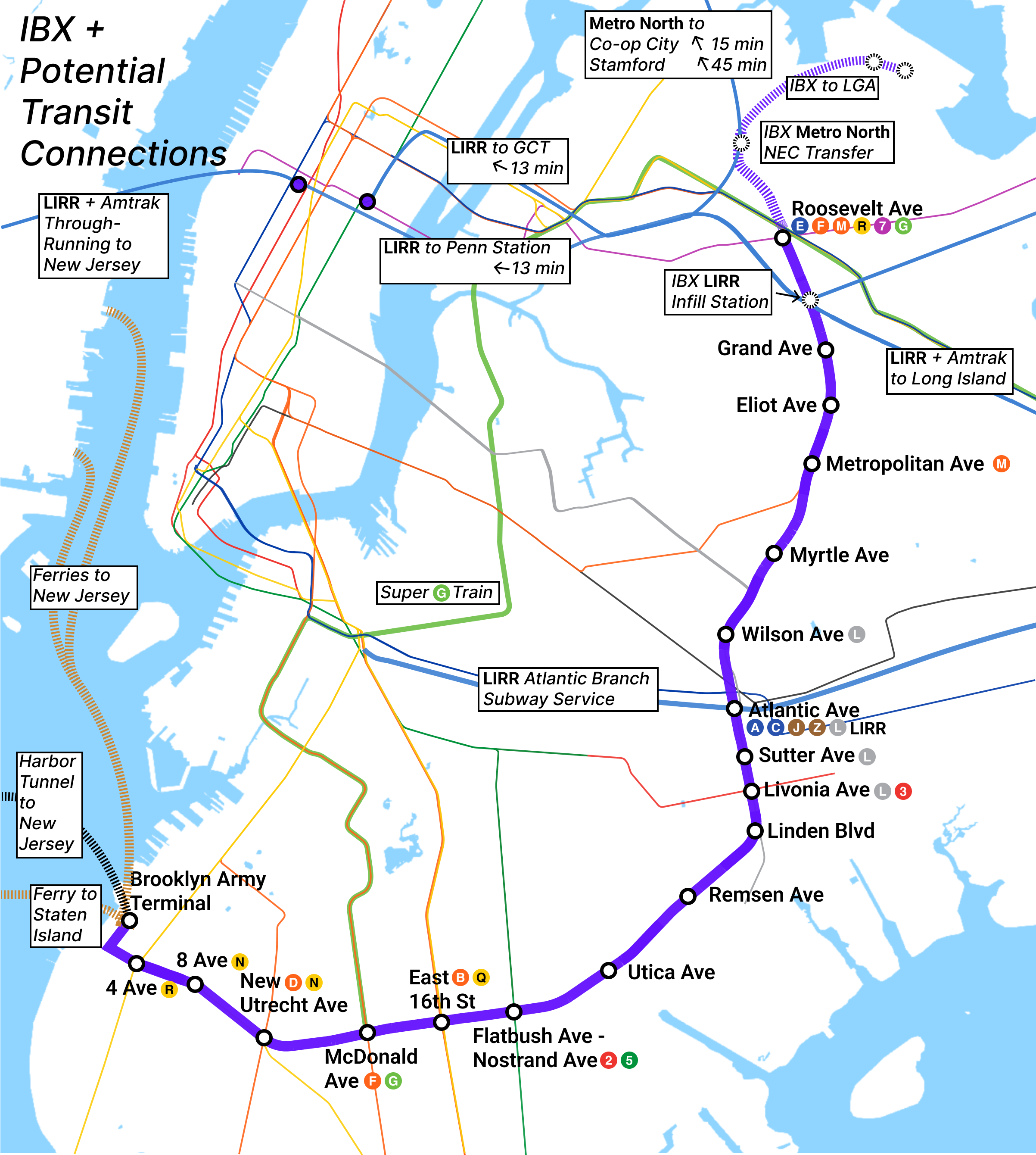
The plan adds an infill station for a transfer to the LIRR and extends the line in a slightly roundabout way to connect to an infill Northeast Corridor station before veering to the airport. This distinguishes it from early ideas that didn’t make it to A Better Billion, namely a Y from IBX to both the airport and Harlem. The point of this is not just to connect IBX with the airport but also create a hub by connecting IBX to more things, in this case a transfer station designed to connect people from the entirety of the New Haven Line to LaGuardia.
Why doesn’t this work?
The general answer is that subway lines should be radial or circumferential and not mixed, and this is a mix – IBX is circumferential, connecting stations at a fairly consistent distance from Manhattan, and the extension to the Northeast Corridor (or even Harlem, well north of Midtown) would maintain this character, but a tail veering to the airport would suddenly be radial. Such lines always underperform, because they fail at both the function of a radial line, namely connecting outlying areas to city center, and those of a circumferential, namely connecting lines to one another better and providing near-center neighborhoods with additional service orthogonal to the radial direction.
The more specific answer is that we know where passenger demand to LaGuardia is, and it’s nowhere on IBX or for that matter on the New Haven Line. Airport passenger demand is extremely Manhattan-centric, and within Manhattan it centers on Midtown and the Upper East Side:
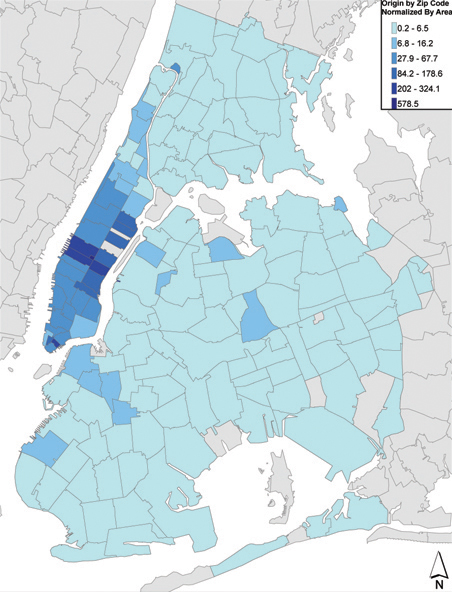
At the proposed IBX-NEC transfer point, just about every passenger from the airport would transfer to the commuter trains. The required infrastructure to build this might as well be used on a commuter rail branch, going to East Side Access as it is more central for air travelers than Penn Station based on the above map. IBX is more or less useless. Or, better yet, the Astoria Line can be extended as we propose, along an easier alignment that can be done largely above ground.
Now, what about airport workers? Those are usually mentioned, almost always as an afterthought, in various justifications for lines; I heard transit advocates use that line to argue for Andrew Cuomo’s backward air train idea back when he was still governor. Those are still poorly served by an IBX extension. On a map of airport employee residential density, it looks almost good:
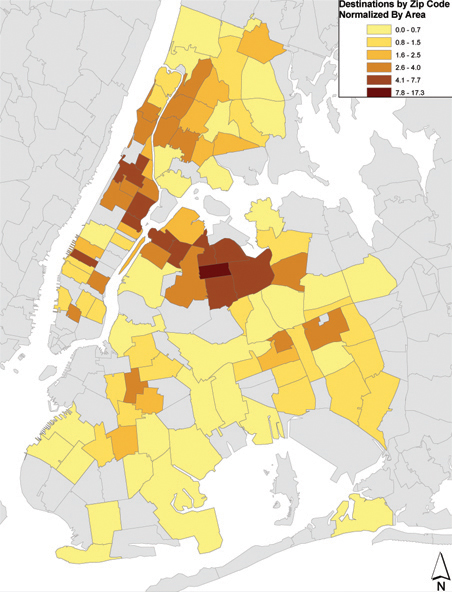
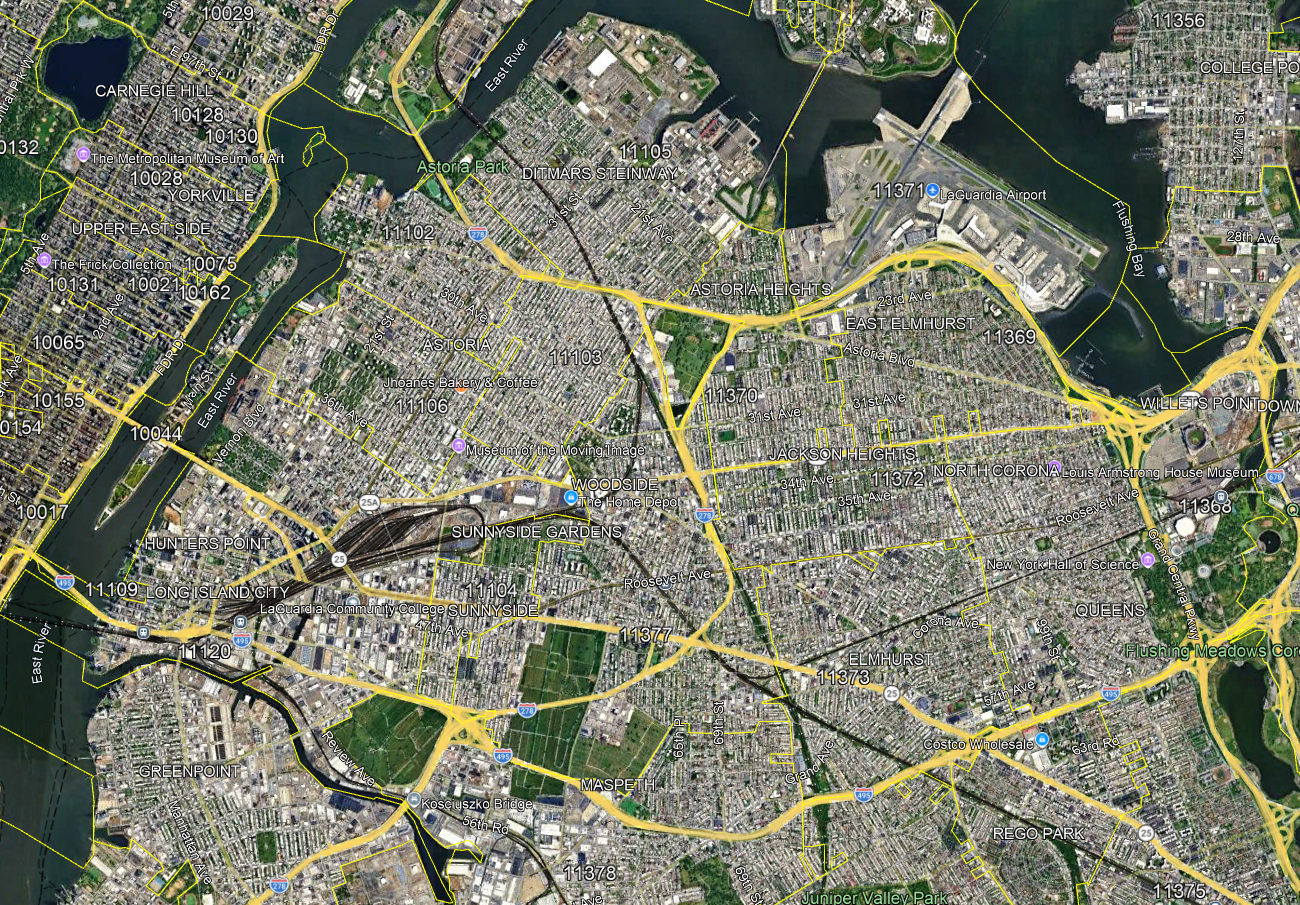
The highest-density zip code on the map above is 11372, whose southwest corner is Jackson Heights. But what’s unclear from the picture above is just how circuitous a swing from Jackson Heights to almost Astoria to LaGuardia is. The straight line distance from Jackson Heights to the nearest potential transfer station location to Terminal B is almost twice that of the direct straight line distance from Jackson Heights to Terminal B. The street grid isn’t straight but neither would an IBX extension be, needing to keep going northwest before turning 120 degrees to the east to get to the terminals. For most people in these neighborhoods, IBX would not provide a trip time improvement over buses.
But more conceptually than this, rail improvements aiming to serve airport workers are generally a bad idea, because airport workers never cluster in one residential place on which a line can be built. The paired density maps are at different scales, and the ratio between the densest and least dense colors is much higher for the air traveler density map than for the airport employee one. OnTheMap gives, as of 2023, 11,000-12,000 airport workers, depending on whether one counts hotel workers across the Grand Central Parkway from the airport in the total. Out of 11,666 on a more generous count, only 3,200 even live in Queens and only 1,182 live in Brooklyn. The blob of seven high-density zip codes of worker origin plus the medium-density one between them (11377, just west of Jackson Heights) only furnishes 1,000 airport workers from all eight zip codes combined.
How does this relate to previous proposals?
There’s a tendency in New York planning, at all levels of officialness from the RPA down, to take one big project that’s politically agreed on and hang everything on it. The Third Regional Plan tried to tie in everything to Second Avenue Subway, to the point of bloating it to a four-track line (by the 1990s all planning was for a two-track line). Even commuter rail, in this case a LIRR Atlantic Branch connection to Lower Manhattan, was shoehorned into it, with through-service onto the subway. The Fourth Plan did the same with its Triboro proposal running through to Metro-North in the Bronx and with commuter rail through-tunnels trying to work around Gateway.
The result of such schemes is proposals that try to have a single line do work it cannot possibly do and would be compromised to the point of unusability if it were forced. In Los Angeles, for example, this is leading to a squiggle of a subway extension of the K (Crenshaw light rail) Line through West Hollywood, 6 km longer than it needs to be. In New York, this is leading to taking IBX, as pure a circumferential as one can be, and lading it with tunnels to destinations for which it doesn’t make sense.
It’s important to resist this temptation. If rail service to LaGuardia is desired, it should use the subway line that already points in that direction, whose alignment allows for an elevated extension, just marginal enough to the residential parts of Astoria to avoid NIMBYs, just close enough to still serve the neighborhood well. The overall planning complexity of two good lines is less than that of one bad line – the cost doesn’t magically increase just because the rail link from Astoria to LaGuardia is categorized as “N/W extension” rather than “IBX extension,” and it’s easier to supervise more, smaller projects if they’re parallelizable.
 Pedestrian Observations
IBX (nee Tri Boro) should not run to LaGuardia, but it should have the transfer station to Penn-NEC service. The point of this is precisely the circumferential ability to get from Brooklyn , Queens, or LIRR points to the Bronx and beyond without visiting Manhattan.
Jackson Heights is on the E.
And the F,M,R and 7.
Yes, just extend the Astoria Line with the N and W trains to LaGuardia.
Another reason that it’s not a great idea is that as an airport transfer, the Roosevelt Ave IBX stop is 3 blocks from the Roosevelt Av-Jackson Heights subway complex – about 1,000 feet from the main entrance (closer to one of the 7 train’s exits). It’s cumbersome enough to come up from the E/F/M/R with bags to the Q70, which is right in the complex, but a 3 block walk on city streets to take an indirect train route is not an improvement
Was hoping for IBX to be a replacement for the Q70 and especially the M60 buses so the bus fleet can be reallocated elsewhere.
Buses are cheap. Just buy more.
Bus drivers aren’t cheap. I presume that neither is depot expansion. Especially in landlocked areas (applicable for the M60).
By that logic, QueensLink and A Better Billion aren’t necessary since most extensions are already covered by buses.
Railroad yards aren’t cheap either. They went through all sorts of contortions for the additional cars needed for the Second Ave line.
Bus drivers aren’t cheap. I presume that neither is depot expansion. Especially in landlocked areas (applicable for the M60).
Does this file under “treating everything as a generational project, so the scope explodes, costs explode, and naysayers start rousing from their slumber”?
The foam is getting especially frothy. At least this hallucination acknowledges the existence of Cross Harbor Freight. Everybody wants Cross Harbor Freight because it means the food has a way to get in that doesn’t involve trucks stuck in gridlock and a way for the garbage, recyclables, sewage sludge and incinerator ash a way to get out without trucks. Double decking the right of way so both can exist gets real expensive real fast.
They don’t cluster in one place at the airport either. They are scattered all sorts of places, at the airport, railfans never go. Passengers cluster at the terminals. Who take a cab. Partly because passenger’s origin/destination don’t cluster in one place either.
Passengers are more likely to have suitcases with them that they don’t like shelping so much, they like the taxi dropping them off at the airport door as it is less distance they have to do it. Even if they are arriving and planning to use transit they will use the hotel shuttle to get all that to the hotel. If they are leaving from NYC they will use a taxi or drive their own car to the airport.
Airports often have enough employees in the area to run good transit for them, and a few people will use it for travel (those taking short trips don’t pack as much), but passenger counts will always been a poor input for people who will use airport transit because as a passenger luggage is a problem.
taxis are expensive though.
the people who spent hundreds of dollars on airfare can afford cabfare.
So is parking at the airport. A taxi is cheaper than parking for longer trips. Even the cheap lots in Des Moines are add up fast: I have no idea what parking costs at a NYC airport but it can’t be cheap. People who travel often can legally expense the cost of a taxi to the airport, so it is “free” (see a lawyer for details, there are complex exceptions that might apply). People who travel for vacation don’t do it often and parking/taxi is part of the cost of the trip.
The business traveler going for a day (sometimes with a hotel so return the next day) put everything in a backpack and thus can use transit. Even then a significant minority are traveling with tools of some sort and wouldn’t want to use transit. However the traveler of any type going for a week is likely to have more stuff and thus more/larger luggage.
I have taken all my luggage on transit. It is possible, and it works. It still sucks enough that I am willing to pay for other shuttles if I can find enough money to afford it. (as @adirondacker12800 points out the cost of a taxi is tiny compared to all the other expenses of travel)
Transit is cheaper.
There’s 13 million people a year using the train to Heathrow of which ~0 are staff (as you can see the flow data and there aren’t lots of trips to nearby places where the staff live), plus 13 million people a year using the tube of which some unknown percentage are staff, and on top of that 13% of flight passengers travel by bus and coach from the central bus station according to Wikipedia, plus coach passengers who go direct from terminal 5 in particular meaning probably 40% of Heathrow passengers use public transport of one form or another.
OK I don’t have to work it out – there’s a report – https://www.heathrow.com/content/dam/heathrow/web/common/documents/company/heathrow-2-0-sustainability/futher-reading/STZ-2024-annual-report.pdf – 45% of passengers to Heathrow use public transport to get there.
Slightly older data for all London airports and with some other interesting stats like where they come from – https://www.london.gov.uk/sites/default/files/2025-10/London%27s%20airports%20data%20pack.pdf
So is walking or bicycling. Yet people pay $5 a half hour to use the “daily” parking lots at the terminals.
There are “local” buses in Queens that serve LaGuardia. The express bus from Manhattan that connects to subway lines in Manhattan instead of connecting in Queens. There are long distance style buses with luggage storage. There are shared vans that can drop you off or pick you up at your doorstep. Cabs, limosines and “black car”. Rental cars. If you rent a car you don’t have to pay for parking.
If you insist on taking the train schedule your flights at Newark or Kennedy. Which have trans Atlantic service.
There’s also the airport trains in New York being weak. You have to use 4 different trains to go from JFK to the metropolitan museum of art vs 1 from Heathrow to the British museum.
And perhaps that’s not a fair comparison but it’s only 3 trains from most of the south east to Heathrow.
Three trains, 6 train to 51st and Lexington Ave. to change to the E train at 53rd and Lex to Airtrain in Jamaica. Or 6 train to Grand Central for the LIRR to Jamaica for Airtrain. I doubt anyone would stop you from wandering around either museum with your luggage but it would be …arduous unless you are traveling light. It’s two from Madison Square Garden to Newark or JFK. With three options for JFK, LIRR to Jamaica or the E train to Jamaica for the Jamaica Airtrain or A train to Howard Beach for Airtrain there. Or the Empire State Building. Or Macy’s. Or the Shed, the Edge and the Vessel in Hudson Yards.
There are few hotels in the vicinity of the Met. If you are spending $1,000 night for a hotel room the cab fare to the airport isn’t a problem.
I never said that no passenger will take the train to the airport. That 45% do in Heathrow seems high to my gut – but it doesn’t contradict anything I said. Airplane passenger traffic is not a good indication of ridership was my only claim.
@henry, do not forget we take more holidays, the train network is generally better making it more plausible to use public transport for more places and people who fly are significantly poorer than in the US.
Another line that is combining radial and circumferential is the SAS extension along 125 St. Andrew Lynch’s plan to extend IBX to Manhattan would actually fix this, allowing the circumferential IBX to serve the same function on 125 (and then ideally the SAS would go up to the Bronx instead)
Second Ave lines across 125th are radial for the Upper East Side. Where the people from the far Upper West Side get off to be replaced by people on the Upper East Side who want to go to West Midtown. All without changing trains at Grand Central. Which means other people can change trains in Grand Central.
Van’s plan actually keeps SAS on 125 St because then it will connect to not only the (2) (5) (6) but also the other subway lines running to the Bronx / uptown, i.e. the (1) (3) (A) (B) (C) (D). The IBX terminates at 125 St – Park Ave for the connection to the (4) (5) (6) + all MNR lines and the “least amount of redundant coverage.”
I also do agree that the IBX between LGA and 125 St is worth pursuing, perhaps just as cost-effective as a full extension of the Astoria Line; the IBX between Brooklyn and LGA is just bonus service. Certainly the IBX across the Hell Gate is needed to create a true triborough circumferential line.
As a reference for a potential airport connector to LaGuardia:
The Oakland Airport BART connector is 3.2 miles (5 km). It costs $6.50 per person for the the 8 minute ride. It cost about $500 million to build. The fare is set to provide a break-even farebox recovery (i.e. no additional cost to BART or the airport).
I don’t disagree with your view here, but your comment regarding the distance to the terminal would imply that there is a preferred alternative route you would have suggested be used (by either an airtrain or any other type of people mover).
What is that route? Because if the primary goal is to reduce total trip time, I think you will find yourself in a bind when accounting for how much time is lost/saved when comparing the travel time of the N to get to Astoria vs the E express train in getting to Roosevelt.
While reducing trip time is certainly a nice objective here, I think part of the reason for the project is to also eliminate traffic slowdown risk that the buses have today vs the scheduled transit modes of travel.
The best way forward here (in my mind) would be to change the N to run express from Queensboro to Astoria Bvd and build an extension to LGA (via the N or via Airtrain) over the GC Parkway. Otherwise I think you find yourself back at the options connecting to Roosevelt.
I don’t know NYC geography to comment on the details. In general though, airports by their nature on not on the way to/from anywhere and so you try not to run long distance service there. Flight patterns force height restrictions near them, they try to have a lot of “crash landing” empty space at the ends of runways. Trains running through airports (as opposed to to the terminal and stopping) often have to run in expensive tunnels just because the airport design doesn’t apply them to be build cheaper at grade (even though the ground is often empty, airplanes cannot cross tracks)
As such in general you run a stub branch from someplace people want to be for the airport. Transit running through the airport generally is taking a long detour – which is fine for those who want to get to the airport, but that is time robbed from everyone who wants to go elsewhere. Several different main trunk lines should meet up someplace, and run a stub to the airport. Sometimes you can go like Denver and build an airport way out and then terminate an otherwise good line there – though as Denver grows (if…) it will be interesting to see how/if they can make this work.
airport connectors do get used by lots of citizens and are highly profitable.
The critique is right on the core point: when a line tries to be both circumferential and radial, it usually fails at both .
But that lesson points to a cleaner solution.
LaGuardia demand is overwhelmingly Manhattan-centric . So instead of bending IBX into something it isn’t, we should complete a connection that already aligns with that demand: the Long Island Rail Road Port Washington Branch.
To his credit, the Cuomo-era AirTrain plan recognized that corridor—but routed it “past” the airport to Willets Point, undermining the experience.
What’s changed is expectation. A transfer is no longer good enough.
A short spur into LaGuardia would deliver a true one-seat ride from Grand Central Terminal and Penn Station—fast, direct, and aligned with how people actually travel.
That doesn’t negate extending the BMT Astoria Line. It complements it: subway for access, regional rail for speed.
And the same standard should now apply at JFK. With the Port Authority of New York and New Jersey advancing a new capital plan to replace rolling stock and stations, a one-seat ride from Manhattan shouldn’t be aspirational—it should be the goal.
New York doesn’t need more hybrid projects.
It needs to finish the obvious ones.
Ray, the LIRR trains wouldn’t fit the AirTrain loop and would require one or two central stations like with say CDG or LHR. That would necessitate either lots of digging or a large elevated structure over a complex road interchange. Seems rather unlikely in the near future. Also unsure how much capacity exists for LIRR to do either of these stubs, N/W is much less complicated in that regard.
It doesn’t matter how complicated things would be at the airport. There are other people already using the tunnels to go other places. To send a short half empty train to the airport, LaGuardia or Kennedy, a long, standing room only train, has to be canceled. If you want better rail access to the airport feel free to fly to Cleveland.
Heathrow express has ridership of about 4.5 million (decreasing trend due to Elizabeth line) which is higher than several LIRR branches even if you correct for the difference in passenger numbers (factor of about 3/4) and ignore the Elizabeth line. So I don’t think it’s a foregone conclusion that LIRR to JFK or LGA is a bad idea.
A to JFK and N/W to LGA is probably better, but LIRR to both/either would probably be quite beneficial for the region. Especially after implementing through running, for the extra capacity and ease of access to different destinations and airlines for people in New Jersey even compared to subway service.
And the obscure branches of the LIRR have once an hour service. Unless think once an hour to the airport is a good idea you have to cancel the standing room only 5:00 Express to Ronkonkoma so dozens and dozens of people can take a much shorter train to the airport. And then cancel the 5:05 to Massapequa. And at 5:10 the train to Long Beach. And at 5:15 the… many many people will be really pissed off that brain dead railfans can’t understand that running one train means cancelling another one. If you don’t want to take the bus to LaGuardia schedule a flight to Newark or Kennedy. If that’s not good enough the train goes right to the, as in there is so little traffic there is only one, terminal in Cleveland.
If capacity is really that big of an issue, LIRR should convert their trains to longitudinal seating and through running should be implemented. These are brain dead obvious solutions.
Part of it is that the “obscure” LIRR branches would have half hourly service in London.
It’s too bad you have no fucking clue. Though I suspect it’s multiple clues you lack.
You can’t send trains to both airports every ten minutes and trains to all the branches of the LIRR twice an hour. That have local and express service making them behave like two or more branches.
I don’t know why youse people are having such difficultly understanding how the space time continuum works on this planet.
Nice to see an actual argument instead of just insults.
As for the space time continuum, through running and proper operations can roughly double throughput at Penn Station and fully longitudinal seating also roughly doubles room versus almost fully transverse seating. That’s quite a lot of capacity up for grabs, plenty to squeeze in 2-3x hourly airport service to LGA and JFK if planners chose that route; I do think A + N/W is a superior option, but there are lots of good reasons to choose LIRR.
….Your dealer has really good hallucinogens.
@adiron, there’s two track lines here that have half hourly express and half hourly local service.
LIRR probably does more than that at peak as it stands.
@adiron, there’s two track lines here that have half hourly express and half hourly local service.
LIRR probably does more than that at peak as it stands.
Yes it does have more than two trains an hour. It’s why they spent billions of dollars to build two more tunnels between Queens and Manhattan. The problem is not the single track between Great Neck and Port Washington the problem is that there are 12 car standing room only trains in Woodside. That would have to be canceled to send short half empty trains to the airport. Which doesn’t stop you from booking flights in and out of Newark or Kennedy if the bus offends your delicate sensibilities. Or flying to Cleveland if the people mover is the problem.
I doubt the line is at capacity by British or Japanese standards West of Jamaica.
If it wasn’t at capacity, before the pandemic, why did they spend billions of dollars to divert people to Grand Central? There is a complicated answer that requires juggling more than two things at the same time.
It’s difficult to respond to hallucinations. Do you make electric Kool-Aid or just drop a tab. Does it still come in tabs?
The major hallucination:
I’m going to assume you are imagining some sort of magical mystical through running doing something mystically radical and magically revolutionary. It won’t. They can run 20 trains an hour through a tunnel. No amount of frothy railfan fantasy can change that. They run 20 trains an hour through the tunnels, at peak, now. Without much of the magical mystical ThRouuUgGhhH rUnnNnNinnGgG!! !! !!
They have been running trains through Penn Station since Penn Station opened in 1910. They have been running trains from New England through to New Jersey and beyond since 1917. They are aware of the concept. And manage use up the capacity of the tunnels without doing a lot of it. Even though clueless railfans hallucinate some sort of magic happens when an Acela arrives from the west and departs to the east. Or vice versa. Or a Regional does it. Or when Metro North turns over a Train-to-the-Game train to NJTransit and it wonderously turns into a train to Trenton. The tunnel doesn’t care if the train turned around at the platform, out in the yards, or is running through. 20 of them can go through each one per hour.
The foamer hallucination that throooooooooooooooooughhhhhhhhh runnnnnnnnnning !! !! will do something is a delusion. I especially like the ones where they imagine people in Ridgwood want to shop in the Woolworth’s in Lynbrook instead of the one in Ridgewood. Particularly when I point out that means the train in Ridgewood needs to be going to Lynbrook and not Port Washington or New Haven or…
Perhaps it’s magic mushrooms that makes you think spending billions of dollars for a train or two an hour won’t be derided. Heartily. If they are going to spend billions of dollars it’s going to more than a train or two an hour. How many? Twelveteen? Elevendy eight?
20 trains an hour, per tunnel, in conventional normal service, means there can be 60 trains an hour in each direction. The people in New England will continue to expect service. To places, I know this maybe hard to believe, Not-Manhattan. Through Penn Station. Like they have been doing since 1917. Pesky of them isn’t it? And Metro North wants to send people to the West Side via Penn Station without forcing them to go through Grand Central. Which is on the East Side.
Out of the 60 possible crossings the LIRR gets allocated 50 of them. Which makes it easy to calculate how much capacity each train uses. 2 percent. 6 trains an hour from Grand Central to LaGuardia would use up 12 percent of the total capacity. Which is also 30 percent of the capacity at Grand Central. 6 trains an hour from Grand Central to Kennedy airport would use up 12 percent of the total capacity and another 30 percent of the capacity at Grand Central. You think Long Islanders are going to give up 60 percent of the capacity to Grand Central I definitely want your dealer’s number. Sending 12 trains an hour to the airports from Penn Station and 12 trains an hour from Grand Central would use up 48 percent of the LIRR’s capacity. Your dealer has really good shit. To do that you have to cancel 12 car long standing room only trains so short stubby barely filled ones can go to the airport. It takes truly exquisite hallucinogens.
Because it doesn’t make sense to spend billions for a smattering of trains per hour. And you have no friggin’ clue that there are people who fly commercial and don’t bat an eye when the concierge at their $1,000 a night hotel suggests using the helicopter service to the airport. Train to the airport sounds like a great idea. For other people. Because there has been a connection to a people mover for decades and it doesn’t get much use. And while it’s possible to confabulate a station at every terminal at the airports, there will still be, again I know it’s hard to believe, there are people outside of Manhattan. People who have origins and destinations Not-Manhattan. Who will still want to take the bus. Or the EXISTING people mover from an EXISTING in service train station. Along with the people who use it to change terminals, go to the rental car counters, the hotel shuttles etc. The existing people mover the the high frequency train station outside of the airport’s fence will be as good as it gets. Because sane people aren’t ingesting psychedelics. ..Or you could fly to Dublin and change planes for Cleveland. Where the trains go to the airport sorta kinda directly.
A spur would take service away from Flushing, which is one of the bigger job centers in the city. I would argue to go the other way around: extend the Astoria Line past LGA to Flushing itself.
Or booking a flight out of one of the airports that does have train service. If the bus offends your delicate sensibilities you can avoid it. Many ways.
You must have a lot of time on your hands!
It barely takes any time at all to select the itinerary that uses Newark or JFK instead of LaGuardia. A lot depends on origins and destinations.
Indeed, and much less time than it takes to be on here all day misrepresenting what other commenters are saying.
(Better LGA access, though, is only one benefit of extending the N to Flushing.)
Putting a bunch of low usage stations on a circuitous route to Flushing wouldn’t be my choice. I’m assuming the full blown railfan extravaganza of a station at all of the flight terminals.
Something more useful to more people, like along Northern Blvd would be my choice. None of it stops people from flying through Newark or Kennedy. Or taking a cab. Or booking a shared van. Or renting a car. Or…
Yes it does have more than two trains an hour. It’s why they spent billions of dollars to build two more tunnels between Queens and Manhattan. The problem is not the single track between Great Neck and Port Washington the problem is that there are 12 car standing room only trains in Woodside. That would have to be canceled to send short half empty trains to the airport. Which doesn’t stop you from booking flights in and out of Newark or Kennedy if the bus offends your delicate sensibilities. Or flying to Cleveland if the people mover is the problem.
I think the arguments against are weak.
I would love to see passenger demand to JFK, considering the AirTrain, a people mover that only has 1 stop outside of JFK (Jamaica), an $8.75 fare and no free transfer to the subway, had over 10 million riders https://www.apta.com/wp-content/uploads/2026/03/2025-Q4-Ridership-APTA.pdf. LGA, which has half the annual passengers of JFK, could easily see 2-3 million passengers annually on a train line that goes all the way to Borough Park, a $3 fare and free transfer to the rest of the subway via Jackson Heights-Roosevelt Ave (and 51st St if the L.I.E. Line is built). This easily dwarfs the potential ridership of extending the IBX to Astoria.
Why are you so sure a train to Borough Park dwarfs the ridership potential of a subway extension?
Howard Beach is outside the airport perimeter too. You pay an Airtrain fare because Senators in the hinterlands contort regulations. If you don’t want to pay the Airtrain fare no one is stopping you from taking a city bus to the airport.