Why High Speed 2 and Other European Lines Make Fewer Stops than the Shinkansen
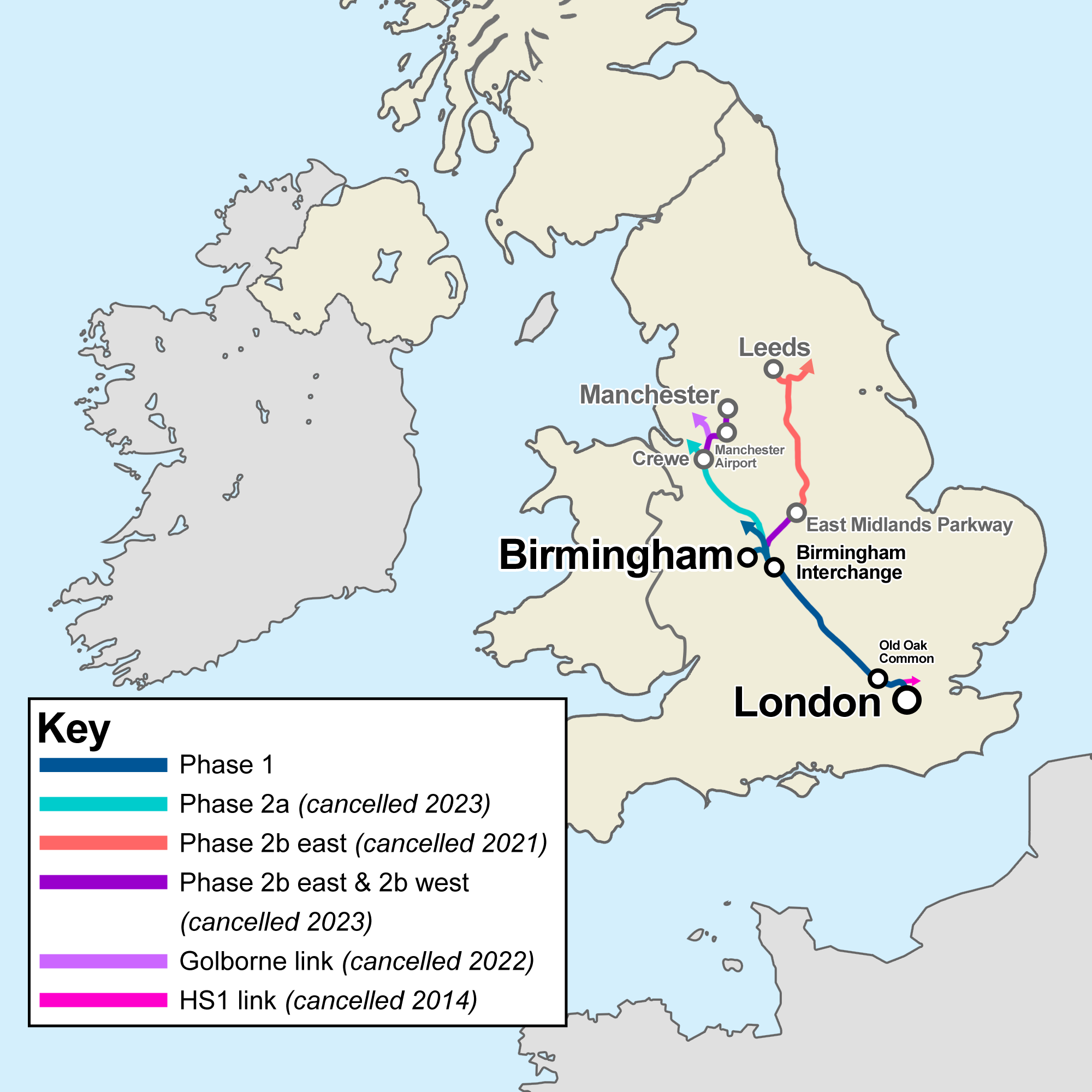
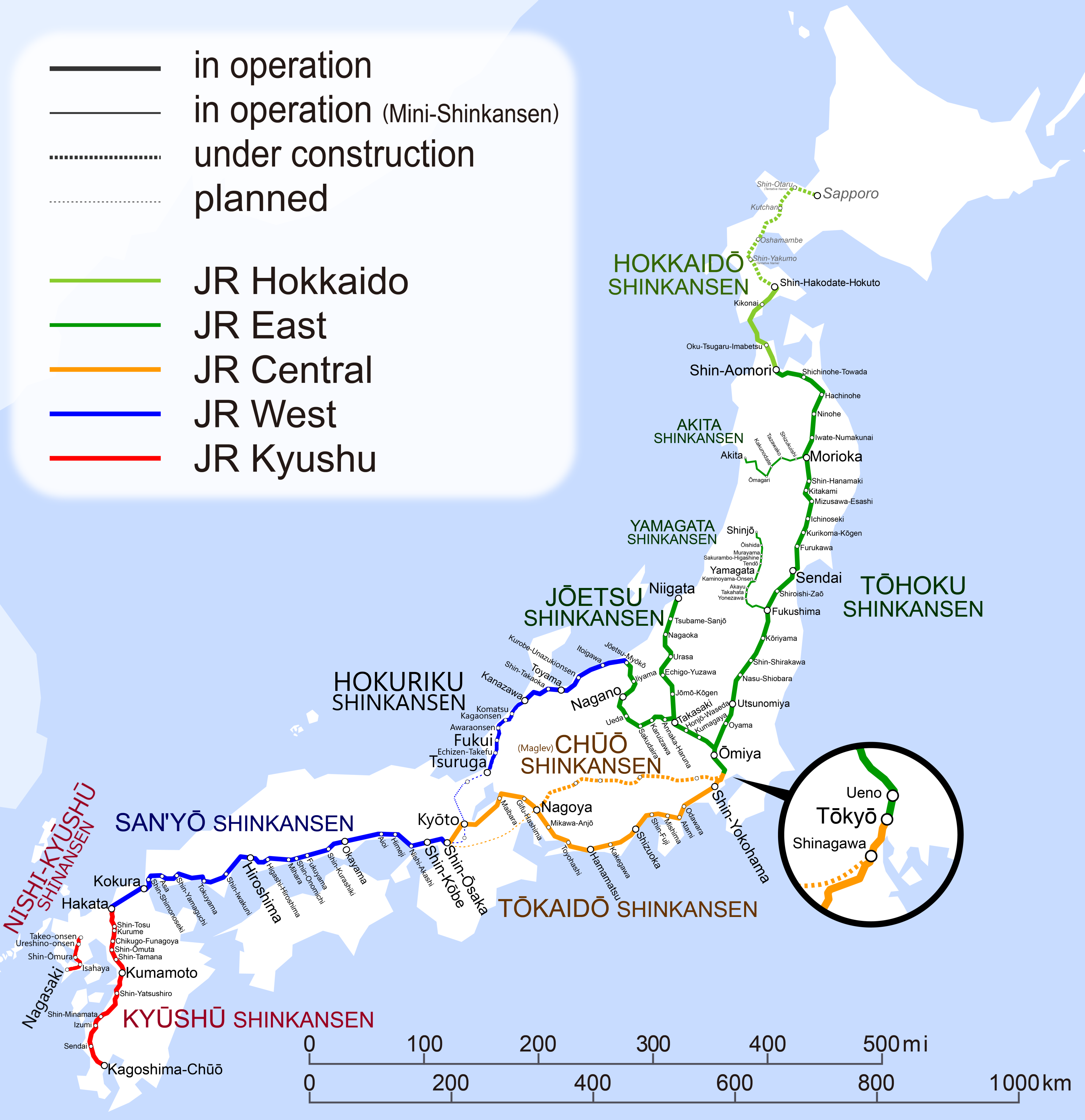
At a meeting last week, Borners was asking me why High Speed 2 is designed not to make any stops between London and Birmingham. This distance, about 150 km between Old Oak Common and Birmingham Interchange, would have around 4.5 interstations on the Shinkansen, but in the UK, it runs nonstop. More generally, in Europe similarly long stretches without stations are observed, but not in Japan. This post goes over why; it is not due to poor design on the part of either side, but rather a response to the respective geographies of the countries in question.
Speed classes on the rail network
Modern intercity rail networks have multiple speed classes, comprising not just separation between high-speed trains and trains on the classical lines but also local and express trains on the same line, often the same track. Here, it is useful to go over the difference between Japan and Europe in general and Britain in particular.
On the Tokaido Shinkansen, the fastest trains, stopping only in Tokyo and its immediate suburbs, then Nagoya, then Kyoto, and then Shin-Osaka are called Nozomi and average 210 km/h end-to-end; trains making additional stops are called Hikari and average 178 km/h; trains making all Shinkansen stops are called Kodama and average 132 km/h. Below that class are limited express trains on the narrow-gauge network, all much slower. The original Kodama, inaugurated in 1958 just before the Shinkansen began construction, did the Tokyo-Osaka trip at an average speed of 80 km/h. The fastest trains on classical lines in Japan average around 100-110 km/h, on lines without Shinkansen, while lines parallel to Shinkansen, such as the Tokaido Main Line, are slower as they prioritize regional traffic at an average speed of 60 km/h or so.
Britain, in contrast with Japan, has rather fast trains on its classical network, as do other countries that chose to invest in upgrading their existing network rather than in building high-speed rail on it. The intercity trains today connect London with the major cities of the Midlands and North at average speeds of about 130 km/h, depending on city and line. The West Coast and East Coast Main Lines are both straight, built in the 1830s and 40s when it wasn’t clear trains could even round significant curves without derailing, in one of Europe’s flattest geographies, the exact opposite of Japan with its mountainous terrain and narrow-gauge lines. Both lines were four-tracked in the 19th century, more or less allowing fast intercity trains to run alongside slower regional lines without interference. In effect, trains offering Kodama speeds are available in Britain today.
Germany is in a similar situation to Britain. The topography here is hillier and the lines built slightly later, after engineers figured out that sharp curves were fine at the speeds of mid-19th century steam trains, but it’s possible to squeeze decent speed out of some of them, especially in flatter northern Germany. Berlin-Hamburg, exceptionally, averages around 160 km/h entirely on classical track, with timetabled overtakes between intercity and regional trains and extensive schedule padding to allow for recovery from cascading delays. Other lines average 120-130 km/h, for example to Leipzig and Cologne, so that Kodama speeds are already available, again, and the focus when high-speed rail is built is on the Hikari/Nozomi speed range.
Finally, France, like Japan and unlike Britain and Germany, chose to invest in high-speed rail more than to upgrade its classical lines. But it, too, already had high speeds on its classical lines: from Paris to Marseille and Nice, trains averaged 120 km/h before the TGV opened. Short-range intermediate cities like Dijon already had fairly good service available, so serving them was less important than maximizing the speed of longer-range connections like Paris-Lyon and Paris-Marseille.
The urban geography of Japan, were it in Europe, would thus be serviceable on classical lines. In contrast, the lower speed of classical trains in Japan means that exurban centers like Odawara, Mishima, Utsunomiya, and Takasaki greatly benefit from having local Shinkansen trains available. England is denser than Japan; there are places at similar range from London on or near the main lines, such as Milton Keynes and Northampton, but they already have fairly fast trains to the capital, and will have even faster trains when High Speed 2 opens even though they don’t get stations, because the removal of the intercity trains from the West Coast Main Line will allow for schedule rewrites reducing timetable padding and allowing for faster trip times between London and such intermediate points, which today are lower priorities than higher average speeds to Birmingham and points north.
City size and prioritization
On the one hand, as outlined above, there is less need for Kodama-speed service to intermediate cities in Europe than there is in Japan. On the other hand, regardless of need, such service must take lower priority in Europe, due to differences in urban geography.
In Japan, the Tokaido Shinkansen prioritizes Tokyo-Nagoya-Kyoto-Osaka traffic, as those cities outshine all others. Kodama trains could do the trip significantly faster than they do today, but are held at local stations to let Nozomi pass, and most trains are Nozomi rather than Hikari or Kodama. However, north of Tokyo, the situation flips. There is extensive commuter traffic, seen in much shorter average trips than on the Tokaido Shinkansen. The northern exurbs of Tokyo furnish extensive traffic, while the cities beyond commute range are too small to drive traffic all by themselves.
In the Tohoku region, by far the largest major metropolitan area is Sendai, population 2.3 million. The only other major metropolitan area served by the Tohoku or Joetsu Shinkansen, Niigata, has 1.4 million. The other cities don’t qualify as MMAs; the largest, Toyama on the Hokuriku Shinkansen, has an urban employment area of 1 million, while the others, such as Fukushima, Morioka, and Nagano, have around 500,000 each. Utsunomiya and the Takasaki-Maebashi region have 1.3 and 1.1 million respectively, enough that their needs should drive service planning as much as those of the cities to their north.
Britain is the exact opposite. Its metro area listings are somewhat outdated – I can only find 2001 data, compared with 2015 for Japan in the above paragraph – but we can compute based on metropolitan counties, designed to approximate metropolitan areas for the major secondary cities of England. Birmingham’s West Midlands and Greater Manchester are 3 million each, Leeds’ West Yorkshire is 2.4 million, Liverpool’s Merseyside is 1.5 million; at longer range, counting cities to be served on long extensions on classical lines at lower speed, Newcastle’s Tyne and Wear is 1.2 million, Edinburgh is 900,000, and Glasgow is depending on definitions between 1 and 1.8 million. In contrast with those, there is nothing that populous justifying its own station between London and Birmingham. Milton Keynes is too small, and an exurban station at the intersection with the under construction East West Rail between Oxford and Cambridge would not provide much added benefit over the existing direct express trains from Oxford and Cambridge to London.
The British situation generalizes. In Germany, not only does every line have quite a number of midsize cities at its end and beyond it, but also no city is so large that it sprouts subsidiary metro areas the size of Utsunomiya and Maebashi. When intermediate stops are built on high-speed lines, such as Montabaur on the Cologne-Frankfurt line, they are weak, and serve mostly for political purposes to defray NIMBYism; two such political stations are likewise included in the Hanover-Hamburg line. Even then, with stations that raise construction costs and compromise the alignment and timetable for no good technical reason, the stop spacing on these lines is wider than on the Shinkansen, which speaks to the difference in geography between Europe and Japan.
 Pedestrian Observations
I don’t think that is really the thought process of Shinkansen planning though. They will drop a station on any town it passes through as long as its not too close to a more important town, because the time-cost of doing so is acceptable for stopping services and zero for express services.
By your logic, Hokkaido Shinkansen should probably run non-stop between Sapporo and Shin-Hakodate-Hokuto, but it’s planned to stop at Shin-Yakumo, Oshamambe, Kutchan, and Shin-Otaru. This is significantly wider stop spacing than most Shinkansen lines, dictated by the alignment mostly under uninhabited mountains, but still tighter than many European examples.
Do you think this practice is bad?
But Alon’s point is that UK/Germany regional service is so much faster than Japan’s classical narrow gauge network that intermediate towns and small cities can generally be served best by removing fast services from classical lines to new build HSR. Additionally UK has just insane amount of legacy trunk coverage by Japanese standards outside central London (where Tokyo has London beat just with JR East’s through-running regional network alone).
Between Osaka and Tokyo, Japan only has 3 full length 2 track lines, Tokaido Mainline, Tokaido Shinkansen and the bypass of Chuo Line-Kansai line (the latter not really used admittedly). Compare to the UK where WCML itself is quadtracked all the way to Winwick Junction north of Warrington. Midland Mainline Quadtrack goes to Kettering, ECML to Grantham and they both serve the Eastern half of Transpennine Urban zone.
There is definitely 我田引鉄 “railways pulled into your ricefield” problem in Shinkansen planning as localities try to get get Shinkansen access. Some of these stations are total duds, but thanks to Japan’s love of passing loop spam, core express intercity services like Hayabusa on Tohoku or Kagayaki on Hokuriku aren’t unduly effected. Only really on Hakata-Tokyo/Taiheiyo trunk, and the Kanto sections of JR East’s Shinkansen network do capacity constraints really make choices hard. On the edges of Kyushu, Hokuriku, Joetsu shinkansen the problem is getting ridership, not capacity. There is something to be said for learning more from Central European regional rail services out there (and ticket pricing).
On Sapporo Shinkansen which will see the classical narrow guage Hakodate mainline north of Oshambe close once it opens. The problems Sapporo shinkansen has are about the absolutely necessary tunnelling, and worker shortage given it has to compete for a shrinking pool of workers with Chuo shinkansen, Naniwasuji, Tokyo metro extensions etc. And Shin-Otaru is a major destination for Tourists coming from Honshu, Oshambe is also gateway to Niseko ski-resort. These aren’t Shiroishi-zao style locations. Hokkaido’s distinct ecology creates a domestic and foriegn tourism base that most of Tohoku doesn’t have. These shouldn’t be Shiroishi-Zao.
And yes I have been to Shiroishi-Zao, only true Japan nerds would get much out of it. Whereas Niseko’s “Japan with spring snow” thing is attractive to Ozzies and Chinese.
But Aylesbury or Stoke on Trent for example don’t have regional trains to more than 1 or 2 high speed two destinations respectively. So there isn’t plausible existing service.
Lichfield (which ironically is probably extra stop #3) has better connectivity.
Stoke on Trent is limited in its service due to capacity constraints on WCML. With the opening of HS2 it very much well might have a direct service to London. Currently it has Avanti services to Milton Keynes and Manchester, along with local service to Birmingham. That already looks like it’s decently connected. With capacity relief the Milton Keynes service can probably be extended down to London.
Aylesbury is also on the Chiltern line, which is slow anyway. I think currently there’s a Birmingham-Marylebone train but it serves as an express regional service anyway. HS2 will not largely relieve the chiltern line.
Sorry, Stoke on Trent does have direct service to London. For some reason my app is glitching and only showing trains up to Crewe. It takes just over 1h30m, which is a reasonable speed.
Aylesbury has no connectivity at all by rail to the north – its only connectivity is to London.
Stoke has service to 3 not 2, my mistake, it has service to London, Birmingham and Manchester.
It doesn’t have [direct] to Liverpool, Chester/North Wales or mainline destinations north of Crewe – and its unlikely to see improvements to those destinations as a result of HS2.
What Aylesbury should get is an East-West rail spur that will serve it nicely from the North. Chiltern railways improvements can be a separate project from HS2. We don’t need to be introducing more timetable complexity for this stop that surely needs timed overtakes to serve, unless we should delay every service by 6 mins for a stop in Aylesbury for all places? Unfortunately not every town needs an express connection to everywhere else.
Aylesbury is very different from Stoke.
It should totally have the Metropolitan Line extended to it and the Chiltern service exiled to the Princes Risborough branch. Not just as compensation, but because through-running Chiltern services onto the Met’s tracks is a major reason for the failures of CBTCing the sub-surface lines. Also offers a place to put a depot to de-interline from the Jubilee which shares a depot across a flat junction at Neasden (eugh).
And Stoke is a relatively major destination at a reasonable distance between Brum and Manchester.
That would then result in slower trip times to London than the status quo. The thing Aylesbury needs is fast service with fewer stops. Now that could go via Princes Risborough if needed but the advantage of the Amersham route is that it is less congested.
That one is still going ahead – https://en.wikipedia.org/wiki/Four_Lines_Modernisation#Signalling – its the other sharing that isn’t happening.
4 lines modernisation is nearly 20 years late and probably 10x comparable scale of signalling costs. 5 different types of railway with 5 different signalling systems, 4 power systems is….insane.
Properly using the express tracks, ditching the silly Uxbridge service would help get that speed of Aylesbury-Liverpool Street down to an hour with frequency above 4 tph. And door to door time will actually be faster since the Met goes to better locations than Marylebone station. Better frequencies, greater reliability, reduction of ops/maintenance > top speed in these distances. Frankly 4-5 tph and an hour to the city on an airconditioned train gets you all you need.
Aylesbury’s connection problems to the north should be solved with an East-West rail spur, connecting it with Midland and WCML. Adding timetabling complexity and timed overtakes to HS2 is silly. Birmingham Interchange has an overbuilt four track section connecting to the Delta junction for that purpose, and we don’t need to inflate the tunneling costs by quad tracking the Chiltern tunnels so trains can merge at higher speeds to reduce timetabling constraints.
Still looks to be getting half a million passengers a year, only in Japan would that be considered bad ridership.
We gotta change that.
https://worksinprogress.co/issue/why-japan-has-such-good-railways/
This is a fascinating article. In addition to the great descriptions of what makes Japanese cities special, it also answers some questions I had about JNR’s privatization. Thank you for the link!
I wrote 80% of the article. I’m shoving down everybody I meet’s throat! Thanks for the praise.
You’re welcome, very enjoyable and informative, and (half facetiously) thanks a lot for packing all those links in there, now I have so much more to read up on, LOL.
Letting wide swaths of suburbia return to nature only happens when you are taking really good drugs. Maybe Szurke will give you his dealer’s number. Without the drugs or bulldozing wide swaths of suburbia things are going to be more or less like they are today.
@adirondacker12800 Over what timeline? Suburbia will not change much next year no matter what you do. However if you give it great transit (and the rest of the city too), it will change over the next 20. If you change the cities (how is an exercise for the reader – which as anyone who has taken college math knows is code for I don’t know but I’m hoping you figure it out because it would be really nice) such that people prefer to live there things will change. We can see in Detroit what happens to older neighborhoods when people don’t want to live there – slowly houses are torn down (I know this is in mostly in city limits – but the neighborhoods look like suburbs so I’m calling them suburbs). Give this another 100 years and things will return.
Of course suburbs usually destroyed the soil such that is only suitable for growing grass. Expect another ten thousand years before things fully return to nature.
Prairie is nature. Not that Detroit should be prairie land.
@henrymiller74
It certainly does not take 10,000 years before suburbs can return to nature; bioswale projects show that it takes years if some effort is put in. Certainly the environment will be degraded in certain ways (pollutants, structures) for quite a while, but if you expose enough soil and put in some trees nature will find a way.
As for how to change the cities — Not Just Bikes just put out a great video pointing out that the last oil crisis is a major contributor to the sea change in Dutch cities. It does seem that push factors are the main thing that will change cities, but it does bear keeping in mind that excess cost of living is also a push factor, hence high cost of living places not expanding as much as they could.
10,000 years to fully return to nature is about right. There are a lot of things we can do that get us close enough for practical purposes, but labs can measure differences. These differences don’t matter in the real world but they still exist.
I think there are a few reasons for that, one that is mentioned in the article itself. Japan needs to placate local governments arguably more than Germany, as each prefectural government needs to provide a 1/3 of the funding for length of Shinkansen line in their prefecture, unless alternative agreements are made. An example where strong local opposition caused substandard results is the Nishi Kyushu Shinkansen. Saga prefecture effectively blocked construction in its area by refusing to pay its share, forcing the Shinkansen to be built as a stub with no connection to the national network. It argues that the benefits it gets are limited as future conventional limited express trains will bypass its cities, while it has to bear a large portion of the financial costs which will benefit Nagasaki (as Saga only has limited time savings to Fukuoka, but a large proportion of the alignment is in its prefecture). This funding mechanism forces at least one station in each passing prefecture for newer Shinkansen lines.
New built Shinkansen in the JR era are also different from ones built in the past, as after the opening of Shinkansen, the parallel conventional lines are let go from the responsibility of the JR. These are often managed by what’s known as “Third sector railways” funded by local governments or abandoned. Therefore, conventional lines and Shinkansen are not thought to be one transportation system, but rather the Shinkansen is thought of as the only passenger railway line in the area. Therefore, from the perspective of JR, it must serve local service as well as long distance passengers, influencing the stop spacing.
I think Alon’s analysis makes sense as it mostly pertains to earlier built Shinkansen which were funded using different rules under JNR. This includes Tokaido, Sanyo, Joetsu, and older parts of the Tohoku. Some of these were built to relieve congestion on conventional lines as well, and due to the density of the Tokaido-Sanyo corridor, more stop spacing was required, and the parallel conventional lines were still operated by JNR, later transferred to JR.
“Therefore, conventional lines and Shinkansen are not thought to be one transportation system, but rather the Shinkansen is thought of as the only passenger railway line in the area. Therefore, from the perspective of JR, it must serve local service as well as long distance passengers, influencing the stop spacing.”
This is true of Korea, too, to the extent that a lot of not fully high-speed new-build track–<300kph, occasionally single track–gets labeled as KTX, albeit circa this latest generation of Korean high-speed trains there is a differentiation between KTX-Ieum (~250kph, broadly becoming the “standard” rail service, above the ITX services that run on legacy track) and KTX-Cheongnyeong (>300kph, dedicated HSL besides city-center approaches), as well.
It would seem to me that perhaps this is the crux of the issue: whether or not a non-high-speed service is treated as an upgrade of conventional rail vs. nearly a different mode, up to largely different segregated alignments and down to simply different stopping patterns, to cope with different geographies. Does a larger unified planning area–e.g. all of Japan (pre-JR) vs. mostly within individual European countries–account for the difference? I’d be curious how Chinese rail planning deals with this interface.
Placate is the wrong word here, its a burden sharing agreement, it worked really well for the Kyushu Shinkansen trunk and the Tohoku mainline extension in aligning benefits/costs pretty well. Its hitting trouble because with the Nishi-Kyushu shinkansen, Nagasaki prefecture is the prime beneficial, but the core remaining alignment is in Saga. Ditto Okayama for proposed extensions to Shikoku.
You say that but those 3rd sector railines for the most part share stations, and interface their timetables with the JR network thanks to freight. And most are actually viable for at least another generation, thanks to freight and urban service. Toyama, Iwate, Ishikawa and Aomori have actually been building new stations to serve their capital cities (Shin-Toyamaguchi, Morioka’s Aoyama, Matto in Ishikawa). The big exception is the Hisatsu Orange line which makes sense given its geography.
I would also make distinction between these legacy mainlines 3rd sector and the DMU branch line 3rd sector.
Do JR and JRTT planners think much about how the new line will interact with the third-sector railways when they plan the Shinkansen routes? I understand the timetable coordination, but from what I understand it’s more so the 3rd sector branch lines plan based on the Shinkansen’s timetable rather than it being part of a coordinated plan from the beginning. This is probably similar to how a local swiss bus coordinates with the rail schedule in a small town.
I’ve heard for the former mainlines hosting high freight traffic there is difficulty to reach an agreement due to the sharing of maintenance burden being deemed unfair. I’ve heard that seems to be the case for the bypassed sections of the future Hokkaido Shinkansen extension. Even for these lines do JRTT planners think of all the railways as an integrated network when planning the system? Do planners think of these 3rd sector parallel main lines as a substitute to Shinkansen in some areas or only as a complement? I guess that was my main point.
Worth noting that aside from uninhabited areas there are lots of stops on European high speed lines. The Germans run (fast) regional trains on their high speed lines with intermediate stops.
I’m not seeing any stations open to passengers between Halle and Erfurt and between Erfurt and Bamberg on the high-speed lines. There are some on other lines, but generally at wider spacing than the Shinkansen.
Between Erfurt and Bamberg there are trains that go off the high speed line to serve Corberg. That counts.
Between Erfurt and Halle/Leipzig there aren’t stops, but also the line goes through empty countryside there so there aren’t good locations for a station.
Maybe Buttstadt, population 6000, should have a stop. But then it is less than half the size of Buckingham or Brackley and isn’t on a road even as important as the A421 let alone the A43.
The stop at Coburg might count from an organizational perspective, but it certainly was done on the cheap (30M€ for the junctions according to Wikipedia). It’s used by 6 per day going north, 18 going south (quite respectable!). Although they save 37% of time going towards Nürnberg, they don’t serve the 10 intermediate stations.
This setup was decided on in the 90s/00s in replacement of a route through the city or station on the periphery.
If the junctions cost €30m and Coberg brings in 300k ICE passengers a year – which is less than the French beetroot stations then it still pays for itself.
And that ignores the costs of appeasing the locals in other ways that HS2 has had to. €30m is less than 100m of HS2 track adjusted for inflation.
I agree that there are good reasons for leaving out the Milton Keynes Parkway station, but the trade-off is that someone travelling from the northern parts of HS2 trying to get to Oxford or Cambridge (or Milton Keynes, Bedford or Bicester) still has to go into London and then back out because of the lack of transfer to East-West Rail. Getting to Oxford/Cambridge from outside the Southeast is often unpleasant right now – Oxford is served by branch lines, Cambridge by a main line that ends in East Anglia and a branch of the ECML. Making these journeys easier is a goal of the EWR project, but it’s diminished by the lack of interchange to HS2.
At least using all services serving London for these journeys will be more pleasant than plodding along on CrossCountry services, which are terrible. Maybe some day there will be opportunities to transfer to regional services at Birmingham of good enough quality to 1) prevent the need to go all the way to London, and 2) to mitigate how inconvenient the interchanges between the high speed and classic trains at Curzon Street and Interchange are designed to be. (Nice to imagine, but UK politics makes investing outside of London very challenging.)
I think the main issue is ticket price actually, and going via London doesn’t help at all there.
If we could build at French costs this wouldn’t be true.
There will still be some intercity service on the WCML, but reduced frequencies. IIRC HS2 isn’t supposed to replace all WCML intercity service.
What do you think the implications are for the US in the (mostly) linear Boston-Atlanta or California corridors and more multipolar Texas and Midwest networks?
The Acela averages ~110km from DC to Boston, where you and others have called for HSR on mostly upgrades to existing tracks, with few new sections (CT coast excluded). South of DC, there is no highly improved regional line and 200+ mph HSR needs largely new tracks.
I still think a super-express, ~1 stop per state HSR service makes sense from Boston to Atlanta (ATL-GSP Airport-CLT-RAL-RVA-WAS-BAL-WLM-PHL-NWK-NYP-HFD-PVD-BOS), alongside other regional or zoned regional HSR service making important stops at ATL or CLT airports and/or beltway stops like Metropark our Route 128.
The problem is getting there. I can make an argument for which ever plan you want – some are more reasonable than others, but there are merits to both. However politically I think you will find the smaller cities have enough political power that you can’t put service past them without stopping – even if it doesn’t make sense. These extra stops add up quick – a non-stop DC to Atlanta would be just over 3 hours: 900km at 300km/h – both those numbers are very rounded because without route selection we can’t do better. I expect between geographical and the one city you decide to stop in per state we will be closer to 4 hours. Now add a few stops along the way and the full travel times can get over the 5 hours which Alon as often said is the cut off from where train/fly tips to fly for most people. So in turn it makes sense to see if we can do the non-stop/low-stop as well.
As the US builds a system – if we ever do – more and more routes become viable. Perhaps someday we can ask if there is a second route DC-Atlanta that stops in fewer cities – but they are unserved and so the people will be more willing to accept not having a stop everywhere just to get service to some more distant cities. Looking at a map, there is no obvious route that would serve any of the big cities in South Carolina, but an Atlantic coast express to Miami and a transfer from Savanna (random city – there are lots of options in the area) could end up being the fastest route just because politically when you build it people are more willing to be bypassed – who knows what the future will be.
Which is why I keep telling people who wants trains in the US “focus on DC-NYC-Boston. This is the most obvious route and we can expand from there. However if we don’t get a real success anywhere we just look like crackpots who want to take away everyone’s car – something that is obviously unreasonable (even if it isn’t). However if instead of trying to get something to our state we all agreed to work together to get something great someplace we get something great to point to.
The Great Circle distance between DCA and ATL is 547 miles or 880 kilometers. Nobody is going to build a route like that. A fast way to guesstimate high speed rail trip times is the distance Google maps proposes for an automobile trip and half the time. It’s 639 miles or 1028 km between Washington D.C. and Atlanta via Richmond and Charlotte. And almost ten hours. An average speed on 150 mph/250kph it could be four-ish.
….. Sometime after there is highs speed rail across the Northeast and Midwest because that would serve more people. And get the most puddle jumpers out of NYC area airports.
There are plenty of puddle jumpers from BOS/NYC/PHL/DCA to RIC/ORF/RDU/CLT/GSP/ATL. Greatly decreasing or banning these short flights either makes more spaces for long distance flights or reduces congestion and increases safety. The Southeast DC-ATL corridor should probably be prioritized over the Midwest, if only because there is such a large anchor on the other side in the BosWash corridor creating network effects in one line unlike anything else in the country (or world).
@henrymiller74 It’s reasonable to discuss at least 1 (one) DC-Atlanta line in the context of a 20-year or 30-year project, but unrealistic to think about a second corridor in the same region given how hard it is for the US to get started building HSR. And lack of sizeable intermediate cities on the I-95 corridor. Luckily, there is already an EIS for Atlanta to Charlotte on the I-85 corridor via GSP Airport. If CLT-RAL-RVA-DC is optimized for speed, probably skipping Greensboro, total ATL-DC times could be roughly 4 hours.
I’ll see your Atlanta and raise you Chicago. The country’s third biggest metro area and the center of the country’s fourth biggest combined statistical area.
The median center of population is in southwestern Indiana. Half the people in the U.S. live east of there and half live west of there. Or half live north of there and half live south of there. Metro Chicago straddles the line between east and west. Chicago is as far from New York as Atlanta give or take a few miles and has more big cities along the way. Boston is closer to Chicago than it is to Atlanta and there are more big cities along I-90 than there are along I-85.
A quarter of the population lives in the northeastern quadrant. With Chicago just grazing the edge. There are lots and lots and lots of puddle jumpers that are internal to it. That could be served by high speed rail. Without Delta and Atlanta or American and Charlotte.
That Boston to Chicago comparison conveniently ignores all of the I-95 cities from Boston to Richmond. And New York to Chicago has zero large metro areas on I-80 without expensive and time-consuming detours to Philadelphia or the water-level route, compared to 7+ on the (direct) way from New York to Atlanta.
And, not sure Albany, Rochester, Buffalo and Cleveland are any bigger than Charlotte, Raleigh-Durham, Greenville-Spartanburg and Greensboro-Winston-Salem these days, even if I think the latter should probably be left off a 200+mph corridor.
All talk bout the Midwest or ‘NE quadrant’ being populated ignores that you have to build out in different directions from Chicago to hit Minneapolis, St Louis, Indianapolis or Detroit. And that you likely aren’t building due west from NYC, but rather taking a detour north or south. No such issue for the Boston-Atlanta axis. There’s a 1m+ metro area every 100 miles or so, and all in one line and relatively flat, if sprawled.
The U.S. Census Bureau counts everybody once a decade. And make projections/estimates between each census. Volunteers at Wikipedia then digest the information and produce tidy articles. “State-name statistical area” can be quite informative. You don’t have to guess.
Metro Worchester is 866,866, metro Springfield is 460,291 and the combined statistical area is 693,629. Hartford is a few miles away and would connect, it’s …planning region… is 975,328. Albany is 904,682. I live in the combined statistical area and we’d be clumped with Albany. It’s 1,192,181. Utica is 287,039. Syracuse is 652,956. Which gets complicated because there would be buses from surrounding metro areas. That are too small and not along the line. Rochester is 1,052,087. Buffalo is 1,155,604. Greater Greater Toronto is across the river. The “Golden Horseshoe” a.k.a. Greater Greater Toronto is ten million people. And the commercial capital of Canada. “Golden Horseshoe” might include Buffalo and Rochester.
… the only metro area between Richmond and Charlotte that is bigger than a million is Raleigh. which is more than 100 miles from either of them. Diverting from I-85-ish would add 30 miles.
New York to Chicago via I-80 is much shorter than routes trains would be likely to take. Google lets you plan trips. Chicago-Cleveland-Pittsburgh-Philadephia-New York is a very similar distance as New York-Atlanta. Chicago-Cleveland-Albany-New York is a bit longer. Which doesn’t change that Chicago is a bigger metro area than Atlanta and a bigger combined statistical area. Bigger than anything Not-Los Angeles. I know this may be too hard to figure out. It means metro Chicago is bigger than anything in the Southeast. It doesn’t change that you can spit across the state line from metro Toledo to metro Detroit. Which is bigger than any metro area in North Carolina. And has a combined statistical area with the same population as South Carolina.
I’m sure Greenville South Carolina is quite dazzling. I suspect people in New England are more interested in Detroit and Chicago. Toronto. The difficult part between Springfield and Albany could be the same tracks that they use to get to Montreal. Which I’m sure they would find more interesting than any other wide place in the road you imagine is a destination between Richmond and Charlotte.
Bro, Toronto, Ontario, Canada is not remotely on the United States Interstate Highway System I-90. It involves an international border that is far harder in terms of economic integration than the already sticky borders of the Eurozone & Schengen Area. Nor is it possible for one linear trip to serve Boston, Toronto and Chicago as they are in opposite directions after Buffalo. Hartford is not on I-90 either. Different state and not served by a linear Boston-Albany train, which at any rate is a far lower tier priority than radial lines from NYC, DC or even a handful of routes out of Chicago. Nor does a train tour of America’s finest rust belt cities of Buffalo, Cleveland, Detroit and/or Pittsburgh promise to have as great an effect on reshaping land use, locational decisions and the forward-looking environmental footprint as a project in cities that are actually growing.
No need to arbitrarily truncate the Boston/NYC-Atlanta Corridor to Richmond-Charlotte for some reason either. There is one continuous and linear string of major metro areas with 50m+ people on the other side of ATL-DC, which improves the network effect profile and cost/benefit of the Southeast Corridor. Each of which has satellite cities – Hampton Roads for Richmond, NC Triad and Piedmont cities for Raleigh and Charlotte. NYC to Atlanta clearly has more people and has an easier geographic profile than crossing mountains from NYC to Chicago. Fewer political hurdles than international and language barriers with a country that will never share the same currency, customs and labor markets for NYC or Boston to Toronto or Montreal.
And besides, this is only a question of priority. Most people that get this far on this website should obviously support limited HSR networks in the Northeast, Southeast, Midwest, Texas and California.
Clap harder. All of the clapping won’t change that Chicago is closer to New York than Atlanta is. Or that Canada isn’t in the Schengen Area. Traveling to it from anywhere in Canada is much more difficult than going to the U.S. Or any of the other enthusiastic clapping. Clap harder!! !!
I think the Japan approach actually works better for the US outside the NE corridor. Firstly, most of the HSL built outside of the NEC will not be at full capacity due to lower population density, so adding a stopping service will not be as detrimental as denser networks in Europe. The current conventional train system outside the NEC is also catastrophically bad, slower and less reliable than the conventional lines in Japan. Therefore, it would actually be genuinely useful for there to be more local stops on high speed lines.
Unfortunately, we need to learn what NOT to do from California, as they are proposing a single track HSR with passing loops . This decreases the utility of a High Speed line to serve local stops along the way due to severely decrease capacity and frequency, while forcing longer trains.
I think there’s a case for a Boston-NYC-Philidephia-Baltimore?-Washington DC service that misses everywhere else. Those are by far the biggest stops.
Of course you would also need Hikari service that matches Acela and a Kodama north east regional as well.
Not unlike Tokyo, the NEC south of NYC has considerably more traffic than its northern half. North of NYC, you only need the 2 existing service patterns: the express that stops at New Haven, Providence, and the Boston stations, and the regional that makes other stops.
South of NYC, you need 3 service patterns:
East of Penn Station is Long Island and New England. 20 million people. West of Penn Station is the rest of North America. Yep. there will be more demand west of Penn Station. Many railfans have difficulty understanding that the 8 million people on Long Island will generate more traffic than the million-ish in Greater Greater Stamford. Or that there will be railroad tracks in Stamford that can have intercity trains on them even though the realllllly fast trains go across Long Island Sound. It’s likely we will all dead by the time decisions have to be made.
… Alon gets perturbed by the prospect of having an all-stops train use the commuter tracks through “Wall Street” and Brooklyn. That’s a trainload or two of people every hour that aren’t in MIdtown Manhattan. ….Because the goal in Manhattan to divert people out of Midtown… And it’s okay the all-stops takes 15 minutes longer than the other trains. Boarding downtown or in Brooklyn saves that much time.
Trains that are not-stopping do not have to not-stop between the platforms.
Wilmington is almost exactly halfway between New York and D.C. At a station with tight curves on either side. It’s okay if the only trains that serve Wilmington are the all-stops. Because it’s halfway between New York and D.C. which makes any trip take half as much time. The curves don’t matter as much because the train has to slow down to ….stop…. The trains that are not-stopping can not-stop someplace else. Along the freight bypass where they put the highway bypass would probably work. It’s likely we will all dead by the time decisions have to be made.
If construction costs were much lower, then a rail analogue of the HK-Zhuhai-Macau Bridge or the Chesapeake Bay Bridge Tunnel could be interesting. I don’t think Hempstead-Islip-Brookhaven (~1.7m) compares well enough to Stamford-New Haven (~1.5m) to be worth the detour though.
As an aside, Queens will under most scenarios have an HSR stop, which serves quite a lot of the population from Long Island already; Brooklyn is an interesting possibility for an HSR stop, but expensive.
Bay Bridge Tunnelesque is cheaper than tunneling all the way to the Westchester County airport. Or cheaper than the decades of lawsuits before realigning things through a Walmart parking lot on Ye Olde Historik Boston Post Road. All of us are likely to be dead before anything gets done.
“Wall Street” is the country’s third or fourth biggest business district depending on who is measuring what. They’d be building the tunnel and deep cavern station to get commuters out of Midtown. That makes the twice an hour intercity train “free”. The station in Brooklyn would be replacing the existing terminal. Again “free”. The existing terminal serves most of the subway lines in Brooklyn. And the few it doesn’t, four and half lines have a station at East New York.
People anywhere on the island manage to wend their way to JFK or LGA. Quite a few of them EWR. They can figure out how to get to the stations. It’s 8 million people that get service and the people who are stunned by the glory of Stamford will still be able to get there. On a different train. And diverting a Boston-D.C. train through Wall Street, someday far in the future, means the train that went through Stamford can go to Penn Station. Instead. Railfans every where are having brain lock considering that.
The naval base is east of a crossing between Shoreham and New Haven, there wouldn’t need to be any tunnels. And no container ports that serve Post Panamax ships either, the main bridge wouldn’t need to be very high. I’m imagining over the automobile lanes so the train passengers have a better view. And all of us are likely to be dead before anything gets done.
Railfans imagine a gazillion trains. There are 11 million people in southern New England. They get Japanese level urges to travel it’s four trains an hour. If there is one toddling through Stamford it’s even less. Which leaves scads of capacity for the LIRR expresses for stations east of Farmingdale to weave themselves in between. Change at Jamaica for Grand Central or Wall Street. Every half hour to Yaphank and every half hour to Speonk. There is even capacity for the summer Friday afternoon expresses to Montauk. And all of us are likely to be dead before anything gets done.
An HSR station at Atlantic terminal or World Trade Center would be great, but not realistic in our lifetimes. HSR utilising Gateway, East River tunnel, and Hell Gate is much more plausible. If the US had ~French costs, then a south shore Long Island HSR would be an excellent idea similar to the paused LGV Centre or indeed HS2.
The great circle distance between LaGuardia Airport and Boston/Logan is 184 miles or 297 kilometers. Railfans channeling Czar Nicholas think great circle routes save a lot of distance. The existing route through Providence is 228 miles or 368 kilometers. At an average speed of 150 miles an hour, shortening the route by 44 miles saves 18 minutes. No one in their right mind is going to build a great circle route. The trip has to be faster than …. conveyances…. normal people use. 18 minutes isn’t going to make people charter a helicopter instead.
They keep adding office space to Manhattan. Wall Street is the country’s third largest business district. Which means adding capacity there reaches more jobs than any other business district except Midtown or Chicago. With the benefit of freeing up capacity in Midtown for other people to use. Shift two trainloads of intercity traffic through Brooklyn, who don’t want to go to Stamford, which may be hard to believe but is possible, that means there is two trainloads of capacity through midtown to have a train go to the center of the universe in Stamford.
Getting New York to New Haven down to an hour would be very difficult. Down to half an hour impossible. Generations of NIMBYs have been NIMBYing since their great grandmothers opposed widening Post Road a century ago. And had capacity shifted out to the farmland where Route 15/Merritt Parkway is. And extorted amenities. Stamford is almost halfway between New York and New Haven. 15 minutes means a trip to Washington D.C. is an hour and three quarters. 30 minutes add 15 minutes for two hours. Two hours is faster than anything other than Marine One landing on the White House lawn. And people on Lawn Guyland get service too !!
What existing route between LGA and BOS? Do you mean between Penn and South Station?
Stamford may not be the center of the universe, but it already has okay quality right of way through it. Wall Street and Brooklyn do not, or at least not in two directions in the case of Brooklyn. Perhaps in the distant future there will be a Cross Harbor tunnel allowing for both freight and trips to Atlantic Terminal, but it doesn’t seem likely any time soon. Then you have the problem that taking the LIRR main line would either involve a lot of stopping or make an already complex system even moreso, or the alternative problem of building new HSR through the south shore of Long Island. Then of course you have the issue of Long Island Sound. It would be fantastic if it existed, but I doubt it will for quite some time.
I’m not sure who is saying New York to New Haven in half an hour is possible.
There are long stretches between New York and D.C. where the existing right of way is straight enough for higher speeds. The almost century old catenary needs to be replaced. And the railbed needs to be upgraded. They did that in the section between New Brunswick and Trenton a few years ago. In very round numbers it cost 5 million per track mile. It left 200 route miles, between NY and DC, to be upgraded.
Between Boston and D.C. there will be four or more tracks available most places. It will be okay if they have more than one service pattern. Like they have now. Because there are a lot of people. It appears many railfans have difficultly grasping that if someone gets on in, lets say, Trenton, they can’t simultaneously be on a train that doesn’t stop in Trenton. If there are six train loads of people, per hour, between New York and D.C. two of them can be the super express to Boston, two of them can be the train that makes all the stops and two of them can be the one that makes most of the stops and only runs between New York and D.C.
The train that is not-stopping doesn’t have to not-stop between the platforms. It will be okay if sometime in the future the only trains that stop in Wilmington are the trains that make all the stops. The tight curves on either side of the station won’t affect the total trip time because the train has to slow down to stop. Instead of tearing down Downtown Elizabeth a short tunnel means the trains that are not-stopping can not-stop in the tunnel. All of this can be separate projects done at different times. … it would make the most sense to re-electrify all at once… Someday far in the future when they need more capacity they can decide that a tunnel bypassing Trenton is a good idea. The all-stops train will be able to serve Trenton.
And while you are confabulating all of this keep in mind the High Speed Ground Transportation Act of 1965 was going to have us flitting between New York and D.C. in two hours. Real soon. The trains they bought for that service were a tiny bit faster than today’s Acela.
Agreed completely.
In ancient times there were trains that originated in New York and terminated in Philadelphia. That didn’t stop – they expressed – between Newark and North Philadelphia. And in ancient times there were trains between New York and Philadelphia that went through West Trenton instead of Trenton. (Reading Railroad services instead of Pennsylvania Railroad services) and trains from New York to Boston via Providence – like there are now – and trains from Boston to New York through Springfield. In the future, any of that will be on tracks that will be there for other reasons and therefore can be viewed as “free”. Contemplating that makes many railfans curl up into a ball and start mumbling.
…. and there were trains that didn’t stop in Philadelphia!!! Which made the trip from Harrisburg or points west of there, to New York, faster. If you wanted to go to Philadelphia there was a different train. These days almost everyone has what would have been a super computer in 1986 in their pocket. With nearly ubiquitous connection to trip planners. Which makes checking timetables, fares etc. much easier.
Yes to all of that. But it is informative to know the background of HS2 which is that the WCML is at beyond capacity and the line needs lots of overdue maintenance. That means it has lots of closures at weekends and other times but they are hardly keeping pace. There is no space on the current ROW to add an extra track(s) thus HS2 to be built on a completely new ROW and that will be able to dispense with intermediate stations. The old WCML will become Kodama-like, with more trains providing an upgraded service compared to today. “Everyone wins.” Once HS2 is operational they intend to close more of the old line totally for as long as it takes to repair so that overall the WCML will be upgraded much more quickly than the current stop-start, patchwork, interminable work.
This logic behind HS2 is rarely if ever discussed by mainstream media but it makes a lot of sense and shows why it is necessary and is the first part of the plan to be built; northern extensions don’t have the same problems or urgency because of less intense usage. (It’s not really because southerners are throwing northerners under the bus … though there will be endless grumbling by all those Kodama travellers with the bustitution necessary as they do those repairs). It’s also not about saving 15 minutes or whatever off the current Lon-Birm journey for the elites, however if you have to build a brand new ROW then it would be silly not to make it HSR (though they may have gone OTT with designing for 360kph?). The people on all those towns between the big cities may be the biggest beneficiaries.
Perhaps HS2 should be renamed HCR (High capacity rail) 🤣 but then people will ask, why does a capacity expansion cost so bloody much???
Everyone wins.
But this isn’t really true in reality.
OK if it’s for capacity then there’s no harm in Amersham, High Wycombe, Aylesbury, Calvert, Brackley, Kenilworth, Lichfield and Stoke on Trent all having stations.
If it’s really about capacity, every intermediate stop eats into it. Probably it would be fine, but consider Alons point that e.g. the Kodama needs to slow down to preserve capacity to a degree that it’s not any faster than what is achievable on conventional rail 🙂
HS2 phase 1 doesn’t go near a fast conventional railway.
Removing the Kodama and Hikari would create more capacity than slowing either of them down (and Nozomis are slowed down by 6-9mins due to timetable complexity currently).
Looking at the Tokyo timetables, I reckon there are technically 20 slots, with 17 slots actually used currently. By removing stopping services you could get to 18tph with 2 left over for recovery. The signalling system could probably support more if it weren’t for the terminal limitation at Tokyo.
Just think of how much faster the trains could get between Tokyo and the end of the line if they didn’t stop at all!
You do understand that the point of a passenger railroad is moving people, not moving trains. If the train doesn’t stop at a station passengers won’t be able to get on or off trains.
I’m not saying that this should be done. I’m using it as an example to illustrate a point on how rail capacity works when you have non homogenous vs homogenous stopping patterns. Some people somehow don’t understand that adding more stops will reduce capacity when your proposed railway’s purpose is to move people, from far away.
That’s fair. But stopping 1/3rd of trains at Calvert and 1/3rd of trains at Kenilworth in a bunch each hour (with the others running through with pathing allowance in case they get out of order) would cost you one hourly train slot.
Do the people at the Kodama stations hurl themselves at moving trains or do they stand on the tracks and get scooped up?
If you want London-Birmingham (and further north) passengers to take the new line to decongest the old line, the new line needs to be faster than the old line, without too many intermediate stops.
I believe the Montabaur station is only there for connections with regional trains, the town is tiny and close to Limburg where there’s also an ICE stop. But the station there is “Limburg Süd”, distinct from the main station, it does not offet connections to other trains.
Montabaur with 15,000 people is positively large compared to Merklingen which has 2,000 people and a stop on the high speed line – https://en.wikipedia.org/wiki/Merklingen_-_Schwäbische_Alb_station.
It’s like Kings Sutton having one on HS2 phase 1 – the other towns are all far too large.
“The feasibility study presented on July 20, 2015, resulted in a benefit-cost factor of -0.3.”
That’s amazing. The stop only got built because the neighbouring municipalities paid for it. It’s BW, guess they have money to burn.
But unlike Montabaur, it’s not an ICE stop, only RE trains stop there.
RE trains that use the high speed line.
Based on the current timetable, a hypothetical unimpeded Kodama (standard dwell at all 15 intermediate stops, and no slow sectors to create overtaking gaps) would take around 3 hours 7 minutes to cover Tokyo to Shin-Osaka. That would be an average speed of 165 km/h, which I suppose speaks to the sprinting capabilities of the N700-family EMUs.
Milton Keynes (264k) is nearly as big as Strasbourg (293k) and that has its own high speed line in France. And if “importance” matters to justify the line to Strasbourg both Oxford and Cambridge are “important” and neither has particularly wonderful connections to the north and midlands.
And it’s not just the size of individual places that matters, it’s the combination. A station at Calvert would serve Oxford, Aylesbury, Milton Keynes, Winslow and Bicester by rail and Brackley, Buckingham, Banbury and Thame by road, as well as the surrounding villages – all of which add up. Between all of them it’s significantly more people than Edinburgh for example.
I think Strasbourg makes more sense than Milton Keynes mostly because it is on the way to Frankfurt or Stuttgart and Munich; then add that it is French unlike those (therefore a natural place to stop given the French tax euro at work), it is a home of the EU, and that the greater geographic centrality of Paris means that without a line to Strasbourg, a point of the hexagon would not be well served. Comparatively, allowing Oxford-(by car)-Milton Keynes-London trips isn’t very good.
I think a big difference between HS2 and almost every other high speed line is that they originally planned to use the full capacity of the line with the long distance intercity services. That’s the main reason that there can’t be separate service patterns south of Birmingham Interchange.
I think the Germans and the French would have absolutely included Montabaur type intermediate stations at Aylesbury, East-West rail transfer, Leamington Spa. They wouldn’t have given this single high speed line the task of serving all cities both in the northwest and the northeast, to relieve all major intercity railways out of London.
The lack of stops between Birmingham and London isn’t the only weakness of the HS2 planned service.
For a start it assumed you could get reasonable reliability with 18 trains an hour that was always going to go onto the classic network in places which was always a brave assumption.
Then there’s the non existent planned HS2 service to the Lake District, Chester and North Wales, Hull, Bradford, Sunderland and Middlesbrough, and only serving Stoke via Stafford making the journey time improvement tiny.
So it was always a pretty odd timetable at best.
It’s brave to imagine Birmingham generating more traffic than Tokyo.
Well I did wonder if the ridership estimates were a bit on the high side. But I didn’t realise they were that bad.
Supposedly, with a bravura performance of precision train movements, the Japanese manage 14 trains an hour on the Tokaido line. 18 an hour is brave in more than one way.
As of 2026, 17 tph on the Tokaido Shinkansen, with multiple stopping service patterns. If speed was homogeneous, 18tph wouldn’t be a problem.
As discussed below the Tokaido Shinkansen has somewhat better culture, one line, zero junctions let alone flat junctions, zero sharing with legacy passenger traffic, zero freight, very long night closures, zero split trains.
It is in no way comparable to what was being attempted with HS2. If anything that they are limited to 17 services an hour even given their advantages shows how utterly implausible it ever was to run 18 services an hour on HS2.
It’s still very brave to propose the U.K. is going to generate more traffic than Japan. On an island of similar size as the one Tokyo is on. With a smaller population.
Tokaido Shinkansen also has a complex operation of timed overtakes which HS2 generally doesn’t have to worry about. Generally trains from any destination can enter the core section of HS2 in any order as long as they’re 2-3 mins behind the train in front of it. Without timed overtakes and homogenous stopping pattern it’s likely Tokaido Shinkansen can operate 21+tph if there wasn’t the junction and terminal constraint at Tokyo.
As the 2-track section has one intermediate station (Interchange is effectively part of the 3-way split/merge between Brum, Western leg and Eastern leg) with everything stopping there – it’s very different to the Tokaido line with its different stopping patterns and the like at being able to cope with the high frequencies.
There is the issue of southbound merging and getting everything arriving on time at the merge south of Interchange, but with 3 free paths on the timetable, the ability to hold/loop trains using the 3 tracks per direction at Interchange station, and the plan for the trains to run at 320km/h normally but be capable of 360km/h so they can claw back time lost to delays, they plumbed in considerable mitigation of that issue. The Japanese, French, etc experts grilled about the high frequency at committee stage of the legislative process saw no operational problems with the timetable and said that a big problem with their networks was that they are stuck at 12-14tph by the signalling and service patterns (they said similar about speed, and that foreign expertise was the main reason why, along with future proofing for at least a century to avoid expensive upgrade programs, there’s the 400km/h design speed between Wendover and Handacre).
How could the Japanese have any idea when they a) are better at timekeeping generally and b) don’t run any high speed services on a mixed traffic line.
Even the French don’t really do it to the same extent because the mixed traffic lines they do run on have much lower traffic levels than the British ones. That said even with the signalling upgrades the French are only going to be running 16 services an hour on the LGV Sud Est at peak – and not all day.
Given the size of Britain that gives you a very small time advantage over 300km/h and significantly higher construction costs. Theoretically with instant acceleration you’d be talking 45 minutes to travel 300km at 400km/h vs 60 minutes at 300km/h or 56 minutes at 320km/h. Was it really worth all the pain to save 10 minutes?
Everybody says, and its absolutely not true for the North facing lines, which share track space with the narrow guage network in the Seikan tunnel and Akita-Daisen on the Ou line. And both mini-shinkansen lines interline with local services that operate on regauged legacy lines in Iwate, Yamagata and Akita. And the 2 mini-shinkansen services require disconnects and re-connects at Fukushima and Morioka, with speeds on the reguaged capped at legacy narrow guage speeds effectively below 130km. Level Crossing, and weather patterns (snow lots of snow) mean JR East service is less reliable.
It more modest interlining than most Euro-hsr services for sure, and sans Seikan tunnel these sections aren’t especially busy to the point it creates capacity headaches. Although the Omiya-Tokyo bottleneck is real, and the system now has five branches to boot.
“Modest” is doing a lot of heavy lifting – especially compared to the British network.
There’s nothing like the West Coast Mainline north of Preston or Liverpool Lime Street where HS2 was always going to be sharing track with legacy services.
From my understanding they’re going to build a new underground station at Liverpool which won’t interline with the classical network. The interlining will only start north of Liverpool, where there is less congestion. Japan interlines their shinkansen on single track railways, and even there is low traffic, it’s a very high complexity environment.
LGV Sud-Est is more complex than HS2 because it has many branches and reaches locations such as Bourg Saint Maurice which are single tracked as well. Not to mention some services reverse branch to use the Interconnexion Est and some trains essentially run reverse, using only the section from Coubert junction into Paris, just to branch off towards Massy. None of this will exist with HS2 unless a HS2-1 connection is made.
Theoretically with instant acceleration you’d be talking 45 minutes to travel 300km at 400km/h vs 60 minutes at 300km/h or 56 minutes at 320km/h. Was it really worth all the pain to save 10 minutes?
Technically its saving 11 min, plus it is 650 km to Glasgow which if you eventually built out the whole way would save 24 min. In a world where budget airlines exist, being able to do London to Scotland in 1h40 does have benefit. I’m not saying it is absolutely the right decision, and I could absolutely be open to a cost-benefit of 400kph vs 360/380kph, but I can’t entirely fault the British for future proofing. Also, is it really that much more pain. A 320kph line is already VERY flat and VERY straight. If you are already taking properties and moving earth, is it all that much more to take the property and pile the dirt a few dozen meters left or right of where you were going to to straighten the curve a bit more (not saying it isn’t much much, but honestly asking.)
Probably is a big deal. In the UK. It might just be certain critical points and which represent particular difficulties, geographical, political and costwise, to overcome.
But anyway, as I understand it, the 360kph is more about trains being able to catchup on timetables after any unscheduled delay. Though for that one doesn’t need track rated for 360 all the way.
Unless someone overcomes the laws of physics w.r.t. wind resistance that kind of very high speed will be restricted to special occasions. Even where the entire track is rated to 350kph, after beginning operations the Chinese have slowed their trains to 320kph.
Chinese have resumed 350km/h operations since 2018 with the introduction of CR400 trains, and with the future CR450 they will raise speeds to 400km/h on some lines. I believe the design speeds on most 350km/h lines are actually 380km/h and I wonder if they will raise it to that after the introduction of future rolling stock.
Its not.
If you look at the ordnance survey map Aylesbury Vale is “flat” to 300km/h standards (I believe 10km vertical radius curves) but not to 400km/h standards so there are a lot more earthworks and bridges and they are more substantial.
It’s not clear to me how many trains actually reach those speeds – at one point it looked like it was one train a day in each direction. Perhaps now it’s a handful – but still most are slower I think?
Vertical curves are set to around 5% of gravity, this is around 0.5m/s^2.
At 360km/h, 100m/s, this would be 20,000m, and at 300km/h, this would be around 14,000m. At 400km/h, this would be 25,000m. The difference is not as significant as you make it out to be, especially if you limit speeds to 360km/h.
A handful of trains are the super sprinter type which make very few stops, but most trains on Shanghai-Beijing and Beijing-Guangzhou HSL run at 350km/h. I think there are plenty other high speed lines that operate at 350km/h.
This has come up several times right here on this blog. It’s tiresome to refute the same stupidiuty over and over, and usually coming from the same facts-immune individuals. This time, I’m not even going to do the work for you and give you the damned links – do it yourself, for just once.
Higher speeds make for very different horizontal and vertical track alignments. Horizontal, to some extent, “doesn’t matter” that much, on the hugely simplistic assumption that 1ha of land is worth about the same as another. Vertically, things change radically. What was once a short up-and-over bridge (or down-and-under dive) with a bit of embankment (or excavation) on each side becomes hugely longer as the allowed radii (propotional to v^2) of the vertical curves approaching, traversing, and exiting the crossing. Earthworks and bridges and tunnels are stupidly expensive per linear distance.
“Future-proofing” (for an entirely imaginary but hugely profitable “future”) versus exploding (not just increasing, exploding) today’s construction costs is just “rent-seeking” by another name.
I’ve said for decades now that 350kmh will turn out to be nonsense, simply because pushing Flight Level 0 density air out of the way of a moving vehicle is ruinously energy-intensive (~ v^3) (That was back in the days when I delusionally pretended that “sustainable” meant anything which it simply does not and never possibly can.) Trains may be operating at 350+kmh today in various places but that’s an ahistorical a-geological blip. We’re fast running out of years of industrial civilization (= extractable resources), and there’s absolutely no way that any “need” for 400kmh trains (vs commercial aviation, or whatever) is going to arrive before that.
“Future-proofing” against … what? THERE IS NO FUTURE. The flying cars aren’t coming.
400kmh for HS2 always was graft. Somebody else will pay for it. And somebody else did, as HS2 reach and scope keep getting gutted back and back and back until nothing.
If you want an example compare the 880m https://en.wikipedia.org/wiki/Thame_Valley_Viaduct to the 80m viaduct over the same river further downstream on the classic chiltern mainline with a top speed of 160km/h – https://en.wikipedia.org/wiki/Chiltern_Main_Line
Aylesbury vale is probably flatter than the landscape in https://en.wikipedia.org/wiki/LGV_Sud-Est#/media/File%3ALGV_Cruzilles_Mépillat_10.jpg on LGV Sud Est where you can see the light touch earthworks
Richard, your explanations of higher speed costs are good enough but let me correct and expand a few things. Energy requirement increases with the square, not the cubic power of speed. Going from 300 to 400 km/h would increase electricity cost by a 16/9 ratio. In the unlikely scenario where this ratio could not be improved by better train aerodynamics, at usual French MWh and ticket prices, SNCF would have to sell 23 instead of 13 seats to power its TGVs. They wouldn’t lose sleep about it. Ruling out going above 320 km/h, SNCF tells us that the main problems lie elsewhere. Slab track and larger power stations are a one off manageable hit. The fact that trains, tracks and especially the catenary will be under severe stress would continuously impact maintenance costs. You explained the issue on the vertical alignment. Now let’s look at the horizontal one. Land acquisition costs will increase in multiple ways. The straighter alignment required with higher speeds will limit the builders’ options. Higher cost properties will have to be acquired as they will be in the way. Higher pressure changes will require tracks placed further apart, and wider tunnels but that’s only the visible part. The audible one is larger. Aerodynamic noise generally increases with the 5th to 6th power of speed. In practice, the effective right of way, the area where inhabitants will have to be relocated or compensated will be much larger. China’s experiments with higher speed on viaducts built over rice fields are understandable. Trying it in wealthy Buckinghamshire was asking for trouble even before considering this blog topic, the issue of the missing stations.
One issue is that they have been unable to bypass ancient woodlands for example because of the horizontal curve radius.
Matthew:
With your stops every 500 metres and now “ancient” woodlands, I’m beginning to think you, MH, are the reason why building HSR in UK is so impossible and impossibly expensive. Whatever happened to the “rolling green hills of England” as an ideal? (“green & pleasant land” doesn’t refer to dark dangerous woods); what happened is that by the approx 18th century merry England had cut down every tree in the land. The only thing that saved them from the fate of the Easter islanders was the discovery of coal. You lot are extremists, clear cutting for centuries then trying to protect every bit of nature possible, never mind the cost (and it is true that the UK is the most impoverished ecosystem in Europe, which for me means there isn’t much to save …; just take a holiday in France … ).
Anyway, I read somewhere that the entire LGV-Sud-Est (Paris-Lyon) ROW used 16km2 of land. Compare that to the 32km2 occupied by CDG airport, and some ridiculous figure for N7 and A6 highways to the south.
………..
dralaindumas: Manifestement, vous avez tort, car il est tout simplement imposseeeble que Mlynarik se soit trompé sur un point aussi fondamental.
Michael, à ma connaissance, la LGV Sud-Est/LN1 a une emprise de 24 km2. Le chapitre “acquisition et remembrement” représenta environ 5% du coût final.
What about the 192 km long HS2 Phase 1, with 141 km in the open including 19 km along the former Grand Central Main Line? The 2018 report by the Comptroller and Auditor General said that “In order to build Phase 1 of the railway, the government will need to acquire approximately 70 square km of land along the route… For the 2015 Spending Review, HM Treasury approved an overall spending package of 4316 million Pounds for land and property”. Phase 1 final cost is uncertain but it seems land acquisition costs will represent around 5 to 10% of the total. The percentage is in line with LGV stats but the numbers aren’t. Adjusted for inflation in 2019 Euros, SNCF’s land acquisition costs were about 131 million, the famously affordable 428 km LN1 costing only about 2622 million.
HS2 is on the contrary fabulously expensive but who is to blame? However you want to call them, those living along the route were not going to fade away, especially if you don’t give anything of value like a HSR station. There is nothing new about it. While the tunnel-free LGV Sud-Est follows the up and downs of the land, the 1899 Grand Central Main Line had to dig a 2700 m tunnel near Cathesby to placate a landowner. It is the designer’s job to adapt his project to the nature of the lands and its residents while taking into account the laws of physics discussed above. Doing so can influence public response as culture is not set in stone. The obvious success of the LGV Sud-Est changed the French attitude towards the railways. I am afraid the years of bad press elicited by badly designed HS2 and CA HSR will do the same in the opposite direction.
Looking at the landscape north of the Chiltern, it does not seem the vertical curve limitation would hugely explode the cost of a 400km/h or 360km/h alignment. In the Chilterns it’s possible that a 300km/h or even, shock! 270km/h speed limit might help with reducing costs. If that is so, let it be! Large portions of LGV Sud-Est are built to 270km/h and parts of the 320km/h (actually 350km/h design speed) LGV Est are built to 300km/h in difficult sections. Engineering is not black or white, its cost-benefit and tradeoffs, despite what a lot of people here think.
Each new generation of High Speed trains seem to be reducing energy consumption by 20-30%, and in 50-100 years, operating at 400km/h might be as economical 320km/h or 350km/h today. These projects should have a design life of roughly 100 years anyway.
Do not also forget that Europe is pretty small. Tokyo-Fukuoka is equivalent to London-Lyon or London-Thurso in terms of distance.
And the Chinese distances are even longer.
It’s also easier to upset people in a non-democracy/poorer country as well.
You overestimate the ability of Real Americans(tm) to … you overestimate their abilities.
I personally think it speaks to the low quality of the civil service decision making processes – and not thinking stuff through has caused an awful lot of problems for our country (and frankly the other Western countries) and this is far from the only one.
Sounds like an excellent reason to avoid cutting down ancient woodlands if it can be avoided.
Honestly a 4km curve radius in the south rather than a 10km curve radius would have been enough to get some compromises on the damage to the environment – and would probably have allowed the line to be further away from the houses in south Aylesbury and Wendover for example.
Yeah, except I don’t trust the British description, either the “ancient” or the “forest”. Look at the article today on the New Forest. It is neither new, being founded by that Frenchman 1000 years ago, nor a forest. All the pics show open heathland and what few ‘trees’ shown are low scrubby bushes.
http://www.theguardian.com/uk-news/2026/apr/12/new-forest-split-two-uk-government-protest
The civil servants do what the politicians tell them to do. It’s not the civil servants fault the politicians are spineless.
I don’t think it’s the spinelessness that is causing issues in Britain. Legislation is passed just fine.
The issue is that legislation is poorly thought through in the details, and the civil service have to take a fair amount of the blame for that – as do the special advisors perhaps.
It’s not the civil servants job to tell entitled NIMBYs and BANANAs to go fuck off. It’s the politicians.
There is a challenge around working out what has widespread opposition and what doesn’t. But it’s not just the politicians job to figure that out and come up with solutions.
The inability of the civil service to plot a path between steamroller (as they did with HS2 or perhaps making tax digital) and appeasing nonsense as they did with Thanet Parkway’s ugly green walls because someone was worried about noise is a big problem.
It’s a pity they didn’t bow to your omniscience.
https://en.wikipedia.org/wiki/Ancient_woodland – so yes probably not totally ancient. But also it is valuable for nature and we have a nature crisis as well as a climate crisis.
And there’s like half a dozen woods listed in https://assets.publishing.service.gov.uk/media/6915bfc29d50fc2fe8161755/Ancient_Woodland_Summary_Report-V1.pdf – with a 4km radius rather than 10km radius could they not all have been avoided?
Its much more that I have a fair idea about how politics actually works – so I understand to some degree politics and transport issues.
Additionally I represent a marginalised constituency (people outside the big cities) and therefore have a different perspective.
Also with regards to HS2 if you had say 2 stops between London and Birmingham that would still be a bit light by the standards of most of our peers, but there would be a stronger case to be made to limit it to that because of the relatively large number of branches you need.
Plus even if you follow Onux’s and Alon’s proposal to have through running through Birmingham and you build a separate line in the east you still have 4 branches and 5 service patterns on those branches which is quite a lot.
And are annoyed that the politics of the sound barriers didn’t go the way Your Omniscience thinks it should have gone. It’s unclear if the color of the sound barriers offend you or the sound barriers themselves.
That’s the way democracy works, Your Omniscience. For the past century, give or take a few years, depending on the constituency. Unless you think people in big cities should only count three fifths of the valiant yeomanry of the righteous ruralside. Or perhaps only property owners? Penis owners? Penis owners who hold property?
It is ‘brave’ imagine Birmingham generating more traffic than Tokyo, because it exposes how little you know about HS2!
The ’18tph’ was not the Birmingham frequency – it was the London to all the destinations in the North frequency, of which 3tph would go to Birmingham city centre, 3tph more would stop at Interchange on the outskirts en-route to further north, and 11tph would whizz by Birmingham without stopping.
It was actually 17 paths of 20/hour used:
3 Birmingham
3 Manchester
1 Stafford-Stoke-Maccelsfield
1 Liverpool
1 Liverpool/Lancaster (split at Crewe)
2 Edinburgh/Glasgow (split at Carlisle)
1 Sheffield/Leeds
1 Sheffield/York
2 Leeds
2 Newcastle
2 spare for timetable resiliance
1 spare ‘for growth’
And, while there would be slower-than-today (because these services would stop at the places getting a frequency boost from HS2, rather than run non-stop through the stations as per now) residual classic line services between London and some of the HS2 destinations, these frequencies are mostly the level of London service to these destinations today (3 Birmingham, 3 Manchester which includes stops at Stafford, Stoke and Maccesfield, 2 Liverpool, 1 Glasgow which includes stops to Lancaster, 2 Sheffield, 2 Leeds, 2 Edinburgh via Newcastle, 1 Newcastle). Glasgow and Leeds get a boost of 1tph, via portions, with the HS2 full-Y service pattern, but otherwise it’s pretty much the same frequency as the current service patterns.
So you are running (for example) 35 million seats of passenger capacity (16x3x1000x2x365) from London to Manchester when the existing service today only has 3.3 million passengers a year.
So yes it is somewhat brave.
And yes the services today are run with fairly heavy loads but a fair amount of that is between the intermediate stops that HS2 will be breezing past at top speed without stopping.
Even if you see an uplift of say 3x which the Elizabeth line gets you’d only be looking at 10 million passengers a year. And even for that given the existing service does it in less than 2.25 hours vs driving that takes 4 hours – so it is probably still somewhat overly optimistic.
Ah the no true Birminghamer/Brummie argument. Make it 18 trains an hour at Old Oak Common being very brave. Unless your delusions include imagining London is Tokyo instead of Nagoya.
I assume these frequencies are for peak demand only, and you are not going to run the full timetable for 16 hours in a day, or you may not even reach peak frequency at all on many days. There will be peak days and non peak days, and I’d assume only the 17-18tph would be reached on peak days (just the same as on the Tokaido Shinkansen)
seats capacity is a useless measure. Unlike airplanes an empty seat doesn’t cost much compared to the other costs and so you shouldn’t optimize/yield manage for full trains. Ideally you would be 80% full at peak, but realistically it is fine to get 100% full at peak so long as you encourage people to ride off peak (that you can find a seat for your group next to each other is motivation).
Of course if only 4 million will ride, having 35 million seats is excessive and indicates you spent too much someplace that should have been spent elsewhere (like another mile of track in the next phase), 8 would be a better number of seats if you only get 4 million riders.
I know I have said lower numbers than this before, but I believe I was somewhat optimistic according to people in the rail industry, so just to cover the variable costs of running a train I think you need to fill around 10% of the seats.
And you need significantly more than that to cover the fixed costs as well as @dralaindumas has pointed out historically – and that the French do with their track access charges.
Matthew – the seats/train*3tph*16 hours*365 days*2 directions calculation and assuming the biggest trains for every service gives you 21 million seats with today’s London-Manchester service.
35 million seats doesn’t seem so big an uplift (1000 seats/HS2 train vs 600 seats/Pendolino) when compared to that – it’s little wonder you compared apples to oranges with potential seats to existing riders instead!
And the 3.4 million existing rider figure (I assume you made a typo with 3.3) is merely a subset of the true figure – being the number of rail journeys from the City of Manchester to London Borough of Camden (ie not the whole of the Manchester area to a small part of the London area that contains Euston station). The true figure is more like 7 million from what I can make out from the report that had the 3.4 million figure (eg stats like an average of a third of seats are filled by end-to-end passengers on the Manchester-London route) and people discussing it elsewhere when someone else pathologically opposed to HS2 tried to pull a fast one by passing that stat as saying more than it does. That’s also a 23/24 figure that hasn’t fully recovered from COVID / Avanti’s initial post-COVID issues, etc and doesn’t count Stockport/Manchester Airport passengers who would also be on the Manchester-London trains.
Having a large number of excess seats vs current passengers would be a good thing on this route – demand management pricing means that quite a few people fly Manchester-London, quite a few drive as a lower cost option and others just don’t travel at all. There’s plenty of suppressed demand for HS2 to capture even before you deal with induced demand created by 66 minute journeys between the two cities (basically putting Manchester as close as Southampton to London). Plus HS2 was (perhaps foolishly) designed to not require upgrading until about 2100.
—-
adrondiack – I’m not saying anywhere is Tokyo (other than Tokyo, of course), you continue to imply that people are saying that places have the demand of Tokyo when they are not doing so!
My first point was that your notion that HS2 was saying that Birmingham had the demand of Tokyo was nonsense by listing their ’18tph’ service pattern and showing that most of the trains have nothing to do with Birmingham and half of those that do are merely calling there en route to somewhere else.
My second point was that London already sees 16tph from HS2 destinations (3 Birmingham, 3 Manchester, 2 Liverpool, 1 Glasgow, 2 Edinburgh, 2 Sheffield, 1 Newcastle, 2 Leeds). I’m actually going to say that it’s brave to suggest that the 17tph (not 18tph!) that HS2 was proposing was an overestimate of demand (especially as it was planning for 60+ years into the future), rather than the proposal being brave!
The UK values frequency with its Intercity connections, and branching lines mean that those frequencies quickly add up in core sections.
And, of course, these trains are not big long 1323 seat Shinkansen – even a double HS2 set would only have 1000 seats and not all HS2 routes could physically take double sets even if there was demand for that. The pre-existing trains max out at 600 seats (less than a half-size Shinkansen), with some only having 300.
As for London being Nagoya, not Tokyo (putting aside that neither, but rather its own thing), you are putting too much on raw population and ignoring other factors – London is the UK’s downtown where most of the economic and cultural activity takes place (despite Governmental efforts to try and spread that around the country) – far more dominant within its country than (smaller global player) Tokyo. As such it probably punches above its population weight (which is kept artificially small by planning policy like green belt) when it comes to things like domestic rail demand.
—-
Sia – these frequencies were to be mostly all day as are the 16tph listed earlier in this post. There was perhaps going to be some drop off, which is also true today – eg Liverpool only has 25tpd today, rather than the 32tpd that 2tph may imply, with 9 hours with 2tph and 7 with 1tph (the second train, however is new for this timetable, so its somewhat introductory), but Intercity Rail in the UK doesn’t particularly do peak/off-peak and its moving that way on more local rail as well. Sundays are the exception, due to staffing issues.
17 trains an hour is what you claimed. Which is the kind of demand the Tokaido generates.
The island of Honshu is more or less the same area as the island of Britain. With 50 percent more population. Most them crowded into a small strip of land at the foot of volcanos overlooking the Sea of Japan. With car ownership strongly discouraged. If you think more demand, between smaller population centers, is going to appear in the U.K. go right ahead.
….overlooking the Pacific, the Tokaido is on the east cost of Honshu
If we look at the regional data there are 10.5 million trips a year from the North West to London. According to the flow data there are something like 5 million trips a year from London to mainline destinations north of Crewe, plus Liverpool Lime Street, plus Chester and North Wales, call it 4 million excluding north Wales and Glasgow. Plus there’s something like a couple of million to Crewe/Wilmslow/Stockport/Runcorn/Macclesfield. So that leaves a little over a million unaccounted for. Now sure some of those trips will go via Manchester, but some will go via the mainline, some will go via Liverpool and a few will go via other places like Stockport, Stoke or Leeds.
Now sure on top of that there is the South East and East which have 1.5 million trips and 0.6 million trips from the North West respectively, but a fair few of those are to Milton Keynes or places on or near the Cross Country service or the Liverpool-Norwich service.
Maybe something like 4.5 million is a truer figure for the full trip than the 3.3 million that do Euston-Piccadilly.
They could have bought shorter trains and merely built the stations so they could be passively extended to 16 cars.
Yet another mistake.
And a fair number of those seats are used to the intermediate destinations, a lot of which have pretty strong ridership to London (and to each other).
Apparently it is difficult for train enthusiasts to understand that ….paving stones… streetlamps… bathtubs… rarely get the urge to take train journeys. The reason to run passenger train is to move passengers around. And while having a faster train may induce new demand the amount of people who can become passengers has a direct relationship to how full the trains will be. How many people there are is where you begin speculations on what demand will be. Because passenger trains exist to move people.
@adirondacker12800, not always, Strasbourg and Lille very much punch above their weight, as do Cambridge (and to a lesser degree Oxford) and Edinburgh in the UK.
Very big cities like London, Paris and New York seem to punch above their weight too.
And there are things below average. It’s how averages work.
That doesn’t change that it’s very very ….optimistic… to speculate London, with a much smaller population than Tokyo, is going to have more passengers. Or that the U.K. with a smaller population than Japan and a smaller population than Honshu, is going to have more passengers. Because there is a direct relationship between people and passengers.
@adirondacker Guess what, we’re talking about half of Honshu here, because almost all of the UK lies to the north of London, while half of Honshu lies to the west of Tokyo, so we’re comparing almost like to like. Given that HS2 trains will on average be lower capacity than Tokaido Shinkansen’s and air market share is systematically lower in the UK compared to Japan’s, these numbers are really not out of the realm of possibility, especially taking into account things like Manchester’s future growth. If this were really Japan, they’d already be building a parallel maglev HS3 going to birmingham and manchester 🤣
I bow to railfan arithmetic where two plus two equals three squared.
The arithmetic is, half of tokyo, half of japan, half of ridership. one plus one equals two. Tokyo has a north facing side too, UK does not.
London has a west and east sides though – and Japan doesn’t really.
Like look probably half of Japan’s population lives along the Tokaido and Sanyo Shinkasen lines. Perhaps with Japanese style stop spacing half of the UK population could be said to live along HS2.
The arithmetic is that the island of Honshu and the island of Britain have very similar areas. And the island of Honshu has 50 percent more population. The population of Japan is clinging to the narrow plains along the coast at the bottom of mountains. The population of the U.K. is much more spread out. Go ahead, add two to two and come up with three squared.
This is why we invented branching!
Plus somehow, Glasgow and Edinburgh, even with their current travel times, people demand more trains than planes when compared to Japan. With almost all the serviced population being closer than 3.5hr or less, the travel demand will be proportionally stronger (with the largest city centres of Manchester, Liverpool, Leeds, etc being about 1.5-2hr away, instead of 2.5 hours away). And remember, the UK isn’t running shinkansen trains. The average train size will probably be close to half the size of Shinkansen trains. it’s just maths!
There’s more trains to Edinburgh and Glasgow because a) the trains are shorter and b) lots of people travel to the intermediate stops.
I think more people go to Warrington and Wigan than Glasgow from London according to the flow data.
It was probably whoever packed down the second path. Which probably was well before humans. Perhaps before mammals.
It doesn’t change that someone in Birmingham can not get on a train in Newcastle, easily, to get to London. ( a person can only be one passenger at time ) And there are 50 percent more people on Honshu than on Britain.
SNCF built two intermediate stations on the LGV Sud-Est; the LGV Sud-Est’s length divided by three is a little less than the nonstop distance between Old Oak Common and Birmingham Interchange. This is a line that is very much full with long-distance intercity services, and has only limited service to the two intermediate stations, measured in trains per day and not per hour.
Precisely. In MH’s and others arguments here, the scale is being ignored. Comparing Strasbourg which is about 400km from Paris, to Milton Keynes which is approx. 80km from London! Further, on such a short journey the difference between HSR and the usual intercity express is not worthwhile. (The population scale comparison is wrong too, of course.)
Remarkably the Brits have adopted the French model for HS2 and more remarkably resisted all the demands to turn it into a stopping service for every cottage along the way. (HSR–>CCR: Cottage core railway.) If one is spending a stupid fortune on building the thing at the least it needs to provide the best journey between the UK’s two major cities. If it was a longer journey perhaps providing a few more stops might have made sense but in the French manner (a few trains a day for those stops).
Michael, the intermediate places along LGV Sud Est that don’t get stops are truly tiny – even smaller than Buckingham. That isn’t the case with HS2.
2-hourly service to a town of 20,000 also really isn’t that bad by French standards. I mean that implies, what, half-hourly service in Britain?
There’s a scale difference between England and France, and Germany is more similar to England in this sense.
Cologne – Frankfurt is almost the same distance as London – Birmingham and includes 2 “uneconomical” stations, like the LGV Sud-Est. So maybe it’s more about the number of these stops between major cities than about the distance between them.
Of course the LGV Sud-Est is full now (for a few hours per day). But did this happen over time or did they plan it like this from the start? My theory is that if they did, they could have used that as a reason not to include the 2 “uneconomical” stations, like with HS2.
Frankfurt-Cologne has three intermediate stops including two “uneconomical” ones that almost certainly actually more than cover their costs.
Same with the French ones. Yes they might not be in big cities like the rail bosses would prefer as they don’t understand the countryside, but I am pretty sure they do actually more than break even.
A rural long distance station with say 300,000 passengers a year at say an average of €33/passenger is bringing in €10m/year in revenue. A simple station doesn’t cost anything like that to run – probably they cost maybe €1m/year assuming it is staffed and assuming the parking charges are high enough to cover the car park costs – and I looked at the parking charges and they are pretty high, so I expect the car parking is wildly profitable in reality.
On top of that there is maybe €500k in driver/guard costs to stop the train on an hourly basis assuming a 5 minute stop penalty plus perhaps a €1-3 million euros a year in fare losses from the slightly longer trip time.
LGV Sud-Est was a tremendous success from the beginning. Wiki says it exceeded ridership projections immediately without stating what those projections were, but it carried 10M passengers in its first ten months, rising to 52M/yr prepandemic, and remains one of the busiest, if not the busiest, high speed lines in Europe.
By achieving and maintaining high average speeds between a small number of so-called uneconomical stations the effect of stopping and dwelling on total journey time is minimized, combined with service to terminal stations in city centers with good connections to local transit.
As an engineer I look at LGV Sud-Est with admiration for its design principles, utility, and ridership. (Or it’s because I was gifted a little TGV toy train layout as a child.) While I have been to France I have not had the pleasure of taking advantage of this mode. I hope that this picture I have from a distance matches the reality of the typical user.
But J.G there’s also no remotely plausible intermediate stops beyond the two that have already been built and that can be stopped at by services running in the shadow of the Dijon trains that have already left the line by the point you get to them.
I was responding to the question, was LGV Sud-Est planned to be “full” from the start or did it happen over time, which I interpreted as “Was LGV Sud-Est an immediate success from a ridership perspective, and has it continued to be?”
The ridership data indicates the answer is “yes” to both, and moreover the success was also economic in that the low construction costs were paid back quickly, and assets can be maintained and replaced without public subsidy.
I wouldn’t advocate for additional intermediate stops, even if they were bypassed by Lyon or Marseilles bound trains, as it would compromise both the design principles and upstream capacity near Paris.
I haven’t read many of Alon’s historical posts on TGV, but I’d imagine they have covered these principles, services, and ridership in depth. I’ll be sure to read further now.
With the TGV intermediate stations the total ridership for the two stops is 1.138 million. Not awful, but only 2% of the total.
Let’s work out plausible ridership from a Calvert station where East West Rail crosses HS2. There’s 60k passengers a year between Oxford and Manchester as it stands with a slow but direct service. If you assume 3x more for HS2, plus double to cover Aylesbury, Bicester and the surrounding towns and villages and then multiply by 2.5 to cover services to Liverpool, Chester/North Wales and the mainline destinations (i.e north of Warrington Bank Quay) and you are at 900k, add on Haddenham and Thame Parkway to London and you are at close to 1.5 million passengers just from that one stop.
If we assume say 3 million from a Stoke stop as its by the M6 as well as close to Stoke and another 1.5 million from a Lichfield stop by the A38 and lets say another 1.5m from Leamington/Coventry South and you are at 7.5m extra passengers from 4 extra stops.
In contrast for the big existing stops by the same multiplier Manchester would give you 3×3.3m giving 10m to London, so combined with the other northern destinations you’d be looking at 25m. Then let’s say 10m for Birmingham to London and maybe 5m for Birmingham Interchange which is also a strong location – so you’re looking at the extra intermediates generating 16% of the total ridership (i.e. 7.5m out of 47.5m) – that’s a much larger amount than in France and well worth a 10 minute trip penalty plus some risk.
And you’re still in a position where assuming you’re running 12 car trains that they are only half full (i.e. 11x2x750x16x365). Probably 11 trains (3 Birmingham, 3 Manchester, 2 Liverpool, 2 Glasgow, 1 Holyhead) is actually manageable as well.
OK so there’s probably another 7.5m passengers from Crewe, Stafford, Stoke, Macclesfield, Wilmslow, Stockport and Runcorn and they need perhaps one extra train to serve them depending on how you actually finish HS2 off and whether one of the Manchester ones follows the classic Stoke route and is slightly slower and has slightly lower fares.
@ J.G. and Matthew.
The Montchanin and Macon-TGV stations serve urban areas of 43 and 60 thousand. It seems Trenitalia, which is requesting more Paris-Lyon train paths, thinks that of stopping there would be ‘uneconomical’.
The Yonne Département nevertheless suggested a new station at the point where the LGV passes over the PLM line near Saint Florentin (6000 inhabitants). Centrally located in the Département the station would improve connections with gain of 48 minutes towards Paris and over 2 hours towards Lyon. Studies were postponed since everyone understands that it could only built after the opening of a second Paris-Lyon LGV. Studies for this second line, the POCL project, were frozen for 10 years in 2018. Given France’s budgetary problems, uncertainty about the favored route, and current upgrading of the LGV Sud-Est signaling system to ERTMS level 2 which should allow 16 instead of 13 trains per hour in 2030, the POCL project is likely to remain on hold.
It seems SNCF preferred an alternative in which TGVs would leave the LGV north of Sens, and continue towards Troyes (172 000 inhabitants urban area area) reached in 52 minutes, or 57 if stopping at a green field station near Sens (57000 inhabitants at the northern end of the Yonne Département) instead of 85. Cost was estimated at 400 million in 2009, because the dormant Sens-Troyes line needs serious work. This was about twice as much as needed to electrify the Paris-Troyes line. The city of Troyes and the Aude Département pushed for the latter endeavor which should be completed in 2028.
So you’re doing circles and not just looking at the population in the town – fair enough.
However if you take a 10km circle around where HS2 crosses the A46 near Coventry you get 483,000 people! The other circles of that size where I have suggested stops are more like 60-100k, but there are pretty big places in the UK just outside the 10km range.
@matthew hutton So you want to add yet another stop barely 15km from Interchange to serve Coventry? HS2 is not a milk run railway, and this is antithetical to high speed objectives. If people so desperately want to take HS2 they can go to Interchange, which will probably be just as easy to reach as a parkway station outside of Coventry.
Alternatively, they can take the equivalent of existing Avanti intercity services to London directly. I really don’t see the point in adding unnecessary stopping patterns to HS2 15km away from another stop.
Isn’t the average stop spacing on the brand new Nagasaki Shinkansen something like 15km? And the average on the Tokaido and Sanyo Shinkansen’s is like 30km. So another stop after 15km for 500k people seems very very reasonable.
Did you read the article itself? People between London and Birmingham already have reasonable intercity travel options and the equivalent speed of Kodama (or faster). In Japan, including the areas served by the Nagasaki Shinkansen do not have that. In Japan the Shinkansen is also thought of as an overlay or partial replacement to conventional lines, while in Britain it is tightly integrated with conventional lines, with some long distance traffic being to HS2, while shorter distance (but still intercity) service staying on conventional lines.
Alon is absolutely correct that “there is less need for Kodama-speed service to intermediate cities in Europe than there is in Japan.” But the reason for the differences are not only due to geography. Population drives the need for stations on high-speed rail. Japan has more significant population centers to justify stopping a fast train along–for example–the Tokaido line, all the way from Tokyo to Shin-Osaka (and beyond). Also, unlike the US and UK, Japan has narrow, expensive motorways.
I agree with the suggestions that a focus in the US should be on the East Coast, especially NYC-Washington DC. Trains have run faster there in the past and could do better with relatively modest investments in infrastructure.
I thought the Japanese motorways were pretty good when I drove on them. People drove fast on them too.
At this stage, any discussion of HS2 should start with the premise that its designers did not know what they were doing. This is not to say that they were irrational. Like you, they considered the size of the population centers between Birmingham Interchange and Old Oak Commons, the relative speed of the parallel WCML and they concluded that any intermediate stop would be a hindrance. They envisioned HS2 carrying at record speed frequent high speed trains coming from the East and West Midlands, the North of England and Scotland. The vision had internal logic but was not rooted in reality. At English construction costs, the UK could not afford it. It was actively opposed along the phase 1 route and only received lukewarm support elsewhere. The branches that would bring such traffic were cancelled.
While designing the LGV Atlantique, SNCF favored a TGV station near Blois but the 100 000 inhabitants already had frequent, reservation-free trains to Paris and were not interested. A local politician’s idea of a iVendome-TGV station did not make much sense with only 20000 inhabitants in the area but turned out to be the key towards designing a route accepted by the local population.
In other words, the stations are the pillards to the bridge you are attempting to build. They can bring you the support needed in a democracy. There is obviously a phenomenon of decreasing returns. Stopping a Javelin to pick up 25 passengers in the Kent is most reasonable. Stopping a 1100 pax pair of twin-deck TGVs for 20 Vendomois is more difficult to justify but is a nice problem to have.
SNCF was created because its private predecessors were going bankrupt. Running uneconotmical services was its raison d’etre.
In aggregate, TGV services are not supposed to be loss-making. Focally, they may be. Yield management sells a lot of seats below cost until profitable sales occur. There are a few stations on the LGV network, SNCF could do without but they had to be built to get the profitable ones open on time.
Population. Because passenger railroads exist to serve passengers.
It’s so flat between Buffalo New York and Toledo Ohio that they are on the same lake. I suspect many railfans are unaware of the way lakes work. It’s means it’s at the same level in Buffalo that it is in Toledo. The “river” between Lake Erie and Lake Huron restricts flow enough that there is a slight difference in the levels. But not enough for there to be locks. You can sail from Buffalo to Chicago without passing through a lock. It’s almost equally flat allllllllllllllllllll the way to Denver. Which is never going to have high speed rail because there aren’t enough people between Denver and any place else to build high speed rail. Even though the geography is very very similar to the geography between Utica New York and Saint Louis.
The shortest route between New Haven and Boston goes through the middle-of-nowhere Connecticut.
Which makes most railfans drool over the longer of the two alternate routings. Via Providence. Even though it has less people than the shorter route through Springfield. And there are enough people in southern New England, that can become passengers that two routes out of Boston makes sense. And even though it would be really cheap to build tracks between Minneapolis Minnesota and Bismarck North Dakota there are more people in what used to Worcester County Massachusetts than there are in all of North Dakota.
It’s population. Because passenger railroads exist to serve passengers.
What is your point? If we want to achieve NYC-BOS in 2 hours the cheapest way would be to do the short high speed New Haven-Kingston bypass and use the existing infrastructure for the rest. If you want to invest more and serve more people you can eventually build an inner New England via the other cities. I don’t see anything wrong with either.
I’m sorry you are too stupid to understand population density maps. The shortest route between Boston and New Haven goes places with few people. No one except particularly obtuse railfans are proposing it. Even though it’s the straightest. Nor is anyone proposing high speed rail between Fargo and Bismarck North Dakota. Even though the geography for any kind of ground transportation is quite good. Because there aren’t many people out there.
Adirondacker, the rail fans are not the ones being obtuse here. The lack of significant population along the straight line between Boston and New Haven indicates it is the place for HSR. Similarly, the low population density I-5 corridor between Los Angeles and the Bay Area is the route California High Speed Rail should have chosen.
North Dakota may not have the population centers necessary to support HSR but New England is another matter. Avignon is smaller than New Haven but its TGV station gets over 4 million passengers a year, more than Amtrak’s ridership in the 5 million inhabitants Boston area. The untapped US market for high speed rail is large even before we consider New Haven as the gateway to New York City.
It’s the place to put trains if you think trees will be a significant market segment. People in New England live in places not South Station and scattering a few stations around will encourage ridership. Because trees don’t get the urge to travel. Or the grass out along I-5.
Adirondacker, the problem is not that trees do not take the train, it is that Americans do not take the train. Amtrak’s market share on its best line, the North East Corridor, is 6%. The highway’s share is close to 90% when Japanese and French trains go over 50% on similar distances, on the crowded Tokaido corridor as well as the empty lands hosting the Sud-Est, Atlantique and Est LGVs. The difference is that both Japan and France have fast and reliable train service, while Amtrak trains are expensive, slow and nevertheless often delayed.
Empty land is not a requirement but, as seen with HS2, its absence can be a problem. Empty land between Boston and New Haven is just an opportunity. You don’t have to take it. If Rhode Island preferred and helped finance a route near large population centers, it should be considered but I don’t see it happening.
It doesn’t need to be screamingly fast as possible. It needs to be faster than alternatives. Passengers aren’t going to go out into the woods and hurl themselves at trains. They need a station to use the trains.
I don’t know if citing HS2 is a good thing. On the whole, HS2 seems to come from the script of a Monty Python sketch. I’m sorry that, like Sia you don’t understand population density maps. Connecticut east of New Haven, that isn’t clinging to the shore like a bunch of Japanese, is almost as depopulated as northwestern Rhode Island. The noise and fumes of the Connecticut Turnpike, which is where most proposals suggest putting a new right of way, in it’s general vicinity, has discouraged development even more than the mountains and valleys.
There is an existing right of way between Boston and the border between Connecticut and Rhode Island. That is good enough. Using an existing right of way is cheaper than carving a new one. Boston isn’t Tokyo, it’s not even London and Westerly is definitely not Osaka. Nor is Providence, Yokohama. The existing right of way is good enough. Likely forever and ever and ever and ever. There is a very very straight route across Long Island. That the government already owns, one way or another. Diverging to Providence and across Long Island adds 50 miles. Which at an average speed of 150 is 20 minutes. Which is faster than anything other than a private helicopter. Which passes by more people. Who can become passengers. Because the point of a passenger railroad is passengers. It’s not moving trains as fast a possible. Because without passengers there is no reason to move the trains. To stations. Where people can get on and off the trains.
Currently Boston-NYC by train isn’t faster than flying, so although the population map says there are people, the people do not take the train. Moving passengers fast than alternatives is necessary to moving more passengers. Last time I checked Boston-NYC on the existing ROW isn’t faster than flying either especially on the shoreline portion. Going to Long Island also costs money. Without money there will be no trains and no passengers. If you can get the money I’ll support the option that gets the most passengers and is faster than alternatives. But if there is no money there will be no trains.
No it’s not. Which is why people channeling the Czar are drawing straight lines across the forests of northern Connecticut. Which will cost money just like any other alternative. Probably more than using the existing right of way in Massachusetts and Rhode Island, which with minor improvement, is good enough. And the flatter places in the general vicinity of the Connecticut Turnpike that won’t need tunnels through hills or viaducts across valleys. Which what they would need in northern Connecticut. Which would cost money.
A causeway across Long Island Sound, at prices the state of Virginia manages to get for the Bay Bridge Tunnel, would cost less than a tunnel from Manhattan to New Haven. Which is what is needed to get New York to New Haven down to a half hour. Going via Long Island adds 25 miles which at an average speed of 150 miles miles an hour adds 12 whole minutes.
The Chesapeake Bay in Virginia is about 15 feet deep, and no where along the route deeper than 36 feet. To cross LI Sound Shoreham to New Haven you cross water 84 feet deep, and if aiming for the Conn-RI border water 120-160 feet deep. You will not get to build a causeway/tunnel there for the prices that Virginia got across the Chesapeake.
Shoreham to New Haven is the widest point of LI Sound, at least 20 miles of crossing. Chesapeake Bay Bridge is 4.3mi. Even if your per unit cost is the same (see above, it is not) you are spending a huge amount of money to cross it.
It doesn’t matter that there is no naval base. LI Sound is an active seaway. No one, not the Coast Guard, not NY State or Connecticut, not Congress, not the rich and powerful members of the NY Yacht Club who sail on it and have more clout than all railfans combined, no one would allow a causeway to cross it without multiple tunnels or high bridges to allow shipping and sailboats through. This is an absolute hard no without any exceptions of any kind whatsoever.
It is quite possible the people who use the Sound would block any bridge at all, and only allow a tunnel. You are a fool if you think opposition to improving the route through southern Connecticut would be more difficult than putting a bridge across LI Sound. The rich and powerful do not live along the train tracks, they live on waterfront property looking at the Sound.
“Passes by more people”
Connecticut is 3.7M, Westchester County is another 1M. Suffolk County is 1.5M and Nassau 1.4M. 2.9M is not more than 4.7M. 62% of the 7.8M on Long Island is inside the boundaries of the City of New York. Running intercity service there is a great idea, but you can do that south to Phila/DC with existing infrastructure and you can do that for Boston . . . also with existing infrastructure, either expecting people to take the subway to Manhattan (which they do now) or putting one on the line that already runs through that part of Long Island, at Queens/Queensboro Plazas, where all of the subway lines come together, for a slightly shorter trip and maybe one less transfer.
It is a complete strawman to suggest that you need a tunnel for a 30 min trip NYC to New Haven. You could absolutely build/upgrade a surface route that averaged the 146mph to cover those 73mi in half an hour. But as you admit your route would be 12 min longer, then just build NY-NH at 42 min, and get the same trip time at vastly less cost.
It’s also absurd to think NIMBYism along an existing intercity rail line with high speed(ish) service cannot be overcome, but people in outer LI will be totally fine with pushing a brand new rail line through their bucolic landscape. LI fought making the two track mainline three tracks in the much more developed part of the island. Past Ronkonkoma on the way to Shoreham the line is single tracked with a few diesels a day toddering through level crossings. Good luck turning that into a 350kph double track route with overhead wire. Plus I remember at one point your “already government owned right of way” involved things like power line paths and former rail lines that are now local parks (although I’m not sure the route you are thinking now). Once again, good luck with that.
What part of “New Haven” was confusing? The “New” part or the “Haven” part?
There are a bit less than a million people basking in the glory of Stamford, in what used to be Fairfield county. The other ten million people in New England cope with their disappointment. And won’t give a shit if the train to New York and beyond doesn’t pass through Stamford.
Which screws over your contortions of population. A lot.
The MTA, pesky pesky MTA publishes subway timetables. It takes time to get from Atlantic Ave./Barclays to Penn Station.
https://www.mta.info/schedules/subway/3-train
Even if it’s only the all-stops trains that call at Flatbush Ave. it will be faster door-to-door. Because it takes time to get to Penn Station in Manhattan
https://www.mta.info/schedules/subway/q-train
It takes two subway trains to get from the J/Z or the L to Penn Station. In Manhattan. It will be a short elevator ride from them to the East New York station.
It’s possible, someday in the future, to take the E train from Jackson Heights to Jamaica and change to a train going someplace-very-disappointing-because-it’s-not-Stamford in New England. Or to Penn Station in Manhattan for destinations, I know this is west of Ninth Ave, and icky because it’s New Jersey, in New Jersey and beyond. Or the 7 train to Grand Central for a Metro North train to Stamford !! !! !! !!!!!
It’s the same people who will pass out pitchforks and torches when clueless frothy foaming railfans suggest building elevated railroads over the Walmart parking lot on Historik Ye Olde Boston Post Road. Unless you are imagining there are multiple universes in the orbit of Stamford.
Every barge that serves the ports between New Haven and Throggs Neck Bridge is multiple trucks that aren’t on the Connecticut Turnpike. They aren’t very tall. It is very very unlikely land could be found to put a significant port west of New Haven.
The mud down there is squishy. I suspect the stanchions, pylons etc. go down quite a bit deeper. The bedrock of Long Island Sound erupts on north side to become the Connecticut coast. I also suspect that sinking a pile through seawater is relatively speaking, quite cheap. Even then, a 25 mile tunnel across the Sound is cheaper than a 75 mile tunnel under the pitchforks of former Fairfield County.
… Ten million people in Southern New England….
After hicksville where would this HSR alignment go? Underground in a big straight tunnel?
Quad tracking the Main Line is possible but would be expensive. You’ll need to build flying junctions for all the branches.
I was under the assumption you’re not building new tunnels under the new haven line and instead just running on the existing alignment. I guess foamers really need the train to hit 220mph 10mi out of NY Penn 😛
The alternative is? Give everyone autonomous personal helicopters? Jet packs? PRT in the magical tunnels the Boring Company promised? I suppose an alternative is gridlock so bad employers and their employees move to Omaha.
It wouldn’t go through HIcksville. Shortened: The mighty Central Railroad of Long Island was going to out compete the South Side Railroad servicing downtown Hempstead. Which encouraged the LIRR to attempt it too. After bankruptcies the LIRR had control of the extravaganza. The remnant of the Central is the Hempstead branch. The right of way is still there, east of the active passenger tracks. There is supposedly occasional freight service along Commercial Ave in Hempstead. East of the Meadowbrook Parkway it’s the golf cart track between the golf courses. It then becomes a Long Island Power Authority high voltage corridor. With lovely power pylons looming over Levittown. It would merge into the Main Line west of Farmingdale.
think outside the box. if the express tracks are under the local tracks the local trains don’t cross over the express tracks at grade. If the express tracks are under the local tracks it dampens the noise. If the local tracks are in a trench over the express tracks it’s a grade separation project. All the annoying rush hour closings go away. And the noise from the gates. And the looming pylons go away.
Glaciers ground down New England. Tunnels would be through rock most of the time. In an easement that doesn’t allow blowing up the McMansion on it. Glaciers eventually melt and usually leave a pile of ground up rocks. Called a moraine. The collection of moraines glaciers left off the coast of what we call Connecticut is commonly called Long Island. It’s a big pile of sand, gravel, silt etc with the occasional house size boulder. That could be dug up with conventional construction equipment because tracks can be shifted out of the way. And the golf carts can go someplace else for a few years. So can the high voltage lines.
In nice round numbers it’s 225 miles from Boston to New York. In nice round numbers it’s 225 miles from New York to Washington D.C. Which means it’s 450 miles from Boston to D.C. The trains have to average 150 miles an hour to make the trip from Boston to D.C. in three hours.
Ten miles from Manhattan is Penn Station Newark. Until sometime far far in the future, that may never come, and a bypass is built, having trains pass the platforms at 220 isn’t going to happen.Not that the curves near Newark would allow it. Jamaica has curves too.
I’m not betting on DC-Boston 3 hours in my lifetime. 4 hours using the existing new haven line maybe, but not 3.
Just for the sake of a fantasy 3 hour alignment, I see the hempstead branch, definitely better than main line for hsr service in terms of alignment. I guess the ronkonkoma branch will need to be quad tracked too then. So tunnels? elevate the whole thing? Or blended? I still see level crossings on Ronkonkoma branch
I remember Lyndon Johnson. Who signed the High Speed Ground Transportation Act of 1965. It proposed making the trip between New York and D.C. two hours. Real soon. The Pennsylvania Railroad and the Budd Company even made a promotional film on a shiny new Metroliner and promised the next generation would be able to go 160. Metroliners were able to shorten the schedule to three hours. We finally have trains that can go 160 but the work that would allow that hasn’t been done. And it takes them three hours, give or take a few minutes, to get between NY and DC. If you don’t get your hopes up you wont be disappointed.
Trenches? There are ventilation considerations. And other evacuation considerations. Shallow trench is easier to configure. And easier to dig, from the surface, with conventional construction equipment because the right of way doesn’t have McMansions on it and Long Island is a pile of sand and gravel. Not hard rock like Connecticut.
Beyond the scope, reimagine the LIRR in Nassau. There can be streetcars and bicycle routes on the surface. There can’t be a bike/walk corridor through McMansions.
fewer people, fewer trains, more people, more trains. The sky is blue.
Nobody is proposing high speed rail directly from new haven to boston in low density areas, or from bismark to billings. The other thing trains need are rails, and electric trains, rails with wire. Oh look! Kingston to Boston has rails with wires, and has people along it. Why not run some electric trains on it!
If you get the point why did you ask what the point is?
I’m interested in more than just passengers. I’m interested in speed and cost effectiveness. Be on the way is a good consideration. I have no problem putting high speed rail through the cheap (nobody lives there so buying the land is cheap) route if it gives me a really fast trip from Boston to NYC which is what most of the traffic is going to do. Then I take a couple tiny communities along the route and give them a station, long term I build shorter spur routes to those other cities that I missed, those people can take a transfer – I want to get to cities like Buffalo that cannot be on the map anyway, so some of these lines must exist the only question is what cities they go through.
Now I said I have no problem with the low cost direct route through nowhere. That doesn’t mean I’m insisting on it. The important questions are how much faster is that route, second is how much cheaper is it (long term future me pays more for all those spur lines, but today I need something cost effective for the problems of today). I will then compare that to the alternatives. Honestly just that I’m willing to give an honest comparison is likely to make the longer but higher population route more affordable because the people in those little cities on realizing I’m willing to skip them completely are likely to clear a lot of the hurdles making their route hard thus making the cost difference much smaller and so they are worth serving – if they thought it was a given they get service they instead are going to be looking to see how much they can extra from this.
It costs money to build spurs all over New England. And gives the people on the spurs shitty frequency. The Great Circle distance from New Haven Airport to Boston/Logan is 123 miles. The distance from South Station to New Haven Union Station is 156. I’ll leave it up to you to figure out how long it takes to go 33 miles at an average speed of 150 miles per hour. The road mileage from Providence to Worcester is 40. Or seven miles more than going through Providence. It doesn’t get people in Springfield or Hartford to Boston. Because that’s before building spurs from Springfield or Hartford. Or get New Englanders to Albany on their way to places, I know this may be hard to believe, not Stamford.
Spurs do cost money – but New England has too many people to think we wouldn’t build them. No matter what route you choose eventually someone worth serving doesn’t live on the line. How do the million people who live in/near Buffalo NY fit in – they are not even on your map, but they like everyone else wants to get to Boston or NYC. There is no sane route that serves both Providence and Worcester – yet both have enough population that we ought to give those people good access to the train.
Sure I want to use as much as possible existing right of way, but if politics gets in the way – Boston-NYC with no stops is still a powerful enough route to be worth having and the line through the middle of nowhere might end up better just because we can manage the politics. While we are at it we can add a stop in some small town that has dreams. Just that I’m willing to make the above compromise might be enough of a shot to some of the politics along the way to stop demanding the things that make this impossible and start supporting it, which if nothing else makes it worth doing. But
Instead of spending money building spurs to the one-line-that-serves-all-purposes use the mileage and money for two !! !! lines emanating from Boston. That New Englanders can use the second line to get to Albany and beyond. There is a lot of beyond north and west of Albany. … Vermont for one. It seems the Vermonters are aiming to move most of their traffic through Saratoga Springs New York.
Sia, as you said, nobody is proposing high speed rail directly from New Haven to Boston in low density areas though this is exactly what SNCF did between Paris and Lyon, cutting out Dijon and a string of smaller cities along the Seine and Saône rivers.
CA HSR is another example of the US wanting its own version of the LGV Sud-Est while doing the exact opposite. And then we have the attempts at fighting the laws of physics, namely Amtrak’s tilting Acelas and Brightline West’s single track in a highway median.
The difference is that there is already a railway with decent speed from Kingston-Providence-Boston. If we already have that, why not use it, while serving more people? Just need a short link from New Haven to Kingston.
FWIW, Marron’s NECHSR report advocated for a New Haven-Kingston bypass inland of the current alignment.
https://nec.transitcosts.com/infrastructure-investments (select infrastructure investments and scroll)
Here’s the webtool which shows the takings (credit to Devin Wilkins)
https://devincwilkins.github.io/nec-webtool/#10/41.1399/-73.5686
I love this webtool by the way. Compare to every time CTDOT schedules a public information meeting on a project, they drop a low rez pdf of the work to be undertaken. (Not that the public info meetings are worth much to begin with.)
My only caution, and it is a gentle one, is that $5B is optimistic in this cost environment (and might have been when the report was written). The current Connecticut River Bridge will cost $1.3B alone (year of expenditure, I think) and demonstrates the “Anglosphere cost disease.”
The other questions that I’d ask is where would this alignment run level, embanked, viaduct, bridge, or tunnel (if any), what grades would be required, and whether the alignment decisions were made based on terrain, takings, geometry/curvature, other considerations, or some or all of the above. But that is a conversation for a future date, should Alon choose to return to this topic.
Yep I think this plan is the only reasonable NEC upgrade plan. Too bad it requires agency coordination and a top-down service planning mindset that American agencies seem allergic to.
I’d agree, and even this is a big ask. It’s depressing.
They manage to produce coordinated timetables here.
Since 1971 the National Railroad Passenger Corporation, usually doing business as Amtrak, has been coordinating. I’m sorry they didn’t consult you.
Coordinate which 20 trains NJTransit and which similar number of trains the LIRR runs into Penn Station New York during peak do you imagine they should be coordinating with?
The NJTransit timetable for Trenton lists connections for Philadelphia. If you don’t want to wait for the connection in listed in the timetable there are other trains that ruUuuNnNnnNn tHHhrRrroOoOougGgGhHHH Trenton to New York. Some of them RunnnnnnnnnnnnnnNn Throuuuuuuuuuuuuuuuuuuuuuugh Penn Station New York all the way to Boston. What do you want to coordinate?
Someday SEPTA might actually be running 20 trains an hour throughhhhhhhhhhhhhhhh the upper level at 30th Street. Which ones of those get coordinated with what?
I understand naive railfans who think the Toonerville Trolley meeting every train is a fantabulous. It falls apart in big cities.
Ignoring “Anglosphere cost disease” and the surprisingly small number of property takings I think it passes close to more houses in a richer area than almost any other project.
You also have lower levels of legacy rail usage, and ~0 ability to reasonably use the trains to visit most destinations off the north east corridor.
Building along a motorway isn’t a magic wand either when you’ll have to shut/heavily disrupt the side roads for construction – and they aren’t serving small places either.
Matthew, I’m not following. What I’m trying to say is that I’m concerned $5B was a lowball. My $1.3B figure is sourced from a currently contracted, under-construction bridge replacement project for the present rail line which would not be used for this new alignment. Therefore the $5B figure would have to include a duplicate Connecticut River crossing between Old Saybrook and Old Lyme, and a duplicate Thames River crossing between New London and Groton of greater length and similar complexity. (There are other smaller river crossings that presumably are subsumed in the cost per distance basis used for the calculation.)
The $5B number is not broken down, but I trust the Marron team has done their homework, and should this report be revisited or updated with more detail, I look forward to seeing it, if only for my own education.
That happens where there are a lot of people. Who can become passengers.
The MBTA’s services using South Station use the same South Station as Northeast Corridor trains. MBTA’s services using North Station are two subway lines away from South Station or one subway line away from Back Bay Station.All of the services in Rhode Island are on the same tracks as the Northeast Corricor trains. All of the train stations in Connecticut, that aren’t also an Amtrak station connect to one. All of the Long Island Railroad connects to the Northeast Corridor in Penn Station New York. People along the Hudson line can use Empire Services to get to Penn Station New York. Harlem line patrons have to take a cab from Grand Central to Penn Station. Or two subway trains. Or a bus. Or walk. Into every life some rain must fall. All of NJTransit trains connect to the Northeast Corridor. As do all SEPTA trains. And all MARC trains. And all VRE trains. … You aren’t expecting Chicago’s RTA trains to make it all the way to Philadelphia are you? It’s not as woeful as it used to be. Once you total up Northeastern commuter trains and Chicago area commuter trains there aren’t any other commuter trains. Alternately if you want to visit the Grand Canyon booking a flight from Newark/EWR or Baltimore/BWI to LAS/Las Vegas is much better than expecting SEPTA to get you there. PVD/Providence doesn’t have non-stops but I’m sure one the airlines serving it has connecting flights.
Tunnels though hills and viaducts across valleys a bit farther north aren’t one either. Which are farther away from people. Who can become passengers. Or they could do nothing. I suppose everybody could sit in gridlock until jetpacks or autonomous personal helicopters are perfected.
Into every life some rain must fall. I suppose everybody could sit in gridlock until jetpacks or autonomous personal helicopters are perfected. Or you know of a set of tunnels from Rhode Island to New Jersey that nobody else knows about.
The actual construction needed in the corridor itself is very limited, mostly grade separation projects and slight curve alignments. There are some properties that need to be condemned, but this isn’t in huge numbers, except for the New England bypass. Once the Southern Half of the NEC is modernised we can start seeing the benefits and there will be more political will to build the bypass on the northern half in due course.
The remaining grade crossings are in Connecticut between New Haven and New London. The bypass between New Haven and New London won’t have any.
rail-rail grade separation projects are necessary.
The big issue with Alon’s work on this is that they assume that all routes will have the same costs per km to construct. Their figures for this come out at under $40m/km – which I don’t think is realistic.
If the Belgians (who are super low cost) could do a high speed line from Brussels to Antwerp for $40m/km then it would have happened. Frankly for Brussels-Antwerp I suspect a figure of at least 2/3rds of the cost of HS1 (i.e. at least $100m/km vs $150m/km for HS1) is realistic given the population density.
Probably given the number of freeway exits, and the wealth of the area in general and the weakness of train services across North America and the existing strongish line that $200m/km is probably realistic. Maybe with a very fair wind $150m/km.
Given Anglophone cost disease you could easily see a HS2 matching $500m/km or even worse.
There are many lines constructed at under $40M/km. The data is at TCP here
https://docs.google.com/spreadsheets/d/1D6nUGPHWkvJChmuDDMF27jb2pImUJCvMxA4ycN1rdWg/edit?usp=sharing
I think $5B was necessarily aspirational, because part of the point of the report was to say that if American planners, project managers, and engineers adopt these designs and these practices and these processes, costs can be lowered. It’s not a bad point to make. And there’s always room for more precision and clarity within those constraints, should the team choose to revisit this project.
OK so 29% of the lines in the list hit that price point.
Still most are either through entirely empty countryside in France or Spain or they are in countries where they import cheap labour from elsewhere (e.g. the Swiss getting southern Italian labour to build their railways or the Turkish getting people from eastern Turkey when PPP is influenced heavily by wealthy Istanbul)
The projects that are in densely populated places are a lot more expensive than that.
I think saying “we should hit global average costs for rural lines” makes things more uncomfortable for the people who like the status quo. Even “we should hit High Speed One costs” in urban areas makes things pretty uncomfortable.
Matthew,
First of all, you’d have to convince me that the lines in question were built by labor that was actually cheaper than prevailing wages, locally sourced or not. I’d be shocked if a country as friendly to organized labor as France would tolerate a critical infrastructure project being built at lower than prevailing wage rates for locally hired union labor, or that French railway workers would tolerate these imported scabs crossing the inevitable picket lines. But it’s entirely possible that I have a caricature of an image of France’s relationship with labor. Perhaps someone who knows these things can correct me if I’m wrong.
Second of all, you’d have to convince me that if the first point is true, that the labor savings in question are responsible for the majority of the low costs of these lines. To butcher Alon’s terminology, is it a first-order effect? Or are the greater effects from use of sound technical standards; competent project estimating, bidding, design, and build contracts of appropriate size, scope, and schedule; competent project management with a minimum of consultant slop; and reform and decoupling of permitting, planning, and environmental impact assessments? All with sustained political support and sponsorship? In other words, I simply don’t believe “imported cheap labor” was the silver bullet you’re implying it was when Marron’s case studies indicate greater factors in play.
Third – this is indeed rural. The I-95 right of way which the alignment mostly parallels passes north of the coastal towns’ centers in question, and adjacent development is either wilderness, state land, agriculture, or lower value properties consisting mostly of small businesses like gas stations, and single family homes. The takings are of minimal concern here. This is as rural as coastal Connecticut gets. Marron even took care not to suggest demolishing Mystic Aquarium, which would have turned me against them permanently. (kidding)
In short, I think saying “American costs for rural lines should hit global average costs for rural lines” is completely appropriate here.
I don’t think Matthew suggested that there was cheap imported labor on French LGV or Spanish AVE works. Neither did French vociferous unions have an influence. They are mostly present in public employment and parastatal one like SNCF, RATP, EDF. They have a bad reputation in France and elsewhere, but the endless disputes about driver operated doors seen in NYC or England make them look reasonable.
Large public works are not immune from political pressure. The Régions who nowadays participate in the financing of LGV extensions typically require a modest quota of workers picked from their unqualified and long term jobless residents. If that was a cost-saving measure, the construction companies would do it on their own.
Foreign competition, mandated by EU laws, prevent a cartel-like behavior between the few giant French construction companies. Italian companies won Grand Paris Express contracts but for cost reasons most workers are not expats.
HSR #1 construction cost is moving earth. Because this is a largely mechanized task, China, France and Spain ended up with similar average HSR construction cost/km. Careful design, limiting tunneling and the amount of earth that needs to be moved and the distance it will have to travel, makes a big difference. One can compare HS2 footprint, visible from space, with the LGVs ones.
@dralaindumas,
Thanks – you’re correct that I conflated the statements on France and Switzerland in error.
Thank you also for providing clarity on the picture of French organized labor.
In a video about green tunnels on HS2, they sold it as a “cost saving” measure because that would have meant that they don’t have to move that much spoil away as they can partially backfill the trench. I found this very strange because LGVs tend to use a vertical alignments to mostly balance cut and fills. Looking at the land which HS2 crosses north of the Chilterns this evidently should be possible, but isn’t done.
I have a strong suspicion that this is due to NIMBY-defensive design, that made the alignment predominantly in cutting to reduce the visual impact on the landscape. This caused vastly increased costs to remove spoil rather than just relocate it, and produced outcomes like the green tunnels to solve this self-inflicted problem.
A “small” decision like that can have a huge effect at the end.
Reason 5000 to pay off the locals with more stops and not nonsense like this.
If I do a 15km circle around sections of the LGV Sud Est south of Sens I get like 10-15,000 people within the circle, maybe 20,000 as you approach Le Creusot where there is a stop. Its 1-20,000 people away from the cities where there are stops between Barcelona and Madrid.
In contrast its between 100,000 and 500,000 within that radius between the end of the Chiltern tunnel and Leamington Spa – and its similar between Birmingham and Crewe.
Connecticut is lower, roughly 50,000-100,000, but that is still a lot more than France.
If you look at the Kanazawa to Tsurgua Shinkansen that is the 4th most expensive project on the list, and also one of the ones where the population density is pretty high – 300-500k roughly in a 15k circle. And this is by the same rail company that did Osaka station pretty cheaply and on a par with Stockholm/Antwerpen Centraal.
Maybe 150-200 is too high as it is much lower density than SE England and Japan near Kanazawa, but I do still think 40 is too low.
I hope this isn’t too shocking. Running trains in New England means they have to run in New England.
The choices don’t include rural France, Yokohama, Australian outback, etc. You have to pick places in New England. The colonial fishing villages along the coast are still there. With tracks that swoop and curve in and out of every cove and bay along the way. Which wasn’t a problem when the top speed of the steam trains was low. The squiggly bits clinging to the coast are too curly for fast trains. The other places in Connecticut the tracks could run are the flattish places between the steep river valleys and the coast or tunneling through the hills on either side of the river valleys and on viaducts across them. Not the plains of North Dakota. Or even the plains of Long Island. And the population density of the Chilterns, how far Paris is from Lyon or the complexity of Shinkansen operations, don’t matter because trains in New England have to run in New England.
The UK has an unusual population spread where one city far dominates all others, at one end (London, obviously) and most other cities are lined up in a row, getting progressively smaller (Birmingham is larger than Manchester/Liverpool/Leeds, are greater than Newcastle, is greater than Glasgow/Edinburgh). This is contrast to geographies where the largest metro is in the middle (the NEC/New York, with DC and Boston both being comparitively larger than Brimingham; also Paris vis a vis Benelux and the rest of France) or two large metros anchoring the ends (Tokyo/Osaka).
As a result what the UK should have built (could still build given how far they’ve gotten) is a system where when trains originate then run local to the next major center, then express to London only stopping at the biggest interchanges. It should look like this:
https://imgur.com/a/ffL6HVP
The advantage for the UK’s layout is that the highest density of traffic is on the busiest segment (leading to London) and that smaller towns get fast, one seat, express service to most major centers and London (compared to Japan, where if your smaller city is a Kodama-only stop then you are stuck with slow all-stop travel, or forced to transfer). The disadvantage is that travel between two smaller stops (say Stafford-Lancaster, or Durham-Derby) requires a transfer, as opposed to a one seat ride on the Kodama, but these trips are always significantly fewer than travel to larger destinations.
The one thing that HS2 got right and that matches this paradigm is the no stops between Birmingham and London. In the cascade of local services starting at each hub, then the locals between Birmingham/E. Midlands and London can absolutely be handled by the legacy lines (Chiltern, West Coast, Midlands main lines). As Alon notes, some of these lines have already been upgraded to the point that they are providing service as fast as an all-stop/Kodama service would on a new build HSR line. Plus in the sense of the cascade of service, once you get to London there is no next larger metro for the local to turn into an express for. Better to keep those services off of the HSR lines to maximize express speed and simplify their patterns.
A few notes on this diagram:
-I clearly fall into the “access” vs “express” school of HSR design (aka “through route” vs “bypass”). This is like the Japanese (where every train from Tokyo to Osaka also stops in Nagoya) and unlike the French (which will run trains Paris-Marseille without serving Lyon). The HS2 service plan on Wikipedia had 9 tph passing Manchester, of which 3 tph went Manchester-London and 2 tph went Manchester-Birmingham. This plan has 6 tph through Manchester (50% less cost) with all of them serving Birmingham (200% more service) and and London (100% more service).
-This is not intended to show all rail service in the UK. Particularly for legacy lines I was only calling out those that illustrate their role in the cascade of service towards London.
-Each line represents 1 tph. I do not claim this to be optimized or perfect, either as a route or a schedule. Should Leeds-Newcastle go through Middlesborough not Durham? Should small stops in the North like Oxenholme get 1 tph not 2? Feel free to debate or offer insight and suggestions.
This is not possible with the HS2 infrastructure. Under this plan all HS2 trains would have to reverse at Birmingham Curzon to continue further north, which it isn’t designed to do. (This would be, 36tph 400m/200m trains reversing?) Currently I think only 6 platforms are planned, and certainly the station throats cannot handle this much traffic, and with dependence on southbound and northbound timetables, this is a non starter.
I think a new high speed line from Birmingham to Cardiff/Bristol is more justified than building high speed infrastructure up to Carlisle or building a new HSL paralleling the GWML. The travel times are good enough already on those corridors.
I supposed what you could do is to have all trains stop at Birmingham Interchange, but I really wonder what demand there would be to do that. At least the platforms have enough capacity, there being 4. Connection options aren’t all that good to local transport options, with transfer to International requiring another leg on an APM. I think regardless of what you do there will be reverse branching present for Leeds/Northeast services to go to the Bristol/Cardiff, and Leeds-Liverpool trains needing to share some HS2 track immediately south of Manchester.
Liverpool not having a one seat ride to London would also be a downgrade. Coordinating cross platform transfers at an underground station at Manchester would be difficult, and I’m not really sure 4tph is really required for Scotland and the North. I think it’s better to split the capacity so 2tph go directly to Liverpool instead via HS2, 1tph going to Crewe and onto the classic lines, and Leeds doesn’t need that many trains.
This is not possible with the HS2 infrastructure.
If I was not clear before, what I presented is not a service plan for HS2 as it is being built, but showing what the infrastructure SHOULD have been built to accommodate, given the demographic geography of the UK.
I think a new high speed line from Birmingham to Cardiff/Bristol is more justified than building high speed infrastructure up to Carlisle or building a new HSL paralleling the GWML. The travel times are good enough already on those corridors.
Not at all. First of all London has four times the population of Birmingham, so ridership from Cardiff/Bristol to London should be four times that to Birmingham, making the HS line to London the clear winner every time. Compared to the “Northern Powerhouse” HS3 line from Liverpool to Leeds, Bristol and Cardiff combined have fewer people than Liverpool, Manchester or Leeds alone, and less than a quarter of the population of those cities plus Newcastle. Second, London to Bristol is 118mi, to Swansea 186mi, and to Exeter 195mi. Compare to London to Birmingham at 118mi and to Manchester at 200mi. If the travel time is good enough London-Bristol now then it is good enough London-Birmingham now (times are comparable between the two pairs) so why build any HSR at all? In the cascading model I explained the GWML to Bristol serves the same purpose as the WCML to Birmingham in providing service for the smaller towns closer to London, so the HS lines paralleling them don’t stop and provide very fast service for the more major cities and other cities beyond.
I supposed what you could do is to have all trains stop at Birmingham Interchange, but I really wonder what demand there would be to do that.
There is no demand for that, which is illustrative of why the current HS2 plan and infrastructure is so poorly thought out. The service plan was for every third train from Manchester or Leeds to stop at B. Interchange, but 2 of three from Birmingham, but none from Liverpool or Sheffield. This defeats the purpose of interchanging, since Manchester and Leeds were getting direct service to Birmingham, but places where a two seat ride on HS2 might be faster than legacy routes (Derby/Nottingham to Liverpool, or Sheffield to Scotland) couldn’t do that, because one or both parts of the trip were not stopping at B. Interchange. Or people have to wait for the 1 tph that makes that stop when up to 5 other tph pass them by (E. Midlands Hub). Adding 20-50 min of wait time for the interchange train also destroys the advantage of using the HS line for these trips. In my plan, if every trains stops in central Birmingham (for which there is quite a lot of demand) then every train is automatically an interchange train for every other destination. Some don’t make sense (Newcastle to Edinburgh would be much faster going direct than going south first) but for any that do you get them for free and dramatically increase network effects.
Liverpool not having a one seat ride to London would also be a downgrade.
In my diagram Liverpool gets 2 tph to London, stopping local to Crewe, then only stopping at Birmingham until reaching London.
I’m not really sure 4tph is really required for Scotland and the North.
According to Scotrail.co.uk there are 49 daily trains Glasgow-London and 51 daily trains Edinburgh-London. That’s 4.16 tph if the trains run 24 hrs per day. Demand should be higher if service is faster due to HSR. If anything 4tph is not enough (although, I am not sure how long the current trains are, if they are 200m and the HS sets are 400m then its 50 trains per day, or 4 tph for ~13 hrs, which is about right.)
Leeds doesn’t need that many trains.
Manchester Piccadilly sees 27.4M passengers per year, Leeds City Station sees 27.3M. Their metro areas are 2.5M and 2.3M respectively, #3 and #4 in the UK. Their service should be the same.
Onux, the Birmingham stations are the place where the plans put forward by you and by High Speed Two Limited mainly differ. Network Rail considers that New Street’s ridership is already the double of its intended design. The station is unpopular among UK rail users. Its platforms are dark, relatively short, and cannot be extended to the HSR standard of 400 meters. If HS2 intends to solve capacity issues on the West Coast Main Line, getting stuck with New Street will be a problem. In my not so humble opinion HS2 was badly designed but, in regard to the need of a reactivated Curzon Street Station, I agree with HS2 Limited.
Reading this as a fantasy map rather than what should be attempted on HS2 would make much more sense. The thing with the GWML is that it doesn’t really need capacity relief to the extent of
WCML, and its travel times are mostly good enough. It could be upgraded to 225km/h and electrified, and that should be more than enough to serve the needs between Bristol/Cardiff and London. Cardiff/Bristol – Birmingham HSR will serve Cardiff/Bristol-Birmingham, Manchester, Liverpool, Leeds, East Midlands, so that is a significant population, and given how slow the cross country services are currently (not in the same realm as GWML) I believe this is justified.
For the rebuilt New Street station it probably has to be deep bored, with 4 approach tracks and 6-8 platforms given all the branches and with the addition of cross country HSR.
Yet it doesn’t work that way on Long Island. Odd…
London-Glasgow direct is hourly with a second much slower two-hourly service via Birmingham, London-Edinburgh direct is half hourly with a much slower two-hourly service via Birmingham and half a dozen or so Lumo services as well.
These counts looks like they includes interchanges.
”Yet it doesn’t work that way on Long Island. Odd…”
~65% of LI’s population is squeezed into NYC at the western end. They already have access to intercity trains via subway, and you can give them better access with a station in Brooklyn and/or Queens without 30-90 miles of new route and the fourth longest bridge over water in the world.
The rest of LI has a population less than Birmingham, spread over a distance about equal to Birmingham-London. Which makes it a bit harder to serve.
The better analogy to Sia’s misguided preference: advocating for an HSR line from Albany to Philadelphia, but no HSR from Albany to NYC, because trip times on the Empire Service ‘are good enough and could be upgraded.’
@Matthew Hutton
Thank you for the clarification/correction. If Edinburgh-London is 2tph (every 30 min) plus 0.5tph via Birmingham (every 2 hr) and Glasgow-London is 1tph + 0.5tph, then that combines to 4tph today, or the same as I am showing. Service to London (and Birmingham, and Manchester) on HSR should drive ridership higher. I am still comfortable advocating for 4 tph to Scotland via a UK HSR network, with actual passenger demand adjusted via train length, or for how long base 4tph is run, versus which early/late hours get 1tph.
@Onux The biggest argument for the Cross Country HSR is for more local capacity near Birmingham to enable an S bahn like service. Currently capacity is both constrained for cross country and regional services.The GWML already has 4 tracks, and has a reliable S bahn service in the form of Crossrail.
I don’t think this applies for an Albany-Philadelphia line at all, plus NYC is in the same direction as Philadelphia, not in a different direction.
@dralaindumas
The main building of Birmingham New St is approx 160 x 170m, with an area of 0.031 km2. It serves 36.6M passengers per year.
Paddington Station is 290 x 120m for the main train shed, or 290 x 150m at the widest. It has an area of about 0.032 km2. It serves 69.9M passengers per year.
If Paddington can serve 90% more passengers than New St in the same footprint, then I’m confident New St could be (could have been at this point) remodeled to handle the extra passengers that would come with HSR. As for platforms, is is about 410m from the west end of the Hill St overpass to the start of the pedestrian overpass to Moor St Link. For 16 tph you only need two platforms at that length, or in a pinch one. For all of the money spent building Curzon St, it would have been possible to make the needed adjustments/improvements to New St.
For the Curzon St construction zone they have flattened an area of approx 940 x 135m with an area of 0.117 km2, so I do not find arguments that New St could not be expanded or get larger platforms to be very persuasive.
I could agree that Curzon St needed to be reactivated as part of sending HS2 to New St, but not for HS trains but for capacity. There are several lines whose secondary services could got to Cuzon (Birmingham-Peterborough Line, Chase Line, some Cross-Country services from the north) to make track space available at New St. A station for those services would have been much cheaper than what is being built now, and able to use the existing tracks rather than all of the money spent on a new route into Birmingham city center.
In this regard, it is also worth noting that the HS2 end around route through Water Orton back into Curzon should take around 13 min, if you believe published values on HS2 trip times (I am not aware of detailed calculations being provided, so it is a case of interpreting between various given times). Trains will do Birmingham Airport to New St today in 10 min, so it would actually be a faster London-Birmingham trip to get off HS2 at the airport and use un-upgraded legacy approaches to get to city center. Similarly going north out of New St through Wolverhampton to a HS line gets a similar trip time to Manchester from Birmingham as HS2 is supposed to (or rather would have, if everything after Phase 1 was not cancelled) because the trek into and out of Cuzon is at essentially normal speeds. This is a colossal waste of money to build all that new infrastructure at that speed. Far better to have put money into improving the legacy approaches to New St from north and south and have all trains stop there.
The reason for this is of course to make trains from beyond Birmingham to London faster by staying on true HS track and not stopping. This is the French approach I referred to in the first post. I find it lacking because taking Manchester-London trip times from 89 minutes to 71 minutes adds effectively no ridership. The HSR ridership curve is essentially flat below 1h30m; trips as short as that get effectively 100% mode share. Also, the split services and wait times work against the HS2 plan. If you just miss the Manchester-Birmingham direct under HS2’s service plan, the 30min wait for the next train will be almost as long as the 41min journey. If you miss it under my plan, it’s 10 min until the next train leaving Manchester which is guaranteed to stop in Birmingham – not quite subway service but getting close. And all this assumes current trip times on the tracks north of New St. Improve them even modestly and factor in wait times and London-Manchester starts getting close to being a wash. At that point network effects from passengers being able to transfer between trains should be much better for ridership and economic benefit.
Birmingham has intercity service now, why are they going through all the trouble of building High Speed 2?
So do the people in Stamford. To New York City since the 1849, without a ferry to Boston, since 1870 and beyond Manhattan, without a ferry, since 1917. And will far into the future.
That doesn’t make them less populous.
Define Birmingham. WIkipedia is a bit indecisive. The population of Birmingham, England, doesn’t have much to do with population centers in the Americas.
Census Bureau figures are that Nassau and Suffolk are a bit more than Connecticut without, I know it’s disappointing, Greater Stamford.And they are less spread out than Connecticut. Farmingdale and East Yaphank would serve then well enough. Though Yaphank is a state-of-mind in the town of Brookhaven, not an incorporated municipality. Calling it Brookhaven might be more recognizable. I digress.
This kind of stuff is too easy to check.
https://en.wikipedia.org/wiki/List_of_longest_bridges
Which is neither here nor there. It’s possible to do. And while it’s possible to get from Long Island to New England without paying a toll only masochists do it. The trains can be on the bridge/causeway that is tolled. A lot. Because Northeasterners don’t blink at high automobile tolls. People in New England will be able to get to Long Island without going through the Bronx. And vice versa. Perhaps even ones in Cos Cob who want to schmooze with fellow yachtsmen in Southhampton. Long Island, not Southhamton, U.K. Which means other people can get stuck in traffic in the Bronx…. So many ways to get stuck in traffic in the Bronx and Westchester…. Queens… Traffic and weather on the “1s” on WINS 1010 on the AM dial and on the “5s” on WBBR, 1130. So you can plot escapes. I digress.
…and I thought the yachtsmen of the mighty fleets of Fairfield were going to force it be a tunnel. Odd.
And ya made me look. The population of the “Hampton Roads” Metropolitan Statistical Area, the one on the southern end of the Chesapeake Bay Bridge-Tunnels is smaller than Nassau and Suffolk combined. The northern end is ..empty. Avoids going through metro D.C. Like a bridge from Shoreham to New Haven would avoid going through the Bronx.
And plopping a causeway with some high places for the sailboats is cheaper than a tunnel from Manhattan to New Haven. Are you proposing deep cavern stations in New Rochelle, Stamford and Bridgeport or will alternate trains on the existing track be good enough? Seeing that schlepping on the subway is good enough for the peons in Brooklyn and Queens wouldn’t that be good enough?
Re bridge or tunnel:
The Fehmarnbelt Belt fixed link is being built currently to link the Danish island of Lolland to the German island of Puttgarten, as part of the rail link from Hamburg to Copenhagen (and Malmo, Stockholm, Oslo). It is 18km of water. The original plan involved bridges but they found an immersed tunnel was easier and cheaper so that is what they are doing. Due to finish in a few years and to cost $8bn. That is for 2 rail tracks and 4 road lanes. At about 25m deep it is the deepest such immersed tunnel project ever and they had to develop special dredging etc technology for it.
But it looks like it would be appropriate for LI to Connecticut without being ruinously expensive (oh, except this is the Anglosphere so I guess we have to double to triple the cost?)
BTW the Fehmarnbelt crossing is by ferry and, at least when I did it half a lifetime ago in the 80s, it is one of those rare novelties where the train actually rolls onto the boat.
@Sia
This isn’t a fantasy map for HS2 with regards to Bristol because the line to the west is very clearly labelled “HS4”. This is an outline of how the UK should be planning its services given the placement and dominance of London. HSR to Bristol is much lower down the list than the actual HS2 plans.
The analogy with Albany-Philadelpha is very accurate in the sense of building HSR between to peripheral cities vs between a peripheral and the center. You don’t do this. Ridership from Wales, Cornwall, Devon and Somerset to London is almost certainly higher than from those areas to everywhere on the Cross Country Route. Total service from Bristol and Cardiff to Birmingham is only 3tph from all these areas. GWML by contrast has 5.5tph to Bristol and beyond, plus another 6tph using the line to get to other destinations.
You have it backwards on the upgrade vs HSR. GWML already supports 200kph, so increasing to 225kph won’t do much. It is electrified London to Cardiff (although the planned electrification to Bristol was stopped 80% of the way there). The Cross Country route by contrast is only 100kph Birmingham to Bristol and un-electrified. Upgrading that stretch would make a huge difference, and is the proper plan for a secondary route, not full HSR.
Again, the issue is not access to Bristol, it is the places beyond it. Southern Wales, Devon, etc. combine for approx. 4.5M people. Its not all in one city, so much less ridership or importance than other cities with 2M+ residents, but again Bristol is as far as Birmingham, Cardiff about as far as Manchester, and the farthest reaches of the service shown about as far as Newcastle. The services extending past Bristol would benefit enormously by cutting 30-40 min off of the London-Bristol leg.
If you want an S-Bahn for Birmingham, the way to do it is the same way that every other S-Bahn or RER has been built – dig a tunnel across the city center connecting legacy lines on either side. Building a new HSR line for 150km then digging a tunnel for the handful of tph on that HSR line while leaving your dozen plus tph of s-bahn service on the legacy surface through route has it backwards – its putting all of the money into the “get out of the way service” instead of into the “more important service”. Plus, the east branch of HS2 under any plan basically replicates the northern half of the cross county route Birmingham to Leeds. So while there is some logic to extending HSR to Bristol (HS5?) you would want to do it on the surface so it could share tracks and platforms with other HSR services for connections.
I believe that the Cross Country route would be good for 200km/h instead of 160km/h if they sorted out the level crossings.
@Onux Bristol is indeed as far away from London as Birmingham, but Birmingham has Manchester, Liverpool, Leeds, etc behind it. Bristol only has Cardiff and much smaller cities. Again, the main goal of HS2 was to relieve congestion on the WCML. This just isn’t the case for the GWML. The Cross country route also has real congestion problems if you want to increase service. (which is partially why the currently paltry low frequency on cross country routes exist)
As for Birmingham S Bahn, when HS1 was constructed, why didn’t the North London line get the tunnel, with HS1 running on the surface? This is the same situation in Birmingham. There are already existing cross city routes, but they are congested with long distance traffic and short distance traffic. It is much easier to build a tunnel/bypass for high speed services because you don’t need to build the stations. This would be more like the Thameslink rather than the Crossrail.
Perhaps this cross country high speed line can only be a bypass of the most congested parts of the Cross Country line, and doesn’t need to be built to full hsr standards. Either way, relieving capacity is more important than speed in terms of this part of network planning.
https://www.youtube.com/live/NtVJ7Zjy-DE?si=ffH80hTOTKfdevCe
@Sia, the Birmingham New Street capacity being released by HS2 is going to be used to send the Reading-Newcastle cross country service via Coventry rather than via Solihull.
But regardless it is literally one train to London being removed plus somewhat fewer delays.
@Sia, the Birmingham New Street capacity being released by HS2 is going to be used to send the Reading-Newcastle cross country service via Coventry rather than via Solihull.
But regardless it is literally one train to London being removed plus somewhat fewer delays.
The alternative is sitting in gridlock in Queens and the Bronx. And Westchester and what was Fairfield.
@Sia
Bristol is indeed as far away from London as Birmingham, but Birmingham has Manchester, Liverpool, Leeds, etc behind it. Bristol only has Cardiff and much smaller cities.
Total agreement. Hence the reason my diagram labels the HS line to Cardiff as “HS4” as in less important and do after all of HS2 and HS3. But once again, if there is insufficient population to justify a HS line to Bristol-London, then there will be no justification for a HS line Bristol-Birmingham; Birmingham and the destinations beyond it (Manchester, etc.) are much smaller compared to London, farther away than London, and have none of the demographic geography that makes London such a huge destination (it is the political, economic, and cultural center of the whole county).
when HS1 was constructed, why didn’t the North London line get the tunnel, with HS1 running on the surface?
I don’t know enough about the history of HS1 to day for sure. I can say that the North London line is not part of any S-Bahn/RER scheme, because it goes around the center, not across it. I also do not see why HS1 did not use the NL line, it is four tracked all to Dalston Kingsland and appears to have ROW for four tracks to Stratford (ROW as in space on the at grade portions, existing viaducts and overpasses on this stretch are two track). It seems like a waste of money to have tunneled underneath it rather than worked out a shared surface route. Such sharing via smart schedule building is how Alon and the Transit Costs project put together a plan for HSR from Washington-Boston with almost no new track construction, saving tens of billions.
Perhaps this cross country high speed line can only be a bypass of the most congested parts of the Cross Country line, and doesn’t need to be built to full hsr standards.
I could completely support a legacy upgrade of the Bristol-Birmingham route similar to what has been done on the ECML and WCML (electrification, etc.) As @Matthew Hutton points out a large issue is just eliminating grade crossings.
It’s nice they let you use the big box of crayons. Don’t be too disappointed when little of it is implemented. I suggest an Altamont thread the next time they allow you to use the big box.
@Michael
A Fehmarn belt style tunnel would work for Long Island Sound. However, cost is not up to $8.9B. The route Adirondacker has referenced is 2.5x as long, so cost would be something in the range of 22.25B, before one factors in the cost of the new HSR route across LI to get there, about 110km, as a mix of totally greenfield, to just add overhead electrification. This absolutely possible, but it is not the cheap and simple “Chesapeake Bay Causeway” that Adirondacker is dreaming about.
There are better options. If the concern is car traffic, a tunnel from Rye to Oyster Bay-ish is regularly floated; it is a quarter of the distance and at the Rye end both I-95 and I-287 are basically right at the water, for people going east or west. For rail Greenpoint to Old Saybrook-ish is less than half the distance over water, for which you trade an additional 60km of new route across LI (but 60km of track on land will be far less expensive than the 24km of bridge/tunnel saved.) Or, if the goal is to go where the people are, following the Babylon/Montauk branches across the south shore of LI (which is where the highest population density is) then jumping Springs to New London is slightly less distance over water, but with a few intermediate islands in the way for shafts and staging, making it three medium-long crossings instead of one super-long.
@Onux
Also keep in mind that to be a true bypass of midtown like adirondacker proposes, you need another Hudson crossing to Atlantic Terminal (or, a Hudson crossing to WTC then an East River crossing to Atlantic Terminal or East New York). This is actually a great idea, similar to how most HSR traffic to/from Shanghai uses Hongqiao instead of the main station, or the Paris HSR semi ring with stations such as CDG and Disney Paris. It’s just horribly unlikely with current US costs.
There are these things called maps and they disagree. If you don’t want to use maps railfans have listed distances from Manhattan on either rail line. You could call the one through Stamford, the hypotenuse and eventually derive the side between Yaphank and New Haven. None which changes there are more people who know how to get to Farmindale or Brookhaven than would want to wend their way to Stamford. Which will still have intercity service. I suppose they could adjust the drugs causing the hallucinations too.
Yes and since it’s the third busiest central business district in the country it would have more demand than anything other than Midtown or Chicago. Which frees up capacity for other people to get to those high paying jobs in Midtown. More demand than Los Angeles, Dallas, Atlanta, San Francisco…. San Jose… Stamford…
Google maps says it’s 7 miles, by road, from Journal Square in Jersey City to the mall hovering over the LIRR terminal on Flatbush Ave. in Brooklyn. The alternative is building Son-of-East-Side-Access under 34th Street so even more people can clog Midtown on their way to work Downtown or building Son-of-East-Side-Access Downtown so they can change trains out in the suburbs. Which frees up capacity for other people to get to those high paying jobs in Midtown. Some of them would even be lucky enough to experience the delights of the magical mystical through running to a back office job in Brooklyn.
Finagling two trainloads of intercity passengers through Brooklyn means those people get a faster trip. Which frees up capacity for other people to get to Midtown.
…. railfans work up a lot of froth about Austin Texas. Slighty less people in metro Austin than there are in Brooklyn. And almost 200 miles to Fort Worth. 200 miles of really cheap track versus 7 miles of tunnel. That will serve more passengers. Yokels from the hinterlands get offended by this. Who have higher paying jobs and therefore subsidize yokels more than the people in Austin. Or Fort Worth. Hmm.
@Szurke
to be a true bypass of midtown like adirondacker proposes, you need another Hudson crossing to Atlantic Terminal (or, a Hudson crossing to WTC then an East River crossing to Atlantic Terminal or East New York).
I don’t believe Adirondacker is proposing that intercity rail from LI has to bypass Midtown, rather he is arguing that the best route from NYC to Boston goes across LI and then LI Sound rather than up the Connecticut coast. It is entirely possible to run current intercity service from DC to Boston through Penn Station and then continue east from Sunnyside rather than turning north to Hell Gate Bridge. Another Hudson crossing to Brooklyn is not required to do what he is suggesting.
Adirondacker has mentioned that it is bad for people in LI to have to drive west to go north east to New England because of all of the traffic in Queens and the Bronx. This is true, but street traffic does not affect train operations.
As both you and Adirondacker have mentioned, a tunnel from Hoboken to Wall St to Atlantic terminal would be a phenomenal idea for both commuter and intercity trains because of the size of downtown Manhattan in jobs and the number of people living densely in Brooklyn. The problem with continuing such a line to Boston is the enormous expense of crossing LI sound compared to the fact that a serviceable existing line is right there from NYC to New Haven already.
Isn’t that a bit like Staten Island already having several fixed links from NYC via New Jersey, yet they still built the Verrazzano Narrows bridge at immense expense. And Staten Island has less than half a million population though of course it has high thru-traffic to New Jersey etc. The same is true for any LI to Connecticut link only even higher populations and thru-traffic. As I have said before it is surprising a bridge from the northern end of LI to the mainland wasn’t built as part of the IHS way back. Maybe a bit like the Verrazzano, opened in 1964, the bridge or tunnel technology wasn’t quite there yet?
Yes there is. People will continue to be able to use in it the future. If the train takes an hour to get between New York and New Haven, it has to average a speed of 300 miles an hour between New Haven and Boston to make the trip 90 minutes. If you want it to take 30 minutes there needs to be a tunnel between Manhattan and New Haven. How many miles of causeway across the Sound would a deep cavern station in Stamford cost?
The trains have to go west so people can change trains to ones going east. That takes time. All the wasted time means people use ferries to cross the Sound.
It’s tolled. All the sweet sweet tolls pay for it. https://www.mta.info/fares-tolls/tolls/vehicle-types
Going through New Jersey to get to the rest of the city was icky? Robert Moses wanted to … upstage the Port Authority? Both? Potato farmers wanted to sell off the farm that wasn’t making money to real estate developers? All of the above and….
It connected to the Gowanus Expressway. So that the freight no longer had to go through Manhattan. What a concept! Divert people away from Manhattan other people can use the freed up capacity to go to Manhattan. The original construction included the double decking. It took five years for traffic to shift enough that it was opened.
Having potato fields sprout split levels had something to do with needing both decks. Sales prospects view the freshly subdivided subdivision on Sunday when there is little traffic and imagine driving back to Brooklyn for work. Then whine that there is traffic. And they have to pay a toll.
Good point.
And if they were to build any kind of fixed link across LI Sound the road part would certainly be tolled. The Fehmarnbelt Belt fixed link will be tolled and it will repay the cost over the first few decades, just as the other big bridges/tunnels linking Copenhagen ie. Great Belt and Oresund bridges [Wiki: “Oresundsbro Konsortiet, the Danish-Swedish organisation that owns and runs the bridge, predicted that all debts would be to be repaid by 2033, four years ahead of earlier estimates.”]. The trick is to build it at reasonable cost which certainly means choosing a shorter crossing than the one shown on the fantasy maps. (Onux, I suspect the Gatsby types that live in Oyster Bay and adjoining bays won’t want it anywhere near them.)
If done well, it could almost be at zero cost to the HSR route …
……………….
Remember the rant/discourse by Stanley Tucci (Eric Dale) in Margin Call:
http://www.imdb.com/title/tt1615147/quotes
Eric Dale: Do you know I built a bridge once?
Will Emerson: Sorry?
Eric Dale: A bridge.
Will Emerson: No, I didn’t know that.
Eric Dale: I was an engineer by trade.
Will Emerson: Hmmm… hmmm
Eric Dale: It went from Dilles Bottom, Ohio to Moundsville, West Virginia. It spanned nine hundred and twelve feet above the Ohio River. Twelve thousand people used this thing a day. And it cut out thirty-five miles of driving each way between Wheeling and New Martinsville. That’s a combined 847,000 miles of driving a day. Or 25,410,000 miles a month. And 304,920,000 miles a year. Saved. Now I completed that project in 1986, that’s twenty-two years ago. So over the life of that one bridge, that’s 6,708,240,000 miles that haven’t had to be driven. At, what, let’s say fifty miles an hour. So that’s, what, 134,165,800 hours, or 559,020 days. So that one little bridge has saved the people of those communities a combined 1,531 years of their lives not wasted in a fucking car. One thousand five hundred and thirty-one years.
Penang island in Malaysia has only 800,000 people, no through traffic and two road bridges – including a 24km one. They are also planning a tunnel which will have provision for a LRT line.
If anything Staten Island is under provisioned with connections to the rest of the region.
There is an existing short crossing!! !!
From Queens to the Bronx. Which connects to squiggly tracks along the fjords of the north side of Long Island Sound. For almost two centuries. Which has encouraged NIMBY filled suburbs to grow up around the squiggly tracks. The same people who would supposedly vehemently oppose a causeway miles and miles away are the same ones who would oppose elevated railroad tracks teetering over Trader Joe’s parking lot in the next town over. Railfans who imagine they would oppose the causeway but not the railroad viaduct are taking reallllly good drugs. A tunnel from Manhattan to New Haven via the Bronx, Westchester and Fairfield wouldn’t be cheap.
Stopping in Stamford would need a deep cavern station. Which would not be cheap. Half hour between New Haven and Manhattan implies quarter of an hour between Stamford and Manhattan. An hour and half from Manhattan to Washington D.C. implies an hour and three quarters between Stamford and D.C.
…. or improve the existing tracks so that an express stopping at Bridgeport, Stamford and Rye can make it between New Haven and Manhattan in an hour it’s two hours to D.C. from Stamford. The only thing faster than that is Marine One landing on the White House lawn. Without a tunnel and at the same station the people commuting to Stamford will continue to use.
.. Like the ones across it now are…. The ferries, that avoid traffic in Queens and avoid traffic in, I know this is disappointing, Stamford, aren’t cheap… Give it a whirl.Ask Google Maps how to get from Shoreham NY to New Haven CT. Go ahead.. At this moment in time it’s two hours using the expensive ferry and three using the tolled bridge in Queens. I think the three hour estimate is wildly optimistic. That the expensive ferry exists is proof that people are willing to pay high fares/tolls.
The subway ride from Penn Station New York to Atlantic Ave/Barclay’s Center in Brooklyn, where the train making all the stops could stop, takes 20 minutes. I’ll leave it up to you to weigh time savings for the 2.7 million people in Brooklyn versus a very very generous guesstimate of people in the catchment area of Stamford and Rye. Or the millions who could use Jamaica. Or Farmingdale. Or Brookhaven.
>Another Hudson crossing to Brooklyn is not required to do what he is suggesting.
I suppose, but this seems rather stupid to me. Diverting from Stamford and New Haven to serve Hempstead and Islip is a sidegrade, with a megaproject or two tacked on. Much better if you also serve downtown and Brooklyn, which have much higher population/ridership than any of New Haven or Hempstead etc.
>bad for people in LI to have to drive west to go north east to New England because of all of the traffic in Queens and the Bronx. This is true, but street traffic does not affect train operations.
I agree that this is a bad argument. People who want to bypass Queens and the Bronx can simply take a ferry.
>The problem with continuing such a line to Boston is the enormous expense of crossing LI sound compared to the fact that a serviceable existing line is right there from NYC to New Haven already.
Plus the enormous expense of crossing the Hudson (and East River), tunnels through downtown Manhattan and downtown Brooklyn, likely a lot of demolition around East New York if a freight junction is a consideration, additional tracks out to at least Floral Park, electrification from I believe Ronkonkoma to Greenport, and connecting back to the NEC somewhere in Connecticut. Like I said, not feasible with current US costs. For instance, Caltrain electrification was in megaproject territory at 2.44b. The only thing feasible with current US costs is something like Alon’s plan.
I’ll ask again, what part of “New Haven” is confusing? The “New” part or the “Haven” part? There are 12 million people in Southern New England. 11 million of them cope with the disappointment of not living in Greater Stamford. And don’t give a shit if the train to New York or beyond goes through Stamford or Jamaica. ….. Have you been in the good stuff again?
There will be more than one train a day. There will be many trains most hours of the day. The really fast ones can make lots of noise in the very straight trench on Long Island and only stop in New Haven and Providence on the way to Boston. Other, different, trains can wander through Stamford. Spend tens of gazillons of dollars to dig a tunnel from New York to New Haven so people can get to either from Stamford in 15 minutes, it needs a bazillion dollar deep cavern station. Or spend a gazillion to make it an hour between New Haven and New York, which also speeds up all of the other trains using up the capacity of all four tracks, and it takes 30. People with conventional perceptions of space and time won’t care much. Mostly because, I realize this is difficult to deal with emotionally, they aren’t going to or starting out in Greater Stamford.
It may be the good stuff affecting …things. A passenger can only be on one train a time. If the southbound leaving New Haven goes across the Sound people in Stamford will be unaware of it. And will get on the train that does go through Stamford. Because there will be many trains an hour. And I know it’s hard to believe but people in Worcester, some day far in the future, will take the train that is going through Stamford to get to, don’t clutch at your pearls too fast, Bridgeport. Lots and lots of people unconcerned, I know this may be almost incomprehensible, that they are going places Not-Stamford.
Hadn’t occurred to me. If it’s just peachy that people in Brooklyn and Queens schlep to Manhattan why can’t people in Stamford schlep to Manhattan too? That’s an option. Since they have Metro North service, stop sending intercity trains to them at all. They can go to New York or New Haven on Metro North and change trains. The other 11 million Southern New Englanders won’t care. Or the 2.7 million people in Brooklyn.
They are slow, expensive and don’t have enough capacity.
I suppose it was silly to build the Chesapeake Bay Bridge Tunnel. There was a ferry. Or the Verrazzano Bridge. There was a ferry. I’ll stop citing bridges or tunnels that replaced ferries. One last one… Before the New York Connecting Railroad bridged the Hell Gate trains from New England would roll onto a ferry in the Bronx, sail to Jersey City and roll off. People who didn’t want to take a ferry from the Bronx to Jersey City could take the train that went through Poughkeepsie, wandered around in western New Jersey, eventually connected to the Reading and used the B&O to get to Washington D.C., This whole Penn Station thing was silly. … The LIRR ferries in Long Island City connected with the 34th Street Shuttle for the Second and Third Ave El. Penn Station was very very silly.
This whole railroad thing is silly, there were sailing ships and canals… Steamships flitting between East Coast ports survived until the early 20th Century…When the Erie Canal opened people were astounded and amazed that only took ten days to get from New York to Buffalo. Railroads, pshaw.
You don’t comprehend the scale. We add capacity to the country’s third largest business district or the jobs and employees go someplace else. Like Saint Louis.
You don’t comprehend the scale or you’ve been in the good stuff or both. I’m beginning to lean towards suspecting at least two different kinds of stuff. There isn’t going to be any freight. Not on passenger tracks in Brooklyn. And there isn’t going to be any freight on high speed tracks anywhere. Not significant amounts…. Freight doesn’t know how to tell time. Most of it doesn’t even have a watch. The people expecting a delivery, measure time in hours or days not minutes. Freight might appear to be able to tell time if the good stuff seems to make it sentient. It isn’t.
Correct, which is why it does not make sense to divert through Long Island only to go to Jamaica, Hempstead, and Islip if the cost is several megaprojects. Penn to Jamaica to Islip and onwards is not better enough to justify the cost.
Ferry capacity can be fixed, if the demand is there. As for being slow and expensive, that is true. But I rather doubt that suburban Long Island can easily justify a bridge or tunnel to exurban Connecticut by itself. Add WTC and Atlantic Terminal, and I do see the case.
Canary Wharf does not have HSR and is doing fine. La Defense does not have HSR and is doing fine. I really don’t think downtown Manhattan _needs_ HSR, though it is a good idea long term if the monies can be found.
I suspect that to get another tunnel funded you may need to combine projects with the Cross Harbor tunnel, personally. From my understanding that is the only Hudson crossing that is seriously being considered other than Gateway. Then it’s a matter of figuring out how to get to the New York and Atlantic. Atlantic yards used to be a freight terminal.
Canary Wharf has struggled since the 2008 GFC and then the pandemic. Transit connections have been part of it:
Crossrail also provides a fast connection to Stratford and it has been proposed that it may finally bring the built-but-never-opened Eurostar station there. Bizoids are a lucrative subset of Eurostar customers.
Meanwhile La Defense has become the largest finance/business district in Europe and is growing while Canary Wharf is in stasis. Part of the masterplanning of La Defense was transit with Metro line 1 extended to it, and RER-A opening in 1977; RER-E will open soon. These provide a quick ride (only 1 or 2 stops) to the city centre (and old biz district in 9th arrond.) and RER-E will have a direct link to Gare du Nord + Eurostar. The orbital line M15 will have a stop there. By comparison the Jubilee Line Extension wasn’t built until 1999 and is quite a long ride to central London.
They could stop using a DDay landing craft for a start!
That their fastest ferry does 15 knots is really very poor in this day and age. The typical Dover-Calais and Holyhead-Dublin ones do 22-25 knots these days.
For the umpteenth time the Virginians built the Chesapeake Bay Bridge Tunnel. For a much smaller metro area. It opened in 1964. They expanded the causeways in 1999. and are busy building more tunnel.
Yes it can. See above.
I didn’t expect to have to ask this question again so soon. What part of New Haven is confusing? The “New” part or the “Haven” part? It’s not exurban. It’s the core city in a Metropolitan Statistical Area and home to a world renowned university. Perhaps it’s that you have been indulging something, again, from your stash.
For the umpteeth time Manhattan to New Haven via Stamford, in 30 minutes, is not going to be cheap. It would be a tunnel. The deep cavern station in Stamford wouldn’t be cheap either.
And even though the people in Stamford seem to be unnaturally attractive to railfans for reasons I can not determine, the millionish of them aren’t that much more compelling, to normal people, than, for the umpteeth time, the 2.7 million in Brooklyn, 2.4 million in Queens, 1.4 million in Nassau or the 1.5 million in Suffolk, And even when there are trains getting to New Haven without going through Stamford there can be different trains that do go through Stamford. That railfans who are so dazzled by it can use. That won’t be in a tunnel or a deep cavern station. which means they will be able to see it. and get dazzled. There are two!! !! buildings 26 stories tall! !! and a few shorter ones. Astounding!!
2.7+2.4+1.4+1.5 is 8, a little bit less than metro Dallas and a little bit more than metro Houston. I’m sorry arithmetic is hard while you are under the influence. I’m sure some equally clueless railfan wants to blubber “Raleigh” or “Omaha”. 8 million people would make it the country’s 6th largest metro area. Larger than Atlanta, larger than Miami, larger than Phoenix, larger than San Bernardino… How ’bout Queens being the same size as metro Portland Oregon. And ten miles of tunnel from Penn Station to Jamaica is going to be cheaper than 175 miles of track through the mountains between Seattle and Portland. Which makes clueless railfans swoon. The population of the whole state of Washington, which includes potato fields hundreds of miles away from Seattle, is smaller than Long Island’s. And the population of Southern New England is bigger than Long Island’s. I’m am sorry arithmetic is hard.
https://en.wikipedia.org/wiki/Metropolitan_statistical_area
Which ones justify their costs? Even though, this is very very disappointing, none of them are home to Stamford. I want to know.
I haven’t laughed that hard in months. Canary Wharf is the place businesses moved to. So is La Defense. Wall Street is the place businesses moved from. Spawning Midtown. Manhattan spawned places like, wait for it………..Stamford……
I know this is really really difficult to understand. There are lots and lots of people going to Midtown. If you can skim off the people who are going Downtown before they get to Midtown other people can go to Midtown. Enough of them can be skimmed off that building the 7 miles of tunnel and Son-Of-East-Side-Access deep cavern connecting to the Fulton Transit Center, for commuters, makes sense. Since it’s not Japan or Spain and all the trains can go to all the platforms, a few intercity trains an hour can sneak through. And since it is purportedly the country’s third biggest business district it makes more sense for business travelers to go there than Boston or Philadelphia or Los Angeles or Atlanta or Seattle or Portland *(^*$! Oregon.
I giggled when I started looking things up. Wikipedia says 180,000 people work in LaDefense. That seems a bit low. Things like office area square meters/feet can be … open to discussion. LaDefense has as much as Philadelphia. Perhaps you were confusing LaDefense with Philadelphia? Downtown Brooklyn? The usual number bandied about for the World Trade Center is 50,000 workers. It’s unclear if that is in the single building or includes the shorter ones around it. The PATH station by the same name, in October of 2025, had almost 50,000 passengers. They allow people to work other places. Like I did, a few blocks away. The 2024 numbers for the clump of subway stations connected to the World Trade Center platforms for the E train had 43,000. The rabbit warren that got connected together into Fulton Transit Center had 61,000. None are the ones actually called Wall Street. I’m still giggling. How about the busiest five stations northwest of the subway station in Brooklyn that serves the Long Island Railroad terminal? I’m sure clueless railfans think the terminal is “downtown”. It’s not. Knee slappers. Ya gonna be here all week or is this just a single performance?
Buy some clues. I don’t know why railfans cannot understand that there cannot be two trains at the same place at the same time. If there is a passenger train every few minutes there cannot be freight trains too. Nor are they proposing a tunnel for the occasional freight train. The 15 million people in Southern New England and the 8 million on Long Island eat a lots of food, drink a lots of beer, install a lot of drywall, generate lots of garbage, sludge, recyclables etc. There are going to be lots of freight trains. Long ones. The projections are that the Midwesterners infesting Bushwick will encourage the grandchildren of the immigrants they displaced to move to the Island. Like the children of the immigrants they displaced did in the 50s and 60s. Like those immigrants did in the 20s and 30s. And that all this merry moving about will create gridlock in 2035. Recovery from Hurricane Sandy generated jusssssssssst enough extra traffic that it gridlocked. If people east of Manhattan want to eat they need freight trains. And since many of the distribution centers for Manhattan are in the outer boroughs, so do people in Manhattan. it’s not going to be distributed from
The last delivery on what is now High Line Park was frozen turkeys in 1981. There isn’t going to be freight to the National Biscuit Company a.k.a Nabisco Bakeries, that were along it, because those buildings have been converted to Google offices. After complaints that converting a former factory to office space would mean people would be working there. People, working, in a factory building. They were appalled. I digress. It may not have gone through. Who cares? It’s not late 19th century industrial anymore.
Atlantic Yards or Barclay’s Center or Pacific Park or whatever they rename it to next week, gets freight for the retail stores by truck. The garbage and recyclables leaves by truck. The LIRR hasn’t had freight in the general vicinity for decades. It’s not 1904 anymore, there never will be. Because the potato warehouses are now a mall. And the distribution centers are on Ave D in Carnarsie.
Cross Harbor Freight is proposed to connect the Greenville Yards in Jersey City that is miles and miles away from Exchange Place, seven stops away on the Hudson Bergen Light Rail, to connect to the freight tracks in Brooklyn, near the sewage treatment plant Alon thinks is a destination. Miles away from Flatbush and Atlantic. 8 subway stops away on the Q where the freight trains could be. That passes along the distribution centers along Ave D in Canarsie. Though the Sanitation Garage that could be sending garbage out isn’t distribution. I digress. Your perceptions of Brooklyn are … amusing.. Once the effects wear off get some clues.
1964 was a much lower cost time for the US.
The part where it is (1) situated at the widest part of Long Island Sound at about 19 miles from New Haven airport to Long Island, and (2) does not avoid much of the worst track in Connecticut. I’ve been considering on the basis of Greenport to perhaps New London, which is exurban. This would, AFAIK, save the most time between Brooklyn and Boston.
I’m basing my argument on the Marron NEC plan, not a plan requiring a deep cavern in Stamford.
Notice how Canary Wharf and La Defense are still located at the same city. I really don’t think many businesses are excited to move from Wall Street to Saint Louis or Omaha or whatever you want to use as a strawman. Downtown Brooklyn perhaps, or Newark.
Ah yes, HSR stations absolutely need to be situated perfectly downtown to obtain maximum ridership. Let’s just ignore that none of the Paris HSR stations, and the vast majority of Chinese HSR stations, are not located downtown. None of London’s HSR stations are/will be in the City of London.
And yet, Cross Harbor freight is still the only somewhat serious proposal for another Hudson crossing.
And people paying tolls in 2026 pay them in 2026 currency or it’s electronic equivalent. And the building they are doing now gets paid for in 2026 dollars. And the tolls they collect when the first set of tunnels go into service will pay them off. With whatever dollars are worth in the future. In nice round numbers are about a buck a mile.
Their are as high on a supply as exquisite as yours. There aren’t going to be any major realignments along the New Haven Line between Manhattan and New Haven. Because the same people you imagine would vehemently protest a causeway forty miles away are the same one who will vehemently oppose a railroad viaduct over Ye Olde Historik Boston Post Road in the next town over.
And the Tappan Zee bridge is at the widest point of the Hudson north of the Narrows. People sometimes have a broader range of goals than you.
All of the track along the Connecticut coast too curvy twisty and unusable for high speeds. The degree of the awfulness isn’t that important.
We’ve been over this. The straightest line goes though the forested places in northeastern Connecticut. It just grazes New Haven. And misses everyplace else. If the advice of the Marron Institute is so fabulous for Greenwich and Westport, why isn’t it good enough for Old Saybrook? They suggested the same thing every railfan suggests, east of New Haven, in general vicinity of the Connecticut Turnpike, Welll not every railfan there are the really wacky plans suggesting White Plains Airport, Danbury, Waterbury, Hartford, Providence. Or maglev via Albany. Or directly from Providence to Hartford because Hartford is the state capital. Even though Rhode Islanders are bright enough, when they want to conduct business with their state, do it with Rhode Island. Not Connecticut.
Yes Greenport is rural. Stereotypically duck farms and potatoes. New London is apparently the core city for the Southeastern Connecticut Planning Region. Which has great big destinations at the casinos. Big enough that it’s affecting the way the Census Bureau reports Combined Statistical Area. Because the Census Bureau doesn’t care about the opinions of addled railfans. They care about counting actual people. And then compile the information into charts and graphs and lists. That other people consolidate into Wikipedia articles. Going from Greenport to New London doesn’t get people from Brooklyn to New Haven, with an MSA of 568,000, Hartford with an MSA of 975.000, Springfield with a CSA of 693,000, or Worcester with an MSA of 866,000. And it doesn’t get Bostonians to them either. Or vice versa. . It doesn’t get the rest of Long Island to those places either. And it really sucks for Stamford to Boston.
Yet, without asking you, they do it. Quite frequently. Business leaders have been bemoaning that companies have been leaving. Since the 19th Century. They’ve been leaving California for decades too. It’s how places like Chicago aren’t forests and swamp. People who analyze where they go, after bemoaning high taxes, high rents, high labor costs etc. see a strong correlation with the location and where the CEO went through puberty.
Technically they are not. Just because you weren’t around when businesses moved from Downtown to Midtown almost a century ago doesn’t mean they didn’t move. Or more recently to Stamford. Or Florida.
I’m suggesting that the intercity trains can sneak through the infrastructure created for commuters. Which has the side benefit of shifting people from Penn Station. Which means other people can go through Penn Station to be stunned by the glory of Stamford. And even though the LIRR terminal is allllllllllll the way out Flatbush Ave people use subway stations that are downtown. Go ahead, total up the average weekday ridership of the busiest ones and compare it to Canary Wharf.
Things change, “Everybody” Thought Commodore Vanderbilt was nutz to put the depot alllllllllllllll the way up on 42nd Street. I doubt much is going to change with what’s going on at Flatbush and Atlantic because the railroad has been there for almost 200 years.
Because the Corporation didn’t want those noisy smelly railroad trains sullying the square mile. Which is why there an excessive amounts of terminals outside of the City.
Because while symbol manipulators furiously tapping away at keyboards require less calories than stevedores, they still eat. The prediction, made years ago, was that freight has to move by rail. Or sometime around 2035 everything would gridlock. The slight increase from Hurricane Sandy recovery did. It was also predicted that it would just put the gridlock off until 2045 or 2050. But people would still be able to eat and garbage and sludge would still be able to get out. Because as Onux so cleverly pointed out rail traffic doesn’t get stuck in road traffic !! !!
Our NEC plan specifically doesn’t do major realignment between New York and New Haven, unless you count the Port Chester and Greenwich bypass, which is for capacity more than for speed and involves very few residential takings.
I think it is called the Governor Mario M. Cuomo Bridge now ….
I understand that considering two or more goals gets you confused. It doesn’t meet goals. And I understand you have difficultly understanding other people can have goals that are different from yours.
It is. The one it replaced was the Governor Malcolm Wilson Tappan Zee Bridge. The toll road on either side of it, that was added to the Interstate system when the system was created, is the Governor Thomas E. Dewey Thruway. There are lots of other things named after politicians that aren’t used commonly. The only major … piece of infrastructure… that I can think of, named after a woman, is the Hutchinson River Parkway. She was expelled from Boston in a schism. Partly because she was a woman and partly because she was literate and was teaching other women to read!! !!
Michael, I believe Canary Wharf is doing okay since 2021. This article claims office vacancies are down to 10%, the lowest since 2018. https://workplaceinsight.net/canary-wharf-leasing-activity-continues-to-improve/ That said, I am sure Crossrail has helped with that, and a direct Eurostar connection would be great as well. Just saying it’s not necessary for good ridership.
This brings us back to Alon’s post. Elizabeth line and RER equivalents for downtown Manhattan are, I believe, express subway lines. These are certainly not the same as dedicated regional rail, perhaps a speed level down.
This seems to make sense based on the geography and population of that area; you have population for New Haven, but there are not sheer bluffs and mountains like the Hudson fjord along Long Island sound as far as I can tell. Also, looking at LIRR I didn’t notice before how bad the Port Jefferson line would be for HSR. What would even be the plan there, Jamaica-Hempstead-Farmingdale-Islip-Smithtown-Stony Brook-Port Jefferson-new build HSR-19mi bridge/tunnel-New Haven? Really doesn’t seem like a great plan in my opinion. All to serve the center of the universe, New Haven.
And yet, Downtown’s vacancy rate continues to decrease post pandemic.
Yes, people can easily get from Atlantic Terminal or WTC to downtown Brooklyn. I’m not sure what your point is.
I’m sure a HSR station in the City of London would be great if it could be afforded, but without one London is doing well with rail ridership. Same goes for Paris. Most Chinese big city HSR services do not serve the CBD, AFAIK, though often there is a station nearby served by a few routes.
No. It’s even in the name: Réseau Express Régional (RER) and it directly replaced old regional rail, co-opting the same tracks and stations and commuters, but with modern powerful trains that could maintain a higher average speed and accelerate quicker to that speed (a speed level up not down). The RER serves the far corners of Ile de France and in fact one or two go beyond. There is no line less than 100km and several that are close to 200km (admittedly with branches). The concept was to deliver a more Metro like service but also to thru-run the city centre spreading the pax load across multiple stations instead of one terminal, as well as get riders closer to their ultimate destination (thus also relieving the Metro).
I agree with Michael. A true RER system in NY would involve metro north, LIRR, NJT through running the core of Manhattan either through Penn/Grand Central or an alternate tunnel. This would also involve a higher density of stops in NYC, similar to what the Penn Station Access is doing in the Bronx. More stations at Sunnyside and before the Hells Gate bridge would also be helpful too.
The Express subways do not go out far enough into the suburbs to be compared to RER. They are also not usually built on the row or are an upgrade of conventional rail.
If it isn’t the drugs, you work at being an idiot? I suppose it could be that you are naturally stupid.
Yet again, some day in the future they can spend money building new tunnels and a deep cavern station in Midtown so people can change trains and go to downtown or they can spend money building tunnels across downtown and people can change trains someplace-not-Midtown and get downtown faster. Across the platform in merry timed transfers with the trains going to Penn Station or Grand Central. Though it just gives the appearance of timed transfers, to yokels from the hinterlands. Most of the day it would be so frequent normal people, the ones not carrying a trainspotter’s notebook, wouldn’t care.
And I’m not going to waste more time on the other steaming piles of idiocy.
It is yet again obvious that yokels from the hinterlands have no concept of the scale. When there are 8 parallel tracks in Western Queens people who got on trains east of Jamaica don’t have to stop every 10 blocks. The dozens and dozens of people who want to go to 63rd Drive can change trains in Jamaica and use a different train to get there. Because there are 8 tracks and they are all being used. And the vast majority of people who don’t even know 63rd Drive exists don’t have to stop there. Because they aren’t going there. And there are different trains that do.
Ah yes, when your assumptions are constantly being corrected it must be all the others who are stupid.
No one is seriously proposing a new deep cavern station in Midtown for HSR/RR, as far as I know. A new tunnel between Penn and GC on the other hand, yes.
RER A is about 30 miles as the crow flies, NYC Subway line A is about 20 miles as the crow flies. Line A has quite a few more stops and lower speed. As I said previously, it’s a step down from an RER like service, I never said they are the same. But they are more similar than you might initially think. And they both serve both the primary CBD and financial districts of their respective cities with express service. Compare NYC Subway line A with the Great Western Mainline, and RER A with HS2.
Not sure what you are measuring but for RER-A it is 59km between central Paris and its western-most terminus at Cergy-le-Haut while it is 25km to its eastern-most terminus at Marne-la-Vallée. But those are as the crow flys so the rail is longer still. As for “slower”, again not sure what you are comparing but the RERs are considerably faster than the Transiliens they replaced, and that was part of their raison d’être. Even with stops I believe their average speed is almost 50kph. And of course a lot faster than Paris Métro (av. 28kph; I don’t think that includes stops so actually much slower).
Michael, Cergy le Haut – Châtelet is only 39 km. MTA’s best comparison is commuter rail, for example Rye-Grand Central Terminal also 39 km. At peak time, RER A runs 6 trains per hour in 45′ with 12 stops (average 52 km/h), Metronorth 4 trains per hour (3 express ones taking 45 to 47′ with 1 to 3 intermediate stops, 1 omnibus taking 52′ after 8 stops). These trains are obviously affected by the slow passage through Grand Central Terminal throat.
In regard to MTA subways, over the 31 km separating Euclid Ave and 168th St, the C which stops at all 38 intermediate stations needs 72′ (average speed 25.833 km/h) while the A Express serving only 16 intermediate stops (median interval 1824 m) needs 52′ (average 35.769 km/h). The C is not faster than Paris legacy metros with their more closely spaced stations. For the A, the best comparison is with Paris M14 which travels the 29.7 km between Orly and Saint Denis-Playel in 39′ (average 45.7 km/h) with 18 intermediate stops (median interval 1563 m). Headways go down to 225 seconds on the A, 85” on the M14.
The Métro’s average speed includes stops. M1 is about 29 km/h after automation, so about the same average as the New York City Subway, with a slightly tighter stop spacing than the locals and a much tighter one than the expresses.
Michael, I’m measuring the ends of the lines on Google Maps. RER A is somewhat more straight than NYC A, so if anything as the crow flies is more advantageous to the RER.
Figures I can find online of dubious accuracy (but before AI slop) have the RER A at 49kph and NYC A at 30.6kph, which I believe includes stops. Of course, in the core of Paris (+ La Defense) RER A has maybe 7 stops, while NYC A has something like 10-12 in a similar distance from Brooklyn to Upper Manhattan. So RER A is ~60% faster and NYC A has ~60% more stops (not that stops are the only reason the NYC A is slower). Compare to the NYC C, with about 20 stations over that distance; and Paris line 1 with about 25 stations over that distance.
Census Bureau information is not an assumption. Nor are vacancy rates. You can’t cite vacancy rates and then ignore the underlying information that the vacancy rates reflect. There are other ways to check business activity besides vacancy rates, average weekday ridership and income tax information come to mind. I’m sure United States Postal Service has information that can be intriguing too. Which makes “Wall Street” the country’s third biggest business district. Or that two trains cannot be in the same place at the same time. I offered the option of being drug addled. Or deliberately an idiot. I suppose it could be FUD. Do they pay you by the word or do you do it for free? Most FUDsters are bright enough to not attempt to argue with Census Bureau information. Or other facts.
We ran out of capacity to Midtown decades ago. It’s scandalous that politicians get away with not solving that. For decades. Penn Station to Grand Central makes clueless railfans swoon, who have no concept of the scale. And want all of the trains to go all of the places. And since it is within Midtown, it doesn’t increase capacity in or out of Midtown. Because Penn Staton is on the West Side of Midtown Manhatan and Grand Central is on the East Side.
Clueless railfans are good at proposing things that have two trains in the same place at the same time. Penn Station to Grand Central means one train has to be two places at the same time. You can’t have 40 eastbound trains stop in Penn Station and have 30 of them go to Long Island, 10 of them go over the Hell Gate Bridge and 40 of them go to Grand Central. I suppose that would solve the airport problem!! !! The train could leave Penn Station and become the train to LaGuardia and the train to Long Beach at the tunnel portal. A different train could leave Grand Central and become the train to Port Washington and the train to Kennedy Airport, east of Woodside. Do the passengers get split in two or do they get doubled? What about the luggage. How do you assure it gets on the train to the airport? So many questions. I’m going to assume that when it’s two cars in the same place some sort of magic happens that means the passengers don’t merge together. How does that work? Silly me, separate universes, they will be unaware of each other. The platform screen doors are interdimensional portals? So many questions. If it’s an interdimensional portal why not use the interdimensional portal at Yankee statdium instead of a train. So many questions.
The demand in Manhattan has been so large that a long long time ago different people decided to send different trains one way and other, different trains on a separate route. Different people. To many places. Differently. Because there are a lot of them.
Since 1911, when the Hudson and Manhattan was fully open, people using the Pennsylvania, Erie and the Delaware Lackawanna and Western or their successors, have had a choice between uptown trains and downtown trains. The downtown trains reached capacity years ago. The Port Authority spent lots of money to upgrade the signal system to squeeze a few more trains through the tunnel every hour. They are spending a lot of money to be able to add a few cars to the Newark trains. Once that capacity is used up the only alternative is more tunnel. Or moving jobs to someplace where employees can get to work. Like Florida. There can be trains that go downtown, different trains that go to the West Side and other separate trains that go to the East Side. the scale is much bigger, than clueless railfans who want all of the trains to go to all of the places, imagine the scale to be.
The original subway made it all the way out to Brooklyn. Which meant people using elevated trains to go over the Brooklyn Bridge so they could change to the elevated lines in Manhattan could instead change from elevated lines in Brooklyn to the subway. It got extended and split into the “H” system. People outside of Manhattan could choose between trains. When they wanted to go to Penn Station they could take a West Side train and when they wanted to go to Grand Central they could take an East Side train. on Express trains. That are different than the local trains. Which stop at different places. And don’t go to Brooklyn.
Around the same time the Queensboro Bridge opened. People who wanted to go to the East Side could use the tunnel to Grand Central, or go across the bridge on Second Avenue elevated trains. Allllllll the way down to South Ferry. Or use the trains going through other tunnel to get to the West Side. All the way down to Whitehall Street. And soon after Brooklyn.
The Great Depression dashed plans. As did World War II. Eventually by the 1960s so many people had moved to places on Long Island that were not-Brooklyn it was proposed to send Long Islanders to the East Side without going to Penn Station. The tunnel under the East River was completed in 1972. And it’s scandalous it took until recently to connect it. And those plans included “to the general vicinity of Broad Street, downtown”. Because even though clueless railfans want all the trains to go to all the places the scale in New York is so big that there can be trains that go downtown and different trains that go to the East Side and yet other trains that go to the West Side. And people who want to go to Grand Central don’t have to go through Penn Station and people who want to go to the World Trade Center don’t have to go through Woodside and railfans who have no concept of the scale can be disappointed all the trains don’t go to all of the places.
The different speeds doesn’t change that they serve similar purposes. What you see is what you are going to get because it’s unlikely there will ever be enough demand to build more tracks in that part of Brooklyn. Or on the West Side of Manhattan. And someday far in the future to better serve the people eastern Queens and Hudson county something between express subway and commuter trains can use the LIRR tracks a few blocks away. And it will okay that metro New York, with more people has four kinds of intra regional trains instead of Paris’ three.
Adirondacker, you say that “it’s unlikely there will ever be enough demand to build more tracks on the West Side of Manhattan”. I disagree. Mid-town, 12th Ave runs at 1000 meters from the closest subway line. Add a few blocks up or down 8th Ave to the nearest C station and a 12th Ave resident has to walk 1200 m to reach a rapid transit station. This would be unthinkable in Paris. Manhattan is more densely populated than Paris. It has the demand, but lacks the money to build a subway line at NYC costs. This is also true on the East side where the need for a 2nd Ave subway has been recognized since 1919.
>Mid-town, 12th Ave runs at 1000 meters from the closest subway line. Add a few blocks up or down 8th Ave to the nearest C station and a 12th Ave resident has to walk 1200 m to reach a rapid transit station. This would be unthinkable in Paris. Manhattan is more densely populated than Paris. It has the demand, but lacks the money to build a subway line at NYC costs.
I’m looking at the NYC subway map and I wonder what routing would allow coverage of the Hell’s Kitchen neighborhood. It’s hard to see where a new line would go in the direction of upper Manhattan and Brooklyn, so perhaps a diversion of either line 2 or 3?
>Census Bureau information is not an assumption.
I am referring to your assumptions about e.g. the Marron HSR plan.
>Or that two trains cannot be in the same place at the same time.
Certainly, they cannot. That is why it’s important that through running allows more trains in the same time frame. You also miss that eastbound trains through Midtown can not only come from New Jersey, but also Empire Connection.
>Once that capacity is used up the only alternative is more tunnel.
More tunnels are probably needed in the long term, sure. Maybe even in the short term as the PATH tunnels are supposedly extremely degraded. However, after Gateway it doesn’t look to me like tunnels are a bottleneck from New Jersey given that the NEC will also be four tracks.
@ Szurke and Adirondacker. Where and what would the missing West Side subway be? It could follow either 10th/Amsterdam or 11th/West End Avenues. I think 11th is best. 9th Ave residents are a block from the 8th Ave subways and don’t really need a 10th Ave option. NYC has seen development over the Hudson river south of WTC. A 11th Ave subway would make such developments viable elsewhere. The two options are a deviation of the 1/3 subway and a separate shuttle. The shuttle could use automated trains to cut operating costs. Stations should be much smaller than on the 2nd Ave extension and could be more closely placed than typically in NYC. Because the Broadway 1/2/3 trains already serve Manhattan West Side north of 75th Street, the most logical starting point would be the 72nd street 1/2/3 station. The line could run south as far as WTC once money is available but doesn’t have to. A first stage could end at 34th St/Hudson Yards 7 station. That flexibility is one of the advantages of the shuttle option. Where would the 1/3 subway deviate from its current route? It depends on how challenging creating turnouts under build up areas would be and I just don’t know. The easy option of starting under Central Park north of 96th Street is a long way up north. Could it end south of Chambers St on the relatively quiet 1 branch, or North of Chambers St allowing one seat rides to and from Brooklyn?
Yes it is. It was the one they used to get there when they viewed the apartment. Or interviewed for the job. It may have involved crosstown buses.
To replace the inadequate elevated trains serving suburban Bronx neighborhoods along with Manhattan tenements. I’m intrigued. How does building a subway on the West Side improve capacity on the East Side? The West Side has eight tracks of subway and the East Side has four and in a few places six. I don’t come up with “the West Side needs more” when considering that. I’m very intrigued.
The century old iterations I’ve stumbled on have six tracks of between 125th and 34th. South of 34th pairs begin to diverge off. It, along with the rest of the Second System, more or less replaces the elevated trains in Brooklyn. It seems Sixth Ave. would have six tracks with two more tracks of Hudson and Manhattan between 9th and 42nd. Rumors about “Riverdale super express”. Which implies not-stopping. Six tracks may have seemed reasonable when the population of the Bronx was exploding. It slowed and stopped. It seems it’s going to be close to what it is now baring nuclear war. 8 tracks on the West Side and 6 tracks on the East Side are likely as good as it is going to get for a very long time. If not forever. I’m still intrigued about how subway on the West Side increases capacity on the East Side.
The constraint is the tunnels. 20 an hour.
Uptown is called uptown because it’s not downtown. In this case it’s a very long walk or 15 minute subway ride between the two. There are enough people who want to go downtown that there are ** different ** trains. FIlled with people. That go downtown. Faster than the trains that go uptown. That are filled with people who want to go uptown. A few more people want to go downtown the solution is tunnels to downtown. Not tunnels to uptown. Because uptown is a 15 minute subway ride away from downtown. Which isn’t uptown.
… are hallucinations. Instead of clinging to them I suggest clinging to Hyperloop or Japanese maglev hallucinations.
Adirondacker, you are such a weasel. There is no way what I wrote can be interpreted as meaning the a new subway line on the West Side of Manhattan would improve connectivity on the East Side.
The alternate view is that Second Ave. subway doesn’t make any of the West Side subway stations closer to 12th Ave. Perhaps I didn’t realize it was a list of loosely connected facts about Manhattan and my mistake was that I tried to connect them.
I was going to list some Manhattan facts myself. I decided against it.
I’m still intrigued to know where this missing subway – on the West Side – would be.
People have been dumping garbage into the river since people arrived. The World Trade Center is on landfill. …..former street level. Either of them are on the bedrock below the former landfill.
The last significant landfill operation was dumping the spoil from the hole for original World Trade Center into the river to become Battery Park City. Since then we have passed strict environmental protection laws and the chances of landfilling more river are slimmer than building viaducts over Ye Olde Historik Boston Post Road in Connecticut. It is last in the sense of previous and the last in the sense of final.
It wouldn’t because people are already using them. What a concept, People. Using passenger trains. Amazing. Which frequently conflicts with crayonista running trains hither thither and yon for the sake of running trains. Very annoying the way people use passenger trains which means there can’t be any thither and yon.
Routes, different ones. During the day the 1 train is on the local tracks and the 3 train is on the express tracks. which are separate from the local tracks. Which is how it is able to express. Which isn’t local. And is on different tracks. So different that north of 96th St. the 1 train is on Broadway and the 3 train is blocks away on Malcolm X Blvd./Lenox Ave. Which was 6th Ave. before it was renamed. Carrying different people. From different places. And south of Chambers the 1 continues hurtling south. West of the original subway/Lexington Ave/East side lines and the 3 train is east of the original subway/Lexington Ave/East Side lines. That then come together in Brooklyn at Boro Hall and the Seventh Ave trains start to run local and the Lexington Ave trains run express. Until most of them run local. Which is partly the reason the trains are full of people in Manhattan. People from the outer boroughs use them in Manhattan. . What. A. Concept, People. Using passenger trains. From different places. Going different places.
No it’s not https://www.mta.info/schedules/subway/1-train
They spent half a billion dollars to build a new three track terminal under the loop tracks to improve frequency. Because a lot of people use those trains. And they needed more frequency. So much demand that north of Chambers street there is another set of tracks right next to the ones it uses. For express trains. Which aren’t local. And are filled with different people. From different places. Expressing.
Manhattan, as a mostly naturally shaped object isn’t as rectangular as you apparently think it is. 12th Ave. begins to swerve towards the center of the island south of 30th St. It meets up with 11thAve. in the general vicinity of 23rd St., a major east/west street. And according to Google maps the roadway south of there is 11th Ave. Which begins swerving towards the center of the island and meets 10th Ave. in the general vicinity of 14th St. another major east/west street. Where the early 19th century grid was overlaid onto the farmland north of existing suburban grids of the late 18th Century. The shoreline continues to swerve towards the center. 10th Ave meets the shoreline a few blocks south of 14th. It’s not as rectangular as you think it is.
An 11th Ave subway would be under 11th Ave. Until it runs out island at 14th St. 11th Ave with traffic on top and utilities underneath. 10th Ave suffers from the same maladies. I’d suggest the right of way a few yards/meters west of 10th that is two tracks wide. Because Robert Moses put two tracks of railroad on it about a century ago. That is less likely to have utilities under it and won’t seriously disrupt traffic as the side streets temporarily become dead-end when the hole is being dug. Squint at Hudson Yards it seems that perhaps maybe they reserved a right of way through the redevelopment that could connect up with the existing right of way north of there. In the 23rd century. When we will all be dead.
15 trains per hour in the morning peak is relatively quiet.
It’s 15 trainloads of people, per hour, who don’t want to go places clueless railfans want to send their train. You have to find trains other people aren’t already using.
@dralain
Actually looking at the map again, I wonder if the L might be the best line to cover Hell’s Kitchen. Turn it to go north. Though that does make it a bit slower to run the L across to New Jersey (if the political will could be summoned to do so, which is probably never), you could argue that the interchange of 7 and L would be good to have anyways. Such a pattern of grid like subways interacting after right angles reminds me a lot of Chinese metros. You could have both 7 and L cross to NJ after making right turns and intersecting. Some similar patterns can be seen e.g. in Shanghai, Wuhan, or indeed Paris 12 and 8 and NYC A/C and N/R/Q/W.
>It wouldn’t because people are already using them. What a concept, People. Using passenger trains. Amazing. Which frequently conflicts with crayonista running trains hither thither and yon for the sake of running trains. Very annoying the way people use passenger trains which means there can’t be any thither and yon.
Yes, people can never ever change their current travel patterns. That is why NYC would never do things like swap the F and M.
>relatively quiet 1 branch
I do agree with adirondacker on this, AFAIK the 1 is well used, just not as congested much as the most congested lines 6 and 7.
Szurke, I agree. New York City Subway may already have too much interlining. Extending the L would be easier than adding deviations on busy lines. Extensions can proceed by stage as financing becomes available as seen along the 2nd Ave. My point was only that Manhattan’s subway coverage, although good, wasn’t comprehensive. Beyond that, I would listen to the community and the professionals who have access to travel patterns.
The 7 train could be extended down to 14th instead of extending the L to 34th. New Jerseyans who want to go to Union Square could do it without going through Midtown or Downtown. Which means other people could go to Midtown or Downtown.
Like the 7/Flushing line intersects the Lexington Ave lines at Grand Central, the Sixth Ave. lines at Fifth Ave. Or the recently added connection to Times Square where it connects with the Broadway lines, the Seventh Ave. lines and Eighth Ave. lines?
Or how the L/Carnarsie connects with the Lex and Broadway at Union Square, the Sixth Ave and Seventh Ave lines at Sixth Ave. and the Eighth Ave. lines at Eighth?
A Queens Blvd train that was going to Sixth Ave swapped places with a Queens Blvd train that is going to Sixth Ave. A few people have to use a different local. I’m almost sure one of the goals was to have more express trains serve 53rd Street instead of not-stopping under Central Park.
This seems reasonable for Chelsea/High Line, but does not cover Hell’s Kitchen. If I were the master crayon drawer of the MTA I would do both 7 to 14th Street and L to maybe 50th Street.
Quelle horreur.
Likely, also the 1/2/3 and A/C/E are very complex in that area. I believe there are “water tunnels” which are potentially in the way as well.
https://secretnyc.co/hells-kitchen-subway-station/ it does seem that the Hell’s Kitchen neighborhood wants subway access, though I am not sure that a 7 stop is the best way to do so.
Onux, Birmingham New Street station’s cutting cannot be expanded. The track layout reflects its exiguity with entry and exit switches about 500 meters apart instead of the 800 m typically seen in stations with 400 m platforms. Entrance and exit are very slow, often at 10 mph. The platforms have pointy ends, are not even straight, and built for the narrow UK gauge. In order to extend a platform to the 400 m standard, one would need to eliminate a couple of switches and a track but New Street building sits above the tracks. Its supports cannot move, limiting flexibility in redesigning the platforms. Commerce area is large but the concourse size is relatively modest. At platform level, air pollutants are above EU norms. Given these limitations, I don’t see how New Street could become the core station of Britain’s intercity rail without deeper tunnels and platforms, i.e. a huge investment.
Any realistic new street HS2 plan would enquire a mined tunnel. At that point it is easier to locate the HS2 station at the Curzon street into a 4 track partially underground through station. The platform locations can be nudged closer towards New Street for more convenience.
The WCML branch from International to New Street cannot reasonable handle both local and HS2 traffic. A new urban approach is required regardless, whether it is the current one or another faster one.
Sia, I agree. TBM can usually dig tunnels at moderate cost but a mined HSR station would be something else. Large underground stations like Berlin Hbf, Stuttgart 21, Chatelet and Gare de Lyon RER or planned Marseille through platforms are usually dug from the surface. There is no way it could be done at cramped New Street. Curzon street site would be easier.
Have you seen the proposals for the australian HSR? It’s worth a read and a laugh because they’re suggesting two 4 track deep mined 200m long hsr stations, at Sydney Central and Parramatta. And also, they’re using the Gotthard Base Tunnel emergency station recovery concept for a tunnel between Sydney and the Central Coast with 115km route length of tunnel for 190km total route length.
https://media.caapp.com.au/pdf/j2IbcN94MVkB/4d2b42f4-a09d-457d-ae1d-cf7f8fe872e8/HSRA%20Newcastle%20to%20Sydney%20High%20Speed%20Rail%20Business%20Case%20FINAL_Redacted%202026.pdf
Of course it’s astronomically expensive. I seriously question what’s the point of hiring all these consultants if they propose things like this. I really can’t take proposals like this seriously.
Australia is like the UK in that the civil service has been gutted of any such expertise so that everything has to be outsourced to consultants including design etc but also including assessment of the design and then the assessment of the construction etc. I mean, what could go wrong …. (HS2).
However even with the best will, this proposed central coast HSR would be the most expensive of anywhere in Australia because it has to navigate a mountain range. Look at G maps and see the twisty highway 1. Hence the huge tunnels. No point talking about Madrid-Barcelona with similar or worse geographic challenges and which cost under €12bn (?). The estimated cost of this is A$62bn (€38bn).
The excessive tunnels etc in central Sydney have been heavily criticised, and it sure looks like gold-plating for the construction companies.
Many believe, including me, that this is the worst HSR to begin with because it is by far the most expensive and it will be the most difficult. It is being done because these days Newcastle and the Central Coast is a spillover part of Sydney and is seen as a more affordable housing solution (which won’t be true by the time they do this; I’m not sure it’s true today). The politicians are afraid of a backlash if they choose Sydney-Canberra as the first HSR line, because the perception is Canberra is all politicians who live there in lavish temporary accomodation (at public expense) while commuting on weekends to their Sydney harbourside mansions … However, it is the better option because it is short (285km, 1h12m) and not nearly so challenging. It is also about one third of the way to Melbourne which is the presumed major HSR of the future (combined population of all these ≈12m; the Sydney-Melbourne air route is the third busiest city-pair in the world).
But anyway, no one really believes any HSR will be built. I think some $230m has been allocated for the Newcastle route but that is just for more studies, ie. consultants. This will be the most expensive HSR per km, taking the crown from HS2 because we’re spending a lot but not a single km will be built. A bit like the AUKUS submarine plan … (half a trillion dollars and no one believes a single sub will be delivered; Trump may actually save us from that disaster despite our idiot politicians).
Having said all that, if it gets built it will be successful. Plenty already live there and commute but the roads are congested and the ancient train takes 90 mins (very scenic …). And it would generate enthusiasm for the main game, ie. Sydney-Canberra-Melbourne.
Sia, thanks for the Australian referral. I like these reports and have seen worse (Ligne Nouvelle Provence Côte d’Azur, Terceiro Valico dei Giovi between Genova and the Po basin, and anything coming from CA HSR).
This one is a governmental paper with some economic evaluations by E&Y and I suspect some IA contribution. It is 254 pages long but some are redacted. The report depicts a “compelling vision for high speed rail”. It almost manages to justify this expensive link (benefit-cost ratio 0.8 to 1) but most of the benefits are indirect. We are told that this HSR supports the delivery of 52000 to 104000 new homes generating a 21.8 to 30.4 billion AUD benefit associated with more affordable housing options. This is difficult to verify. HSR should help the Hunter and Central Coast regions fulfill their considerable tourism potential. Today they only receive 2 and 0.6% of Australia’s foreign visitors against Sydney’s 47%. If I ever set foot in Australia, I would consider visiting the region but there is a catch. I would rather take the conventional train because a 194 km HSR trip with 115 km in tunnel is something I am not interested in. I will also ignore HS2 since I read that the London-Birmingham passengers will only have an open view for 8 minutes. I believe that these projects’ designers should have realized that this was getting silly.
This is not to say that everything is wrong there. This region seems to be a good place for a starter HSR. It already has significant (15 million/year) ridership on a slow (65 km/h average) conventional line. There seem to be real housing affordability issues and a growing population. There is also a lot of empty space where tunneling may not be necessary.
The national parks between Sydney and the Central Coast are already crossed by the A1 Pacific Highway and the conventional rail line. Why do high speed trains have to go underground there? Is this related to the 1.25% restriction put on maximum grade in the open? The paper evaluates various options impacting between 10 and 80 hectares of park land. Is this a serious issue in a state, New South Wales, having 7 696 641 hectares of national parks? Is Australia so cash rich and land poor that it should spend AUD 82.4 billion on 194 km HSR, as much as Spain spent for about 3500 km of AVE? I can’t believe it. Australia and Spain have similar GDPs of about 1.5 trillion Euros. The paper said that the line is future proofed thanks to ETCS level 2 allowing 12 trains per hour. Is it really or is it on the contrary combining wasteful choices and cost-cutting. 200 meter platforms and relatively narrow tunnels imposing a 200 km/h speed limit are a worrying start for an ambitious high speed rail program. The 2014 Zero Carbon HSR report envisioned 1799 km of HSR between Brisbane, Sydney, Canberra and Melbourne at a cost of AUD2012 79 billion with only 81 km in tunnel. The current document does not mention the discrepancy. Did Australia’s mountains grew in the meantime?
Yes, I wasn’t joking when I said it was scenic. It is spectacular. Sydney Harbour is rightly acclaimed but just to the north is the almost equally spectacular Hawkesbury with the difference that it is all natural wilderness. It is also more shallow mudflats and this is the source of many Sydney Rock oysters (see movie Oyster Farmer). [en.wikipedia.org/wiki/Oyster_Farmer#/media/File:Hawkesbury_River_rail_bridge.jpg]
I had assumed it was the terrain. OTOH it can be no worse than the Madrid-Barcelona line. Australians, or their politicians, have become obsessed with tunnels. Having long delayed building freeways to handle traffic in the major cities (a Brit habit, aversion to planning) tunnels were seen as the solution and alternative to surface roads and all the land resumption and disruption etc. Look at the Sydney’s $30-$40bn WestConnex system, recently opened.
Yes we’re rich but still dumb to waste so much money. (GDP may be similar to Spain but with half the population.)
British disease. Cowardly politicians reinforced by noisy environmentalists who scream at every blade of grass removed. And any indigenous relics which of course are everywhere in a country occupied continuously for 60,000 years. White guilt; see tv series The Secret River (based on the best-selling book) set in Hawkesbury colonial days.
The politicians and consultants and AECOM have sneered at Zero Carbon as a bunch of amateurs but it consists of engineers and planners with plenty of expertise. In fact I am not sure if AECOM has much if any HSR experience; the Australian division was originally Maunsells who mostly built roads and bridges in Oz and SE Asia. It is all a travesty because the current Labor Prime Minister Anthony Albanese was a previous federal transport minister and long supporter of High Speed rail. He should have set up the appropriate section in the Transport ministry and staffed it with the Zero Carbon boys. Alas, he has taken the same route as all other politicians and bowed to the industry and total reliance upon consultants.
Michael, that is why the 254 pages governmental report is disappointing. The most relevant comparisons are missing. The lower Zero Carbon project and the Jakarta-Bandung HSR, closest by distance as well as ambition, are not discussed. Like the Newcastle-Sydney one this short line is a first step towards a more conventional long distance HSR. For 500 km trips, HSR has been constantly favored by the traveling public but over short distances HSR advantage is not guaranteed, whether in Java’s green field stations poorly served by transit or in urban sprawl affected New South Wales.
The 142 km Indonesian line cost about 8 billion USD, a cost explained by the mountainous terrain. The lack of tunnels under built-up areas resulted in atrociously located terminal stations. Given these limitations, trains are reasonably busy (6 million pax/year) but the line is hemorrhaging money (first year ticket sales 2 trillion IDR, operating costs 3.32 trillion, taxes and interest 1.84 trillion).
The NSW HSR complements a slow conventional line. It has the multiple stations suggested by Alon’s theory, stations which “designed with Country from the outset will become inviting public spaces – places which people truly enjoy being in and which celebrate culture and community – encouraging activation in their surroundings.” On top of Western Sydney International Airport and Central Sydney, they will be in Parramatta, Gosford for Central Coast, Morisset for Lake Macquarie and Newcastle. These destinations are described as “a place of ingenuity, where future jobs and new ways of living create a neighborhood for tomorrow”, “a lively urban heart linking mountains to the water, capturing the spirit of an evolving city”, “a vibrant place where connected creativity and unbounded thinking unlock future value” and “elevating urban lifestyles, pioneering economic opportunities, and creating a destination of choice.” I’ll let Australians match the descriptions with the towns, and decide whether it makes sense to move there once HSR is available given Sydney’s high real estate prices.
There are two main reasons why the Canberra HSR is better. First is cost and difficulty and how that impacts politics. Second is that it will be a dead end for ages and possibly forever.
The former is an issue because it risks being a white elephant or worse, or if it runs into any difficulties or big cost escalation, being abandoned if the conservatives get back into power. It’s really important that the first HSR is like the Paris-Lyon LGV, build it fast and have assured travelling public from day 1; no one would fly from Sydney to Canberra and eventually from Melbourne which of course is why it creates opposition from the usual suspects (cozy duopoly of Qantas & Virgin and the privatised airports). But the type of people attracted to live in the Central Coast want the Oz dream of quarter-acre block with double or triple garage, and are habituated their whole lives to drive everywhere. Will enough of them get out of their cars to commute to Sydney (which might involve using more public transit in Sydney)? Maybe but not a cert. The concept of the coast developing its own economy is good too but has a dismal record in Australia.
The second point is that while it is intended as the first phase in linking Sydney to Brisbane, that is a huge distance and difficult terrain, not only a narrow coastal strip with hills and rivers but very built up with sprawled Australian habitat. The point about Canberra is that not only is it a major destination (and it would have stops at Goulburn, Orange and probably a spur to Wollongong) but it is one third of the way to Melbourne. It is unthinkable to not build the Melbourne link if the Canberra leg is built and is successful. It would become a political imperative!
I’m sure the Central Coast (and by all accounts today even Newcastle, a coal town!) is a pleasant place. But very car-dependent and very suburban (not really rural) so not for everyone. This is why it needs multiple stations and not just a terminus in Newcastle; the place is sprawled along the coast. As I said earlier I am unconvinced about affordability because everywhere in Australia is expensive; Sydney’s problem is that it is geographically constrained on all sides, by the Pacific to east, the Blue Mountains to the west, and those national parks north and south. The concept of using HSR to alleviate this is a good one. Goulburn and Orange and even Canberra itself would be viable for the same purpose. But what we really need is a LGV between Sydney and Melbourne (that would always pass thru Canberra). Another concept, before Sydney West airport was built (and which I and others predict will be a flop) is that Canberra airport could have been entirely viable as an alternative to Sydney if it had a HSR link. See my now ancient writings on this:
A good comparable for Sydney to Brisbane may be Vietnam. That project is estimated at $67b, and has more difficult terrain (marshy soil in addition to mountains) but on the other hand is not anglosphere.
Michael, AUKUS is a good example of anglosphere cost disease. It’s clear that French cost disease is bad in some areas (Attack-class, Hinkley Point C, Flamanville 3, initially Grand Paris Express), but it really doesn’t hold a candle to the anglosphere.
AUKUS is hor categorie! It is f-witted beyond belief. No one has a clue where the costs come from because there isn’t even a design for the subs and no delivery dates. Part of it is the neediness for American protection, and that is common around the world w.r.t. defence contracts and purchases. And nuclear so it can travel all the way to the North Pacific to support the US in its aggression.
With the French I don’t think it is the same thing or even close. A lot of it is what some might call French over-reach but which I would call ambitiousness. Each of your examples is development of a thing de novo and that is always expensive (to begin with) and with surprises along the way. Areva, then EDF have admitted that the EPR was a bit of over-reach and they still haven’t mastered it. It is the largest nuclear power reactor in the world. Though Hinkley is a combination of this problem of an immature product (twin EPRs) combined with Anglosphere cost disease: it is approx. twice the unit cost of Flamanville (which also cost exploded but not as much) and it is unclear why (ie. compared to Flamanville) (EDF run the construction etc at Hinkley but the majority of workers are British and suppliers of concrete, steel, etc). British obsession with safety (or more properly “safety theatre”) is a possible thing, but IMO with no improvement in outcomes (compared to French or others) but it can explode costs acutely with nuclear.
One would have to say, in each field, the French have delivered quite well. At least, unlike the Brits, they retain those industrial capabilities including the only truly independent nuclear bomb capacity in Europe. And the French civil service has knowledgable people running the show and even the politicians running ministries aren’t the kind of amateur buffoons you get in Blighty. If Australia wants their subs to go nuclear then they should have stuck with the French (who were designing a diesel version of the Baracuda nuclear sub for Australia so eventually a lot of it could be constructed in Australia, not possible for nuclear) and it would have been delivered and at a fraction of the ridiculous AUKUS budgets, and on a timescale that might have been before our current Collins-class are forced to retire. But the decision to go nuclear was a brain fart from conservative Scott Morrison which he snookered Labor to agree (Biden & Brits demanded it be bipartisan) just before an election! In fact we should have, and might yet be forced to, designed our own next version of the Collins (itself a design tracing back to the Swedes) which we built in Australia. Unfortunately, like the Brits, a lot of this expensively obtained expertise is about to be permanently lost.
I think a big part of the problem is that it’s never really had much expertise.
Right, in my head I was thinking of how France has two primary classes of nuclear reactor and Canada has one. Hopefully EPR can achieve similar cost reduction velocity, but at present it’s looking unlikely.
It is important to remember that Australia felt communication with the French was poor. In retrospect, that is hilarious. But IIRC similar issues led to Chinese companies winning Java HSR instead of the Japanese.
Well, they rolled out their 50+ reactors in an amazing few decades and did this because they settled on a design and stuck with it so they could essentially produce them on an assembly line. To achieve about 90% of their grid being nuclear. China is still at 5%. No doubt they were hoping to do that with the EPR which is to replace their ageing first-gen reactors coming up for retirement (though like everywhere they are getting big life extensions). There have been improvements and streamlining but it is too complex. I read that one thing they have done is to reduce the hundreds of different spec pipes by a factor of 2 or 3.
That was just smoke though I am not confident our military/navy guys are necessarily on the top of this game. The French have been making subs de novo, both diesel & nuclear, for ages so might be justified in a little arrogance.
But no, if the Australians were frustrated it was at least partly due to the agreement they made. And then it really came down to the dumbest decision to go the American route … along with the even dumber decision to go with the Brits for the new design. Not that the Brits can’t do these things but all experts, including British and Americans, warned and continue to warn that the Brits will be very hard pressed to meet their own needs.
The seriously irritating thing is how Labor and Albo have gone along 100% with this impossible scheme and to this day continue to say “what problems?” Seemingly in total denial that no subs can possibly be delivered no matter how much money they throw at the Americans or Brits. Even now when they have the perfect diplomatic excuse of Trump to back out of the whole deal.
It’s going to be real cheap real soon for three quarters of a century. It gets more expensive. The surprise is that starry eyed optimists think it’s going to get real cheap real soon. The alternatives went and got real cheap. Prices of those can’t drop forever. All they have to do is drop lower than the cost of nuclear. Which has been promising to get real cheap real soon for three quarters of a century. They have.
I am pretty sure it is this. And yes sometimes French health and safety can be a bit lax – but there is no evidence it is the case with their nuclear plants.
Other serious countries like South Korea I am sure have perfectly sensible nuclear rules as well.
See, this fits the cliche perfectly. And is what I meant about “safety theatre”. That is, not regulations that actually improve safety but often pointless over-regulation and that in fact can reduce safety. In my completely unbiased opinion France actually gets this kind of thing right, and so it is no accident (sic) that on anything I can think of, they are safer than Blighty.
We’ll come to nuclear in a while, but the elevator issue is an example. The US insists on much bigger elevators (which is one of the things leading to much higher costs) partly on quite specious safety grounds: 1. so wheelchairs can turn around in the elevator (rather than exit backwards, or perhaps enter backwards) and 2. to fit a full length ambulance trolley for a body. The result is terrible with many residential buildings having a single elevator for hundreds of apartments so that during breakdowns people on higher floors are very adversely affected. And because of the US oligopoly in elevator sellers in the US (because the market is too small and ridiculously fragmented w.r.t. regulations) there are awful monopoly practices like insisting that the manufacturer/installer has to be responsible for maintenance and repair, not third parties (which is surely against consumer law in most jurisdictions?), which in turn means it can take weeks or months to repair broken elevators. Ask residents of hi-rise if they prefer one large elevator or two smaller Euro-style elevators!
Incidentally, safety rules largely still advise occupants to not use the elevators in case of fire. However, after 911 this has been reconsidered (though probably not with noticeable effect … yet) because it is the quickest way to evacuate a hi-rise, and in fact elevators are in the strongest best protected part of a building, the usually concrete core. (The main thing is to ensure an elevator’s electrics are less easily interruptible.)
…………
Nuclear safety has almost certainly gone OTT and is now counter-productive in terms of real-world safety. And in the UK it is the worst because it is burdened further by eco-nuttiness in which no expense shall be spared. And as that article pointed out, is often counterproductive in outcomes. Then there is the economic impact which leads to degradation of other safety issues. Or you build fewer reactors so are more dependent on fossil fuels, eg. Germany, which has far worse and more comprehensive human health implications never mind long-term planetary effects.
In fact with nuclear the UK has something like the nutty US approach to elevators: they don’t accept international regulations, like Areva/EDF will have generated for their EPR (built with export markets in mind). And they haven’t established a single set of regulations that apply UK-wide. This is supposedly in the name of “flexibility”. Yeah, right. So for Sizewell’s EPRs they might well have to go thru an entire repeat of the same bs dance as for Hinkley! Yet, in the next instant they apparently are writing new regulations to make building and siting SMRs wherever anyone wants to build them! As if SMRs, that actually are no longer small at all, are any less a safety risk than current-gen reactors. I reckon a 450MW so-called SMR has exactly the same risk profile as a 1750MW EPR (which is at least partly the logic the French used to make a bigger reactor).
That article mentions that the UK regulations resulted in significantly more concrete and steel than the Flamanville or Olkiluoto EPRs. To what point is entirely unclear:
That was 240 hours of continuous pour (you can find it on video). Apparently if the pour was interrupted it would ruin the whole thing … I wonder at what real primary safety issue this humungous amount of concrete and steel serves. As I understand it, it still wouldn’t prevent a China syndrome type event, and of course that kind of event is extraordinarily unlikely (can’t even happen anymore on the old Russian reactors of the Chernobyl type).
The thing about safety regulation is that it is proposed by people who never have to cope with it in their own lives. No accident we call them safety nazis. As a research scientist I can tell you that the top safety officers at universities and institutes are forever tightening regulations because for them it has no cost (indeed “justifies” their existence) but is imposed on the people involved in the activity (ie. the scientists themselves) and ditto the cost, both monetary and time wise etc. In my experience working across Australia, UK, France, USA (and briefly Japan & Netherlands) the UK is the worst at this stuff. We see the end result in both nuclear construction and HS2.
/rant
It is in part because your favourite country, France, manages local residents much more smartly than the British.
It is harder for the British for sure – with a higher population density – but the French are definitely simply better at it.
Shame they are so far behind writing timetables!
Yes, possibly so.
Hopefully Aus can back out soon and beg France (or Germany, or SK) for some off the rack subs. Made in Aus is looking awfully unlikely anytime within 20 years.
I believe the safety issue is supposed to be terrorism. Which is really nice, because it leads to more coal plants that are killing far more people than have ever been killed by terrorism.
And yet in e.g. speed enforcement we are probably the best. Because we manage a decent balance between fines and actually giving repeat offenders a ban.
The Australians are much more unreasonable.
Speed limits on roads we are the best too with a default 60mph/100kmh on rural roads although it is slowly becoming worse with them getting slower and more silly.
We have a pretty strong record on road safety overall with one of the best records in the world (which is also slowly becoming worse).
I think the French were pretty lax about it when I repeatedly dislocated my shoulder due to insufficient health and safety training for their ski lift staff.
And I saw an older man get crushed by the next chair because they couldn’t stop the lift in time due to poor health and safety.
I don’t think that’s theatre.
Another ridiculous one is the Japanese banning walking on the escalator.
It would be nice if that diagram was visible in my region @Onux!
Are you aware of an image host that you can access? Sorry, never thought of that issue just always used imgur.
Any others? It was a bit of a surprise to see it didn’t work to be honest.
https://www.img.vision/ could be an option?
Try this: https://d.imgvision.net/onux/BoVvSjw.jpeg
Well it’s a big upgrade on the official HS2 plan. The Birmingham thing is definitely very compelling.
I think if you were to do a high speed line north of Leeds/Manchester to serve Edinburgh/Glasgow you’d go via the flatter east. I suspect if you did that then the Leeds thing would also become very compelling.
You’d be in a position to also serve extra places without having to stop everything, 2tph to other places with one for Manchester and one for the east and Scotland would still be useful.
That the HS2 plan is actually being built is it’s advantage. Trains that actually run are much better than ones that woulda shoulda coulda. And don’t.
Matthew, this is for you since you a 5-star bullshitter and resident Limey on this blog. (that’s just une petite blague:-)
London opened CrossRail about 45 years after Paris RER-A on which it was modelled.
Intercity HSR, ie. HS2, is going to exceed a half-century after Paris-Lyon.
As it happens in the same year that LGV-SudEst opened, 1981, Sanisettes were introduced to Paris (and spread to most French cities, then the world). It was a solution to the problem of providing public toilets that were both convenient and were kept usable by virtue of auto-cleaning. Yet, some 45y on you Brits are still struggling with this bit of critical urbanism! As I recall at the time, London experimented with them but they failed, for reasons I cannot remember.
London opened Thameslink in 1988 which definitely counts, and if you argue the metropolitan line counts then I’d say our first partial RER line took shape in the 1890s.
In part because we started building urban bypass lines in the 1840s and built others in the early 20th century.
And of course we started running high speed services on the Great Western and East Coast mainlines in the early 1970s.
Additionally we are ahead of the French in terms of airport express services, radial suburban railways, and express cross country services away from the capital.
We definitely have some self-cleaning public toilets – perhaps not as many.
Look in general France is ahead of Britain on a bunch of things for sure, and you highlight them, but they are also behind on a bunch of things as well, like racial and gender equality/integration and the geographic spread of good universities.
I have no idea what you mean, but brownie points for chutzpah …
Here is one comment on that article:
Oh, and typical of such articles (complaints about British public transit, loos, streets, cleanliness …) is that there isn’t a mention of how Paris or the French solve the problem, and solved it 45 years ago. Not even in the comments. If there are any Sanisettes in the UK it seems that no one in the comments is aware of them.
Let me acknowledge that this problem at least partly stems from the absurd stranglehold of council spending and budgets by central government (since Thatcher, of course).
I meant circumferential lines, got my circle terminology confused. Right now Paris has line 2 and line 6 creating a circle (only from 1942, 58 years after the circle line) – and soon they will have line 15 creating a second circle, which is behind London with the Mildmay and Windrush lines creating a second circle, likely Paris will be 20 years behind when its opened.
You do have to have circumferential lines in the suburbs as well as radial lines into the city centre.
Also other areas we are ahead include delay-repay, contactless payment.
A lot of this is whinging which we like to do. In terms of mismanaged plastic waste for example we are pretty much the same as the French and meaningfully better than the Germans and the United States. Australia does particularly well on that to be fair.
Public transport – at least the compensation for delays is generous, far more so than other countries. And a lot of it is down to our ambitious (and perhaps too ambitious) timetabling.
The toilets thing is mostly down to this and I agree it is bad.
Very strange. I think you are still confused. The numbering might be a clue. M2 was the second line constructed (completed in 1903) and today’s M6 was originally also called 2 “south”. What you’re talking about is merely some shuffling/tidying of line endings and name changes. There was always (from about 1909 IIRC) the circular route equivalent to today’s M2 + M6. Of course in some senses it is not a true circular route. I was wondering if it ever was but according to Andrew Martin “you would never be able to run around the circle on a single train; you would always have to change at either Etoile or Nation” just as you have to today.
OTOH if you want to get technical, Paris had the first true circular underground (mostly trenched) route linking all the mainline train stations, from 1844: the Petite Ceinture (PC).
Anyway you’ve got to know that I will never concede much to LU compared to Paris. I find the former a degueulasse while it is quite exciting to use the Paris Métro. Not to mention both easy to use and inexpensive. The main thing to say about the LU is that it is remarkably functional given how it was created, as described in painful detail by Christian Wolmar. He describes how the Circle Line caused chaos when opened because it cut across other lines (at the same level!) which had to give it priority. Paris M2 & M6 are the two elevated lines to avoid this and because they have to cross the Seine twice and traverse mainline stations. The various London companies involved kept suing each other to try to resolve things but it never happened. The Circle line itself was shared by the two main companies, one running clockwise and the other counterclockwise but they continued to fight. It took nationalisation to attempt proper rationalisation of routes etc and even then there were limits due to the physical legacy. In the 80s I remember sitting for many minutes on stationary trains waiting for the same thing to happen. Nuts!
Matthew, the Mildmay and Windrush Overground trains run on lines built between 1844 and 1869. Thameslink crosses London through the 1866 Snow Hill tunnel. The Trent Valley bypass opened in 1847. Fifty years ago, the sleek InterCity 125 trains started running at a commendable 140 to 150 km/h average speed. These trains had an iconic design and powerful diesel engines but principally benefited from the high standard on which the 1841 Great Western Main Line and 1850 East Coast Main Lines were built. In Australia, they are faster than their predecessors but only reach an average speed of 85 km/h between Melbourne and Sydney, 71 km/h between Sydney and Dubbo.
Another heritage you have been running through is the North Sea oil. SNCF’s counterpart to the InterCity 125 was the Turbotrain. The ETG and RTG raised average speeds on non-electrified lines and for a while it was thought that the TGV would also use aeronautic turbines. After the 1970’s oil crises, France reversed course, went for nuclear power plants and SNCF electrified the LGVs and other lines.
Britain has a strong record in basic science. Car racing is by definition competitive. In this field, about 80% of the world engineers are based in Motorsport Valley, a cluster of engineering companies employing about 41000 people in the area crossed by HS2. Clearly, Britain can innovate but its rail industry has struggled. The APT and the premature attempt at moving block signaling on the West Coast Main Line failed. A recent electrification drive was interrupted because it went over its already generous budget. BR privatization is still controversial. With the exception of HS1 and Crossrail, it seems the British rail industry has just been making the best out of its great Victorian era heritage.
OK. Does CAHSR have too many stops/too few stops/just right?
I believe in terms of stops it is appropriate.
There are where people are. And will likely be in the future.