Category: Germany
EU, Germany to Accelerate Rail Investment in Response to Iran War
As the American war on Iran led Iran to close the Straits of Hormuz, taking 20% of global oil deliveries offline, the German government and the EU have both promised that they are going to implement short- and long-term measures to reduce oil consumption and the national security risks it involves. These include investment in electric vehicles and German and European infrastructure packages on public transportation to reduce the extent of driving. Sources close to Chancellor Friedrich Merz added that even if the war is resolved soon and oil deliveries resume, the long-term package will reduce Russia’s oil and gas export revenues and improve European security.
In Germany, deficit spending will be used; members of the SPD left assure the coalition that there will be a two-thirds majority for it as Die Linke is opposed to the Iran war and supportive of both the green transition and visible decoupling from the American-led world order, and the Greens have long been supportive of such investments. The package is said to total 100 billion € in capital construction for urban, regional, and intercity rail, and negotiations are ongoing over the split, with the coalition insisting that nearly all money be spent on U- and S-Bahn extensions including future park-and-rides with electric vehicle charging stations and on high-speed rail lines and negotiators for the Greens demanding more money for regional trains and trams. The Greens’ working group on transportation insists on prioritizing regional trains, since the point of the program is to provide alternatives to the car where the current quality is too low, rather than to make already strong intercity lines stronger.
At the EU level, a package will be used to construct high-speed rail on the core cross-border lines in Western and Central Europe; farther east, financing for member state-led projects will be made available with member states choosing their own priorities, which can even be about issues other than transportation. The highest-priority lines are said to be Utrecht-Rhine-Ruhr, a connection from the LGV Est to Saarbrücken and Frankfurt via Metz and to Karlsruhe and Stuttgart via Strasbourg, completion of high-speed rail across the gaps in Belgium, an acceleration of construction of the connecting high-speed lines on the German and Austrian side of the Brenner Base Tunnel, an acceleration of the remaining gap from Perpignan to the rest of the TGV network, a new line from Bordeaux and Dax to Irún and the Spanish network, and a connection from Berlin to Poznań and the under-construction Polish network toward Warsaw. The German government assures the EU Commission that its own package will include a Berlin-Dresden connection to link with the base tunnel to be built to Czechia, where the Czech network will connect from it to Prague and the rest of the country.
The total cost of all of these lines at the EU level is said to be 50 billion €, but the package is expected to be much larger to include electric vehicle infrastructure and grants to the cohesion countries. Hungary may be included with especial subsidies in the event Péter Magyar wins the election this month, in order to provide him with more economic legitimacy, in which case a program connecting Budapest with the major secondary cities of Hungary as well as Bratislava and Vienna will be announced, a total of 600 km of Hungarian construction at what is estimated to cost 20 billion €.
Why Building Metros is Necessary for the Green Transition Away from Cars
There’s controversy in Germany over building U- and S-Bahn extensions, in which environmentalists argue against them on the grounds that people can just take trams and the environmental benefits of urban rail are not high. For example, the Ariadne project prefers push factors (green regulations and taxes) to pull factors (building better alternatives), BUND opposes U- and S-Bahn expansion, and a report endorsed by Green politicians argued based on shoddy analysis leading to retraction that the embodied carbon emissions of tunneling exceeded any savings, which it estimated at only 714 t-CO2 per underground km built. Against this, it’s important to sanity-check car and public transport ridership to arrive at more solid figures.
To start with, virtually everyone travels by car or by public transport. There’s a notable exception for cycling, but cycling is typically done at short ranges, and the metro expansions under discussion here (all outside the Ring) are beyond that range. In Berlin, the modal split for cycling peaks in the 1-3 km range and is small past 10 km. Beyond the scale of a neighborhood or maybe a college town, cars and mass transit are substitutes for each other.
Nor does public transport expansion lead to hypermobility, in which overall trips grow longer as people commute from farther away and car use doesn’t decline or only weakly declines. If anything, the ratio of substitution for passenger-km rather than trips is that a p-km by metro substitutes for more than one p-km by cars, because metro-oriented cities can be denser and allow for shorter commute trips. Berliners average 3.3 4.6-km trips per day, or 15 km/day; Germany-wide, it’s 35.5 km/day (see table 11 of MiD). If anything, the presence of a large city core also shortens the average car trip by reducing exurb-to-exurb driving at low density.
Nor does polycentricity solve the problem. Indeed, ridership in polycentric regions is weaker than in monocentric ones. MiD has data by state and Verkehrsverbund in Germany, with modal splits by trips (all trips, not just work trips) and passenger-km, the latter measure having far less in the way of cycling and walking. From this, we have the following table:
| Geography | Transit % (trips) | Car % (trips) | Transit % (p-km) | Car % (p-km) |
| Berlin | 27 | 24 | 47 | 40 |
| Brandenburg | 9 | 51 | 22 | 71 |
| Mecklenburg-Vorpommern | 7 | 52 | 14 | 80 |
| Saxony-Anhalt | 9 | 48 | 12 | 81 |
| Saxony | 11 | 56 | 16 | 77 |
| Thuringia | 9 | 55 | 16 | 79 |
| Hamburg | 22 | 29 | 43 | 47 |
| Bremen | 14 | 33 | 30 | 60 |
| Schleswig-Holstein | 8 | 56 | 14 | 79 |
| Lower Saxony | 8 | 53 | 15 | 77 |
| Nordrhein-Westfalen | 10 | 55 | 18 | 74 |
| Rheinland-Pfalz | 9 | 57 | 19 | 75 |
| Saarland | 10 | 65 | 15 | 79 |
| Hesse | 12 | 52 | 19 | 74 |
| Baden-Württemberg | 9 | 53 | 17 | 75 |
| Bavaria | 10 | 56 | 18 | 75 |
| Munich (city) | 25 | 29 | 39 | 51 |
| Frankfurt (city) | 24 | 29 | 38 | 52 |
| Stuttgart (city) | 23 | 36 | 33 | 60 |
| Munich (MVV) | 19 | 41 | 31 | 61 |
| Hamburg (HVV) | 16 | 33 | 29 | 63 |
| Hanover (Region) | 15 | 42 | 25 | 66 |
| Rhine-Main (RMV) | 13 | 49 | 22 | 71 |
| Rhine-Neckar (VRN) | 10 | 51 | 17 | 75 |
| Rhine-Ruhr (VRR) | 12 | 53 | 20 | 73 |
| Rhine-Sieg (VRS) | 12 | 49 | 22 | 70 |
Berlin is by all measures the most public transport-oriented and least car-oriented part of Germany. The source doesn’t explicitly break out VBB, but VBB comprises Berlin and Brandenburg, whose population ratio is 59:41, so we get a modal split by trips of 20% transit, 35% car; a similar computation for p-km is less certain since Brandenburgers, many of whom commute to Berlin, have longer trip lengths, but it’s likely Berlin and Brandenburg’s combined modal split is slightly better than those of MVV and HVV, both monocentric. Brandenburg, notably, has the highest modal split by p-km outside the city-states, owing to the Berlin commuters.
In contrast, the polycentric regions – Rhine-Neckar (Mannheim), Rhine-Ruhr (excluding Cologne), Rhine-Sieg (Cologne-Bonn), and to a large extent also Rhine-Main (Frankfurt) – all have weak modal splits. The cities themselves have healthy usage of public transport, judging by the data that’s available and by ridership on their Stadtbahn systems, but most of the Rhine-Ruhr’s population doesn’t live in Düsseldorf, Duisburg, Essen, Dortmund, or Wuppertal, and this population drives.
The upshot is that rail development that strengthens city center at the expense of suburban job clusters should be considered a positive development for transitioning from cars to public transport. Job clusters outside city center do not reduce commuting, but instead make commuting more auto-oriented.
This, in turn, creates serious estimation problems for the diversion rate, which is why environmental benefit-cost analyses underrate the effect of urban rail construction. An expansion of a north-south line like U8 would not just increase the residential connectivity of Märkisches Viertel but also, on the margins, increase the commercial connectivity of Alexanderplatz and other central stations served by the line. This, in turn, should induce additional ridership on lines nowhere near Märkisches Viertel, for example, east-west lines like U5 and U2. At the neighborhood level, the construction of the line would create a lot of induced trips and not have a high diversion rate from cars. But at the city level, little examples of diversion as more work and non-work destinations cluster in Mitte would multiply, never enough for an easy comparison, and yet enough that, as we see, more people would be living and working here without driving, where otherwise they’d be driving between two Kreise elsewhere in Germany.
Taken all together, the diversion rate at the level of trips should be considered 100%: at large enough scale, every trip by public transport is a trip not done by car, perhaps in the city, perhaps elsewhere in the country. Every p-km by public transport is multiple p-km not done by car, since dense cities allow for shorter trips without the traffic congestion problems caused by trying to fit high density and also a high modal split for driving.
With that in mind, a calculation of a first-order diversion rate is in order. A daily trip by rail is a daily trip not done by car. The average trip length in Germany by all modes is 12 km, but this is weighed down by short walking and biking trips; the average daily driving rate per car is 26 km (see table 21 of MiD) when the car is in use, and is 10,000 km/year per car. If we take 10,000 v-km to be the diversion rate per 3 public transport trips, we get that, at the emissions intensity of 2017, a daily public transport trip represents an annual emissions reduction of 0.43 t-CO2. The Märkisches Viertel extension of U8, estimated to get 25,000 trips/day, would reduce Germany-wide emissions by 10,000 t/year, which is nearly an order of magnitude more than the carbon critique of Berlin U-Bahn expansion got. At the current 670€/t cost used in German benefit-cost analyses this is around a 2% rate of return on cost purely from the carbon savings, never mind anything else – and usually green policy uses a low discount rate due to the long-term effects of greenhouse gas emissions, 1.4% in the Stern review.
Fare Practices
Here’s a table of urban public transport fares for various cities, covering the United States, Canada, parts of Europe, Turkey, and Japan. Included are single fares, multi-ride discounts, day passes, weeklies, and monthlies, with the last three shown with their ratios to single fares. As far as possible we’ve tried doing fares as of 2026, but it’s possible a few numbers are not updated and depict 2025 figures.
The thing to note is that in Continental Europe, there are steeply discounted monthlies – only two cities in the table charge for a monthly more than for 30 single-trips (Paris at 35.5, Bari at 35). Most Italian cities cluster around 20, and Barcelona, Lisbon, and especially Porto are even lower. Berlin used to have a multiplier of 32 before the 9€ monthly and the subsequent Deutschlandticket but the current multiplier is 15.75 within the city. Stockholm has a monthly multiplier of 24.7. Prague’s multiplier is 12.
Japanese monthly fares are strange by Western standards, in the sense that they are station-to-station, with subsegments allowed but no trips outside the segment; subject to this constraint the multiplier is 30-40, with small additional discount for buying 3-6 months in advance, but the unrestricted monthly fare is very high. London and Istanbul functionally do not have monthlies, in the sense that the multiplier is so high (78.5 Istanbul-wide, and it’s not truly unlimited but is capped at 180 trips/month) that except for trips within Central London it might as well not exist.
American and Canadian monthly fares are usually higher than in Continental Western Europe, with multipliers in the 30s. New York’s multiplier was especially high, about 46, and the MTA has just abolished the monthly fare entirely and phased out the MetroCard (as of the new year, starting in two hours), making people use the weekly cap with OMNY instead, which has a multiplier of 11.7 and, over a 30-day month, forces a monthly multiplier of 50. Toronto has a very high monthly multiplier as well, 46.6. This is bad practice: a high monthly discount functions as a technologically simple off-peak discount (indeed, London pairs its stingy monthly discount with a substantial off-peak discount), and OMNY itself is buggy to the point that fare inspectors on the buses can’t tell if someone has actually paid except by looking at debit card statements, which do not show one as having paid if one has a valid transfer or has reached the weekly cap (and not tapping in this case is still illegal fare dodging in New York law).
The practice of the cap, increasingly popular in the US under London influence, is rare as well. London’s fare cap originates in its complex zone system: the Underground has nine zones with zone 1 only covering Central London so that passengers taking multiple trips per day can expect to take trips across different zones that they may not be familiar with; there isn’t fare integration, but rather there’s a special surcharge on some commuter train trips and a discount on buses; peak and off-peak fares are different. Thus, the calculation for the passenger of whether to buy tickets one at a time or get a pass is difficult, so Oyster does this calculation automatically to give the most advantageous fare. In a Continental city where fares are either flat regionwide or have zones with limited granularity (often the entire metro is in the innermost zone) and monthly discounts are steep, the calculation is simple: an even semi-regular rider should always get a monthly.
American and Canadian cities typically have flat fares or a simple zone system, good fare integration between buses and the subway or light rail, and commuter rail that’s functionally unusable for urban trips rather than resembling the subway with a $2 surcharge. The use case of London does not apply to such cities. New York should not have a fare cap, but a heavily surcharged single trip, perhaps $5, and an attractive flat monthly fare, perhaps $130. This system ensures passengers are incentivized to pay and there is little opportunistic fare dodging as the user has already prepaid for the entire month, so it pairs well with proof-of-payment fare collection, common in many of the European examples (though metro systems outside Germany and its immediate vicinity do have faregates).
The overall level of the fare is determined by the willingness of the government at various levels to subsidize public transport; the table can be used to compare these at PPP rates as well. However, the distribution of fares across different products and distances is not a matter of subsidy but a matter of good and bad industry practices, and the best practice for simple fare collection is to offer a prepaid monthly at a heavy discount compared with the single ride.
High-Speed Rail is not for Tourists
Foreigners to a country often get a warped idea of what its infrastructure is like. Most infrastructure is used for day-to-day domestic travel, for commuting to work or school, for visits to family and friends, for social gatherings, for business travel within the national internal market. Foreign travelers make use of this infrastructure when they visit, but they use it differently, and can make erroneous assumptions about how locals use it and what it means for transportation in general. This has two policy implications: one concerns American misconceptions about European rail travel; the other concerns pan-European misconceptions about European rail travel, which is almost entirely domestic, based on domestic networks, and planned and debated in the local language and not in English.
The Europe of the tourists
To estimate how foreign tourists may view Europe, we need some information on tourist travel within the bloc. The best I have is lists of the most visited cities in the world, and unfortunately, the only lists I have that go beyond the global top 10 are from before corona. But 2019 should not be too different to first order from the present. Here are international arrivals, from the global top 50:
| City | Millions of arrivals (2019) |
| London | 19.55 |
| Paris | 19.08 |
| Istanbul | 14.71 |
| Rome | 10.31 |
| Prague | 9.15 |
| Amsterdam | 8.83 |
| Barcelona | 7.01 |
| Vienna | 6.63 |
| Milan | 6.6 |
| Athens | 6.3 |
| Berlin | 6.19 |
| Moscow | 5.96 |
| Venice | 5.59 |
| Madrid | 5.59 |
| Dublin | 5.46 |
Notably, there’s almost no intersection with any of the busiest intercity rail links in Europe. The top two are the trunk from Paris on the LGV Sud-Est to the bifurcation between Dijon and Lyon, and the Frankfurt-Mannheim trunk line. Paris is a huge international tourist draw, but nothing on the LGV Sud-Est and its extensions is; the top department outside Ile-de-France in tourism overnight stays is Alpes-Maritimes, a 5.5-6 hour trip from Paris by TGV. Germany has little tourism for its size, especially not in Mannheim – foreigners come to Berlin or Munich, or maybe Frankfurt for business trips. Only two city pairs in Europe with solid high-speed rail links appear in the table above, Milan-Rome and Madrid-Barcelona.
The upshot is that the American tourist who comes here and marvels at the fact that even in Germany the trains are faster and more reliable than in the United States isn’t really experiencing the system as most users do. If they take the TGV, it’s much likelier that they’re taking Eurostar and dealing with its premium prices and probably also with its security theater if they’re going to London rather than Brussels or Amsterdam. They have nothing to do in Lyon or Bordeaux or Strasbourg or Lille, so it’s unlikely they see the workhorse domestic lines. It’s even more unlikely they take the train to the smaller cities with direct TGVs, such as Saint-Etienne, Chambéry, and others that beef up the ridership of the LGV Sud-Est without serving Lyon itself; there were considerable errors made by American analysts in the Obama era about high-speed rail coming from looking only at the million-plus metro areas and not at these secondary ones.
By the same token, the American tourist in question is much likelier to be riding Spanish trains with their brand and price differentiation by speed than to be riding the workhorse regional and intercity trains anywhere in Northern Europe. ICEs charitably average 160 km/h on a handful of lines when they’re on time, which isn’t often, and on key corridors like Berlin-Cologne or Berlin-Frankfurt are closer to 120 km/h. The reason Germany is close to even with France on ridership per capita and well ahead of Italy and Spain is that these trains have decent connections with one another and with slower regional trains, so that people can connect to those secondary cities better. Trips from Berlin to Augsburg with a connection in Munich are not hard to plan, or trips to city cores in the Rhine-Ruhr and other polycentric regions. These are largely invisible to the foreign tourist, who doesn’t have anything to do in a city like Münster.
This also applies to the European tourist, not just the American or Asian or Middle Eastern one. A German who visits France is interested in trains from Germany to Paris, and those are not that good, but will probably not be taking TGVs between Paris and Rennes or Lille. From that, they’ll conclude the TGVs aren’t that useful in general.
The Europe of the typical intercity rail traveler
In contrast with the tourists’ picture of the countries of Europe, the typical intercity rail traveler uses the system in a way that the table above doesn’t really capture. All of the following characteristics are likely:
- They are traveling domestically since cross-border rail within Europe is practically never good.
- They are traveling based on domestic business, leisure, and social networks: if French, they can be going between Paris and anywhere else in France, and very occasionally even between two places outside Ile-de-France; if German, they are likely going between two major cities or maybe between a major and a midsize city.
- They are a regular traveler, which implies good knowledge of the system and its quirks, experience with large complex stations allowing getting between the train and the street within minutes, and probably also some kind of discounted fare card such as the BahnCard 25 in Germany or the half-fare card of Switzerland.
- They have the disposable income to drive, and choose to take the train because of a combination of speed, fares, and convenience rather than because they truly can’t afford a car or because they are ideologically opposed to travel modes with high greenhouse gas emissions.
The upshot is that finicky systems like the TGV and ICE are useful to their current travelers, even if foreigners and people who move in pan-European networks find them unreliable for various reasons. Any kind of EU-wide policy on rail has to acknowledge that SNCF and DB may have problems but are the main providers of solid intercity rail within Europe and are not the enemy, they just focus on city pairs that reflect their domestic travel needs.
And any attempt to learn from Europe and adapt our intercity rail successes has to look beyond what a tourist visiting for a few days would notice. It’s not just the wow effect of speed; Eurostar has that too and its ridership is an embarrassment, with fewer London-Paris trips per day than Paris-Lyon even though metro London is around six times the size of metro Lyon. It’s other details of the network, including how far it reaches into the longer tail of secondary markets.
The secondary markets require especial concern, first because they form a large fraction (likely a majority) of European high-speed rail travel, second because they’re invisible to tourists, and third because they require careful optimization.
One issue is that secondary markets are great for cars, decent for trains, and awful for planes. The TGV owns them at distances where cars take too many hours longer than the train, which helps extend the trains well past the three- to four-hour limit that rail executives quote as the upper bound for competitive train trip time. At shorter range, high-speed rail competes with cars more than with planes, and so the secondary markets lose value.
Another issue is that it’s easy to overdo secondary markets at the expense of compromising speed on the primary ones. This is usually not because of tourists, who almost never ride them, but rather because of domestic travelers who are atypically familiar with and dependent on the system and will use it not just on city pairs like Berlin-Augsburg or Berlin-Münster but also things like Wismar-Jena, on which most people will just drive. In the United States, groups of users of Amtrak trains outside the Northeast Corridor like the Rail Passengers’ Association (RPA, distinct from the New York-area planning organization) routinely make this mistake and overrate the viability of slow night trains. I bring this up here because it is possible to overcorrect from the principle of “don’t rely on tourist reports too much, and do pay attention to the secondary markets” and instead pay too much attention to the secondary markets.
Reverse-Branching on Commuter Rail
Koji asked me 3.5 days ago about why my proposal for New York commuter rail through-tunnels has so much reverse-branching. I promised I’d post in some more detail, because in truth, reverse-branching is practically inevitable on every commuter rail system with multiple trunk lines, even systems that are rather metro-like like the RER or the S-Bahns here and in Hamburg.

This doesn’t mean that reverse-branches, in this case the split from the Görlitzer Bahn trunk toward the Stadtbahn via S9 and the Ring in two different directions via S45/46/47 and S8/85, are good. It would be better if Berlin invested in turning this trunk into a single trunk into city center, provided it were ready to build a third through-city line (in fact, it is, but this project, S21, essentially twins the North-South Tunnel). However, given the infrastructure or small changes to it, the current situation is unavoidable.
Moreover, the current situation is not the end of the world. The reasons such reverse-branches are not good for the health of the system are as follows:
- They often end up creating more frequency outside city center than toward it.
- If there is too much interlining, then delays on one branch cascade to the others, making the system more fragile.
- If there is too much interlining, then it’s harder to write timetables that satisfy every constraint of a merge point, even before we take delays into account.
All of these issues are more pressing on a metro system than on a commuter rail system. The extent of branching on commuter rail is such that running each line as a separate system is unrealistic; tight timetabling is required no matter what, and in that case, the lines could reverse-branch if there’s no alternative without much loss of capacity. The S-Bahn here is notoriously unreliable, but that’s the case even without cascading delays on reverse-branches – the system just assumes more weekend shutdowns, less reliable systems (28,000 annual elevator outages compared with 1,800 on the similar-size U-Bahn), and worse maintenance practices.
So, on the one hand, the loss from reverse-branching is reduced. On the other hand, it’s harder to avoid reverse-branching on commuter rail. The reason is that, unlike a metro (including a suburban metro), the point of the system is to use old commuter lines and connect them to form a usable urban and suburban service. Because the system relies on old lines more, it’s less likely that they’re at the right places for good connections. In the case of Berlin, it’s that there’s an east-west imbalance that forces some east-center-east lines via S8, which was reinforced by the context of the Cold War and the Wall.
In the case of New York, consider this map:
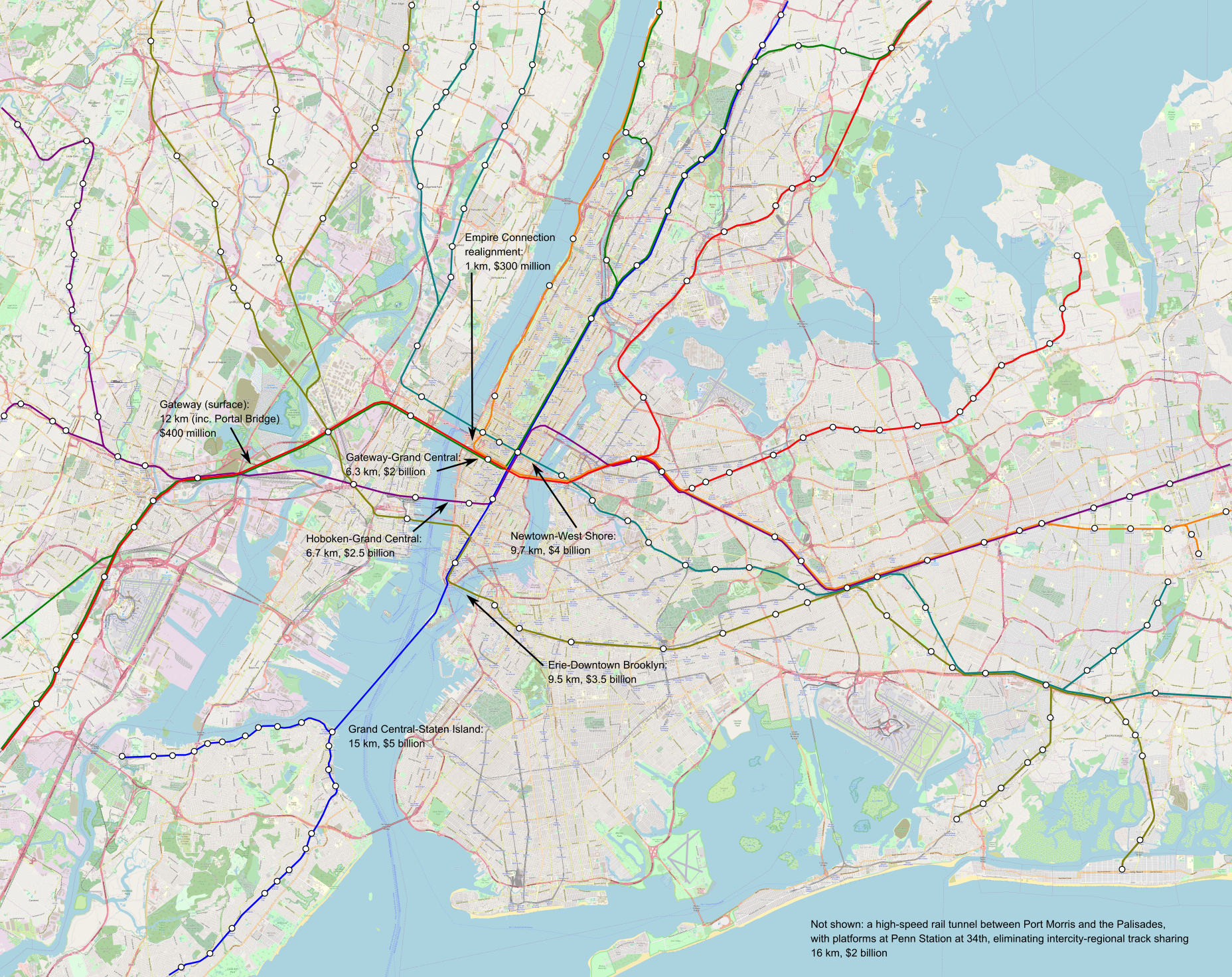
The issue is that too much traffic wants to use the Northeast Corridor lines in both New Jersey and Connecticut. Therefore, it’s not possible to segregate everything, with lines using the preexisting North River Tunnels and the new Gateway tunnels having to share tracks. It’s not optimal, but it’s what’s possible.
Can Ridership Surges Disrupt Small, Frequent Driverless Metros?
A recent discussion about the Nuremberg U-Bahn got me thinking about the issue of transfers from infrequent to frequent vehicles and how they can disrupt service. The issue is that driverless metros like Nuremberg’s rely on very high frequency on relatively small vehicles in order to maintain adequate capacity; Nuremberg has the lowest U-Bahn construction costs in Germany, and Italian cities with even smaller vehicles use the combination of short stations and very high frequency to reduce costs even further. However, all of this assumes that passengers arrive at the station evenly; an uneven surge could in theory overwhelm the system. The topic of the forum discussion was precisely this, but it left me unconvinced that such surges could be real on a driverless urban metro (as opposed to a landside airport people mover). The upshot is that there should not be obstacles to pushing the Nuremberg U-Bahn and other driverless metros to their limit on frequency and capacity, which at this point means 85-second headways as on the driverless Parisian lines.
What is the issue with infrequent-to-frequent transfers?
Whenever there is a transfer from a large, infrequent vehicle to a small, frequent one, passengers overwhelm systems that are designed around a continuous arrival rate rather than surges. Real-world examples include all of the following:
- Transfers from the New Jersey Transit commuter trains at the Newark Airport station to the AirTrain.
- Transfers from OuiGo TGVs at Marne-la-Vallée to the RER.
- In 2009, transfers from intercity CR trains at Shanghai Station to the metro.
In the last two cases, the system that is being overwhelmed is not the trains themselves, which are very long. Rather, what’s being overwhelmed is the ticket vending machines: in Shanghai the TVMs frequently broke, and with only one of three machines at the station entrance in operation, there was a 20-minute queue. A similar queue was observed at Marne-la-Vallée. Locals have reusable farecards, but non-locals would not, overwhelming the TVM.
In the first case, I think the vehicles themselves are somewhat overwhelmed on the first train that the commuter train connects to, but that is not the primary system capacity issue either. Rather, the queues at the faregates between the two systems can get long (a few minutes, never 20 minutes).
In contrast, I have never seen the transfer from the TGV to the Métro break the system at Gare de Lyon. The TGV may be unloading 1,000 passengers at once, but it takes longer for all of them to disembark than the headway between Métro trains; I’ve observed the last stragglers take 10 minutes to clear a TGV Duplex in Paris, and between that, long walking paths from the train to the Métro platforms, and multiple entrances, the TGV cannot meaningfully be a surge. Nor have I seen an airplane overwhelm a frequent train, for essentially the same reason.
What about school trips?
The forum discussion brings up two surges that limit the capacity of the Nuremberg U-Bahn: the airport, and school trips. The airport can be directly dispensed with – individual planes don’t do this at airside people movers, and don’t even do this at low-capacity landside people movers like the JFK and Newark AirTrains. But school trips are a more intriguing possibility.
What is true is that school trips routinely overwhelm buses. Students quickly learn to take the last bus that lets them make school on time: this is the morning and they don’t want to be there, so they optimize for how to stay in bed for just a little longer. Large directional commuter volumes can therefore lead to surges on buses: in Vancouver, UBC-bound buses routinely have passups in the morning rush hour, because classes start at coordinated times and everyone times themselves to the last bus that reaches campus on time.
However, the UBC passups come from a combination of factors, none of which is relevant to Nuremberg:
- They’re on buses. SkyTrain handles surges just fine.
- UBC is a large university campus tucked at the edge of the built-up area.
- UBC has modular courses, as is common at American universities, and coordinated class start and end times (on the hour three days a week, every 1.5 hours two days a week).
It is notable that Vancouver does not have any serious surges coming from school trips, even with trainsets that are shorter than those of Nuremberg (40 meters on the Canada Line and 68-80 meters on the Expo and Millennium lines, compared with 76 meters). Schools are usually sited to draw students from multiple directions, and are usually not large enough to drive much train crowding on their own. A list on Wikipedia has the number of students per Gymnasium, and they’re typically high three figures with one at 1,167, none of which is enough to overwhelm a driverless 76 meter long train. Notably, school trips do not overwhelm the New York City Subway; New York City Subway rolling stock ranges from 150 to 180 meters long rather than 76 as in Nuremberg, but then the specialized high schools go as far up as 5,800 students, and one has 3,000 and is awkwardly located in the North Bronx.
Indeed, neither Vancouver nor New York schedules its trains based on whether school is in session. Both run additional buses on school days to avoid school surges, but SkyTrain and the subway do not run additional vehicles, and in both formal planning and informal railfan lore about crowding, school trips are not considered important. So school surges are absolutely real on buses, and university surges are real everywhere, but not enough to overwhelm trains. Nuremberg should not consider itself special on this regard, and can plan its U-Bahn systems as if it does not have special surges and passengers do arrive continuously at stations.
The Hamburg-Hanover High-Speed Line
A new high-speed line (NBS) between Hamburg and Hanover has received the approval of the government, and will go up for a Bundestag vote shortly. The line has been proposed and planned in various forms since the 1990s, the older Y-Trasse plan including a branch to Bremen in a Y formation, but the current project omits Bremen. The idea of building this line is good and long overdue, but unfortunately everything about it, including the cost, the desired speed, and the main public concerns, betray incompetence, of the kind that gave up on building any infrastructure and is entirely reactive, much like in the United States.
The route, in some of the flattest land in Germany, is a largely straight new high-speed rail line. Going north from Hanover to Hamburg, it departs somewhat south of Celle, and rejoins the line just outside Hamburg’s city limits in Meckelfeld. The route appears to be 107 km of new mainline route, not including other connections adding a few kilometers, chiefly from Celle to the north. An interactive map can be found here; the map below is static, from Wikipedia, and the selected route is the pink one.

For about 110 km in easy topography, the projected cost is 6.7 billion € per a presentation from two weeks ago, which is about twice as high as the average cost of tunnel-free German NBSes so far. It is nearly as high as the cost of the Stuttgart-Ulm NBS, which is 51% in tunnel.
And despite the very high cost, the standards are rather low. The top speed is intended to be 250 km/h, not 300 km/h. The travel time savings is only 20 minutes: trip times are to be reduced from 79 minutes today to 59 minutes. Using a top speed of 250 km/h, the current capabilities of ICE 3/Velaro trains, and the existing top speeds of the approaches to Hamburg and Hanover, I’ve found that the nonstop trip time should be 46 minutes, which means the planned timetable padding is 28%. Timetable padding in Germany is so extensive that trains today could do Hamburg-Hanover in 63 minutes.
As a result, the project isn’t really sold as a Hamburg-Hanover high-speed line. Instead, the presentation above speaks of great trip time benefits to the intermediate towns with local stops, Soltau (population: 22,000) and Bergen (population: 17,000). More importantly, it talks about capacity, as the Hamburg-Hanover line is one of the busiest in Germany.
As a capacity reliever, a high-speed line is a sound decision, but then why is it scheduled with such lax timetabling? It’s not about fitting into a Takt with hourly trip times, first of all because if the top speed were 300 km/h and the padding were the 7% of Switzerland, the Netherlands, and Sweden then the trip time would be 45 minutes, and second of all because Hamburg is at the extremity of the country and therefore it’s not meaningfully an intercity knot that must be reached on the hour.
Worse, the line is built with the possibility of freight service. Normal service is designed to be passenger-only, but in case of disruptions on the classical line, the line is designed to be freight-ready. This is stupid: it’s much cheaper to invest in reliability than to build a dual-use high-speed passenger and freight line, and the one country in the world with both a solid high-speed rail network and high freight rail usage, China, doesn’t do this. (Italy builds its high-speed lines with freight-friendly standards and has high construction costs, even though its construction costs in general, e.g. for metro lines or electrification, are rather low.)
S-Bahn and RER Ridership is Urban
People in my comments and on social media are taking it for granted that investments into modernizing commuter rail predominantly benefit the suburbs. Against that, I’d like to point out how on the modern commuter rail systems I know best – the RER and the Berlin S-Bahn – ridership is predominantly urban. Whereas the typical American commuter rail use case is a suburban resident commuting to a central business district job at rush hour, the typical use case on the commuter trains here is an urban resident going to work or a social outing in or near city center. Suburban ridership is strong by American standards, benefiting from being able to piggyback on the high frequency and levels of physical investment produced by the urban ridership.
Here’s Berlin’s passenger traffic density on the U- and S-Bahn, as of 2016 (source, p. 6):

The busiest section of the S-Bahn is the Stadtbahn from Ostkreuz to Hauptbahnhof, with about 160,000 passengers per weekday through each interstation. The eastern sections of both the north and the south arms of the Ringbahn are close, with about 150,000 each, and the North-South Tunnel has 100,000. These traffic density levels extend into outer urban neighborhoods outside the ring – ridership on the Stadtbahn trunk remains high well into Lichtenberg – but by the time the trains cross city limits, ridership is rather low. All tails crossing city limits combined have 150,000 riders/day, so a little more than a quarter of the ridership density on the city center segments. Of those tails, the busiest, with a traffic density of 24,000/day, is to Potsdam, which is a suburb but is an independent job center rather than a pure commuter suburb like the rest of the towns in Brandenburg adjacent to Berlin.
I don’t have similar graphics for Paris, only a table of ridership on the SNCF-RER and Transilien by station and time of day and a separate table with annual ridership on the RATP-RER and Métro. But the results there are similar. Total boardings on the RATP-RER in 2019 was 399 million, of which 52 million originated in stations in the Grande Couronne, 186 million in the Petite Couronne, and 161 million in the city. If we double the Grande Couronne boardings, to account for the fact that just about all of those riders are going to the city or a Petite Couronne job center like La Défense, then we get just over a quarter of overall ridership, a similar result to the traffic density of Berlin. On the SNCF-RER, the share of the Grande Couronne is higher, around half.
The city stations include job centers and transfer points from mainline rail and the Métro – there aren’t 47 million people a year whose residential origin station is Gare du Nord – so it’s best to view the system as one used predominantly by Petite Couronne residents, with a handful using it as I did internally to the city and another handful commuting in from the Grand Couronne. This is technically suburban, but the Petite Couronne is best viewed as a ring of city neighborhoods that are not annexed to the city for sociopolitical reasons; the least dense of its three departments, Val-de-Marne, is denser than the densest German city, Munich.
The difference in this pattern with the United States is not hard to explain. Here and in Paris, commuter rail charges the same fares as the subway, runs every 5-10 minutes in urban neighborhoods (even less on the city center trunks), and makes stops at the rate of an express subway line. Of course urban residents use the trains, and we greatly outnumber suburbanites among people traveling to city center. It’s the United States that’s weird, with its suburb-only rail system stuck in the Mad Men era trying to stick with its market of Don Drapers and Pete Campbells.
One- and Two-Dimensional Rail Networks
As people on social media compare the German and American rail networks, I’m going to share two graphics from the upcoming Northeast Corridor report, made by Kara Fischer. They are schematic so it’s not possible to speak of scale, but the line widths and colors are the same in both; both depict only lines branded as Amtrak or ICE, so Berlin-Dresden, where the direct trains are branded IC or EuroCity, is not shown, and neither are long-range commuter lines even if they are longer than New Haven-Springfield.


The Northeastern United States has smaller population than that of Germany but not by much (74 million including Virginia compared with 84 million), on a similar land area. Their rail networks should be, to first order, comparable. Of course they aren’t – the map above shows just how much denser the German rail network is than the American one, not to mention faster. But the map also shows something deeper about rail planning in these two places: Germany is two-dimensional, whereas the Northeastern US is one-dimensional. It’s not just that the graph of the Northeastern rail network is acyclic today, excluding once-a-day night trains. More investment in intercity rail would produce cycles in the Northeastern network, through a Boston-Albany line for one. But the cycles would be peripheral to the network, since Boston, New York, Philadelphia, and Washington are collinear on the Northeast Corridor, and the smallest of these four metro areas, Philadelphia, is larger than all those on the branches depicted above, combined.
The most important effect on network planning is that it turns the Northeast Corridor into easy mode. We would not be able to come up with a coherent timetable for Germany on the budget that our program at Marron had. In the Northeast, we did, because it’s a single line, the main difficulty being overtakes of commuter trains that run along subsections.
This, in turn, has two different implications, one for each place.
The one-dimensionality of the Northeast
In the Northeast, the focus has to be on compatibility between intercity and commuter trains. Total segregation of tracks requires infrastructure projects that shouldn’t make the top 50 priorities in the Northeast, especially at the throats of Penn Station, South Station, and Washington Union Station. Total segregation of tracks not counting those throats requires projects that are probably in the top 50 but not top 20. Instead, it’s obligatory to plan everything as a single system, with all of the following features:
- Timed overtakes, with infrastructure planning integrated into timetable design so that the places with overtakes, and only the places with overtakes, get extra tracks as necessary.
- Simpler commuter rail timetabling, so that the overtakes can be made consistent, and so that trains can substitute for each other as much as possible in case of train delays or cancellation.
- Higher-performance commuter rail rolling stock, to reduce the speed difference between commuter and intercity trains; the trains in question are completely routine in German regional service, where they cost about as much as unpowered coaches do in the United States, but they are alien to the American planning world, which does not attend InnoTrans, does not know how to write an RFP that European vendors will respect, and does not know what the capabilities of the technology are.
- Branch pruning on commuter rail, which comes at a cost for some potential through-running pairs – trains from New Jersey, if they run through to points east of Penn Station, should be going to the New Haven Line and Port Washington Branch, and probably not to Jamaica; Newark-Jamaica service is desirable, but it would force dependency between the LIRR and intercity trains, which may lead to too many delays.
In effect, even an intercity rail investment plan would be mostly commuter rail by spending. The projects mentioned in this post are, by spending, almost half commuter rail, but they come on top of projects that are already funded that are commuter rail-centric, of which the biggest is the Hudson Tunnel Project of the Gateway Program. This is unavoidable, given the amount of right-of-way sharing between intercity trains and the busiest commuter rail lines in the United States. The same one-dimensionality that makes intercity rail planning easier also means that commuter rail must use the same non-redundant infrastructure that intercity rail does, especially around Penn Station.
The two-dimensionality of Germany
A two-dimensional network cannot hope to put all of the major cities on one line, by definition. Germany’s largest metro areas are not at all collinear. In theory, the Rhine-Ruhr, Frankfurt, Stuttgart, and Munich are collinear. In practice, not only does this still exclude Berlin and Hamburg, which is not at all like how Northeastern US collinearity works, but also the Rhine-Ruhr is a two-dimensional polycentric region, and Frankfurt is a terminal station oriented in such a way that a Stuttgart 21-style through-running project would allow for through-service from Stuttgart or from Cologne to points east but not from Stuttgart to Cologne. There’s also a tail of regions in the 1-1.5 million population range – Leipzig, Dresden, Nuremberg, Hanover, Karlsruhe – that are collectively larger than the largest single-core region (Berlin), even if they’re still smaller collectively than the eight-core Rhine-Ruhr region. The highest-demand link, Frankfurt-Mannheim, is a bottleneck between many city pairs, and is not at all dominant over other links in frequency or demand.
This makes for a network that is, by necessity, atypically complex. Train delays between Frankfurt and Mannheim can cascade as far as Berlin and Hamburg. There are timed connections, timed overtakes of slower regional trains on shared links (more or less everything in yellow on the map), and bypasses around terminal stations including Frankfurt and Leipzig as well as around Cologne, which is a through-station oriented east-west permitting through-service from Belgium and Aachen to the rest of Germany but not between Frankfurt and Dusseldorf.
Not for nothing, Deutsche Bahn has not really been able to make all of this work. The timetable padding is around 25%, compared with 10-13% on the TGV, and even so, delays are common and the padding is evidently not enough to recover from them.
The solution has to be reducing the extent of track sharing. The yellow lines on the map should not be yellow; they should be red, with dedicated passenger-only service, turning Germany into a smaller version of China. The current paradigm pretends Germany can be a larger version of Switzerland instead. But Switzerland builds tunnels galore to go around strategic bottlenecks, and even then makes severe compromises on train speeds – the average speeds between Zurich, Basel, and Bern are around 100 km/h, which works for a country the size of Switzerland but not for one the size of Germany, in which even the current 130-150 km/h average speeds are enough to get rail advocates to never take any other mode but not enough to get other people to switch.
In effect, the speed vs. reliability tradeoff that German rail advocates think in terms of is fictional. The two-dimensionality of Germany means that the only way to run reliably is not to have high frequency of both fast and slow trains on the same tracks between Berlin and Halle, between Munich and Ingolstadt, between Hanover and Hamburg, etc. Eliminating the regional trains is a nonstarter, so this means the intercity trains need to go on passenger-dedicated tracks.
In contrast, careful timetabling of intercity and regional trains on the same line has limited value in Germany. The regional trains in question have low ridership – the core of German commuter rail is S-Bahn systems that run in dedicated city center tunnels and have limited track sharing with the rest of the network, much less with the ICEs. If there’s high regional traffic on a particular link, it comes from combining hourly trains on many origin-destination pairs, in which case trains cannot possibly substitute for one another during traffic disturbances, and timetabling with low padding is unlikely to work.
Like Takt-based planning for Americans, building a separate intercity rail network for Germans comes off as weird and foreign. France and Southern Europe do it, and Germans look down on France and Southern Europe almost to the same extent that Americans look down on Europe. But it’s the only path forward. If anything, this combination of speed with reliability means that completing an all-high-speed connection on a major trunk line, like Berlin-Munich or Cologne-Munich, would permit cutting the timetable padding to more reasonable levels, which would save time on top of what is saved by the higher top speed. Germany could have TGV average speeds as part of this system, if it realized that these average speeds are both necessary and useful for passengers.
Mass Transit on Orbital Boulevards
Herbert in comments has been asking me about urban rail on ring roads; Nuremberg has such a road with an active debate about what to do with it. Ring roads are attractive targets for urban rail, since they tend to be wide commercial throughfares. The one in Nuremberg is especially attractive for a tramway, or possibly a medium-capacity metro if one can be built cheaply; this is an artifact of its circumference (18 km) and the city’s size, reminiscent of the Boulevards of the Marshals hosting Paris Tramway Line 3, and the Cologne Gürtel, most of whose length has a tramway as well. Significantly closer-in ring roads, often delineating the medieval or Early Modern walls, are too small for this.

The history of such rings tends to be that they were built based on the extent of the industrial city. Cologne’s was built in the 19th century to connect growing bedroom communities to one another, where they previously only extended along the radial boulevards connecting them to the historic center. The Boulevards of the Marshals delineated the inner end of the Thiers wall from the 1840s; the Périphérique motorway is where the outer end had been. The upshot is that the construction standards are rather modern – for one, the roads are wide. Another upshot is that those roads are often destinations in and of themselves, so that radial rail lines have stops at them; the Métro has stops at every intersection with the Boulevards of the Marshals, generally named after the nearby gate (for example, I lived near Porte de Vincennes, due east along Métro Line 1).
This contrasts with older rings, including one visible on the screenshot above. Those older rings come from premodern city walls, and may not always have enough width to make it easy to build two tram lanes in the center or to do cheap cut-and-cover without disturbing the residences and businesses too much. Even when they do, they’re so close to the center the time savings from a ring at that radius are moderate. Jarrett Walker has long pointed out that people don’t travel in circles, giving the example of the Vienna Ring Road, which has two U-Bahn lines on different sections of it but no continuous ring, as a 5.3 km circle is too small to have viable long relatively linear sections. In Paris, old boulevards closer in than the ring forming Métro Lines 2 and 6 generally have Métro stops but it’s inconsistent, and there’s no coherent circular route to be built.
The modal question – tram or metro – is complicated by special elements of orbital boulevards, which sometimes cancel out, and can work differently in different cities.
In favor of light rail, there’s the issue of speed. Normally, the advantage of subways over tramways is that they’re faster. However, on a circumferential route, the importance of speed is reduced, since people are likely to only travel a relatively short arc, connecting between different radials or from a radial to an off-radial destination. What are more important than speed on such a route are easy transfers and high frequency. Easy transfers could go either way: if the radial routes are underground then it may be possible to construct underground interchanges with short walking, but it isn’t guaranteed, and if there are any difficulties, it’s better to keep it on the surface to shorten the walk time. This has in general been an argument used by pro-tram, anti-subway advocates in Germany, but on routes that rely on multiple transfers, potentially three-legged trips, it is a stronger argument than on a radial line from a suburban housing project to city center.
Frequency is especially delicate. It can be high regardless of mode. Driverless metros can reach 90-second headways or even less, but those are achieved on very busy lines, which need that frequency for throughput more than anything, like Lines 1 and 14 in Paris with their 85-second peak headways. In practice, an orbital tram, especially one in a smaller city than Paris, needs to be prioritizing frequency in order to shorten the trip, not to provide very high throughput, which means that the vehicles could be made smaller than full-size metros, to support frequency in the 3-6 minute range. This could be done at-grade with light rail, or underground with very small-profile metros akin to those used in small Italian cities like Brescia, or even some larger ones like Turin.
In favor of metro, there is the cost issue. The same factors that make speed less important and frequency more important also make it easier to build a metro. If the road is wide enough, which I think the one in Nuremberg is, then cut-and-cover is more feasible, reducing costs. The low required capacity permits intermediate-capacity metros (again, as in Brescia or some smaller French cities), with stations of perhaps 40-50 meters, reducing their construction costs. Nuremberg in particular has had some very low U-Bahn construction costs, so its ability to build an orbital U-Bahn should not be discounted. That said, even at Nuremberg costs – around $100 million/km in 2023 PPPs for U3 extensions – the extra speed provided by such a line, say half an hour to do a full orbit compared with a little less than an hour on a tram, may not be worth it necessarily, whereas such a speedup on a line that passengers may ride for 10 km unlinked would be extremely beneficial.
 Pedestrian Observations
